Showing posts with label Garhi Shahu. Show all posts

Monday, May 30, 2011

PAKISTAN: A year on from the Lahore attacks but Ahmedis still suffering

AHRC Logo
Opinion / Columns
PAKISTAN: A year on from the Lahore attacks but Ahmedis still suffering

FOR PUBLICATION
AHRC-ETC-017-2011
May 30, 2011

An article by Nasim Malik published by the Asian Human Rights Commission

PAKISTAN: A year on from the Lahore attacks but Ahmedis still suffering


A day of ghastly sight of gristly, gruesome bloodshed of Ahmadis in Lahore Pakistan

A year after the terrifying horrendous massacre of 86 Ahmadis of the Ahmadiyya Muslim Community in Lahore, Pakistan the world remains deeply in shock, appalled by that act of religious terrorism, cold bloodedly covered up by the government of Pakistan.

The 86 murdered were part of a Friday worship service in Darul Zikr mosque in Lahore and Baitul Noor mosque in Model, Town, Lahore. During the course of this carnage nearly 150 people were seriously injured.

The very next day the security forces arrested 6 terrorists who confessed that they had carried out the attack on the Darul Zikr mosque but no action to this day has been taken against anyone. Both the mosques are in close proximity of police stations who could clearly hear the gun shots and blasts but they did not show up on site until the terrorists had exhausted all their ammunition stock. Even on arrival the police did not allow the emergency services to enter the mosque which could have saved many innocent lives of worshippers.

The families of the victims of this carnage received no support or assistance from the government whatsoever and the widows and the orphans are left to suffer and fend for themselves.

The government of Pakistan usurped the fundamental basic human rights, rights of religious freedom of Ahmadis in Pakistan by declaring them non-Muslims in 1974. This was perpetuated by the infamous Ordinance XX promulgated by General Zia ul Haq under which Ahmadi Muslims can be sentenced to death or imprisoned for practising the Islamic faith or using the Islamic scriptures or epithets.

Over 200 Ahmadi Muslims have been murdered in Pakistan for following their faith since 1974 and several hundred prosecuted and imprisoned under the infamous Blasphemy laws.

Pakistan today is infected with Islamists persisting in their hard-line interpretation of Islam based on force and violence to promote their objectives and promote terrorist activities resulting in frightful loss of innocent lives on a daily basis.

The federal government has taken no effective bold step to curb and eliminate the activities of extremists who are continuing to erode the very values on which Pakistan was established.

The political parties in Pakistan too have shown no indication to confront the religious bigotry, extremism and violence which has shattered the social and economic fabric of the society.

Pakistan is a signatory to the UN Human Rights Charter and its ancillary declarations but is attitude and treatment of minorities particularly Ahmadis is deplorable.

Ahmadis now well established in 198 countries of the world have earned a worldwide reputation of being a very tolerant law abiding and peace loving community. They have been treated horribly, unjustly and discriminately to the extent they cannot even vote but they have never protested or acted against the state of Pakistan.

Ahmadi generals shed their blood in the Pakistan wars to protect its integrity and today the government of Pakistan is not showing the slightest regard for the rights, safety and security of Ahmadis in Pakistan.

The 28 May 2010 massacre gives an undeniable slur of cruelty and atrocity upon Pakistan and its continued injustice and violation of the fundamental rights of Ahmadis will not go in vain. It is time that the government of Pakistan sanely attends to its obligations towards all its subjects without discrimination to save itself from a path of destruction on which it is treading. It is now high time for the government of Pakistan to act.

——————
The views shared in this article do not necessarily reflect those of the AHRC, and the AHRC takes no responsibility for them.

About the Author:
Mr. Nasim Malik was a Swedish Socialdemocrat politician and was elected as a reserve member of the Swedish Parliament and President of the International Wing of the Socialdemocrats Kalmar. He can be reached at nasim.malik@kalmar.se


Saturday, May 28, 2011

Ghari Shahu attacks anniversary: 88 Ahmadis killed. 1 year on. 0 justice.

Express Tribune, Pakistan
Pakistan
Ghari Shahu attacks anniversary: 88 Ahmadis killed. 1 year on. 0 justice.
By Rana Tanveer
Published: May 28, 2011
A policeman stands guard inside the compound of an Ahmadi worship place, May 30, 2010. PHOTO: REUTERS/FILE
LAHORE: As grieved Ahmadi families prepare to mark the first anniversary of the deadliest attack on their community in Pakistan’s history, investigations stand still.

On Friday, May 28, 2010, over 88 people were killed in twin gun-and-bomb attacks at Ahmadi places of worship in the Garhi Shahu and Model Town areas in Lahore. Investigations were launched and arrests were made but little has come out of the investigations.

According to police, a charge-sheet against the accused was prepared after investigations and has been submitted before an anti-terrorism court in Lahore. “The remaining attackers were killed in the operation and no other attackers or facilitators have been identified,” Civil Lines Superintendent of Police (Investigations) Captain (retd) Liaquat Ali Malik told The Express Tribune. “Police responded effectively and killed all of the attackers.”

But many members of the Ahmadiyya community believe that the police response was sluggish.

In its annual report released in January, the London-based Ahmadiyya Jama’at said that police took a long time to arrive in numbers and the delayed response led to more casualties due to lack of medical assistance for the injured. “There was inadequate supervision of the police operation. The contingent present at Garhi Shahu received no orders to mount a prompt counter-attack,” the report says.

Ahmadiyya Jama’at Pakistan spokesperson Saleemuddin says that the police has made scant progress in investigations. “The two attackers against whom a charge-sheet was prepared were tackled by worshippers themselves in Model Town. The police has neither identified any other attacker nor has it taken the matter seriously,” he said.

Ahmadis have many fears over their protection in the country. According to the Ahmadiyya Jama’at, 99 members of the community were killed in 2010. The number is confirmed by the Human Rights Commission of Pakistan (HRCP) in its State of Human Rights 2010 report. The HRCP adds that 64 Ahmadis were charged with blasphemy that year.

The Lahore attacks, according to Ahmadiyya Jama’at, were not a big surprise as the provincial government had been forewarned by various sources about the likelihood of such an attack.

Even after the attack, no special measures were taken to secure Ahmadi places of worship. In September 2010, a suicide bomber blew himself up at the entrance of a worship place in Mardan, Khyber-Pakhtunkhwa, where worshippers were offering Friday prayers.

The Ahmadi population, estimated to be around four million, has been marginalised since Pakistan’s parliament declared Ahmadis non-Muslims in 1974. Ten years later, in 1984, then president General Ziaul Haq enacted an ordinance forbidding Ahmadis from calling themselves Muslims and refer to their places of worship as mosques. Under the law, Ahmadis can serve up to three years in prison for “posing as Muslims”.

Saleemuddin believes that the silence over the plight of Ahmadis could lead to more such attacks. “If anti-Ahmadi laws are not repealed, their lives in Pakistan [will continue to] remain in danger,” he says.

Published in The Express Tribune, May 28th, 2011.

Thursday, November 18, 2010

Serious problems in Pak on religious freedom: US

November 18, 2010
Serious problems in Pak on religious freedom: US
Updated on Thursday, November 18, 2010, 10:04

Ahmadiyya Mosque, LahoreWashington: Noting that serious problems remain in Pakistan with regard to religious freedom, the Obama administration has expressed its concern over the existence of laws that are “discriminatory” against religious minorities.

“There have been attacks against Christians, against the Ahmadis. There’s still discriminatory laws on the books, blasphemy laws, anti-Ahmadi laws.”

“We’re raising these issues with the government of Pakistan,” Assistant Secretary of State for Democracy, Human Rights and Labour, Michael Posner, said.

Posner was responding to questions after the release of the annual State Department Report on Global Religious Freedom by Secretary of State Hillary Clinton.

“The (Pak) government is taking steps. It’s a very tense situation now, and there are tensions within the society. So it’s a mixed picture, honestly.”

“We give the government credit for steps it has taken, but also recognise that more needs to be done. And it’s part of our diplomacy with them,” Posner said in response to a question.

One of the things this report does is identify, in Pakistan and elsewhere, government actions that contribute to the problem, he said.

The annual State Department Report said despite the government’s steps to protect religious minorities, the number and severity of reported high-profile cases against minorities increased during the reporting period.

“Organised violence against minorities increased; for example, there was violence against Christians in Gojra, Punjab, and a terrorist attack on Ahmadis in Lahore, Punjab.”

“There were instances in which law enforcement personnel abused religious minorities in custody,” it said.

Security forces and other government agencies did not adequately prevent or address societal abuse against minorities.

Discriminatory legislation and the government’s failure or delay in addressing religious hostility by societal actors fostered religious intolerance, acts of violence, and intimidation against religious minorities, it said.

“Specific laws that discriminated against religious minorities included the anti-Ahmadi provisions of the penal code and the blasphemy laws which provided the death penalty for defiling Islam or its prophets,” said the report.

The Ahmadiyya community continued to face governmental and societal discrimination and legal bars to the practice of its religious beliefs. Members of other Islamic sects, Christians, Sikhs, and Hindus also reported governmental and societal discrimination, it said.

Noting that relations between religious communities remained tense, the State Department Report said societal discrimination against religious minorities was widespread, and societal violence against such groups occurred.

Non-governmental actors, including terrorist and extremist groups and individuals, targeted religious congregations, it said, adding that a domestic insurgency led by religious militants increased acts of violence and intimidation against religious minorities and exacerbated existing sectarian tensions.

“Extremists target violence against Muslims advocating for tolerance and pluralism, including followers of Sufism,” the report said.

During the reporting period, US embassy officials closely monitored the treatment of religious minorities, worked to eliminate the teaching of religious intolerance, and encouraged the amendment or repeal of the blasphemy laws, it added.

PTI

Saturday, September 25, 2010

After the attack: a victim of the Lahore attack remembers

Express Tribune, Pakistan
Blogs
After the attack: a victim of the Lahore attack remembers
Sonya Rehmanby Sonya Rehman
A graduate from the Columbia University Graduate School of Journalism who works as a freelance journalist for The Express Tribune and various publications in Lahore.
Saturday, 25 September 2010
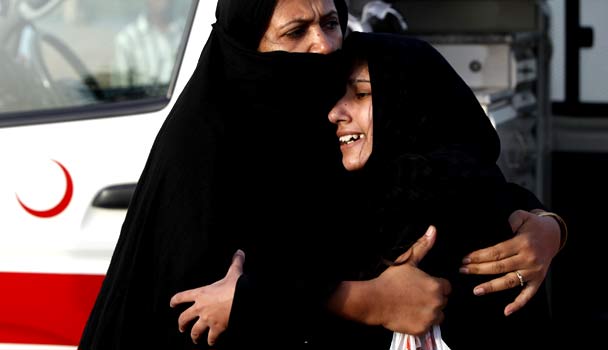
Women mourn the loss of relatives after the attack on May 28 PHOTO: REUTERS
You read stories of violence and atrocities committed on faceless Pakistanis in your local newspapers on a daily basis. You absorb the news as detached consumers. Empathy and even hints of grief might stir your heart while reading a poignant story every once in a while, but try as you might, you will never be able to relate to the victims and those directly involved – because you were never there. It didn’t happen to you or, anyone you know. And for that, you’re almost relieved. Yet guiltily so.

But what would happen, if one day, you or your loved ones were victims of a cruel, intolerant act of violence? And what if, someone you knew and loved deeply was taken away from you, within a mere few agonising hours?

What then? How would you survive the horror?

Settled abroad with her husband, Irum received a phone call from her distraught sibling. It was the 28 day of May – this year – a Friday. Back home in Pakistan, it was 2:30pm. Two Ahmadi places of worship in Lahore were under siege by terrorists, and Irum’s father was in one of them – Darul Zikar, a place that Irum for many years, used to frequent with her family on Friday for prayers, and over Eid, as a young girl.

Prior to her sibling’s phone call, “Abu” had called Irum’s mother and told his wife that he was injured. He’d been shot in his left foot. After telling his wife to remain calm, Irum’s mother heard a series of gun shots. Then, the line went dead.

Abroad, Irum watched the television in horror – live visuals of the attack were being shown on the BBC. Three hours later, after the attack was over, Irum’s father could not be found. Family members searched hospitals, but to no avail.

Hours later at 10:00pm, Irum’s father had been located. His body was found at a local hospital. “I was half expecting it since there had been no news,” Irum said, “But when my brother-in-law called me, I fell to the floor and wept. God knows how many hours I wept for.”

Irum immediately left for Pakistan. The journey home was wretched.“For many nights which followed, I had haunting nightmares that I was in there too, and that a bullet had hit my leg,” she stated, “A few times I dreamt that I was in there and that I had covered my father and the bullet had hit my back instead of his foot, and that he was safe.”

In the days, weeks and months that have followed after the incident, Irum and her family, in their grief, gain strength from the fact that along with them, eighty-five other families suffer the loss of their loved ones. It is in this grief that they have sought some resilience and patience to endure their personal tragedy.

“After my father’s death,” Irum said, “My first reaction was that I didn’t want to live here anymore. Lahore has always been my favourite place in the world. But now it has become a place where my father was brutally killed. And no one came to help. Imagine how the mother of those two brothers killed in Sialkot must be feeling about her city and her fellow citizens. That’s how I feel. No one helped; they all gathered around their TV sets and watched the show – just like the mob in Sialkot.”

After speaking with an uncle, who was in Darul Zikr at the time of the attack, Irum informed me that there were five to six terrorists in the building. “They first burned the cars outside,” she said, “Then they came inside, opening fire on anyone in sight. One guy climbed up on the minaret and remained there till the end – he would shoot anyone he saw below in the courtyard.”

In the hall where her father was, two men broke in, spraying bullets. Then, one of them went to the hall on the first floor and started throwing hand-grenades from above, into the hall below. At one point, one of the attacker’s placed a grenade at the feet of an old man. “He was sitting on a chair,” Irum said, “My uncle watched from a distance as the grenade went off.”

“This entire incident has scarred us badly,” Irum stated. “Three Ahmadis have been killed since the attack on the May 28. One in Narowal, and two in Sindh. So you can imagine how unsafe we feel.”

After the tragedy, Irum and her family have begun to follow strict safety measures. “There are many Ahmadis in Lahore who are getting threatening phone calls and their homes have been marked with red ink as targets,” she said, “Basically every Ahmadi in Pakistan is practicing his/her faith under the dark shadow of terror, at the risk of their lives…but we’re holding on.”

Sunday, July 18, 2010

Opinion: How can Pakistan turn over a new leaf?

Global Post, USA
Opinion
Home / Worldview
--
Opinion: How can Pakistan turn over a new leaf?
The only chance to cleanse the state is to return to a secular identity.
Sonya Fatah


By Sonya Fatah — Special to GlobalPost
Published: July 18, 2010 10:35 ET in Worldview

--
Wazir Khan Mosque, Lahore
Pigeons fly over the Wazir Khan Mosque in the walled city of Old Lahore on July 9, 2010 in Pakistan. (Daniel Berehulak/Getty Images)

NEW DELHI, India — It isn’t a topic that’s making headlines in Pakistan. But it’s a debate that’s been raised countless times since the country’s birth in August 1947: Should Pakistan be secular?

Dogged by internal crises, the rise of a growing intolerant extremist segment and a deliberately apathetic state and military response, Pakistan’s future seems bleak.

Imagine a reinvention. Get rid of the “Islamic” part of the Islamic Republic of Pakistan. Shred all copies and records of the 1973 constitution and repeal a series of self-serving amendments to the constitution as well as bigoted anti-minority and anti-women laws. What you may be left with is the skeleton for a secular democracy.

A spate of recent terror attacks suggests this might be Pakistan’s only way of battling its inner demons. On May 28, armed militants attacked two mosques of the Ahmadiya community in Lahore. Ninety-seven people died and dozens were wounded.

Then on July 1 there were twin suicide attacks on Data Darbar also in Lahore, one of the largest and most visited Sufi shrines in Pakistan. The attack on the shrine was extraordinarily bold because it was an attack on Pakistan’s majority of Sunni barelvi believers. Some 43 people died.

In Faisalabad, on July 2, two Christian brothers were arrested for violating the Blasphemy Law. They’ve been accused of writing a pamphlet with derogatory comments about Prophet Muhammad. [Both of them were killed on 19th by an unknown gunmen in fron of City Court, while in Police custody.] In Waris Pura, a locality of some 100,000 Christians, Muslim mobs have been threatening to burn homes and kill Christians if both brothers are not executed.

The simple fact is that the state has, especially over the last 40 years, allowed for the persecution of its minorities. It has rewarded its majority to discriminate against them.

Sound harsh? A little exaggerated? Here are the facts.

Lets start with the Ahmadiyas. In 1974, under the supposedly liberal leadership of Zulfiqar Ali Bhutto, parliament passed a law declaring Ahmadiyas non-Muslims. This was a reward to the Jamaat-e-Islami party in Pakistan for spreading virulent anti-Ahmadiya hate speech and demanding their removal from the esteemed list of Pakistan-approved Muslim identities.

As if that wasn’t enough, Pakistan’s favorite general, General Zia ul Haq — whose arched eyebrows would have given Jack Nicholson some sleepless nights — presided over Ordinance XX in 1984. The ordinance spelt out the following: Ahmadiyas were not allowed to call themselves Muslims, to pray in regular mosques, to read out Quranic verses, or to “pose as Muslims.”

Move now to Faisalabad where street protests against two Christian brothers are mounting. No one has witnessed the brothers writing the pamphlet. As members of a tiny minority they’re unlikely to have wanted to defile anything Muslim in public or in private.

But the problem for Rashid and Sajid Emmanuel is something called the Blasphemy Law. Another gift of Zia ul Haq, the 1986 law carries the penalty of death for anyone who desecrates the Quran or defiles the name of Prophet Muhammad.

Many dubious claims invoking blasphemy have been made against innocent Muslims, Hindus and Christians alike since the law was first passed. Surrounded by a volatile public whose religious sensitivity is beyond reason, the accused often gets his or her death sentence before the matter even reaches the court.

Pakistan has always struggled to define itself. In the absence of a concrete identity, Islam has been used and manipulated for political ends. In 1958 the official tag of “Islamic” Republic was added to its name.

Pakistan’s founder, the barrister Mohammad Ali Jinnah, had no such plan for Pakistan. On Aug. 11, 1947, when addressing the first constituent assembly, he told Pakistanis, “You are free; you are free to go to your temples, you are free to go to your mosques or to any other place of worship in this State of Pakistan. You may belong to any religion or caste or creed — that has nothing to do with the business of the State.

“You will find that in course of time Hindus would cease to be Hindus and Muslims would cease to be Muslims, not in the religious sense, because that is the personal faith of each individual, but in the political sense as citizens of the State.”

That was not Jinnah’s singular speech on secularism.

Sadly, he died in 1948 and what has happened since then is a sad and dangerous tale.

As the 2010 report of the United States commission on International Religious Freedom puts it: “Religiously discriminatory legislation has fostered an atmosphere of intolerance” in Pakistan.

Over the years Pakistanis have watched as minority groups and women have been targeted. Yet with the exception of a few activist groups and human rights organizations, the majority of Pakistanis have maintained a condemnable silence.

The difference was palpable in national reactions to the two, separate attacks on religious communities in Lahore.

“This act of violence was unanimously — politicos, religiosos and all — vociferously ‘condemned’ and the country saw many protests, demos and city shut-downs,” Amina Gilani wrote, referring to the attacks on Data Darbar, in The Tribune, one of Pakistan’s English-language dailies. “A somewhat different reaction to the event of May 28 … The reaction of the majority — politicos, religiosos and all — was comparatively rather muted. It raised no suggestions for a national get-together.”

How does Pakistan turn over a new leaf? Pakistan’s only salvation to cleanse the state and its mindset is to return to a secular identity.

“[We] will need a revolution of the national mindset and a whole new constitution,” said Ardeshir Cowasjee, a longtime writer and editorialist. “[We] will also need a whole and entire new brand of politicians, or leaders of whatever type. We need to do away with ‘Islamic’ and with the Objectives Resolution before we can even begin to make progress — plus ditch quickly the Hadood Ordinances and the blasphemy laws and all Islamic provisions, which govern this country. So it has to be secularism all the way.”

That’s a lot of work for any country, more so for one in crisis.

Still there are forces moving in that direction. On Christmas Day last year, Haji Adeel, a major political leader of the Awami National Party and a Pakistani senator, advocated a return to secularism. Adeel found himself the target of a host of critics including the Islamic right. But he also found supporters, and set off debate in various circles about the idea.

Now that Saudi-style and Saudi-funded Wahhabi Islam has reached the popular shrine of Data Ganj Baksh, perhaps more Pakistanis will see that the anti-American, anti-Israeli and anti-colonialist body that defines itself as the Taliban, is also anti-them.

Still, even if secularism is Pakistan’s yellow brick road to saving itself, it’s going to take a lot more than changing the constitution and axing a few laws. This is a battle for changing mindsets, and Pakistanis are in it for the long haul.

Friday, July 16, 2010

CCTV footage of Garhi Shahu worship place attack obtained

Daily Dawn, Pakistan
Pakistan

CCTV footage of Garhi Shahu worship place attack obtained
Friday, 16 Jul, 2010

Seventy people were killed and more than 100 were wounded in the attack on the worship place in Garhi Shahu. - Photo by AP/File /
Seventy people were killed and more than 100 were wounded in the attack on the worship place in Garhi Shahu. — Photo by AP/File

LAHORE: DawnNews has obtained the CCTV footage of the May 28 terrorist attack on the Ahmedi worship place in Lahore’s Garhi Shahu area.

The footage was recorded from a camera placed outside “Darul Zikr”, the Ahmadi prayer house.

The footage shows two heavily-armed terrorists enter the place of worship at the time of prayers and shooting at worshippers.

People panicked as a result and the footage shows them running haphazardly to save their lives.

The terrorists took to different rooms in the prayer house and shot at people after which they entered the main hall and blew themselves up.

Seventy people were killed and more than 100 were wounded in the attack on the worship place in Garhi Shahu.

©2010 DAWN Media Group. All rights reserved

Thursday, July 8, 2010

Punjab govt’s inaction against militants irks GHQ

Daily Dawn, Pakistan
FROM THE PAPER »
FRONT PAGE

Punjab govt’s inaction against militants irks GHQ
   By Baqir Sajjad Syed
   Thursday, 08 Jul, 2010

At least 37 people were killed in an attack on Data Darbar shrine, Lahore. - AFP
At least 37 people were killed in an attack on Data Darbar shrine, Lahore. — AFP

ISLAMABAD: While public attention has been focused on the political barbs flying between Islamabad and Lahore, behind the scenes the Pakistan Muslim League-N has earned itself a new and very powerful adversary thanks to its inaction against the ‘Punjabi Taliban’ – the Pakistan Army.

It is now evident that the Punjab government led by the PML-N and the army, which is spearheading counter-terrorism operations, are on a warpath.

At a recent meeting at the General Headquarters (GHQ), senior intelligence officers conveyed their serious concern to the Punjab government over its failure to act against terrorists based in the province on the basis of information provided to it.

Other issues that were discussed included the lax handling of detained terrorists, especially of an injured assailant apprehended after the recent attack on Ahmadi places of worship (he was allowed to communicate with his accomplices from his hospital bed by a cellphone which allowed them to launch an attempt to free him).

Sources say that the meeting was attended by the top officials from both sides.

Nonetheless, officially both sides are denying any knowledge of this exchange. Punjab Government’s Public Relations Director-General Raoof Hassan said he was not aware of any such meeting since it did not appear on the official schedule. He also declined, in his capacity as one of Punjab government’s spokesmen, to assist in getting the comments of Chief Minister Shahbaz Sharif on the issue.

Long before the attack on Ahmadis, an alert was circulated by an intelligence agency warning that a group of militants led by previously little-known Qari Daud had been tasked by the banned Tehrik-i-Taliban Pakistan (TTP) leadership to attack the community in Punjab. However, the warning was not heeded.

It is said that warnings about an attack on Data Darbar were also ignored by the provincial authorities.

Besides citing specific instances, sources in the national security apparatus said it was particularly worrying that the PML-N government was in a state of total denial about the existence of the problem in the province which was in the militants’ line of fire.

This spat between the Punjab government and the army turned into a more serious war of words after a news report based on leaks by the provincial authorities surfaced.

The report said the army and intelligence agencies were not cooperating with the Punjab government in investigation into terrorist attacks.

Senior officers, who spoke on condition of anonymity, scoffed at the report. “Nowhere in the world do spies stand in the witness box and give testimony,” one of them said.

They also questioned why had the provincial government failed to crack down on militant bases identified by intelligence agencies, including the Bahawalpur seminary run by Maulana Masood Azhar of the banned Jaish-i-Muhammad.

“What has the Punjab government done to round up middle- and low-ranking activists and office-bearers of these outfits? Has it confiscated hate material churned out by them?” are other hard-hitting questions the officers are now raising.

“We have time and again told them to act against the Bahawalpur madressah where a number of militants are hiding. But they are not ready to do so,” one official said. He alleged that the Punjab government was sitting on the fence as far as sectarian-cum-militant organisations were concerned.

Earlier criticism by the federal government was ritually dismissed by the provincial leadership as political point-scoring.

A security analyst said militants always benefited from poor civilian intelligence; a politicised police force; and de-motivated, poorly trained and ill-equipped local law-enforcement paraphernalia in the province.

But now they had a new advantage – those in the provincial political leadership, bureaucracy and LEAs who are willing to turn a blind eye to their activities, he said.

Investigators said that most terrorist attacks in Punjab were linked to the TTP and Punjabi Taliban in contrast to claims by certain quarters that the so-called ‘foreign hand’ was involved in them.

The message from the terrorist groups perpetrating these attacks is that the government should negotiate with the militant organisations and stop its efforts to help the Afghan government reconcile with various warring factions, notably the Haqqani network.

Security officials said they felt encouraged by the federal government’s position of not entertaining any such demands.

However, they revealed that they were taken aback by PML-N chief Mian Nawaz Sharif’s recent media remarks articulating views similar to those of the Taliban and their sympathisers.

Recent media reports had quoted the Punjab home department as having planned action against 23 militant organisations working under new names.

But, the sources say, no notification has been issued to proscribe the outfits that have resurfaced under new names after having been outlawed.

Police officials say they now have new, specific orders to act against terrorist groups. The police, they say, are already working against ‘suspicious elements’.

©2010 DAWN Media Group. All rights reserved

Religious intolerance of Pakistan is a global threat

Duluth News Tribune, Canada
Religious intolerance of Pakistan is a global threat
On May 28, with memories of the despicable attempt of a Pakistani-American Muslim to kill scores of New Yorkers still fresh in our minds, Pakistani Muslim terrorists brutally killed 86 innocent people while they offered Friday prayers. The twin mosque attack was in Lahore, Pakistan. The two events took place on two opposite corners of the globe but shared a striking similarity.
By: Imran Hayee, Duluth News Tribune        July 08, 2010

On May 28, with memories of the despicable attempt of a Pakistani-American Muslim to kill scores of New Yorkers still fresh in our minds, Pakistani Muslim terrorists brutally killed 86 innocent people while they offered Friday prayers. The twin mosque attack was in Lahore, Pakistan.

The two events took place on two opposite corners of the globe but shared a striking similarity. In both events, the victims were non-Muslims, according to Pakistani law, and the terrorists belonged to the same Pakistani extremist organization, the Tehrik Taliban Pakistan.

Over the past few years, it has seemed that almost every terrorist act anywhere on the globe somehow has involved Pakistan. Why? Finding a clear answer may be a complex exercise, but the unyielding and state-sanctioned religious intolerance in Pakistan is the major contributing factor for this phenomenon.

Soon after its founding, Pakistan succumbed to the demands of religious extremists who started a concerted campaign to establish a puritanical fundamentalist state. The successive governments allowed this religious bigotry to flourish and distract the people from real issues of governance. Intolerance gradually crept into the fabric of Pakistani society. In 1974, the Pakistani government committed an unprecedented act of religious intolerance when it constitutionally defined who is a Muslim. In 1984, Ordinance XX and the subsequent anti-blasphemy laws institutionalized the persecution of minorities and religious dissidents with severe punishment and even death for those non-Muslims “impersonating” Muslims.

The unfounded but patronized religious intolerance of the Pakistani government has encouraged extremist clerics to define their own obscurantist version of Islam. Their version allows no tolerance for divergent views; killing any non-Muslim or heretic is their favorite slogan. Christians, Jews, Hindus and Buddhists are their obvious targets, but any Muslims who do not see the world through their eyes are not spared. Many extremist clerics spread this philosophy of hate and intolerance through their madrassas, or religious schools, by brainwashing innocent children and frustrated youth. The graduates of these madrassas are trained to do nothing but kill all who fall outside the realm of their narrow spectrum of life.

This kind of religious intolerance is bound to outgrow the geographical boundaries of Pakistan and few such waves already have occurred with the outpour exponentially increasing. Whether it be the World Trade Center bombing in New York, the shoe bomber’s foiled attempt to blow a U.S.-bound plane, the 7/7 subway attacks in London, the massive hotel and synagogue killings in Mumbai or the recent botched Times Square bombing attempt, each incident has its roots submerged in the philosophy of hatred and the religious intolerance of Pakistan.

If not reverted, this monster can perpetrate unparalleled damage to humanity and civilized culture throughout the world.

To protect against future acts of terrorism, America and the world must act now to pressure the government of Pakistan to uproot the seed of religious intolerance by repealing the anti-blasphemy laws and the current constitutional definition of Islam. Moreover, all madrassas which impart religious intolerance and hatred must be abolished. These madrassas could be nationalized by replacing hate-oriented elements of the intolerant religious education with traditional secular curriculum. This also will help provide jobs to many unemployed, educated, Pakistani youths who otherwise become vulnerable to the ploy of extremist clerics.

The suggested approach is not easy but necessary. Today, if this or a similarly effective approach is not deployed, then tomorrow, each radical madrassa in Pakistan will emerge as a fertile recruiting place for the militant extremists and terrorists, like al-Qaeda. I hope the world and America deal with this Pakistani religious intolerance before it is too late.

Imran Hayee of Duluth is an associate professor and the director of graduate studies in the electrical and computer engineering department at the University of Minnesota Duluth. He is UMD’s only Pakistani-American Muslim faculty member. He flew to Pakistan the day of the May 28 twin mosque terrorist attacks because his brother-in-law was among the 86 victims. He wrote this for the News Tribune upon his recent return.

Tuesday, July 6, 2010

Six terrorists in Ahmedi worship places’ attacks arrested: CCPO

Daily Times, Pakistan
Tuesday, July 06, 2010

Six terrorists in Ahmedi worship places’ attacks arrested: CCPO

LAHORE: The Lahore Police on Monday claimed to have arrested six terrorists involved in the attacks on the worship places of Ahmedis and recovered large quantities of explosives and weapons from their possession.

Addressing a press conference, Capital City Police Officer (CCPO) Lahore Muhammad Aslam Tareen said that the terrorists identified as Haroon Saeed, Rizwan, Umair, Umer, Javed Alam and Abbas were also involved in different terrorist activities, including the attacks at the Jinnah Hospital and Moon Market. He said that police had recovered 18,000 kgs of explosive material, six kalashnikovs, 21 grenades and 600 bullets, adding that terrorists Haroon Saeed and Rizwan had also been involved in insurgency activities in Afghanistan, while Umair and Umer were acting as facilitators and Javed Alam and Abbas were the owners of the houses where these terrorists were living. APP

Inquiry into attacks on Ahmedis pulls off vanishing act

Daily Times, Pakistan
Tuesday, July 06, 2010

Inquiry into attacks on Ahmedis pulls off vanishing act

*
CM had entrusted committee with determining factors that contributed to attacks
*
Ahmedi leader says compensation for victims was never given

By Afnan Khan

LAHORE: The inquiry that was ordered by Punjab Chief Minister Shahbaz Sharif to identify the security loopholes and the reasons behind the terrorist attacks on the worship places of Ahmedis has become long overdue and does not seem to be coming out of the works anytime soon.

According to the CM’s orders, the inquiry report was supposed to be filed within five days of the attacks, which left around 90 people dead and around 200 injured after terrorists stormed Ahmedi worship places at Model Town and Garhi Shahu on May 28. Rights activists and civil society members have accused the Punjab government for adopting a “neglectful and discriminatory behavior” towards the victims of the attacks.

The CM had set up a high-level inquiry committee, headed by Punjab Health Secretary Fawad Hassan Fawad and consisting of the provincial home secretary and inspector general of police.

The committee was given the task of discovering the factors that had contributed to the attacks. The issue has been put aside by the bureaucracy, as the inquiry report, which was due to be submitted before the CM by June 3, never surfaced and there is no government account on whether the negligence of government officials contributed to the loss of so many innocent lives.

A senior Ahmedi leader, requesting anonymity, told Daily Times that the community members were afraid and had felt exposed to danger a few days before the attack took place, adding that the minority group had made several requests to the government to provide them with Elite Force personnel to tackle any terror attacks, “but the government never listened to any of our demands and only provided a few guards who had no capacity to stand against such an attack”.

“But the thing that has further scared and confused the Ahmedis in the country is the fact that the government changed the station house officers of both the areas’ police stations a few days before the incident. Not only that, a magistrate visited the areas and removed all Ahmedi volunteers with weapons,” he said.

Missing compensation: He said that the compensation announced by the Punjab government was never given to those who had lost their loved ones and those who were severely injured in the attack. Munawar Ali, the spokesman for the minority group, told Daily Times that there were a number of discriminatory acts conducted by the Punjab government against the community, “which further increases the gravity of the tragedy”. He said that the terrorist had managed to kill so many people because of loopholes in security, “but the government downplayed the incident from the start”. He said the minority group was only allowed to depute a few volunteers inside the worship place, but they were not allowed to carry any firearms. None of the Punjab government officers, including government spokesman Pervaiz Rasheed and Senior Adviser to the CM Sardar Zulfiqar Khosa, commented on the issue. However, Fawad Hassan Fawad told Daily Times that he apologised for the inquiry not having been completed, adding that he could not complete it since he was busy with his own department’s issues. He said the inquiry should have been assigned to some other officer, “who would have worked on it”.

Sunday, July 4, 2010

Since the Second Amendment

Himal Southasia Magazine, Nepal
Since the Second Amendment    July 2010

By: Husain Naqi

The massacres at two Ahmadiyya mosques in Lahore is the result of anti-Ahmadi sentiment fanned by religious extremists and allowed by a compromised state and the silent support of political parties.

FlagThe 28 May mayhem at two Ahmadiyya mosques in Lahore brought into sharp focus the agenda of extremist Islamic groups against Pakistan’s religious minorities. It also exposed the political opportunism of the government, especially in Punjab province. The civil administration’s complacency, despite being tipped off about the entry of extremists aligned with the Tehreek-e-Taliban Pakistan (TTP) into the province, also lays bare its failure to deal sternly with easily identifiable perpetrators and their patrons amongst banned sectarian outfits. In late May, this complacency resulted in the loss of 94 lives and over a hundred injured.


Unfortunately, the twin attacks targeting this religious minority were not unexpected, but merely constitute the latest in a century of Ahmadi discrimination by mainstream Muslims. Ahmadis were declared to be ‘non-Muslim’ through a constitutional amendment in 1974, under Zulfikar Ali Bhutto – despite the fact that, at that time, Bhutto’s left-of-centre Pakistan People’s Party (PPP) enjoyed a two-thirds majority in the national legislature. Ahmadis continue to be derogatorily called Qadianis, after the name of the village in Gurdaspur District, in Punjab state, where the sect’s founder, Mirza Ghulam Ahmad, lived and established his creed’s headquarters in 1901.

The differences between Ahmadis and other Muslims lie in three main areas: prophethood, the crucifixion and resurrection of Jesus, and jihad. The main difference is with regard to the common Muslim belief that the Prophet Muhammad was the last among 124,000 prophets, that there would be no prophet after him, and that anyone claiming otherwise was an apostate whose punishment is death. Ahmadis, on the other hand, believe that Mirza Ghulam Ahmad was the promised messiah. Interestingly, Ahmad had once even described himself as Maseel-i-Krishna (in the likeness of Krishna). While Ahmadiyya communities can today be found in India, Bangladesh and Indonesia (as well as in Europe), the largest, of three million, is in Pakistan, which also has the distinction of being the first country to have officially declared Ahmadis to be non-Muslim.

In the first decade of the 20th century, Mirza Ghulam Ahmad began to be targeted and branded as an apostate by the Ahraris, an ultra-orthodox segment of Deobandi/Wahhabi Islam. The history of the Ahrari community too is important in understanding the matter of Ahmadiyya persecution. Initially, the Ahraris’ political views were nationalistic, and they briefly joined the Congress party; even after they separated, they remained close to the Congress. They were bitter opponents of the Pakistani establishment, even referring to the new country as palidistan (dirty place), and were also vociferous critics of Muhammad Ali Jinnah.

In contrast, the Ahmadis supported the creation of Pakistan and respected Jinnah. At his request, the head of the community at the time, Mirza Bashir-ud-din Mahmood, the son of Mirza Ghulam Ahmad, directed all Ahmadis to vote for the Muslim League in the crucial 1946 elections, even declaring that anyone who did not vote for the Muslim League candidate would be considered an outcast. Jinnah reciprocated this gesture when the Muslim League included Zafarullah Khan, a member of a leading Ahmadi family, as Pakistan’s first foreign minister.

At the same time, one of the leading scholars at the Deoband seminary, Maulana Shabbir Ahmad Usmani, a virulent critic of the Ahmadis, was also included in the central body of the All Indian Muslim League. It is important to note that Jinnah did not feel that Sharia law should be made supreme in Pakistan, nor even that Islam should be declared the state religion, despite what subsequently took place. Yet after Jinnah’s death, Maulana Usmani and other non-secular elements in the Muslim League hierarchy became dramatically stronger, eventually succeeding in getting the so-called Objectives Resolution (which was eventually made a substantive part of the Constitution by General Zia ul-Haq) passed by the Constituent Assembly, elected in 1946. This formally ensured that the new Constitution would not be based on secular policy lines, as spelled out by Jinnah, but rather stipulated that the country would essentially adopt an Islamic state structure.

For his part, Maulana Usmani assumed the title of Pakistan’s Sheikh-ul-Islam, the supreme Islamic divine. He also needs to be identified as perhaps the earliest exponent of Islamist extremism in Pakistan, as he, along with Maulana Zafar Ali Khan, the owner-editor of the sectarian Urdu daily Zamindar, formed a militant organisation, Sarfaroshan-e-Islam. Throughout this period, Usmani lent considerable support to the anti-Ahmadi lobby, the Ahraris.

Ahrari’s punching bag
After remaining relatively quiet for a time on the establishment of Pakistan, the Ahraris decided to strongly take up an anti-Ahmadi campaign, despite their claims to have given up on their anti-Pakistan views and pledging support for the Muslim League. Doing so also allowed the Ahraris to be taken off the Muslim League’s list of nationalist groups that had opposed Partition (these included Khan Abdul Ghaffar Khan’s Khudai Khidmatgar and more than a dozen others). Yet the Ahraris (and other like-minded parties) stepped up their denunciations of Ahmadiyyat and of Ahmad himself, and called for the removal of Foreign Minister Zafarullah Khan and other senior civil and military officers from the Ahmadi community. In this, they were led by three individuals in particular – Maulana Mazhar Ali Azhar, Master Taj Din and Ataullah Shah Bukhari. In the meantime, with the support of the Punjab government, the Ahraris were able to gain a strong political foothold in Punjab province.

Historically, it was actually the Afghan government that first officially considered the Ahmadi community as heretical, with its adherents even given death penalties. The first to fall victim in Kabul, during the reign of Amir Abdur Rahman Khan in the 1920s, was an Ahmadi by the name of Abdur Raahman Khan, who was staked to the ground and stoned to death. Many more such deaths followed, the earliest defence of which came in a pamphlet written by Maulana Shabbir Ahmad Usmani himself. Some 20 years later, this pamphlet was reprinted and distributed in large numbers in Pakistan, especially in the Punjab, despite Jinnah’s fervent attempts at instituting secularism.

In the first decade after Pakistan’s creation, the role of Punjab province as a bastion of political power and bureaucratic control was already well understood by Islamist extremists – the same ones who had identified Ahmadis as a convenient punching bag. Identifying Ahmadis as people who undermined the Prophet’s exalted position as khatam-un-nabiyyeen (the last of the prophets) was sure to give political dividends. This also provided the Ahraris – with their anti-Pakistan, anti-Jinnah background – a convenient way to legitimise themselves in a hostile environment. Having been laundered of their anti-Pakistan past, groups such as the Ahraris were brought into the political mainstream thanks to the feudal leadership of the Punjab Muslim League and the province’s bureaucratic apparatus. It was no wonder that, by May 1948, the first conference of All Pakistan Majlis-e-Ahrar was held in Punjab at Lyallpur (now renamed Faisalabad, after the late Saudi monarch). In the following year, the group held several conferences targeting Ahmadis, particularly demanding that they be declared non-Muslim. Jinnah was still alive but in bad health when the murder of an Ahmadi army doctor, one Major Mahmood, took place.

The anti-Ahmadi campaign succeeded in fanning public hatred against the community, particularly among clerics but also among Punjab’s Shia community. Verbal abuse developed into widespread violence, and there were more murders of Ahmadis and burning of their places of worship. In July 1952, the Ahrari leadership began to spearhead a series of high-level national umbrella meetings of Muslim parties, which sharpened the anti-Ahmadi campaign by passing a resolution to resort to direct action to require the fulfilment of their demands on the Ahmadis, and to form a central committee to that effect. An ultimatum was eventually given to Prime Minister Khwaja Nazimuddin in January 1953, calling on the government to accept the demands within a month. After heated meetings, the government rejected the ultimatum on 27 February, leading to the arrest of the action committee and the beginning of public agitation. In Punjab province alone, some 50,000 volunteers pledged to sacrifice their lives to ‘defend the honour’ of the Prophet Muhammad, while massive donations were collected. Eventually, the military had to be called into various parts of Punjab to restore order, at which point martial law was enforced and some of the top leaders of the anti-Ahmadi actions were sentenced to death (though these were never carried out). That was far from an end to the issue, however.

Wajibul qatl
Two decades after Prime Minister Nazimuddin’s rejection of the anti-Ahmadi lobby’s ultimatum, in 1974 Prime Minister Bhutto surrendered to the Islamists, agreeing to the passage of the Second Constitutional Amendment that officially declared Ahmadis to be non-Muslims. The military ruler who followed, Gen Zia ul-Haq, went even farther, introducing a new blasphemy law prohibiting Ahmadis from using Islamic symbols, from calling their places of prayer ‘mosques’, and using the Islamic greeting of as-salaamu alaikum, etc. Gen Zia also amended the Constitution to make the provisions of the Objectives Resolution a substantive part of the Constitution.

While Pakistani civil society has since urged multiple amendments to annul the discriminatory laws and constitutional provisions, the legislators have been lethargic. It is not realistic to expect that the majority of the political parties in the Parliament would take such a step even today. With a political culture ascendant, especially in Punjab where any negative event is quickly branded a conspiracy of yahud-o-hunood (Jews and Hindus) who are not available as targets in the Punjab – the Ahmadis make a convenient target for the politics of hate, before which all the political parties are cowed down.

The vernacular press and Urdu television channels also inflame anti-Ahmadi sentiment. In the months and weeks leading up to the Lahore attacks, a programme on Geo TV, the country’s most popular channel, aired a number of clerics vociferously dubbing Ahmadis as apostates – and reminding viewers that the punishment for apostasy is death; the provincial ruling party in Punjab even sponsored a public meeting at which staunchly anti-Ahmadi clerics were prominent presenters. In days after the attacks, Ahmadis have been publicly described in the media as wajibul qatl (worthy of being killed). Little wonder, then, that an incident such as the Lahore massacre took place – and that worse could yet follow.

Husain Naqi is a freelance columnist and human-rights activist in Lahore.

Friday, July 2, 2010

Ten arrested for attacks on Ahmedis in Lahore

Daily Dawn, Pakistan
Metropolitan 

Ten arrested for attacks on Ahmedis in Lahore
Friday, 02 Jul, 2010

Police claimed to have recovered at least 20,000 kg of explosives, 100 Kalashnikovs and 18 suicide jackets from different areas of Lahore. - File photo
Police claimed to have recovered at least 20,000 kg of explosives, 100 Kalashnikovs and 18 suicide jackets from different areas of Lahore. — File photo

LAHORE: At least 10 people, including two masterminds, allegedly involved in attack on the Garhi Shahu worship place of Ahmedi community have been arrested on Friday by Lahore police along with a huge cache of arms and ammunitions.

Police claimed to have recovered at least 20,000 kg of explosives, 100 Kalashnikovs and 18 suicide jackets from different areas of the city.

According to sources, the two masterminds had gone to the North Waziristan’s Datta Khel area and one of them holds a diploma in engineering.

©2010 DAWN Media Group. All rights reserved

Monday, June 28, 2010

Ahmedis’ assailants jailed on judicial remand


Samaa TV (Local)
Ahmedis’ assailants jailed on judicial remand
Upadated on: 28 Jun 10 05:11 PM

Staff Report

LAHORE: Assailants of the Ahmedi places of worship in Lahore were presented in the anti-terrorism court Monday, where they were sentenced to be jailed on judicial remand.

The culprits were brought to the court again after a 10-day physical remand.

Both terrorists were caught by worshippers while they were attacking the Ahmedi place of worship at Model Town.

According to the police, Abdullah alias Mohammad belongs to Rahimyar Khan and was trained at Miranshah. He will be brought to court again on July 12 after a 14-day judicial remand.

The other bomber, 20-year-old Mooaz was from southern Punjab, and was earlier identified as Ameer Moavia.

Police also recovered explosive material from the culprits.

Gunmen attacked the Ahmedi places of worship in Model Town and Garhi Shahu on May 29.

Punjab police spokesman DIG Akram Naeem Bharoka told reporters that 79 people had died and 107 injured. However, a spokesman for the Jamaat-i-Ahmadiya Pakistan said that 95 people had lost their lives.

Deputy commissioner of Lahore Sajjad Bhutta said that the death toll at Garhi Shahu was higher because three attackers blew themselves up with suicide vests packed with explosives when police tried to enter the building.

The Human Rights Commission of Pakistan (HRCP) said it had warned of threats against the Ahmadi community centre in Lahore for more than a year and demanded “foolproof security and protection” from the government.

It expressed concern over “the increasing sectarian dimension” of militancy in Pakistan, which it called “a big security threat to the entire society”.

Police arrested three suspects on information provided by Abdullah. Abdullah identified the two other men who blew themselves up in Garhi Shahu as Darwaish of Swat and Mansoor of Waziristan.

Abdullah also said that he and three others were sent for the two missions by Badar Mansoor, the head of the Punjabi Taliban group in Waziristan.

The DIG said that the arrest of the two bombers had revealed their network’s link with the TTP and police would be able to reach others. He said that militants were in the habit of forming new groups.

This was the worst attack in Pakistan since March 12 suicide attacks seconds apart killed 57 people in Lahore while targeting the Pakistani military.

Nine attacks have now killed more than 220 people in Lahore over the past year, a historical city, residence for the elite and home to many top officials of the Pakistan military and intelligence establishment. SAMAA

Sunday, June 27, 2010

Fear and silence

Daily Dawn, Pakistan
FROM THE PAPER »
EDITORIAL
.
Fear and silence
   By Mohsin Hamid
   Sunday, 27 Jun, 2010
 .
Why are Ahmadis persecuted so ferociously in Pakistan? - (File Photo)
Why are Ahmadis persecuted so ferociously in Pakistan? — (File Photo)

Why are Ahmadis persecuted so ferociously in Pakistan?

The reason can’t be that their large numbers pose some sort of ‘threat from within’. After all, Ahmadis are a relatively small minority in Pakistan. They make up somewhere between 0.25 per cent (according to the last census) and 2.5 per cent (according to the Economist) of our population.

Nor can the reason be that Ahmadis are non-Muslims. Pakistani Christians and Pakistani Hindus are non-Muslims, and similar in numbers to Pakistani Ahmadis. Yet Christians and Hindus, while undeniably discriminated against, face nothing like the vitriol directed towards Ahmadis in our country.

To understand what the persecution of Ahmadis achieves, we have to see how it works. Its first step is to say that Ahmadis are non-Muslims. And its second is to say that Ahmadis are not just non-Muslims, but apostates: non-Muslims who claim to be Muslims. These two steps are easy to take: any individual Pakistani citizen has the right to believe whatever they want about Ahmadis and their faith.

But the process goes further. Step three is to say that because Ahmadis are apostates, they should be victimised, or even killed. We are now beyond the realm of personal opinion. We are in the realm of group punishment and incitement to murder. Nor does it stop here. There is a fourth step. And step four is this: any Muslim who says Ahmadis should not be victimised or killed, should themselves be victimised or killed.

In other words, even if they are not themselves Ahmadi, any policeman, doctor, politician, or passerby who tries to prevent, or just publicly opposes, the killing of an Ahmadi, deserves to die. Why? Because anyone who defends an apostate is themselves an apostate.

Aha.

This is what the persecution of Ahmadis achieves. It allows any Muslim to be declared an apostate. For the logic can be continued endlessly. When an Ahmadi man is wounded in an attack and goes to a hospital for treatment, if the doctor agrees to treat him, she is helping an apostate, and therefore she becomes an apostate and subject to threats. When a policeman is deputed to protect the doctor, since she is an apostate, the policeman is helping an apostate, so he too becomes an apostate. And on and on.

The collective result of this is to silence and impose fear not just on the few per cent of Pakistanis who are Ahmadis, or even on those who are Christians and Hindus, but on all of us. The message is clear. Speaking out against the problem means you are the problem, so you had better be quiet.

Our coerced silence is the weapon that has been sharpened and brought to our throats.

This is why Nawaz Sharif’s statement in defence of Ahmadis met with such an angry response. Because the heart of the issue isn’t whether Ahmadis are non-Muslims or not. The heart of the issue is whether Muslims can be silenced by fear.

Because if we can be silenced when it comes to Ahmadis, then we can be silenced when it comes to Shias, we can be silenced when it comes to women, we can be silenced when it comes to dress, we can be silenced when it comes to entertainment, and we can even be silenced when it comes to sitting by ourselves, alone in a room, afraid to think what we think.

That is the point.

The writer is the author of the novels Moth Smoke and The Reluctant Fundamentalist.

©2010 DAWN Media Group. All rights reserved

Friday, June 25, 2010

Facilitators of Ahmedis’ attacks arrested

Daily Times, Pakistan
Friday, June 25, 2010

Facilitators of Ahmedis’ attacks arrested

LAHORE: A team of law enforcers, including personnel of intelligence agencies and police commandos, arrested two major suspects of the attacks on the Ahmedis’ worship places, sources told Daily Times on Thursday. They said both men were the main facilitators of terrorists who not only provided weapons and ammunition, but also escorted the terrorists when they had arrived to carry out the attacks in Garhi Shahu and Model Town. The sources said late on Wednesday, a large team of law enforcers, including intelligence agencies’ personnel, had surrounded the Shahdara area. They searched several houses and arrested the two suspects, Rana and Hafeez, and shifted them to unidentified locations for further investigation. The sources said both were arrested on information gathered from the arrested terrorist, Muaaz. They said that during investigation, Muaaz revealed that he had carried out the attack in Model Town under Rana’s supervision, while his accomplices had done their job in Garhi Shahu under Hafeez’s supervision. staff report

Monday, June 21, 2010

Hate speech

Daily Dawn, Pakistan
FROM THE PAPER »
EDITORIAL
.
Hate speech
Dawn Editorial
Monday, 21 Jun, 2010
.
A strong case can be made against the JI leader for fomenting aggression and religious persecution under the country's laws regarding hate speech and incitement to violence. - Photo on file
A strong case can be made against the JI leader for fomenting aggression and religious persecution under the country’s laws regarding hate speech and incitement to violence. — Photo on file

The street power and political clout wielded by Pakistan’s religious right have resulted in the state and society being held hostage by extremist elements. The latter stop at nothing to further their agenda of inciting hatred, divisiveness and violence. The latest example is that of the Jamaat-i-Islami chief, Syed Munawwar Hasan, who during a sermon in Lahore on Friday threatened a fresh movement against the Ahmadi community if it “did not accept their minority status” and the government kept silent about “their blasphemous and unconstitutional activities”.

Mr Hasan did not specify any particular instance substantiating his charges, leading one to read his comments as hate speech and also as an attempt to blackmail the government into further victimising an already persecuted community. Given the incendiary passions the issue arouses, any call by religious parties in this context is certain to be attended by violence. A strong case can be made against the JI leader for fomenting aggression and religious persecution under the country’s laws regarding hate speech and incitement to violence.

Even beyond this particular case, it has now become a matter of urgency that the government show an active and uncompromising stance on the issue of hate speech and incitement to violence or other sorts of criminal activity. Pakistan’s polity is already rent by religious, ethnic and sectarian divisions. Allowing irresponsible and divisive opinions to be aired publicly will deepen these fissures. Once it begins, the process of religious, ethnic and other communities being pitted against one another will prove difficult to bring under control. Spiralling violence, particularly in view of other issues being faced by the country such as militancy and terrorism, can then be expected. It is in the interests of both the state and citizenry to take a stand against inflammatory hate speech and lobby for the prosecution of those who break the law.

©2010 DAWN Media Group. All rights reserved

Sunday, June 20, 2010

In our beginning is our end

Daily Dawn, Pakistan
Columnist
.
In our beginning is our end
   By Ardeshir Cowasjee
   Sunday, 20 Jun, 2010

Whatever progress we have made in Pakistan's 63 years of life has been on the negative side, writes Ardeshir Cowasjee. - Photo by Reuters
Whatever progress we have made in Pakistan’s 63 years of life has been on the negative side, writes Ardeshir Cowasjee. — Photo by Reuters

We must read to remember. The early days of Pakistan were far from halcyon, though those of us who lived through them look back with some nostalgia. Whatever progress we have made in this country’s 63 years of life has been, as it turns out, on the negative side.

Where have we progressed in leaps and bounds? Well, in the scale of wholesale corruption, political and administrative ineptitude, and bigotry and intolerance and their accompanying violence — they were all there at the beginning which was in itself violent.

Perhaps the presence of founder-maker Mohammad Ali Jinnah for the first year of Pakistan’s life kept things somewhat in check, though his loyal lieutenants did take advantage of his state of health. His exhortations of Aug 11, 1947 to his constituent assembly were in vain.

All that he laid down — tolerance, equality of citizenship, the shunning of corruption, nepotism and jobbery, and above all that law and order was the first priority of any government — was all lost. It was never digested, the quality of manpower saw to that.

Having dipped into an OUP 2010 publication, The Culture of Power and Governance of Pakistan 1947-2008 by Ilhan Niazi, it has sadly dawned upon me how misplaced was the early enthusiasm for the new country and the belief that the words and teachings of Jinnah would prevail.

In January 1949, governor of the Punjab Francis Mudie sent a note to Prime Minister Liaquat Ali Khan complaining that Punjab Chief Minister Mamdot was one up on the centre and even Jinnah “every time that they have intervened and the feeling is growing that the centre is powerless even when the government is hopelessly corrupt and the administration paralysed … no questions of policy are even contemplated”.

The services were demoralised, ministers were interfering in the administration, “becoming more and more rapacious”. Land grabbing was the fashion from the start — the Punjab chief minister was described as “lazy, inefficient and a liar”, his main interest being the acquisition of evacuee land out of which he and his family and followers had all done splendidly.

The same applied to many other politicians and administrators whose main focus was the abandoned evacuee properties — buildings and land.

In March that same year, the ulema, who even in those days wielded far more influence than they should have done and were mainly comprised of groups that had opposed the creation of Pakistan, scored a famous victory.

The Muslim League, led by Liaquat Ali Khan, turned its back on Jinnah and his avowal to the world that Pakistan was not to be a theocratic state led by priests with a divine mission, and pushed through the constituent assembly the Objectives Resolution which put paid to any hope of freedom of worship, of the fundamental principle that all citizens are equal and above all of Jinnah’s promise to his people: “You may belong to any religion or caste or creed — that has nothing to do with the business of the state.”

In 1952, Interior Secretary G. Ahmed sent to Prime Minister Khwaja Nazimuddin a note on the internal situation. He reported a loss of public confidence in the weak and far from competent government. The country was on the downgrade, provincial and political disharmony was on the increase, and there was an undercurrent of restlessness.

The cause: the mindset of the politicians and their medieval attitude towards the acquisition and exercise of power — politicians at all levels used and abused the state as a personal estate, and were adept at playing games with the religious fundamentalists for short-term political benefit.

Well, all of the above is an apt description of what has transpired each year of Pakistan’s life — the generals had not by 1952 reared their heads, but the accusation against the politicians has also applied equally and fairly since 1956 to the generals of our army and to vast numbers of corrupt and venal administrators who have been willing tools in the hands of whatever masters they have served in servile manner.

Come 1953, and the ulema flaunted their powers. In January they issued an ultimatum to Prime Minister Nazimuddin that unless he declared the Ahmadis to be a non-Muslim minority and sacked all Ahmadis in key state posts they would resort to ‘direct action’. This they did in March, the prime minister having ignored them.

Widespread disturbances, killings and rioting broke out in Punjab leading to the imposition of a local martial law. In 1954 Justices M. Munir and M.R. Kayani presented their report on the disturbances in which they famously declared that, after having heard various members of the ulema, it was impossible to define a Pakistani Muslim.

Their final sentence to the report is one of the saddest truest comments ever made on this country: “But if democracy means the subordination of law and order to political ends — then Allah knoweth best and we end the report.”

Were any lessons learnt? No. In 1974, Prime Minister Zulfikar Ali Bhutto, bowing, it is said to external and internal pressures excommunicated an entire community, declaring the Ahmadis a minority. Ziaul Haq in 1984 declared the Ahmadis to be non-Muslims and into the Pakistan Penal Code inserted sections 298-B and 298-C prohibiting them from referring to their place of worship as a masjid, from referring to the call to prayer as the azan, from ‘posing’ as a Muslim, or from referring to their faith as Islam. The punishment was a fine and up to three years imprisonment.

And so, on to May 28 2010. Where do we go from there?

arfc@cyber.net .pk

©2010 DAWN Media Group. All rights reserved

Wednesday, June 16, 2010

Why Pakistan's Ahmadi community is officially detested

Page last updated at 15:01 GMT, Wednesday, 16 June 2010 16:01 UK
Why Pakistan’s Ahmadi community is officially detested
By Mohammed Hanif
BBC News, Karachi

More than 80 Ahmadis were killed last months in two atacks in Lahore
When a Pakistani Muslim applies for a passport or national ID card, they are asked to sign an oath that no Muslim anywhere in the world is asked to sign.

The oath goes like this: “I consider Mirza Ghulam Ahmad an impostor prophet. And also consider his followers, whether belonging to the Lahori or Qadiani group, to be non-Muslims.”

Like millions of other Pakistanis, I have signed this oath several times without giving much thought to exactly what Mr Ahmad stands for, or what the technical difference between Lahoris or Qadianis is. I want my passport, and if I have to sign up to a fatwa to get it, so be it.

But like millions of people from my generation I also remember that when I was growing up, the minority Ahmadi sect were considered just another Muslim sect.

Non-Muslims

Like scores of others I had friends who were Ahmadis. We played cricket together, and sometimes, when our parents ordered us off to the mosque, we even prayed side by side.

Ahmadis are despised by many Pakistanis
Last month, when more than 90 Ahmadis were massacred in two mosques in Lahore, I remembered the precise moment in 1974 when it all began to change.

There were street protests by religious parties against Ahmadis demanding that they should be declared non-Muslims.

One day I saw some bearded activists standing outside a clothes merchant’s shop in our town, chanting anti-Ahmadi slogans and turning customers away, telling them that buying clothes from Ahmadis was haram - forbidden.

At the time I was learning to memorise the Koran from a very kind, mild-mannered teacher.

I asked him what exactly was wrong with the Ahmadis.

He explained to me that they didn’t believe that the Prophet Muhammad was the last and the final messenger.

I said OK, maybe that makes them kafirs, infidels, but who says that kafirs can’t sell cloth?

My teacher’s response was a full-handed slap, so sudden, so unexpected that it rang in my ears for days to come.

That same year Pakistan’s first elected parliament declared Ahmadis non-Muslims.

Then in 1984 Pakistan’s military dictator and self-appointed guardian of the faith General Zia-ul-Haq inserted that oath in the constitution that we are all required to sign.

Because of the new laws, Ahmadis have been sent to prison simply for using the Muslim greeting Assalamu alaikum, or putting a Koranic verse in a greeting card.

Heretic

Over the last three decades the hatred against Ahmadis has become so widespread that Pakistan is now embarrassed by the only Nobel laureate it has ever produced.

Attacks on Ahmadis are beconing increasingly commonplace
Dr Abdus Salam Khan won the Nobel Prize for physics and, as a proud Pakistani, accepted his award in national dress.

But he was an Ahmadi so there is no monument to celebrate him, no universities named after him.

The word “Muslim” on his gravestone has been erased. Even the town he is buried in has been renamed in an attempt to erase our collective memory.

This hatred was evident in the reactions to the massacre.

TV channels were more obsessed with making sure that in their broadcasts Ahmadi mosques were called “places of worship”.

When you refuse to call a place of worship by its proper name, you are implying that it’s not a mosque, it’s not a church, it’s not a synagogue, it’s a place where godless people do godless things.

And all the various Islamic political parties, whose leaders often refuse to pray together, are united on this.

When Pakistan’s main opposition leader Nawaz Sharif used the phrase “our brothers” for the murdered Ahmadis, leaders from 11 political parties came together to condemn him and threatened to issue a fatwa declaring him a heretic.

Over the last three decades the siege has been so palpable that those Ahmadis who couldn’t afford to emigrate have taken to hiding their identity.

If you want to destroy someone in public life it’s enough to drop a hint that they are Ahmadi.

In the 1980s, the former chief minister of Punjab and current federal minister didn’t attend his own mother’s funeral because there were rumours that she was an Ahmadi.

When the funerals of the massacred Ahmadis took place there were no officials, no politicians present.

Pakistan’s liberal bloggers and some English-language columnists did write along the lines that Ahmadi blood is on our hands.

Others were adamant that it was yet another Friday, yet another massacre by the Pakistani Taliban, and we should just fight this sort of terrorism and leave the sectarian debates alone.

Two incidents in the past week made me realise how pathological our response was. At a vigil to mark the massacre, where a handful of people had turned up, a passer-by asked me “Are you an Ahmadi?” My own loud and aggressive denial surprised me.

Then an Ahmadi friend whose father survived the Lahore massacre wrote to me saying: “You know we have been living like this for decades. [Did] something like this have to happen for you to speak up?”

 
^ Top of Page