Showing posts with label bigotry. Show all posts

Thursday, August 25, 2011

Reality begins to dawn

Dawn.com
OPINION 
Reality begins to dawn
August 25, 2011By Khalid Aziz | From the Newspaper
AFTER 10 years of facing an existentialist threat from terrorism inflicted by extremist groups, Pakistan has finally woken up to the seriousness of the situation.

An indication of this came the other day when the cabinet defence committee decided that there was a “need to clearly identify the threat posed by terrorism including the underlying factors such as ideological, motivational, funding, weapon supply, training and organisational support for terrorist groups and those abetting the terrorists”.

At this juncture, this seems a difficult task; nevertheless, one admires the statement as a meaningful one since the gathering included all heads of the military establishment. Maybe, the light of reality is now beginning to dawn.

Clearly, the challenge is huge. The status of minorities and the existence of pluralism in an Islamic state remain insurmountable barriers thwarting any move towards modernity unless the Saudi king helps out by favouring the use of ijtihad and ijma.

In his recent analysis, one of Pakistan’s most astute foreign secretaries in recent years, Riaz Mohammad Khan, in his book Afghanistan and Pakistan: Conflict, Extremism and Resistance to Modernity identifies the causal relationship between the mediaeval version of Islam followed in Pakistan and its attendant consequences. He thinks that had Pakistan travelled on the path it had adopted in 1960, it could have become an exemplary Muslim nation like the Turkey of today. However, this is still possible if a concerted effort is made.

Pakistan’s tragedy is that the narrative of modernity is viewed with hostility by the religious fraternity; in fact we have allowed the creation of separate minds that have different presumptions and attitudes. Most spurn modernity as if it was a devious philosophy of the West aimed at subjugating the Islamic world. The second suspicion of those harbouring this mentality is that modernity is America’s hegemonic tool. Both these critiques are challenged by the elite. As a result, the state is fragmenting rapidly.

Whatever the criticism of the West on the grounds of global politics or great-power strategy, modernisation is not the West’s property; it is a way of thinking. Islam has as much claim to modernity as the West’s claim in the Middle Ages to the medical knowledge provided by Muslim scholars like Abd Allah ibn Sina or Avicenna.

Forty of his medical treatises were taught in universities in Europe and he was adopted as the father of medical knowledge by a Christian Europe that was in the grip of religious rancour against Islam in the aftermath of the Crusades. Yet, Europe accepted his teachings since as modernists they separated knowledge from religion.

We, on the contrary, have developed a faulty logic that denies the value of knowledge emanating from Hindu, Jewish or Christian sources as being threatening to Islam; this is ridiculous and the very anti-thesis of a modernist mind generated more by paranoia than empirical reasoning.

Clearly, if we want to move Pakistan away from ignorance and bigotry, then a counter-extremism policy must focus on creating a new narrative and vision for Pakistan. It will not be an easy task. The vision must incorporate our history and culture. It must also include global values and respect for others. In order to grow and develop, we need to reform our educational system, and create a trained pool of skilled youth ready to undertake employment. If these attributes are missing then the shift to modernism will be futile.

A transformative vision could be Pakistan becoming “a progressive and a cosmopolitan state that believes in and practises principles of peace, love and brotherhood in its internal and external policies. It will be a society where diversity is respected and where differences of opinion are expressed within a democratic framework functioning under the rule of law and where equity is provided in state policies.”

However, to contemplate such a reconstruction of Pakistan requires major adjustments in the way that our key institutions, particularly the army and the religious political parties, think. Those who have benefited from the previous dispensation will need to be transformed; that will not be easy.

Pakistan may be facing immense difficulties, but its existence is not threatened by India, the Jews or the Christians; its greatest detractors are its own guardians — both civil and military.

Riaz Khan narrates how we took lightly the initial onslaughts by the religious parties when they rioted in Lahore in 1953 demanding that Ahmadis be declared non-Muslims. Later, we kept quiet when Gen Zia introduced the Nizam-i-Mustafa as a political device to win the support of religious parties against the Movement for the Restoration of Democracy.

Gen Zia changed the Pakistani mindset by moving it away from rationality and modernity through these reforms, without understanding what the result of this ill-advised social experimentation would mean for Pakistanis. The two main planks of his intervention were the Hudood Ordinances and the Toheen-i-Risalat (insulting prophethood), blasphemy laws. These measures targeted the Ahmadis and other minorities; simultaneously he increased state patronage for clerics for the jihad against the Soviets in Afghanistan.

Gen Zia’s changes introduced Islamic radicalism as a state narrative. He was assisted in his design by the religious parties, as they were the main beneficiaries of his largesse and that of Saudi Arabia and UAE in the 1980s that was linked to Salafism. It fuelled extremism and embedded it in Pakistan’s security paradigm that began to see itself as a protector of global Islam.

Apparently, the task before the defence committee though difficult, is clear. They need to correct the state narrative, make peace with India, repeal regressive laws and instil economic growth. But they also need Saudi assistance for legitimising modernity through ijtihad.

The writer is chairman of the Regional Institute of Policy Research in Peshawar.
azizkhalid@gmail.com

©2010 DAWN Media Group. All rights reserved
URL: www.dawn.com/2011/02/15/herald-exclusive-shrunken-space.html

Tuesday, July 19, 2011

Caged Ahmedi Refugees Fear Returning to Pakistan

Newsline, Pakistan
Home » Blog Row,
The Water Cooler
Caged Ahmedi Refugees Fear Returning to Pakistan
19 JULY 2011By Kashif N Chaudhry

The plight of minorities: Was the very pretext for Pakistan's existence not the preservation of religious freedom?
The plight of minorities: Was the very pretext for Pakistan’s existence not the preservation of religious freedom?
It is no secret that Ahmedis in Pakistan are treated worse than animals, the latter at least having the freedom to bark, meow, chirp the way they choose to. Even when caged, pets are generally loved and cared for. Ahmedis on the other hand receive hatred and indifference from a large segment of Pakistani society. On the one hand, the Mullah brigade has disseminated venom against Ahmedis nationwide (and abroad), while on the other, the state supports this bigotry by criminalising the very existence of Ahmedis through laws that can best be described as discriminatory and cruel.

Since Ahmedis have been declared ‘Wajib-ul-Qatl’ (deserving of death) by numerous influential extremist groups, they are threatened on a regular basis by extremists living in our neighbourhoods. Ahmedi businesses are forcibly closed down, children harassed and homes attacked. False cases are registered, and with many interested in the prospect of hoors, false witnesses are readily available. Section 298-C of the Pakistan Penal Code prohibits Ahmedis from calling themselves Muslim or act “in any manner whatsoever that outrages the religious feelings of Muslims.” This includes saying the Azaan, calling the Ahmedi place of worship a “mosque,” saying the greeting of peace, aka Salaam, reciting the Quran in public, or saying the Kalima. How these acts cause pain to the feelings of “constitutional” Muslims is beyond me, and how not saying any of this brings solace remains an even bigger enigma. Faced with such bitter two-sided damnation, what would a sane Ahmedi do, if not leave the country?

Was the very pretext for Pakistan’s existence not the preservation of religious freedom? Would it therefore not be befitting of Ahmedis to campaign for a separate state on the same grounds? But since this would cause chaos and unrest in the land they call home, Pakistani Ahmedis patiently pray and continue to hope for better days. However, when persecution becomes overbearing for some, they are forced to resort to emigration, which is the Quran’s prescribed way to escape religious persecution (4:98).

Such a group of desperate Pakistani Ahmedis availed a chance to escape to Thailand (legally) in late 2010. They were hopeful of better reception at the regional office of UNHCR in Bangkok. Pending applications for asylum, the group of 131 Ahmedis was placed in detention for “overstaying their visas.” In the face of uncertainty and horror, 35 Ahmedis agreed to be deported to Pakistan. The other 96 preferred to stay in detention rather than reliving the persecution back home.

Mr Veerawit Tianchainan is the executive director of the Thai Committee for Refugees. At an honorary dinner in Pennsylvania recently, he spoke of the horrible conditions the detainees were kept under. Ladies had to take turns sleeping since there was not enough space in the cells for everyone to lie down at the same time. Faced with overcrowded living conditions, many children had only the floor beside the toilets to sleep on. One of the captives, a pregnant lady, later gave birth in these same conditions.

Months into the detentions, human rights groups started noting and campaigning for the release of these refugees. Mr Tianchainan spearheaded a valiant effort to remove the Ahmedis from these inhumane circumstances. He explained how it took his team weeks of hard work that included a great amount of paper work, multiple phone calls and a period of fundraising to gather the huge amount required to bail the detained Ahmedis out and secure their release. It is no surprise why the Pakistani government did not negotiate for the release of these poor detainees. The state supports laws and tolerates, and in many cases endorses, behaviour that leads to such emigrations in the first place. The fact that the majority of the emigrants preferred the misery of detainment in horrible conditions in a foreign land to life at home is strong reason for shame and compunction, if we have any. Ahmedi emigrants fleeing Pakistan generally belong to one of two groups: those personally under threat, including new converts, and those who have witnessed such threats being carried out, especially in the form of the murder of close relatives. Each of the Ahmedi detainees in Thailand had a similar tale, and theirs have yet to come to a close. Angry at a “safe exit,” extremist groups have stepped up their mischief. Families still in Pakistan are now experiencing even greater harassment. The persecution continues unabated as a whole nation watches in silence and apathy.

As the 96 refugees were released from the detention centre in Thailand last month, one child dreaded going back. “I don’t want to go back in that ‘big cage,’” she said. I can imagine that the mother’s reply would have been something like this: “At least we were treated like animals here, not any worse.”

Kashif N Chaudhry is a graduate of King Edward Medical College in Lahore and is presently completing his medical residency at Mt Sinai Hospital in New Jersey.

© 2009 Newsline Publications (Pvt) Ltd
URL: www.newslinemagazine.com/2011/07/caged-ahmedi...

Saturday, February 5, 2011

Republic of Fear and Bigotry

Express Tribune, Pakistan
OINION
Republic of Fear and Bigotry
Nasim Zehra
By Nasim Zehra
Published: February 5, 2011
The writer is director current affairs at Dunya TV and a former fellow at Asia Center, Harvard University nasim.zehra@tribune.com.pk

Last week in our Senate, two revealing incidents took place. One, the refusal of a senator to lead the fateha for the assassinated Governor Salmaan Taseer. Second, a privilege motion moved by Senator Mandokhel, calling upon the deputy chairman of the Senate to declare a Pakistani woman a blasphemer because, in a text message, she had referred to the late governor as shaheed. Mandokhel sahib’s contention is that since Salmaan Taseer was a blasphemer, anyone calling him shaheed is also a blasphemer. On February 3, responding to the senator’s insistence that the chairman Senate give a ruling on the matter, the chairman said he would do so later. The Senate session was then prorogued.

In the last few weeks, new blasphemy cases have been filed, one of them against a first-year student. The 17-year-old, reported to the police for writing something blasphemous on his examination paper, is now in prison. Also, last week a sessions court handed down a death sentence, along with a Rs200,000 fine, to a man of Jalalpur Peerwala for committing blasphemy. The accused was reportedly mentally challenged.

Against the backdrop of these incidents, a factual review of the developments that took place after PPP MNA Sherry Rehman proposed the initial bill, alongside initial government moves to review Article 295, is essential. Of course, the current outcome of this move has been that the prime minister has announced the withdrawal of Ms Rehman’s bill.

The new aspect to the prime minister’s February 3 announcement was that he had consulted Ms Rehman and that she had agreed to withdraw her bill. Her statement, however, indicates that it was more or less a unilateral move by the prime minister but that she would abide by it because of party discipline. More importantly, as she explained, the withdrawal announcement was unnecessary since the bill had not even been tabled. What is truly ironic is that in the same statement in which the prime minister announced the withdrawal of the bill, he invited various political parties to come forward and discuss ways on how to prevent misuse of the existing law — which is precisely what Ms Rehman’s proposed amendment bill was seeking to address.

Meanwhile, of the many developments that took place after the sessions court’s judgment against Aasia Bibi, six are especially noteworthy.

The first is that while human rights groups have been working on the issue of misuse of the blasphemy law for years, it was when the PPP-led government announced a committee to amend the laws that Ms Rehman tabled her bill. She shared it with all party leaders and made it a point to inform the chief whip of the government of her plans — and he did not ask her to hold off for a while. She consulted with several lawyers about the bill and did not submit it in secret. The proposed amendment created a wave of awareness that has finally led everyone (including the Council of Islamic Ideology) to concede that changes are required to end the existing law’s misuse. Even the religious parties have taken this position of reform repeatedly in various forums. All this contradicts the claims of those who now hold the view that the introduction of this bill was an ill-timed move.

Two, the government blundered along, making contradictory moves and statements on the issue of amending the blasphemy law ever since Aasia Bibi’s conviction. They set up a committee to review it and created a parliamentary subcommittee headed by MNA Nafisa Shah. But at the first whiff of criticism by other groups, the law minister announced that the amendment will take place “over my dead body”.

On one hand, the Punjab governor, when he was alive, criticised the law and lobbied for Aasia’s presidential pardon while on the other, the same government’s law and interior ministers were saying quite the opposite. Instead of ironing out these stark contradictions, the departure of the JUI from the coalition convinced the government that backtracking on the amendment would buy it survival security. Hence, Sherry Rehman’s bill was not a victim of bad timing but, in fact, a victim of the PPP’s bad politics.

Three, every backtracking move by the government emboldened those who equated amendment of the man-made law with blasphemy. Parties like the PTI, the PML-N and the PML-Q have become actively engaged in street protests organised by the ‘religious right’ that are shadow-boxing with imaginary blasphemers.

Four, in pursuit of what the government believes to be survival-mode politics, the government and the PPP have practically abandoned Sherry Rehman. She has been provided some security outside her house but no government ministers have spoken in parliament against the death threats that she has been receiving. Almost no one has spoken for her at other public forums either. The government has not opted to be part of her defence in the Lahore High Court where there is a case demanding that she be disbarred from parliament. She is also involved, again unsupported by the PPP, in a blasphemy case in Multan.

Five, the big names of the legal community who led the lawyers’ movement seem to have opted for selective commitment to rule of law by not taking a clear-cut position to stand by Sherry Rehman — barring exceptions like Salman Akram Raja and Hina Jilani. Six, against the backdrop of increasing cases of blasphemy being registered — against a student, a doctor and a Dera Ghazi Khan imam and his son — Ms Rehman stands vindicated on both the call for amending the existing law and on the timing of such a proposed amendment.

The government’s blundering over amending Article 295 of the Pakistan Penal Code will qualify as a textbook example of how expedient politics can take nations down a path of disaster. Clearly, in the Senate, the chairman has found it difficult to give a ruling against Senator Mandokhel’s incredible demand that an activist be denounced as a blasphemer. Equally incredible is the imprisonment of a 17-year-old on blasphemy charges. And, not least of all, the news that no one is representing the prosecution in the court as the case of Governor Salmaan Taseer’s murder proceeds is shocking.

In the coming days, it is not unlikely that, led by the short-sighted politics of the PPP and of other parliamentary parties, Pakistan’s politics and state will have, in fact, weakened the best Islamic values within Pakistan, undermined parliamentary politics and strengthened the constituency of those who want to see Pakistan turn into the Republic of Fear and Bigotry.

Published in The Express Tribune, February 6th, 2011.

Wednesday, January 5, 2011

The End of Jinnah’s Pakistan

   Wednesday, January 5, 2011
Wall Street Journal, USA
The End of Jinnah’s Pakistan
Governor Salmaan Taseer's murder raises questions about the future of Pakistan’s Western-educated elites.

By SADANAND DHUME

Every time you think things can’t possibly get worse in Pakistan, along comes something to prove you wrong. On Tuesday, in possibly the country’s most consequential political shock since the 2007 murder of former Prime Minister Benazir Bhutto, Salmaan Taseer, the 65-year-old governor of Punjab province, was gunned down in an upscale Islamabad market by one of his police bodyguards. The reason: the governor’s plain-spoken defense of Asia Bibi, an illiterate Christian woman sentenced to death under Pakistan’s harsh blasphemy laws. According to press reports, Taseer’s killer pumped nine bullets into him for daring to call the blasphemy provision a “black law.”

Muhammad Ali Jinnah, far right, at the 1947 partition conference.
Needless to say, Taseer was right. Pakistan’s blasphemy laws belong more in a chronicle of medieval horrors than in a modern society, let alone one that receives billions of dollars in Western largesse. Since the mid-1980s, blasphemy—including criticizing the prophet Mohammed—has carried a mandatory death sentence. Amnesty International calls the laws “vaguely formulated and arbitrarily enforced” and “typically employed to harass and persecute religious minorities.” Over the past quarter century, at least 30 people have been lynched by mobs after being accused of blasphemy. Many others have been forced to flee the country. Though Christians make up less than 2% of Pakistan’s population, they account for about half the country’s blasphemy cases.

In a larger sense, however, the significance of Taseer’s murder lies in what it says about the future of nuclear-armed Pakistan. Carved out of the Muslim-majority provinces of British India in 1947, the country has long struggled to reconcile two competing visions of its reason for being. Is Pakistan, as imagined by its founder, Muhammad Ali Jinnah—a London-trained barrister with a fondness for pork sandwiches and two-toned spats—merely a homeland for the subcontinent’s Muslims? Or was it created to echo the far more ambitious formulation of Abul Ala Maududi, the radical Islamist ideologue born roughly a generation after Jinnah: for the enforcement of Islamic Shariah law upon every aspect of society and the state?

Taseer broadly belonged to Jinnah’s Pakistan. He was educated as a chartered accountant in England, founded a successful telecom company, and published the country’s leading liberal newspaper in English. (Though, as the son of a famous Urdu poet, Taseer was perhaps more culturally authentic than his nation’s founder.) By contrast, Taseer’s killer, a 26-year-old named Mumtaz Qadri, symbolizes Maududi’s vision. In photographs, he’s bearded and moustache-less, in the manner prescribed by fundamentalist Islam. That Mr. Qadri could defy South Asia’s usually rigid codes of hierarchy by murdering someone far above his station jibes with the contempt radical Islamists often feel for traditional elites. According to press reports, Mr. Qadri showed no remorse for the murder.

The murder highlights anew the way in which Pakistan’s English-speaking classes resemble a small island of urbanity surrounded by a rising tide of fundamentalist zeal. They have only themselves to blame for their predicament. From independence onward, successive governments—military and civilian alike—have ridden the tiger of fundamentalism out of political expediency, misplaced piety or geopolitical ambition. A statistic from Zahid Hussain’s “Frontline Pakistan” is telling: When Pakistan gained independence in 1947 it housed 137 madrassas. That number has since swelled to about 13,000, between 10% and 15% of which are linked to sectarian militancy (Sunni versus Shia) or terrorism.

For many analysts, Pakistan’s slide began during the prime ministership of Zulfiqar Ali Bhutto, the debonair, Scotch-swilling feudal from Sindh first elected in 1970. Believing that he could co-opt the then small fundamentalist lobby, Bhutto banned alcohol and gambling and shuttered night clubs. He replaced the traditional Sunday holiday with Friday and declared the tiny heterodox Ahmadiyya sect to be non-Muslim. Bhutto promoted the pious and ultimately treacherous Zia ul-Haq to head the army.

After Zia seized power in a coup in 1977, the Islamization of Pakistan took off in earnest. The general set up Shariah courts, began government collection of zakat (an Islamic alms tax), denuded libraries of books deemed un-Islamic, and mandated compulsory prayer for civil servants and marks in their personnel files for piety. In the 1980s, army officers were instructed to read “The Quranic Concept of War,” a book by a zealous officer, Brigadier General S.K. Malik, which argues that “terror struck in the hearts of the enemies is not only a means, it is the end in itself.” Many of these officers subsequently rotated through the notorious Inter-Services Intelligence whose links to violent fundamentalist groups fighting NATO troops in Afghanistan and India in Kashmir are widely regarded as too deep to sever entirely.

Since the terrorist attacks of 9/11, the U.S. has worked hard to stem the rising tide of fundamentalism in Pakistan. First it backed the military strongman Gen. Pervez Musharraf. When he failed to deliver, policy makers in Washington held out hope that a democratically elected government, armed with greater legitimacy, would fight a better fight. But so far—despite co-operating with stepped-up U.S. drone strikes against militants in the country’s remoter reaches—the regime of President Asif Ali Zardari and Prime Minister Yousaf Raza Gillani has hardly succeeded in stemming the tide of fundamentalist anger in either Pakistan or Afghanistan.

Perhaps Governor Taseer’s murder will lead the country’s squabbling politicians and scheming generals to come together in a renewed bid to save Jinnah’s country from Maududi’s vision. Perhaps Pakistani society will be outraged enough to act against the thousands of madrassas that poison the country daily. But if the past is any guide to the future, it may not be a good idea to hold your breath. Jinnah, it can safely be assumed, is spinning in his grave.

Mr. Dhume is a columnist for WSJ.com and a resident fellow at the American Enterprise Institute in Washington, DC.

URL: http://online.wsj.com/article/SB10001424052748704723104576062961607588454.html

Tuesday, December 14, 2010

An idea whose time has come

Daily Times, Pakistan
Tuesday,
December 14, 2010

EDITORIAL: An idea whose time has come

If it were not so tragic, the case of a blasphemy-accused doctor would have made for comic reading. Reportedly, Dr Naushad Valiyani threw the business card of a medical representative “which had his full name, Muhammad Faizan”, in a dustbin. Mr Faizan then launched a blasphemy complaint against the doctor. The absurdity of the charges against Dr Valiyani exposes the nature of the draconian Blasphemy Law, which can be misused for any purpose under the sun. General Ziaul Haq left this country with a minefield in the shape of this law, which lends itself to abuse. The case of Dr Valiyani is just one of the many cases where the complainant is crossing all lines of common sense. ‘Muhammad’ is a popular name over the Muslim world. To say that the doctor committed blasphemy just because he threw a business card that had ‘Muhammad’ written on it is ridiculous. The issue was resolved between the parties when the doctor apologised, although not before Faizan and his friends had reportedly roughed up the doctor. However, the intervention of some clerics resulted in a blasphemy charge against the accused, who was then arrested.

Since we are so fond of the Pakistan Penal Code (PPC), why not invoke PPC 153 A in cases where false accusations are made? According to PPC 153 A (a), whoever “by words, either spoken or written, or by signs, or by visible representations or otherwise, promotes or incites, or attempts to promote or incite, on grounds of religion, race, place of birth, residence, language, caste or community or any other ground whatsoever, disharmony or feelings of enmity, hatred or ill-will between different religious, racial, language or regional groups or castes or communities” shall be fined and punished with imprisonment for a term that may extend to five years. Thus, Muhammad Faizan should be charged with incitement against the innocent doctor.

In another incident, three alleged blasphemers in Karachi — Syed Raheel Masood Wasti, Samreen Masood and Zafar Iqbal — denied desecrating the Holy Quran. As per their statement, they were not in the house when their illiterate maid accidentally threw out some pages of the Quran after cleaning the house. They have expressed fear for their lives and that they can be falsely persecuted under the Blasphemy Law. This is yet another example of the way the mullahs use this law. In almost all the cases under the Blasphemy Law, the accusations are mala fide. The accusations are based on personal vendetta, blackmail, settling scores, property disputes, etc. It is therefore beyond comprehension why the mullah brigade is threatening to launch a movement, Tehreek Namoos-e-Risalat (TNR), in case any amendments are made to the Blasphemy Law, except that it serves their political agenda of keeping the country hostage to their fulminations. This flawed law should be repealed in the first instance, and if that is not possible because our politicians have yet to find the courage to defy the blackmail of the religious groups, at least the amendment bill by Ms Sherry Rehman should be considered seriously. Islam is a religion of peace but the fundamentalists have hijacked our religion and given new interpretations to serve their vested interests. The religious right is committing the greatest blasphemy by distorting the name of Islam. When the British introduced the Blasphemy Law, it was done to maintain harmony between all religious communities in the Indian subcontinent. Ziaul Haq’s Blasphemy Law has done the exact opposite. It has made the religious minorities more insecure in this ‘land of the not-so-pure’. When a state legalises persecution of minorities, it is time to change the laws.

Pakistan can never progress if it chooses to espouse the values of the Dark Ages. Let us not be afraid to challenge the religious extremists just because they threaten us with ‘dire consequences’. We have been held hostage to their absurdities for decades. It is high time we rolled back Zia’s legacy and moved forward towards a progressive, secular and democratic Pakistan. *

URL: www.dailytimes.com.pk/default.asp?page=2010\12\14\story_14-12-2010_pg3_1

Monday, December 13, 2010

Govt slammed for ‘failure’ to protect religious minorities

Daily Times, Pakistan
Monday,
December 13, 2010

Govt slammed for ‘failure’ to protect religious minorities

By Afnan Khan

LAHORE: Noted human rights activists and members of persecuted communities in Pakistan censured the government for its rights record and failure to stop violence against minorities.

They said government’s failure to amend the blasphemy law exposed the fact that extremists were still very strong in the country and that the government was failing to protect the persecuted communities. Political parties only used the issue to take political mileage, they complained.

A senior official of the Asian Human Rights Commission (AHRC) Baseer Naweed told Daily Times that the commission has expressed deep concerns over the state of human rights in Pakistan in its annual report for 2010.

He said the report observed that the condition of human rights in Pakistan in 2010 remained grave. The AHRC has encountered cases and situations which indicated continued systematic abuse of human rights as well as areas critically affected by conflict and the absence of the rule of law, he added.

State actors, including police and judiciary, commonly perpetrate, permit and fail to punish egregious violations of human rights, especially against women and religious minorities. These violations include forced disappearances, torture, extra-judicial killings, disfiguring attacks on women, forced marriage and religious conversion, rape, domestic abuse, and other crimes.

However, the commission appreciated the government’s steps towards ending executions as not a single person was executed since November 2008 out of the approximately 7,500 prisoners on death row.

Minorities remain insecure and unprotected because of the misuse of blasphemy law and ineptness of the government and its authorities with regard to the actions of extremist groups. These groups enjoy impunity because of the government’s interest in political expediency and having supporters in powerful institutions like army and intelligence agencies, the report says.

It urged the government to withdraw all the reservations on the ICCPR and CAT and ratify it in its true spirit so that the law enforcement agencies are made accountable before the law. It also urged the government to stop the menace of torture in custody by any authority, whether it be police or army, and make torture a crime by law.

There is an urgent need of stopping the corruption at all levels while all forms of violence against women should carry proper punishments. It also demanded that journalists must be provided protection and those who attack, torture and kill them must be prosecuted.

Meanwhile, Jamaat Ahmadiyya spokesperson Saleemud Din told Daily Times that Ahmedi citizens were becoming worst victims of blasphemy law, and more than 3,500 criminal cases have been registered against Ahmedis throughout the country under various laws.

He said last year, 74 Ahmedis faced fresh charges while those who were charged under section 295-A have also been prosecuted in anti-terrorism courts. A total 98 Ahmedis were killed this year, while the number of total killings was 110 till 2009.

He said it was an alarming situation as a hate campaign against the community was in full swing right under the nose of government across the country while the extremists were building up their pressure and activities in Chenab Nagar and it could prove to be disastrous if no step was taken.

One of the victims of Gojra riots, Samson Suhail, and a rights activist, Nadeem Anthony, told Daily Times that minorities were feeling very disappointed as the government had failed to amend blasphemy law.

They said they were still determined to continue the struggle for their rights, as it was a matter of their survival. Grant of bail to those five people who were arrested after being shown in footage torching innocent Christians in Gojra has also discouraged the victims a lot, yet they were still determined to fight the case against extremists.

At least seven people, including women and children, were burnt alive by the extremist mobs in Gojra over the claims that some Christians in a nearby town of Korian had desecrated the holy Quran.

They said Almas Masih, who had lost his wife, brother and children, had to flee the country due to continuous death threats by the extremists for pursuing the case against them.

However, Pakistan People’s Party Minority Wing President Napoleon Qayoom told Daily Times that the government was keen to protect the rights of minorities.

He said President Asif Zardari himself ordered him to ensure justice to a Christian nurse who was allegedly raped by a doctor. The president also asked him to monitor distribution of relief goods among minorities after receiving news of discrimination by some local officials in Sukkur and nearby areas.

Napoleon admitted that government’s failure to amend the blasphemy law was a discouraging factor for minorities, yet he appreciated the fact that things were allowed to be openly discussed under the umbrella of the PPP government.

He said President Asif Zardari won the hearts of the people by his recent statement in which he called on the influential people to stand up for the rights of women and minorities. He said that PPP leadership was aware of the fact that the miscreants misused blasphemy law to settle scores with their rivals and a great struggle was required to end these laws.

VIEW: Shame on us

Daily Times, Pakistan
Monday,
December 13, 2010

VIEW: Shame on us — Yasser Latif Hamdani

Yasser Latif HamdaniOn the Blasphemy Law, the mullah knows he is on a weak footing both constitutionally and with reference to Islam. He knows that there is no moral sanction in Islam to deprive people of their freedom of thought and expression. He knows that, historically, Islamic civilisation has not only tolerated but protected dissent

After my article ‘Aasia Bibi and due process’ (Daily Times, December 6, 2010) last week, Muhammad Zubair of Business Plus invited me to speak on his show along with Dr Meraj-ul-Huda of the Jamaat-e-Islami on the issue of the Blasphemy Law.

The good doctor waxed eloquent about how those opposing the Blasphemy Law had no faith in the constitution and the courts. However, when I pointed out some of the grounds on which the law, in its current form, was entirely unconstitutional, he dropped nothing less than a bombshell as someone who claims to defend the constitution. The senior Jamaat-e-Islami leader claimed that parliament had no right anymore to amend the Blasphemy Law. This blatant denial of the rights of the elected representatives of Pakistan, rights that according to Jamaat-e-Islami vested in General Ziaul Haq, rubbishes all claims of Jamaat-e-Islami to be a party committed to a democratic polity.

As if that were not enough, Dr Huda proceeded to show me just how far people like him would go in lying through their teeth to prove their point. When I quoted Jinnah’s warning about the misuse of Article 295-A and how it might be used to silence academic freedom and bona fide criticism of religion, he claimed that Jinnah had only said that because there was mention of “Her Majesty” in that clause. Perhaps Dr Huda did not bother to research the issue before proving himself to be the poster boy for foot-in-the-mouth disease. Article 295-A deals strictly with scurrilous remarks about founders of various faiths and not Her Majesty. Article 295-A came out in response to the events in Lahore surrounding the Raj Pal controversy.

That Jamaat-e-Islami has a history of shamelessly distorting history is well known. Its sinister role against Pakistan and the people of Pakistan is also well documented in history. What I cannot believe is that, even after being exposed over and over again, the Meraj-ul-Hudas, the Professor Ghafoors, the Munawar Hasans and the Qazi Hussains still shamelessly appear on television to lie over and over again and that too in the name of Islam. Is there no shame at long last?

The truth is that our mullah — the true enemy of Islam — is now stubbornly standing in the way of the progress of this country towards a civilised and democratic state based on the rule of law. On the Blasphemy Law, the mullah knows he is on a weak footing both constitutionally and with reference to Islam. He knows that there is no moral sanction in Islam to deprive people of their freedom of thought and expression. He knows that, historically, Islamic civilisation has not only tolerated but protected dissent. The greatest Muslim scientists, celebrated far and wide, were committed atheists, many of whom would have also fallen foul of Pakistan’s draconian laws. In Islamic history, no caliphate or Muslim empire has ever instituted legally the death penalty for blasphemy, not even the heartless Aurangzeb. There was no such law under the much mourned Ottoman Empire either. Historically, there are some incidents, few and far between, where people were put to death for claiming to be divine. The chivalrous Salauddin was misled by sectarian fanatics into killing El-Suhrawardy. Before that, Nooruddin Zangi had arrived in Medina and killed two men after accusing them of being Jews and trying to defile, God forbid, the holy mosque.

A state does not legislate, however, on the basis of exception. If Islam is the higher law by which we are to conduct ourselves, we must investigate as to what the general rule in Islam is. One is reminded of an incident soon after the conquest of Egypt by Muslims. Amr bin Aas (RA) was appointed governor of the new province. In a city square where the governor resided was a statue of Jesus Christ held sacred by the Coptic Christians. One night, some Muslim soldier allegedly broke the nose off of the statue and then disappeared. The Copt leaders protested and lodged a complaint with the governor. They demanded, as restitution, the right to build and similarly defile a statue of the Holy Prophet (PBUH). Amr bin Aas (RA) politely told them their request was not possible as the Holy Prophet (PBUH) was the most sacred personage to him but he offered to have his own nose cut off instead as punishment. These were those fine traditions of tolerance and religious harmony, too fine for the philistines as it were, that made Islamic lands centres of excellence, learning and enlightenment while the entire world was in darkness. Today, what we have instead is the picture that our mullah is hell-bent on painting of Islam and of the Holy Prophet (PBUH). The mullah is the worst blasphemer and the biggest enemy of the Holy Prophet (PBUH) today.

Finally, above all else, Islam abhors hypocrisy. What else do you call it then when our clerical class shamelessly applies different standards to different situations? A non-Muslim cannot become the president of Pakistan because he is a non-Muslim but the Blasphemy Law applies to him or her equally. Shame on us.

The writer is a lawyer. He also blogs at http://pakteahouse.net and can be reached at yasser.hamdani@gmail.com

Thursday, November 25, 2010

Chenab Nagar Ahmedis terrified of ‘hate campaigns’

Daily Times, Pakistan
Thursday,
November 25, 2010

Chenab Nagar Ahmedis terrified of ‘hate campaigns’

MTKN hoardingBy Afnan Khan

LAHORE: Thousands of Ahmedis of Chenab Nagar (formerly Rabwah) are living in a curfew-like situation while awaiting another disaster, as extremists keep pressurising them by running “hate campaigns” through anti-Ahmedi conferences, distribution of provocative material and inviting participants from terror-ridden areas like Waziristan, in their events.

The over 66,000 people living in this small town have been subjected to persecution and deadly attacks since the 1970s when the then parliament of former premier Zulfikar Ali Bhutto initiated a move to declare them non-Muslims.

However, the situation worsened after the killing of over 85 Ahmedis in a terrorist attack on their worship places on May 28 in Lahore this year. Community representatives in the area told Daily Times that extremist clerics were boosting their hate campaign against the community and their insecurity had reached to a record high because the so-called anti- Ahmedi conferences now comprised a large number of participants and seminary students from terror-ridden areas like Waziristan and other parts of Khyber Pakhtunkhwa.

They also added that the strength of these religious seminaries was increasing, as the participants from KP and southern Punjab were promoting extremist religious ideologies they were receiving from these special conferences in Chenab Nagar and its surrounding cities, including Chiniot, Jhang, Faisalabad and Sargodha.

The community members told Daily Times that the extremist seminaries were also purchasing more and more property in the surrounding localities and such a situation had made it very difficult for the Ahmedis to move around, as target killings, violence and persecution were increasing by the day.

“We used to live in harmony and respect with the members of other communities in the surrounding areas, but now it has become very suffocating for us and our children, especially after the recent terrorist attacks on our worship places in Lahore. They (extremists) are allowed by government and local authorities to launch a hate and violence spree against us in broad daylight as posters, stickers and pamphlets against us are being distributed everywhere and there is nobody to stop them,” Usman Ahmed, a resident of Chenab Nagar, stated.

He added that the government was equally responsible for what the Ahmedis were going through across the country, as they had never taken any concrete steps to end this vicious cycle of hatred in the name of religion.

“People from all classes and walks of life are living in Chenab Nagar and are waiting for another bolt from the blue after the terrorist attacks in Lahore because the hatred against us is in full swing and at the worst degree right under the nose of the authorities,” he said.

The residents also said that the teachers in schools had started singling out Ahmedi students, and a number of potential students were even being denied admissions in various government schools and institutions of the area. They said that 2010 was the most violent and tragic year for Ahmedis in the country as the number of those who had been killed this year was 99.

“This single indicator along with the increasing number of violent cases, presence of so many religious seminaries in the area and the full-throttle hate campaign against us is enough to realise that terrorists wanted to wipe us from the face of the Earth and our government’s silence over the situation is criminal,” Amir, another resident of Chenab Nagar, said.

Residents of the area said that there were several hardliner seminaries in the area but those most actively against the Ahmedis and posed a direct threat to them included Jamia Usmania, Muslim Colony, Madrassa Masjid Khatam-e-Nabuwat, Muslim Colony, Madrassa Jamia Ahrar Kot, Wasawa and Jamia Masjid, Nalka Adda.

However, the chief of Jamia Usmania, Qari Shabbir Usmani, told Daily Times that the allegations levelled against the seminaries, including Jamia Usmania, were “a bunch of lies made up by the Ahmedis”.

He said that they organised conferences only to sensitise people that the Ahmedis were non-Muslims and nobody should consider them a Muslim, adding that they neither distributed any hate material against them nor convinced anybody to kill Ahmedis or use violence against them. Qari Shabbir added that if they were really doing something illegal against the Ahmedis, then they must have faced action by the government or law enforcement agencies by now, and since they had not received any complaints, it proved their (seminaries) point. However, he alleged that the Ahmedis themselves were terrorists and if law enforcement agencies peeped into their colonies, they would find several terrorists and weapons hidden inside the residential areas. He added that Ahmedis were the real enemies of Islam and they were not only conspiring against the state but also blasphemed against the Holy Prophet (PBUH) and his followers. The Punjab government spokesman could not be reached for comment despite repeated attempts.

URL: www.dailytimes.com.pk/default.asp?page=2010\11\25\story_25-11-2010_pg7_25

Tuesday, November 23, 2010

COMMENT: No to blasphemy laws

Daily Times, Pakistan
Tuesday,
November 23, 2010

COMMENT: No to blasphemy laws — Marvi Sirmed

Marvi SirmedOne is amazed at the audacity of the advocates of blasphemy laws, who think of themselves as vigilant guards of not only the Almighty, but religious personages as well, thereby creating an illusion that God and the Prophet (PBUH) might not be able to deal with the blasphemer


It is nothing much, just one more conviction under the Blasphemy Law of Pakistan. This time, it is a woman. Aasia Bibi gets her fate written by an Additional Sessions Court in Nankana Sahib, District Sheikhupura. We have, it seems, successfully saved the honour of Prophet Mohammad (PBUH).

A simplistic, popular argument in favour of the faulty black laws of blasphemy has been that, as committed Muslims, we cannot let blasphemers get off scot-free. And since the law of the land asks for capital punishment for the crime of blasphemy, it is obligatory to pursue such cases with public vigilance. To an ordinary thinking mind, this increasing insecurity about the honour of Islam, the Holy Prophet (PBUH) and Holy Quran looks ridiculously misplaced. Ever since the blasphemy laws were promulgated in the Indo-Pak subcontinent, they seem to have instigated violence against religious minorities.

Blasphemy accusations were regularly levelled against the Sufi mystics before and during Mughal India. In most of these cases, orthodox schools of religious thought used blasphemy as a pretext for settling other scores. One can see it in the case of Sufi saint Sarmad Shaheed who was beheaded by Aurangzeb, Baba Bulleh Shah who was thrown out of his native Kasur on charges of blasphemy, and even Rahman Baba who was accused of being an atheist and had to defend the conspiracies to oust him from his village, Hazar Khwani, in Mohmand district of the then Peshawar province.

It, however, remained largely an activity of the royal courts to invoke blasphemy against Sufis or political opponents. The scourge of popular vigilantism entered Indian society after the 1860s Blasphemy Law inclusion in the India penal code. There was no looking back after this, especially after Pakistan came into being. The first major case of blasphemy that got public attention and a permanent imprint on the Muslim mind was that of Ilam Din (called Ghazi and Shaheed simultaneously). Ilam Din, as the legend goes, was an ordinary Muslim son of a carpenter and irregular mosque-goer. It was the oratory of the clerics Maulana Ahmed Saeed Dehlvi and Amir-e-Shariat in a protest meeting against the publication of a profane book against Prophet Mohammad (PBUH) that instigated the carpenter’s son to get up, hold up the dagger and stab the publisher to death. This act of murder without any conviction by a court of law (the matter was still sub judice) was hailed by all and sundry, including the entire range of Muslim political leaders. Ilam Din is still revered for this “valour”, “act of piety for sheer love of Prophet Mohammad (PBUH)” and for being “a matchless warrior”, as Dr Sir Allama Iqbal was quoted as saying at Ilam Din’s funeral in the Encyclopaedia of World Muslims.

After Pakistan came into being, we had to rely on the excessive use of Islamic symbolism to justify our existence as a separate entity from parent India, and to avoid a further breakdown through the generous provision of religious adhesive to an otherwise multi-ethnic, multi-cultural federation. The Islamisation of laws was an easy tool to adopt that outlook. It was no later than the early 1950s that pogroms against the Hindu population started in Khulna and other parts of East Pakistan, but also the fierce attacks on Ahmedis and Christians in West Pakistan. The existing Blasphemy Law provided an easy solution for pushing minorities against the wall. What is most troublesome is that even in those days popular vigilantism was allowed to let go unchecked, rather it was patronised.

Aasia Bibi’s case is not the only shame Pakistan has had to suffer; we have many such cases to our credit, especially after 1992 when 295-C was further amended to make death the obligatory blasphemy sentence. A cursory look at the data amply shows a sudden surge in blasphemy cases post-1992.

Section 295 of the Pakistan penal code prohibits “injuring or defiling a place of worship with intent to insult the religion of any class”. Section 295-A forbids “deliberate and malicious acts intended to outrage the religious feelings of any class by insulting its religion or religious beliefs”. Section 295-B puts a bar on “defiling, etc, of the Holy Quran”. Section 295-C forbids the “use of derogatory remarks, etc, in respect of the Holy Prophet (PBUH)”. There is an additional Section 298 that forbids “uttering words, etc, with deliberate intent to wound religious feelings”. Three more sections, Section 298-A (use of derogatory remarks, etc, in respect of holy personages), 298-B (misuse of epithets, descriptions and titles, etc, reserved for certain holy personages or places) and Section 298-C (person of the Ahmedi group, etc, calling himself a Muslim or preaching or propagating his faith) make a further mockery of every principle of justice and equality in a modern state.

The basic problem with these sections is that none of them qualifies and determines the variables like “deliberate” and “malicious” attempts of profanity/defamation. In the backdrop of this ambiguity, the absolute unwanted character of these legislative provisions has not only suppressed the religious minorities manifold, but also given rise to uncontrollable public vigilantism and violence in society.

According to a recent report by the National Commission for Justice and Peace (NCJP), a total of 964 people had been charged under the Blasphemy Law in Pakistan from 1986 to 2009. Out of these, NCJP says, 479 were Muslims, 340 Ahmedis, 119 Christians, 14 Hindus, and 10 others. It may be noted that none of the blasphemy convicts have been executed so far, but 32 people charged with blasphemy have been extra-judicially killed. No serious enquiry into their murders has yet been seen. Many of these murders have either been committed in the custody of police or in front of authorities. But powerful religious groups manage to go scot-free in every murder, thereby strengthening the view that the life of minority citizens has no value and depends on their conduct under sheer suppression by a furious majority.

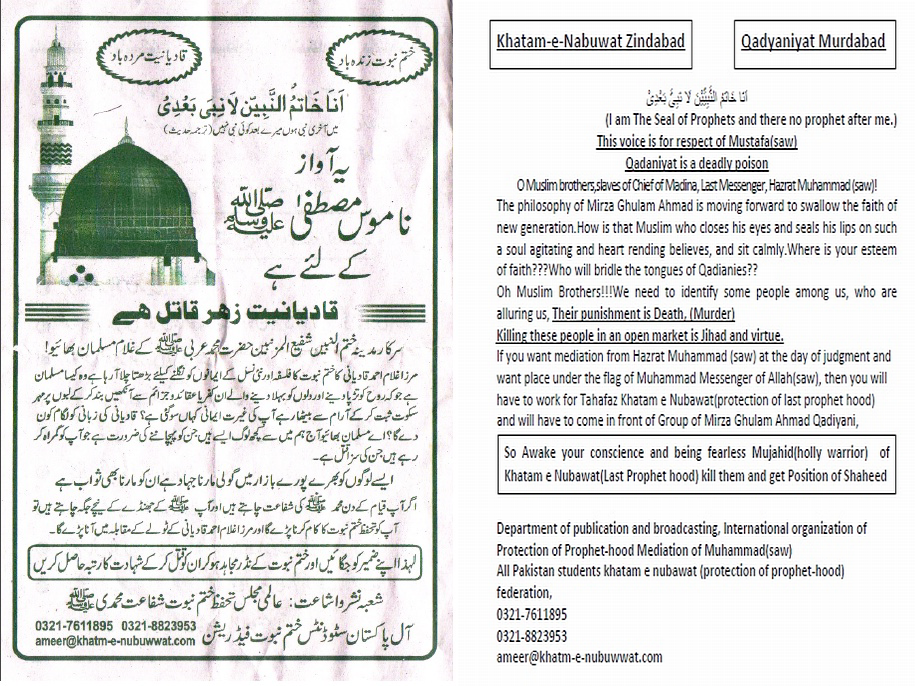
One is amazed at the audacity of the advocates of blasphemy laws, who think of themselves as vigilant guards of not only the Almighty, but religious personages as well, thereby creating an illusion that God and the Prophet (PBUH) might not be able to deal with the blasphemer and would need the help of Tehrik-e-Khatam-e-Nabuwat and the like. In my view, they themselves are the biggest blasphemers.
It needs to be strongly voiced in every public sphere today that Pakistan, with a majority Muslim population, does not need blasphemy laws. The presence of these laws hints at Muslim insecurity as well of lack of confidence in our own selves. Let us not make laws for the already powerful majority. A blasphemy law without a strong blasphemy libel law is merely a tool of suppression. It is not 295-C that is the problem, it is the way we have written our statute and the way we are shaping our worldview that has become the problem. Root it out before it roots us out. Pakistan cannot afford any more shame.

The writer is a rights activist and independent blogger. She can be reached at marvi@marvisirmed.com

Monday, November 22, 2010

VIEW: Blasphemy Law

Daily Times, Pakistan
Monday,
November 22, 2010

VIEW: Blasphemy Law — Yasser Latif Hamdani

Yasser Latif HamdaniNothing will cripple the terrorists more decisively than a tolerant, moderate and democratic Pakistan that respects human rights and treats all its citizens equally. No victory would be permanent if such a Pakistan is not achieved

Arundhati Roy committed blasphemy of another kind when she asked the Americans to reconsider their alliance with India without resolving the Kashmir issue in accordance with the wishes of the Kashmiri people. Earlier she had upset many Indians when she claimed that Kashmir was not an integral part of India, a statement that had every gung-ho Indian, those Oscar Wilde’s vicious patriots and there are about a billion of them, baying for her blood, proving that India is and will remain an intolerant society for some time to come.

Well, taking inspiration from her, Pakistanis should also ask President Obama why his government continues to aid a government and a country that continues to trample on the rights of its own people. No I am not talking about India. I am talking about Pakistan, where the state continues to persecute religious minorities by using a law that cannot be justified on any grounds, whether democracy or Islam. In my previous article I briefly touched on the issue of the Blasphemy Law and the verdict against the Christian woman, a mother of five, who was beaten up and then handed over to the police. It is likely that she will get a presidential pardon. That however is not enough. In the process Pakistan has been humiliated for the umpteenth time simply because we want to appease the mullahs as we have done so consistently since 1949, who in any event have declared a war on Pakistan. I had predicted this much in my article.

So when Obama says “we will act if Pakistan is unwilling or unable to act”, he should walk the walk as well. Nothing will cripple the terrorists more decisively than a tolerant, moderate and democratic Pakistan that respects human rights and treats all its citizens equally. No victory would be permanent if such a Pakistan is not achieved. President Obama, the US, the IMF, the World Bank and the entire western world should immediately stop assisting Pakistan in every field from humanitarian aid to military aid till Pakistan puts its house in order. Being a signatory and having ratified the International Convention on Political and Civil Rights, Pakistan is bound by international law and its own constitution to provide all its citizens the right to life and liberty and religious belief unconditionally.

I do not favour arguments referring to religious interpretation, but our Blasphemy Law is untenable even from an Islamic angle. There is nothing in the Holy Quran or even the Hadith that definitively prescribes such a Blasphemy Law. On the contrary we have a clear example set by the Holy Prophet (PBUH) when he forgave his worst enemies and offenders like Hinda. Almost everyone knows the story of the old woman who would throw garbage daily on the path that the Holy Prophet (PBUH) took. When she fell ill, the Holy Prophet (PBUH) went to visit her and nursed her back to health. Less known is the story of another old woman who the Holy Prophet (PBUH) helped by carrying wood to her house. Along the way, not knowing the identity of her helper, she began to speak about the “trouble maker” of Makkah. It was only after their journey was at an end that the Holy Prophet (PBUH) told her that he was the same Muhammad (PBUH) she had spent the greater part of the journey abusing. This was the Holy Prophet’s (PBUH) character. This is why he is referred to as Rahmatul-lil-Alameen or the mercy for all worlds.

Islamic law and jurisprudence is derived from four sources, known as the Usul-ul-Fiqh (fundamentals of the law), i.e. the Holy Quran, the Sunnah, Qiyas (analogy) and Ijma (consensus). The Holy Quran is silent on the issue of blasphemy. The Sunnah of the Holy Prophet (PBUH) seems to suggest the exact opposite. By using Qiyas, one can only conclude that the Blasphemy Law is patently un-Islamic and there is no Ijmah or consensus amongst the scholars of Islam on the punishment of blasphemy.

Islamic civilisation has a rich history of not only tolerating but even celebrating dissent. Needless to say some of the greatest scientists in Islamic history, Al Razi, the father of medicine, and Avicenna, would have been lynched many times over had Islam actually favoured a Blasphemy Law as is currently on the statute books of Pakistan. I am told that our local textbooks on science all have a chapter on the achievements of Muslim scientists and the contribution of Islamic civilisation to science and enlightenment of humanity. It is forgotten that this was achieved by a culture of tolerance, acceptance and openness. In my last column, I quoted the founder of this nation as stating as clearly as possible that bona fide criticisms and investigations into religion must be protected and safeguarded from any Blasphemy Law. So must be the fundamental rights of life, liberty and religious belief.

A nation is its laws ultimately. The intolerance permeating down to every segment of our society is the direct result of the laws that evade common sense and logic. It is therefore time to repeal the Blasphemy Law.

The writer is a lawyer. He also blogs at http://pakteahouse.wordpress.com and can be reached at yasser.hamdani@gmail.com

Saturday, November 20, 2010

Ahmadiyah followers evicted again

HEADLINES
Sat, 11/20/2010
12:07 PM

Ahmadiyah followers evicted again
Panca Nugraha, The Jakarta Post, West Lombok
.
Against Ahmadiyah members: Several people meet village officials in Gegerung village, Gerung regency in West Nusa Tenggara on Friday. The villagers objected the presence of Ahmadiyah followers, who just returned to Gegerung village after staying for a long time in shelters at Wisma Transito. They asked the officials to evict all Ahmadiyah members from the village.Antara/Ahmad Subaidi

.
Members of the Ahmadiyah sect, who returned to their homes in West Lombok, West Nusa Tenggara, a few months ago after being evicted, were evicted once again on Friday following pressure from local villagers.

Dozens of Gegerung villagers converged at the village office on Friday and urged the village chief to immediately evict the Ahmadiyah members from Ketapang hamlet.

They voiced objection to the presence of the Ahmadiyah members to the Gegerung village chief, the Lingsar district head and police chief.

During the meeting held at the Gegerung village office, located around 3 kilometers from Ketapang hamlet, a number of Ahmadiyah followers began leaving their homes, especially women and children.

Most of the men stayed until noon on the grounds that they were protecting their belongings.

The Ahmadiyah members, made up of 12 families, or 45 people, eventually agreed to leave their homes before Friday prayers after officials from the village administrative office and police assured the safety of their belongings.

They took with them household utensils that they could carry on motorcycles and returned to the displaced persons shelter at Wisma Transito in Mataram.

Gegerung village chief Sahudin told reporters the Ahmadiyah members returned to Ketapang six months ago, but they did not report their presence to the village administrative office.

The local villagers deemed the returning Ahmadiyah members a disturbance.

“The residents are resolute and rejected their return. We have coordinated on the issue with the regent.

For the time being, we ask the Ahmadiyah members to return to their shelter at Wisma Transito and vacate their homes in Ketapang so as to avoid undesirable incidents,” said Sahudin.

He added that after the meeting with residents, he and the Lingsar Police chief immediately reported the residents’ demand to West Lombok Regent Zaini Arony.

“We have reported the matter to the regent, and next Friday he will conduct Friday prayers in Ketapang and provide guidance to residents. There’s no decision whatsoever now, but we have asked the Ahmadiyah members to leave Ketapang to prevent untoward matters from happening,” he said.

The 45 Ahmadiyah members in Ketapang are part of the 36 families, or 127 Ahmadiyah members, staying at Wisma Transito.

The Ahmadiyah members, who were initially evicted from their village in February 2006, were forced to return to their homes in Ketapang because they had been staying at the Wisma Transito shelter without any certainty about their fate.

“We are willing to leave if asked, but please pay attention to our problem. We also want to lead a normal life like other people,” said Ahmadiyah member in Ketapang, Sarim Ahmad, 45.

Sarim and the other families returned to Ketapang three months ago. They returned to till their land and rear chickens because they have not received social assistance at the Wisma Transito shelter for the past two years.

He urged authorities to assure the safety of their belongings they left behind in Ketapang, because they had often lost chickens.

Friday, November 19, 2010

Indonesian Ahmadiyah Again Driven From Lombok Homes

Jakarta Globe, Indonesia
NEWS
Indonesian Ahmadiyah Again Driven From Lombok Homes
Fitri R. | November 19, 2010

Mataram. Twelve Ahmadiyah families who returned to their homes in Gegerung village in West Lombok shortly after being chased out in 2006 have once again been ordered to leave.

The 50 Ahmadiyah members, who had been back home for the past three years, were from a larger group forced to stay at the Transito temporary shelter in Mataram, the provincial capital, after they were driven from their homes by other residents of Gegerung.

However, in response to a protest against their presence by villagers at a town hall meeting on Friday, local authorities conducted a raid on the homes of the Ahmadiyah families shortly before noon prayers, forcing men, women and children to flee with their belongings.

The families were forced to return to the Transito shelter, although two individuals, a man and his aging father, have chosen to remain behind.

At the meeting that prompted the raid, presided over by Gegerung village chief Syahudin, Lingsar subdistrict chief Agus Sukma Aryana and Lingsar Police Chief Syamnurdin, the villagers said they could not accept the return of the Ahmadiyah members.

“We remain opposed to their presence in this village,” said one of the residents.

“They are a stain on this village and must be cleaned out.”

Another resident said that if the authorities did not order the families to relocate, “then the people will have to do it.”

“Don’t force the people to take matters into our own hands,” one resident said.

During the raids, overseen by Syahudin and Syamnurdin, the village chief asked the stricken families to return to the shelter.

“We ask with all respect that all Ahmadiyah members prepare to leave this village and return to Transito,” he said.

The subdistrict chief said he would oppose any move by the Ahmadiyah families to return to their homes, and asked other villagers not to resort to violence.

“This case will be resolved by the administration,” he said.

Syamnurdin ordered several of his officers to stand guard outside the deserted Ahmadiyah homes to ensure that residents did not vandalize or destroy them, following threats.

He also warned the two Ahmadiyah men who chose to stay on to “leave before something bad happens to you.” However, villagers had already burned down the home of the older man by then.

Zulhair, the younger Ahmadiyah member who chose to stay, blamed the latest surge in animosity toward the minority group on comments made by West Lombok district head Zaini Arony that the Ahmadiyah would have their civic rights respected.

He said the comments were printed in local news reports, which he cut out and took to the Gegerung village hall for confirmation on Nov. 10.

He added an official at the village hall had insisted that Zaini’s decision would never be accepted by Gegerung residents, who were opposed to the presence of the Ahmadiyah in their village.

“Why must we always be chased out, over and over again?” asked Gegerung Ahmadiyah member Sarim Ahmad.

“What did we do wrong?”

Sarim returned home three years earlier to resume farming his land that had been neglected for a whole year after the events of 2006.

“If I farm, at least I’m making a living, whereas at Transito I have no hope for a meaningful life,” he said.

Copyright 2010 The Jakarta Globe

Wednesday, November 17, 2010

Solemn Celebrations for Displaced Lombok Ahmadis

Jakarta Globe, Indonesia
NEWS
Solemn Celebrations for Displaced Lombok Ahmadis
Fitri | November 17, 2010

Mataram. Some 250 members of the Ahmadiyah sect on Wednesday performed their Idul Adha prayers in the transit shelter they have been living in for almost five years after their homes in Lombok were razed by hard-liners.

“We should not blame God or feel that there has been no greater suffering than what we are going through now,” Nasrudin, an Ahmadiyah scholar who was leading the prayers, said during his sermon.

In February 2006, thousands of hard-line Muslims burned down homes and mosques belonging to followers of the minority Islamic sect in Lingsar, West Lombok district, leaving more than 40 families homeless.

About half of the families continue to live in the temporary shelter, a former transit dormitory for hajj pilgrims in West Nusa Tenggara’s provincial capital, while the others have gone to stay with relatives.

Despite the small community’s ongoing tribulations, no tears were shed this year. “We are tired of crying; what we can do now is strengthen ourselves to accept whatever we have to face,” said one Ahmadiyah member who declined to be named.

Nasrudin said some people at the shelter had become resigned to their fate. “One of the members of the congregation even asked not to be moved from the shelter because he found this place beautiful and pleasing, as a way to heaven,” he said.

Nasrudin called on the community to remain unified in the face of hardship. “We are in the spotlight and we should not be torn apart just because of trivial matters,” he said.

Two cows and four goats had been donated to help the displaced community celebrate the qurban ritual, or traditional animal sacrifice. “These are from our brothers and sisters in Jakarta,” one of the organizers said of the animals.

Ahmadiyah communities have been the target of attacks by hard-line Muslims in several regions, mostly in Lombok and West Java, in recent years. They claim to also face continued official discrimination, having difficulties obtaining jobs and processing official paperwork.

Followers of Ahmadiyah, a sect founded in India in 1889, profess that the group’s founder, Mirza Ghulam Ahmad, was the Messiah, a belief that is contested by mainstream Muslims.

Ahmadiyah representatives have had to dismiss claims the group does not believe Muhammad was the last prophet and does not consider the Koran its holy book.

Copyright 2010 The Jakarta Globe

Sunday, November 14, 2010

Sect Families Facing Island Exile Ungrateful for Rejecting Aid Offer, Indonesian Official Says

Jakarta Globe, Indonesia
NEWS
Sect Families Facing Island Exile Ungrateful for Rejecting Aid Offer, Indonesian Official Says
Fitri | November 14, 2010

Mataram, West Nusa Tenggara. Ahmadiyah families in danger of being evicted to a remote island have been criticized for opposing the move and an offer to buy assets they were forced to abandon in a previous eviction.

The West Lombok administration plans to buy the assets left behind by the families when they were forced to move out of Gegerung village in 2006, after other villagers attacked them.

District spokesman Ispan Junaidi said on Saturday that Rp 710 million ($80,000) had been set aside to buy the houses and furniture of the families.

“We are trying to help them,” he said. “They have not responded positively to our offer. We feel they are trying to make it difficult for us to find a solution that will resolve this matter once and for all.”

Twenty-two families from the minority Muslim sect have been living in the Transito evacuee shelter in Mataram, the capital of West Nusa Tenggara, since the 2006 eviction. They have made frequent requests to village and district leaders to be allowed to return to Gegerung.

But last month, the head of West Lombok said they were moving the Ahmadiyah families to a remote island, a decision many have called discriminatory and inhumane.

“We are trying to protect Ahmadiyah members,” district head Zaini Arony said.

He said he had discussed the situation with religious figures and it had been agreed the families would be sent to Teluk Sepi Island. He defended the decision by saying the local administration feared a repeat of the violence in February 2006, when thousands of Muslims burned down the families’ homes.

Ispan said there was no possibility of the families returning to Gegerung because the villagers were adamant they would not let them live among them.

“We have offered to pay Rp 710 million for their assets,” he said. “Instead, the families are now asking for Rp 1.5 billion. They do not seem to want to sell us their assets.” He added that only two of the homes had proper documentation so that their value could be assessed.

“So it is difficult for us to increase our offer above Rp 710 million,” Ispan said. “We believe some of the leaders of the Ahmadiyah in West Nusa Tenggara don’t want to help themselves or their followers. They reject whatever solutions we offer. Our offer is to buy their assets and relocate them to Sepi Island.”

Jauzi Djafar, a spokesman for the provincial chapter of Jemaah Ahmadiyah Indonesia, said the West Lombok administration had never sat down with them to discuss the offer.

“How are we supposed to evaluate the offer when they have never called us to sit down and discuss this offer with them?” he said. “What assets are they specifically referring to is not clear to us.”

He said the most important concern of the families was their safety and security.

“We want our people to return home to their own backyards,” he said.

“People should be made aware of the law, so that differences are not used as a reason to attack Ahmadis. No one has talked to us, whether about buying our assets or moving us to Sepi Island.”

Ispan has said at least 20 families will be moved to the island next year. “There’s enough land on Teluk Sepi for them to farm,” he said. “It’s better than letting them get attacked or killed. It’s the humane thing to do.”

He had previously acknowledged that the families had not been consulted about the plan.

Copyright 2010 The Jakarta Globe

Wednesday, November 10, 2010

Ahmadiyah Leader Tries To Clear the Air About Persecuted Sect's Beliefs

Jakarta Globe, Indonesia
NEWS
Ahmadiyah Leader Tries To Clear the Air About Persecuted Sect’s Beliefs
Ulma Haryanto & Fitri | November 10, 2010

Jakarta. The beleaguered Ahmadiyah sect has tried to clarify its beliefs, with the national secretary of Ahmadiyah Indonesia, Zafrullah Pontoh, saying it had never claimed Mirza Ghulam Ahmad as their prophet.

Rather, he was the “Promised Messiah, a savior for Muslims, Christians and Jews.”

“We believe in the Holy Prophet Muhammad as the messenger of the last religion, which is Islam. We follow Islam as the final religion,” Zafrullah told the Jakarta Globe on Tuesday.

He denied they were too afraid to say they believed Mirza Ghulam Ahmad was the Prophet and were hiding their true beliefs to avoid further persecution.

Religious Affairs Minister Suryadharma Ali has repeatedly called for the sect to be banned, claiming members cannot consider themselves followers of Islam because they did not believe Muhammad was the final monotheist prophet. Nor did they consider the Koran as their holy book.

Anti-Ahmadiyah violence has increased since 2008, when Indonesia banned the sect from any public displays or teaching. Earlier that year the sect had to give the government a statement explaining the core contents of the religion. Zafrullah said this was to “avoid unrest and disruption to peace and order.”

“This limits us from explaining our beliefs to the public,” he said. “As a result, people receive second-hand information and stick with it.”

Mirza Ghulam Ahmad established the Ahmadiyah movement in Qadian in India in 1889.

Zafrullah said the 12-point statement submitted to the government had explained that they believed Muhammad was the final messenger, and that Mirza Ghulam Ahmad was “a teacher and a messiah who will strengthen the understanding of Islam, as taught by Prophet Muhammad.”

“They often claim that we consider Tazkirah as the holy book, which is not true,” he said. “Tazkirah is a compilation of Mirza’s writings and notes on his behavior, just like the Hadith [the words and deeds of Prophet Muhammad].” God was Allah to them, just like any other Muslim.

According to Jauzi, who chairs the Ahmadiyah regional leadership council in West Nusa Tenggara, the main difference between the two was that Ahmadiyah believed Mirza Ghulam Ahmad was the Promised Messiah.

“In other religions, the Messiah has not arrived yet. For us he did. It was Mirza Ghulam Ahmad. That is the core difference,” Jauzi told the Globe.

Zafrullah said there were two Ahmadiyah groups in Indonesia – the Jemaah Ahmadiyah Indonesia, or JAI, and the Gerakan Ahmadiyah Indonesia, or GAI.

“Both are Ahmadiyah, [JAI] is Ahmadiyah from Qadian, a small town in India, while [GAI] derives its teachings from Lahore [Pakistan],” he said.

“Although both follow Islam according to the teachings of Mirza Ghulam Ahmad, Lahore Ahmadis place Mirza Ghulam Ahmad merely as a “reformer”, and not the messiah, as opposed to the main belief of Ahmadiyah.

“JAI has more members than GAI. But the leaders of the two organizations know each other, and we acknowledged each other without getting too deep into each other’s business.”

Zafrullah said the split came after a feud among pupils of Mirza Ghulam Ahmad after his death. Those who did not see him as a messiah moved to Lahore.

Ulil Abshar Abdalla, a Democratic Party chairman and founder of the Liberal Islam Network, has been critical of Suryadharma for his failure to stand up to those who preach hatred and instigate violence against the sect.

On Tuesday he said the minister had adopted an approach that fostered radicalism.

“It’s like putting oil on a flame,” Ulil said.

Copyright 2010 The Jakarta Globe

Friday, November 5, 2010

Indonesian President Urged to Take Minister to Task Over Ahmadiyah

Jakarta Globe, Indonesia
NEWS
Indonesian President Urged to Take Minister to Task Over Ahmadiyah
Armando Siahaan | November 05, 2010

Jakarta. The religious affairs minister has once again come under fire after an international human rights group called on President Susilo Bambang Yudhoyono to repudiate the minister’s stance against the Ahmadiyah.

In an open letter to the president, New York-based Human Rights Watch accused Suryadharma Ali of actively promoting discrimination against the minority Islamic sect.

“President Yudhoyono should order Minister Suryadharma to stop playing with fire with his demands to ban the Ahmadiyah,” said Phil Robertson, HRW’s deputy director for Asia.

“Formalizing religious discrimination increases the vulnerability of Ahmadiyah and opens the door for further attacks and wider communal violence. This is hardly the recipe for promoting Indonesia as a modern, rights-respecting state.”

Suryadharma has been heavily criticized for his repeated calls for the sect to be banned and his unwillingness to revoke a 2006 joint ministerial decree that makes it difficult for minority religions to build houses of worship.?

In September, the deputy speaker of the House of Representatives, Pramono Anung, from the Indonesian Democratic Party of Struggle (PDI-P), lambasted Suryadharma for his inability to separate his roles as a minister and as the chairman of the United Development Party (PPP), the second-largest Islamic party in the country.

Pramono said some of Suryadharma’s decisions on religious issues had been heavily influenced by his political background.

“A religious affairs minister should protect all religious groups. Not just his group or his religion,” he said.?

Bonar Tigor Naipospos, deputy chairman of the Setara Institute for Democracy and Peace, said it was “obvious” Suryadharma was abusing his position to push his own political agenda.??

Ulil Abshar Abdalla, a Democratic Party politician and founder of the Liberal Islam Network, has also chastised Suryadharma for his failure to stand up to those who preached hatred, going as far as saying the minister had adopted an approach that fostered radicalism.

In its letter, HRW questioned why Yudhoyono had not taken action against his minister, which had lead many to believe that he supported such intolerance.

“President Yudhoyono gave a nationwide speech about religious tolerance in the United States, but what will he tell visiting US President Barack Obama about the burned Ahmadiyah mosques in Indonesia?” Robertson said.?

“Yudhoyono should take clear steps to protect religious freedom, starting with loudly rejecting any ban on the Ahmadis, and ensuring that those responsible for attacks on Ahmadiyah homes and mosques are prosecuted.”

Nasaruddin Umar, a director for Islamic affairs at the Religious Affairs Ministry, said that it could not comment on the issue before studying HRW’s letter comprehensively.

Copyright 2010 The Jakarta Globe
 
^ Top of Page