Showing posts with label amendment. Show all posts

Sunday, May 29, 2011

Persecution of Ahmadis continues despite attacks

Daily Times, Pakistan
Sunday, May 29, 2011

Persecution of Ahmadis continues despite attacks

By Afnan Khan

LAHORE: Persecution of Ahmadi community continues even after the worst ever attacks on their worship places in Lahore in May last year.

A few weeks back, a terrorist blew himself up outside an Ahmadi place of worship in Mughalpura area. The terrorist had been caught red-handed and released by police some time back.

Daily Times had, in December 2010, reported that a terrorist attack on the stated place or local Ahmadis in the area was likely, as a hate campaign had been launched against them by local hardliners and extremists.

A seminary present in the area spearheaded the campaign. It not only pasted a large number of posters against Ahmadis on walls in the main Gunj Bazaar of the area but also forbade the locals from burying their dead in the related graveyard despite the fact that these people had been living in the area even before the partition (of Subcontinent) and their forefathers had been buried there.

The management of the worship place told Daily Times that they had caught a suicide attacker on April 15 with the help of police guards just before prayers at 12:40 pm.

The management said that the terrorist, who was in his early twenties, had been waiting for the prayers to start and looking for an opportunity to sneak into the worship place and blow himself up.

But, it added, one of the volunteers spotted the suicide vest the terrorist had been wearing under his shirt and caught him with the help of other volunteers and police guards present there.

Later, a heavy police contingent, led by the station house officer, reached the spot and took the terrorist to the Mughalpura Police Station where he identified himself as Abid.

The management added that it had tried to pursue the case, however, police told them that the terrorist had been handed over to superior investigation agencies.

It maintained that sources in the Mughalpura Police Station had informed them that the terrorist had been freed due to political pressure that piled on police when a number of hardliners reached outside the police station and issued a warning to attack policemen if the “innocent boy” was not released.

Station House Officer (SHO) Asim Jahangir abstained from commenting on the issue, when contacted. He only told this scribe that he was not on duty on the day the incident took place and would check for the latest updates later on.

Spokesman for Ahmadis, Saleemuddin, told Daily Times that the hate campaigns against them were still in full swing across the country. He regretted that so far the federal and provincial governments had not taken any solid steps to protect Ahmadi community from extremists and terrorists. He added that a number of Ahmadis had been tortured and killed even after the May 28, 2010, terrorist attacks, but they were still waiting for protection from the government.

Saleemuddin said that the government’s behaviour towards Ahmadis was also discriminatory, adding that it even did not announce any compensation for those Ahmadis that had been killed in the May 28 attacks.

The spokesman said that a number of families of the victims of the May 28 attacks were still waiting for the compensation cheques worth Rs 0.5 million. He also mentioned that many families that had received the compensation cheques did not spend the money but deposited it to the government’s flood relief fund.

Thursday, April 14, 2011

Pakistan militants killed 2,500 in 2010, report says

South Asia
14 April 2011 Last updated at 17:11 GMT
Pakistan militants killed 2,500 in 2010, report says

Hundreds were injured in militant attacks - most victims were civiliansHundreds were injured in militant attacks — most victims were civilians
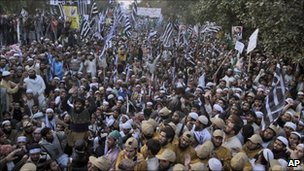
More than 2,500 people were killed in militant attacks in Pakistan in 2010, according to the independent Human Rights Commission of Pakistan (HRCP).

Nearly half of victims were civilians killed in suicide blasts. There were 67 such attacks last year, the group said.

The report also said at least 900 people had been killed in US drone strikes during the same period.

The number of people killed by the army is not mentioned, but it estimated to be in the region of 600-700.

Pakistani troops are battling insurgents across the north-west. Many of those it has killed are believed to be militants, but civilian lives have been lost too.

The HRCP is the main human rights watchdog in the country. Its findings are often disputed by the authorities, the BBC’s Syed Shoaib Hasan in Karachi says.

The group’s findings show a rise in the numbers being killed in Pakistan’s conflict.

BBC research published last July suggested 1,713 people had been killed by militants over the preceding 18 months, while 746 people had died in drone attacks during the same period.

‘Increasing intolerance’

The HRCP released its data in its annual report on the state of human rights and security in Pakistan between January and December 2010.

“Pakistan’s biggest problem continues to be violence carried out militants,” HRCP chairman Mehdi Hasan said.

“In 2010, 67 suicide attacks were carried out across the country in which 1,169 people were killed,” he said. “At least 1,000 of those were civilians.”

Dr Hasan said that in all 2,542 people had been killed in militant attacks in the country last year.

He said the most glaring example of government oversight had been in Balochistan province, where targeted killings shot up rapidly with 118 people being killed in 2010.

Dr Hasan said the figure was set to increase in 2011, as the government seemed unconcerned about the unravelling of the law and order situation in Balochistan.

The HRCP report also spoke about increasing intolerance against religious minorities in the country.

It said 99 members of the Ahmedi (Qadiani) sect had been killed in attacks in 2010, while 64 people had been charged under the country’s blasphemy law.

There was no immediate response to the report from the Pakistani authorities, nor was there any word from militant groups.

Monday, March 21, 2011

Year 2010, bloodiest chapter in history of Ahmedi killings

Daily Times, Pakistan
Monday, March 21, 2011

Year 2010, bloodiest chapter in history of Ahmedi killings

By Afnan Khan

LAHORE: The year 2010 witnessed a series of intermittent persecutions of Ahmedis and can be labelled as the bloodiest chapter in the history of the minority’s killings in Pakistan with an unprecedented number of assassinations including a twin terrorist attack on their worship places in Lahore.

At least 98 people were gunned down for following Ahmedis’ religious beliefs, while 86 were brutally killed and 124 injured when terrorists attacked their worship places in the city last year on May 28. Separately, several others survived assassination bids during numerous incidents in different parts of the country.

Among the victims of the target killings was Professor Muhammad Yusuf, who was murdered by terrorists in his own locality.

Yusuf ran a small, charitable school at his house where he provided education to the poor and downtrodden children of Ferozwala area, irrespective of their colour, creed or caste. However, after Yusuf’s assassination, his own family was forced to flee to Sri Lanka in order to survive.

Separately, as per the annual report issued by the community’s information office, at least three Ahmedis were wrongfully booked under the blasphemy law and 67 others were unjustly charged with and dragged into religion-based cases.

The report also accused the civil judge Mirpur for sentencing three Ahmedis, namely Masood Ahmad Chandio, Abdul Razzaq and Abdul Ghani to three years of imprisonment in March 2010 under Ahmedi specific law. Meanwhile, three others, namely Muhammad Qasim, Mazahir Ahmad and Ahmad Yar, were arrested under PPC 298-C and 295-C on false accusation of preaching and blasphemy in Sargodha.

Other incidents involving injustices to Ahmedi citizens include handing over the control of an Ahmadiyya worship place in Ahmad Nagar to non-Ahmedis on January 14 last year as per the orders of the Chiniot District Co-ordination Officer and the denial of shelter and food to the flood affected Ahmedis in the ravaged areas of southern Punjab.

Thursday, February 3, 2011

Pakistan MP drops effort to repeal blasphemy laws

South Asia
3 February 2011 Last updated at 14:11 GMT
Pakistan MP drops effort to repeal blasphemy laws

Many in Pakistan are opposed to any effort to alter the blasphemy lawsMany in Pakistan are opposed to any effort to alter the blasphemy laws
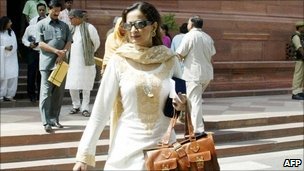

A Pakistani politician has dropped her attempt to amend the country's controversial blasphemy laws, accusing her party of appeasing extremists.

Pakistan People's Party MP Sherry Rehman made her decision after the government ruled out changing the law.

Correspondents say Ms Rehman is one of only a few politicians prepared to speak out on the blasphemy law.

They say there has been a climate of fear since the murder of Punjab governor Salman Taseer who opposed it.

Mr Taseer was killed in January by one of his bodyguards, who later admitted murdering the governor because he had spoken out against the blasphemy law.

Hundreds of people are in prison on charges under the law. Critics say it has been used to persecute minority faiths and is sometimes exploited by people pursuing grudges against others.

It has been under scrutiny since a Christian, Asia Bibi, was sentenced to death in November. Ms Bibi denies insulting the Prophet Muhammad in her Punjab village in June 2009.

'Blow-back'

Ms Rehman told the BBC in January that she received death threats every half hour, but would defy them.

However, in a statement received by the BBC on Thursday, she said she would not be proceeding with her proposed bill following remarks by Prime Minister Yousuf Raza Gilani earlier in the week.

"Since the PM announced that there cannot even be discussion on procedural amendments, and the committee announced by the party to amend the laws has been disbanded, then as a PPP representative I had no option but to abide by the party's decision in parliament.

She added: "Appeasement of extremism is a policy that will have its blow-back."

Sherry Rahman
Mr Gilani had said that no amendment in the law could be considered. He also disbanded a committee set up to determine how to amend the laws.

The BBC's Syed Shoaib Hasan in Karachi says politicians in Pakistan are increasingly reluctant to amend the law - many are afraid of being targeted in the way Mr Taseer was.

He says Ms Rehman's courageous stance against what is seen by some experts as a flawed law has few public supporters.

Ms Rehman stressed that she had not agreed to "withdraw" her private member's bill.

"There was never any question of withdrawing the bill as the Speaker had never admitted it on the agenda," she said.

Ms Rehman added that if the Speaker had allowed her bill "perhaps some of our colleagues would have understood that it was not suggesting total repeal of the law, but protecting our great Prophet's name against injustices done via procedures introduced by [former President] Zia ul-Haq.

"It was a question of protecting our citizens from injustice done in the name of a religion that values peace and tolerance more than anything else," she said.

Her statement came as Human Rights Watch urged the government to release a boy of 17 who is under arrest in Pakistan, accused of blaspheming against the Prophet Muhammad in a high school exam.

Monday, January 10, 2011

TNR rally warns govt not to touch blasphemy law

Daily Times, Pakistan
Monday,
January 10, 2011

TNR rally warns govt not to touch blasphemy law

*
Hundreds of thousands gather in Karachi to demand govt abolish committee set up to review law, withdraw bill from NA

Staff Report/Agencies

KARACHI: The Tehreek-e-Namoos-e-Risalat (TNR) and the All-Religious Parties Alliance held a massive rally on Sunday, 8demanding the government not touch the country’s blasphemy law, abolish the committee set up to review the law and withdraw the proposed blasphemy bill from the National Assembly.

Hundreds of thousands of people participated in the march from the Numaish Chowrangi to Tibat Centre. They raised placards and banners voicing their demands.

The size of the Karachi rally, which was large even by the standards of the city of 16 million, showed how bitter the argument is over the decades-old laws.

Tehreek-e-Namoos-e-Risalat convener and the chief of the Jamiat Ulema-e-Pakistan (JUP), Dr Abul Khair Muhammad Zubair, said it was a matter of regret that the present government had tabled a bill to amend the blasphemy law.

Dr Abul Khair gave a deadline of January 30 to the government to dissolve the committee that was formed to review blasphemy law. “Otherwise the next Tahafuz-e-Namoos Rislat March will be organised in Lahore on January 30,” he said.

Jamaat-e-Islami chief Munawar Hassan said the rulers intended to amend the blasphemy law at the direction of their Western idols. He said that he offers Altaf Hussain and Nawaz Sharif to come forward and take a stand in favour of the blasphemy law, as it was a matter of belief and religion for each Muslim. “They should come forward to make a statement on record in this regard, avoiding all minor or major differences,” he said.

Munawar demanded that Prime Minister Yousaf Raza Gilani withdraw the bill, which was tabled “for the nefarious propose of amending the blasphemy law and the PM should give a policy statement on the floor of the assembly in this regard”.

Jamiat Ulema-e-Islam-Fazl Fazlur Rehman said the nation would not allow any one to amend or remove the blasphemy law. He vowed that the “Western agenda” would not be allowed in Pakistan, which “had come into being in the name of Allah and the holy Prophet (PBUH)”.

He alleged that the government was expressing extremism in its struggle against the blasphemy law. JI Karachi chief Muhammad Hussain Mehnti, JUI-F leader Maulana Abdul Ghafoor Haidri, JUP member Shabir Abu Talib, PML-Q leader Muhammed Zubair Khan and Owais Pasha of the Tanzeem Islami also spoke on the occasion.

The blasphemy law has been the subject of much attention after a Christian woman, Aasia Bibi, was sentenced to death last year.

Although courts typically overturn blasphemy convictions and no executions have been carried out, rights activists say the laws are used to settle rivalries and persecute religious minorities.

While the Islamists do not win many seats in elections, they have the capacity to bring people out into the streets.

The rally followed a tumultuous week in Pakistani politics in which the Pakistan People’s Party government backtracked on reforms to stave off collapse.……

Saturday, January 8, 2011

VIEW: An open letter to President Zardari

Daily Times, Pakistan
Saturday, January 8, 2010

VIEW: An open letter to President Zardari — II — Shahid Saeed

Wrapped in the coffin of Salmaan Taseer was not just the body of a mortal but ideas, expressions, feelings and socio-political ideals. We buried not just a man, but reason, sanity, tolerance, liberalism, secularism and compassion

The members of Jamaat-e-Ahle Sunnat Pakistan did not bring your party to power nor does the PPP represent the Jamiat Ulema-e-Pakistan. Tahaffuz-e-Namoos-e-Risalat Mahaz members do not vote for your party and you did not get elected because of the Sunni Tehrik. The Hindu, Christian and Ahmedi citizens of Pakistan do not look up to these parties for their rights; they look at parties like yours. Nearly all of the three million Pakistanis who follow the Hindu faith live in Sindh. Nearly all of them vote for the Pakistan People’s Party.

Investigation from your very own minister for minorities affairs found Asia Noreen to be innocent. A doctor has been accused of blasphemy for throwing away the card of a pharmaceutical company representative. Justice Arif Hussain Bhatti took bullets in the chest for giving justice to an innocent accused of blasphemy.

Extremism and fanaticism manifest themselves in various forms — in the form of hate-mongering against other faiths and in the form of lack of tolerance for any opinion deemed in violation of what is considered divinely ordained law. The cancer of extremism has permeated each and every inch of this society, from those who blow themselves up in the middle of crowded markets to those who sympathise with them or even try to defend them. Zia’s legacy cannot be eroded by an 18th Amendment or removal of his name from the president’s list. His legacy remains alive in the form of the blasphemy laws, the Hudood Laws and all other discriminatory laws. His legacy remains alive in the form of every bomber that blows himself up in the streets and bazaars of this unfortunate country. His legacy remains alive in the form of the assassination of your own wife.

The very basic problem with laws promulgated in the name of religion remains that the doors of any subsequent change are closed forever and the very issue of debate on their legality, their fairness and their effects becomes controversial.

Lately, you have claimed that politics is about making unpopular decisions for the greater good. Here is an unpopular decision that is definitely worth orchestrated agitation. Here is an unpopular decision you can make that will give the six million citizens of minority faiths a nice sleep for the first time in their lives. Here is an unpopular decision that will prove to be the first one in making Pakistan a modern progressive state that does not condone murder in the name of religion.

His death carries a message for all liberals in Pakistan, a mark on their heads for the Qadris to ascend to their imagined heavens. It possibly brings vocal liberalism to an end on the political stage. If the PPP is to continue abandoning principled, courageous, humane and compassionate politicians, then there will be no more Salmaan Taseers or Sherry Rehmans to strengthen the party.

Wrapped in the coffin of Salmaan Taseer was not just the body of a mortal but ideas, expressions, feelings and socio-political ideals. We buried not just a man, but reason, sanity, tolerance, liberalism, secularism and compassion. His presence will forever be missed. It will be missed even more if the PPP fails to honour his memory and continues to act like a crowd of sheep, unwilling to flex its muscles and resist the agitation instigated by bigots.

Taseer’s death should not dissuade you from pursuing an amendment in the notoriously abused law. In his death, Salmaan Taseer has become the symbolic champion of minority rights, the face of liberal and progressive politics in Pakistan. A state that ignores death-chanting slogans from mullahs and lets people garland a murderer has surrendered itself to the extremists. If the PPP wishes to remain silent on the blasphemy laws even now, it might as well have assassinated Taseer itself and became the voice of the street mullahs and the Taliban. Otherwise, it will honour the memory of Shaheed Salmaan Taseer and support the bill put forward by Sherry Rehman. The choice is yours to make.

(Concluded)

The writer is interested in history and public policy. He can be reached at shahid@live.com.pk

URL: http://www.dailytimes.com.pk/default.asp?page=2011\01\08\story_8-1-2011_pg3_6

Thursday, January 6, 2011

Religious parties unite to protect Qadri

Daily Times, Pakistan
Thursday,
January 6, 2010

Religious parties unite to protect Qadri

By Zeeshan

ISLAMABAD: Religious parties on Wednesday seemed united in protecting Punjab Governor Salmaan Taseer’s assassin Malik Mumtaz Qadri.

Sunni Ittehad Council (SIC), a Bralevi sect party, called a meeting for tomorrow (Friday), likely to be held in Rawalpindi to discuss the fallout of the assassination of the Punjab governor.

Senior SIC member Haji Hanif Tayeb told Daily Times by phone that Sahibzada Fazal Karim would chair the meeting and then it would be decided whether to support Qadri or otherwise. The Tahafuz-e-Namoos-e-Risalat Mahaz, a forum of Bralevi school of thought, also seemed determined to protect Qadri. Maulana Raghib Naeemi told Daily Times that anarchy would increase in society if some one tried to amend the blasphemy law. “It is a principled decision of the Mahaz to support Qadri,” Naeemi categorically stated. Jamaat-e-Islami Ameer, Syed Munawar Hassan, justified Qadri’s act, saying Salmaan Taseer himself had to be blamed for his fate.

In a press statement, he said Taseer’s views on the blasphemy law provoked Qadri into killing him. Badshahi Masjid Khateeb Maulana Abul Khabir Azad asked the government not to amend the blasphemy law, as it would hurt the sentiments of 180 million people of Pakistan.

Replying to a question, he denied that he refused to lead Taseer’s funeral prayers saying he was busy and could not spare time.

Thursday, December 30, 2010

Govt appeases religious parties on blasphemy law

Daily Dawn, Pakistan
Pakistan
Govt appeases religious parties on blasphemy law
From the Newspaper
December 30, 2010
By Raja Asghar
Community condemns murder of man, the fourth in his family to be shot dead this year
Tahafuz-e-Namoos-e-Risalat Action Committee Chairman, Anwar-ul-Haq Haqqani addresses press conference at Quetta press club on Wednesday. — Photo by PPI

ISLAMABAD: In a move to appease religious parties, the government told the National Assembly on Wednesday it had no mind to change the controversial anti-blasphemy law often seen misused against members of minority communities, but appeared calm against political theatrics of some volatile allies.

Religious Affairs Minister Khurshid Ahmed Shah interrupted the house proceedings to make a policy statement “with full responsibility” that the “government has no intention to repeal the anti-blasphemy law and to disown a private bill of a PPP member proposing changes in the Zia-era law to abolish a mandatory death sentence against a convict provided by it and to guard against miscarriage of justice.

The government assurance came ahead of what has been described as a countrywide “shutter down strike” called for Friday by a religious grouping seeking to protect the dignity of the holy prophet Mohammad (PBUH), or “namoos-i-risalat”. “The government regards safeguarding ‘namoos-i-risalat’ as its responsibility and believes in it”, the minister said and, in a reference to the daft submitted by former information minister Sherry Rehman but yet to come before the house, added: “If someone has brought a private bill, it has nothing to do with the government.”

Mr Shah also assured the house that the government would not allow any wrong done to minorities, which have often complained of false accusations made against their members under a law enforced by former military dictator Gen Mohammad Zia-u-Haq as part of his controversial campaign to Islamise the Pakistani society. But he did not specify any measures to do that.

The strike call was given by a “Namoos-i-Risalat” conference held in Islamabad on Dec 15 under the auspices of Majlis-i-Tahafuz Khatam-e-Nabuwat (association for the protection of the finality of prophethood), which was also attended by the representatives of some banned religious groups operating under new names. ……

©2010 DAWN Media Group. All rights reserved
URL: www.dawn.com/2010/12/30/govt-appeases-...-blasphemy-law.html

Tuesday, December 28, 2010

Religious parties announce strike over blasphemy issue

Daily Dawn, Pakistan
National
Religious parties announce strike over blasphemy issue
From the Newspaper
December 28, 2010

PESHAWAR, Dec 27: Tehrik-i-Namoos-i-Risalat has announced a province-wide shutter down strike in Khyber Pakhtunkhwa on Dec 31 to stall any move for making amendments to the blasphemy law and appealed to business community to make the strike a success.

The decision was taken in a meeting of the steering committee of Tehrik-i-Namoos-i-Risalat at Al-Markaz-i-Islami with its convener Shabir Ahmed Khan in the chair here on Monday.

Those who attended the meeting included Shamsur Rehman Shamsi and Maulana Amanat Shah of the JUI-F, Ikramullah Shahid and Maulana Abdul Haseeb Haqqani of JUI-S, Fayaz Khan and Maulana Merajuddin of JUP, Fazalur Rehman Madni of Markazi Jamiat Ahle Hadith, Ramzan Tauqeer of Tehrik-i-Islami, and Israrullah advocate and Hamidullah Jan of JI.

The participants criticised Punjab Governor Salman Taseer and Pakistan People`s Party MNA Sherry Rehman for their attempt to help release the blasphemy convict Aasia Bibi.

“There is no room for changes in the blasphemy law as it is a matter of faith,” they unanimously said and asked the government to forthwith reject the bill presented by Sherry Rehman in the National Assembly for amendment to the law.

Holding their respective party flags activists of all the religious parties would hold rallies and public meetings in different districts, and the traders would keep the shutters down to express solidarity with the Tehrik-i-Namoos-i-Risalat.

The meeting decided that the district leadership of all the parties would hold meetings with traders to seek their complete support for shutter down strike. However, the traffic will remain smooth in all the districts. The steering committee will meet again today (Tuesday).

©2010 DAWN Media Group. All rights reserved
URL: www.dawn.com/2010/12/28/religious-parties-announce...issue.html

Tuesday, December 14, 2010

An idea whose time has come

Daily Times, Pakistan
Tuesday,
December 14, 2010

EDITORIAL: An idea whose time has come

If it were not so tragic, the case of a blasphemy-accused doctor would have made for comic reading. Reportedly, Dr Naushad Valiyani threw the business card of a medical representative “which had his full name, Muhammad Faizan”, in a dustbin. Mr Faizan then launched a blasphemy complaint against the doctor. The absurdity of the charges against Dr Valiyani exposes the nature of the draconian Blasphemy Law, which can be misused for any purpose under the sun. General Ziaul Haq left this country with a minefield in the shape of this law, which lends itself to abuse. The case of Dr Valiyani is just one of the many cases where the complainant is crossing all lines of common sense. ‘Muhammad’ is a popular name over the Muslim world. To say that the doctor committed blasphemy just because he threw a business card that had ‘Muhammad’ written on it is ridiculous. The issue was resolved between the parties when the doctor apologised, although not before Faizan and his friends had reportedly roughed up the doctor. However, the intervention of some clerics resulted in a blasphemy charge against the accused, who was then arrested.

Since we are so fond of the Pakistan Penal Code (PPC), why not invoke PPC 153 A in cases where false accusations are made? According to PPC 153 A (a), whoever “by words, either spoken or written, or by signs, or by visible representations or otherwise, promotes or incites, or attempts to promote or incite, on grounds of religion, race, place of birth, residence, language, caste or community or any other ground whatsoever, disharmony or feelings of enmity, hatred or ill-will between different religious, racial, language or regional groups or castes or communities” shall be fined and punished with imprisonment for a term that may extend to five years. Thus, Muhammad Faizan should be charged with incitement against the innocent doctor.

In another incident, three alleged blasphemers in Karachi — Syed Raheel Masood Wasti, Samreen Masood and Zafar Iqbal — denied desecrating the Holy Quran. As per their statement, they were not in the house when their illiterate maid accidentally threw out some pages of the Quran after cleaning the house. They have expressed fear for their lives and that they can be falsely persecuted under the Blasphemy Law. This is yet another example of the way the mullahs use this law. In almost all the cases under the Blasphemy Law, the accusations are mala fide. The accusations are based on personal vendetta, blackmail, settling scores, property disputes, etc. It is therefore beyond comprehension why the mullah brigade is threatening to launch a movement, Tehreek Namoos-e-Risalat (TNR), in case any amendments are made to the Blasphemy Law, except that it serves their political agenda of keeping the country hostage to their fulminations. This flawed law should be repealed in the first instance, and if that is not possible because our politicians have yet to find the courage to defy the blackmail of the religious groups, at least the amendment bill by Ms Sherry Rehman should be considered seriously. Islam is a religion of peace but the fundamentalists have hijacked our religion and given new interpretations to serve their vested interests. The religious right is committing the greatest blasphemy by distorting the name of Islam. When the British introduced the Blasphemy Law, it was done to maintain harmony between all religious communities in the Indian subcontinent. Ziaul Haq’s Blasphemy Law has done the exact opposite. It has made the religious minorities more insecure in this ‘land of the not-so-pure’. When a state legalises persecution of minorities, it is time to change the laws.

Pakistan can never progress if it chooses to espouse the values of the Dark Ages. Let us not be afraid to challenge the religious extremists just because they threaten us with ‘dire consequences’. We have been held hostage to their absurdities for decades. It is high time we rolled back Zia’s legacy and moved forward towards a progressive, secular and democratic Pakistan. *

URL: www.dailytimes.com.pk/default.asp?page=2010\12\14\story_14-12-2010_pg3_1

Monday, December 13, 2010

Clerics to launch campaign if blasphemy laws amended

Daily Times, Pakistan
Monday,
December 13, 2010

Clerics to launch campaign if blasphemy laws amended

*
Six-member action committee formed to evolve future strategy

Staff Report

RAWALPINDI: All the religious parties of the country have announced to launch a movement, Tehreek Namoos-e-Risalat (TNR), against proposed amendments in the blasphemy laws, Markazi Jamaat Ahle Sunnat Ameer Pir Atiqur Rehman said on Sunday.

Talking to reporters after attending All Parties Namoos-e-Risalat conference, Pir Atiqur Rehman said that Jamiat Ulema-e-Pakistan (JUP) President Dr Abul Khair Muhammad Zubair had been nominated as the convener of the newly formed group.

The conference was attended by Syed Munawar Hassan, Qazi Hussain Ahmed, Maulana Fazlur Rehman, Professor Sajid Mir, Allama Sajid Naqvi, Mufti Muneebur Rehman, Dr Abul Khair Zubair, Pir Atiqur Rehman, Hamidul Haq Haqqani, Liaqat Baloch, Maulana Abdul Ghafoor Haidri, Abdul Rauf Farooqi, Sikandar Abbas Gillani and Maulana Muhammad Abbas.

He said a six-member action committee, comprising Liaqat Baloch, Maulana Abdul Ghafoor Haidri, Abdul Rauf Farooqi, Sikandar Abbas Gillani and Maulana Muhammad Abbas, had been formed to evolve future strategy of the TNR.

“The purpose of the meeting was to convey a message to the government that the nation would not tolerate any type of amendment in the blasphemy law, especially in the article 295-C of the constitution,” Dr Zubair said.

“The future strategy will be evolved in a meeting to be held in Islamabad on December 15,” he said.

Dr Zubair further said that the heads of all the five Wafaqul Madaris (religious educational boards) had also ratified the outcome of the conference.

He warned the rulers that if they dared to touch the blasphemy law, their government would not continue further as an organised protest campaign would be initiated throughout the country.

Pak clerics warn of protests if blasphemy laws are amended

December 13, 2010
Pak clerics warn of protests if blasphemy laws are amended
Updated on Monday, December 13, 2010, 15:32

Rawalpindi: Religious parties in Pakistan have warned that they will launch a movement called the Tehreek Namoos-e-Risalat (TNR), if the government moves to amend the country’s blasphemy laws.

Talking to reporters after attending an all parties Namoos-e-Risalat conference here on Sunday, Markazi Jamaat Ahle Sunnat Ameer Pir Atiqur Rehman said that Jamiat Ulema-e-Pakistan (JUP) president Dr Abul Khair Muhammad Zubair had been nominated as the convener of the newly formed group.

The Daily Times quoted him, as saying further that a six-member action committee, comprising Liaqat Baloch, Maulana Abdul Ghafoor Haidri, Abdul Rauf Farooqi, Sikandar Abbas Gillani and Maulana Muhammad Abbas, had been formed to evolve the TNR’s future strategy.

“The purpose of the meeting was to convey a message to the government that the nation would not tolerate any type of amendment in the blasphemy law, especially in the article 295-C of the Constitution,” Dr Abul Khair Zubair, a religious leader, said.

“The future strategy will be evolved in a meeting to be held in Islamabad on December 15,” he added.

Dr Zubair further said that the heads of all the five Wafaqul Madaris (religious educational boards) had also ratified the outcome of the conference.

Syed Munawar Hassan, Qazi Hussain Ahmed, Maulana Fazlur Rehman, Professor Sajid Mir, Allama Sajid Naqvi, Mufti Muneebur Rehman, Dr Abul Khair Zubair, Pir Atiqur Rehman, Hamidul Haq Haqqani, Liaqat Baloch, Maulana Abdul Ghafoor Haidri, Abdul Rauf Farooqi, Sikandar Abbas Gillani and Maulana Muhammad Abbas attended the conference.

ANI

Tuesday, November 23, 2010

COMMENT: No to blasphemy laws

Daily Times, Pakistan
Tuesday,
November 23, 2010

COMMENT: No to blasphemy laws — Marvi Sirmed

Marvi SirmedOne is amazed at the audacity of the advocates of blasphemy laws, who think of themselves as vigilant guards of not only the Almighty, but religious personages as well, thereby creating an illusion that God and the Prophet (PBUH) might not be able to deal with the blasphemer

It is nothing much, just one more conviction under the Blasphemy Law of Pakistan. This time, it is a woman. Aasia Bibi gets her fate written by an Additional Sessions Court in Nankana Sahib, District Sheikhupura. We have, it seems, successfully saved the honour of Prophet Mohammad (PBUH).

A simplistic, popular argument in favour of the faulty black laws of blasphemy has been that, as committed Muslims, we cannot let blasphemers get off scot-free. And since the law of the land asks for capital punishment for the crime of blasphemy, it is obligatory to pursue such cases with public vigilance. To an ordinary thinking mind, this increasing insecurity about the honour of Islam, the Holy Prophet (PBUH) and Holy Quran looks ridiculously misplaced. Ever since the blasphemy laws were promulgated in the Indo-Pak subcontinent, they seem to have instigated violence against religious minorities.

Blasphemy accusations were regularly levelled against the Sufi mystics before and during Mughal India. In most of these cases, orthodox schools of religious thought used blasphemy as a pretext for settling other scores. One can see it in the case of Sufi saint Sarmad Shaheed who was beheaded by Aurangzeb, Baba Bulleh Shah who was thrown out of his native Kasur on charges of blasphemy, and even Rahman Baba who was accused of being an atheist and had to defend the conspiracies to oust him from his village, Hazar Khwani, in Mohmand district of the then Peshawar province.

It, however, remained largely an activity of the royal courts to invoke blasphemy against Sufis or political opponents. The scourge of popular vigilantism entered Indian society after the 1860s Blasphemy Law inclusion in the India penal code. There was no looking back after this, especially after Pakistan came into being. The first major case of blasphemy that got public attention and a permanent imprint on the Muslim mind was that of Ilam Din (called Ghazi and Shaheed simultaneously). Ilam Din, as the legend goes, was an ordinary Muslim son of a carpenter and irregular mosque-goer. It was the oratory of the clerics Maulana Ahmed Saeed Dehlvi and Amir-e-Shariat in a protest meeting against the publication of a profane book against Prophet Mohammad (PBUH) that instigated the carpenter’s son to get up, hold up the dagger and stab the publisher to death. This act of murder without any conviction by a court of law (the matter was still sub judice) was hailed by all and sundry, including the entire range of Muslim political leaders. Ilam Din is still revered for this “valour”, “act of piety for sheer love of Prophet Mohammad (PBUH)” and for being “a matchless warrior”, as Dr Sir Allama Iqbal was quoted as saying at Ilam Din’s funeral in the Encyclopaedia of World Muslims.

After Pakistan came into being, we had to rely on the excessive use of Islamic symbolism to justify our existence as a separate entity from parent India, and to avoid a further breakdown through the generous provision of religious adhesive to an otherwise multi-ethnic, multi-cultural federation. The Islamisation of laws was an easy tool to adopt that outlook. It was no later than the early 1950s that pogroms against the Hindu population started in Khulna and other parts of East Pakistan, but also the fierce attacks on Ahmedis and Christians in West Pakistan. The existing Blasphemy Law provided an easy solution for pushing minorities against the wall. What is most troublesome is that even in those days popular vigilantism was allowed to let go unchecked, rather it was patronised.

Aasia Bibi’s case is not the only shame Pakistan has had to suffer; we have many such cases to our credit, especially after 1992 when 295-C was further amended to make death the obligatory blasphemy sentence. A cursory look at the data amply shows a sudden surge in blasphemy cases post-1992.

Section 295 of the Pakistan penal code prohibits “injuring or defiling a place of worship with intent to insult the religion of any class”. Section 295-A forbids “deliberate and malicious acts intended to outrage the religious feelings of any class by insulting its religion or religious beliefs”. Section 295-B puts a bar on “defiling, etc, of the Holy Quran”. Section 295-C forbids the “use of derogatory remarks, etc, in respect of the Holy Prophet (PBUH)”. There is an additional Section 298 that forbids “uttering words, etc, with deliberate intent to wound religious feelings”. Three more sections, Section 298-A (use of derogatory remarks, etc, in respect of holy personages), 298-B (misuse of epithets, descriptions and titles, etc, reserved for certain holy personages or places) and Section 298-C (person of the Ahmedi group, etc, calling himself a Muslim or preaching or propagating his faith) make a further mockery of every principle of justice and equality in a modern state.

The basic problem with these sections is that none of them qualifies and determines the variables like “deliberate” and “malicious” attempts of profanity/defamation. In the backdrop of this ambiguity, the absolute unwanted character of these legislative provisions has not only suppressed the religious minorities manifold, but also given rise to uncontrollable public vigilantism and violence in society.

According to a recent report by the National Commission for Justice and Peace (NCJP), a total of 964 people had been charged under the Blasphemy Law in Pakistan from 1986 to 2009. Out of these, NCJP says, 479 were Muslims, 340 Ahmedis, 119 Christians, 14 Hindus, and 10 others. It may be noted that none of the blasphemy convicts have been executed so far, but 32 people charged with blasphemy have been extra-judicially killed. No serious enquiry into their murders has yet been seen. Many of these murders have either been committed in the custody of police or in front of authorities. But powerful religious groups manage to go scot-free in every murder, thereby strengthening the view that the life of minority citizens has no value and depends on their conduct under sheer suppression by a furious majority.

One is amazed at the audacity of the advocates of blasphemy laws, who think of themselves as vigilant guards of not only the Almighty, but religious personages as well, thereby creating an illusion that God and the Prophet (PBUH) might not be able to deal with the blasphemer and would need the help of Tehrik-e-Khatam-e-Nabuwat and the like. In my view, they themselves are the biggest blasphemers.

It needs to be strongly voiced in every public sphere today that Pakistan, with a majority Muslim population, does not need blasphemy laws. The presence of these laws hints at Muslim insecurity as well of lack of confidence in our own selves. Let us not make laws for the already powerful majority. A blasphemy law without a strong blasphemy libel law is merely a tool of suppression. It is not 295-C that is the problem, it is the way we have written our statute and the way we are shaping our worldview that has become the problem. Root it out before it roots us out. Pakistan cannot afford any more shame.

The writer is a rights activist and independent blogger. She can be reached at marvi@marvisirmed.com

Monday, November 22, 2010

VIEW: Blasphemy Law

Daily Times, Pakistan
Monday,
November 22, 2010

VIEW: Blasphemy Law — Yasser Latif Hamdani

Yasser Latif HamdaniNothing will cripple the terrorists more decisively than a tolerant, moderate and democratic Pakistan that respects human rights and treats all its citizens equally. No victory would be permanent if such a Pakistan is not achieved

Arundhati Roy committed blasphemy of another kind when she asked the Americans to reconsider their alliance with India without resolving the Kashmir issue in accordance with the wishes of the Kashmiri people. Earlier she had upset many Indians when she claimed that Kashmir was not an integral part of India, a statement that had every gung-ho Indian, those Oscar Wilde’s vicious patriots and there are about a billion of them, baying for her blood, proving that India is and will remain an intolerant society for some time to come.

Well, taking inspiration from her, Pakistanis should also ask President Obama why his government continues to aid a government and a country that continues to trample on the rights of its own people. No I am not talking about India. I am talking about Pakistan, where the state continues to persecute religious minorities by using a law that cannot be justified on any grounds, whether democracy or Islam. In my previous article I briefly touched on the issue of the Blasphemy Law and the verdict against the Christian woman, a mother of five, who was beaten up and then handed over to the police. It is likely that she will get a presidential pardon. That however is not enough. In the process Pakistan has been humiliated for the umpteenth time simply because we want to appease the mullahs as we have done so consistently since 1949, who in any event have declared a war on Pakistan. I had predicted this much in my article.

So when Obama says “we will act if Pakistan is unwilling or unable to act”, he should walk the walk as well. Nothing will cripple the terrorists more decisively than a tolerant, moderate and democratic Pakistan that respects human rights and treats all its citizens equally. No victory would be permanent if such a Pakistan is not achieved. President Obama, the US, the IMF, the World Bank and the entire western world should immediately stop assisting Pakistan in every field from humanitarian aid to military aid till Pakistan puts its house in order. Being a signatory and having ratified the International Convention on Political and Civil Rights, Pakistan is bound by international law and its own constitution to provide all its citizens the right to life and liberty and religious belief unconditionally.

I do not favour arguments referring to religious interpretation, but our Blasphemy Law is untenable even from an Islamic angle. There is nothing in the Holy Quran or even the Hadith that definitively prescribes such a Blasphemy Law. On the contrary we have a clear example set by the Holy Prophet (PBUH) when he forgave his worst enemies and offenders like Hinda. Almost everyone knows the story of the old woman who would throw garbage daily on the path that the Holy Prophet (PBUH) took. When she fell ill, the Holy Prophet (PBUH) went to visit her and nursed her back to health. Less known is the story of another old woman who the Holy Prophet (PBUH) helped by carrying wood to her house. Along the way, not knowing the identity of her helper, she began to speak about the “trouble maker” of Makkah. It was only after their journey was at an end that the Holy Prophet (PBUH) told her that he was the same Muhammad (PBUH) she had spent the greater part of the journey abusing. This was the Holy Prophet’s (PBUH) character. This is why he is referred to as Rahmatul-lil-Alameen or the mercy for all worlds.

Islamic law and jurisprudence is derived from four sources, known as the Usul-ul-Fiqh (fundamentals of the law), i.e. the Holy Quran, the Sunnah, Qiyas (analogy) and Ijma (consensus). The Holy Quran is silent on the issue of blasphemy. The Sunnah of the Holy Prophet (PBUH) seems to suggest the exact opposite. By using Qiyas, one can only conclude that the Blasphemy Law is patently un-Islamic and there is no Ijmah or consensus amongst the scholars of Islam on the punishment of blasphemy.

Islamic civilisation has a rich history of not only tolerating but even celebrating dissent. Needless to say some of the greatest scientists in Islamic history, Al Razi, the father of medicine, and Avicenna, would have been lynched many times over had Islam actually favoured a Blasphemy Law as is currently on the statute books of Pakistan. I am told that our local textbooks on science all have a chapter on the achievements of Muslim scientists and the contribution of Islamic civilisation to science and enlightenment of humanity. It is forgotten that this was achieved by a culture of tolerance, acceptance and openness. In my last column, I quoted the founder of this nation as stating as clearly as possible that bona fide criticisms and investigations into religion must be protected and safeguarded from any Blasphemy Law. So must be the fundamental rights of life, liberty and religious belief.

A nation is its laws ultimately. The intolerance permeating down to every segment of our society is the direct result of the laws that evade common sense and logic. It is therefore time to repeal the Blasphemy Law.

The writer is a lawyer. He also blogs at http://pakteahouse.wordpress.com and can be reached at yasser.hamdani@gmail.com

Monday, June 21, 2010

The liabilities of our state

Daily Times, Pakistan
Monday, June 21, 2010

VIEW: The liabilities of our state — Yasser Latif Hamdani

The state is not only negligent of its duty in protecting the faith of the Ahmedis, it is directly criminally liable under its own Blasphemy Law every time it prints a passport or an identity card application

A first information report, commonly known as an FIR, has been lodged in Lahore against Facebook under section 295 C of the Pakistan Penal Code (PPC). Legally, this raises some very poignant questions about the criminal liability of a corporation, i.e. a business with legal identity.

The issue has been the subject of much litigation, most notably and recently the Citizens United v Federal Election Commission, 558 US 50 (2010), in which the US Supreme Court held that any limits on a corporation’s political funding would be tantamount to a violation of the first amendment to the US constitution. It remains to be seen, of course, if the corporations are going to get the right to vote as well but needless to say, this judgement has, for all practical purposes, created room for all sorts of mischief, including criminal liability for a corporation. Therefore, a criminal case against Facebook, absurd as it may seem, is legally possible, thanks to the landmark American judgement above, amongst other things, even if the established Pakistani case law might exempt it on other grounds.

What I am interested in, however, is not Facebook, which is, after all, a foreign company, but the criminal liability that may now also be extended to the ‘state’ in Pakistan, which is also, like a corporation, a legal artificial person. That a sovereign state — yes we do love the word sovereign, do we not? — is a legal person under the law is an undisputed fact. This primarily means that the state in Pakistan is collectively bound by the laws of Pakistan, including but not limited to the PPC. Now consider Section 295-A of the PPC, which states: “Deliberate and malicious acts intended to outrage religious feelings of any class by insulting its religion or religious beliefs: Whoever, with deliberate and malicious intention of outraging the religious feelings of any class of the citizens of Pakistan, by words, either spoken or written, or by visible representations insults the religion or the religious beliefs of that class, shall be punished with imprisonment of either description for a term which may extend to 10 years, or with fine, or with both.”

Now let us here revisit some facts. The Second Amendment has, quite regrettably, laid down in no uncertain terms that members of the Ahmediyya sect, of either the Qadiani or Lahori jamaats, form a separate religion, with distinct religious beliefs. Now, with that in mind, let us dwell upon the declaration that every Pakistani Muslim is asked to sign when getting either his national identity card or his passport:

I consider Mirza Ghulam Ahmad Qadiani to be an imposter prophet…” I spent some time looking for a positive meaning of the word ‘imposter’ or ‘impostor’ but found none whatsoever. The meanings I did find were: one who fakes, charlatan, fake, faker, fraud, humbug, mountebank, phoney, pretender, quack. If this is not ‘insulting’ and a ‘deliberate’ and ‘malicious’ act to outrage the feelings of a community then I do not know what is. Now clearly, constitutionally recognised Muslims in the territories of Pakistan do not believe that Mirza Ghulam Ahmad Qadiani was a nabi or a prophet. Those who believe in his prophethood are no longer recognised, according to the Second Amendment of the constitution of the Islamic Republic of Pakistan, as Muslims. Yet, it goes without saying that in doing so and admitting that they form a separate faith unto themselves, there are constitutional and legal protections that apply to the Ahmedis and their faith. The state is not only negligent of its duty in protecting the faith of the Ahmedis, it is directly criminally liable under its own Blasphemy Law every time it prints a passport or an identity card application. It goes without saying that no petitioner is going to petition, no lawyer is going to take the case and no judge is going to rule according to the law in this matter. Moral courage is lacking in our country, especially when it comes to enforcing the rights of minorities.

However, does the state not have any responsibility to at least attempt to abide by its own laws? Parliament recently restored the word ‘freely’ to the Objectives Resolution as it forms the substantive part of Pakistan’s constitution under Article 2-A. Even without the word ‘freely’, the resolution promised that “adequate provision shall be made for the minorities to profess and practise their religions and develop their cultures”. On the contrary, the state has made every provision to hamper the profession and practice of the Ahmedi minority’s religion. It has, indeed, through Ordinance XX of 1984, clamped down on and, for all practical purposes, criminalised the Ahmedi mode of worship.

Pakistan recently ratified the International Covenant of Political and Civil Rights. Article 18 of the said covenant — which may not be derogated — lays down:

“1. Everyone shall have the right to freedom of thought, conscience and religion. This right shall include freedom to have or to adopt a religion or belief of his choice, and freedom, either individually or in community with others and in public or private, to manifest his religion or belief in worship, observance, practice and teaching.

2. No one shall be subject to coercion, which would impair his freedom to have or to adopt a religion or belief of his choice.” In Pakistan, after Zaheeruddin v the State, there is no scope for the implementation of this covenant, regardless of the good intentions of the present government. So long as Pakistan does not return to Jinnah’s original conception of an impartial state based on justice, fair play and complete equality of citizenship, it is bound to rank amongst the worst human rights violators and abusers in the world.

Yasser Latif Hamdani is a lawyer. He also blogs at http://pakteahouse.wordpress.com and can be reached at yasser.hamdani@gmail.com

Sunday, June 13, 2010

What the eye did not see

Daily Dawn, Pakistan
Columnist
.
What the eye did not see
   By Ardeshir Cowasjee
   Sunday, 13 Jun, 2010

On May 28 of this year, how many members of the minority Ahmadi community were massacred in cold blood by the 'student' fraternity upholding their version of the religion of the majority? The official reaction: silence. Unforgivable! - Photo by Reuters.
On May 28 of this year, how many members of the minority Ahmadi community were massacred in cold blood by the ‘student’ fraternity upholding their version of the religion of the majority? The official reaction: silence. Unforgivable! — Photo by Reuters.

“Wherein adequate provisions shall be made for the minorities freely to profess and practise their religions and develop their cultures” reads the fifth clause of the Objectives Resolution as adopted by the Constituent Assembly of Pakistan, having been moved by Prime Minister Liaquat Ali Khan, on March 7, 1949.

“Wherein adequate provisions shall be made for the minorities to profess and practise their religions and develop their cultures” reads the same clause in the same resolution when inserted into the constitution of 1973 by the Eighth Amendment and made the annex, and thus a substantive part of the constitution, by President Gen Zia ul Haq and his Majlis-i-Shura in 1985.

“CJ lauds parliament for correcting historic wrong” read the lead headline in this newspaper on June 9. The historic wrong was the omission of the word ‘freely’ from the constitution. It has now been reinserted by the 18th Amendment to the constitution as brought in by this PPP-Z government (accompanied by considerable fulsome fanfare).

Hearing petitions in the Supreme Court against various clauses in that contentious amendment, Chief Justice Iftikhar Chaudhry is quoted as having remarked not only how wrong it was that the word ‘freely’ was removed from the original clause in the Objectives Resolution but it was also strange that at the time the amendment was passed not one Majlis member had noticed the omission.

He might have added that it was equally strange that since 1985 none of our constitutional experts who have tinkered with the constitution, nor any member of succeeding governments until now, had been at all bothered about the removal of the word, which removal was obviously done with a purpose.

An editorial in our press on June 10 noted that “nobody noticed it till now” and “it is shocking that not only was this omission never highlighted but even the reinsertion was ignored by many until the Supreme Court’s remarks on this issue….”

On April 2, 1993, in my column printed in this space, I wrote about the grand opening on March 21 that year of the newly built Supreme Court and of the passing of its keys by Prime Minister Nawaz Sharif to Chief Justice of Pakistan Afzal Zullah. I also wrote of the Objectives Resolution, the text of which, embossed on brass plaques, was affixed to a wall in the entrance hall of the court, and quoted the entire original text.

Then: “What now adorns the wall of our Supreme Court is a modified version of the resolution which has destroyed its sanctity. Let us zero in on the original clause … The powers that be have deemed it fit and right to purposefully omit the word ‘freely’ from what has been inscribed. The people thus stand deceived. Does there live a man amongst us who will stand up and say ‘mea culpa’? Who will right the wrong? It is the true text, in toto, of the resolution as passed that must be embossed in the building wherein sit men against whose judgments an appeal lies only before God Almighty.”

On to Dec 3, 2000, when once more in my column printed in this space writing on the omission of the word ‘freely’ from the Annex to the constitution I commented: “Now we move to the Supreme Court, the Islamic Republic’s citadel of justice which in 1997 was so shamelessly stormed by Nawaz Sharif, his aiders and abettors, for which Nawaz remains unpunished. When the present building in which the Supreme Court sits was inaugurated plaques were affixed to the walls of the entrance hall on which were engraved in English and in Urdu the text of the Objectives Resolution. In the English version the word ‘freely’ was mischievously (repeat mischievously) omitted although it was contained in the Urdu version.

“In 1993 I made a vain attempt to get through to Chief Justice Afzal Zullah and impress upon him that the English version should be corrected. Then came Chief Justice Dr Nasim Hasan Shah, who said he would do his best to set things right. Nothing happened. He was followed by Chief Justice Sajjad Ali Shah who settled the issue by having both plaques, English and Urdu, removed from the hall. No successive chief justice has seen to it that the plaques with the corrected English version be re-affixed.

“Now I appeal to Gen Pervez Musharraf to do what he can to amend the annex to the constitution and to have the plaques refitted….”

So, somewhere within the storage vaults of Chief Justice Chaudhry’s court lie two plaques, unmourned, over the passage of over a decade. As matters in the Islamic Republic have evolved it is perhaps better that they remain where they are, for grave doubts have surfaced as to the wisdom of the passing of the Objectives Resolution. And, the resolution being the preamble to the 1973 constitution, what was Ziaul Haq’s true purpose in adding it for a second time, and amending it, as the annex?

We have seen over the past three decades how impossible it is for the minorities to truly ‘freely’ practise their religion. How many minority citizens of Pakistan have been killed or persecuted, through bigotry, intolerance and Zia’s iniquitous blasphemy laws. And on May 28 of this year, how many members of the minority Ahmadi community were massacred in cold blood by the ‘student’ fraternity upholding their version of the religion of the majority? The official reaction: silence. Unforgivable!

arfc@cyber.net .pk

©2010 DAWN Media Group. All rights reserved

Sunday, September 21, 2008

Not in the name of faith by Kunwar Idris - [Opinion]

By Kunwar Idris

LAST week three funerals took place on three successive days. The dead came from different backgrounds, belonged to different places and professions. Common to the three was their faith.

They were Ahmadis — and that was good enough reason for the unknown gunmen to kill them.

The first to be shot dead — on Sept 8 — was Dr Abdul Mannan Siddiqui at Mirpurkhas during a midday round of his hospital wards. Seth Yusuf, a Nawabshah trader, was shot dead the next day as he headed home after saying his prayers. The third funeral was Sheikh Saeed’s who was shot, like the other two during the day while at his pharmacy in a lower middle-class colony of Karachi.

Ahmadis as a community are not new to murder. It is only that more of them are now being murdered than ever before and more brazenly as the murderers enjoy a kind of impunity. None of them has ever been caught and convicted. The tragic irony of it all is that the 1974 amendment to the constitution declaring Ahmadis “not Muslims”, which was intended to settle the ‘problem’ for all times to come, (as the PPP leadership then claimed and still boasts of) had in fact exacerbated it. According to the Ahmadiyya central office since 1974, 105 Ahmadis have been murdered. Among them have been scientists, doctors and educationists. In the 26 years, before the amendment (1947 to 1973) their number was only 18. The destruction of their properties and places of worship increased in even larger proportion.

This month’s gunning spree (three wounded are still struggling for their life) followed soon after a prime-hour discussion on one of the more popular television channels commemorating the 1974 amendment. That programme ended with a verdict by a participating mufti of an extremist school that for deviating from the conventional view of the finality of the prophethood of the Holy Prophet (PBUH) the Ahmadis deserved to be murdered. A condescending compere followed it up with a lyrical oration heaping insults on the founder of the Ahmadiyya movement.

If festering prejudice needed an impetus to murder, the compere of the Sept 7 programme and his chosen scholars provided it. A measure of understanding, perhaps, can be shown to politicians and priests when they are persuaded to whip up religious emotions to the point of violence only to divert the attention of the people from other woes. But the mass media that stands for full freedom of expression with matching social responsibility should not be seen as joining them.

The union of international journalists must have studied the contents and tenor of the broadcast in question before advising its counterpart here to abide by its code of honour and isolate the odd offenders rather than invite intervention by the government. Sensibly, the freedom to project one’s own religious views does not imply the freedom to instigate violence against others. This stipulation must stand at the core of both the ethics of the media and the law of the land.

The three men murdered were peaceable, law-abiding citizens. Those who knew Seth Yusuf, as the people of Nawabshah indeed had for 50 or more years, would not have ever thought of doing him the slightest harm. He was a God-fearing man in his seventies. His murderers were obviously strangers who were either indoctrinated or paid to kill him only because he was the chief of the district’s Ahmadiyya community.

Young Sheikh Saeed’s elder brother and his uncle, a professor of medical sciences at the Jinnah Postgraduate Centre, were gunned down at the same place and for the same reason in the last two years. This is a situation in which even an indifferent investigating agency could get a clue as to the identity of the killers only if it felt concerned, if not about the dead, then about its own credibility.

Most poignant has been the death of Dr Abdul Mannan Siddiqui. Tributes to him flowed freely and generously. To the lawyers of the district he was a benefactor of mankind. The hospital staff looked up to him more as a father than as an employer. The head of the district police thought he was a great man the like of whom are not born everyday. The association of the doctors summed it all up: Mannan’s murder is the murder of humanity.

The treatment of the humblest of mankind often took the deceased doctor to the far end of the desert. Holding frequent and free medical camps at Nagarparkar, the farthest outpost on the border with India, was his wont. The ranas and waderas would swear by his professional integrity and humanitarian concerns.

It is a pity, but should cause no surprise, that no leader of the government had spoken on Mannan’s death — to condemn the killers or to commiserate with the bereaved. The lone and powerful voice has been of Altaf Hussain, the MQM chief. His instant condemnation of the killers and tribute to Dr Mannan for his selfless service to humanity came like a gust of fragrant breeze blowing through a stillness laden with the stench of prejudice.

After specialised studies in America, Mannan was planning to settle down there when his father Abdur Rehman Siddiqui (also a doctor) reminded him that his first duty was to his own people. Mannan hurried back and went on, as if in vengeance, to raise his father’s humble clinic to the standard of a modern hospital that was free for the poor. He was the only son of his late father. It hurts deep inside when the life of a man, who is the age of your son, is cut short. Mannan was just 44 as is my son. It is now up to his admirers and the patients he healed to keep alive the legend of his and his father’s service of 60 years.

As for the devout anchorman and his ponderous scholars, they may have to go to Mirpurkhas and the desert beyond to learn that the worth of a man lies not in schism but in service. After all it is a Dutch and Christian woman who takes care of the lepers here whom the faithful shun.

To kill a man for his belief is inhuman and cannot be Islamic for Islam is a religion of humanity. And it is for our leaders to realise that by employing religion in the service of politics they have made this Islamic Republic into a world metaphor for dictatorship, brutality and terror where the youth are trained to kill and women, by many accounts, are buried alive.

kunwaridris [at] hotmail.com

© The DAWN Group of Newspapers, 2008
URL : www.dawn.com/2008/09/21/op.htm#2
 
^ Top of Page