Showing posts with label Christian. Show all posts

Monday, March 21, 2011

The fate of minorities in Pakistan

READERS FORUM
Mon, 03/21/2011
10:04 PM
The fate of minorities in Pakistan [Letter]
This is in reference to “Pakistan, Ahmadiyah and democracy, (the Post, March 16) by Sanaullah, the Ambassador of Pakistan.

Sanaullah is ambassador of Pakistan and it’s his duty to paint a glorified picture. But the reality is too bleak. Living in Pakistan is altogether different from what Sanaullah states.

As far as the economy is concerned, I am not an economist but the figures available on the Internet indicate Pakistan’s GDP Growth rate is now at 2 percent as compared to 6.8 percent in 2007.

Minorities, in fact, are treated as second-grade citizens. Constitutionally, they are free to worship but practically an Ahmadi cannot worship freely; thanks to blasphemy laws. Minorities are not allowed to build places of worship according to their needs.

Hindus are fleeing to India. According to a recent report published in media, more than 50,000 have fled in recent years, including legislator Ram Singh Sodho. The plight of the Ahmadis is even worse.

Let alone building new places of worship, they are not allowed to repair their old and dilapidated ones. They are routinely bullied in their neighborhoods, discriminated in government jobs, and the education and business sectors.

Their headquarters town (Rabwah; forcibly re-named Chenab Nagar by the government under pressure from radical mullahs), which is built on purchased land, is practically under siege by fanatics who have forcibly occupied their land.

They are not allowed to purchase land around the town to expand their housing.

Wake up Indonesia. Religion-related laws are a bad omen of radicalism/Talibanization, which have plagued Pakistan where no place/community and sect is safe. It all started with just a constitutional amendment.

Anwar Ahmad
Karachi


Copyright © 2008 The Jakarta Post - PT Bina Media Tenggara. All Rights Reserved
URL: www.thejakartapost.com/news/2011/03/21/the-fate...

Wednesday, March 16, 2011

Seditious comments of the radical clergies

Weekly Blitz
VOLUME # 6, ISSUE # 12, DHAKA,
MARCH 16, 2011
Seditious comments of the radical clergies
By Salah Uddin Shoaib Choudhury
March 16, 2011

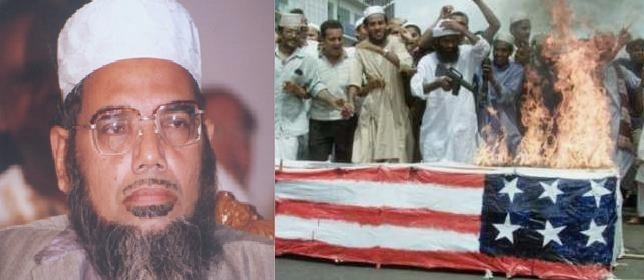
Notorious Islamist leader Mufti Fazlul Huq Amini
Notorious Islamist leader Mufti Fazlul Huq Amini.
Mufti Fazlul Huq Amini and Moulana Rezaul Karim are known as notorious Jihadists in Bangladesh. They not only give instigations to Jihad, but also are actively involved in recruiting locals and sending them to various countries in the world for taking part in Jihadist notoriety. Amini, a teacher with Jamia Qurania Arabia Madrassa at Lalbagh area in Dhaka is the son-in-law of late Moulana Mohammed Ullah aka Hafezzi Huzur. Since past few decades, Fazlul Huq Amini is involved in giving provocative lectures to Muslim youths with the agenda of poisoning their minds against United States, the West, Israel, India, Christians and Jews. Few years back, in a number of open rallies and public meetings in Bangladesh, Amini and his follower chanted slogan “We shall be Talibans – Bangla will be Afghan”.

Both Amini and Karim are categorically engaged in justifying Jihad and killing of non-Muslims as holy tasks for Muslims. They also are gaining strength with the goal of transforming Bangladesh into a Sharia state. Maulana Rezaul Karim runs a residential madrassa at Charmonai, southern part of Bangladesh. During the war hundreds of Hindu and non-Muslim women were violated by the Pakistani troops inside the campus of the Madrassa. His father, late Moulana Fazlul Karim is known as one of the notorious war criminals in Bangladesh. Fazlul Karim was also one of the top funders and patrons of anti-Ahmadiya activities inside Bangladesh, where Mufti Fazlul Huq Amini acted as virtual second-in-command of this man. During the atrocious activities of anti-Ahmadiya groups in Bangladesh, notorieties continues of this particular religious sect in the country as well as dozens of Ahmadiya mosques were attacked and demolished.

Recently, these two clergies made extremely seditious and offensive statements against Bangladesh in a public meeting, which was organized to press demand to lift High Court’s ban on Fatwa. They said, “if the ruling of the High Court banning Fatwa is upheld by the Supreme Court [judgement in this issue is expected to be declared on Marsh 21, 2011], we shall go for sacrificing lives en messe”.

The said, “hundreds and thousands of people will lay seize at the Supreme Court premises on march 21, 2011, when the court gives its judgement. And if any anti Islam ruling is given [upholding the ban on Fatwa], we shall seize the Prime Minister’s office, parliament and the Supreme Court”.

The clergies said, they want Bangladesh to be ruled under Sharia law.

Moulana Rezaul Karim said, “We shall see, how many people police can kill”. We shall color the streets with human blood if any decision against Islam is taken by the government or the judiciary in the country”.

Following this statement, the Muslim clergies are now engaged in collecting names of people who would be willing to sacrifice lives right from March 21, if the ban on Fatwa is continues. It may be mentioned here that, Moulana Rezaul Karim has a few million of supporters, while Mufti Fazlul Huq Amini is enjoying the status of a local version of Osama Bin Laden with his millions of followers and supporters within the Koranic madrassas in Bangladesh. Sensing the degree of severe consequence and extreme risk of lives of the civilians of the country, following the recent statement of these clergies, a Write Petition has already been filed with Bangladesh Supreme Court on March 13, 2011 bringing attention of the court to such activities of Mufti Fazlul Huq Amini and Moulana Rezaul Karim. Writ petition number: 2237. The matter was already raised before the court and the judge decided to hear the issue in presence of the Attorney General.

Meanwhile, hearing the news of this writ petition, Moulana Rezaul Karim in a public meeting held at the auditorium of Bangladesh Supreme Court on March 15, 2011 said, “Enemies of Islam are now conspiring to tarnish the image of Muslims and they are also actively working in seeing fatwa to be banned in the country”.

Karim said, “Enemies of Islam shall be given proper lesson in due course of time”.

It is important to mention here that, anticipating Supreme Court’s decision against fatwa, these Islamist clergies have already called for dawn-to-dusk general strike in Bangladesh on April 4. Notorious Islamist groups like Hizbut Tahrir and Hizbut Towhid have extended support to this general strike and other activities of the Islamist clergies in favor of Sharia law.

In a recent statement published at their website, the leader of Hizbut Towhid, Bayejid Khan Panni said, “Stay alert against the enemies of Islam and Judeo-Christian agents. We must wage war against these elements, to uphold the glory of Islam”.

Tuesday, January 25, 2011

Rights group slams Pakistan for abuses

The daily Nation, Pakistan
 Thursday, January 25, 2011
Rights group slams Pakistan for abuses
Published January 25, 2011

NEW YORK — Pakistan came under sharp criticism for human rights abuses in 2010 while India escaped any direct rebuke for its atrocities in Kashmir and elsewhere in the country in a new report released by a prominent rights group on Monday.

The New York-based Human Rights Watch said the Taliban and other religious extremists in Pakistan increased their deadly attacks against civilians and public spaces during the past year, while the Pakistani government response was marred by serious human rights violations.

In doing so, HRW placed Pakistan on the list of most abusive countries. Others on the list are: Belarus, China, Colombia, Congo, Cuba, Egypt, Indonesia, Iran, Myanmar, North Korea, Saudi Arabia, Yemen, and Zimbabwe. The only negative reference to India came indirectly when the report chided democracies around the world are ignoring abuses by repressive regimes and opting for improved relations rather than condemning rights violations and curtailing aid. It said President Barack Obama’s “famed eloquence … has sometimes eluded him when it comes to defending human rights.” This was especially noticeable in contacts with countries that are important to US interests, such as China, India, Indonesia, Egypt and Bahrain, the group said.

The 649-page 2011 report, Human Rights Watch’s 21st annual review of human rights practices around the globe, summarises major human rights trends in more than 90 states and territories worldwide. Suicide bombings, armed attacks, and killings by the Taliban, al-Qaeda, and their affiliates targeted nearly every sector of Pakistani society, including religious minorities and journalists, resulting in hundreds of deaths.

The country’s largest cities bore the brunt of these attacks. Two attacks in late May 2010 against the Ahmadiyya religious community in Lahore killed nearly 100 people, it noted. On July 1, a suicide bombing at Data Darbar, shrine of the patron saint of Lahore, killed 40 people. Militant attacks targeting civilians in conflict areas amounted to war crimes.

“Taliban atrocities aren’t happening in a vacuum, but instead often with covert support from elements in the intelligence services and law enforcement agencies,” Ali Dayan Hasan, senior South Asia researcher at Human Rights Watch, said in a statement. “The Pakistan government needs to use all lawful means to hold those responsible to account.” The government’s response to militant attacks instead has routinely violated basic rights, Human Rights Watch said. Thousands of Taliban suspects have been held in unlawful military detention without charge, many of them in two military facilities in Swat, one in the Khyber agency of the tribal areas, and at least one more in Khyber Pakhtunkhwa Province.

Saturday, January 15, 2011

Blasphemy allegations: Another Christian family on the run

Express Tribune, Pakistan
Pakistan
Punjab
Blasphemy allegations: Another Christian family on the run
Rana TanveerRana Tanveer
June 07, 2010
Supporters of one of several Namoos-i-Risalat groups, Shahab Islami Pakistan chant slogans and wave flags during a rally to support the assassin of Salmaan Taseer in Rawalpindi. PHOTO: AFP
LAHORE: Two Christian women were beaten and publically humiliated by an angry mob over apparently frivolous blasphemy allegations and they and their family are now in hiding for fear of being killed, The Express Tribune has learnt.

“None of our relatives is ready to let us stay with them. They fear the wrath of the extremists, particularly after the assassination of Salmaan Taseer,” a male member of the family said over the phone from an undisclosed location.

The family and a non-governmental organisation that is helping them asked that their identities not be revealed, lest it put them in further danger. The names mentioned here are fictitious.

According to the family, the allegations stem from a dispute between Amina, a Muslim, and her sister-in-law Zahira, a Christian, in an East Lahore locality. The two got into an argument on Tuesday night and though it appeared to have been settled, on Wednesday morning, after her husband Zahid had gone to work, Amina walked out onto the street and started shouting that Zahira had abused the Holy Prophet (pbuh).

A short while later, a group of men led by Muhammad Sameer, a member of a religious organisation keen on raising its sectarian profile, forced their way into the house and started slapping Zahira, said another of her brothers, Sohail. “Other men and women from the neighbourhood started gathering at the house too and they beat up my sister and mother. They were the only people in the house,” he said.

“We tried our best to get her to confess her crime,” Sameer told The Express Tribune. As a member of the religious organisation, he said he could not tolerate any derogatory remarks about the Holy Prophet (pbuh).

Sameer added that he was very proud of his wife’s performance during the mob beating. “She beat Zahira more than anyone else. Her hand is so swollen that she hasn’t been able to make rotis since the day of the incident. I’ve been getting my meals from a restaurant,” he said.

Malik Mumtaz Qadri, the self-confessed assassin of Salmaan Taseer, is a member of the same group as Sameer. The group also runs a twenty-four hour cable TV channel.

Khadim Hazoor, Sameer’s son-in-law and another participant in the beating, said that the women’s faces were blackened and they were made to wear necklaces of shoes and paraded around the locality on donkeys to humiliate them. He said the women denied blaspheming and repeatedly touched their feet seeking mercy.

He said the people of the locality would not allow Zahid or his family to return to their house, which he lives next door to. He claimed that the fight between Zahira and Amina the night before the incident revolved around the upbringing of Zahid and Amina’s 18-month-old daughter. Amina had wanted to raise her daughter as a Muslim, but Zahira wanted her niece to be raised as a Christian, he said.

Hazoor accused Zahid of “cheating Islam” by pretending to convert from Christianity to Islam so he could marry the Muslim girl. “We will not let them live in this house. He has not only cheated Amina but also Islam,” he said.

Zameer Khan, an NGO worker, helped the family flee the locality after they were attacked. “Apparently there was no blasphemy, just an argument between two women,” he said.

He said after hearing of the incident, he had reached the scene to find the women being attacked. He said he had asked the mob if anyone had heard Zahira utter any blasphemous remarks, to which they all replied in the negative. He said he persuaded them to let the women go while he investigated the matter. He then helped relocate the family temporarily. He said he had also convinced the mob not to involve the police.

Published in The Express Tribune, January 15th, 2011.

Thursday, January 13, 2011

Pakistan’s Pols Paralyzed by Religious Extremism

Time CNN, USAWorld
Pakistan’s Pols Paralyzed by Religious Extremism
Thursday, Jan. 13, 2011 By Omar Waraich / Islamabad
Pakistani Islamists attend a rally supporting the blasphemy law on Jan. 9, 2011, in Karachi. Asif Hassan/AFP/Getty Images
Pakistan’s President Asif Ali Zardari will visit the White House on Friday, amid growing U.S. concern that his country is drifting into the embrace of Islamist extremism. The brutal assassination of Punjab Governor Salmaan Taseer, over his moves to reform a blasphemy law used to persecute religious minorities, has been a shocking indicator: Taseer was shot 27 times by one of his own bodyguards, while the others looked on. The murder was widely celebrated in Pakistan, and its confessed perpetrator, Mumtaz Qadri, has been lionized by tens of thousands of demonstrators on the street, while the liberal element personified by Taseer has been marginalized. The unrestrained march of extremism in the world’s second largest Muslim nation — the only one with nuclear weapons — and on whose support the U.S. is depending in Afghanistan is a clear cause for anxiety in Washington. “Societies that tolerate such actions,” Vice President Joe Biden told reporters during a brief visit to Islamabad on Wednesday, “end up being consumed by those actions.”

Still, despite worrying signs, it’s easy to overstate the Islamist challenge. Pakistan’s religious parties remain at the political margins, usually sharing between them less than 10% of the vote. “It’s the secular forces that have always been in power, whether it was the military or the main political parties,” says opposition lawmaker Ayaz Amir. “The clerical forces are entitled to articulate whatever they want to. But who’s been succumbing, who’s been doing the backtracking? It’s the secular forces.” Successive governments have attempted for political reasons to placate the religious right with concessions. The same principle was evident in the current government’s capitulation to the conservatives on the blasphemy law, making clear in the wake of Taseer’s murder that it has no intention of pursuing his effort to reform the measure.

Taseer’s assassination certainly presented a formidable challenge, by bringing together erstwhile enemies in the religious camp in a rare show of unity. The crowd of 40,000 on the streets of Karachi last weekend celebrating Taseer’s murder included such sects as the typically moderate Barelvis, their more hard-line rival Deobandis, the even more extreme Wahhabis, and even the Shi’ites so often targeted by the more extreme Sunni sects. Groups that are more inclined to fight one another than to pray together have found common cause on blasphemy. “It’s the one issue where you can put together more people on the streets than are willing to vote for you,” says analyst Mosharraf Zaidi. The religious right now feels emboldened by the impassiveness of secular parties and the state: no one who threatened to kill Taseer and other like-minded politicians has been arrested.

Among the keenest supporters of Qadri was the Sunni Tehreek, an armed group headquartered in Karachi that opposes the Taliban and related extremists. The group has donated a reward to Qadri’s family and issued threats against Taseer’s daughter. “Qadri did what he did out of his religious conviction,” says Fahimuddin Sheikh, a spokesman for the Sunni Tehreek. But, he adds, “We are very much against the Taliban and the terrorists. We haven’t just supported the army’s offensives against them, but mounted rallies in support of them. These are people who want to use the gun to impose their views.” Which, of course, is exactly what Taseer’s assassin appears to have been doing.

Like Qadri, the members of the Sunni Tehreek are drawn from the Barelvi sect, estimated to make up 80% of the population. In recent years, Barelvi shrines and leaders have been attacked by Taliban-affiliated militants who deem their practices heretical. But when it comes to defending the “honor of the Prophet,” the Barelvis can be fiercer than other sects, and Taseer’s opposition to the blasphemy laws was cast as an act of blasphemy. It was always misleading to cast the Barelvis as exemplars of tolerance, says lawmaker Amir. “This impression really comes down to the Barelvis’ support for our recent wars against the Taliban,” he adds. “Otherwise they’ve been involved in the spread of religiosity in Pakistani society. That’s the problem with Pakistan: too much religion.”

The spread of religiosity has created a sense of religious guilt and shame in much of mainstream Pakistan, analysts say, pulling the consensus in a more conservative direction. Within hours of the killing, some 2,000 Pakistanis, most conversant in English, had joined a Facebook fan page dedicated to Qadri before it was shut down. They were not fundamentalists, nor were they averse to Western culture. “If you go through the profiles of Qadri supporters on Facebook, you’d think Justin Bieber was the cause of extremism in Pakistan,” tweeted the Pakistani blogger Kala Kawa. Says analyst Zaidi: “Articulating love for the Prophet is a way people purge their guilt. They see blasphemy as a red line, and if it’s seen to be crossed, they say they’re on board.”

Pakistani tensions over religion don’t exist independently of the tensions of social class in this grotesquely unequal society. After Taseer’s assassination, many liberals discovered to their horror that their domestic staff didn’t share their grief; some smiled at the news. Even though the governor had come from a modest background, many Pakistanis saw him as epitomizing a wealthy, English-speaking, liberal elite. “If you’re from the Urdu-schooled mainstream of the country, the assertiveness of the class rubs you the wrong way,” says Zaidi. “And it’s easy to depict someone who’s outwardly Westernized as being distant from religion.” Taseer’s status as a high-profile politician also diluted any sympathy for him from those sections of the population resentful of a political class they perceive as being inept, distant and venal.

Opposition to the U.S. war in Afghanistan and the Taliban’s claim to represent a purer form of Islam made it difficult for the Pakistani authorities to rally public support against the domestic extremist challenge. It was only after the Pakistani Taliban revealed its brutality in parts of the country over which it had gained control that public support swung behind a military offensive to drive them out. But Taseer’s assassination is an uncomfortable reminder of a religious intolerance deeply embedded within the country’s mainstream, which no Pakistani government is likely to risk confronting head-on.

© 2011 Time Inc. All rights reserved
URL: www.time.com/time/world/article/0,8599,2042522,00.html

Thursday, January 6, 2011

Religious parties pledge support to assassin

The daily Nation, Pakistan
 Thursday, January 06, 2011
Religious parties pledge support to assassin
Published January 06, 2011

Assassin Mumtaz Hussain Qadri
MULTAN/KARACHI – The religious parties Wednesday were all praise for Mumtaz Hussain Qadri, the assassin of Punjab Governor Salmaan Taseer, and warned the govt that any attempt to repeal or amend the blasphemy law would be resisted.

In Multan, Tehrik Tahaffuz-e-Namoos-e-Risalat (TTNR) offered full legal and moral support to Qadri, saying no stone would be left unturned to get him released.

“We’ll dedicate our all out energies and resources for the sacred cause. We’re also going to hold a ‘successful’ public meeting in Karachi on January 9 for the protection of the Namoos-e-Risalat,” announced a joint declaration issued by the Multan chapter of the body after an emergency meeting held at the Jama’at-e-Islami (JI) office.

The meeting, chaired by the local president of TTNR Mufti Hidayatullah Pasroori, was attended by the representatives of all religious parties including JI, JUP, JUI and Jamiat Ahl-e-Hadith besides lawyers and traders.

“The arrest of family members of Ghazi Mumtaz Hussain Qadri is highly condemnable. The government has no logic to detain them. They should be released forthwith,” demanded the declaration.

The clerics further asked of the government to immediately dissolve the committee formed by President Asif Ali Zardari to amend the blasphemy law (295-C) and withdraw Sherry Rehman’s bill; otherwise, the rulers would be responsible for any related development.

“He (Salmaan Taseer) himself is responsible for his killing. No Muslim can tolerate blasphemy,” said Pasroori while addressing the meeting. He said the killing of someone on the issue of blasphemy was nothing new in the region. “Those who committed blasphemy have been facing the same fate in the past.”

TTNR Secretary-General Dr Ashraf Ali Ateeq warned the rulers to mend their ways and seek forgiveness from Almighty Allah for their blasphemous behaviours. “They’re bent upon hurting the religious sentiments of Muslims to appease their foreign masters. We warn them to refrain from making such ill-advised moves; otherwise, they’ll have to face serious consequences,” he added.

Wednesday, January 5, 2011

Salmaan Taseer: murder in an extremist climate

Guardian, UK
Comment is free > Cif Belief
Salmaan Taseer: murder in an extremist climate
Intolerance, extremism and vigilantism are devouring us all in Pakistan. Yet the authorities still allow hate to be cultivated
Sana Saleem
Sana Saleem
guardian.co.uk, Wednesday 5 January 2011 12.14 GMT
Pakistani bodyguard Malik Mumtaz Hussain Qadri sits in a police van after being arrested at the site of a fatal attack on Salmaan Taseer, the governor of Punjab, in Islamabad yesterday. Photograph: Sabir Khan/AFP/Getty Images
It was less than a month ago that a Muslim cleric from Peshawar, Yousaf Qureshi, publicly offered money to anyone who would kill Aasia Bibi; kill in the name of the blasphemy law. Despite the public announcement and incitement to murder for money, no action was taken against this man. It was overlooked as an emotional outburst.

However, these public incitements to murder and violence do not always end there; there are many waiting to carry out such acts in the name of religion. On Tuesday, one such man gunned down Salmaan Taseer, Punjab governor, business tycoon and a vocal critic of abuse of the blasphemy law. Taseer was shot dead outside a restaurant in Islamabad by one of his own guards, Malik Mumtaz Hussain Qadri. Shortly afterwards, he handed himself to police, beaming with pride in front of cameras while confessing that he had killed Taseer because of his opposition to the blasphemy law. As Taseer’s bullet-riddled body was taken to hospital, later to be pronounced dead, Qadri’s confession was broadcast on television. A young bearded man, smiling, staring right into the camera while confessing a murder. There was no sign of remorse, only an uncanny smile reflecting reassurance that God will accept his great deed.

Shamefully, Qadri is not alone, as many as eight Facebook fan pages sprang up within a few hours, pronouncing Qadri a “hero” and a “son of Pakistan”. Clerics announced that Taseer’s death can’t be mourned because he supported a blasphemer, Bibi. In one breath, television anchors described his death as a great loss at this time of political instability and questioned his stance on the blasphemy law.

The interior minister, while talking to the media, spoke about the need for added security for government personnel and emphasised the importance of better scrutiny of those who join the elite forces. However, the real cause of Taseer’s assassination was only whispered, minced with other issues, when it should be the only thing on our minds. His death is more than just a political loss, it is a reminder of the extremism, bigotry and intolerance that has been brewing in the very heart of this country. The roots of this can be tracked back over three decades, when murder became justified in the name of religion, when killing someone for having an opinion became a law in this country.

His death indicates the strength of the forces Pakistan is up against. It highlights the inhumanity that is propagated by these draconian laws. As an activist, I will not allow his death and the cause he stood for to go in vain. We can’t afford to succumb to extremism. His murder is a message to everyone in Pakistan who stands for justice and humanity, that the intolerance, the extremism, the vigilantism has devoured us all as a society. It is a threat to silence all those who stand for justice, to make them kowtow to extremism or have their heads struck off in the name of religion. Civil society in Pakistan and everyone else who has been struggling for justice needs to come forth stronger than before.

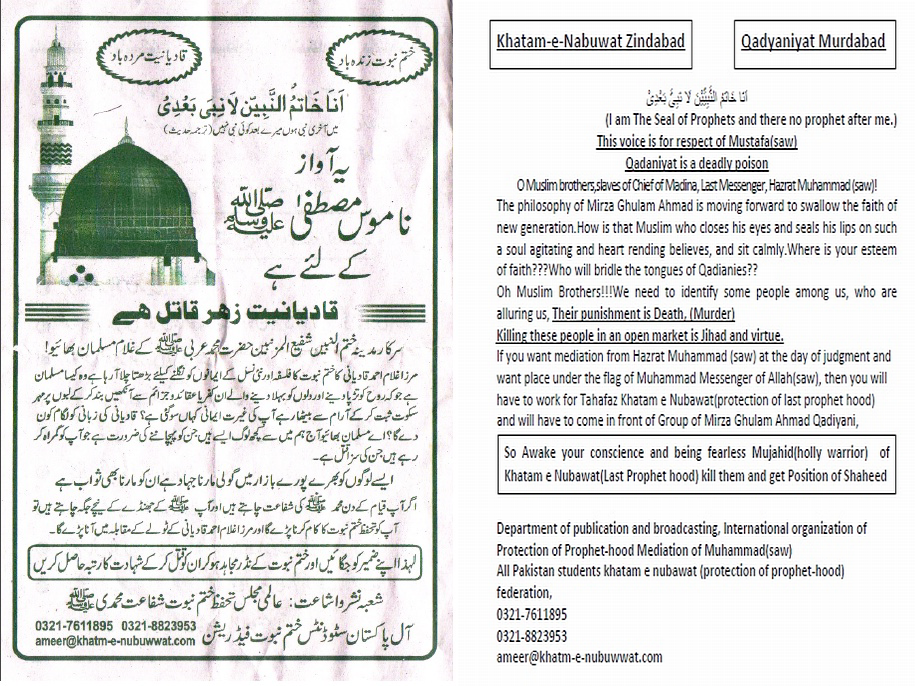
Taseer’s assassination was orchestrated through public announcements, hate speech on television, text messages and even by distributing pamphlets. Each one of these actions was overlooked, eventually leading to Taseer’s cold murder. As for the authorities in Pakistan, they should realise that no amount of security will help, when the extremist mindsets and factors that cultivate them continue to be tolerated. Until the state takes firm action against the hate campaigns, many more Qadris will spring up ready to gun down anyone who dares to speak out against injustice.

© Guardian News and Media Limited 2011
URL: www.guardian.co.uk/commentisfree/belief/20...r-pakistan

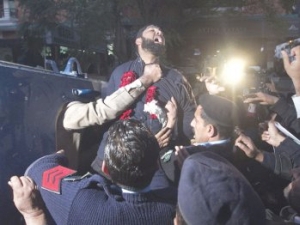
Lawyers shower roses for governor’s killer

Daily Dawn, Pakistan
Pakistan
Lawyers shower roses for governor’s killer
AP
January 05, 2011
Malik Mumtaz Hussain Qadri, the bodyguard arrested for the killing of Punjab Governor Salman Taseer, shouts religious slogans while being taken away by police after he was presented at a court in Islamabad. - Reuters Photo

LAHORE: Lawyers showered the suspected killer of a prominent Pakistani governor with rose petals when he arrived at court Wednesday and an influential Muslim scholars group praised the assassination of the outspoken opponent of laws that order death for those who insult Islam.

Mumtaz Qadri made his first appearance in an Islamabad court, where a judge remanded him in custody a day after he allegedly sprayed automatic gunfire at the back of Punjab province Gov. Salman Taseer while he was supposed to be protecting him as a bodyguard.

A rowdy crowd slapped him on the back and kissed his cheek as he was escorted inside. The lawyers who tossed handfuls of rose petals over him were not involved in the case.

As he left the court, a crowd of about 200 sympathizers chanted “death is acceptable for Muhammad’s slave.” The suspect stood at the back door of an armored police van with a flower necklace given to him by an admirer and repeatedly yelled “God is great.”

More than 500 clerics and scholars from the group Jamat Ahle Sunnat said no one should pray or express regret for the killing of the governor. The group representing Pakistan’s majority Barelvi sect, which follows a brand of Islam considered moderate, also issued a veiled threat to other opponents of the blasphemy laws.

“The supporter is as equally guilty as one who committed blasphemy,” the group warned in a statement, adding politicians, the media and others should learn ”a lesson from the exemplary death.”

Jamat leader Maulana Shah Turabul Haq Qadri paid “glorious tribute to the murderer … for his courage, bravery and religious honor and integrity.”

Mumtaz Qadri told interrogators Tuesday that he shot the liberal Taseer multiple times because of the politician’s vocal opposition to the harsh blasphemy laws.

©2010 DAWN Media Group. All rights reserved
URL: www.dawn.com/2011/01/05/lawyers-shower-...-killer.html

Tuesday, December 28, 2010

Religious parties announce strike over blasphemy issue

Daily Dawn, Pakistan
National
Religious parties announce strike over blasphemy issue
From the Newspaper
December 28, 2010

PESHAWAR, Dec 27: Tehrik-i-Namoos-i-Risalat has announced a province-wide shutter down strike in Khyber Pakhtunkhwa on Dec 31 to stall any move for making amendments to the blasphemy law and appealed to business community to make the strike a success.

The decision was taken in a meeting of the steering committee of Tehrik-i-Namoos-i-Risalat at Al-Markaz-i-Islami with its convener Shabir Ahmed Khan in the chair here on Monday.

Those who attended the meeting included Shamsur Rehman Shamsi and Maulana Amanat Shah of the JUI-F, Ikramullah Shahid and Maulana Abdul Haseeb Haqqani of JUI-S, Fayaz Khan and Maulana Merajuddin of JUP, Fazalur Rehman Madni of Markazi Jamiat Ahle Hadith, Ramzan Tauqeer of Tehrik-i-Islami, and Israrullah advocate and Hamidullah Jan of JI.

The participants criticised Punjab Governor Salman Taseer and Pakistan People`s Party MNA Sherry Rehman for their attempt to help release the blasphemy convict Aasia Bibi.

“There is no room for changes in the blasphemy law as it is a matter of faith,” they unanimously said and asked the government to forthwith reject the bill presented by Sherry Rehman in the National Assembly for amendment to the law.

Holding their respective party flags activists of all the religious parties would hold rallies and public meetings in different districts, and the traders would keep the shutters down to express solidarity with the Tehrik-i-Namoos-i-Risalat.

The meeting decided that the district leadership of all the parties would hold meetings with traders to seek their complete support for shutter down strike. However, the traffic will remain smooth in all the districts. The steering committee will meet again today (Tuesday).

©2010 DAWN Media Group. All rights reserved
URL: www.dawn.com/2010/12/28/religious-parties-announce...issue.html

Saturday, December 25, 2010

Marchers vow to defend blasphemy law

The daily Nation, Pakistan
 Saturday, December 25, 2010

Marchers vow to defend blasphemy law
Published December 25, 2010

LAHORE/
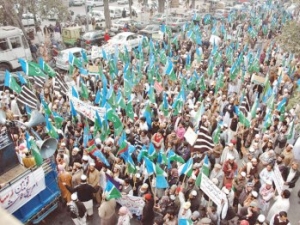
RAWALPINDI - On the call of Tehrik Namoos-e-Risalat, tens of thousands of activists of various religious parties on Friday organised countrywide protest demonstrations against government’s bid to amend the controversial Blasphemy Law.

The organisations expressed their unanimous support for the law, as they observed Tahafuz-e-Namoos-e-Risalat Day across the country. They threatened to hold more countrywide protests and surround the parliament house if the government went ahead with changes to the controversial law. Mammoth rallies were organised in several cities, including Islamabad, Lahore, Rawalpindi, Multan, Quetta and Karachi by the religious groups.

In Lahore, a protest rally, led by clerics from various religious organisations, was taken out from Masjid-e-Shuhada. Activists of Jama’at-e-Islami, Jamiat Ulema-e-Islam, Jamiat Ulema-e-Pakistan and other religious parties turned up in large numbers to lodge their protest against government’s attempts to amend the Law.

Qari Zawar Bahadur, Maulana Amjad Khan, Dr Waseem Akhtar, Ameer-ul-Azeem, Abd-ur-Raof Farooqi, Maulana Aziz-ur-Rahman and others addressed on the occasion. The protesters called for jihad and vowed to make sacrifices to protect the honour of Holy Prophet Muhammad (PBUH). They chanted slogans against government and demanded dismissal of Punjab Governor Salmaam Taseer. They said they would not tolerate any to change the law.” They threatened to launch a national movement.

In Rawalpindi, a rally was taken out from Darul Aloom Taleem-ul-Quran to Fawara Chowk, Raja Bazaar.

Led by Ahl-e-Sunnat Wal Jama’at (ASWJ) Pakistan head Maulana Muhammad Ahmed Ludyanwi, other participants of the rally were JUI-F Secretary-General Maulana Abdul Ghafoor Haidri, Wifaq-ul-Mudaris Nazim Maulana Qazi Abdul Rasheed and JI Markazi Naib Ameer Dr Muhammad Kamal.

While addressing the participants, the speakers said all the ulema and the nation were united and would also render sacrifices to guard the dignity of the Holy Prophet Muhammad (PBUH).

They urged the UN to formulate a law to protect the dignity of all the prophets and award death sentences to those who harmed their nobility.

“PPP-led government should shelve the idea of amending the law as the masses will never allow it to do so in a country which came into being in the name of Islam,” they added.

They demanded of the government to dismiss Governor Punjab Salmaan Taseer from his office immediately.

Sunday, December 12, 2010

Anti-blasphemy resolution at UN is absurd

Calgary Herald, Canada
Anti-blasphemy resolution at UN is absurd
By Dan Shapiro, For The Calgary Herald DECEMBER 12, 2010

The recent UN Human Rights Council draft resolution on “Combating defamation of religions” would make George Orwell roll over in his grave. If adopted by the UN General Assembly, it will give governments around the world unacceptable powers.

In the name of preventing religious discrimination, the resolution insulates religious orthodoxy from all criticism. The resolution is incoherent, self-contradictory and a gross violation of the fundamental freedoms of religion and expression.

Sponsored by Morocco on behalf of the Organization of the Islamic Conference (OIC), it lends cover and legitimacy to the blasphemy laws of oppressive states which do not respect their citizens’ religious freedom. It thus precludes any possibility of an Islamic reformation, the very thing many Muslims want.

How can you “defame” a religion by saying something “false” about it? “Defamation” involves making a purportedly factual claim about someone that harms their reputation, but is false. For example, Jerry Falwell famously sued Hustler publisher Larry Flynt for printing a cartoon implying Falwell had sex with his own mother in an outhouse. The U.S. Supreme Court ruled that public figures such as Falwell cannot be protected from offensive speech recognizable as satire. Why, then, should “religious symbols and venerated personalities” be protected from ridicule, as the resolution suggests?

Besides, religious disagreement is a very different beast than protecting individuals’ reputations. It is about the truth or falsity of the religion or religious claims. So, you can’t have a law against saying something “false” about a religion precisely because there is no agreed upon means of determining truth or falsity here.

If religious disputes are to be decided by the state, they will come down on the side of orthodoxy and against dissenting views every time.

The resolution claims, disingenuously, that it aims to combat discrimination based on religion. Of course, we should combat actual religious discrimination. For example, if you don’t get a job because you are Muslim or a Jew, that is unjustifiable discrimination. But this doesn’t mean that Islam or Judaism should be protected from criticism and debate.

The resolution is incoherent because it targets the wrong kind of discrimination and protects the wrong entities. Individuals have human rights to be protected; ideas, ideologies, religions and states do not.

Yet, the resolution claims that it protects freedom of religion. Invoking a measure that restricts freedom of religion (by seeking to make it illegal to express religious views that differ from official opinion) is a funny way to protect this fundamental freedom.

Belief systems such as religions are not homogeneous. Blasphemy laws exacerbate, rather than reduce, discrimination based on religion. Such laws violate state neutrality, since the state evaluates competing religious claims and punishes the dissenting minority.

Minorities who differ from the majority religion, for example Christians or non-believers in Muslim-majority countries, are at risk. So too are minority co-religionists, such as Ahmadis who do not view Muhammad as the last Prophet and are persecuted as apostates in many Muslim-majority countries.

Case in point: “Although Christians, Ahmadis, and Hindus make up less than three per cent of Pakistan’s population, they have accounted for about half of the blasphemy defendants over the last two decades,” according to “Policing Belief,” a recent Freedom House report. Pakistan’s Penal Code imposes capital punishment for blasphemy, including for defamation of Islam.

You can’t have meaningful freedom of religion and conscience without robust freedom of speech. For if we’re not free to express our deeply held beliefs, then it makes no sense to speak of freedom of religion and conscience.

In the case of blasphemy or “defamation of religion” laws, there is a dangerously slippery slope since they are often used to punish political opponents and dissidents. For example, bloggers in Pakistan and Iran who have criticized their governments have been charged with “defaming Islam.”

Unfortunately, it bears constant repetition: No government, church, mosque, synagogue or UN Human Rights Council should coerce you into thinking or saying – or, not thinking or not saying – what you believe (short of the infamous yelling “fire” in a crowded theatre exception).

The “defamation of religions” resolution is not about protecting human rights; it is about justifying repression of opinion not sanctioned by the authorities. The resolution does not advance freedom of religion; on the contrary, it curtails it in dangerous ways.

Dan Shapiro is a research associate with the Sheldon Chumir Foundation for Ethics in Leadership.

Copyright © The Calgary Herald

Sunday, December 5, 2010

In the name of God

Daily Times, Pakistan
Sunday,
December 05, 2010

VIEW: In the name of God — Andleeb Abbas

Andleeb AbbasReligion has become license to categorise and exorcise personal vendettas. The Blasphemy Law, which itself is blasphemy against the legal system of Pakistan, is a shameful intention of maligned intentions and misrepresentation of Islamic law, letter and spirit


“For God’s sake” is the best license to deceive and decree anybody and everybody. From an ordinary beggar on the street to the big guns responsible for ‘religious affairs’ in Pakistan, all is holy and sanctimonious for religion and the Almighty. Hajj, which is the highest and purest of spiritual cleansing practices for a Muslim, has been turned into a filthy game of money guzzling and insatiable greed, completely degrading the spirit and soul of the occasion. The shameful treatment meted out to the pilgrims from Pakistan is now open news with all implicated busy trying to shrug the filth off their shoulders and pile it on whoever is trying to implicate them in this ruthless game of snatching other people’s money.

The government, deaf to the pleas of the suffering pilgrims, was finally forced into action when the Supreme Court received a letter by Saudi Prince Bandar Bin Khalid alleging corruption of billions by the local ministry of religious affairs, which was managing the travel and boarding facilities of the pilgrims. According to him, the accommodation he was offering was only 2 km from the Haram and was priced at Saudi Riyals 33.50 while the one chosen by the ministry was far away and was rented at the cost of Saudi Riyals 3,600. The living conditions were so bad that people had little access to proper tenting and basic water and toilet facilities. Imagine their focus on surviving the lack of facilities rather than getting closer to God. As the Pandora’s Box opens, whistle-blowing becomes a favourite pastime of the people involved. The Pakistani Ambassador in Saudi Arabia has blamed it on the minister of religious affairs who in turn has blamed and ordered the arrest of DG Hajj, Rao Shakeel. The prime minister has ordered his customary enquiry and has gladly accepted the generous offer of the Saudi government to give Saudi Riyals 250 per pilgrim as token compensation for the difficulties faced by them, caused by their own corrupt leaders.

Hajj is the single biggest religious congregation in the world and is a huge miracle of almost three million people bowing in front of the Almighty in submission of their flawed humanity. However, this ritual where the rich and poor, black and the not-so-black are supposed to stand equal and go through the tough rituals with due endurance has also become a marketing and money making religious tourism package industry. Various groups have introduced differentiated packages that include special early flights, customised training and education programmes, six-star facilities and a grouping of who is who to give the feeling of exclusivity to these privileged classes. How on earth such discrimination serves the purpose of Hajj, which is a symbol of humility, inclusivity and equality, God only knows. The exploitation of religion is not a new phenomenon but what is novel in today’s world is what a professional and organised industry it has become, which targets every single religious instinct anyone has to ensnare and entrap vulnerable minds, be it the ignorance and innocence of a suicide bomber, the guilt of middle-class morality or the pomp and religiosity of the elite of society.

Religion has become license to categorise and exorcise personal vendettas. The Blasphemy Law, which itself is blasphemy against the legal system of Pakistan, is a shameful intention of maligned intentions and misrepresentation of Islamic law, letter and spirit. Aasia Bibi’s case may have become the favourite topic of talk shows and a chance for the ruling and opposition party to procure the unfound, favourable limelight. However, the fact remains that this law itself is Tauheen-e-Risalat. The hallmark of the Holy Prophet (PBUH) was his magnanimity of heart and humility of action. His exemplary patience and abstinence from retaliation was what made him the greatest of the greats and converted the bitterest of his enemies into the most loyal of followers. The religious parties, including the Jamaat-e-Islami (JI), Jamiat Ulema-e-Islam (JUI) and so many other groups of Islamic defaming factions, are busy condemning those who dare touch the ‘holy’ law of blasphemy and threatening hell on earth to all those who dare question the interpretation of Islamic laws other than the ones decreed by them. This arrogance and insecurity of the religious clergy has always brought about their downfall and will again reduce them to a meaningless and irritating political echo.

These religious factions, no matter how irritating, are loud and obvious. The more worrying fact is the rise of the educated and sophisticated religious resellers who are subtle and devious in their apparently modern enlightenment version of Islam. These cosmetically well read Islamic exhibitors, at the peak of their life, claim to have done a deep study of Islam, which has transformed them into humble orators who can quote a Quranic verse at will to support any western quotation they may have uttered earlier on. It is this new breed of pseudo-reformed Islamists, having perfected the art of religious hypocrisy, who present the most dangerous trend in ‘Godly’ exploitation in the present times. They are dangerous because they have a higher credibility and following than the mullahs and thus actually disturb and disarm young minds more than the screaming imam with his predictable pre-Friday prayer condemnations.

Humanity is a universal religion and only its true followers and practitioners have the right to be called Muslim or Christian or any other title. God never believed in names only and He, through His prophets, gave the message of how a human gets the right of being, of existing, of elevating himself to the highest of cadres by respecting the differences in other people, by forgiving other people’s misdeeds and by concentrating on developing in oneself values of integrity, patience and tolerance. It is the flagrant devaluation of these principles that has, today, made the brand name Muslim such a dubious and distrustful trademark, which is associated with terror, intolerance and violence. It is thus not only for God’s sake but for the sake of the revival of the human race’s supremacy over all other species that we need to understand that religion without humanity and compassion is itself the biggest blasphemy, turning ‘mankind’ into ‘mancruel’.

The writer is a consultant and can be reached at andleeb@franklincoveysouthasia.com

Friday, December 3, 2010

COMMENT: The blasphemer must not be pardoned

Daily Times, Pakistan
Friday,
December 03, 2010

COMMENT: The blasphemer must not be pardoned — Abbas Zaidi

Allah has very, very explicitly said in the very beginning of the Quran that whosoever kills one human being is guilty of killing the entire humanity. Thus, by wanting to kill humans in the name of the Prophet (PBUH), these mullahs, in letter and spirit, want to launch an insane jihad against Allah

Hundreds of mullahs have taken to the streets to warn against the possible pardon President Zardari might grant Aasia Bibi, who allegedly blasphemed against Prophet Muhammad (PBUH). They say that if Aasia Bibi, the Christian blasphemer, is pardoned, they will launch a jihad against the government and the entire world and kill all the blasphemers. Aasia Bibi must not be pardoned. Otherwise, the lives of around five billion humans might be jeopardised. And now the Lahore High Court has also passed an order on the petition of a private citizen that the president cannot pardon Aasia Bibi because the case is sub judice. Why do mullahs so fanatically react to each case of perceived or alleged blasphemy?

The logic is very simple. Non-Muslims have, roughly speaking, two views of Prophet Muhammad (PBUH): (1) they (for instance, Christians and Jews) do not consider him to be a prophet at all, and (2) they (Hindus, Buddhists, and the rest) are not bothered about the issue at all. Now this is not acceptable as far as our furious mullahs are concerned. They demand that the world positively accept him to be the last prophet. Which effectively means that non-Muslims either convert or be ready for the sword.

Was Prophet Muhammad (PBUH) the last prophet of Islam or the world? This is a tricky issue, which the mullahs are not prepared to deal with. If he were the last prophet of Islam, then it would be unfair on our part to force non-Muslims to accept him as the last prophet of Islam. If prophet Muhammad (PBUH) was the last prophet of humankind, then we must look for guidance in the Holy Quran. And if the Holy Quran says that he was the last prophet of humanity, then we must seek guidance from the Book of Allah and see if Allah instructs us Muslims to wage a jihad against those who deny Prophet Muhammad’s (PBUH) prophetic finality. If Allah gives no such an instruction, then we Muslims must fear His wrath because Allah has very, very explicitly said in the very beginning of the Quran that whosoever kills one human being is guilt of killing the entire humanity. Thus, by wanting to kill humans in the name of the Prophet (PBUH), these mullahs, in letter and spirit, want to launch an insane jihad against Allah.

But my plea that Aasia Bibi must not be pardoned is based upon a different logic. If Aasia Bibi is pardoned, it would establish her guilt. The president of Pakistan has a constitutional privilege to pardon anyone who has been punished for some offence. Now this implies that the person pardoned is indeed guilty. Thus, it would mean that Aasia Bibi did, in fact, commit a crime of immensely heinous nature, which resulted in the death penalty verdict against her.

In 1992, the Pakistan government formulated the blasphemy law whose fruit Aasia Bibi is made to taste today. At that time, I wrote against the law saying that it would be misused by criminals and criminal-minded people to settle personal scores and commit acts of robbery and snatching people’s possessions. Many people resented my argument and blamed me for being a Jewish agent. Three mullahs came over to ‘see’ me in the newspaper office where I worked. Those were different times. Now I may be dealt with in a different manner. However, certain things never change. In 1992, I wrote that the stature of Prophet Muhammad (PBUH) was not so weak as to need, of all the people, Pakistanis for protection. I say the same thing today: the great Prophet (PBUH) needs no protection from a country which, year after year, is a contender for the top slot on the international list of the most corrupt countries. The Prophet (PBUH) does not need to be protected by the fascists who commit the ultimate blasphemy against Allah by killing people, His creation, in His prophet’s name.

The writer is a researcher with a PhD in sociolinguistics. He can be reached at hellozaidi@gmail.coma

URL: www.dailytimes.com.pk/default.asp?page=2010\12\03\story_3-12-2010_pg3_6

Wednesday, December 1, 2010

SIC warns against any change in blasphemy law

The daily Nation, Pakistan
 Wednesday, December 01, 2010
SIC warns against any change in blasphemy law
Published December 01, 2010

LAHORE — While rejecting the parliamentary committee constituted by the Prime Minister for proposing amendments in blasphemy laws, Sunni Ittehad Council (SIC) has warned the government of tough resistance if it undertakes any effort to amend the Islamic laws.

Sahibzada Fazal Karim, the SIC chief, expressed these views while addressing a Press conference at Lahore Press Club along with other leaders of the council on Tuesday.

He said no amendment could be made in the blasphemy laws according to the Article 227 of 1973 Constitution.

He informed that the SIC had formed a delegation to hold meetings with the members of Senate and national and provincial assemblies to convince them to deter government’s move to amend the blasphemy laws.

Sahibzada said the SIC delegation would also write letters to all members of the parliament in this regard.

He announced the SIC would observe a condemnation day on Friday across the country in which ulema and prayer leaders would slam the government’s repressive policies against the participants of the ‘Save Pakistan Long March’ and also adopt resolutions against government for suppressing the lovers of Holy Prophet.

Condemning the Indian atrocities in Held Kashmir, he said the leaders of SIC demanded that India not be given permanent membership of Security Council, as the New Delhi was responsible for the killing of more than 80,000 Kashmiris.

Castigating the policies of PPP-led coalition government, he claimed that the government had failed to deliver.

He further said the rulers were pursuing their personal interests only, leaving the country at the mercy of US drone attacks and terrorism.

Sahibzada said the SIC appreciated the Lahore High Court decision barring the government from pardoning the blasphemy convict, Aasia Masih, or extraditing her to the US.

He demanded that written-off loans be recovered, while the elite classes should bring their money to the country.

The SIC chief called upon the federal and provincial governments to take steps to maintain peace and harmony during the month of Muharram.

No minority rights in Pakistan

Daily Times, Pakistan
Wednesday,
December 01, 2010

COMMENT: No minority rights in Pakistan — Shahid Saeed

We live in such an ideologically insecure country hell-bent on maintaining our brand as an Islamic Republic that we undercount and under-report the percentage of minorities in our census. There is a barrier the size of the Great Wall of China that prevents minorities from becoming successful citizens in Pakistan

Amidst the outrage over the sentencing to death of Aasia Bibi, a 45-year old mother of five, over charges of blasphemy that seem difficult to prove and have triggered a debate on the blasphemy law itself, what has been conveniently ignored is the fact that the said incident occurred after people refused to drink water brought by Aasia Bibi, considering it to be napaak (impure). Ironically, it is socially acceptable that people belonging to the poor Christian community are treated despicably, considered unhygienic, called names such as choora (sewer cleaner), regardless of their actual profession. The accusers who refused to drink water brought by Aasia Bibi were somehow acting within religious guidelines. I would like to ask them whether they would act in the same manner if Aasia Bibi and her likes were to be replaced by white Caucasian Christian women. I am pretty positive that there would be no qualms in accepting that glass of water or food touched by Christians who are not chooras. Clearly, then, it is not a matter of religion but socio-economic status that makes people discriminate in such an outrageous and horrific manner in the name of religion.

A few years ago, the Capital Development Authority (CDA) had put up a banner on the Islamabad Expressway inviting the Christian biradari (community) to apply for janitorial jobs vacant at the CDA. Historically, Christians from poor backgrounds have served as janitors and cleaners, and many continue to do so whilst fighting social injustice, but for a government department to declare janitorial jobs solely reserved for Christians is disgusting. Our society tolerates, accepts and practises shameful, abominable and repulsive behaviour every day, all in the name of religion. My head hangs in shame.

We live in a country where, for a long time, elections were carried out under religious apartheid as minorities were denied their right to universal franchise by forcing separate electorates on them. The freedom to profess religion guaranteed by Article 20 of the constitution has been meaningless in the light of the legal and social discrimination against minorities. Article 20 grants people of all faiths freedom to “profess, practice and propagate” their religion, but the Second Amendment and Ordinance XX prohibit the Ahmedis from practising their religion openly and denies them the right to call themselves Muslims by categorising their faith for them. We guarantee them freedom of religion, only as long as the majority can feel secure by calling itself the constitutional Muslims and prohibiting the Ahmedis from nearly everything that they believe in, including the right to name their small town of Rabwah, as it has been rechristened Chenab Nagar. The insecurity of the majority sects has been written down in the Second Amendment and Ordinance XX and continues with constant court cases against the Ahmedis.

The fact is there are no minority rights in Pakistan. Minority members of parliament have to begin their speeches by first praising Islam and the government of Pakistan for guaranteeing them whatever limited rights they have, and still they are looked down upon by the ulema (sitting mostly on the treasury desks). It is as if we are doing a favour to them by extending basic humanitarian rights. The Hindu community has faced constant harassment and the number of forced conversions in Sindh has been on a constant rise. The Christian community faces social barriers of enormous proportions and has been the target of innumerable terrorist attacks too. Starting from partition when the Sikh and Hindu populations were killed in massive numbers, minority faiths have suffered immensely. The anti-Ahmedi agitation of 1953 started the wave of mass harassment and persecution that continues to this day. Temples have been razed, churches have been burnt and poor people lynched and killed in the name of religion.

From Shantinagar to Gojra, the history of this land is full of the murder of minorities at the hands of the self-proclaimed righteous guardians of religious boundaries. In a country where sectarian terrorism consumed thousands of lives and minorities have been forced to live in fear, Article 20 is nothing but hollow words.

We live in such an ideologically insecure country hell-bent on maintaining our brand as an Islamic Republic that we undercount and under-report the percentage of minorities in our census. There is a barrier the size of the Great Wall of China that prevents minorities from becoming successful citizens in Pakistan. The wall has been raised by legal and social measures that persecute them and discriminate against them. The majority Muslim population, hijacked by a significant number of hardline religious leaders and their followers, has made life for the minorities a living hell. They use mosque loudspeakers for telling them that they will inevitably go to hell in their afterlife.

With the passage of the Objectives Resolution, the fate of minorities in this country was sealed forever and the dream of the state envisaged in Jinnah’s August 11, 1947 speech had died. The report of the Court of Inquiry constituted under the Punjab Act II of 1954 to enquire into the Punjab Disturbances of 1953, commonly known as the Justice Munir report, had then answered some valid questions about the role of religion in the state. The ulema — disunited as they are on a million issues and unable to come to a single definition of a Muslim — were then nearly united, and still are, on how to treat minorities: they shall be zimmies and “will have no say in the making of law and no right to administer the law” and would not be allowed to propagate their religion. Summarising, the good Justices Munir and MR Kayani wrote: “It is this lack of bold and clear thinking, the inability to understand and take decisions which has brought about in Pakistan a confusion which will persist and repeatedly create situations of the kind we have been inquiring into until our leaders have a clear conception of the goal and of the means to reach it…The sublime faith called Islam will live even if our leaders are not there to enforce it. It lives in the individual, in his soul and outlook, in all his relations with God and men, from the cradle to the grave, and our politicians should understand that if Divine commands cannot make or keep a man a Musalman, their statutes will not.”

These words have proven to be prophetic and stand so apt for today, albeit with the caveat that we no longer have liberal judges who did not think secularism was a bogeyman. The 11-year rule of ‘Islamisation’ has changed our attitudes, ideologies and beliefs immensely, and now we teach our children lies that never were a part of our history. We are confused about the very ideology behind the creation of this country, what it was meant to be, what it has become and what it should be. The confusion persists, but with laws that demand a blind Safia Bibi to produce four witnesses to support her claim of rape, laws that allow honour killings to take place through forgiveness granted under diyat and laws that sentence people to death over fake blasphemy charges, we have arrived at a point where it is clear that theocracy has failed us. Only a secular, progressive and democratic Pakistan can guarantee social progress for the people of this country. Rest assured, the future looks bleak if things are to continue the way they are now.

The writer is interested in history and public policy. He can be reached at shahid@live.com.pk

SIC rejects move to amend blashphemy law

The News - Internet Edition
Wednesday, December 01, 2010
Zilhajj 24, 1431 A.H.
Lahore
SIC rejects move to amend blashphemy law

Wednesday, December 01, 2010
By Our Correspondent
Lahore

Sunni Ittehad CouncilSUNNI Ittehad Council (SIC) has rejected the parliamentary committee constituted by Prime Minister Gilani for proposing amendments to blasphemy laws and warned of tough resistance to any effort for amending Islamic legislation.

SIC has formed a high level delegation to hold meetings with Senatrs and MNAs and MPAs to convince them to reject the government move to amend the Blasphemy Laws, said Sunni Ittehad Council Chairman Sahabzada Fazal Karim and heads of other Sunni Ittehad Council component parties while addressing a press conference at the Lahore Press Club on Tuesday.

Fazal Karim said Sunni Ittehad Council had rejected the parliamentary committee for proposing amendments to Blasphemy Laws since no amendment could be made in that law under Article 227 of the Constitution providing protection to all Islamic laws in the country.

He said Sunni Ittehad Council delegation would also write letters to all members of the parliament to plead its case and to advise them to refrain from becoming part of any attempt to amend the Blasphemy Laws.

Fazal Karim praised the members and workers of SIC, a platform of religious arties of Barelvi school of thought, for their courage and valor in resisting the police highhandedness, arrests, baton charge and teargassing to join in the SIC’s Save Pakistan Long March and announced that Sunni Ittehad Council had decided to observe a condemnation day on Friday, December 3, all over the country in which Ulema and prayer leaders would condemn the government’s repressive policies and adopt resolutions lashing out at the government to suppress the ‘Lovers of Holy Prophet (SAW)’ and the school of thought which backed Quaid-e-Azam in Pakistan Movement.

Fazal Karim, who is head of his own faction of JUP and an MNA on Pakistan Muslim League-Nawaz ticket condemned the Pakistan Muslim League-Nawaz government of Punjab for blocking the SIC long march. He condemned general policies of the PPP-led coalition government in Islamabad for failing to deliver its electoral promises, adding that rulers were pursuing only personal interests while leaving the country at the mercy of drone attacks and terrorism which brought the country on the verge of destruction.

He said Sunni Ittehad Council praised LHC decision to bind the government against pardoning blasphemy convict Aasia Masih or to extradite her to US.

He also condemned rulers’ corruption which, accoding to him gulped down over 5 billion rupees from national kitty every year and left the country under a staggering $ 55 billion foreign debt and stressed that if rulers’ corruption could be controlled then the entire foreign debt could be paid off in one year.

Saturday, November 27, 2010

Several injured, arrested at Sunni Ittehad Council rally

Daily Dawn, Pakistan
Pakistan
Several injured, arrested at Sunni Ittehad Council rally
Agencies
November 27, 2010
The workers of Sunni Tehreek (ST) arriving on board Khyber Mail were arrested at Rawalpindi Railways station. — File Photo

ISLAMABAD: Over a hundred local leaders and activists of Sunni Ittehad Council were arrested on Saturday. Police stopped the rally near ‘Soha Rawalpindi, where the activists had held a sit-in protest and were determined to move forward.

Police in twin cities of Islamabad and Rawalpindi jump-started into action since Saturday morning in a bid to stem Council’s Long March from Islamabad to Lahore. Hazrart Bari Imam Shrine was sealed.

The workers of Sunni Tehreek (ST) arriving on board Khyber Mail were arrested at Rawalpindi Railways station.

According to Cantt Police Station, at least 50 people were taken into custody. Meanwhile, Sunni Council spokesman claimed over 200 of their workers were nabbed.

In view of security apprehensions, the government was in top gear since yesterday to stanch Islamabad-Lahore Long March announced by Sunni Ittehad as the march to ‘Save Pakistan’.

Islamabad’s exits and entry points especially those roads leading to Bari Imam Darbar were heavily guarded with baton-wielding police contingents armed with tear-gas shells and armored personnel carrier (APC).

Police were given duties outside madaris in support of Sunni Tehreek. Also, some local leaders were browbeaten into staying back.

Police took 19 Tehreek workers including a local leader during an operation in Jhelum.

According to Rawalpindi officials, over 100 people have been taken into custody. – Agencies

Chief of the Sunni Ittehad Council (SIC) Sahibzada Fazal Karim on Saturday said the SIC will not allow the repeal of the blasphemy laws. He said terrorism had distorted Pakistan’s image across the globe, adding that those persuading people for suicide bombings were not loyal to Pakistan.

Hundreds of SIC activists started a nearly 200-mile long march on Saturday in a protest against Taliban attacks on the country’s religious sites.

Authorities warned that militants could attack the procession which was being led by Sahibzada Fazal Karim.

Police escorted the convoy out of Islamabad, where the journey had started.

The participants, travelling on foot and in cars, plan to rally in Lahore, where 47 people died in a suicide bombing at a Sufi shrine in July.

While addressing the participants of the long march at Islamabad’s Bari Imam shrine, Karim said the government had not accepted the SIC’s demand for legislation to curb terrorism and called for an All Parties Conference on the issue.

He further demanded the release of the arrested SIC activists.

The local administration had imposed Section 144 in Rawalpindi and several activists from various religious seminaries had been arrested.

Following intelligence reports of possible terror attacks, the Punjab government had banned the long march to avert any untoward incident.

©2010 DAWN Media Group. All rights reserved

Friday, November 26, 2010

An instrument of abuse?

Dawn.com Blog
An instrument of abuse?
by ANNIE on 11 26th, 2010 |

ProtestersThe death sentence handed down to Pakistani Christian woman Aasia Bibi by a court in Punjab province’s Nankana district has once again brought attention to Pakistan’s blasphemy laws. And while the 45-year-old mother of five awaits a review of the verdict against her, questions are being raised regarding the intent behind and utility of the said laws.

While the Constitution of Pakistan criminalises “deliberate and malicious acts intended to outrage” the religious sentiments of “any” community, the blasphemy laws, in the form of additions to Sections 295 and 298 of the Pakistan Penal Code (PPC), proceed to recommend much more exacting penalties, including death, if the accused is found to be either disrespectful toward or critical of the Quran, Prophet Mohammad, Islam’s caliphs and other important figures mentioned in the statutes. These particular laws therefore do not stand up for religions other than Islam thereby rendering defenceless other religious communities. Moreover, the laws’ provisions pertaining to the Ahmedi community in many ways constrain them from practicing their religion. Forbidden from calling themselves, or “posing” as, Muslims, the legislation makes abundantly clear, albeit circuitously, that their faith should not be what it is.

It was in the early 1980s and during the regime of former military dictator Ziaul Haq that committing blasphemy was made a penal offence under the PPC. In its current state, the law prescribes a jail term for anyone found disrespectful toward the Quran and death penalty for anyone found to be reproachful of Prophet Mohammad. Oddly enough, while the question of intent is not considered when it comes to the latter offence, it continues to remain punishable by nothing short of the death penalty. The blasphemy laws also prescribe a fine and a prison term with regard to penal offences associated with the Ahmedi community.

Having survived for nearly three decades in its current and extreme form, the blasphemy laws have so far escaped all reform due to opposition from religio-political groups. At the same time, other, essentially secular, political groups have been succumbing to these hardline forces mostly out of fear of losing clout in regions with conservative leanings and where religious organisations seem to enjoy a considerable degree of influence. Even at this point, with the international community ramping up pressure on the government to pardon Aasia and to eventually repeal the blasphemy laws, certain otherwise antagonistic clerics from the Barelvi and Deobandi schools of thought have come together to caution President Asif Ali Zardari over going ahead with the pardon saying the move may lead to “untoward repercussions”.

While the sentencing of Aasia has led to much international uproar, hers is just one of the many cases which have led to blasphemy convictions by the courts. Moreover, many of the blasphemy accused – mostly from the unprotected religious minority groups – have been targeted and sometimes killed by lynch mobs. The still recent killing of two Christian brothers in Faisalabad, the case of Zaibunnisa who remained incarcerated for 14 long years on blasphemy allegations and the violence that targeted Christians in Gojra in 2009 are just some of the recently reported instances which clearly depict how such laws have effectively abandoned the country’s religious minorities and emboldened extremists.

These and similar other incidents have inevitably led to questions pertaining to the rationale behind the laws as well as to their outcome in terms of greater social good. And while the laws are frequently used to blackmail and victimise Pakistan’s miniscule religious minorities, they also come in handy by those wanting to settle personal scores, sort business rivalries and tackle land disputes with other Muslims. Rights groups have continually demanded that the laws be repealed and have referred to the statutes as fundamentally unjust and discriminatory in nature.

Moreover, legal experts and analysts have frequently termed the text of the laws as vague and even flawed in ways that make it a ready instrument of abuse. Incompatible with the universally accepted human rights charter, the laws and their application also stand in clear violation of the Constitution of Pakistan which guarantees every citizen the “right to profess, practice and propagate” his/her religion and in fact forbids the state from making “any law which takes away” the citizens’ fundamental rights.

Given the fact that the blasphemy laws have only served to fuel disharmony and strife in society, a thorough review of the legislation, followed by significant changes to it, can be the first small step toward countering the culture of exploitation that has become all-too-synonymous with these laws.

Qurat ul ain Siddiqui is the Desk Editor at Dawn.com

©2010 DAWN Media Group. All rights reserved

Babar Awan says no one can change blasphemy law

The News - Internet Edition
Friday, November 26, 2010,
Zilhajj 19, 1431 A.H.
 Babar Awan says no one can change blasphemy law

Friday, November 26, 2010
By Ansar Abbasi

Babar AwanISLAMABAD: Law Minister Babar Awan has categorically said that no one should think of repealing the blasphemy law. “In my presence as the Law Minister, no one should think of finishing this law,” he said while declaring himself to be a “Shaheen” (eagle). He was talking to a senior member of the Jang Group on Thursday.

The minister came out with these unequivocal remarks in the wake of the latest media debate over the blasphemy laws, which started once again by the recent award of a death sentence to a Christian woman on blasphemy charges.

The categorical stance by Minister Awan, arguably one of the closest aides of President Zardari and one with a role in many controversies, is in direct contradiction to that taken by Governor Punjab Salmaan Taseer, who while being critical of the same law is all out to secure the release of Aasia Masih, sentenced to death by a district and sessions court of Nankana Sahib in the Punjab. Taseer has already declared that the convict was innocent and according to observers his view is shared by many commentators who in a majority of cases may not even have gone through the details of the evidence and judgment.

While appreciating the comment that any effort to amend or repeal the blasphemy law would lead to chaos, the Babar Awan emphasised that in his presence as law minister no one would be allowed to change or repeal the law.

“In order to remove ambiguity pl (please) also write 2moro (tomorrow) that I told U (The Jang Group) (that) in my presence as Law Minister no one should think of finishing this law,” this is what the law minister precisely said in his written statement. On this, the law minister was asked if he should be quoted, he said, “Sure.” Babar Awan added that he was servant of servants of the Prophet Muhammad (PBUH).

He said, “I’m khadim of khadmaan-e-Rasool.” He prayed that candle of ishq-e-Rasool (love for Prophet (PBUH)) is lit in every heart. The law minister, instead, said that all religious nobles must be respected in order to save world from crisis like the publication of caricature.

It is not clear if the law minister has the blessings of President Asif Ali Zardari, who is under pressure to pardon the convict Aasia Masih but it shows serious cracks within the ruling elite about its policy on the blasphemy law.

Babar Awan claims to be a religious scholar; he gives lectures on Islam but at the time faces serious accusation of corruption in the Harris Steel Mill case of Bank of Punjab scandal. Additionally, he continues to claim to be a PhD and uses the prefix of Dr with his name despite the fact that the Monticello University, which awarded him the fake degree, has already been declared unauthorized both by the American and Pakistani authorities to have been entitled to issue such a degree at any stage.

Babar Awan is also generally believed as the man responsible for the government’s confrontational mode with the judiciary. All controversies notwithstanding, on the issue of blasphemy laws he has opted to detach himself from all those who are demanding the repeal of these laws.

URL: www.thenews.com.pk/26-11-2010/Top-Story/2293.htm
 
^ Top of Page