Showing posts with label protests. Show all posts

Monday, October 3, 2011

Pakistan’s blasphemy laws have left even judges in fear of their lives

Guardian, UK
Comment is free > Cif Belief
Pakistan’s blasphemy laws have left even judges in fear of their lives
The furore over the killing of Punjab governor Salmaan Taseer for allegedly licentious behaviour is merely the latest and most extreme example of an appallingly divisive issue
Declan Walsh
Declan Walsh
guardian.co.uk, Monday 3 October 2011 20.00 BST
Mumtaz Qadri, sentenced to death for killing Taseer Photograph: STRINGER/PAKISTAN/REUTERS
Mumtaz Qadri, sentenced to death for killing Taseer
Photograph: STRINGER/PAKISTAN/REUTERS
So he’s going to swing — perhaps. On Saturday a Pakistani judge sentenced Mumtaz Qadri, the police bodyguard who assassinated the Punjab governor Salmaan Taseer, to death by hanging. The young policeman smiled and thanked God. “My dream has come true,” he reportedly said.

It was a predictably theatrical turn from Qadri, a former nobody who murdered Taseer in cowardly fashion – shooting the governor 27 times in the back – and who has since revelled in the notoriety of his blood-stained celebrity. Equally predictable, alas, was the reaction on the streets outside.

Close to the courtroom in Rawalpindi, angry young men attacked a monument to the former prime minister Benazir Bhutto, defacing her image on the spot where she died in a suicide bombing in 2007. Down in Lahore, turbaned men with long sticks surged through the ancient Anarkali bazaar, thrashing traders who refused to shutter their shops in sympathy for Qadri.

Meanwhile the clerics engineering the protests – old men with soft palms and tinder-dry beards – issued po-faced statements decrying the sentence. Qadri was a good Muslim, they insisted, and Taseer got what he deserved. The governor had offended them by advocating reforms to Pakistan’s antiquated blasphemy laws. In particularly they hated him for defending Aasia Bibi, a Christian mother-of-five sentenced to death under those laws last November. He deserved to die, they said.

Taseer’s wife and children, in contrast, were silent. They stayed at home, busy worrying about their son and sibling, Shahbaz. The 27-year-old was kidnapped in August as he purred through Lahore in a sports Mercedes – his father’s old car, in fact. Word has it he is being held in the tribal badlands of Waziristan; whether his captors are religious extremists, common criminals, or both, remains unclear.

The family is also reeling from character assaults. When Taseer was still alive, conservatives circulated photos of his children, lifted from their Facebook pages, showing them engaged in objectionable activity, such as dating and swimming in a swimming pool. After Taseer died, Qadri’s lawyers aired allegations about his sex life, drinking habits and apparent taste for pork – proof, they said, of a licentiousness that justified his cold-blooded murder.

The distasteful spectacle is partly a product of Pakistan’s social gulf. The Taseers inhabit the gilded bubble of a tiny elite whose westernised lives play out in Hello!-style photospreads of society magazines. In fact the Taseers own one of the most popular magazines. But it also goes to the heart of a bigger ideological crisis.

In theory, Pakistan is a country that welcomes all creeds and castes. But in practice it is proving to be anything but. Ask Faryal Bhatti, a teenage girl recently expelled from school for the crime of bad spelling.

A week ago last Thursday, the 13-year-old Christian girl was sitting an Urdu exam which involved a poem about the prophet Muhammad when she dropped a dot on the Urdu word naat (a devotional hymn to the prophet), accidentally turning it into lanaat, or damnation. Spotting the error, her teacher scolded her, beat her and reported the matter to the principal. The news soon flamed through her community in Havelian, 30 miles north of Islamabad.

Mullahs raged against Bhatti in their sermons; a school inquiry was hastily convened to examine the matter. Bhatti was expelled; her mother, a government nurse, was banished to another town, and the family has since fled Havelian in fear of their lives. All over a missing dot.

What accounts for such madness? In some parts Taseer’s death has inspired a McCarthyite atmosphere in which nobody wants to seen to be soft on blasphemy. But there is also a more profound reason. Devotion to the prophet Muhammad is central to the faith of the Barelvi Sunnis, who make up the majority of Pakistani Muslims. Even a whiff of insult to the prophet can whip up feverish anger.

The core problem, in fact, is that the blasphemy furore exposes the fragility of the Pakistani state – ideological, legal and security-wise. The mixing of religion and politics has long troubled Pakistan, but over the past 30 years that dangerous cocktail has been spiked by the army’s policy of nurturing extremists – hence men like Qadri who believe they have a right to kill in the name of God.

Meanwhile President Asif Ali Zardari’s government has shown zero leadership when it comes to reforming the blasphemy law – in fact, cowardly ministers have run a mile from any suggestion of change. And those who do dare to stand up for progress – or just the rule of law – live in fear of the next Qadri-style hit.

In truth, Taseer’s baby-faced killer is unlikely to be hanged any time soon. A lengthy appeals process is just starting, and the Zardari government has imposed an unofficial moratorium on capital punishment. But the judge who sentenced him, Pervez Ali Shah, faces perhaps shorter odds.

Judges who rule the “wrong” way on blasphemy face immense dangers in Pakistan. In 1997 extremists burst into the chambers of a high court judge who acquitted an accused blasphemer three years earlier, and shot him dead. Justice Shah will be fearing a repeat.

Reporters at Qadri’s hearing on Saturday noted that the judge slipped from the courtroom via the back door. He knows he is a marked man. Now only time will tell if the discredited Pakistani state can stand up for at least one good man.

© Guardian News and Media Limited 2011
URL: http://www.guardian.co.uk/commentisfree/...blasphemy-laws

Sunday, October 2, 2011

‘Heretical’ Ahmadiyya sect raises Muslim hackles

Hindustan Times
Icon Sun. 02 Oct 2011
New Delhi
‘Heretical’ Ahmadiyya sect raises Muslim hackles
First Published: 23:31 IST(2/10/2011)
Last Updated: 23:36 IST(2/10/2011)
Zia Haq, Hindustan Times
New Delhi, October 02, 2011

They proudly claim to be Muslims but are laughed off by mainstream Islam as “fakes”. The dispute goes beyond mere ridicule. From Pakistan to Indonesia, the Ahmadiyyas are often killed for believing in their own line of subordinate prophets after Mohammed. Now, as they try to assert themselves in India, the sect’s very birthplace, a conflict looks likely.

In Delhi’s Constitution Club last month, a Quran exhibition held by the Ahmadiyyas had to be called off because of shrill protests from Jama Masjid Imam Ahmed Bukhari and an All-India Muslim Personal Law Board member.

Yet the Ahmadiyyas — a minority within minority — believe if there is a place to thrive, it is India.

“This is one of the few countries where we have the same rights as others,” Syed Tanveer, the spokesperson for Ahamiddya Muslim Jamaat, told HT from Qadian, Punjab.

Backing them is the National Commission for Minorities, which is now examining if Bukhari and All-India Muslim Personal Law Board member Kamal Farooqui attempted to curb the Ahmadiyyas’ religious freedom.

Bukhari and his brother Yahya, among others, were briefly arrested on September 24 for disrupting the exhibition.

Politically, the Ahmadiyyas are seeking legitimacy from Congress MP Pratap Singh Bajwa, who represents in their religious nerve-centre — Qadian in Gurdaspur.

“Bajwa had judged us well and found us to be law-abiding. That’s why he supports us,” Tanveer said.

Minority watchdog chief Wajahat Habibullah said: “An attack on the religious freedom of Ahmaddiyas clearly falls under our jurisdiction.”

Despite the proposed intervention, the Ahmadiyyas are unlikely to find acceptability because of a worldwide fatwa (edict) against them.

“The commission has to serve notices to 150 million Muslims of India who will never allow Ahmadiyyas to call themselves Muslims,” Bukhari said. Habibullah is facing attacks for visiting the Quran exhibition.

The conflict could escalate in India, where the Ahmadiyyas want to spread themselves.

Muslims generally believe there can be no prophets after Mohammed. The Ahmadiyyas have their own TV station in the UK, where their “caliph” lives in exile.

Copyright © 2011 HT Media Limited. All Rights Reserved
URL: www.hindustantimes.com/Heretical-Ahmadiyya-sect...752846.aspx

Saturday, September 24, 2011

Delhi: Quran exhibition called off after protests

Zee News India
Delhi
Delhi: Quran exhibition called off after protests
Last Updated: Saturday, September 24, 2011, 18:41

Shahi Imam Bukhari detained fearing violence.New Delhi: An exhibition on Quran and the message of Islam being held here was called off Saturday mid-way through its schedule after facing protests from other Muslim groups.


The three-day exhibition was organised in the constitution club by Ahmadiyya Muslim Jamaat, a group of representatives of Ahmadiyyas sect of Muslims. The exhibition was supposed to end Sunday, however, following strong protests from majority of Muslim groups, led by the Shahi Imam of Jama Masjid, Maulana Syed Ahmed Bukhari.

The exhibition was wrapped up after apprehensions of tension as Bukhari announced a protest. This also resulted in a brief detention of Bukhari, spurting up tension in the area of old Delhi.

“We had to wrap up our exhibition after a protests from the hardliners,” a member of the Ahmadiyya Muslim Jamaat told agency.

“We were spreading the message of love, to tell the world that Quran is for everyone. But the hardliners don’t want this,” he said.

Bukhari was briefly detained and taken to the Daryaganj police station of old Delhi. The Shahi Imam said that they were protesting against the exhibition as it was not spreading “correct messages” of Islam.

“They don’t consider Prophet Mohammad the last prophet, hence they are not Muslims,” Bukhari said.

“We had urged the government to stop the exhibition as what they are promoting is not authentic. We gave the government time till Friday to close the exhibition, but our requests were not heard, so we decided to protest,” Bukhari told IANS.

“However, when we were to start the protest, I was detained along with my supporters and taken to Daryaganj police station,” he said.

Bukhari said that he then refused to leave the police station premise till the exhibition was called off.

“Protestors were gathering, they (police) then said that the exhibition was being wound-up,” he said.

Bukhari was at the police station from 12 noon to around 4 p.m.

According to police, the situation in the area is now normal.

“Bukhari was detained for some time in the morning. The situation in the area is normal now,” Central Delhi DCP Vivek Kishore said.

© 1996-2011 Zee News Limited, All rights reserved
URL: http://zeenews.india.com/news/...protests_733318.html

Fearing row, Bukhari detained

Hindustan Times
IconSat. 24 Sep 2011
New Delhi
Fearing row, Bukhari detained
First Published: 23:14 IST(24/9/2011)
Last Updated: 23:16 IST(24/9/2011)
HT Correspondent, Hindustan Times
New Delhi, September 24, 2011

Shahi Imam Bukhari detained fearing violence.The Shahi Imam of the Jama Masjid and more than a hundred of his supporters were detained for four hours at the Daryaganj Police Station on Saturday morning, police said. Police said Maulana Syed Ahmed Bukhari and motorcade composed of 25 to 30 vehicles, which was en route the Constitution Club to protest against a three-day seminar organised by proponents of the Ahmadiya sect, was intercepted at Delhi Gate around 12 pm.

“The step was in line with ensuring that the law and order situation did not get out of hand after the Imam and his followers reached the venue.

They were detained under Section 65 of the Delhi Police (DP) Act and later released at 3:30 pm,” said a senior police officer.

According to the Imam, his visit was meant to ensure that the said exhibition, which also featured copies of the Holy Quran containing modifications introduced by the sect as early as 1901, be cancelled on religious grounds.

“I had formally requested the state government to cancel the said exhibition because it is against the prevailing and true tenets of Islam – failing which I would go to the Club to ensure that it was called-off,” Maulana Bukhari told Hindustan Times.

He added that the works on display at the exhibition were ‘more desecrating than the Danish cartoon lampooning Prophet Muhammad’.

Police released the Imam and his supporters from the Daryaganj Police Station at 3:30 pm but the former refused to leave the premises till the authorities concerned called-off the seminar and communicated it to them at 3:45 pm.

Copyright © 2011 HT Media Limited. All Rights Reserved
URL: www.hindustantimes.com/Fearing-row-Bukhari-detained/Article1-749803.aspx

Exhibition on teachings of Quran denounced

The Hindu, India
News » Cities » Delhi
NEW DELHI, September 24, 2011
Exhibition on teachings of Quran denounced
Madhur Tankha
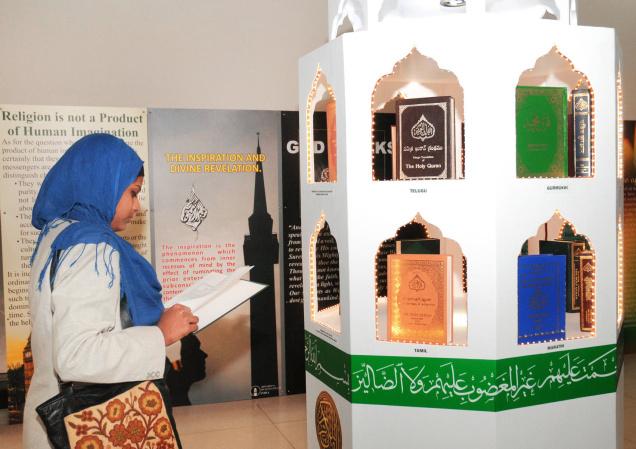
HOLY READING: A visitor at the three-day Quran exhibition titled 'Love for all, Hatred for none' that began in New Delhi on Friday. Photo: V. V. Krishnan
HOLY READING: A visitor at the three-day Quran exhibition titled ‘Love for all, Hatred for none’ that began in New Delhi on Friday. Photo: V. V. Krishnan
Protest by Muslim Law Board member and Shahi Imam’s brother

A three-day exhibition on the teachings of the Quran by Ahmadiyya Muslim Jammat, Delhi, that opened at the Constitution Club here on Friday ran into trouble when All-India Muslim Personal Law Board member Kamaal Farooqui and Syed Yahya Bukhari, brother of the Shahi Imam of Jama Masjid, along with their supporters denounced the event for “wrongly interpreting the tenets of Islam and the holy Quran”.

Talking to the media outside the Constitution Club, Mr. Farooqui said since Ahmadiyyas have been branded as non-Muslims in Pakistan, Iran, Iraq and other Islamic countries they cannot mount an exhibition in which they have interpreted the teachings of the holy Quran.

“If we start interfering in other people’s religion as it is being done through this exhibition, then it would create a dangerous precedent in the country. This exhibition cannot be allowed at any cost. Today we are demonstrating peacefully, but if this exhibition continues then on Saturday there will be a bigger demonstration,” he warned.

After the demonstrators had left, Ahmadiyya Muslim Jamaat External Affairs Secretary Syed Tanvir Ahmed said: “Ahmadiyyas are Muslims because they follow what Hazrat Mohammad taught them, read namaz and keep roza. But as this exhibition seeks to promote peace and brotherhood we will discontinue our exhibition after 5 p.m. on Saturday.”

National Minority Commission Chairman Wajahat Habibullah said he had no problem if the Ahmadiyyas described themselves as Muslims. “The teachings of the holy Quran have been beautifully displayed.”

The exhibition is displaying the Quran in 53 Indian and foreign languages including Kashmiri, Tamil, Telugu, Marathi and Gurmukhi, Russian, Spanish, Korean and Vietnamese. Seeking to dispel misunderstanding surrounding Islam, the exhibition is highlighting the tenets of Islam. “We want people to know that Islam stands for peace,” said Ahsan Ghori, while presenting the exhibition before guests. The exhibition highlights that Islam has assigned a position of dignity and honour to women and is a peaceful religion.

Ahmadiyyas face protest at peace mission

Times of India
Delhi
Ahmadiyyas face protest at peace mission
Shreya Roy Chowdhury, TNN | Sep 24, 2011, 06.49AM IST

NEW DELHI: The Islamic concept of jihad is often misunderstood in the current times of war and terrorism. And Ahmadiyyas have organized an exhibition to tell the world about what they claimed to be the real message of Quran — peace and brotherhood. Through their ‘Holy Quran Exhibition’ at Constitution Club, they said they wanted to change common perceptions.

This is perhaps one of the rare occasions when members of this sect, who face persecution in Pakistan, have come out to proclaim the inclusivity of their faith and answer queries on a wide range of issues. A 10-minute video on Islam’s emphasis on peace and rejection of war is a highlight of the exhibition. “This is an effort by the Ahmadiyyas to tell society that Quran is for everybody,” says Sayed Salahuddin, a volunteer.

But the exhibition has triggered strong protests from other Muslim sects at the venue. They were protesting against the Ahmadiyyas’ claim of being Muslims. The protests forced rescheduling of the exhibition, which will now end on Saturday instead of Sunday.

When the organizers set up the exhibition on Friday morning, they put up display boards addressing issues of jihad, women’s rights, science and globalization along with handsome volumes of over 70 translations of the Quran.

But after the protests the organizers scaled down the exhibition. The books are gone and so have the displays. “We were advised by police to remove the books as mischief-mongers from other sects might desecrate them. We agreed, because we believe in peace,” said Sayed Tanvir Ahmed, one of the organizers, who had come from Qadian, Punjab, where the Ahmadiyya sect was born.

But the man who led the protests, Kamal Faruqui, executive committee member of All-India Muslim Personal Law Board said, “We did not want to create a law and order problem. We wanted a token protest. Ahmadiyyas can’t call themselves Muslims. To be a Muslim, you have to believe in the oneness of God and finality of prophethood. Anyone who doesn’t believe in this is not a Muslim. They have been declared non-Muslims allover the world,” he said.

He heard about the exhibition on Thursday and rumours were confirmed by advertisements in the newspapers. “It’s not a new organization,” continued Faruqui, “They have every right under the Constitution to practice their religion and be treated as a minority. But by calling themselves Muslims, they are deceiving the people.”

The Ahmadiyyas are branded heretics in Pakistan and face opposition. “We are not popular among Muslims,” said Shiraz Ahmad, in charge of education for the Ahmadiyyas in India. “But we never retaliate. We spread the message of peace. We are declared non-Muslims by ulemas because they are afraid they’ll lose control if the masses follow us,” said Ahmad. But he also likes challenges. “We have been facing oppression for over 100 years. But where there is opposition, people also ask questions. They think, let’s go find out.”

Copyright © 2011 Bennett, Coleman & Co. Ltd. All rights reserved
URL: http://timesofindia.indiatimes.com/city/delhi/Ahmadiyyas...10099709.cms

Tuesday, January 25, 2011

Rights group slams Pakistan for abuses

The daily Nation, Pakistan
 Thursday, January 25, 2011
Rights group slams Pakistan for abuses
Published January 25, 2011

NEW YORK — Pakistan came under sharp criticism for human rights abuses in 2010 while India escaped any direct rebuke for its atrocities in Kashmir and elsewhere in the country in a new report released by a prominent rights group on Monday.

The New York-based Human Rights Watch said the Taliban and other religious extremists in Pakistan increased their deadly attacks against civilians and public spaces during the past year, while the Pakistani government response was marred by serious human rights violations.

In doing so, HRW placed Pakistan on the list of most abusive countries. Others on the list are: Belarus, China, Colombia, Congo, Cuba, Egypt, Indonesia, Iran, Myanmar, North Korea, Saudi Arabia, Yemen, and Zimbabwe. The only negative reference to India came indirectly when the report chided democracies around the world are ignoring abuses by repressive regimes and opting for improved relations rather than condemning rights violations and curtailing aid. It said President Barack Obama’s “famed eloquence … has sometimes eluded him when it comes to defending human rights.” This was especially noticeable in contacts with countries that are important to US interests, such as China, India, Indonesia, Egypt and Bahrain, the group said.

The 649-page 2011 report, Human Rights Watch’s 21st annual review of human rights practices around the globe, summarises major human rights trends in more than 90 states and territories worldwide. Suicide bombings, armed attacks, and killings by the Taliban, al-Qaeda, and their affiliates targeted nearly every sector of Pakistani society, including religious minorities and journalists, resulting in hundreds of deaths.

The country’s largest cities bore the brunt of these attacks. Two attacks in late May 2010 against the Ahmadiyya religious community in Lahore killed nearly 100 people, it noted. On July 1, a suicide bombing at Data Darbar, shrine of the patron saint of Lahore, killed 40 people. Militant attacks targeting civilians in conflict areas amounted to war crimes.

“Taliban atrocities aren’t happening in a vacuum, but instead often with covert support from elements in the intelligence services and law enforcement agencies,” Ali Dayan Hasan, senior South Asia researcher at Human Rights Watch, said in a statement. “The Pakistan government needs to use all lawful means to hold those responsible to account.” The government’s response to militant attacks instead has routinely violated basic rights, Human Rights Watch said. Thousands of Taliban suspects have been held in unlawful military detention without charge, many of them in two military facilities in Swat, one in the Khyber agency of the tribal areas, and at least one more in Khyber Pakhtunkhwa Province.

Tuesday, January 18, 2011

Defiance of law: Tahaffuz rally speakers threaten courts

Express Tribune, Pakistan
PAKISTAN
PUNJAB
Defiance of law: Tahaffuz rally speakers threaten courts
Rana Tanveer
January 18, 2010
In yet another rally TNRM leaders said they will respect no law if blasphemy laws are touched. PHOTOS: EXPRESS/ABID NAWAZ
LAHORE: The Mall saw yet another rally on Monday organised by Tahaffuz Namoos-i-Risalat Mahaz (TNRM). Several speakers at the rally lauded Mumtaz Qadri, the confessed killer of Governor Salmaan Taseer, and warned the courts of stiff reprimand if any order was passed against him.

Most shops and offices on The Mall were closed during the four hours the rally took to make its way from Data Darbar to the Governor’s House.

TNRM, a coalition of eight Sunni parties, organised the rally to pay tributes to the police guard who shot Taseer dead on January 4.

Speakers said there could be no punishment for Qadri and demanded his early release. TNRM vice president Dr Ashraf Jalali, who led the rally, told the participants that if Qadri was punished they would hold a long march to Islamabad and snatch all those responsible for it out of their offices. Jalali also issued a warning to the media not to extend invitations to those who criticised Qadri or spoke in favour of amending the blasphemy laws. “Mumtaz Hussain Qadri is a hero of the Muslim ummah. Whoever criticises him or Section 295-C will have their tongues pulled out.”

Jalali praised the police deployed in front of the Governor’s House saying that Qadri’s act had lifted the status of the entire police force.

The rally goers and their leaders chanted slogans against Taseer. The participants burnt pictures of President Asif Ali Zardari and other Pakistan Peoples Party leaders.

The 3,000 or so participants brought traffic and businesses on the The Mall to a stop. Roads leading to The Mall were choked with traffic and it seemed as if city life had come to a standstill for the hours the rally was in progress. Shops and offices on The Mall were closed for fear of a flare up but no untoward incident was reported.

Punjab Assembly members got their share of the firebrands’ wrath as they passed the Assembly building. “We curse every member of the Punjab Assembly for carrying a resolution in favour of Salmaan Taseer,” said a rally leader.

Some lawyers were also spotted in the rally. Advocate Chaudhry Mushtaq Ahmed ‘congratulated’ the participants on Taseer’s death and said if Section 295-C was removed they would obey no laws. But, he also said no law was actually needed to deal with blasphemers as a few “true Muslims” were all it required to deal with them. He said no lawyer would appear before the court to prosecute Taseer’s murder.

Maulana Tasadduq Hussain, a Jaamiat Ulema Pakistan leader, said the media only invited a certain kind of religious scholar to debate blasphemy issues. He said those favouring Taseer or criticising Qadri were enemies of Islam.

TNRM secretary general Muhammad Ali Naqashbandi said the media should invite TNRM scholars for debate on blasphemy issues. He condemned the media for inviting ‘improper’ scholars to their talk shows.

Published in The Express Tribune, January 18th, 2011.

Monday, January 17, 2011

Jamaat-ud-Dawa rally: Banned outfit incites violence

Express Tribune, Pakistan
PAKISTAN
Jamaat-ud-Dawa rally: Banned outfit incites violence
Rana Tanveer
January 17, 2011
Clerics warned the media against criticising religious decrees.
LAHORE: Shockingly, Jamaat-ud-Dawa, an organisation proscribed since the Mumbai terrorist attacks, not only managed to organise a sizeable rally, but clerics invited to speak during the demonstration spewed hate speech upon hate speech, targeted minorities, incited people to violence with impunity and roused people to adopt the ‘way of jihad’.

Despite the presence of clear cut laws, speakers “praised” the actions of the self-confessed killer of former Punjab governor Salman Taseer and warned media commentators against what they termed being critical of fatwas (religious decrees)” while discussing blasphemy matters.

Head of Jamaat-ud-Dawa’s political affairs wing Prof Hafiz Abdul Rehman Makki said that anyone “supporting a blasphemer is also a blasphemer and both must meet the same fate”.

Hundreds of Jamaat-ud-Dawa activists and their sympathisers initially assembled near Nasir Bagh and started marching towards the Punjab Assembly building on The Mall.

Hafiz Makki said that Taseer had been assassinated because the government had not “educated him” about being careful on sensitive issues before appointing him as the provincial governor.

He said matters concerning blasphemy “are like (a live) high-tension wire with more than 11,000 volts … whoever touches (it) would be reduced to nought”.

Highly charged marchers, carrying placards declaring a ‘holy war against elements conspiring against Islam’, ripped away signboards and streamers in favour of the slain governor and surprisingly also in favour of his successor, Latif Khosa.

Endorsing Mumtaz Hussain Qadri’s actions, Hafiz Makki said the man had played “his due role and police department should be proud of … such a (true) lover of Holy Prophet (Pbuh)”.

Chagrined at Pope Benedict XVI’s statement in which he had urged the Pakistani government to “repeal” blasphemy laws, the speakers went ballistic and warned Christians and Jews “everywhere” that Muslims were “ready to take extreme action”. At one point, Hafiz Makki even urged all Christians to “convert to Islam”.

Warning people who had presented a “gift of tears for Taseer”, Hafiz Makki said that there would be more weeping in the days ahead, adding: “What is the death of one man (Taseer) when so many (people) are (being) killed on the streets daily?”

Earlier, Convener of Tehreek Hurmat-e-Rasool (Pbuh) Maulana Ameer Hamza said that whoever “commits blasphemy revokes his right to life”.

Addressing President Asif Ali Zardari, Maulana Hamza said: “You should know that we will not allow you to free Aasia (Bibi),” adding in an offensive manner to take “this opportunity to convey the same message” to President Barack Obama.

Published in The Express Tribune, January 17th, 2011.

Saturday, January 15, 2011

Blasphemy allegations: Another Christian family on the run

Express Tribune, Pakistan
Pakistan
Punjab
Blasphemy allegations: Another Christian family on the run
Rana TanveerRana Tanveer
June 07, 2010
Supporters of one of several Namoos-i-Risalat groups, Shahab Islami Pakistan chant slogans and wave flags during a rally to support the assassin of Salmaan Taseer in Rawalpindi. PHOTO: AFP
LAHORE: Two Christian women were beaten and publically humiliated by an angry mob over apparently frivolous blasphemy allegations and they and their family are now in hiding for fear of being killed, The Express Tribune has learnt.

“None of our relatives is ready to let us stay with them. They fear the wrath of the extremists, particularly after the assassination of Salmaan Taseer,” a male member of the family said over the phone from an undisclosed location.

The family and a non-governmental organisation that is helping them asked that their identities not be revealed, lest it put them in further danger. The names mentioned here are fictitious.

According to the family, the allegations stem from a dispute between Amina, a Muslim, and her sister-in-law Zahira, a Christian, in an East Lahore locality. The two got into an argument on Tuesday night and though it appeared to have been settled, on Wednesday morning, after her husband Zahid had gone to work, Amina walked out onto the street and started shouting that Zahira had abused the Holy Prophet (pbuh).

A short while later, a group of men led by Muhammad Sameer, a member of a religious organisation keen on raising its sectarian profile, forced their way into the house and started slapping Zahira, said another of her brothers, Sohail. “Other men and women from the neighbourhood started gathering at the house too and they beat up my sister and mother. They were the only people in the house,” he said.

“We tried our best to get her to confess her crime,” Sameer told The Express Tribune. As a member of the religious organisation, he said he could not tolerate any derogatory remarks about the Holy Prophet (pbuh).

Sameer added that he was very proud of his wife’s performance during the mob beating. “She beat Zahira more than anyone else. Her hand is so swollen that she hasn’t been able to make rotis since the day of the incident. I’ve been getting my meals from a restaurant,” he said.

Malik Mumtaz Qadri, the self-confessed assassin of Salmaan Taseer, is a member of the same group as Sameer. The group also runs a twenty-four hour cable TV channel.

Khadim Hazoor, Sameer’s son-in-law and another participant in the beating, said that the women’s faces were blackened and they were made to wear necklaces of shoes and paraded around the locality on donkeys to humiliate them. He said the women denied blaspheming and repeatedly touched their feet seeking mercy.

He said the people of the locality would not allow Zahid or his family to return to their house, which he lives next door to. He claimed that the fight between Zahira and Amina the night before the incident revolved around the upbringing of Zahid and Amina’s 18-month-old daughter. Amina had wanted to raise her daughter as a Muslim, but Zahira wanted her niece to be raised as a Christian, he said.

Hazoor accused Zahid of “cheating Islam” by pretending to convert from Christianity to Islam so he could marry the Muslim girl. “We will not let them live in this house. He has not only cheated Amina but also Islam,” he said.

Zameer Khan, an NGO worker, helped the family flee the locality after they were attacked. “Apparently there was no blasphemy, just an argument between two women,” he said.

He said after hearing of the incident, he had reached the scene to find the women being attacked. He said he had asked the mob if anyone had heard Zahira utter any blasphemous remarks, to which they all replied in the negative. He said he persuaded them to let the women go while he investigated the matter. He then helped relocate the family temporarily. He said he had also convinced the mob not to involve the police.

Published in The Express Tribune, January 15th, 2011.

Thursday, January 13, 2011

Pakistan’s Pols Paralyzed by Religious Extremism

Time CNN, USAWorld
Pakistan’s Pols Paralyzed by Religious Extremism
Thursday, Jan. 13, 2011 By Omar Waraich / Islamabad
Pakistani Islamists attend a rally supporting the blasphemy law on Jan. 9, 2011, in Karachi. Asif Hassan/AFP/Getty Images
Pakistan’s President Asif Ali Zardari will visit the White House on Friday, amid growing U.S. concern that his country is drifting into the embrace of Islamist extremism. The brutal assassination of Punjab Governor Salmaan Taseer, over his moves to reform a blasphemy law used to persecute religious minorities, has been a shocking indicator: Taseer was shot 27 times by one of his own bodyguards, while the others looked on. The murder was widely celebrated in Pakistan, and its confessed perpetrator, Mumtaz Qadri, has been lionized by tens of thousands of demonstrators on the street, while the liberal element personified by Taseer has been marginalized. The unrestrained march of extremism in the world’s second largest Muslim nation — the only one with nuclear weapons — and on whose support the U.S. is depending in Afghanistan is a clear cause for anxiety in Washington. “Societies that tolerate such actions,” Vice President Joe Biden told reporters during a brief visit to Islamabad on Wednesday, “end up being consumed by those actions.”

Still, despite worrying signs, it’s easy to overstate the Islamist challenge. Pakistan’s religious parties remain at the political margins, usually sharing between them less than 10% of the vote. “It’s the secular forces that have always been in power, whether it was the military or the main political parties,” says opposition lawmaker Ayaz Amir. “The clerical forces are entitled to articulate whatever they want to. But who’s been succumbing, who’s been doing the backtracking? It’s the secular forces.” Successive governments have attempted for political reasons to placate the religious right with concessions. The same principle was evident in the current government’s capitulation to the conservatives on the blasphemy law, making clear in the wake of Taseer’s murder that it has no intention of pursuing his effort to reform the measure.

Taseer’s assassination certainly presented a formidable challenge, by bringing together erstwhile enemies in the religious camp in a rare show of unity. The crowd of 40,000 on the streets of Karachi last weekend celebrating Taseer’s murder included such sects as the typically moderate Barelvis, their more hard-line rival Deobandis, the even more extreme Wahhabis, and even the Shi’ites so often targeted by the more extreme Sunni sects. Groups that are more inclined to fight one another than to pray together have found common cause on blasphemy. “It’s the one issue where you can put together more people on the streets than are willing to vote for you,” says analyst Mosharraf Zaidi. The religious right now feels emboldened by the impassiveness of secular parties and the state: no one who threatened to kill Taseer and other like-minded politicians has been arrested.

Among the keenest supporters of Qadri was the Sunni Tehreek, an armed group headquartered in Karachi that opposes the Taliban and related extremists. The group has donated a reward to Qadri’s family and issued threats against Taseer’s daughter. “Qadri did what he did out of his religious conviction,” says Fahimuddin Sheikh, a spokesman for the Sunni Tehreek. But, he adds, “We are very much against the Taliban and the terrorists. We haven’t just supported the army’s offensives against them, but mounted rallies in support of them. These are people who want to use the gun to impose their views.” Which, of course, is exactly what Taseer’s assassin appears to have been doing.

Like Qadri, the members of the Sunni Tehreek are drawn from the Barelvi sect, estimated to make up 80% of the population. In recent years, Barelvi shrines and leaders have been attacked by Taliban-affiliated militants who deem their practices heretical. But when it comes to defending the “honor of the Prophet,” the Barelvis can be fiercer than other sects, and Taseer’s opposition to the blasphemy laws was cast as an act of blasphemy. It was always misleading to cast the Barelvis as exemplars of tolerance, says lawmaker Amir. “This impression really comes down to the Barelvis’ support for our recent wars against the Taliban,” he adds. “Otherwise they’ve been involved in the spread of religiosity in Pakistani society. That’s the problem with Pakistan: too much religion.”

The spread of religiosity has created a sense of religious guilt and shame in much of mainstream Pakistan, analysts say, pulling the consensus in a more conservative direction. Within hours of the killing, some 2,000 Pakistanis, most conversant in English, had joined a Facebook fan page dedicated to Qadri before it was shut down. They were not fundamentalists, nor were they averse to Western culture. “If you go through the profiles of Qadri supporters on Facebook, you’d think Justin Bieber was the cause of extremism in Pakistan,” tweeted the Pakistani blogger Kala Kawa. Says analyst Zaidi: “Articulating love for the Prophet is a way people purge their guilt. They see blasphemy as a red line, and if it’s seen to be crossed, they say they’re on board.”

Pakistani tensions over religion don’t exist independently of the tensions of social class in this grotesquely unequal society. After Taseer’s assassination, many liberals discovered to their horror that their domestic staff didn’t share their grief; some smiled at the news. Even though the governor had come from a modest background, many Pakistanis saw him as epitomizing a wealthy, English-speaking, liberal elite. “If you’re from the Urdu-schooled mainstream of the country, the assertiveness of the class rubs you the wrong way,” says Zaidi. “And it’s easy to depict someone who’s outwardly Westernized as being distant from religion.” Taseer’s status as a high-profile politician also diluted any sympathy for him from those sections of the population resentful of a political class they perceive as being inept, distant and venal.

Opposition to the U.S. war in Afghanistan and the Taliban’s claim to represent a purer form of Islam made it difficult for the Pakistani authorities to rally public support against the domestic extremist challenge. It was only after the Pakistani Taliban revealed its brutality in parts of the country over which it had gained control that public support swung behind a military offensive to drive them out. But Taseer’s assassination is an uncomfortable reminder of a religious intolerance deeply embedded within the country’s mainstream, which no Pakistani government is likely to risk confronting head-on.

© 2011 Time Inc. All rights reserved
URL: www.time.com/time/world/article/0,8599,2042522,00.html

JI asks MQM to clarify stand on blasphemy law

The News - Internet Edition
Friday, January 13, 2011,
Safar 08, 1432 A.H.
Karachi
JI asks MQM to clarify stand on blasphemy law

By our correspondent
Karachi

The Jamat-e-Islami has categorically asked the Muttahida Qaumi Movement to clear its position regarding Namoos-e-Risalat law instead of asking religious parties to stop protesting against the issue.

The reaction of JI came in the wake of statement of Chief of Muttahida Qaumi Movement Altaf Hussain in which he had demanded religious parties to discontinue their campaign against blasphemy law as the government, especially the Prime Minister of Pakistan has clearly said that blasphemy law would not be revoked

The JI asked Altaf Hussain to pressurise the coalition government to announce on the floor of the House that the blasphemy law would not be repealed.

Monday, January 10, 2011

Taseer murder: Sunni Ittehad warns against protests

Express Tribune, Pakistan
PAKISTAN
Punjab
Taseer murder: Sunni Ittehad warns against protests
Rana Tanveer
January 10, 2010

Children protesting in front of Lahore Press Club against any change in blasphemy law. PHOTO: RIAZ AHMAD/ EXPRESS

LAHORE: A Tahaffuz Namoos-i-Risalat conference held in the city on Sunday warned against public rallies and demonstrations praising Governor Salmaan Taseer or protesting his killing. A Mumtaz Qadri, speakers threatened, would be at every corner of the country to stop such displays of solidarity, a reference to the police guard who has confessed to killing the governor.

Maulana Nawaz Kharal, a spokesperson for the Sunni Ittehad Council (SIC), led the chorus while addressing the conference held at Aiwan-i-Iqbal. Kharal also said there should be no protest against Qadri and added, “Don’t associate Mumtaz with any terrorist group. He is a true lover of the Holy Prophet (pbuh).” He said his Sunni followers protect Qadri and his family with their lives.

SIC chairman Fazle Karim too condemned protests in favour of Salmaan Taseer. Karim said the NGOs protesting the governors’ death had never held any protest against the killings at Sunni gatherings after the attacks at Jamia Naeemia, Nishtar Park in Karachi, Data Darbar, shrines of Abdullah Shah Ghazi and Farid Ganj Shakar. He said they had not even raised a voice against the ban on the veil imposed in France. He said his followers would continue “the mission of Ghazi Ilamudin Shaheed.” He said the Sunni Tehrik would provide legal assistance to Qadri.

Dr Muhammad Ashraf Asif Jalali, founder of Idara Sirat-i-Mustaqeem Pakistan, announced the Ghazi Ilmudin Award for Qadri. He said that his group would lay a wreath on Ilmudin’s grave on Qadri’s behalf on January 15. He also said that it would hold a rally on January 19 from Lahore to Qadri’s residence in Rawalpindi.

Jalali then demanded that the government release Qadri as soon as possible and exonerate him from the charge of murder. He said the punishment for a blasphemer against the Holy Prophet (pbuh) was death. He claimed that the inclusion of Section 295-C in the Pakistan Penal Code had brought good luck for the country. He went on to say that all participants in Taseer’s funeral had jeopardised their Islamic faith. He said their participation in the prayers had put a question mark on their commitment to the community of the faithful.

The participants of the conference included Justice (retd) Nazeer Akhtar, former judge Nazeer Ghazi, Pir Sayed Karamat Ali and Dr Raghib Naeemi. After the conference ended, a group of SIC activists headed to the Governor’s House gate on The Mall on a van and chanted slogans in support of Qadri.Earlier, nearly 300 Sunni Tehrik activists had held a protest rally in front of the Lahore Press Club demanding Qadri’s immediate release. Participants of the rally also chanted slogans against the protestors in favour of Taseer.

In the only civil society rally after Taseer’s assassination on January 4, the participants had condemned the murder which they said was a result of religious extremism.

Published in The Express Tribune, January 10th, 2011.

URL: http://tribune.com.pk/story/101580/taseer...against-protests/

Sunday, January 9, 2011

JI wants people to learn a lesson from Taseer’s murder

The News - Internet Edition
Sunday, January 09, 2011,
Safar 04, 1432 A.H.
Karachi
JI wants people to learn a lesson from Taseer’s murder

Sunday, January 09, 2011

By our correspondent
Karachi

The General Secretary, Jamat-e-Islami, Liaquat Baloch, while rejecting the proposed changes in the blasphemy law said that the January 9 public meeting would show the extent of love for the Holy Prophet (PBUH) as people have united on one platform to vent their anger against the proposed changes.

He was addressing a joint press conference at the Idara-e-Noor-e-Haq on Saturday to announce details of the public meeting scheduled for January 9.

He held Governor Taseer responsible for his own murder due to his “negative attitude towards the law” and supporting a Christian woman who was convicted by the court and awarded the death sentence. He further said that people should learn a lesson from the murder of the governor of Punjab.

He said that the final moment had come for the defence of Namoos-e-Risalat and all were ready to sacrifice their lives if any change in the law was made by the government. It is the utmost decision of the Muslims of Pakistan that they would sacrifice their lives to defend the law.

He further said that the protests would continue till such time as the government withdrew the private bill presented by PPP MNA Sherry Rehman, abolished committees to review the law, and called for a clear-cut policy pertaining to the blasphemy law on the floor of the house.

‘Today leaders of Tehreek-e-Namoos-e-Risalat are united on the one-point agenda and demand of the government to review its decision and avoid toeing the policies of US.”

Abdul Ghafoor Haideri of the JUI-F said that the governor, Punjab, had taken up the issue as if it only aimed at opposing the minority community and he also consoled Aasia Bibi telling her that the matter would be taken to the president to pardon her punishment, which proved to be his last effort and he was sent to eternal peace.

He said that in a meeting on November 24 it was demanded Aasia Bibi’s issue should be resolved by the judiciary and warned the president of Pakistan not to interfere in it. But unfortunately the government used delaying tactics.

He said that government still had time to rethink the demands of Tehereek-e-Namoos-e-Risalat to dissolve the committee, withdraw the private bill, and announce its clear-cut policy on the law, otherwise leaders of the TNR would announce its future strategy.

Saturday, January 8, 2011

Fazl demands Blasphemy Law bill removal

The News - Internet Edition
Updated at 2355 PST
Saturday, January 08, 2011
National
Fazl demands Blasphemy Law bill removal
KARACHI: Jamiat Ulema-i-Islam-F (JUI-F) chief Maulana Fazlur Rehman Saturday demanded the government to take back a private bill regarding Blasphemy Law presented in National Assembly.

Addressing a press conference at a local hotel here after a conference with heads of religious parties, the action against religious seminaries and madaris is based on government’s dishonesty.

Various leaders including Jamat-e-Islami chief Syed Munawwar Hasan, Jamiat Ulema-e-Pakistan’s Sahibzada Abul Khair Zubair and Maulana Hafeez Jalindhary attended the conference.

‘Action against religious forces and their seminaries is being intensified; however, we want to clarify that such stratagems are unbearable,’ Maulana Fazl said adding the recent incidents of Karachi violence are a conspiracy to stop Tahaffuz Namoos-e-Risalat rally and sabotage the conference in this regard.

JUI-F leader demanded the government to take back a private bill tabled in connection with Blasphemy Law and dissolve a committee established by President regarding Blasphemy Law to ascertain the culpability.

Thursday, January 6, 2011

Religious parties pledge support to assassin

The daily Nation, Pakistan
 Thursday, January 06, 2011
Religious parties pledge support to assassin
Published January 06, 2011

Assassin Mumtaz Hussain Qadri
MULTAN/KARACHI – The religious parties Wednesday were all praise for Mumtaz Hussain Qadri, the assassin of Punjab Governor Salmaan Taseer, and warned the govt that any attempt to repeal or amend the blasphemy law would be resisted.

In Multan, Tehrik Tahaffuz-e-Namoos-e-Risalat (TTNR) offered full legal and moral support to Qadri, saying no stone would be left unturned to get him released.

“We’ll dedicate our all out energies and resources for the sacred cause. We’re also going to hold a ‘successful’ public meeting in Karachi on January 9 for the protection of the Namoos-e-Risalat,” announced a joint declaration issued by the Multan chapter of the body after an emergency meeting held at the Jama’at-e-Islami (JI) office.

The meeting, chaired by the local president of TTNR Mufti Hidayatullah Pasroori, was attended by the representatives of all religious parties including JI, JUP, JUI and Jamiat Ahl-e-Hadith besides lawyers and traders.

“The arrest of family members of Ghazi Mumtaz Hussain Qadri is highly condemnable. The government has no logic to detain them. They should be released forthwith,” demanded the declaration.

The clerics further asked of the government to immediately dissolve the committee formed by President Asif Ali Zardari to amend the blasphemy law (295-C) and withdraw Sherry Rehman’s bill; otherwise, the rulers would be responsible for any related development.

“He (Salmaan Taseer) himself is responsible for his killing. No Muslim can tolerate blasphemy,” said Pasroori while addressing the meeting. He said the killing of someone on the issue of blasphemy was nothing new in the region. “Those who committed blasphemy have been facing the same fate in the past.”

TTNR Secretary-General Dr Ashraf Ali Ateeq warned the rulers to mend their ways and seek forgiveness from Almighty Allah for their blasphemous behaviours. “They’re bent upon hurting the religious sentiments of Muslims to appease their foreign masters. We warn them to refrain from making such ill-advised moves; otherwise, they’ll have to face serious consequences,” he added.

Wednesday, January 5, 2011

Salmaan Taseer: murder in an extremist climate

Guardian, UK
Comment is free > Cif Belief
Salmaan Taseer: murder in an extremist climate
Intolerance, extremism and vigilantism are devouring us all in Pakistan. Yet the authorities still allow hate to be cultivated
Sana Saleem
Sana Saleem
guardian.co.uk, Wednesday 5 January 2011 12.14 GMT
Pakistani bodyguard Malik Mumtaz Hussain Qadri sits in a police van after being arrested at the site of a fatal attack on Salmaan Taseer, the governor of Punjab, in Islamabad yesterday. Photograph: Sabir Khan/AFP/Getty Images
It was less than a month ago that a Muslim cleric from Peshawar, Yousaf Qureshi, publicly offered money to anyone who would kill Aasia Bibi; kill in the name of the blasphemy law. Despite the public announcement and incitement to murder for money, no action was taken against this man. It was overlooked as an emotional outburst.

However, these public incitements to murder and violence do not always end there; there are many waiting to carry out such acts in the name of religion. On Tuesday, one such man gunned down Salmaan Taseer, Punjab governor, business tycoon and a vocal critic of abuse of the blasphemy law. Taseer was shot dead outside a restaurant in Islamabad by one of his own guards, Malik Mumtaz Hussain Qadri. Shortly afterwards, he handed himself to police, beaming with pride in front of cameras while confessing that he had killed Taseer because of his opposition to the blasphemy law. As Taseer’s bullet-riddled body was taken to hospital, later to be pronounced dead, Qadri’s confession was broadcast on television. A young bearded man, smiling, staring right into the camera while confessing a murder. There was no sign of remorse, only an uncanny smile reflecting reassurance that God will accept his great deed.

Shamefully, Qadri is not alone, as many as eight Facebook fan pages sprang up within a few hours, pronouncing Qadri a “hero” and a “son of Pakistan”. Clerics announced that Taseer’s death can’t be mourned because he supported a blasphemer, Bibi. In one breath, television anchors described his death as a great loss at this time of political instability and questioned his stance on the blasphemy law.

The interior minister, while talking to the media, spoke about the need for added security for government personnel and emphasised the importance of better scrutiny of those who join the elite forces. However, the real cause of Taseer’s assassination was only whispered, minced with other issues, when it should be the only thing on our minds. His death is more than just a political loss, it is a reminder of the extremism, bigotry and intolerance that has been brewing in the very heart of this country. The roots of this can be tracked back over three decades, when murder became justified in the name of religion, when killing someone for having an opinion became a law in this country.

His death indicates the strength of the forces Pakistan is up against. It highlights the inhumanity that is propagated by these draconian laws. As an activist, I will not allow his death and the cause he stood for to go in vain. We can’t afford to succumb to extremism. His murder is a message to everyone in Pakistan who stands for justice and humanity, that the intolerance, the extremism, the vigilantism has devoured us all as a society. It is a threat to silence all those who stand for justice, to make them kowtow to extremism or have their heads struck off in the name of religion. Civil society in Pakistan and everyone else who has been struggling for justice needs to come forth stronger than before.

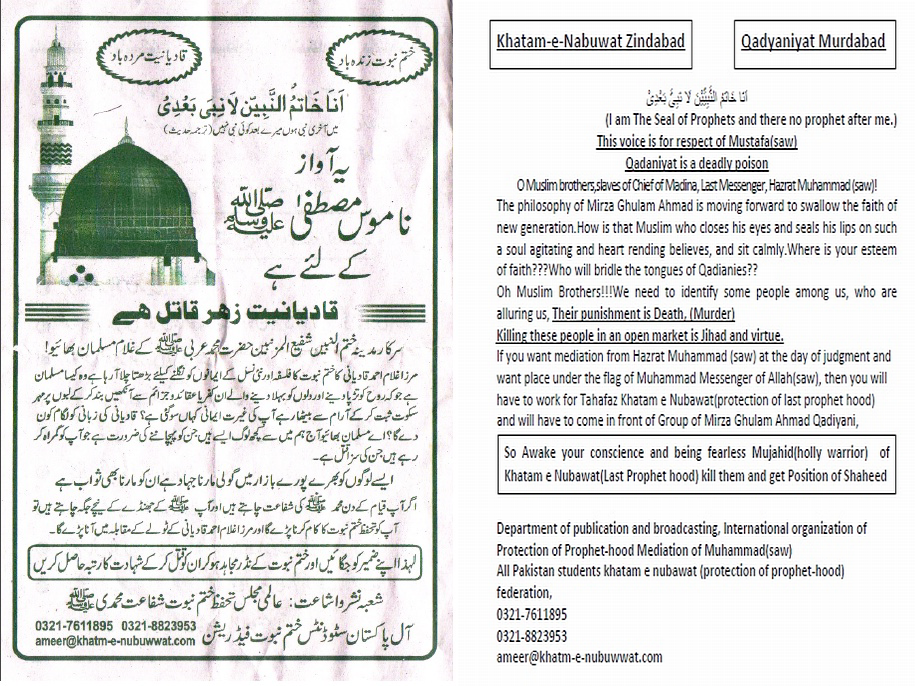
Taseer’s assassination was orchestrated through public announcements, hate speech on television, text messages and even by distributing pamphlets. Each one of these actions was overlooked, eventually leading to Taseer’s cold murder. As for the authorities in Pakistan, they should realise that no amount of security will help, when the extremist mindsets and factors that cultivate them continue to be tolerated. Until the state takes firm action against the hate campaigns, many more Qadris will spring up ready to gun down anyone who dares to speak out against injustice.

© Guardian News and Media Limited 2011
URL: www.guardian.co.uk/commentisfree/belief/20...r-pakistan

Lawyers shower roses for governor’s killer

Daily Dawn, Pakistan
Pakistan
Lawyers shower roses for governor’s killer
AP
January 05, 2011
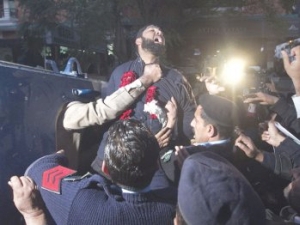
Malik Mumtaz Hussain Qadri, the bodyguard arrested for the killing of Punjab Governor Salman Taseer, shouts religious slogans while being taken away by police after he was presented at a court in Islamabad. - Reuters Photo

LAHORE: Lawyers showered the suspected killer of a prominent Pakistani governor with rose petals when he arrived at court Wednesday and an influential Muslim scholars group praised the assassination of the outspoken opponent of laws that order death for those who insult Islam.

Mumtaz Qadri made his first appearance in an Islamabad court, where a judge remanded him in custody a day after he allegedly sprayed automatic gunfire at the back of Punjab province Gov. Salman Taseer while he was supposed to be protecting him as a bodyguard.

A rowdy crowd slapped him on the back and kissed his cheek as he was escorted inside. The lawyers who tossed handfuls of rose petals over him were not involved in the case.

As he left the court, a crowd of about 200 sympathizers chanted “death is acceptable for Muhammad’s slave.” The suspect stood at the back door of an armored police van with a flower necklace given to him by an admirer and repeatedly yelled “God is great.”

More than 500 clerics and scholars from the group Jamat Ahle Sunnat said no one should pray or express regret for the killing of the governor. The group representing Pakistan’s majority Barelvi sect, which follows a brand of Islam considered moderate, also issued a veiled threat to other opponents of the blasphemy laws.

“The supporter is as equally guilty as one who committed blasphemy,” the group warned in a statement, adding politicians, the media and others should learn ”a lesson from the exemplary death.”

Jamat leader Maulana Shah Turabul Haq Qadri paid “glorious tribute to the murderer … for his courage, bravery and religious honor and integrity.”

Mumtaz Qadri told interrogators Tuesday that he shot the liberal Taseer multiple times because of the politician’s vocal opposition to the harsh blasphemy laws.

©2010 DAWN Media Group. All rights reserved
URL: www.dawn.com/2011/01/05/lawyers-shower-...-killer.html

Hardline Stance: Religious bloc condones murder

Express Tribune, Pakistan
PAKISTAN
Hardline Stance: Religious bloc condones murder
Salman Siddiqui
January 5, 2011
Arrested Qadri sits in a police van at the site of a fatal attack on Salman Taseer, the governor of Punjab, by his bodyguard in Islamabad on January 4, 2011. PHOTO: AFP
KARACHI: More than 500 religious scholars belonging to the Barelvi school of thought paid rich tributes to the assassin of Punjab Governor Salmaan Taseer on Tuesday and urged ‘Muslims across the country’ to boycott the funeral ceremony.

While the Deoband and Barelvi leaders appear to be on the same page when it comes to condemning the slain Pakistan Peoples Party (PPP) leader for terming the blasphemy law as a black law, the Barelvi scholars, who claim to be the ‘true lovers of the Holy Prophet (pbuh)’, have taken a more hardline stance.

The largest body of the Barelvi group, the Jamaate Ahle Sunnat Pakistan (JASP), whose directions are considered binding on every other organisation that follows the same school of thought, issued a statement saying that “No Muslim should attend the funeral or even try to pray for Salmaan Taseer or even express any kind of regret or sympathy over the incident.”

The statement which has been endorsed by senior Barelvi leaders such as Professor Saeed Shah Kazmi, Allama Syed Riaz Hussain Shah, Syed Shah Turabul Haq Qadri and Hajji Mohammad Tayyab calls the assassin Mumtaz Hussain Qadri ‘Ashiqe Rasool Ghaziye Mulk (Lover of the Prophet, Commander of the Country)’.

“We pay rich tributes and salute the bravery, valour and faith of Mumtaz Qadri,” the statement said, adding that the ministers, politicians, ‘so-called’ intellectuals and anchor persons should learn lessons from the governor’s death. The scholars said that those who insult the Holy Prophet (pbuh), even if they did not intend to, were liable for death.

Hajji Mohammad Tayyab, who is also the secretary general of the Sunni Ittehad Council, told The Express Tribune that scholars had “repeatedly urged the president, prime minister and Governor Taseer himself that if their knowledge about the blasphemy law are limited, they should consult them and avoid debating over the issue as it would inflame the people and then anything could happen.”

Shah Turabul Haq Qadri’s son Siraj, also a senior member of the JASP, endorsed the statement and said it was now binding on every Muslim.

Jamiat Ulemae Pakistan (JUP) central executive committee member Maulana Shabbir went as far as saying that in his opinion Salmaan Taseer was ‘Wajubul Qatil’ (must be killed according to divine law). “He had called the divine law of God, a black law and tried to protect a condemned blasphemer,” he said.

Senior Sunni Tehrik leader Shahid Ghauri said although his party was yet to issue any formal statement about the matter, he would support the call of JASP because the people who gave the edict were his elders.

Senior Jamaate Islami leader Farid Paracha distanced his organisation from the JASP statement, but condemned the governor for calling the blasphemy law, a black law. “I believe that this call for changing the law was being done at the behest of the US and other western powers.”

Senior cleric of the Deoband school of thought and Jamia Binoria chief Mufti Naeem said he could not understand why the slain PPP leader invited trouble for himself, especially given that the blasphemy law was passed in 1985 by the parliament unanimously. “He kept on taking Aasia’s name, but I ask why didn’t he ever make a similar plea for Aafia (Siddiqui).” Naeem said although Islam says that anyone who commits blasphemy is liable to death punishment, what the killer Mumtaz Qadri did was totally wrong as he took the law into his hand.

“The blasphemy law was made exactly to prevent such incidents. Else there will be chaos in the country and everyone would kill everyone,” he said. Maulana Asad Thanvi too supported Naeem’s stance and said although what governor Taseer did was condemnable in the strongest words, he should have been tried in the courts.

Allama Abbas Kumaili of the Shia school of thought said the blasphemy law can be misused and there was no doubt about it. “But the way Salmaan Taseer took up the matter was blunt which inflamed the more emotional and ignorant people of our country.”

Published in The Express Tribune, January 5th, 2011

 
^ Top of Page