Showing posts with label Ahmadis. Show all posts

Monday, October 3, 2011

Pakistan’s blasphemy laws have left even judges in fear of their lives

Guardian, UK
Comment is free > Cif Belief
Pakistan’s blasphemy laws have left even judges in fear of their lives
The furore over the killing of Punjab governor Salmaan Taseer for allegedly licentious behaviour is merely the latest and most extreme example of an appallingly divisive issue
Declan Walsh
Declan Walsh
guardian.co.uk, Monday 3 October 2011 20.00 BST
Mumtaz Qadri, sentenced to death for killing Taseer Photograph: STRINGER/PAKISTAN/REUTERS
Mumtaz Qadri, sentenced to death for killing Taseer
Photograph: STRINGER/PAKISTAN/REUTERS
So he’s going to swing — perhaps. On Saturday a Pakistani judge sentenced Mumtaz Qadri, the police bodyguard who assassinated the Punjab governor Salmaan Taseer, to death by hanging. The young policeman smiled and thanked God. “My dream has come true,” he reportedly said.

It was a predictably theatrical turn from Qadri, a former nobody who murdered Taseer in cowardly fashion – shooting the governor 27 times in the back – and who has since revelled in the notoriety of his blood-stained celebrity. Equally predictable, alas, was the reaction on the streets outside.

Close to the courtroom in Rawalpindi, angry young men attacked a monument to the former prime minister Benazir Bhutto, defacing her image on the spot where she died in a suicide bombing in 2007. Down in Lahore, turbaned men with long sticks surged through the ancient Anarkali bazaar, thrashing traders who refused to shutter their shops in sympathy for Qadri.

Meanwhile the clerics engineering the protests – old men with soft palms and tinder-dry beards – issued po-faced statements decrying the sentence. Qadri was a good Muslim, they insisted, and Taseer got what he deserved. The governor had offended them by advocating reforms to Pakistan’s antiquated blasphemy laws. In particularly they hated him for defending Aasia Bibi, a Christian mother-of-five sentenced to death under those laws last November. He deserved to die, they said.

Taseer’s wife and children, in contrast, were silent. They stayed at home, busy worrying about their son and sibling, Shahbaz. The 27-year-old was kidnapped in August as he purred through Lahore in a sports Mercedes – his father’s old car, in fact. Word has it he is being held in the tribal badlands of Waziristan; whether his captors are religious extremists, common criminals, or both, remains unclear.

The family is also reeling from character assaults. When Taseer was still alive, conservatives circulated photos of his children, lifted from their Facebook pages, showing them engaged in objectionable activity, such as dating and swimming in a swimming pool. After Taseer died, Qadri’s lawyers aired allegations about his sex life, drinking habits and apparent taste for pork – proof, they said, of a licentiousness that justified his cold-blooded murder.

The distasteful spectacle is partly a product of Pakistan’s social gulf. The Taseers inhabit the gilded bubble of a tiny elite whose westernised lives play out in Hello!-style photospreads of society magazines. In fact the Taseers own one of the most popular magazines. But it also goes to the heart of a bigger ideological crisis.

In theory, Pakistan is a country that welcomes all creeds and castes. But in practice it is proving to be anything but. Ask Faryal Bhatti, a teenage girl recently expelled from school for the crime of bad spelling.

A week ago last Thursday, the 13-year-old Christian girl was sitting an Urdu exam which involved a poem about the prophet Muhammad when she dropped a dot on the Urdu word naat (a devotional hymn to the prophet), accidentally turning it into lanaat, or damnation. Spotting the error, her teacher scolded her, beat her and reported the matter to the principal. The news soon flamed through her community in Havelian, 30 miles north of Islamabad.

Mullahs raged against Bhatti in their sermons; a school inquiry was hastily convened to examine the matter. Bhatti was expelled; her mother, a government nurse, was banished to another town, and the family has since fled Havelian in fear of their lives. All over a missing dot.

What accounts for such madness? In some parts Taseer’s death has inspired a McCarthyite atmosphere in which nobody wants to seen to be soft on blasphemy. But there is also a more profound reason. Devotion to the prophet Muhammad is central to the faith of the Barelvi Sunnis, who make up the majority of Pakistani Muslims. Even a whiff of insult to the prophet can whip up feverish anger.

The core problem, in fact, is that the blasphemy furore exposes the fragility of the Pakistani state – ideological, legal and security-wise. The mixing of religion and politics has long troubled Pakistan, but over the past 30 years that dangerous cocktail has been spiked by the army’s policy of nurturing extremists – hence men like Qadri who believe they have a right to kill in the name of God.

Meanwhile President Asif Ali Zardari’s government has shown zero leadership when it comes to reforming the blasphemy law – in fact, cowardly ministers have run a mile from any suggestion of change. And those who do dare to stand up for progress – or just the rule of law – live in fear of the next Qadri-style hit.

In truth, Taseer’s baby-faced killer is unlikely to be hanged any time soon. A lengthy appeals process is just starting, and the Zardari government has imposed an unofficial moratorium on capital punishment. But the judge who sentenced him, Pervez Ali Shah, faces perhaps shorter odds.

Judges who rule the “wrong” way on blasphemy face immense dangers in Pakistan. In 1997 extremists burst into the chambers of a high court judge who acquitted an accused blasphemer three years earlier, and shot him dead. Justice Shah will be fearing a repeat.

Reporters at Qadri’s hearing on Saturday noted that the judge slipped from the courtroom via the back door. He knows he is a marked man. Now only time will tell if the discredited Pakistani state can stand up for at least one good man.

© Guardian News and Media Limited 2011
URL: http://www.guardian.co.uk/commentisfree/...blasphemy-laws

Monday, September 19, 2011

CJ urged to take action against land grabbing

The daily Nation, Pakistan
 Monday, September 19, 2011
CJ urged to take action against land grabbing
Published: September 19, 2011

CHINIOT — Advocate Supreme Court Malik Rab Nawaz has appealed to the Chief Justice of Pakistan Iftikhar Muhammad Chaudhry to take suo motu action against Qadiani Jama’at which is not accepting the amendment in constitution that declares it as non-Muslim jama’at.

Addressing the 6th Khatam-e-Nabuwat Conference under the auspicious of Khatam-e-Nabuwat Lawyers Forum here on Thursday, he said that Qadianis had refused to accept the non-Muslim status and entering their names in voter lists as Muslims. He also urged Punjab Chief Minister Shahbaz Sharif to take notice of Qadiani land mafia which had grabbed hundred acres of govt land situated at Chenab nagar (Chak Dhigyan).

Rab Nawaz highlighted that Qadianis Jama’at had occupied all the land of high way, railway and mineral department and the land of River Chenab’s old bridge road in the name of grassy plots and tree plantation. He demanded the CM to direct the Chiniot DCO and Chenab Nagar TMA to get this land free.

He further said Qadianis, violating the rules and directions of State Bank, had made private exchange bank where hundi system was on the rise. He asked the Prime Minister Yousuf Raza Gilani to take immediate notice of this violation. He demanded the authorities concerned to create a column of non-Muslims in identity card for Qadianis.

Paying tribute to the leaders and workers of Tehreek Khatam-e-Nabuwat, he commemorated their sacrifices and struggles during the movement.

Sunday, September 18, 2011

Persistent persecution

News on Sunday, Pakistan
threat
Persistent persecution
Ahmadi community in Faisalabad keeps carrying the tag of ‘liable to be killed’ with no security
By Aoun Sahi
September 18, 2010

Naseem Ahmad Butt, 55, father of four daughters and a son and a follower of Ahmadi school of thought, was sleeping in the courtyard of his house in Muzaffar Colony in Faisalabad on the night of September 4, 2011 when four unidentified attackers broke into his house and attacked him. He received one bullet in his chest while the second one ruptured his kidney.

The firing woke up his wife whose cries forced the attackers to flee. “My brother was lying in a pool of blood when I saw him. He told me that the attackers were between 20 and 25 years old. One of them kicked him and when he woke up, they shot him. He died in a local hospital seven hours after the attack,” Khalid Pervez Butt, younger brother of Naseem Butt, tells TNS.

Naseem used to work as a technician in a local powerloom and had no enmity. “The attackers did not steal anything from his house. Being Ahmadi seems to be his only ‘sin’ that made him liable to be killed,” says Khalid Butt. His first cousin Naseer Butt was also killed in a similar fashion on September 8, 2010. “Police has made no effort to trace his killers. However, in a hope of assistance, I have got a case registered with police under section 302 of Pakistan Penal Code,” he tells TNS, adding that it is the fourth murder in his family.

Baitul Hadi“In 1994, one of my younger brothers and one of my first cousins (younger brother of Naseer Butt) were killed by religious fanatics. Police had arrested the assailants. Local activists of religious parties held protest rallies against the arrests of culprits and one of the assailants had been released just a few months back,” he says.

Three days after this incident on September 7, 2011, another Ahmadi, Chaudhry Basheer Ahmad, was attacked in Rachna Town in Sheikhupura district. He received three bullets and is still in hospital in a critical condition.

September has always been a tough month for Ahmadis in Pakistan as on September 7, 1974, the Parliament of Pakistan declared them non-Muslims. Almost all religious parties hold rallies and gatherings in the first week of September every year against Ahmadis. Majlis-e Tahffuz-e Khatm-e Nubuwwat takes the lead and arranges an annual gathering to celebrate victory against Ahmadis every year in Rabwah — the Jama’at Ahmadiya’s headquarters in Pakistan.

“Faisalabad has become one of the toughest cities in Pakistan for Ahmadis to live in,” Syed Mahmood Ahmad, secretary of the Faisalabad chapter of Jama’at Ahmadiya, tells TNS. “Naseem Butt was neither an active member of our Jama’at nor was an influential person. He was killed only because of his religious beliefs. Within days after his killing, unidentified people have written slogans like ‘slaves of the companions of Prophet (PBUH) and ‘down with Qadyaniat’ on the walls of Muzaffar Colony.

In May this year, a pamphlet terming Ahmadis ‘liable to be killed’ was distributed in Faisalabad. “It also carried names and addresses of prominent Ahmadis in Faisalabad. We have time and again contacted the Faisalabad police that a group of fanatics is threatening Ahmadis in the area. But no action has ever been taken,” says Ahmad. “On June 2, 2011, I sent an email to the home secretary and the police chief of Punjab as well as Faisalabad’s regional police officer, but nothing has been done to help us.”

Over the past two years, as many as six Ahmadis have been killed in Faisalabad, but no killer has been brought to book. “Religious fanatics are being encouraged by a lack of action on the part of the government agencies. It has even become too tough for Ahmadi youth to get education in public sector universities. A few months back, four girls belonging to our community were expelled from National Textile University. The 2010 annual magazine of that university carried three articles against Ahmadis,” says Mahmood Ahmad.

An Ahmadi praying in MosquePolice officials in Faisalabad do not seem to have taken the issue seriously. “We have no resources to provide special security for Ahmadis,” Shakir Hussain Dawar, senior police official in Faisalabad, tells TNS. “As far as Naseem Butt’s murder is concerned, we are investigating it from all angles. We have not ruled out the possibility of religious factor,” he says.


Saleemuddin, the Jama’at spokesperson, says that Ahmadis are being threatened all across the country, adding that Faisalabad has become the most hostile city towards the Ahmadis. “Most hate material is being generated and funded there. Eleven Ahmadis have been killed in Faisalabad since 1984.” In May last year, more than 88 people were killed in Lahore when gunmen opened fire at two separate places of worship of Ahmadis. “One year has passed, but no progress has been made in the case.”

Human rights activists have termed the situation deplorable. They are worried about the situation and have been writing constantly to the government about the security of Ahmadis. “Faisalabad has become a test case for the government to check the persecution of Ahmadis. The opponents of Ahmadis have even published their addresses and phone numbers on the pamphlets distributed in Faisalabad around three months back. No action has been taken against the culprits. It seems that the persecution will continue,” says HRCP Director IA Rehman.

Thursday, August 18, 2011

INDONESIA: Conviction of Ahmadyah victim undermines constitutional protections

AHRC Logo
News / AHRC News / INDONESIA: Conviction of Ahmadyah victim …

INDONESIA: Conviction of Ahmadyah victim undermines constitutional protections

August 18, 2011

The Asian Human Rights Commission (AHRC) is disturbed by the punitive decision of the Indonesian Court on August 15, 2011 to jail an innocent Ahmadi Muslim who protected himself during a mob attack, which reveals the impartiality of the judiciary and the legal community.

Deden Sudjana was sentenced to six months imprisonment by the court, for simply protecting the house the mob were attacking. Meanwhile, the 12 men who were responsible for brutally killing three Ahmadi Muslims in an attack in February 2011, were only sentenced to between three and six months imprisonment.

Some 1,500 people attacked the home of an Ahmadiyah community leader in Cikeusik, west Java in February. Sudjana was hit with a machete and almost had his hand severed during the mob attack. Head of security for the Indonesian Ahmadiyah Congregation (JAI) at the time, Sudjana was detained since May for allegedly inciting the attack. In its judgment, the court ruled that he had disobeyed a police order to leave the scene, and had been filmed punching another man. He was thus convicted of articles 212 and 315.1 of the Criminal Code; resisting state officers and maltreatment, respectively.

The decision is senseless and embarrassing, a travesty of justice. The lenient sentences handed out to those convicted of killing three Ahmadis in July raised questions regarding judicial impartiality and upholding of constitutional protections (see AHRC-PRL-034-2011), which have now been spotlighted again. The two verdicts indicate that Indonesia’s criminal justice system is not able to deliver justice independent from religious considerations. Indonesia’s judicial commission must act on this miscarriage of justice and push for reforms that will truly ensure a fair and impartial justice process.

Indonesia today is increasingly seeing extremists push their agenda forward, mostly with the use of violence, resulting in the loss of life and damage to property. The Indonesian government has taken no effective steps to stop or prevent such activities, which will slowly erode the country’s secular values.

Similarly, the Indonesian courts and legal system have shown a complete disregard for the basic rule of law, and have not taken up their mandate of protecting the constitutional rights of Indonesian citizens.

The AHRC urges for a review of both verdicts, and calls upon the Indonesian government and courts to ensure that all religious and other minorities are adequately protected.

Document ID: AHRC-PRL-034-2011
Document Type: Press Release
URL: www.humanrights.asia/news/press-releases/AHRC-PRL-034-2011

Friday, August 5, 2011

Morden man fears for brother named on Ahmadiyya Muslim murder list in Pakistan

Wimbledon Guardian, UK
News
Morden man fears for brother named on Ahmadiyya Muslim murder list in Pakistan
12:25pm Friday 5th August 2011
By Omar Oakes »

Fears: Chaudhary Nawaz shows a list of names of people, including his brother, who are 'liable to be murdered' in Pakistan
Fears: Chaudhary Nawaz shows a list of names of people, including his brother, who are “liable to be murdered” in Pakistan
The brother of a Pakistani man whose name was published on a religious murder list by Muslim fanatics has said he is distraught with worry.

Chaudhary Nawaz, from Hillcross Avenue in Morden, said his brother Dr Muhammad Nawaz, a technology college academic in Pakistan, had gone into hiding for fear of being murdered for being an Ahmadi Muslim.

Ahmadi Muslims are not considered Islamic in Pakistan under the Government’s strict blasphemy laws and this list of prominent Ahmadis is being widely distributed in Faisalabad, a textile hub in the Punjab province.

The list is published on a pamphlet given out widely in shopping areas and claims: “To shoot such people is an act of jihad [struggle of faith] and to kill such people is an act of sawab [reward].”

Mr Nawaz, 48, said: “I can’t tell you how worried I am. Sometimes I try not to think about it because I am so frightened about what could happen.

“My brother is a good man, an educator. He doesn’t deserve to be targeted like this.

“I feel helpless because he is thousands of miles away and I can’t help him.”

Mr Nawaz, a senior member of the Morden district of the Ahmadiyya Muslim Association, said his brother cannot leave Faisalabad because he has to care for their mother, an 82-year-old Alzheimer’s sufferer.

A similar list of Ahmadis was published two years ago in Faisalabad. Three people on that list were murdered by militants in a crowded market bazaar in April 2010.

Nearly two months later, 94 Ahmadis were murdered in mosques in Lahore.

Last October, the Wimbledon Guardian revealed how religious hatred by hardline Muslims towards Ahmadis was being demonstrated on a much smaller scale in south London, which is home to their UK headquarters, the massive Bait-ul-Futuh mosque in London Road, Morden.

Our investigation revealed Sheikh Suliman Gani, imam at the Tooting Islamic Centre (TIC), had told worshippers to boycott Ahmadi businesses, leading to financial hardship for shop owners and the sacking of a worker who would not renounce his religion.

The Khatme Nabuwwat Academy, an East London-based religious group affiliated to the Pakistan-based Khatme Nabuwwat, was invited to talk at the TIC last year.

The Khatme Nabuwwat’s Pakistani-based website describes Ahmadis as “nothing but a gang of traitors, apostates and infidels”.

Copyright 2001-2010 Wimbledon Guardian, UK. All rights reserved.
URL: www.wimbledonguardian.co.uk/news/9180679.Man_fears.../

Friday, July 29, 2011

INDONESIA: Courts verdict encourages further attacks against religious minorities

AHRC Logo
News / Press Releases / INDONESIA: Courts verdict encourages…
INDONESIA: Courts verdict encourages further attacks against religious minorities

July 29, 2011

(Hong Kong, July 29, 2011) Three to six months in prison was the shocking sentence given to the perpetrators of the mob killing of three Ahmadiyahs earlier this year. The remaining perpetrators will be released on the reading of the verdict on 23 August this year. Most of them will be released during the coming weeks. This lenient punishment and the conduct of the judges in the trial sends a clear signal to religious fundamentalists that they not need to worry about the law and constitutional protection of minorities.

“The verdict and trial conduct does not meet national or international standards” Wong Kai Shing, Executive Director of the Asian Human Rights Commission said. “The lenient punishment will encourage more extremist action against religious minorities” Wong added,” the courts failed to enforce Indonesian law for the protection of citizens.”

On 28 April 2011 the Serang District Court in West Java convicted twelve suspects for maltreatment, joint assault and incitement in the horrendous Cikeusik killing from February this year. A mob set against the discriminated religious minority of Ahmadiyah followers attacked the group in Umbulan village, Cikeusik resulting in five members being injured and three killed. At least one patrol car from Cikeusik sector police and 2 trucks from riot-control force (Dalmas) of Pandeglang dictrict police men were present and watched the violence, doing nothing to prevent it or apprehend the perpetrators. The shocking scenes were published in a video online sparking international outcry.

The Indonesian Ahmadiyah congregation (JAI) commented that the verdict does not fulfil the sense of fairness. According to A. Mubarik Ahmad, the public relation of JAI, this crime must be seen as crimes against humanity, not just a crime against the Ahmadiyah. The Indonesian criminal code never regulated the crimes against Ahmadiyah. Moreover, he stated that the state still cannot find the murderer of the victims, because the trial did not charged the suspect with murder charge, thus there is no examination and trial for the murderer.

In 1980 and 2005, Indonesian Ulama Assembly (Majelis Ulama Indonesia) issued a fatwa against the Ahmadiyah community in Indonesia denouncing Ahmadyah followers as an errant sect. In 2008 a joint ministerial decree banned the group for promulgating its religion and other basic religious rights. The decree is widely believed to be responsible for encouraging attacks against Ahmadis. Numerous attacks against Ahmadiyah communities and their members were documented by the Setara Institute and Wahid Institute over the last years.

The AHRC is concerned that the lenient punishment for a mob killing against the minority group will encourage more fundamentalist violence. Institutions have failed in this case to send a strong message against extremism. The AHRC believes that law and constitutional values were not the basis for the judgement in this case.

Thursday, July 21, 2011

INDONESIA: Ahmadiyah community faces ongoing discrimination

AHRC Logo
Opinions / Interviews / INDONESIA: Ahmadiyah community faces ongoing discrimination
INDONESIA: Ahmadiyah community faces ongoing discrimination

July 21, 2011

An interview with Zaenuda Ikhwanul Aziz from the Indonesian Ahmadiyah Community (JAI) published by the Asian Human Rights Commission regarding the situation faced by Ahmadis in Indonesia.

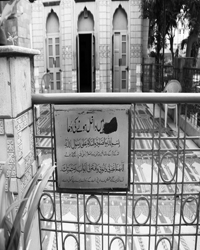
Zaenuda Ikhwanul AzizZaenuda Ikhwanul Aziz, is the secretary of the legal committee of the Indonesian Ahmadiyah congregation (Jamaah Ahmadiyah Indonesia — JAI). He is actively involved in the struggle of the Ahmadiyah in the country.
How do you feel about what is happening to the Ahmadiyah community in Indonesia?

We feel that we are being discriminated against, especially the Ahmadiyah communities at the localities outside the capital of Jakarta. For example, the government does not give identification cards and marriage certificates to Ahmadiyahs.

At the economic sector many Ahmadiyahs have had to change the location of their businesses. Even in some provinces, the people from the community are intimidated not to buy products from Ahmadiyah shops and businesses and this has resulted in a serious reduction of our income.

In the social sector we also are excluded and intimidated. We are not allowed to be involved in social gatherings.

At the religious sector the Minister of Religion prohibits us from conducting the Hajj, (the pilgrimage to Mekka) and even when we pray, members of the local communities attack our mosques. Sometimes, our villages are also attacked.

Also, in the health sector, many people reject Ahmadiyahs as patients. We therefore feel discriminated against in most, if not all, sectors.

When did you start to feel the discrimination?

The discrimination started when the Indonesian Ulama Assembly (Majelis Ulama Indonesia - MUI) declared Ahmadiyah as an errant sect in 1980. This fatwa brought to light the differences between Ahmadiyahs and the community. The people followed the fatwa believing that Ahmadiyah is errant without seeking any further explanation or consideration.

The main actors involved are the Indonesian government, central and local law enforcement authorities and several Ulama members who influence the people to attack Ahmadiyah communities. This is especially so with those persons who live within Ahmadiyah communities.

In your opinion, what is the reason for the increase of the aggression against Ahmadiyahs in the last few years?

There are several reasons, not the least of which is that the government is indecisive about law enforcement. If the joint ministerial decree against JAI still prevailed then the government could not allow the local regulations in the provinces to declare Ahmadiyah as an errant sect. Unfortunately, the government did nothing to prevent this from happening.

The aggressors see Ahmadiyah as a threat because the numbers of Ahmadiyah communities is increasing and they are scared that they will lose their followers.

Also, the content of the joint ministerial decree has been misinterpreted. There are local regulations which use the joint resolution decree to declare Ahmadiyah as errant whereas there is no such statement in the decree itself. The JAI think this happened because the government is trying to distance itself from the joint of resolution decree.

Is the state doing anything to protect the Ahmadiyahs?

We feel the state protection is still minimal. There is still turmoil because there is no law enforcement. It is seldom that perpetrators of violence against Ahmadiyahs are arrested and they are never prosecuted in the courts.

What do you feel about the work of the police?

In general, the work of the police is still far from professional. However, we must acknowledge that in some areas, there are some good police officers working in relation to Ahmadiyahs.

What about the work of the courts?

Judges are deficient at searching for the truth. Their efforts are deficient when examining at a trial, investigating the witness and proof, such as happened at Cisalada trial. Even the verdict against the Ahmadiyah victim was heavier than that of the perpetrators.

What is the Ahmadiyah community doing in their own defence?

Our representatives visit government officials, legal enforcement authorities, and the community in general. Relating to the legal dealings, we entrust this to our legal counsel.

The result of our visits are promising in that there are several communities and authorities who opened up and accepted us such as in Bandung, Central Java, and Wonosobo. But there have also been rejections such as in Cianjur, Bogor.

What is your ultimate goal in this struggle?

All we ask for is the right to live like other citizens and that these rights are fulfilled by the government

————————
The views shared in this article do not necessarily reflect those of the AHRC, and the AHRC takes no responsibility for them.

Sunday, June 19, 2011

Writing on the pamphlet

News on Sunday, Pakistan
minorities
Writing on the pamphlet
Dreaded messages have reappeared in Faisalabad to haunt the threatened Ahmadi community
By Aoun Sahi
June 19, 2010
Two brothers, Sheikh Ashraf Parvez and Sheikh Masood Jawed, owners of Murad Cloth House and Murad Jewellers, in Faisalabad’s Rail Bazaar, refused to leave the country after a mob destroyed their shops back in 1974 during the anti-Ahmadi riots. Luckily, in only a few months, they were able to establish their businesses again and, in the coming years, Sheikh Ashraf Parvez became the senior vice-president of Rail Bazaar traders’ association.

Word Mosque removed from boardThings were going well until early 2010 when a pamphlet was distributed in Faisalabad condemning the Ahmadi community and exhorting the Muslims in the city to boycott the traders and businesses owned by the Ahmadis. Distributors of the pamphlet listed some shops and businesses owned by people belonging to the Ahmadi community. The names of Murad Cloth House and Murad Jewellers featured at number three on the list.
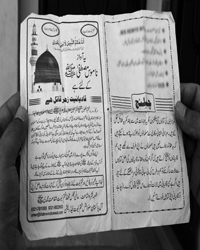
A couple of months later, on April 1, 2010, Sheikh Ashraf, Sheikh Masood and his son Sheikh Asif Masood were killed by ‘unknown people’ on the road at around 10 in the night when they were returning to their homes from their shops. A case was registered. However, no suspect has been arrested so far. “They were killed only because of their faith,” says Sheikh Ashraf’s son, requesting not to be named, who sits at the shop. His worries are not over yet.

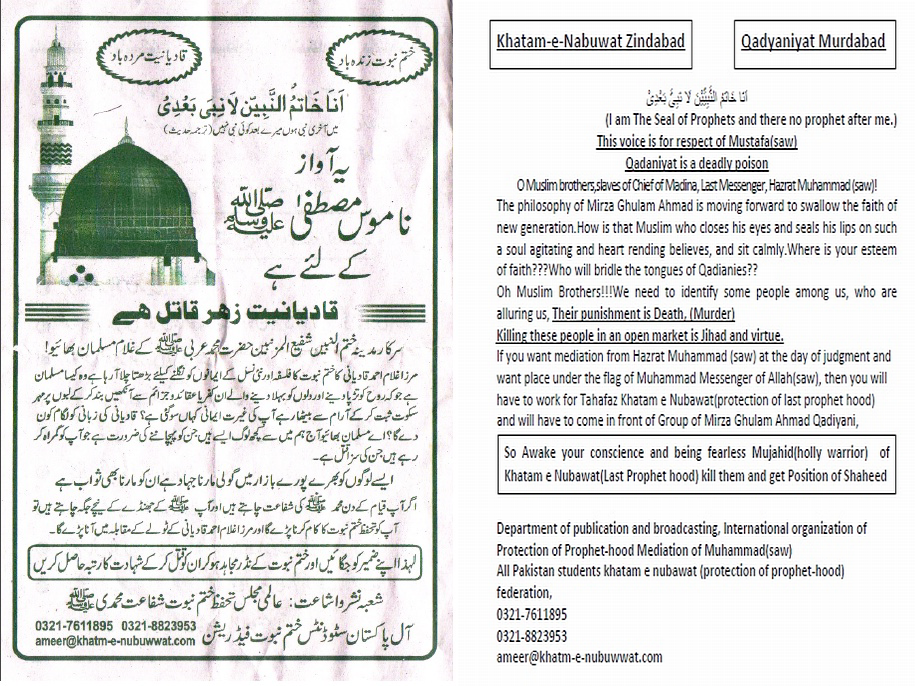
Two weeks back, another pamphlet was distributed in Faisalabad that labelled members of the Ahmadi community as “Wajibul Qatl” (liable to be persecuted), and inciting people to publicly attack followers of the faith. “Their punishment is death. Killing these people amounts to jihad,” read the leaflet. The pamphlet contained names and addresses of Ahmadi traders, industrialists and doctors. This time, Murad Cloth House was on top of the list.

“I don’t know how to react; our lives have been disturbed, our sanity badly affected,” says the 28-year-old son of the slain Sheikh Ashraf. “We are very vulnerable. I cannot concentrate on my business. I suspect every customer is a potential attacker!”

“I don’t expect justice,” he goes on.

Talking to TNS, another person on the ‘hit list’ relates how he was forced to move somewhere else after last year’s pamphlet was circulated. “It seems we are being watched all the time. They seem to know everything about us which is obvious from the way they’ve given the latest addresses of our homes and businesses,” he says. “We feel like petty outcasts.”

According to him, as a matter of routine, the situation becomes tense every year in April-May when the annual event of ‘Khatm-e-Nabuwat’ is held in the city. “Every speaker condemns and abuses the Ahmadis. We have put up our complaints before the administration, to no avail.”

Pamphlets distributed in Faisalabad urging Muslims to kill AhmadisHe laments the fact that things have gotten to a point where introducing oneself as Ahmadi means inviting trouble and public isolation.



So far, no security has been provided even to those who were mentioned in the pamphlet. On June 2, 2011, Mahmood Ahmad, Jamaat’s secretary in Faisalabad, sent an email to the home secretary and the police chief of Punjab as well as Faisalabad’s regional police officer, but nothing has been done to help the matter.

“Our mouths have been shut, our hands are tied. I am writing this in the hope that somewhere, somehow this letter finds its way to a compassionate and patriotic police official who shall dare to stand up for us, for the sake of Pakistan,” reads the email.

“Distribution of pamphlets against Ahmadis in Faisalabad is a regular practice,” Mahmood Ahmad tells TNS, adding that whereas the tone of these papers was “mild” in the past, their lives were jeopardised.

“Last year, the pamphlet had only asked the ‘Muslims’ to band together against the businesses owned by the Ahmadis which resulted in the persecution of at least five people belonging to our community, apart from instances of dacoity, kidnapping for ransom and expulsion of some of our students in mainstream educational institutions.”

Mahmood fears more violence if proper steps are not taken by the government. He also blames the Punjab government for ignoring the myriad protests lodged by the Ahmadi community in the province. “Religious fanatics are being encouraged by a lack of action on the part of the government agencies,” he says.

Police officials in Faisalabad do not seem to have taken the issue seriously so far. “I have deputed one person from the department to arrest the people whose cell numbers are mentioned on the pamphlet,” says Asmatullah Junenio, Superintendent of Police (SP), Faisalabad, talking to TNS.

He claims that the security of the Ahmadi community has been beefed up. “The number of police officials deputed to safeguard our worship places has been increased.”

Munir Ahmed, whose cell number is given on the pamphlet and who admits to be working for an organisation on the finality of Prophethood, informs TNS that he is in Lahore these days. “I have nothing to do with this [pamphlet] and I firmly believe they [the Ahmadis] are lying. The law should take its due course to punish them and the blasphemers.”

According to Saleemuddin, the Jamaat spokesperson, Ahmadis are being threatened all across the country. “Anti-Ahmadi wall-chalkings, pamphlets and stickers are a common phenomenon these days,” he says, adding that Faisalabad has become the most hostile towards the Ahmadis. “Most hate material is being generated or funded there.”

Legal experts believe inciting people to kill others is a serious crime as per the Pakistan Penal Code (PPC). “According to the Anti-Terrorism Act 1997, inciting somebody to kill others falls under the definition of terrorism. 153A, 505 and 506 sections of PPC also address such crime,” says Asad Jamal, advocate High Court.

Jamal, who has been working on human rights issues since long, believes that the police is bound to act against such activities.

Human Rights activists also believe there is no political will to protect the minorities, especially the Ahmadis. “They are indeed the most vulnerable group in Pakistan. Printing and distribution of hate material against them is a grave concern for us. We have already brought such activities by religious fundamentalists into the notice of the authorities, but no action has been taken against the culprits so far,” contends Zohra Yousuf, Chairperson, HRCP.

“Many members of this community have already migrated to other countries. The government will have to assert itself strongly to protect the community.”

aounsahi@gmail.com

Sunday, May 29, 2011

Persecution of Ahmadis continues despite attacks

Daily Times, Pakistan
Sunday, May 29, 2011

Persecution of Ahmadis continues despite attacks

By Afnan Khan

LAHORE: Persecution of Ahmadi community continues even after the worst ever attacks on their worship places in Lahore in May last year.

A few weeks back, a terrorist blew himself up outside an Ahmadi place of worship in Mughalpura area. The terrorist had been caught red-handed and released by police some time back.

Daily Times had, in December 2010, reported that a terrorist attack on the stated place or local Ahmadis in the area was likely, as a hate campaign had been launched against them by local hardliners and extremists.

A seminary present in the area spearheaded the campaign. It not only pasted a large number of posters against Ahmadis on walls in the main Gunj Bazaar of the area but also forbade the locals from burying their dead in the related graveyard despite the fact that these people had been living in the area even before the partition (of Subcontinent) and their forefathers had been buried there.

The management of the worship place told Daily Times that they had caught a suicide attacker on April 15 with the help of police guards just before prayers at 12:40 pm.

The management said that the terrorist, who was in his early twenties, had been waiting for the prayers to start and looking for an opportunity to sneak into the worship place and blow himself up.

But, it added, one of the volunteers spotted the suicide vest the terrorist had been wearing under his shirt and caught him with the help of other volunteers and police guards present there.

Later, a heavy police contingent, led by the station house officer, reached the spot and took the terrorist to the Mughalpura Police Station where he identified himself as Abid.

The management added that it had tried to pursue the case, however, police told them that the terrorist had been handed over to superior investigation agencies.

It maintained that sources in the Mughalpura Police Station had informed them that the terrorist had been freed due to political pressure that piled on police when a number of hardliners reached outside the police station and issued a warning to attack policemen if the “innocent boy” was not released.

Station House Officer (SHO) Asim Jahangir abstained from commenting on the issue, when contacted. He only told this scribe that he was not on duty on the day the incident took place and would check for the latest updates later on.

Spokesman for Ahmadis, Saleemuddin, told Daily Times that the hate campaigns against them were still in full swing across the country. He regretted that so far the federal and provincial governments had not taken any solid steps to protect Ahmadi community from extremists and terrorists. He added that a number of Ahmadis had been tortured and killed even after the May 28, 2010, terrorist attacks, but they were still waiting for protection from the government.

Saleemuddin said that the government’s behaviour towards Ahmadis was also discriminatory, adding that it even did not announce any compensation for those Ahmadis that had been killed in the May 28 attacks.

The spokesman said that a number of families of the victims of the May 28 attacks were still waiting for the compensation cheques worth Rs 0.5 million. He also mentioned that many families that had received the compensation cheques did not spend the money but deposited it to the government’s flood relief fund.

Monday, May 16, 2011

Survivors Recount Violence in Cikeusik

Jakarta Globe, Indonesia
INDONESIA
Survivors Recount Violence in Cikeusik
Ulma Haryanto | May 16, 2011

The house in Cikeusik, Banten, where a mob attacked an Ahmadiyah community in February. Three Ahmadiyah members were killed in the attack. (Antara Photo)
Ahmad Masihuddin, Irwan and Bebi are the lucky ones.

Ahmad recalls the moment when a man attempted to mutilate his genitals, while Irwan has developed an intense fear of water. Bebi cannot speak, due to a dislocated jaw, and must eat through a straw.

Despite the fear of reprisals, two of these three men — Ahmad and Irwan — met with the Jakarta Globe over the weekend to recount their memories of the bloody attack against a small group of Amhadiyah sect members in the village of Cikeusik, Banten, on Feb. 6.

On that day, three Ahmadis — Roni Pasaroni, Warsono and Tubagus Chandra — were killed by a 1,500-strong mob. Much of the violence was captured on video, and footage of Ahmadi men stripped of their clothes and being brutally beaten with stones and bamboo sticks can be seen on YouTube.

Twelve men are facing charges in relation to the attack. If found guilty their maximum sentences could range from 12 years in jail to the death penalty.

But Irwan and Ahmad say that even the harshest of punishments for those 12 men will not blot out the acts of cruelty they witnessed and endured on that day. Nor will guilty verdicts dampen the attendant rage and frustration they feel at a police force that is widely seen as having stood by and allowing the violence to unfold.

“Police pronounced me dead when my muddy, naked body was thrown into a police truck,” Ahmad said. “If I did not use the martial arts knowledge I learned through the years, I’d be among the dead.”

The police had collected Ahmad’s battered body after he had been dragged through the dirt by a group of enraged attackers. “Along the way, people slashed me with machetes, and threw rocks and bamboo poles at me. I lost consciousness. I believed I had died.”

Unguarded

Irwan, Roni and Warsono had left for Cikeusik from Jakarta on the night of Feb. 5. Irwan told the Globe that they had traveled to Cikeusik to provide security for a demonstration that the village’s Ahmadiyah community was planning on staging the next day.

“I was at our regular Koran recital meeting in Petojo [Central Jakarta]. Roni came to me and asked if I wanted to come along with him to Cikeusik,” Irwan said. “I asked him what for. He told me to guard a demonstration.”

They arrived around 10 p.m. on Saturday night, and were met by Deden Sujana, head of security for the Indonesian Ahmadiyah Congregation (JAI). The next day, Deden would almost lose his right arm to a machete attack, and police would later name him as a suspect for triggering the violence.

Ahmad, who lives in Kalideres, West Jakarta, had likewise gone to Cikeusik to provide security for the demonstration.

“Eki, a colleague of mine at JAI, was on holiday and asked me to replace him to guard an Ahmadi home in Cikeusik. Without thinking it over, I agreed,” he said.

“I was in the same car as [Tubagus] Chandra and Diaz [Ferdiaz Muhammad, an Ahmadi who survived the incident]. Chandra was driving, we arrived at Serang at 3 a.m. and picked up five more Ahmadis.”

Ahmad had prior experience protecting sect members. In 2008 he had guarded an Ahmadi school in Parung, Bogor, that had come under attack, and he had been on hand with the now-deceased Tubagus when one of the sect’s orphanages in Tasikmalaya, West Java, was sealed by local authorities last December.

Ahmad worked in the administrations division at JAI, while Tubagus worked for the security division with Deden. Ahmad, however, was well trained in self-defense. He had earned a black belt in Taekwondo at the age of 15, and was instructing others in Muay Thai at 18.

As Ahmad and his friends pulled into Cikeusik, he was relieved to see some dozens of police officers standing watch over both ends of the road where the house of local Ahmadiyah cleric Ismail Suparman was located. “I texted my parents so that they didn’t have to worry. The police were here,” Ahmad said.

“Suddenly, the wife of the Cikeusik village head, Inayah, ran toward us screaming. She told all of us to leave immediately, because it seemed thousands of people were marching to Cikeusik to slaughter us. Deden told her, ‘Don’t worry. We have Pak Hasan [Cikeusik Police chief of general crimes unit] here.’ ”

However, video footage posted on YouTube clearly showed the police running away when the mob attacked.

Tired from their late-night journey, Ahmad said he and his friends laid down to rest. They awoke around 10:30 a.m., he said, to loud chants of “Allahu Akbar” (God is great) and “Ahmadiyah infidels” mixed in with the sound of stones hitting the house.

To Ahmad’s ears, it sounded as if thousands of people were outside Ismail’s home. It was then, Ahmad said, that Deden rushed outside, and attempted to hit a man in a black jacket who seemed to be leading the mob.

“This man was Idris Mahdani,” Ahmad said. “He is from Banyu Mundu village [40 kilometers away from Cikeusik]. After he was hit by Deden, he retreated several steps back before taking out his machete and waved it in the air as the villagers pelted the Ahmadis with rocks.”

Vicious Beatings

Following Deden’s lead, Ahmad said he went outside and starting throwing stones back at the mob, but realizing that they were vastly outnumbered, he and some of the other sect members tried to escape out the back door of Ismail’s house. “We ended up stuck in knee-high mud at the paddy fields. We could not run. The drive to Cikeusik was taxing and we were exhausted,” he said.

The group of Ahmadis parted then, he said. Some sought cover in a patch of jungle while others headed to a nearby river.

Irwan and Ahmad fled to the river. Irwan slipped and fell in. Ahmad stumbled and was caught by the mob.

“I had with me about Rp 2 million ($235) for food and accommodation, and my BlackBerry. The mob greedily took it. But they still did not spare me.”

It was then that he saw Roni trying to go to the defense of their friend Bebi, who was on the ground being kicked by members of the mob. Someone would drop a heavy stone on Bebi’s face, but he would survive, largely because of Roni’s help.

Roni, who declined to talk to the Globe, would suffer a dislocated jaw in the attack.

In the meantime, Ahmad was fighting for his own life.

“I saw Irwan slip and fall into the river. I had 10 men on top of me trying to hit me with sticks and stones and they stabbed me with their machetes,” he said.

Ahmad said he was dragged 500 meters back to Ismail’s house, and viciously beaten the whole way. He said he saw Roni being stabbed with a bamboo spear.

“They stripped me,” Ahmad said. “They were about to cut my genitals. I shoved the man and shouted ‘You guys have to have limits!’ Another man hit me on the side but the impact also knocked away the guy who tried to mutilate my genitals.”

Ahmad said that he tried to retain his focus and stay calm during the beating, protecting his head and neck in particular to avoid being fatally wounded by the mob.

“I turned on my side and let it take the beatings. I did not want to give them my neck.” He said that he still felt a numbness in his neck from the injuries he sustained during the prolonged beating. “Part of my body went to sleep, as if struck by a stroke.”

At some point, Ahmad said, he lost consciousness.

“The police thought I was dead; they threw me into the car just like that. But I gained consciousness and started to ask for water. I was extremely dehydrated,” he said.

While Ahmad was struggling to survive the mob’s anger, Irwan was struggling to stay afloat in the river while also dodging a hail of rocks being thrown at him.

“I could barely swim,” Irwan said. “I was dragged by the current as I tried to stay afloat. In the meantime the mob was still trying to hit me with rocks,” he said.

At one point, he went under, and lost track of the time. He said he had no idea how long he was submerged, but remembered being pulled from the river.

“At one point it was all dark. But then I heard a voice calling me. It was Yadi, another Ahmadi” Irwan said. Yadi had swum against the current to rescue Irwan, dragging him to the shore.

Shirt for a Bandage

For Ahmad, the trip from Cikeusik to Malingping hospital, 10 kilometers away, took one and a half hours. He said the police gave him a shirt with which to stem the bleeding from a gash on his head.

“I met Deden in the hospital, he was holding his right hand, I saw Bebi vomiting blood, Ferdiaz put me on his lap and started giving me water, he was also injured,” he said.

Deden was taken to Pertamina hospital in Jakarta. The other men were transferred to Serang hospital, six hours away. In Serang, their fresh stitches had to be removed because they crusted with dirt.

Although Irwan did not sustain any serious injuries, he said he was now terrified of water, and had trouble recounting the details of the attack.

“I am undergoing counseling for my trauma. My therapist said that I had to think of water as my savior. If the river current didn’t carry me away, I might be one of the casualties,” he said.

Ahmad, however, said he was consumed with rage whenever he saw police officers or fundamentalist Muslims in white robes.

“Once I wanted to go to Senen, I passed the National Monument and at that time there was a demonstration on Libya and Ahmadiyah. All of a sudden I started shouting to the driver, ‘Just hit them! Hit them! Why should they make a fuss over another country when their own is still in a mess,’?” he said.

Ahmad also said he suffered from vertigo and severe headaches after the beating, and had just recently recovered the ability to speak.

“Previously, I found it almost impossible to talk,” he said.

“Once I was in Citraland [West Jakarta mall] and saw a police officer. I went to him and screamed at him, ‘What are you doing here? You’re doing nothing! Just like in Cikeusik! Officers only watch and do nothing!’ ”

Copyright 2010 The Jakarta Globe
URL: www.thejakartaglobe.com/indonesia/survivors-.../441269

Wednesday, May 11, 2011

Islamic Hard-Liners Plan Massive Pancasila Rally

Jakarta Globe, Indonesia
HOME
Islamic Hard-Liners Plan Massive Pancasila Rally
Nivell Rayda | May 11, 2011

Cianjur, West Java. After failing to kick-start a revolution through massive protests echoing those in the Middle East this year, hard-line Muslim groups are now plotting an even bigger rally next month, this time claiming they have forged an unlikely alliance with nationalists.

Speaking from his home in West Java, Chep Hermawan, the leader of the Islamic Reform Movement (Garis), said that 40,000 protesters were expected to rally in front of the Presidential Palace in Jakarta on June 1.

“Basically everyone who is a staunch critic of SBY will be on board,” Chep said, referring to President Susilo Bambang Yudhoyono. “It will be like Cairo, where everyone who didn’t like Mubarak joined forces to topple a corrupt government.”

Chep named Sri Bintang Pamungkas, a Suharto-era political activist, and Andi Mapetahang Fatwa, a member of the Regional Representatives Council (DPD), as being among the nationalists who had expressed an interest in taking part in the rally.

“We plan on doing this on the anniversary of the Pancasila,” Chep said, referring to the state ideology first articulated by former President Sukarno on June 1, 1945.

Chep said Muslim groups were hoping to return the Pancasila to its original state, as outlined in the Jakarta Charter of June 22, 1945. The first principle of the Jakarta Charter, which was ultimately incorporated into the preamble of the constitution, was the “obligation for all followers to observe Shariah law.” It was later changed to “Belief in the one and only God,” by then-Vice President Mohammad Hatta.

“We want the Pancasila to return to its original state,” Chep said. “We don’t reject the Pancasila, rather we want to restore it to its intended purpose.”

The protest, Chep added, would also cover other topical issues. “Basically our plan is to stage a rally that appeals to all, not just Muslims,” he said. “We have been talking with the nationalists and they agreed to join our rally, but they will be pushing labor issues, agricultural reform and so on.”

Demonstrators, he said, would also demand the dissolution of Ahmadiyah, a minority Islamic sect considered deviant by mainstream Muslims.

In February, a massive rally by hard-line groups demanded Yudhoyono issue a decree banning Ahmadiyah, threatening a revolution if he failed to do so by March 1. Nothing has happened since the deadline passed.

Chep blamed a lack of coordination and funds for the failure of the February protests.

For the June protest, Chep said that meetings had been, and would continue to be, held with leaders of opposition parties and former presidential candidates, asking them for political and financial support. “I have also prepared Rp 2 billion [$234,000] to finance the rally in the hope that opponents of the government will be convinced to invest as well,” Chep said.

Executives of the hard-line Islamic Defenders Front (FPI) and the Islamic People’s Forum (FUI) said they had not yet heard of the plan.

Copyright 2010 The Jakarta Globe
URL: www.thejakartaglobe.com/news/islamic-.../440537

Tuesday, May 3, 2011

‘Victim’ Reveals Sinister Workings Of NII Recruiters

Jakarta Globe, Indonesia
HOME
‘Victim’ Reveals Sinister Workings Of NII Recruiters
Fitri R. | May 03, 2011

Rights activists have claimed to see disturbing similarity in the deadly mob attack on an Ahmadi community, above, in Cikeusik, Banten, in February, and religious violence targeting Christians in Central Sulawesi and Maluku, below, from 2000-07. Activists say both conflicts show evidence of being instigated by agent provocateurs. (AP, AFP, JG Photos)
After weeks of tweaking and trials and errors, an activist at a prominent human rights group was finally able to connect his laptop computer to an old 32-inch cathode-ray tube television at home.

Although he had seen it about 20 times already, Hendi (not his real name) was eager to watch the 40-minute video of the bloody attack on the Ahmadiyah minority sect in the Cikeusik subdistrict of Banten on a screen with a much bigger resolution than that of his laptop.

“I’m curious to learn who these people who wear the blue and green ribbons are. The fact that they wear ribbons to distinguish friends from foe suggests that they don’t know each other,” he told the Jakarta Globe after asking not to reveal his identity because he was far from concluding his research.

Witnesses say around 20 attackers wearing the ribbons on their jackets and shirts were among the first to arrive at the scene on Feb. 6 and could be seen provoking others to attack a house belonging to an Ahmadi. More than 1,000 people eventually joined the assault which resulted in the death of three Ahmadis.

Hendi said he was curious how the attackers, who witnesses say were not from the area, knew which house to attack.

Obsessed with learning who these people were, Hendi scrutinized every frame of the video, listening to a barrage of sounds and noises and scribbling in his notebook every time he heard an audible conversation.

“They were highly skilled in martial arts, can be seen provoking the masses to attack Ahmadiyah and simply vanished just minutes into the riot,” he concluded, adding that this was precisely the pattern found in scores of sectarian conflicts that sprung up after the fall of Suharto.

Finding the Mastermind

Hendi said that he became fixated on digging up the truth that many of his activist friends chose to ignore after the Al Jazeera television station in March reported closer ties being forged by hard-line groups and several retired military generals.

The activist said that unless police were able to apprehend the provocateurs, the mastermind behind the Cikeusik attack would never be revealed.

But Hendi is not alone. Mufti Makaarim, executive director of the Institute for Defense, Security and Peace Studies, also thinks that there is more to the attack than meets the eye.

“Rogue elements within the military have used radical Muslims as proxies before to create diversions or push certain political agendas. They don’t want to be linked directly to sectarian conflicts,” he said, adding that religious violence had been used in the past to de-legitimize civilian-controlled governments.

Chep Hermawan, head of the Islamic Reform Movement (Garis), a hard-line group, has said that several retired generals had approached radical Muslim groups one month prior to the Cikeusik attack in a bid to topple President Susilo Bambang Yudhoyono by exploiting mainstream Muslims’ resistance toward the Ahmadiyah.

Chep named them as former Army chief of staff Gen. (ret.) Tyasno Sudarto; Maj. Gen. (ret.) Muchdi Purwoprandjono, former commander of the Army’s Special Forces (Kopassus); Maj. Gen. (ret.) Kivlan Zen, former commander of the Army’s Strategic Reserve Command (Kostrad); and Gen. (ret.) Fahrul Razi, a former deputy chief of staff.

IDSPS’ Mufti seemed hardly surprised. “These are old players,” he said.

Similar Patterns

In his book, “Civil Islam: Muslims and Democratization of Indonesia,” anthropology professor Robert Hefner said that during the Suharto regime, the government made use of hard-liners to act as agent provocateurs to de-legitimize criticisms toward his rule, particularly when calls were mounting for him to step down at the height of the 1997-98 Asian Financial Crisis. In the book, Hefner details numerous reports and anecdotes that detail links between the military and hard-liners.

He writes that during the May 1998 riots in Jakarta, a group of unidentified men started burning and looting businesses and homes owned by ethnic Chinese. The men provoked ordinary civilians to follow suit and by the time security forces arrived they had vanished, similar to Hendi’s observations of the Cikeusik attack 12 years later.

A similar pattern was reported during a religious conflict in East Java a year earlier, with efforts to break ties between the Nahdlatul Ulama, led by future President Abdurrahman “Gus Dur” Wahid, and syncretist Javanese Muslims.

NU probes quoted witnesses as saying that groups of men dressed in “ninja” outfits had been killing Muslims clerics as well as people believed to be black-magic sorcerers. But a series of rumors that sprang up after the violence would omit mention of the ninja-clad attackers and allege that the Muslim clerics and sorcerers had in fact been killing each other.

It would not be the last time such tactics would be reported.

In 2000, a string of religious conflicts between Muslims and Christians erupted in Poso, Central Sulawesi, and Ambon, Maluku. Several rights groups cited witnesses reporting ninja-clad bands of people killing both Muslim clerics and Christian priests.

Then-President Gus Dur accused a Maj. Gen. “K” and a civilian named “Gogon” to be behind in the conflicts in Poso and Ambon. But until he was forced to resign in 2001, Wahid never disclosed the full identities of those he accused.

At the time, Kivlan was one of only two major-generals in the military with that initial.

“Gogon” is the reported nickname of Ahmad Sumargono of the conservative Indonesian Islamic Propagation Council (DDII), a long-time friend of Muchdi and later a politician of the Star Crescent Party (PBB.)

Conflicts in Ambon and Poso went on until 2007, ending after the National Police toured the area with FPI leader Rizieq Shihab, who urged remnants of the Muslim militias to join FPI and fight new enemies: immorality and blasphemous sects. Some former militia members chose to join the Jemaah Islamiyah terror network.

Military Might

After the fall of Suharto in May 1998, the new government formed fact-finding teams to investigate the cause of the Jakarta riots as well as the kidnapping and murder of 14 student activists, according to Hefner.

In October 1998, one team probing the kidnapping of activists released its findings and concluded that it was conducted by a special unit inside the Army Special Forces Command (Kopassus). The team deemed former Kopassus commander Prabowo Subianto and his successor, Muchdi, responsible for the crime.

Prabowo would later go on to found the Great Indonesia Movement Party (Gerindra). Muchdi would go on to head the National Intelligence Agency (BIN). In 2009 he would be controversially acquitted for the 2004 murder of rights activist Munir Said Thalib.

In a postscript addendum after he concluded research into his book in November 1999, Hefner wrote that most disturbances at the time bore the telltale signs of agent provocateurs.

“Although its leaders have been removed from the heights of government, advocates of state terror remain ensconced in segments of the military and bureaucracy. The dismantlement of their shadowy network of vigilantes and gangsters will be one of the greatest challenges facing democratic Indonesia,” he wrote.

For Hendi, the evidence is still up for debate. But the patterns he says he sees are undeniable.

“What is intriguing for me about the Cikeusik attack is that it doesn’t follow the same pattern as other cases of violence on Ahmadiyah involving hard-liners,” Hendi said. “The attack bears more resemblance to the ones seen during the sectarian conflicts in Ambon or Poso.

“I think there is a good indication that one of the martial arts groups associated with a military figure might be involved.

“But unless police are able to arrest one of the provocateurs or at least have someone who would identify who they are and where they’re from, we won’t know who the true masterminds are.”

Monday, May 2, 2011

Is Dislike of SBY Driving Military Old Guard to Hard-Liners?

Jakarta Globe, Indonesia
NEWS
Is Dislike of SBY Driving Military Old Guard to Hard-Liners?
Nivell Rayda | May 02, 2011

President Susilo Bambang Yudhoyono’s speeches often leave many Indonesians mystified, and the one he made shortly after a series of book bomb scares across the capital last month was no exception.

“To that group, [I say] if you don’t like me, don’t sacrifice the people. Don’t let them become victims,” he said on March 18, shortly after police discovered a fourth bomb sent to the house of a prominent music mogul.

To some, the president appeared presumptuous for assuming that he was the target, but Mufti Makaarim, executive director of the Institute for Defense, Security and Peace Studies, thinks that there is more to the remark than meets the eye.

“He knows that there are some people who benefit from religious violence and acts of terrorism. He senses that there are a few retired generals who would love to see him lose legitimacy to run this country,” he said. “For me the speech was clear. As vague and intriguing as it may seem to the rest of the nation, he was addressing military retirees.”

Connecting the Dots

Two other incidents that took place shortly after that speech seemed to crystallize what Yudhoyono meant.

On March 20, a little-known Islamic political analyst named Wachiduddin received thunderous applause from an audience of 500 veiled women and bearded men at a talk show organized by Hizbut Tahrir Indonesia, a hard-line group that seeks the formation of an Islamic caliphate.

Wachiduddin on that day said that it was important for hard-line Muslim activists to establish ties with warmongers and military officials. Excerpts and video recordings of the show have been circulating online since.

“Gaining support from ahlul quwwah [bearers of military might] in a revolution is a method exemplified by the great prophet, Muhammad,” he said. “The prophet and his disciples once convened with ahlul quwwahs throughout Mecca, asking them to convert to Islam and join his holy struggle.”

Muhammad eventually gained the support of Sa’ad bin Muaz, a prominent seventh-century warlord from Medina, Saudi Arabia, the self-proclaimed expert added. “Muslim activists [in Indonesia] must visit these generals. We must convince them that Islam is the only system blessed by Allah. Generals must become the 21st century Sa’ad bin Muaz,” Wachiduddin said.

On March 22, two days after the speech, Al Jazeera reported that “senior retired generals” were supporting the Islamic Defenders Front (FPI) and other hard-liners to incite religious violence and overthrow Yudhoyono.

The report included an interview with retired Army Chief Gen. Tyasno Sudarto, a staunch government critic who acknowledged his support for the groups that he said aimed to topple Yudhoyono in a “revolution.”

Coming Out

Besides Tyasno, there are more military men backing the hard-liners, according to Chep Hernawan, head of the Islamic Reform Movement (Garis). In an interview with the Jakarta Globe, he identified them as retired Maj. Gen. Muchdi Purwoprandjono, former commander of the Army’s Special Forces (Kopassus); retired Maj. Gen. Kivlan Zen, former commander of the Army’s Strategic Reserve Command (Kostrad); and retired Gen. Fahrul Razi, a former deputy chief of staff.

Chep said several meetings had already taken place since January between the ex-generals and conservative Muslim leaders to discuss their plans.

“We’re united by the Ahmadiyah issue, since these retired generals have also lost faith in how the president is managing the country. They are Muslims too and know very well that Yudhoyono’s hesitance in banning Ahmadiyah could spark public anger, particularly from Muslims,” Chep said.

He was referring to the minority sect deemed deviant by mainstream Muslims that has faced increasing persecution over the years, including from the state.

Islamic People’s Forum (FUI) secretary general Muhammad Al Khaththath had also acknowledged its movement to seek the dissolution of the sect was supported by retired generals but refused to divulge details into what sort of arrangements the hard-liners had with the generals.

‘Awan Merah’

A source inside the military retiree circle told the Jakarta Globe that the hard-liners had benefited financially as well as politically from the relationship.

“These generals always finance pesantrens [Islamic religious boarding school] and madrasahs [Islamic schools] owned by hard-line figures. Their houses are always visited by hard-line groups and some return with plenty of donations,” the source said on condition of anonymity.

“In return they pledge allegiance and consider these generals as their patrons. [Hard-liners] are often exploited for a certain political gain.”

But the source said that the retired generals had a more sinister plot. “The other retirees are calling their actions ‘Awan Merah’ [Red Cloud], short for ‘Aksi Purnawirawan Militer Berdarah’ [Bloody Actions of Military Retirees],” he told the Globe.

“Their aim was to create another religious conflict like the ones in Ambon [North Maluku] or Poso [Central Sulawesi]. But this time, they want it to be close to the capital. It is likely that their target would be Kuningan or Parung.”

Around 2,000 followers of the Ahmadiyah faith live in Manis Lor village in Kuningan district, West Java, making it the largest Ahmadi community in Indonesia. An attack on the community occurs almost every year.

Parung, a small town about halfway between Jakarta and Bogor, is home to an Ahmadiyah center. It was last attacked in 2008.

“Other retirees are not too sure about their strategies. Toppling a president is not that easy,” the source said. “But what these generals have in common is that they all hate SBY, they’re devout Muslims or what some would describe as ‘green generals,’ they have close ties with hard-liners and in the past they had their hands dirty in cases of religious violence.”

Mufti of the IDSPS said the retired generals were discontented with Yudhoyono because he had failed to provide enough political positions for members of his former corps.

Only two retired generals sit in Yudhoyono’s administration: State Secretary Sudi Silalahi and Deputy Defense Minister Sjafrie Sjamsuddin.

“The aim is to topple Yudhoyono through de-legitimization of his rule, to show that civilian-controlled government is failing and that we should go back to military rule,” he told the Globe. “That has happened during the administrations of [former presidents] [B.J.] Habibie and Gus Dur [Abdurrahman Wahid].”

Mutual Interests

Muchdi, the retired major general, has confirmed that he has close relationships with hard-line Muslim figures. “I have friends from almost every Muslim organization and yes, some of them are radicals,” he told the Globe.

He was cautious, however, about revealing the extent of those ties with radicals. “All I can say is that these [hard-liners] don’t have a political vehicle to channel their aspirations. They just want their voices heard by the government,” he said.

“I don’t agree with violence and every Muslim organization that I have talked to feels the same way. There is not a single political party that can facilitate their needs, that is why some rogue elements within the organizations feel frustrated and do [violent] things.”

Muchdi, the former head of the National Intelligence Agency (BIN) who was controversially acquitted in 2009 of the murder of rights activist Munir Said Thalib, has also been cited as a senior adviser of FUI publication Suara Islam and of Media Dakwah, a publication tied to the Indonesian Islam Propagation Council (DDII).

Although he is open about opposing the existence of the Ahmadiyah, he denied playing a part in religious violence.

“After the cases in Cikeusik [Banten] and Temanggung happened, text messages began circulating saying that me and Tyasno Sudarto were behind the melees,” he said, referring to a mob attack on Ahmadis in Banten that left three sect members dead and the violent riot in the West Java town after a blasphemy trial.

“To me, rumors like that happen almost on a daily basis. Some issues we have to fight back but some I chose to ignore. I don’t know why, but people see me as a hard-line Muslim myself.”

A long time critic of Yudhoyono, Tyasno has been participating in various rallies and activities to oust the president. His disapproval for his former classmate in the military academy had led him to form an unlikely bond with radical Muslims, secular nationalists and other groups frustrated with the sitting administration.

In March 2010, Tyasno joined hard-line Muslim activists in an event organized by HTI to denounce the growing economic influence of the United States in Indonesia.

The retired Army chief did little to hide his alliance with hard-line groups during the interview with Al Jazeera.

“We work together to enlighten each other. Our angle is different. They fight in the name of Islam, we use national politics. But we have a common goal, which is change. We want to save our country, not destroy it. The revolution should be peaceful, not anarchist or bloody,” he said.

Al Jazeera cited a Web site that detailed a proposed cabinet line-up for the so-called Islamic government — which included Tyasno — drafted by FUI’s Al Khaththath, himself a member of the HTI and former chairman.

Like Muchdi, Kivlan denied sponsoring religious violence and suggested Muslim groups channel their resentment toward the Ahmadiyah in a court of law.

“For me, the solution is simple. Launch a legal action [against the sect]. The same with Ahmadiyah, if they feel intimidated, report it. Don’t take this problem to the street … let the court decide. Only then will all problems be solved,” he told reporters after his name circulated as a mastermind of attacks against members of the sect.

Old Ties

But despite the denials, it is hard not to question how hardliners have continued to enjoy impunity without the presence of political support from powerful figures.

In February, hard-line groups began demanding that Yudhoyono step down unless he issued a decree banning the Ahmadiyah, just days after the president announced plans to disband organizations that used violence to further their goals.

“The fact that the government is reluctant to dissolve hard-line groups suggests that these organizations have support from powerful people. He wouldn’t even touch HTI, which is clearly trying to establish an Islamic state and replace our national ideology. That’s treason,” human rights activist and noted military critic Usman Hamid told the Globe.

In 1965, the military began establishing close ties with Muslim groups in order to fight communists. It is widely estimated that close to a million people were killed in an ensuing witch hunt for Indonesian Communist Party (PKI) supporters.

During the Suharto regime, the military maintained the relationships, including with former elements of the Darul Islam and the Islamic Troops of Indonesia (TII), which launched a widespread rebellion during the Sukarno era in a failed attempt to establish a theocracy.

The military allegedly capitalized on the relationships during the final days of Suharto’s 32-year regime by inciting hatred toward the Chinese ethnic minority through rumors that they had caused the Asian financial crisis of 1997-98. A widespread riot occurred in May 1998, targeting Chinese businesses and homes.

After the fall of Suharto, the ethnic violence spread throughout the islands of Java, Borneo, Sulawesi and the Malukus.

Witnesses detected a similar pattern in the seemingly separate conflicts and reported the presence of unidentified men provoking an attack on other religious groups. “What we are seeing today is a re-establishment of old ties. There is a good chance that similar conflicts would occur again,” Usman said.

In a recent interview with the Globe, Mahmudi Haryono, alias Yusuf, a former terrorism convict who once participated in religious violence in Poso, said that the best possible way to disrupt national stability in Indonesia would be to incite another violent religious conflict.

“There are thousands of us who ‘graduated’ from Moro, Poso and Ambon. This is a time of peace so most of us just carry on with our daily lives. But when there is another conflict, they would leave their job and everything they have and fight. A lot of people that I know feel that way,” he said.

“I realized, even back then, that the jihadist movement has been exploited by political power to destabilize the government. But blind faith and the notion that Muslims are under attack can prompt radical Muslims to do just about anything.”

Copyright 2010 The Jakarta Globe
URL: www.thejakartaglobe.com/indonesia/is-dislike.../438560

Saturday, April 30, 2011

Exclusive: Secret Report Reveals How BIN Misread Threat to Ahmadiyah

Jakarta Globe, Indonesia
NEWS
Exclusive: Secret Report Reveals How BIN Misread Threat to Ahmadiyah
Nivell Rayda | April 30, 2011

Defendants on trial for the gruesome slaying of three Ahmadiyah followers await there trial at a Banten courthouse on Tuesday. A document obtained by the Jakarta Globe reveals that the State Intelligence Agency totally misread the threat facing Ahmadiyah.
When the hard-line Islamic Defenders Front attacked demonstrators rallying in support of the embattled Ahmadiyah sect on June 1, 2008, many believed that fundamentalists would go to any length until they succeeded in ridding Indonesia of the minority Islamic group.

Many more had predicted that the issuance of a joint ministerial decree (SKB) — which bans Ahmadis from practicing their faith in public and proselytizing — a week after the rally would not be enough to halt intimidation and discrimination against members of the sect.

A secret document obtained by the Jakarta Globe, however, suggests there was one institution that believed otherwise: the State Intelligence Agency (BIN).

‘Unfounded Concerns’

A month after the June 2008 attack on the rally at the National Monument (Monas), BIN prepared a 180-page assessment on the expected implications of the decree. In the document, BIN claimed it had found no indications that persecution, torture or intimidation of the sect’s members would continue.

“Concerns that there would be an escalation of violence following the enactment of the SKB, prove to be unfounded,” according to the preface of this document, written by Bambang Karsono, a BIN expert on social and cultural affairs. “In fact, members of Ahmadiyah, who have become … targets of attacks, have so far been passive in response to the enactment.

“The reaction [to the SKB] from the opponents of Ahmadiyah appears to be modest. Although they still demand the complete disbandment of Ahmadiyah, apparently they feel that the banning of its [Ahmadiyah’s] activities is enough,” the document continues.

The same document, however, acknowledges the presence of hard-line groups that, according to BIN’s assessment, “have the potential to use violence to deal with Ahmadiyah.”

It then went on to identify the groups that might cause trouble: the Islamic Defenders Front (FPI), the Islamic People’s Forum (FUI), the Indonesian Committee for Solidarity with the Islamic World (Kisdi), Hizbut Tahrir Indonesia, Ittihadul Muballighin, the Indonesian Islamic Propagation Council (DDII) and the Islamic Union (Persis).

But BIN had focused its attention mainly on the expected reactions within Nahdlatul Ulama and Muhammadiyah, the country’s largest Islamic organizations, which have always chosen peaceful methods in voicing objections against the Ahmadiyah.

Mufti Makaarim, executive director of the Institute for Defense, Security and Peace Studies, said he had no doubts whatsoever the documents obtained by the Globe were authentic.

“This is not a top-secret operations document. This is more of an academic analysis that BIN obtained. Still, it is not meant for public scrutiny,” Mufti told the Globe, adding that the structure and format is consistent with other documents produced by the intelligence agency.

“BIN’s suggestions on the implications of the SKB on Ahmadiyah are deeply flawed, because none of its predictions came true. The data is quite comprehensive so I assume the problem lies with the analysis,” Mufti added.

Hard-Liners Underestimated

As events since the Monas rally have proven, attacks and persecution against Ahmadiyah communities nationwide grew at the hands of hard-line groups like the FPI, the FUI and the HTI.

Elaine Pearson, deputy Asia director at Human Rights Watch, said that Ahmadiyah communities in Indonesia have paid the price for BIN’s flawed analysis.

“The document suggests that BIN naively underestimated the Islamist militant groups [in its analytical report]. Attacks on Ahmadiyah have steadily increased following the 2008 decree,” she told the Globe.

Last year, an entire Ahmadiyah village in Bogor was ransacked. On Feb. 26, three Ahmadis were brutally murdered in the subdistrict of Cikeusik in Banten, by a lynch mob of some 1,500 people.

Ahmadis have not even found refuge in death. Last month, the grave of a recently deceased Ahmadi was dug up by a mob, and his body removed from a Bandung cemetery.

Instead of protecting the beleaguered community, the government has put the blame on Ahmadiyah, with Religious Affairs Minister Suryadharma Ali saying the sect should be disbanded.

A crucial tenet in Islam is that Muhammad was the final prophet. But mainstream Muslim organizations accuse Ahmadiyah of considering its founder, Mirza Ghulam Ahmad (1835-1908), to be a prophet as well.

Sect members have faced intense discrimination as a consequence. Ahmadis in West Nusa Tenggara live in abject poverty, shunned by mainstream Muslim communities. Ahmadiyah members say that in some areas the government refused to issue marriage certificates or renew their identification cards.

Limits to the Rule of Law

In its 2008 report, “Indonesia: Implications of the Ahmadiyah Decree,” the Brussels-based International Crisis Group predicted the SKB would increase the likelihood of religious vigilantism.

“The decree satisfied no one except a few members of the parliament,” ICG said.

“Hard-liners felt it did not go far enough and, scenting victory, pressed for more.”

BIN in its analysis assumed that mainstream Muslim groups would take any Ahmadiyah violations of the decree to the courts of law. But the intelligence agency underestimated the violent nature of hard-line groups.

FPI figures responsible for the June 2008 attack were later sent to prison for a year, a punishment many saw as too lenient in relation to the damage they had done to the nation’s image of religious tolerance and freedom.

Persecution against Ahmadiyah members occurred time and again because of police inaction, the Setara Institute for Peace and Democracy has said.

The Indonesian Ahmadiyah Congregation (JAI) recorded more than 150 cases of attacks and intimidation after the SKB was enacted. Perpetrators were brought to trial in just two cases. Those found guilty would be sentenced to less than a year in prison, while the actual masterminds behind the attack would often not even be prosecuted.

Perceptions and Promises

A 2010 study by the Indonesian Survey Circle (LSI) showed that 30.2 percent of 1,000 respondents supported acts of violence against the sect.

While making no connection to the issuance of the decree, LSI researcher Adrian Sopa said that this was a sharp increase to a similar survey in 2005 that showed only 13.9 percent of respondents backed such moves. The 2005 survey was conducted after the Indonesian Ulema Council (MUI) reaffirmed Ahmadiyah’s blasphemous status.

The MUI had declared Ahmadiyah deviant in 1980, but acts of violence against the sect were suppressed under former President Suharto’s iron-fisted rule. However, as soon as the regime was toppled, some Muslim groups brought up the issue again.

After former President Abdurrahman “Gus Dur” Wahid — who many deemed a champion of religious tolerance — stepped down in 2001, the call intensified and a string of violence against Ahmadiyah was set in motion.

The government also made empty pledges about the protection of Ahmadiyah’s right to practice its beliefs.

On Feb. 27, 2006, then Religious Affairs Minister Maftuh Basyuni said that if Ahmadiyah would call its founder Mirza Ghulam Ahmad a mere reformer and not a prophet of Islam “then all problems would be solved.”

On Jan. 14, 2008, then JAI chairman Abdul Basit issued a document titled “Twelve Commitments of Ahmadiyah” which stated that the Ahmadiyah community believes Muhammad to be the final prophet of Islam.

But despite JAI’s wish to be welcomed into the mainstream Muslim community, the ministry continued to push for the dissolution of Ahmadiyah or have it declared a separate religion, thus banning Ahmadiyah from using Islamic attributes like the Koran.

So far, the government has stopped short of disbanding Ahmadiyah altogether. The BIN document argues that Ahmadiyah met all of the formal requirements to legally exist.

‘International Embarrassment’

The BIN dossier also suggests the agency was concerned about Ahmadis members seeking asylum abroad, on the grounds of persecution. “This would be an international embarrassment. There is a need for diplomatic talks with countries presumed to be the destination of asylum seekers,” the document says.

“It’s disturbing that BIN seems more worried about the potential for embarrassment if Ahmadis seek refuge abroad than about their being beaten to death by other Indonesians,” HRW’s Pearson said.

Firdaus Mubarik, JAI spokesman, said BIN’s underestimating the anti-Ahmadiyah movement was to have dire consequences.

“They forgot about the potential for violence, which led to terror and murder.”

Copyright 2010 The Jakarta Globe
URL: www.thejakartaglobe.com/indonesia/exclusive.../438263
 
^ Top of Page