Showing posts with label violence. Show all posts

Friday, November 25, 2011

Pakistan: Ahmadi student ejected for resisting Islamists

Sepro News
World:  Asia
Pakistan: Ahmadi student ejected for resisting Islamists
Ahmadi Muslims live in constant fear of persecution in Pakistan. Earlier this year, hundreds were killed by Islamic radicals
Friday, November 25, 2011
By Rodrick Samson

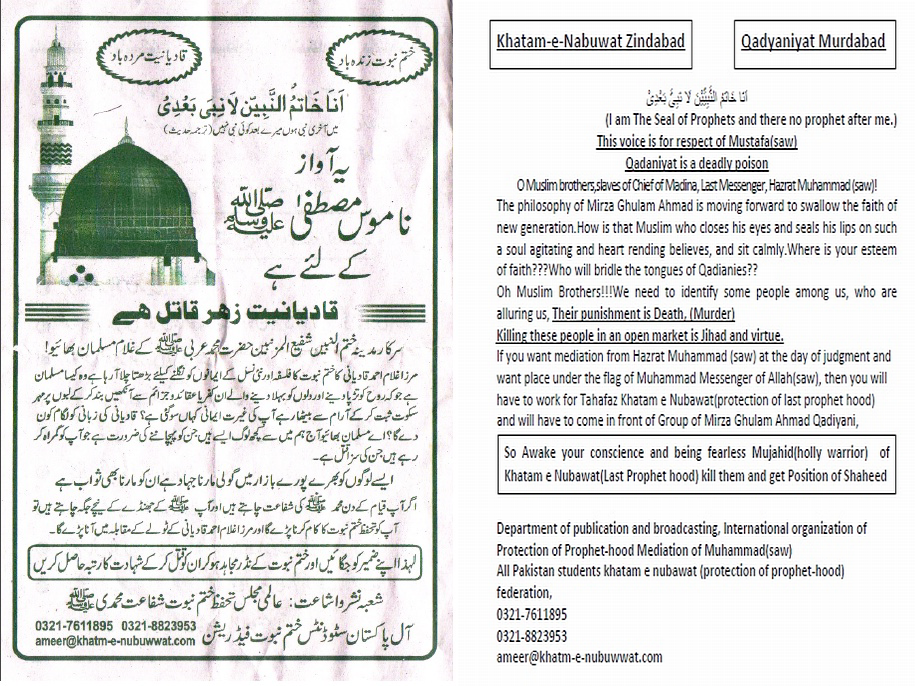
Rabia Saleem, a female student of the Ahmadi religious sect in the final year of studies at the COMSATS Institute of Information Technology in Lahore, Pakistan, has been expelled on allegations of blasphemy. Rabia Saleem was accused of blasphemy by the student wing of the banned Islamist organization known as Tahaffuz-e-Khatam-e-Nabuwwat (TKN). She lived at a student hostel in Lahore, and allegedly removed a banner displayed by TKN condemning the Ahmadi community. A guard observed her removing the poster. He then accused her of committing blasphemy by dishonoring the verses of the Koran. The controversy has been extensively covered in the Pakistani media. Ahmadis are considered by many Muslims as heretics and are treated to the same persecution as are Christians and Hindus in Pakistan.

According to a fellow CIIT student, Nasreem Ghulam, the banner displayed at the hostel door condemned Ahmadis but did not include Koranic verses. Ahmadis claim that she has been falsely accused because of her faith. Rasheed Ahmed Khan, the CIIT Registrar, denied any connection between the removal of the offending banner with the student’s faith. According to the Al-Ufaq website, “Rabia Saleem has been expelled for violating the discipline of the Institution and not complying with the rules and regulation.” He refused to provide a copy of the notice that was served to the student.

Pakistani Ahmadis bury massacre victims, 2011.

A faculty member on the condition of anonymity said,” It was a petty matter that could have been resolved by the warden and the administration, but the warden along with the security guard and CIIT administration exploited the situation against the Ahmadi student, the administration has a very discriminating attitude towards the religious minorities and never leaves a chance to take action against them. In the past several similar incidents took place, but the administration allowed the Tahaffuz-e-Khatam-e-Nabuwwat to continue their propaganda against the Ahmadis, the administration allows the TKN to act, because of the support from the administration they have become strong. The religious organizations should be barred from all the educational institutes, they are harboring terrorists by allowing such organizations to act freely and do whatever they like.”

The TKN has been displaying banners denouncing Ahmadis, while the CIIT administration has expelled the student with TKN‘s support and allowed them to display banners inciting hatred against the religious minorities and protest against the Ahmadis. They announced that they will not allow any Ahmadi student to live on the campus and will even kill if any of them resists. TKN has also started campaigns against the Ahmadis on various social networks as well.

The CIIT administration has been accused of allowing such extremist activities to continue on campus, while authorities and the ministry of education silently observe the situation allowing the propaganda against the Ahmadi students.

The Ahmadis have been living in continuous fear, earlier this year an Ahmadi religious institute was attacked in Lahore, and hundreds of innocent people were killed. In past several years the persecution against the Ahmadis has been on the rise.

In September an 8th grader was expelled for a spelling mistake in the Urdu exam in Abbotabad. Her mother was also expelled from Abbotabad.

The Masihi Foundation and Life for All Pakistan, which campaign for human rights, have also condemned the incident and issued a joint statement,” We strongly condemn the incident, the administration of the institution must be condemned for supporting a religious organization and allowing them to act against the code of conduct. The Institution‘s spokesperson said that the Ahmadi student was expelled for violating discipline, displaying banners against the religious minorities is not a violation of the discipline?”

Furthermore, read the statement “ Openly announcing a religious minority liable to be killed is allowed in an educational institution, is this not violation of the regulations and humanity? Where are we headed? Why was a banner against a religious minority allowed to be displayed at the hostel door? Many students suffer discrimination in the educational institutions, but no one addresses the matter. I fail to understand the role of the education Ministry, if they dont do anything for the education, then what is the need of having such an department, it is merely a burden on the nation, simply abolish such ministries which are not performing their designated duties. The state is allowing the religious hatred to grow and is not taking notice of the growing persecution.”

“The extremist mind set is growing and taking over, if this continues Pakistan will lose all the sane people alive. Ensuring the safety of the minorities is the state‘s responsibility, Quaid-e-Azam the founder of Pakistan said every citizen has the right to practice his / her religion freely, anyone‘s religion is their personal mater and not the matter of the state. Is today‘s Pakistan Quaid-e-Azam‘s Pakistan? The Director COMSATS must have immediately resigned on such a shameful incident.”

“This is the reason religious and state affairs should be kept separate,” continued the statement from the humanitarian organizations.

“The concerned authorities must intervene and take the necessary action. The growing extremism in the educational institutions must be checked, no one should be allowed to speak or do anything against any religion. Tolerance and Harmony must be promoted, the religious leaders must play a positive role and condemn such incidents, so that in future students like Rabia Saleem don’t suffer. The only Pakistani who won the Nobel peace prize - Abdul Salam - was never given the place he deserved only because he was an Ahamdi. It is about time the government takes steps to end the religious extremism before it consumes the nation like a plague.”

Rodrick Samson is Spero correspondent in Pakistan.

© Copyright Spero, All rights reserved.
URL: www.speroforum.com/a/OKRZLTUIGV5/...resisting-Islamists

Lahore: Ahmadi student expelled on false blasphemy charges

Asia News
» 11/25/2011 17:11
PAKISTAN
Lahore: Ahmadi student expelled on false blasphemy charges
by Jibran Khan
Rabia Saleem ripped up an anti-Ahmadi poster. Students affiliated with Islamic fundamentalist groups accused her falsely in order to expel her from campus. The university usually covers up extremist abuses as silence reigns in the Education Ministry. Catholic priest slams the authorities’ inaction.

Lahore (AsiaNews) — An Ahmadi student from Lahore (Punjab) was expelled from her university in her senior after she was accused of blasphemy. Students affiliated with Tahaffuz-e-Khatam-e-Nabuwwat (TKN) accused Rabia Saleem of ripping up a poster with anti-Ahmadi content. Ahmadi Muslims are considered heretical by mainstream Islam because they do not view Muhammad as the last prophet. The poster was on the door of the hostel where the young woman lived, and, according to sources, it did not contain any verses from the Qur‘an. A student, who asked for anonymity, said that the university “discriminates against religious minorities” and allows fundamentalist groups to “do as they as they please.”

Rashid Ahmad Khan, additional registrar at the Comsats Institute of Information Technology in Lahore, had denied any link between the student’s expulsion and her religion. Instead, he said she was expelled for “breaking university rules” since she “did not provide a document” required in order to register. Student sources say instead that the expulsion of the Ahmadi student was racist in nature, the result of an attitude of discrimination towards religious minorities that permeates the university.

In the meantime, TKN-affiliated students announced that “Ahmadi students would not be allowed” on campus, and that anybody who tried to resist them would be killed. The university and the education ministry reacted to the threat with total silence.

By contrast, it has send shockwaves through the Ahmadi community, which now fears fresh attacks, like the dual attack of May 2010 against two mosques in Lahore that left hundreds dead.

Speaking to AsiaNews, Fr Amir John said that “many students are victims of discrimination in school and that no one has seriously tackled the problem.” In his view, the state “tolerates religious hatred” and “does nothing when episodes of persecution occur.”

For the Catholic priest, the extremist mindset continues to spread and because of it Pakistan could lose important and prominent people from religious minorities.

The Masihi Foundation and Life for All, two NGOs involved in helping victims of discrimination and violence, also condemned Rabia Saleem’ expulsion. In a joint statement, they called for “tolerance and harmony” and urged religious leaders to “play a positive role” in building a multi-confessional society.

They also noted that the only Pakistani to win a Nobel Prize (for Physics) is Abdus Salam, an Ahmadi, who was not appropriately honoured at home for his international award.

Tuesday, November 15, 2011

Ahmadis of Chantara are under Threat!

Ahmadiyya Muslim Jama'at, Bangladesh
Ahmadis of Chantara are under Threat!

After about an year and a half, Ahmadis of Chantara village under Ghatail Upozilla (Police Station) of Tangail district are under threat again!

Background:

Last year (18th June 2010) a makeshift Tin-shed Ahmadiyya mosque and a house were vandalized by some fanatic people led by Imam Mufti Nasiruddin. Daily Star Report, 19.06.2010.

After that there were further attacks on Ahmadis on 7th & 8th August, 2010, when almost all the houses of 40 (forty) Ahmadi families were vandalized, looted and many were injured. See the link below:


Again there was fresh attack on Ahmadis on 18th October, 2011, this time 6 Ahmadis including a lady were severely injured. See the link below:


Ahmadiyya Muslim Jama’at arranged Press Conferences, issued Press Notes and met and submitted documents to high-ups of the government including Ministers belongs to that area, MP of that area, IG of Police and sought justice and appealed to uphold the basic human and citizen rights of Ahmadis. We were assured that justice will be done and rights of Ahmadis will be protected.

Recent Incident:

On 13th November, 2011, almost one and a half years after, local Ahmadis of the village Chantara took initiative to set a tin-shed boundary to protect the place of mosque that was vandalized and looted by the fanatics in last year. But unfortunately, bowing down to the demand of fanatics Officer In-charge and UNO of Ghatail Upozilla stopped Ahmadis to erect the tin-shed wall and in their presence all the construction material were taken away.

Now the question are :

  • Aren’t the Ahmadis citizens of Bangladesh.
  • Don’t they have the rights to protect their own properties.
  • Isn’t their constitutional and basic human rights to build their place of worship/mosque and practice whatever they belief?
  • Can Administration do injustice to any of their citizens?

Govt need to act against Ahmadiyya tormentors

New Age, Bangladesh
15/11/2011 00:00:00
Home | EDITORIAL |
Govt need to act against Ahmadiyya tormentors

MEMBERS of the Ahmadiyya community, a minority sect of Islam, are once again exposed to intimidation. This time, they have been barred from building a mosque at a village in Tangail, although, in line with Article 41 of the constitution, ‘every citizen has the right to profess, practice or propagate any religion’ and ‘every religious community or denomination has the right to establish, maintain and manage its religious institutions’. According to a report published in New Age on Tuesday, the victims have pointed fingers to the law enforcers, who are supposed to protect their rights, for that violation. A local leader of the Ahmadiyya community alleged that while members of the Ahmadiyya community at Chantara village under Ghatail upazila started fencing their land in a bid to construct a mosque Monday morning, the police came to the spot and stopped their activities apart from pulling down the fencing.

It is pertinent to recall that Ahmadiyyas are a beleaguered community in Bangladesh. A section of religious bigots have sought to prevent them from practising their faith for years. Besides, they have clamoured during this period that the government declare Ahmadiyyas as non-Muslims which is altogether affront not only to democratic values but also to the spirit of religious harmony. Worse, they have unleashed attacks on them and their homes and places of worship on several occasions. Regrettably, however, successive governments have hardly taken any deterrent steps against these crimes. Rather, they appear to have pursued an appeasement policy when it comes to dealing with such bigotry. All this may have, on the one hand, emboldened the bigoted elements in society to continue their misdeeds and, on the other, prompted the law enforcing agencies to give indulgence to the tormentors of the Ahmadiyyas.

Most people in Bangladesh, irrespective of their religious faiths, believe in communal harmony; the bigots are essentially a minority. If the government is serious, it can tackle such bigotry that is posing a danger to our syncretistic social fabric, developed over centuries. Ironically, the denial of rights of a community occurs at a time when a political force, which usually loves to be identified as the defender of that secular entity of the country, is in power. The incumbents indeed need to do something decisive to ensure the rights of all minorities, including the Ahmadiyyas, as well as to thwart the overall activities of the bigots.

Tangail villagers stop Ahmadiyyas from building mosque

New Age, Bangladesh
15/11/2011 00:00:00
Home | FRONTPAGE |
Tangail villagers stop Ahmadiyyas from building mosque

Our Correspondent. Tangail

People in a Tangail village stopped the local members of the Ahmadiyya community from constructing a mosque for themselves on Monday.

Assistant superintendent of police Md Sajahan said that members of the Ahmadiyya community at Chantara in Ghatail started to build a mosque in the village about 11:00am but that other villagers stopped the work.

On hearing about the matter, the police from Ghatail police station went to the spot and removed both parties, he added.

Policemen have been deployed there to deal with any violence.

Local Ahmadiyya leader Rafiq Ahmed, however, said that local members of the community had started fencing their land to build a mosque but that the police had stopped their activities.

‘Not only that, but the police also broke our fencing and deployed extra policemen there,’ he said.

Thursday, August 18, 2011

INDONESIA: Conviction of Ahmadyah victim undermines constitutional protections

AHRC Logo
News / AHRC News / INDONESIA: Conviction of Ahmadyah victim …

INDONESIA: Conviction of Ahmadyah victim undermines constitutional protections

August 18, 2011

The Asian Human Rights Commission (AHRC) is disturbed by the punitive decision of the Indonesian Court on August 15, 2011 to jail an innocent Ahmadi Muslim who protected himself during a mob attack, which reveals the impartiality of the judiciary and the legal community.

Deden Sudjana was sentenced to six months imprisonment by the court, for simply protecting the house the mob were attacking. Meanwhile, the 12 men who were responsible for brutally killing three Ahmadi Muslims in an attack in February 2011, were only sentenced to between three and six months imprisonment.

Some 1,500 people attacked the home of an Ahmadiyah community leader in Cikeusik, west Java in February. Sudjana was hit with a machete and almost had his hand severed during the mob attack. Head of security for the Indonesian Ahmadiyah Congregation (JAI) at the time, Sudjana was detained since May for allegedly inciting the attack. In its judgment, the court ruled that he had disobeyed a police order to leave the scene, and had been filmed punching another man. He was thus convicted of articles 212 and 315.1 of the Criminal Code; resisting state officers and maltreatment, respectively.

The decision is senseless and embarrassing, a travesty of justice. The lenient sentences handed out to those convicted of killing three Ahmadis in July raised questions regarding judicial impartiality and upholding of constitutional protections (see AHRC-PRL-034-2011), which have now been spotlighted again. The two verdicts indicate that Indonesia’s criminal justice system is not able to deliver justice independent from religious considerations. Indonesia’s judicial commission must act on this miscarriage of justice and push for reforms that will truly ensure a fair and impartial justice process.

Indonesia today is increasingly seeing extremists push their agenda forward, mostly with the use of violence, resulting in the loss of life and damage to property. The Indonesian government has taken no effective steps to stop or prevent such activities, which will slowly erode the country’s secular values.

Similarly, the Indonesian courts and legal system have shown a complete disregard for the basic rule of law, and have not taken up their mandate of protecting the constitutional rights of Indonesian citizens.

The AHRC urges for a review of both verdicts, and calls upon the Indonesian government and courts to ensure that all religious and other minorities are adequately protected.

Document ID: AHRC-PRL-034-2011
Document Type: Press Release
URL: www.humanrights.asia/news/press-releases/AHRC-PRL-034-2011

Tuesday, August 2, 2011

Muslim sect braces for Indonesia Ramadan violence

ABS-CBN Interactive. Philippine
Home > World
Muslim sect braces for Indonesia Ramadan violence
by Presi Mandari, Agence France-Presse
Posted at 08/02/2011 1:26 PM | Updated as of 08/02/2011 1:26 PM

JAKARTA - As most Indonesian Muslims started the fasting month of Ramadan peacefully this week, followers of the minority Ahmadiyah Islamic sect braced themselves for hatred and bloodshed.

Ahmadiyah leaders said they feared the worst after a court last week handed down sentences of only a few months in jail to hardliners who killed three sect members in a vicious mob attack.

“The extremists say this is a holy month, everything must be pure and sacred. So we, the Ahmadiyah followers, must be cleared out,” Ahmadiyah spokesman Firdaus Mubarik told AFP.

The sect is unorthodox in that it does not believe Mohammed is the last prophet of Islam. It claims 500,000 followers in Indonesia, where it has existed in relative calm since the 1920s.

Islamic vigilante groups, emboldened by a decree ordering the sect to stop spreading its beliefs in the Muslim-majority country, have recently started targeting the Ahmadiyah in an ugly wave of hate crimes.

“For us, the fasting month doesn’t mean there’ll be peace for us to perform our religious obligations. On the contrary, there are more opportunities for Muslim extremists to mobilize and incite people to attack us,” Mubarik said.

Last year’s holy month saw Ahmadiyah homes and a mosque destroyed by angry mobs, he said.

Days before this year’s Ramadan began on Monday, authorities ordered the Ahmadiyah community in Samarinda city, on Borneo island, to close their mosque following complaints from members of the mainstream Sunni Muslim faith.

Hundreds of hardliners from the Islamic Defenders Front, one of the vigilante groups responsible for the violence, rallied Saturday at the presidential palace in Jakarta demanding Ahmadiyah be outlawed altogether.

Harassment, persecution and violence against minorities, especially the Ahmadiyah, have become more frequent under the leadership of twice-elected President Susilo Bambang Yudhoyono, analysts say.

The latest outrage, according to local and international human rights groups, was the slap on the wrist given to the ringleaders of February’s deadly mob frenzy against Ahmadiyah followers in Cikeusik village, western Java.

Around 1,500 enraged extremists descended on a house occupied by a handful of Ahmadiyah defenders, brushed aside the police and proceeded to stone, beat and hack their victims to death before destroying the property.

The unprovoked attack was filmed by an Ahmadiyah member who is now in hiding under police protection, providing graphic evidence of the crimes.

Yet prosecutors claimed the sect provoked the violence by refusing to abandon their property to the mob. The state did not charge any of the perpetrators with murder; instead it produced what Human Rights Watch described as an “almost laughable” list of minor infringements.

Dani bin Misra, a 17-year-old who was caught on film repeatedly smashing a victim’s skull with a stone, was sentenced to three months in jail for assault causing death, public incitement and destruction of property.

Idris bin Mahdani, who led the mob, was convicted of illegal possession of a machete and received five months and 15 days in jail.

The United States and the European Union expressed strong misgivings but Yudhoyono has said nothing about the sentences, raising questions over his oft-repeated commitment to pluralism and the rule of law.

“We’re in a state of emergency regarding freedom of religion,” Setara Institute for Democracy and Peace activist Hendardi told AFP.

“Last week’s court ruling not only failed to give a deterrent effect to the offenders but will encourage the violators to carry out more attacks against minorities in the coming days.”

Religious affairs ministry spokesman Zubaidi said the sentences were the result of a fair trial, and rejected allegations that the police had failed to properly investigate the crimes.

“As an executive body, we cannot interfere in the legal system… Whether the sentences are light or harsh, how it’s perceived is relative,” he said.

Copyright ©2011 ABS-CBN Interactive. All Rights Reserved
URL: www.abs-cbnnews.com/global-filipino/world/08/02/11/muslim-sect...

Muslim sect braces for Indonesia Ramadan violence

The Straits Times, Singapore
Breaking News
August 02, 2011 Tuesday
Updated 11.29 pm
SE Asia
Home > Breaking News > SE Asia > Story
Aug 02, 2011
Muslim sect braces for Indonesia Ramadan violence
Ahmadiyah leaders said they feared the worst after a court last week handed down sentences of only a few months in jail to hardliners who killed three sect members in a vicious mob attack. -- PHOTO: REUTERS
Ahmadiyah leaders said they feared the worst after a court last week handed down sentences of only a few months in jail to hardliners who killed three sect members in a vicious mob attack. — PHOTO: REUTERS
JAKARTA - AS MOST Indonesian Muslims started the fasting month of Ramadan peacefully this week, followers of the minority Ahmadiyah Islamic sect braced themselves for hatred and bloodshed.

Ahmadiyah leaders said they feared the worst after a court last week handed down sentences of only a few months in jail to hardliners who killed three sect members in a vicious mob attack.

‘The extremists say this is a holy month, everything must be pure and sacred. So we, the Ahmadiyah followers, must be cleared out,’ Ahmadiyah spokesman Firdaus Mubarik told AFP.

The sect is unorthodox in that it does not believe Mohammed is the last prophet of Islam. It claims 500,000 followers in Indonesia, where it has existed in relative calm since the 1920s.

Islamic vigilante groups, emboldened by a decree ordering the sect to stop spreading its beliefs in the Muslim-majority country, have recently started targeting the Ahmadiyah in an ugly wave of hate crimes.

‘For us, the fasting month doesn’t mean there’ll be peace for us to perform our religious obligations. On the contrary, there are more opportunities for Muslim extremists to mobilise and incite people to attack us,’ Mr Mubarik said. — AFP

Injustice in Indonesia

   Tuesday, August 2, 2011 As of 12:00 AM
Wall Street Journal, USA
REVIEW & OUTLOOK ASIA
Injustice in Indonesia
Failure to protect religious minorities undermines the country’s democracy.

Indonesia, the world’s most populous Muslim-majority democracy, is in many ways a beacon for those who believe Islam and liberalism can peacefully co-exist. Yet with the light sentences last week for 12 people involved in a riot that killed three members of a religious minority, that beacon has dimmed a bit.

A dozen people were sentenced Thursday to a maximum of six months in jail for their roles in the February riot in Cikeusik, a village on western Java. More than 1,000 locals had targeted around 20 members of the Ahmadiyya sect; in addition to the deaths, at least five Ahmadis were seriously wounded. The tumult, which was caught on tape, started as the Ahmadis were preparing to ask the police for stronger protection in the face of Islamist efforts to chase the group out of the village. Of the three victims—Warsono Kastolib, Roni Pasaroni and Tubagus Chandra—one was bashed to death with a rock.

Indonesia’s treatment of its Ahmadi minority has become a test of the country’s commitment to democratic pluralism, and the trial resulting from the February riot is the latest sign Jakarta is failing. The sect, which describes itself as an offshoot of Islam, is viewed as heretical by many Muslims. Islamists have tried various means, legal and illegal, to intimidate the Ahmadis, including attacks on property owned by Ahmadis around the country.

February’s riot was one of the most serious instances to date, yet no one has been charged with murder or manslaughter as a result. The 12 defendants in last week’s case received extremely light sentencing recommendations from prosecutors, and the sentences actually imposed by the judges were lighter still.

President Yudhoyono needs to be firm with radical Islamists.
Associated Press
President Yudhoyono needs to be firm with radical Islamists.
While the judiciary is independent, at root this is a failure of political leadership. Rather than making a forceful case that Indonesia’s democratic future hinges on allowing all Indonesians the freedoms of worship and speech—and then pressing police and prosecutors to fully investigate the riot and bring those responsible to justice—Jakarta has at best stood idly by.

At worst, President Susilo Bambang Yudhoyono has exacerbated the problem. He supported a 2008 decree barring the Ahmadiyya from proselytizing. The law certainly doesn’t condone rioting. But it does send the message that some forms of religion deserve fewer freedoms than others.

Prosecutors and judges in this case seem to have heard that message loud and clear. Defenders of the rioters claim the Ahmadis “provoked” the riot; this theory was credited by prosecutors in requesting light sentences for the defendants’ roles. Judges also went along with prosecutors’ argument for leniency on the grounds that since an Ahmadi had videotaped the riot and released the tape, the Ahmadis themselves had tarnished Indonesia’s reputation. One Ahmadi, Deden Sujana, received a six-year sentence for “incitement” in an earlier trial.

Mr. Yudhoyono seems to have thought he was making a calculated gamble that he could appease Islamists on the Ahmadiyya issue with little cost. Hence his 2008 decree and his silence as this case proceeded. But the riot in Cikeusik shows how short-sighted that is. Given sufficient quarter, Islamists will threaten basic law and order and undermine Indonesia’s democracy.

This verdict comes at a time when other Islamist threats against minority religions are on the rise, including at least one riot directed at Christians and increasingly frequent attacks on Christian-owned property. The vast majority of Indonesians practice a moderate form of Islam that understands the chasm between thinking a group is heretical and throwing rocks at the group’s members. Mr. Yudhoyono does a disservice to the millions of those moderates who voted for him when he doesn’t speak out for equal protection under the law.

Copyright ©2011 Dow Jones & Company, Inc. All Rights Reserved
URL: http://online.wsj.com/article/SB10001424053111903341404576481320800361998.html

Monday, August 1, 2011

Ahmadiyah Community Fears Burst of Violence Over Holy Month

Jakarta Globe, Indonesia
HOME
Ahmadiyah Community Fears Burst of Violence Over Holy Month
Ulma Haryanto | August 01, 2011

As Indonesia’s Muslim majority prepares for Ramadan and Idul Fitri, the minority Ahmadiyah Islamic sect is bracing itself for more persecution.

“Especially during Ramadan, there are more opportunities for [anti-Ahmadiyah] groups to mobilize masses and spread hatred [against us],” said Firdaus Mubarik, spokesman for the Indonesian Ahmadiyah Congregation (JAI).

Fresh from a disheartening court ruling against Islamic radicals who attacked and killed Ahmadis in Cikeusik, Banten, Firdaus fears for the worst after previous Ramadan experiences.

“A mosque in Tasikmalaya was burned several years ago [during Ramadan]. And the clash in Manis Lor also happened a week before Ramadan started,” he said.

The Islamic holy month, Firdaus said, has been used as an excuse by hard-liners to “purge” unholiness, which for them included the Ahmadiyah.

“The [Cikeusik] ruling is no longer our concern. It’s the possibility that violence might occur at anytime in the future,” he said.

The ruling handed out jail sentences of three to six months to 12 men involved in the brutal Feb. 6 attack in which about 1,500 hard-liners launched an assault on a house with 20 Ahmadis. Three Ahmadis died in the videotaped attack while five others were seriously injured.

“Over the years we’ve received intimidation and threats and have been expelled. The lenient sentence is an invitation for more violence,” Firdaus said.

On Saturday, nearly 1,500 hard-liners marched toward the presidential palace in Jakarta demanding the government disband Ahmadiyah.

Islamic Defender’s Front (FPI) leader Muhammad Rizieq Shihab, who was previously convicted of instigating an attack against Ahmadis, called on President Susilo Bambang Yudhoyono to “not be a coward.”

Some marchers held placards that said “Disband Ahmadiyah or Revolution” and “War against Ahmadiyah.”

Firdaus said Ahmadiyah communities, especially those in vulnerable areas, were going to increase their guard for Ramadan.

The Cikeusik verdict has received widespread international condemnation, the latest coming from Christian Solidarity Worldwide.

“The shockingly lenient sentences imposed on the perpetrators of some of the worst anti-minority violence in recent years raises serious questions about the integrity of Indonesia’s justice system, and gives the extremists a green light to continue their campaign of hatred,” CSW’s Advocacy Director Andrew Johnston said in a statement.

“It leaves religious minorities throughout Indonesia, not only in West Java, and not only the Ahmadiyah community, vulnerable and defenseless,” he said.

Saturday, July 30, 2011

Indonesian Muslims demand Ahmahdiyah be outlawed

The Straits Times, Singapore
Breaking News
July 30, 2011 Saturday
Updated 3.30 pm
SE Asia
Home > Breaking News > SE Asia > Story
Jul 30, 2011
Indonesian Muslims demand Ahmahdiyah be outlawed

Members of Indonesia's Islamic Defenders Front (FPI) rally on the streets in Jakarta July 30, 2011. Members of the FPI are demanding the government to disband Ahmadiyah sect. Indonesia's Assembly of Indonesian Muslim Clerics (MUI) considers the Ahmadiyah sect to be 'heretical' for believing that Mohammad was not Islam's final prophet. -- PHOTO: REUTERS
Members of Indonesia's Islamic Defenders Front (FPI) rally on the streets in Jakarta July 30, 2011. Members of the FPI are demanding the government to disband Ahmadiyah sect. Indonesia's Assembly of Indonesian Muslim Clerics (MUI) considers the Ahmadiyah sect to be 'heretical' for believing that Mohammad was not Islam's final prophet. — PHOTO: REUTERS
JAKARTA — HUNDREDS of conservative Muslims held a noisy but peaceful rally in Indonesia’s capital on Saturday to demand the government outlaw an Islamic sect they consider heretical.

Nearly 1,500 white-robed protesters - gathering days after a court sentenced 12 men to less than six months in jail for lynching three Ahmahdiyah sect members - marched through the streets until they reached the presidential palace.

Some held placards that said ‘Disband Ahmadiyah or Revolution’ and ‘War against Ahmadiyah.’

Cleric Muhammad Rizieq Shihab shouted through his bullhorn that President Susilo Bambang Yudhoyono should ‘not be a coward.’ ‘Disband them!‘ he said, as the crowd of 1,500 cheered and chanted ‘Allah Akbar’ or ‘God is great’.

Indonesia, a predominantly Muslim and secular nation of 240 million, has a long history of religious tolerance.

But experts say a small, extremist fringe has grown more vocal in recent years and is seeking - with some success - to impose its will on police, the judicial system and the government. They’ve been emboldened by the inaction of Mr Yudhoyono, who relies on the support of Islamic parties in Parliament, and does not want to offend conservative Muslims by taking sides. — AP

Friday, July 29, 2011

INDONESIA: Courts verdict encourages further attacks against religious minorities

AHRC Logo
News / Press Releases / INDONESIA: Courts verdict encourages…
INDONESIA: Courts verdict encourages further attacks against religious minorities

July 29, 2011

(Hong Kong, July 29, 2011) Three to six months in prison was the shocking sentence given to the perpetrators of the mob killing of three Ahmadiyahs earlier this year. The remaining perpetrators will be released on the reading of the verdict on 23 August this year. Most of them will be released during the coming weeks. This lenient punishment and the conduct of the judges in the trial sends a clear signal to religious fundamentalists that they not need to worry about the law and constitutional protection of minorities.

“The verdict and trial conduct does not meet national or international standards” Wong Kai Shing, Executive Director of the Asian Human Rights Commission said. “The lenient punishment will encourage more extremist action against religious minorities” Wong added,” the courts failed to enforce Indonesian law for the protection of citizens.”

On 28 April 2011 the Serang District Court in West Java convicted twelve suspects for maltreatment, joint assault and incitement in the horrendous Cikeusik killing from February this year. A mob set against the discriminated religious minority of Ahmadiyah followers attacked the group in Umbulan village, Cikeusik resulting in five members being injured and three killed. At least one patrol car from Cikeusik sector police and 2 trucks from riot-control force (Dalmas) of Pandeglang dictrict police men were present and watched the violence, doing nothing to prevent it or apprehend the perpetrators. The shocking scenes were published in a video online sparking international outcry.

The Indonesian Ahmadiyah congregation (JAI) commented that the verdict does not fulfil the sense of fairness. According to A. Mubarik Ahmad, the public relation of JAI, this crime must be seen as crimes against humanity, not just a crime against the Ahmadiyah. The Indonesian criminal code never regulated the crimes against Ahmadiyah. Moreover, he stated that the state still cannot find the murderer of the victims, because the trial did not charged the suspect with murder charge, thus there is no examination and trial for the murderer.

In 1980 and 2005, Indonesian Ulama Assembly (Majelis Ulama Indonesia) issued a fatwa against the Ahmadiyah community in Indonesia denouncing Ahmadyah followers as an errant sect. In 2008 a joint ministerial decree banned the group for promulgating its religion and other basic religious rights. The decree is widely believed to be responsible for encouraging attacks against Ahmadis. Numerous attacks against Ahmadiyah communities and their members were documented by the Setara Institute and Wahid Institute over the last years.

The AHRC is concerned that the lenient punishment for a mob killing against the minority group will encourage more fundamentalist violence. Institutions have failed in this case to send a strong message against extremism. The AHRC believes that law and constitutional values were not the basis for the judgement in this case.

Thursday, July 21, 2011

INDONESIA: Ahmadiyah community faces ongoing discrimination

AHRC Logo
Opinions / Interviews / INDONESIA: Ahmadiyah community faces ongoing discrimination
INDONESIA: Ahmadiyah community faces ongoing discrimination

July 21, 2011

An interview with Zaenuda Ikhwanul Aziz from the Indonesian Ahmadiyah Community (JAI) published by the Asian Human Rights Commission regarding the situation faced by Ahmadis in Indonesia.

Zaenuda Ikhwanul AzizZaenuda Ikhwanul Aziz, is the secretary of the legal committee of the Indonesian Ahmadiyah congregation (Jamaah Ahmadiyah Indonesia — JAI). He is actively involved in the struggle of the Ahmadiyah in the country.


How do you feel about what is happening to the Ahmadiyah community in Indonesia?

We feel that we are being discriminated against, especially the Ahmadiyah communities at the localities outside the capital of Jakarta. For example, the government does not give identification cards and marriage certificates to Ahmadiyahs.

At the economic sector many Ahmadiyahs have had to change the location of their businesses. Even in some provinces, the people from the community are intimidated not to buy products from Ahmadiyah shops and businesses and this has resulted in a serious reduction of our income.

In the social sector we also are excluded and intimidated. We are not allowed to be involved in social gatherings.

At the religious sector the Minister of Religion prohibits us from conducting the Hajj, (the pilgrimage to Mekka) and even when we pray, members of the local communities attack our mosques. Sometimes, our villages are also attacked.

Also, in the health sector, many people reject Ahmadiyahs as patients. We therefore feel discriminated against in most, if not all, sectors.

When did you start to feel the discrimination?

The discrimination started when the Indonesian Ulama Assembly (Majelis Ulama Indonesia - MUI) declared Ahmadiyah as an errant sect in 1980. This fatwa brought to light the differences between Ahmadiyahs and the community. The people followed the fatwa believing that Ahmadiyah is errant without seeking any further explanation or consideration.

The main actors involved are the Indonesian government, central and local law enforcement authorities and several Ulama members who influence the people to attack Ahmadiyah communities. This is especially so with those persons who live within Ahmadiyah communities.

In your opinion, what is the reason for the increase of the aggression against Ahmadiyahs in the last few years?

There are several reasons, not the least of which is that the government is indecisive about law enforcement. If the joint ministerial decree against JAI still prevailed then the government could not allow the local regulations in the provinces to declare Ahmadiyah as an errant sect. Unfortunately, the government did nothing to prevent this from happening.

The aggressors see Ahmadiyah as a threat because the numbers of Ahmadiyah communities is increasing and they are scared that they will lose their followers.

Also, the content of the joint ministerial decree has been misinterpreted. There are local regulations which use the joint resolution decree to declare Ahmadiyah as errant whereas there is no such statement in the decree itself. The JAI think this happened because the government is trying to distance itself from the joint of resolution decree.

Is the state doing anything to protect the Ahmadiyahs?

We feel the state protection is still minimal. There is still turmoil because there is no law enforcement. It is seldom that perpetrators of violence against Ahmadiyahs are arrested and they are never prosecuted in the courts.

What do you feel about the work of the police?

In general, the work of the police is still far from professional. However, we must acknowledge that in some areas, there are some good police officers working in relation to Ahmadiyahs.

What about the work of the courts?

Judges are deficient at searching for the truth. Their efforts are deficient when examining at a trial, investigating the witness and proof, such as happened at Cisalada trial. Even the verdict against the Ahmadiyah victim was heavier than that of the perpetrators.

What is the Ahmadiyah community doing in their own defence?

Our representatives visit government officials, legal enforcement authorities, and the community in general. Relating to the legal dealings, we entrust this to our legal counsel.

The result of our visits are promising in that there are several communities and authorities who opened up and accepted us such as in Bandung, Central Java, and Wonosobo. But there have also been rejections such as in Cianjur, Bogor.

What is your ultimate goal in this struggle?

All we ask for is the right to live like other citizens and that these rights are fulfilled by the government

————————
The views shared in this article do not necessarily reflect those of the AHRC, and the AHRC takes no responsibility for them.

Friday, July 15, 2011

In Ahmadis’s desert city, Pakistan closes in

Reuters, USA
Edition US
In Ahmadis’s desert city, Pakistan closes in
Rabwah
By Myra MacDonald
RABWAH, Pakistan | Fri Jul 15, 2011 9:04am EDT
(Reuters) — At the office of what claims to be one of Pakistan’s oldest newspapers, workers scan copy for words it is not allowed to use – words like Muslim and Islam.

“The government is constantly monitoring this publication to make sure none of these words are published,” explains our guide during a visit to the offices of al Fazl, the newspaper of the Ahmadiyya sect in Pakistan.

This is Rabwah, the town the Ahmadis built when they fled the killings of Muslims in India at Partition in 1947, and believing themselves guided by God, chose a barren stretch of land where they hoped to make the Punjab desert bloom.

Affluent and well-educated, they started out camping in tents and mud huts near the river and the railway line.

Now they have a town of some 60,000 people, a jumble of one- and two-storey buildings, along with an Olympic size swimming pool, a fire service and a world class heart institute.

Yet declared by the state in the 1970s to be non-Muslims, they face increasing threats of violence across Pakistan as the country strained by a weakening economy, an Islamist insurgency and internecine political feuds, fractures down sectarian and ethnic lines.

“The situation is getting worse and worse,” says Mirza Khurshid Ahmed, amir of the Ahmadi community in Pakistan. “The level of religious intolerance has increased considerably during the last 10 years.”

The town, renamed Chenabnagar by the state government since “Rabwah” comes from a verse in the Koran, is now retreating behind high walls and razor wire, awaiting the suicide bombers and fedayeen gunmen who police tell them are plotting attacks.

Last May, 86 people were killed in two Ahmadi mosques in Lahore, capital of Punjab; others were attacked elsewhere in the province. Many fled to Rabwah where the community gives them cheap housing and financial support.

Among them is 15-year-old Iqra from Narewal, whose shopkeeper father was stabbed to death last year as the family slept. “I was sleeping in another room when my father was attacked,” she begins in a small voice, pulling a black scarf across her face to cover her mouth in the style of Ahmadi women.

“The attacker wanted to kill all the Ahmadis in Narewal,” her brother Zeeshan continues. “My elder brother tried to help my father and he was stabbed and wounded too.”

Later police found the attacker hiding in a mosque. He had believed the mullahs when they told him that all Ahmadis were “wajib ul qatl”, or deserving of death.

BATTLEGROUND FOR POWER

The Ahmadis follow the teachings of Mirza Ghulam Ahmad, who in the town of Qadian in late 19th century British India called for a revival of a “true Islam” of peace and justice. His teachings were controversial with Muslims and Christians alike.

He argued that Jesus did not die on the cross but escaped and travelled to India and was buried in Kashmir. And he claimed to be the metaphorical second coming of Jesus, destined to put Muslims back on the true path.

Many Muslims were offended by the suggestion he had come as a prophet, breaching a basic tenet of Islam that there can be no prophet after Mohammad, whose teachings are believed to be based literally on the word of God, perfect and therefore final.

Yet his call for peace, hard work, temperance, education and strong community bonds resonated, and over the years the proselytizing movement acquired millions of followers worldwide.

At home, however, their history has been intimately bound up in Pakistan’s own descent from its relatively optimistic birth.

Lacking a coherent national identity, it has become a battleground for competing political, religious and ethnic groups seeking power by attacking others.

“The mistake of the Ahmadis was that they showed their political strength,” said an Ahmadi businessman in Lahore.

Better education he said, meant they obtained good positions in the army and civil service at first; strong community bonds made them an influential force in politics up to the 1970s.

But they also made an easy target for the religious right who could whip up anti-Ahmadi sentiment for political gain.

Ahmadis follow two different schools of thinking, but will argue, often with detailed references to the Koran in both Arabic and English, that they do not dispute the finality of the Prophet Mohammad. Their erudite theological arguments, however, had little chance against the power of the street.

After anti-Ahmadi violence, they were declared non-Muslims in 1974. In the 1980s, their humiliation was completed when legal provisions barred them from associating themselves with Islam, for example by using the call to prayer or naming their place of worship a “masjid” or mosque.

“You can say you don’t consider me to be a Muslim but you can’t force me to also say I am not a Muslim,” complains Ahmed, the amir, the pain clear in his voice.

Yet in the newspaper office in Rabwah, a white board displays the words they are not allowed to use – they could be accused of blasphemy, which carries the death penalty.

SPREADING TO OTHER SECTS

Many Pakistanis, if you ask about treatment of the Ahmadis, shrug it off – it’s an old story, they say, dredged up by westerners who do not appreciate the importance of the finality of the Prophet.

Yet there are signs the attitudes first directed toward Ahmadis are spreading to other sects. In a country which is majority Sunni, and where insurgents follow Sunni Islam, Shi’ites and even Sufi shrines have been bombed.

A 2010 study by Pakistani analyst Ayesha Siddiqa of students in elite colleges found that while 60 percent said the government was right to declare Ahmadis non-Muslims, a sizeable 18 percent believed Shi’ites were also non-Muslims.

These and other findings led her to conclude that radicalism was growing even among the educated youth – it is often, wrongly, blamed on poverty – which in its extreme form could lead people into violence.

Their tendency, she wrote, to see different groups with an unquestioned bias, she wrote, “especially coated with religious overtones or padded with religious belief prepares the mind to accept the message from militant organizations.”

In the nearest town to Rabwah, the central square as been renamed “Khatme Nubuwwat” Chowk, meaning the finality of the Prophet. Beyond, low jagged hills spike up above the dusty land, the summits of much bigger rock formations below the surface.

Many of the Ahmadis had been active supporters of the movement which created Pakistan and when they first came here they were inspired by a verse in the Koran, describing “an elevated land of green valleys and springs of running water.”

Now they are surrounded by a very different country.

Rabwah itself is open to the outside world – despite the high walls guarding individual houses, it is not a walled town.

“Under the circumstances we try to take the best measures we can to protect ourselves,” says the amir. “But what we can do is very limited. We don’t have a mindset or training for that.

And in any case, he adds, “How many people can leave Pakistan or Rabwah?“

Wednesday, May 18, 2011

UN High Commissioner urges for Special Rapporteur visit

Jakarta Post, Indonesia
NATIONALWed, 05/18/2011 9:29 PM
UN High Commissioner urges for Special Rapporteur visit
The Jakarta Post, Jakarta
The United Nations’ High Commissioner for Human Rights, Navanethem Pillay, has urged the government to accept the request of the Special Rapporteur on freedom of religion or belief to visit the country this year.

The call came in a letter sent to Foreign Affairs Minister Marty Natalegawa, a copy of which was obtained by The Jakarta Post on Wednesday.

In the letter, dated April 26, Pillay expressed his concern over reports of violence against members of religious minorities in Indonesia.

He said he had received reports of widespread violence and discrimination against the Ahmadiyah community in Indonesia, including the issuance of several decrees banning their activities in certain regions.

He had also received reports concerning harassment and violence against members of other religious minorities, he said.

“In Bogor, West Java, I am informed that local authorities have closed off the Indonesian Christian Church of Taman Yasmin and prevented them from conducting religious services,” Pillay wrote in his letter.

There were also reports of Christian groups being attacked and Christian churches being burned in several regions. He further mentioned reports that a Buddhist community in North Sumatra was ordered to dismantle a Buddha statue at a temple that was considered by some to be a challenge to Islam in that area.

Pillay said he hoped that his office “might be able to contribute in some meaningful and constructive way to the discussion and law reform efforts taking place within Indonesia and would welcome the opportunity to discuss this further” with the Indonesian government.

“In this regard, I strongly encourage the Government of Indonesia to accept the request of the Special Rapporteur on freedom of religion or belief to undertake a visit to the country later this year,” he added.

Copyright © 2008 The Jakarta Post - PT Bina Media Tenggara. All Rights Reserved
URL: www.thejakartapost.com/news/2011/05/18/un-high...visit.html

UN tells RI to review laws restricting religious freedom

Jakarta Post, Indonesia
NATIONALWed, 05/18/2011 8:15 PM
UN tells RI to review laws restricting religious freedom
The Jakarta Post, Jakarta
The United Nations’ High Commissioner for Human Rights Navanethem Pillay has urged Indonesia to review its laws restricting religious expression and practice.

In a letter sent to Foreign Minister Marty Natalegawa, a copy of which was obtained by The Jakarta Post on Wednesday, Pillay expressed his concern over reports of violence against members of religious minorities in Indonesia.

“I have been particularly disturbed by the widespread violence and discrimination reported against the Ahmadiyya community which has included the state-sanctioned closing of Ahmadi mosques, the burning of homes and places of worship, and even physical violence and murder,” Pillay wrote in his letter dated April 26.

Three Ahmadis were killed when Islamic hard-liners attacked a small Ahmadiyah community in Cikeusik, West Java, on Feb. 6 this year. Several local and provincial administrations have since issued decrees banning Ahmadiyah activities in their respective regions.

Pillay said reports had said that since the new regulations were issued, “further acts of harassment and violence have taken place”.

He pointed out that Indonesia had ratified the International Covenant on Civil and Political Rights (ICCPR), which guarantees the right to freedom of religion.

“Government at both national and provincial levels should comply with the guarantees contained in the Indonesian Constitution and in the international treaties in which Indonesia is a party. All laws, particularly those restricting religious expression and practice, should be reviewed to ensure they comply with these standards,” he said.

He also urged the Indonesian government to ensure the legal accountability of all perpetrators, including the imposition of penalties.

Copyright © 2008 The Jakarta Post - PT Bina Media Tenggara. All Rights Reserved
URL: www.thejakartapost.com/news/2011/05/18/un-tells...freedom.html

Tuesday, May 17, 2011

UN ‘Disturbed’ by Indonesia’s Religious Violence

Jakarta Globe, Indonesia
HOME
UN ‘Disturbed’ by Indonesia’s Religious Violence
Camelia Pasandaran & Cameron Bates | May 17, 2011

The United Nations has written to the Indonesian government expressing “concern” about the increasing number of reports about violence committed against religious minorities.

The Ministry of Foreign Affairs, however, says it is yet to receive a copy of the letter, dated April 26, 2011, from UN High Commissioner for Human Rights Navanethem Pillay. The letter was also copied to the National Commission on Human Rights (Komnas HAM) and a number of other Indonesia institutions.

Pillay also reveals a proposed visit by the UN’s special rapporteur on freedom of religion or belief to visit Indonesia this year to investigate the allegations.

In the letter, a copy of which was obtained by the Jakarta Globe on Sunday, Pillay says she is writing to the Indonesian government to “express my concern over the large number of letters and reports I have received in recent months concerning violence against members of religious minorities in Indonesia.”

“I have been particularly disturbed by the widespread violence and discrimination reported against the [Ahmadiyah] community, which has included the state-sanctioned closing of Ahmadi mosques, the burning of homes and places of worship, and even physical violence and murder.”

Pillay said that since the violent attack that left three Ahmadi dead in Cikeusik, West Java, on Feb. 6, several government authorities had responded by issuing new regulations and decrees that allowed “further acts of harassment and violence” to occur.

Pillay also noted a number of other reported incidences of religious intolerance, including the ongoing stand-off between the Bogor government and the Indonesian Christian Church (GKI) Yasmin.

“Christian groups have reportedly been attacked and Christian churches have reportedly been burned in Gebyog, Klaten and Tegal in Central Java. In North Sumatra, a Buddhist community was ordered to dismantle a Buddha statue at a temple that was considered by some to be a challenge to Islam in that area.”

The commissioner said the incidents put at risk the human rights guaranteed in the Constitution and the International Covenant on Civil and Political Rights, to which Indonesia is a signatory.

“The General Assembly and Human Rights Council have repeatedly urges States to take all necessary and appropriate actions, in conformity with international human rights standards, to combat hatred, discrimination, intolerance and acts of violence, intimidation and coercion motivated by intolerance based on religion or belief, as well as incitement to hostility and violence, with particular regard to members of religious minorities.”

Pillay said she understood that discussions were ongoing between the government, Komnas HAM, civil society and religious groups concerning the issue.

“I encourage the government of Indonesia to take this opportunity to support reflection and action at various levels to address the broader issues behind religious intolerance and discrimination.”

She said that laws that restricted religious expression and practise “must be reviewed to ensure they comply with these standards” and well as ensuring that justice was upheld against those found to have committed wrongdoing.

Pillay also “strongly encouraged” the government to accept a proposed visit by the United Nation’s special rapporteur on freedom of religion or belief to visit Indonesia this year.

Rev. Ujang Tanusaputra of GKI Yasmin said the letter was “a bad assessment of Indonesia in the context of religious freedom.”

“As a nation that is based on [the state ideology] Pancasila with its motto Unity in Diversity, the government should uphold and implement the pillars of Indonesia.”

Copyright 2010 The Jakarta Globe
URL: www.thejakartaglobe.com/home/united-nations.../441540

Monday, May 16, 2011

Survivors Recount Violence in Cikeusik

Jakarta Globe, Indonesia
INDONESIA
Survivors Recount Violence in Cikeusik
Ulma Haryanto | May 16, 2011

The house in Cikeusik, Banten, where a mob attacked an Ahmadiyah community in February. Three Ahmadiyah members were killed in the attack. (Antara Photo)
Ahmad Masihuddin, Irwan and Bebi are the lucky ones.

Ahmad recalls the moment when a man attempted to mutilate his genitals, while Irwan has developed an intense fear of water. Bebi cannot speak, due to a dislocated jaw, and must eat through a straw.

Despite the fear of reprisals, two of these three men — Ahmad and Irwan — met with the Jakarta Globe over the weekend to recount their memories of the bloody attack against a small group of Amhadiyah sect members in the village of Cikeusik, Banten, on Feb. 6.

On that day, three Ahmadis — Roni Pasaroni, Warsono and Tubagus Chandra — were killed by a 1,500-strong mob. Much of the violence was captured on video, and footage of Ahmadi men stripped of their clothes and being brutally beaten with stones and bamboo sticks can be seen on YouTube.

Twelve men are facing charges in relation to the attack. If found guilty their maximum sentences could range from 12 years in jail to the death penalty.

But Irwan and Ahmad say that even the harshest of punishments for those 12 men will not blot out the acts of cruelty they witnessed and endured on that day. Nor will guilty verdicts dampen the attendant rage and frustration they feel at a police force that is widely seen as having stood by and allowing the violence to unfold.

“Police pronounced me dead when my muddy, naked body was thrown into a police truck,” Ahmad said. “If I did not use the martial arts knowledge I learned through the years, I’d be among the dead.”

The police had collected Ahmad’s battered body after he had been dragged through the dirt by a group of enraged attackers. “Along the way, people slashed me with machetes, and threw rocks and bamboo poles at me. I lost consciousness. I believed I had died.”

Unguarded

Irwan, Roni and Warsono had left for Cikeusik from Jakarta on the night of Feb. 5. Irwan told the Globe that they had traveled to Cikeusik to provide security for a demonstration that the village’s Ahmadiyah community was planning on staging the next day.

“I was at our regular Koran recital meeting in Petojo [Central Jakarta]. Roni came to me and asked if I wanted to come along with him to Cikeusik,” Irwan said. “I asked him what for. He told me to guard a demonstration.”

They arrived around 10 p.m. on Saturday night, and were met by Deden Sujana, head of security for the Indonesian Ahmadiyah Congregation (JAI). The next day, Deden would almost lose his right arm to a machete attack, and police would later name him as a suspect for triggering the violence.

Ahmad, who lives in Kalideres, West Jakarta, had likewise gone to Cikeusik to provide security for the demonstration.

“Eki, a colleague of mine at JAI, was on holiday and asked me to replace him to guard an Ahmadi home in Cikeusik. Without thinking it over, I agreed,” he said.

“I was in the same car as [Tubagus] Chandra and Diaz [Ferdiaz Muhammad, an Ahmadi who survived the incident]. Chandra was driving, we arrived at Serang at 3 a.m. and picked up five more Ahmadis.”

Ahmad had prior experience protecting sect members. In 2008 he had guarded an Ahmadi school in Parung, Bogor, that had come under attack, and he had been on hand with the now-deceased Tubagus when one of the sect’s orphanages in Tasikmalaya, West Java, was sealed by local authorities last December.

Ahmad worked in the administrations division at JAI, while Tubagus worked for the security division with Deden. Ahmad, however, was well trained in self-defense. He had earned a black belt in Taekwondo at the age of 15, and was instructing others in Muay Thai at 18.

As Ahmad and his friends pulled into Cikeusik, he was relieved to see some dozens of police officers standing watch over both ends of the road where the house of local Ahmadiyah cleric Ismail Suparman was located. “I texted my parents so that they didn’t have to worry. The police were here,” Ahmad said.

“Suddenly, the wife of the Cikeusik village head, Inayah, ran toward us screaming. She told all of us to leave immediately, because it seemed thousands of people were marching to Cikeusik to slaughter us. Deden told her, ‘Don’t worry. We have Pak Hasan [Cikeusik Police chief of general crimes unit] here.’ ”

However, video footage posted on YouTube clearly showed the police running away when the mob attacked.

Tired from their late-night journey, Ahmad said he and his friends laid down to rest. They awoke around 10:30 a.m., he said, to loud chants of “Allahu Akbar” (God is great) and “Ahmadiyah infidels” mixed in with the sound of stones hitting the house.

To Ahmad’s ears, it sounded as if thousands of people were outside Ismail’s home. It was then, Ahmad said, that Deden rushed outside, and attempted to hit a man in a black jacket who seemed to be leading the mob.

“This man was Idris Mahdani,” Ahmad said. “He is from Banyu Mundu village [40 kilometers away from Cikeusik]. After he was hit by Deden, he retreated several steps back before taking out his machete and waved it in the air as the villagers pelted the Ahmadis with rocks.”

Vicious Beatings

Following Deden’s lead, Ahmad said he went outside and starting throwing stones back at the mob, but realizing that they were vastly outnumbered, he and some of the other sect members tried to escape out the back door of Ismail’s house. “We ended up stuck in knee-high mud at the paddy fields. We could not run. The drive to Cikeusik was taxing and we were exhausted,” he said.

The group of Ahmadis parted then, he said. Some sought cover in a patch of jungle while others headed to a nearby river.

Irwan and Ahmad fled to the river. Irwan slipped and fell in. Ahmad stumbled and was caught by the mob.

“I had with me about Rp 2 million ($235) for food and accommodation, and my BlackBerry. The mob greedily took it. But they still did not spare me.”

It was then that he saw Roni trying to go to the defense of their friend Bebi, who was on the ground being kicked by members of the mob. Someone would drop a heavy stone on Bebi’s face, but he would survive, largely because of Roni’s help.

Roni, who declined to talk to the Globe, would suffer a dislocated jaw in the attack.

In the meantime, Ahmad was fighting for his own life.

“I saw Irwan slip and fall into the river. I had 10 men on top of me trying to hit me with sticks and stones and they stabbed me with their machetes,” he said.

Ahmad said he was dragged 500 meters back to Ismail’s house, and viciously beaten the whole way. He said he saw Roni being stabbed with a bamboo spear.

“They stripped me,” Ahmad said. “They were about to cut my genitals. I shoved the man and shouted ‘You guys have to have limits!’ Another man hit me on the side but the impact also knocked away the guy who tried to mutilate my genitals.”

Ahmad said that he tried to retain his focus and stay calm during the beating, protecting his head and neck in particular to avoid being fatally wounded by the mob.

“I turned on my side and let it take the beatings. I did not want to give them my neck.” He said that he still felt a numbness in his neck from the injuries he sustained during the prolonged beating. “Part of my body went to sleep, as if struck by a stroke.”

At some point, Ahmad said, he lost consciousness.

“The police thought I was dead; they threw me into the car just like that. But I gained consciousness and started to ask for water. I was extremely dehydrated,” he said.

While Ahmad was struggling to survive the mob’s anger, Irwan was struggling to stay afloat in the river while also dodging a hail of rocks being thrown at him.

“I could barely swim,” Irwan said. “I was dragged by the current as I tried to stay afloat. In the meantime the mob was still trying to hit me with rocks,” he said.

At one point, he went under, and lost track of the time. He said he had no idea how long he was submerged, but remembered being pulled from the river.

“At one point it was all dark. But then I heard a voice calling me. It was Yadi, another Ahmadi” Irwan said. Yadi had swum against the current to rescue Irwan, dragging him to the shore.

Shirt for a Bandage

For Ahmad, the trip from Cikeusik to Malingping hospital, 10 kilometers away, took one and a half hours. He said the police gave him a shirt with which to stem the bleeding from a gash on his head.

“I met Deden in the hospital, he was holding his right hand, I saw Bebi vomiting blood, Ferdiaz put me on his lap and started giving me water, he was also injured,” he said.

Deden was taken to Pertamina hospital in Jakarta. The other men were transferred to Serang hospital, six hours away. In Serang, their fresh stitches had to be removed because they crusted with dirt.

Although Irwan did not sustain any serious injuries, he said he was now terrified of water, and had trouble recounting the details of the attack.

“I am undergoing counseling for my trauma. My therapist said that I had to think of water as my savior. If the river current didn’t carry me away, I might be one of the casualties,” he said.

Ahmad, however, said he was consumed with rage whenever he saw police officers or fundamentalist Muslims in white robes.

“Once I wanted to go to Senen, I passed the National Monument and at that time there was a demonstration on Libya and Ahmadiyah. All of a sudden I started shouting to the driver, ‘Just hit them! Hit them! Why should they make a fuss over another country when their own is still in a mess,’?” he said.

Ahmad also said he suffered from vertigo and severe headaches after the beating, and had just recently recovered the ability to speak.

“Previously, I found it almost impossible to talk,” he said.

“Once I was in Citraland [West Jakarta mall] and saw a police officer. I went to him and screamed at him, ‘What are you doing here? You’re doing nothing! Just like in Cikeusik! Officers only watch and do nothing!’ ”

Copyright 2010 The Jakarta Globe
URL: www.thejakartaglobe.com/indonesia/survivors-.../441269

Thursday, April 7, 2011

INDONESIA: Increasing attacks on religious groups demands central government action

AHRC Logo
NEWS
INDONESIA: Increasing attacks on religious groups demands central government action
April 7, 2011

Dear friends,

We wish to share with you the following statement from Amnesty International, KontraS, Imparsial, Elsam, Setara Institute, ICRP, HRWG, ANBTI, ILRC and Wahid Institute.

Asian Human Rights Commission
Hong Kong

FOR IMMEDIATE RELEASE
AHRC-FST-025-2011
April 7, 2011

A Statement from Amnesty International, KontraS, Imparsial, Elsam, Setara Institute, ICRP, HRWG, ANBTI, ILRC and Wahid Institute forwarded by the Asian Human Rights Commission

INDONESIA: Increasing attacks on religious groups demands central government action


The Indonesian government must do more to stop the rising number of incidents of violence, intimidation, harassment and discrimination against religious minorities, said a group of Indonesian and international human rights organizations today.

Amnesty International, along with KontraS, Imparsial, Elsam, Setara Institute, ICRP, HRWG, ANBTI, ILRC and Wahid Institute voiced their concern about the growing environment of discrimination and harassment against religious minorities, in particular the Ahmadiyya community.

KontraS has documented at least 62 incidents between January and March 2011 only against the Ahmadiyya community. According to data collected by HRWG, the pace of such attacks has increased sharply in 2011 compared with the previous two years. There are also concerns about continuing attacks against Christians.

A particularly alarming development was the involvement of the Indonesian military and police in intimidation and forced conversion of members of the beleaguered Ahmadiyya community. KontraS has documented at least 20 cases in March and early April 2011 where military and police have been involved in cases of intimidation, harassment and forced conversion.

Amnesty International shared the concerns raised by Indonesian human rights groups with the senior leadership of the Indonesian National Police on 5 April.

Amnesty International also met some of Indonesia’s largest mass religious organizations, including Muhamadiyyah, Nahdlatul Ulama, and the Communion of Churches in Indonesia (PGI), an umbrella group for Protestant Churches.

Alarmed by the deteriorating situation, and in light of the positive meetings with police officials and religious leaders, the human rights groups issued the following recommendations:

— The central government must fulfill its obligation to ensure that all citizens, regardless of their religious beliefs, benefit from the human rights enshrined in the 1945 Indonesian Constitution and the International Covenant on Civil and Political Rights, which Indonesia ratified in 2005 as provided by Law No. 12/2005;

— The central government, through the Ministry of Home Affairs, should immediately assert its exclusive authority to regulate religious affairs under the 2004 Law on Regional Autonomy and ensure that any regulations issued at the provincial as well as at the district level are in compliance with human rights protections as provided in the 1945 Indonesian Constitution and Indonesia’s obligations under international law, in particular the ICCPR;

— The Joint Ministerial Decree of 2008, which placed significant restrictions on the activities of the Ahmadiyya religious community, has served to foster a climate conducive to violence and vigilanteism, and should be immediately repealed;

— The Indonesian police should restate publicly its commitment to protecting the rights of all citizens regardless of their religious beliefs and put in place a proactive strategy for preventing and addressing incidents of religiously based violence. The groups welcomed the efforts to address the incidents in Cikeusik and Temanggung and look to the government and police to ensure that the trials proceed without intimidation of the victims, witnesses and their lawyers. The police should also ensure they register and investigate all cases of religious-based violence, regardless of the religious background of the victim.

— Central and local government officials should emphasize the basic protections for religious belief, expression, and association included in the 1945 Indonesian Constitution and international law and refrain from making comments stigmatizing religious minorities, which has created a climate fostering discrimination and violence.

Jakarta, 6 April 2011

 
^ Top of Page