 |
INDONESIA |
Survivors Recount Violence in Cikeusik
Ulma Haryanto | May 16, 2011
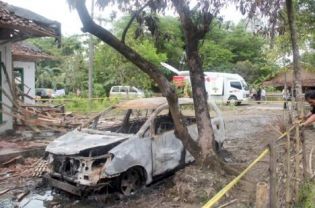
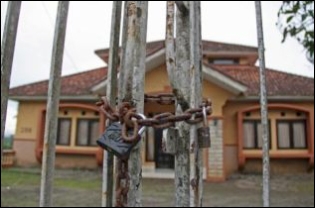
The house in Cikeusik, Banten, where a mob attacked an Ahmadiyah community in February. Three Ahmadiyah members were killed in the attack. (Antara Photo)
Ahmad Masihuddin, Irwan and Bebi are the lucky ones.
Ahmad recalls the moment when a man attempted to mutilate his genitals, while Irwan has developed an intense fear of water. Bebi cannot speak, due to a dislocated jaw, and must eat through a straw.
Despite the fear of reprisals, two of these three men — Ahmad and Irwan — met with the Jakarta Globe over the weekend to recount their memories of the bloody attack against a small group of Amhadiyah sect members in the village of Cikeusik, Banten, on Feb. 6.
On that day, three Ahmadis — Roni Pasaroni, Warsono and Tubagus Chandra — were killed by a 1,500-strong mob. Much of the violence was captured on video, and footage of Ahmadi men stripped of their clothes and being brutally beaten with stones and bamboo sticks can be seen on YouTube.
Twelve men are facing charges in relation to the attack. If found guilty their maximum sentences could range from 12 years in jail to the death penalty.
But Irwan and Ahmad say that even the harshest of punishments for those 12 men will not blot out the acts of cruelty they witnessed and endured on that day. Nor will guilty verdicts dampen the attendant rage and frustration they feel at a police force that is widely seen as having stood by and allowing the violence to unfold.
“Police pronounced me dead when my muddy, naked body was thrown into a police truck,” Ahmad said. “If I did not use the martial arts knowledge I learned through the years, I’d be among the dead.”
The police had collected Ahmad’s battered body after he had been dragged through the dirt by a group of enraged attackers. “Along the way, people slashed me with machetes, and threw rocks and bamboo poles at me. I lost consciousness. I believed I had died.”
Unguarded
Irwan, Roni and Warsono had left for Cikeusik from Jakarta on the night of Feb. 5. Irwan told the Globe that they had traveled to Cikeusik to provide security for a demonstration that the village’s Ahmadiyah community was planning on staging the next day.
“I was at our regular Koran recital meeting in Petojo [Central Jakarta]. Roni came to me and asked if I wanted to come along with him to Cikeusik,” Irwan said. “I asked him what for. He told me to guard a demonstration.”
They arrived around 10 p.m. on Saturday night, and were met by Deden Sujana, head of security for the Indonesian Ahmadiyah Congregation (JAI). The next day, Deden would almost lose his right arm to a machete attack, and police would later name him as a suspect for triggering the violence.
Ahmad, who lives in Kalideres, West Jakarta, had likewise gone to Cikeusik to provide security for the demonstration.
“Eki, a colleague of mine at JAI, was on holiday and asked me to replace him to guard an Ahmadi home in Cikeusik. Without thinking it over, I agreed,” he said.
“I was in the same car as [Tubagus] Chandra and Diaz [Ferdiaz Muhammad, an Ahmadi who survived the incident]. Chandra was driving, we arrived at Serang at 3 a.m. and picked up five more Ahmadis.”
Ahmad had prior experience protecting sect members. In 2008 he had guarded an Ahmadi school in Parung, Bogor, that had come under attack, and he had been on hand with the now-deceased Tubagus when one of the sect’s orphanages in Tasikmalaya, West Java, was sealed by local authorities last December.
Ahmad worked in the administrations division at JAI, while Tubagus worked for the security division with Deden. Ahmad, however, was well trained in self-defense. He had earned a black belt in Taekwondo at the age of 15, and was instructing others in Muay Thai at 18.
As Ahmad and his friends pulled into Cikeusik, he was relieved to see some dozens of police officers standing watch over both ends of the road where the house of local Ahmadiyah cleric Ismail Suparman was located. “I texted my parents so that they didn’t have to worry. The police were here,” Ahmad said.
“Suddenly, the wife of the Cikeusik village head, Inayah, ran toward us screaming. She told all of us to leave immediately, because it seemed thousands of people were marching to Cikeusik to slaughter us. Deden told her, ‘Don’t worry. We have Pak Hasan [Cikeusik Police chief of general crimes unit] here.’ ”
However, video footage posted on YouTube clearly showed the police running away when the mob attacked.
Tired from their late-night journey, Ahmad said he and his friends laid down to rest. They awoke around 10:30 a.m., he said, to loud chants of “Allahu Akbar” (God is great) and “Ahmadiyah infidels” mixed in with the sound of stones hitting the house.
To Ahmad’s ears, it sounded as if thousands of people were outside Ismail’s home. It was then, Ahmad said, that Deden rushed outside, and attempted to hit a man in a black jacket who seemed to be leading the mob.
“This man was Idris Mahdani,” Ahmad said. “He is from Banyu Mundu village [40 kilometers away from Cikeusik]. After he was hit by Deden, he retreated several steps back before taking out his machete and waved it in the air as the villagers pelted the Ahmadis with rocks.”
Vicious Beatings
Following Deden’s lead, Ahmad said he went outside and starting throwing stones back at the mob, but realizing that they were vastly outnumbered, he and some of the other sect members tried to escape out the back door of Ismail’s house. “We ended up stuck in knee-high mud at the paddy fields. We could not run. The drive to Cikeusik was taxing and we were exhausted,” he said.
The group of Ahmadis parted then, he said. Some sought cover in a patch of jungle while others headed to a nearby river.
Irwan and Ahmad fled to the river. Irwan slipped and fell in. Ahmad stumbled and was caught by the mob.
“I had with me about Rp 2 million ($235) for food and accommodation, and my BlackBerry. The mob greedily took it. But they still did not spare me.”
It was then that he saw Roni trying to go to the defense of their friend Bebi, who was on the ground being kicked by members of the mob. Someone would drop a heavy stone on Bebi’s face, but he would survive, largely because of Roni’s help.
Roni, who declined to talk to the Globe, would suffer a dislocated jaw in the attack.
In the meantime, Ahmad was fighting for his own life.
“I saw Irwan slip and fall into the river. I had 10 men on top of me trying to hit me with sticks and stones and they stabbed me with their machetes,” he said.
Ahmad said he was dragged 500 meters back to Ismail’s house, and viciously beaten the whole way. He said he saw Roni being stabbed with a bamboo spear.
“They stripped me,” Ahmad said. “They were about to cut my genitals. I shoved the man and shouted ‘You guys have to have limits!’ Another man hit me on the side but the impact also knocked away the guy who tried to mutilate my genitals.”
Ahmad said that he tried to retain his focus and stay calm during the beating, protecting his head and neck in particular to avoid being fatally wounded by the mob.
“I turned on my side and let it take the beatings. I did not want to give them my neck.” He said that he still felt a numbness in his neck from the injuries he sustained during the prolonged beating. “Part of my body went to sleep, as if struck by a stroke.”
At some point, Ahmad said, he lost consciousness.
“The police thought I was dead; they threw me into the car just like that. But I gained consciousness and started to ask for water. I was extremely dehydrated,” he said.
While Ahmad was struggling to survive the mob’s anger, Irwan was struggling to stay afloat in the river while also dodging a hail of rocks being thrown at him.
“I could barely swim,” Irwan said. “I was dragged by the current as I tried to stay afloat. In the meantime the mob was still trying to hit me with rocks,” he said.
At one point, he went under, and lost track of the time. He said he had no idea how long he was submerged, but remembered being pulled from the river.
“At one point it was all dark. But then I heard a voice calling me. It was Yadi, another Ahmadi” Irwan said. Yadi had swum against the current to rescue Irwan, dragging him to the shore.
Shirt for a Bandage
For Ahmad, the trip from Cikeusik to Malingping hospital, 10 kilometers away, took one and a half hours. He said the police gave him a shirt with which to stem the bleeding from a gash on his head.
“I met Deden in the hospital, he was holding his right hand, I saw Bebi vomiting blood, Ferdiaz put me on his lap and started giving me water, he was also injured,” he said.
Deden was taken to Pertamina hospital in Jakarta. The other men were transferred to Serang hospital, six hours away. In Serang, their fresh stitches had to be removed because they crusted with dirt.
Although Irwan did not sustain any serious injuries, he said he was now terrified of water, and had trouble recounting the details of the attack.
“I am undergoing counseling for my trauma. My therapist said that I had to think of water as my savior. If the river current didn’t carry me away, I might be one of the casualties,” he said.
Ahmad, however, said he was consumed with rage whenever he saw police officers or fundamentalist Muslims in white robes.
“Once I wanted to go to Senen, I passed the National Monument and at that time there was a demonstration on Libya and Ahmadiyah. All of a sudden I started shouting to the driver, ‘Just hit them! Hit them! Why should they make a fuss over another country when their own is still in a mess,’?” he said.
Ahmad also said he suffered from vertigo and severe headaches after the beating, and had just recently recovered the ability to speak.
“Previously, I found it almost impossible to talk,” he said.
“Once I was in Citraland [West Jakarta mall] and saw a police officer. I went to him and screamed at him, ‘What are you doing here? You’re doing nothing! Just like in Cikeusik! Officers only watch and do nothing!’ ”
Ahmad recalls the moment when a man attempted to mutilate his genitals, while Irwan has developed an intense fear of water. Bebi cannot speak, due to a dislocated jaw, and must eat through a straw.
Despite the fear of reprisals, two of these three men — Ahmad and Irwan — met with the Jakarta Globe over the weekend to recount their memories of the bloody attack against a small group of Amhadiyah sect members in the village of Cikeusik, Banten, on Feb. 6.
On that day, three Ahmadis — Roni Pasaroni, Warsono and Tubagus Chandra — were killed by a 1,500-strong mob. Much of the violence was captured on video, and footage of Ahmadi men stripped of their clothes and being brutally beaten with stones and bamboo sticks can be seen on YouTube.
Twelve men are facing charges in relation to the attack. If found guilty their maximum sentences could range from 12 years in jail to the death penalty.
But Irwan and Ahmad say that even the harshest of punishments for those 12 men will not blot out the acts of cruelty they witnessed and endured on that day. Nor will guilty verdicts dampen the attendant rage and frustration they feel at a police force that is widely seen as having stood by and allowing the violence to unfold.
“Police pronounced me dead when my muddy, naked body was thrown into a police truck,” Ahmad said. “If I did not use the martial arts knowledge I learned through the years, I’d be among the dead.”
The police had collected Ahmad’s battered body after he had been dragged through the dirt by a group of enraged attackers. “Along the way, people slashed me with machetes, and threw rocks and bamboo poles at me. I lost consciousness. I believed I had died.”
Unguarded
Irwan, Roni and Warsono had left for Cikeusik from Jakarta on the night of Feb. 5. Irwan told the Globe that they had traveled to Cikeusik to provide security for a demonstration that the village’s Ahmadiyah community was planning on staging the next day.
“I was at our regular Koran recital meeting in Petojo [Central Jakarta]. Roni came to me and asked if I wanted to come along with him to Cikeusik,” Irwan said. “I asked him what for. He told me to guard a demonstration.”
They arrived around 10 p.m. on Saturday night, and were met by Deden Sujana, head of security for the Indonesian Ahmadiyah Congregation (JAI). The next day, Deden would almost lose his right arm to a machete attack, and police would later name him as a suspect for triggering the violence.
Ahmad, who lives in Kalideres, West Jakarta, had likewise gone to Cikeusik to provide security for the demonstration.
“Eki, a colleague of mine at JAI, was on holiday and asked me to replace him to guard an Ahmadi home in Cikeusik. Without thinking it over, I agreed,” he said.
“I was in the same car as [Tubagus] Chandra and Diaz [Ferdiaz Muhammad, an Ahmadi who survived the incident]. Chandra was driving, we arrived at Serang at 3 a.m. and picked up five more Ahmadis.”
Ahmad had prior experience protecting sect members. In 2008 he had guarded an Ahmadi school in Parung, Bogor, that had come under attack, and he had been on hand with the now-deceased Tubagus when one of the sect’s orphanages in Tasikmalaya, West Java, was sealed by local authorities last December.
Ahmad worked in the administrations division at JAI, while Tubagus worked for the security division with Deden. Ahmad, however, was well trained in self-defense. He had earned a black belt in Taekwondo at the age of 15, and was instructing others in Muay Thai at 18.
As Ahmad and his friends pulled into Cikeusik, he was relieved to see some dozens of police officers standing watch over both ends of the road where the house of local Ahmadiyah cleric Ismail Suparman was located. “I texted my parents so that they didn’t have to worry. The police were here,” Ahmad said.
“Suddenly, the wife of the Cikeusik village head, Inayah, ran toward us screaming. She told all of us to leave immediately, because it seemed thousands of people were marching to Cikeusik to slaughter us. Deden told her, ‘Don’t worry. We have Pak Hasan [Cikeusik Police chief of general crimes unit] here.’ ”
However, video footage posted on YouTube clearly showed the police running away when the mob attacked.
Tired from their late-night journey, Ahmad said he and his friends laid down to rest. They awoke around 10:30 a.m., he said, to loud chants of “Allahu Akbar” (God is great) and “Ahmadiyah infidels” mixed in with the sound of stones hitting the house.
To Ahmad’s ears, it sounded as if thousands of people were outside Ismail’s home. It was then, Ahmad said, that Deden rushed outside, and attempted to hit a man in a black jacket who seemed to be leading the mob.
“This man was Idris Mahdani,” Ahmad said. “He is from Banyu Mundu village [40 kilometers away from Cikeusik]. After he was hit by Deden, he retreated several steps back before taking out his machete and waved it in the air as the villagers pelted the Ahmadis with rocks.”
Vicious Beatings
Following Deden’s lead, Ahmad said he went outside and starting throwing stones back at the mob, but realizing that they were vastly outnumbered, he and some of the other sect members tried to escape out the back door of Ismail’s house. “We ended up stuck in knee-high mud at the paddy fields. We could not run. The drive to Cikeusik was taxing and we were exhausted,” he said.
The group of Ahmadis parted then, he said. Some sought cover in a patch of jungle while others headed to a nearby river.
Irwan and Ahmad fled to the river. Irwan slipped and fell in. Ahmad stumbled and was caught by the mob.
“I had with me about Rp 2 million ($235) for food and accommodation, and my BlackBerry. The mob greedily took it. But they still did not spare me.”
It was then that he saw Roni trying to go to the defense of their friend Bebi, who was on the ground being kicked by members of the mob. Someone would drop a heavy stone on Bebi’s face, but he would survive, largely because of Roni’s help.
Roni, who declined to talk to the Globe, would suffer a dislocated jaw in the attack.
In the meantime, Ahmad was fighting for his own life.
“I saw Irwan slip and fall into the river. I had 10 men on top of me trying to hit me with sticks and stones and they stabbed me with their machetes,” he said.
Ahmad said he was dragged 500 meters back to Ismail’s house, and viciously beaten the whole way. He said he saw Roni being stabbed with a bamboo spear.
“They stripped me,” Ahmad said. “They were about to cut my genitals. I shoved the man and shouted ‘You guys have to have limits!’ Another man hit me on the side but the impact also knocked away the guy who tried to mutilate my genitals.”
Ahmad said that he tried to retain his focus and stay calm during the beating, protecting his head and neck in particular to avoid being fatally wounded by the mob.
“I turned on my side and let it take the beatings. I did not want to give them my neck.” He said that he still felt a numbness in his neck from the injuries he sustained during the prolonged beating. “Part of my body went to sleep, as if struck by a stroke.”
At some point, Ahmad said, he lost consciousness.
“The police thought I was dead; they threw me into the car just like that. But I gained consciousness and started to ask for water. I was extremely dehydrated,” he said.
While Ahmad was struggling to survive the mob’s anger, Irwan was struggling to stay afloat in the river while also dodging a hail of rocks being thrown at him.
“I could barely swim,” Irwan said. “I was dragged by the current as I tried to stay afloat. In the meantime the mob was still trying to hit me with rocks,” he said.
At one point, he went under, and lost track of the time. He said he had no idea how long he was submerged, but remembered being pulled from the river.
“At one point it was all dark. But then I heard a voice calling me. It was Yadi, another Ahmadi” Irwan said. Yadi had swum against the current to rescue Irwan, dragging him to the shore.
Shirt for a Bandage
For Ahmad, the trip from Cikeusik to Malingping hospital, 10 kilometers away, took one and a half hours. He said the police gave him a shirt with which to stem the bleeding from a gash on his head.
“I met Deden in the hospital, he was holding his right hand, I saw Bebi vomiting blood, Ferdiaz put me on his lap and started giving me water, he was also injured,” he said.
Deden was taken to Pertamina hospital in Jakarta. The other men were transferred to Serang hospital, six hours away. In Serang, their fresh stitches had to be removed because they crusted with dirt.
Although Irwan did not sustain any serious injuries, he said he was now terrified of water, and had trouble recounting the details of the attack.
“I am undergoing counseling for my trauma. My therapist said that I had to think of water as my savior. If the river current didn’t carry me away, I might be one of the casualties,” he said.
Ahmad, however, said he was consumed with rage whenever he saw police officers or fundamentalist Muslims in white robes.
“Once I wanted to go to Senen, I passed the National Monument and at that time there was a demonstration on Libya and Ahmadiyah. All of a sudden I started shouting to the driver, ‘Just hit them! Hit them! Why should they make a fuss over another country when their own is still in a mess,’?” he said.
Ahmad also said he suffered from vertigo and severe headaches after the beating, and had just recently recovered the ability to speak.
“Previously, I found it almost impossible to talk,” he said.
“Once I was in Citraland [West Jakarta mall] and saw a police officer. I went to him and screamed at him, ‘What are you doing here? You’re doing nothing! Just like in Cikeusik! Officers only watch and do nothing!’ ”
Copyright 2010 The Jakarta Globe
URL: www.thejakartaglobe.com/indonesia/survivors-.../441269
URL: www.thejakartaglobe.com/indonesia/survivors-.../441269









 Posts
Posts


