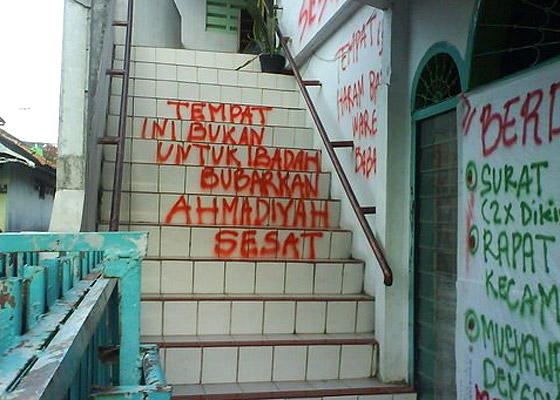
Showing posts with label arson attack. Show all posts

Saturday, February 12, 2011

Tolerance for religions tested in Indonesia

Sydney Morning Herald, Australia
World
Tolerance for religions tested in Indonesia
February 12, 2011s

Moved from place to place ... there are about 135 followers of the Ahmadiyah faith at the decrepit Mataram refugee camp, West Lombok. Photo: Murdani Usman
Moved from place to place … there are about 135 followers of the Ahmadiyah faith at the decrepit Mataram refugee camp, West Lombok. Photo: Murdani Usman
Politicians condemn attacks on Ahmadiyah followers but nothing seems to be done, writes Tom Allard in Mataram, Lombok.

THE killing of three followers of the Ahmadiyah faith by a frenzied group of Islamists this week has left Indonesia reflecting on how closely it lives up to its national credo “unity in diversity”.

Captured in horrific detail, on video taken with a mobile phone, were the bodies of three men, stripped naked, being battered by stones and staves as hundreds of onlookers cheer. The police either stand back or, in the case of one officer, try half-heartedly to shoo away the attackers.

It was grotesque, stomach-churning stuff and it was widely circulated throughout the country. Then, two days later, a marauding mob of militants attacked churches and torched vehicles in Central Java, upset that a man who had been found to have blasphemed Islam was given a five-year sentence and not death.
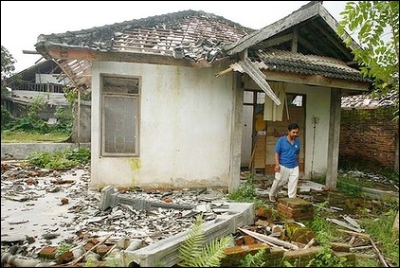
Attack ... a ruined home at Lingsar, West Lombok. Photo: Danny Arcadia
Attack … a ruined home at Lingsar, West Lombok. Photo: Danny Arcadia
The country’s reputation for religious harmony, lauded by the US President, Barack Obama, as “inspiring” and an “example to the world” on his historic visit to his boyhood home last year, was in tatters.

After the violence, came the self-examination.

The Indonesian President, Susilo Bambang Yudhoyono, condemned the violence as “intolerable” and vowed a full investigation. Many Islamic leaders also voiced their abhorrence and there were searing and soul-searching editorials in the media.
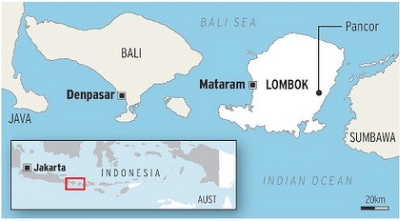
Lombok, Indonesia
Yet the response of many politicians and officials to the murder of the Ahmadis was deeply unsettling, betraying sentiments that have underpinned the apparent disregard of authorities to an escalation of anti-Ahmadiyah violence evident across Indonesia for years.

The Ahmadiyah faith is a variant of Islam that follows the teachings of the Koran but regards an Indian preacher, Mirza Ghulam Ahmad, as a “messiah” who followed the prophet Muhammad. But Imran Muchtar, a parliamentarian from Dr Yudhoyono’s Democratic Party, said its members “should repent”.

Hazrul Azwar, a politician from an Islamic party in Dr Yudhoyono’s coalition, bemoaned that “the fake prophet is a disgrace to my religion. Clerics in the whole world have banned Ahmadiyah, why is the government not doing the same thing?“

Suryadharma Ali, the Religious Affairs Minister who has called for the group to be outlawed, said “the government hasn’t made any decision on what to do [but] the suggestion to disband the Ahmadiyah will be a very valuable input for us”.

Put simply, for many, the Ahmadiyah, which has about 200,000 adherents in Indonesia and has been here since 1925, have brought their problems on themselves.

In West Lombok, where some of the worst treatment of Ahmadis has been meted out in recent years, a government spokesman, Ispan Junaidi, explained the conflict with: “The Ahmadiyah, they don’t socialise, they kept to their group and never blend in with the locals.”

In Mataram, the capital of the district, Ahmadis driven from their homes live in a decrepit refugee centre, families packed into tiny cubicles fashioned from bamboo and rattan inside a crumbling building.

Clutching his grandson, Harun, a fisherman, sums up a life on the move since his village, Kruak, was first attacked in 1998. He had lived peacefully there for more than 15 years, he says, when, with no warning, a group of 50 men from outside Kruak destroyed the homes and prayer room of 15 Ahmadis.

He moved to Pancor, another small village. In 2002, the Ahmadis were attacked again by a group of teenagers.

“The next time they came, it wasn’t just teens, it was everybody,” recalled Udin, also from Pancor. “Brimob [the elite mobile police force whose job it is to quell riots] came. They suggested we take refuge elsewhere and said they would calm things, look after everything.

“The police stayed but they joined in and took everything. Over the next three nights, 70 houses were destroyed.”

Harun and some of the other Ahmadis then shifted to Gegerung, moving into a housing development that no one would inhabit because it was on the edge of a sandmine and close to a cemetery.

In the beginning, it seemed they had found a safe place. The locals were welcoming. The Ahmadis and orthodox Muslims celebrated Id-ul-Fitr, the major Muslim holiday, together and everyone pitched in to build a new mosque. In 2006, a group of Islamists destroyed their homes. The Ahmadis returned to rebuild and were attacked again in November. “It is very sad. I don’t understand why this happens and why the police do nothing,” said Harun.

Rather than attempt to find and prosecute the perpetrators and their ideological leaders, or enforce the rights of the Ahmadis to return to their homes, authorities here have proposed to send them to a desert island, Gili Tangkong.

It would be exile in their own country, says Sahidin, another Amhadi at the shelter. “I have been there. It is 300 metres long. It has no fresh water,” he said. “It’s small, and not liveable. Why can’t we return to our homes?“

While they bide their time in the Mataram shelter, West Lombok’s Ahmadis can’t get replacements for the identity cards destroyed in the attacks. That means they can’t open a bank account, let alone get a loan. The children don’t have birth certificates.

The Ahmadis can’t travel, get a driver’s licence, buy property or find a job in the formal economy.

The reason for the lack of documents is that Indonesians must list their religion on the cards and Ahmadiyah is not one of the six recognised faiths: Islam, Hinduism, Catholicism, Protestantism, Buddhism and Confucianism.

It’s this kind of prescriptive approach to its citizens practising their faith that undermines Indonesia’s secularism, enshrined in its constitution.

So too does a controversial blasphemy law, and decrees of the ministry of religious affairs, like the one in 2008 that banned Ahmadis from proselytising.

Yenny Wahid, the daughter of Indonesia’s great, late Islamic leader and former president, Gus Dur, said the decree has contributed to the worsening of attacks against Ahmadis.

Copyright © 2011 Fairfax Media
URL: www.smh.com.au/world/tolerance...20110211-1aqiz.html

Friday, February 11, 2011

Religion Run Amok

   February 11, 2010
Wall Street Journal, USA
REVIEW & OUTLOOK ASIA
Religion Run Amok
Indonesia is reeling from some of the worst sectarian violence in years.
Indonesians have been shaken this week by some of the country’s most horrific episodes of sectarian violence in recent memory. On Sunday, hundreds of Muslims stabbed and clubbed to death three members of the minority Ahmadiyya sect in a village in Java. Mobs struck again on Tuesday after the sentencing of a Catholic man accused of blaspheming Islam. Believing the judge’s verdict to be too lenient, some 1,500 protestors stormed through the streets of Temanggung in Central Java province, torching churches and Christian schools.

Violence motivated by religious radicalism is hardly new in Indonesia, but it has the potential to hold the country back just as it is poised for a burst of development and globalization. Ratings agencies are upgrading the country’s risk profile, and foreign investment is flooding in. The government announced on Monday that GDP grew at 6.9% year on year in the last quarter of 2010, exceeding analysts’ expectations. The stakes for safeguarding the country’s tradition of secular pluralism are high.

Indonesian President Susilo Bambang Yudhoyono promptly condemned this week’s bloodshed, denouncing the “anarchic” acts in Temanggung and directing police to move swiftly to find the perpetrators. At an address on Wednesday, the president went further, calling for authorities to disband all violent sectarian groups: “Even though a democratic country upholds freedom of expression and the right to assemble, we must not give any space and tolerance to public speech or calls to carry out violence or murder on anyone.”

A police officer stand guards at the damaged house of a member of Ahmadiyah after it was attacked by Muslim mob in Pandeglang, Banten province, Indonesia, Monday, Feb. 7, 2011.
Associated Press
A police officer stand guards at the damaged house of a member of Ahmadiyah after it was attacked by Muslim mob in Pandeglang, Banten province, Indonesia, Monday, Feb. 7, 2011.
These words carry extra weight coming from a leader who prides himself on caution and a cool political head. But on the whole his government’s efforts against Islamist creep still proceed in fits and starts. An over-reaching antipornography law continues to eat away at speech freedoms, nourishing the climate of oppression. And the judiciary frequently waffles when prosecuting the terrorists and radicals that police haul in. On Monday prosecutors recommended a mere six-month jail term for a member of an extremist group accused of assaulting two leaders of a Protestant church last September.

Another serious obstacle has to do with Indonesia’s police force itself, which, since being split from the armed forces after the fall of the Suharto regime, has become hobbled by pervasive corruption. Footage from Sunday’s assault shows police standing nearby, resisting the attackers only feebly.

Half-heartedness seems to afflict the force at higher levels, too: The chief of the Central Java police declared on Wednesday that the Temanggung riots were “purely an act of criminal vandalism” and not religiously motivated. Such evasiveness has long been seen as evidence that radical groups trade political favors in exchange for a lighter hand against their activities.

Defending the Ahmadiyya in particular will require further initiative by lawmakers, even if firmer enforcement prevails. The sect, which is viewed as heretical by mainstream Muslims, is targeted for ostracism by decree under a 2008 law requiring its adherents to “stop spreading interpretations and activities that deviate from the principal teachings of Islam.” President Yudhoyono supported the legislation before it passed and has in the past kept silent after previous mob attacks against Ahmadiyya followers.

If the president has, as his rhetoric suggests, truly been shaken out of complacency by this week’s brutality, then making strides on any of these fronts would constitute a welcome start. The upcoming trial of Abu Bakar Bashir, a radical cleric who was arrested last August on terrorism charges, will serve as another key test for his government. The aging spiritual head of Jemaah Islamiya, a jihadist group linked to al Qaeda, Bashir received only short prison sentences after trials in 2003 and 2005. Tough justice this time around would be a major symbolic victory.

The reaction from one hardline outfit, the Islamic Defenders Front, or FPI, is a sign that Mr. Yudhoyono’s expressions of resolve are already having an impact. An FPI leader was quoted in the local press yesterday as threatening a nationwide uprising if the president follows through on his pledge to disband violent religious organizations. “Indonesia will be like Egypt,” the militia commander warned.

The sectarians apparently think President Yudhoyono is serious about stopping their violence. But Indonesians will be waiting to see if he backs his promises with action.

Copyright ©2011 Dow Jones & Company, Inc. All Rights Reserved
URL: http://online.wsj.com/article/SB...enews_wsj

Banten Police Chief Loses Post in Wake of Religious Violence

Jakarta Globe, Indonesia
HOME
Banten Police Chief Loses Post in Wake of Religious Violence
Farouk Arnaz | February 11, 2011

Indonesian Police have confirmed that the head of Banten Police has been removed from his post following the deadly attack on members of the Ahmadiyah community in Cikeusik.

National Police deputy spokesman Brig. Gen. Ketut Untung Yoga said Banten Police chief Brig. Gen. Agus Kusnadi and his subordinates, intelligence head Chief Comr. Aditiawarman, and the head of Pandeglang Police, Adjutant Chief Comr. Alex Fauzi Rasyad.

The trio, accused of breaching operating standards by failing to anticipate the attacks, had previously been questioned by Comr. Gen. Nanan Soekarna, the police’s Internal Affairs head.

It remains unclear whether the head of Cikeusik Police, Adj. Comr. M. Supur has also been removed from his post.

Police, meanwhile, have so far detained 24 suspects in relation to the anti-Christian violence in Tamanggung, Central Java.

Copyright 2010 The Jakarta Globe
URL: www.thejakartaglobe.com/home/banten...violence/422150

Assailant leader captured in Cikeusik footage recorded by A

NATIONAL
Fri, 02/11/2011
5:39 PM
Assailant leader captured in Cikeusik footage recorded by A
The Jakarta Post
A man who lead the brutal attack on Ahmadiyah followers at Cikeusik,Pandeglang, Banten, was captured in video footage taken by a key witness, known only by the initial A, who uploaded the video on YouTube.

“The man [assailant leader] appeared to be composed as he commanded the assailants. He told the mobs to destroy the house and car, and then attack the Ahmadiyah followers.

Police investigators should pursue that angle,” said Chairul Anam, one of A’s attorneys as quoted by kompas.com on Friday at the National Police.

Chairul from the Human Rights Working Grup (HRWG) along with representatives from the National Commission for Human Rights (Komnas HAM) and the Jakarta Legal Aid Institute came to the National Police to accompany A, who underwent questioning as a witness in the incident.

According to Chairul, the footage also captured assailants wearing different colored bands. Some wore blue and green bands while some did not wear any. The video was submitted to National Police chief Gen. Timur Pradopo on Thursday.

National Police detectives chief Comr. Gen. Ito Sumardi said police were studying the footage.

When asked about the colored bands, Ito said he would “explain it later” after his team had finished questioning witnesses.

A, known as an Ahmadi, was reportedly suspected by the mobs for intentionally recording the lynching. He managed to avoid the mobs’ suspicion by claiming himself as a journalist.

A told Komnas HAM that his presence along with 17 Ahmadis in Cikeusik was to guard Suparman’s property and house. Suparman is the Ahmadiyah leader in the village whose home was attacked by the mobs.

Commentary: Didn’t you see the writing on the wall?

COMMENTARY
Fri, 02/11/2011
10:32 AM
Commentary: Didn’t you see the writing on the wall?
Endy M. Bayuni, The Jakarta Post, Washington, DC
As shocking as the attacks on religious minority groups in Indonesia on Sunday and Tuesday were, the news did not come entirely as a surprise to anyone who has closely followed recent trends on interfaith relations.

This is doubly tragic. The attacks might have been prevented if the authorities had not been in constant denial of a creeping intolerance expressed by majority Muslims on one hand and religious minorities on the other.

Sunday’s mob attack on the followers of Ahmadiyah at a member’s home in Pandeglang, Banten, was not an isolated case. The Ahmadis have been the target of several mob attacks in recent years.

Attacks have become bolder and more violent precisely because the police have not acted firmly. As a result, three Ahmadis were slain on Sunday, six others injured and two reported missing in the worst mob violence wreaked against them.

What was so shocking about the tragedy was its brutality. Video clips of the violence posted on YouTube show the murderers beating an already dead Ahmadi while shouting “Allahu akbar!” (God is great). It also showed that the killing took place in the presence of the police.

Tuesday’s rampage in the Central Java city of Temanggung did not lead to any casualties but rioters destroyed three churches. Protests erupted after the local district court sentenced a man to five years’ imprisonment for blasphemy — the maximum penalty. The final day of the trial of 58-year-old Antonius Richmond Bawengan drew thousands of people who apparently were going to be disappointed with anything less than a death sentence.

Predictably, as soon as the verdict was read the crowd turned rowdy. Catholic churches in the town became a target of mob violence on the assumption that Antonius belonged to the congregations.

Police had known about the gathering mob but were unable to stop its destructive actions.

One can make the argument that these were isolated cases and in no way reflected relations between religious communities in the nation, at least not between the larger religious groups.

Ahmadiyah, with followers numbering around 300,000, has been singled out by Indonesia’s Muslim Sunni majority, who resent Ahmadiyah’s claim to be an Islamic sect. The government, on the advice of the Indonesian Ulema Council (MUI), has imposed restrictions on Ahmadiyah, such as a ban on the spread of its teachings and on their organization’s use of the word “Islam”.

Religious Affairs Minister Suryadharma Ali even said in August that he was seeking to ban Ahmadiyah completely because its beliefs, specifically belief in a Prophet after Muhammad, blasphemed Islam.

Such an official attitude is carte blanche for radical groups to attack Ahmadis — and for the police not to make any serious attempt to stop such attacks.

The attack on the churches in Temanggung was not an isolated incident either. Many churches across the country have been the target of vandalism in the past year. These attacks have grown both in frequency and intensity. Some of the attacks turned into physical clashes with Christian congregations.

What triggered the attacks on Tuesday may be an isolated case, but the ease with which people were assembled and mobilized to go on a rampage to defend Islam was not. Something is gravely wrong with interfaith relations at the grassroots level. The attacks on churches confirm a recent survey and warnings by experts and religious leaders about the rising intolerance evinced by Indonesia’s Muslim majority.

Religious leaders who have been engaged in interfaith dialogues have clearly failed to communicate a message of peace to their followers.

Two problems have clearly emerged.

First is the police’s inability, or probably unwillingness, to confront mobs, especially mobs using religious symbols. There is nothing holy or religious about attacking, killing or harassing other people because of their faith.

The second and larger problem is the government’s continued denial of a growing problem on the religious freedom front. Religious minorities are finding it more difficult to practice their faith in the face of growing intolerance from Muslims.

Every attack on Ahmadiyah followers or churches has been dismissed by the government as nothing more than criminal acts for the police to deal with.

The roots of the problem — the inability of Christians to build their places of worship or the inability of Ahmadis to practice their faith — were never addressed, let alone resolved.

If there is any silver lining, it is that the tragedies on Sunday and Tuesday finally prompted a large number of Muslims in Indonesia to come out and to condemn the violence carried out in the name of their religion. Their silence in the past might have been construed as condoning the attacks or complicity in the crime.

President Susilo Bambang Yu-dhoyono for once has gone beyond ordering the police to arrest the perpetrators. In a speech on Wednesday the President demanded that the groups that incite violence and spread hate messages be disbanded. He still fell short of recognizing that there were problems in religious freedom, but he went further than he has gone before.

Has the government done enough? Have we seen the last of the violent attacks against religious minorities? Time will tell. But the writing’s on the wall.

The writer is senior editor of The Jakarta Post. He is currently a visiting fellow at the East-West Center in Washington, DC.

Police release religious leaders linked to Cikeusik attack

NATIONAL
Fri, 02/11/2011
9:22 AM
Police release religious leaders linked to Cikeusik attack
The Jakarta Post, Jakarta

Police say they have released three religious leaders detained for their alleged roles in the brutal mob attack on an Ahmadiyah congregation in Cikeusik, Banten, on Sunday, which saw three men beaten to death and several others seriously injured.

There was insufficient evidence linking the religious leaders to the attack to keep them detained, Banten Police chief Brig.Gen. Agus Kusnadi said Thursday night, as reported by metrotvnews.com.

“They were not released, but their detention has been suspended, and this was not because of pressure from the ulemas, but because there was not enough evidence to detain them,” Agus said.

Earlier on Thursday, hundreds of ulemas, kyais and santri (students of Muslim boarding schools) stormed the Pandeglang Police headquarters, demanding the release of the religious leaders.

Pandeglang Police chief, Adj.Sr.Com.Alex Fauzy Rasyad later agreed to meet representatives of the ulemas, led by Abuya Muktadi. The meeting started at 3:30 p.m. and continued until 7 p.m.

Agus Setiawan, a member of the Muslim Defenders Team who accompanied the ulemas, said the religious leaders released by police were KH Muhamad, KH Kosim and KH Munir.

“We appreciate police investigators for their understanding to release the religious leaders,” Agus said.

Banten Police Say Only Two Suspects Detained in Ahmadiyah Attack

Jakarta Globe, Indonesia
NEWS
Banten Police Say Only Two Suspects Detained in Ahmadiyah Attack
February 11, 2011

A police officer outside the house of an Ahmadiyah cleric, Suparman, in Cikeusik district, Pandeglang, Banten after an attack that killed three people on Sunday. (Antara Photo)
Of five suspects identified in Sunday’s deadly mob attack on an an Ahmadiyah community in Cikeusik district, Pandeglang, only two are in police custody, according to Banten Police Chief Brig. Gen. Agus Kusnadi. The other three, identified only as Banten “clerics,” are still free because there is no strong legal basis to detain them.

Agus also said the police have identified the person who gave the order to launch the attack that eventually killed three people and caused widespread shock for the brutality of the incident. A graphic videotape of the mayhem has circulated widely.

In addition, Agus insisted, as have other officials, that the attack on the Ahamdiya followers was “provoked” by the minority group in the face of an angry mob seeking to oust them from the village.

“Our investigation shows the order to attack was made by text message and we have already obtained the identity of the person who gave the command. We are hunting him down,” Agus said, adding that the police are also trying to identify other attackers.

“From the video footage, the attackers wore blue ribbons on their shirts. They came from Cibaliung, Cigeulis and Panimbang districts but we don’t know yet if they are from the same mass organization,” he said.

Agus rejected the accusation that the attack was the result of police negligence.

“We didn’t let it happen, we had anticipated it. The clash happened because there was provocation from the people who were attacked and the big number of attackers,” he said.

According to Agus, on Feb. 3, Pandeglang Police received an SMS saying there would be an eviction and disbandment of Ahmadiyah followers in Cikeusik by fundamentalist Muslims who object to the group’s theology.

On Feb. 4, Pandeglang Police coordinated with local government officials to take actions regarding the SMS, he said.

On Feb. 5, the Pandeglang Police evacuated an Ahmadiyah cleric, Suparman, and members of his family who had been living in the village. Local residents had complained that they did not want Suparman in the village any longer,

On Feb. 6, the day of the attack, at 3 a.m., Agus said, the local chief of police sent officers to Cikeusik. Their duty was to secure Suparman’s empty house.

At 7 a.m. three groups of Ahmadis from outside Cikeusik arrived at Suparman’s house despite the police trying to persuade them to leave the area. “But they didn’t want to be evacuated, they said they want to defend their organization’s asset [Suparman’s house],” Agus said.

At about 10 a.m., a mob of some 1,500 people came to Suparman’s house. The Ahmadis inside the house, Agus said, provoked them and an attack was inevitable.

“There were only 120 police officers and they could not control the situation,” he said.

Antara, JG

Copyright 2010 The Jakarta Globe
URL: www.thejakartaglobe.com/news/banten...attack/422069

Hard-Liners Demand Govt Ban Ahmadiyah Sect

Jakarta Globe, Indonesia
HOME
Hard-Liners Demand Govt Ban Ahmadiyah Sect
Heru Andriyanto, Markus Junianto Sihaloho, Anita Rachman & Farouk Arnaz | February 11, 2011

While officials and analysts debated the merits of President Susilo Bambang Yudhoyono’s call to disband violent organizations, calls grew louder on Thursday for the minority Ahmadiyah sect to be disbanded instead.

Speaking at a discussion in Jakarta, Hasrul Azwar, House faction chairman of the Islam-based United Development Party (PPP), said the only way to stop the violence was to disband Ahmadiyah as an organization.

“The government must make its stance clear,” he said. “It’s not about human rights, it’s about the defamation of Islam.”

Calls for the sect to be disbanded come just days after a mob of around 1,500 Muslims attacked a house occupied by 25 Ahmadiyah followers in a village in Banten, leaving three dead.

Muslim groups have accused Ahmadiyah members of heresy, saying that they profess their founder, Mirza Ghulam Ahmad, to be the final prophet of Islam — a tenet that runs directly against mainstream Islamic beliefs that reserve that claim for the Prophet Muhammad.

This accusation has been disputed by the Ahmadiyah community, but is the main reason behind the government’s 2008 joint ministerial decree banning Ahmadiyah members from spreading their faith.

Activists say there have been at least 100 attacks against Ahmadiyah communities in Indonesia over the past decade, and that the 2008 decree has been used by hard-liners as a cover to further attack the sect.

Deputy House Speaker Priyo Budi Santoso of the Golkar Party suggested Ahmadiyah should declare itself as a new religion to end the continuing conflict that has surrounded its existence in Indonesia.

If Ahmadis could not “repent, recognize their mistake and come back to mainstream Islam,” then they should “leave Islam and declare a new religion,” he said on Thursday, echoing calls made a day earlier by Imran Muchtar, from the ruling Democratic Party.

However, Priyo clarified that he did not condone banning the sect outright.

“No, their beliefs should not be banned here; I don’t have the heart for that,” he said.

“So, [I say to] Ahmadis, don’t hesitate to declare Ahmadiyah as a new religion.”

He said if Ahmadiyah was established as a new religion then its followers would be allowed to hold religious services and would be protected from persecution.

Two hard-line Muslim activists on Thursday called for the sect to be banned altogether.

Achmad Michdan, a member of the Muslim Defenders Team (TPM), said the Ahmadiyah sect should be disbanded because it was clearly deviating from Islamic teachings and was guilty of committing blasphemy.

“Ahmadiyah must be prosecuted and disbanded. Under our law, violations of intellectual property rights in music, for instance, risk criminal conviction and punishment,” the lawyer told reporters at the South Jakarta District Court.

“What Ahmadiyah does is much more serious than that. They bring a different interpretation of Islam and disregard its basic teachings, such as Mohammed being the last prophet.

“I can’t believe that having committed such serious offenses Ahmadiyah can go unpunished under our law.”

Muhammad Al Khaththath, secretary general of the Islamic People’s Forum (FUI), said the continued sectarian conflicts over the Ahmadiyah were in part due to government inertia on the issue.

“When conflicts regarding the Ahmadiyah occur, it is always the Muslims who are blamed. Why is that?” Khaththath said.

“Ahmadiyah must be disbanded. If [Yudhoyono] can’t find a solution then he had better step down.”

The sect has faced frequent calls for disbandment, including from Religious Affairs Minister Suryadharma Ali.

In September last year, the minister said the government had two options to deal with the Ahmadiyah: either maintain the current restrictions on the group’s activities, or ban the group altogether.

A ban, he said, would protect group members from attack and may help bring them back into the fold of mainstream Islam.

Copyright 2010 The Jakarta Globe
URL: www.thejakartaglobe.com/home/hard...sect/421961

Thursday, February 10, 2011

No special measures for Ahmadis: Fauzi Bowo

HEADLINES
Thu, 02/10/2011
10:38 AM
No special measures for Ahmadis: Fauzi Bowo
Hans David Tampubolon and Irawaty Wardhani, The Jakarta Post, Jakarta
The Jakarta administration will not put in place special measures to prevent attacks on Ahmadis, and instead will leave the safety of the sect’s followers in the hands of the Jakarta Police and God, Governor Fauzi Bowo said Wednesday.

“We will not step up our alert status or anything. We will only intensify our approach to community groups and religious leaders at all levels. Only God can decide what will happen next and God willing Jakarta will remain peaceful,” Fauzi told reporters on Wednesday.

Fauzi’s statement came hours after Jakarta Police chief Insp. Gen. Sutarman said it was possible there would be more attacks on Ahmadis in Greater Jakarta in the immediate future.

“Our intelligence report says that there is the potential for similar incidents to happen here,” Sutarman told reporters, referring to Sunday’s attack on Ahmadis in Pandeglang, Banten, in which three people were killed.

Sutarman said that to prevent another attack on Ahmadis, the city police would step up surveillance around Ahmadiyah communities in Greater Jakarta.

The police have dispatched officers to guard 13 Ahmadiyah communities in Greater Jakarta.

The police, Sutarman said, would use excessive force against anyone who attacked Ahmadis, adding that he had told his officers to shoot on sight.

Ahmadis, he said, were regular citizens and deserved to be protected by the state regardless of their beliefs.

“Religious interpretations of Ahmadiyah are not our problem. Our main concern is the public’s safety,” he said.

Fauzi said he did not believe that there would be more attacks against Ahmadis anytime soon, adding that current security was sufficient to prevent such an attack.

“I have met with the Jakarta military commander and have agreed that we will coordinate on all necessary steps to safeguard the city together with the Jakarta Police,” Fauzi said.

Following the Pandeglang attack, Banten Governor Ratu Atut Chosiyah said Ahmadis ought to repent so that they would not be made the target of more attacks by Muslims.

Separately, Ahmadiyah leader Zafrullah Pontoh said that he could appreciate what the city government and the police had done to prevent attacks against Ahmadis, but added that what mattered most was that the government would guarantee that violence would not happen again.

“The attack is like a flame. If it grows bigger, it will become very hard to put out and the society as a whole will be severely damaged,” Zafrullah told The Jakarta Post.

“In a healthy society, we would not have violent persecution of religious beliefs or ways of life,” he said.

Ahmadis identify themselves as Muslims, abide by the Koran and believe that Muhammad was the last law-bearing prophet, but that Mirza Ghulam Ahmad, the founder of Ahmadiyah, was the last prophet. Mainstream Muslims believe Muhammad was the final prophet.

Religious Affairs Minister Sur-yadharma Ali has said Ahmadiyah should be “disbanded”.

Suryadharma is also the chairman of the United Development Party (PPP), an Islamist party.

The Ka’bah Youth Movement, which is affiliated with the PPP, was implicated in a mob attack in Temanggung, Central Java, on Tuesday, in which three churches were burned down.

Ahmadiyah, diversity and the nation

OPINION
Thu, 02/10/2011
10:04 AM
Ahmadiyah, diversity and the nation
Moh Yasir Alimi, Semarang
Again and again, Ahmadiyah followers have been attacked. In the latest violence targeting the Islamic sect in Cikeusik, Banten, three people were killed and many others injured. This barbaric attack has wounded our basic sense of humanity and revealed the extent of our nation’s diversity consciousness.

“Diversity consciousness” is something a nation needs to develop and nurture so that it can unite the many ideological orientations present within it. Diversity consciousness is what we need to keep our plural nation strong and blessed by God.

It was only with diversity consciousness that our founding fathers were able to create this nation, and it is only with diversity consciousness that we will be able to maintain this nation and achieve our dreams.

Without it, a nation will persistently be hijacked and weakened by groups of people who impose their own ideologies. Without it, democracy will be ineffective and a nation will hardly be able to compete in the global world order.

Diversity consciousness should therefore be protected through any means, legal apparatuses, discourses and weapons alike, like God shielding the veins in a human body with skin, bones, tissue and the intellect.

That is why the government needs to ensure that diversity consciousness is respected and that stern measures are taken to restore it when diversity consciousness is violated. The government also has to ensure that no groups attack others because they have different views and that no regulations provoke violence.

From the perspective of diversity consciousness, it is tragic that the violence against Ahmadiyah was “provoked” by state rules (a joint decree bt three ministries) and statements by an institution funded by the taxes Indonesians pay. Since the enactment of the joint ministerial decree (SKB) and the fatwas of the the Indonesian Ulema Council (MUI) that declared the sect deviant, the violence against Ahmadiyah has increased.

This is particularly true in Makassar, West Nusa Tenggara and West Java. In Central Java, East Java and Yogyakarta there are also concentrations of Ahmadiyah followers, but in those provinces religious life has continued to be peaceful.

Perhaps there are larger concentrations of Ahmadiyah followers in the former provinces than in the latter. The history of the religion and the role of civil society and political and religious leadership are factors that have influenced why these regions have different attitudes to Ahmadiyah. The SKB and the MUI fatwas are newer issues, aggravating the radical responses in West Java, West Nusa Tenggara and Makassar.

After the SKB, the perpetrators believed they were justified in committing violent acts against Ahmadiyah. The SKB contains content that can be used to rationalize hunting down the sect’s followers. The question now is whether Ahmadiyah followers are allowed to conduct religious gatherings in their own mosques, preach to their own members and publish material for their own believers.

MUI representative Amidhan said in a discussion on national TV on Monday that followers of Ahmadiyah were not allowed to publish materials, conduct seminars, give speeches or even assemble.

According to Amidhan, the violence in Cikeusik, Banten, erupted because Ahmadiyah members had gathered in the home of one of their members, which was a violation of the SKB.

Such a statement is heartless. I cannot imagine how such a statement could come from an ulema who is considered an inheritor of the Prophet. A prophet, as Muhammad PBUH said, is sent to beautify the character of humans. What materialized from Amidhan’s statement was anger, not any prophet-like character.

This angry front proves that the MUI is out of touch and spiritually impoverished. The body may know very well the legal text of the Koran, sophisticated Islamic jurisprudence and the laws regarding food, but it has failed to discern the basic tenets of Islamic spirituality.

It is a very basic spiritual teaching that people can become fierce, cruel or insensitive to the grief of others when their heart is empty of Allah, the Merciful and the Compassionate. These people may pray five times a day, but those activities are more politically motivated than religious, more lahir (outer) than batin (inner).

The MUI’s angry front also reminds me of Pharaoh’s clerics who fought the prophet Moses by creating magic snakes. It is said that Moses defeated the clerics because, with the help of God, he created a bigger snake that ate the little snakes of the religious clerics.

Ahmadiyah followers are regular people. They are neither Moses nor a chosen man who can create a giant snake. It is the state that should be the giant snake eating the little snakes in their various contemporary forms as people, religious institutions and rules.

The time has come to evaluate the decrees and fatwas that overturned the democratic principles of Indonesia, black ideas that have weakened our national imagination and bankrupted the diversity consciousness of our nation.

The writer is a lecturer at Semarang State University (Unnes) and former coordinator of Majelis Kataman Quran Canberra.

Ahmadis Should Declare a New Religion: Politician

Jakarta Globe, Indonesia
HOME
Ahmadis Should Declare a New Religion: Politician
Anita Rachman | February 10, 2011

Hundreds of people from the Islamic Community Forum or FUI, rallying for the disbandment of Ahmadiyah sect at Hotel Indonesia traffic circle in May, 2009. (JG Photo/Safir Makki)
Deputy House Speaker Priyo Budi Santoso says followers of an Islamic sect deemed heretic by mainstream Indonesian Muslims should declare a new religion.

The calls from the Golkar legislator echo those made a day earlier by Imran Muchtar, from the ruling Democratic Party.

He said if followers of Ahmadiyah could not “repent, recognize their mistake and come back to mainstream Islam,” then they should “leave Islam and declare a new religion.”

Priyo, speaking on Thursday, said declaring Ahmadiyah a new religion would end the growing conflict.

“I suggest [Ahmadis] declare Ahmadiyah as a new religion because of the complicated problem,” he said.

Priyo said that even though Ahmadiyah was banned in a number of Middle Eastern countries, he disagreed that Indonesia should adopt similar policies.

“No, their belief should not be banned here; I don’t have a heart for that,” he said. “So, [to] Ahmadis, don’t hesitate to declare Ahmadiyah as a new religion.”

He said that if Ahmadiyah was established as a new, then followers must not be persecuted and allowed to hold religious services.

Copyright 2010 The Jakarta Globe
URL: www.thejakartaglobe.com/home/ahmadis...politician/421824

Tuesday, February 8, 2011

INDONESIA: Religious violence result of authorities consent in past cases

AHRC Logo
Asian Human Rights Commission — Statement
INDONESIA: Religious violence result of authorities consent in past cases
FOR IMMEDIATE RELEASE
AHRC-STM-028-2011
February 8, 2011
A Statement by the Asian Human Rights Commission
INDONESIA: Religious violence result of authorities consent in past cases

The Asian Human Rights Commission (AHRC) urges a full investigation into the killings of at least three followers of the Ahamadiyah Islamic minority sect that occurred on Sunday February 6, 2011 in Umbulan village in Banten. As incidents of religious violence have been repeated in the last year, the AHRC cannot help but notice the lack of police action to prevent violence against religious minorities.

The aggression against the Ahamadiyah is justified by the local residents based on the Indonesian Ulemas Council (MUI) declaration that labelled the Ahamadiyah as heretic. However, it is the duty of the police to protect the rights of every person to exercise their freedom of religion as a human right and a fundamental right in Indonesia. In past attacks and mob violence against religious minorities the police often claimed not have had enough personnel in the place to avoid the eruption of violence. Indonesia saw a series of attacks including violence against members of religious minorities and burning of places of worship.

“The police can no longer hide behind the claim not being able to stop such violence” Wong Kai Shing, the Executive Director of the AHRC said. Such incidents do not typically come as a surprise and the police is often aware of such clashes ahead.

The negligence of the authorities, which in many cases amounts to consent to such violence, has resulted in a serious deterioration of the situation of religious freedom and has encouraged agitators to take more drastic measures of violence against minorities.

The 2008 Joint Ministerial Decree against promoting activities by the Ahamadyas has labelled them as a target and presents a major set-back for religious freedom and plurality in Indonesia.

Violence broke out in Temanggung Central Java in a blasphemy trial against Antonious Richmond Bawengan. After prosecutors demanded a five year prison sentence for the blasphemy charge a mob of fundamentalist Muslims demanded the death penalty, burned churches and cars and attacked the court room. The situation in Temanggung is reportedly chaotic.

The AHRC sees the increasing use of extreme violence in cases of fundamentalist religious views as a result of the inaction of the authorities in the last years in similar cases and blatant negligence by the government against fundamental rights.

The AHRC demands an impartial investigation into all cases of religious violence and expects the government of Indonesia and the police to take a strong stance against any religious intolerance. Democracy is not the rule of majorities over minorities but must be based on the uncompromised protection of fundamental rights including the freedom of religion.

Editorial: Banten: Murder in The Name of Religion

Jakarta Globe, Indonesia
OPINION
Editorial: Banten: Murder in The Name of Religion
Jakarta Globe | February 08, 2011

Mob rule and religious intolerance are on the rise in Indonesia. Two days after a deadly attack on the Ahmadiyah sect in Banten comes the worrying news that a mob attacked and vandalized two churches in Central Java.

This time the reason was anger over a court’s decision to sentence a Christian man to five years in prison for distributing leaflets seen as blaspheming Islam.

The mob demanded the death sentence, but the court had already passed down the maximum sentence allowed under the law.

Such acts of violence are becoming alarmingly common and the authorities seem paralyzed to act. Indonesia’s image as a tolerant nation is in peril.

We must ask ourselves what is happening here.

How has religious intolerance spun so far out of control? Are these incidents simply spontaneous emotional acts or are there other forces behind these rampages seeking to sow the seeds of discord?

Regardless of the reasons behind it, violence cannot be condoned and must be condemned in the strongest terms.

If religious extremism is on the rise, what steps are the authorities taking to tackle this menace and protect law-abiding citizens?

This week alone there have been two violent attacks.

These are criminal acts and those responsible must be brought to justice. However, we have yet to hear any words of reassurance from the police or the government. We have yet to hear them say they will act with the full force of the law.

We have only to look at the success of the police in their fight against terrorism to see that they are capable of suppressing religious extremism. But they will only do so if the will is there.

Too often, extremist groups are allowed to run riot in the name of Islam, sullying the name of the religion and the nation.

Blame must also lie with the minister of religious affairs. He is responsible for protecting the rights of all religious followers in the country, yet some of his statements have fanned the flames of intolerance.

Words can carry weight and meaning far beyond those intended by the speaker, so any words uttered in the name of religion must be carefully considered.

Indonesia is not the only country where religious strife is part of the social fabric. India too has suffered religious violence, leaving hundreds, sometimes thousands of people dead.

But often, such instances are linked to political leaders who incite the violence for their own self-interests.

We cannot be considered a law-abiding society if we allow such acts of violence against innocent people to occur without response.

Violence begets violence and very soon we will have full-blown civil strife between different ethnic and religious groups. Do we have the moral courage as a nation to tell these religious thugs that enough is enough?

Minister told to take precautions when commenting on Ahmadiyah

NATIONAL
Tue, 02/08/2011
4:56 AM
Minister told to take precautions when commenting on Ahmadiyah
The Jakarta Post, Jakarta
Religious Affairs Minister Suryadharma Ali needs to be more prudent when commenting on the Ahmadiyah religious sect, Abdul Kadir Karding, chairman of the House of Representatives’ Commission VIII overseeing religious affairs, warned Tuesday.

Suryadharma, Abdul said, should not blatantly announce his plan to ban the sect as he did last year as it only fuelled animosity toward the Ahmadis.

“The religious affairs minister is not the minister for Muslims only, but for all people in Indonesia. He represents the government and the government represents the people. A statement like that will only fuel the militancy of hard-line groups and justify their violent acts,” he added.

Ahmadiyah mosques and homes in Indonesia have been the target of intimidation and a series of attacks, reportedly not only committed by civilians, but also by the authorities. The latest incident happened over the weekend in a village in Pandeglang, Banten, where a mob of 1,500 people attacked a house guarded by around 20 Ahmadis. Three Ahmadis died in the attack.

Suryadharma has repeatedly called for the Ahmadiyah faith to be banned in Indonesia. In late August 2010 he claimed that after seeking divine advice he concluded that banning Ahmadiyah would be the best solution.

MUI’s edict contributed to anti-Ahmadiyah violence

NATIONAL
Tue, 02/08/2011
6:54 PM
MUI’s edict contributed to anti-Ahmadiyah violence
Mariel Grazella, The Jakarta Post
Wahid Institute director Yenny Zanuba Wahid says the Indonesian Ulema Council’s (MUI) edict that branded Ahmadis heretics has contributed to the violence committed against them.

The MUI issued an edict in 1980 saying Ahmadiyah was not part of the Muslim faith and that its followers were infidels. The council reissued the edict in 2005.

“I think [the edict] contributed to the violence,” Yenny said Tuesday.

According to Yenny, the MUI’s edict was used by certain groups to legitimate their actions.

A group of local residents attacked an Ahmadiyah congregation in Cikeusik, Banten, on Sunday. Three Ahmadis died in the violence.

“It provides legitimacy to easily provoked groups to cause destruction and even to commit murder,” she said.

Monday, February 7, 2011

Indonesia: Government must act now to protect rights of Ahmadis after mob butchers three

Amnesty International
Indonesia: Government must act now to protect rights of Ahmadis after mob butchers three
Posted: 7 February 2011

Amnesty International has urged the Indonesian government to investigate the killings of three members of a religious minority group by a mob on the island of Java this weekend.

The killings occurred when reportedly over 1,000 people wielding rocks, machetes, swords and spears stormed the house of a leader from the Ahmadiyya minority faith in the sub-district of Cikeusik, Banten province on 6 February 2011. Several more Ahmadis were wounded in the attack and two are reportedly missing.

Donna Guest, Asia-Pacific Deputy Director at Amnesty International, said: “This brutal attack on Ahmadiyya followers reflects the continued failure of the Indonesian government to protect religious minorities from harassment and attacks and to hold the perpetrators accountable.

“The Indonesian police must initiate a prompt, thorough and effective investigation into the violence and ensure that those suspected of involvement are prosecuted in fair trials.”

She added: “Indonesia must develop a concrete strategy to strengthen respect for freedom of religion and religious tolerance, which has clearly deteriorated in recent years.”

The Ahmadiyya are a religious group who consider themselves a part of Islam, although many mainstream Muslim groups say they do not adhere to the accepted belief system.

The mob surrounded a house where at least 18 Ahmadis were gathered, demanding that they disperse. They then charged inside the home, attacking and killing three Ahmadis identified as Roni, Tarno and Mulyadi.

The victims were found with multiple injuries including stab wounds and lacerations. At least five others were seriously injured and the whereabouts of two are said to be unknown. The mob also destroyed the house, as well as vehicles parked around it.

Background information:

Amnesty International has documented numerous cases of intimidation and violence against the Ahmadiyya community by radical Islamist groups in various parts of Indonesia.

These include attacks and burning of Ahmadiyya places of worship and homes, at times leading to their displacement.

In most cases, those who commit acts of violence against the Ahmadiyya are not punished and there is a tendency by the authorities to blame the minority for “deviant views” when attacks occur.

Harassment and attacks against the Ahmadiyya community are also fuelled by a 2008 joint ministerial decree forbidding the Ahmadiyya from promoting their activities. In September 2010, Indonesia’s Minister of Religion, Suryadharma Ali, called for the Ahmadiyya to be banned.

The government must repeal all laws and regulations that restrict the right to freedom of religion as guaranteed in Article 18 of the International Covenant on Civil and Political Rights (ICCPR) and initiate an independent and impartial inquiry into all cases of intimidation and violence against religious minorities in Indonesia.

Amnesty International has also called on the National Human Rights Commission (Komnas HAM) to investigate allegations that the police did not take adequate steps to protect the Ahmadiyya followers who were gathered, or to prevent Sunday’s attacks.

Indonesian authorities must investigate Ahmadiyya killings

Amnesty International
Indonesian authorities must investigate Ahmadiyya killings
7 February 2011

There have been attacks on Ahmadiyya places of worship and homes in Java (c) Private
There have been attacks on Ahmadiyya places of worship and homes in Java
© Private
Amnesty International has urged the Indonesian government to investigate the killings of three members of a religious minority group by a mob on the island of Java this weekend.

The killings occurred when reportedly over 1,000 people wielding rocks, machetes, swords and spears stormed the house of a leader from the Ahmadiyya minority faith in the sub-district of Cikeusik, Banten province on Sunday. Several more Ahmadis were wounded in the attack and two are said to be missing.

“This brutal attack on Ahmadiyya followers reflects the continued failure of the Indonesian government to protect religious minorities from harassment and attacks and to hold the perpetrators accountable,” said Donna Guest, Asia-Pacific Deputy Director at Amnesty International.

“The Indonesian police must initiate a prompt, thorough and effective investigation into the violence and ensure that those suspected of involvement are prosecuted in fair trials.”

The Ahmadiyya are a religious group who consider themselves a part of Islam, although many mainstream Muslim groups say they do not adhere to the accepted belief system.

The mob surrounded a house where at least 18 Ahmadis were gathered, demanding that they disperse. They then charged inside the home, attacking and killing three Ahmadis identified as Roni, Tarno and Mulyadi.

The victims were found with multiple injuries including stab wounds and lacerations. At least five others were seriously injured and the whereabouts of two are said to be unknown. The mob also destroyed the house, as well as vehicles parked around it.

Amnesty International has documented numerous cases of intimidation and violence against the Ahmadiyya community by radical Islamist groups in various parts of Indonesia.

These include attacks and burning of Ahmadiyya places of worship and homes, at times leading to their displacement.

In most cases, those who commit acts of violence against the Ahmadiyya are not punished and there is a tendency by the authorities to blame the minority for “deviant views” when attacks occur.

Harassment and attacks against the Ahmadiyya community are also fuelled by a 2008 joint ministerial decree forbidding the Ahmadiyya from promoting their activities. In September 2010, Indonesia’s Minister of Religion, Suryadharma Ali, called for the Ahmadiyya to be banned.

The government must repeal all laws and regulations that restrict the right to freedom of religion as guaranteed in Article 18 of the International Covenant on Civil and Political Rights (ICCPR) and initiate an independent and impartial inquiry into all cases of intimidation and violence against religious minorities in Indonesia.

Amnesty International has also called on the National Human Rights Commission (Komnas HAM) to investigate allegations that the police did not take adequate steps to protect the Ahmadiyya followers who were gathered, or to prevent Sunday’s attacks.

“Indonesia must develop a concrete strategy to strengthen respect for freedom of religion and religious tolerance, which has clearly deteriorated in recent years,” said Donna Guest.

Eight questioned over deadly Indonesia religious clash

MSN News, Indonesia
By Agence France-Presse, Updated: 2/7/2011
Eight questioned over deadly Indonesia religious clash
Indonesian police said Monday they are questioning eight people involved in a bloody religious clash which claimed three lives at the weekend.

The incident, involving more than 1,000 Muslims who stormed a house in West Java on Sunday to stop the minority Ahmadiyah Islamic sect from holding worship, has been condemned by the government and rights activists.

National police spokesman Boy Rafli Amar said eight people are being questioned and investigations are ongoing, but police are yet to lay charges.

President Susilo Bambang Yudhoyono has instructed police to take firm action against the perpetrators, “to capture them and haul them to court if need be,” his senior adviser Daniel Sparingga told AFP.

“The president is deeply concerned and condemned the violence and said that the country must be firm in defending the constitution, that would never allow small groups to use religion to attack groups of different faiths,” he said.

Indonesia’s constitution explicitly guarantees freedom of religion and the country of some 240 million people, 80 percent of whom are Muslim, has ratified the International Covenant on Civil and Political Rights.

But a government decree adopted in 2008 under pressure from Islamic conservatives bans the Ahmadiyah sect from spreading its faith, which includes the belief that its founder, Mirza Ghulam Ahmad, was the final Muslim prophet.

The group, which claims hundreds of thousands of members in Indonesia, has been repeatedly targeted with violence by members of hardline Islamic extremist organisations who operate with almost total impunity.

National Human Rights Commission chairman Ifdhal Kasim said Sunday’s incident was “embarrassing” as the police had made no effort to stop the mob.

“The police are biased and ignored their ultimate responsibility which is to protect the people,” he said.

“The government has no right to make judgments on whether a religion is heretical or not. Its job is to protect the people.”

Ahmadis Recount Morning of Terror

Jakarta Globe, Indonesia
HOME
Ahmadis Recount Morning of Terror
Nivell Rayda & Ulin Yusron | February 07, 2011

Bebi, 45, is one of the survivors of the Cikeusik attack that saw three people killed. He sustained severe injuries to his head and body. Other Ahmadiyah members say they're lucky to have escaped alive. (JG Photo/Nivell Rayda)
Bebi, 45, is one of the survivors of the Cikeusik attack that saw three people killed. He sustained severe injuries to his head and body. Other Ahmadiyah members say they’re lucky to have escaped alive. (JG Photo/Nivell Rayda)
Ahmad Masihudi has bruises on his right jaw, a swollen eye and cuts all over his body, but he considers himself a lucky man. A resident of Parung, West Java, Ahmad said he was grateful “just to be alive” after a lynch mob of over 1,500 people attacked members of the Ahmadiyah community in the Cikeusik village of Pandeglang on Sunday.

Ahmad said he was one of about 18 members of the Ahmadiyah, a minority Islamic sect, who went to Cikeusik to protest the detention of local Ahmadiyah cleric Ismail Suparman by Pandeglang Police. But a bloody clash ensued which left three Ahmadis dead and five badly injured. Ten other Ahmadis managed to escape.

Those killed were identified as Roni and Warsono from Jakarta and Chandra from Parung.

“I ran with all my might when the mob came in the thousands. We were clearly outnumbered. It was an outright attack,” 25-year-old Ahmad said.

“I ran to a nearby rice field. We all agreed to scatter in a bid to give some of us a chance at surviving the ordeal. I remember several people chasing me. I was hit in the back with bamboo a stick. I stumbled to the ground.”

Ahmad said he was saved by the fact that he had Rp 1 million ($110) in cash on him.

“They let me go just like that [after finding the money]. But that didn’t stop the others from trying to beat me up. I saw a police officer. I immediately held on to him and wouldn’t let go as the mob tried to pull me and continued to hit me,” Ahmad said.

“The other officers soon came and I was dragged to a police truck.” Ahmad was indeed one of the lucky ones.

One of the injured, Deden Sujana, remains in a coma with extensive injuries to his head and body. The 45-year-old was in critical condition and has been rushed to Pertamina Hospital in Jakarta. Deden’s right arm suffered a blow from a machete and was nearly severed.

In an emergency meeting convened by the central government over the attack, National Police Chief Gen. Timur Pradopo said on Sunday night that police on Thursday had been informed about Ahmadiyah members in Cikeusik being involved in “activities,” which locals deemed “unacceptable” and were preparing to take action.

“The FKUB [Interreligious Communication Forum of Banten] anticipated problems and took [Ahmadiyah cleric] Ismail Suparman to local police for his own safety on Saturday,” Timur said.

“But suddenly, on Sunday at around 7 a.m., a group of 15 Ahmadis, led by a man named Deden, who claimed to be from the Ahmadiyah central headquarters, arrived at Ismail’s empty home, saying that the house belonged to the Ahmadiyah community and they would guard it in case of any attack,” Timur said.

“We [the police] arrived and asked them to leave. They refused. At the same time, some 1,500 villagers came. This is when the incident occurred.”

Another resident of Parung, Ferdiaz, said he had been one of the Ahmadiyah members who had occupied Ismail’s house.

He confirmed that police had attempted to get them to leave the house for their own safety.

Ferdiaz told police they would not vacate and reminded officers that it was their job to protect them from harm. But soon afterwards, the mob started pelting the house with rocks and several people even drew machetes. Police did little but watch the show, Ferdiaz said.

“In the end, I ran, but a man slashed me with a machete in my back. They hit me with rocks and sticks. I was lucky police officers managed to stop them.”

In Jakarta, about 50 people gathered in front of the State Palace to protest against the violence. Yudhi Latief from the Reform Institute said police must protect all citizens. “Nobody should be killed just because they have different faiths,” he said.

Additional reporting by Farouk Arnaz

Yudhoyono: Punish Banten Officials Guilty of Negligence

Jakarta Globe, Indonesia
HOME
Yudhoyono: Punish Banten Officials Guilty of Negligence
Armando Siahaan, Amir Tejo, Dessy Sagita & Heru Andriyanto | February 07, 2011

Aminah has a police guard as she surveys the house where her son was killed on Sunday. (AFP Photo/Nurani Nuutong)
President Susilo Bambang Yudhoyono on Monday ordered a probe into the deadly attack on the Ahmadiyah community in Banten, including into negligence by local law enforcers and officials.

“I have ordered a full investigation, to find out the real cause and occurrence,” the president said.

“The purpose is that those who were negligent, guilty and violated the law must be punished.”

Violators could have come from both sides in the conflict, he said, but the probe should look specifically into whether there was negligence on the part of state authorities at the time of the attack.

“This includes if the clash could have actually been prevented, but prevention was done ineffectively, whether by the security apparatus or the local government,” he said.

“If this is this case, they need to be punished.”

His words came as one of his ministers said the sect deserved better protection, but another suggested followers could help themselves by detaching their beliefs from Islam.

Yudhoyono called on law enforcers and local military commands to be more proactive, professional and firm in preventing violence and taking action against those involved in attacks.

“I want all parties not to be lax, not to take this situation lightly,” he said.

“If there are signs [of conflict], take the appropriate measures, don’t wait until a clash and conflict erupt.”

Yudhoyono said he regretted the incident and offered his condolences to the victims’ families, but also hinted that the government would not revoke the 2008 joint ministerial decree on the Ahmadiyah, which he referred to as “the best option to solve the problem and to avoid horizontal conflicts.”

The decree prohibits Ahmadis from worshiping in public and from spreading their teachings but stops short of a ban on the sect.

“If the agreement was reached, embraced, abided to and implemented, then the conflicts, the physical clashes, the acts of violence could have been prevented,” he said.

Separately, Djoko Suyanto, coordinating minister for political, legal and security affairs, said on Monday that Ahmadiyah followers deserved to be protected like all Indonesians.

“They are our citizens, citizens of Indonesia whose safety is guaranteed and protected,” he said at the State Palace.

But he admitted that a solution for the sect’s troubles would not be easy to find.

“It is an issue of faith, belief, it is not easy to change someone’s mind-set,” he said, adding it was vital for law enforcers and communities to detect signs of conflict to prevent escalation.

Meanwhile, Religious Affairs Minister Suryadharma Ali said that to avoid animosity against the Ahmadiyah community, one option was for the sect to detach itself from Islam.

“Ahmadis can be asked to let go of their identity as part of Islam,” he said in Surabaya.

But he added he believed Ahmadis would refuse to leave Islam.

An Ahmadiyah spokesman, Firdaus Mubarik, told the Jakarta Globe that the solution offered by Suryadharma would not solve any problem as “belief is a very private matter.”

A similar solution imposed in Pakistan, he said, had only increased the number of victimized Ahmadis.

 
^ Top of Page