Showing posts with label Umbulan. Show all posts

Sunday, July 31, 2011

Lightly on the lynch mob

The Economist
Sunday July 31st 2011 
Asia Banyan
Religious persecution in Indonesia
Lightly on the lynch mob
Jul 31st 2011, 9:54 by R.C. | PENANG
Lynching perpetrators

SO, WHAT sort of sentence do you think a man convicted of killing someone by smashing in his skull with a stone might get in Indonesia? Life? Thirty years in prison? Twenty? Five? No. Three months, apparently.

At least, that was the sentence handed down by a court in Java on July 28th against Dani bin Misra. He was part of a frenzied mob of Sunni Muslim chauvinists, about 1,000 strong, that hacked and beat to death three members of the minority Ahmadi sect of Islam in February. Eleven others were on trial (including the cleric pictured above, white turban on the left). None of the guilty received more than six months for their crimes; none of them were even accused of murder. The ringleader was convicted of nothing more terrible than illegal possession of a machete; he got just over five months.

Considering the horror of the killings, these verdicts were risible and have been condemned as such by all and sundry—human-rights groups, the American government (which usually leans over backwards to be nice towards its new friend and the world’s largest Muslim country), the EU, as well as Indonesian civil-rights organisations.

It’s a terrible verdict for Indonesia, and for Indonesian justice. On the subject of religious tolerance—and the related matter of Islamic terrorism—it’s as if the country always takes two steps forwards and then quickly takes another step back. A few weeks ago a court finally sentenced one of the country’s most culpable terrorist leaders to a meaningful prison sentence; now another court gives these perpetrators nothing more than a slap on the wrist for what was clearly an awful murder. Furthermore, no one could have been in any doubt as to the savagery and barbarity of the attack on the Ahmadis; it was all caught on film and posted (temporarily) on YouTube.

Most worryingly, the verdicts would seem to give a virtual green light to anyone else who wants to attack the Ahmadiyah, a sect that many Muslims regard as illegitimate and heretical (they face terrible persecution in Pakistan). As Human Rights Watch has said: “The…verdict sends the chilling message that attacks on minorities like the Ahmadiyah will be treated lightly by the legal system. This is a sad day for justice in Indonesia.”

In theory the rights of the Ahmadis to freedom of worship and expression should be protected by the country’s constitution, like everyone else’s. But the government has partly gone along with the more extremist Muslims who wanted the sect banned completely; as a result, the sect has been stranded in a legal twilight zone. Many have argued that this invites attacks on the sect; these latest verdicts also point in that direction. The present government wants to be known as progressive and democratic at home and abroad—putting the Suharto years behind it, as it were—but that aspiration will remain well out of reach unless it does a great deal more to protect vulnerable minorities within its own borders.

(Picture credit: AFP)

Wednesday, June 8, 2011

Could Indonesia ‘Pakistanize’?

   Wednesday, June 8, 2011
Wall Street Journal, USA
REVIEW & OUTLOOK ASIA
Could Indonesia ‘Pakistanize’?
The present tepid leadership hasn’t done enough to halt the rise of militant Islam.

By BENEDICT ROGERS

Four men, traumatized, terrorized and stigmatized, sat in a Jakarta apartment and described to me how they were almost killed by a Muslim mob earlier this year.

One was stripped naked, beaten to a pulp, a machete held at his throat with a threat to cut off his penis. He was dragged through the village and dumped in a truck like a corpse. Another fled into a fast-flowing river, pursued by attackers throwing rocks and shouting “kill, kill, kill.” He hid in a bush, dripping wet and extremely cold, for four hours. A third suffered a broken jaw, while a fourth, pursued by men armed with sickles, machetes and spears, was detained by the police for three days, treated as a suspect not a victim.

The four were members of Indonesia’s Ahmadiyya community, a Muslim sect regarded by other Muslims as heretical. They were victims of an attack in Cikeusik, Banten province, on February 6. More than 1,500 Muslims attacked 21 Ahmadis, killing three. President Susilo Bambang Yudhoyono has called for a full investigation.

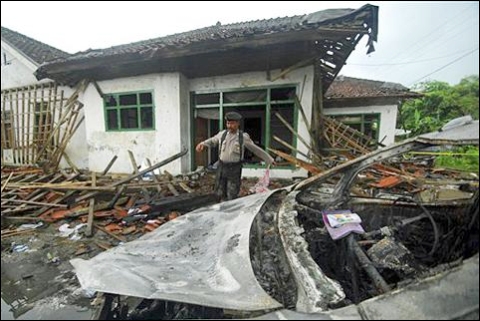
If Cikeusik was an isolated incident, it could be dismissed as a tragedy. Sadly, such tragedies are increasingly frequent. Last month I visited Cisalada, West Java, the scene of a similarly violent attack in October. Houses had broken windows boarded up, and some had been burned. A mob had thrown Molotov cocktails at the Ahmadi mosque and carried samurai swords. Anti-Ahmadi abuse was scrawled on the walls.

Indonesia’s tradition of pluralism, enshrined in its state ideology “pancasila,” is now under increasing threat. The world’s largest Muslim-majority nation has won applause for its religious tolerance and remarkable transition from authoritarianism to democracy, but these achievements are undermined by an increasingly vocal, violent Islamist minority. Under pressure from Islamists, the government banned the dissemination of Ahmadiyya teachings in 2008.

The rise of militant Islam has caused some in Indonesia to warn of “Pakistanization.” As a term to describe Indonesia today it is an exaggeration, but as a warning of what may come if action is not taken, it is valid. Pakistan’s path to extremism accelerated when the Ahmadiyya were banned in 1984; their treatment is a barometer of tolerance in a Muslim society.

It’s not just the Ahmadiyya. Christians are also under pressure. Radical Islamists have stirred tensions and forced churches to close. Even churches that have legal registration and secured Supreme Court rulings in their favor have remained sealed, their congregations forced to worship in the street. According to the Setara Institute in Indonesia, 91 violations of religious freedom were documented in 2010, at least 75 of which affected Christians.
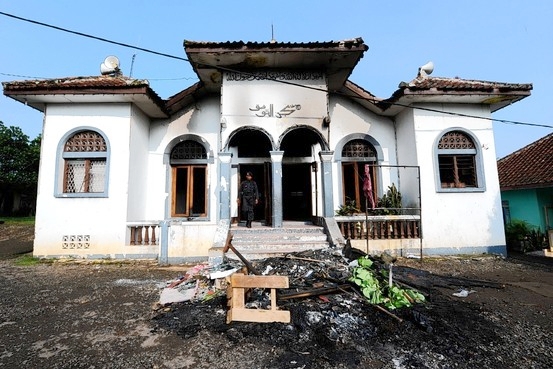
A police officer stand guards at the damaged house of a member of Ahmadiyah after it was attacked by Muslim mob in Pandeglang, Banten province, Indonesia, Monday, Feb. 7, 2011.

A police officer stand guards at the damaged house of a member of Ahmadiyah after it was attacked by Muslim mob in Pandeglang, Banten province, Indonesia, Monday, Feb. 7, 2011.
AFP/Getty Images
A mob damaged this Ahmadiyya mosque in Cisalada, West Java, last year.
“The radicals want to push us to the limit, to see how long we are prepared to worship [out on the street] before we surrender,” Rev. Palti Panjetan, pastor of the HKBP Filadelfia church in Bekasi, West Java, told me. Local Muslims who have supported the church have also faced intimidation from Islamists.

Both Ahmadis and Christians warn that if their persecution continues, Indonesia could fracture. The victims of Cikeusik talk of seeking asylum overseas for their entire community. “We still love our country, but one day Christians and Ahmadis will decide we want to separate from Indonesia, if the situation does not change,” Rev. Panjetan says. “It is only a matter of time before there is ‘Sudan-ization,’ a separation of Indonesia between Muslims and minorities, like north and south Sudan. We don’t want that.”

Indonesia does have constitutional and legal protections for minorities. In fact, United Nations High Commissioner for Human Rights Navanethem Pillay, in a letter to Indonesia’s foreign minister in April, called for a review of all laws restricting religious freedom, to “ensure they comply” with Indonesia’s own constitution and international covenants.

The core problem is the weakness of the government. President Yudhoyono makes tepid statements condemning violence, but takes no action to protect minorities. Perpetrators of violence are arrested, but face minor charges and paltry punishments.

There are some signs that leaders are waking up. Last week former presidents B.J. Habibie and Megawati Sukarnoputri expressed concern that pancasila had lost its prominence. Last month, leading political and judicial figures, including the president, warned that “pancasila has been sidelined from people’s way of life.” Such statements are welcome, but rhetoric alone will not stop Indonesia’s slide toward Islamization.

Instead there are concrete steps Mr. Yudhoyono should take. Domestically, he can ensure that perpetrators of violence are brought to justice, that victims and witnesses receive proper protection, and that more investment is made in counter-extremism initiatives like the Wahid Institute, a liberal Muslim think tank founded by former President Abdurrahman Wahid. Jakarta could revise a blasphemy law on the books since the Sukarno era—often used by radicals to stir up hatred—and repeal the Ahmadiyya decree.

These recent events have tarnished Indonesia’s international reputation as a tolerant society. President Yudhoyono could start to repair it by inviting the U.N. Special Rapporteur on freedom of religion and belief to visit the country, as suggested by Ms. Pillay in her letter. Since Mr. Yudhoyono seems to care about Indonesia’s stature abroad—evidenced by Jakarta’s willingness to take on leadership roles in the region—the international community is in the right place to urge him to act.

Appeals from people like Rev. Panjetan must be heard. “We need support from the international community… . The rise of radicalism is not only a problem between Indonesians. There is an international agenda. Wahhabi influence is growing. We need the international community to be a watchdog. If there is no help from the international community, we are hopeless, we will be destroyed.”

If Indonesia abandons pluralism, the geopolitical consequences will be significant. The democratic success of the largest Muslim-majority country will be in jeopardy. The world will have lost a role model of tolerant, moderate Islam, which doesn’t bode well for the success of democratic revolutions in the Middle East. It is in all our interests to ensure that does not happen.

Mr. Rogers is East Asia Team Leader at Christian Solidarity Worldwide, a human rights organization based in London.

Copyright ©2011 Dow Jones & Company, Inc. All Rights Reserved
URL: http://online.wsj.com/article/SB10001...824805736.html

Monday, March 7, 2011

Indonesia: USCIRF Urges Protection of the Ahmadiyah

United States Commission on International Religious Freedom
News Room > Press Releases
3/07/2011: Indonesia: USCIRF Urges Protection of the Ahmadiyah
FOR IMMEDIATE RELEASE
March 7, 2011

WASHINGTON, DC – The U.S. government should urge the government of Indonesia to protect the embattled Ahmadiyah religious community and to repeal laws prohibiting the Ahmadiyah community from manifesting their faith, said the U.S. Commission on International Religious Freedom (USCIRF) today.

Since 2008, a joint ministerial decree prohibited Ahmadis from spreading their faith and promised protection of their communities’ worship activities. USCIRF’s statement comes as three Indonesian provinces issued decrees that prohibit the Ahmadiyah from publicly manifesting their faith. Provincial governments in West and East Java and South Sulawesi issued their decrees following a mob attack that killed three Ahmadiyah followers in Banten almost one month ago. The Minister for Law and Human Rights and the Minister of Religious Affairs have supported the provincial decrees claiming that they are necessary to maintain public order. The provincial decrees appear to violate Indonesia’s constitution, which guarantees religious freedom. President Yudhoyono has not yet called for the decrees to be repealed, though he did call for the protection of Ahmadiyah followers, the arrest of perpetrators of violence, and an investigation into whether police provided sufficient protection for the Ahmadiyah community of Banten.

“The Obama Administration is right to commend Indonesia’s tradition of tolerance, but it should condemn the enactment of these discriminatory laws and other recent trends that threaten the country’s stability, pluralistic culture, and democratic future,” said Leonard Leo, USCIRF chair. “The banning of a peaceful religious group in three provincial areas contradicts Indonesia’s reputation for religious tolerance. The Indonesian government needs to protect, not ban, the Ahmadis.”

USCIRF traveled to Indonesia last year and wrote to President Obama asking him to raise the issues of protection for religious minorities, the existence of anti-Ahmadiyah and blasphemy laws, and the ability of militant groups to use violence with impunity. USCIRF also urged the Administration to emphasize religious freedom in bilateral engagement, given the prominence religious organizations, actors, and political parties play in politics and civil society. That letter can be found at www.uscirf.gov.

“Extremist groups were repudiated at the polls, but continue to seek power by spreading violence and hate,” said Mr. Leo. “The Indonesian government should get tough on militant groups that use violence to intimidate religious minorities and swiftly prosecute those who carried out the gruesome killings of Ahmadis in Banten. Indonesia’s government should see its blasphemy and anti-Ahmadiyah laws as breeding sectarian violence, not social stability. These laws should be repealed if Indonesia is to remain true to its long commitment to religious freedom. As has happened in Pakistan and other places, sectarian violence will continue as long as militant groups expect the government to enforce their version of orthodoxy, instead of religious freedom for all.”

USCIRF is an independent, bipartisan U.S. federal government commission. USCIRF Commissioners are appointed by the President and the leadership of both political parties in the Senate and the House of Representatives. USCIRF’s principal responsibilities are to review the facts and circumstances of violations of religious freedom internationally and to make policy recommendations to the President, the Secretary of State and Congress.

To interview a USCIRF Commissioner, contact Tom Carter, Communications Director at tcarter @uscirf.gov or (202) 523-3257.

HRWG to File Report on Ahmadi Killing to UN

HeadlinesVIVA News
HRWG to File Report on Ahmadi Killing to UN
“The meeting is scheduled to take place on 10th of March 2011”
Senin, 7 Maret 2011, 10:50 WIBElin Yunita Kristanti
Attackers of Ahmadi members in Banten (dok. Ahmadiyah)
VIVAnews — Human Rights Working Group (HRWG) will be filing report on the brutal attacks against Ahmadi members in Cikeusik, Banten, to the UN Human Rights Council in no time.

“The Cikeusik case is a caution of dire problems which pose threat over freedom of religion and belief,” said Executive Deputy Director of HRWG, Choirul Anam, today in Jakarta.

HRWG also plans of filling in accounts on any acts of violence committed against Indonesia’s Ahmadiyya since 2005. “Ahmadiyya suffer from more systematic acts of violence. If no efforts of prevention are made, we fear that more serious threats will be posed in the days to come,” said Choirul Anam.

Written reports and oral presentations will be brought before a session with special UN rapporteur on freedom of religion and belief. “The meeting is scheduled to take place on 10th of March 2011,” he said.

Granted that the report is ready, HRWG expects the International community will urge the Indonesian government to assure for protections over Ahmadi members.

The Cikeusik attack was ignited on February 6, 2011, by hundreds of angry crowd toward a group of Ahmadis who were at that time gathering in the home of an Ahmadi cleric, Suparman. Three men were slaughtered during the assault and seven others were severely injured.

Police have named 16 suspects from the case, one of which is a member of Ahmadi.

• VIVAnews

Sunday, March 6, 2011

Police Say Ahmadis Wanted Banten Raid to Happen, Name 14 Suspects

Jakarta Globe, Indonesia
HOME
Police Say Ahmadis Wanted Banten Raid to Happen, Name 14 Suspects
Farouk Arnaz | March 06, 2011

Recent violence targeting the Ahmadiyah community in the Cikeusik subdistrict of Banten only erupted because the Ahmadis wanted it to happen, the National Police’s chief of detectives Comr. Gen. Ito Sumardi said on Thursday.

The Feb. 6 attack saw some 1,500 people attack Ahmadiyah members who had refused to leave the house of a local leader of the sect in Umbulan village. Three Ahmadis were killed.

“I would like to quote one Ahmadi [we questioned] as saying he did physical exercises every day. The Ahmadis were also equipped with spears, slingshots, machetes and two sacks of stones,” Ito said. He then said the Ahmadis wanted the clash to happen.

“According to the theories of victimology, this clash did not merely occur because of insufficient numbers of police personnel dispatched to the site. It happened because the victims wanted the clash to take place.”

Ito added that a total of 14 suspects have so far been named in the case, including 12 from among the attacking mob.

“We are still hunting for one of the suspects, Abrori. He was from Gadod in Pandeglang district. He assaulted the victims until they died,” he said.

Ito also said a police officer and one Ahmadi had been named suspects. He refused to identify the police officer, but he said the Ahmadi suspect was named Deden Sudjana, a man who led 16 others in safeguarding the home that was attacked.

This is not the first time Deden is declared a suspect, but police backtracked on Feb. 18 on the earlier decision to name Deden a suspect for his presumed role in the violence.

Deden was allegedly seen in a video of the attack circulating on the Internet, asking a police officer to let the assault take place as 1,500 people descend on the house in Umbulan.

“Deden has been accused of provocation, beating, throwing [objects] and possession a sharp weapon. He is also guilty of disobeying police orders at the scene. His incitement triggered the clash, when he said that if police cannot control the masses, [they should] let the assault take place,” Ito told reporters.

He confirmed that a police officer had been charged in the case for violating the police’s code of ethical conduct, as well as Article 359 on negligence resulting in the death of a human being.

A police source separately identified the suspect as Chief. Brig. T.B. Ade Sumardi, the leader of the Sabhara division at the Cikeusik Police, charged with protection, patrol and anti-riot duties. The source said Ade was at the scene but failed to prevent the incident from happening.

Copyright 2010 The Jakarta Globe
URL: www.thejakartaglobe.com/home/police-say.../426623

Thursday, March 3, 2011

Indonesia province announces Ahmadiyah curbs

Asia-Pac
3 March 2011 Last updated at 13:23 GMT
Indonesia province announces Ahmadiyah curbs
By Kate McGeown
BBC News, Jakarta

Anti-Ahmadiyah sentiment has been gathering momentum in recent monthsAnti-Ahmadiyah sentiment has been gathering momentum in recent months

Authorities in Indonesia’s West Java have issued a decree which severely limits the activities of a small Islamic sect called the Ahmadiyah.

Members will not be able to publicly identify themselves and are being urged to convert to mainstream Islam.

Indonesia is a secular country, where freedom of religious expression is enshrined in the constitution.

But recently the government has been under pressure from hardliners to ban the sect completely.

Low profile

The province of West Java is home to Indonesia’s largest community of Ahmadis, but there are estimated to be more than 200,000 throughout the country.

But now they will be much harder to find.

The local authorities want them to limit their activities, take down signs identifying their mosques and schools, and - ideally - to re-educate and re-integrate themselves within mainstream Islam.

They are even encouraging other people in the area to monitor what the Ahmadis are doing.

Lawyers for the Ahmadiyah say the decree violates a law protecting people’s rights to worship how they choose.

But hardline Islamic groups say the order is perfectly legal, claiming that the sect’s beliefs deviate from the tenets of Islam and therefore violate the country’s rules against blasphemy.

The hardliners have repeatedly petitioned the government to outlaw the Ahmadiyah completely, and they are finding an increasingly positive reception.

Even the minister for religion supports a ban.

The Ahmadis have already been keeping a low profile since three of their members were killed last month by an angry mob.

This decree is yet another sign that their way of life is no longer welcome in a country often lauded for religious tolerance.

Wednesday, March 2, 2011

Analysts Say Links Between Radical Groups, Terrorists Are Growing in Indonesia

VOA News
Asia
Analysts Say Links Between Radical Groups, Terrorists Are Growing in Indonesia
Brian Padden | Jakarta March 02, 2011
Indonesian Muslims display a defaced poster of Mirza Ghulam Ahmad, the prophet of Ahmadiyah, during a protest demanding ban of the Muslim sect in Jakarta, Indonesia, March 1, 2011Photo: AP
Indonesian Muslims display a defaced poster of Mirza Ghulam Ahmad, the prophet of Ahmadiyah, during a protest demanding ban of the Muslim sect in Jakarta, Indonesia, March 1, 2011
In Indonesia security analysts say there is a growing connection between terrorist groups and Islamic fundamentalist organizations that do not overtly advocate violence. They say this new collaboration has resulted in more attacks against Christians and members of the Ahmadiyah religious sect.

Security analyst Sidney Jones with the International Crisis Group says after Indonesian security forces dismantled a terrorist training camp in Aceh last year, remaining cells reassessed their strategy.

For years they have tried and failed to impose an Islamic state through the violent overthrow of the government. She says they have now begun to look at how effective legal Islamic groups have been in pressuring the government to pass a strong anti-pornography law and banning the Ahmadiyah sect from propagating its faith.

“We’ve seen the relative success of the hard-line civil society groups in pressing their agendas to the point where, in the aftermath of that Aceh training camp, a critique that emerged from within the jihadi organizations was, ‘What have we achieved politically through jihadi operations?’ A big fat zero,” she said.

Since then she says there has been a growing connection between militant groups and Islamist organizations like the Islamic Defenders Front that do not overtly espouse violence.

Bonor Tigor Naipospos is with the Setara Institute, which monitors religious freedom in Indonesia. He says it is no coincidence that there has been a surge in violence against Christians and Ahmadiyah members.

Many Muslims consider the Ahmadiyah to be heretics, because although they consider themselves Muslims, they do not believe Mohammad was the last prophet.

Naipospos says radical groups have instigated the attacks to create a wider conflict.

“They hope they will get [a] reply from the Christian groups,” he said. “They hope the Christian groups will reply with violence and then they will be justified in making the place of the conflict more bigger.”

While the government has been proactive in cracking down on terrorist groups, Jones says it has been slow to respond to the violence related to religious intolerance. The government has been passive, she says, because it perceives broad popular support in Indonesia, not for the violence, but for limiting other religious groups.

“I think there is a concern that there is a wider public perception that these people may be using tactics that we don’t agree with, but their goals are more or less right,” said Jones. “That is why we have the minister of religion making repeated statements about the need to ban Ahmadiyah and the fact that it is their own fault for getting attacked because they don’t leave Islam.”

She says until the government takes strong action to prevent attacks or prosecute anyone who encourages violence, radical groups will continue to breed discontent and undermine the democratic foundations of the country.

AGO supports local bans on Ahmadiyah

HEADLINES
Wed, 03/02/2011
6:40 AM
AGO supports local bans on Ahmadiyah
The Jakarta Post, Jakarta
The Attorney General’s Office (AGO) has supported the issuance of several bylaws that ban Ahmadiyah activities.

“Of course we support [the regional administrations’ acts] because they are the ones who own their territories, and that’s their stance, so why not support them?” Attorney General Basrief Arief said on Wednesday as quoted by Antara.

Several regional administrations have issued bylaws that ban the Ahmadis from religious activities following a bloody attack on followers of the minority religious group in Pandeglang, Banten, last month.

Basrief said the administrations’ decision to issue the bylaws must have been based on their comprehension of the regions’ social condition and to keep public order.

If Ahmadiyah is considered to be inciting violence and disrupting public order, “it is the regional administration’s authority [to ban Ahmadiyah],” he added.

Ahmadiyah teachings are considered heretical and blasphemous against Islam by the Indonesian Ulema Council (MUI). Followers of the faith have been a target of mob attacks in recent years.

Copyright © 2008 The Jakarta Post - PT Bina Media Tenggara. All Rights Reserved
URL: www.thejakartapost.com/news/2011/03/02/ago...ahmadiyah.html

RI seeks to redefine freedom amid rising religious violence

NATIONAL
Wed, 03/02/2011
12:22 PM
RI seeks to redefine freedom amid rising religious violence
Bagus B.T. Saragih, The Jakarta Post, Jakarta
God have mercy: A group of Ahmadiyah followers in Yogyakarta conduct a prayer on Tuesday after recent bans issued by several regional leaders across the country. The Yogyakarta chapter of Ahmadiyah has halted its public activities. -JP/Slamet Susanto
As local administrations move to ban Ahmadiyah, the government is in a dilemma revolving around “liberty versus order” as it responds to calls to disband the notorious Islam Defenders Front, known as the FPI.

Following the mob incident that killed three Ahmadis in Banten and the burning of three churches in Central Java last month, President Susilo Bambang Yudhoyono ordered his ministers to seek legal measures to disband groups frequently involved in acts of violence.

Some believed he was likely referring to groups such as the FPI. But the order has proved to be no easy task.

The Home Ministry, which is endowed with the authority to outlaw an organization, said the freedom to form a union or organization was guaranteed by the 1945 Constitution. This, ministry spokesman Reydonnyzar Moenek told The Jakarta Post, meant the government was in a dilemma.

As of 2010, more than 9,000 mass organizations were registered with the ministry. It has never banned a single one since the issuance of the mass organization law in 1985, which granted it authority.

Home Minister Gamawan Fauzi, a politician from President Yudhoyono’s Democratic Party, denied he had ignored the President’s order, saying he was only cautious not to use the authority recklessly in fear of violating the Constitution. “We are now studying the facts of the incidents,” he claimed.

The minister argued that the procedures to disband mass organizations under the existing regulation were complex. “The 1985 Mass Organization Law is too old and is no longer relevant to the country’s current situation,” he said, adding that his ministry was finalizing the revision draft of the law, which will be submitted to the House of Representatives for deliberation this year.

A 1986 government regulation outlining the ministry’s authority to disband mass organizations stipulates the government at central and regional levels can freeze a mass organization that disrupts national security and public order, receives foreign aid without the central government’s permission and helps foreign parties that jeopardize national interests.

The regulation also stipulates that the ministry ask for considerations from the Supreme Court on whether a certain group be frozen. A frozen organization shall be disbanded if found to continue the illicit acts for three months after receiving warning letters from the government.

Despite its violent acts over the past few years, the ministry said it had not yet found evidence that the FPI had broken the 1985 law.

While legal matters are hindering the government from taking stern action against the militant group, local administrations are facing no difficulties in finding reasons to ban Ahmadiyah, a minority group deemed heretical by the country’s mainstream Muslims.

Last week, Samarinda Mayor Syaharie Jaang in East Kalimantan froze the local chapter of Ahmadiyah after dozens of FPI members rallied in front of his office a few days earlier. The hardline group gave Syaharie a week’s deadline to disband the local chapter of the Islamic sect, saying if it failed to do so it would do it themselves.

The mayor reportedly granted the FPI’s demand because he considered Ahmadiyah “a time-bomb that could trigger violence”.

In another instance, East Java Governor Soekarwo issued a decree banning Ahmadis from conducting any kind of activity on Monday, only days after 32 Islamic organizations announced a plan to carry out a mass rally in the provincial capital of Surabaya to demand the administration outlaw Ahmadiyah in the province.

Activists have questioned whether democracy is the actual reason behind the government’s reluctance to disband the FPI.

Indonesian Legal Aid Foundation (YLBHI) chairwoman Erna Ratnaningsih said Timur had a long history of hobnobbing with hardliners since he was West Java Police chief in 2008. Along with Jakarta Governor Fauzi Bowo, Timur attended the FPI’s 12th anniversary celebration at the organization’s headquarters in Jakarta, she said. Last month, she added, Gamawan also met with FPI leader Rizieq Shihab to seek advice over Ahmadiyah.

But disbanding mass organizations, some have argued, might not be the answer to end religious violence. Imam Prasodjo, a sociologist from the University of Indonesia, for instance, said violent acts were also caused by cultural aspects that were difficult to manage. “Disbandment of those groups will not automatically reduce violence. Group members will continue [committing violence] as long as cultural problems exist,” he said referring to the stigma against Ahmadiyah.

MASS ORGANIZATIONS INVOLVED IN VIOLENT ACTS

Copyright © 2008 The Jakarta Post - PT Bina Media Tenggara. All Rights Reserved
URL: www.thejakartapost.com/news/2011/03/02/ri...violence.html

Tuesday, March 1, 2011

An Ahmadi Named Suspect on Mob Attack Case

HeadlinesVIVA News
An Ahmadi Named Suspect on Mob Attack Case
“Police accommodate the interests of both conflicting parties”
Selasa, 1 Maret 2011, 15:55 WIBBayu Galih, Dedy Priatmojo
Attackers of Ahmadi members in Banten (dok. Ahmadiyah)
VIVAnews — Jakarta Legal Aid Center condemns criminalization against an Ahmadi member named Deden, who, like many Indonesians, uses one name, by the Indonesian police as regards mob attack against Ahmadi members in Cikeusik, Banten. Police file charges toward Deden with crowd provocation and disregard of orders issued by state officials.

“Police accommodate the interests of both conflicting parties: the attackers, and the Ahmadi members. It’s not fair. It’s, on the other hand, biased,” said Director of Jakarta Legal Aid Center, Nurcholis Hidayat, in Jakarta today, March 1.

According to Nurcholis, one out of 12 suspects is an Ahmadi member who, according to him, should on the contrary be under witness protection.

“Most of the witnesses from Ahmadiyya went through interrogations from which the final testimonies will be used against them,” said Nurcholis.

E. Java Ahmadiyah decree violates constitution, harms pluralism

NATIONAL
Tue, 03/01/2011
6:52 PM
E. Java Ahmadiyah decree violates constitution, harms pluralism
The Jakarta Post, Makassar
A decree regulating restrictions on Ahmadiyah activities issued by the East Java governor is against the Constitution and harms the nation’s value of pluralism, noted lawyer Todung Mulya Lubis on Tuesday.

“The decree is a violation of the Constitution,” he said as quoted by tempointeraktif.com.

The Constitution guarantees the freedom of religion, including people’s right to practice their beliefs, he added.

East Java governor Soekarwo on Monday issued a decree that prohibited all Ahmadis in the province from conducting activities related to Ahmadiyah.

Soekarwo’s decree prohibits Ahmadis from distributing pamphlets and placing signs at their offices and mosques. They are also not allowed to wear anything to indicate that they are Ahmadiyah members.

The decree is a bad precedent that may be followed by other regions, Todung said. He urged Home Minister Gamawan Fauzi to immediately annul the decree.

Todung also said he suspected that the decree was issued without careful consideration and was a result of pressure from certain groups.

“That’s one of the risks of being a public official,” he said, adding that he would challenge the decree at the State Administrative Court.

Copyright © 2008 The Jakarta Post - PT Bina Media Tenggara. All Rights Reserved
URL: www.thejakartapost.com/news/2011/03/01/e-java...pluralism.html

Organizations demand govt disband Ahmadiyah in S. Sulawesi

NATIONAL
Tue, 03/01/2011
7:21 AM
Organizations demand govt disband Ahmadiyah in S. Sulawesi
Andi Hajramurni, The Jakarta Post, Makassar
The South Sulawesi Islamic People’s Forum (FUI), comprised of 18 Muslim organizations, rallied Tuesday demanding that the local government issue a regulation disbanding Ahmadiyah in the area.

They rallied in front of the Regional House of Representatives building.

South Sulawesi FUI secretary Siradjuddin said Ahmadiyah had been declared heretical in 1974 by the Indonesian Ulema Council and that stance was further strengthened by the joint decree prohibiting the spread of Ahmadiyah’s teachings.

“But in reality Ahmadiyah is still in existence. That is clearly a violation and an abjection toward Islam,” he said.

The police ordered the Jamaah Ahmadiyah mosque emptied and stood guard at the mosque and the secretarial building.

“Ahmadiyah activities will be shut down until the situation is safe,” South Sulawesi Police chief Insp. Gen. Johny Wainal Usman said.

Copyright © 2008 The Jakarta Post - PT Bina Media Tenggara. All Rights Reserved
URL: www.thejakartapost.com/news/2011/03/01/organizations...sulawesi.html

Regional heads violate Constitution with bans

HEADLINES
Tue, 03/01/2011
1:48 AM
Regional heads violate Constitution with bans
Bagus BT Saragih and Achmad Faisal, The Jakarta Post, Jakarta/Surabaya
While the Indonesian Constitution guarantees religious freedom, the government is backing regional heads who have issued restrictions on the religious activities of followers of Ahmadiyah.

East Java Governor Soekarwo on Monday issued a decree that prohibited all Ahmadis in the country’s second most populous province from conducting any kind of activities related to Ahmadiyah.

According to Soekarwo’s decree, Ahmadis are prohibited from distributing pamphlets and putting signs in front of their offices and mosques. They are also not allowed to wear anything to indicate that they are members of Ahmadiyah.

“This is for the sake of security and public order. It is my right to keep this region free from violence,” Soekarwo told a press conference.

Also attending the conference were East Java Police chief Insp. Gen. Badrodin Haiti, Indonesian Ulema Council (MUI) East Java chapter head Abdusshomad Bukhori, the head of the East Java Prosecutors’ Office Abdul Taufiq and Brawijaya Military Commander Maj. Gen. Gatot Nurmantyo.

Abdul said government leaders in the province were concerned about the recent fatal attack on an Ahmadiyah congregation in Cikeusik, Banten, that claimed three Ahmadis’ lives.

“With this policy we hope those who consider Ahmadiyah deviant will not commit violence,” he said.

Home Minister Gamawan Fauzi said such regulations are in line with the 2008 joint ministerial decree banning Ahmadiyah members from proselytizing.

East Java’s restriction on Ahmadis followed regulations issued in Samarinda and Pandeglang following the Cikeusik incident. All cited security issues as their basis.

Indonesian Legal Aid Foundation (YLBHI) chairwoman Erna Ratnaningsih said the local rulings might instead exacerbate potential violence.

“The regulation could be taken as justification for pressures against Ahmadiyah,” she said.

Erna said banning Ahmadiyah was against Article 28 of the Constitution, which guarantees every citizen religious rights.

“Besides, religious affairs are supposed to be a central government matter according to the 2004 Regional Autonomy Law,” she said.

The law stipulates that the central government is in charge of foreign affairs, defense, security, the judiciary, monetary affairs and national fiscal policy as well as religious affairs. The rest is under the authority of local administrations.

Prior to the issuance of Soekarwo’s decree, 32 Islamic organizations had announced that they planned to carry out a massive rally in the provincial capital of Surabaya next week to demand the administration not allow Ahmadiyah in the province.

“If the government does not react immediately leaders in other regions will keep succumbing to pressures and continue banning Ahmadis,” Erna said.

Similar policies were also reportedly in effect in the provinces of South Sumatra and West Nusa Tenggara and in the cities of Bogor and Kuningan prior to the Cikeusik incident.

Zafrullah Ahmad Pontoh, a spokesman for Ahmadiyah Indonesia, said he was disappointed with the ban.

Copyright © 2008 The Jakarta Post - PT Bina Media Tenggara. All Rights Reserved
URL: www.thejakartapost.com/news/2011/03/01/regional...bans.html

Monday, February 28, 2011

Rights groups condemn local bans on Ahmadiyah

HEADLINES
Mon, 02/28/2011
11:38 AM
Rights groups condemn local bans on Ahmadiyah
Ina Parlina, The Jakarta Post, Jakarta
Groups condemned bans issued by local administrations on the followers of Ahmadiyah following a fatal mob attack in Cikeusik village, Banten.

The chairwoman of the Indonesian Legal Aid Foundation (YLBHI), Erna Ratnaningsih, said such policies would only erode the country’s diversity and violated the Constitution.

“Such policies violate people’s right to worship as stipulated by the Constitution,” she told The Jakarta Post via telephone Sunday.

She added that the ban was justification for and a tool of violence against religious minorities.

Ahmadiyah teachings are considered heretical and blasphemous against Islam by the Indonesian Ulema Council (MUI). Followers of the faith have been a target of mob attacks in recent years.

The latest incident in Cikeusik village in which three Ahmadis were murdered, raised public calls for the government to find a solution.

Saying it would prevent violence, several local administrations enacted bylaws prohibiting Ahmadis from practicing their faith.

A week after the Pandeglang administration banned Ahmadiyah activities, the Samarinda administration issued an order to seal off Ahmadiyah houses of worship and halt religious activities.

The YLBHI identified at least three similar discriminative regulations long imposed in Bogor and Kuningan, West Java, and in Lombok, West Nusa Tenggara.

Erna said she was concerned discrimination and violence were most likely to spread throughout the country if the central government left the policies unchecked.

“These policies set the stage for intolerance at the grass-roots level.”

Ridha Saleh from the National Commission for Human Rights shared Erna’s concerns, saying local administrations could not subjectively impose certain rulings to control people’s religious lives “because it does not only violate the Constitution, but also usurps the authority of the central government.

“Regulating such religious matters lies in the hands of the central government,” he told the Post.

Erna said the enactment of the local policies violated the 2004 Regional Autonomy Law because local regulations must be issued based on a higher law.

“In this case, local administrations violated the regional autonomy law, which stipulates that religion is one of five issues that are overseen by the central government,” she said, adding that many of those regulations were based on the wrong foundation: the intolerant fatwa (decree) of the MUI.

“I doubt the deliberations for these local regulations received public participation, as is required,” Erna said. “Ahmadiyah spokesman Ahmad Mubarik once told me these local administrations never sought their opinions.”

Both Erna and Ridha called on local administrations to revoke the policies. Ridha urged local governments not to jump the gun by issuing such regulations, but to let the central government solve the “problem” with Ahmadiyah.

The central government has not addressed the issue beyond reviewing a controversial 2008 joint ministerial decree on Ahmadiyah, which critics say is often used to justify violence against the religious sect.

“Such rushed decisions that eventually result in intolerant policies may be used by hard-line groups to mete out violence against Ahmadiyah,” Ridha said, adding that such regulations were prone to abuse and misinterpretation.

Copyright © 2008 The Jakarta Post - PT Bina Media Tenggara. All Rights Reserved
URL: www.thejakartapost.com/news/2011/02/28/rights...ahmadiyah.html

Ahmadis in C. Sulawesi told to stop using house as place of worship

ARCHIPELAGO
Mon, 02/28/2011
8:27 AM
Ahmadis in C. Sulawesi told to stop using house as place of worship
The Jakarta Post
An Ahmadiyah community in Sigi, Central Sulawesi, says its local House of Representatives (DPRD) was discriminating against them by demanding they stop using a house in the area as a place of worship.

“We have been in Sigi since the 1960s…We have never done anything to upset the community’s sense of security or disturb the region’s security,” Sigi Ahmadiyah leader Ahmad Najamuddin said Sunday, as quoted by Tempointeraktif.com.

Sigi DPRD chairman Gesang said the Ahmadiyah community must stop using the house as a place of worship or the government would force them to do so.

“Please use that Ahmadiyah mosque shaped like a house as a house, not a mosque,” Gesang said. He added that a permit from the local government was needed before establishing a place of worship.

Copyright © 2008 The Jakarta Post - PT Bina Media Tenggara. All Rights Reserved
URL: www.thejakartapost.com/news/2011/02/28/ahmadis...worship.html

Friday, February 25, 2011

Understanding right to religious freedom

OPINION
Fri, 02/25/2011
11:00 AM
Understanding right to religious freedom
Harison Citrawan, Jakarta
Attacks on Ahmadis in Cikeusik, Banten, and on three churches in Temanggung in Central Java a few weeks ago have once again sparked public debate. Subsequently, the debate leads the nation to a crossroad on whether or not Ahmadiyah should be banned.

In my view, this can actually serve as momentum for us to enhance a progressive discourse on human rights now that the government is working on the bill on religious harmony. Thus, this article attempts to construe the idea of religious freedom from a human rights point of view, particularly concerning the two problematic issues of limitations of such freedom and the concept of proselytism.

Article 18 of the International Covenant on Civil and Political Rights mentions that: (1) Everyone shall have the right to freedom of thought, conscience and religion. This right shall include freedom to have or to adopt a religion or belief of his choice, and freedom, either individually or in community with others and in public or private, to manifest his religion or belief in worship, observance, practice and teaching; (2) No one shall be subject to coercion which would impair his freedom to have or to adopt a religion or belief of his choice.

I would like to emphasize the state’s protection of individual’s freedom of religion. Nevertheless, on some occasions many Indonesians mix up the terms of religious tolerance and religious freedom.

It appears that when we tolerate one’s religion along with his/her religious activities, it demonstrates the degree of freedom of religion; and vice versa, the degree of tolerance depends on how free people are to hold and practice their religions. But, in my view both terms differ fundamentally from one another.

Religious freedom is a legal right. The Human Rights Committee in its General Comment on Article 18 elaborates such freedom as “the freedom to manifest religion or belief [that] may be exercised ‘either individually or in community with others and in public or private’.”

The concept of worship extends to ritual and ceremonial acts giving direct expression to belief, as well as various practices integral to such acts, including the building of places of worship, the use of ritual formulae and objects, the display of symbols, and the observance of holidays and days of rest.

In addition, the practice and teaching of religion or belief includes acts integral to the conduct by religious groups of their basic affairs, such as the freedom to choose their religious leaders, priests and teachers, the freedom to establish seminaries or religious schools and the freedom to prepare and distribute religious texts or publications.

This interpretation should be quite clear to implement and certainly Indonesia could adopt this authoritative interpretation made by the Committee as the Covenant has been enacted into national law in 2005.

Nevertheless, on the other side, religious tolerance signifies the acceptance of differing views of people in religious matters. Such concept of toleration emerges mostly in a religious authority state, and further it presupposes preferential treatment of a predominant religious group.

Thus, it is also worth noting that the law preserves individual freedom, not individual tolerance, to a different view or faith. In many religious violence cases around the country, it seems that the state merely preserves the predominant religious group’s toleration; hence all religions are not equal.

With the law enforcement officers reluctant to prosecute perpetrators of the violence, predominant religious group toleration would likely prevail over individual freedom.

Second is the issue of proselytism. I would base the argument from a liberal democracy perspective which provides freedom to all individuals to a marketplace of ideas. Freedom of thought, opinion and religion are to be put on one bucket list of ideas and the human rights law indeed protects individuals to exercise such freedom.

It is interesting to highlight a debate in the case of Kokkinakis v. Greece (1993) in the European Court of Human Rights. In this case, the claimant defended proselytism by stating that “religion was part of the ‘constantly renewable flow of human thought’” and it was impossible to conceive of its being excluded from public debate.

From the court’s assessment I conclude that there should be a distinction between bearing witness and improper proselytism. The former relates to true evangelism and is likely to be inherent to some major religions, and the latter refers to the form of activities offering material or social advantages with a view to gaining new members for a congregation or exerting improper pressure on people in distress or in need; it may even entail the use of violence or brainwashing.

In addition, Judge Pettiti in his concurring opinion went even further by mentioning that freedom of religion and conscience certainly entails accepting proselytism; a believer must be able to communicate his faith and beliefs in the religious sphere as in the philosophical sphere. He also mentioned that the only limits to the exercise of this right are “those dictated by respect for the rights of others where there is an attempt to coerce the person into consenting or to use manipulative techniques”.

The use of violence in proselytism is clearly not covered under freedom of religion, but proselytism per se cannot be regarded as a direct infringement of one’s right. Moreover, the mere discussion of religion, or to try to convince one’s neighbor about his belief by “proper” means are not contrary to the current human rights law regime.

An important aspect of these legal reasonings conveyed above is that the state has to assess the existence of possible interference in an individual’s right to freedom of religion upon two considerations: first, the maintenance of public safety, order or morals or importantly the fundamental rights and freedoms of others, and second, such interference should be proportionate to the legitimate aim necessary in a democratic society.

These two assessments consequently require the current government to define or to set criteria of religious freedom and adjust the bill on religious harmony to make it in line with the international human rights law.

It appears that in many aspects, the current bill is unlikely in accordance with the freedom protected in international human rights rules conveyed above, particularly concerning the issue of the limits of religious practice and proselytism.

Finally, as we still lack positive development of human rights — both in terms of system and practice — in construing the right to religious freedom the government and lawmakers may also have to take several human rights practices in well-established democracies into account.

In many religious violence cases around the country, it seems that the state merely preserves the predominant religious group’s toleration.

The writer is an alumnus of Rijksuniversiteit Groningen, the Netherlands

Copyright © 2008 The Jakarta Post - PT Bina Media Tenggara. All Rights Reserved
URL: www.thejakartapost.com/news/2011/02/25/understanding...freedom.html

Thursday, February 24, 2011

US, Australia warn RI about growing intolerance

WORLD
Thu, 02/24/2011
12:13 PM
US, Australia warn RI about growing intolerance
Zamzam Aden, The Jakarta Post, Jakarta
A United States congressman and Australian envoy as well as local and international experts expressed concerns over recent attacks on minority groups in Indonesia, warning that the attacks were a threat to freedom of expression.

US Congressman David Dreier, who met President Susilo Bambang Yudhoyono on Wednesday to hold talks on bilateral issues, told a press conference on Tuesday that he was willing to discuss the recent attacks on Ahmadis if the issue came up.

“The burning of churches is something I believe is anathema to the idea of allowing freedom of expression, which I know the Indonesian government supports,” said Dreier.

“We’re not here to intervene in internal affairs, but I know there is a great concern about the whole situation of any kind of religious intolerance.”

Recent attacks on the minority Ahmadiyah Muslim sect involved the killing of three men in Cikeusik village, Banten province, and attacks on three churches in Temanggung, Central Java.

Australian Ambassador to Indonesia Greg Moriarty said he was appalled by the killings “but similarly many Indonesians were appalled by those killings and violence” and that he believed President Yudhoyono was committed to bringing the perpetrators to justice.

“We have to take the President’s words at face value,” said Moriarty

Yudhoyono should not wait too long to act said political expert Nasir Tamara.

“The state should not be absent. Indonesia is a democratic country and the state should protect its citizens, including religious minorities,” said Nasir.

On Monday, Ahmadiyah spokesman Zafrullah Pontoh rejected a government proposal to deem the sect a new religion.

Nasir said the government should not attempt to corner Ahmadiyah with the proposal, which in effect would forcefully eject Ahmadis from Islam.

“This is nothing new; everyone knew it would happen,” said Nasir.

A visiting Australian professor of the Australia-Indonesia Institute Board, David Hill, said that like other communities, Indonesia’s acceptance of different religious views had not been as successful as many would have hoped.

“Indonesia certainly faces considerable challenges in that regard, but what is clear to me is the forces of tolerance far outweigh the voice of intolerance.”

Copyright © 2008 The Jakarta Post - PT Bina Media Tenggara. All Rights Reserved
URL: www.thejakartapost.com/news/2011/02/24/us...intolerance.html

Wednesday, February 23, 2011

Indonesia must commit to freedom of religion

Amnesty International
Indonesia must commit to freedom of religion
23 February 2011

Amnesty International has urged the Indonesian government to repeat its commitment to protecting the right to freedom of religion in the face of calls from radical groups to outlaw a religious minority community.

Several hundred members of the Islamic Defenders Front (FPI) and other groups staged a demonstration in the capital Jakarta on 18 February calling on President Susilo Bambang Yudhoyono to disband the Ahmadiyya group. A second protest is planned outside the Presidential Palace for 1 March 2011.

“The Indonesian government must state, clearly and publicly, that it will protect the rights of all Indonesian citizens, regardless of their religion – and that includes the rights of the Ahmadiyya community,” said Sam Zarifi, Amnesty International’s Asia-Pacific Director.

“The President should denounce public statements inciting violence against the Ahmadiyya and take steps to ensure that all religious minorities are protected and allowed to practise their faith free from fear, intimidation and persecution.”

Three members of the Ahmadiyya were killed on the island of Java on 6 February 2011 when more than 1,000 people wielding rocks, machetes, swords and spears stormed the house of an Ahmadiyya leader in the sub-district of Cikeusik, Banten province.

An interview with FPI Chairman Habib Rizieq Syihab was posted on the group’s website on 18 February in which he reportedly stated: “… if today, just three infidel Ahmadis were murdered, possibly tomorrow or the next day there will be thousands of Ahmadi infidels who will be slaughtered by Muslims.”

The Ahmadiyya are a religious group who consider themselves to be a part of Islam. Many mainstream Muslim groups say they do not adhere to the accepted belief system.

Amnesty International has documented numerous cases of intimidation and violence against the Ahmadiyya community by radical Islamist groups in various parts of Indonesia.

“We welcome the efforts to investigate the violence that led to the death of three Ahmadiyya followers in Cikeusik, but it’s essential that the Indonesian government demonstrate that it will seriously investigate and address all attacks on religious minorities,” said Sam Zarifi.

Amnesty International has also called for the repeal of laws and regulations that restrict the right to freedom of religion that have fuelled harassment and attacks against the Ahmadiyya community.

A joint ministerial decree was issued in 2008 forbidding the Ahmadiyya from promoting their activities.

Most recently a local regulation was issued on 20 February 2011 in the Pandeglang district where the attacks occurred, forbidding Ahmadiyya activities.

The right to freedom of religion in Indonesia is guaranteed in the International Covenant on Civil and Political Rights (ICCPR), to which Indonesia is state party, as well as the Indonesian Constitution.

Religious Violence In Indonesia

VOA News
Editorials
Religious Violence In Indonesia
A small but vocal and sometimes violent minority rejects the equal rights of all groups. Recently there have been several worrisome instances of religious violence.
02-23-2011
A police officer inspects the damage at the house of a member of Ahmadiyah sect after it was attacked by Muslim mob in Pandeglang, Banten province, Indonesia, February 7, 2011Photo: AP
A police officer inspects the damage at the house of a member of Ahmadiyah sect after it was attacked by Muslim mob in Pandeglang, Banten province, Indonesia, February 7, 2011
Indonesia has a rich tradition of respecting religious pluralism and promoting tolerance. However, a small but vocal and sometimes violent minority rejects the equal rights of all groups. Recently there have been several worrisome instances of religious violence.

On February 6th, a mob attacked a house belonging to a leader of the Ahmadiyah community. Three members of the Muslim minority sect were brutally killed. A video of the incident shows the police at the scene but not intervening to stop the violence.

The Ahamadiyah sect, which numbers in the hundreds of thousands in Indonesia, was founded in the 19th century and differs from orthodox Muslims in that members do not believe Mohammed was the final prophet. In 2008, the Indonesian government issued a decree prohibiting the Ahmadiya from promoting their faith publically. Some human rights activists believe the decree fuels societal discrimination against the Ahmadiya community.

Two days after the attack on the Ahmadiyah, another mob in Temanggung, Central Java, set fire to churches after a Christian man received a five-year prison sentence for insulting Islam. Police said eight people were arrested over the incident.

On February 15th, hundreds of men attacked a Shi’a religious school in East Java, injuring at least six students. Shi’a followers represent a small minority of Indonesian Muslims. The police apprehended three suspects, but the affiliation of the attackers remains unclear.

Indonesian President Susilo Bambang Yudhoyono has stated that the government of Indonesia will take firm action against the perpetrators of the violence, underscoring Indonesia’s commitment to rule of law and to the protection of the rights of all communities. Indonesian police have arrested a number of suspects believed to be involved in these incidents.

The United States is deeply concerned about the recent violence in Indonesia directed at members of the minority Muslim communities and about the recent church burnings in Central Java. The United States joins the vast majority of Indonesians in deploring these acts of violence.

The right to freedom of religion is an internationally recognized fundamental freedom. The Indonesian constitution provides for freedom of religion and accords “all persons the right to worship according to their own religion and belief.” The United States joins the vast majority of Indonesians in urging differences to be met with understanding and tolerance.

Tuesday, February 22, 2011

PPP lawmaker interrupts plenary, discussing Ahmadiyah

NATIONAL
Tue, 02/22/2011
2:50 PM
PPP lawmaker interrupts plenary, discussing Ahmadiyah
Bagus BT Saragih, The Jakarta Post, Jakarta
Hasrul Azhar, the House Islamic United Development Party (PPP) chairman, has proposed the establishment of legislative inquiry on Ahmadiyah.

Hasrul interrupted a House of Representatives’ plenary session suddenly on Tuesday, only to ask House speakers to officially declare the minor Islamic sect Ahmadiyah illegal.

“Ahmadiyah has become the source of social conflicts and violence. It is deviant and could bring deviance to Muslims.

“Therefore, I request this forum declare that Ahmadiyah is deviant and must be disbanded,” Hasrul told the session.

Said Abdullah of the Indonesian Democratic Party of Struggle (PDI-P) responded Hasrul’s statement by saying it was only the government that had the authority to decide Ahamdiyah’s fate in Indonesia.

“It is very inappropriate to judge Ahmadiyah in this forum. The House of Representatives is neutral and must accommodate Indonesia’s unity in diversity [bhinneka],“ he said.

Hasrul replied, “It was just a proposal. We may also propose to establish an inquiry on Ahmadiyah!“

Tuesday’s plenary session was scheduled to endorse a proposal to establish an inquiry into corruption in the Indonesian taxation system, which has triggered heated tensions between lawmakers.

Copyright © 2008 The Jakarta Post - PT Bina Media Tenggara. All Rights Reserved
URL: www.thejakartapost.com/news/2011/02/22/ppp-lawmaker...ahmadiyah.html
 
^ Top of Page