Showing posts with label FPI. Show all posts

Tuesday, November 15, 2011

Hard-Line Group Lashes Out At Bekasi Ahmadis

Jakarta Globe, Indonesia
HOME
Hard-Line Group Lashes Out At Bekasi Ahmadis
Ulma Haryanto | November 15, 2011

More than 30 people claiming to be from the notorious Islamic Defenders Front besieged an Ahmadiyah mosque in the Jatibening area of Bekasi on Monday, demanding it be sealed off.

Local Ahmadiyah leader Rahmat Rahmadijaya told the Jakarta Globe that the group tried to place a placard in front of the mosque to make clear that Ahmadis were not allowed to worship.

“It happened around 2 p.m., about 30 people entered the mosque. They wanted to hang up a placard stating that Ahmadiyah is banned, based on the Joint Ministerial Decree, a West Java gubernatorial decree and a decree by the Bekasi mayor,” Rahmat said, referring to the activists.

Human rights groups have blamed the 2008 joint ministerial decree for increasing violence against followers of the minority Muslim sect.

The Setara Institute for Peace and Democracy said the number of attacks rose from three in 2006 to 50 in 2010.

Earlier this year, West Java Governor Ahmad Heryawan issued a decree banning the sect from spreading its beliefs through any media and forbidding the display of its name in public, including signposts on mosques. A similar decree was signed by Bekasi’s acting mayor, Rahmat Effendi, and went into effect last month.

The Ahmadiyah mosque had faced weekly threats from the local Islamic Defenders Front (FPI) branch and had to hold its Friday prayers under protection from Bekasi Police. There are around 200 Ahmadis in the area.

Bekasi Police Chief Sr. Comr. Priyo Widyanto denied there had been a siege.

“It is a lie. The truth is that the Bekasi municipality was only trying to hang a placard in front of their mosque, banning Ahmadiyah,” Priyo said, adding that the event was also witnessed by officials from the Indonesian Council of Ulema (MUI), the Inter-Religious Communication Forum (FKUB) and the FPI.

The police chief of Pondok Gede district, Sr. Comr. Burhanuddin, said police were aware of hard-line Muslim groups’ opposition to the presence of Ahmadis and had “secured” the area.

Firdaus Mubarik, a spokesman for the Indonesian Ahmadiyah Congregation (JAI), said the Bekasi anti-Ahmadiyah decree could be used by hard-line groups to legitimize their harassment.

Copyright 2010 The Jakarta Globe
URL: www.thejakartaglobe.com/...bekasi-ahmadis/478494

Tuesday, November 8, 2011

Trial Begins for FPI Members Accused in Ramadan Raids

Jakarta Globe, Indonesia
NEWS
Trial Begins for FPI Members Accused in Ramadan Raids
Rahmat | November 08, 2011

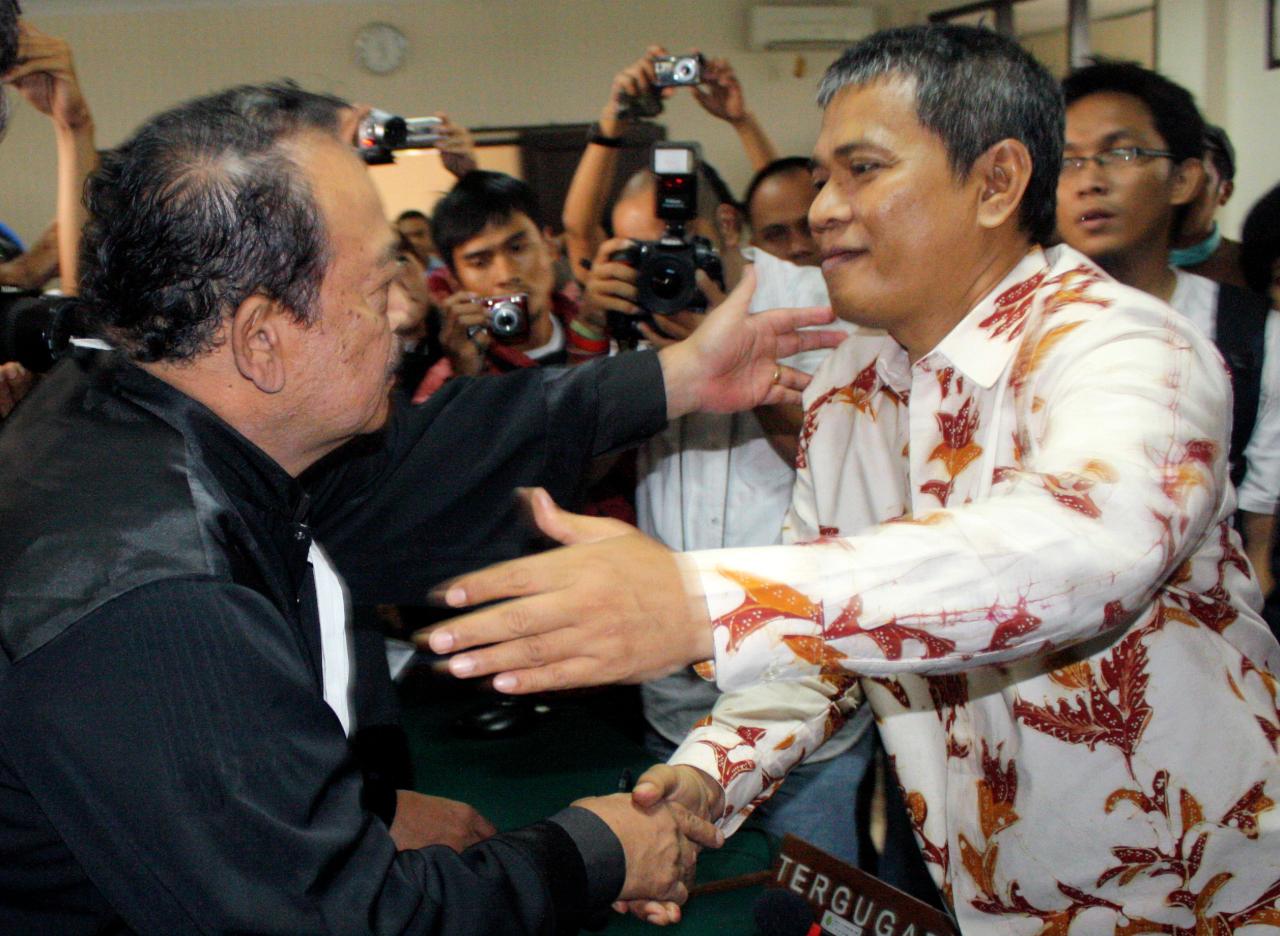
Abdurrahman Assagaf, left, head of the Makassar chapter of the Islamic Defenders Front, and members Arifuddin, middle, and Ruswandi Abubakar sit in court on Tuesday. (AFP Photo)
Makassar. Three members of the hardline Islamic Defenders Front appeared in court in Makassar on Tuesday to answer to charges of assault and property destruction stemming from raids on an Ahmadiyah complex and restaurants during the Islamic fasting month of Ramadan in August.

Abdul Rahman Assagaf, head of the South Sulawesi chapter of the group, known as the FPI, appeared with two other members, Arifuddin and Ruswandi Abubakar.

“The three defendants are alleged to have abused and assaulted the owner of Warung Coto and another restaurant in AP Pettarani [street], Makassar, in August,” Prosecutor Muhammad Adnan said as he read the indictment aloud in court.

Abdul is also facing charges of incitement of violence for a later attack by an FPI group on an Ahmadiyah complex.

In the Aug. 14 attack, the LPI, a unit of the Islamic Defenders Front (FPI), smashed several windows at the Indonesian Ahmadiyah Congregation (JAI) complex, including at its mosque, and damaged a car and a motorcycle parked in the compound.

The 30-strong mob also attacked Ahmad, the lone person guarding the JAI secretariat, and two paralegals from the Legal Aid Foundation (LBH) who tried to stop the attack. LPI members also scuffled with riot police sent to the scene to restore order.

The three defendants have been charged with assault and destruction of property for their alleged roles in restaurant raids carried out by the FPI on Aug. 12, during which about 50 FPI members convoyed through the streets looking for open restaurants and food stalls shortly after Friday prayers.

The mob forced three restaurants on Jalan Pettarani to close, and made the owners sign written statements promising that they would not operate during daylight hours for the remainder of the fasting month.

If convicted of the charges, the three defendants face up to five years in prison each.

About 100 police officers were on hand to ensure order during the 15-minute hearing. A group of 50 FPI members showed up to voice support for their comrades, but the scene remained calm.

Copyright 2010 The Jakarta Globe
URL: www.thejakartaglobe.com/news/trial-begins.../477185

Friday, October 14, 2011

Indonesia: Open letter on human rights violations against the Ahmadiyya in West Java

Amnesty International
Indonesia: Open letter on human rights violations against the Ahmadiyya in West Java

Ref: TG ASA 21/2011.034
Index: ASA 21/032/2011

Gamawan Fauzi
Minister of Home Affairs
Ministry of Home Affairs
Jl. Medan Merdeka
Utara No.7
Jakarta 10110
Indonesia

14 October 2011

AMNESTY INTERNATIONAL INTERNATIONAL SECRETARIAT
Peter Benenson House, 1 Easton Street
London WC1X 0DW, United Kingdom
T: +44 (0)20 7413 5500 F: +44 (0)20 7956 1157
E: amnestyis@amnesty.org W: www.amnesty.org

Dear Minister,

OPEN LETTER ON HUMAN RIGHTS VIOLATIONS AGAINST THE AHMADIYYA IN WEST JAVA

We are writing to raise our concerns about intimidation, threats and violence against several Ahmadiyya communities at the hands of certain religious groups and organizations, as well government officials in the province of West Java. These include attacks on the property of Ahmadiyya members, closure or takeover of Ahmadiyya places of worship, and members of the community being threatened in attempts to force them to denounce their beliefs.

We are particularly concerned that government authorities – including the police – are failing to protect these communities and, in some cases, actively taking part in their persecution. There is also evidence that a provincial regulation entitled “Regulation of the Governor of West Java No. 12/2011 concerning Prohibition of Activities of the Indonesian Ahmadiyya Congregation in West Java” (Regulation of the Governor of West Java No. 12/2011) issued on 3 March 2011 is being used by attackers to justify such unlawful actions.

Article 3 of the Regulation, among other things, “prohibits followers of the Ahmadiyya community from carrying out activities… related to the spreading of interpretation and activities that deviate from the fundamental teachings of Islam”. These activities include spreading Ahmadiyya teachings, installing their signboards in public places and on their places of worship and educational institutions, as well as using anything that could identify them as Ahmadiyya followers.

Below we highlight a number of cases documented by Amnesty International in West Java province. We urge the Indonesian government to ensure prompt, independent, impartial and effective investigations into these reports and take steps to ensure such attacks are not repeated. Indonesia must abide by its international legal obligation to respect and protect the freedom of thought, conscience and religion of all individuals and communities in the country.

1. ATTACKS ON AHMADIYYA PROPERTY AND INTIMIDATION OF COMMUNITY

At 11pm on 29 March 2011 in the village of Sukagalih, Sukaratu sub-district, Tasikmalaya district, approximately 100 people reportedly attacked a house belonging to the Ahmadiyya. According to eye witnesses, some of the attackers were from the As-Syafiiyah Islamic boarding school in Cikatubang located 500m from the village. There were four people in the house: a man, aged 63; his wife, aged 55; their daughter, aged 21; and a wheelchair-bound grandmother, aged 86. The attackers smashed their windows with plant pots, stones and bricks while shouting obscenities and religious slogans.

After a few minutes, the attackers entered the house through the front door, smashing furniture and electrical goods. The attackers then moved on to a small bamboo house at the back of the main property. After the family living in this house escaped, it was set on fire and razed to the ground with all of its contents.

Within days of this attack, two banners were erected immediately outside the main house and at the entrance of the road leading up to the house. The banner outside the house read:

“We support the West Java Governor Regulation No. 12/ 2011 that the Ahmadiy[ya] does not put its name on any place of worship, educational institute or anything else that belongs to Ahmadiy[ya] and ask for a presidential decree to be issued soon to dissolve Ahmadiy[ya].”

The banner at the entrance to the road leading to the attacked house read:

“Thank you to the Governor of West Java for issuing Governor Regulation [No.] 12/2011 on the prohibition of Ahmadiy[ya] activities and the spreading of Ahmadiy[ya} teachings.”

Both the banners were signed by a coalition of groups including the Islamic Defenders Front (Front Pembela Islam, FPI) and the Islamic Reform Movement (Gerakan Reformasi Islam, GARIS).

On the morning of 30 March 2011 at least six students from the boarding school were reportedly detained by the police for their involvement in the attack and taken to the Tasikmalaya District Police Station (Polres). However, they were released without charge later that evening after a demonstration by students from the boarding school in front of the police station. The local military village “guidance” officer (Bintara Pembina Desa or Babinsa) told the Ahmadiyya victims that the police had received threats of more violence against Ahmadiyya houses if the detainees were not immediately released.

2. CLOSURE OR TAKEOVER OF AHMADIYYA PLACES OF WORSHIP

In the ten days after the Governor of West Java issued the Regulation, the Babinsa officer and the Bojongpicung Sub-district Police approached elders of the Ahmadiyya community in the village of Cipeuyem, Haruwangi sub-district and asked them to allow a non-Ahmadiyya preacher to use their place of worship at prayer time. The elders denied their request.

At around 2pm on 13 March 2011, a group of around 50 people from Cipeuyem village reportedly arrived at the Ahmadiyya place of worship led by the Head of the Indonesian Ulema Council (Majelis Ulama Indonesia, MUI) in the village. They then collected all the books they could find in the place of worship and set them on fire on the pavement.

Later the same day, members of the Bojongpicung Sub-district Police (Polsek), the Bojongpicung military (Koramil), the local village administration, and the same religious leader who had earlier led the book burning, reportedly called the Ahmadiyya elders to a meeting and pressured them to close the Ahmadiyya place of worship. On 17 March 2011 in a second meeting with the same people, under the pressure of intimidation, two members of the Ahmadiyya community were forced to sign a letter saying they agreed the place of worship should be closed. Following this incident, the local Ahmadiyya community has been too frightened to continue to use this place of worship.

In the nearby hamlet of Neglasari, Sukadana village, Campaka sub-district, Cianjur district, a non-Ahmadiyya preacher has taken over an Ahmadiyya place of worship.

After a banner supporting the Governor of West Java’s Regulation was put up near the main group of Ahmadiyya houses in Neglasari, members of the Ahmadiyya community were reportedly invited to a meeting on 16 March 2011 to brief them on the Regulation. The meeting was attended by local representatives of the Attorney General’s Office, the Cianjur District Police, local representatives from the Ministry of Religion and the village administration, as well as several religious leaders. Three days later, one of those religious leaders then visited the head of the Neglasari chapter of the Ahmadiyya asking to use the Ahmadiyya place of worship for a gathering of 1,000 of his followers. Alarmed at the large number of this congregation – usually the Ahmadiyya congregation is around 20-50 people – the Ahmadiyya elders asked the local police to intervene.

In a meeting held on 21 March 2011 at the Campaka Sub-district Police Station, the head of the local police reportedly called for the planned prayer gathering to be cancelled. Nevertheless, later that day, the non-Ahmadiyya leader turned up with a congregation of 500 people and used the Ahmadiyya place of worship without permission from the Ahmadiyya elders. In attendance were around 200 public order (Dalmas) police officers from the Cianjur District Police and officers from Campaka, Sukanegara, Pagelarang and Cibeber Police Sub-districts. The Ahmadiyya members present reported that the police officers did not take any steps to prevent this, but only stood and watched.

Since then, their place of worship has frequently been used by other leaders from around Sukadana village and some of these prayer meetings are organized to “educate” the Ahmadis about Islam. The Ahmadiyya community around the place of worship has been unable to use it for several months and complaints to police have not been followed up.

3. THREATENED IN AN ATTEMPT TO FORCE THEM TO DENOUNCE THEIR BELIEFS

On 1 April 2011 a local village head reportedly approached a family in Sukadana village, Campaka sub-district and told them they must make a decision to either leave the Ahmadiyya faith or leave their homes, and offered Rp 300,000 [US$ 35] if they signed papers denouncing their faith. The family decided to leave the area not long after and is now trying to collect money to build another house closer to the core Ahmadiyya community in Sukadana village.

Since the Regulation was issued, Ahmadiyya families in Sukagalih village, Sukaratu sub-district also reported receiving visits every few weeks by village administration staff and FPI members and associated leaders. The Ahmadiyya members reported being given invitation letters asking them to attend meetings where they would be expected to leave the Ahmadiyya faith. Those who agreed to attend are made to sign a register. Officials have reportedly informed the Ahmadiyya members that “if you do not want to sign, we will not be responsible for what might happen to you”.

Amnesty International has obtained a copy of one of the invitation letters (dated 9 May 2011) from a group called the Association of Victims of the Ahmadiyya Deviant Sect (Ikatan Masyarakat Korban Aliran Sesat Ahmadiyah, IMKASA) reportedly set up by the Soldiers to Defend Islam (Laskar Pembela Islam, LPI). The heading of this invitation says in big letters: “Don’t die unless you’re a Muslim”, which Ahmadiyya members have found threatening.

4. AMNESTY INTERNATIONAL’s CONCERNS

The duty of a state to respect and ensure respect for human rights is key to ensuring the enjoyment of these rights by individuals and communities within the state. This duty is provided for, among others, in the International Covenant on Civil and Political Rights (ICCPR), to which Indonesia is a state party. It includes the obligation of states to do their utmost to prevent people’s rights being violated or abused, both by state officials and by others. If abuse has taken place, a state is obliged to investigate and prosecute those responsible in fair proceedings, and ensure reparations for victims. The police, as the arm of government charged with law enforcement, has a key role to play in ensuring that human rights are not violated or abused, as well as in the investigation of such violations and abuses when they do occur.

Under Article 2(1) of the ICCPR, human rights must be protected “without distinction of any kind, such as race, colour, sex, language, religion, political or other opinion, national or social origin, property, birth or other status”.

In an authoritative General Comment on Article 2 (non-discrimination) of the ICCPR, the Human Rights Committee, the expert group tasked under the Covenant to oversee its implementation, has stated that “[t]here may be circumstances in which a failure to ensure Covenant rights as required by Article 2 would give rise to violations by States Parties of those rights, as a result of States Parties’ permitting or failing to take appropriate measures or to exercise due diligence to prevent, punish, investigate or redress the harm caused by such acts by private persons or entities”.

Article 14 (1)(g) of Law No. 2/2002 on the Indonesian National Police also provides that “the police have a duty to investigate all criminal acts in accordance with the Criminal Procedure Code and under relevant legislation”.

Indonesian police have failed to investigate these attacks and bring those responsible to justice. Amnesty International is concerned that this failure runs contrary to Indonesia’s obligations under both the ICCPR and Indonesian laws.

Amnesty International is also concerned that the Regulation of the Governor of West Java No. 12/2011 and the closure or takeover of Ahmadiyya community places of worship denies the Ahmadiyya community their right to freedom of religion or belief.

The right to freedom of religion or belief is guaranteed in Article 18(1) of the ICCPR which provides that:

“[e]veryone shall have the right to freedom of thought, conscience and religion. This right shall include freedom… either individually or in community with others and in public or private, to manifest his religion or belief in worship, observance, practice and teaching.”

The Human Rights Committee has stated that:

“[t]he freedom to manifest religion or belief in worship, observance, practice and teaching encompasses a broad range of acts. The concept of worship extends to… various practices integral to such acts, including the… display of symbols… and the freedom to prepare and distribute religious texts or publications.”

Further, threats by local government officials against the Ahmadiyya in an attempt to force them to denounce their beliefs are in violation of Article 18(2) of the ICCPR which provides that “[n]o one shall be subject to coercion which would impair his freedom to have or to adopt a religion or belief of his choice”.

According to the Human Rights Committee, “[a]rticle 18(2) bars coercion that would impair the right to have or adopt a religion or belief, including the use of threat of physical force… to compel believers or non-believers to adhere to their religious beliefs and congregations, to recant their religion or belief or to convert”.

The right to freedom of religion is also enshrined in the Article 28E (1) of the Indonesian Constitution which provides that “[e]very person shall be free to choose and to practice the religion of his/her choice”.

According to Indonesian human rights lawyers, the Regulation of the Governor of West Java No. 12/2011 is also in violation of the Article 10 (3)(f) of Law No. 32/2004 on Regional Autonomy. In the autonomy law, the powers to make regulations on matters of religion are in the domain of the central government. Provincial or local-level regulations are therefore invalid to the extent that they are inconsistent with higher laws, such as national laws or regulations, according to the hierarchy of laws in Article 7(1) of Law No. 10/2004 on Law-making.

5. Recommendations

In order to remedy this situation, Amnesty International calls on your department to immediately take the lead in ensuring the following:

  • Order the central police to undertake a thorough, independent and impartial investigation into the intimidation, threats and violence against the Ahmadiyya community in West Java;
  • Ensure that the findings of the investigation are made public and are submitted, wherever relevant, to the Public Prosecutor so that all those suspected of involvement in human rights-related offences are brought to justice in proceedings which meet international standards of fairness and without the imposition of the death penalty, and that victims are provided reparations;
  • Revoke the Regulation of the Governor of West Java No. 12/2011 and all other regional and national regulations that restrict the activities of the Ahmadiyya community in Indonesia or otherwise violate their right to freedom of thought, conscience and religion;
  • The central government must ensure that any regulations issued at the provincial and at the district level are in compliance with human rights protections as provided in the 1945 Indonesian Constitution and Indonesia’s obligations under international law, in particular the ICCPR; and
  • Denounce all public statements inciting discrimination and violence against the Ahmadiyya and take steps to ensure that all religious minorities in Indonesia, including the Ahmadiyya, are protected and allowed to practise their faith free from fear, intimidation and persecution.

Please do not hesitate to contact us if you have any questions. We would be pleased to discuss this matter with you.

Yours sincerely,

Donna Guest
Asia-Pacific Deputy Director

Cc: General Timur Pradopo
Head of the Indonesian National Police

Patrialis Akbar
Minister of Justice and Human Rights

Suryadharma Ali
Minister of Religious Affairs

Ahmad Heryawan
Governor of West Java Province

Ifdhal Kasim
Head of the National Human Rights Commission (Komnas HAM)

Human Rights Committee, General Comment No. 31 on Article 2 of the Covenant: The Nature of the General Legal Obligation Imposed on States Parties to the Covenant, UN Doc. CCPR/C/74/CRP.4/Rev.6, 21 April 2004, para. 8.

Human Rights Committee General Comment No. 22: The right to freedom of thought, conscience and religion (Article 18): UN Doc. CCPR/C/21/Rev.1/Add.4, 30/07/1993 para. 4.

Human Rights Committee General Comment No. 22: The right to freedom of thought, conscience and religion (Article 18): UN Doc. CCPR/C/21/Rev.1/Add.4, 30/07/1993 para. 5.

Tuesday, August 16, 2011

Indonesia: new mob attack on Ahmadi minority condemned amid sentencing controversy

News & EventsAmnesty International
Indonesia: new mob attack on Ahmadi minority condemned amid sentencing controversy
Posted: 16 August 2011
The Indonesian authorities must act to halt attacks on the country’s Ahmadi minority, Amnesty International said today, after a radical Islamist group led an attack on the Ahmadiyya in Makassar, South Sulawesi.

Hundreds of members of the group the Islamic Defender’s Front (FPI) attacked a large group of Ahmadiyya in their place of worship on Sunday.

Armed with machetes and bamboo sticks, the FPI members stormed the building at around 1am and attacked worshippers, inflicting serious head injuries on at least one Ahmadiyya member.

Three local human rights defenders, two from the Indonesian Legal Aid Institute (LBH) in Makassar and one from the Indonesian Forum for the Environment (WALHI) were beaten by the mob while trying to stop the attacks. According to them, police officers who were present did nothing to stop the violence or protect the victims.

Amnesty International’s Asia-Pacific Deputy Director, Donna Guest, said:

The Indonesian authorities must immediately investigate and punish these attacks on the Ahmadiyya and human rights defenders in South Sulawesi.

We fear that some groups now think that they can attack religious minorities and human rights defenders without any fear of serious consequences.

The previous evening dozens of FPI members had ransacked the building, breaking its windows and damaging a vehicle.

Donna Guest added:

The Ahmadiyya are not receiving adequate protection from the security forces or the courts.

There are concerns that the authorities are not treating violence against the Ahmadiyya seriously. The Indonesian police must do more to protect religious minorities from attacks and intimidation.

The fresh attacks have taken place amid a sentencing controversy over a fatal mob attack in February in Banten province on the home of an Ahmadi leader by over a 1,000 people wielding rocks, machetes, swords and spears.

An Indonesian court yesterday sentenced Deden Sudjana of the Ahmadi community to six months’ imprisonment for incitement and ‘maltreatment’ during the February mob attack on the Ahmadiyya property. Three Ahmadis were beaten to death in the attack.

On 28 July, 12 of the attackers received sentences of three to six months, and none were tried for murder.

Meanwhile, in January 2011, hundreds of FPI members attacked an Ahmadiyya community centre in South Sulawesi, vandalising the building while the police looked on. Amnesty International is not aware of any investigation into the attacks.

There have also been reports of raids on entertainment outlets and food stalls by FPI members in Makassar since the beginning of Ramadan, the Muslim holy month of fasting.

South Sulawesi’s provincial government is reportedly preparing a regulation issued by the Governor that would unlawfully restrict Ahmadiyya activities in the province.

The Ahmadiyya are a religious group who consider themselves a part of Islam; however many Muslim groups say they do not adhere to the accepted belief system.

Monday, August 15, 2011

Indonesia’s FPI Leader Detained

HeadlinesVIVA News
Indonesia’s FPI Leader Detained
Abdurrahman was detained at the police station for investigation process.
Senin, 15 Agustus 2011, 16:35 WIBAries Setiawan

FPI Attackers
VIVAnews — The Makassar District Police named Islamic Defenders Front (FPI) leader, Abdurrahman, a suspect in a riot case committed by the FPI South Sulawesi.

Abdurrahman was detained at the police station for investigation process.

Makassar District Police Crime and Investigation Division Head, AKBP Himawan Sugeha asserted, Abdurrahman, was arrested during the attack at the Jamaah Ahmadiyah Indonesia (JAI) Secretariat, early Sunday morning. Abdurrahman’s act allegedly violated Article 160 on sedition, for inciting others to commit unlawful acts.

“Abdurrahman did not set out the destruction, but he incited (FPI members of the destruction). He faces criminal imprisonment of maximum six years,” said AKBP Himawan Sugeha in his press statement.

In addition to Abdurahman, the police were still pursuing three other unidentified FPI members who promoted vandalism during the fasting month. They were identified in the case of destructions of restaurants and JAI secretariat on Jalan Anuang.

“We hope that FPI will not do it again because it is police authority to conduct raids,” said Himawan.

Coverage by : Rahmat Zeena | Makassar
• VIVAnews

FPI Attacks Ahmadiyah Complex and Restaurants

Jakarta Globe, Indonesia
HOME
FPI Attacks Ahmadiyah Complex and Restaurants
Rahmat | August 15, 2011

Makassar. Police in the South Sulawesi capital have named the head of the armed wing of the hard-line Islamic Defenders Front a suspect in an attack on Sunday against the beleaguered Ahmadiyah sect.

Adj. Sr. Comr. Himawan Sugeha, the Makassar Police chief of detectives, said that Abdurrahman, the head of the Islamic Defenders Force (LPI), had been arrested and would be charged with incitement to violence for the early morning attack on the Indonesian Ahmadiyah Congregation (JAI) secretariat.

“Abdurrahman himself didn’t take part in the vandalism, but he incited it, for which he could face up to six years in prison,” Himawan said.

In the attack, the LPI, a unit of the Islamic Defenders Front (FPI), smashed several windows at the JAI complex, including at its mosque, and damaged a car and a motorcycle parked in the compound.

The 30-strong mob also attacked Ahmad, the lone person guarding the JAI secretariat, and two paralegals from the Legal Aid Foundation (LBH) who tried to stop the attack. None of the three victims suffered serious injuries. LPI members also scuffled with riot police sent to the scene to restore order.

The mob began its rampage on Saturday night, attacking and shutting down food stalls and restaurants in the city.

Himawan said the police were tracking down three FPI members involved in those attacks. He added the police were annoyed by the FPI’s vigilantism.

“We hope they stop carrying out these raids because that’s the police’s job,” he said. “If they just preach then we have no problem with that.”

Copyright 2010 The Jakarta Globe
URL: www.thejakartaglobe.com/home/fpi-attacks.../459311

Indonesia Ahmadi attack victim jailed for 6 months

The Straits Times, Singapore
BREAKING NEWS
Home > Breaking News > SE Asia > Story
Aug 15, 2011
Indonesia Ahmadi attack victim jailed for 6 months

JAKARTA (AP) — An Indonesian man wounded when Muslim hard-liners attacked members of his minority Islamic sect was sentenced on Monday to six months in jail, more than some of the actual attackers who were caught on video.

Human rights groups blasted the ruling as encouraging growing religious intolerance in Indonesia, the world’s largest Muslim-majority country.

The Serang District Court said Deden Sudjana - whose hand was nearly severed by a machete - resisted police orders to leave the scene and then attacked one of the leaders of the mob that killed three members of the Ahmadiyah sect.

The Feb 6 attack - captured on video and widely circulated on the Internet - showed a frenzied crowd of around 1,500 descending on members of Ahmadiyah in the village of Cikeusik with machetes, wooden clubs and rocks to try to prevent them from worshipping.

Copyright © 2011 Singapore Press Holdings Ltd. Co. All rights reserved.
URL: www.straitstimes.com/BreakingNews/SEAsia/Story/STIStory_702361.html

Victim of Indonesian mob attack sent to jail

The Associated Press August 15, 2011 
Victim of Indonesian mob attack sent to jail
By ALI KOTARUMALOS, Associated Press

Member of Ahmadiyah sect Deden Sudjana, sits on the defendant's chair during his trial at a district court in Serang, Banten, Indonesia, Monday, Aug. 15, 2011. The man injured when Muslim hard-liners attacked members of his minority Islamic sect was sentenced Monday to six months in jail, more than some of the actual attackers. (AP Photo)
Member of Ahmadiyah sect Deden Sudjana, sits on the defendant’s chair during his trial at a district court in Serang, Banten, Indonesia, Monday, Aug. 15, 2011. The man injured when Muslim hard-liners attacked members of his minority Islamic sect was sentenced Monday to six months in jail, more than some of the actual attackers. (AP Photo)
JAKARTA, Indonesia (AP) — An Indonesian man wounded when Islamic hard-liners launched a deadly attack on his minority sect was sentenced Monday to six months in prison — more than some of those caught on video taking part in the lynching.

Human rights groups blasted the ruling, saying 48-year-old Deden Sudjana was acting in self-defense. They said it showed how the police, the judicial system and the government are helping fuel religious intolerance in the world’s most populous Muslim nation.

Sudjana was convicted of inciting violence because he defied police orders to leave the scene when the attackers arrived at a meeting of the minority Ahmadiyah sect. Sudjana instead fought back during the Feb. 6 incident in the village of Cikeusik in central Indonesia.

Member of Ahmadiyah sect Deden Sudjana, right, is greeted by his lawyer Nurcholis Hidayat, after the judge delivered his verdict during his trial at a district court in Serang, Banten, Indonesia, Monday, Aug. 15, 2011. The man injured when Muslim hard-liners attacked members of his minority Islamic sect was sentenced Monday to six months in jail, more than some of the actual attackers. (AP Photo)
Footage of the attack, which circulated widely on the Internet, showed 1,500 hard-liners descending on a house where 20 members of the sect had gathered. The attackers, carrying wooden clubs, machetes and rocks, killed three people and continued to pummel their lifeless bodies, chanting “God is Great!“ as police looked on.

Sumartono, presiding judge of the Serang District Court, gave Sudjana six months for resisting police orders and then beating one of the mob’s leaders.

Sudjana — whose hand was nearly severed by a machete during the attack — looked stunned as the verdict was read out.

“I’m the victim,” he told reporters as he was escorted from the courtroom. “Why am I getting a higher sentence than some of the perpetrators?“

Indonesia, a predominantly Muslim and secular nation of 240 million, has a long history of religious tolerance.

But a small, extremist fringe has grown more vocal and violent in recent years. They’ve been emboldened by the inaction of President Susilo Bambang Yudhoyono, who relies on the support of Islamic parties in Parliament, and does not want to offend conservative Muslims by taking sides.

Perpetrators of such violence often go unpunished.

Member of Ahmadiyah sect Deden Sudjana, center, speaks to the press after his trial at a district court in Serang, Banten, Indonesia, Monday, Aug. 15, 2011. The man injured when Muslim hard-liners attacked members of his minority Islamic sect was sentenced Monday to six months in jail, more than some of the actual attackers. (AP Photo)
Human rights groups say police, under pressure by hard-liners, did not carry out a proper investigation into the Feb. 6 attacks and that prosecutors, claiming the Ahmadis were instigators, didn’t call key eyewitnesses.

Andreas Harsono, of the New York-based Human Rights Watch, called it the Talibanization of Indonesia.

“We have the impression that the Indonesian justice system has surrendered to (those) who have decided to take the law into their own hands,” he said.

The decision to punish one of the victims will only encourage more such violence, he added.

So far, 12 members of the mob have been convicted, including one man who was captured on camera smashing in an Ahmadi member’s skull with a rock.

They were given between three to six months in jail.

The Ahmadiyah, which has followers around the world, is considered heretical by many Muslims and banned in many Islamic countries because of its belief that Muhammad was not the final prophet.

In recent years, hard-liners in Indonesia have attacked the sect’s mosques and intimidated some of its 200,000 followers, but the lynching in Cikeusik was by far the most brutal.

The latest attack occurred over the weekend in the South Sulawesi town of Makassar, where 30 members of the hardline Islamic Defenders Front attacked a mosque.

Two people also were beaten, sect members and a lawyer who tried to interfere, rights groups said.

Associated Press writers Niniek Karmini and Michael Holtz contributed to this report from Jakarta.

Copyright © 2011 The Associated Press. All rights reserved
URL: www.google.com/hostednews/ap/article/ALeqM5ihZBh...

Monday, August 8, 2011

Accepting Others Is Indonesia’s Homework

Jakarta Globe, Indonesia
OPINION
Accepting Others Is Indonesia’s Homework
Nicholaus Prasetya | August 08, 2011

A police talks with three defendants of Ahmadiyah attack in Cikeusik during the first trial at Serang District Court, Banten, April 26, 2011. (Antara Photo/Asep Fathulrahman)
Sadly, the barometer of intolerance continues to rise. While the perpetrators of the latest incident — in which two houses used as churches in Riau were burned to the ground — have not been found, it seems to be in line with many other acts of intolerance happening across Indonesia.

What makes the Riau incident worse is that it happened during the holy month of Ramadan, a time of peace and devotion recognized by Muslims around the world.

The attack also served to keep other similar events in the front of Indonesians’ minds. It was only about a week ago when the people who led the mob that attacked and killed members of the Ahmadiyah sect in Cikeusik were sentenced to just a few months in prison. One of the Ahmadiyah followers, meanwhile, was given a nine-month prison sentence. It also recalled the Temanggung rampage, when a Catholic church there suffered damage from a mob inflamed by religious intolerance.

Another lingering indication that intolerance is become the norm in Indonesia is the GKI Yasmin Church in Bogor. There is still no agreement on where the GKI members may conduct their services, since the local authorities have barred them from their church. They have been forced to pray on the side of the road, making them an easy target for passers-by, who shout in protest, objecting to the public display of a minority religion.

While church members are harassed for standing up for their beliefs, hard-line Islamic groups in Jakarta easily conducted protests and marches in advance of Ramadan, causing traffic chaos. The Islamic Defenders Front (FPI) met no resistance with their protest several days ago, where they demanded that the government ban Ahmadiyah. Indeed, the FPI seems to be able to do whatever it wants, wherever and whenever it wants, with no intervention by police or authorities. How is this justified?

What is at stake in all these incidents is Indonesia’s reputation for tolerance, which is often praised but in reality is no longer deserved. If we are a tolerant country, what, exactly, are we tolerating?

It appears that tolerance in Indonesia has come to mean tolerance based upon loyalty among people who share the same values. Or taking it further, tolerance is only for those who have power and dominate a given area or region.

This fact is clearly seen in the case of the FPI. Do the police “tolerate” the FPI simply because it has a large following and powerful leaders? Looking at it the other way, should Indonesia “tolerate” those who attacked and killed Ahmadiyah followers simply because the Ahmadiyah are a tiny minority? Does that justify the lenient court verdicts?

This is the paradox when it comes to discussing tolerance. On the one hand, tolerance is easily applied to members of the majority, even in cases where the law has been broken. On the other hand, people from religious minorities consistently bear the brunt of intolerance.

Real tolerance for minorities cannot come about just by listening to the words of our leaders. It has to take root in reality. Only talking about tolerance is nonsense, as can be seen from so many recent cases. Sadly, there is often simply no room for minorities.

This is also part of the paradox of a democratic country: the majority can easily control the law, and minorities, who are supposedly equal, are often repressed. This is a paradox that goes back as far as Socrates and is not easily resolved. In a democracy, what should be right can be made wrong, simply because enough people demand it. Those with the power and the numbers can enforce their will.

As a diverse country with a large Muslim majority, we must have the courage to not allow our many minorities to be dominated by the majority. Religious tolerance should not be based on power. But this seems hard to achieve given the existence of extremists who undoubtedly also play an important role in our democratic society. As a result, the Indonesian government fails to protect minorities and develop and promote the values of real tolerance. At a time when these values are most needed, the virtues of tolerance are being neglected.

Two things are lacking here. One is communication. As the philosopher Jurgen Habermas has noted, in a diverse democratic community, effective communication is vital because without it consensus cannot be reached.

But a consensus must be reached in Indonesia free of coercion and domination. The nature of the extremist groups in our society shows that they cannot share their ideology and thoughts in a peaceful manner; they will not engage in reasoned debate and discussion. Their manner is rigid and cagey — they feel they are always right. If they are opposed by anyone, they resort to intimidation.

We need to change our perception of the limits of freedom. Our social contract with one another imposes limits on our absolute freedom and those limits are what allow society to function. What one group believes is absolutely correct may not be consistent with the rights of others, especially religious minorities.

This is why people need to practice tolerance through communication in their daily lives. We need to build not simple relativism but a real appreciation of differing views.

This is the great homework that has to be done immediately by the Indonesian government and its people. If intolerance cannot be stopped, diversity in Indonesia will be lost.

Nicholaus Prasetya is currently a student at the Bandung Institute of Technology (ITB).

Tuesday, August 2, 2011

Muslim sect braces for Indonesia Ramadan violence

ABS-CBN Interactive. Philippine
Home > World
Muslim sect braces for Indonesia Ramadan violence
by Presi Mandari, Agence France-Presse
Posted at 08/02/2011 1:26 PM | Updated as of 08/02/2011 1:26 PM

JAKARTA - As most Indonesian Muslims started the fasting month of Ramadan peacefully this week, followers of the minority Ahmadiyah Islamic sect braced themselves for hatred and bloodshed.

Ahmadiyah leaders said they feared the worst after a court last week handed down sentences of only a few months in jail to hardliners who killed three sect members in a vicious mob attack.

“The extremists say this is a holy month, everything must be pure and sacred. So we, the Ahmadiyah followers, must be cleared out,” Ahmadiyah spokesman Firdaus Mubarik told AFP.

The sect is unorthodox in that it does not believe Mohammed is the last prophet of Islam. It claims 500,000 followers in Indonesia, where it has existed in relative calm since the 1920s.

Islamic vigilante groups, emboldened by a decree ordering the sect to stop spreading its beliefs in the Muslim-majority country, have recently started targeting the Ahmadiyah in an ugly wave of hate crimes.

“For us, the fasting month doesn’t mean there’ll be peace for us to perform our religious obligations. On the contrary, there are more opportunities for Muslim extremists to mobilize and incite people to attack us,” Mubarik said.

Last year’s holy month saw Ahmadiyah homes and a mosque destroyed by angry mobs, he said.

Days before this year’s Ramadan began on Monday, authorities ordered the Ahmadiyah community in Samarinda city, on Borneo island, to close their mosque following complaints from members of the mainstream Sunni Muslim faith.

Hundreds of hardliners from the Islamic Defenders Front, one of the vigilante groups responsible for the violence, rallied Saturday at the presidential palace in Jakarta demanding Ahmadiyah be outlawed altogether.

Harassment, persecution and violence against minorities, especially the Ahmadiyah, have become more frequent under the leadership of twice-elected President Susilo Bambang Yudhoyono, analysts say.

The latest outrage, according to local and international human rights groups, was the slap on the wrist given to the ringleaders of February’s deadly mob frenzy against Ahmadiyah followers in Cikeusik village, western Java.

Around 1,500 enraged extremists descended on a house occupied by a handful of Ahmadiyah defenders, brushed aside the police and proceeded to stone, beat and hack their victims to death before destroying the property.

The unprovoked attack was filmed by an Ahmadiyah member who is now in hiding under police protection, providing graphic evidence of the crimes.

Yet prosecutors claimed the sect provoked the violence by refusing to abandon their property to the mob. The state did not charge any of the perpetrators with murder; instead it produced what Human Rights Watch described as an “almost laughable” list of minor infringements.

Dani bin Misra, a 17-year-old who was caught on film repeatedly smashing a victim’s skull with a stone, was sentenced to three months in jail for assault causing death, public incitement and destruction of property.

Idris bin Mahdani, who led the mob, was convicted of illegal possession of a machete and received five months and 15 days in jail.

The United States and the European Union expressed strong misgivings but Yudhoyono has said nothing about the sentences, raising questions over his oft-repeated commitment to pluralism and the rule of law.

“We’re in a state of emergency regarding freedom of religion,” Setara Institute for Democracy and Peace activist Hendardi told AFP.

“Last week’s court ruling not only failed to give a deterrent effect to the offenders but will encourage the violators to carry out more attacks against minorities in the coming days.”

Religious affairs ministry spokesman Zubaidi said the sentences were the result of a fair trial, and rejected allegations that the police had failed to properly investigate the crimes.

“As an executive body, we cannot interfere in the legal system… Whether the sentences are light or harsh, how it’s perceived is relative,” he said.

Copyright ©2011 ABS-CBN Interactive. All Rights Reserved
URL: www.abs-cbnnews.com/global-filipino/world/08/02/11/muslim-sect...

Muslim sect braces for Indonesia Ramadan violence

The Straits Times, Singapore
Breaking News
August 02, 2011 Tuesday
Updated 11.29 pm
SE Asia
Home > Breaking News > SE Asia > Story
Aug 02, 2011
Muslim sect braces for Indonesia Ramadan violence
Ahmadiyah leaders said they feared the worst after a court last week handed down sentences of only a few months in jail to hardliners who killed three sect members in a vicious mob attack. -- PHOTO: REUTERS
Ahmadiyah leaders said they feared the worst after a court last week handed down sentences of only a few months in jail to hardliners who killed three sect members in a vicious mob attack. — PHOTO: REUTERS
JAKARTA - AS MOST Indonesian Muslims started the fasting month of Ramadan peacefully this week, followers of the minority Ahmadiyah Islamic sect braced themselves for hatred and bloodshed.

Ahmadiyah leaders said they feared the worst after a court last week handed down sentences of only a few months in jail to hardliners who killed three sect members in a vicious mob attack.

‘The extremists say this is a holy month, everything must be pure and sacred. So we, the Ahmadiyah followers, must be cleared out,’ Ahmadiyah spokesman Firdaus Mubarik told AFP.

The sect is unorthodox in that it does not believe Mohammed is the last prophet of Islam. It claims 500,000 followers in Indonesia, where it has existed in relative calm since the 1920s.

Islamic vigilante groups, emboldened by a decree ordering the sect to stop spreading its beliefs in the Muslim-majority country, have recently started targeting the Ahmadiyah in an ugly wave of hate crimes.

‘For us, the fasting month doesn’t mean there’ll be peace for us to perform our religious obligations. On the contrary, there are more opportunities for Muslim extremists to mobilise and incite people to attack us,’ Mr Mubarik said. — AFP

Saturday, July 30, 2011

Indonesian Muslims demand Ahmahdiyah be outlawed

The Straits Times, Singapore
Breaking News
July 30, 2011 Saturday
Updated 3.30 pm
SE Asia
Home > Breaking News > SE Asia > Story
Jul 30, 2011
Indonesian Muslims demand Ahmahdiyah be outlawed

Members of Indonesia's Islamic Defenders Front (FPI) rally on the streets in Jakarta July 30, 2011. Members of the FPI are demanding the government to disband Ahmadiyah sect. Indonesia's Assembly of Indonesian Muslim Clerics (MUI) considers the Ahmadiyah sect to be 'heretical' for believing that Mohammad was not Islam's final prophet. -- PHOTO: REUTERS
Members of Indonesia's Islamic Defenders Front (FPI) rally on the streets in Jakarta July 30, 2011. Members of the FPI are demanding the government to disband Ahmadiyah sect. Indonesia's Assembly of Indonesian Muslim Clerics (MUI) considers the Ahmadiyah sect to be 'heretical' for believing that Mohammad was not Islam's final prophet. — PHOTO: REUTERS
JAKARTA — HUNDREDS of conservative Muslims held a noisy but peaceful rally in Indonesia’s capital on Saturday to demand the government outlaw an Islamic sect they consider heretical.

Nearly 1,500 white-robed protesters - gathering days after a court sentenced 12 men to less than six months in jail for lynching three Ahmahdiyah sect members - marched through the streets until they reached the presidential palace.

Some held placards that said ‘Disband Ahmadiyah or Revolution’ and ‘War against Ahmadiyah.’

Cleric Muhammad Rizieq Shihab shouted through his bullhorn that President Susilo Bambang Yudhoyono should ‘not be a coward.’ ‘Disband them!‘ he said, as the crowd of 1,500 cheered and chanted ‘Allah Akbar’ or ‘God is great’.

Indonesia, a predominantly Muslim and secular nation of 240 million, has a long history of religious tolerance.

But experts say a small, extremist fringe has grown more vocal in recent years and is seeking - with some success - to impose its will on police, the judicial system and the government. They’ve been emboldened by the inaction of Mr Yudhoyono, who relies on the support of Islamic parties in Parliament, and does not want to offend conservative Muslims by taking sides. — AP

Monday, June 27, 2011

Prosecutor weak in Ahmadiyah trial: Elsam

Jakarta Post, Indonesia
NATIONALMon, 06/27/2011 5:19 PM
Prosecutor weak in Ahmadiyah trial: Elsam
The Jakarta Post
A team monitoring the trials of an attack against religious minority group Ahmadiyah said Monday the prosecutor performed below standard.

It said many witnesses’ statements were not well-explored during the trials.

Wahyu Wagiman, a team member from the Institute for Policy Research and Advocacy (Elsam), told reporters the prosecutor ignored statements from key witnesses such as Muh. Kamil Safei over the 13 trials.

“Kamil said in a trial that he received a text message from Ujang Muh. Arif, a case defendant, saying that Habib Rizieq, the Islamic Defenders Front [FPI] leader, would be held responsible for the riot,” Wahyu said.

The prosecutor did not question the content of the text message further, Wahyu added.

In February, about 1,500 people attacked Ahmadis in Cikeusik, Banten, killing three.

Eleven defendants are being jointly tried for an assault causing death, inciting violence, maltreating others, participating in assault and illegally possessing sharp weapons.

Prosecutors declined to charge anyone with the murder or manslaughter of the three Ahmadis.

The next trials will be held on June 30 and July 3 at Serang District Court. (rpt)

Copyright © 2008 The Jakarta Post - PT Bina Media Tenggara. All Rights Reserved
URL: www.thejakartapost.com/news/2011/06/27/prosecutor-weak...

Sunday, June 19, 2011

Two groups in tension over Ahmadiyah issues

Jakarta Post, Indonesia
NATIONALSun, 06/19/2011 10:20 AM
Two groups in tension over Ahmadiyah issues
The Jakarta Post
Two youth mass organizations in Makassar almost became implicated in a brawl over Ahmadiyah issues.

The police have issued warnings. The organizations, the Islamic Defenders Front (FPI) and the Pancasila Youth, through their leaders signed a peace pact before the police officials.

Tribunnews.com reported that tension originated from a misunderstanding between the groups’ members.

Pancasila Youth regional secretary Andi Azikin said FPI members misinterpreted the situation when they saw Pancasila Youth members by an Ahmadiyah Mosque.

“The FPI members thought we were defending the people at the Ahmadiyah mosque. The truth is we are not involved in Ahmadiyah issues,” Azikin said Sunday.

The FPI was reportedly at the site to prevent people from performing prayers at the mosque.

According to witnesses, FPI members provoked Pancasila Youth activists. Pancasila activists were then forced back to their headquarters where they allegedly planned to respond.

In the last three years, Ahmadiyah people have been subject to much discrimination in the country after the Indonesian Clerics Association (MUI) issued a religious decree stating Ahmadiyah was not part of Islam.

The FPI has been active in suppressing the Amadiyah people.

The administration under President Susilo Bambang Yudhoyono has not provided proper protection to Ahmadiyah people, or the right to perform prayer.

Many activists perceive this as a sign of the administration’s lack of commitment toward he country’s ideology of pluralism.

Copyright © 2008 The Jakarta Post - PT Bina Media Tenggara. All Rights Reserved
URL: www.thejakartapost.com/news/2011/06/19/two...issues.html

Tuesday, April 26, 2011

As Terrorism Takes on a New Face, the President Needs to Find His Backbone

Jakarta Globe, Indonesia
OPINION
As Terrorism Takes on a New Face, the President Needs to Find His Backbone
Bramantyo Prijosusilo | April 26, 2011

The recent arrests of suspected terrorists reveal that our new generation of extremists has little contact with the older generations, who were radicalized and trained through direct experience and contact with international networks.

These new terror suspects, the police say, have more or less radicalized themselves relatively independently from the traditional connections to conflict areas in Central Asia or the Philippines. This new generation of suspects consists of individuals who studied in universities who radicalized themselves through jihadi Web sites and discussion forums on the Internet, and through the study of jihadi books and videos that are disseminated in Indonesia through the Internet.

In other words, this new breed of suspected terrorists is the fruit of the labors of such Web sites as arrahmah.com, almuhajirun.net and other active sites of various shades of Islamist fundamentalism and extremism. The proliferation of such sites, from the pseudo-intellectual offerings of the one managed by Hizbut Tahrir Indonesia and bizarrely obnoxious sites such as that of the Islamic Defenders Front (FPI), to the Web site of the state-sponsored Indonesian Ulema Council (MUI) means that we have no shortage of online material needed to radicalize a young man or woman and make them hate this country and the democratic, pluralist society we are developing here.

The fact that so many sites and organizations can actively incite hatred against our republic and against different groups in our society, to the point that they blatantly support the use of violence against the state and against fellow members of our society, testifies of the weakness of our government and our laws.

As a nation we have had traumatic experiences with the use of rubber-band laws that in the past were employed by the government to silence critics and dissenters, so we are cautious not to give the government too many powers that they can use against critics.

But when people like Sobri Lubis from the FPI scream at an audience of a religious gathering, urging them to kill Ahmadiyah followers, declaring that their blood is halal and that he will take responsibility for their killing, there should be legal ways to hold him to account — especially after we have seen that Ahmadiyah followers have been brutally killed by a mob reportedly affiliated with the FPI.

Sadly, our president has not the courage that this nation expects from its leaders, and he has even let the Islamist mobs go so far as threatening to bring about a revolution while at the same time calling the head of state vile names. Not only did these people get away with slandering the president and inciting murder, when these people demonstrated in front of the palace they were actually invited to come in for a chat!

It appears that Islamist fundamentalism in our country works on two fronts. The first hides under a cloak of legitimacy and steers away from appearing directly involved in violence but it actively preaches hatred against democracy, secularism, pluralism and religious liberalism. This group maintains a respectable image and has exponents in respectable institutions such as the MUI. These people a few years back began their offensive against secularism, pluralism and liberalism, by, among other things, defining pluralism as “the belief that all religions are the same.”

This apparently intentional misreading of pluralism is one of the bases of the argument that the MUI uses to declare that because secularism, liberalism and pluralism are threatening the basic tenets of Islam (such as the belief in the superiority of Shariah law), they are evil.

These evils, the MUI says, would lead people to follow manmade laws instead of Shariah. In other words the MUI is saying that our Constitution and our state are wrong and evil and we should adopt religious law instead.

What utter audacity from a state-sponsored institution that is also considered by graft watchdogs to be one of the most corrupt institutions in the country! Critics have also pointed out that the unconstitutional and uncivilized prosecution of the Ahmadiyah Muslims was also driven by the theological support of a fatwa by the MUI.

If the MUI declared liberal Islam as haram, then Rizieq Shihab on his FPI Web site has added a dose of vitriol to the brewing hate stew. According to him, liberal Islam is more satanic than Satan himself! So it comes as no surprise if some young university graduates who, wanting to contribute in the worldwide jihad to establish an Islamic caliphate that implements the one and only true Islam, should also learn how to make a bomb “in your mother’s kitchen” and package it in a book to send to one of the pioneers of the liberal Islam network here, the Democratic Party politician Ulil Abshar-Abdalla. That a poorly trained policeman lost his hand in the explosion that followed is further evidence of just how ill-prepared we are to rise up to the challenge of this new generation of terrorists.

To stop this deeply disturbing development in the recruitment of terrorists in our country, the president should demonstrate at least a minimum of firmness. Who would believe that we are a nation that fought a war of independence against the might of the Japanese, the British and the Dutch, considering all the meetings it took before any kind of military decision was taken in response to the kidnapping of our sailors by Somali pirates?

All throughout society people are talking about how fearful President Susilo Bambang Yudhoyono is to take any position on any issue. Rumors are that he is held hostage by his political enemies and the skeletons in his cupboards. If this is true, he should be a patriot and step down, for this country deserves a president who can and will fight for the Constitution and protect its citizens. If it is not true then he should immediately make moves to erase the image of cowardice and rein in those who are attacking the foundations of our state, particularly as some of those are ministers in his cabinet.

The names that people have called the head of state, and the liberties taken in disregard of the Constitution, are attacks that cannot be left unpunished.

Bramantyo Prijosusilo is a writer, artist and broadcast journalist in East Java.

Copyright 2010 The Jakarta Globe
URL: www.thejakartaglobe.com/opinion/as-terrorism.../437317

Sunday, March 6, 2011

Police Say Ahmadis Wanted Banten Raid to Happen, Name 14 Suspects

Jakarta Globe, Indonesia
HOME
Police Say Ahmadis Wanted Banten Raid to Happen, Name 14 Suspects
Farouk Arnaz | March 06, 2011

Recent violence targeting the Ahmadiyah community in the Cikeusik subdistrict of Banten only erupted because the Ahmadis wanted it to happen, the National Police’s chief of detectives Comr. Gen. Ito Sumardi said on Thursday.

The Feb. 6 attack saw some 1,500 people attack Ahmadiyah members who had refused to leave the house of a local leader of the sect in Umbulan village. Three Ahmadis were killed.

“I would like to quote one Ahmadi [we questioned] as saying he did physical exercises every day. The Ahmadis were also equipped with spears, slingshots, machetes and two sacks of stones,” Ito said. He then said the Ahmadis wanted the clash to happen.

“According to the theories of victimology, this clash did not merely occur because of insufficient numbers of police personnel dispatched to the site. It happened because the victims wanted the clash to take place.”

Ito added that a total of 14 suspects have so far been named in the case, including 12 from among the attacking mob.

“We are still hunting for one of the suspects, Abrori. He was from Gadod in Pandeglang district. He assaulted the victims until they died,” he said.

Ito also said a police officer and one Ahmadi had been named suspects. He refused to identify the police officer, but he said the Ahmadi suspect was named Deden Sudjana, a man who led 16 others in safeguarding the home that was attacked.

This is not the first time Deden is declared a suspect, but police backtracked on Feb. 18 on the earlier decision to name Deden a suspect for his presumed role in the violence.

Deden was allegedly seen in a video of the attack circulating on the Internet, asking a police officer to let the assault take place as 1,500 people descend on the house in Umbulan.

“Deden has been accused of provocation, beating, throwing [objects] and possession a sharp weapon. He is also guilty of disobeying police orders at the scene. His incitement triggered the clash, when he said that if police cannot control the masses, [they should] let the assault take place,” Ito told reporters.

He confirmed that a police officer had been charged in the case for violating the police’s code of ethical conduct, as well as Article 359 on negligence resulting in the death of a human being.

A police source separately identified the suspect as Chief. Brig. T.B. Ade Sumardi, the leader of the Sabhara division at the Cikeusik Police, charged with protection, patrol and anti-riot duties. The source said Ade was at the scene but failed to prevent the incident from happening.

Copyright 2010 The Jakarta Globe
URL: www.thejakartaglobe.com/home/police-say.../426623

Government Warns Muhammadiyah Against Politicizing Ahmadiyah Issue

Jakarta Globe, Indonesia
HOME
Government Warns Muhammadiyah Against Politicizing Ahmadiyah Issue
March 06, 2011

Cabinet Secretary Dipo Alam has struck back at Indonesia’s second largest Muslim organization, which has been critical of the government’s inability to resolve the “Ahmadiyah problem.”

Dipo warned on Sunday against politicizing the Ahmadiyah unrest because it had the potential to “create communal conflicts.”

Commenting specifically on calls by Din Syamsuddin, the head of Muhammadiyah, for the government to ban the sect, Dipo said religious leaders needed to help maintain peace and tolerance in society.

Asked about Din’s call for the government to take action against a number of regional laws curtailing the rights of the Islamic sect, Dipo said the government had already issued a 2008 law banning the group from spreading their faith.

Hard-liners use the law to justify their attacks on the persecuted group.

Dipo said all elements in society should follow the law in dealing with Ahmadiyah.

He said regional governments should be aware of the law and were “responsible for the harmonious lives of their people.”

Late last month, Din said that Muhammadiyah’s stance on Ahmadiyah had not changed since it had issued a fatwa against the group in 1933. Muhammadiyah labels Ahmadiyah “misleading.”

Din said Muhammadiyah, however, would not actively seek the dissolution of the sect though the government needed to be firm in dealing with the issue.

“The government should be able to take firm action, instead of being hesitant. With its firm stance, it can prevent certain groups of people from … handling the Ahmadiyah problem,” he said.

“It is the state’s power to take stern action by referring to our Constitution because the existence of a group in society is the state’s business,” he said.

Din said Muhammadiyah would do its best to prevent its members from being mislead by Ahmadiyah followers.

Antara

Copyright 2010 The Jakarta Globe
URL: www.thejakartaglobe.com/home/government-warns.../426955

Friday, March 4, 2011

Muhammadiyah demands firm against on Ahmadiyah

NATIONAL
Fri, 03/04/2011
8:10 PM
Muhammadiyah demands firm against on Ahmadiyah
Antara, Jakarta
Muhammadiyah Chairman Din Syamsuddin has urged the government to take firm measures against Islamic sect Ahmadiyah, which believers are constantly under a threat of violence from the predominantly Sunni Muslims in the country.

“We ask the government not to let the problem drag on, because by ignoring and letting the issue continue, impatient people could take the law into their own hands,” Din said Friday after a dialog with Home Affairs Minister Gamawan Fauzi in Jakarta, state news agency Antara reported.

Also attending the dialog on Ahmadiyah with the home affairs minister were leaderships of Muhammadiyah and Nahdlatul Ulama (NU), both were among the largest Muslim mass organizations in Indonesia.

“Take firm action as soon as possible,” Din said because delaying to address the issue would provoke instability.

The state must not stand still when there is a group or organization asking other religious believers to join them, while the teaching insults Muslims, he said.

“It will create social unrest. The state must be present here, the government has the authority to enforce the law in order to prevent any unrest. But it should not take too long,” he said.

He suggested that the government should intensify giving guidance to Ahmadiyah followers. Islamic mass organizations are ready to help the government guide them, according to the Muhammidyah chairman.

“I personally would like to call on Ahmadiyah followers to come back to Islam, that Prophet Muhammad SAW is the last one. Islam clearly rejects a new prophet after Prophet Muhammad SAW,” he said.

Besides Din Syamsuddin, Muhammadiyah leaders attending the meeting with the minister were Muhammadiyah Secretary General Agung Danarto and Majelis Tarjih Chairman Syamsul Anward.

From NU, those who were present were NU Secretary General Syuhud, Deputy Chairman As`ad Said Ali, dan Katib Am Malik Madany.

Copyright © 2008 The Jakarta Post - PT Bina Media Tenggara. All Rights Reserved
URL: www.thejakartapost.com/news/2011/03/04/...ahmadiyah.html

Jakarta mulls banning Ahmadiyah

JAKARTA
Fri, 03/04/2011
6:57 PM
Jakarta mulls banning Ahmadiyah
Andreas D. Aditya, The Jakarta Post, Jakarta
Jakarta Governor Fauzi Bowo has announced plans to follow in the footsteps of a number of regions that have issued bans to prevent members of the Ahmadiyah sect from practicing their religion in public.

“If ncecessary, we can even go further to not only issue a gubernatorial decree, but instead issue a bylaw on this. The administration will have a discussion with the City Council,” Fauzi said Friday.

Previously, East and West Java and South Sulawesi have issued such bans on the sect.

Fauzi said he planned to send officials to East and West Java to study their bans.

Calls for the banning of the Ahmadiyah sect and its teachings have been increasingly heard from various Muslim elements across Indonesia over the past few weeks.

Three members of the sect were brutally murdered and several others were seriously injured in a planned mob attack in Cikeusik, Pandeglang, Banten, last month.

Members of the sect have faced similar violence and discrimination in past attacks on their homes and property, including in Gegerung village, West Nusa Tenggara, where in February 2006 at least 12 Ahmadi families were forcibly evicted from their homes by local authorities and ordered to live in a refugee-style camp. (dre)

Copyright © 2008 The Jakarta Post - PT Bina Media Tenggara. All Rights Reserved
URL: www.thejakartapost.com/news/2011/03/04/grave...java.html

Grave of Ahmadi dug up in West Java

NATIONAL
Fri, 03/04/2011
9:12 PM
Grave of Ahmadi dug up in West Java
The Jakarta Post, Jakarta
The remains of a deceased Ahmadiyah follower in Bandung, West Java, were found Thursday after his grave had allegedly been dug up shortly after his funeral.

“It happened [on Thursday]. It is true, the grave of [an Ahmadi] from the Buni Jaya chapter was dug up by unknown parties, and the corpse was just left there,” Ahmad Sulaeman from the Priangan Barat chapter of Jemaah Ahmadiyah Indonesia said Friday, as quoted by kompas.com.

Sulaeman said the remains were of an Ahmadi from Bogor named Ahmad Mulyadi, whose family had been from Buni Jaya, and thus requested he be buried there.

The remains had been brought from Bogor to Bandung for burial on Thursday.

After the funeral was finished at about 9.30 a.m, a group of people had come allegedly asking the cemetary keepers to dig up the grave again.

Priangan Barat Jemaah Ahmadiyah Indonesia coordinator said he deeply regretted the incident.

“… We hope the officers take legal action, especially because [this violates] the governor’s regulation. The regulation is said to set sanctions against people conducting acts of violence against Ahmadiyah followers,” Rafiq Ahmad said.

Under the regulation, Ahmadis are prohibited from conducting religious activities openly, and local residents are prohibited from carrying out acts of violence against them.

Copyright © 2008 The Jakarta Post - PT Bina Media Tenggara. All Rights Reserved
URL: www.thejakartapost.com/news/2011/03/04/grave...java.html
 
^ Top of Page