Showing posts with label murder. Show all posts

Monday, October 3, 2011

Ahmadi schoolteacher shot dead in Sheikhupura

Express Tribune, Pakistan
Pakistan
Ahmadi schoolteacher shot dead in Sheikhupura
By Rana Tanveer
Published: October 3, 2011
Dilawar Hussain was shot twice at the government school where he taught.
LAHORE: As his students watched, a recent convert to the Ahmadi faith, Dilawar Hussain, 42, was shot dead at a government primary school in a village in Sheikhupura on Saturday.

According to the FIR registered, the deceased was shot twice while he was taking a class at the primary school in Dere Golianwala.

Hussain, along with his wife, Ishrat Bibi, and four children, had recently converted to the Ahmadi faith. His family was the only one in the village belonging to the Ahmadiyya community, Sheikhupura’s Ameer Jamaat Ahmadiyya Chaudhry Abdul Hameed Bhatti told The Express Tribune.

He said the deceased’s siblings boycotted him after his conversion and other relatives went against him when local clerics declared him “liable to be killed”.

Bhatti said even his brothers, one of whom is a police officer, did not want to register an FIR and become a complainant. Instead, they made Ishrat Bibi the complainant and prepared the application themselves.

Hussain’s relatives refused to own his body. At the same time, they created obstacles for his widow to take the body away from the village to Rabwah, the headquarters of the Ahmaddiya community. However, under police security, she finally managed to take the body away.

Sheikhupura SHO Shahid Zafar Gujjar said that as the FIR was registered against two unidentified people, they had no information about the murderers.

The SHO said authorities will be able to trace out the assailants once the witness identifies them. He added that the police had completed the legal requirements by getting autopsy of the body and registering the FIR. He revealed FIR # 1146/11 under section 302 of the Pakistan Penal Code had been registered against the assailants.

Saleemuddin, a spokesperson for Jamat-e-Ahmadiyya Pakistan, condemned the murder and demanded the immediate arrest of the accused. He said fatwas declaring members of the Ahmadi sect “liable to be killed” were being issued in different parts of the country and these religious edicts were being published in vast numbers. This, according to Saleemuddin, has resulted in target killings of many Ahmadis.

Published in The Express Tribune, October 3rd, 2011.

Copyrighted © 2011 The Express Tribune News Network
URL: http://tribune.com.pk/story/265652/ahmadi-schoolteacher-shot...

Wednesday, September 28, 2011

PAKISTAN: Ahmadi students are under threat from the extremist religious groups — government turns a blind eye again

AHRC Logo
News / AHRC News
PAKISTAN: Ahmadi students are under threat from the extremist religious groups — government turns a blind eye again

September 28, 2011

Malice, hatred and discrimination against Ahmadi Muslim students in Pakistan are part of a wider scheme to cripple Ahmadis educationally, economically and socially. Ahmadis were declared a non Muslim minority in Pakistan by the amendment in the Constitution and they cannot perform their religious duties in open places, nor can they declare themselves Muslims. And even then, they cannot enjoy the rights of the minorities as guaranteed in the Constitution of Pakistan.

A campaign against Ahmadi students, particularly women students, has been ongoing, especially in vocational and professional institutions, colleges and universities. Ahmadis are accused of being “the worst enemies of Islam and Pakistan.” It is a common practice by miscreants to paste highly slanderous and provocative posters on walls in the universities and colleges.

It is not long ago that 15 Ahmadi female students and 8 male students were rusticated from the Punjab Medical College, Faisalabad, Pakistan. The Ahmadi female students were particularly targeted and pressurised to choose between faith and career. All this is an organised campaign, conducted allegedly by the Islami Jamiat Talaba (IJT), a student branch of Jamat-e-Islami, a fundamentalist Islamic political and religious party.

One third year student at the National Textile University, Faisalabad, Punjab province, Ms. Hina Akram, had to leave her studies on account of intense faith-based harassment at the hands of some members of the university. One of Hina’s teachers came to know she was an Ahmadi and reacted furiously; He told Hina that she was a Kafir (infidel) and would suffer the consequences. The teacher and his colleagues started a hate-campaign against Hina. Hina’s father complained to the University but nothing was done and sadly, Hina was forced to terminate her studies as she could no longer face the continued hostility.

However, the persecution, the oppression, the injustice, the denial of their right to education, to foster their talents and academic development is encouraged by the legislation and provision by Ordinance and the liberty accorded to the Mullahs (religious leaders) and their accomplices.

Hina’s future, her aspirations, her hopes and ambitions, has been completely destroyed like those of scores of other Ahmadi female and male students. They are victimised for being members of a Community which all over the world carries the reputation of being peaceful, law abiding and highly respectable among faith communities.

The federal government has still not taken seriously the case of the rustication of the 23 Ahmadi students from Punjab Medical College besides the several reminders from their parents and rights organizations. In the far flung areas the students from the Ahmadi community have to face such practices of the local religious groups at school level which forces Ahmadi students to hide their identity or to migrate to urban centers where Ahmadis face less persecution. The IJT, under the guidance of extremist religious leaders, have been allegedly assigned to clean the educational institutional particularly, universities and professional colleges, of Ahmadi students and the staff of the educational institutions are being forced to provide details of the students.

It is reported that the Punjab provincial government has very soft attitude towards the extremist religious elements including banned sectarian groups and allow them to conduct their activities freely in the province. Please see the links;
http://www.humanrights.asia/news/ahrc-news/AHRC-STM-126-2011
http://www.humanrights.asia/news/ahrc-news/AHRC-STM-077-2011

Such cases of blatant violations of human rights, mass terror, stark discrimination, religious vendetta and abominable social harm are a challenge to the World Community to be addressed resolutely and with determination.

The government of Pakistan must not allow the extremist religious groups and parties to persecute the minority groups and run their own parallel government by denying the students from the Ahmaddiya community their right to education. The rusticated students should be readmitted in their educational institutions. The government’s policy of appeasement of religious extremist groups is undermining the rule of law which has gone under the hands of religious gangs and sectarian bigots.

The Government of Pakistan must do more to honour its commitments to the international charters. Declarations and technical assistance must be provided to ensure that every citizen of Pakistan has the fundamental right to education without any discrimination on account of faith, religion or belief. The Harare Commonwealth Declaration of 1991 made it obligatory for every Member State to provide special facilities for the education and equal rights of women and ensure all women are treated equally without any prejudice or discrimination. Article 26 of the UDHR (Universal Declaration of Human Rights 1948) clearly emphasises that everyone has the right to education and it will be equally accessible to all on the basis of merit, which unfortunately is not the case for Ahmadis in Pakistan.

Pakistan is a signatory to UDHR. It is also a signatory to the Harare Declaration and various bilateral agreements to qualify for assistance for the provision of education.

The denial of education to Ahmadi Muslim women and men in Pakistan is a deplorable act which needs to be denounced. International organizations, donors and others who fund the provision and development of education, particularly professional and technical education must ensure that Pakistan faithfully adheres to the word and spirit of the charters and agreements it has signed and create an environment which complies with Article 26:2 of the UDHR which states;

‘Education shall be directed to the full development of the human personality and to the strengthening of respect for human rights and fundamental freedoms. It shall promote understanding, tolerance and friendship among all nations, racial or religious groups’.

We solicit the World community to continue its pressure upon the Government of Pakistan to restore the rights and freedoms of Ahmadi Muslims including civil rights and their right to education and intellectual and professional development.

Document ID: AHRC-STM-129-2011
URL: www.humanrights.asia/news/ahrc-news/AHRC-STM-129-2011

Tuesday, September 27, 2011

Indonesia’s ‘individual jihadists’ gaining ground

MSN News, Malaysia

By Agence France-Presse, Updated: 9/27/2011
Indonesia’s ‘individual jihadists’ gaining ground
There was nothing sophisticated about the suicide bombing at an Indonesian church Sunday – using homemade explosives packed with nails, nuts and bolts, the bomber killed only himself.

National Police spokesman Anton Bachrul Alam holds up photographs of Ahmad Yosepa Hayat, the Bethel Injil Church bomber, during a press conference in Jakarta on September 27, 2011.
The attack was in stark contrast to the country’s deadliest terrorist incident nine years ago, when the Al-Qaeda-linked Jemaah Islamiyah (JI) killed 202 people, mostly foreigners, in the highly planned Bali bombings.

With networks such as JI suffering serious damage in the face of a remarkably successful crackdown by Indonesian security forces, a new generation of loosely-connected jihadists has been left to step up.

“The weakening of the large organisations is something positive. Indonesia has done a pretty damn good job of basic law enforcement,” International Crisis Group analyst Sidney Jones told AFP.

“The chances are less likely you’ll get an attack of that magnitude,” she added, referring to the Bali bombings.

Instead the world’s most populous Muslim-majority nation has seen a spate of smaller attacks on minority religious groups both from bombers and in incidents of mob violence.

Details that have emerged about Sunday’s attack indicate that these small groups are finding strength and solidarity in their loose alliances.

Police identified Sunday’s bomber as 31-year-old Ahmad Yosepa Hayat, a member of Jemaah Ansharut Tauhid (JAT), which was founded by militant spiritual leader Abu Bakar Bashir.

Hayat was sitting among the Bethel Injil Church congregation in Solo, Central Java, when he stood up and detonated a bomb strapped to his stomach, killing himself and wounding 27 others.

Hayat was already on Indonesia’s most-wanted list for his role in another suicide attack five months ago in far-away Cirebon, 300 kilometres (186 miles) east of Jakarta, where another bomber attacked a police mosque.

That incident bore striking similarities to Sunday’s attack, with the bomber managing to kill only himself, and the explosives containing nails, nuts and bolts.

In recent years Indonesia’s police anti-terror unit, Detachment 88, has killed some of the country’s most-wanted militants, including Noordin Top, believed to have played a role in every major terrorist attack in the country’s recent history, and Dulmatin, who had a hand in the Bali bombings.

JI’s spiritual leader Abu Bakar Bashir was sentenced in June to 15 years’ imprisonment for funding a militant training camp in Aceh on Sumatra island, where special autonomy allows the region to implement some sharia laws.

But the attacks on religious minorities and “enemies of Islam” over the past year have been carried out by new cells – with old ties – and mostly made up of young men from vulnerable communities.

In an editorial, the Jakarta Globe said there was “no shortage of young people willing to take up the jihadist cause” and warned Indonesia is heading down a “very dangerous path”.

Jones said there are seven or eight known small groups operating in Solo alone, which are “all in communication with one another” and beginning to merge their agendas.

“Every time we’ve seen one of these smaller networks emerge, there have been at least one or two members with links to older networks,” she said.

“They’re harder to detect than bigger networks. They understood it was dangerous for them to use mobile phones to communicate, which makes it much more difficult for police to track them down.”

Critics of the government say it has done nothing to combat sectarian attacks, which while less deadly, have seen worrying incidents of mob violence.

A court sentenced 12 Muslim radicals to just a few months in jail for an attack on members of the minority Muslim sect Ahmadiyah, in Cikeusik in West Java in February.

The machete-wielding mob clubbed, hacked and stoned three defenceless men to death in front of police.

Victims who survived the attack were handed longer sentences than their assailants for “provoking violence”.

On September 12, on Indonesia’s remote Maluku islands, violence erupted in the provincial capital Ambon after rumours spread through text message that a Muslim motorcycle taxi driver had been attacked and killed by Christians.

“The government didn’t take strong action in Ambon, so this has created a wake-up call to jihadis to do something,” the Institute for International Peacebuilding security analyst Noor Huda Ismail said.

“We need to have transparent and accountable law enforcement. Of course if Indonesia doesn’t enforce the law these groups will keep doing these attacks.”

Sunday, September 18, 2011

Persistent persecution

News on Sunday, Pakistan
threat
Persistent persecution
Ahmadi community in Faisalabad keeps carrying the tag of ‘liable to be killed’ with no security
By Aoun Sahi
September 18, 2010

Naseem Ahmad Butt, 55, father of four daughters and a son and a follower of Ahmadi school of thought, was sleeping in the courtyard of his house in Muzaffar Colony in Faisalabad on the night of September 4, 2011 when four unidentified attackers broke into his house and attacked him. He received one bullet in his chest while the second one ruptured his kidney.

The firing woke up his wife whose cries forced the attackers to flee. “My brother was lying in a pool of blood when I saw him. He told me that the attackers were between 20 and 25 years old. One of them kicked him and when he woke up, they shot him. He died in a local hospital seven hours after the attack,” Khalid Pervez Butt, younger brother of Naseem Butt, tells TNS.

Naseem used to work as a technician in a local powerloom and had no enmity. “The attackers did not steal anything from his house. Being Ahmadi seems to be his only ‘sin’ that made him liable to be killed,” says Khalid Butt. His first cousin Naseer Butt was also killed in a similar fashion on September 8, 2010. “Police has made no effort to trace his killers. However, in a hope of assistance, I have got a case registered with police under section 302 of Pakistan Penal Code,” he tells TNS, adding that it is the fourth murder in his family.

Baitul Hadi“In 1994, one of my younger brothers and one of my first cousins (younger brother of Naseer Butt) were killed by religious fanatics. Police had arrested the assailants. Local activists of religious parties held protest rallies against the arrests of culprits and one of the assailants had been released just a few months back,” he says.

Three days after this incident on September 7, 2011, another Ahmadi, Chaudhry Basheer Ahmad, was attacked in Rachna Town in Sheikhupura district. He received three bullets and is still in hospital in a critical condition.

September has always been a tough month for Ahmadis in Pakistan as on September 7, 1974, the Parliament of Pakistan declared them non-Muslims. Almost all religious parties hold rallies and gatherings in the first week of September every year against Ahmadis. Majlis-e Tahffuz-e Khatm-e Nubuwwat takes the lead and arranges an annual gathering to celebrate victory against Ahmadis every year in Rabwah — the Jama’at Ahmadiya’s headquarters in Pakistan.

“Faisalabad has become one of the toughest cities in Pakistan for Ahmadis to live in,” Syed Mahmood Ahmad, secretary of the Faisalabad chapter of Jama’at Ahmadiya, tells TNS. “Naseem Butt was neither an active member of our Jama’at nor was an influential person. He was killed only because of his religious beliefs. Within days after his killing, unidentified people have written slogans like ‘slaves of the companions of Prophet (PBUH) and ‘down with Qadyaniat’ on the walls of Muzaffar Colony.

In May this year, a pamphlet terming Ahmadis ‘liable to be killed’ was distributed in Faisalabad. “It also carried names and addresses of prominent Ahmadis in Faisalabad. We have time and again contacted the Faisalabad police that a group of fanatics is threatening Ahmadis in the area. But no action has ever been taken,” says Ahmad. “On June 2, 2011, I sent an email to the home secretary and the police chief of Punjab as well as Faisalabad’s regional police officer, but nothing has been done to help us.”

Over the past two years, as many as six Ahmadis have been killed in Faisalabad, but no killer has been brought to book. “Religious fanatics are being encouraged by a lack of action on the part of the government agencies. It has even become too tough for Ahmadi youth to get education in public sector universities. A few months back, four girls belonging to our community were expelled from National Textile University. The 2010 annual magazine of that university carried three articles against Ahmadis,” says Mahmood Ahmad.

An Ahmadi praying in MosquePolice officials in Faisalabad do not seem to have taken the issue seriously. “We have no resources to provide special security for Ahmadis,” Shakir Hussain Dawar, senior police official in Faisalabad, tells TNS. “As far as Naseem Butt’s murder is concerned, we are investigating it from all angles. We have not ruled out the possibility of religious factor,” he says.

Saleemuddin, the Jama’at spokesperson, says that Ahmadis are being threatened all across the country, adding that Faisalabad has become the most hostile city towards the Ahmadis. “Most hate material is being generated and funded there. Eleven Ahmadis have been killed in Faisalabad since 1984.” In May last year, more than 88 people were killed in Lahore when gunmen opened fire at two separate places of worship of Ahmadis. “One year has passed, but no progress has been made in the case.”

Human rights activists have termed the situation deplorable. They are worried about the situation and have been writing constantly to the government about the security of Ahmadis. “Faisalabad has become a test case for the government to check the persecution of Ahmadis. The opponents of Ahmadis have even published their addresses and phone numbers on the pamphlets distributed in Faisalabad around three months back. No action has been taken against the culprits. It seems that the persecution will continue,” says HRCP Director IA Rehman.

Tuesday, September 13, 2011

Indonesia’s Ahmadiyah Sect Fears Religious Violence

VOA News
Asia
Indonesia’s Ahmadiyah Sect Fears Religious Violence
Brian Padden | Jakarta September 13, 2011
Members of the Ahmadiyah community attend Friday prayers at the An-Nur Mosque in Manis Lor village, in Kuningan, West Java. Indonesian Foreign Minister Marty Natalegawa defended the country's judicial system after a court sentenced Muslim radicals to a few months in jail for killing members of the minority sect (File photo, August 5, 2011).Photo: AFP
Members of the Ahmadiyah community attend Friday prayers at the An-Nur Mosque in Manis Lor village, in Kuningan, West Java. Indonesian Foreign Minister Marty Natalegawa defended the country's judicial system after a court sentenced Muslim radicals to a few months in jail for killing members of the minority sect (File photo, August 5, 2011).

Last month, an Indonesian court sparked outrage over the light sentences handed out to 12 people accused of a deadly riot. The accused were part of a mob that targeted members of the Ahmadiyah Muslim minority sect, killing three of them.

Analysts say the light sentences were an example of what they say is Indonesia’s uneven justice system that can hand down unpredictable sentences.

An example is the case of Irwan Kristanto, who has been locked behind the doors of Pondok Rajeg prison for five months now. He is allowed to have visitors, but can not give a recorded interview.


The frail 29 year-old looks like he is barely 20. He explains that life here has been tough.

As a thief, the shy young man is forbidden to work in the orchard garden that stands in the middle of the concrete block. That is a job only accessible for those on a narcotics-related offense. But Irwan’s case is different from the murderers serving 20 year sentences. His crime was stealing two computer memory cards from an Internet café. Net value: $40.

Antonius Badar follows the Irwan case for the Indonesian legal aid group LBH Masyarakat. On Monday, he is visited Irwan’s parents, Hendri and Siti, to make sure they managed to get a copy of their son’s judgment.

“Sometimes, the district court doesn’t give this letter to the prison,” Badar says. “And the prison doesn’t know how long the prisoner should be in the prison. If Irwan didn’t have this letter, he could stay longer in prison.”

Irwan’s father, Hendri, describes a case that, he says, should not have ended with a young man with no prior police record sent to a hardcore jail.

Last February, he says, Irwan was spending time in an internet café, wondering how to better provide for his newly pregnant wife. In the spur of the moment he steals the two memory cards and leaves. But he forgot his cell phone and when he later returns to retrieve it, he is caught and sent to the police. A court later sentences him to 6 months in jail.

Rizal, owner of the Internet café, says that he now regrets having called the police. After a few hours Irwan apologized and his parents reimbursed the cost of the memory cards. Rizal says there was no real damage done and that should have been taken into account by the court.

Leopold Sudaryono, a researcher for the Asia Foundation, says the police have a quota system with financial incentives to prosecute such petty crimes.

“They have very limited amount of budget to process cases every month while at the same time each police station has quotas, a minimum amount of cases they have to bring to justice,” Sudaryono says. “Meaning what they are doing, they have to press charges for very petty crimes which will not require many operational costs to investigate. And usually the prosecutors just carry on with the cases.”

But there are other factors that contribute to uneven sentencing, which are highlighted in the Ahmadiyah case.

The maximum sentence given to the 12 people accused of taking part of the deadly attack on the minority sect was 6 months in jail. That is the same sentence Irwan received for his petty theft offense.

Leopold Sudaryono blames the police for the stark difference in the two sentences. He says police undermined the Ahmadiyah case after officers were widely accused of failing to stop the mob attack.

“So it is in the interest of the police, in the investigation of the case, not to substantiate that the violence is orchestrated,” he says.”If they investigate the case and provide the evidence otherwise, they will cut their own neck! That’s why they refer the case to the prosecutor as a weak case.”

Last week, Indonesia’s foreign minister refused to comment on the verdict or whether such light sentences would encourage more violence. Foreign Minister Marty Natalegawa told reporters the problem of religious intolerance is not Indonesia’s alone.

“I’m afraid when we speak of, for example, the whole issue of now outside the domain of the court, about the whole issue of religious intolerance or intolerance in general and all kinds of phobia, I’m afraid Indonesia doesn’t have a monopoly on that, unfortunately,” he said.

Indonesian public opinion polls indicate that law enforcement agencies are the least trusted institutions.

Irwan, the convicted thief, says as harsh as his sentence was, he has fared relatively well. He should be released on August 27, just in time he hopes, to be home for the birth of his first child, a baby girl, due on the same day.

Tuesday, September 6, 2011

PAKISTAN: The federal government must intervene to stop the killings of Ahmadis

AHRC Logo
News / AHRC News
PAKISTAN: The federal government must intervene to stop the killings of Ahmadis

September 5, 2011

Another Ahmadi killed in hate crime against religious minorities

The religious minority group of Ahmadis is under constant threat of religious hate crimes and no serious efforts have been initiated by the government to provide protection the community.

In the latest incident a member of the Ahmadiyya community was murdered after receiving death threats from an extremist group who is allegedly patronized by the Punjab provincial government. Mr. Naseem Ahmad Butt, 55, was shot dead by four men as he lay sleeping inside his house in Muzaffar Colony, Faisalabad, Punjab province. According to his brother Khalid Pervez Butt, at about 1am, the attackers entered by climbing over the walls. “The boys were between 20 and 25 years old. Three of them kept a watch on the door as one kicked my brother. When he was awake, the killer said “You are Ahmadi and liable to be killed”, Khalid told daily The Express Tribune.

The attacker then shot Naseem in the chest while another bullet ruptured his kidney. A car and a bicycle were used in the attack, Khalid said. Naseem, was a worker at a power loom factory and leaves behind his widow, four daughters and a son. His first cousin, Naseer Butt, was also killed last year when he was passing through a crowded market place in the same Faisalabad city. Police have made no effort to trace his killers and the case has been declared as a blind murder.

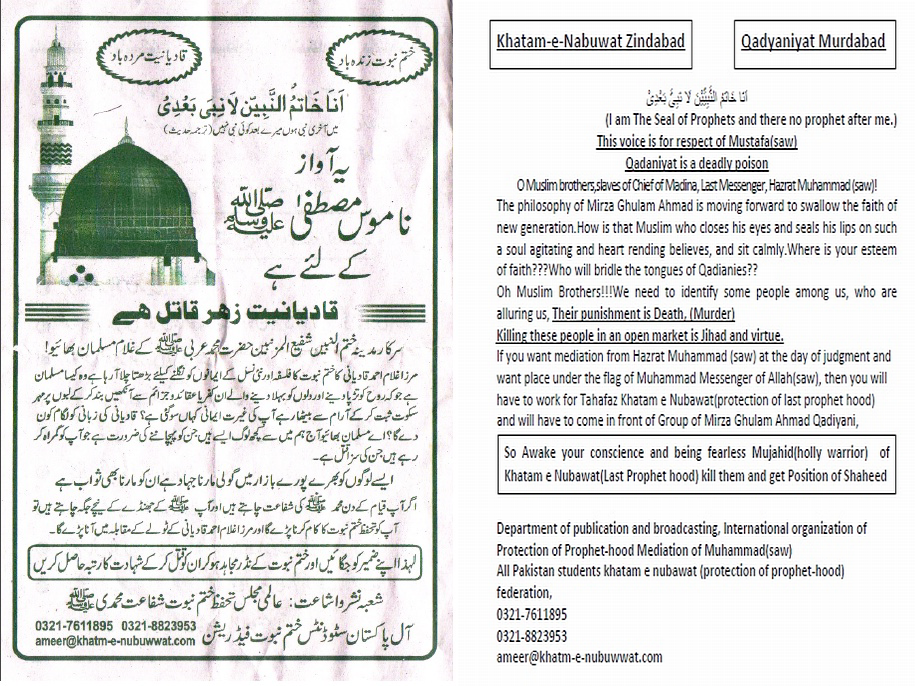
In a hate campaign a band religious group is openly issuing pamphlets calling on citizens to kill people from the Ahmadiyya community. This should be done in the open and crowded market places as a Jihad (holy war). Killing, beating and punishing them would be rewarded by God.

The Asian Human Rights Commission has informed the authorities about the plan to target Ahmadis but no action whatsoever has been taken and this religious minority group has been left to the mercy of militant religious groups. Please see: PAKISTAN: Extremists openly plan to kill hundreds of Ahmadis–government turns a blind eye. In this instance the pamphlets were published by the All Pakistan Student Khatm-e-Nabowat Federation and were issued by the information department of Aalmi Majlis-e-Khatm-eNabowat Shafaat-e- Muhammadi with their phone numbers and email address.

In the hate crimes against the Ahmadiyya community more than 111 Ahmadis have been killed in target killings since 1984 when an ordinance against Ahmadis were issued by a military dictator. In May last year, more than 88 people were killed in the provincial capital Lahore when gunmen opened fire at two separate places of worship and, one year on, no progress has been made by investigators.

The government of President Asif Zadari must take immediate action to protect the Ahmadiyya community and bring to a halt the hate crimes being committed openly against them. There is no question as to the identities of the religious extremists who are calling for a Jihad against the Ahmadiyya community as they openly express their hate speeches from the public address systems of their mosques. The provincial government of the Punjab has been implicit in assisting the Jihad and makes no effort to conceal the fact that they openly support the extremist. Once again the government of President Zadari knowing that one of their provincial governments is openly supporting the Jihad against the Ahmadiyya community has done nothing.

The federal government must intervene with all haste to rein in the extremists and seriously question a provincial government that encourages violence against the people of Pakistan regardless of their religious faith or ethnicity.

Document ID: AHRC-STM-115-2011
URL: www.humanrights.asia/news/ahrc-news/AHRC-STM-115-2011

Saturday, September 3, 2011

Indonesia sect fears more attacks

Los Angeles Times
WORLD
Indonesia sect fears more attacks
Three members of the Ahmadiyah, a minority sect, were slain by Islamic hard-liners in February. Ahmadis fear the attackers' light sentences signal tacit government acceptance of religious violence.
Nurhayati, a member of the Ahmadiyah, a minority Islamic sect, and her child are among those seeking refuge at a safe house in Banten, Indonesia. (Dita Alangkara, Associated Press / September 3, 2011)
By Kate Lamb, Los Angeles Times
September 3, 2011

Reporting from Jakarta, Indonesia— Arif Hakim recalls that deadly day in February when a thousand machete-wielding Islamic hard-liners descended upon his tiny congregation in rural West Java.

“I saw them coming, screaming that we were infidels and should be killed,” the 32-year-old welder said. “The police just watched and I panicked. I escaped and ran through the rice fields, but I could still hear the sounds of my friends being captured and [attacked].”

Three of Hakim’s fellow worshipers were killed in the melee. Their offense: They were members of a minority Islamic sect called Ahmadiyah, which has been under growing pressure by Islamic extremist groups.

The sect, which has adherents worldwide, is nonetheless banned in many Muslim countries because Ahmadis have divergent beliefs about the coming of the second messiah.

Across Indonesia, Ahmadiyah members have in recent years been the target of attacks, but the incident in the village of Cikeusik, West Java, stands out for both the level of violence and the fact that it was recorded on video.

The video, distributed worldwide on YouTube, shows a mob chanting religious slogans as they beat three Ahmadis to death with rocks, wooden clubs and machetes.

Many say the violence signals a dangerous wave of intolerance in the world’s most populous Muslim nation, one that had long prided itself on its acceptance of minority religious groups.

In recent years, harassment and attacks have been on the rise, with Christian groups, as well as Ahmadis, facing intimidation.

Many believe the attacks have come with tacit government acceptance in a nation where 200 million of the 237 million citizens are Muslim.

Bowing to political pressure, the Indonesian government in 2008 issued a decree calling on Ahmadiyah to “stop spreading interpretations and activities that deviate from the principal teachings of Islam.”

Although officials say the decree was intended to defuse religious tension, attacks against the minority group increased to 50 in 2010 from three in 2006, according to the Setara Institute, a nongovernmental group that monitors religious freedom.

The 12 men charged in the West Java deaths were sentenced to between three and six months in prison, court rulings that critics say give a virtual green light to the violent persecution of minorities.

Meanwhile, an Ahmadi man involved in the incident was sentenced to six months in prison, convicted of having provoked the violence because he called on fellow sect members to help defend Ahmadi property before the attack.

“I think the verdicts were appalling and underscore an image that the Indonesian government is going to have to confront, which is of a place of growing intolerance,” said Sidney Jones, a political analyst with the International Crisis Group.

The U.S. State Department has also criticized the sentencing of the Ahmadi man.

Islamic hard-liners, on the other hand, continue to defend their anti-Ahmadiyah campaign. A group called the Islamic Defenders Front, or FPI, which has previously attacked brothels, nightclubs and the editor of Indonesian Playboy, denies that it was involved in the West Java incident but says Ahmadiyah must go.

“Ahmadiyah is not Islam; they are an insult to Islam,” said the group’s Jakarta leader, Habib Salim Alatas, wearing a yellow sarong and heavy eyeliner, seated in a living room lined with portraits of stern-faced imams. “It is like a religion for rats.”

On Aug. 16, the eve of Indonesia’s Independence Day, President Susilo Bambang Yudhoyono defended the country’s pluralistic reputation against growing criticism at home and abroad. But many Ahmadiyah followers are not reassured.

“People attack Ahmadi homes, their children are bullied in school, their businesses are boycotted and others are injured. I think it is a scary life,” says Firdaus Mubarik.

Ahmadiyah, which originated in India in the 19th century, has 200,000 followers in Indonesia. Many who fled Cikeusik after the attack are afraid to return. On Lombok island, the 138 members of another group of Ahmadis have lived in a shelter for six years since an attack there.

Hakim, the Cikeusik welder who sought refuge in a neighboring village but was later interrogated and beaten by a second knife-wielding mob, worries about a similar fate.

“I thought that would be the end of my life,” he said, sitting under a fuchsia bougainvillea tree at the entrance of a Jakarta mosque. But “I am trying to think the incident is not the scariest thing in my life, but the sweetest because I still live.”

Lamb is a special correspondent.

Copyright © 2011, Los Angeles Times
URL: www.latimes.com/news/nationworld/world/la-fg-indonesia...story

Friday, September 2, 2011

Ahmadi Victim Recalls Cikeusik Mob Attack, Says Threats Continue in Jail

Jakarta Globe, Indonesia
NEWS
Ahmadi Victim Recalls Cikeusik Mob Attack, Says Threats Continue in Jail
Chrestella Tan | September 02, 2011

Deden Sujana, head of security for the Indonesian Ahmadiyah Congregation (JAI) during his trial at Serang District Court. (Antara Photo/Asep Fathulrahman)
For months Deden Sujana had to be treated in a Jakarta hospital. He was put on life support as doctors raced to save his right hand, which was nearly severed during a deadly attack on members of the Muslim minority sect Ahmadiyah in February.

Now in jail for provoking the attack and still facing intimidation, Deden told the Jakarta Globe in an interview on Thursday that when a mob of 1,500 descended upon an Ahmadi’s house in Cikeusik, Banten, he was prepared to die.

“Let’s die together,” Deden said, recalling the words he told an Ahmadi friend as the two were lying on the ground bleeding, while men armed with machetes, bamboo sticks and rocks continued to beat their ailing bodies.

“I was stabbed in the chest,” he said, adding that the blade just missed his heart. “Doctors said I should have been dead. It is a miracle of God that I am still alive.”

Deden’s wrist was slashed by a machete when he was trying to protect his head during the attack. There is now a long scar encircling it. Although doctors managed to reattach Deden’s hand, he has lost feeling in most parts of it.

He said his hand would never fully recover. Only his thumb and index finger are still functioning properly, and he regularly feels intense pain.

When asked who attacked him, Deden said: “I remember, it was Idris.”

He was referring to Idris bin Mahdani, who in August was sentenced to five and a half months in prison for possession of a machete, but not for attacking Deden. Just weeks after his conviction, Idris was released.

Instead, the Serang District Court put the blame for the attack on Deden, claiming he refused to vacate the building and thereby provoked the assault that left three Ahmadis dead. Last month, Deden received a harsher penalty than Idris: six months in jail.

Deden has refused to lodge an appeal, however, saying that with just two months before his release, the legal move would be useless. There was also concern that his appeal would only cause more controversy and lead to more hatred of Ahmadis, who have already suffered more than 160 attacks across the country over the last decade.

Kiagus Ahmad, Deden’s lawyer from the Jakarta Legal Aid Foundation (LBH Jakarta), said he respected his client’s decision, but there was a downside.

“Deden’s decision is setting a bad precedent. If every victim like him does the same thing, people will think that it is OK for [victims] to be criminalized,” he said. He added that Deden’s decision in the long run could further endanger minority groups.

Deden said he was concerned about the threats and intimidation he continued to face, even behind bars.

Since his trial began last month, Deden said several people claiming to represent the local administration had approached him before trial sessions. They said he could have his charges dropped or given a lenient sentence if he renounced his faith as an Ahmadi.

Prison officials now keep a close eye on Deden, who faces insults and intimidation from the rest of the prison population.

“There are many people — inside and outside this jail — who want me dead,” he said.

“The hardest intimidation came from Serang Police,” Deden added, referring to the deputy chief of Serang City Police, Adj. Comr. Jajang.

He would not specify the intimidation allegedly carried out.

The chief of Serang District Police, Adj. Sr. Comr. Krisnandi, challenged Deden to come up with evidence. “What Deden has said about the intimidation was not credible. Nobody has been able to show us there was truth to the claims,” Krisnandi said.

Kiagus maintained that the intimidation proved that law enforcers have been biased in their treatment of the minority group, which mainstream Muslim organizations deem deviant.

Andreas Harsono, an Indonesian consultant for New York-based Human Rights Watch, urged the police and the National Police Commission to investigate Deden’s statement about the attack by Idris as well as his claims of harassment and intimidation by police officials.

Andreas reiterated that the court had not been fair toward Ahmadiyah. The HRW consultant highlighted the court’s refusal to put the survivors of the attack on the witness stand.

“There were many irregularities in the Cikeusik trial, but it’s Deden Sujana’s choice to appeal or not to appeal. He needed to consider the possibility of a higher sentence on appeal. He has his family to be with,” Andreas said.

Copyright 2010 The Jakarta Globe
URL: www.thejakartaglobe.com/news/ahmadi-victim.../462886

Thursday, September 1, 2011

Ahmadis’ Holidays Plagued With Fear in Indonesia

Jakarta Globe, Indonesia
NEWS
Ahmadis’ Holidays Plagued With Fear in Indonesia
Elisabeth Oktofani & Fitri | September 01, 2011

Not all Muslims celebrated Idul Fitri with jubilance and excitement. For members of the Ahmadiyah minority sect, this year’s celebration is marked by heartache and fear.

Firdaus Mubarik, a spokesman for the Indonesian Ahmadiyah Congregation (JAI), told the Jakarta Globe on Wednesday that approximately 600 Ahmadis in Sukadana village in West Java’s Cianjur district had been banned from using their mosque for prayers.

“Ahmadiyah followers in Sukadana village were told by the village chief that they could not use their own mosque to hold a Idul Fitri prayer in case of a possible attack by the residents,” Firdaus said.

“For us, this is a threat.”

Instead, Firdaus said the group had to hold its prayers inside an Ahmadiyah Islamic school as guards from Cianjur kept watch.

Similar threats were also aired against Ahmadis in Makassar, who were recently attacked by assailants from the hardline Islamic Defenders Front (FPI).

“Even though our mosque was damaged by the FPI on August 13, thank God we could hold Idul Fitri prayers in our own mosque peacefully this morning wthout any disturbance,” Irza Rasid, an Ahmadi from Makassar, told the Globe.

“Unfortunately, we could not stay longer to gather and celebrate Idul Fitri among the Ahmadiyah congregation because we did not want the FPI to come and attack us,” he added.

Last month, FPI members attacked the Makassar office of the JAI, where Ahmadis had planned to hand out food and groceries to the surrounding community.

“The FPI often conducts raids on Ahmadiyah activities without any coordination with the police. Not only did they carry out raids, but also threats and intimidation towards us.” Irza said. “It needs to be understood that we do not want to fight back … because we have our own motto, which is love for all, hatred for none.”

The JAI has recorded more than 160 cases of violence against Ahmadiyah communities in the last 10 years.

In Mataram, West Nusa Tenggara, Ahmadis have been living in a rundown shelter for nearly six years after their village was attacked and ransacked by mainstream Muslim groups.

“We have lost our land, we have lost our homes. Some have even lost their lives, but we are thankful for we have you, Allah,” Ahmadi children sang after the community performed their Idul Fitri prayer on Wednesday.

Many cried as some 50 children sang the song remembering the violence that drove them away from one village to the next, destroying every possession that they owned.

More than 250 Ahmadis took part in the prayer, occupying a tiny room in the middle of the abandoned Transito building. The ceiling showed signs of collapsing on to the congregation, which had to use makeshift prayer mats made from recycled newspapers and torn sheets of plastic.

Community members prepared a simple chicken stew and rice cake.

“I know they are nothing fancy, but they remind me of home,” 58 year-old Siti Kalsum said.

Copyright 2010 The Jakarta Globe
URL: www.thejakartaglobe.com/news/ahmadis.../462681

Saturday, August 27, 2011

Idul Fitri Brings Little Cheer to Ahmadi Shelter

Jakarta Globe, Indonesia
NEWS
Idul Fitri Brings Little Cheer to Ahmadi Shelter
Fitri | August 27, 2011

Ahmadiyah families in Transito shelter, Mataram, West Nusa Tenggara.
Mataram, West Nusa Tenggara. Nothing has changed at the Transito shelter in the five and a half years that it has served as home to 138 members of the beleaguered Ahmadiyah Islamic sect.

A sixth successive Idul Fitri in cramped conditions without even the most basic of amenities beckons, with no word on when they will be allowed to return to their home village of Gegerung in West Lombok, from where they were driven out by fellow Muslims in February 2006.

The electricity to the shelter was cut off three years ago, food aid from the government — which has perpetuated their limbo by refusing them the right to return home or register as residents of Mataram — was halted last year, and sanitation facilities are non-existent.

A stipend from the state was stopped in 2007. Not being registered residents, they have been denied the free gas stoves distributed by the government to all citizens, and they now resort to gathering scrap to burn as fuel.

“It’s the durian season now, and people are throwing out lots of durian husks. We’re collecting those to fire our stoves,” says Munikah, one of the shelter’s inhabitants. “We can’t afford to use kerosene because it costs Rp 12,000 [$1.40] a liter.”

The women band together in preparing the predawn and sunset meals during Ramadan, crowding the shelter’s corridor as they toil over smoky stoves. The meals themselves are basic, heavy on starchy ingredients to mask the lack of vegetables or meat. However, they carry on fasting like most other Muslims.

Clothes for the Kids

The rest of the country may be in a festive mood with the approach of Idul Fitri — and its attendant indulgences such as family reunions, hearty meals and the buying of new clothes — but at Transito, it will be just another day of trying to scrape by.

All that Munikah is hoping for before then is that her husband can bring home a little more than the Rp 25,000 per day he typically makes through cutting hair at a nearby market.

“It’d be nice if he got a little something extra for Idul Fitri so we could at least get the kids some new clothes,” she says. “But if that doesn’t happen, they won’t be too disappointed.”

After living so long at the shelter, the Ahmadiyah children have grown more accepting of their situation, says Basir Aziz, a local Ahmadi elder. “There are 50 children here, 16 of whom were born in this shelter,” he says.

“This year they seem a lot more resilient and upbeat. They don’t feel marginalized. They’re showing a tremendous passion to study and practice their faith, despite all they’ve been through.”

The life at the shelter is the only one that 6-year-old Ida knows. Asked if her parents had bought her new clothes for the holiday, she responds with a maturity beyond her years. “I’ve got the clothes from last year. They’re still fine,” she says with a smile.

Nor do they complain about the partially collapsed ceiling in their prayer hall, or the fact that all 33 families here are forced to share crowded living quarters, with only flimsy partitions of cardboard and rags mounted on bamboo frames giving privacy.

No More Tears

“When the kids play, they’re never sad,” says Hairudin, an Ahmadi who earns Rp 5,000 a day as a coolie at the local market.

“They’ve become used to all this after almost six years. We’ve got no more tears. We have to take what we get.”

For Hairudin and the other Ahmadis, sorrow is an emotion they dare not indulge. “If I broke down in sadness just thinking about how we got hounded out of our homes, I wouldn’t be able to go to work each day, and that would be the biggest problem for my family,” he says.

“That’s why we don’t think about that anymore. Tears are a luxury we can’t afford. All we can do now is just think about how to get through each day.”

H. Mahmulludin, an Ahmadi elder, agrees there is no use being bitter about the past.

He bears no grudge against the local authorities, who last year raised the ire of human rights activists with a plan to exile all Ahmadis in West Lombok to a remote island and bar them from plans to develop the region as a top tourist draw.

“The governor has resolved all the differences between us in a peaceful manner,” he says. “The violence against us has stopped, and that helps a lot.”

What also helps, Mahmulludin says, is a weekly stipend from local community leaders.

But that pales in comparison to what they would have received if the government had agreed to compensate them for the homes they left behind in Gegerung.

In what activists have highlighted as just another example of discrimination against the Ahmadis, they have been denied compensation or the option of selling their homes, even as the government bars them from going back to inhabit them.

Continuing Pogrom

Despite this, there have been several attempts by some of the Ahmadis to return and farm their land while keeping a low profile. However, they have been routinely chased out by other villagers, who have branded them “a stain on this village” that “must be cleaned out.”

In the most recent incident, last November, local authorities themselves led the pogrom of the Ahmadis, forcing men, women and children to flee with their belongings.

Those who remained behind had their homes burned by a mob, while others vowed to keep coming back to farm their land.

“If I farm, at least I’m making a living, whereas at Transito I have no hope for a meaningful life,” said Sarim, one of the Ahmadis targeted last November.

Nobody was prosecuted for the attack, and the local administration did not compensate for losses, which the victims estimated at Rp 735 million.

For Munikah and the other mothers forced to watch their children grow up in what has become a refugee camp, the hope that there will ever be a resolution to the community’s plight and that they may one day return to their homes has dwindled along with the sadness.

All that remains, Munikah says, is a sense of resignation and just an iota of optimism that maybe — just maybe — Idul Fitri this year will herald a change for the better.

Copyright 2010 The Jakarta Globe
URL: www.thejakartaglobe.com/news/idul-fitri.../462042

Friday, August 26, 2011

Ahmadiyah activity banned during Idul Fitri in S. Sulawesi

Jakarta Post, Indonesia
NATIONALFri, 08/26/2011 6:57 PM
Ahmadiyah activity banned during Idul Fitri in S. Sulawesi
The Jakarta Post
The South Sulawesi administration says it forbids members of the Ahmadiyah Muslim community to conduct religious activities during the upcoming Idul Fitri holiday.

South Sulawesi governor Syahrul Yasin Limpo said according to his subordinate’s report, the condition in the province was conducive, but he said he was concerned that Ahmadiyah members would still conduct activities over the holiday, which could promote violence.

“We don’t want a repeat of conflicts, we will guard the Ahmadiyah mosque,” Syahrul said Friday as quoted by tempointeraktif.com

Syahrul refused to comment on whether Ahmadis could conduct worship activity in their mosques. “I cannot answer that. But their religious activities are certainly forbidden.”

South Sulawesi Police head, Insp. Gen. Johny Wainal Usman also stipulated that no Ahmadiyah activities could be carried out during Idul Fitri.

South Sulawesi Ahmadiyah spokesman M. Mahtiar Ahmad said he was disappointed by the governor’s decision.

He said that the government should protect Ahmadiyah because it was peaceful and did not threaten Indonesia’s sovereignty.

“Insya Allah [God willing] we cam continue to practice our worship activities. I hope the police remove the police tape surrounding our mosque.”

Copyright © 2008 The Jakarta Post - PT Bina Media Tenggara. All Rights Reserved
URL: www.thejakartapost.com/news/2011/08/26/ahmadiyah-activity...sulawesi.html

Thursday, August 25, 2011

Monthly Newsreport - Ahmadiyya Persecution in Pakistan - July, 2011

Another Ahmadi killed

Nawabshah, Sindh; July 11, 2011: A well-known and respected Ahmadi lawyer, Malik Mabroor Ahmad (50) was killed in a religiously motivated attack in Nawab Shah, Sindh. At approximately 8:15pm, he was shot at point blank range near his office by an unidentified gunman. Upon hearing the gunfire, the brother of the deceased, Malik Waseem Ahmad, rushed to the scene, however by the time he arrived Malik Mabroor Ahmad had already passed away. The assailant also fired at him three times when he tried to chase him but luckily he was unhurt.

Malik Mabroor Ahmad was a peaceful and law abiding citizen and a renowned lawyer. He was very well respected amongst the local community and was known for his kindness. He served the community with great distinction throughout his life. He is survived by his mother, a wife with three sons and two daughters. All the children are at a school-going age.

It is worth noting that Mr. Mabroor survived a previous attack on his life in 2008 but no action was taken by the local authorities to protect him from the extremists. That same year two renowned Ahmadis, Mr. Muhammad Yousuf from Nawab Shah and Dr. Abdul Mannan Siddiqui of Mirpur Khas, Sindh were killed by the religious extremists. Since 1984, after the promulgation of the infamous Ordinance XX by the dictator Zia-ul-Haq, 39 Ahmadis have been killed for their faith in Sindh alone, while this is the sixth incident of its kind in Nawab Shah. It is worth noting that hardly any of the killers have so far been brought to justice. All possible means of mass communication are being used by extremists to incite the people against Ahmadis and fuel the raging fire of sectarianism in the country, and the government is not willing to stop it.

The ‘crime’ of Islamic prayer in Islamist state

Sadullah Pur, District Mandi Bahauddin (Punjab); July 21, 2011: A court sentenced two Ahmadis for offering funeral prayers in accordance with Islamic practice, to one year imprisonment in the Islamic Republic of Pakistan. The verdict was announced by the Civil Judge Phalia on July 21, 2011. The clerics celebrated the verdict and distributed sweets.

This case was registered against 18 Ahmadis of Sadullah Pur on April 8, 2003 under PPC 297 and the anti-Ahmadiyya clause PPC 298-C, in Police Station Pahrianwali. They were accused of offering funeral prayers of an Ahmadi in accordance with Islamic custom. These were the days of the ‘enlightened moderation’ of President General Musharraf, now in exile, unable to return to Pakistan.

As per details of this case, Mr. Ghulam Rasul, Ahmadi died on April 6, 2003. He was buried in the common graveyard after routine funeral rites. The incident was reported to the police. The police were happy to take notice, registered a criminal case against as many as 18 Ahmadis and proceeded to make raids to arrest the accused. They arrested 4 Ahmadis including their president, Mr. Mahboob Ahmad, an old man over 70, and Mr. Aziz Ahmad, a brother of the deceased. Bails were later obtained, although mullas agitated a great deal to get the bails cancelled.

These Ahmadis were prosecuted for the next eight years. Eventually a judge announced one year imprisonment for the president of the community and the brother of the deceased and acquitted the other sixteen. Mr. Mahboob Ahmad an octogenarian was arrested from the courts’ premises and taken to the police lock-up in Phalia.

The mullas distributed sweets in Sadullah Pur after the verdict and announced “victory” in the nearby village of Pindi Dhotran.

Someone should hold the state accountable for unduly prosecuting 16 innocent Ahmadis for eight years over an unjustified complaint.

Ahmadi attacked in Gujranwala

Gujranwala; July 16, 2011: Mr Imtiaz Ahmad S/O Mr Basharat Ahamd of Amir Park, Gujranwala city received some threatening letters written in Punjabi. He was threatened with attempt on his life. Sure enough, on July 16, when he left the mosque after the evening prayer two persons fired at him twice in the nearby square. He was hit on his right thigh. The bullet entered the flesh and emerged from the other side. Fortunately it did not fracture his bone. He was rushed to the hospital where he is recovering.

A report was made to the Civil Lines police station for registration of a police case.

An outrage committed by police

Haveli Majoka, District Sargodha; July 6, 2011: The police in district Sargodha have added still another shameful act to their long list of misdeeds in the denial of human rights and freedom of religion to Ahmadis. They have done this again at the call of the mullas, beyond their official duty and the requirement of the law. On July 6, 2011, the police went over to the Ahmadiyya graveyard, desecrated and decamped with seven tombstones.

The law does not specify that an Ahmadi’s tombstone should not bear the Kalima or Quranic verses. The mulla thinks it is implied in the spirit of the law; but so is the case with names of thousands of Ahmadis in Sargodha district.

A video of their outrage is available. It will remain in archives as record.

Plight of Ahmadi educationist couple
They could have been an asset to the education sector in Pakistan

The following is a sad story but it should be placed on record. It shows how Pakistani society has harmed itself in the early 21st century. Its Islamist clergy, administration, police, polity in general have all played their part in landing the state in a quagmire.

Mr Azhar Ahmad is a youthful Ahmadi in his early 30s. He has an MBA in ‘Marketing’. He resided in Qutb Pur, Tehsil Dunyapur, Lodhran, a district located in the southern Punjab. He is married to Ms. Sarwat Mubbashir who has master’s degree in Zoology. They were married in December 2008. They now have two sons, Muddassar Ahmad Chaudhary aged 18 months and his new-born sibling Masroor Ahmad Chaudhary. As the couple are motivated to spread education in society through commitment, hard work and honest living, they decided to set up an educational institution in their town that would serve the people.

They established New Millat College of Commerce and Sciences, Dunyapur in April 2009. It was started in a 7-room building. The inauguration ceremony was held the next month to which they invited the elite of the district. It was a great success.

The couple’s hard work and good management delivered excellent results the very first year. A majority of the students were, of course, non-Ahmadi. The two top scorers stood first and third in the entire district. All the students, male and female, passed; they all obtained ‘first division’ marks — an amazing feat. The college claimed to provide a decent building, qualified teachers, friendly environment, a modern lab, at moderate cost.

All the above was not to the liking of their competitors. They started a hostile propaganda campaign against the New Millat College. As they could find no other valid reason, they picked up the weapon of religion to harass the couple. In this they enlisted the willing support of Khatme Nabuwwat clerics.

As the College of Commerce and Sciences had proved a great success, the couple planned to hold classes for women for F. Sc, B. Com, B. Ed and M. Ed degrees. They took a loan and started construction. The new building comprised 19 rooms. Students joined the New Millat Girls College, and the classes began.

In response, the Aalami Majlis Tahaffuz Khatme Nabuwwat printed hostile posters and put them up all over the town. The posters called for a general boycott of Qadianis, and of the New Millat College in particular. They urged “the Muslims of Dunyapur to boycott these (Qadianis’) institutions as evidence of their love for the Sovereign of the Two Worlds (PBUH), save the children becoming Qadianis and thus deserve the intercession of the Prophet.”

This campaign was intense and effective. Consequently, none of the town’s notables sent a message of congratulations to the couple over the brilliant results shown by the college after the first year of operation, even though the beneficiaries were primarily their children. The reaction displayed jealousy and prejudice. The mullas were furious. They took to holding open-air meetings and processions. The so-called elite sought peace in accepting intimidation. Mr Ahmad reported the unjustified agitation to the police. They did not respond.

The lack of administration and police support to the targeted family encouraged the mullas to become more rabid. They put up hateful banners in the town and distributed hate literature. They even visited door to door to dissuade parents from sending their children to colleges run by ‘Qadianis’. Delegations of mullas met the teachers and told them to stop teaching at the ‘New Millat College’. They even contacted the students, and indoctrinated them in hate and extremism.

The mullas used invective and slander in their speeches. They openly declared Ahmadis to be Wajib ul Qatl (must be killed). “They have no right to build here educational institutions; they are not allowed even to build a mosque. They should be thrown out of Dunyapur. Their colleges should be shut down”, mullas insisted. The bureaucracy found it convenient to support the mulla. The District Education Officer, Lodhran refused to register the college, so the students of New Millat had to obtain their examination registration through another college.

The Khatme Nabuwwat mullas, supported by the competitors of the New Millat colleges, had spoiled the communal and social peace sufficiently to urge the administration to take notice – of course, on the lines suggested by the clerics.

A committee was formed and its meeting was held under the chairmanship of the Deputy District Officer Revenue. It was also attended by a DSP, the police rep, a number of mullas, Ms Qudsia Saleem, the principal of the ‘New Millat’.

A reading of the ‘minutes of meeting’ shows that the chair and the DSP initially said a few decent words in support of peace and harmony, but then followed the agenda of the obscurantist mullas. The minutes convey that three of the participants stated that Qadianis were Kafir (infidels) and Wajib ul Qatl (must be killed). Also Qari Asghar demanded that if ‘these people’ want to run a school they should indicate boldly on the school board that it belongs to Qadianis. Maulana Akram said that this was a Qadiani conspiracy whereby they wanted to preach Qadianism in the town; they are in minority, they should build a school where they are in majority. Ms Qudsia Saleem said that the schools’ opponents were raising non-issues and they were only interested in making the New Millat enterprise a failure. The DSP (police) then came up with, “I have been told by the District Police Officer that the issue can only be solved with the help of the people. So I suggest, a Committee should be formed, whose decision should be implemented.”

As planned, a so-called Peace Committee was formed whose members were rabid ulama 1. Mufti Asghar Ali, 2. Maulana Saeedi, 3. Maulana Hafiz ur Rahman, 4. Qari Akram and 5. Kanwar Khalil. Also included as ‘v/s’ (whatever this means) were two Ahmadis Ms Qudsia Saleem and Mr Azhar Chaudhry.

It was a strange committee whose recommendations were to be binding on the administration. It comprised none else but the opposing parties themselves; one group of five mullas and the other group of two targeted Ahmadis. How on earth could such a ‘committee’ come up with a fair and reasonable solution? The mediocrity and apathetic nature of the district level bureaucracy in Lodhran is noteworthy here. These ‘Minutes of the meeting’ were sent to the DCO, DPO, etc. As the ‘Committee’ proceeded to act as proposed, it is reasonable to assume that the high level district administration approved the ‘Minutes’.

The Peace Committee’s recommendations surprised no one. These five mullas wrote down their findings as that of the ‘Five-member Peace Committee’, as if assuming and endorsing that the two Ahmadis were not a part of the committee. The committee stated their unanimous decision that (extracts), “Qadianis/Mirzais should not be allowed to build any school or college in Dunyapur. …The present New Millat College, is an institution run by Qadianis, it should be closed down immediately so that there is not the slightest change in the beliefs and thinking of the Muslim students, and the peace of Dunyapur remains undisturbed. Thereafter, if the administration does not act to close down the school and the college, it will be held responsible for the (breakdown in) law and order. From the Five-member Aman Committee Dunyapur.” Copy of its findings and decision, with translation, is placed at Annex to this report.

It is obvious that the entire procedure of holding a meeting followed by this ‘Peace Committee’ and all its relevant formalities were pre-planned to obtain a warning from the mullas to the authorities to facilitate their action of closing down the New Millat institutions, as desired by the religious fanatics. Lodhran is a district in the south Punjab. This region has been mentioned in dispatches repeatedly in recent years, all over the world – not incorrectly and not without reason.

Thereafter the situation worsened rapidly for Mr Azhar Ahmad and his wife Ms Sarwat Mubbashir. The mullas visited them and told them to convert to ‘Islam’ or face the consequences.

The couple were left with no option but to quit. They held a meeting with the colleges’ staff and decided to transfer the institution to one of the staff members. This was at great financial loss to the couple. Within days the couple shifted to another city where they are, for the time being, more at peace, but without their cherished goal of providing first-rate education to the youth of Pakistan.

The staff member who purchased the property at cut-rate price, has now refused to pay them the outstanding amount.

Although, the couple left Dunyapur in March 2011, this has not helped peace in that town, as peace is not the aim of mullas. Months later, the communal situation is more grave than ever. Mullas visit Ahmadi businessmen and threaten them with harm to life and property. They continue to make provocative speeches using sound amplifiers and post anti-Ahmadiyya stickers urging the people to hate Ahmadis and implement a complete social boycott of them. Such fascist tactics are being used to marginalize a small community.

Desecration of Islamic creed on behest of the mullas

Chak 245/E.B, District Vehari; July 7, 2011: Local mullas are disturbing the peace of this village. They demanded that officials erase the Kalima written on the inside wall of the Ahmadiyya mosque. The District Police Officer told Ahmadis to raise the outer wall so that the Kalima could not be seen from outside, so as to avoid the objection of the mullas. The outer wall was raised accordingly.

This failed to placate the mullas, who held a Khatme Nabuwwat Conference in protest on June 29, 2011, and put further pressure on the administration. Some mullas came to the village the next day and raised anti-Ahmadiyya slogans in the mosque of Ahle-Sunnat wal Jamaat. Subsequently, bowing to the pressure of the extremists the police spray-painted the Kalima to cover it. This sacrilege was committed by the authorities despite the fact that Ahmadis had already raised the outer wall of the mosque and the Kalima was not visible from the outside. The paint faded away with the passage of time and the Kalima became visible once again. The opponents and clerics again protested over it. The DPO ordered the police again to erase it, as demanded by the mullas. The police sprayed black paint on it and covered it completely.

Despite the fulfillment of demands, mullas still held another anti-Ahmadiyya conference on July 21, 2011 and declared Ahmadis Wajib-ul-Qatl (must be killed).

Firing outside Ahmadi’s house

Tehal, District Gujrat; June 25, 2011: Dr. Muhashir Ahmad is the president of the Ahmadiyya community in Tehal, district Gujrat. He was watching TV at home when someone fired several gun-shots outside his house. The attackers fled and could not be traced. It is worth noting that some assailants forced entry to his house a few months ago on December 23, 2010 and fired several gun-shots. Fortunately he and his family survived the attack. The situation is tense once again in an area which has a history of anti-Ahmadiyya incidents.

Tension in Azad Jammu & Kashmir

Kotli, AJK; June 2011: Dr. Shah Muhammad Javed is the president of the Ahmadiyya community in Kotli. Someone damaged the electric lights of his main gate on June 19 and again on June 27, 2011. Meanwhile a suspect vehicle took rounds of his house twice. This was brought to the notice of the local police who took no action. It is worth noting that Dr. Shah survived an attack on his life two years ago. He has also escaped an attempt to kidnap him. Authorities have shown no concern about the threats to his life.

Transfer of an Ahmadi Sessions Judge

Bahawalpur; July, 2011: Mr. Nadeem Gulzar an Additional Sessions Judge is an Ahmadi. He was transferred to Bahawalpur. Thereafter he started receiving threats to his life from Tahrik-e-Taliban. A letter containing such a threat to his life was also received by the Chief Justice Lahore High Court. His phone calls were being traced and recorded. Consequently he had to be shifted to Lahore in high security. Subsequently he was posted at Sialkot.

Pachnand is becoming a flash point

Pachnand, District Chakwal: Pachnand in particular and District Chakwal in general has been mentioned in our monthly reports in the recent past repeatedly. The situation, rather than cooling down, has been allowed to worsen. A recent letter from Ahmadiyya central office to the relevant authorities is translated below:

Nazarat Umoor-e-Aama
Sadar Anjuman Ahmadiyya Rabwah (Pakistan)
Ph: 047-6212459
Fax: 047-66215459
nuasaa@hotmail.com

To, …
Subject: Anti-Ahmadiyya activities in District Chakwal
Sir,
I hope you are well and in good health.
For sometime, a provocative and zealous anti-Ahmadiyya campaign has been going on in District Chakwal. In this, a Tahaffuz Khatme Nabuwwat conference was held in Pachnand on May 26, and a campaign to boycott Ahmadis was launched through the press after a meeting of the Anjuman Tajran on July 7. This goes on. Besides that, extracts from the writings of the founder of the Ahmadiyya Jamaat are quoted out of context, and thereby common folk are provoked to indulge in violence.
The most dangerous development in this is the fact that a list of Ahmadis’ names along with their addresses is published and provided along with the hateful handouts. The aim is to facilitate extreme public fury against Ahmadis.
As a result of the above, the Ahmadiyya centre in Pachnand was attacked and fired at on June 16, 2011. An FIR has been registered in Police Station Lawa, District Chakwal under Act No. 9 on June 16, 2011. A campaign to boycott Ahmadis goes on, for no reason. Hate and prejudice is preached in the holy name of religion. There is serious risk of extreme action, consequently.
In fact, Ahmadis have nothing to do with accusations of blasphemy. No Ahmadi can even think of the alleged and supposed defiling beliefs. Ahmadis hold the Holy Prophet (PBUH) in the highest esteem, and this is an essential part of Ahmadiyya belief system.
Although most of the decent and sympathetic citizens of Pakistan condemn these nefarious activities, miscreants are busy in harming the country through harmful actions based on religion. They are to some extent supported by the print and the electronic media.
Authorities have been informed in the past of such sensitive activities, but unfortunately no action has been taken against the miscreants. This has prompted them to further attacks against Ahmadis.
As a result of these provocations, 205 Ahmadis have been killed for their faith since the promulgation of the anti-Ahmadi Ordinance in 1984. This still goes on. Numerous other Ahmadis have been targeted in person or through discrimination, and there is no light visible yet at the end of this tunnel.
A few of the provocative leaflets and posters are enclosed for information and appropriate action.
Yours sincerely,
Saleemuddin
Director Public Affairs
Rabwah (Chenab Nagar) District Chiniot

This copy was released on July 19, 2011.

Subsequent to the above letter, a magistrate of Talah Gang issued notices to 16 each of the Ahmadiyya group and their tormentors and told them to enter a surety bond of Rs.50,000 each under PPC 107/151 to ensure peace. That is fair administration – Pakistani style.

The incident reminds one of a recent court verdict in Indonesia where, a judge has sentenced, subsequent to brutal murder of three Ahmadis, three main accused to three to six months’ imprisonment.

And then, Muslim liberals moan over the tyranny of their religious thugs.

The perilous development in Mardan

Mardan: It was reported last month that Dr Rafiq Ahmad and Mr Ata ul Khair, two Ahmadi brothers of Mardan were attacked by unknown persons. After the two brothers fired at them in defense both assailants were injured. They fled but the police reached their hideout and arrested them. A few days later they were released on bail by a court but were rearrested on another count by the police.

It is now learnt that the two have been released again by a court. This is ominous. The two have attempted a murder, and are now facing charges. Their targets are the prosecution witnesses. The accused are now free, and it would surprise no one if they dispose of the witnesses.

Dr Ahmad and Mr Khair are under great stress, and think that under these circumstances they can not continue to live a normal life in Mardan.

The ‘tolerant’ Brelvis!

Faisalabad and Pasroor; July 2011: In the past, the so-called ‘Brelvis’ of the sub-continent, had developed a reputation for being relatively tolerant and peaceful. They claimed to be successors of the Sufi tradition and were opposed to the extremism displayed by most adherents of Wahabi and Deobandi sects. However, this is changing fast. The Brelvi leaders seem to be afraid of being left behind in the present race for political influence in Pak society, in comparison to other religious groups. They have adopted hard line, make more noise in forums where blasphemy is the topic, have organised their own wings of Khatme Nabuwwat, set up a student organisation and have formed a party like Sunni Tehrik that is unabashedly political. Allama Tahir-ul-Qadri, who travels often and lives in the West, has apparently given green signal to his Minhaj-ul-Quran group to strive hard and beat the other clerics in all that is obscure and extreme. Following two recent reports confirm this policy.

Tehrik Minhaju ul Quran in District Sialkot has issued a Fatwa poster on behalf of its branch in Shamali Merajkay, Tehsil Pasrur. The poster size is 18 inch x 12 inch. It is printed on glazed paper in multi-colour. It is provided with stainless steel ring at top for permanent hanging and display. Obviously its confessed origin in a village called Shamali Merajkay is a trick. Its cost in large-scale production would require funds that can come only from the Minhaj-ul-Quran centre.

The poster gives extracts from fatwas issued by a 19th Century hard-line cleric, Ahmad Raza Khan Brelvi. The text has been paraphrased to suit the 21st century environment. It asserts: Anyone who claims to be prophet is “Dajjal (the Great Deceiver), Kazzab (a great liar), Kafir (infidel) and (of course) Wajibul Qatl.” According to the Brelvi’s fatwa quoted in the poster, “Anyone who considers a Qadiani persecuted and does not call him a Kafir or does not boycott him is himself a Kafir.” The poster makes an impassioned plea to all Muslims to indulge in self-examination and assess for themselves if they are in violation of this fatwa. “If so, are we really Muslim, and shall we be entitled to the intercession of Muhammad (PBUH) on the Day of Judgment? – For God’s sake, consider and ponder,” the poster admonishes.

The Minhaj-ul-Quran is not content with distributing posters only. It chose the religion-sensitive city of Faisalabad to hold a week-long ‘anti-Qadiani course’. Its scheduling was announced in three-column news in the city’s Daily Business Report on July 1, 2011. The vernacular Daily Express printed interim daily reports as the course progressed. According to the former daily, following ulama were scheduled to impart instructions to the participants: Pir Nabil ur Rehman (of Karma Wala), Pir Saeed ul Hasan, Pir Mahboob Hussain (Pir Bal Sharif), Fazl Karim MNA, Sahibzada Faiz Durrani, Mufti Muneeb, Prof. Ilyas Aazmi, Umer Faiq, Mian Iftikhar ul Hassan, Nur uz Zaman Noori, Prof Zafr ul Haq, Khurshid Ahmad Saeed of Islamabad, Jafar Qamar, Mushtaq Sultani, Badi uz Zaman advocate, Ejaz Tahir, Umar Awan, Naeem Mushtaq, Muhammad Naeem.

According to the Daily Express, the speakers said, (extracts): “Qadianism is attacking the benevolent shade-giving tree of Islam – The Jewish lobby is busy in unsuccessful attempts to spread misleading conspiracies and mischiefs among Muslims, through Qadianis – Two great mischiefs of the modern times, the Western civilization and Qadianism are causing great destruction to Islamic society all over the world – It is essential that we, the moths of Muhammadan lamps sacrifice our lives and wealth in this great cause. – We shall have to die (kat marna) for the Khatme Nabuwwat.” The Daily Express, Faisalabad; July 4, 5 of 2011 One wonders if the renowned Allama Tahir-ul-Qadri is spreading the same message in Europe that his disciples are so vigorously propagating in Pakistan under his guidance. The daily Din recently published a series of articles titled, “Non-Muslims’ rights in Islam” written by ‘Sheikhul Islam Dr. Muhammad Tahir-ul-Qadri.’ The gap between what he professes and what his acolytes do is too wide to be ignored.

Anti-Ahmadiyya conferences

Green Town, Lahore

June 4, 2011: A Seeratun Nabisa (Conduct of the Holy Prophet) conference was held in Bagarian Chowk, Green Town, Lahore on June 4, 2011. This conference was extensively advertised through banners and posters in the area. It started after the evening prayers and lasted till 4 a.m. Approximately 250 people participated while nine mullas addressed them. Although it was Seeratun Nabi conference where the magnificent example of the Holy Prophetsa should have been mentioned, hardly a word was said on the subject. The occasion was used to provoke the public against the Ahmadiyya community and to promote militant Jihad in the society. Mullas used highly provocative language against the Ahmadiyya community and anti-Ahmadiyya rhymes were sung after every speech. Mullas urged the public to support Jamaat Dawah financially and to offer a son for Jihad from each family.

It is worth noting that this conference was organised by the Jamaat Dawah which is a banned terrorist outfit. The police was present, while armed guards of the Jamaat Dawah were also on duty. Jihadi literature and CDs containing Jihadi songs were sold openly at the conference.

Chak 20 Gagh, Shorkot

July 10, 2011: Mullas held a Milad Mustafasa (birthday of the Holy Prophetsa) conference here. Two mullas, Naseeruddin Naseer from Shorkot and Yasin from Khanewal attended the conference. Yasin took the anti-Ahmadiyya line in his speech. He criticized the personality of the founder of the community and indulged in invective against him. He told the audience that Ahmadis were apostates and Wajib-ul-Qatl (must be killed). He urged the public to kill Ahmadis to express their true love for the Prophetsa. This conference started at 9 p.m. and lasted till 2 a.m.

Shorkot has a history of anti-Ahmadiyya events. Such conferences are held here regularly and public is provoked against the Ahmadiyya community.

Light sentences in sectarian killings provoke outcry

Indonesia: On February 6, 2011, a mob attacked Ahmadis in a village and lynched three of them. A trial followed in which the prosecutors demanded very light sentences for the accused, and the judge imposed lighter still, three to six months’ imprisonment to a dozen assailants. Pakistani Urdu press reported the news in a one-column one inch space, while the world took due notice of the miscarriage of justice. A report published in ‘The Australian’ is reproduced below:

Mob murder leniency panned
“AN alleged ringleader of horrific mob murders of three Ahmadis that shamed Indonesia’s claims to religious tolerance has been sentenced to five months and 15 days in jail for illegal possession of a machete.
Idris bin Mahdani was shown in a video of the February 6 incident directing about 1000 religious extremists attacking a Cikeusik village house sheltering 20 members of the minority Muslim sect.
The video, which caused widespread outrage when broadcast by YouTube, also featured 17-year-old Dani bin Misra smashing a large rock into the head of a prone victim.
The youth was yesterday sentenced to three months for manslaughter in Serang District Court where prosecutors had asked for sentences of five to seven months for 12 defendants.
Prosecutors justified their light sentencing claims by alleging the Ahmadis had aggravated the attack by antagonizing clerics and villagers who were trying to force them out of the district.
Ahmadiyya, which has an estimated 1 million Indonesian followers, has been denounced as ‘deviant’ by the Indonesian Ulama Council, the country’s senior clerical body.
Several national government ministers have called for its suppression.
New York-based Human Rights Watch, which has campaigned for protection of the increasingly threatened and isolated Ahmadis, described yesterday’s verdicts as “a sad day for justice” in the country.
‘When the Cikeusik video went viral, people around the world were shocked and appalled by the savagery of the mob kicking and slashing three men to death, HRW’s deputy director for Asia, Phil Robertson, told the Agence France-Presse news agency.
“But instead of charging the defendants with murder and other serious crimes, prosecutors came up with an almost laughable list of ‘slap-on-the-wrist’ charges.
The Cikeusik trial sends the chilling message that attacks on minorities like the Ahmadiyya will be treated lightly by the legal system.
Reported by Peter Alford in The Australian on July 29, 2011

Ahmadis behind bars

Four Ahmadis, Mr. Naseer Ahmad, Mr. Ameer Ahmad, Mr. Ameen Ahmad and Mr. Shahid Ahmad of Lathianwala have been wrongfully charged of murder in district Faisalabad with FIR no. 682/2010. A passerby was killed during an exchange of fire between Ahmadis and non-Ahmadis. The fire-fight broke out because Ahmadis had to defend themselves against perpetual harassment and aggression. The police could not specify whose bullet had caused the casualty; they arrested four Ahmadis, nevertheless. They have not been granted bail, yet; they are in prison since October 2010.

From the media

*
We shall not allow the deniers of Khatme Nabuwwat raise their head. — Pir Atiq ur Rehman (a former AJK minister)
The daily Ausaf; Lahore, July 24, 2011
*
Qadiani gang is the worst enemy of Islam — Maulana Ilyas Chinioti
The daily Musawat; Lahore, July 25, 2011
*
Chenab Nagar: Residents in different neighborhoods deprived of water for 12 days. They are very upset.
The daily Din; Lahore, July 28, 2011
*
Chenab Nagar: 14 transformers burnt out. Citizens deprived of electric power for 15 days.
The daily Ausaf; Lahore, July 24, 2011
*
Chenab Nagar: Sudden down-pour plays havoc – electric poles fell down; a number of cattle electrocuted.
… People’s lives become unbearable. Moreover, on account of step motherly treatment of TMA Chiniot, the city roads have dilapidated since long.
The daily Ausaf; Lahore, July 12, 2011
*
Western civilization and Qadianiat are two great evils of present times. — Professor Khurshid (of Minhaj ul Quran)
The daily Express; Faisalabad, July 5, 2011
*
11 more killed in sectarian attack (in Quetta)
The daily Dawn; Lahore, July 31, 2011
*
10 killed in attack on coach in Para Chinar
The daily Aman; Faisalabad, July 17, 2011
*
Suicide blast at PML-Q rally in Battagram; seven dead
The daily Dawn; Lahore, July 12, 2011
*
Taliban execution video (16 Pakistanis executed)
The daily Nation; Lahore, July 19, 2011
*
18 major events involving terrorism, but only 5 police cases registered in the Punjab
The daily Samaa; Lahore, July 24, 2011
*
Militants ransack 11 schools in Bara
The daily Dawn; Lahore, July 16, 2011
*
Six vehicles torched in Kurram, 10 passengers kidnapped.
The daily Dawn; Lahore, July 18, 2011
*
Two more schools destroyed in Khyber
The daily Dawn; Lahore, July 26, 2011
*
Malik Ishaque, an LJ leader released from prison. Ahle Sunnat ulama arrange reception and distribute sweets.
The daily Pakistan; Lahore, July 15, 2011
*
Drone attacks and military operations have rendered the country blood-soaked. — Munawar Hasan (of JIs’ statement in Riyadh, Saudi Arabia)
The daily Lahore Post; Lahore, July 30, 2011
*
Shabab (a JI auxiliary) men overturn beautician contest (in Gujranwala)
The daily Dawn; Lahore, July 28, 2011
*
Countrywide crackdown against banned Hizb underway
The daily Nation; Lahore, July 30, 2011
*
Raiwind headquarters of the Tablighi Jamaat is the cradle of extremism — Rehman Malik (Interior minister)
All extremists visited Raiwind. They were linked with Afghan Jihad and Islamic madrassas.
The daily Jang; Lahore, July 30, 2011
*
No one dare cast a malicious eye on Tablighi Markaz in Raiwind. — Shujaat Hussain (PML-Q)
These are the centers of Islam. Their defence is our responsibility. Response to Rehman Malik’s statement
The daily Aman; Faisalabad, July 30, 2011
*
Lashkre Jhangvi is involved in 80% of terrorist activities — Rehman (Federal Interior Minister)
The daily Waqt; Lahore, July 31, 2011
*
Army Chief General Ashfaq Kayani insisted in a rare public speech on the need to fight the political, psychological or religious trends which lead to radicalism.
The Daily Times, Site edition; July 9, 2011
*
MQM is a terrorist organization. Destroyed Karachi peace — Qari Zawar Bahadur (of JUP)
The daily Khabrain; Lahore, July 31, 2011
*
85 dead in Norway rampage
The daily Dawn; Lahore, July 24, 2011
*
Terror revisits Mumbai; three blasts kill 21, injure 150
The daily Dawn; Lahore, July 14, 2011
*
Deoband seminary’s reformist VC fired
The daily Dawn; Lahore, July 25, 2011
*
18 killed as violence spreads in Karachi
The daily Dawn; Lahore, July 25, 2011
*
10 more gunned down. No end to killings in Karachi.
The daily Dawn; Lahore, July 31, 2011
*
Baluchistan: 5 Punjabi labourers constructing a mosque killed
The daily Aman; Faisalabad, July 24, 2011
*
(Chaudhry Abdul) Majeed (PP) sworn in as AJK premier
The daily Dawn; Lahore, July 27, 2011
*
People Party offers governorship of Sindh to Jamaat Islami
The daily Khabrain; Lahore, July 12, 2011
*
Officials barred from leaking data to media
The daily Dawn; Lahore, July 14, 2011
*
10bn of US financial support unaccounted for
The daily Dawn; Lahore, July 16, 2011
*
Auditors detect tax evasion of Rs. 209 bn.
The daily Dawn; Lahore, July 25, 2011
*
61 pc of lawmakers, three CMs paid no tax — Imran
The daily Dawn; Lahore, July 26, 2011
*
Revolt in Qadiani community
As per details, the Qadiani Community of Jamaat Ahmadiyya has broken into pieces.
The daily Ausaf; Lahore, July 12, 2011
Op-ed
*
A rotten structure
Zulfiqar Ali Bhutto’s nationalization of educational institutions and administrative reforms proved to be a retrogressive step.
Ziaul Haq’s martial law continued the process of decay and deterioration. His main ‘contribution’ was opening the floodgates of corruption. As a matter of fact, apart from corrupt military officials, non-representative politicians, disgruntled civil servants, mullahs and other rightwing elements were his main constituency.
By the time Zia was removed from the scene, the process of all-round deterioration was complete. If ZAB played havoc with the economy and administration, Ziaul Haq was responsible for destroying the social fabric of society, robbing it of its intellectual element and dehumanizing it. The trauma was so great that even after two decades, with several regime changes, things remain almost the same.
Where we stand in July 2011? From mal-governance we have graduated to the absence of governance, and finally reached a stage where the Pakistan state has lost a lot of its ‘stateness’.
Tasneem Siddiqui in the Dawn of July 19, 2011
*
The other side
Nine thousand madrassahs are attached to the largest board Wafaq al Madaras al Arabia. Apart from that more than 13,000 madrassahs where at least three million male and female students receive education are linked to boards Tanzeem ul Madaris Ahle Sunnat, Wafaq al Madaris al Salafia, Wafaq al Madaris Shia and Jamaat e Islami’s Rabita al Madaris al Islamia. All these five boards of madrassah are under the umbrella of Ittehad Tanzeem al Madaris Diniah. There is a need to make their union more effective.
Hamid Mir in the daily Jang, Lahore of July 18, 2011
Press Report
*
UK Commends Ahmadiyya Muslims’ Efforts
The UK’s Secretary of State for Culture, Olympics, Media and Sport, Jeremy Hunt has appreciated the values displayed by Ahmadi Muslims, particularly the way they integrated within their local communities across the world, especially in the UK. He gave this appreciation at the just concluded 48th annual conference of the Ahmadiyya Muslim Jamaat at the vast Oakland Farm site in Alton. …
Speaking about the importance of loyalty and love for one’s country, the world leader of the Ahmadiyya Muslims said, “Ahmadi Muslims must desire and work towards the betterment of the countries in which they live. Furthermore they must always adhere and respect the local laws. …”
The Daily Champion, Nigeria; July 31, 2011
*
Injustice in Indonesia
Failure to protect religious minorities undermines the country’s democracy
February’s riot was one of the most serious instances to-date, yet no one has been charged with murder or manslaughter as a result. The 12 defendants in last week’s case received extremely light sentencing recommendations from prosecutions and the sentences actually imposed by the judges were lighter still.
The Wall Street Journal, August 2, 2011

Annex: Decision of a “Peace Committee”

Decision of a “Peace Committee” – Urdu original and translation
Duniyapur Millat College case


In the name of Allah, the Gracious, Ever Merciful

Greetings of peace!

Today, on April 8, 2011 the Five-member Peace Committee formed by the administration held a meeting under the chairmanship of Hadrat Allama Maulana Ramzan Saeedi; Mufti Muhammad Asgar Ali Rizwi, Maulana Hafiz ur Rahman, Qari Muhammad Akram Sahib and Kanwar Muhammad Khalil participated. After consulting members of different schools of thought and honourable citizens the Five-member Peace Committee has unanimously decided that the Qadianis/Mirzais should not be allowed to build any school or college in Dunyapur because their aim is not to provide education but to preach Qadianiat, and Muslims suspect that their children would be preached Qadianiat along with the education. This will hurt the feelings of Muslims and thereby pose great threat to law and order. So, we demand from the administration that the opening of this school should be stopped forthwith. The New Millat College in Dunyapur city is an institution run by Qadianis; it should be closed down immediately so that there is not the slightest change in the beliefs and thinking of the Muslim students, and the peace of Dunyapur remains undisturbed. Thereafter, if the administration does not act to close down the school and the college, it will be responsible for the (breakdown in) law and order.

Wishing peace,

From the Five-member Peace Committee Dunyapur

Maulana Muhammad Ramzan Saeedi Sahib
(Signature)
Mufti Muhammad Asgar Ali Rizwi Sahib
(Signature)
Maulana Muhammad Hafiz ur Rahman Sahib
(Signature)
Qari Muhammad Akram Sahib
(Signature)
Kanwar Muhammad Khalil Sahib
(Signature)

Documents

 
^ Top of Page