Showing posts with label Sikhs. Show all posts

Monday, October 3, 2011

Ahmadi schoolteacher shot dead in Sheikhupura

Express Tribune, Pakistan
Pakistan
Ahmadi schoolteacher shot dead in Sheikhupura
By Rana Tanveer
Published: October 3, 2011
Dilawar Hussain was shot twice at the government school where he taught.
LAHORE: As his students watched, a recent convert to the Ahmadi faith, Dilawar Hussain, 42, was shot dead at a government primary school in a village in Sheikhupura on Saturday.

According to the FIR registered, the deceased was shot twice while he was taking a class at the primary school in Dere Golianwala.

Hussain, along with his wife, Ishrat Bibi, and four children, had recently converted to the Ahmadi faith. His family was the only one in the village belonging to the Ahmadiyya community, Sheikhupura’s Ameer Jamaat Ahmadiyya Chaudhry Abdul Hameed Bhatti told The Express Tribune.

He said the deceased’s siblings boycotted him after his conversion and other relatives went against him when local clerics declared him “liable to be killed”.

Bhatti said even his brothers, one of whom is a police officer, did not want to register an FIR and become a complainant. Instead, they made Ishrat Bibi the complainant and prepared the application themselves.

Hussain’s relatives refused to own his body. At the same time, they created obstacles for his widow to take the body away from the village to Rabwah, the headquarters of the Ahmaddiya community. However, under police security, she finally managed to take the body away.

Sheikhupura SHO Shahid Zafar Gujjar said that as the FIR was registered against two unidentified people, they had no information about the murderers.

The SHO said authorities will be able to trace out the assailants once the witness identifies them. He added that the police had completed the legal requirements by getting autopsy of the body and registering the FIR. He revealed FIR # 1146/11 under section 302 of the Pakistan Penal Code had been registered against the assailants.

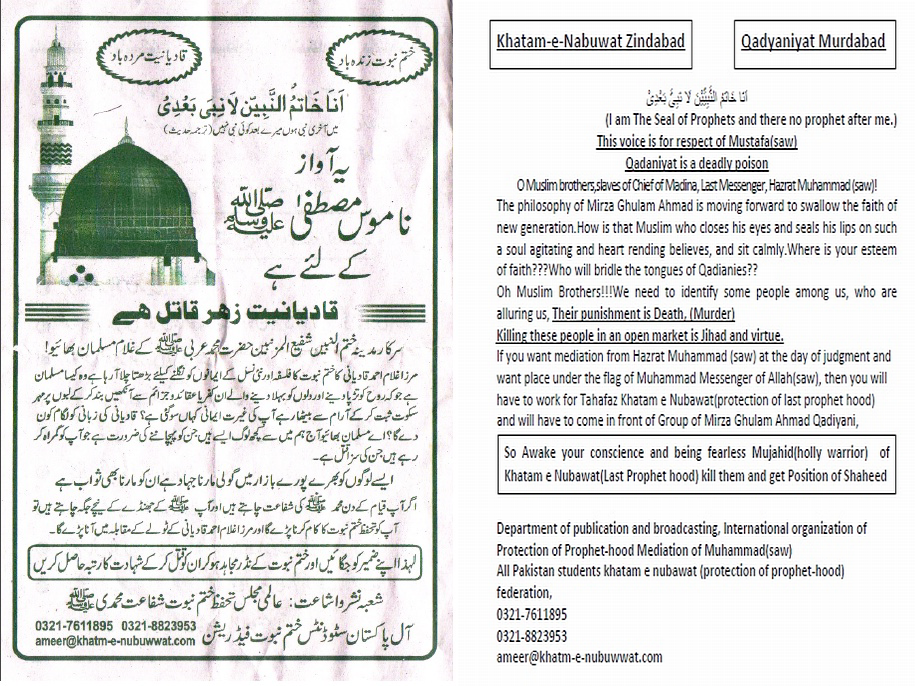
Saleemuddin, a spokesperson for Jamat-e-Ahmadiyya Pakistan, condemned the murder and demanded the immediate arrest of the accused. He said fatwas declaring members of the Ahmadi sect “liable to be killed” were being issued in different parts of the country and these religious edicts were being published in vast numbers. This, according to Saleemuddin, has resulted in target killings of many Ahmadis.

Published in The Express Tribune, October 3rd, 2011.

Copyrighted © 2011 The Express Tribune News Network
URL: http://tribune.com.pk/story/265652/ahmadi-schoolteacher-shot...

Monday, September 19, 2011

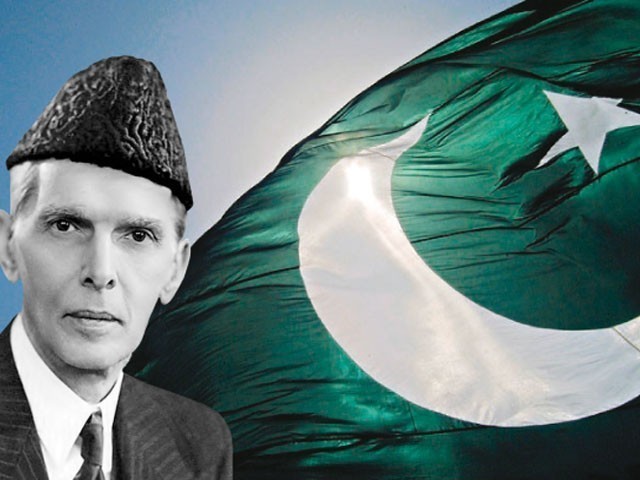
Jinnah’s Pakistan, hijacked by clerics
The Express Tribune Blogs
Opinion
The Verdict
Kashif ChaudharyJinnah’s Pakistan, hijacked by clerics
Posted by Kashif Chaudhry
Published: September 19, 2011
Jinnah founded Pakistan with the dream of it being a secular state where people could live as free citizens. However, today, Pakistan finds it hard to uphold the very ideals it was founded upon
Jinnah founded Pakistan with the dream of it being a secular state where people could live as free citizens.However, today, Pakistan finds it hard to uphold the very ideals it was founded upon
With the partition of the Indian subcontinent, Pakistan came into existence on August 14, 1947. The valiant and astute Muhammad Ali Jinnah led the minority Muslim community of united India to a separate homeland to fulfill the demand for freedom of religion, profession, and speech.

Jinnah was an outstanding lawyer who had studied law in London. He had a modern outlook on the world and was strongly secular. Part of the oath under which he took office reads:

“No subject … in Pakistan shall, on grounds only of religion, place of birth, descent, color or any of them be ineligible for office.”

He was absolutely clear that the new state he was founding would accommodate people of all faiths and descent without any prejudice. To assert this point, he appointed a non-Muslim as his first law minister. The Muslims in his cabinet consisted of Sunni, Shia, and Ahmadis alike. He believed that Islam endorsed a secular democracy and the two were perfectly compatible.

“The great majority of us are Muslims. Consequently, we have a special and a very deep sense of unity. But make no mistake: Pakistan is not a theocracy or anything like it” he said in an address in 1948.

He believed in a Pakistan wherein the mosque would be separate from the state.

“You are free; you are free to go to your temples, you are free to go to your mosques or to any other place of worship in this State of Pakistan. You may belong to any religion or caste or creed that has nothing to do with the business of the State” he said.

In the struggle for Pakistan, Jinnah was not faced with the Indian Congress and the British alone. He also had to endure intense animosity from hard-line Muslim clerics and counter their vile propaganda. He was accused, by the ultra right-wing, of blasphemy, and they considered him a great heretic for his secular ideology.

Prominent clerics like Maulana Maududi urged common Muslims not to side with Jinnah. Maududi wrote:

“It is forbidden to vote for [Jinnah’s] Muslim League.”

Despite this, the resolute Jinnah was successful in garnering support from the masses in most Muslim-majority areas.

Today, the nation finds it hard to uphold the very ideals it was founded upon. As it passes through dangerously volatile times, it has forsaken its founding principles of freedom and secularism.

But how and why did Pakistan turn against itself?

Even though he tried his best to steer it toward a secular democracy, Jinnah did not live long enough to see it become one. Over the coming years, Pakistan took a very troubling turn. In a matter of nine years, it became an “Islamic Republic,” and in a little over two decades, it had essentially become a theocracy.

The same extremist clerics who had opposed Jinnah and his struggle for Pakistan gradually claimed ownership of the State. They formed political groups that used religion to amass public support. Their demonstrations of street power, frequently violent, meant that sectarian hatred and intolerance was the order of the day.

Even governments avoided a clash with the radical right and became increasingly wary of arousing any negative religious sentiment and consequently losing popular vote. This only furthered the extremist cause, and in time, the original path Pakistan started on was completely forsaken. Pakistan, it is now said, was formed for the Muslims and is meant to become an Islamic theocracy where the Shariah, as interpreted by the hard-liners, is to be the ultimate law.

One tragedy after another, Jinnah’s Pakistan was dealt with massive blows. His Pakistan was no more his; it had been hijacked by forces of extremism and intolerance.

Non-Muslims could not hold the highest office in any of the core institutions anymore.

In 1953, there were widespread riots against the Ahmadi Muslims, a sect that extremists considered heretics.

The harassment of Shia Muslims and other minority groups also increased and went largely unchecked.

In 1974, the government yielded to intense pressure and declared the Ahmadiyya sect non-Muslim.

Tout de suite, the State had taken authority to decide its people’s religion, and the two were no longer separate.

General Zia ul Haq took over the country and became its third military president in 1977. To legitimize his dictatorship, he sought to please the right-wing and set to Islamize Pakistan. Amongst other things, he introduced the controversial blasphemy laws that stated death as the punishment for any derogatory remark against the Quran, Prophet Muhammad (PBUH), and other Islamic holy personages.

For Ahmadis, Zia also promulgated an ordinance in 1984 that criminalized the practice of their faith. Zia’s rule was the toughest for citizens who did not adhere to what had now become the state-backed perversion of Islam. Jinnah’s secular Pakistan had drifted into the hands of his enemies.

Jinnah had warned of this in his August 11th, 1947 address to the Constituent Assembly of Pakistan. He said:

“As you know, history shows that in England, conditions, some time ago, were much worse than those prevailing in India today. The Roman Catholics and the Protestants persecuted each other. Even now there are some States in existence where there are discriminations made and bars imposed against a particular class. Thank God, we are not starting in those days.” He continued: “Today, you might say with justice that Roman Catholics and Protestants do not exist; what exists now is that every man is a citizen, an equal citizen of Great Britain and they are all members of the nation.”

In the same address, he said:

“My guiding principle will be justice and complete impartiality, and I am sure that with your support and cooperation, I can look forward to Pakistan becoming one of the greatest nations of the world.”

Jinnah knew that a secular form of government could bridge differences and bring together people of all faiths and backgrounds to build a strong Pakistan. Just as the Catholics had learned to live with the Protestants, he was optimistic that the Pakistan he was founding would be a successful nation, a beacon of tolerance and an example of unity in diversity. However, the men who opposed Jinnah’s ideals before partition stood in his way yet again.

Founded on freedom of religion and practice, Pakistan is one of the biggest violator of religious freedom today. For Pakistan to succeed, it will have to reverse the dangerous turn it took and get back on the path that Jinnah laid before it. The blasphemy laws must be amended, everyone must be equal citizen of the state, the anti-Ahmadi laws must be revisited and the state must remain separate from the mosque at every cost. Pakistan must educate itself and look for the unity that Jinnah so cherished in the diversity across the land.

In February 1948, Jinnah said in an address:

“You have to stand guard over the development and maintenance of democracy, social justice and the equality of manhood in your own native soil. With faith, discipline and selfless devotion to duty, there is nothing worthwhile that you cannot achieve.”

Unfortunately, recent events have shown that Pakistan is still far away from taking that vital turn. The government has shown little resolve to go after the perpetrators of religious hate and violence and definitely no will to even trigger a dialogue on the controversial laws of the land. With Pakistan headed toward a steep decline, the solution lies in bold courage and reform. Jinnah’s Pakistanis will have to wake up sooner than later and reclaim the land from his opponents. Pakistanis must bring about a rebirth of Pakistan – Jinnah’s Pakistan.

Copyrighted © 2011 The Express Tribune News Network
URL: http://blogs.tribune.com.pk/story/8046/jinnahs-pakistan-hijacked-by-clerics/

Thursday, September 15, 2011

Religious freedom report: Pakistan one of 10 countries ‘failing to protect minorities’ rights’

Express Tribune, Pakistan
Pakistan
Sindh
Religious freedom report: Pakistan one of 10 countries ‘failing to protect minorities’ rights’
By Atika Rehman
Published: September 15, 2011
US state department report states that the Pakistani govt failed to protect minorities against abuse, discrimination. PHOTOS: FILE
KARACHI: Pakistan was cited among 10 countries “failing to sufficiently protect religious rights”, in a report regarding religious freedom released by Washington on Wednesday.

The other countries, mentioned in the US State Department’s International Religious Freedom report for the second half of 2010, included Afghanistan, Egypt, Iraq, Nigeria, Russia, Tajikistan, Turkmenistan, Venezuela and Vietnam.

However, Pakistan was not included in the list of ‘countries of particular concern’ regarding religious freedom – much to the dismay of the US Commission on International Religious Freedom (USCIRF). The list named China, Saudi Arabia, Myanmar, North Korea, Eritrea, Iran, Sudan and Uzbekistan.

“… the current list continues with glaring omissions, such as Pakistan and Vietnam. We respectfully urge Secretary Clinton to consider the six additional countries we recommended for designation,” said USCIRF Chair Leonard Leo.

The report details actions such as active state repression, violence against religious groups, apostasy and blasphemy laws, anti-Semitism and restrictions on religious attire and expression.

The report bluntly states that the constitution and laws in Pakistan “restricted religious freedom and, in practice, the government enforced these restrictions.”

Citing acts of violence against religious minorities as well as societal and governmental discrimination, it states that “the government rarely investigated or prosecuted the perpetrators of increased extremist attacks on minorities and the majority promoting tolerance, which deepened the climate of impunity.”

The report includes a long list of case studies of violence and discrimination against Ahmadis, Christians, Sikhs, Hindus and other Muslim sects.

The controversial blasphemy law, Aasia Bibi’s case in particular, and discrimination against the Ahmadiyya community take centre stage in the 30 pages of the report dedicated solely to Pakistan. “The government did not undertake reform measures to prevent the abuse of the blasphemy laws.

Toward the end of the reporting period the public discourse regarding the blasphemy laws became increasingly heated, which contributed to the government’s reluctance to address the issue. For example, after initially signalling he was considering pardoning Aasia Bibi’s death penalty sentence for alleged blasphemy, President Zardari refrained from doing so,” the report states.

It adds that the government, in fact, distanced itself from a bill introduced by a member of the ruling party that would have amended the blasphemy laws to prevent abuse.

Terming the blasphemy laws “a legal weapon against religious minorities and other Muslims”, the report says that the government’s failure in addressing religious hostility fostered intolerance and acts of violence against minorities and Muslims alike.

However, the report gives credit to the slain minorities minister Shahbaz Bhatti for promoting religious tolerance and taking an active role in assisting victims of religiously motivated attacks on Christians and Ahmadis.

The report states that, according to the National Commission for Justice and Peace (NCJP), between 1987 and 2010, a total of 1,068 persons were charged under the blasphemy laws. In 2010, blasphemy complaints were registered with the police against 17 Christians, eight Muslims, five Ahmadis, and seven Hindus, according to the report.

(ADDITIONAL INPUT FROM AFP)

Published in The Express Tribune, September 15th, 2011.

Copyrighted © 2011 The Express Tribune News Network
URL: http://tribune.com.pk/story/252659/religious...rights/

Wednesday, September 14, 2011

Count Pakistan among countries violating religious freedom: US commission

Express Tribune, Pakistan
Pakistan
Thinking proactively: Ahmadis have found their own solutions in Rabwah
By Atika Rehman
Published: September 14, 2011
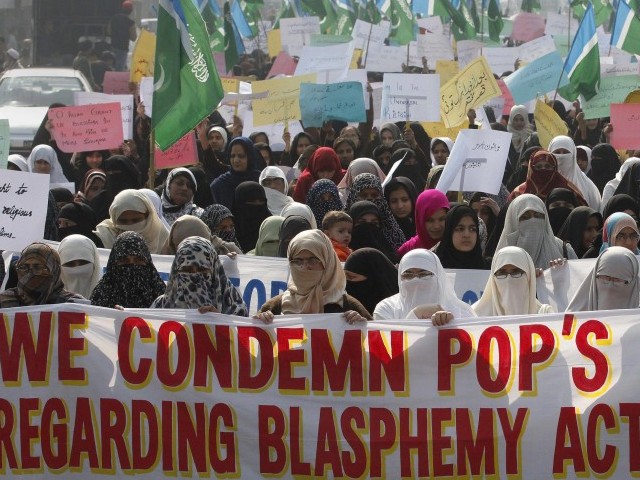
Female supporters of Jamaat-i-Islami (JI) hold placards and banner during a protest regarding the Pope's statements on Pakistan's blasphemy law. PHOTO: AFP/FILE
Female supporters of Jamaat-i-Islami (JI) hold placards and banner during a protest regarding the Pope’s statements on Pakistan’s blasphemy law. PHOTO: AFP/FILE
WASHINGTON: The United States Commission on International Religious Freedom (USCIRF) expressed concern over Pakistan’s omission from the list of eight countries termed “countries of particular concern” with regards to violation of religion freedom.

The list was published by the US State Department in a report which listed Burma, China, Eritrea, Iran, North Korea, Saudi Arabia, Sudan and Uzbekistan as countries where religious rights were severely infringed.

Although Pakistan was omitted from the list, the report stated that Pakistan’s laws restrict religious freedom and that the government enforced these restrictions. It also adds that investigation and prosecution of perpetrators in the case of extremist attacks on minorities are rare.

Citing the blasphemy law and Aasia Bibi’s case, the report suggests that the Pakistan government distanced itself from a bill proposed by an MNA to repeal the “discriminatory” law.

It also mentions that the Ahmadiyya community along with members of other Islamic sects, Christians, Sikhs, and Hindus face governmental and societal discrimination.

The report noted, however, that the government took some measures to improve religious freedom. It mentioned the late Federal Minister for Minorities, Shahbaz Bhatti’s attempts to assist victims of religiously motivated attacks.

The commission on Tuesday remarked that it is concerned that no new countries were added to the list.” said

‘Don’t forget Pakistan’

“Repeating the current list continues glaring omissions, such as Pakistan and Vietnam … we respectfully urge Secretary Clinton to consider the six additional countries we recommended for designation,” said Leonard Leo, USCIRF Chair.

The other four countries recommended by the commission are Egypt, Iraq, Nigeria and Turkmenistan.

Commenting on the report, US Secretary of State Hillary Clinton urged governments Tuesday to do more to defend religious freedom as Washington released a report citing eight countries with troubling records on the issue.

“We reaffirm the role that religious freedom and tolerance play in building stable and harmonious societies. Hatred and intolerance are destabilizing,” Clinton said.

Copyrighted © 2011 The Express Tribune News Network
URL: http://tribune.com.pk/story/252125/count...commission/

Monday, December 13, 2010

Pak clerics warn of protests if blasphemy laws are amended

December 13, 2010
Pak clerics warn of protests if blasphemy laws are amended
Updated on Monday, December 13, 2010, 15:32

Rawalpindi: Religious parties in Pakistan have warned that they will launch a movement called the Tehreek Namoos-e-Risalat (TNR), if the government moves to amend the country’s blasphemy laws.

Talking to reporters after attending an all parties Namoos-e-Risalat conference here on Sunday, Markazi Jamaat Ahle Sunnat Ameer Pir Atiqur Rehman said that Jamiat Ulema-e-Pakistan (JUP) president Dr Abul Khair Muhammad Zubair had been nominated as the convener of the newly formed group.

The Daily Times quoted him, as saying further that a six-member action committee, comprising Liaqat Baloch, Maulana Abdul Ghafoor Haidri, Abdul Rauf Farooqi, Sikandar Abbas Gillani and Maulana Muhammad Abbas, had been formed to evolve the TNR’s future strategy.

“The purpose of the meeting was to convey a message to the government that the nation would not tolerate any type of amendment in the blasphemy law, especially in the article 295-C of the Constitution,” Dr Abul Khair Zubair, a religious leader, said.

“The future strategy will be evolved in a meeting to be held in Islamabad on December 15,” he added.

Dr Zubair further said that the heads of all the five Wafaqul Madaris (religious educational boards) had also ratified the outcome of the conference.

Syed Munawar Hassan, Qazi Hussain Ahmed, Maulana Fazlur Rehman, Professor Sajid Mir, Allama Sajid Naqvi, Mufti Muneebur Rehman, Dr Abul Khair Zubair, Pir Atiqur Rehman, Hamidul Haq Haqqani, Liaqat Baloch, Maulana Abdul Ghafoor Haidri, Abdul Rauf Farooqi, Sikandar Abbas Gillani and Maulana Muhammad Abbas attended the conference.

ANI

Thursday, November 18, 2010

Serious problems in Pak on religious freedom: US

November 18, 2010
Serious problems in Pak on religious freedom: US
Updated on Thursday, November 18, 2010, 10:04

Ahmadiyya Mosque, LahoreWashington: Noting that serious problems remain in Pakistan with regard to religious freedom, the Obama administration has expressed its concern over the existence of laws that are “discriminatory” against religious minorities.


“There have been attacks against Christians, against the Ahmadis. There’s still discriminatory laws on the books, blasphemy laws, anti-Ahmadi laws.”

“We’re raising these issues with the government of Pakistan,” Assistant Secretary of State for Democracy, Human Rights and Labour, Michael Posner, said.

Posner was responding to questions after the release of the annual State Department Report on Global Religious Freedom by Secretary of State Hillary Clinton.

“The (Pak) government is taking steps. It’s a very tense situation now, and there are tensions within the society. So it’s a mixed picture, honestly.”

“We give the government credit for steps it has taken, but also recognise that more needs to be done. And it’s part of our diplomacy with them,” Posner said in response to a question.

One of the things this report does is identify, in Pakistan and elsewhere, government actions that contribute to the problem, he said.

The annual State Department Report said despite the government’s steps to protect religious minorities, the number and severity of reported high-profile cases against minorities increased during the reporting period.

“Organised violence against minorities increased; for example, there was violence against Christians in Gojra, Punjab, and a terrorist attack on Ahmadis in Lahore, Punjab.”

“There were instances in which law enforcement personnel abused religious minorities in custody,” it said.

Security forces and other government agencies did not adequately prevent or address societal abuse against minorities.

Discriminatory legislation and the government’s failure or delay in addressing religious hostility by societal actors fostered religious intolerance, acts of violence, and intimidation against religious minorities, it said.

“Specific laws that discriminated against religious minorities included the anti-Ahmadi provisions of the penal code and the blasphemy laws which provided the death penalty for defiling Islam or its prophets,” said the report.

The Ahmadiyya community continued to face governmental and societal discrimination and legal bars to the practice of its religious beliefs. Members of other Islamic sects, Christians, Sikhs, and Hindus also reported governmental and societal discrimination, it said.

Noting that relations between religious communities remained tense, the State Department Report said societal discrimination against religious minorities was widespread, and societal violence against such groups occurred.

Non-governmental actors, including terrorist and extremist groups and individuals, targeted religious congregations, it said, adding that a domestic insurgency led by religious militants increased acts of violence and intimidation against religious minorities and exacerbated existing sectarian tensions.

“Extremists target violence against Muslims advocating for tolerance and pluralism, including followers of Sufism,” the report said.

During the reporting period, US embassy officials closely monitored the treatment of religious minorities, worked to eliminate the teaching of religious intolerance, and encouraged the amendment or repeal of the blasphemy laws, it added.

PTI

Sunday, June 13, 2010

Minorities form working group

Daily Times, Pakistan
Sunday, June 13, 2010

Minorities form working group

KARACHI: The representatives of Hindus, Christians, Sikhs, Bahai, Ahmedi and Zoroastrian communities of Sindh formed on Saturday a working group on ‘Right of Communities Vulnerable Because of Their Belief’ during a meeting at a local hotel. The Human Right Commission of Pakistan (HRCP) would support the group.

The group will highlight human rights violations through fact finding reports, researches, issuing public statements and arranging press briefings and also to analyse the laws, practices and policies, which are discriminatory and would provide recommendations. The meeting also decided that the group will conduct capacity building programmes of the members of vulnerable communities and a mechanism of early warning signs to determine the tension involving minorities and would recommend appropriate actions.

During the meeting, the participants discussed the agenda of the newly formed group including the status of commission of minorities, countering advocacy of hatred based religious beliefs, discrimination being faced by the communities in services, education, family and property laws, constant threats and fear, blasphemy laws and property related issues. During the meeting the participants decided that the newly formed group would meet once in six months.

Addressing the meeting HRCP Director I A Rehman said that the group would address all the issues being faced by the communities and deal with the rights of these communities.

“Since the last several years, the living conditions of minorities has worsened and the communities have become extremely vulnerable as extremists and militants are inciting hatred,” he said. amar guriro

Tuesday, June 8, 2010

The demand for Pakistan and Islam

Daily Times, Pakistan
Tuesday, June 08, 2010

VIEW: The demand for Pakistan and Islam

The Muslim League’s propaganda struck terror in the hearts of the Hindus and Sikhs who were told that they would be paying jazya and Islamic law will prevail in all sectors of individual and collective life. The minority Shia and Ahmediyya communities were also fearful that it would result in Sunni domination

The recent attack on a congregation of Ahmedis during prayers, which claimed more than 90 innocent lives, has revived a discussion as to whether there is a connection between the creation of Pakistan and Islam. Within the Muslim League there was always a constituency in favour of Pakistan becoming an Islamic state. One of its proponents was a close confident of Jinnah: Raja Sahib Mahmudabad, a Shia. In 1939 he wrote to the historian Mohibul Hassan:

“When we speak of democracy in Islam it is not democracy in the government but in the cultural and social aspects of life. Islam is totalitarian — there is no denying about it. It is the Quran that we should turn to. It is the dictatorship of the Quranic laws that we want — and that we will have — but not through non-violence and Gandhian truth” (Mushirul Hasan, 1997: 57-8).

If the March 23, 1940, Lahore Resolution be taken as the start of the Pakistan campaign, then Jinnah had to make a breakthrough in the Muslim-majority provinces of northwestern India — Khyber Pakhtunkhwa, Punjab and Sindh — each of which had regional parties headed by Muslims. The Muslim League had to convince the Muslim voters in these provinces that their leaders were courting Hindus and Sikhs and thus were paving the way for Hindu Raj under the Indian National Congress. That opportunity arrived in July 1945 when the British government announced provincial elections for February 1946. Punjab Governor Sir Bertrand Glancy has recorded in several secret fortnightly reports (FR) the tactics that the Muslim League adopted during the long election campaign. In the FR of December 27, 1945, Glancy noted:

“Among Muslims the Leaguers are increasing their efforts to appeal to the bigotry of the electors. Pirs and maulvis have been enlisted in large numbers to tour the province and denounce all who oppose the League as infidels. Copies of the Holy Quran are carried around as an emblem peculiar to the Muslim League. Feroz [Khan Noon] and others openly preach that every vote given to the League is a vote cast in favour of the Holy Prophet (PBUH). These deplorable tactics, as I have frequently said, were only to be expected; they provide a grim augury of the future peace of India and they are certainly not easy for the Unionists to counter” (Lionel Carter, 2006: 160).

In the FR of February 2, 1946, Glancy wrote:

“The ML [Muslim League] orators are becoming increasingly fanatical in their speeches. Maulvis and pirs and students travel all round the province and preach that those who fail to vote for the League candidates will cease to be Muslims; their marriages will no longer be valid and they will be entirely excommunicated…It is not easy to foresee what the results of the elections will be. But there seems little doubt the Muslim League, thanks to the ruthless methods by which they have pursued their campaign of ‘Islam in danger’, will considerably increase the number of their seats and Unionist representatives will correspondingly decline” (Carter, 2006: 171).

Similar tactics were adopted in the campaigns in Khyber Pakhtunkhwa and Sindh. In his doctoral dissertation, India, Pakistan or Pakhtunistan?, Erland Jansson writes:

“The pir of Manki Sharif…founded an organisation of his own, the Anjuman-us-asfia. The organisation promised to support the Muslim League on the condition that Shariat would be enforced in Pakistan. To this Jinnah agreed. As a result the pir of Manki Sharif declared jihad to achieve Pakistan and ordered the members of his anjuman to support the League in the 1946 elections” (pg 166).

Jinnah wrote in November 1945 a letter to Pir Manki Sharif in which he promised that the Shariat would apply to the affairs of the Muslim majority. He wrote:

“It is needless to emphasise that the Constituent Assembly, which would be predominantly Muslim in its composition, would be able to enact laws for Muslims, not inconsistent with the Shariat laws and the Muslims will no longer be obliged to abide by the un-Islamic laws” (Constituent Assembly of Pakistan Debates, Volume 5, 1949, pg 46).

The Muslim League’s propaganda struck terror in the hearts of the Hindus and Sikhs who were told that they would be paying jazya and Islamic law will prevail in all sectors of individual and collective life. The minority Shia and Ahmediyya communities were also fearful that it would result in Sunni domination. This is obvious from the correspondence between the Shia leader Syed Ali Zaheer and Jinnah in July 1944 (G Allana, 1977: 375-9). Although the Council of Action of the All-Parties Shia Conference passed a resolution on December 25, 1945, rejecting the idea of Pakistan (SR Bakshi, 1997: 848-9), most Shias shifted their loyalty to the Muslim League in the hope that Pakistan will be a non-sectarian state. Initially the Ahmediyya were also wary and reluctant to support the demand for a separate Muslim state (Munir Report, 1954: 196). It is only when Sir Zafarullah was won over by Jinnah that the Ahmedis started supporting the demand for Pakistan. To all such groups Jinnah gave assurances that Pakistan will not be a sectarian state.

In my forthcoming book on the partition of Punjab, now running into more than 1,000 pages but which is at last completed and for which I am now looking for a publisher, I will shed light on how the fierce Islamist propaganda impacted on the partition of Punjab. The Sikhs had more fears than anyone else about what could happen to minorities in Pakistan. In a meeting in May 1947 sponsored by Lord Mountbatten to help the Muslims and Sikhs reach an agreement on keeping Punjab united, Jinnah offered the Sikhs all the safeguards they wanted if they agreed to support Pakistan. Only in March 1947 some 2,000-10,000 Sikhs — depending on who you cite — were butchered in the Rawalpindi rural areas so the Sikhs were very wary of Jinnah’s overtures. Chief Minister of Patiala Hardit Singh Malik writes he had an inspiration and asked Jinnah: “Sir you are making all the promises but God forbid if something happens to you, what will happen then?” The exact words Jinnah used in reply will be revealed in my forthcoming book, but the reasoning was that his followers will treat his words as sacred.

Ishtiaq Ahmed is a Visiting Research Professor at the Institute of South Asian Studies (ISAS) and the South Asian Studies Programme at the National University of Singapore and Professor Emeritus of Political Science at Stockholm University. He is currently working on a book, Is Pakistan a Garrison State? He can be reached at isasia@nus.edu.sg

Wednesday, August 19, 2009

Minorities’ right to liberty

---daily Dawn, Pakistan
Provinces
Minorities’ right to liberty
Anwar syed
Sunday, 16 Aug, 2009 | 10:27 AM PST |

A group of Muslims, professedly incensed and enraged over the alleged desecration of the Quran, killed seven Christians in Gojra in Punjab. The allegation may not have been valid.

It is possible that the victims and their killers had been involved in a local quarrel. It is also possible that the victims were targeted simply because they were non-Muslim. The following presentation is based on this latter premise.

The killings have been widely condemned. Prime Minister Yousuf Raza Gilani and Punjab Chief Minister Shahbaz Sharif went to Gojra to condole with the victims’ families, and each announced an award of Rs100m as compensation to them. Mr Gilani also announced his government’s resolve to apprehend and prosecute the killers. This was a laudable response on his part, and we hope it does not turn out to be one of those promises that are lightly made and then forgotten.

This was not the first incident of its kind in the country’s recent experience. Hindu, Christian and Ahmadi communities and neighbourhoods in Sindh and Punjab have been attacked, persons killed, homes and businesses plundered and places of worship destroyed. These deeds were barbaric and so were their doers.

It takes a measure of intellectual sophistication and civility to value diversity and respect those who think differently from others. These attitudes of mind are cultivated in a democratic culture, which settles issues through discussion, debate and a process of give-and-take (compromise). This mode of arriving at decisions does not admit of absolutes. It requires admission of a degree of tentativeness in one’s own position, willingness to concede that the opponent has to be heard, for his argument may have some merit.

Granting exceptions, it may be said that absolute firmness of belief in the validity of a set of propositions, and tolerance of those who do not subscribe to them, do not go together. Indeed, they are mutually exclusive.

Intense believers in their professed faith have fought others in numerous times and places. Protestants and Catholics, and within the Protestant Church Anglicans and Presbyterians, persecuted, even killed, one another for more than 100 years in Ireland and Scotland respectively.

The same kind of conflicts took place in France, Germany, Switzerland and Massachusetts. In India orthodox caste Hindus have traditionally humiliated certain lower caste groups as untouchables. They have also been persecuting their Muslim citizens.

Islam enjoins tolerance of the non-believer. ‘Moderate’ Muslims are indeed tolerant of views other than their own. But there are, and have been, others who hold that those who disagree with them are not real Muslims, and that they deserve to be placed beyond the pale of Islam, if not eliminated. At the present time, the Taliban are the foremost of such groups.

Where in the configuration described above do we place the frenzied Muslims in Gojra who killed some of its Christian residents? It is most likely that they were intellectually unsophisticated, at best semi-literate, basically uncouth and uncivil.

Next, they were intense believers in the sanctity of their faith. The allegation that the Christians had desecrated the Quran may have been invalid but, if so, that fact was probably not known to most of them. They did, however, allow themselves to get into a rage without looking into the allegation. That may have happened because the accused were poor Christians.

Muslims constitute nearly 97 per cent of this country’s population. The remaining three per cent consist of Christians, Hindus and a sprinkling of Sikhs and Zoroastrians. Certain individuals from among them became renowned for their attainments. Justice A.R. Cornelius, chief justice of Pakistan, was one of the most learned, profound and eloquent jurists that ever worked in Pakistan. Justice Bhagwandas, a former judge of the Supreme Court, is another such luminary. Some of the more wealthy Zoroastrians have given large sums of money for the establishment and maintenance of educational institutions, hospitals and other charities.

The minority people are loyal citizens of Pakistan as much as the Muslims may be. They pose no threat to its security and well-being. Nor do they pose a threat to the well-being of their neighbours. They are not numerous or strong enough even to influence public policy (as for instance the Jews are in America). Why would then any group of Muslims want to persecute, harass, terrorise or kill them?

In most such cases they are accused of having committed blasphemy, such as insulting the Prophet (PBUH) or desecrating the Quran. The accusation is often unfounded. It is possible also that the alleged act, if it did happen, was accidental and unintended. The blasphemy law should be repealed because it is a bad law, but false accusations against minority persons will continue to be made, for the motivation behind them has nothing to do with the law’s susceptibility to abuse.

One reason why minority groups are harassed may be that they are weak, and weakness invites aggression. They can easily be driven from their homes and whatever little land they may have, which their tormentors can then appropriate. If some of them have defied any of the tough guys in the area, they will be punished for their self-assertion. The greater likelihood is that their oppressors are acting simply from perversity, viciousness and meanness of spirit of which they happen to have more than their share.

What is then to be done? I believe that governments and political leaders at all levels, particularly the Islamic parties, must do all they can to persuade the imams and khateebs in our mosques to tell their audiences that it is their Islamic duty to protect the non-Muslim minorities in this country.

The writer is professor emeritus at the University of Massachusetts. anwarsyed @ cox.net

©2009 DAWN Media Group. All rights reserved
 
^ Top of Page