Showing posts with label security. Show all posts

Thursday, November 18, 2010

Serious problems in Pak on religious freedom: US

November 18, 2010
Serious problems in Pak on religious freedom: US
Updated on Thursday, November 18, 2010, 10:04

Ahmadiyya Mosque, LahoreWashington: Noting that serious problems remain in Pakistan with regard to religious freedom, the Obama administration has expressed its concern over the existence of laws that are “discriminatory” against religious minorities.

“There have been attacks against Christians, against the Ahmadis. There’s still discriminatory laws on the books, blasphemy laws, anti-Ahmadi laws.”

“We’re raising these issues with the government of Pakistan,” Assistant Secretary of State for Democracy, Human Rights and Labour, Michael Posner, said.

Posner was responding to questions after the release of the annual State Department Report on Global Religious Freedom by Secretary of State Hillary Clinton.

“The (Pak) government is taking steps. It’s a very tense situation now, and there are tensions within the society. So it’s a mixed picture, honestly.”

“We give the government credit for steps it has taken, but also recognise that more needs to be done. And it’s part of our diplomacy with them,” Posner said in response to a question.

One of the things this report does is identify, in Pakistan and elsewhere, government actions that contribute to the problem, he said.

The annual State Department Report said despite the government’s steps to protect religious minorities, the number and severity of reported high-profile cases against minorities increased during the reporting period.

“Organised violence against minorities increased; for example, there was violence against Christians in Gojra, Punjab, and a terrorist attack on Ahmadis in Lahore, Punjab.”

“There were instances in which law enforcement personnel abused religious minorities in custody,” it said.

Security forces and other government agencies did not adequately prevent or address societal abuse against minorities.

Discriminatory legislation and the government’s failure or delay in addressing religious hostility by societal actors fostered religious intolerance, acts of violence, and intimidation against religious minorities, it said.

“Specific laws that discriminated against religious minorities included the anti-Ahmadi provisions of the penal code and the blasphemy laws which provided the death penalty for defiling Islam or its prophets,” said the report.

The Ahmadiyya community continued to face governmental and societal discrimination and legal bars to the practice of its religious beliefs. Members of other Islamic sects, Christians, Sikhs, and Hindus also reported governmental and societal discrimination, it said.

Noting that relations between religious communities remained tense, the State Department Report said societal discrimination against religious minorities was widespread, and societal violence against such groups occurred.

Non-governmental actors, including terrorist and extremist groups and individuals, targeted religious congregations, it said, adding that a domestic insurgency led by religious militants increased acts of violence and intimidation against religious minorities and exacerbated existing sectarian tensions.

“Extremists target violence against Muslims advocating for tolerance and pluralism, including followers of Sufism,” the report said.

During the reporting period, US embassy officials closely monitored the treatment of religious minorities, worked to eliminate the teaching of religious intolerance, and encouraged the amendment or repeal of the blasphemy laws, it added.

PTI

Sunday, July 18, 2010

Opinion: How can Pakistan turn over a new leaf?

Global Post, USA
Opinion
Home / Worldview
--
Opinion: How can Pakistan turn over a new leaf?
The only chance to cleanse the state is to return to a secular identity.
Sonya Fatah


By Sonya Fatah — Special to GlobalPost
Published: July 18, 2010 10:35 ET in Worldview

--
Wazir Khan Mosque, Lahore
Pigeons fly over the Wazir Khan Mosque in the walled city of Old Lahore on July 9, 2010 in Pakistan. (Daniel Berehulak/Getty Images)

NEW DELHI, India — It isn’t a topic that’s making headlines in Pakistan. But it’s a debate that’s been raised countless times since the country’s birth in August 1947: Should Pakistan be secular?

Dogged by internal crises, the rise of a growing intolerant extremist segment and a deliberately apathetic state and military response, Pakistan’s future seems bleak.

Imagine a reinvention. Get rid of the “Islamic” part of the Islamic Republic of Pakistan. Shred all copies and records of the 1973 constitution and repeal a series of self-serving amendments to the constitution as well as bigoted anti-minority and anti-women laws. What you may be left with is the skeleton for a secular democracy.

A spate of recent terror attacks suggests this might be Pakistan’s only way of battling its inner demons. On May 28, armed militants attacked two mosques of the Ahmadiya community in Lahore. Ninety-seven people died and dozens were wounded.

Then on July 1 there were twin suicide attacks on Data Darbar also in Lahore, one of the largest and most visited Sufi shrines in Pakistan. The attack on the shrine was extraordinarily bold because it was an attack on Pakistan’s majority of Sunni barelvi believers. Some 43 people died.

In Faisalabad, on July 2, two Christian brothers were arrested for violating the Blasphemy Law. They’ve been accused of writing a pamphlet with derogatory comments about Prophet Muhammad. [Both of them were killed on 19th by an unknown gunmen in fron of City Court, while in Police custody.] In Waris Pura, a locality of some 100,000 Christians, Muslim mobs have been threatening to burn homes and kill Christians if both brothers are not executed.

The simple fact is that the state has, especially over the last 40 years, allowed for the persecution of its minorities. It has rewarded its majority to discriminate against them.

Sound harsh? A little exaggerated? Here are the facts.

Lets start with the Ahmadiyas. In 1974, under the supposedly liberal leadership of Zulfiqar Ali Bhutto, parliament passed a law declaring Ahmadiyas non-Muslims. This was a reward to the Jamaat-e-Islami party in Pakistan for spreading virulent anti-Ahmadiya hate speech and demanding their removal from the esteemed list of Pakistan-approved Muslim identities.

As if that wasn’t enough, Pakistan’s favorite general, General Zia ul Haq — whose arched eyebrows would have given Jack Nicholson some sleepless nights — presided over Ordinance XX in 1984. The ordinance spelt out the following: Ahmadiyas were not allowed to call themselves Muslims, to pray in regular mosques, to read out Quranic verses, or to “pose as Muslims.”

Move now to Faisalabad where street protests against two Christian brothers are mounting. No one has witnessed the brothers writing the pamphlet. As members of a tiny minority they’re unlikely to have wanted to defile anything Muslim in public or in private.

But the problem for Rashid and Sajid Emmanuel is something called the Blasphemy Law. Another gift of Zia ul Haq, the 1986 law carries the penalty of death for anyone who desecrates the Quran or defiles the name of Prophet Muhammad.

Many dubious claims invoking blasphemy have been made against innocent Muslims, Hindus and Christians alike since the law was first passed. Surrounded by a volatile public whose religious sensitivity is beyond reason, the accused often gets his or her death sentence before the matter even reaches the court.

Pakistan has always struggled to define itself. In the absence of a concrete identity, Islam has been used and manipulated for political ends. In 1958 the official tag of “Islamic” Republic was added to its name.

Pakistan’s founder, the barrister Mohammad Ali Jinnah, had no such plan for Pakistan. On Aug. 11, 1947, when addressing the first constituent assembly, he told Pakistanis, “You are free; you are free to go to your temples, you are free to go to your mosques or to any other place of worship in this State of Pakistan. You may belong to any religion or caste or creed — that has nothing to do with the business of the State.

“You will find that in course of time Hindus would cease to be Hindus and Muslims would cease to be Muslims, not in the religious sense, because that is the personal faith of each individual, but in the political sense as citizens of the State.”

That was not Jinnah’s singular speech on secularism.

Sadly, he died in 1948 and what has happened since then is a sad and dangerous tale.

As the 2010 report of the United States commission on International Religious Freedom puts it: “Religiously discriminatory legislation has fostered an atmosphere of intolerance” in Pakistan.

Over the years Pakistanis have watched as minority groups and women have been targeted. Yet with the exception of a few activist groups and human rights organizations, the majority of Pakistanis have maintained a condemnable silence.

The difference was palpable in national reactions to the two, separate attacks on religious communities in Lahore.

“This act of violence was unanimously — politicos, religiosos and all — vociferously ‘condemned’ and the country saw many protests, demos and city shut-downs,” Amina Gilani wrote, referring to the attacks on Data Darbar, in The Tribune, one of Pakistan’s English-language dailies. “A somewhat different reaction to the event of May 28 … The reaction of the majority — politicos, religiosos and all — was comparatively rather muted. It raised no suggestions for a national get-together.”

How does Pakistan turn over a new leaf? Pakistan’s only salvation to cleanse the state and its mindset is to return to a secular identity.

“[We] will need a revolution of the national mindset and a whole new constitution,” said Ardeshir Cowasjee, a longtime writer and editorialist. “[We] will also need a whole and entire new brand of politicians, or leaders of whatever type. We need to do away with ‘Islamic’ and with the Objectives Resolution before we can even begin to make progress — plus ditch quickly the Hadood Ordinances and the blasphemy laws and all Islamic provisions, which govern this country. So it has to be secularism all the way.”

That’s a lot of work for any country, more so for one in crisis.

Still there are forces moving in that direction. On Christmas Day last year, Haji Adeel, a major political leader of the Awami National Party and a Pakistani senator, advocated a return to secularism. Adeel found himself the target of a host of critics including the Islamic right. But he also found supporters, and set off debate in various circles about the idea.

Now that Saudi-style and Saudi-funded Wahhabi Islam has reached the popular shrine of Data Ganj Baksh, perhaps more Pakistanis will see that the anti-American, anti-Israeli and anti-colonialist body that defines itself as the Taliban, is also anti-them.

Still, even if secularism is Pakistan’s yellow brick road to saving itself, it’s going to take a lot more than changing the constitution and axing a few laws. This is a battle for changing mindsets, and Pakistanis are in it for the long haul.

Tuesday, July 6, 2010

Inquiry into attacks on Ahmedis pulls off vanishing act

Daily Times, Pakistan
Tuesday, July 06, 2010

Inquiry into attacks on Ahmedis pulls off vanishing act

*
CM had entrusted committee with determining factors that contributed to attacks
*
Ahmedi leader says compensation for victims was never given

By Afnan Khan

LAHORE: The inquiry that was ordered by Punjab Chief Minister Shahbaz Sharif to identify the security loopholes and the reasons behind the terrorist attacks on the worship places of Ahmedis has become long overdue and does not seem to be coming out of the works anytime soon.

According to the CM’s orders, the inquiry report was supposed to be filed within five days of the attacks, which left around 90 people dead and around 200 injured after terrorists stormed Ahmedi worship places at Model Town and Garhi Shahu on May 28. Rights activists and civil society members have accused the Punjab government for adopting a “neglectful and discriminatory behavior” towards the victims of the attacks.

The CM had set up a high-level inquiry committee, headed by Punjab Health Secretary Fawad Hassan Fawad and consisting of the provincial home secretary and inspector general of police.

The committee was given the task of discovering the factors that had contributed to the attacks. The issue has been put aside by the bureaucracy, as the inquiry report, which was due to be submitted before the CM by June 3, never surfaced and there is no government account on whether the negligence of government officials contributed to the loss of so many innocent lives.

A senior Ahmedi leader, requesting anonymity, told Daily Times that the community members were afraid and had felt exposed to danger a few days before the attack took place, adding that the minority group had made several requests to the government to provide them with Elite Force personnel to tackle any terror attacks, “but the government never listened to any of our demands and only provided a few guards who had no capacity to stand against such an attack”.

“But the thing that has further scared and confused the Ahmedis in the country is the fact that the government changed the station house officers of both the areas’ police stations a few days before the incident. Not only that, a magistrate visited the areas and removed all Ahmedi volunteers with weapons,” he said.

Missing compensation: He said that the compensation announced by the Punjab government was never given to those who had lost their loved ones and those who were severely injured in the attack. Munawar Ali, the spokesman for the minority group, told Daily Times that there were a number of discriminatory acts conducted by the Punjab government against the community, “which further increases the gravity of the tragedy”. He said that the terrorist had managed to kill so many people because of loopholes in security, “but the government downplayed the incident from the start”. He said the minority group was only allowed to depute a few volunteers inside the worship place, but they were not allowed to carry any firearms. None of the Punjab government officers, including government spokesman Pervaiz Rasheed and Senior Adviser to the CM Sardar Zulfiqar Khosa, commented on the issue. However, Fawad Hassan Fawad told Daily Times that he apologised for the inquiry not having been completed, adding that he could not complete it since he was busy with his own department’s issues. He said the inquiry should have been assigned to some other officer, “who would have worked on it”.

Thursday, June 10, 2010

Damned by Faith

Newsline, Pakistan
Home »
News & Politics
Damned by Faith
By Aftab Alexander Mughal                              10 JUNE 2010

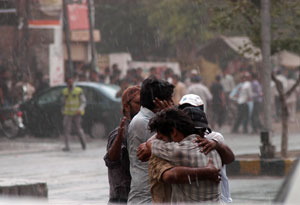
Drowned in sorrow: Men console each other after the deadly attacks on Ahmedi places of worship on May 28. Photo: AFP
At least 95 Ahmedis were killed and nearly 100 injured in two dastardly attacks on their places of worship in Garhi Shahu and Model Town in Lahore. According to local police sources, around 10 terrorists, wearing suicide vests and armed with hand grenades and automatic weapons, attacked the worshippers who had gathered for Friday prayers. At the end of the five-and-a half-hour operation at the Garhi Shahu worship place and a relatively brief one at Model Town, two of the assailants were arrested while the rest blew themselves up.

The Ahmedis have consistently been targeted by sectarian outfits. They view themselves as Muslims, but following pressure from some Sunni religious parties, they were declared non-Muslims through a constitutional amendment passed in 1974 by the Bhutto government. Subsequently, the late president, General Zia-ul-Haq, introduced several anti-Ahmedi laws in the ’80s, including the controversial Blasphemy Law, adding to the miseries of the two million Ahmedis living in Pakistan.

Unfortunately, a certain section of the media, especially some Urdu newspapers and TV channels, have been actively engaged in instigating their audiences against the Ahmedis and other religious minorities, rendering their lives and properties insecure. Last year, well-known TV anchor Amir Liaquat was accused of inciting hatred against Ahmedis in his religious programme on Geo television, which allegedly resulted in the murder of two Ahmedis by fanatics in Sindh. Despite protests raised by civil society groups, Liaquat’s programme continues to be telecast. A few weeks back, Hamid Mir, another anchor from the same TV channel, was accused of using very irresponsible language against Ahmedis in a mobile phone conversation with a Tehrik-i-Taliban member – they are “worse than infidels,” he is reported to have told the TTP guy and accused Khalid Khwaja, a former ISI official who was then in their custody, of having links with the Ahmedi community, which allegedly may have led to his murder. (Mir disputes the claim that it was his voice on the mobile phone recording).

Shockingly, certain sections of the media in Pakistan appear to be more sympathetic to the Taliban and other terrorist outfits than they are to religious minorities.

In this carnage of Ahmedis, for instance, certain sections of the Urdu media were quick to accuse the Indian intelligence agency RAW and the Americans of being involved in the bloody incident. They continue to live in a state of denial. As does the Punjab government, which appears to be blind to the existence of militant outfits in South Punjab. Punjab Law Minister Rana Sanaullah told the media that the attackers had come from North and South Waziristan’s tribal belt where the Taliban have been running their self-styled government. What he failed to mention was that it was the Punjabi Taliban, who had trained in Waziristan and returned to the Punjab to carry out the deadly attacks. The Punjab branch of the Taliban comprises mainly the Lashkar-e-Jhangvi and Jaish-e-Mohammad, who have joined forces with the Taliban.

Last year, Ahmedis, Shias and Christians in various parts of the country had received threatening letters from various militant groups. Consequently, the Ahmedis along with the Human Rights Commission of Pakistan (HRCP) had requested the government to provide them security but their request was not taken seriously. The HRCP, in its last report, had stated that at least five members of the Ahmedi community were murdered in target killings in 2009, raising to 100 the number of murders since the introduction of anti-Ahmedi laws by the Zia-ul-Haq government in 1984.

The Pakistan Muslim League (PML-N) headed by an erstwhile Zia protegé, which is in power in the Punjab now, is known to hold right-wing views and is often accused of having links with militant organisations.

Recently, his brother, the Punjab Chief Minister Shahbaz Sharif, drew a lot of flak when he publicly requested the Taliban not to attack the Punjab because they, like the Taliban, were opposed to the US drone attacks in Waziristan. And Punjab’s Law Minister Rana Sanaullah participated in an election rally with the leaders of a banned terrorist organisation in Jhang. Incidentally, many terrorists who attacked Christians in Gojra in 2009 came from that city.

In some instances, the police have succeeded in arresting the terrorists but the courts have released them “for want of evidence” much to the disappointment of the victims and their families. On May 25, the Supreme Court upheld the Lahore High Court’s decision to free Hafiz Saeed from house arrest by dismissing the appeals of the federal and Punjab governments for lack of evidence. Saeed is the notorious chief of the banned terrorist organisation, Lashkar-e-Tayyaba (LeT), which is now working in the garb of a ‘charity organisation’ called the Jamaat-ud-Dawa (JuD).

A question that still remains unanswered is, why didn’t the Punjab government take any security measures to protect the Ahmedis despite the federal interior ministry’s warnings of possible terrorist attacks on them?

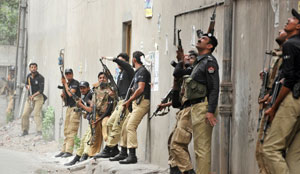
Police stand armed in their counter-attack against the terrorists in Lahore in May 2010. Photo: AFP
Following this latest attack on the Ahmedi community, other religious minorities living in the Punjab are feeling extremely vulnerable. And more so since the militants returned to Lahore’s Jinnah Hospital where one of the assailants was being treated, along with several other injured Ahmedis of the May 28 carnage.

There is no denying the fact that the Lahore attacks were the work of Punjab-based militant groups, and they need to be tackled just like the militants operating out of Waziristan in order to avert attacks of this nature in the near future.

Unless and until the establishment does not treat the country’s religious minorities as equal citizens and the media does not stop inciting hatred against them, the minorities will remain under constant threat from extremist forces.

Tuesday, June 1, 2010

The tide of bigotry

The News - Internet Edition
Tuesday, June 01, 2010,
Jamadi-us-Sani 17 , 1431 A.H.
 The tide of bigotry

Tuesday, June 01, 2010
Zafar Hilaly

It took the Punjab Police a full two hours and 45 minutes after the first “1-5” emergency call went out for the police to reach the scene of the attacks on the Ahmedi prayer centres. It’s not as if the buildings were on another planet. From where the Lahore Police are stationed (in strength) it should have taken at best 15 minutes to get there, sirens blaring. The prayer centres were known to be prime targets and, what is more, warnings of such an attack were aplenty. Astonishingly, a single policeman was assigned to guard each prayer centre.

When the police did finally arrive, some policemen had pistols in hand; and when asked how pistols could be of any use in such a situation, replied that only pistols were available as their G3 rifles were faulty. No wonder the Taliban appear fearless. One of them actually pranced about on the minaret, giving cockeyed police marksmen the opportunity to bring him down, which, of course, they failed to do. The single uninjured captured terrorist was overpowered by the public, which handed him over to the police.

If the police could not prevent the attack, or end it, or capture the sole terrorist arrested, or prevent the reported escape of two terrorists, then what precisely did they do?

The deputy commissioner of Lahore informed the nation, moments after the attack had ended, that India was responsible. And the reason? Because the attacks coincided with Nawaz Sharif’s decision, exactly 11 years ago, to test Pakistan’s nuclear weapons. Imagination and fiction make up three-quarters of the average Pakistani’s life. However, in the case of the DC of Lahore, they clearly make up all of his. With such bright sparks around him, it is no wonder that Shahbaz Sharif’s administration is floundering.

Had the failure of the Lahore authorities to respond occurred in a country where self-respecting politicians were at the helm, there would have been hell to pay. In Japan a number of those responsible would have committed suicide. In South Korea, a former president jumped over a cliff on account of the shame that his wife’s corruption had earned the family. There would have been resignations galore.

In Punjab, however, the law minister dismissed the criticism levelled by the governor as the barking of a rabid dog. As for the chief minister, all that he appears likely to fall on is not the proverbial sword but the sack full of letters of protest that his brother’s tax-return forms have generated. At moments of stress Shahbaz Sharif looks and speaks as if he has warded off a nervous breakdown by the skin of his teeth. But he should not lose heart. There is nothing wrong with him that a miracle cannot cure.

After the carnage of Lahore and the threat of the Taliban to visit similar destruction on the other minorities in Pakistan, including the 25 per cent of the population who are Shias, unease, nay fear, is rife. Rumours corroborated by foreign sources reveal that the population of Hindus in Pakistan has declined, not because they have stumbled upon some magic birth-control potion, but because they are fleeing the country. Similarly, Christians are terrified that some bigot or the other might report them for blasphemy, a charge which the police are reluctant to rebut and magistrates terrified to dismiss.

The nagging feeling that the government has already lost the battle against extremism has now acquired the force of conviction. Just as in India, according to Mrs Indira Ghandi, “there exists no politician daring enough to attempt to explain to the masses that cows can be eaten,” so too in Pakistan none are about who will declare the extremists and their fellow travellers–now visible in every sphere of human activity, and particularly so in Punjab–as enemies of God, because the Prophet (PBUH) demanded the protection of those who practiced other religions. What ZA Bhutto and Musharraf promised turned out to be false dawns.

With the government unable to protect them, the minorities have two options either to bow to the inevitable and accept their fate while power inexorably flows into the hands of overt or closet fundos; or to protect themselves by any means that they can. And this can have dangerous consequences.

There is still time for the federation not only to act and stop the rising tide of bigotry, but also to reverse it. The vast majority of the people are not extremists, but rather tolerant Muslims. Pakistanis, love their religion, however, they wear it lightly. But things are changing fast. In public and private life tolerance is finding refuge in hypocrisy. Attendances in mosques have grown, but corruption has risen much faster. Recourse to the burqa appears pervasive, but so too the extent of prostitution. The economic meltdown may account for some of the latter; however, the popularity of locally made pornography points in a different direction.

Extremists thrive because, increasingly, to the common man our political problems seem insoluble and economic problems incomprehensible. The inequalities are intolerable and the inherited justice system corrupt, iniquitous and unworkable. Our polity has contracted a killer ailment. This happens when one set of muscles (aka politicians) goes rigid pulling against another and the patient (the state) becomes paralysed. It’s known as tetanus, which if untreated, is fatal.

The writer is a former ambassador. Email: charles123it@hotmail.com

Saturday, May 29, 2010

Carnage in Lahore [Editorial]

---The News International- Internet Edition

Carnage in Lahore

Saturday, May 29, 2010

At least 80 people have been killed in what appears to be one of the bloodiest acts in several years of violence motivated by religious hatred. The attack on two places of worship in Garhi Shahu and Model Town in Lahore where Ahmedis were saying prayers is a testament to how fanaticism can rouse the savage within men and what inhumanity religious intolerance, if allowed to grow unchecked, can lead to. Hundreds were trapped as the police and the terrorists fought it out. The number of the dead will certainly rise. The manner in which the two buildings were targeted was, in some ways, similar to the simultaneous attacks in October last year on sites where the security apparatus was based. In other ways they resembled the ‘morality-squad violence’ seen over the past two years in Lahore. The Tehrik-e-Taliban Punjab has reportedly claimed responsibility for the Friday attack, but it is too soon to determine if this claim is credible. Be that as it may, the attacks are certainly tied to the past. Pakistan’s Ahmedi community has been under attack since the 1950s. With the decades that have passed since then, the severity of their persecution has increased, and has been enshrined in law. In the mid-1970s they were declared non-Muslim. A decade later a bar was placed on them preaching or professing their faith. Violence of all kinds against them – murder, kidnappings, forced conversions – has taken place. The latest attack is a continuation of this. It fits too with the more organised terrorism we have been seeing recently.

It was obvious during the whole incident that our police force – struggling to tackle the gunmen, crowds of onlookers and the tearful families of worshippers – found the situation a bit too much to handle. Crowd control at the site of both incidents was non-existent. The police caused a panic when they resorted to aerial firing after taking an occupied building. It is also important to note that they were poorly equipped in terms of both weaponry and body armour. If we expect the forces of law and order to fight the terrorists, they need to do so ‘at par’. And that includes training. One fact the Punjab government needs to face up to is that the problem of militancy and terrorism is rooted within the province. This has been denied in the past by the Punjab chief minister. But there is no getting away from the fact that the attacks in Lahore have been the work of groups based in Punjab, perhaps in the south. Just like the militants in the northwest they need to be tackled if the periodic violence we see in the city is to be stopped and further episodes of this kind averted.

URL: www.thenews.com.pk/daily_detail.asp?id=241937

80 killed as worship places of Ahmedis attacked in Lahore

---The News International - Internet Edition

 80 killed as worship places of Ahmedis attacked in Lahore

Saturday, May 29, 2010
Lahore chapter head, retired major general and one reporter among dead; gunmen hit two buildings; three arrested; commissioner claims RAW supporting terrorists; President, PM denounce attacks

By Salman Aslam, Arshad Dogar and Sajid Bashir

LAHORE: Eighty people were killed and over 120 others injured when armed men launched simultaneous attacks on worship places of Ahmedis in Garhi Shahu and Model Town areas here on Friday. The assailants made the worshippers hostages after making their way to both the worship places, hurling hand grenades and spraying volleys of bullets.

In Model Town, the people fought with the terrorists and overpowered them after the two terrorists had killed many worshippers. However, in Garhi Shahu, many people were rescued after the police launched an operation.

Among the dead were former sessions judge Ameer Ahmad Sheikh, also the Ameer of the Ahmedis Lahore Chapter, Ejazul Haq, a reporter of a private TV channel, and Major General (retd) Nasir Ahmad.

SP Qila Gujjar Singh Lines Babar Bukht Qureshi said both the worship places were packed for the Friday prayers. In the first incident, seven gunmen made the worshippers hostage in the heavily built-up Garhi Shahu building at 1:40 pm, eyewitnesses said.

The assailants wearing explosive vests and carrying arms and ammunition hurled three grenades after an interval of 10 minutes and took positions at different points. Gunfire and explosions continued for a long time at the worship place. The attackers hurled the fourth grenade at 2:09 pm, the fifth one at 2:23 pm, the sixth at 2:40 pm and the next three after an interval of two minutes each.

One attacker was atop a minaret, firing with an assault rifle and throwing grenades as the police were engaged in a fierce gunbattle with the armed men below.At least, 500-600 worshippers, including children, were trapped in the building. Around 10 cars parked outside the building were damaged.

The attackers again started firing at 2:30 pm. Jawans of the Elite Force launched the operation. A police team, led by SP Babar Bukht Qureshi, managed to break open the back door of the building and rescued the trapped worshippers. Three attackers apparently blew themselves up while no details were available about the other attackers, a police officer said.

The attackers also fired shots and hurled a hand grenade at the mosque of Ahl-e-Hadees, adjacent to the City Law College. Indiscriminate firing by the assailants smashed the windowpanes of nearby buildings.

A police official said there were only two attackers inside who eventually blew themselves up. Police recovered two damaged AK-47 rifles and four hand grenades from them, he added. People gathered outside the building raised slogans of Allah-ho-Akbar when police launched the operation. Two armoured vehicles were arranged to rescue the hostages.

ASP Civil Lines Maroof was wounded. He got an injury on his leg when his gun went off accidentally. SP Cantt Haider Ashraf and his gunman also received minor injuries in firing by terrorists.

Many could sense the frustration of SP VVIP Captain (retd) Romeel Akram, who stood in the corner of the building, puffing away at cigarettes, not being able to hunt down the attackers. The police placed barbed wires and barricades to keep the people away from the spot. But people, including women and children, assembled near the building to watch the rescue operation. Many families witnessed the police operation from the rooftop of their buildings.

Families of the worshippers rushed to the site to inquire about their children studying in the City Law College. Agony painted on the face of a woman running barefoot alongside the road depressed many, as she did not find her son in the stampede. The locals said security was not sufficient on Friday as compared to the past.

A group of armed policemen created panic among the already terrified people by opening indiscriminate firing in the air as a mark of jubilation. Later, they raised slogans of Allah-o-Akbar and dispersed.

A dozen ambulances took the dead and injured to hospitals. The process of shifting the dead and injured to the hospitals continued till 7:30 pm.

Jaffar, a Class VIII student, who was rescued by the police from the building, said two gunmen on the rooftop and one on a minaret were firing at the worshippers. The boy’s father, Farid, had also been trapped inside Baitul Noor in Model Town.

As gunfire rattled around him, Jaffar made a call to his mother by cell-phone, telling her he was hiding in a room adjacent to the building. “All people are trying to save their lives,” he told his mother.

A middle-aged man said he was too scared to leave, even after the firing had stopped. “I just pretended dead and kept lying among the dead in a pool of blood,” he recalled.

A man rescued by the police said he went upstairs and found a room where he hid under a table. “I was too afraid to leave, even after the firing had stopped,” he maintained.

Aqeel Ahmad, a UET student, who hailed from DG Khan, said he had been visiting the said building for the last three years for worship. He was worried as his two friends were trapped in the building.

In the second attack, two men wearing explosive vests reached Baitul Noor at 87-C Model Town at around 1:41 pm on a bike and shot dead two guards, one performing duty 20 yards away from the building, and the other on the main entrance.

Later, they parked their bike in which a time device was planted near a picket, set up by the administration of the building and rushed inside the three-storey building. The two opened indiscriminate fire at the worshippers present inside the building and hurled two hand grenades at the people, as a result of which dozens of people, including children, sustained severe wounds.

One attacker stayed in the main hall while the other rushed to the other hall. Meanwhile, one of the two assailants was overpowered by some worshippers, who snatched his gun before he could blow himself up. “We grabbed his arms so that he could not pull the pin of explosive vest he had worn,” said a youth, who declined to be named.

The worshippers gave a good thrashing to him and the men on security fired shots at him and, as a result, he received around nine wounds in both legs.

“He tried to fire shots from his AK-47 rifle, but fortunately the bullet stuck in the chamber and we managed to grab his arms to stop him from making another move,” Rizwan said and added the jackets they had snatched from the assailants contained around 2-kg of explosive. The explosive in the jackets containing ball-bearings was attached with a detonator.

The other attacker, who was in the second hall, could not timely reach the spot to save his accomplice. The worshippers encircled him when he was reloading his weapon.

Physical brawl between the attackers and the worshippers was going on when the area echoed with the sounds of a huge explosion. The time device planted in the bike parked a few yards away from the building exploded with a big bang. As a result, a cameramen and a reporter received injuries. A car and a bike were partially damaged. A DSNG of a private channel was attacked by a bike rider, who fired at least seven shots at the vehicle. Luckily all travelling in the vehicle escaped unhurt. Both the attackers, one of whom was identified as Mohammad, were handed over to the police. They were aged 16-18 and were clad in Shalwar Kameez. One had trimmed his beard while the other had a long beard, the building inmates said.

The injured attacker was shifted to the Jinnah Hospital under tight security, while the other was removed to an undisclosed location for questioning.

Inspector General Police Tariq Saleem Dogar, along with heavy contingent of police, reached the spot. An eyewitness, Farid, an engineer by profession, said the attackers had started firing indiscriminately. People were running, trying to find a place to hide, he added.

Another eyewitness said the terrorists had a beard and were clad in Shalwar Kameez and looked like from the tribal area.

Many eyewitnesses said the police reached the site when they had already captured the attackers.

The Bomb Disposal Squad defused almost 18 hand grenades and four detonators, besides collecting the remains of the explosive devices for forensic examination.

A violent mob attempted to snatch official weapons from DSP Model Town Nasar Bajwa. The locals of the area expressed concern over the string of militant attacks and condemned the government for not taking concrete measures to protect the lives of innocent citizens.

Agencies add: Lahore Commissioner Khusro Pervez has claimed the Indian intelligence agency, RAW, had been backing terror elements to sabotage peace in Pakistan. He said terrorists in Model Town and Garhi Shahu used AK-47 rifles, Russian-made hand grenades and suicide jackets.

President Asif Ali Zardari, Prime Minister Yousuf Raza Gilani and Punjab Chief Minister Shahbaz Sharif have ordered an inquiry into the deadly incident in Lahore. They have condemned the incidents in strongest terms.

Saturday, October 4, 2008

Is it our war or not? - [Opinion]

by Khalid Aziz

Pakistani media is replete with discussion about the war in the tribal areas and the response of the militants in the form of suicide bombings and armed confrontation as in Bajaur, Darra, Hangu and Swat or the Marriott bombing in Islamabad. It is being said that the war Pakistan is fighting is actually America’s war and has been thrust on us. Secondly, it is also said that if Pakistan was not advancing US interests there would be peace. This is an absurd type of reasoning based on a partial reading of history. The real cause of instability is the absence of an analysis of the process of identity formation in Pakistani since 1947.

Our problems did not begin in 9/11 or with the invasion of Afghanistan by the US. They began much earlier with the efforts of a religiously driven lobby to undo the original concept of Pakistan which has been under attack since Independence in 1947. The argument that it is not our war is in effect another effort to fix our identity within the radical camp. What type of a nation we will finally turn out to be is the real matter under contest. It has divided Pakistan, pushed us into unrealistic foreign policy options with India and Afghanistan and created fighting militias in our midst. In the process we have made our country dysfunctional. The state is hardly able to provide security, justice, empowerment or human development. That is the reason that it is not winning the battle for the hearts and minds of Pakistanis.

The idea for a separate Muslim state in India was used as a negotiating lever to derive more benefits from both the British Imperial rulers and the Hindu majority. The proof lies in the conduct of the Muslim League. Had the formation of a separate nation been a goal before 1946, the Muslim League would have mobilised and prepared itself for the establishment of a separate nation. No preparations were undertaken. Compare this with the work done in the mobilisation and preparation by the Indian National Congress.

However, the rapid collapse of Imperial rule in India forced the birth of Pakistan and many of the basic decisions relating to the new nation were never taken. However, the establishment of a religious state in the region was neither in the mind of the Quaid-e- Azam nor Allama Iqbal, its architects. The pressure of the Islamists manifested itself immediately after the death of the Quaid when Prime Minister Liaquat Ali moved the Objectives Resolution in the Constituent Assembly on March 25, 1949. This resolution was in contradiction to the Quaid’s idea of a modern, democratic and a secular state. The resolution would not have been moved if the Quaid had been alive. The resolution made Pakistan an Islamic state when it said that sovereignty rests with Allah and not with the people of Pakistan.

The first challenge to the state occurred in 1953 with the anti-Ahmedi disturbances in Lahore. It led to the imposition of martial law for the suppression of the riots. The report on them has two telling observations. First, it found that if the disturbance had been treated as a pure law-and-order problem and not tied to political considerations, one district magistrate and superintendent of police were enough to quell them. Secondly, it said that tying political ends with law-and-order problems is a policy which will kill democracy. How prescient.

Since 1977, when Gen Zia-ul-Haq took power, Pakistan underwent rapid identity transformation, and amongst other questionable decisions his government undertook to join the Jihad in Afghanistan against the Soviet Union on behalf of the US. In doing so we changed the very basis of our nationhood. We began to propagate an Islamic identity not confined within national boundaries. It created a supra-revolutionary identity. There were two important results of this decision. First, by supporting Jihad we allowed the creation of private militias with close links to our military. Militias became legal and corrupted our ability to maintain order. Secondly, when we entered the larger international stream of Islam we severed our sub-continental cultural links; communities which had been living together for centuries now became intolerant of one another. This encouraged sectarianism and divided the nation.

Our conversion to a Jihadist model also affected our foreign policy. Like Janus we became two-faced. On the one hand we obeyed the rules concerning conventions relating to conduct as a nation state. On the other, we developed a dark side which enabled our establishment to use the Jihadis as force multipliers! It had other undesirable effects. For example, during Zia’s time we even launched a raid into Soviet Central Asia. Toleration of Islamic evangelicalism began to alter the pragmatic basis of foreign policy involving India and Afghanistan. For instance, at the time of the US attack on Afghanistan and the defeat of the Taliban in Kunduz in November 2001, Gen Musharraf had to request President Bush to be allowed to retrieve Pakistani advisors who were stranded there through special C-130 flights.

Had we been pragmatic, we would have kept our doors open to Ahmed Shah Masud, the leader of the Northern Alliance, and thus not been left isolated in the reconstruction of Afghanistan today. Incidentally, Masud had once visited Islamabad in 1980s, begging to be helped, but was snubbed. Yet we are nowadays arguing quixotically that the failure to let Pakistan influence Afghanistan was a US failure!

After the November 2001 US attack on Afghanistan, when the Taliban and Al Qaeda crumbled, members of the two groups escaped to Pakistan. Gen Musharraf thought it fit to categorise militants into good and bad ones. The good ones were given refuge in Waziristan and some were settled in Bajaur. The result of that bad decision is staring us in the face; these “guests” are now destroying and killing our youth; yet we say it is not our war.

Pakistan did not get into the terrible state because of 9/11. The seeds were sown on March 25, 1949. We not only encouraged Jihadism but by changing the laws and school syllabus we opted to become an Islamic orthodox state. We ended up creating an Islamic generation which is now guiding the nation’s destiny as professionals. In all honesty, aren’t we ourselves responsible for the mess that has been caused so far?

By permitting the creation of militias based on religion we made it difficult for ourselves to implement the writ of the state. As a result we have made the Pakistani state dysfunctional. The habit of obedience has broken down. The justice system doesn’t operate in the face of coercive power of the Jihadis; courts give judgments that cannot be enforced. Governance has almost collapsed. Direct taxes as percentage of total taxes are barely 8-9 percent of the aggregate total. These are all signs of a weakened state.

Should we accept defeat? Not at all. Despite the enormous human cost, with most of the dead on both sides being Pakistanis, the tide has turned. It is another example how by dealing with such problems as law-and-order issues we can meet the challenge and re-establish the state. It clearly suggests that if Pakistan is to survive it must shun Jihadism, end proxy wars, build peace with India and ban private armies. We must rebuild a Pakistani identity based on our local culture. It is for these reasons that I say that the existing conflict is not America’s war but ours. Let us get the narrative straight and begin the task of re-establishing national priorities.

The writer is a former chief secretary of NWFP and heads the Regional Institute of Policy Research. Email: azizkhalid @gmail.com

 
^ Top of Page