Showing posts with label Bhutto. Show all posts

Monday, June 13, 2011

Murshid, Marwa Na Daina

Newsline, Pakistan
Home » News & Politics
Murshid, Marwa Na Daina
13 JUNE 2011By Mohammed Hanif
Taliban Army'

What is the last thing you say to your best general when ordering him to conduct a do-or-die mission? A prayer maybe, if you are religiously inclined. A short lecture underlining the importance of the mission if you want to keep it businesslike. Or maybe you just say ‘good luck,’ accompanied by a clicking of the heels and a final salute.

On the night of July 5, 1977 as Operation Fair Play, meant to topple Z.A. Bhutto’s elected government, was about to commence, the then army chief General Zia-ul-Haq took his right-hand man and the Corps Commander of 10th Corps, Lt General Faiz Ali Chishti aside and whispered to him: “Murshid, marwa na daina.” (Murshid, don’t get us killed.)

Zia was indulging in two of his favourite pastimes: spreading paranoia among those around him, and cosying up to the junior officer he needed to do his dirty work. General Zia had a talent for that; he could make his juniors feel as if they were indispensable to the running of this world. And he could make his seniors feel like gods – as Bhutto found out at the cost of his life.

General Faiz Ali Chisti’s troops didn’t face any resistance that night; not a single shot was fired and like all military coups in Pakistan, this was dubbed a ‘bloodless coup.’ There was a lot of bloodshed in the following years though; in military-managed dungeons at Thori gate, in Bohri Bazar, around Ojhri camp and finally at Basti Laal Kamal near Bahawalpur, where a plane exploded killing General Zia and most of the Pakistan army’s high command. General Faiz Ali Chisti, of course, had nothing to do with this. General Zia rid himself of his murshid soon after coming to power. Chishti had started to take that term of endearment – murshid – a bit too seriously, and dictators can’t stand anyone who thinks of himself as the king-maker.

Thirty-four years on Pakistan is a society divided at many levels. There’s the beghairat bunch throwing economic statistics at the ghairat brigade, there are laptop jihadis and liberal fascists and fair-weather revolutionaries. There are Balochi freedom fighters up in the mountains and bullet-riddled bodies of young political activists in obscure Baloch towns. And of course there are the members of civil society with a permanent glow on their faces, presumably on account of all their candlelight vigils.

All these factions may not agree on anything, but there is a consensus on one point: General Zia’s coup was a bad idea. When was the last time anyone heard Nawaz Sharif or any of Zia’s numerous protégés thump their chest and say, ‘Yes, we need another Zia?’ And have ever you seen a Pakistan military commander who stood on Zia’s grave and vowed to continue his mission?

It might have taken Pakistanis 34 years to reach this consensus, but we finally agree that General Zia’s domestic and foreign policies didn’t do us any good. They brought us automatic weapons, heroin and sectarianism; they also made fortunes for those who dealt in these commodities. And they turned Pakistan into an international jihadi tourist resort.

And yet somehow, without ever publicly owning up to it, the army has continued Zia’s mission. Successive army commanders, despite their access to vast libraries and regular strategic reviews, have never actually acknowledged that what they started during the Zia era was a mistake. Clearly, the late Dr Eqbal Ahmed wasn’t off the mark when he said that the Pakistan Army is brilliant at collecting information, but its ability to analyse this information is non-existent.

Looking back at the Zia years, the Pakistan army begins to appear like one of those mythical monsters that chops off its own head, but then grows an identical one and then proceeds on the only course it knows.

In 1999, two days after the Pakistan army embarked on its Kargil misadventure, Lt General Mahmud Ahmed gave a ‘crisp and to-the-point’ briefing to a group of senior army and air force officers. Air Commodore Kaiser Tufail, who attended the meeting, later wrote in an article that they were told that it was nothing more than a defensive manoeuvre and the Indian Air Force would not get involved at any stage. “Come October, we shall walk into Siachen – to mop up the dead bodies of hundreds of Indians left hungry, out in the cold,” General Mahmud told the meeting. “Perhaps it was the incredulousness of the whole thing that led Air Commodore Abid Rao to famously quip, ‘After this operation, it’s going to be either a court martial or martial law!’ as we walked out of the briefing room,” Air Commodore Tufail recalled.

If Rao Abid even contemplated a court martial, he must have lacked leadership qualities because there was only one way out of this mess; a humiliating military defeat, a world-class diplomatic disaster, followed by yet another martial law. The man who should have faced the court martial for Kargil appointed himself the country’s president for the next decade.

General Mahmud went on to command ISI, Rao Abid retired as Air Vice Marshal; both went on to find lucrative work in the army’s vast welfare empire and Kargil was forgotten as if it was a game of dare between too juveniles who were now beyond caring about who had actually started the pointless game. The battles were fierce and some of the men and officers fought so valiantly that two were awarded Pakistan’s highest military honour, the Nishan-e-Haider.

But nobody seems to remember the amount of bloodshed during the mission And where were hundreds of others whose names never made it to any awards list, whose names were, in fact, not mentioned at all, and whose families consoled themselves by saying that their loved ones had been martyred while defending our nation’s borders. Nobody pointed out the basic fact that there was no enemy on those mountains before some delusional generals decided that they’d like to ‘mop up’ hundreds of Indian soldiers after starving them to death.

The architect of this mission, the daring commando, General Musharraf, who didn’t bother to consult his colleagues before ordering his soldiers to their slaughter, doesn’t even have the wits to face a sessions court judge in Pakistan, let alone a court martial. During the entire episode the nation was told that it wasn’t the regular army that was fighting in Kargil, it was the ‘mujahideen.’ But those who received their loved ones’ flag-draped coffins, and those that didn’t even get a corpse to mourn, had sent their sons and brothers to serve in a professional army, not a freelance lashkar.

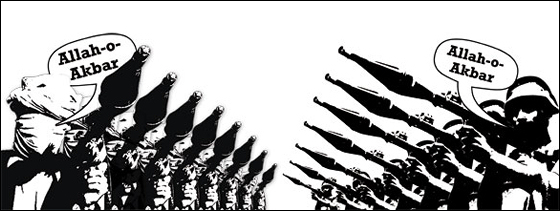
The Pakistan army’s biggest folly has been that under Zia it started outsourcing its basic job – soldiering – to these freelance militants. By blurring the line between a professional soldier who, at least in theory, is always required to obey his officer, who in turn is governed by a set of laws, and a mujahid who can pick and choose his cause and his commander depending on his mood, the Pakistan army has caused immense confusion among its own ranks. When soldiers who cry ‘Allah-o-Akbar’ when mocking an attack are ambushed in real life by enemies who shout ‘Allah-o-Akbar’ even louder, can we blame them if they waver in their response? When the naval chief Nauman Bashir calls the PNS Mehran attackers “very well trained,” is he just giving us hollow justification for what transpired, or admiring the creation of the institution he serves? When naval officials tell journalists that the attackers were “as good as our own commandos,” are they giving themselves a back-handed compliment?

In the wake of the attacks on PNS Mehran in Karachi, some TV channels pulled out an old war anthem sung by Madam Noor Jehan and started playing it against the backdrop of images of the young, hopeful faces of the slain officers and service men. Written by the legendary teacher and creator of childrens’ Tot Batot stories, Sufi Tabassum, the anthem carries a stark warning: Aiay puttar hatan tay nahin vick day, na labh di phir bazaar kuray (You can’t buy these brave sons from shops, don’t go looking for them in bazaars).

Whereas Sindhis and Balochis have mostly composed songs of rebellion, Punjabi popular culture has always lionised its karnails and jarnails and even an odd dhol sipahi. The Pakistan army has, throughout its history, refused to take advice from politicians, as well as thinking professionals from its own ranks. It has never paid heed to historians and sometimes ignored even the esteemed religious scholars it has used to whip up public sentiment for its dirty wars. But the biggest strategic mistake it has made is that it has not even taken advice from late Madam Noor Jehan, one of the army’s most ardent fans in Pakistan’s history. You can probably ignore Dr Eqbal Ahmed’s advice and survive in this country, but you ignore Madam at your own peril.

Since the Pakistan army’s high command is dominated by Punjabi-speaking generals, it is difficult to fathom what it is about this advice that they don’t understand. Any which way you translate it, the message is loud and clear – and lyrical: soldiers are not to be bought and sold like a commodity in shops. “Na awaian takran maar kuray” (That search is futile, like butting your head against a brick wall), Noor Jehan goes on to rhapsodise.

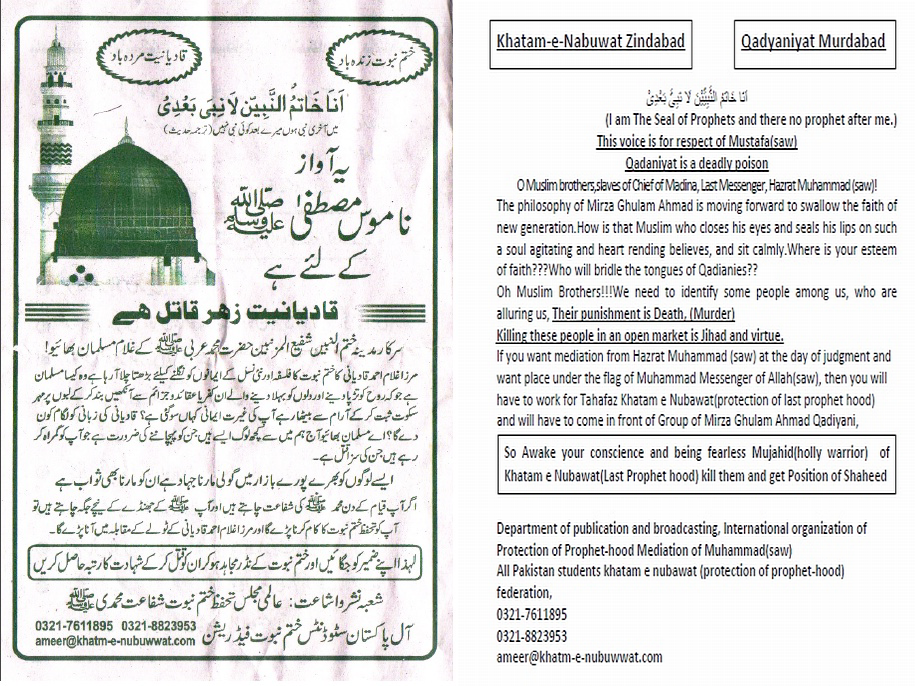
For decades the army has not only been shopping for these private puttars in the bazaars, it has also set up factories to manufacture them. It has, in fact, raised entire armies of them. When you raise the Lashkar-e-Taiba, Jaish Mohammed, Sipah-e-Sahaba, Sipah-e-Mohammed, Lashkar-e-Jhangvi and Al-Badar Mujahideen, others encouraged by the thriving marketplace will go ahead and create outfits like the Anjuman Tahuffuz-e-Khatam-e-Nabuwwat and Anjuman-Tahuffuz-e-Namoos-e-Aiysha. And it’s not just Kashmir, Afghanistan and Chechnya they want to liberate; they want to go back in time and seek revenge for a perceived slur that may or may not have been cast by someone more than thirteen hundred years ago in a country far, far away.

As if the army’s sprawling shopping mall of private puttars in Pakistan wasn’t enough, it has also actively encouraged the import and export of these commodities and even branched out into providing rest and recreation facilities for the ones who want a break. The outsourcing of Pakistan’s military strategy has reached a point where mujahids have their own mujahids to do their job and, inevitably, at the end of the supply chain are those poor, faceless teenagers with explosives strapped to their torsos being despatched to blow up other poor children.

Two days before the Americans killed Osama bin Laden and took away his bullet-riddled body, General Kayani addressed army cadets at Kakul. After declaring a victory of sorts over the militants, he gave our nation a stark choice. And before the nation could even begin to weigh the pros and cons, he went ahead and decided for them: we shall never bargain our honour for prosperity. As things stand, most people in Pakistan have neither honour, nor prosperity. They will readily settle for merely being able to survive in their little worlds without being blown up.

The question people really want to ask General Kayani is that if he and his army officer colleagues can have both honour and prosperity why can’t we, the people, have even a tiny bit of both?

The army and its advocates in the media often worry about Pakistan’s image, as if we are not suffering from a long-term serious illness, but a seasonal bout of acne that just needs better skin care. The Pakistan army has, over the years, cultivated an image of 180 million people with nuclear devices strapped to its collective body, threatening to take the world down with it. We may not be able to take the world down with us and the world might defang us or manage to calm us a bit, but the fact remains that Pakistan as a nation is paying the price for our generals’ insistence on acting like, in Asma Jahangir’s immortal words, “duffers.” And they are adding insult to inquiry by demanding medals and golf resorts for being such consistent duffers for such a long time.

What people really want to do at this point is to put an arm around our military commanders’ shoulders, take them aside and whisper in their ears: “Murshid, marwa na daina.”

Mohammed Hanif is a journalist, novelist and playwright who worked as reporter for Newsline before joining the BBC. He is the author of A Case of Exploding Mangoes.

© 2009 Newsline Publications (Pvt) Ltd
URL: www.newslinemagazine.com/2011/06/murshid-marwa-na-daina/

Saturday, August 21, 2010

Blasphemy: Pakistan’s descent into anarchy

Express Tribune, Pakistan
Blogs
Blasphemy: Pakistan’s descent into anarchy
by by Khubaib UsmaniTaha Kehar
Saturday, 21 August 2010
Upon Pakistan's declaration as an Islamic republic, the rights of religious minorities, particularly Hindus, Christians, and Ahmadiyya, diminished.
Upon Pakistan’s declaration as an Islamic republic, the rights of religious minorities, particularly Hindus, Christians, and Ahmadiyya, diminished.

The widow of Bantu Masih hurls her pet hens inside the cage as she prepares dinner. Her only son Bagga, a scavenger, will return sometime after a full day’s tedious labour. The family lives in a remote locality 65 km from Lahore. They had to shift here overnight, after an enraged crowd killed Bantu Masih, the sole breadwinner of the family, over alleged charges of blasphemy in court premises.

Human rights organisations and secular circles in Pakistan have been condemning the abuse of blasphemy laws in the country for the last many decades. Introduced by military dictator General Zia, the law is termed draconian by human rights organisations of the country fast descending down to further anarchy and chaos due to religious fanaticism.

Analysts believe this is the worst form of human right violation and no government in Pakistan could get rid of this despicable use of the law, the seeds of which were sown in 1949 when Liaqat Ali Khan, the country’s first prime minister made it a preamble of the constitution. The Objectives Resolution passed by the first Constituent Assembly in 1949 including 280 Articles and six Schedules became its preamble. The power to amend the Constitution was contained in Article 239.

The country’s checkered history saw the 1956 and 1962 constitutions, but no government in Pakistan could dare to part ways with the controversial Objective Resolution which many believe to be in direct confrontation with the ideology of the Quaid-e-Azam who in his landmark address to the First Legislative Assembly said:

“You are free; you are free to go to your temples, you are free to go to your mosques or to any other place of worship in this State of Pakistan. You may belong to any religion or caste or creed — that has nothing to do with the business of the State.”

It is surprising as to why a staunch supporter of secularism like Bhutto could not do away with the controversial resolution while he is credited with giving a consensus document after 26 years of the country’s independence. Gen Zia cunningly used religion for his own nefarious designs. He exploited the sentiments of extremist segments in the name of religion when the former USSR invaded Afghanistan. Few believe that it was Pakistan’s war on any account. Sentiments of the public had been deliberately exploited in the name of religion with financial backing of the West.

“The Blasphemy Law is the culmination of the sojourn the nation set upon itself in 1949,” commented a senior human rights activist who requested anonymity. “Jinnah wanted to make Pakistan a secular state but the country lost direction following his untimely death. Upon Pakistan’s declaration as an Islamic republic, the rights of religious minorities, particularly Hindus, Christians, and Ahmadiyya, diminished. These minorities live under the fear of threat to their lives and property, desecration of their places of worship, and the Blasphemy Act that carries a penalty of death,” he observed.

The frenzied mob mentality and the knee-jerk reaction on the streets following a blasphemy charge is a real source of concern for human rights organisations of the country. “Trapping anyone in the vicious cobweb of blasphemy is the easiest job in Pakistan,” says an activist of human rights commission of Pakistan who wished to remain anonymous.

It was not that long ago when Gojra, a small city in the heartland of Punjab witnessed frenzied mob attacks on Christian neighbourhoods which killed nine. The attacks were triggered by reports of desecration of the Holy Quran. It was reported that Mukhtar Maseeh, Talib Maseeh and his son Imran Maseeh had desecrated the papers inscribed with Holy Quran verses at a wedding ceremony. Before the tragic attack in Gojra, mosques were used to make announcements provoking the attack. Locals were urged to “make mincemeat of the Christians” before Gojra. Similarly, in Daudnagar announcements were made from mosques asking people to come out to “fight rampaging” Christians.

On October 28, 2001 in Lahore, militants killed 15 Christians at a church, three weeks after the US-led War in Afghanistan to topple the Taliban. On September 25, 2002, unidentified gunmen shot dead seven people at a Christian charity in Karachi’s central business district. They entered the third-floor offices of the Institute for Peace and Justice (IPJ) and shot their victims in the head. All of the victims were Pakistani Christians.

In November 2005, hundreds of militants attacked Christians in Sangla Hill in the Punjab province and destroyed Roman Catholic, Salvation Army and United Presbyterian churches. The attack was over allegations of violation of blasphemy laws by a Pakistani Christian named Yousaf Masih.

In February 2006, churches and Christian schools were targeted in protests over the publications of the Jyllands-Posten cartoons in Denmark, leaving two elderly women injured and many homes and properties destroyed. A young Hindu labourer, a few months back, was beaten black and blue by his own colleagues in Karachi on the pretext that he used derogatory language against the Holy Prophet (PBUH). The victim died on the spot and his family could not dare to lodge a complaint in the local police station and the police arrested no one. The incident happened in broad day light at a construction site in Karachi. The heirs of the deceased disappeared from their native abode on the fear of further persecution by the locals

“We need a paradigm realignment of the country, unless Pakistani is declared a secular state there will not be any tangible development on human rights front” concludes Muneer Ahmad who is pursuing a master’s degree in History from a well recognized public sector university. According to Minority Rights Group International, Pakistan had the world’s highest increase of threats against minorities last year and was ranked the sixth most dangerous country for minorities overall. Pakistan was ranked after Somalia, Sudan, Afghanistan, Iraq, Burma and the Democratic Republic of the Congo.

URL: http://blogs.tribune.com.pk/story/1172/blasphemy-pakistans-descent-into-anarchy/

Sunday, July 18, 2010

Opinion: How can Pakistan turn over a new leaf?

Global Post, USA
Opinion
Home / Worldview
--
Opinion: How can Pakistan turn over a new leaf?
The only chance to cleanse the state is to return to a secular identity.
Sonya Fatah


By Sonya Fatah — Special to GlobalPost
Published: July 18, 2010 10:35 ET in Worldview

--
Wazir Khan Mosque, Lahore
Pigeons fly over the Wazir Khan Mosque in the walled city of Old Lahore on July 9, 2010 in Pakistan. (Daniel Berehulak/Getty Images)

NEW DELHI, India — It isn’t a topic that’s making headlines in Pakistan. But it’s a debate that’s been raised countless times since the country’s birth in August 1947: Should Pakistan be secular?

Dogged by internal crises, the rise of a growing intolerant extremist segment and a deliberately apathetic state and military response, Pakistan’s future seems bleak.

Imagine a reinvention. Get rid of the “Islamic” part of the Islamic Republic of Pakistan. Shred all copies and records of the 1973 constitution and repeal a series of self-serving amendments to the constitution as well as bigoted anti-minority and anti-women laws. What you may be left with is the skeleton for a secular democracy.

A spate of recent terror attacks suggests this might be Pakistan’s only way of battling its inner demons. On May 28, armed militants attacked two mosques of the Ahmadiya community in Lahore. Ninety-seven people died and dozens were wounded.

Then on July 1 there were twin suicide attacks on Data Darbar also in Lahore, one of the largest and most visited Sufi shrines in Pakistan. The attack on the shrine was extraordinarily bold because it was an attack on Pakistan’s majority of Sunni barelvi believers. Some 43 people died.

In Faisalabad, on July 2, two Christian brothers were arrested for violating the Blasphemy Law. They’ve been accused of writing a pamphlet with derogatory comments about Prophet Muhammad. [Both of them were killed on 19th by an unknown gunmen in fron of City Court, while in Police custody.] In Waris Pura, a locality of some 100,000 Christians, Muslim mobs have been threatening to burn homes and kill Christians if both brothers are not executed.

The simple fact is that the state has, especially over the last 40 years, allowed for the persecution of its minorities. It has rewarded its majority to discriminate against them.

Sound harsh? A little exaggerated? Here are the facts.

Lets start with the Ahmadiyas. In 1974, under the supposedly liberal leadership of Zulfiqar Ali Bhutto, parliament passed a law declaring Ahmadiyas non-Muslims. This was a reward to the Jamaat-e-Islami party in Pakistan for spreading virulent anti-Ahmadiya hate speech and demanding their removal from the esteemed list of Pakistan-approved Muslim identities.

As if that wasn’t enough, Pakistan’s favorite general, General Zia ul Haq — whose arched eyebrows would have given Jack Nicholson some sleepless nights — presided over Ordinance XX in 1984. The ordinance spelt out the following: Ahmadiyas were not allowed to call themselves Muslims, to pray in regular mosques, to read out Quranic verses, or to “pose as Muslims.”

Move now to Faisalabad where street protests against two Christian brothers are mounting. No one has witnessed the brothers writing the pamphlet. As members of a tiny minority they’re unlikely to have wanted to defile anything Muslim in public or in private.

But the problem for Rashid and Sajid Emmanuel is something called the Blasphemy Law. Another gift of Zia ul Haq, the 1986 law carries the penalty of death for anyone who desecrates the Quran or defiles the name of Prophet Muhammad.

Many dubious claims invoking blasphemy have been made against innocent Muslims, Hindus and Christians alike since the law was first passed. Surrounded by a volatile public whose religious sensitivity is beyond reason, the accused often gets his or her death sentence before the matter even reaches the court.

Pakistan has always struggled to define itself. In the absence of a concrete identity, Islam has been used and manipulated for political ends. In 1958 the official tag of “Islamic” Republic was added to its name.

Pakistan’s founder, the barrister Mohammad Ali Jinnah, had no such plan for Pakistan. On Aug. 11, 1947, when addressing the first constituent assembly, he told Pakistanis, “You are free; you are free to go to your temples, you are free to go to your mosques or to any other place of worship in this State of Pakistan. You may belong to any religion or caste or creed — that has nothing to do with the business of the State.

“You will find that in course of time Hindus would cease to be Hindus and Muslims would cease to be Muslims, not in the religious sense, because that is the personal faith of each individual, but in the political sense as citizens of the State.”

That was not Jinnah’s singular speech on secularism.

Sadly, he died in 1948 and what has happened since then is a sad and dangerous tale.

As the 2010 report of the United States commission on International Religious Freedom puts it: “Religiously discriminatory legislation has fostered an atmosphere of intolerance” in Pakistan.

Over the years Pakistanis have watched as minority groups and women have been targeted. Yet with the exception of a few activist groups and human rights organizations, the majority of Pakistanis have maintained a condemnable silence.

The difference was palpable in national reactions to the two, separate attacks on religious communities in Lahore.

“This act of violence was unanimously — politicos, religiosos and all — vociferously ‘condemned’ and the country saw many protests, demos and city shut-downs,” Amina Gilani wrote, referring to the attacks on Data Darbar, in The Tribune, one of Pakistan’s English-language dailies. “A somewhat different reaction to the event of May 28 … The reaction of the majority — politicos, religiosos and all — was comparatively rather muted. It raised no suggestions for a national get-together.”

How does Pakistan turn over a new leaf? Pakistan’s only salvation to cleanse the state and its mindset is to return to a secular identity.

“[We] will need a revolution of the national mindset and a whole new constitution,” said Ardeshir Cowasjee, a longtime writer and editorialist. “[We] will also need a whole and entire new brand of politicians, or leaders of whatever type. We need to do away with ‘Islamic’ and with the Objectives Resolution before we can even begin to make progress — plus ditch quickly the Hadood Ordinances and the blasphemy laws and all Islamic provisions, which govern this country. So it has to be secularism all the way.”

That’s a lot of work for any country, more so for one in crisis.

Still there are forces moving in that direction. On Christmas Day last year, Haji Adeel, a major political leader of the Awami National Party and a Pakistani senator, advocated a return to secularism. Adeel found himself the target of a host of critics including the Islamic right. But he also found supporters, and set off debate in various circles about the idea.

Now that Saudi-style and Saudi-funded Wahhabi Islam has reached the popular shrine of Data Ganj Baksh, perhaps more Pakistanis will see that the anti-American, anti-Israeli and anti-colonialist body that defines itself as the Taliban, is also anti-them.

Still, even if secularism is Pakistan’s yellow brick road to saving itself, it’s going to take a lot more than changing the constitution and axing a few laws. This is a battle for changing mindsets, and Pakistanis are in it for the long haul.

Thursday, July 8, 2010

Pakistan’s Religious Minorities Face Persecution by the State

Jakarta Globe, Indonesia

July 08, 2010
Pakistan’s Religious Minorities Face Persecution by the State

Just a month ago, at least 95 members of the Ahmadiyah Islamic sect were killed and nearly 100 injured in attacks on their places of worship in Lahore, in Pakistan’s Punjab province. The attacks were part of a campaign against Ahmadis by Islamist groups openly sympathetic to terrorist groups, including the Taliban.

Politicians have been strangely silent on the attacks. Punjab’s chief minister, Shahbaz Sharif, the leader of the Pakistan Muslim League, has not shown his face at either Ahmadi mosque targeted in the attacks, despite living down the road from them.

Mohammed Hanif, a journalist, wrote: “When the funerals of the massacred Ahmadis took place there were no officials, no politicians present.”

Several days after the attack, former Pakistani Prime Minister and Pakistan Muslim League leader Nawaz Sharif said the members of the Ahmadi sect were his brothers and sisters and that militants should be flushed out wherever they were active.

His comments drew sharp criticism from religious parties like the Khatm-e-Nabuwat Movement, Jamiat Ulema-e-Islam and Jamaat-e-Islami.

Maulana Ilyas Chinioti, the head of KNM, a member of the PML-N and the Punjab provincial assembly, also condemned Sharif’s statement.

Maulana seems to be openly preaching that non-Muslims are lesser humans, despite the fact that Ahmadis profess that they are Muslims.

Those who dare to defend the rights of religious minorities in Pakistan are usually labeled as being “anti-Islam.”

Ahmadis have been under widespread attack by increasingly violent Islamic fundamentalists across the planet.

The movement was founded in India by Mirza Ghulam Ahmad, who died in 1908 and who claimed to have succeeded the Prophet Muhammad as leader of the religion and who would bring about the final triumph of Islam as per Islamic prophecy.

According to a June 4 story in The News, a surviving attacker of the Lahore carnage, Abdullah, alias Muhammad, said he was misled into believing that Ahmadis were involved in drawing blasphemous caricatures of the Prophet Muhammad, so their bloodshed was a great service to Islam.

The campaign against the sect began a decade ago in Pakistan. Before the 1947 partition of Pakistan and India, anti-Ahmadiyah agitation was instigated by the Majlis-i-Ahrar, a lower-middle-class party.

In 1934, Ahrar set up an anti-Ahmadi movement after the Ahmadi community supported a demand for a Pakistan. In 1953, six Ahmadis lost their lives when an anti-Ahmadiyah wave swept the newly founded country.

According to Waqar Gilani, in 1973 the then president of Azad Jammu and Kashmir, Sardar Abdul Qayyum, declared Ahmadis to be non-Muslims. In the same year, a Saudi Arabian conference also agreed to oust Ahmadis from the circle of Islam.

In 1974 they were declared non-Muslims by the Pakistani Parliament. In 1984, Gen. Zia-ul-Haq promulgated a martial law ordinance containing blasphemy laws that undercut the activities of religious minorities generally, but struck at Ahmadis in particular.

Since then, they have been arrested frequently for greeting someone with the traditional Islamic Assalam-o-Alaikum, reciting Muslim prayers or reading the Holy Koran.

In the period 1984-2009, 105 Ahmadis were killed in Pakistan, according to two authors writing in Viewpoint, a Pakistani online magazine.

“During the same period, 22 Ahmadiyah mosques were demolished, 28 were sealed by authorities, 11 were set on fire and 14 were occupied, while construction of 41 was banned. In at least 47 cases, burials were denied in common graveyards while 28 bodies were exhumed,” the two wrote.

Since 2000, an estimated 400 Ahmadis have been formally charged in criminal cases, including blasphemy. Many remain imprisoned.

Both printed and electronic Pakistani media have played a scandalous role in spreading hatred against the community.

Recently, the Muslim Canadian Congress blamed major media outlets in Pakistan for inflaming rhetoric against Ahmadiyah, Ismaili and Shia Muslims.

In particular, the MCC pointed out that GEO Television had become the voice of Al Qaeda and the Taliban and had spread hatred against these communities as well as against non-Muslims.

Religious minorities in general and Ahmadis in particular are not treated by the Pakistani state as equal citizens. They are routinely intimidated and persecuted because of their faith.

Unless the state changes its mind-set about minorities, they will live under constant threat, which is against international human rights laws and the constitution of Pakistan.

Aftab Alexander Mughal is the editor for a Pakistan-based nongovernmental organization, Minorities Concern of Pakistan.

Copyright 2010 The Jakarta Globe

Tuesday, July 6, 2010

Religious fundamentalism main root of violence in Pakistan

Calgary Herald, Canada
Religious fundamentalism main root of violence in Pakistan
By Mahfooz Kanwar, For The Calgary Herald July 6, 2010

In a little more than a month there have been two major terrorist attacks perpetrated by Muslims against other Muslims at mosques in Lahore, Pakistan.

This past Thursday, two suicide bombers blew themselves up killing at least 42 people and injuring a minimum of 180 people at the Data Darbar shrine, where a famous Sufisaint is buried.

On May 28, fundamentalist Muslims massacred more than 90 Ahmadiyya Muslims at their two mosques in Lahore and injured hundreds more.

When these events occur – and their have been many more in this Punjab region of Pakistan – the world wonders: why do Muslims kill other Muslims?

Not only did some Muslim fundamentalists armed with suicide vests, guns and grenades kill and injure dozens of worshippers, but they also took a large number of Ahmadis hostage.

This appalling, murderous act is not unusual in the history of Pakistan. In 1953, Jamaat-e-Islami Pakistan, a fundamentalist religious and political party in Pakistan, created a murderous upheaval against Ahmadis in the same city of Lahore. Jamaat’s hooligans killed approximately 2,000 innocent Ahmadis. Now, the Taliban and al-Qaeda are suspected in this sectarian violence.

During my schooling, I minored in Islamic studies, and have published a book on Sociology of Islam. I have studied Islam further and have published my research in two other of my books as well as columns in newspapers and I have discussed those results in three of my 21 documentaries over the years.

Many Muslim fundamentalists are semi-literate, and some of them totally illiterate mullahs. The Holy Book of Qur’an makes it very clear that those Muslims who kill or commit suicide will be condemned to hell. Yet, some of these ill-informed Muslim extremists, such as suicide bombers, commit both murder and suicide. And they believe they are acclaimed to go to heaven in their life here after.

Pakistani Islamists always have had issues with the Muslim sect of Ahmadis. Along with the Islamic fundamentalists, some prominent secular politicians have also played the card of religion in Pakistan. The former prime minister of Pakistan, Zulfikar Ali Bhutto, declared Ahmadis as non-Muslims in the early 1970s.

Bhutto’s government introduced a column for religion on the national identity cards as well as passports in singling out the Muslim sect of Ahmadis along with the rest of non-Muslims in Pakistan. This was designed basically to create a system of religious apartheid in Pakistan. That act smacked the basic Islamic principle of tolerance.

In Pakistan, Ahmadis are often barred from praying in their mosques. To preach their faith is considered to be a crime under Article 295 of the Penal Code of Pakistan. The federal sharia Court of Pakistan has ruled that preventing Ahmadis from preaching their faith is no violation of the fundamental rights guaranteed in the Constitution of Pakistan. This is akin to the system of apartheid which was once practised in South Africa.

Although Bhutto was overwhelmingly supported politically by more than two million Ahmadis in Pakistan, he declared Ahmadis as non-Muslims. Bhutto, a secular political leader, betrayed Ahmadis big time. However, the vile fundamentalist and ruthless military dictator Muhammad Zia-ul-Haq expanded the system of apartheid for Ahmadis in Pakistan.

What makes Bhutto, Zia and many mullahs qualified to decide who are or aren’t Muslims? It is supposed to be God’s business to judge His creatures.

In my research for my forthcoming book, Addiction to Religion, I note, among other things, that Islam means peace and Muslims are supposed to adhere to peace, but that does not seem to be the case for decades now.

Islam is a religion but Islamism is an addiction to religion that leads to terrorism. Fundamentalism is a gateway to addiction to religion which blinds people to become suicide bombers who commit two sins in Islam that will take them to hell.

Unfortunately, Pakistan is ruled by five pillars of corrupt establishment. They are: unpatriotic feudal landlords turned politicians (they, along with the Jamaat-e-Islami, were opposed to the creation of Pakistan), cruel military dictators (who have ruled Pakistan ruthlessly for more than half of it’s history), corrupt politicians, depraved bureaucrats, and fundamentalist mullahs.

This last pillar is perhaps the most key. Until the idea of freedom of religion becomes accepted in Pakistan, Muslims will keep on killing each other. That’s because they believe that there is only one way to practice Islam – their way. They are taught no tolerance to other faiths or even to those who share their faith but practise it differently. That’s why Shiites kill Sunnis, Sunnis kill Shiites, both kill Ahmadis and these groups – with the backing of the government and Pakistani law – all persecute and attack Christians and Hindus.

Until and unless something revolutionary happens, Pakistan will continue facing drastic, murderous problems.

Mahfooz Kanwar is Professor Emeritus at Mount Royal University

Copyright © The Calgary Herald

Wednesday, June 2, 2010

Still no counterterrorism strategy

The News - Internet Edition
Wednesday, June 02, 2010,
Jamadi-us-Sani 18 , 1431 A.H.

 Still no counterterrorism strategy

Wednesday, June 02, 2010
Mosharraf Zaidi

One of my closest friends has never once, in more than fifteen years, ever responded to my salaam with a salaam. I have never held it against him. If he did, and a budding Mullah Chinioti heard him say it, he could be imprisoned for three years. I don’t blame my friend for never wanting to take the risk. Being risk-averse is not a choice made when you reach adulthood for Pakistani Ahmedis. It is a way of life. Every murdered Ahmedi in Pakistan helps reinforce the fear and the stoicism of this patriotic community of Pakistanis. And every murdered Ahmedi is a stain on Pakistan’s rich canvas of disgrace and guilt.

The press in Pakistan is awash in self-conscious hand-wringing about the massacre of Ahmedis by the TTP in Lahore. No such trepidation or nerves were on display at any previous point in this bloody and unending war between the TTP and the Pakistani people. Pakistanis that aspire for a “liberal” social and political space are incandescent with rage about the blasphemy law, about Zulfi Bhutto’s kneeling before the “mullahs” and about Zia’s escalation of state-sponsored, legal and constitutional hostility towards Ahmedis. Most Pakistanis, however, far and widely disconnected from what has come to represent “liberal” in Pakistan, would rather stay silent. There is surely a degree of shame and guilt for living in a country that has, even if it is by some degrees of separation, essentially participated in ghettoising an entire community. For most Pakistanis, however, there’s something more important than this shame. There is a fierce commitment to Islam.

This narrative of overarching religious devotion needs to be understood for what it is. Most Pakistanis are not particularly religious, but are very, very particularly devoted to the symbols of their religion. There is scarcely a symbol more central to Pakistani Muslims than the life, times and person of the Holy Prophet Muhammad, may Allah’s peace and blessings be upon him. The flat and comprehensive finality of the Holy Prophet is non-negotiable.

Of course, that commitment does not, under any moral, legal or political framework, justify the way that Ahmedis are treated in Pakistan. In fact, the real outrage may be that Pakistani Muslims allow themselves to live in a country where religious fanatics posing as vigilantes see it fit to distribute their twisted version of justice on the lives of the innocent minorities of Pakistan.

The religious issue of the status of the Ahmedi faith in Pakistan is further complicated because it is also a legal issue. If Pakistanis, whether they call themselves liberal or not, are interested in beating the fanatics, and making Pakistan a safe place to live for all Pakistanis, then remembering certain facts is central to the project of fixing Pakistan.

The religious identity of Pakistan’s Constitution was the product of a democratic discourse. It is easy to demonise Zia, particularly given his government’s slavish pandering to a tiny sliver of mullahs. But frankly, reality also requires us to remember that Bhutto’s own rhetoric and most of the mainstream discourse preceding Bhutto (notwithstanding Ayub’s colonised vision for Pakistan) was not uncomfortable with Muslim identity. To the contrary, it had a healthy mix of political Muslimness, without any of the political Islamism that infected Pakistan under Zia.

That middle-of-the-road approach to Islam in the public space has not turned out very well. Arguably, it has bequeathed to Pakistan the TTP and its various components, and affiliates, including the increasingly brazen Lashkar-e-Jhangvi. But the emergence of Pakistani soil as the birthing place of so many terrorists is not solely a product of the Pakistani political conversation, and Islam’s place in it. It is also a product of the Pakistani military elite’s insatiable appetite for shiny new weapons.

The success or failure of the PPP- and Muslim League-dominated mainstream politics of Pakistan – which has always absorbed “Muslimness” into the discourse – can be argued about. There is no argument, however, about one fact. Since well before Bhutto, one bankable reality in Pakistani politics is that so-called Pakistani liberalism will always score high with the west and fail spectacularly at home. The righteous indignation of Pakistan’s “progressive” and “liberal” elite – whenever Pakistani extremism or fanaticism rears its ugly head – has very little bearing on what takes place in this country. Of the most important issues to any sincerely progressive person in Pakistan – such as how women are treated, how the powerful are unaccountable and how minorities are treated – it is the Pakistani fanatic that has won every single argument since 1947.

As children of Jinnah’s Pakistan, perhaps aspiring liberals and progressives need to start to ask questions about the nature of our citizenship, the nature of our engagement, and the nature of our politics within the broader canvas of realpolitik in Pakistan. The most important paint on this canvas is the green-coloured traditional South Asian Muslim sentiment of the overwhelming majority of Pakistanis. Pakistan’s central conversation is not a Sufi rock concert. It is a race for the next rupee, whilst carefully stepping over a cocktail of Barelvi, Deobandi, Wahhabbi, post-modern, Salafi and Shiite veritable “landmines”. Pakistani Muslim orthopraxis is diverse and contested – but it is central to defining the lowest common denominator in Pakistan’s issue-politics.

Asking questions about how to improve the rate of success of liberal causes in Pakistan requires us to take a break from mullah-bashing, and introspect. It is a political minefield if you’re a reformer interested in stripping Pakistan’s Constitution of its Muslim identity. It is an orchard ripe with fruit if you’re interested in exploiting existing religious stereotypes and biases in Pakistani society. Where can we reasonably expect every politician to eventually land every single time?

A transformed political landscape is a long-term project. Without substantially more grounded and active participation of Pakistani liberals in mainstream politics, it has no chance of fruition. In the meantime, Pakistanis, like the ones at Ghari Shahu and Model Town, are dying. I’m not interested in the guilty pleasures of trying to figure out if they were Muslim or not. I’m interested in catching the murderous criminals that did this, and making sure they don’t do it again. We can have all the uncomfortable religious conversations we like once we’re all secure from these bombs and bullets.

Let’s not forget that Benazir Bhutto is among the thirty thousand victims of terrorism in Pakistan since 2001. Since the TTP came together in December 2007, they have killed indiscriminately at mosques, at schools, at universities and in markets. Every law – both written and unwritten – in Pakistan is used to protect its VIPs, and yet the TTP got to Shaheed Mohtarma, and killed her.

We are too self-conscious as a nation. Too beholden to mullahs on the one hand, and too dislocated from our own culture and context on the other. The terrorist attacks in Lahore were more of what has become a standard part of life in Pakistan since 2007. The TTP may be ceding ground to the Pakistani Army and the friendly skies that US drones explore on a daily basis. But they are winning the war. The longer we remain stuck in a useless ideological conversation, the more ground the TTP will gain.

The most important tribute we can pay to those that were slaughtered by the TTP in Lahore is to formulate and execute a transparent and comprehensive counter-terrorism strategy. Anything less would be a continuation of the failed politics of Pakistani liberals, and the unchallenged run of success enjoyed by Pakistani fanatics. Of course, many of us have been advocating a CT strategy now for the better part of three years. I am not hopeful.

In the meantime, I will continue to be ashamed every time I meet my Ahmedi friends. Whatever religious disagreements we may have, Pakistani Muslims should have been protectors of the weak, not spectators to their torment. The TTP’s bloodlust does not abdicate us from that responsibility.

The writer advises governments, donors and NGOs on public policy. www.mosharrafzaidi.com

Monday, May 3, 2010

A matter of faith

---Express Tribune, Pakistan

A matter of faith

By Basil Nabi Malik
May 03, 2010


The writer is a lawyer with Malik, Chaudhry, Ahmed and Siddiqi in Karachi (basil.nabi@tribune.com.pk)

It is common knowledge that we are duty bound to follow and respect the Constitution of Pakistan and each and every one of its articles. However, the same becomes a tad bit difficult when certain unpalatable clauses are added which really have no business being in the constitution.

For example, if I were to ask anyone as to the definition of a ‘Muslim’, I am guessing the last place they’d look would be in the Constitution of Pakistan. However, lo and behold Article 260 of our constitution actually defines the term. Ironically, all this happened during the time of Zulfikar Ali Bhutto, though he was, of course, pressured to do this by certain religious quarters.

Although it was clearly a political move, the method was unique. Rather than to go into the intricacies and complications of trying to forge a unanimously agreed-upon definition, which many thought was next to impossible and perhaps even unnecessary, he thought it fit to zero in on an exclusionary clause which ‘enlightened’ us on what a Muslim could not be.
.
However, clearly, this was the kind of medieval quackery that only ‘scheming politicians’ could think of. It took the likes of General Zia in 1985 to give us an affirmative definition of a Muslim, sans the discussions and attempts at consensus building, which in all likelihood, he probably found irrelevant. He did this in the form of the President’s Order No. 24 of 1985, whereby Article 260(3) was substituted with what can best be described as intriguing definitions of the terms ‘Muslim’ and ‘non-Muslim’.

The word ‘Muslim’ entailed: “a person who believes in the unity and oneness of Almighty Allah, in the absolute and unqualified finality of the Prophethood of Muhammad (pbuh), the last of the Prophets and does not believe in, or recognise as a prophet or religious reformer, any person who claimed or claims to be a prophet, in any sense of the word or of any description whatsoever, after Muhammad (pbuh)”. General Zia, however, didn’t leave it at that.

For some odd reason, he didn’t feel that the people of the country would actually be able to understand the term ‘Muslim’ and so the definition of ‘non-Muslim’ was also inserted. The term ‘non-Muslim’ was defined as: “a person who is not a Muslim and includes a person belonging to the Christian, Hindu, Sikh, Buddhist or Parsi community, a person of the Qadiani Group or the Lahori Group who call themselves ‘Ahmadis’ or by any other name or a Bahai and a person belonging to any of the Scheduled Castes”.

Effectively, in one stroke, General Zia did what Justice Munir in the Munir Report of 1954 dreaded and forewarned against: the adoption of certain religious worldviews at the expense of others, thereby inducing divisions in society. To be more exact, after asking a variety of the ulema as to what the definition of a Muslim would entail and receiving varying responses, Justice Munir said in the report that: “keeping in view the several definitions given by the ulema [defining the term Muslim], need we make any comment except that no two learned divines are agreed on this fundamental.”

The point is that what business is it of the state to get into this whole matter of defining who is a Muslim and who isn’t. One would have thought that this is a matter best left to individuals themselves and is something to be assessed by their conduct and actions — and in any case it is a private matter for each individual. It’s a pity that the 18th amendment chose to ignore this in the present constitution.

URL:
http://tribune.com.pk/story/10274/a-matter-of-faith/

Sunday, August 23, 2009

Not the business of the state — 2

--- daily DAWN, Pakistan
COLUMNISTS
Not the business of the state — 2
By Ardeshir Cowasjee
Sunday, 23 Aug, 2009 | 09:51 AM PST

Are we not supposed to all be equal citizens with equal rights as decreed by Mohammad Ali Jinnah, the man who founded and made the country? - Photo by Reuters/FileOn Aug 18, a letter from Citizen of Pakistan Naeem Sadiq of Karachi (naeemsadiq @ gmail.com) was printed in this newspaper of record. The subject was a ‘Request for suo moto notice’ and it was an appeal to the chief justice of the Sindh High Court.

Karachi’s Defence Housing Authority in its application form for the allotment of plots in its DHA City scheme has asked those applying to declare their religion and sect. This, states Naeem, is discriminatory and a violation of our fundamental rights. He contends that the intention of the DHA is to make segregated living zones for those of different religions and to further add to this division on sectarian grounds. The demand is at odds with Islam, the Quran and Sunnah making no mention of any ‘sects.’

As he writes: ‘Unless checked, this practice may soon extend to a declaration of religion and sect for other routing commercial transactions, such as buying a PIA ticket or obtaining a mobile telephone SIM.’ So, he has requested the chief justice of Sindh to ‘take suo moto notice and order the DHA to remove the requirement of religion and sect from its application forms and other related documents’.

Absolutely correct — it is not the business of the DHA to delve into the religion and sect of people wishing to purchase plots which it has advertised for sale.

In similar vein, Citizen Sadiq on July 25, 2009 addressed a letter to Chief Justice of Pakistan Iftikhar Chaudhry at Islamabad on the matter of compulsory zakat deductions by the banks of Pakistan, appealing to the Supreme Court in the public interest to take suo moto notice. His letter reads: ‘The Supreme Court of Pakistan in a landmark judgment on March 9, 1999 gave a ruling that members of all ‘fiqhs’ were entitled to exemption from compulsory deduction of zakat, and the federal government had no authority to reject the declaration of any Muslim seeking exemption from zakat, if it was made on a prescribed form. This judgment enables any Muslim to declare his/her ‘fiqh’ and thus seek exemption from compulsory deduction of zakat. De facto, it also recognises the right of individuals to practise their faith according to their own ‘fiqhs,’ and not be dictated by the government’s interpretation.

‘The historic judgment, while so well recognising the right of individuals in matters of their faith, made an irritating mess of how this right was to be practised. Firstly, it requires Muslims to declare their ‘fiqh.’ The great Prophet of Islam (PBUH) did not subscribe to any ‘sect’ or ‘fiqh.’ For his followers to be forced to invent, be branded and be divided by sects and ‘fiqhs’ is therefore an absolutely unethical and undesirable demand on the part of the government.

‘The second irritant relates to the requirement of making this declaration on a prescribed format, thus creating a serious bureaucratic and procedural difficulty for the ordinary citizens. They are required to fill a judicial stamped paper of Rs20 (available for Rs120), have it signed by a notary public and two witnesses before making a completely unnecessary declaration of their ‘fiqh.’ The form is also called CZ-50 affidavit.

‘This anomaly could be easily rectified if the Supreme Court, through a public interest suo moto notice, clarified its original judgment by requiring only those Muslims to give in writing (on a plain piece of paper) who do wish their zakat to be deducted by a bank. This would truly be in keeping with the Supreme Court verdict that all Muslims are entitled to exemption from compulsory deduction of zakat.’

By July 31, Naeem received a letter from the Supreme Court registrar advising him that the chief justice had been pleased to accept the application and ordered that the matter (Suo Moto Case No.12 of 2009) be heard on Aug 10 at Islamabad, and he was required to appear in person.

Two issues were raised at the hearing: (a) that the procedure for exemption from compulsory deduction of zakat was tedious, time-wasting, and cumbersome; and (b) that the state cannot compel its citizens to declare a specific ‘fiqh’ and thus be divided and boxed into one or the other schools of interpretation.

Chief Justice Chaudhry sitting with Justices Jawwad Khawaja and Ijaz Ahmad heard the submission, agreed that it was a pro bono case, and ordered the State Bank and the federation of Pakistan to appear before the court at the next hearing (which is fixed for Oct 5) and explain as to why this procedure cannot be simplified and improved in the light of issues raised by the appellant.

The state of Pakistan is intrusive when it comes to matters of religion. Why? Are we not supposed to all be equal citizens with equal rights as decreed by Mohammad Ali Jinnah, the man who founded and made the country? According to the original constitution as promulgated at noon on Aug 14, 1973 by Zulfikar Ali Bhutto, we were equal citizens of the state, with equal rights. But this equality was done away with in 1974 by Bhutto’s second amendment to his constitution, bending to the obscurantists and bigots, and an entire community was shorn of its rights and declared a minority.

Prior to this, in 1979 the same community was targeted by Ziaul Haq, general of the army and president of the republic, pious and God-fearing. He had decreed that all citizens, regardless of their religion, wishing to obtain a passport must sign a declaration that it is his/her belief that the Prophet of Islam is the final prophet and that any pretender that follows him is false.

Such is the business of the state.

arfc@cyber.net.pk

©2009 DAWN Media Group. All rights reserved
 
^ Top of Page