Showing posts with label conviction. Show all posts

Sunday, February 7, 2010

Minority affairs’ minister sees blasphemy law revision this year

---Daily Dawn, Pakistan
Pakistan
Minority affairs’ minister sees blasphemy law revision this year
Sunday, 07 Feb, 20107
WASHINGTON: Pakistan plans within this year to revise its laws against blasphemy, which have long been criticised as a way to abuse minorities, a government minister said.

Shahbaz Bhatti, minister for minority affairs, said religious reconciliation was a little-noticed priority for President Asif Ali Zardari’s civilian government in Pakistan, which lies on the frontline of the US-led war against extremism.

Bhatti, a long-time Roman Catholic activist whose position was given full cabinet status for the first time, said he was speaking with political parties to present revisions to the blasphemy law by the end of 2010.

“This is a democratic government which has a commitment to repeal all the discriminatory laws affecting the rights of minorities,” Bhatti told AFP in an interview in Washington.

“We are using military action to fight terrorism and we are using economic opportunities, but another thing which is important is that we are pursuing interfaith harmony,” he said.

Bhatti said that while he did not envision an immediate repeal of blasphemy laws, the revision would require judges to investigate cases before they are registered — creating oversight of the police, who are often accused of abuse.

The revised law would also assign punishment equivalent to that under the blasphemy laws for anyone who makes a false complaint, he said.

Bhatti was in Washington to attend the National Prayer Breakfast, an annual Christian-organised gathering drawing national leaders. He also met with US lawmakers, the US Commission on International Religious Freedom and Richard Holbrooke, the US special envoy to Afghanistan and Pakistan.

Pakistan’s law against blaspheming Islam carries the death penalty. While no one has ever been sent to the gallows for the crime, activists say the law is used to exploit others out of personal enmity or business disputes.

In June last year, blasphemy allegations led to mob violence against Christians in Punjab that caused hundreds to flee, according to the US State Department’s annual report on religious freedom around the world.

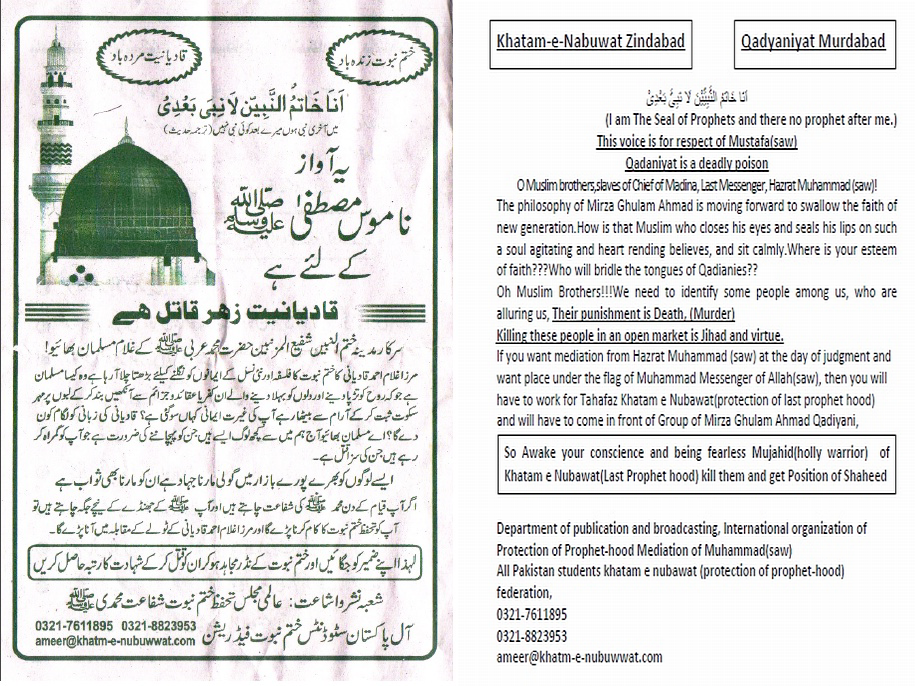
The report said there was particular discrimination against the Ahmadiya community, which Pakistan considers non-Muslim as adherents do not believe Mohammed was the last prophet.

In another incident in September, a 25-year-old Christian jailed on blasphemy allegations died in prison. Activists suspected he was tortured, but authorities said he committed suicide.

Pakistan, founded in 1947 as a Muslim homeland during the bloody partition of British India, is overwhelmingly Muslim. Religious minorities however form some five per cent of the population, according to government figures.

Among Muslims, strong tensions also persist between the majority Sunni and the minority Shia sects. Bombings on Friday killed 33 people in Karachi, including an attack near a bus carrying people to a Shia procession.

In UN bodies, Pakistan has butted heads with Western democracies by sponsoring resolutions on fighting “religious defamation.”

But Bhatti vowed to make progress at home.

In December, the government launched a drive to set up more than 120 “district interfaith harmony committees” around Pakistan to help resolve conflicts surrounded minorities.

Bhatti said he has personally visited religious communities around the country including more than 30 madrassas, or Islamic schools, to encourage tolerance.

While he said he met a positive reception, Bhatti was under no illusions about his safety, saying he has faced death threats.

“When I started this struggle I said that I would not compromise on the principle of religious freedom and human equality,” he said.

“These principles are the nucleus of my life. I will live for them and I will die for them.”

©2010 DAWN Media Group. All rights reserved

Sunday, August 23, 2009

Not the business of the state — 2

--- daily DAWN, Pakistan
COLUMNISTS
Not the business of the state — 2
By Ardeshir Cowasjee
Sunday, 23 Aug, 2009 | 09:51 AM PST

Are we not supposed to all be equal citizens with equal rights as decreed by Mohammad Ali Jinnah, the man who founded and made the country? - Photo by Reuters/FileOn Aug 18, a letter from Citizen of Pakistan Naeem Sadiq of Karachi (naeemsadiq @ gmail.com) was printed in this newspaper of record. The subject was a ‘Request for suo moto notice’ and it was an appeal to the chief justice of the Sindh High Court.

Karachi’s Defence Housing Authority in its application form for the allotment of plots in its DHA City scheme has asked those applying to declare their religion and sect. This, states Naeem, is discriminatory and a violation of our fundamental rights. He contends that the intention of the DHA is to make segregated living zones for those of different religions and to further add to this division on sectarian grounds. The demand is at odds with Islam, the Quran and Sunnah making no mention of any ‘sects.’

As he writes: ‘Unless checked, this practice may soon extend to a declaration of religion and sect for other routing commercial transactions, such as buying a PIA ticket or obtaining a mobile telephone SIM.’ So, he has requested the chief justice of Sindh to ‘take suo moto notice and order the DHA to remove the requirement of religion and sect from its application forms and other related documents’.

Absolutely correct — it is not the business of the DHA to delve into the religion and sect of people wishing to purchase plots which it has advertised for sale.

In similar vein, Citizen Sadiq on July 25, 2009 addressed a letter to Chief Justice of Pakistan Iftikhar Chaudhry at Islamabad on the matter of compulsory zakat deductions by the banks of Pakistan, appealing to the Supreme Court in the public interest to take suo moto notice. His letter reads: ‘The Supreme Court of Pakistan in a landmark judgment on March 9, 1999 gave a ruling that members of all ‘fiqhs’ were entitled to exemption from compulsory deduction of zakat, and the federal government had no authority to reject the declaration of any Muslim seeking exemption from zakat, if it was made on a prescribed form. This judgment enables any Muslim to declare his/her ‘fiqh’ and thus seek exemption from compulsory deduction of zakat. De facto, it also recognises the right of individuals to practise their faith according to their own ‘fiqhs,’ and not be dictated by the government’s interpretation.

‘The historic judgment, while so well recognising the right of individuals in matters of their faith, made an irritating mess of how this right was to be practised. Firstly, it requires Muslims to declare their ‘fiqh.’ The great Prophet of Islam (PBUH) did not subscribe to any ‘sect’ or ‘fiqh.’ For his followers to be forced to invent, be branded and be divided by sects and ‘fiqhs’ is therefore an absolutely unethical and undesirable demand on the part of the government.

‘The second irritant relates to the requirement of making this declaration on a prescribed format, thus creating a serious bureaucratic and procedural difficulty for the ordinary citizens. They are required to fill a judicial stamped paper of Rs20 (available for Rs120), have it signed by a notary public and two witnesses before making a completely unnecessary declaration of their ‘fiqh.’ The form is also called CZ-50 affidavit.

‘This anomaly could be easily rectified if the Supreme Court, through a public interest suo moto notice, clarified its original judgment by requiring only those Muslims to give in writing (on a plain piece of paper) who do wish their zakat to be deducted by a bank. This would truly be in keeping with the Supreme Court verdict that all Muslims are entitled to exemption from compulsory deduction of zakat.’

By July 31, Naeem received a letter from the Supreme Court registrar advising him that the chief justice had been pleased to accept the application and ordered that the matter (Suo Moto Case No.12 of 2009) be heard on Aug 10 at Islamabad, and he was required to appear in person.

Two issues were raised at the hearing: (a) that the procedure for exemption from compulsory deduction of zakat was tedious, time-wasting, and cumbersome; and (b) that the state cannot compel its citizens to declare a specific ‘fiqh’ and thus be divided and boxed into one or the other schools of interpretation.

Chief Justice Chaudhry sitting with Justices Jawwad Khawaja and Ijaz Ahmad heard the submission, agreed that it was a pro bono case, and ordered the State Bank and the federation of Pakistan to appear before the court at the next hearing (which is fixed for Oct 5) and explain as to why this procedure cannot be simplified and improved in the light of issues raised by the appellant.

The state of Pakistan is intrusive when it comes to matters of religion. Why? Are we not supposed to all be equal citizens with equal rights as decreed by Mohammad Ali Jinnah, the man who founded and made the country? According to the original constitution as promulgated at noon on Aug 14, 1973 by Zulfikar Ali Bhutto, we were equal citizens of the state, with equal rights. But this equality was done away with in 1974 by Bhutto’s second amendment to his constitution, bending to the obscurantists and bigots, and an entire community was shorn of its rights and declared a minority.

Prior to this, in 1979 the same community was targeted by Ziaul Haq, general of the army and president of the republic, pious and God-fearing. He had decreed that all citizens, regardless of their religion, wishing to obtain a passport must sign a declaration that it is his/her belief that the Prophet of Islam is the final prophet and that any pretender that follows him is false.

Such is the business of the state.

arfc@cyber.net.pk

©2009 DAWN Media Group. All rights reserved

Wednesday, August 19, 2009

Not the business of the state

---daily Dawn, Pakistan
Columnists
Not the business of the state
By Ardeshir Cowasjee
Sunday, 16 Aug, 2009 | 12:53 AM PST


It has taken a mere 62 years — a blip in the life of many a nation, many an empire — for those who pass for politicians, both civil and military, to nearly dismantle Pakistan. Those of little genius have managed to do so to the best of their ability.

In the large it has been brick by brick, though at times large chunks have been done away with in one fell swoop, and on one occasion, back in 1971, an entire wall was demolished to serve the purposes of power-hungry megalomaniacs.

Given all to which it has been subjected, given the warping and distortions of the national mindset, Pakistan is to be congratulated for not only having survived the machinations of its ruling cliques, but to actually still be standing, albeit in a highly wobbly mode, on its mortgaged feet. For all the wrong reasons, it is now a high-profile country in the comity of nations, renowned all over the world for being what it should not be.

Each Aug 14 the nation is expected to honour the memory of the man who made it, Mohammad Ali Jinnah, and to celebrate the being of Pakistan. This year, that was denied in our capital city. From what we have read and seen on our television channels, Islamabad was festooned, not with the national flag, but with the flag of the party in power. Our kings of straw celebrate themselves, not their country and its maker, and they rule over a Pakistan that now has nothing to do with the ideals that gave it birth. However, let us remember the words spoken by Jinnah on Aug 7, 1947 when he landed in Karachi: ‘I never expected to see Pakistan in my lifetime. We must be very grateful to God for what we have achieved.’ One must suppose that we who have survived the 62 years of downgrading must be grateful for what is left to us. But what can one make of a nation many of whose citizens are still debating whether there should ever have been a Pakistan?

Those who quibble over partition should remember that by 1947 Jinnah’s firm and committed conviction was that there was no other possible solution in the face of the end of the empire. For better or for worse, the minority Muslims had to have their own land. A united India could never have worked out.

Days prior to the country’s founding, he urged his people to forget the past, to bury the hatchet, to work together no matter to which community or religious faith they belonged. He told them clearly that a state can progress and thrive only when each man is an equal citizen of the state, with equal obligations, rights and privileges.

He told them that the first duty of any government was the imposition of law and order, he warned against the pernicious subcontinental affliction of bribery and corruption, of nepotism and jobbery, and clearly and emphatically stated that the citizens of his country ‘may belong to any religion, caste or creed — that has nothing to do with the business of the state’.

Once he was dead, those who followed swiftly broke faith with him and it took them but six months to betray both Jinnah and the people of his country. They managed to do everything he had warned them not to do, and those that have followed the followers have succeeded beyond Jinnah’s wildest dreams in converting his country to quite the opposite of what he intended and in polluting the minds of its people. It was not to be for better, but unequivocally for worse.

To say that the leadership the country has suffered over its 62 years has been disastrous is but to overstate the obvious. Sadly, it must be admitted, Jinnah had an inkling that he was bequeathing his country to those who would prove unworthy inheritors of his labours (never did he utter the word ‘sacrifice’).

This newspaper of record which informs us on its masthead each day that it was founded by Mohammad Ali Jinnah, has allowed me to reiterate time and time again words spoken by that great man to his friend, my father Rustom Fakirjee Cowasjee, when one day he remarked, in dismal tone: ‘Mark my words, each successive government of Pakistan will be worse than its predecessor.’ And so it has been — such is our fate.

Though, today, it is difficult to believe that any successor can be much worse than what we now have sitting. But, then, with what we have on the ground which is likely to follow, Jinnah’s prescience might continue to prove to be accurate.

The lethal mixture of state and religion, imposed upon us by the Objectives Resolution of 1949 has ensured that bigotry and intolerance would flourish, that discriminatory laws would be imposed and would be immoveable, that sectarian killings would be a daily occurrence and that the threat of Talibanisation would be a reality with which we must live, though our mighty army has now taken up the fight. The question is, with the deterioration that has set in, can the fight be won?

To end, a quote from an editorial in this newspaper written 20 years ago on the occasion of Jinnah’s birth anniversary: ‘… we have paid ritualistic tribute and homage to the ideals and principles of Mohammad Ali Jinnah without grasping the essence and practical implications of his message and carrying out his behest. All his life he remained a true exponent of liberty and political pluralism and an ardent advocate of the rule of law and a democratic polity….’

arfc @ cyber.net.pk

©2009 DAWN Media Group. All rights reserved
 
^ Top of Page