Showing posts with label shia. Show all posts

Saturday, October 8, 2011

Ideology and intolerance

Dawn.com
OPINION
Ideology and intolerance
October 8, 2011Irfan Husain
MOHAMMAD Ali Jinnah visualised the state of Pakistan as “a homeland for the Muslims of the subcontinent”.

Sadly, he did not specify precisely which sect of Muslims he had in mind. Although a Shia himself, he did not have a sectarian bone in his body.

Indeed, he was secular to the core, and this was the philosophy he bequeathed to the state he had created virtually single-handedly. This was a bequest we tore up even before he was laid to rest.

So as we witness the ongoing massacre of Hazara Shias in Balochistan, we need to take a hard look at the monsters Pakistan has spawned over the years. Management gurus teach us that before we can solve a problem, we must first analyse it to gain a full understanding of the underlying causes.

But given the deep state of denial we prefer to stay in, we shy away from making the logical connection between cause and effect. When elaborating on his ‘two-nation theory’, Mr Jinnah was of the view that Muslims could not live side by side with Hindus in a united India as we were a different nation in terms of values and cultural norms.

This notion led to the partition of India in 1947, and even though millions of Muslims did not — or could not — make their way to the new state, Pakistan was born in a cataclysm of blood and fire. Almost immediately, the hard-line vision of Islam, espoused by Maulana Maududi and his Jamaat-i-Islami, became the ideology of large numbers of right-wing intellectuals and clerics.

However, it wasn’t until Zia seized power in 1977 that this literal strand of Islam became the official ideology of the state.

Some of the hard-line Sunni groups like the Sipah-i-Sahaba came into being in Zia’s period, declaring Shias to be ‘wajib-ul qatal’, or deserving of death. Needless to say, these killers were permitted to thrive by Zia.

Step by step, the notion of separateness at the heart of Partition has fostered a feeling of ‘us against them’. Taken to its illogical extreme by hard-line ideologues and their brainwashed followers, this translates into the belief that those not following their particular school of Islamic thought become ‘wajib-ul qatal’.

Massacres and individual murders resulting from rabid intolerance bearing the spurious stamp of religious orthodoxy are too numerous to cite here. But the recent episodes of the cold-blooded slaughter of Hazara Shias in Balochistan should open the eyes of those wishing to negotiate with the terrorists responsible for these acts.

Another hard-line, anti-Shia group, the Lashkar-i-Jhangvi, was quick to claim responsibility for these murders, and yet the state has done nothing to bring this organisation to book.

According to a Human Rights Watch press release, “In Balochistan, some Sunni extremist groups are widely viewed as allies of the Pakistani military, its intelligence agencies and the paramilitary Frontier Corps, which are responsible for security there.

Instead of perpetrating abuses in Balochistan against its political opponents, the military should be safeguarding the lives of members of vulnerable communities under attack from extremist groups”.

But it’s not just in Pakistan that Hazara Shias have been targeted: in Afghanistan, thousands have been killed by the Taliban.

Being a visible ethnic group, they are especially vulnerable to an increasingly vicious and violent Sunni majority. In a blog on this newspaper’s website, Murtaza Haider has cited a revealing doctoral thesis by Syed Ejaz Hussain. According to his research, 90 per cent of all those arrested for committing terrorist attacks in Pakistan between 1990 and 2009 were Sunni Deobandis.

And it’s not just Shias who are being targeted, or Christians, Hindus and Ahmedis: as we have seen time and again, suicide attacks against mosques and Sufi shrines have killed thousands of Sunnis as well. While there are a growing number of extremist groups, they are all united in their intolerance, and their contempt for democratic values and common decency.

Despite the evil these killers represent, there are growing voices in Pakistan demanding that the government negotiate with them. A spokesman for the Pakistani Taliban was quoted recently as saying his group would talk to the government provided it broke off its relationship with the United States and imposed Sharia law in the country.

For a criminal gang to make such demands is preposterous; but for sane, educated Pakistanis to advocate talks with such people is even worse. Instead of insisting that we lock up these terrorists and try them, we are being asked to treat them as a political entity with valid demands.

If we are to ever defeat the hydra-headed monster we have created, our defence establishment will have to acknowledge its huge error in thinking that it could use these killers to further its agenda in Afghanistan and Kashmir. This has provided them with legitimacy, support and impunity. Unless the Pakistani state repudiates all links with extremism in all its forms, outfits like the Lashkar-i-Jhangvi will continue to murder at will within Pakistan, while the Lashkar-e-Taiba creates mayhem in our neighbourhood.

Quite apart from the collapse of the writ of the state caused by the depredations of these groups, and the innocent lives sacrificed at the altar of misplaced expediency, Pakistan has become a pariah in the international community. Increasingly, the use of terrorism as an instrument of policy is making us a scary country with a powerful death wish.

But while we struggle to cope with the rising tide of extremism, we need to step back and examine how and why we arrived at this abyss.

Clearly, it did not happen overnight. Looking back, we can see that the demand for separate electorates for Muslims in British India over 100 years ago was a major historical fork in the road. By conceding to this demand from a group of Muslim aristocrats as part of their divide-and-rule policy, the British tried to ensure that the two major religious communities would not unite against them.

However, we do not have the luxury of blaming our predicament on past imperial policies. The British are long gone, and the barbarians are poised to capture the state. We still have a choice, but if we don’t act quickly, we risk joining the ranks of failed states like Somalia, Yemen and Afghanistan.

irfan.husain@gmail.com

©2010 DAWN Media Group. All rights reserved
URL: www.dawn.com/2011/10/08/ideology-and-intolerance.html

Thursday, August 25, 2011

Reality begins to dawn

Dawn.com
OPINION 
Reality begins to dawn
August 25, 2011By Khalid Aziz | From the Newspaper
AFTER 10 years of facing an existentialist threat from terrorism inflicted by extremist groups, Pakistan has finally woken up to the seriousness of the situation.

An indication of this came the other day when the cabinet defence committee decided that there was a “need to clearly identify the threat posed by terrorism including the underlying factors such as ideological, motivational, funding, weapon supply, training and organisational support for terrorist groups and those abetting the terrorists”.

At this juncture, this seems a difficult task; nevertheless, one admires the statement as a meaningful one since the gathering included all heads of the military establishment. Maybe, the light of reality is now beginning to dawn.

Clearly, the challenge is huge. The status of minorities and the existence of pluralism in an Islamic state remain insurmountable barriers thwarting any move towards modernity unless the Saudi king helps out by favouring the use of ijtihad and ijma.

In his recent analysis, one of Pakistan’s most astute foreign secretaries in recent years, Riaz Mohammad Khan, in his book Afghanistan and Pakistan: Conflict, Extremism and Resistance to Modernity identifies the causal relationship between the mediaeval version of Islam followed in Pakistan and its attendant consequences. He thinks that had Pakistan travelled on the path it had adopted in 1960, it could have become an exemplary Muslim nation like the Turkey of today. However, this is still possible if a concerted effort is made.

Pakistan’s tragedy is that the narrative of modernity is viewed with hostility by the religious fraternity; in fact we have allowed the creation of separate minds that have different presumptions and attitudes. Most spurn modernity as if it was a devious philosophy of the West aimed at subjugating the Islamic world. The second suspicion of those harbouring this mentality is that modernity is America’s hegemonic tool. Both these critiques are challenged by the elite. As a result, the state is fragmenting rapidly.

Whatever the criticism of the West on the grounds of global politics or great-power strategy, modernisation is not the West’s property; it is a way of thinking. Islam has as much claim to modernity as the West’s claim in the Middle Ages to the medical knowledge provided by Muslim scholars like Abd Allah ibn Sina or Avicenna.

Forty of his medical treatises were taught in universities in Europe and he was adopted as the father of medical knowledge by a Christian Europe that was in the grip of religious rancour against Islam in the aftermath of the Crusades. Yet, Europe accepted his teachings since as modernists they separated knowledge from religion.

We, on the contrary, have developed a faulty logic that denies the value of knowledge emanating from Hindu, Jewish or Christian sources as being threatening to Islam; this is ridiculous and the very anti-thesis of a modernist mind generated more by paranoia than empirical reasoning.

Clearly, if we want to move Pakistan away from ignorance and bigotry, then a counter-extremism policy must focus on creating a new narrative and vision for Pakistan. It will not be an easy task. The vision must incorporate our history and culture. It must also include global values and respect for others. In order to grow and develop, we need to reform our educational system, and create a trained pool of skilled youth ready to undertake employment. If these attributes are missing then the shift to modernism will be futile.

A transformative vision could be Pakistan becoming “a progressive and a cosmopolitan state that believes in and practises principles of peace, love and brotherhood in its internal and external policies. It will be a society where diversity is respected and where differences of opinion are expressed within a democratic framework functioning under the rule of law and where equity is provided in state policies.”

However, to contemplate such a reconstruction of Pakistan requires major adjustments in the way that our key institutions, particularly the army and the religious political parties, think. Those who have benefited from the previous dispensation will need to be transformed; that will not be easy.

Pakistan may be facing immense difficulties, but its existence is not threatened by India, the Jews or the Christians; its greatest detractors are its own guardians — both civil and military.

Riaz Khan narrates how we took lightly the initial onslaughts by the religious parties when they rioted in Lahore in 1953 demanding that Ahmadis be declared non-Muslims. Later, we kept quiet when Gen Zia introduced the Nizam-i-Mustafa as a political device to win the support of religious parties against the Movement for the Restoration of Democracy.

Gen Zia changed the Pakistani mindset by moving it away from rationality and modernity through these reforms, without understanding what the result of this ill-advised social experimentation would mean for Pakistanis. The two main planks of his intervention were the Hudood Ordinances and the Toheen-i-Risalat (insulting prophethood), blasphemy laws. These measures targeted the Ahmadis and other minorities; simultaneously he increased state patronage for clerics for the jihad against the Soviets in Afghanistan.

Gen Zia’s changes introduced Islamic radicalism as a state narrative. He was assisted in his design by the religious parties, as they were the main beneficiaries of his largesse and that of Saudi Arabia and UAE in the 1980s that was linked to Salafism. It fuelled extremism and embedded it in Pakistan’s security paradigm that began to see itself as a protector of global Islam.

Apparently, the task before the defence committee though difficult, is clear. They need to correct the state narrative, make peace with India, repeal regressive laws and instil economic growth. But they also need Saudi assistance for legitimising modernity through ijtihad.

The writer is chairman of the Regional Institute of Policy Research in Peshawar.
azizkhalid@gmail.com

©2010 DAWN Media Group. All rights reserved
URL: www.dawn.com/2011/02/15/herald-exclusive-shrunken-space.html

Thursday, June 30, 2011

Darul Uloom asks Saudi Arabia to ban Ahmadiyas from Mecca visit

Times of India
India
Darul Uloom asks Saudi Arabia to ban Ahmadiyas from Mecca visit
Mohammed Wajihuddin, TNN | Jun 30, 2011, 04.20am IST
Darul Uloom DeobandMUMBAI: Islamic seminary Darul Uloom Deoband has asked the Saudi Arabian government to ban Ahmadiyas (Qadiyanis) from visiting Mecca and Medina to perform Haj and Umrah (mini-Haj). Ahamdiyas have been declared non-Muslims in countries like Pakistan and face persecution.

The seminary’s vice-rector, Maulana Abdul Khaliq Madrasi, has alleged that many Qadiyanis from India “disguise themselves as Muslims” and visit Mecca to perform Haj and Umrah in a memorandum to Saudi ruler King Abdullah, the custodian of two mosques in Mecca and Medina. “Stop them as they are misguided and may mislead other Muslims,” said the memorandum.

Ahmadiyas are the followers of Mirza Ghulam Ahmad (1835-1908), who declared himself to be imam Mahdi or the awaited imam that is also the faith of Muslims, and are scattered across the world.

The Ahmadiya movement is headquartered at Qadiyan near Amritsar and has around five lakh followers in India. Their spiritual leader — Khalifatul Masih (successor of the Messiah) — Mirza Masror Ahmad is London based.

Mainstream Muslim scholars believe that Muhammad was the last prophet and, since Mirza Ghulam Ahmad claimed to be the Prophet’s shadow and the awaited Messiah, he deviated from a basic principle of Islam and, therefore, he and his followers cannot be considered Muslims. The Mahdi and Messiah, Muslims believe, will not be self-declared.

The Ahmadiya Jamaat’s Qadiyan-based spokesman Maqbool Ahmad said, “We are not aware of it. But Darul Uloom’s campaign against us is not new.”

The seminary reminded the Saudi monarch of an Organisation of Islamic Countries resolution that ex-communicated Ahmadiyas from Islam in 1979. The seminary’s letter to the Saudi king suggests a clause in the application forms for Haj and Umra where every applicant should be asked to declare that he/she believes that Mohammed is that last prophet.

Copyright © 2011 Bennett, Coleman & Co. Ltd. All rights reserved
URL: http://timesofindia.indiatimes.com/india/Darul-Uloom-.../9045624.cms

Tuesday, February 15, 2011

Herald exclusive: Shrunken space

Dawn.com
HERALD
Herald exclusive: Shrunken space
By Nasir Jamal and Madiha Sattar | Herald Exclusive
February 15, 2011
Crushing the voice of reason: a massive rally in Karachi against amendments to the blasphemy law.
Holding a memorial reference for Punjab Governor Salmaan Taseer, who was shot dead on January 4 by a member of his security detail because of his stance against the blasphemy law, had not even been the original intent of the Citizens For Democracy (CFD). Founded in December last year as a network for those unhappy with the spread of religious extremism in Pakistan, and especially with the blasphemy law, at first its members wanted to hold a seminar on the law itself. They tried to book the auditorium at the Pakistan Institute for International Affairs in Karachi’s Saddar area, explains founding member Noman Quadri. They were refused. When Taseer was murdered and the issue became too hot to handle, the CFD decided to hold a memorial for him instead.

Initially the Karachi Arts Council agreed, but at the last minute withdrew. “They said they had received direct and indirect threats and had heard from sources that our event would be targeted,” says CFD member Beena Sarwar. The next stop was the Karachi Press Club, historically a place open to people who have all types of causes to publicise and injustices to protest. But press club officials refused to allow the CFD to hold the event at its premises, Quadri says . Tahir Hasan Khan, the president of the club, claims the CFD’s request was not turned down. According to him, given the sensitivity of the issue the administration needed to consult the club’s officials before arriving at a decision, which meant they could not say yes immediately. Insiders say the press club’s governing body was unwilling to give permission “because it could have threatened the club’s members”.

Sarwar believes the club did not need to consult its governing body. “We know that they can take such decisions without all that bureaucracy. They have done it many times in the past,” she says. For Quadri, then, the reason for the refusal was simple. “The club was not willing to host any event associated with Taseer or the blasphemy law,” he says.

The event was finally held at the offices of the Pakistan Medical Association. But the small space available there could not hold the crowd of about 500 that showed up, a literal manifestation of the shrinking space for moderate voices in Pakistani public discourse. Nor is this surprising when one considers how little Taseer’s own party has done to protect and expand this space. When Mumtaz Qadri publicly confessed to killing the governor, Taseer’s sympathisers were shocked to hear many Pakistan Peoples Party (PPP) leaders, including Babar Awan, the federal law minister, and Fauzia Wahab, the party’s information secretary, dubbing the killing a “political murder” instead of seeing it as an assassination carried out on religious grounds.

And after refraining from supporting Taseer on his stand on the blasphemy law while he was alive, the party is yet to officially organise a meeting or a reference in his honour. The only mention of his death in a party-organised event so far – apart from perfunctory messages of condolence from senior leaders and a week-long suspension of party activity – was when PPP co-chairperson Bilawal Bhutto addressed a London memorial reference for Taseer.

“The decision to not play up the religious side of the murder came from the top party leadership because the government cannot afford to open a new front with rightist groups and parties,” a PPP provincial leader from Lahore admits to the Herald. The party and its struggling government in Islamabad clearly do not want to be seen as pitching themselves against the religious right on the issue of the widespread misuse of the blasphemy law.

This reluctance to back Taseer’s views from one of the most liberal political parties in the country seems to be both a manifestation and a cause of the shrinking space for frank, rational debate on issues that are creating deep fissures in Pakistani society and ultimately leading to violence. “This is a message to all liberal and progressive people to keep quiet and scare and intimidate them,” Taseer’s daughter Sara told foreign media outlets after her father’s killing, “[it] is a message to every liberal [Pakistani] to shut up or be shot.” A Lahore-based political scientist who does not want to be named agrees with her. “The implications of Taseer’s murder by a religiously motivated man will be significant and far-reaching for our society, where religious conservatism is rapidly increasing because of the silence of successive governments on the issue in the past,” he says.

In the days immediately following Taseer’s murder, leaders of Jamaat Ahl-e-Sunnat Pakistan issued decrees against offering funeral prayers for Taseer or even expressing regret over his killing. Taking a cue from these statements, the khateeb of Lahore’s Badshahi Masjid and the imam of a mosque inside the Governor House, both government employees, refused to lead Taseer’s funeral prayers. A few weeks later, two senators refused to lead a prayer for the slain governor when the Senate met for the first time after his death. One of them, Professor Ibrahim, belongs to Jamaat-e-Islami while the other, Abdul Khaliq Peerzada, represents the Muttahida Qaumi Movement, which prides itself on its liberal credentials. And when Islamabad-based CFD member Marvi Sirmed invited Senator Humayun Khan Mandokhel, an independent from Balochistan, to participate in a memorial service for Taseer, she received an alarming response. “[Taseer] met his fate. This is our religion. You have to accept it or leave Pakistan,” he told her.

Nor were ordinary citizens far behind. A group of lawyers cheered for Qadri and showered rose petals on him during his first appearance in an Islamabad court, and a number of rallies were taken out in various cities of Punjab by religious groups openly supporting him and his action. On social networking website Facebook, about 2,000 users hailed Qadri as a brave man willing to sacrifice everything to protect the honour of the Prophet of Islam, and that was before the group’s page was shut down. A large section of the media, particularly television channels, stopped far short of condemning the murderer and instead continued focusing on why Taseer was killed in the way that he was. Many regulars on talk shows and in newspapers’ opinion pages also focused on discussing the ‘crime’ he had committed by publicly supporting Aasia Bibi, a Christian mother condemned to death under the blasphemy law, rather than denouncing Qadri and his act. The advocates of amendments to or a repeal of the blasphemy law were painted negatively in the media, usually as intending blasphemers working on a foreign agenda to harm Islam and Muslims.

Urdu newspaper Ummat, for instance, translated an Observer article on former information minister Sherry Rehman, who has filed a bill to make amendments to the law, to imply that she had willingly and independently gone into exile in her home. This was emphasised several times in the translation despite the fact that the original article had described how threats against her life have been pouring in and the government has instructed her to provide a 48-hour notice before leaving home. Another Urdu newspaper mistranslated a New York Times article on Taseer by his daughter Shehrbano in such a way that she began to receive threats in response to it (the newspaper later fired the subeditor responsible for the translation).

“Religious intolerance has become a way of life for many of us in Pakistan,” says a Christian-rights activist who requested anonymity. “People are scared of speaking or writing on issues such as the shabby state of religious minorities in Pakistan. Taseer’s assassination will certainly add to the existing repressive atmosphere and make things more difficult for those who are working to realise the ideal of a tolerant, progressive society for all citizens of Pakistan,” he adds, saying the governor had won Christian hearts by espousing Aasia’s cause.

But even though Pakistani Christians feel strongly for Taseer and his family, they have not organised public events to pay tribute to him because they have been “advised against it”, he explains. “Church leaders don’t want the murder and their opposition to the blasphemy laws to be seen as a Christian-Muslim issue. That is why public displays of emotion on his death were avoided. We cannot afford to invite trouble. Our community has already lost a lot in violent attacks on its members and churches in Punjab and elsewhere in recent years.”

Civil society activists, Taseer’s friends and his close relatives have been able to organise candlelight vigils in Lahore, Islamabad and elsewhere in the country, and a handful of liberal politicians and human rights activists have spoken out on television talk shows in his favour. But that has been the extent of the public protest. “It is time for progressive elements to sit back and reconsider their strategy for countering the growing power of conservative forces in society, especially in the media, rather than indulge in any adventurism,” advises the analyst from Lahore. According to him, the most important task at hand for them is to see to it that Qadri is punished for taking the law into his own hands.

But it is unclear whether the state is powerful enough or has the courage to punish Taseer’s murderer. Police officers investigating the case are said to have received threats to their lives and the prosecution has been unable to find lawyers. “Few lawyers, if any, would want to represent the state in this case because of possible threats,” says an Islamabad-based reporter who has been covering the proceedings of Taseer murder case. He claims the majority of lawyers from the twin cities of Islamabad and Rawalpindi, including those belonging to Punjab’s ruling Pakistan Muslim League–Nawaz, are supportive of Qadri, which prevents others from taking the risk of representing the prosecution. “Even the judiciary is scared of hearing the case for similar reasons and because of the active backing of Qadri and his instigators by religious parties and groups,” he adds.

More than anyone else, it is Taseer’s family that is facing a real threat, says a businessman close to them. They are said to be shunning any interaction with the domestic media for fear of stoking a new controversy. After the mistranslation of Shehrbano’s article, “they have decided to stay away from the media,” he confirms. Although they did not agree, he adds that “some people had even advised Taseer’s wife and children to quietly leave the country for some time and return when the issue is forgotten.” If Taseer’s assassination underscores anything, then, it is the Pakistani state’s increasing inability to take on extremist violence, and its helplessness in protecting those who differ from a narrow interpretation of religion that seems to be becoming mainstream.

©2010 DAWN Media Group. All rights reserved
URL: www.dawn.com/2011/02/15/herald-exclusive-shrunken-space.html

Herald Exclusive: The law of diminishing utility

Dawn.com
HERALD
Herald Exclusive: The law of diminishing utility
By Asad Jamal | Herald Exclusive
February 15, 2011
What the history of blasphemy cases in Pakistan overwhelmingly points to is the suffering of those who languish for years in jail because of faulty trials and biased proceedings.
Zaibunnisa was jailed in 1996 on blasphemy charges when Qari Hafeez, a cleric from Lahore, complained to the police that he had found torn pages of the Quran thrown in a drain. A medical board declared her mentally ill soon after her arrest, but she was still incarcerated. It was only in July 2010, 14 years after she was first sent behind bars, that the Lahore High Court ordered her release, but not on medical grounds. Her lawyer had convinced the court that there was no evidence linking her to the crime. After she was freed, Hafeez told the media that he had not named her as an offender and a police official reportedly told journalists that she had been arrested to defuse tension that had developed in the area over the defiling of the Quran.

That an innocent, mentally-challenged woman had to spend nearly a decade and a half in prison because the police made her a scapegoat is as much a comment on the ideological biases of judges, lawyers and law-enforcement agencies as it is a description of the multiple pressures they face in blasphemy cases. In almost all these cases, trial courts are either unwilling to give the accused the benefit of the doubt or are under pressure to dispense strict punishment even when, as in Zaibunnisa’s trial, evidence is not solid and incriminating.

Senior Supreme Court lawyer Abid Hassan Minto tells the Herald that hers is not an isolated case. “Many blasphemy cases go on for years,” he says. “Sometimes even bail applications are not taken up because judges and prosecution lawyers use delaying tactics to keep the accused in jail as long as they possibly can without his or her trial reaching a conclusion.” Naeem Shakir, a senior lawyer based in Lahore who has served as defence counsel in dozens of blasphemy cases, says the prosecution and even judges do not really want those accused of blasphemy to get justice. “Short of awarding the death penalty instantly, both lawyers and judges want to prolong the agony of the accused to the maximum,” he says.

The case of Wajihul Hasan, booked under blasphemy charges in 1999, tells a similar story. He could not get bail because the complainant, Lahore-based lawyer Ismail Qureshi, who is known for his extreme religious views, wields considerable influence in both the bench and the bar. A trial court awarded Hasan the death penalty in 2002, but no judgment was made on his appeal to the Lahore High Court (LHC) until 2010. It came as no surprise that Justice Ijaz Ahmed Chaudhry, the recently appointed LHC chief justice, upheld Hasan’s sentence and in his verdict praised Qureshi for his services to Islam and the cause of the honour of the Prophet of Islam. An appeal is now pending in the Supreme Court.

Aside from verdicts influenced by personal ideologies or external pressure, Shakir says blasphemy accused and their lawyers also face an extremely hostile situation within and outside courtrooms. “When I was defending Salamat Masih in a Gujranwala sessions court (see “Law Unto Themselves”) the entire passage from the court’s main gate to the door of the courtroom would be full of people carrying placards and banners demanding death for my client and raising incessant slogans against him as well as me.” At one stage, he says, the atmosphere became so aggressive that they had to ask the high court to shift the trial from Gujranwala to Lahore.

But Shakir says the situation is hardly different in Lahore. “During one hearing the prosecution produced some evidence, and when I wanted to see it the crowd in the courtroom made so much noise that the judge stopped me from taking notes on it and took it back from me,” he says. According to him, this was a clear violation of legal procedures that stipulate that no framing of charges can be complete unless the accused and his counsel hear all the charges and see the entire body of evidence. Shakir also claims that he and his family faced threats to their lives while he was working as defence counsel for another blasphemy accused, Gul Masih. “I became so scared for my son that I made it a point that he never went out unaccompanied.”

Apart from being under pressure due to this hostile environment, judges have also been swayed by their religious bias while deciding blasphemy cases. In two cases filed under the same subsection of the blasphemy laws, a court applied different yardsticks for a Muslim and a Christian. In 2008, Khwaja Sharif, the outgoing LHC chief justice, did not quash a case against a Christian woman, Martha Bibi, even after her counsel cited an earlier decision in which the same judge had quashed a case against one Qari Mohammad Yunus on the grounds, among others, that the complaint was not registered with the permission of the government, even though 295-C cases do not carry this requirement (see What the Law Says).

Tahir Iqbal’s case is another instance of how prominently personal biases figure in blasphemy cases. A Muslim who converted to Christianity, Iqbal was arrested under blasphemy charges in Lahore in December 1990. He was denied bail despite his lawyer’s contention that his client was paralytic. The sessions court judge who dismissed the bail application on July 7, 1991 passed the following order: “Learned counsel for the petitioner has conceded before me that the petitioner has converted to Christianity. With this admission on the part of petitioner’s counsel there is no need to probe further into the allegations… Since conversion from Islam to Christianity is in itself a cognisable offence involving serious implication, I do not consider the petitioner entitled to the concession of bail at this stage.” The judge was unaware, and did not want to be informed, that there is no law in Pakistan that makes conversion from Islam to any other religion an offence. In July 1992, Iqbal was found dead in jail under mysterious circumstances. His lawyer believes he was poisoned.

In at least one blasphemy case, the high court recorded in detail how the sessions court had completely disregarded legal procedure. When Salamat Masih, a 13-year-old Christian, appealed against his 1995 death sentence, Justice Arif Iqbal Bhatti of the LHC pointed out glaring gaps in the trial, declaring that the sessions court had disregarded legal requirements for examining and verifying evidence and had based its judgment on tenuous grounds. Bhatti was later gunned down for exonerating Salamat Masih and his co-accused (see “Law Unto Themselves”).

This is not the only case in which a higher court of appeal has noted inconsistencies in the trial at the lower level. In 16 out of 17 reported blasphemy cases in which final verdicts have been announced by the High Court, Federal Shariat Court or Supreme Court since 1980, the accused were acquitted. In all 16 cases, appellate courts pointed out weaknesses and flaws in the prosecution’s case and pointed to the questionable veracity of evidence as a major factor in final acquittals. They also found various violations of legal procedure and other problems with investigations, collection of evidence and preparation of the prosecution’s case that proved instrumental in defeating or weakening the case. In two-thirds of the cases, courts found that personal enmity, religious rivalry and property disputes were important factors in the registration of blasphemy cases in the first place.

But in many cases, intimidation does not end even after punishment has been meted out. Despite having served their sentences, convicts in blasphemy cases live under perpetual fear for their lives. Amin Masih, 45, was convicted for blasphemy in 1999 and awarded imprisonment. His appeal was never taken up. He completed his sentence in 2004, but even now he cannot return to his village. The last time he met his old parents was seven years ago. He does not meet any of his brothers and sisters and does not attend family get-togethers for fear of being hunted down. He now lives under an assumed identity after a minority rights organisation got him a new job and a new residence.

His case offers clear insight into the problems with blasphemy-case trials. First, a mob mobilised through mosques gathered to kill him immediately after his business competitor alleged that he had committed blasphemy. It was only after some village elders took him into their protective custody that his life was saved. Once the trial began, religious activists would throng the courtroom during each hearing. His appeal against conviction was never taken up by the high court.

That Amin Masih will immediately run into trouble if he goes back to his village is evident from what happened to Zahid Shah. A resident of Chak Jhumra near Faisalabad, Shah was charged under the blasphemy laws soon after converting to Christianity. His family claimed he was mentally unstable. In 1997 he was granted bail but still had to stay away from his village and relatives for the next several years. When finally he returned in July 2002, he was dragged out of his brother’s house by a mob that beat him with iron rods and stoned him to death.

What the history of blasphemy cases in Pakistan overwhelmingly points to is the suffering of those who languish for years in jail because of faulty trials, biased proceedings, hostile crowds howling in and outside courtrooms, and inordinate delays in the hearing of appeals. All this makes these cases a nightmare not just for the accused but also for any defence counsels. There are only a handful of lawyers among thousands of trained attorneys in Lahore who are willing to defend those accused of blasphemy in a court of law, Shakir tells the Herald.

All this leads to the most important question about the blasphemy laws: Have they discouraged incidents of blasphemy or have they simply contributed to the fracturing of society? “We need to ponder over whether these laws are creating social and religious harmony or dividing society into religions and sects and putting people into the conflicting categories of ‘conservative’ and ‘liberal,’” says Yunus Alam, who heads the Multan-based Minority Rights Commission of Pakistan. Data suggests that the number of registered blasphemy cases has increased consistently with every passing decade since the 1980s (see “Law Unto Themselves”), and extrajudicial killings, mob justice and unfair trials suggest that they have become tools for religious persecution, minority-bashing and, of late, suppressing freedom of speech.

— Asad Jamal is a Lahore-based lawyer who deals with minorities and other human rights issues
— Additional reporting by Muhammad Badar Alam

©2010 DAWN Media Group. All rights reserved
URL: www.dawn.com/2011/02/15/herald-exclusive...utility.html

Thursday, February 3, 2011

“No option” but to abide by PM’s decision on blasphemy: Sherry

Daily Dawn, Pakistan
Pakistan
“No option” but to abide by PM’s decision on blasphemy: Sherry
AFP
February 03, 2011
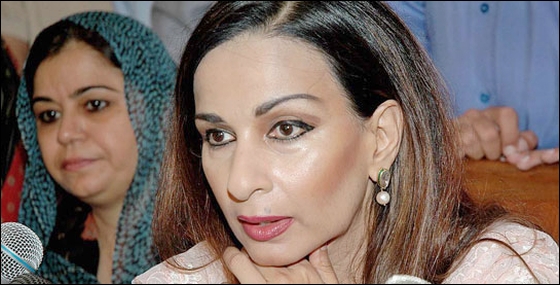
Sherry Rehman — (File Photo)

ISLAMABAD: A liberal lawmaker on Thursday accused Pakistan’s prime minister of sabotaging efforts to reform blasphemy laws that have been widely condemned by rights groups.

“Appeasement of extremism is a policy that will have its blowback,” said Sherry Rehman, a lawmaker for the main ruling Pakistan People’s Party (PPP).

The former information minister petitioned parliament to reform the legislation in November after a Christian woman was sentenced to death, but the private member’s bill was never listed on parliament’s agenda.

Despite escalating international condemnation and the murder of politician Salman Taseer for backing reform, the government refuses to consider any amendment, bowing to protest from the nation’s powerful religious right-wing.

Prime Minister Yousuf Raza Gilani on Wednesday told lawmakers that Rehman “agreed to withdraw her bill according to party policy”.

“The prime minister categorically made it clear that government has no intention to amend the law. Neither he nor the speaker of the national assembly has constituted any committee to consider the amendment bill,” his office said.

A furious Rehman disagreed, but said she had “no option” but abide by the decision after the prime minister ruled out any discussion.

“It was a question of protecting our citizens from injustice done in the name of a religion that values peace and tolerance more than anything else,” she said.

The government had pledged to keep intact the blasphemy law on December 30, in a bid to head off threatened protests.

The move exposed Rehman and Taseer as lone campaigners. Five days later Taseer was murdered outside an Islamabad cafe by his bodyguard, since lauded a hero by hundreds of religious conservative clerics, student activists and lawyers.

The law stirred fresh controversy this week after the arrest of a 17-year-old boy for allegedly writing a blasphemous comment in a school exam.

Human rights campaigners say the law encourages Islamist extremism and is too often used to settle personal scores.

“Pakistan has set the standard for intolerance when it comes to misusing blasphemy laws, but sending a schoolboy to jail for something he scribbled on an exam paper is truly appalling,” said Human Rights Watch.

While the law carries a maximum penalty of death, those sentenced to hang in the past have had their sentences overturned or commuted on appeal.

©2010 DAWN Media Group. All rights reserved
URL: www.dawn.com/2011/02/03/no-option...sherry.html

Monday, January 31, 2011

Don’t dare touch blasphemy law

The daily Nation, Pakistan
 Monday, January 31, 2011
Don’t dare touch blasphemy law
Published January 31, 2011

Don't dare touch blasphemy law - TNRM Rally in Lahore
LAHORE — Leaders of religious parties from all schools of thought, joined by the bigwigs of PML-N, PML-Q, PML-Zia and PTI, at a mammoth rally in the provincial metropolis on The Mall on Sunday vowed to render any sacrifice for protecting the blasphemy law, saying that no Muslim would compromise on the honour of Holy Prophet Muhammad (PBUH).

Thousands of people participated in the rally organised by Tuhaffaz-e-Namoos-e-Risalat Mahaz (TNRM) from Nasir Bagh to the Faisal Chowk where the top leadership of the mainstream political and religious parties addressed highly-charged participants. The participants were carrying flags of different religious parties, placards and banners inscribed with writings in favour of blasphemy law and against Pope Benedict, the US and European Parliament.

Highly-charged participants continued waving flags inscribed with Kalima Tayyaba throughout the proceedings of the rally. They were also beatings effigies of Pope Benedict, Sherry Rehman, Fauzia Wahab, Shahbaz Bhatti and Aasia Bibi with sticks.

The demonstrators chanted slogans ‘Mumtaz Qadri Ko Raha Karo, Gustakh-e-Rasool Ki Saza Sar Tun Se Judda, Ghulami-e-Rasool Main Maut Be Qabool Hai’.

Law enforcement agencies made unprecedented security arrangements to avoid any untoward happening during the mammoth rally. The Police closed down The Mall, from Nasir Bagh to the Governor’s House, for traffic a couple of hours before the start of the rally. Though it was weekend holiday, massive traffic jams were witnessed on the adjoining arteries due to closure of The Mall. The Police allowed entry to the participants after thorough search and that too only from Masjad-e-Shuhada and Nasir Bagh. Besides policemen in uniform, plain-clothed men were also deputed to keep a close eye on the participants. Trained shooters were also deputed on almost all multi storey buildings on both sides of the Mall, from Nasir Bagh to Faisal Chowk.

Addressing the rally, JUI-F Chief Maulana Fazlur Rehman urged the religious parties to continue maintaining unity in their ranks and make concerted and serious efforts for protecting blasphemy law.

Referring to the ongoing Tuhaffaz-e-Namoos-e-Risalat Tehreek, he said the flood of people would not stop before reaching the destination of protecting the blasphemy law. He said the Tehreek would be further strengthened and a big rally would be organised in Peshawar on February 20.

He declared that demonstrations would be held on every Friday till February 20. He said at the moment, the nation only had one-point agenda of protecting Namoos-e-Risalat.

“Unemployment, price hike, loadshedding and lawlessness have made the life of common man miserable. But the people have shown more concerns on Namoos-e-Risalat than all other issues”, the JUI-F Chief said, adding, the people would never allow the rulers to make any amendment in the blasphemy law. He urged the rulers to take a clear stance on blasphemy law instead of misguiding the nation by giving vague clarifications.

Referring to the participation of such a huge number of people in the rally, he said the nation had conveyed a strong message to Pope Benedict, the US and European Parliament. He said the people had made it clear that they would not let the present regime to implement the US agenda in the country.

“They (western countries) made attempts to damage Islamic values and culture, imposed ban on construction of minarets, published blasphemous caricatures of the Holy Prophet (PBUH) and subjected Muslims to inhuman treatment,” he regretted.

Referring to the fresh upsurge in Arab countries, Fazl stated that the US would fail to save its puppets and the same would happen in Pakistan. He said the people would have to decide whether they accepted slavery of Allah and His Prophet (PBUH) or that of the US’ like our rulers.

Referring to the incident of killing of three people by US national in Lahore, he warned the rulers against setting culprit Raymond Davis free without judicial trial. He said the people would take the law into their hands if rulers adopted any illegal course to free the US diplomat. He counselled Governor Latif Khosa to visit jail to meet Mumtaz Qadri.

“Salmaan Taseer met Asia Bibi in the jail. Khosa should visit the jail to meet Mumtaz Qadri,” he said, adding, Khosa was in the Governor House only due to Mumtaz Qadri.

Ameer Jama’at-e-Islami Syed Munawar Hasan said the movement for protecting Namoos-e-Risalat and free the country from US slavery would be further reinforced and taken to its logical ending. He said the Muslim World was facing a wave of revolution and the Pakistani rulers could not escape this for a longer period. He said the world had changed after 9/11 and all should realise this reality.

“The US is implementing its agenda in the wake of change after 9/11. She wants to damage Islamic values and culture, change law and revise syllabus in Islamic countries and snub voices from mosques,” he stated, adding that the Muslims should realise and stand to fight the war of civilisations. He said that the US and western countries were hatching conspiracies to take the Muslims away from their religion.

The JI Ameer further said the nation accepted the challenge against the US and her agents.

Warning the present rulers of dire consequences, he said that they (rulers) and the assemblies would cease to exist if attempts were made to amend the blasphemy law.

He said it was only due to the cowardice of the rulers that the Americans were killing innocent Pakistanis on streets. He said there had been terrorist activities in the Punjab capital in the past when vehicles carrying arms were recovered from the Americans but they were later released. It was for the President, the Prime Minister and the Chief Minister to explain the whereabouts of those Americans, he added.

Convener TNRM Sahibzada Abual Khair Zubair said the rulers were not fulfilling demands and trying to keep people away from the movement by creating confusions. He urged the political parties having representation in the parliament to take up the issue at the highest platform. He congratulated the participants for fulfilling their commitment to protect Namoos-e-Risalat.

Ameer Jama’at-ud-Dawa Hafiz Muhammad Saeed urged the rulers to work for an international legislation to curb desecration of Prophets all over the world. He said the rulers who had taken oath on the Holy Quran should decide to sever diplomatic relations with the countries where blasphemous caricatures had been published. He said Pope Benedict’s demand for repealing the blasphemy laws was aimed at fanning lawlessness and anarchy in the country.

JUI leader Abdul Ghafoor Haidri said the rulers were paying no heed to the protests by the nation for the last couple of months. He said the TNRM earlier made four demands - dissolution of committee headed by Shahbaz Bhatti, withdrawal of bill submitted by Sherry Rehman, action against Salmaan Taseer for violating his oath and uttering against the law of land and statement of Prime Minister on the floor of the National Assembly that blasphemy law would not be amended. He said delay on the part of the government led to the killing of Salmaan Taseer. He urged the rulers to fulfil demands to avert any future eventuality.

Allama Sajid Naqvi said the government was not taking clear stance on blasphemy law only due to the US pressure. He stressed upon continuing the struggle to protect blasphemy law. He said no one could be allowed to commit blasphemy.

Abdul Qadir Ropri urged the rulers to withdraw the bill presented by Sherry Rehman to stop another Mumtaz Qadri from coming into action. He said efforts would be made for freeing Mumtaz Qadri.

Ashraf Jalali said the nation had decided to punish blasphemers. He said Mumtaz Qadri had fulfilled his commitment for Hurmat-e-Rasool by killing Salmaan Taseer and he should be freed.

Addressing the rally, Senator Sajid Mir said the nation had recorded a strong protest against attacks on blasphemy law. He said the blasphemer deserved only one punishment and that was death. He said people from all schools of thought had consensus on blasphemy law.

Vowing to protect Namoos-e-Risalat, central leader PML-Q Ch Pervaiz Elahi said his party would be the first to quit the assembly if it dared to make any attempt to amend the blasphemy law.

“We have not adopted double standards like the rulers and our children and assets are of no values before Namoos-e-Risalat. Overwhelming participation in today’s rally proves that the nation is united to protect Namoos-e-Risalat. No amendment in blasphemy law is acceptable as Muslims value Namoos-e-Risalat more than their lives, children and assets,” he said, adding that his party would leave no stone unturned to protect the blasphemy law inside and outside the parliament.

Ilyas Ghuman termed Javaid Ghamdi an accursed and outcast but no speaker responded to his remarks.

PML-Zia Chief Ejazul Haq said a long march should be launched after giving a deadline to the government.

PML-N leader Kh Saad Rafiq said the PML-N had clear stance on blasphemy law.

“Blasphemy law should not be amended. Efforts should also be made to stop wrong use of blasphemy law,” he said.

Pakistan Tehreek-e-Insaf Vice-President Ijaz Chaudhry pledged that his party would not allow any change in the law. He demanded public hanging of Raymond Davis, the US citizen who shot dead three Pakistanis on Thursday.

Secular politicians jump on blasphemy bandwagon

Express Tribune, Pakistan
Pakistan
Punjab
Secular politicians jump on blasphemy bandwagon
Rana Tanveer
January 31, 2011
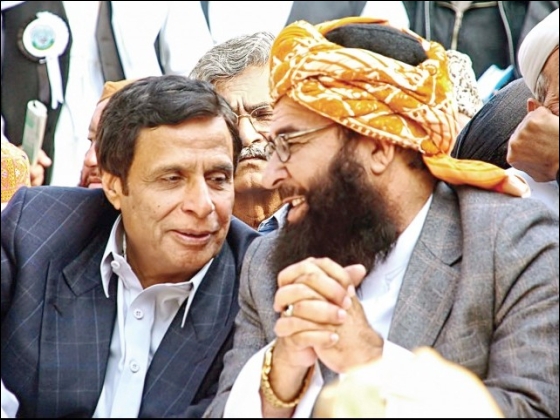
At the Tehrik-i-Namoos Risalat rally held on The Mall yesterday, Pakistan Muslim League-Quaid-i-Azam's Chaudhry Pervaiz Elahi shares a private moment with Maulana Ghafoor Haideri. PHOTO: EXPRESS/WASEEM NIAZ
At the Tehrik-i-Namoos Risalat rally held on The Mall yesterday, Pakistan Muslim League-Quaid-i-Azam’s Chaudhry Pervaiz Elahi shares a private moment with Maulana Ghafoor Haideri. PHOTO: EXPRESS/WASEEM NIAZ
LAHORE: The Pakistan Muslim League-Quaid-i-Azam will quit the National Assembly if it amends the blasphemy laws, said party leader Chaudhry Pervaiz Elahi at a Tehrik-i-Namoos-i-Risalat rally here on Sunday.

“We curse the assembly that would dare to amend the anti-blasphemy laws,” Elahi said. “Our party would be the first to quit such an assembly.”

The former chief minister added that he and his party colleagues were deeply committed to the cause. “Our children and our worldly belongings are of no consequence in the defence of Namoos-i-Risalat,” he said.

Elahi was one of several political leaders from non-religious parties to attend the Tehrik-i-Namoos-i-Risalat rally. Analysts say that these politicians are trying to gain religious sympathies and to cash in on anti-government feeling following the assassination of Governor Salmaan Taseer.

Apart from pressing their own credentials in protecting the sanctity of the Holy Prophet (pbuh), the speakers railed against Raymond Davis, the American consulate employee currently in police custody for the killing of two Pakistanis. They told the government that he must be treated “according to the law” and not be handed over to the United States.

“The American gunned down two innocents but the government is trying to exonerate him,” said Maulana Fazlur Rehman, president of Jamiat Ulema-i-Islam-F (JUI-F). “This matter must be left to the courts to decide. If there is an executive intervention to stop the courts from exercising their jurisdiction, no one will respect the courts.”

He said his party would not let “American agents” continue their rule in Pakistan. He said that there would be another rally in Peshawar on the same issue on February 20.

Jamiat Ulema-i-Islam-S chief Maulana Samiul Haq, who was introduced before his speech as a backer of the Taliban, told the rally that their primary demand of the government should not be that it pledge to leave the blasphemy laws alone, but that it pledge to remove all Americans and their supporters from the country. He urged the protesters to continue their “independence movement”, otherwise the killing of Pakistanis in drone attacks and firing incidents by foreigners would continue.

Syed Munawar Hasan, ameer of Jamaat-i-Islami, said that the law should “take its natural course” and penalise the accused American. He said some Americans had previously been arrested in the city with weapons but were let off.

Ijazul Haq, leader of the PML-Zia, said the blasphemy laws were not made by a dictator, his father Gen Ziaul Haq, but were “the laws of Allah” and as such could not be amended. He said the religious parties should give the government a deadline by which it would pledge not to amend the laws in any way, otherwise they should plan a long march towards Islamabad.

JUI-F leader Hafiz Hussain Ahmed referred to Davis as an employee of Blackwater, the American mercenaries. “During interrogation he confessed that he was on a special mission and was operating on instructions. The government should make public his mission and instructions and why he riddled our brothers with bullets.”

He claimed that the US government was offering visas in return for Davis’ release. He said if the government bowed to American demands and let him off, they would besiege the US embassy and the Presidency in Islamabad.

Also invited to the rally were Muhammad Waseem and Imran, brothers of Faheem and Faizan Haider, the two men that Davis killed. Repeated announcements were made from the stage to welcome them and express solidarity with them.

“The blood of the martyrs Faheem and Faizan will not go to waste. We will contest their case before the court. The government must stop its conspiracy to portray this as a case of self-defence, otherwise neither the city government nor the provincial government will be able to continue,” said an organiser in an announcement from the stage.

PML-Nawaz MNA Khawaja Saad Rafiq, representing his party chief, said the PML-N would not accept any foreign pressure for the release of Davis. He said “the American diplomat” had killed two people and one of his colleagues had crushed another under his vehicle, and they would be dealt with according to the law. He said US Ambassador Cameron Munter had telephoned Nawaz Sharif to ask for help to secure Davis’ release, but Sharif had refused. He also led the crowd in shouting the slogan: “Amrika ka jo yaar hay, ghaddar hay ghaddar hay” [Whoever is America’s friend is a traitor].

Jamiat Ulema-i-Pakistan general secretary Qari Zawar Bahadur said that the government should close the US embassy in Islamabad in protest at the incident. He said all “Blackwater operatives” must be forced out of Pakistan.

Published in The Express Tribune, January 31st, 2011.

Wednesday, January 26, 2011

Kidnapping for ransom a boon for militants

Daily Dawn, Pakistan
Pakistan
Kidnapping for ransom a boon for militants
From the Newspaper
January 26, 2011

ISLAMABAD, Jan 25: Kidnapping for ransom has always been a well-paying crime but the entry of militants has made this more profitable, which is why the incidence of the case is continuously rising.

Senior investigating officers of police claim that militants are involved in kidnapping cases in all corners of Pakistan.

“They are directly involved in kidnapping in Punjab, Khyber Pakhtunkhwa, Sindh, especially in Karachi, and Islamabad,” one police officer tells Dawn.

Senior police officers say that money is the main reason for the increased incidence of kidnapping though the militants have also started using it as a tactic to pressure law enforcement and intelligence agencies; in a number of cases they refuse to accept money in exchange for the hostage and ask for the release of their arrested accomplices.

“A third reason is also to spread fear,” says a senior policeman.

However, a new trend is the links the militants and the criminal gangs are forming with each other at different levels. These had first been established when kidnappings were carried out by the two groups together. By now it is routine practice for the kidnapping to be carried out by the local criminals of the area the hostage lives in either out of choice or because they have been asked to do so by militants.

In cases where the objective is to collect ransom, the local criminals continue to keep the hostage in their custody. The hostages are said to be kept in hideouts in Khyber Pakhtunkhwa and Central Punjab.

“But at times, especially when the militants want to spread fear, the hostage is kept in their custody,” says a police officer, adding that the Tehrik-i-Taliban militants have an exclusive committee (Shura) which decides the fate of the victims – exchange for ransom, exchange for militants in state custody or spread fear.

With the entry of militants, religion also tends to play a role in the kidnappings from the act to the negotiations to the release. In some cases, militants have picked up hostages, assuming that they were Ahmedi or Shia. The later realisation that the victims were Sunni compelled the militants to accept a reduced ransom. Some years ago a businessman from Islamabad was kidnapped only to be released when he and his kidnappers were intercepted at a checkpost as they were exiting Islamabad.

During interrogations, the kidnappers revealed that they had kidnapped the businessman because they thought he was a Qadiani. A similar perception about a law enforcement personnel’s faith also led to him being kidnapped.

Dawn has learnt that in many cases, religio-political leaders or religious leaders have helped at the negotiation stage. In such cases, the police react according to the politicians, who negotiate with the militants over the ransom, they added.

For instance, even the negotiations over the release of a Polish engineer, Piotr (Peter) Stanczak, were carried out with the help of a religio-political leader. But as the militants demanded the release of their accomplices arrested in connection with suicide attacks in Islamabad, the two sides could reach no agreement. It was after this that the kidnappers killed the engineer.

In some cases, however, as a last resort, prisoners have been exchanged for hostages. This is what happened in the case of foreign engineers from an East Asian country.

As their captors refused to accept ransom money, the government had no choice but to release militants in exchange.

The ‘business’ has spread so far that separate groups of militants have been formed who ‘specialise’ in kidnappings – they select victims, collect information such as financial wherewithal, carry out the reconnaissance of the area. This information is passed on to the militants who then carry out the kidnapping themselves or pass it to other criminal gangs.

“In some kidnapping cases, the hostages’ families were even informed of their bank balances when the ransom was being negotiated,” an officer adds.

One such group is said to be headed by Mullah Sabir and Mullah Rahim which operates from South Waziristan.

Before they used to work independently but later they started kidnapping for ransom for the Tehrik-i-Taliban Pakistan, said an official.

©2010 DAWN Media Group. All rights reserved
URL: www.dawn.com/2011/01/26/kidnapping...militants.html

Thursday, January 20, 2011

Religious frenzy grips Pakistan

Thursday, January 20, 2010, Safar 14, 1432 
Religious frenzy grips Pakistan
Random Thoughts
Burhanuddin Hasan
There is hardly any doubt that Muslims, can lay down their lives to uphold and protect the honour and dignity of the Holy Prophet Mohammad (Peace be upon him). His name comes after God in Quran and as Maulana Roomi says “You are ,in short, the most exalted after God.” In Sura Al Ahzab God says “God and His angels shower blessing on the Prophet (PBUH). O believers you too send darood and salam to him (PBUH)”. The Holy Prophet Mohammad (PBUH) has the most exalted position among all Prophets sent by God. He (PBUH) was the only one called to the heavens by God on the night of Mairaj to honour him (PBUH) with his nearness. How can any Muslim have the courage to say a single word against his (PBUH) honour? If anybody does, he should be given death sentence with the due process of law. The Blasphemy Law was enacted during General Ziaul Haq’s rule. This was a man-made law and like all man-made laws could be reviewed from time to time if it is being misused by human beings like all laws. It is not a divine law enacted by God in Quran like some other laws. There are 57 Muslim countries in the world which, do not have any such law on their Statute Books.

The Blasphemy Law has been used in some cases in Pakistan and culprits have been punished if their crime was proved in a court of law. The punishment was awarded by a judge like all punishments. Nobody should take this law into his or her hands and execute the culprit without the due process. In the case of a Christian girl Asia; she was booked under the Blasphemy Law and was awarded death penalty by a court of law. She sent a mercy petition to the Governor of Punjab Mr Salman Taseer who met her in good faith and promised to take up her mercy petition with the President for favourable consideration. He had a feeling that the girl might have been framed like many other cases of Blasphemy. Media unduly sensationalized this story as it does in many such cases these days to gain popularity.

The JUI Chief Maulana Fazlur Rehman who had left the Government on the sacking of one of his ministers in the Federal Cabinet by Prime Minister Gilani, pounced on this issue to take his revenge and gave a call for a nationwide agitation on the issue of Namoos-e-Risaalat, which was totally out of context but could add fuel to the fire of his revenge against the Prime Minister. All religious parties, which keep waiting for such an opportunity to hit the government, joined the agitation taking out big rallies all over the country. It should never be forgotten that these parties; particularly Jamat-e-Islami and the Deobandi group represented by Maulana Fazlur Rehman have always been against the very concept of Pakistan promoted by Iqbal and Jinnah for the Muslims of India as a modern forward looking State as against a theocratic one which was the demand of religious parties..However, when Pakistan came into being they converged on it to change its ideology. They did not succeed but they keep trying. Iqbal who was a great philosopher and scholar of Islam has written a lot about the ignorance of Mullahs.

But it is regrettable that our educational institutions are not teaching these words to our youth who are blindly following the very Mullahs who were against Pakistan. Returning to the tragic murder of Salman Taseer by his misguided security guard who is being idolized by some youth under the influence of the Mullahs is highly regrettable. They should realize that this was not a case of violation of the Holy Prophet’s Namoos (Naoozo Billah). It was a humanitarian effort and his duty as the Governor of Punjab to find out whether a girl belonging to the Christian minority community who claims that she has been falsely framed in a crime she did not commit, is right or wrong? It was his duty to put the girl’s petition to the President. This was by no means a violation of the Namoos-e Risaalat .The security guard who was on duty to protect the life of the Governor, is guilty of murder and will certainly be punished. Those who are idolizing him should also be punished.

It seems the government which is surrounded by all sorts of fears for its survival is hesitating to take bold action against the political parties which have opened the Pandora’s Box over the blasphemy issue at this time when the country is facing economic crises, religious terrorism and corruption. This matter if not tackled with courage and bold action against those elements that unnecessarily launched a mass hysteria on this highly explosive issue, may destabilize the country. One would expect the Supreme Court to take notice of this issue and take action against the criminal elements who are exploiting the name of Islam for an issue which is basically legal.

The media too needs to be directed to use restraint in reporting and commenting on the delicate and sensitive subject of blasphemy. Full marks to PPP Chairman Bilawal Bhutto Zardari who has raised his voice in defense of minority communities and has denounced the uncalled for religious frenzy, let loose by the Mullahs which may destabilize the country.

© Pakistan Observer 1998-2011, All rights reserved
URL: http://pakobserver.net/detailnews.asp?id=72090

Tuesday, January 18, 2011

Defiance of law: Tahaffuz rally speakers threaten courts

Express Tribune, Pakistan
PAKISTAN
PUNJAB
Defiance of law: Tahaffuz rally speakers threaten courts
Rana Tanveer
January 18, 2010
In yet another rally TNRM leaders said they will respect no law if blasphemy laws are touched. PHOTOS: EXPRESS/ABID NAWAZ
LAHORE: The Mall saw yet another rally on Monday organised by Tahaffuz Namoos-i-Risalat Mahaz (TNRM). Several speakers at the rally lauded Mumtaz Qadri, the confessed killer of Governor Salmaan Taseer, and warned the courts of stiff reprimand if any order was passed against him.

Most shops and offices on The Mall were closed during the four hours the rally took to make its way from Data Darbar to the Governor’s House.

TNRM, a coalition of eight Sunni parties, organised the rally to pay tributes to the police guard who shot Taseer dead on January 4.

Speakers said there could be no punishment for Qadri and demanded his early release. TNRM vice president Dr Ashraf Jalali, who led the rally, told the participants that if Qadri was punished they would hold a long march to Islamabad and snatch all those responsible for it out of their offices. Jalali also issued a warning to the media not to extend invitations to those who criticised Qadri or spoke in favour of amending the blasphemy laws. “Mumtaz Hussain Qadri is a hero of the Muslim ummah. Whoever criticises him or Section 295-C will have their tongues pulled out.”

Jalali praised the police deployed in front of the Governor’s House saying that Qadri’s act had lifted the status of the entire police force.

The rally goers and their leaders chanted slogans against Taseer. The participants burnt pictures of President Asif Ali Zardari and other Pakistan Peoples Party leaders.

The 3,000 or so participants brought traffic and businesses on the The Mall to a stop. Roads leading to The Mall were choked with traffic and it seemed as if city life had come to a standstill for the hours the rally was in progress. Shops and offices on The Mall were closed for fear of a flare up but no untoward incident was reported.

Punjab Assembly members got their share of the firebrands’ wrath as they passed the Assembly building. “We curse every member of the Punjab Assembly for carrying a resolution in favour of Salmaan Taseer,” said a rally leader.

Some lawyers were also spotted in the rally. Advocate Chaudhry Mushtaq Ahmed ‘congratulated’ the participants on Taseer’s death and said if Section 295-C was removed they would obey no laws. But, he also said no law was actually needed to deal with blasphemers as a few “true Muslims” were all it required to deal with them. He said no lawyer would appear before the court to prosecute Taseer’s murder.

Maulana Tasadduq Hussain, a Jaamiat Ulema Pakistan leader, said the media only invited a certain kind of religious scholar to debate blasphemy issues. He said those favouring Taseer or criticising Qadri were enemies of Islam.

TNRM secretary general Muhammad Ali Naqashbandi said the media should invite TNRM scholars for debate on blasphemy issues. He condemned the media for inviting ‘improper’ scholars to their talk shows.

Published in The Express Tribune, January 18th, 2011.

Monday, January 17, 2011

Jamaat-ud-Dawa rally: Banned outfit incites violence

Express Tribune, Pakistan
PAKISTAN
Jamaat-ud-Dawa rally: Banned outfit incites violence
Rana Tanveer
January 17, 2011
Clerics warned the media against criticising religious decrees.
LAHORE: Shockingly, Jamaat-ud-Dawa, an organisation proscribed since the Mumbai terrorist attacks, not only managed to organise a sizeable rally, but clerics invited to speak during the demonstration spewed hate speech upon hate speech, targeted minorities, incited people to violence with impunity and roused people to adopt the ‘way of jihad’.

Despite the presence of clear cut laws, speakers “praised” the actions of the self-confessed killer of former Punjab governor Salman Taseer and warned media commentators against what they termed being critical of fatwas (religious decrees)” while discussing blasphemy matters.

Head of Jamaat-ud-Dawa’s political affairs wing Prof Hafiz Abdul Rehman Makki said that anyone “supporting a blasphemer is also a blasphemer and both must meet the same fate”.

Hundreds of Jamaat-ud-Dawa activists and their sympathisers initially assembled near Nasir Bagh and started marching towards the Punjab Assembly building on The Mall.

Hafiz Makki said that Taseer had been assassinated because the government had not “educated him” about being careful on sensitive issues before appointing him as the provincial governor.

He said matters concerning blasphemy “are like (a live) high-tension wire with more than 11,000 volts … whoever touches (it) would be reduced to nought”.

Highly charged marchers, carrying placards declaring a ‘holy war against elements conspiring against Islam’, ripped away signboards and streamers in favour of the slain governor and surprisingly also in favour of his successor, Latif Khosa.

Endorsing Mumtaz Hussain Qadri’s actions, Hafiz Makki said the man had played “his due role and police department should be proud of … such a (true) lover of Holy Prophet (Pbuh)”.

Chagrined at Pope Benedict XVI’s statement in which he had urged the Pakistani government to “repeal” blasphemy laws, the speakers went ballistic and warned Christians and Jews “everywhere” that Muslims were “ready to take extreme action”. At one point, Hafiz Makki even urged all Christians to “convert to Islam”.

Warning people who had presented a “gift of tears for Taseer”, Hafiz Makki said that there would be more weeping in the days ahead, adding: “What is the death of one man (Taseer) when so many (people) are (being) killed on the streets daily?”

Earlier, Convener of Tehreek Hurmat-e-Rasool (Pbuh) Maulana Ameer Hamza said that whoever “commits blasphemy revokes his right to life”.

Addressing President Asif Ali Zardari, Maulana Hamza said: “You should know that we will not allow you to free Aasia (Bibi),” adding in an offensive manner to take “this opportunity to convey the same message” to President Barack Obama.

Published in The Express Tribune, January 17th, 2011.

Saturday, January 15, 2011

Blasphemy allegations: Another Christian family on the run

Express Tribune, Pakistan
Pakistan
Punjab
Blasphemy allegations: Another Christian family on the run
Rana TanveerRana Tanveer
June 07, 2010
Supporters of one of several Namoos-i-Risalat groups, Shahab Islami Pakistan chant slogans and wave flags during a rally to support the assassin of Salmaan Taseer in Rawalpindi. PHOTO: AFP
LAHORE: Two Christian women were beaten and publically humiliated by an angry mob over apparently frivolous blasphemy allegations and they and their family are now in hiding for fear of being killed, The Express Tribune has learnt.

“None of our relatives is ready to let us stay with them. They fear the wrath of the extremists, particularly after the assassination of Salmaan Taseer,” a male member of the family said over the phone from an undisclosed location.

The family and a non-governmental organisation that is helping them asked that their identities not be revealed, lest it put them in further danger. The names mentioned here are fictitious.

According to the family, the allegations stem from a dispute between Amina, a Muslim, and her sister-in-law Zahira, a Christian, in an East Lahore locality. The two got into an argument on Tuesday night and though it appeared to have been settled, on Wednesday morning, after her husband Zahid had gone to work, Amina walked out onto the street and started shouting that Zahira had abused the Holy Prophet (pbuh).

A short while later, a group of men led by Muhammad Sameer, a member of a religious organisation keen on raising its sectarian profile, forced their way into the house and started slapping Zahira, said another of her brothers, Sohail. “Other men and women from the neighbourhood started gathering at the house too and they beat up my sister and mother. They were the only people in the house,” he said.

“We tried our best to get her to confess her crime,” Sameer told The Express Tribune. As a member of the religious organisation, he said he could not tolerate any derogatory remarks about the Holy Prophet (pbuh).

Sameer added that he was very proud of his wife’s performance during the mob beating. “She beat Zahira more than anyone else. Her hand is so swollen that she hasn’t been able to make rotis since the day of the incident. I’ve been getting my meals from a restaurant,” he said.

Malik Mumtaz Qadri, the self-confessed assassin of Salmaan Taseer, is a member of the same group as Sameer. The group also runs a twenty-four hour cable TV channel.

Khadim Hazoor, Sameer’s son-in-law and another participant in the beating, said that the women’s faces were blackened and they were made to wear necklaces of shoes and paraded around the locality on donkeys to humiliate them. He said the women denied blaspheming and repeatedly touched their feet seeking mercy.

He said the people of the locality would not allow Zahid or his family to return to their house, which he lives next door to. He claimed that the fight between Zahira and Amina the night before the incident revolved around the upbringing of Zahid and Amina’s 18-month-old daughter. Amina had wanted to raise her daughter as a Muslim, but Zahira wanted her niece to be raised as a Christian, he said.

Hazoor accused Zahid of “cheating Islam” by pretending to convert from Christianity to Islam so he could marry the Muslim girl. “We will not let them live in this house. He has not only cheated Amina but also Islam,” he said.

Zameer Khan, an NGO worker, helped the family flee the locality after they were attacked. “Apparently there was no blasphemy, just an argument between two women,” he said.

He said after hearing of the incident, he had reached the scene to find the women being attacked. He said he had asked the mob if anyone had heard Zahira utter any blasphemous remarks, to which they all replied in the negative. He said he persuaded them to let the women go while he investigated the matter. He then helped relocate the family temporarily. He said he had also convinced the mob not to involve the police.

Published in The Express Tribune, January 15th, 2011.

Thursday, January 13, 2011

JI asks MQM to clarify stand on blasphemy law

The News - Internet Edition
Friday, January 13, 2011,
Safar 08, 1432 A.H.
Karachi
JI asks MQM to clarify stand on blasphemy law

By our correspondent
Karachi

The Jamat-e-Islami has categorically asked the Muttahida Qaumi Movement to clear its position regarding Namoos-e-Risalat law instead of asking religious parties to stop protesting against the issue.

The reaction of JI came in the wake of statement of Chief of Muttahida Qaumi Movement Altaf Hussain in which he had demanded religious parties to discontinue their campaign against blasphemy law as the government, especially the Prime Minister of Pakistan has clearly said that blasphemy law would not be revoked

The JI asked Altaf Hussain to pressurise the coalition government to announce on the floor of the House that the blasphemy law would not be repealed.

Monday, January 10, 2011

Taseer murder: Sunni Ittehad warns against protests

Express Tribune, Pakistan
PAKISTAN
Punjab
Taseer murder: Sunni Ittehad warns against protests
Rana Tanveer
January 10, 2010

Children protesting in front of Lahore Press Club against any change in blasphemy law. PHOTO: RIAZ AHMAD/ EXPRESS

LAHORE: A Tahaffuz Namoos-i-Risalat conference held in the city on Sunday warned against public rallies and demonstrations praising Governor Salmaan Taseer or protesting his killing. A Mumtaz Qadri, speakers threatened, would be at every corner of the country to stop such displays of solidarity, a reference to the police guard who has confessed to killing the governor.

Maulana Nawaz Kharal, a spokesperson for the Sunni Ittehad Council (SIC), led the chorus while addressing the conference held at Aiwan-i-Iqbal. Kharal also said there should be no protest against Qadri and added, “Don’t associate Mumtaz with any terrorist group. He is a true lover of the Holy Prophet (pbuh).” He said his Sunni followers protect Qadri and his family with their lives.

SIC chairman Fazle Karim too condemned protests in favour of Salmaan Taseer. Karim said the NGOs protesting the governors’ death had never held any protest against the killings at Sunni gatherings after the attacks at Jamia Naeemia, Nishtar Park in Karachi, Data Darbar, shrines of Abdullah Shah Ghazi and Farid Ganj Shakar. He said they had not even raised a voice against the ban on the veil imposed in France. He said his followers would continue “the mission of Ghazi Ilamudin Shaheed.” He said the Sunni Tehrik would provide legal assistance to Qadri.

Dr Muhammad Ashraf Asif Jalali, founder of Idara Sirat-i-Mustaqeem Pakistan, announced the Ghazi Ilmudin Award for Qadri. He said that his group would lay a wreath on Ilmudin’s grave on Qadri’s behalf on January 15. He also said that it would hold a rally on January 19 from Lahore to Qadri’s residence in Rawalpindi.

Jalali then demanded that the government release Qadri as soon as possible and exonerate him from the charge of murder. He said the punishment for a blasphemer against the Holy Prophet (pbuh) was death. He claimed that the inclusion of Section 295-C in the Pakistan Penal Code had brought good luck for the country. He went on to say that all participants in Taseer’s funeral had jeopardised their Islamic faith. He said their participation in the prayers had put a question mark on their commitment to the community of the faithful.

The participants of the conference included Justice (retd) Nazeer Akhtar, former judge Nazeer Ghazi, Pir Sayed Karamat Ali and Dr Raghib Naeemi. After the conference ended, a group of SIC activists headed to the Governor’s House gate on The Mall on a van and chanted slogans in support of Qadri.Earlier, nearly 300 Sunni Tehrik activists had held a protest rally in front of the Lahore Press Club demanding Qadri’s immediate release. Participants of the rally also chanted slogans against the protestors in favour of Taseer.

In the only civil society rally after Taseer’s assassination on January 4, the participants had condemned the murder which they said was a result of religious extremism.

Published in The Express Tribune, January 10th, 2011.

URL: http://tribune.com.pk/story/101580/taseer...against-protests/
 
^ Top of Page