Showing posts with label Zia Ul Haq. Show all posts

Friday, October 28, 2011

Ahmadis: The lightning rod that attracts the most hatred

Daily Dawn, Pakistan
FEATURES 
Ahmadis: The lightning rod that attracts the most hatred
October 28, 2011By Zofeen T. Ebrahim | DAWN.COM
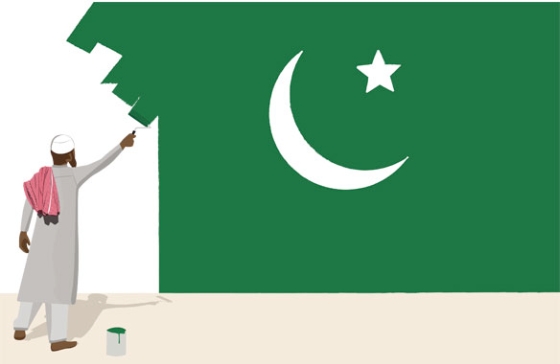
Pakistani Ahmadis today live in constant fear and humiliation. So much so, the hatred has permeated into each and every slice of society and the oppressors have become more vocal and aggressive. - Illutration by Faraz Aamer Khan
A month after ten Ahmadi students were expelled from two schools in the village of Dharinwala, in Faisalabad district, all have been put back to school, not in there old ones, but in two schools in Hafizabad, thanks to Khalil Ahmad, father and grandfather of four students who were among those expelled.

“I managed to get all of them enrolled in two schools in the nearby city of Hafizabad,” he said talking to Dawn.com over phone from his village.

But it’s not been easy. Most parents of the expelled children are too poor, so Ahmed volunteered to pay for their admissions, their books and stationery. And that is not all. He, with the help of his two sons, makes sure they drop and pick all of them on a motorbike, doing turns.

In one school, the principal knows he has given admission to Ahmadi students but the educator believes faith should not come in the way of those seeking education. “In the other the principal has not been told,” Ahmed revealed.

Sadly, all during this episode, the government has remained a quiet bystander, as always.

It is not the first time that students have been expelled from an educational institution in Punjab because of their religious affiliations, remarked Bushra Gohar, a parliamentarian belonging to the secular Awami National Party. According to Gohar, her party members had condemned the expulsion of students belonging to the Ahmadiyya community each time on the floor of the house. “However, a protest or condemnation from the parties leading in the Punjab has not been forthcoming,” she said.

For far too long, Pakistani students belonging to this minority community have been facing various forms of discrimination based on their faith.

“This tidal wave against the Ahmadiyya education shows no sign of ebbing,” Saleemuddin, the spokesperson of the Ahmaddiya Jammat, told Dawn.com.

He said after 1984, when the government promulgated the anti Ahmadiyya ordinance, both the government and the clerics have been trying their utmost to punish them in various ways.

“Ahmadi lecturers were posted away to distant locations and some were not allowed to teach. Ahmadi principals and headmasters were replaced. Ahmadi students were deprived admission in professional colleges. They were refused accommodation in attached hostels. They suffered attacks by extremist elements on campuses.”

According to the Asian Human Rights Commission, the Islami Jamiat Talaba, the student wing of the Islami Jamiat has been tasked to cleanse the educational institutions, including universities and professional colleges of Ahmadi students.

Hasan Ahmed, who was among the 23 students who were expelled from Punjab Medical College, in Faisalabad, back in 2008, can never forget the stressful event and how “night after night, for over a month” he kept stressing over the events that turned his settled student life all topsy-turvy.

“I knew it happened to others, so was not completely caught unawares,” Hasan acknowledged. He is at present completing his house job in Lahore, keeping an “ultra busy schedule”.

Eventually all were re-instated in some college or another. “After months of waiting, just before exam, my friend was sent to Bahawalpur while I went off to a distant place of Rahimyar Khan in a college of lower merit,” narrated Hasan.

After a gargantuan effort, he was finally allowed to appear in exams from Lahore and then got admitted to Allama Iqbal Medical College, in Lahore.

“To be in a state of flux was the worst part of this episode specially since exams were approaching and I didn’t know which place I was to appear from,” said Hasan.

He expressed that till the identity of an Ahmadi remains undisclosed “he remains safe”.

But that is sadly not the case if you are living in Pakistan. People are culturally nosy and want to know your cast and sect. “Eventually they end up finding that you are an Ahmadi. Once they know, you can feel a change of attitude and it just takes a mischief maker to exploit others’ feelings against you,” said Hasan.

Till Hina Akram’s faith remained unknown to her teacher in Faislabad’s National Textile University, she was considered a star student. But after it became known she belonged to the Ahmadiyya community, she faced so much faith-based harassment that she had to quit studies.

“I was told to convert to Islam,” said Hina, who was studying in the sixth semester of her BSc.

“I was handed some anti-Ahmadiyya literature to read, offered a refuge in Muslim home. But when she told the teacher she was an Ahmadi by choice he called her an infidel and warned her of severe consequences.

“You will face such a fire of animosity in the campus that not even the vice chancellor will be able to help you,” he threatened her.

True to his word, a hate campaign was initiated and a social boycott began. Out of college, she is desperately trying to go abroad. Her fate remains in balance.

But it’s not just the education aspect where the anti-Ahmadiyya lobby is hitting, said Saleemuddin. Since 1984, some 208 faith-based killings have taken place. The persecution against the community has surged following the May 28, 2010 massacre of 94 members of the community in Lahore.

After the four million Ahmadis were officially declared non-Muslims in 1984 by the state, they cannot call themselves Muslims or go to mosques. They cannot be overheard praising Prophet Mohammad. To add insult to injury, every Pakistani who claims to be a Muslim and owns a passport has declared that he or she considers them to be non-Muslims and their leader an imposter prophet.

Pakistani Ahmadis today live in constant fear and humiliation. So much so, the hatred has permeated into each and every slice of society and the oppressors have become more vocal and aggressive.

“The extremist elements are getting more and more powerful because of Saudi-US influence and the government’s policy of appeasement,” said I.A. Rehman, General Secretary Human Rights Commission of Pakistan.

“The Ahmadis are already the worst persecuted minority in our country – and things for them appear to be growing worse as hatred and intolerance spread,” Kamila Hyat, a journalist and a rights activist echoed the same sentiments. “The lack of enforcement of laws to prevent the preaching of hatred adds to the problem,” she added.

Saleemuddin said by allowing the extremist clerics to hold anti-Ahmadiyya rallies and conferences, the government is adding fuel to this venom. “People are openly instigated to kill us in the name of Islam,” he said.

“Violence and the advance of bigotry, prejudice and hate against minorities have never really been met with the resolve needed to remove impunity from the social equation in Pakistan,” Sherry Rehman, a legislator belonging to the ruling Pakistan People’s Party, agreed.

Instead, she told Dawn.com what is seen is an “expansion in the space for religious and sectarian apartheids, which has led now to heinous acts of brutality and exclusion of many, particularly Ahmadis.”

She warned: “This is a dangerous trend that conflates national identity with religion.”

Perhaps that is one reason why Pervez Hoodbhoy expresses: “Today, when religion has become so central in matters of the state, they [Ahmadis] do not stand a chance in Pakistan of getting rights, respect, and dignity. The overdose of religion given to young Pakistanis in their schools and homes means that nothing matters more than which religion and sect you belong to. Ahmadis are the lightning rod that attracts more hatred than any other sect.”

For its part rights groups like the Human Rights Watch (HRW) and the Human Rights Commission of Pakistan (HRCP) say they have “repeatedly” raised the issue of “state tolerated persecution”.

“We are urging authorities to intervene in each case,” said Rehman. “But the situation is getting worse day by day.

Terming it “abhorrent and self defeating” when society allows “for the dehumanization of Ahmadis or Christians or the Shia for that matter, it is effectively cannibalizing itself,” said Ali Dayan Hasan, Pakistan director of HRW.

“The federal government expresses regret at incidents but has made clear its unwillingness to repeal or amend discriminatory laws,” said HRW spokesperson.

Given the current intolerance, the fate of the new generation of Pakistani Ahmadis looks “quite bleak” said Rehman.

Even Hoodbhoy said: “For years, Ahmadis, Hindus, and Christians have been desperately seeking to flee Pakistan. They would be foolish to want to stay,” said Hoodbhoy.

This fails to dampen young Hasan’s spirits. He thinks the future looks “brighter than ever before”.

“Even if the situation is made worse in Pakistan, this does not mean the future is not bright. It’s a matter of time before we start getting equal rights in this country.

Often when they get together, the young Ahmadis discuss the “bitter realities” they have to face as Pakistanis.

“But we don’t want to leave our country at the juncture that it is at,” said a patriotic Hasan. This is because the contribution of the Ahmadi community towards building of Pakistan has been immense,” he said with conviction.

He said recently their leader urged all Ahmadis of the world to “fast once a week and pray” especially for the prosperity of Pakistan.”

Zofeen T. Ebrahim is a freelance journalist.

©2010 DAWN Media Group. All rights reserved
URL: www.dawn.com/2011/10/28/ahmadis...most-hatred.html

Saturday, October 8, 2011

Ideology and intolerance

Dawn.com
OPINION
Ideology and intolerance
October 8, 2011Irfan Husain
MOHAMMAD Ali Jinnah visualised the state of Pakistan as “a homeland for the Muslims of the subcontinent”.

Sadly, he did not specify precisely which sect of Muslims he had in mind. Although a Shia himself, he did not have a sectarian bone in his body.

Indeed, he was secular to the core, and this was the philosophy he bequeathed to the state he had created virtually single-handedly. This was a bequest we tore up even before he was laid to rest.

So as we witness the ongoing massacre of Hazara Shias in Balochistan, we need to take a hard look at the monsters Pakistan has spawned over the years. Management gurus teach us that before we can solve a problem, we must first analyse it to gain a full understanding of the underlying causes.

But given the deep state of denial we prefer to stay in, we shy away from making the logical connection between cause and effect. When elaborating on his ‘two-nation theory’, Mr Jinnah was of the view that Muslims could not live side by side with Hindus in a united India as we were a different nation in terms of values and cultural norms.

This notion led to the partition of India in 1947, and even though millions of Muslims did not — or could not — make their way to the new state, Pakistan was born in a cataclysm of blood and fire. Almost immediately, the hard-line vision of Islam, espoused by Maulana Maududi and his Jamaat-i-Islami, became the ideology of large numbers of right-wing intellectuals and clerics.

However, it wasn’t until Zia seized power in 1977 that this literal strand of Islam became the official ideology of the state.

Some of the hard-line Sunni groups like the Sipah-i-Sahaba came into being in Zia’s period, declaring Shias to be ‘wajib-ul qatal’, or deserving of death. Needless to say, these killers were permitted to thrive by Zia.

Step by step, the notion of separateness at the heart of Partition has fostered a feeling of ‘us against them’. Taken to its illogical extreme by hard-line ideologues and their brainwashed followers, this translates into the belief that those not following their particular school of Islamic thought become ‘wajib-ul qatal’.

Massacres and individual murders resulting from rabid intolerance bearing the spurious stamp of religious orthodoxy are too numerous to cite here. But the recent episodes of the cold-blooded slaughter of Hazara Shias in Balochistan should open the eyes of those wishing to negotiate with the terrorists responsible for these acts.

Another hard-line, anti-Shia group, the Lashkar-i-Jhangvi, was quick to claim responsibility for these murders, and yet the state has done nothing to bring this organisation to book.

According to a Human Rights Watch press release, “In Balochistan, some Sunni extremist groups are widely viewed as allies of the Pakistani military, its intelligence agencies and the paramilitary Frontier Corps, which are responsible for security there.

Instead of perpetrating abuses in Balochistan against its political opponents, the military should be safeguarding the lives of members of vulnerable communities under attack from extremist groups”.

But it’s not just in Pakistan that Hazara Shias have been targeted: in Afghanistan, thousands have been killed by the Taliban.

Being a visible ethnic group, they are especially vulnerable to an increasingly vicious and violent Sunni majority. In a blog on this newspaper’s website, Murtaza Haider has cited a revealing doctoral thesis by Syed Ejaz Hussain. According to his research, 90 per cent of all those arrested for committing terrorist attacks in Pakistan between 1990 and 2009 were Sunni Deobandis.

And it’s not just Shias who are being targeted, or Christians, Hindus and Ahmedis: as we have seen time and again, suicide attacks against mosques and Sufi shrines have killed thousands of Sunnis as well. While there are a growing number of extremist groups, they are all united in their intolerance, and their contempt for democratic values and common decency.

Despite the evil these killers represent, there are growing voices in Pakistan demanding that the government negotiate with them. A spokesman for the Pakistani Taliban was quoted recently as saying his group would talk to the government provided it broke off its relationship with the United States and imposed Sharia law in the country.

For a criminal gang to make such demands is preposterous; but for sane, educated Pakistanis to advocate talks with such people is even worse. Instead of insisting that we lock up these terrorists and try them, we are being asked to treat them as a political entity with valid demands.

If we are to ever defeat the hydra-headed monster we have created, our defence establishment will have to acknowledge its huge error in thinking that it could use these killers to further its agenda in Afghanistan and Kashmir. This has provided them with legitimacy, support and impunity. Unless the Pakistani state repudiates all links with extremism in all its forms, outfits like the Lashkar-i-Jhangvi will continue to murder at will within Pakistan, while the Lashkar-e-Taiba creates mayhem in our neighbourhood.

Quite apart from the collapse of the writ of the state caused by the depredations of these groups, and the innocent lives sacrificed at the altar of misplaced expediency, Pakistan has become a pariah in the international community. Increasingly, the use of terrorism as an instrument of policy is making us a scary country with a powerful death wish.

But while we struggle to cope with the rising tide of extremism, we need to step back and examine how and why we arrived at this abyss.

Clearly, it did not happen overnight. Looking back, we can see that the demand for separate electorates for Muslims in British India over 100 years ago was a major historical fork in the road. By conceding to this demand from a group of Muslim aristocrats as part of their divide-and-rule policy, the British tried to ensure that the two major religious communities would not unite against them.

However, we do not have the luxury of blaming our predicament on past imperial policies. The British are long gone, and the barbarians are poised to capture the state. We still have a choice, but if we don’t act quickly, we risk joining the ranks of failed states like Somalia, Yemen and Afghanistan.

irfan.husain@gmail.com

©2010 DAWN Media Group. All rights reserved
URL: www.dawn.com/2011/10/08/ideology-and-intolerance.html

Thursday, August 25, 2011

Reality begins to dawn

Dawn.com
OPINION 
Reality begins to dawn
August 25, 2011By Khalid Aziz | From the Newspaper
AFTER 10 years of facing an existentialist threat from terrorism inflicted by extremist groups, Pakistan has finally woken up to the seriousness of the situation.

An indication of this came the other day when the cabinet defence committee decided that there was a “need to clearly identify the threat posed by terrorism including the underlying factors such as ideological, motivational, funding, weapon supply, training and organisational support for terrorist groups and those abetting the terrorists”.

At this juncture, this seems a difficult task; nevertheless, one admires the statement as a meaningful one since the gathering included all heads of the military establishment. Maybe, the light of reality is now beginning to dawn.

Clearly, the challenge is huge. The status of minorities and the existence of pluralism in an Islamic state remain insurmountable barriers thwarting any move towards modernity unless the Saudi king helps out by favouring the use of ijtihad and ijma.

In his recent analysis, one of Pakistan’s most astute foreign secretaries in recent years, Riaz Mohammad Khan, in his book Afghanistan and Pakistan: Conflict, Extremism and Resistance to Modernity identifies the causal relationship between the mediaeval version of Islam followed in Pakistan and its attendant consequences. He thinks that had Pakistan travelled on the path it had adopted in 1960, it could have become an exemplary Muslim nation like the Turkey of today. However, this is still possible if a concerted effort is made.

Pakistan’s tragedy is that the narrative of modernity is viewed with hostility by the religious fraternity; in fact we have allowed the creation of separate minds that have different presumptions and attitudes. Most spurn modernity as if it was a devious philosophy of the West aimed at subjugating the Islamic world. The second suspicion of those harbouring this mentality is that modernity is America’s hegemonic tool. Both these critiques are challenged by the elite. As a result, the state is fragmenting rapidly.

Whatever the criticism of the West on the grounds of global politics or great-power strategy, modernisation is not the West’s property; it is a way of thinking. Islam has as much claim to modernity as the West’s claim in the Middle Ages to the medical knowledge provided by Muslim scholars like Abd Allah ibn Sina or Avicenna.

Forty of his medical treatises were taught in universities in Europe and he was adopted as the father of medical knowledge by a Christian Europe that was in the grip of religious rancour against Islam in the aftermath of the Crusades. Yet, Europe accepted his teachings since as modernists they separated knowledge from religion.

We, on the contrary, have developed a faulty logic that denies the value of knowledge emanating from Hindu, Jewish or Christian sources as being threatening to Islam; this is ridiculous and the very anti-thesis of a modernist mind generated more by paranoia than empirical reasoning.

Clearly, if we want to move Pakistan away from ignorance and bigotry, then a counter-extremism policy must focus on creating a new narrative and vision for Pakistan. It will not be an easy task. The vision must incorporate our history and culture. It must also include global values and respect for others. In order to grow and develop, we need to reform our educational system, and create a trained pool of skilled youth ready to undertake employment. If these attributes are missing then the shift to modernism will be futile.

A transformative vision could be Pakistan becoming “a progressive and a cosmopolitan state that believes in and practises principles of peace, love and brotherhood in its internal and external policies. It will be a society where diversity is respected and where differences of opinion are expressed within a democratic framework functioning under the rule of law and where equity is provided in state policies.”

However, to contemplate such a reconstruction of Pakistan requires major adjustments in the way that our key institutions, particularly the army and the religious political parties, think. Those who have benefited from the previous dispensation will need to be transformed; that will not be easy.

Pakistan may be facing immense difficulties, but its existence is not threatened by India, the Jews or the Christians; its greatest detractors are its own guardians — both civil and military.

Riaz Khan narrates how we took lightly the initial onslaughts by the religious parties when they rioted in Lahore in 1953 demanding that Ahmadis be declared non-Muslims. Later, we kept quiet when Gen Zia introduced the Nizam-i-Mustafa as a political device to win the support of religious parties against the Movement for the Restoration of Democracy.

Gen Zia changed the Pakistani mindset by moving it away from rationality and modernity through these reforms, without understanding what the result of this ill-advised social experimentation would mean for Pakistanis. The two main planks of his intervention were the Hudood Ordinances and the Toheen-i-Risalat (insulting prophethood), blasphemy laws. These measures targeted the Ahmadis and other minorities; simultaneously he increased state patronage for clerics for the jihad against the Soviets in Afghanistan.

Gen Zia’s changes introduced Islamic radicalism as a state narrative. He was assisted in his design by the religious parties, as they were the main beneficiaries of his largesse and that of Saudi Arabia and UAE in the 1980s that was linked to Salafism. It fuelled extremism and embedded it in Pakistan’s security paradigm that began to see itself as a protector of global Islam.

Apparently, the task before the defence committee though difficult, is clear. They need to correct the state narrative, make peace with India, repeal regressive laws and instil economic growth. But they also need Saudi assistance for legitimising modernity through ijtihad.

The writer is chairman of the Regional Institute of Policy Research in Peshawar.
azizkhalid@gmail.com

©2010 DAWN Media Group. All rights reserved
URL: www.dawn.com/2011/02/15/herald-exclusive-shrunken-space.html

Monday, March 7, 2011

Pakistanization of Indonesia?

OPINION
Mon, 03/07/2011
11:13 AM
Pakistanization of Indonesia?
Moh Yasir Alimi, Canberra
The anti-Ahmadiyah decrees in Pandeglang West Java and most recently in East Java have incited fears among many hearts that the country is heading towards “Pakistanization”.

Pakistan is “a laboratory of abuse in the name of religion” and Pakistan’s path of intense religious violence began with an anti-Ahmadiyah ordinance.

In 1984, president Zia ul Haq adopted Ordinance XX to criminalize the activities of Ahmadiyah followers. Pakistan used to argue that banning Ahmadiyah or declaring Ahmadiyah as non-Muslims would eliminate violence against Ahmadiyah and would stabilize the country.

The argument, now commonly used by Islamic hardliners and certain state officials in Indonesia, is nonsense, however.

The reality in Pakistan demonstrates this. A country built upon egalitarian values, Pakistan is now a place devastated by religious vigilantes, a place suffocated by the rancid smell of blood, a place where Ahmadiyah, Islamic sects and religious minorities are persecuted, a place where bombings take place every day, weakening the power of the nation to build.

In its current state, Pakistan is a failed state. The Human Rights Watch records that after the Ordinance XX declaration of Ahmadiyah followers as non-Muslims in 1984, the persecution of Ahmadiyah has significantly increased.

Like in Pakistan, the decrees in West Java and East Java will criminalize the religious activities of Ahmadiyah and will embolden religious extremists to further persecute Ahmadiyah followers. The ordinances look like a license to kill. As ideas never die, violence continues.

The experience of Pakistan demonstrated that such a cruel regulation bolstered religious vigilantism and weakened the state’s commitment to the constitution, the fundamental values upon which the nation was built.

The result is frightening. A country built upon egalitarian values, like Pakistan, can shift into a place of religious violence. Ali Jinnah, the founding father, was an ardent democrat, and he founded Pakistan on consensual and pluralistic grounds and belief that general supremacy would prevail rather than that of Islam per se. What is left of those ideals?

Pakistan’s experience showed that following the issuance of the regulation the violence against Ahmadiyah would pattern in many forms: murder before the police, mosque attacks, expulsions of Ahmadis from many state universities, more widespread violence, exclusion of Ahmadis from votes, arson attacks on their homes, businesses and mosques, desecration of their graves and more.

Ordinance XX in fact does not only criminalize “the religious activities” of Ahmadiyah, but also “the everyday life” of Ahmadiyah followers.

Then, the effects will go beyond the Ahmadiyah followers; the vigilante will reach other Islamic groups and government officials that they think are different or not in line with their agendas.

For example, a governor with moderate voice, Salman Taseer, was killed early this year because he criticized the blasphemy law which he regarded as a “black rule” inconsistent with the national constitution of Pakistan.

We fear that Indonesia can fall in the same situation. Indonesia is a nation with diversity, which is also reflected in the diversity of its Islamic religious practices.

There are many religious practices considered as bid’ah (innovation), widely practiced by Indonesian Muslims. After Ahmadiyah, it is only a matter of time before these homeland religious practices will be persecuted.

What are the other possible consequences? As the state fails to protect its citizens, many groups in society will create their own paramilitary armies to protect themselves. We can predict the consequence of such a situation.

Therefore, not only are the ordinances in West Java and East Java a blatant violation of international human rights law, the Constitution, the dreams of our founding fathers, but they will threaten our national security and the existence of the nation.

In the long run, the decree will surely strengthen religious vigilantes and weaken the power of the state. There will be more religious and political insecurity.

The decree is also against the fundamental principles of Islam (adh-dhoruriyyatul khomsah): hifdhu ad-din (to protect the freedom of faith), hifd an-nafs (to protect life), hifdh al-aql (to protect the freedom of expression), hifd an-nasb (to protect the sustainability of human being) and hifd al-mal (to protect the rights of property).

For religious and security reason, the central government, particularly the Home Ministry, should evaluate the regional ordinances to stop the march of “Pakistanization”.

Diversity remains the most valuable property the state leaders at any level could have. The central government should ensure that state apparatuses at many levels do not violate the National Constitution, and should embody diversity consciousness. It is the vein of modern Indonesia and the reason of our existence.

Indonesia has its own cultural characteristics and should not follow the dangerous path of Pakistan. History tells that a country built upon egalitarian vision can become a hotbed of religious violence when diversity consciousness is not nurtured, and when its officials lose sight of its founding fathers’ ideals.

The United Nations Sub-Commission on the Prevention of Discrimination and Protection of Minorities has called on the Commission on Human Rights to pressure the Government of Pakistan to repeal Ordinance XX. It is ironic that Indonesia adopts such a regulation.

Like the case in Pakistan, religious clerics are also involved in the mobilization of anti-Ahmadiyah laws. To those clerics, I invite them to renew our faith in God, the Merciful (rahman) and the Compassionate (rahim). The clerics need to embody these two attributes of God, or else they will be spiritually impoverished.

The deepest moral crises take place when religious leaders do not embody rahman rahim in themselves or when they begin to see other people merely from their outer dress, not from their inner humanity. When these two characteristics are absent, the blessings of God will leave us.

The writer is a lecturer at Semarang State University (UNNES), a former coordinator of Majelis Kataman Quran Canberra Australia.

Copyright © 2008 The Jakarta Post - PT Bina Media Tenggara. All Rights Reserved
URL: www.thejakartapost.com/news/2011/03/07/kontras...stun.html

Wednesday, August 11, 2010

Interview: I. A. Rehman, Secretary-General, HRC

Newsline, Pakistan
Home » News & Politics,
People, Q & A
Interview: I. A. Rehman, Secretary-General, HRCP
31 JULY 2010By Talib Qizilbash
“The blasphemy law is damaging Islam”
- I. A. Rehman, Secretary-General, HRCP

I A Rehman
Q: You have been directly involved in supporting human rights in Pakistan for decades. It seems as though the rights of religious minorities have diminished over the years. Is this true?

A: It is true that the rights of religious minorities have shrunk over the past couple of decades. There are several main reasons. Firstly, the majority community (Muslim) has been following a more and more conservative interpretation of its belief, and the seeds of an exclusivist (hence intolerant) belief sown by Zia-ul-Haq have produced a bumper crop. Next, the wars in Afghanistan have thrown up a militant force that is extremely intolerant of any worldview other than its own; it uses violence to suppress all ‘others’ (non-Muslims, Ahmedis, Shias, Barelvis, et al). Thirdly, the political parties dare not distance themselves from extremists. Also, the government has neither the will nor the capacity to prevent persecution of minorities. The religious minorities are considered part of western or Indian communities or their sympathisers and are increasingly targeted in reaction to what is perceived as the West’s crusade against Islam or Muslim people. And finally, the rise of the new Right after the retreat of the Left in the West-ruled world has produced a backlash.

Q: How does the situation for religious minorities compare, for instance, to the current state of women’s rights and children’s rights?

A: Women and children are exploited. In some parts of the country they are gradually winning their rights while in other parts they are losing the rights they had till some years ago (namely, girls’ right to education). But Muslim women and children are not as badly off as minorities as they are not under a threat of liquidation. The non-Muslim women and children share the fate of their menfolk and are even more vulnerable than the latter.

Q: In many cases of violence against religious minorities, there is mob violence: people are worked into frenzy over an alleged case of blasphemy and buildings are burned, people are killed. Can the government do anything to fight this belief in mob ‘justice’ and to help instil the sanctity of the rule of law and every citizen’s right to a fair trial?

A: Mob violence has become the rule for two main reasons. Firstly, society has become more intolerant than before and has been thoroughly brutalised. Secondly, the clerics, judges, et al., have consistently propagated the view that the people have a right to kill blasphemers. The government is unable to stop such violence as its functionaries have been infected by the virus of intolerance and share the mob’s views; the government is afraid of the conservative population’s backlash; and the government’s writ has become weak in all areas.

Q: Our police and judicial system has been infected too?

A: Yes, the community police and courts have been infected. Ahmedis are killed in broad daylight. Eyewitnesses do not depose against the criminals. The police are not keen to investigate cases. Policemen themselves have killed blasphemy suspects. The system has lost the capacity to punish those who persecute the minorities.

Q: Is it possible to have “transparent and fair investigations” after attacks on minorities when violence and intimidation are often used as a tool by extremists to coerce the police, politicians and even the victims?

A: No. The extremists do resort to violence and intimidation to coerce the police, politicians, courts and even the victims. However, except for the victims, all others are amenable to slight pressure because they themselves are in various stages of conversion to minority-bashing.

Q: Has the HRCP succeeded in providing any relief to minorities vis-à-vis any changes in laws and any instances of usurpation of their rights?

A: I must clarify that not all acts of violence upon and persecution of minorities are rooted in laws and many of them can be dealt with under the law. HRCP campaigned for the abolition of separate electorates and this objective has been largely achieved. HRCP (backed by other NGOs) also succeeded in blocking the move to have a column for religion on identity cards, HRCP has consistently called for withdrawal of the blasphemy law and Ordinance XX of Zia-ul-Haq.

Q: From whom has the HRCP faced the most threats and intimidation in this regard?

A: The biggest threats to HRCP have come from extremists flying religious standards.

Q: Before the attacks on the Ahmedi community in Lahore in May, authorities in Punjab were told about threats against the community but no extra protection was given. Should the Punjab government be held indirectly responsible for the slaughter and in cases like this should people file cases against the government for a dereliction of duty in the hope of setting some type of precedent?

A: Yes, the Punjab government had been warned. It can fairly be indicted for the slaughter. It is doubtful if anyone will risk his life by filing a case against the government. You have no idea of the animus against the Ahmedis: hospitals are even afraid of disclosing that they have treated the wounded Ahmedis. Try to persuade the media to call the Ahmedis killed “shaheeds” or even to stop calling them Qadianis and you will find out where you are living.

Q: In terms of the Ahmedi community, it seems like it is more than a case of freedom of religion. There is economic discrimination promoted by the government via land auctions where those who oppose the finality of the Prophethood are barred from participating. How can this be legal?

A: Of course, it is much more than a case of freedom of belief. The economic, social and political motives have always been there. The government policies have fuelled discrimination. Further, Ahmedi-baiting is lucrative business. For quite a few, persecution of Ahmedis is a means of living and gaining social influence.

Q: What progress has been made in the fight against forced conversions and forced marriages in the case of Hindus?

A: Not much progress. In most cases efforts to recover forcibly converted and married girls fail. As a Hindu advocate puts it, the police, the courts and the community at large lack the capacity to do justice to victims. There are only a couple of exceptions over the past many years. Justice is possible where society and police have not totally given up their secular ideals.

Q: There have also been cases of land grabbing by way of destroying Hindu temples, Sikh property and Christian churches, and then occupying the land. How has the government addressed this problem and what solutions has the HRCP spearheaded?

A: Land grabbing is a national pastime. The government leads the way by seizing non-Muslim properties attached to shrines, churches, temples and public welfare trusts. The official managers of these properties are known for corruption. HRCP has not been able to adequately address this problem and it is one of the issues the newly formed HRCP working group on the rights of communities vulnerable because of belief has been asked to take up. As a matter of principle these properties should be restored to the original owners. As for trusts, their incomes must be spent on achieving the objectives their founders had set for themselves.

Q: Do minority MNAs and MPAs play any role in alleviating the problems of their respective communities or are they merely token representatives?

A: The minority MNAs / MPAs are not taken seriously by the government and it can easily please them. In the given situation, they do try to help their communities in the feudal way – that is, people close to them benefit more from their patronage/benevolence than those who are at a distance from them (just like the pure Muslim legislators).

Q: What initiatives have the federal and provincial ministries of minority affairs implemented in improving the situation for minorities in the country in the past decade?

A: In the past decade the most significant step has been the annulment of the system of separate electorates (not yet fully implemented).

Q: The blasphemy law is misused to persecute minorities or frame people to settle personal feuds. In its 2009 report on the state of human rights, the HRCP has recommended that the blasphemy law be repealed. Is this likely, and what would need to happen in both the public and political spheres for this recommendation to gather momentum and strength and be implemented?

A: Case studies have established abuse of the blasphemy law for petty, often personal, ends. HRCP is consistent in demanding repeal of this law because it is damaging Islam and causing havoc to the majority community’s mindset besides making the lives of minorities utterly hazardous. The repeal of the law in the near future is unlikely. This will be possible only when a large number of people (Muslims) realise the prohibitive cost of keeping this law active.

No Room for the ‘Other’

Newsline, Pakistan
Home » News & Politics
No Room for the ‘Other’
31 JULY 2010By Talib Qizilbash
No room for the 'Other'
Re-making Pakistan: Extremists are trying to paint religious minorities right out of the original picture of Pakistan. Illustration: Danish Khan

When Nazir Bhatti hit the streets on February 13, 1997 to take part in a peaceful procession, he wasn’t prepared for the backlash. Just a week earlier, in the village of Shanti Nagar in the Punjab, thousands of angry Muslims descended on the mostly Christian community chanting slogans and carrying rifles, daggers, sticks, and hand-made bombs – their blood was boiling over allegations that a Quran was found ripped to pieces and that Christian names were spotted scrawled over some of the pages. The punishment they meted out was brutal: churches were razed, Bibles were burned, over 700 houses were destroyed and 2,500 locals had to flee.

Around the country, people were horrified. In Karachi, Bhatti led a protest march involving over 1,000 people. It wasn’t long before things turned ugly. Police tossed tear gas and fired shots into the crowd, accusing protesters of attacking first. One person was killed and three injured.

As a leader of the procession, and someone who had stood in the general elections earlier that month, Bhatti was singled out by police. “Twenty-one false cases were filed against me in two hours,” says Bhatti. Murder and blasphemy were among the charges. “The police launched FIRs against 383 people that night.”

He spent the next year in hiding in Lahore and Islamabad. He tried to wait it out, hoping that the cases would be withdrawn. Fighting them wasn’t an option. “Getting bail for 21 serious charges would have been next to impossible.” In 1998, he fled Pakistan. He’s been in the US ever since.

More than 12 years later, religious minorities in Pakistan continue to be treated as second- and third-rate citizens. Each year there are hundreds of incidents involving threats, violence, fabricated allegations of blasphemy, mob ‘justice,’ forced conversions and land-grabbing that target minorities. From his home on the US east coast, Bhatti, who is the editor of the Pakistan Christian Post, says that most people in the Pakistani Christian ex-pat community in Philadelphia have faced threats and violence, including kidnapping and allegations of blasphemy.

Among those in the community is a former elected MPA from Punjab who fled with her husband after publicly speaking out against discrimination. “Many of those who have left do not like to talk about their stories to the press. They fear retaliation against their families and relatives back home.” Thousands of miles away and years later, minorities still fear the culture and systems that rule Pakistan.

Of course, Christians are not the only persecuted community in Pakistan. Hindus, Sikhs and Ahmedis are all threatened and vilified in what the Human Rights Commission of Pakistan (HRCP) calls “an xenophobic atmosphere created and promoted by conservative clerics and a section of the media.” Minorities are often placed at the centre of conspiracies against Pakistan and Islam. “They cannot freely practice their religion and present their point of view without risking their life, honour and property, as is evident from attacks on them.”

And violent attacks seem to be on the rise. “The year 2009 was one of the worst for Ahmedis in Pakistan from a human rights perspective,” said the HRCP in their last annual report on the status of Ahmedis. “Eleven Ahmedis were murdered for their faith. Since the promulgation of the anti-Ahmadiyya law in 1984, there was never a year when more than 11 Ahmedis were killed.”

No one could have guessed how much worse things were about to become in so little time. Eighty-six Ahmedis were killed and 124 injured as worshippers gathered for prayers on a Friday in late May in Lahore. The co-ordinated attacks were the worst to hit the Ahmedi community. “More people were killed in a single day than in the past 16 years put together,” reported the HRCP. This says a lot, since the persecution of Ahmedis has been constant over the years. In 1974, Ahmedis were declared non-Muslims and a decade later, General Zia-ul-Haq promulgated Ordinance XX that basically criminalised Ahmedi worship.

The persecution continues: Ahmedi families bury the victims of the May 2010 Lahore attacks.
The recent Ahmedi tragedy in Lahore on May 28, focused more global attention on Pakistan. And while international condemnation of the attacks was swift and severe, outsiders had already been monitoring the plight of minorities in Pakistan with concern. In the latest Annual Report of the United States Commission on International Religious Freedom, which covers the one-year period up to March 31, 2010, the government-funded organisation recommended that “the State Department designate five additional ‘countries of particular concern’ (CPCs)” for egregious violations of religious freedom; Pakistan was one of them, along with Iraq, Nigeria, Turkmenistan and Vietnam. The US State Department already has eight countries on their list of CPCs: Burma, China, Eritrea, Iran, North Korea, Saudi Arabia, Sudan and Uzbekistan.

The report states, “The religious freedom situation in Pakistan remains deeply troubling, with further deterioration possible due to the actions of religiously motivated extremists, some of whom have ties to Al-Qaeda or to the Afghan Taliban. The current Zardari government has taken positive actions to promote religious tolerance. However, the government has failed to reverse the continuing erosion in the social and legal status of members of religious minority communities and in the ability of members of the majority Muslim community to discuss sensitive religious and social issues freely.”

Those “positive actions” referred to include the creation of a distinct federal minister for minorities and giving the post a cabinet rank. The post was given to MNA Shahbaz Bhatti, who has said he is working towards making revisions to the blasphemy laws.

“We are making changes and amendments in these laws so that these laws cannot be misused, [including to] create insecurity among minorities. We are in the process of consultation, and after consulting with all the stakeholders, such as political parties, Islamic religious scholars and Ulema, and representatives of minorities, we will table a bill in the parliament.”

But revisions to discriminatory legislation are unlikely to be enough in an environment where intolerance and mob violence rule.

In fact, society has become more intolerant than before, says I. A. Rehman, Secretary-General of the HRCP. Worse still, clerics and even some judges have consistently propagated the view that people have a right to kill blasphemers, he says. “The government is unable to stop such violence as its functionaries have been infected by the virus of intolerance and the government is afraid of the conservative population’s backlash.”

In Punjab, there is serious concern that the provincial government is septic with extremist sympathisers. Reports of Punjab Law Minister Rana Sanaullah rubbing shoulders with Maulana Muhammad Ahmed Ludhianvi, the leader of Sipah-e-Sahaba Pakistan (SSP), a banned organisation, at an election rally, do no wonders for the credibility of the PML-N administration in Punjab. There even were reports of MPA Sanaullah visiting the group’s madrassa. Besides being anti-Shia, the SSP was accused by Minister for Minorities Bhatti of being behind the Gojra attacks that targeted Christians in 2009.

Moreover, the Punjab government openly promotes the political and economic ostracisation of the Ahmedi community. Government land auctions purposefully exclude Ahmedis, even in Rabwah, the headquarters of their community since 1948 and a place where they should feel secure. During an auction this year, authorities refused to sell land to any buyer that did not certify that they believed in the Khatme Nabuwwat (Finality of the Prophethood). Buyers also had to undertake that they “would never resell it ever to Ahmedis.” Further, according to the HRCP, the DCO Chiniot, in a letter dated May 10, 2010, and under pressure from Muslim clerics in the area, pushed for barring Ahmedis from a land auction because “the Qadianis being rich in land will buy the land, and Muslim occupants who are at present in occupation of the land will be ousted. This will result in the strengthening of Qadianis in Chenab Nagar (Rabwah).”

In fact, there seems to be a concerted effort to weaken the Ahmedi community and non-Sunni sects. The federal government decided recently that it would appoint conservative cleric Mohammad Khan Sheerani to head the Council of Islamic Ideology (CII), a non-political, non-partisan governmental body that advises lawmakers and the executive on Islamic law. The problem is that the appointee is a member of the JUI-F from Balochistan. Rights groups, including the Women’s Action Forum (WAF), have expressed their concerns over the decision. Dawn reports, “WAF said the stewardship of the CII in the hands of religio-political parties would negate any gains Pakistani society has made, and ensure that civil society groups remain enmeshed in defending the status quo instead of catalysing progressive changes.” Moreover, the move would take the top position away from a moderate cleric and put it in the hands of a conservative. The JUI-F is a Deobandi group.

And in April, using public funds, the Punjab government sponsored and held an “end of the Prophethood” conference at Badshahi mosque in Lahore. At the event clerics and participants burnt an effigy of the founder of the Ahmedi community and “unrestrainedly proposed the denial of religious freedom to Ahmedis,” reported the HRCP.

In Rabwah, Ahmedis have seen conservative forces being pushed into the community for some time. In 2006 the HRCP reported that certain groups were facilitated by the government “to hold the most provocative and slanderous anti-Ahmedi conferences at Rabwah,” the headquarters of the Ahmedis. “Aalmi Majlis Khatme Nabuwwat is based in Multan and Lahore, but they now hold their big annual meeting at Rabwah. Every year the authorities allow such three or four major events at Rabwah. Participants are often a serious threat to peace … .” There were also allegations that extremist anti-Ahmedi clerics were being installed in mosques in the area.

After the May attacks in Lahore, it is unclear how the investigation is proceeding and what kind of justice will be meted out to the perpetrators of the crime. The Gojra incident doesn’t set a good precedent, though.

Christian community targeted: No evidence of blasphemy was found in relation to the Gojra attacks. Photo: AFP
Last year on August 1, Muslim extremists besieged a Christian neighbourhood in Gojra, an area of Toba Tek Singh in Punjab. Houses were looted and burned. Eight people were killed. The riots were sparked by allegations of blasphemy against a Christian man, Talib Masih, who was accused of tearing pages of the Quran and using the paper in celebrations at a mehndi party for his son on July 25: the paper was mixed with rupee notes and tossed at the groom. Attacks against the Christian community started in Korian, Talib Masih’s village, on July 30 and they spread to Gojra two days later.

The Gojra attacks are a classic example of how locals take the law into their own hands. A group of Muslims first tried to haul Masih in front of a Panchayat and get him to admit to his crime. He wouldn’t. So they beat him up and that evening they ransacked Korian. Soon announcements were blaring over the loudspeakers of mosques in villages across the area. Local Muslims were riled up and told to punish the blasphemers.

A judicial inquiry headed by Lahore High Court Judge Iqbal Hameedur Rehman was completed in September 2009. The report, which has yet to be made fully public, recommends that those responsible for “commission and omission” be held accountable. The report also proposes amendments to Pakistan Penal Code sections associated with anti-blasphemy laws, including section 295 all the way through to section 298, which lists the anti-Ahmedi laws.

According to a Daily Times report, “The tribunal reached the conclusion that the riots were a result of the ‘inability of law-enforcement agencies to assess the gravity of the situation, inadequate precautionary and preventative measures taken by law-enforcement agencies, a lukewarm stance by the Toba Tek Singh DPO, the failure of intelligence agencies in providing prompt and correct information, a defective security plan, the irresponsible behaviour of the administration, the complete failure of police while discharging their duties, the non-enforcement of Section 144 of the Criminal Procedure Code, omissions to take steps under sections 107 and 151 of the CrPC, the lack of a decision to invoke the Punjab Maintenance of Public Order (MPO) 1960 – which amounts to letting the miscreants loose to wreak havoc during the course of the riots – and several other factors.’”

An HRCP fact-finding mission that took place prior to the judicial review found that “no desecration of the Holy Quran took place in Korianwala village.” The HRCP team wrote that “though claims were made that desecration of the Holy Quran allegedly occurred in Korianwala on July 25, no case had been registered until 9:45 PM on July 30, shortly after a Muslim mob had attacked and torched Christians’ houses in the village. A number of accounts suggest that the Muslim mob attacked Christians’ houses and a case for defiling of the Holy Quran was lodged only after some Panchayat members who had been blackmailing Talib for money realised that he was either unwilling or unable to pay them any money.”

Eleven months later, after the HRCP report, the judicial inquiry and plenty of time for police investigations, the victims of the crime have seen no justice. Under the anti-terrorism act, charges were laid against at least 17 people, including police officials, but no one has been convicted. A member of the HRCP fact-finding team, Mehboob Khan, informed Newsline that all the accused are out on bail, but the charges still stand.

It is not surprising that the Punjab government has received criticism over the handling of the Gojra incident.

On May 11, the Lahore High Court directed the provincial government to immediately withdraw the appointment of DIG Ahmad Raza Tahir as Lahore capital city police officer. In Justice Iqbal Hameedur Rehman’s inquiry, Tahir, who was a Faisalabad regional police officer at the time of the attacks, was blamed for his failure in controlling the riots.

In so many cases over the years, police officers have not only been accused of failing to do their duties in instances where political and religious leaders try to rouse crowds into a frenzy but also been accused of participating in the rioting.

Pakistani Flag. Photo: AFP
Photo: AFP
Meanwhile, back in Philadelphia, Nazir Bhatti says things are getting worse in Pakistan. “The government is doing nothing. They always say they are protecting minorities, but there are always more blasphemy cases being registered against innocent Christians.” And it is not just trumped-up charges of blasphemy. “There are many cases of forcible conversions in upper Punjab. And it is not just Christians. They are doing the same to Hindus too.”

Dr Ramesh Kumar Vankwani, a patron and founder of the Pakistan Hindu Council, says forced conversions are a big problem. “We filed a constitutional petition on forced conversions in the Supreme Court three years ago, but till now we have received no response,” he says. There seems to be little legal protection for minority communities when it comes to forced conversions. Girls are kidnapped for 15 to 20 days, says Dr Vankwani, and during that time, under duress, they are converted and are married. “Often they are told, ‘Accept Islam and you will be released.’”

Later, when they are allowed to meet their families, the girl is asked to give a statement about how she converted willfully. “Usually, when a girl gives her statement, she is crying,” says Dr Vankwani. “How can she give a free statement when in the custody of her kidnappers?” Only when they are alone, and not under immediate threat from their new ‘families’ do many of these girls find the courage to disclose what really happened. Sadly, the families of victims are also often too scared to register cases against the perpetrators in the face of retribution.

Hindus are susceptible to kidnappings across the nation. In Battagram in Khyber-Pakhtunkhwa, where a small community of Hindu families has lived in peace for generations, threats of violence have been reported. The head of the small Battagram Hindu community was given a choice by the Taliban: pay Jizya (a minority tax) or be abducted, or worse, killed.

The Sikh community in the northwest has not been immune either. Hundreds of Sikh families living in Orakzai Agency have been approached by the Taliban to pay a protection tax, sometimes in the millions of rupees. Some paid, others didn’t. Some Sikhs chose to flee instead. In April 2009, a few unlucky ones who delayed their departure and missed a payment deadline had to watch as the Taliban responded by razing their homes.

Across Pakistan religious minorities are persecuted in many ways. A lack of tolerance and an unfair legal system create a situation where the cards are stacked against them. Bishop Ijaz Inayat of the Holy Trinity Church in Karachi was an outspoken critic of the Gojra riots. In fact, he is an outspoken critic of the state of the nation. “The population is not educated,” he says. “The majority of the people do not know a lot about Islam. As a result they are exploited by certain groups to maintain a crisis situation.” They are fed lies, he says. “They are told that killing an Ahmedi is jannat ki chabi.”

But he is hopeful that changes can come. “There needs to be a national policy,” he says, “a clear-cut policy.” He says it would involve both the government and the media. “The masses need to be educated that all human beings are equal. They need to know that this is an human issue rather than a religious one.”

Of course, with the constant misuse of the blasphemy law, it is also a legal one. The HRCP in its 2009 annual report on the state of human rights says clearly why the blasphemy laws should be repealed and why simple revisions won’t suffice: “Allegations of blasphemy or defiling of religious scriptures, irrespective of their veracity, do not warrant vigilante attacks. Nor do they absolve the government of its primary duty to protect all citizens. Effective prosecution of offenders would serve as a deterrent to future attacks, while a lack of it would encourage impunity. The federal government must take action to ensure that laws on the statute books are not abused to harass or ostracise citizens.”

Sunday, July 18, 2010

Opinion: How can Pakistan turn over a new leaf?

Global Post, USA
Opinion
Home / Worldview
--
Opinion: How can Pakistan turn over a new leaf?
The only chance to cleanse the state is to return to a secular identity.
Sonya Fatah


By Sonya Fatah — Special to GlobalPost
Published: July 18, 2010 10:35 ET in Worldview

--
Wazir Khan Mosque, Lahore
Pigeons fly over the Wazir Khan Mosque in the walled city of Old Lahore on July 9, 2010 in Pakistan. (Daniel Berehulak/Getty Images)

NEW DELHI, India — It isn’t a topic that’s making headlines in Pakistan. But it’s a debate that’s been raised countless times since the country’s birth in August 1947: Should Pakistan be secular?

Dogged by internal crises, the rise of a growing intolerant extremist segment and a deliberately apathetic state and military response, Pakistan’s future seems bleak.

Imagine a reinvention. Get rid of the “Islamic” part of the Islamic Republic of Pakistan. Shred all copies and records of the 1973 constitution and repeal a series of self-serving amendments to the constitution as well as bigoted anti-minority and anti-women laws. What you may be left with is the skeleton for a secular democracy.

A spate of recent terror attacks suggests this might be Pakistan’s only way of battling its inner demons. On May 28, armed militants attacked two mosques of the Ahmadiya community in Lahore. Ninety-seven people died and dozens were wounded.

Then on July 1 there were twin suicide attacks on Data Darbar also in Lahore, one of the largest and most visited Sufi shrines in Pakistan. The attack on the shrine was extraordinarily bold because it was an attack on Pakistan’s majority of Sunni barelvi believers. Some 43 people died.

In Faisalabad, on July 2, two Christian brothers were arrested for violating the Blasphemy Law. They’ve been accused of writing a pamphlet with derogatory comments about Prophet Muhammad. [Both of them were killed on 19th by an unknown gunmen in fron of City Court, while in Police custody.] In Waris Pura, a locality of some 100,000 Christians, Muslim mobs have been threatening to burn homes and kill Christians if both brothers are not executed.

The simple fact is that the state has, especially over the last 40 years, allowed for the persecution of its minorities. It has rewarded its majority to discriminate against them.

Sound harsh? A little exaggerated? Here are the facts.

Lets start with the Ahmadiyas. In 1974, under the supposedly liberal leadership of Zulfiqar Ali Bhutto, parliament passed a law declaring Ahmadiyas non-Muslims. This was a reward to the Jamaat-e-Islami party in Pakistan for spreading virulent anti-Ahmadiya hate speech and demanding their removal from the esteemed list of Pakistan-approved Muslim identities.

As if that wasn’t enough, Pakistan’s favorite general, General Zia ul Haq — whose arched eyebrows would have given Jack Nicholson some sleepless nights — presided over Ordinance XX in 1984. The ordinance spelt out the following: Ahmadiyas were not allowed to call themselves Muslims, to pray in regular mosques, to read out Quranic verses, or to “pose as Muslims.”

Move now to Faisalabad where street protests against two Christian brothers are mounting. No one has witnessed the brothers writing the pamphlet. As members of a tiny minority they’re unlikely to have wanted to defile anything Muslim in public or in private.

But the problem for Rashid and Sajid Emmanuel is something called the Blasphemy Law. Another gift of Zia ul Haq, the 1986 law carries the penalty of death for anyone who desecrates the Quran or defiles the name of Prophet Muhammad.

Many dubious claims invoking blasphemy have been made against innocent Muslims, Hindus and Christians alike since the law was first passed. Surrounded by a volatile public whose religious sensitivity is beyond reason, the accused often gets his or her death sentence before the matter even reaches the court.

Pakistan has always struggled to define itself. In the absence of a concrete identity, Islam has been used and manipulated for political ends. In 1958 the official tag of “Islamic” Republic was added to its name.

Pakistan’s founder, the barrister Mohammad Ali Jinnah, had no such plan for Pakistan. On Aug. 11, 1947, when addressing the first constituent assembly, he told Pakistanis, “You are free; you are free to go to your temples, you are free to go to your mosques or to any other place of worship in this State of Pakistan. You may belong to any religion or caste or creed — that has nothing to do with the business of the State.

“You will find that in course of time Hindus would cease to be Hindus and Muslims would cease to be Muslims, not in the religious sense, because that is the personal faith of each individual, but in the political sense as citizens of the State.”

That was not Jinnah’s singular speech on secularism.

Sadly, he died in 1948 and what has happened since then is a sad and dangerous tale.

As the 2010 report of the United States commission on International Religious Freedom puts it: “Religiously discriminatory legislation has fostered an atmosphere of intolerance” in Pakistan.

Over the years Pakistanis have watched as minority groups and women have been targeted. Yet with the exception of a few activist groups and human rights organizations, the majority of Pakistanis have maintained a condemnable silence.

The difference was palpable in national reactions to the two, separate attacks on religious communities in Lahore.

“This act of violence was unanimously — politicos, religiosos and all — vociferously ‘condemned’ and the country saw many protests, demos and city shut-downs,” Amina Gilani wrote, referring to the attacks on Data Darbar, in The Tribune, one of Pakistan’s English-language dailies. “A somewhat different reaction to the event of May 28 … The reaction of the majority — politicos, religiosos and all — was comparatively rather muted. It raised no suggestions for a national get-together.”

How does Pakistan turn over a new leaf? Pakistan’s only salvation to cleanse the state and its mindset is to return to a secular identity.

“[We] will need a revolution of the national mindset and a whole new constitution,” said Ardeshir Cowasjee, a longtime writer and editorialist. “[We] will also need a whole and entire new brand of politicians, or leaders of whatever type. We need to do away with ‘Islamic’ and with the Objectives Resolution before we can even begin to make progress — plus ditch quickly the Hadood Ordinances and the blasphemy laws and all Islamic provisions, which govern this country. So it has to be secularism all the way.”

That’s a lot of work for any country, more so for one in crisis.

Still there are forces moving in that direction. On Christmas Day last year, Haji Adeel, a major political leader of the Awami National Party and a Pakistani senator, advocated a return to secularism. Adeel found himself the target of a host of critics including the Islamic right. But he also found supporters, and set off debate in various circles about the idea.

Now that Saudi-style and Saudi-funded Wahhabi Islam has reached the popular shrine of Data Ganj Baksh, perhaps more Pakistanis will see that the anti-American, anti-Israeli and anti-colonialist body that defines itself as the Taliban, is also anti-them.

Still, even if secularism is Pakistan’s yellow brick road to saving itself, it’s going to take a lot more than changing the constitution and axing a few laws. This is a battle for changing mindsets, and Pakistanis are in it for the long haul.

Monday, June 14, 2010

Reaction: the response to the Ahmedi massacre

Dawn.com Blog
.
Reaction: the response to the Ahmedi massacre
   by SADAF on 06 14th, 2010 |

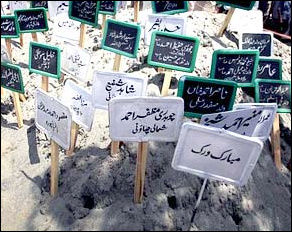
Graves of Martyrs“We are all under threat. They will kill us. They will kill us,” claimed Rubina Saigol, repeating the conversation with members of the Ahmedi community a few months ago. Saigol, an independent social researcher, said that the community members wanted to show her some case files on Ahmedis and talk about the threats publicly.
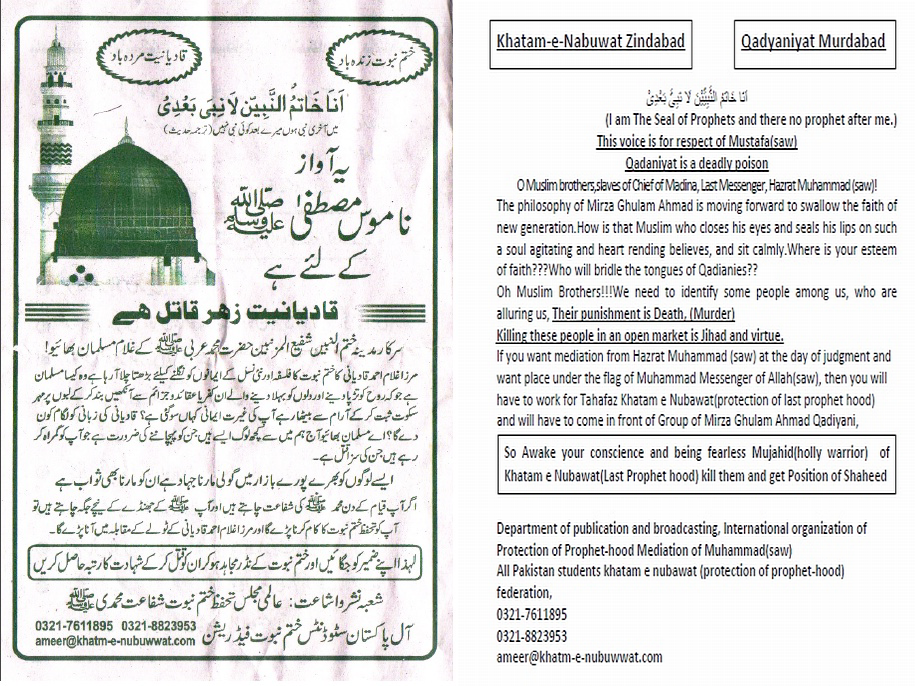

“I feel guilty and terrible that I didn’t write – partly because of fear.”

But before Saigol could gather up any courage to take any action – the threats had become a reality.

On May 28, militants attacked two Ahmedi houses of worship in Lahore, which resulted in the tragic death of more than 80 people and left more than a 100 injured. Within days, other militants attacked Lahore’s Jinnah Hospital where the injured were still recovering from the first attack.

The Ahmedi massacre has left everyone in shock and the Ahmedi community crippled with grief.

The Ahmedis have struggled for rights within India, Pakistan, Bangladesh, Egypt, and Indonesia for many years.

Although the majority of the Pakistani population is Sunni – there is a growing percentage of people who are seriously questioning the Sharia laws and the constitution. The trend can be followed on local blogs and even the op-ed pages of local newspapers – the rhetoric challenges Sharia laws against the basic rights of a citizen.

Pakistan’s Sharia laws are based mainly on the Hanafi school of thought.

According to Sharia Law, an Ahmedi cannot be accepted as a Muslim or as part of an Islamic sect because one of the basic fundamentals of Islam is to accept Prophet Muhammad (pbuh) as the last prophet in Islam – in Quranic verses he is referred to as the “Final Seal” (al-azhab:40).

In several interviews with religious scholars, from Sunni and Shia schools of thought in Cairo and Q’um in Iran agreed that Ahmedis were not a Muslim sect. They went as far as calling them, “heretics” and “infidels.” As well as, if a non-Muslim shows and preaches under a Muslim façade, then he or she must be charged, proven guilty, and punished in court according to Sharia law, a crime which is punishable by death (wajib-ul-qatl).

But one of the scholars in Cairo, who requested to stay anonymous, was quick to add that if a non-believer is a citizen of an Islamic state then he or she becomes the zami (responsibility) of the state. Therefore, it is the state’s responsibility to protect them more than the Muslim citizen, out of fear for violence against them.

“They should be treated with the utmost respect, because we, as Muslims, need to set an example for them,” he said. “As a Muslim, your responsibility is to follow the basics of Islam and lead a good life – violence of any type against anyone is not an example of leading a good life.”

This one scholar, who remains anonymous out of fear for the repercussions he could face, is not alone.

As soon as the attack hit the news, blogs went up everywhere in an uproar; some immediately condemned the brutal attack, others wrote malicious comments about Ahmedis claiming them to be wajib-ul-qatl (deserving of death), and some tried to explain the causes of the attack through religious, political and social analyses.

On the blog pkpolitics there were many harsh comments and the owners of the blog removed those comments and posted a warning to respondents on abusive language.

One of the more kinder comments on pkpolitics was, “Brother, The Qadyani religion should not be even be called ‘Ahemdi religion’, for you know that the Last Prophet Muhammad is exclusively mentioned by the name ‘Ahmed’ both in the Holy Quran and in the Bible (sic).”

Another respondent scolded back, “I cant believe my eyes, Instead of completely condemning the attack and humiliating the attackers, some are debating on the words used and about Qadyani sect or religion whatever…. no wonder Pakistan is heading towards its doom day by day… shame on us (sic).”

Tazeen Javed, winner of Best Humor Blog category for Pakistan’s first Annual Blog Awards, blogs at A Reluctant Mind wrote, a social aspect of the attack holding everyone accountable, event the public, for the attack in “We all have blood on our hands.”

The Waking Life blog posted, “Is it all worth?” questioning Muslims who asked for tolerance in other parts of the world, wrote, “Time to put things in perspective…Facebook may have partaken in blasphemy but there’s plenty of it going on in our cities and society. How about cleaning our own house first? (sic)”

The popular and controversial blog, Café Pyala, which sometimes uses profanity, condemned the attack in the political analysis “Original Sin:” “Truly, if ever there was short-sightedness among Pakistan’s establishment (and there are plenty of examples of it) this was it…The nurturing of extremist thought during Zia ul Haq’s (mis)rule and its repercussions in the shape of today’s barbaric attacks (and earlier targeting of Shias, Hindus and Christians) are a logical continuation of the original sin. (sic)”

Most editorials and columnists for print media did not have to directly respond to profanity like some online media blogs, however they condemned the attack, pointing out the government’s blatant disregard for protecting minorities, and feeding a culture of bigotry.

The Dawn editorial “Culture of Intolerance” wrote, “Religious minorities in Pakistan have not only been shunted to the margins of society but also face outright persecution on a regular basis…the state, meanwhile, remains largely unmoved by the plight of minorities — and that isn’t surprising either for it is a party to this persecution.”

Columnists did not try to hide the humiliation the government as well as the public should feel over the attacks.

Columnist Kamran Shafi, who writes for Dawn, wrote in A sad place, indeed that he recalled a time when there was no religious distinction, just Pakistani citizens. He stated, “The Ahmedis might be considered non-Muslim by the state; surely they are still Pakistani?”

Shafi added that an important member of the Ahmedi community told him that the compensation that was offered to the victims of the attack would be kindly refused and asked to be transferred over to the people of Hunza-Gojal for the relief work.

These voices of different generations and backgrounds of growing tolerance are currently at a grass-roots level, but they can still be heard, even in some political circles.

On the day of the attack, Punjab’s Chief Minister Shahbaz Sharif held a press conference addressing the attack and the efforts of the police. Even though his offices had received reports on a threat to the Ahmedis several days prior to the attack.

While soon after the attacks, Interior Minister Rehman Malik was the only government official who personally went to visit the Ahmedi community to give condolences

Shahbaz Sharif has yet to visit the Ahmedi community since the attacks.

Although most recently, PML-N party leader Nawaz Sharif did condemn the attacks and named Ahmedis as “brothers” and “sisters.” Only for him to be threatened by religious leaders with an anti-Sharif campaign in the region.

If the public’s reaction has mobilised the government to react at all then it leads to the most important question: What is the next step?

Imam Shamsi Ali might have the answer.

“It is very difficult to accept the nature of the world we live in – part of this world is the freedom of expression. I oppose the idea (Ahmedi movement) but I cannot impose my ideas on anyone. I have no right to impose my ideas on anyone,” said Imam Ali.

Ali, who lived and studied Islamic Studies in Islamabad for seven years, is the leader for the 96th street mosque and runs the Islamic Cultural Center in New York.

“We need engagement. If we oppose those claims then we must have intellectual discourse. If we engage with Hindus, Christians, Jews, or Buddhists, then why cannot we talk to them?”

Ali, ultimately, feels that restricting the freedoms of a people is not the way of Islam, rather allowing people their freedom and showing tolerance is way for people to find the path to Islam.

Sadef A. Kully is a Reporter/Associate Producer for Dawn.com

©2010 DAWN Media Group. All rights reserved

Sunday, April 25, 2010

Blasphemy Law haunts minorities even after 18th Amendment

The News International - Pakistan
Thursday, April 22, 2010 | National
Blasphemy Law haunts minorities even after 18th Amendment

Thursday, April 22, 2010
By our correspondent

Karachi

The legacy of Zia Ul Haq continues to haunt the minorities in Pakistan as the 18th Amendment failed to do away with the controversial Blasphemy Law.

Representatives of minority communities have expressed concern over the government’s silence towards the repealing of the law.

Patron of the Pakistan Hindu Council, Ramesh Kumar told The News that he had met with top government officials, including Chairman Parliamentary Committee on Constitutional Reforms, Senator Raza Rabbani regarding amendments to the blasphemy law but failed to get any response.

“The law has greatly been misused against all the minority communities living in the country. There is a dire need to amend the law. I also made some suggestions regarding the selection procedure of the parliamentarians representing the minorities. However, this request, like its former, was also ignored.” Kumar suggested that parliamentarians should be nominated by public votes and not by party nomination.

Representing the Christian community, the secretary general of All Pakistan Minorities Alliance, Michael Javed, said that the government officials had promised on several occasions that amendments would be made but all these ended up in smoke. “It seems that the state has forgotten the outrageous Gojra incident in which seven people were burnt alive and more than 40 houses were torched. Due to the Blasphemy Law, hundreds of innocent people have been killed and several others are languishing in jails on the pretext of false cases.”

Moreover, the government’s decision to allocate four reserved seats in the Senate for the minorities is just a deceptive picture as the ones who would be sitting on the chairs would be representing their respective political parties and not the masses, he added.

A minority rights advocate, Elvis Steven, stated that the sentiment of the community has also been hurt over the exclusion of minorities in the constitutional committee for the 18th Amendment Bill. “Neither any amendment was not made to laws pertaining to minorities nor was any minority leader was taken into consultation for the reforms”.

“The Blasphemy Law has become a dead noose for us,” said Sardar Ramesh, of the Sikh community, a community which has no representation in the government or in the opposition. He said that no follower of any religion could even think of defaming or desecrating another religion and the death sentence punishment for the law should be abolished.

However, the most vulnerable minority community is the Ahmedis who continue to face discrimination and violence in the light of the law.

A report titled ‘State of Human Rights in 2009’ by the Human Rights Commission of Pakistan displays a bleak picture of the minorities. Last year, a total of 41 complaints regarding Blasphemy Law were registered by the police, out of which some 37 Ahmedis were booked under the law. Around five Ahmedi citizens were murdered in target killings.

“The law is exploited and our people are the worst sufferers. Everyday we are issued death threats but remain silent for fear of our lives. Until and unless the government repeals the discriminatory law, the minority communities won’t be able to breathe freely,” said an Ahmedi leader.

URL: www.thenews.com.pk/daily_detail.asp?id=235325
 
^ Top of Page