Showing posts with label jinnah. Show all posts

Friday, October 14, 2011

Blasphemy Law: Coming a full circle

Dawn.com Blog
Blasphemy Law: Coming a full circle
by BUSHRA S on October 14th, 2011 |
It was bound to happen. When you have a vaguely worded law with so many loopholes, and a clergy hell bent on defining religion in asphyxiating, rigid boundaries, its supporters and enablers were bound to get scorched themselves. The law was eventually going to come and bite them in the back and that is exactly what happened two weeks ago.

According to the news story, a student of a religious seminary in Chakwal, Junaid Ahmad was arrested for being blasphemous. He was apparently seen burning pages of Quran a week ago, was beaten by a crowd and handed over to the police. Ironically, however, a shaken and frightened Junaid claimed that he was in reality disposing off Quran’s loose pages to save them from desecration.

The story behind Junaid’s action was simple enough. His teacher, who belongs to Tehrik Khuddam Ahl-i-Sunnat, had told him that burning Quranic pages was a legitimate way of disposing them along with putting them in flowing water (stream etc) and burying them. As he was unable to find the other two options, Junaid resorted to the third one. It was just his luck that the man who saw him as he set the pages on fire had heard from another cleric that burning the Quran amounted to desecrating it. What followed is an ominous reminder of sharply converging, and rigid, interpretations among various schools of religious thought.

Diversity, whether religious or cultural, is always a good thing. But here, this diversity of belief within sects and sub-sects is stamped with unflinching righteousness, intolerance, and violent knee-jerk reactions. Leaving the organised sectarianism between Shias and Sunnis aside, these widely varying interpretations in such an environment result in friction and veiled hatred towards other sects within one’s circle. In such a situation, incidents like the one in Chakwal are in reality a mere prelude to what can follow. One of the most obvious possibilities, while remaining within the ambit of law, is the misuse of the blasphemy law against those who are fanatically in favour of it.

This misuse has already started albeit it is infrequent at the moment. In January this year, an imam and his son from Dera Ghazi Khan were convicted for life for committing blasphemy. They were accused of ripping posters from outside their grocery shop which advertised an event to observe Eid Milad un Nabi (the birth and death anniversary of Prophet Muhammad). There was strong speculation that the issue was not of blasphemy but difference of belief. The Deobandi philosophy, to which the imam and his son prescribed, do not believe in commemorating such days. So where the incident might have simply been that of removing a poster from their personal property, it was forcefully catapulted in the sphere of intentional blasphemy.

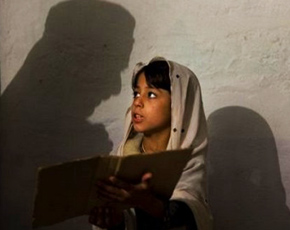
The problem, boiled down to its essence, is this: In all this ritualistic madness, this manic obsession with the act rather than the intention behind it, these “men of faith” have lost the plot. And that is an under-statement. Here school girls are ostracised for misplacing a dot in a word. Doctors are locked up for throwing away a person’s visiting card who shared the prophet’s name. People are persecuted for greeting others in Arabic language. Supporters of blasphemy laws obsessively defend its need to deter people from taking the law in their own hands; but when a man defies this very logic and kills a sitting governor whom he had taken an oath to protect, they cheer and holler themselves hoarse in his support.

So far, most of the victims of these laws are minorities and those belonging to lower and lower-middle income groups. But it won’t remain the same forever. With ferocious intolerance being allowed to breed unchecked in our country, it was only a matter of time before the factions started using this law to target religious rivals at will.

Right now a broad spectrum of religious right is united in its defence of murderer Mumtaz Qadri. Their slogans, demonstrative of their tunnel-minded support for his actions, should be deafening alarm bells for the rest of us.

It is a matter of time before these stout believers, momentarily united in their hate against “liberal fascists”, turn on each other. With such varied interpretations of religion, how will the courts interpret criteria of blasphemy? Will they take the easiest way out and just continue sentencing people in the hope the High Courts will correct the injustice? Will these cowardly actions really serve as a long-term pre-emptive solution or will the religious factions soon interlock horns?

If there is a legal or public showdown between people of different beliefs, the result will be more bloody, brutal and long drawn out than we can imagine. With all sides equally sure of their virtue and willing to die or kill for it, there might not be anyone standing at the end.

On a sardonic note, that will work out just right for the rest of the country.

Bushra S is an editor based in Lahore and can be found conversing on twitter here

©2011 DAWN Media Group. All rights reserved
URL: www.dawn.com/2011/10/14/blasphemy-law-coming-a-full-circle.html

Saturday, October 8, 2011

Ideology and intolerance

Dawn.com
OPINION
Ideology and intolerance
October 8, 2011Irfan Husain
MOHAMMAD Ali Jinnah visualised the state of Pakistan as “a homeland for the Muslims of the subcontinent”.

Sadly, he did not specify precisely which sect of Muslims he had in mind. Although a Shia himself, he did not have a sectarian bone in his body.

Indeed, he was secular to the core, and this was the philosophy he bequeathed to the state he had created virtually single-handedly. This was a bequest we tore up even before he was laid to rest.

So as we witness the ongoing massacre of Hazara Shias in Balochistan, we need to take a hard look at the monsters Pakistan has spawned over the years. Management gurus teach us that before we can solve a problem, we must first analyse it to gain a full understanding of the underlying causes.

But given the deep state of denial we prefer to stay in, we shy away from making the logical connection between cause and effect. When elaborating on his ‘two-nation theory’, Mr Jinnah was of the view that Muslims could not live side by side with Hindus in a united India as we were a different nation in terms of values and cultural norms.

This notion led to the partition of India in 1947, and even though millions of Muslims did not — or could not — make their way to the new state, Pakistan was born in a cataclysm of blood and fire. Almost immediately, the hard-line vision of Islam, espoused by Maulana Maududi and his Jamaat-i-Islami, became the ideology of large numbers of right-wing intellectuals and clerics.

However, it wasn’t until Zia seized power in 1977 that this literal strand of Islam became the official ideology of the state.

Some of the hard-line Sunni groups like the Sipah-i-Sahaba came into being in Zia’s period, declaring Shias to be ‘wajib-ul qatal’, or deserving of death. Needless to say, these killers were permitted to thrive by Zia.

Step by step, the notion of separateness at the heart of Partition has fostered a feeling of ‘us against them’. Taken to its illogical extreme by hard-line ideologues and their brainwashed followers, this translates into the belief that those not following their particular school of Islamic thought become ‘wajib-ul qatal’.

Massacres and individual murders resulting from rabid intolerance bearing the spurious stamp of religious orthodoxy are too numerous to cite here. But the recent episodes of the cold-blooded slaughter of Hazara Shias in Balochistan should open the eyes of those wishing to negotiate with the terrorists responsible for these acts.

Another hard-line, anti-Shia group, the Lashkar-i-Jhangvi, was quick to claim responsibility for these murders, and yet the state has done nothing to bring this organisation to book.

According to a Human Rights Watch press release, “In Balochistan, some Sunni extremist groups are widely viewed as allies of the Pakistani military, its intelligence agencies and the paramilitary Frontier Corps, which are responsible for security there.

Instead of perpetrating abuses in Balochistan against its political opponents, the military should be safeguarding the lives of members of vulnerable communities under attack from extremist groups”.

But it’s not just in Pakistan that Hazara Shias have been targeted: in Afghanistan, thousands have been killed by the Taliban.

Being a visible ethnic group, they are especially vulnerable to an increasingly vicious and violent Sunni majority. In a blog on this newspaper’s website, Murtaza Haider has cited a revealing doctoral thesis by Syed Ejaz Hussain. According to his research, 90 per cent of all those arrested for committing terrorist attacks in Pakistan between 1990 and 2009 were Sunni Deobandis.

And it’s not just Shias who are being targeted, or Christians, Hindus and Ahmedis: as we have seen time and again, suicide attacks against mosques and Sufi shrines have killed thousands of Sunnis as well. While there are a growing number of extremist groups, they are all united in their intolerance, and their contempt for democratic values and common decency.

Despite the evil these killers represent, there are growing voices in Pakistan demanding that the government negotiate with them. A spokesman for the Pakistani Taliban was quoted recently as saying his group would talk to the government provided it broke off its relationship with the United States and imposed Sharia law in the country.

For a criminal gang to make such demands is preposterous; but for sane, educated Pakistanis to advocate talks with such people is even worse. Instead of insisting that we lock up these terrorists and try them, we are being asked to treat them as a political entity with valid demands.

If we are to ever defeat the hydra-headed monster we have created, our defence establishment will have to acknowledge its huge error in thinking that it could use these killers to further its agenda in Afghanistan and Kashmir. This has provided them with legitimacy, support and impunity. Unless the Pakistani state repudiates all links with extremism in all its forms, outfits like the Lashkar-i-Jhangvi will continue to murder at will within Pakistan, while the Lashkar-e-Taiba creates mayhem in our neighbourhood.

Quite apart from the collapse of the writ of the state caused by the depredations of these groups, and the innocent lives sacrificed at the altar of misplaced expediency, Pakistan has become a pariah in the international community. Increasingly, the use of terrorism as an instrument of policy is making us a scary country with a powerful death wish.

But while we struggle to cope with the rising tide of extremism, we need to step back and examine how and why we arrived at this abyss.

Clearly, it did not happen overnight. Looking back, we can see that the demand for separate electorates for Muslims in British India over 100 years ago was a major historical fork in the road. By conceding to this demand from a group of Muslim aristocrats as part of their divide-and-rule policy, the British tried to ensure that the two major religious communities would not unite against them.

However, we do not have the luxury of blaming our predicament on past imperial policies. The British are long gone, and the barbarians are poised to capture the state. We still have a choice, but if we don’t act quickly, we risk joining the ranks of failed states like Somalia, Yemen and Afghanistan.

irfan.husain@gmail.com

©2010 DAWN Media Group. All rights reserved
URL: www.dawn.com/2011/10/08/ideology-and-intolerance.html

Monday, September 19, 2011

Jinnah’s Pakistan, hijacked by clerics

The Express Tribune Blogs
Opinion
The Verdict
Kashif ChaudharyJinnah’s Pakistan, hijacked by clerics
Posted by Kashif Chaudhry
Published: September 19, 2011
Jinnah founded Pakistan with the dream of it being a secular state where people could live as free citizens. However, today, Pakistan finds it hard to uphold the very ideals it was founded upon
Jinnah founded Pakistan with the dream of it being a secular state where people could live as free citizens.However, today, Pakistan finds it hard to uphold the very ideals it was founded upon
With the partition of the Indian subcontinent, Pakistan came into existence on August 14, 1947. The valiant and astute Muhammad Ali Jinnah led the minority Muslim community of united India to a separate homeland to fulfill the demand for freedom of religion, profession, and speech.

Jinnah was an outstanding lawyer who had studied law in London. He had a modern outlook on the world and was strongly secular. Part of the oath under which he took office reads:

“No subject … in Pakistan shall, on grounds only of religion, place of birth, descent, color or any of them be ineligible for office.”

He was absolutely clear that the new state he was founding would accommodate people of all faiths and descent without any prejudice. To assert this point, he appointed a non-Muslim as his first law minister. The Muslims in his cabinet consisted of Sunni, Shia, and Ahmadis alike. He believed that Islam endorsed a secular democracy and the two were perfectly compatible.

“The great majority of us are Muslims. Consequently, we have a special and a very deep sense of unity. But make no mistake: Pakistan is not a theocracy or anything like it” he said in an address in 1948.

He believed in a Pakistan wherein the mosque would be separate from the state.

“You are free; you are free to go to your temples, you are free to go to your mosques or to any other place of worship in this State of Pakistan. You may belong to any religion or caste or creed that has nothing to do with the business of the State” he said.

In the struggle for Pakistan, Jinnah was not faced with the Indian Congress and the British alone. He also had to endure intense animosity from hard-line Muslim clerics and counter their vile propaganda. He was accused, by the ultra right-wing, of blasphemy, and they considered him a great heretic for his secular ideology.

Prominent clerics like Maulana Maududi urged common Muslims not to side with Jinnah. Maududi wrote:

“It is forbidden to vote for [Jinnah’s] Muslim League.”

Despite this, the resolute Jinnah was successful in garnering support from the masses in most Muslim-majority areas.

Today, the nation finds it hard to uphold the very ideals it was founded upon. As it passes through dangerously volatile times, it has forsaken its founding principles of freedom and secularism.

But how and why did Pakistan turn against itself?

Even though he tried his best to steer it toward a secular democracy, Jinnah did not live long enough to see it become one. Over the coming years, Pakistan took a very troubling turn. In a matter of nine years, it became an “Islamic Republic,” and in a little over two decades, it had essentially become a theocracy.

The same extremist clerics who had opposed Jinnah and his struggle for Pakistan gradually claimed ownership of the State. They formed political groups that used religion to amass public support. Their demonstrations of street power, frequently violent, meant that sectarian hatred and intolerance was the order of the day.

Even governments avoided a clash with the radical right and became increasingly wary of arousing any negative religious sentiment and consequently losing popular vote. This only furthered the extremist cause, and in time, the original path Pakistan started on was completely forsaken. Pakistan, it is now said, was formed for the Muslims and is meant to become an Islamic theocracy where the Shariah, as interpreted by the hard-liners, is to be the ultimate law.

One tragedy after another, Jinnah’s Pakistan was dealt with massive blows. His Pakistan was no more his; it had been hijacked by forces of extremism and intolerance.

Non-Muslims could not hold the highest office in any of the core institutions anymore.

In 1953, there were widespread riots against the Ahmadi Muslims, a sect that extremists considered heretics.

The harassment of Shia Muslims and other minority groups also increased and went largely unchecked.

In 1974, the government yielded to intense pressure and declared the Ahmadiyya sect non-Muslim.

Tout de suite, the State had taken authority to decide its people’s religion, and the two were no longer separate.

General Zia ul Haq took over the country and became its third military president in 1977. To legitimize his dictatorship, he sought to please the right-wing and set to Islamize Pakistan. Amongst other things, he introduced the controversial blasphemy laws that stated death as the punishment for any derogatory remark against the Quran, Prophet Muhammad (PBUH), and other Islamic holy personages.

For Ahmadis, Zia also promulgated an ordinance in 1984 that criminalized the practice of their faith. Zia’s rule was the toughest for citizens who did not adhere to what had now become the state-backed perversion of Islam. Jinnah’s secular Pakistan had drifted into the hands of his enemies.

Jinnah had warned of this in his August 11th, 1947 address to the Constituent Assembly of Pakistan. He said:

“As you know, history shows that in England, conditions, some time ago, were much worse than those prevailing in India today. The Roman Catholics and the Protestants persecuted each other. Even now there are some States in existence where there are discriminations made and bars imposed against a particular class. Thank God, we are not starting in those days.” He continued: “Today, you might say with justice that Roman Catholics and Protestants do not exist; what exists now is that every man is a citizen, an equal citizen of Great Britain and they are all members of the nation.”

In the same address, he said:

“My guiding principle will be justice and complete impartiality, and I am sure that with your support and cooperation, I can look forward to Pakistan becoming one of the greatest nations of the world.”

Jinnah knew that a secular form of government could bridge differences and bring together people of all faiths and backgrounds to build a strong Pakistan. Just as the Catholics had learned to live with the Protestants, he was optimistic that the Pakistan he was founding would be a successful nation, a beacon of tolerance and an example of unity in diversity. However, the men who opposed Jinnah’s ideals before partition stood in his way yet again.

Founded on freedom of religion and practice, Pakistan is one of the biggest violator of religious freedom today. For Pakistan to succeed, it will have to reverse the dangerous turn it took and get back on the path that Jinnah laid before it. The blasphemy laws must be amended, everyone must be equal citizen of the state, the anti-Ahmadi laws must be revisited and the state must remain separate from the mosque at every cost. Pakistan must educate itself and look for the unity that Jinnah so cherished in the diversity across the land.

In February 1948, Jinnah said in an address:

“You have to stand guard over the development and maintenance of democracy, social justice and the equality of manhood in your own native soil. With faith, discipline and selfless devotion to duty, there is nothing worthwhile that you cannot achieve.”

Unfortunately, recent events have shown that Pakistan is still far away from taking that vital turn. The government has shown little resolve to go after the perpetrators of religious hate and violence and definitely no will to even trigger a dialogue on the controversial laws of the land. With Pakistan headed toward a steep decline, the solution lies in bold courage and reform. Jinnah’s Pakistanis will have to wake up sooner than later and reclaim the land from his opponents. Pakistanis must bring about a rebirth of Pakistan – Jinnah’s Pakistan.

Copyrighted © 2011 The Express Tribune News Network
URL: http://blogs.tribune.com.pk/story/8046/jinnahs-pakistan-hijacked-by-clerics/

Monday, June 13, 2011

Pakistan’s future is tied to rights for minorities

Sepro News
Commentary:
Analysis
Pakistan’s future is tied to rights for minorities
Monday, June 13, 2011
By David Alton

David AltonIn 1947, Muhammad Ali Jinnah gave a speech to the New Delhi Press Club, setting out the basis on which the new State of Pakistan was to be founded. In it, he forcefully defended the right of minorities to be protected and to have their beliefs respected:

Minorities, to whichever community they may belong, will be safeguarded. Their religion, faith or belief will be secure. There will be no interference of any kind with their freedom of worship. They will have their protection with regard to their religion, faith, their life and their culture. They will be, in all respects, the citizens of Pakistan without any distinction of caste and creed.

These words are a forgotten aspiration in today’s Pakistan where minorities, ranging from Ahmadis to Sikhs, from Christians to Hindus, Buddhists and Zoroastrians, face relentless violence and profound discrimination.

It is estimated that, of a population of over 172 million people, at least 4% of the population come from the minorities: in 2011 the Pakistan Hindu Council put the number of Hindus alone at 5.5% - some 7 million people, while there are almost 3 million Christians, and Pakistan’s Ahmadiyya community is 4 million strong. All of these minorities have suffered grievously, along with those caught up in the sectarian violence between Sunni and Shi’a Muslims.

Jinnah rightly declared that the Government of Pakistan has a duty to protect all of its citizens, regardless of their beliefs or origins. The international community ought to be asking how the State today honours that pledge.

Take the Ahmadis. One year ago, in two separate attacks in Lahore, 98 Ahmadis were murdered and many more injured while they were at Friday prayers. The vicious brutality of these attacks is magnified when considering the Ahmadis’ belief: “love for all and hatred for none.”

Sadly, too few share the same passion for tolerance. While the Ahmadis consider themselves Muslim and follow all Islamic rituals, in 1974 the State declared them to be non-Muslim and, in 1984, they were legally barred from proselytising or identifying themselves as Muslims. Ali Dayan Hassan of Human Rights Watch believes that Ahmadis had thus become “easy targets” for militant Sunni groups who behave with impunity believing they have the full authority of the State in declaring Ahmadis to be infidels. Despite repeated attacks on the Ahmadis no prosecution of perpetrators has occurred in the past 15 years.

And the situation is set to get worse. Earlier this month, on June 11th, The Asian Human Rights Commission issued a statement that “extremists openly plan to kill hundreds of Ahmadis while the government turns a blind eye.”

Last year Terrorism Monitor warned that:

As the Pakistani Taliban are trying to spread their war on the Pakistani State, they are likely to continue to target minorities like the Ahmadis in their efforts to create instability.

On March 29th of this year that threat was brutally and graphically underlined by the murder of Pakistan’s Minister for Minority Affairs, Mr.Shahbaz Bhatti. An advocate of reform of the country’s Blasphemy Law - the cause of many bogus prosecutions against non Muslims - he was gunned down by self described Taliban assassins as he left his Islamabad home. His murderers scattered pamphlets describing him as a “Christian infidel”. The leaflets were signed Taliban al-Qaida Punjab.”

Shahbaz Bhatti’s death is the second high profile killing this year of someone asking for changes to Pakistan’s laws and greater protection for its minorities.

The Foreign Secretary, William Hague, said that Bhatti’s death “is a tragic loss for Pakistan and for all people who believe in human rights and freedom of speech.”

Alistair Burt, Minister for South Asia, added that he had supported Mr.Bhatti’s “in his difficult role and in his attempts to revise his country’s Blasphemy Laws. Those laws have been used to target minorities.”

Minister Bhatti’s death was not an isolated incident.

As terrorism and instability has intensified, so have the deaths. Over 35,000 people have died in attacks since 2003; 2,522 fatalities in the first six months of 2011 alone. And, on the day of writing this, a report from Peshwar detailed the deaths of 34 more people, with over 100 badly injured.

Meanwhile, forced conversions to Islam, rape, and forced marriage are increasingly commonplace.

Take the case of Sidra Bibi.

She is a 14 year old Christian living in the district of Sheikhupura in Punjab, and the daughter of a worker in the cotton industry. She was molested, abducted, raped and threatened her with death. Physically and psychologically abused, she became pregnant. Police have refused to accept her complaint.

Samina Ayub, is also a Christian. Aged 17, she lives with her family near Lahore. Kidnapped, forcibly converted to Islam, renamed Fatima Bibi, she was coerced into marrying in the Muslim rite. Her family reported the abduction but police have not prosecuted those responsible.

Attacks have also been made on places and books sacred to those with minority beliefs. The radical Islamist party, Jamiat ulema-e-Islam recently filed an application to the Supreme Court to ban the circulation of the Bible, describing it as “blasphemous” and “pornographic”

Such intolerance and such virulent attacks pose a grave threat to Pakistan, to the region, but, also, to the UK, where around 1.2 million British citizens of Pakistani descent now reside.

Unlike the authorities who have such a lamentable record in protecting their citizens, Pakistan’s own citizens clearly understand from where the threat to their security originates. In an independent survey 90% cited religious extremism as the greatest threat to the country: which is why we have a duty to speak out for these vulnerable and preyed upon minorities, especially in the aftermath of the killing of Osama bin Laden, since when intolerant violence has intensified.

The former Foreign Secretary, David Miliband commented that: “It is when the international community has taken its eye off the ball in Pakistan that instability has increased…Internally, Pakistan has a duty to protect minority groups and needs the support of its allies to do so.”

Those words are in complete accord with Jinnah’s 1947 Declaration promising tolerance, respect and security for the new country’s minorities - a vision that needs to be reinserted into the political mainstream. In 2011 the grievous plight of Pakistan’s minorities is inextricably bound to its destiny as a nation.

Professor Lord David Alton is a member of the House of Lords. The author of several books, Lord Alton has been widely recognized for his work on behalf of human rights. See: http://www.davidalton.net

© Copyright Spero, All rights reserved.
URL: www.speroforum.com/site/article.asp?idCategory=34...minorities

Sunday, March 20, 2011

Was Jinnah secular?

Express Tribune, Pakistan
OPINION
Was Jinnah secular?

Khaled Ahmed
By Khaled Ahmed
Published: March 20, 2011
The writer is a director at the South Asia Free Media Association, Lahore khaled.ahmed@tribune.com.pk
On the night of March 7, 2011, Justice (retd) Javid Iqbal was interviewed on a TV channel on the nature of the Pakistani state. He held that Pakistan, as envisaged by Jinnah, was to be a secular state. This is the package he has always accepted as the ‘modern Islamic state’ imagined by his father, Allama Iqbal, too.

Javid Iqbal was clear that what Pakistan is now was not what Jinnah had thought of. The word ‘secular’ put off the TV host who insisted that ‘secular’ was the opposite of ‘Islamic’. He even once erroneously equated ‘secular’ with ‘communist’, not knowing that an atheist state cannot be secular. Javid Iqbal said hard Islam was not the project of Jinnah: The Islam of hudood and blasphemy laws was imposed by General Zia.

He even named Dualibi as the Arab scholar who was sent to Pakistan by Saudi Arabia to impose the laws that Pakistan was averse to enforcing. The fact is that the 1980 Zakat & Ushr Ordinance, imposed by General Zia on Sunnis and Shias, was framed by Dualibi in Arabic. Javid Iqbal clearly said that moderate and liberal elements were silent because they feared harm at the hands of extremist forces. He equally despaired of politicians.

He said that only the ibadat (prayer rituals) were unchangeable in Islam; muamilat (affairs) had to change in tune with the times. One reason Islamisation did not improve the Pakistani character was the state’s retrogression towards laws that were no longer compatible with modern times. He referred to an effort made by late MNA MP Bhandara who, as a minority representative, wanted the August 11, 1947 speech of Jinnah incorporated into the Constitution.

The August 11 speech is clearly a secular manifesto issuing out of the mouth of the Father of the Nation. The secularists lean on it; the others think Jinnah still meant a state based on Sharia. One historian even went as far as to say that Jinnah had become ‘infirm of mind’ when he spoke on August 11.

Saleena Karim in her book Secular Jinnah & Pakistan: What the Nation doesn’t Know (Paramount 2010) has probably tackled the case most thoroughly in defence of those who reject the secular label. She has dug up an interview that Jinnah gave to a Reuters’ journalist on May 21, 1947, which was used by chief justice Muhammad Munir in his book From Jinnah to Zia (1979) to infer that Jinnah had wanted a secular state.

She has dug up what Jinnah had really said: ‘But the Government of Pakistan can only be a popular representative and democratic form of government. Its parliament, and cabinet responsible to the parliament, will both be finally responsible to the electorate and the people in general without any distinction of caste, creed or sect, which will be the final deciding factor with regard to the policy and programme of the government that may be adopted from time to time’ (p.31).

She writes: “Instead of calling the proposed Pakistan a ‘modem democratic state’”, Jinnah says only that it will have a “democratic form” of government. He was actually averse to imitating “modern” (read: contemporary) democracy as a political system, considering it a failure’. She thinks it contains a presumed reference to a non-secular state. One could also conclude from this that people may democratically decide to have a non-secular Islamic state with a Sharia.

It is up to the reader to decide whether the argument for a non-secular state is convincing or not, on the basis of what Jinnah is supposed to have said.

Published in The Express Tribune, March 20th, 2011.

Saturday, December 25, 2010

What about Jinnah’s Pakistan?

Dawn.com Blog
What about Jinnah’s Pakistan?
by Murtaza Razvi on 12 25th, 2010 |

Qaid-e-Azam, Muhammad Ali JinnahSome random thoughts come to mind this Christmas, a day that also happens to be Mr. Jinnah’s birthday.

If it were the year 1947, would the advisor to the chief minister, Sindh, Ms. Sharmila Faruqui have rushed to the police station in Clifton as she did last Monday to meet a rape victim only to cast aspersions on the victim’s complaint that she was kidnapped and raped by her assailants? Ms. Faruqui not only disclosed the identity of the rape victim to the media but also implied that she was not quite convinced of the victim’s account of the assault; that she found her to be “hyper and rude”, within hours of the rape; and that the victim and her female friend, who was also beaten up badly, were coming from a party late at night. What does the advisor to the CM actually think? That it’s OK to rape a girl who parties? Who gave Ms. Faruqui the right to cast aspersions on the victim’s story even before the police began to investigate?

Then, just who is Ms. Faruqui to judge the veracity of the wronged woman’s claim, whose medical reports proved that indeed a gang-rape had been committed? Does Ms. Faruqui not know that rape is a heinous crime in any civilised society, regardless of the profession of the victim, whether she is a prostitute or a submissive, God-fearing woman, and that a rapist is a rapist even if he happens to be the husband of the victim?

While the whole episode is outrageous, yet another outrage brews elsewhere in the land of the pure, with a victim who is twice disadvantaged – being a woman and that too from a minority community. Aasia Bibi as the latest blasphemy accused, a poor Christian woman from a village in Punjab who’s on death row in a Lahore prison. Would the mullahs of all hues, Barelvi, Debandi, Ahl-i-Hadis, Shia and what have you, who are now demanding her death have been able to rally for their ‘cause’ at the birth of Pakistan?

Remember how they had stood discredited in the public eye on the eve of the creation of Pakistan, which they had opposed, as Jinnah unequivocally charged the Constituent Assembly at Karachi with framing a constitution for his country, declaring that “Religion will have nothing to do with the business of the state”?

Then, are Ahmadis free to assemble and worship in Pakistan today? Jinnah would be turning in his grave if he knew that we created a minority out of a community that was Muslim in his Pakistan up until 1974. The entire Ahmadi population of the city of Rabwah in Punjab, with a population of 70,000, has a gagging order against them to assemble and pray as they wish, in a country where Jinnah had assured all that they were free to go to their “mosques… temples and any other place of worship”.

If there was a Pakistan Ideology, it was given to the Constituent Assembly of Pakistan by Jinnah himself on the eve of independence, that is why he had to die before a new Objectives Resolution could be passed by his deputies in the same assembly in 1949.

This was the starting point of introducing religion into the business of the state, and upon which Z.A. Bhutto and General Ziaul Haq built the entire edifice of their controversial process of Islamisation, with the result that today Islam itself has become controversial, with Sufi shrines and mosques of rival sects being bombed by the puritans, and innocent citizens being killed because they are not Muslim enough. It was about such people that Jinnah had said: “[Pakistan] will not be a country ruled by mullahs with a divine mission;” and that, “The British parliamentary system should be the model before us.” Both the ideals have since been severely compromised.

Jinnah’s Pakistan was as much in the name of Islam as the independent state of Bosnia in our own times. Pakistan was created for the welfare of the Muslim-majority provinces of British India just as Bosnia was created for safeguarding the interests of the Muslim majority of that region of the former Yugoslavia. Following partition of India, Indian Muslims were advised by the Quaid to remain loyal to their country; it is they who have heeded Jinnah’s call while we in Pakistan have created our own distortions and deviations from his ideals.

Here in a nutshell is a very secular rationale for the creation of Pakistan: Muslims of the even Muslim-majority provinces of a united India, in the face of the denial of any affirmative action in their favour by Congress in 1947, could not have been able to safeguard their socioeconomic interests. Non-Muslims were better qualified to take up most jobs and lucrative vocations, which in their absence fell to Muslims in what we call Pakistan today.

The Quaid was more than willing to keep India in one piece provided he was able to extract an affirmative action plan in favour of the very backward Muslims at the time of independence; this means that even before Pakistan became a reality on the map, Mr. Jinnah had revisited and reviewed his Two-Nation Theory. Never was he to invoke it again even to unite East and West Pakistan, which saw the language riots in Dhaka right at the outset.

The leader and the lawyer Jinnah understood well the distinction between creating a country for disadvantaged Muslims or one in the name of Islam. That fine line was later blurred by his deputies after his death and it was removed altogether by ambitious politicians and military dictators to perpetuate their own rule.

In Jinnah’s Pakistan, we would have been saved many a Ms. Faruqui in the government; instead, an Aasia Bibi, on the back of ballot, could have become the head of state without endangering Islam or trading off nuclear secrets. These two feats today are the exclusive privileges of Pakistani Muslims alone.

Murtaza Razvi is the Editor, Magazines, at Dawn.

©2010 DAWN Media Group. All rights reserved
URL: http://blog.dawn.com/2010/12/25/what-about-jinnah%E2%80%99s-pakistan/

Friday, August 20, 2010

Solidarity versus resentment

Express Tribune, Pakistan
Blogs
Solidarity versus resentment
by Taha KeharTaha Kehar
Friday, 20 August 2010
Pakistanis today need solidarity and a clear understanding of the Islamic democracy Jinnah had envisioned. PHOTO: AFP
At a Press Conference at New Delhi, on July 14, 1947, Jinnah was grilled by a correspondent who wished to inquire as to whether Pakistan would be a secular state or a theocracy.

Jinnah hinted at the absurdity of the question, adding, quite tactfully, that he did ‘not know what a theocratic state’ meant. The correspondent had then fervidly suggested that it was ‘a state where only people of a particular religion, for example, Muslims, could be full citizens and non-Muslims would not be full citizens’. Apprised with this vision of a theocracy, Jinnah aptly stated that ‘when you talk of democracy, I am afraid you have not studied Islam – we learned democracy thirteen centuries ago.’

However, it seems as though Islam in Pakistan has lost its democratic appeal for even though minority rights have been safeguarded, the Muslim community has failed to preserve the rights of the Ahmadis. Glaring illustrations of this claim are the events that led up to the declaration of Martial Law in Lahore in 1953 and, more recently, the attack on an Ahmadiyya mosque in Lahore on the May 28, 2010. This exhibits the dwindling solidarity of the Muslim community and serves to further demonstrate that insurgency in the troubled North-western wing of Pakistan has taught us zilch. What ideological justification is there for those who share a creed to fight one another? An astute observer would put forth three deep-set explanations:

1) The war on terror
2) Assailing the extremist elements and providing a scope for moderation
3) Eternal Peace

What is striking to note is that all these justifications are fundamentally interlinked. The first rationale is an oft-touted ploy which ironically contradicts the second line of reason. As for the third reason, it is purely optimistic and therefore unlikely to be attained any time soon.

Then why is it that the Islamic democracy which Jinnah alluded to at that press conference all those summers ago has grown stale? Have we become theocratic in a unique sense? Are we assaulting the integrity of the minority sections within our own ravaged Muslim euphoria or have we become overly generous to the religious and cultural minorities at the expense of our own marginalised factions?

The explanation is far more intricate than one would assume. It is laden with ‘grey areas’ as opposed to the standard ‘black and white’. Hence, it is apt for the reader to have the final word. But prior to that, it is essential to note that Jinnah’s vision was one of diversity. His advocacy for religious tolerance was not purely restricted to minority groups. He wanted for us to delve deeper and understand its intrinsic worth so that one day the Muslim community can counterbalance its ideological variations and extend its acceptance of conflicting points of view to people of all religious persuasions with poise. Perhaps that would be a more suitable strategy for acquisition of world peace, moderation and the age-old democratic principles of Islam.

URL: http://blogs.tribune.com.pk/story/1137/solidarity-versus-resentment/

Sunday, June 20, 2010

In our beginning is our end

Daily Dawn, Pakistan
Columnist
.
In our beginning is our end
   By Ardeshir Cowasjee
   Sunday, 20 Jun, 2010

Whatever progress we have made in Pakistan's 63 years of life has been on the negative side, writes Ardeshir Cowasjee. - Photo by Reuters
Whatever progress we have made in Pakistan’s 63 years of life has been on the negative side, writes Ardeshir Cowasjee. — Photo by Reuters

We must read to remember. The early days of Pakistan were far from halcyon, though those of us who lived through them look back with some nostalgia. Whatever progress we have made in this country’s 63 years of life has been, as it turns out, on the negative side.

Where have we progressed in leaps and bounds? Well, in the scale of wholesale corruption, political and administrative ineptitude, and bigotry and intolerance and their accompanying violence — they were all there at the beginning which was in itself violent.

Perhaps the presence of founder-maker Mohammad Ali Jinnah for the first year of Pakistan’s life kept things somewhat in check, though his loyal lieutenants did take advantage of his state of health. His exhortations of Aug 11, 1947 to his constituent assembly were in vain.

All that he laid down — tolerance, equality of citizenship, the shunning of corruption, nepotism and jobbery, and above all that law and order was the first priority of any government — was all lost. It was never digested, the quality of manpower saw to that.

Having dipped into an OUP 2010 publication, The Culture of Power and Governance of Pakistan 1947-2008 by Ilhan Niazi, it has sadly dawned upon me how misplaced was the early enthusiasm for the new country and the belief that the words and teachings of Jinnah would prevail.

In January 1949, governor of the Punjab Francis Mudie sent a note to Prime Minister Liaquat Ali Khan complaining that Punjab Chief Minister Mamdot was one up on the centre and even Jinnah “every time that they have intervened and the feeling is growing that the centre is powerless even when the government is hopelessly corrupt and the administration paralysed … no questions of policy are even contemplated”.

The services were demoralised, ministers were interfering in the administration, “becoming more and more rapacious”. Land grabbing was the fashion from the start — the Punjab chief minister was described as “lazy, inefficient and a liar”, his main interest being the acquisition of evacuee land out of which he and his family and followers had all done splendidly.

The same applied to many other politicians and administrators whose main focus was the abandoned evacuee properties — buildings and land.

In March that same year, the ulema, who even in those days wielded far more influence than they should have done and were mainly comprised of groups that had opposed the creation of Pakistan, scored a famous victory.

The Muslim League, led by Liaquat Ali Khan, turned its back on Jinnah and his avowal to the world that Pakistan was not to be a theocratic state led by priests with a divine mission, and pushed through the constituent assembly the Objectives Resolution which put paid to any hope of freedom of worship, of the fundamental principle that all citizens are equal and above all of Jinnah’s promise to his people: “You may belong to any religion or caste or creed — that has nothing to do with the business of the state.”

In 1952, Interior Secretary G. Ahmed sent to Prime Minister Khwaja Nazimuddin a note on the internal situation. He reported a loss of public confidence in the weak and far from competent government. The country was on the downgrade, provincial and political disharmony was on the increase, and there was an undercurrent of restlessness.

The cause: the mindset of the politicians and their medieval attitude towards the acquisition and exercise of power — politicians at all levels used and abused the state as a personal estate, and were adept at playing games with the religious fundamentalists for short-term political benefit.

Well, all of the above is an apt description of what has transpired each year of Pakistan’s life — the generals had not by 1952 reared their heads, but the accusation against the politicians has also applied equally and fairly since 1956 to the generals of our army and to vast numbers of corrupt and venal administrators who have been willing tools in the hands of whatever masters they have served in servile manner.

Come 1953, and the ulema flaunted their powers. In January they issued an ultimatum to Prime Minister Nazimuddin that unless he declared the Ahmadis to be a non-Muslim minority and sacked all Ahmadis in key state posts they would resort to ‘direct action’. This they did in March, the prime minister having ignored them.

Widespread disturbances, killings and rioting broke out in Punjab leading to the imposition of a local martial law. In 1954 Justices M. Munir and M.R. Kayani presented their report on the disturbances in which they famously declared that, after having heard various members of the ulema, it was impossible to define a Pakistani Muslim.

Their final sentence to the report is one of the saddest truest comments ever made on this country: “But if democracy means the subordination of law and order to political ends — then Allah knoweth best and we end the report.”

Were any lessons learnt? No. In 1974, Prime Minister Zulfikar Ali Bhutto, bowing, it is said to external and internal pressures excommunicated an entire community, declaring the Ahmadis a minority. Ziaul Haq in 1984 declared the Ahmadis to be non-Muslims and into the Pakistan Penal Code inserted sections 298-B and 298-C prohibiting them from referring to their place of worship as a masjid, from referring to the call to prayer as the azan, from ‘posing’ as a Muslim, or from referring to their faith as Islam. The punishment was a fine and up to three years imprisonment.

And so, on to May 28 2010. Where do we go from there?

arfc@cyber.net .pk

©2010 DAWN Media Group. All rights reserved

Tuesday, June 8, 2010

The demand for Pakistan and Islam

Daily Times, Pakistan
Tuesday, June 08, 2010

VIEW: The demand for Pakistan and Islam

The Muslim League’s propaganda struck terror in the hearts of the Hindus and Sikhs who were told that they would be paying jazya and Islamic law will prevail in all sectors of individual and collective life. The minority Shia and Ahmediyya communities were also fearful that it would result in Sunni domination

The recent attack on a congregation of Ahmedis during prayers, which claimed more than 90 innocent lives, has revived a discussion as to whether there is a connection between the creation of Pakistan and Islam. Within the Muslim League there was always a constituency in favour of Pakistan becoming an Islamic state. One of its proponents was a close confident of Jinnah: Raja Sahib Mahmudabad, a Shia. In 1939 he wrote to the historian Mohibul Hassan:

“When we speak of democracy in Islam it is not democracy in the government but in the cultural and social aspects of life. Islam is totalitarian — there is no denying about it. It is the Quran that we should turn to. It is the dictatorship of the Quranic laws that we want — and that we will have — but not through non-violence and Gandhian truth” (Mushirul Hasan, 1997: 57-8).

If the March 23, 1940, Lahore Resolution be taken as the start of the Pakistan campaign, then Jinnah had to make a breakthrough in the Muslim-majority provinces of northwestern India — Khyber Pakhtunkhwa, Punjab and Sindh — each of which had regional parties headed by Muslims. The Muslim League had to convince the Muslim voters in these provinces that their leaders were courting Hindus and Sikhs and thus were paving the way for Hindu Raj under the Indian National Congress. That opportunity arrived in July 1945 when the British government announced provincial elections for February 1946. Punjab Governor Sir Bertrand Glancy has recorded in several secret fortnightly reports (FR) the tactics that the Muslim League adopted during the long election campaign. In the FR of December 27, 1945, Glancy noted:

“Among Muslims the Leaguers are increasing their efforts to appeal to the bigotry of the electors. Pirs and maulvis have been enlisted in large numbers to tour the province and denounce all who oppose the League as infidels. Copies of the Holy Quran are carried around as an emblem peculiar to the Muslim League. Feroz [Khan Noon] and others openly preach that every vote given to the League is a vote cast in favour of the Holy Prophet (PBUH). These deplorable tactics, as I have frequently said, were only to be expected; they provide a grim augury of the future peace of India and they are certainly not easy for the Unionists to counter” (Lionel Carter, 2006: 160).

In the FR of February 2, 1946, Glancy wrote:

“The ML [Muslim League] orators are becoming increasingly fanatical in their speeches. Maulvis and pirs and students travel all round the province and preach that those who fail to vote for the League candidates will cease to be Muslims; their marriages will no longer be valid and they will be entirely excommunicated…It is not easy to foresee what the results of the elections will be. But there seems little doubt the Muslim League, thanks to the ruthless methods by which they have pursued their campaign of ‘Islam in danger’, will considerably increase the number of their seats and Unionist representatives will correspondingly decline” (Carter, 2006: 171).

Similar tactics were adopted in the campaigns in Khyber Pakhtunkhwa and Sindh. In his doctoral dissertation, India, Pakistan or Pakhtunistan?, Erland Jansson writes:

“The pir of Manki Sharif…founded an organisation of his own, the Anjuman-us-asfia. The organisation promised to support the Muslim League on the condition that Shariat would be enforced in Pakistan. To this Jinnah agreed. As a result the pir of Manki Sharif declared jihad to achieve Pakistan and ordered the members of his anjuman to support the League in the 1946 elections” (pg 166).

Jinnah wrote in November 1945 a letter to Pir Manki Sharif in which he promised that the Shariat would apply to the affairs of the Muslim majority. He wrote:

“It is needless to emphasise that the Constituent Assembly, which would be predominantly Muslim in its composition, would be able to enact laws for Muslims, not inconsistent with the Shariat laws and the Muslims will no longer be obliged to abide by the un-Islamic laws” (Constituent Assembly of Pakistan Debates, Volume 5, 1949, pg 46).

The Muslim League’s propaganda struck terror in the hearts of the Hindus and Sikhs who were told that they would be paying jazya and Islamic law will prevail in all sectors of individual and collective life. The minority Shia and Ahmediyya communities were also fearful that it would result in Sunni domination. This is obvious from the correspondence between the Shia leader Syed Ali Zaheer and Jinnah in July 1944 (G Allana, 1977: 375-9). Although the Council of Action of the All-Parties Shia Conference passed a resolution on December 25, 1945, rejecting the idea of Pakistan (SR Bakshi, 1997: 848-9), most Shias shifted their loyalty to the Muslim League in the hope that Pakistan will be a non-sectarian state. Initially the Ahmediyya were also wary and reluctant to support the demand for a separate Muslim state (Munir Report, 1954: 196). It is only when Sir Zafarullah was won over by Jinnah that the Ahmedis started supporting the demand for Pakistan. To all such groups Jinnah gave assurances that Pakistan will not be a sectarian state.

In my forthcoming book on the partition of Punjab, now running into more than 1,000 pages but which is at last completed and for which I am now looking for a publisher, I will shed light on how the fierce Islamist propaganda impacted on the partition of Punjab. The Sikhs had more fears than anyone else about what could happen to minorities in Pakistan. In a meeting in May 1947 sponsored by Lord Mountbatten to help the Muslims and Sikhs reach an agreement on keeping Punjab united, Jinnah offered the Sikhs all the safeguards they wanted if they agreed to support Pakistan. Only in March 1947 some 2,000-10,000 Sikhs — depending on who you cite — were butchered in the Rawalpindi rural areas so the Sikhs were very wary of Jinnah’s overtures. Chief Minister of Patiala Hardit Singh Malik writes he had an inspiration and asked Jinnah: “Sir you are making all the promises but God forbid if something happens to you, what will happen then?” The exact words Jinnah used in reply will be revealed in my forthcoming book, but the reasoning was that his followers will treat his words as sacred.

Ishtiaq Ahmed is a Visiting Research Professor at the Institute of South Asian Studies (ISAS) and the South Asian Studies Programme at the National University of Singapore and Professor Emeritus of Political Science at Stockholm University. He is currently working on a book, Is Pakistan a Garrison State? He can be reached at isasia@nus.edu.sg

Monday, May 17, 2010

The fountainhead of religious extremism

---Daily Times, Pakistan
Monday, May 17, 2010
VIEW: The fountainhead of religious extremism — Yasser Latif Hamdani
 
Pakistan will have to undo the Maududian infiltration of its state and society. It means liberating our campuses of organisations like the IJT. It means purging the state and its machinery of elements that are furthering the Jamaat’s hate-filled agenda

My article last week on Faisal Shahzad’s radicalisation elicited unprecedented response on the issue of Islamic organisations operating in the US, thereby necessitating this sequel. There are things that need to be said before it is all too late.

Faisal Shahzad’s e-mail to the “peaceful ummah” as published in the New York Times (http://documents.nytimes.com/e-mail-from-faisal-shahzad#text/p1) leaves no doubt about Shahzad’s state of mind. It was his association with Islamic organisations in the West that transformed him into a global jihadist in the classical Qutbian mould. His language, his denunciation of the West and of hypocritical governments in Pakistan, his appeal to “Khilafah” had all the fingerprints of a campus or a local Islamic body, possibly one infiltrated by the Hizb ut-Tahrir and/or global activists of the Jamaat-e-Islami (JI).

All this however should not mean that we should shut ourselves off from the reality of religious extremism in our own neck of the woods. The lashkars and the mujahideen Pakistan’s cynical and wretched establishment prepared against the Soviets, with American blessing, are obviously one part of the overall story. Religious extremism in Pakistan has a sordid history, one of the state’s constant retreat in the face of religious parties — the same religious parties that had opposed the very creation of Pakistan — and horrible compromises with extremist and fascist elements.

To recap, Islamic religious organisations have been part of the political landscape of the subcontinent ever since Indian independence leader Mahatma Gandhi brought them into politics under the guise of the Islamist ‘Khilafat Movement’. It bears repeating that when Gandhi first encouraged Islamic religious clerics for his own anti-imperialist goals, the lone dissenting voice of reason was that of Pakistan’s founding father Jinnah who told Gandhi not to bring “unwholesome elements into public life”. Yet it is Pakistan — ironically — that has come to be associated with the same unwholesome elements today.

After partition, religious extremism in Pakistan reared its ugly head when Majlis-e-Ahrar, a vociferously anti-Pakistan Islamic party during pre-partition days and an erstwhile ally of Gandhi, in 1953 started its campaign of terror against a hapless sectarian minority with the help of another witchdoctor of dubious history, i.e. Maulana Maududi, who till then had become completely irrelevant after his opposition to Jinnah and the Muslim League. To the credit of Pakistan’s judiciary, it swiftly handed down a death sentence for the person who is singlehandedly responsible in providing the ideological foundations for not just the Islamisation in Pakistan but the global Islamic jihad.

Nevertheless the Maulana’s sentence was commuted and it is Pakistan that has suffered as a result. Subsequent to commutation, his book, Islam and Communism, was picked up, reprinted and distributed allegedly by CIA’s JI desk all over the Muslim world. The idea was to use Maududian extremism to stiffen resistance against Soviet expansionism. It is therefore ironic that the JI, Maulana Maududi’s enduring creature, which in 1977 received funds from quarters in the US to overthrow the increasingly pro-Soviet Bhutto, is today the bastion of anti-Americanism. Wonders never cease.

The fountainhead of religious extremism in our country is Mansoora, the headquarters of the JI, in Lahore. Unless Pakistan and the US seriously take a look at the activities of the JI, any meaningful progress in stopping extremism feeding this terror will be impossible. The JI actively works on Pakistan’s largest university campuses to spread its doctrine of hate and bigotry not just against other countries such as the US but religious and sectarian minorities in Pakistan. Its student wing, the Islami Jamiat-i-Talaba (IJT) is modelled after the National Socialist Party. The JI seeks to infiltrate the army, the air force and the civil bureaucracy to weaken the state’s resolve against extremism in Pakistan. Key members of the JI sit in departments such as education introduce nothing but poison in Pakistan’s young minds.

The JI’s mouthpiece, the Daily Ummat, is full of (fifth) columnists who advocate not just extremism but open violence against minorities. Maududi has inspired a generation of Islamists globally. His exegesis of the Holy Quran is widely read and followed by the Salafi Islamic order, predominantly found in the West and the main source of terrorism in the name of religion. Along with Sayyid Qutb of Egypt, Maududi remains the most widely read Islamist ideologue for relatively more affluent Muslims in the west. Within Pakistan too, the target audience is the middle class. It is, therefore, not uncommon to find inter-city bus services advertising during their in-coach entertainment the publications containing “sagacity and wisdom that defeated Communism, Secularism and Capitalism, which flowed from the pen of Sayyid Qutb and Sayyid Maududi” (direct translation). In the triumphalist Islamist narrative, Qutb and Maududi are prophets without parallel.

Pakistan — if it is serious about tackling terrorism — will also have to undo the Maududian infiltration of its state and society. It means liberating our campuses of organisations like the IJT. It means purging the state and its machinery of elements that are furthering the Jamaat’s hate-filled agenda instead of doing their job. The time has come to take stock of the damage this body of conspiratorial and bigoted men has done repeatedly to the body politic of Pakistan.

It must be remembered, for those who still care about the reasons why we made this country in the first place, that Jinnah’s Pakistan and Maududi’s Pakistan are mutually exclusive. Pakistan must decide here and now: do we wish to make Pakistan a prosperous and democratic state, which is at peace home and abroad ala Jinnah? Or do we wish to make Pakistan a violent dystopia run by maniacs and religious extremists with twisted ideas about religion ala Maududi?

The former route shall save us a lot of heartbreak and humiliation. The latter will ultimately lead to our destruction.

Yasser Latif Hamdani is a lawyer based in Islamabad. He can be reached at yasser.hamdani@gmail.com

URL: www.dailytimes.com.pk/default.asp?page=2010\05\17\story_17-5-2010_pg3_4

Saturday, October 25, 2008

Pakistan: From religious politics to religious extremism

--- The Daily Star, Bangladesh

Saturday, October 25, 2008 01:51 PM GMT+06:00

Strategic Issues

Pakistan: From religious politics to religious extremism
Air Cdre Ishfaq Ilahi Choudhury, ndc, psc (Retd)

FOR years, internal situation in Pakistan has been getting from bad to worse. With the bombing of Marriott Hotel in Islamabad on 13 Sept 2008, there is now serious concern about the long-term viability of the state of Pakistan itself. Is it going to be another Afghanistan, Iraq, Sudan or Somalia is the question. The worry is many times more because Pakistan happens to be a nuclear-armed state. Any nuclear weapon or fissile material falling in the hands of the terrorists will have disastrous consequence. The North-Western part of the country bordering Afghanistan, known as Federally Administered Tribal Areas (FATA), has been virtually under the control of Islamic Militants, known as Pakistani Taliban. The Taliban are fighting a two-pronged war - in Afghanistan against the Afghan-NATO forces and in Pakistan against the Pakistani military; yet most of the victims of their random attacks are innocent civilians. They have imposed harsh and arbitrary ‘Sharia’ law on the populace that include random killing and brutal torture. The bombings and assassinations in both the capitals of Afghanistan and Pakistan by the Taliban mean that they have now extended their areas of operations right up to the capitals. The situation is further complicated by the cross-border operations performed by the Afghan-NATO forces into Pakistan, chasing and attacking the Taliban. Although this had been going on for quite sometime, probably with a nod of approval from the Pakistan government, but with the new elected government in place in Islamabad such news are putting them under increasing pressure. Although commentators are quick to blame President Musharraf for the mess, I would argue that Musharraf continued with a legacy that started with the birth of Pakistan as a nation-state.

Pakistan was the first country in the world created on the basis of religion Israel being the second and only other one. Its founder Mr. M. A. Jinnah argued that Muslims of India constitute a separate nation based on “distinctive culture and civilization, language and literature, art and architecture, names and nomenclature, sense of values and proportion, legal laws and moral code, customs and calendar, history and traditions, —-” (1944). Jinnah’s vision of Pakistan, however, was a Muslim majority democratic state and not a theocratic one. On the future constitution of Pakistan, he said on 11 August 1947, “You will find that in course of time Hindus would cease to be Hindus and Muslims would cease to be Muslims, not in the religious sense, because that is the personal faith of each individual, but in the political sense as citizens of the State.” Again in February 1948, he reiterated, “In any case Pakistan is not going to be a theocratic State – to be ruled by priests with a divine mission. We have many non-Muslims - Hindus, Christians, and Parsis - but they are all Pakistanis. They will enjoy the same rights and privileges as any other citizens and will play their rightful part in the affairs of Pakistan.” Things changed with Jinnah’s death a few months later. The Basic Principle of the Constitution (Objective Resolution 1949) adopted in 1952 stated that the Quran and Sunnah were to be the sources of all laws in Pakistan, that it would be an Islamic Republic and only a Muslim could be the Head of state. Gradual inroad of religion into Pakistani politics had begun. The politicians in Pakistan increasingly used Islam for achieving their political ends. All the three constitutions of Pakistan (1956, 1962, and 1973) promised to create an Islamic Republic, although the political players had no consensus as to what such a republic would be.

It is interesting to note that the Pakistani politicians, while not known for religiosity, were keen to use Islamic cards to political ends and as such always courted the Mullahs. One figure who stood out against the Mullahs was President Ayub Khan (1958-1969). Ayub Khan, despite violent opposition by the Ulemas promulgated the Muslim Family Law in 1961, which, still today, is the only marriage safety mechanism for Muslim women in Pakistan and Bangladesh. Yet, Ayub and his handpicked Muslim League opposed secular democratic movements by raising the bogey of “Islam in Danger.” Ayub’s successor, Gen. Yahya used the Muslim League and Jamaat-e-Islami to carry out large-scale atrocities on the Bengalis during the Liberation War in 1971. In 1974, Mr. Z. A. Bhutto (1972-1976), again not a particularly observant Muslim, declared the Ahmediya community as non-Muslims, threw them out of public life and created restrictions on their religious practices, only to placate the Mullahs.

Islamic parties in British India had little contribution towards the creation of Pakistan. Leaders of the Pakistan Muslim League that led the Pakistan movement were urban elites nurtured in English traditions. The foremost Islamic religious party then was Jamiat Ulema-e-Hind that supported Indian National Congress and opposed the partition. Maulana Maududi, who founded Jamaat-e-Islami, had opposed partition, but upon his migration to Pakistan started campaigning for a state based on Islamic Sharia. He was sentenced to death in 1953 (commuted later under Saudi pressure) for his alleged involvement in anti-Ahmadiya riots in Punjab. Religious parties with extreme views such as Jamaat-e-Islami could never win the hearts and minds of the larger populace because traditionally the Muslims of Pakistan, like the rest of Muslims in South Asia, had been followers of Sufi tradition of Islam. Veneration of saints and sufis formed a core belief across Pakistan. This was an anathema to the Jamaat ideology that was based more on the Deobandi tradition. Thus, despite over 95% Muslim population, the religious parties that preached exclusive and often violent brand of Islam did not have a large support base nor had an overt say in power. However, it all changed, when Gen. ZIa-ul-Haq (1976-1988) seized power.

Like most of the rulers of Pakistan since 1947, Gen Zia was a migrant, a refugee from India and as such had no political base. He picked up the Mullahs as his power base creating a Mullah-Military nexus in Pakistan since then. Two years into the power, Zia introduced Sharia Courts to oversee Civil Courts that functioned on Anglo-Saxon Laws. These courts sanctioned brutal punishments such as stoning, amputation of limbs and lashing. Although many of these sentences were turned down by Higher Courts or suspended due to outcry from the Human Rights activists, whenever those were carried out the victims were almost always the poor and downtrodden. In 1977, Zia-ul-Haq made consumption of alcohol by Muslims a punishable offence. Ironically, the consumption of alcohol and addictive drugs in Pakistan has gone up many times since then. Zia’s Islamic law against blasphemy and adultery made a mockery of justice when those were directed against poor minorities or tortured and tormented women. He made a wholesale revision of school textbooks to make those more Islamic. Thus, children were taught that the Hindus, Sikhs, Jews and Christians are the mortal enemies and there can be no friendship with the infidels. The Hindus and Sikhs were portrayed as conspiratorial and blood thirsty, while Muslim invaders, such as Sultan Mahmud Ghazni, were heroes, even when they came only to loot and plunder. The children were encouraged to go for holy Jihad in order to defend Islam and Pakistan. These textbooks were not meant for the Madrassas, but for the government sponsored mainstream schools. Thus, a whole generation of youth grew up in an atmosphere of hate and prejudice. All these were being done at a time when there were serious issues of social injustices and inequalities to be addressed at home. Zia’s use of Islam was aimed at perpetuating his dictatorship over a populace cowered down by divine justice. His edicts on zakat and ushr alienated the Shia’s and sown the seeds of sectarianism in Pakistan. It can be said in retrospect that Zia contributed much to the rise of fundamentalism, obscurantism and retrogression that is threatening Pakistan today. No wonder, Zia-ul-Haq is a despised figure in today’s Pakistan.

The Soviet intervention in Afghanistan in 1979 came as a blessing for President Zia and the power elites of Pakistan. As the Afghan resistance against the Soviet occupation forces grew, the US found it an opportunity to draw the Soviets into a quagmire Soviet Union’s Vietnam. It fell on the CIA to fund, arm and train the Afghan dissidents, then known as Mujahideen. The CIA’s partner in Pakistan was the Inter-Services Intelligence Agency (ISI). The CIA passed billions of dollars of cash, weapons and explosives through the ISI. Much of these arms and cash were siphoned off by various religious extremists in Pakistan and had been a source of violence and instability since then. Pakistan has since been awash with arms and drugs known as “Kalashnikov culture”. Research estimates that in a population of 160 million there are 40 million firearms and 4 million drug users. For any nation, this could be a prescription for death.

Call for Jihad against the communist infidels in Afghanistan attracted Muslim youths from all over the world to the training camps set up in Pakistan’s north-west. Thousands of CIA-funded Madrassas or religious schools provided fresh recruits for the Jihad in Afghanistan. These Madrassas graduated young men steeped in the doctrine of armed jihad against the enemies of Islam. Interestingly, prior to the 1970s, Pakistan had only few Madrassas, attached to the mosques or shrines for producing Imams and Muezzins. Pakistan did not have Aliya or Quomi Madrassa system as we have in Bangladesh and in parts of India. By 1980s, however, Madrassas proliferated in Pakistan thanks to the flow of funds from the ME countries, particularly Saudi Arabia. Increasingly, the madrassas went under the control of Jamaat-e-Islami or Jamiat-ul-Ulama-e-Islam (JUI), the two leading religious parties of Pakistan. The madrassas were used as a springboard for Wahabi/Salafi school of Islam as practiced in Saudi Arabia. The Sufi and Barelvi schools, two main Sunni traditions in Pakistan, were on retreat. Meanwhile, the minority Shias of Pakistan were alarmed by the growth of Sunni madrassas and the rise of various Sunni Jihadi organizations, such as

Lashkar-e-Janghvi, Lashkar-e-toiba, Sipah-e-Sahaba, which went on a killing spree of the Shias. Soon the Shias started opening their Madrassas and had their militant outfits such as Tehrik-e-Jafri, Sipah-e-Muhammad etc. Since mid-80s, violent Shia-Sunni clashes had been on the rise. By one account, more than 400 people died of sectarian violence in 2007 alone. This year’s toll would be even higher.

THE fall of Kabul to the CIA-ISI sponsored Mujahideen forces in 1992 after eleven years of civil war was considered a great victory of the religious forces and of the government of Pakistan. However, the vicious power struggle between Mujahedin factions led to a civil war that devastated Afghanistan the second time. As the Mujahedins were busy fighting a new force composed of young Madrassa students, known as the Taliban (Students), came sweeping from Pakistan’s border all the way to Kabul in 1996. The Taliban were recruited from Afghan refugee camps, indoctrinated in Pakistani madrassas, and trained and equipped by the ISI. Darul Uloom Haqqania, a madrassa in Akora Khattak, about 40 miles west of Peshawar, run by Maulana Samiul Haq, a JUI leader, claimed to have provided most of the Taliban recruits and the leadership. Meanwhile, the Madrassas across Pakistan had no shortage of students especially from poor rural background for whom free lodging, food, as well as some education was far better than being jobless and hungry at home. Many of these students have routinely been recruited by the Jihadi organisations to go to Kashmir or inside India to spread the Jihad. Some of them are now turning against their own government as suicide bombers or assassins. It has been reported that the poor parents with a number of sons are pressured to give one or two sons in the way of the Allah i.e. become a Jihadi. The parent’s refusal could bring shame and harassment, and if they agree, financial inducement follows. Interestingly, the Mullahs or their children never decide to become a Mujahid or a suicide bomber; always the poor are sacrificed on the altar of God.

Although the Taliban government controlled 90% of Afghanistan, it was recognised by only three sponsor countries, namely: Pakistan, UAE and Saudi Arabia. Pakistan was looking forward to a titular government in Afghanistan that would not raise the Pakhtunistan issue. A pliable government in Kabul would mean Pakistan could then concentrate on Kashmir and the rest of India. Elected prime ministers such as Benazir Bhutto (1988-90, 1993-96) or Nawaz Sharif (1990-93, 1997-99) could not alter the Islamists power structure in Pakistan. In fact, Benazir was the Prime Minister when the Taliban were installed in Kabul. Like many, she believed that the Taliban would stabilise the situation in Kabul and would open up Pakistan’s trade and commerce route to Central Asian Republics. The Taliban rule in Kabul was brutal, archaic and arbitrary and brought nothing but shame on the Islamic community. Meanwhile, inside Pakistan, especially in the North western tribal belt, the Taliban influence grew and by the end of 1990s they came to represent the legal authority. Successive Pakistani government chose to conform and compromise with the Taliban. Although after 9/11, President Musharraf became an active partner with the US in its War on Terror, he maintained a cosy relationship with the religious parties at home. He needed the support of the Mullahs because most of the mainstream politicians had deserted him. Muttahida Majlis-e-Amal (MMA), a cocktail of religious parties, had established a theocratic fiefdom in the NWFP. While Pakistan government was aiding the American forces in their war in Afghanistan, JUI Chief Maulana Fazlur Rahman sent thousands of armed volunteers to fight alongside the Taliban. The Maulana led the convoy in full view of the world media, but when faced with the northern army in the Jalalabad, quickly returned to Pakistan leaving his ragtag army to massacre.

The Al-Qaeda and Taliban, after being pushed out of Afghanistan in 2001, infiltrated into FATA as well as major cities of Pakistan. Large Pashtun migrant population in cities such as Karachi have turned these into their safe haven. They are using Pakistan as their rear areas to regroup, recuperate and rearm. Arrest of Khalid Sheikh Muhammad, a top Al-Qaeda leader, from Rawalpindi in March 2003 showed how terror network are using Pakistani heartland to launch their operations. Other top-level Al-Qaeda leaders arrested included Abu Zubaida and Abu Faraj Al-Libbi, both connected with worldwide terror operations. After early successes against the Taliban and Al-Qaeda forces in 2001-03, there was a let up both from the Afghan-NATO side as well from Pakistan. The Taliban and Al-Qaeda used the intervening period to regroup and rearm. The formation of Muttahida Majlis-e-Amal (MMA) government in NWFP in 2002 only helped the rehabilitation of Al-Qaeda and Taliban in Pakistani soil. MMA actually implemented the Taliban’s agenda banned co-education, put women inside Burqa, banned music, movies and videos, and dispensed harsh Islamic justice to the poor. MMA, of course, were not capable of addressing the issues of illiteracy, backwardness, unemployment and poverty. The poor suffered while the rich just left with their capital. It is no wonder that in the election in 2008, the religious parties suffered their worst defeat. In the NWFP, the leftist Awami Nationalist Party (ANP) bagged the largest numbers of 31 seats while the religious MMA got only 9 seats. Nationally, the religious parties did even worse; they got only 3 seats out of 258 contested. People gave their verdict with the ballot, but then these religious parties never believed in democratic process anyway.

The Government’s use of force since 2007 to dislodge the extremists from the border areas ran into trouble because the Army, equipped and trained to fight a conventional battle in the plains of Punjab or the desert of Sindh, was not battle ready to fight an insurgency in the rugged hills of Hindukush. The paramilitary forces that were initially assigned were pathetically under-armed to withstand a determined enemy. Many among them, especially the Pashtuns, were sympathetic with the Taliban and often, large numbers of them surrendered without a fight. There were allegations at home and abroad of elements within the military, especially ISI, having retained connection and sympathising with the Taliban-Al-Qaeda. Large numbers of Pakistani forces were taken prisoners and were exchanged for Taliban prisoners or huge cash. Videos of beheading of the Pakistani soldiers by the Taliban sent a chill of terror among the troops fighting there. Meanwhile, the Taliban, with assistance of extremist political parties and various militant organisations inside Pakistan have created a battlefield that has no frontiers. Frankenstein’s monster has come back to haunt its creator.

Ironically, within the Pakistani ruling establishment, including the military, there is not enough realization of the grave and imminent danger. They are still preparing for the hypothetical war against India. Latest modernization plan of the armed forces is directed towards the conventional warfare rather than the unconventional one that is raging at present. Pakistan air force has signed a deal for 100 air superiority fighters for bringing parity with Indian Air Force whereas its own bases are now vulnerable to attack by the militants. The Navy is buying Submarine to, probably, search and destroy underwater Taliban! However, since the American’s have clearly spelt out that they were going to hunt down the Taliban-Al-Qaeda wherever they might be, the Pakistan military have finally moved in earnest to fight the Taliban in the FATA and NWFP. Recent reshuffle within the ISI also indicate a change of direction. Meanwhile, homegrown extremist organizations are off the radar screen for the time being, but they are all bidding for their time.

The last election ushered in new hopes for Pakistan. People voted out the religious parties and gave their verdict for a progressive, democratic Pakistan. Now it is up to the politicians to guide the nation out of the chaos into which the Mullah-Military nexus has led them. There is much to be done immediately. The Taliban-Al-Qaeda axis has to be defeated militarily, politically and ideologically. The need for a joint NATO-Afghan-Pakistan command and operational structure is immediate. As long as the terrorists operate freely across the ill defined and porous Pak-Afghan border, Pakistan cannot strongly argue against the NATO-Afghan forces crossing its border in hot pursuit or launching attack on leadership targets at short notice. It would be in the interest of Pakistan to cooperate with the partners. On the political front the religious parties must be isolated and not be allowed to ride on others’ shoulders and re-enter the main stage. The government needs to make people understand that religious extremism leads to violence and terror and that it jeopardizes development and progress. Especially in the tribal belt, there is much to be done on the socio-economic front. The ANP in power provides a window of opportunity that everyone must utilize. There is a need to bring all the Madrasasas under government control and carry out a review of the academic programme. Sayid Qutub and Maududi should be replaced by Al-Farabi, Ibn-Khaldun, Rumi and Iqbal. Inclusive Islam that encourages peaceful co-existence must be encouraged as opposed to exclusive Islam that espouses violence. There is a need to review the textbooks in the mainstream schools too to rid them of extremist contents. The government must ensure better educational opportunity for the poor, so that the poor youth do not fall victim to the manipulation of the religious fanatics. On the ideological front, the government needs to combat the creeping influence of radical Islamic ideology from the ME. There must be effective anti-money laundering mechanism to monitor the flow of money into and within the country to deny finance to religious extremists or their front institutions. The list of priorities can be long, yet they are urgent. The Civil Society in Pakistan is clamouring for a change from religious orthodoxy to religious enlightenment. People have already spoken by rejecting religious extremism on the Election Day. Now it is up to the government to steer the nation towards a peaceful future. A failure now will spell disaster for all of us in South Asia.

The author is a freelancer.

URL: www.thedailystar.net/story.php?nid=59142
www.thedailystar.net/story.php?nid=60164

 
^ Top of Page