Showing posts with label Hindu. Show all posts

Monday, October 3, 2011

Ahmadi schoolteacher shot dead in Sheikhupura

Express Tribune, Pakistan
Pakistan
Ahmadi schoolteacher shot dead in Sheikhupura
By Rana Tanveer
Published: October 3, 2011
Dilawar Hussain was shot twice at the government school where he taught.
LAHORE: As his students watched, a recent convert to the Ahmadi faith, Dilawar Hussain, 42, was shot dead at a government primary school in a village in Sheikhupura on Saturday.

According to the FIR registered, the deceased was shot twice while he was taking a class at the primary school in Dere Golianwala.

Hussain, along with his wife, Ishrat Bibi, and four children, had recently converted to the Ahmadi faith. His family was the only one in the village belonging to the Ahmadiyya community, Sheikhupura’s Ameer Jamaat Ahmadiyya Chaudhry Abdul Hameed Bhatti told The Express Tribune.

He said the deceased’s siblings boycotted him after his conversion and other relatives went against him when local clerics declared him “liable to be killed”.

Bhatti said even his brothers, one of whom is a police officer, did not want to register an FIR and become a complainant. Instead, they made Ishrat Bibi the complainant and prepared the application themselves.

Hussain’s relatives refused to own his body. At the same time, they created obstacles for his widow to take the body away from the village to Rabwah, the headquarters of the Ahmaddiya community. However, under police security, she finally managed to take the body away.

Sheikhupura SHO Shahid Zafar Gujjar said that as the FIR was registered against two unidentified people, they had no information about the murderers.

The SHO said authorities will be able to trace out the assailants once the witness identifies them. He added that the police had completed the legal requirements by getting autopsy of the body and registering the FIR. He revealed FIR # 1146/11 under section 302 of the Pakistan Penal Code had been registered against the assailants.

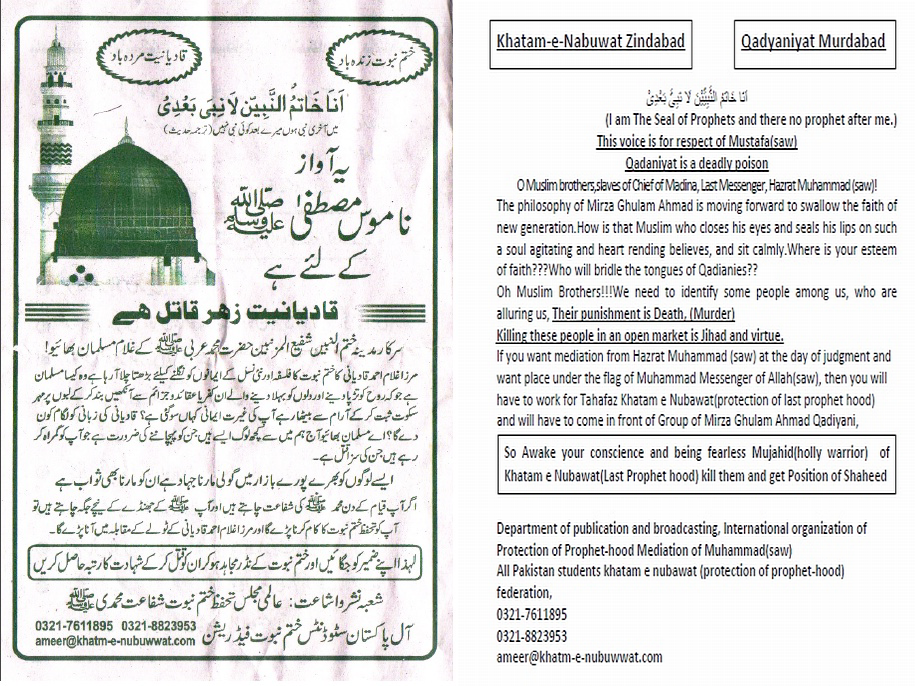
Saleemuddin, a spokesperson for Jamat-e-Ahmadiyya Pakistan, condemned the murder and demanded the immediate arrest of the accused. He said fatwas declaring members of the Ahmadi sect “liable to be killed” were being issued in different parts of the country and these religious edicts were being published in vast numbers. This, according to Saleemuddin, has resulted in target killings of many Ahmadis.

Published in The Express Tribune, October 3rd, 2011.

Copyrighted © 2011 The Express Tribune News Network
URL: http://tribune.com.pk/story/265652/ahmadi-schoolteacher-shot...

Monday, September 19, 2011

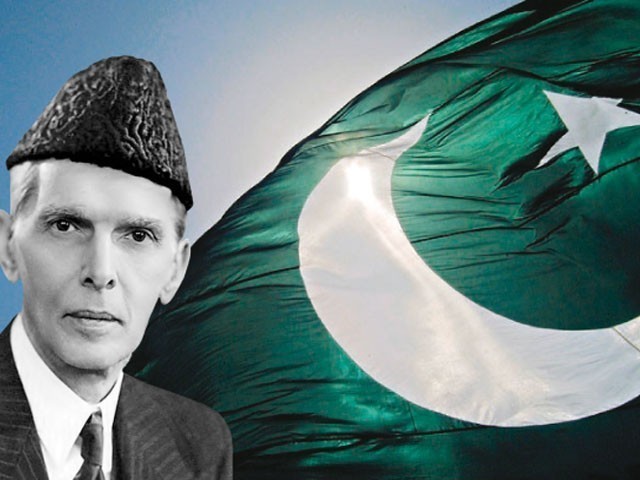
Jinnah’s Pakistan, hijacked by clerics

The Express Tribune Blogs
Opinion
The Verdict
Kashif ChaudharyJinnah’s Pakistan, hijacked by clerics
Posted by Kashif Chaudhry
Published: September 19, 2011
Jinnah founded Pakistan with the dream of it being a secular state where people could live as free citizens. However, today, Pakistan finds it hard to uphold the very ideals it was founded upon
Jinnah founded Pakistan with the dream of it being a secular state where people could live as free citizens.However, today, Pakistan finds it hard to uphold the very ideals it was founded upon
With the partition of the Indian subcontinent, Pakistan came into existence on August 14, 1947. The valiant and astute Muhammad Ali Jinnah led the minority Muslim community of united India to a separate homeland to fulfill the demand for freedom of religion, profession, and speech.

Jinnah was an outstanding lawyer who had studied law in London. He had a modern outlook on the world and was strongly secular. Part of the oath under which he took office reads:

“No subject … in Pakistan shall, on grounds only of religion, place of birth, descent, color or any of them be ineligible for office.”

He was absolutely clear that the new state he was founding would accommodate people of all faiths and descent without any prejudice. To assert this point, he appointed a non-Muslim as his first law minister. The Muslims in his cabinet consisted of Sunni, Shia, and Ahmadis alike. He believed that Islam endorsed a secular democracy and the two were perfectly compatible.

“The great majority of us are Muslims. Consequently, we have a special and a very deep sense of unity. But make no mistake: Pakistan is not a theocracy or anything like it” he said in an address in 1948.

He believed in a Pakistan wherein the mosque would be separate from the state.

“You are free; you are free to go to your temples, you are free to go to your mosques or to any other place of worship in this State of Pakistan. You may belong to any religion or caste or creed that has nothing to do with the business of the State” he said.

In the struggle for Pakistan, Jinnah was not faced with the Indian Congress and the British alone. He also had to endure intense animosity from hard-line Muslim clerics and counter their vile propaganda. He was accused, by the ultra right-wing, of blasphemy, and they considered him a great heretic for his secular ideology.

Prominent clerics like Maulana Maududi urged common Muslims not to side with Jinnah. Maududi wrote:

“It is forbidden to vote for [Jinnah’s] Muslim League.”

Despite this, the resolute Jinnah was successful in garnering support from the masses in most Muslim-majority areas.

Today, the nation finds it hard to uphold the very ideals it was founded upon. As it passes through dangerously volatile times, it has forsaken its founding principles of freedom and secularism.

But how and why did Pakistan turn against itself?

Even though he tried his best to steer it toward a secular democracy, Jinnah did not live long enough to see it become one. Over the coming years, Pakistan took a very troubling turn. In a matter of nine years, it became an “Islamic Republic,” and in a little over two decades, it had essentially become a theocracy.

The same extremist clerics who had opposed Jinnah and his struggle for Pakistan gradually claimed ownership of the State. They formed political groups that used religion to amass public support. Their demonstrations of street power, frequently violent, meant that sectarian hatred and intolerance was the order of the day.

Even governments avoided a clash with the radical right and became increasingly wary of arousing any negative religious sentiment and consequently losing popular vote. This only furthered the extremist cause, and in time, the original path Pakistan started on was completely forsaken. Pakistan, it is now said, was formed for the Muslims and is meant to become an Islamic theocracy where the Shariah, as interpreted by the hard-liners, is to be the ultimate law.

One tragedy after another, Jinnah’s Pakistan was dealt with massive blows. His Pakistan was no more his; it had been hijacked by forces of extremism and intolerance.

Non-Muslims could not hold the highest office in any of the core institutions anymore.

In 1953, there were widespread riots against the Ahmadi Muslims, a sect that extremists considered heretics.

The harassment of Shia Muslims and other minority groups also increased and went largely unchecked.

In 1974, the government yielded to intense pressure and declared the Ahmadiyya sect non-Muslim.

Tout de suite, the State had taken authority to decide its people’s religion, and the two were no longer separate.

General Zia ul Haq took over the country and became its third military president in 1977. To legitimize his dictatorship, he sought to please the right-wing and set to Islamize Pakistan. Amongst other things, he introduced the controversial blasphemy laws that stated death as the punishment for any derogatory remark against the Quran, Prophet Muhammad (PBUH), and other Islamic holy personages.

For Ahmadis, Zia also promulgated an ordinance in 1984 that criminalized the practice of their faith. Zia’s rule was the toughest for citizens who did not adhere to what had now become the state-backed perversion of Islam. Jinnah’s secular Pakistan had drifted into the hands of his enemies.

Jinnah had warned of this in his August 11th, 1947 address to the Constituent Assembly of Pakistan. He said:

“As you know, history shows that in England, conditions, some time ago, were much worse than those prevailing in India today. The Roman Catholics and the Protestants persecuted each other. Even now there are some States in existence where there are discriminations made and bars imposed against a particular class. Thank God, we are not starting in those days.” He continued: “Today, you might say with justice that Roman Catholics and Protestants do not exist; what exists now is that every man is a citizen, an equal citizen of Great Britain and they are all members of the nation.”

In the same address, he said:

“My guiding principle will be justice and complete impartiality, and I am sure that with your support and cooperation, I can look forward to Pakistan becoming one of the greatest nations of the world.”

Jinnah knew that a secular form of government could bridge differences and bring together people of all faiths and backgrounds to build a strong Pakistan. Just as the Catholics had learned to live with the Protestants, he was optimistic that the Pakistan he was founding would be a successful nation, a beacon of tolerance and an example of unity in diversity. However, the men who opposed Jinnah’s ideals before partition stood in his way yet again.

Founded on freedom of religion and practice, Pakistan is one of the biggest violator of religious freedom today. For Pakistan to succeed, it will have to reverse the dangerous turn it took and get back on the path that Jinnah laid before it. The blasphemy laws must be amended, everyone must be equal citizen of the state, the anti-Ahmadi laws must be revisited and the state must remain separate from the mosque at every cost. Pakistan must educate itself and look for the unity that Jinnah so cherished in the diversity across the land.

In February 1948, Jinnah said in an address:

“You have to stand guard over the development and maintenance of democracy, social justice and the equality of manhood in your own native soil. With faith, discipline and selfless devotion to duty, there is nothing worthwhile that you cannot achieve.”

Unfortunately, recent events have shown that Pakistan is still far away from taking that vital turn. The government has shown little resolve to go after the perpetrators of religious hate and violence and definitely no will to even trigger a dialogue on the controversial laws of the land. With Pakistan headed toward a steep decline, the solution lies in bold courage and reform. Jinnah’s Pakistanis will have to wake up sooner than later and reclaim the land from his opponents. Pakistanis must bring about a rebirth of Pakistan – Jinnah’s Pakistan.

Copyrighted © 2011 The Express Tribune News Network
URL: http://blogs.tribune.com.pk/story/8046/jinnahs-pakistan-hijacked-by-clerics/

Thursday, September 15, 2011

Religious freedom report: Pakistan one of 10 countries ‘failing to protect minorities’ rights’

Express Tribune, Pakistan
Pakistan
Sindh
Religious freedom report: Pakistan one of 10 countries ‘failing to protect minorities’ rights’
By Atika Rehman
Published: September 15, 2011
US state department report states that the Pakistani govt failed to protect minorities against abuse, discrimination. PHOTOS: FILE
KARACHI: Pakistan was cited among 10 countries “failing to sufficiently protect religious rights”, in a report regarding religious freedom released by Washington on Wednesday.

The other countries, mentioned in the US State Department’s International Religious Freedom report for the second half of 2010, included Afghanistan, Egypt, Iraq, Nigeria, Russia, Tajikistan, Turkmenistan, Venezuela and Vietnam.

However, Pakistan was not included in the list of ‘countries of particular concern’ regarding religious freedom – much to the dismay of the US Commission on International Religious Freedom (USCIRF). The list named China, Saudi Arabia, Myanmar, North Korea, Eritrea, Iran, Sudan and Uzbekistan.

“… the current list continues with glaring omissions, such as Pakistan and Vietnam. We respectfully urge Secretary Clinton to consider the six additional countries we recommended for designation,” said USCIRF Chair Leonard Leo.

The report details actions such as active state repression, violence against religious groups, apostasy and blasphemy laws, anti-Semitism and restrictions on religious attire and expression.

The report bluntly states that the constitution and laws in Pakistan “restricted religious freedom and, in practice, the government enforced these restrictions.”

Citing acts of violence against religious minorities as well as societal and governmental discrimination, it states that “the government rarely investigated or prosecuted the perpetrators of increased extremist attacks on minorities and the majority promoting tolerance, which deepened the climate of impunity.”

The report includes a long list of case studies of violence and discrimination against Ahmadis, Christians, Sikhs, Hindus and other Muslim sects.

The controversial blasphemy law, Aasia Bibi’s case in particular, and discrimination against the Ahmadiyya community take centre stage in the 30 pages of the report dedicated solely to Pakistan. “The government did not undertake reform measures to prevent the abuse of the blasphemy laws.

Toward the end of the reporting period the public discourse regarding the blasphemy laws became increasingly heated, which contributed to the government’s reluctance to address the issue. For example, after initially signalling he was considering pardoning Aasia Bibi’s death penalty sentence for alleged blasphemy, President Zardari refrained from doing so,” the report states.

It adds that the government, in fact, distanced itself from a bill introduced by a member of the ruling party that would have amended the blasphemy laws to prevent abuse.

Terming the blasphemy laws “a legal weapon against religious minorities and other Muslims”, the report says that the government’s failure in addressing religious hostility fostered intolerance and acts of violence against minorities and Muslims alike.

However, the report gives credit to the slain minorities minister Shahbaz Bhatti for promoting religious tolerance and taking an active role in assisting victims of religiously motivated attacks on Christians and Ahmadis.

The report states that, according to the National Commission for Justice and Peace (NCJP), between 1987 and 2010, a total of 1,068 persons were charged under the blasphemy laws. In 2010, blasphemy complaints were registered with the police against 17 Christians, eight Muslims, five Ahmadis, and seven Hindus, according to the report.

(ADDITIONAL INPUT FROM AFP)

Published in The Express Tribune, September 15th, 2011.

Copyrighted © 2011 The Express Tribune News Network
URL: http://tribune.com.pk/story/252659/religious...rights/

Wednesday, September 14, 2011

Count Pakistan among countries violating religious freedom: US commission

Express Tribune, Pakistan
Pakistan
Thinking proactively: Ahmadis have found their own solutions in Rabwah
By Atika Rehman
Published: September 14, 2011
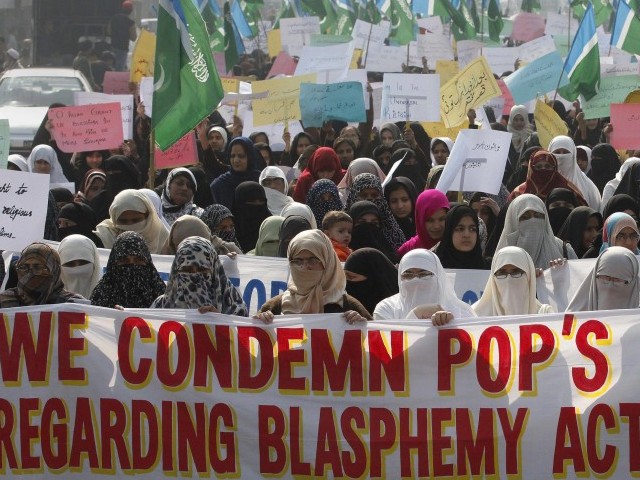
Female supporters of Jamaat-i-Islami (JI) hold placards and banner during a protest regarding the Pope's statements on Pakistan's blasphemy law. PHOTO: AFP/FILE
Female supporters of Jamaat-i-Islami (JI) hold placards and banner during a protest regarding the Pope’s statements on Pakistan’s blasphemy law. PHOTO: AFP/FILE
WASHINGTON: The United States Commission on International Religious Freedom (USCIRF) expressed concern over Pakistan’s omission from the list of eight countries termed “countries of particular concern” with regards to violation of religion freedom.

The list was published by the US State Department in a report which listed Burma, China, Eritrea, Iran, North Korea, Saudi Arabia, Sudan and Uzbekistan as countries where religious rights were severely infringed.

Although Pakistan was omitted from the list, the report stated that Pakistan’s laws restrict religious freedom and that the government enforced these restrictions. It also adds that investigation and prosecution of perpetrators in the case of extremist attacks on minorities are rare.

Citing the blasphemy law and Aasia Bibi’s case, the report suggests that the Pakistan government distanced itself from a bill proposed by an MNA to repeal the “discriminatory” law.

It also mentions that the Ahmadiyya community along with members of other Islamic sects, Christians, Sikhs, and Hindus face governmental and societal discrimination.

The report noted, however, that the government took some measures to improve religious freedom. It mentioned the late Federal Minister for Minorities, Shahbaz Bhatti’s attempts to assist victims of religiously motivated attacks.

The commission on Tuesday remarked that it is concerned that no new countries were added to the list.” said

‘Don’t forget Pakistan’

“Repeating the current list continues glaring omissions, such as Pakistan and Vietnam … we respectfully urge Secretary Clinton to consider the six additional countries we recommended for designation,” said Leonard Leo, USCIRF Chair.

The other four countries recommended by the commission are Egypt, Iraq, Nigeria and Turkmenistan.

Commenting on the report, US Secretary of State Hillary Clinton urged governments Tuesday to do more to defend religious freedom as Washington released a report citing eight countries with troubling records on the issue.

“We reaffirm the role that religious freedom and tolerance play in building stable and harmonious societies. Hatred and intolerance are destabilizing,” Clinton said.

Copyrighted © 2011 The Express Tribune News Network
URL: http://tribune.com.pk/story/252125/count...commission/

Monday, March 21, 2011

The fate of minorities in Pakistan

READERS FORUM
Mon, 03/21/2011
10:04 PM
The fate of minorities in Pakistan [Letter]
This is in reference to “Pakistan, Ahmadiyah and democracy, (the Post, March 16) by Sanaullah, the Ambassador of Pakistan.

Sanaullah is ambassador of Pakistan and it’s his duty to paint a glorified picture. But the reality is too bleak. Living in Pakistan is altogether different from what Sanaullah states.

As far as the economy is concerned, I am not an economist but the figures available on the Internet indicate Pakistan’s GDP Growth rate is now at 2 percent as compared to 6.8 percent in 2007.

Minorities, in fact, are treated as second-grade citizens. Constitutionally, they are free to worship but practically an Ahmadi cannot worship freely; thanks to blasphemy laws. Minorities are not allowed to build places of worship according to their needs.

Hindus are fleeing to India. According to a recent report published in media, more than 50,000 have fled in recent years, including legislator Ram Singh Sodho. The plight of the Ahmadis is even worse.

Let alone building new places of worship, they are not allowed to repair their old and dilapidated ones. They are routinely bullied in their neighborhoods, discriminated in government jobs, and the education and business sectors.

Their headquarters town (Rabwah; forcibly re-named Chenab Nagar by the government under pressure from radical mullahs), which is built on purchased land, is practically under siege by fanatics who have forcibly occupied their land.

They are not allowed to purchase land around the town to expand their housing.

Wake up Indonesia. Religion-related laws are a bad omen of radicalism/Talibanization, which have plagued Pakistan where no place/community and sect is safe. It all started with just a constitutional amendment.

Anwar Ahmad
Karachi


Copyright © 2008 The Jakarta Post - PT Bina Media Tenggara. All Rights Reserved
URL: www.thejakartapost.com/news/2011/03/21/the-fate...

Wednesday, January 26, 2011

Kidnapping for ransom a boon for militants

Daily Dawn, Pakistan
Pakistan
Kidnapping for ransom a boon for militants
From the Newspaper
January 26, 2011

ISLAMABAD, Jan 25: Kidnapping for ransom has always been a well-paying crime but the entry of militants has made this more profitable, which is why the incidence of the case is continuously rising.

Senior investigating officers of police claim that militants are involved in kidnapping cases in all corners of Pakistan.

“They are directly involved in kidnapping in Punjab, Khyber Pakhtunkhwa, Sindh, especially in Karachi, and Islamabad,” one police officer tells Dawn.

Senior police officers say that money is the main reason for the increased incidence of kidnapping though the militants have also started using it as a tactic to pressure law enforcement and intelligence agencies; in a number of cases they refuse to accept money in exchange for the hostage and ask for the release of their arrested accomplices.

“A third reason is also to spread fear,” says a senior policeman.

However, a new trend is the links the militants and the criminal gangs are forming with each other at different levels. These had first been established when kidnappings were carried out by the two groups together. By now it is routine practice for the kidnapping to be carried out by the local criminals of the area the hostage lives in either out of choice or because they have been asked to do so by militants.

In cases where the objective is to collect ransom, the local criminals continue to keep the hostage in their custody. The hostages are said to be kept in hideouts in Khyber Pakhtunkhwa and Central Punjab.

“But at times, especially when the militants want to spread fear, the hostage is kept in their custody,” says a police officer, adding that the Tehrik-i-Taliban militants have an exclusive committee (Shura) which decides the fate of the victims – exchange for ransom, exchange for militants in state custody or spread fear.

With the entry of militants, religion also tends to play a role in the kidnappings from the act to the negotiations to the release. In some cases, militants have picked up hostages, assuming that they were Ahmedi or Shia. The later realisation that the victims were Sunni compelled the militants to accept a reduced ransom. Some years ago a businessman from Islamabad was kidnapped only to be released when he and his kidnappers were intercepted at a checkpost as they were exiting Islamabad.

During interrogations, the kidnappers revealed that they had kidnapped the businessman because they thought he was a Qadiani. A similar perception about a law enforcement personnel’s faith also led to him being kidnapped.

Dawn has learnt that in many cases, religio-political leaders or religious leaders have helped at the negotiation stage. In such cases, the police react according to the politicians, who negotiate with the militants over the ransom, they added.

For instance, even the negotiations over the release of a Polish engineer, Piotr (Peter) Stanczak, were carried out with the help of a religio-political leader. But as the militants demanded the release of their accomplices arrested in connection with suicide attacks in Islamabad, the two sides could reach no agreement. It was after this that the kidnappers killed the engineer.

In some cases, however, as a last resort, prisoners have been exchanged for hostages. This is what happened in the case of foreign engineers from an East Asian country.

As their captors refused to accept ransom money, the government had no choice but to release militants in exchange.

The ‘business’ has spread so far that separate groups of militants have been formed who ‘specialise’ in kidnappings – they select victims, collect information such as financial wherewithal, carry out the reconnaissance of the area. This information is passed on to the militants who then carry out the kidnapping themselves or pass it to other criminal gangs.

“In some kidnapping cases, the hostages’ families were even informed of their bank balances when the ransom was being negotiated,” an officer adds.

One such group is said to be headed by Mullah Sabir and Mullah Rahim which operates from South Waziristan.

Before they used to work independently but later they started kidnapping for ransom for the Tehrik-i-Taliban Pakistan, said an official.

©2010 DAWN Media Group. All rights reserved
URL: www.dawn.com/2011/01/26/kidnapping...militants.html

Sunday, December 12, 2010

Anti-blasphemy resolution at UN is absurd

Calgary Herald, Canada
Anti-blasphemy resolution at UN is absurd
By Dan Shapiro, For The Calgary Herald DECEMBER 12, 2010

The recent UN Human Rights Council draft resolution on “Combating defamation of religions” would make George Orwell roll over in his grave. If adopted by the UN General Assembly, it will give governments around the world unacceptable powers.

In the name of preventing religious discrimination, the resolution insulates religious orthodoxy from all criticism. The resolution is incoherent, self-contradictory and a gross violation of the fundamental freedoms of religion and expression.

Sponsored by Morocco on behalf of the Organization of the Islamic Conference (OIC), it lends cover and legitimacy to the blasphemy laws of oppressive states which do not respect their citizens’ religious freedom. It thus precludes any possibility of an Islamic reformation, the very thing many Muslims want.

How can you “defame” a religion by saying something “false” about it? “Defamation” involves making a purportedly factual claim about someone that harms their reputation, but is false. For example, Jerry Falwell famously sued Hustler publisher Larry Flynt for printing a cartoon implying Falwell had sex with his own mother in an outhouse. The U.S. Supreme Court ruled that public figures such as Falwell cannot be protected from offensive speech recognizable as satire. Why, then, should “religious symbols and venerated personalities” be protected from ridicule, as the resolution suggests?

Besides, religious disagreement is a very different beast than protecting individuals’ reputations. It is about the truth or falsity of the religion or religious claims. So, you can’t have a law against saying something “false” about a religion precisely because there is no agreed upon means of determining truth or falsity here.

If religious disputes are to be decided by the state, they will come down on the side of orthodoxy and against dissenting views every time.

The resolution claims, disingenuously, that it aims to combat discrimination based on religion. Of course, we should combat actual religious discrimination. For example, if you don’t get a job because you are Muslim or a Jew, that is unjustifiable discrimination. But this doesn’t mean that Islam or Judaism should be protected from criticism and debate.

The resolution is incoherent because it targets the wrong kind of discrimination and protects the wrong entities. Individuals have human rights to be protected; ideas, ideologies, religions and states do not.

Yet, the resolution claims that it protects freedom of religion. Invoking a measure that restricts freedom of religion (by seeking to make it illegal to express religious views that differ from official opinion) is a funny way to protect this fundamental freedom.

Belief systems such as religions are not homogeneous. Blasphemy laws exacerbate, rather than reduce, discrimination based on religion. Such laws violate state neutrality, since the state evaluates competing religious claims and punishes the dissenting minority.

Minorities who differ from the majority religion, for example Christians or non-believers in Muslim-majority countries, are at risk. So too are minority co-religionists, such as Ahmadis who do not view Muhammad as the last Prophet and are persecuted as apostates in many Muslim-majority countries.

Case in point: “Although Christians, Ahmadis, and Hindus make up less than three per cent of Pakistan’s population, they have accounted for about half of the blasphemy defendants over the last two decades,” according to “Policing Belief,” a recent Freedom House report. Pakistan’s Penal Code imposes capital punishment for blasphemy, including for defamation of Islam.

You can’t have meaningful freedom of religion and conscience without robust freedom of speech. For if we’re not free to express our deeply held beliefs, then it makes no sense to speak of freedom of religion and conscience.

In the case of blasphemy or “defamation of religion” laws, there is a dangerously slippery slope since they are often used to punish political opponents and dissidents. For example, bloggers in Pakistan and Iran who have criticized their governments have been charged with “defaming Islam.”

Unfortunately, it bears constant repetition: No government, church, mosque, synagogue or UN Human Rights Council should coerce you into thinking or saying – or, not thinking or not saying – what you believe (short of the infamous yelling “fire” in a crowded theatre exception).

The “defamation of religions” resolution is not about protecting human rights; it is about justifying repression of opinion not sanctioned by the authorities. The resolution does not advance freedom of religion; on the contrary, it curtails it in dangerous ways.

Dan Shapiro is a research associate with the Sheldon Chumir Foundation for Ethics in Leadership.

Copyright © The Calgary Herald

Monday, May 3, 2010

A matter of faith

---Express Tribune, Pakistan

A matter of faith

By Basil Nabi Malik
May 03, 2010


The writer is a lawyer with Malik, Chaudhry, Ahmed and Siddiqi in Karachi (basil.nabi@tribune.com.pk)

It is common knowledge that we are duty bound to follow and respect the Constitution of Pakistan and each and every one of its articles. However, the same becomes a tad bit difficult when certain unpalatable clauses are added which really have no business being in the constitution.

For example, if I were to ask anyone as to the definition of a ‘Muslim’, I am guessing the last place they’d look would be in the Constitution of Pakistan. However, lo and behold Article 260 of our constitution actually defines the term. Ironically, all this happened during the time of Zulfikar Ali Bhutto, though he was, of course, pressured to do this by certain religious quarters.

Although it was clearly a political move, the method was unique. Rather than to go into the intricacies and complications of trying to forge a unanimously agreed-upon definition, which many thought was next to impossible and perhaps even unnecessary, he thought it fit to zero in on an exclusionary clause which ‘enlightened’ us on what a Muslim could not be.
.
However, clearly, this was the kind of medieval quackery that only ‘scheming politicians’ could think of. It took the likes of General Zia in 1985 to give us an affirmative definition of a Muslim, sans the discussions and attempts at consensus building, which in all likelihood, he probably found irrelevant. He did this in the form of the President’s Order No. 24 of 1985, whereby Article 260(3) was substituted with what can best be described as intriguing definitions of the terms ‘Muslim’ and ‘non-Muslim’.

The word ‘Muslim’ entailed: “a person who believes in the unity and oneness of Almighty Allah, in the absolute and unqualified finality of the Prophethood of Muhammad (pbuh), the last of the Prophets and does not believe in, or recognise as a prophet or religious reformer, any person who claimed or claims to be a prophet, in any sense of the word or of any description whatsoever, after Muhammad (pbuh)”. General Zia, however, didn’t leave it at that.

For some odd reason, he didn’t feel that the people of the country would actually be able to understand the term ‘Muslim’ and so the definition of ‘non-Muslim’ was also inserted. The term ‘non-Muslim’ was defined as: “a person who is not a Muslim and includes a person belonging to the Christian, Hindu, Sikh, Buddhist or Parsi community, a person of the Qadiani Group or the Lahori Group who call themselves ‘Ahmadis’ or by any other name or a Bahai and a person belonging to any of the Scheduled Castes”.

Effectively, in one stroke, General Zia did what Justice Munir in the Munir Report of 1954 dreaded and forewarned against: the adoption of certain religious worldviews at the expense of others, thereby inducing divisions in society. To be more exact, after asking a variety of the ulema as to what the definition of a Muslim would entail and receiving varying responses, Justice Munir said in the report that: “keeping in view the several definitions given by the ulema [defining the term Muslim], need we make any comment except that no two learned divines are agreed on this fundamental.”

The point is that what business is it of the state to get into this whole matter of defining who is a Muslim and who isn’t. One would have thought that this is a matter best left to individuals themselves and is something to be assessed by their conduct and actions — and in any case it is a private matter for each individual. It’s a pity that the 18th amendment chose to ignore this in the present constitution.

URL:
http://tribune.com.pk/story/10274/a-matter-of-faith/

Wednesday, April 14, 2010

Tackling terrorism and Jihad

---Weekly Blitz, Bangladesh
VOLUME - 5, ISSUE - 16,
DHAKA, April 14, 2010
Tackling terrorism and Jihad
Salah Uddin Shoaib Choudhury

The world is gradually getting united on one agenda on combating terrorism and Jihad. International community has reason now to speak out against Jihad as for past several years, multiple forms of terror acts are spreading in the world mostly by religious fanatics or Jihadists. Bangladesh is also a victim of terrorism and in recent days, especially after the arrest of activists of Jihadist outfits in this country, it has become clear that terror groups are trying to create a new avenue in Bangladesh for their notorious activities.

In Bangladesh, unfortunately, terrorism always gets political blessings mostly from parties in power. It is very clear to everyone that, all the political parties in this country are for reason unknown, maintaining their own segment of musclemen and hooligans. Such elements in political parties are used for various forms of terrorist activities. But, those Jihadist groups active inside Bangladesh are continuing to gather strength with the ulterior motive of establishing Sharia rule in this country. Though Bangladesh government already has banned a number of notorious Islamist militancy group, it is yet to take any action against groups like Hizbut Towhid, which is continuing secret activities around the country with the agenda of destabilizing democratic government and democracy. According to several surveys, the growth rate of Hizbut Towhid members is above 17 per cent every year. Meanwhile, this group has very successfully attracted or recruited more than 100,000 people in Bangladesh.

As I mentioned, Bangladesh is an active member of counter-terrorism efforts, there is serious lacking in the very strategy of combating terrorism and Jihad. It is well known that, breeding grounds of Jihadists in Bangladesh are those thousands of Koranic [Qawmi] Madrassas as well as mosques, where Tablighi activists are regularly seen giving sermons in favor of Jihad. Tablighi Jamaat [TJ] though pretends to be an innocent group preaching Islam, the real agenda of TJ is spreading the message of Jihad amongst people. In a number of terrorist activities in the world, Tablighi Jamaat’s involvements were clearly found. But, in Bangladesh TJ is spreading wings everyday, as the government or security agencies are yet to put focus on the activities of this group.

The second largest congregation of Muslims is the Tablighi Jamaat’s so-called Ijtema, which takes place every year in Bangladesh. According to statistics, more than 1 million people gathered at the Tablighi congregation in 2009, which from this year, the congregation will take place on three different dates as the organizers are sensing larger participation of people from this year.

Main objective of Tablighis is to encourage people towards religious conversion. The next agenda is instigating Jihadist notion. Third is ousting democracy. In a country like Bangladesh, where more than 83 per cent of the population are now Muslims, the only reason behind allowing Tablighis to keep active would be to actually ultimately wipe off the existence of Hindu, Buddhist, Christian, Bahai, Ahmadiya and Jewish community in Bangladesh. There are series of reports in Bangladeshi media about forceful conversion of mostly Hindu girls and boys into Islam. In most cases, where female Hindus are converted, the entire episode is given a ‘legal’ coverage of marriage. But, no one ever bothers, if the marriage was forceful. Actually, most of such so-called marriages are forceful. In some cases, the abductors rape the girl with the motive of putting mental pressure on her of marrying the rapist and ultimately getting converted into Islam. Members of Tablighi Jamaat are continuing to encourage people in trying to get any of the non-Muslims into Islam. Mostly uneducated or half-educated Muslim youths are getting hypnotized or attracted at such ‘calls’ of the Tablighis. And such, inspiration ultimately leads those listeners of Tablighis is doing anything in getting any of the non-Muslims into Islam.

As I said, Madrassas are the breeding grounds of Jihadists; it is unknown to many that, only 26 per cent of the students coming out of Koranic madrassas ultimately find a job with any mosque as cleric or assistants to clerics, while the larger segment of such madrassa educated people with high Jihadist brain-wash either mix-up in the society or just disappear from the scene. It is well anticipated that, such disappeared madrassa students find ways to any of the foreign countries for joining ‘Jihad’. Iranian embassy in Bangladesh as well the Palestinians encourage those people is joining Jihad against Israel and United States. Iranians spend millions of dollars in such activities every year. On the other hand, Pakistani intelligence agency ISI recruits madrassa educated people for joining war against India in Kashmir. Such elements are also sent by ISI to other parts of India with terrorist dictation. Bangladesh government and those combating terrorism should have carefully examined the case of those 84 per cent of madrassa students, who either mix up in the society or get into Jihadist activities. For the sake of fixing a workable and effective strategy on combating terrorism, such investigation and study is extremely essential. No government or security agency can combat terrorism without specific and in some cases even comprehensive information on the roots of terrorism and bases of such terror acts. For the sake of combating terrorism and Jihad, it is essential first of all to understand the strength and ‘route map’ of the terrorists and Jihadists. Once Bangladesh will get this, combating or countering terrorism will become much effective and meaningful.

URL: www.weeklyblitz.net/663/tackling-terrorism-and-jihad

Wednesday, April 7, 2010

Seeking fair treatment for minorities

---The Jakarta Post, Indonesia
Features | Wed, 04/07/2010 11:25 AM
Seeking fair treatment for minorities

ID. Nugroho, Contributor, Jakarta

With hesitation, Karta and two fellow villagers entered the waiting room of the Legal Aid Institute (LBH) in Pancoran, South Jakarta.

The rows of seats in the room were left vacant as the three Baduy Dalam men chose to sit cross-legged on the floor. “It’s not a mosque, is it? Our ancestors forbid us to sleep in a house of worship,” said Karta, who was visiting the other two.

Karta’s appearance in Jakarta a few months ago was a little surprising, at least to the legal aid office staff. He and his peers look very different to most people. They wear the typical clothes of the Baduy Dalam tribesmen in Banten, with dull white shirts, black sarongs resembling women’s skirts and white headcloths.

To Jakartans, they are a rare sight. “People along the road were staring at us, but these are our clothes,” recalled Karta, adding “For us, it’s important to avoid bad conduct, which is an ancestral taboo we dare not breach for fear of being expelled from our community.” The Baduy Dalam people are known for their total obedience to the daily customs passed down by their progenitors.

The Baduy are only one of many diverse ethnic groups in Indonesia. The traditions and beliefs strictly followed by members of this ethnic tribe make them a minority, especially compared with other major groups like the Javanese, Bataks, Bugis and so forth. Though such minorities have the same rights as citizens under the Constitution, in reality they are marginalized.

“Even tribal names are often misquoted, such as the Samin tribe, which should be called the Sedulur Sikep. This tribe’s leading forefather was Samin Surontiko, whose name has now been used for the community,” said AA Sudirman, an observer of minority groups in Indonesia. Likewise, the Baduy tribe’s original name was Kakenes.

Minorities involve more than just ethnic groups. There are various religious groups like Christian, Hindu, Buddhist or Taoist sects and followers of Sunda Wiwitan (a traditional faith), besides people with different sexual orientations like gays and lesbians. Among the religious minorities are the Ahmadiyah, Javanese mystics, Jehovah’s Witnesses, Mormons and Siriya Orthodox Christians.

These groups have continued to exist in society so far. “They do exist and undeniably have equal rights as Indonesian citizens,” said Antonio Pradjasto, director of the Center for Democracy and Human Rights Studies (DEMOS). Sadly, according to Antonio, the reality they have to face is injustice.

In many cases, minority groups, particularly religious ones, have had to undergo hardship. The Ahmadiyah places of worship, for instance, were attacked some time ago. “This should not have happened, because the state is obliged to guarantee individual freedom to perform religious rituals,” added Antonio.

History has proved that rules imposed on minorities violate the system of justice and equality before the law. What the ethnic Chinese group experienced serves as an example. In the Dutch colonial period in Indonesia, along with people of Indian and Arab descent, the Chinese belonged to the foreign Eastern category. With Indonesia’s independence, the Chinese and Indians were still considered foreign citizens, apparently due to the factor of religion.

The instruction of president Soeharto in 1967 banning Chinese schools, publications, faiths and traditions made matters worse for this ethnic community. The Chinese were forced to forget their past. Unfortunately, when the September 30, 1965 incident occurred, most of the Chinese were branded as communists simply because the People’s Republic of China recognized the ideology at the time.

When riots broke out in Jakarta in May 1998, citizens of Chinese stock were again victimized, with alleged rapes taking place in many places. Countless Chinese-owned houses, shops and assets were looted. President Habibie’s instruction in 1998 terminating the use of the terms “indigenous” and “non-indigenous” slightly reduced intergroup tension. The situation considerably improved as Abdurrahman Wahid became president. Familiarly known as Gus Dur, this figure was a minority defender.

“But with all the positive developments, the treatment of minority groups hasn’t changed much. The recent attacks on Ahmadiyah followers happened within in the current term of President Susilo Bambang Yudhoyono,” noted Antonio Pradjasto. Therefore, DEMOS fully supports the request for a judicial review of the law on the prevention of blasphemy, now under deliberation by the Constitutional Court. The National Alliance for Free Profession of Religions and Faiths (AKKBB) requested that the court amend articles regarded as hampering religious freedom.

The aspiration is certainly hard to achieve. At least, Religious Affairs Minister Suryadharma Ali and Law and Human Rights Minister Patrialis Akbar maintain the anti-blasphemy law should exist. In fact, the law regulating only six religions – Islam, Catholic, Christian, Hindu, Buddhist and Confucian faiths – contradicts Article 28 of the Constitution that stipulates “Every citizen shall be free from discriminative treatment on whatever grounds and entitled to protection against such discriminative treatment.”

Intricate though it may seem, the judicial review should at least serve as an attempt to offer fair treatment to the country’s minorities. Let’s hope so.
Freedom lovers: Members of the National Alliance for Freedom of Religions and Beliefs stage a rally at Hotel Indonesia traffic circle in Central Jakarta, asking the government to guarantee freedom of religions and beliefs. JP/R. Berto Wedhatama

Thursday, October 15, 2009

Indonesia: Govt urged to respect Ahmadiyah rights

---The Jakarta Post, Indonesia

National | Thu, 10/15/2009 11:59 AM

Govt urged to respect Ahmadiyah rights

The Jakarta Post, Jakarta

A series of attacks on followers of the Ahmadiyah religious sect has once again drawn criticism, with an expert in religion and democracy urging the government to exercise its authority when there are violations of human rights.

Alfred C. Stepan, director of the Center for the Study of Democracy, Toleration and Religion at Columbia University in New York, said on the sidelines of a discussion held Tuesday that while the government must keep a principal distance, the separation did not mean the state should never get involved in religious matters.

“They should think more about whether there are circumstances in which they have to act quickly because I think it is the government’s responsibility if people’s rights are in peril,” he said.

Followers of the Ahmadiyah group are deemed heretics by mainstream Muslims for recognizing sect founder Mirza Ghulam Ahmad as the last prophet.

Islamic teachings maintain that the Prophet Muhammad is the last prophet.

The Indonesian Ulema Council (MUI) issued an edict officially declaring Ahmadiyah to be a heretical sect.

For years, followers of the religious sect have suffered attacks from various Muslim groups. Some of the attacks, which involved hard-line Muslims, resulted in the fire-bombing of Ahmadiyah mosques and houses.

Stepan said the attacks were violations of human rights and therefore the government’s intervention was needed.

“It is the duty of a democratic government to protect its people’s rights even if they have to act against some people’s freedom,” he said.

Although such measures should not go against the constitution, he said.

In the discussion, Stepan also said that Indonesia was a place where democracy and religions coexisted.

Indonesia, he noted, recognized and respected all the major religions, except Judaism.

“India and Senegal are also examples of democracies that recognize and financially support all religions, but keep some principal distance that would allow the state at times to interfere in the religion *if there were human rights violations*,” he added.

However, he said, the Indonesian government had shown much less willingness to exercise the principal distance than the other two countries.

“That may be a problem,” he added.

Stepan said that in all democracies, tolerance on the state’s part and the religions’ part were needed. Stepan terms the concept “twin tolerations”.

For democracy to function, he said, democratically elected governments must tolerate citizens’ legitimate aspirations, “as long as they do not hurt other people”.

“In pure democratic theory, any group that doesn’t violate other people’s rights has the right to articulate some of their ideas in civil society,” he said.

At the same time, religious hard-liners cannot reject the sovereignty of an elected government; instead forcing religious rules on the populace.

“That’s too great a restriction on democracy,” he said.

Theoretically, twin tolerations would allow religion to act in the area of the civil society, he said.

But, “the twin tolerations could also break down if someone violates it from the other side, if this happens the government must have some role in it,” he added.

Stepan also said that fundamentalism does not necessarily not pose an obstacle to democracy.

He added his research in India showed the greater the intensity of religious practice, the greater the intensity of support for democracy.

There are about 200,000 practicing Ahmadis in Indonesia. (adh)

URL: www.thejakartapost.com/news/2009/10/...madiyah-rights.html

Persecution of minorities and women in South Asia

---Weekly Blitz, Bangladesh

VOLUME - 4, ISSUE - 42, DHAKA,
OCTOBER 14, 2009

Persecution of minorities and women in South Asia

Salah Uddin Shoaib Choudhury

Right before the end of British rule in Indian sub-continent in 1947, several riot amongst various religious groups, mainly amongst Muslims and Hindus took place in India and Pakistan [the then West and East Pakistan], causing severe rise of religious hatred amongst the people in the region. Subsequently, massive Muslim persecution in Gujrat, Sikh Persecution in Punjab by the Indian government, persecution of Hindus in Pakistan and Bangladesh, Persecution of Christians in India, Pakistan and Bangladesh as well persecution of religious minorities in almost all the countries in South Asia gradually generated deep rooted hatred amongst the people belonging to various religious beliefs. The Partition of India was the partition of British India that led to the creation, on August 14, 1947 and August 15, 1947, respectively, of the sovereign states of the Dominion of Pakistan [later Islamic Republic of Pakistan and People's Republic of Bangladesh] and the Union of India [later Republic of India]. The partition of India included the geographical division of the Bengal province of British India into East Pakistan and West Bengal [India], and the similar partition of the Punjab province into West Punjab [later Punjab - Pakistan and Islamabad Capital Territory] and East Punjab [later Punjab – India, Haryana and Himachal Pradesh], and also the division of other assets, including the British Indian Army, the Indian Civil Service and other administrative services, the Indian railways, and the central treasury. The partition was promulgated in the Indian Independence Act 1947 and resulted in the dissolution of the British Indian Empire. In the aftermath of Partition, the princely states of India, which had been left by the Indian Independence Act 1947 to choose whether to accede to India or Pakistan or to remain outside them, were all incorporated into one or other of the new dominions. The question of the choice to be made in this connection by Jammu and Kashmir led to the Indo-Pakistani War of 1947 and other wars and conflicts between India and Pakistan. Stable democratic nation like India could not free itself of curse of communalism even more than fifty years after independence. If anything it has been getting worse year after year. There has been not a single year in post-independence period, which has been free of communal violence though number of incidents may vary. The year 2002 has been one of the worst years in this matter right from the beginning as the Gujarat carnage began in the very beginning of the year. In the year 2002 the first reported riot took place in Kozhikode [Calicut], Kerala on 3rd January. In the clashes between two communities [Hindus and Muslims] five persons were killed. The clashes occurred on the question of eve teasing. The whole region came in the grip of violence. More than twenty persons were injured including five women. Properties worth millions of rupees were destroyed. A heavy police bandobast was made to bring the situation under control. Kerala is generally thought to be free of communal violence. But occasionally it also experiences such frenzy and bout of communal violence. However, it is generally brought under control as the Kerala government usually does not allow things to go out of had.

Gujarat was next to come under intense bout of communal carnage. It was of the kind, which India had never experienced accept at the time of partition. The communal carnage in Gujarat shook whole world. It was difficult to believe such intense communal frenzy could be incited by the BJP for its political gains. More than 2000 people were killed most cruelly in this carnage according to very reliable sources though the Government admits only about 1000 dead.

The Viswa Hindu Parishad [VHP], the Bajrang Dal and Bharatiya Janata Party [BJP] gave a call for bandh [general strike] on 28th February and violent incidents started from the morning of 28th February, particularly in Ahmedabad. And before the sun set on 28th February more than 100 persons were killed in Ahmedabad alone. Most ghastly incidents took place in a place called Naroda Patia where more than 80 persons were burnt alive including women and children and number of women were raped in full gaze of public. The other ghastly incident took place in Gulbarg Society, Chamanpura where about 40 persons were burnt alive including a former member of parliament named Ahsan Jafri from Congress Party.

What is worse the Chief Mister Narendra Modi justified such frenzy and described it as reaction to action in Godhra. And all this happened with full complicity of the police and bureaucracy. The honest officers who did not allow carnage in their areas were instantly transferred by the Narendra Modi Government.

Some ministers who led the mobs have been named in case lodged after the incident. Many mosques and mausoleums were demolished and ground was leveled. Some accounts maintain about 700 such religious structures were brought down or severely damaged. Ahmedabad, Baroda, Mehsana and Panchmahal districts were the worst affected districts covering entire north and central Gujarat. There have been various estimates of the properties destroyed but generally it is maintained properties worth more than US$ 1.5 billion were looted or burnt. The business lost due to closures and migration of labour is several times this figure. Hundreds of Muslim families were totally uprooted. The carnage continued for more than five months.

The next riot took place in Kaithal, at Indian state of Haryana. Though the cause of the violence on disturbances on 28th February is not clear but it seems to be related to Gujarat incidents. According to The Hindustan Times report Shiv Sena, Viswa Hindu Parishad [VHP] and Bajrang Dal mobs pulled down a mosque and caused extensive damage to two others. They damaged at least four mausoleums and enforced a complete bandh. Prohibitory orders were later clamped down on the town.

During the general strike Maharashtra called by the Shiv Sena, Viswa Hindu Parishad [VHP] and Bharatiya Janata Party [BJP] on 1st March 2002 to protest the setting ablaze of coach of the Sabarmati Express on 27th February 2002 in Godhra a violent mob went on rampage in Murbad 80 kilometer from Mumbai. Fortunately Murbad was the only town affected during the call for bandh by the Sangh Parivar.

During the general strike in Murbad in India the Bajrang Dal alliance began looting and burning Muslims shops. It also looted the houses of two prosperous grain merchants and set fire to a jeep [cross-country vehicle] belonging to a transporter. The general strike was total and all shops were closed. The mob was also determined to attack the families of some of the well to do Muslim shopkeepers. But they fled minutes before the attack and saved themselves.

The Police claimed that it fired 13 rounds in the air but the Minorities Commission said that it did not come across anyone who could corroborate the police claim. The Police claimed that they had arrested 32 people including the local Bajrang Dal leaders and charged them with attempted murder, arson and lootings. The Muslims are a microscopic minority in Morbad and are afraid of giving any details of damage to the madrasa and are praising the role of the police, according to the Minorities Commission.

On 17th March 2002 communal incidents took place in Loharu in Bhivani district of Haryana in India. Loharu was once under a Muslim ruler. There is thus Muslim population in this town. A mob of three hundred incited by the rumour of cow slaughter attacked two mosques and at least 15 shops and houses belonging to the minority community. The police had to fire in the air when the mob could not be controlled by tear gas charges.

When the people belonging to the majority community heard that a cow has been taken for slaughter in one of the mosques, it attacked and set fire to this mosque and shops nearby. According to a media reports quoting the police sources, a mob of 300 Shiv Sainiks [Soldiers of Shiva] set fire at another mosque near the railway station and many shops in the adjacent area.

Next incidents of communal violence in India took place in three places in Rajasthan in which three persons were killed on 25th March 2002 on the occasion of Muharram. The immediate provocation was the holding of poornahuti yagnas [a Hindu religious ritual] and kirtans [Hindu religious songs] at various temples on the route of Muharram processions.

Curfew had to be clamped in the town of Gangapur, 80 kilo meters from Sawai Madhopur, in central Rajasthan where 3 people were killed and 15 injured in police firing. According to the police, violence broke out when activists of the Viswa Hindu Parishad [VHP], Bharatiya Janata Party [BJP] and Bajrang Dal sat inside an ancient Hanumanji temple for religious rituals. They began to chant provocative anti-Muslim slogans when the Muharram procession came closer to the temple.

Persecution of Sikhs:

Operation Blue Star, which continued during 3–6 June 1984 was an Indian military operation ordered by Indira Gandhi, then Prime Minister of India, to remove Sikh separatists who were amassing weapons in the Golden Temple [Holy Temple of Sikhs] in Amritsar [India]. The operation was launched in response to a deterioration of law and order in the Indian state of Punjab.

The operation was carried out by Indian army troops with tanks and armoured vehicles. Militarily successful, the operation aroused immense controversy, and the government's justification for the timing and style of the attack are still under debate. Operation Bluestar was included in the Top 10 Political Disgraces by India Today magazine.

Official reports put the number of deaths among the Indian army at 83 and the number of civilian deaths at 492, though independent estimates ran much higher.

The impact of the military assault, its aftermath and the increased tensions led to assaults on members of the Sikh community within India and uproar amongst Sikhs worldwide. In India, many Sikhs resigned from armed and civil administrative office and returned their government awards.

Indira Gandhi first asked Lieutenant General S. K. Sinha, then Vice-Chief of Indian Army and who was to succeed as the Army chief, to prepare a position paper for assault on the Golden Temple. Lieutenant General Sinha advised against any such move, given the sacrilegious outlook from pious Sikhs. He suggested the government adopt an alternative solution. A controversial decision was made to replace him with General Arun Vaidya as the Chief of the Indian army. General Vaidya was assisted by Lieutenant General K. Sunderjee as Vice-Chief. Operation Blue Star was eventually planned and controlled by them.

On 3 June 1984, a 36-hour curfew was imposed on the state of Punjab with all methods of communication and public travel suspended. Electricity supplies were also interrupted, creating a total blackout and cutting off the state from the rest of India and the world. Complete censorship was placed on all types of media.

The Indian Army stormed the Golden Temple on the night of 5 June under the command of Major General Kuldip Singh Brar. The forces had full control of the Golden Temple by the morning of 7 June, 1984. Bhindranwale, Lieutenant General Shahbeg Singh and several other militant leaders were killed in the operation along with a large number of followers and civilians. The armed forces also suffered many casualties. Operation Blue Star coincided with a Sikh annual festival. Pilgrims, including the elderly and children, were trapped inside the temple when the operation began and many were reported as wounded and killed as a result.

Sikh reaction in India began with the decade old persecution of Sikhs, mostly by the Hindu majorities as well as state-partonized terror on them. Indian government enforced total media blackout and stopped local and international media from covering this tragic blood shed of the decade. Before the attack by army a media blackout was imposed in Punjab. The Times reporter Michael Hamlyn reported that journalists were picked up from their hotels at 5 a.m. in a military bus, taken to the adjoining border of the state of Haryana and “were abandoned there”.

Brahma Chellaney, who was then the South Asia correspondent of the Associated Press, was the only foreign reporter who managed to stay on in Amritsar despite the media blackout. His dispatches, filed by telex, provided the first non-governmental news reports on the bloody operation in Amritsar. His first dispatch, front-paged by the New York Times, The Times of London and The Guardian, reported a death toll about twice of what authorities had admitted. According to the dispatch, about 780 militants and civilians and 400 troops had perished in fierce gunbattles. The high casualty rates among security forces were attributed to “the presence of such sophisticated weapons as medium machine guns and rockets in the terrorists' arsenal.”

Chellaney also reported that “several” suspected Sikh militants had been shot with their hands tied. The dispatch, after its first paragraph reference to “several” such deaths, specified later that “eight to 10” men had been shot in that fashion. In that dispatch, Mr. Chellaney interviewed a doctor who said he was picked up by the army and forced to conduct postmortems despite the fact he had never done any postmortem examination before. The number of causalities reported by Brahma Chellaney were far more than government reports, and the Indian government, which disputed his casualty figures accused him of inflammatory reporting. The Associated Press stood by the reports and figures, the accuracy of which was also “supported by Indian and other press accounts” according to Associated Press; and reports in The Times and The New York Times.

Whole of Punjab and especially the Golden Temple Complex was turned into a murderous mouse trap from where people could neither escape nor could they seek succor of any kind. The way the dead bodies were disposed off adds to the suspicions regarding the number and nature of the casualties. The bodies of the victims of military operation in Punjab were unceremoniously destroyed without any attempt to identify them and hand them over to their relatives. The government, after the operation, on the other hand, did every thing in its power to cover up the excesses of the army action. The most disturbing thing about the entire operation was that a whole mass of men, women, and children were ordered to be killed merely on the suspicion that some terrorists were operating from the Golden Temple and other Sikh temples in India.

Similar accusations of high handedness on part of Indian Army and allegations of human rights violation by security forces in Operation Blue Star and subsequent military operations in Punjab has been leveled by Justice V.M. Tarkunde, Mary Anne Weaver, Ram Narayan Kumar, a noted human rights lawyer, Joyce Pettigrew, a Swedish Anthropologist and many others.

Muslim women in India:

On the completion of five decades of independence, women in Muslim communities face considerable challenges as citizens of India and as members of India's largest minority. Their poor socio-economic status reflects a lack of social opportunity which, though not a feature exclusive to Muslim women, is exacerbated by their marginal status within an overall context of social disadvantage for most Indian women. This point was highlighted in a study of 39 districts in 1981 [where the population of Muslims ranged from 20 per cent to 95 per cent - which could be considered a fairly representative sample of the status of Muslims in India]. In the study, the literacy rate of Muslim women was found to be 21.91 per cent - lower than even the poor national average of 24.82 per cent.

According to government reports, Muslim women are among the poorest, educationally disenfranchised, economically vulnerable, politically marginalized group in the country. In 1983, the Gopal Singh Committee instituted by the government, declared Muslims as a “backward” community in India. A central feature of this “backwardness” is their exceedingly poor socio-economic status, particularly of Muslim women. Most Muslim women remain “invisible” workers in the informal economy. The Muslim share in public employment is less than 3 per cent. Within this picture of marginalization, it is a predictable certainty that the corresponding figures for Muslim women are further skewed towards the bottom. A lack of information on Muslim women contributes to the reinforcement of cultural stereotypes, serving to obfuscate their life experiences and struggles. Consequently, the notion that Muslim women's status in India is attributable to certain intrinsic, immutable “Islamic” features or that their social status derives solely from Muslim laws, is widely prevalent.

On the other hand, the appropriation of Muslim women's issues by a vocal and politically influential male Muslim constituency for political purposes poses a considerable challenge to Muslim women's legal empowerment. This was highlighted during the Shah Bano case and the passage of the Muslim Women's Bill in 1986.

Furthermore, it is crucial for Muslims “women and men” to debate among themselves the possible reasons and remedies for their poor status as citizens of India.

The political ascendence of the Hindu right-wing and its inherent link between politics and religion has threatened India's secular fabric. The rise of communal violence in the last two decades has undermined secular law and violated constitutional ideals of religious non-discrimination, protection of human rights, implementation of social justice and the equality of all Indian citizens as well as principles of international human rights law. Right-wing illiberalism, communal prejudice and intolerance of diversity bodes ill for all Indian women; in the case of Muslim women it heightens physical and economic insecurity, limits possibilities of renegotiating their status with Muslim men and precipitates Muslim militancy.

The lack of social opportunities for Muslim women is a crucial issue needing urgent action. An improvement in literacy rates would directly influence Muslim women's socio-economic and political status as citizens of India.

The acknowledgement of the universality of women's rights by the international community is relevant to the debate on Islam and women's rights, particularly with reference to women's rights in the family. The formation of forums and associations of Muslim men and women's initiatives in the 1990s is an important step towards facilitating public debate on Muslim women's issues. Muslim women and men must collaborate with individuals and organizations who are committed to the realization of women's human rights. The alliance of Muslim women with the women's movement in India, as well as movements for secularism, democracy and human rights, are crucial for forging a common front against forces opposed to women's self-determination.

Christian persecution in India:

When Indian Prime Minister Atal Bihari Vajpayee was in the US in September [2000], the National Association of Asian Christians [NAAC] in the US paid US$ 50,000 to the New York Times to publish “an Open Letter to the Honorable Atal Bihari Vajpayee, prime minister of India.”

While “warmly welcoming the PM,” The NAAC expressed deep concern about the persecution of Christians in India by extremist [meaning Hindu] groups mentioning as examples “the priest, missionaries and church workers who have been murdered,” the nuns “raped,” and the potential enacting of conversion laws, which would make “genuine” conversions illegal. The letter concluded by saying “that Christians in India today live in fear.”

Many Hindu religious leaders feel Christianity is a real threat today for Indian democracy and ‘integrity’.

Rape of a nun and brutality on Churches:

Case – 1: A nun was raped in 2008 in the Indian city of Mumbai. Spanish born sister Antolina Martinez de Maranon of the Daughters of Charity, who works in Mumbai with leprosy, tuberculosis and AIDS patients, said in her letter that the violence began in Orissa, “but has now spread to many more states, even to the state we call the Rome of India, Bangalore, where our provincial house is located.”

“Many churches have been profaned there, Masses have even been disrupted, priests and others have been beaten, many things have been destroyed, and they are sowing panic.”

“Nobody is doing anything to stop the radicals from sowing panic and hatred in the minds of simple people and fear and insecurity in the minds of Christians,” Sister Martinez said.

“The Indian bishops want to draw attention to this all over the world, in order to get the international community to react,” she continued. “Otherwise nothing will be done, even though the central government has warned the extremists. Nevertheless, we are dealing here with the opposition party, which has many economic resources and many members trained to hate Christians,” she explained.

Sister Martinez pointed out that news of the death of a priest or nun in some part of India comes each day. “The Daughters of Charity are very protected by the Virgin Mary, even those who are in the north amidst the violence. We recognize that and we give thanks to God,” she said.

Case – 2: On August 25, 2008, India's Orissa state government has been accused of failing to take action against the perpetrators of the gang rape of a 28 year old Catholic nun.

India’s largest English daily, The Hindu reports the Orissa government has failed to take any action against those who committed the gang rape of the nun and the brutal attack on a Catholic priest who courageously resisted their attempts to force him to participate in the atrocity.

The incidents took place on August 25, 2008 at K. Nuagaon, 12 kilometres from the Baliguda subdivision in Kandhamal district in Orissa state in India. Both victims filed First Information Reports at the Baliguda police station. Sister Nirmala, Superior-General of the Missionaries of Charity, wrote to the Orissa Chief Minister and the Prime Minister specifying the atrocities.

The brutalisation of the nun and the priest by a mob raising anti-Christian, Hindutva slogans took place around 1pm at the site of the Divya Jyothi Pastor Centre.

The church was burnt the previous day in reprisal against the murder of an RSS activist, Lakshmanananda Saraswathi, and four of his associates on August 23 2008. The gang rape of the young nun, whose “virginity [was] grossly violated in public” took place in front of a police outpost with 12 policemen from the Orissa State Armed Police present and watching, according to Fr Thomas Chellan, the priest who was dragged out and badly beaten.

“Around 1:00 pm a gang came and pulled me and the Sister out of the house where we had taken shelter and started assaulting us,” Father Chellan told Indian newspaper The Hindu in a telephone interview from Kerala where he was recuperating.

“My appeals to the policemen who were standing nearby and watching only resulted in further beating. At one point the nun slipped away to plead with the police for help but she was dragged back by the mob and her blouse torn,” he said. The nun was gang raped in a nearby building, and he was doused with kerosene by the mob, which threatened to set him on fire. They were saved by a group of youth who took them to the police outpost where “one among the attackers was present with the police between 3pm and 9pm,” Father Chellan said.

News of the K-Nuagaon atrocity was conveyed through mobile phones to several priests and nuns hiding in the forests, fearing for their lives as the anti-Christian hunt was on. The victims were taken to the Baliguda police station around 9:00 pm where they filed First Information Reports.

Father Augustine Kanjamala is a Verbite clergyman who teaches at the University of Mumbai [India]. He appealed to the Churches of the world to “express their protest to the government of India” which has remained “inactive” with regards to anti-Christian violence. He openly charges the Orissa state government for its increasingly explicit collusion with the pogrom currently underway against the community of faithful.

According to Father Kanjamala a plan to cleanse Orissa of its Christian population has been in the making for years, especially in the district of Kandhamal [where most of the atrocities have taken place] where Christians now constitute around 5 per cent of the population. Conversions by, development for and emancipation of Tribals and Dalits are confronted by Hindutva conservatism.

“On 24 December 2007, while the Christians were getting ready to celebrate the birth of Lord Jesus Christ, Swami Laxmananda Saraswati, a member of a Hindu fundamentalist organization [Vishwa Hindu Parishad] and its supporters attacked and destroyed many churches and prayer centres. A large number of Christians were injured and made homeless in the communally sensitive district of Kandhmal, in Orissa state, eastern India.

Exactly eight months later, on 23 August 2008 when the same seer and the Hindu community were preparing to celebrate the birthday of Lord Krishna [Janmashtami] in Jalespata ashram [monastery], he and four of his disciples were gunned down by tribal revolutionary Maoists.

That it was a premeditated attack is evident from the fact that he was warned in advance and that government authorities were aware of it. A local TV Channel reported that the murderers left a note on the spot of the murder that this was a revenge killing for the last December attack on the Christians.

Hindus were quick to accuse the Church of masterminding the murder of their revered religious leader, who was in his 80s, rather than accept the government’s view that the attack had a Maoist origin and color.

A meeting of Hindu leaders took place on the following day in Rourkela, also known as Steel City, where a decision for an immediate and violent retaliation was taken. The total success of the dawn to dusk strike in Orissa on 25 August, 2008 is clear evidence of the shocking reaction. The simultaneous unleashing of violent attacks on 35 Christian centres in Orissa on the evening of 25 August further confirms that the plan was organized.

All bomb attacks were directed at Christians and their institutions. The rampaging mob, seeking revenge for the Guru’s murder, destroyed the pastoral centre of the archdiocese of Bhuvaneshwar with a bomb. A priest and a nun working there were beaten up, stripped and paraded naked in order to humiliate them. Four other priests were severely beaten—one suffered severe burns and is now in critical conditions in Burla Medical College, in the district of Sambalpur. The nun was also gang raped by the mob.

The mob also ransacked a church-run orphanage near Burgarh, and the caretaker, Ms. Rajni Maji, was set ablaze and burned to death. A large number of churches, prayer centres, convents, hospitals, dispensaries and vehicles were attacked and torched. Some nuns received warned by mobile phone and either ran into the jungle or escaped by jeep to the neighbouring state of Chattisgarh.

A few lay people lost their lives while thousands ran for theirs into the forests; more than 200 houses were set on fire.The radical Hindu mobs defied the curfew and forced everyone and everything to shut down, bringing life to a stand still and the state virtually to its knees. The official death toll of 20 reported by the controlled media is totally false.

With 40 per cent of the population made up of Tribals and Dalits [outcasts] Orissa is one of the most underdeveloped states in the country.The Kandhamal district, which has seen high levels of anti-Christian violence in the last decade, is also where a significant number of Christian conversions have taken place in the same period. As Dalits who embrace Christianity achieve socio-economic progress, many Tribals have followed them in that path in recent times. Thus while Orissa's Christian population is less than 2 per cent, the Christian population in the district doubled in the last decade to reach the 5 per cent mark.

In January 1999, the Australian missionary Graham Staines and his two young sons were burned to death by a mob led by one Dara Singh [convicted in 2003].Objecting to missionary activities, the murdered Hindu sage recently said: “The sooner Christians return to the Hindu fold the better it would be for the country.”

Orissa was the first state in the country that passed legislation against religious conversion in 1967, followed later by other states.

Another factor also generates opposition to Christians. It is becoming increasingly clear that where Christian missionaries operate, important social changes take place. People develop, acting and living with greater dignity. Thus, as a result of education, even basic education, Tribals and Dalits are no longer willing to be used as cheap labour in farming. Their sense of dignity and their education have given them the courage to protest against their exploitation and oppression. In addition to such changes over the past two generations, Tribals are now moving in great numbers to the big cities. In Mumbai alone there are some 100,000 young Tribals or Adivasi from Orissa, all working in domestic service or small industrial plants. It is obvious that these changes are transforming Orissa’s socio-economic structure.

There are series of allegations of rape of nuns by the fanatics Hindus in various parts of India. In most cases, those violated nuns do not speak of such brutality fearing social wrath. In some cases, nuns were viodegraphed while being raped, and such video tapes were sold in Indian market as well as in the Middle East by organized crime racket. Alluring titles such as ‘Raping virgin nun’ etc are given to such tapes and the crime racket are cashing millions by selling the sordid stories of the nuns in Christian missionaries.

Case – 3: Meena Lalita Barwa [29], a Roman Catholic nun was raped by a mob of fanatic Hindus in October 2008 and was paraded half-naked.

Sister Meena said that a mob of up to 50 men armed with sticks, axes, spades, crowbars, iron rods and sickles dragged her from the house where they were shelterin. One of the mob raped her, while two more held her down, and then a fourth tried to rape her again, before they paraded her, minus her blouse and underwear, along a road, she said.

When the crowd passed a group of a dozen policemen she begged for help, but they ignored her and talked in a “very friendly” manner to her attackers, she said. “State police failed to stop the crimes, failed to protect me from the attackers,” she said. “I was raped and I don't want to be victimise[d] by the Orissa police. God Bless India, God bless you all.”

Persecution of Ahmadiyya:

While some fanatic Islamists are demanding declaring Ahmadiyyas as ‘non Muslims’, persecution of this religious group is continuing mostly in Pakistan and Bangladesh, while state authorities are completely silent on this extremely serious matter. There are also reports of persecution of Ahmadiyyas in Malaysia, Indonesia and other Muslim nations.

Indonesian government barred the Ahmadiyyas from visiting Mecca to perform Haj. At West Nusa Tenggara in Indonesia, provincial administration imposed the ban a long time ago, but the matter was not publicly anounced.

In Bangladesh, dozens of Ahmadiyya mosques were attacked and destroyed by Muslim fanatics. BNP led Islamist coalition government in 2004 imposed ban on religious books of Ahmadiyyas and police raided various mosques of this religious minority group and ransacked those places with the excuse of searching for banned publications.

Rana Ata-ul Karim [36] was killed on 6 August 2009 in Multan, Pakistan. He was murdered simply for being an Ahmadi. Karim, a well educated agriculturist, left his home for a few minutes in the afternoon and returned to find that his wife had been locked in their bedroom by three young men who had entered his home. He was later shot 3 times and died on the spot. The assailants immediately fled the scene.

Ahmadiyyas are arguably the most vilified minority across the Islamic world. They are not considered Muslims by mainstream branches of the religion. Founded in the 1880s by a religious figure named Ghulam Ahmad, Ahmadis differ with the mainstream on the death and return of Jesus, the concept of jihad and, most controversially, the question of whether the Prophet Mohammad was the last messenger from Allah. Ghulam claimed to have received messages himself from god, making him a later prophet.

Pakistan is hardly alone in discriminating against Ahmadis. In Indonesia, where they are known as the Ahmadiyah, they have been terrorized regularly, with their places of worship attacked by fundamentalists and members being banned from taking part in the Haj in some parts of the country. Laws were passed in Indonesia last year restricting their activities and prohibiting them from proselytizing. In many parts of Kyrgistan, they have been told to cease worshiping.

The depredations in Pakistan have been particularly distressing. Since the mid 1980s, the Ahmadiyyas have been dying in droves. Some 104 have been murdered in targeted attacks or lynchings and 117 others have escaped murder attempts, according to the community’s records. Other forms of harassment are also common: mosques have been demolished, set on fire and forcibly occupied and Ahmadiyya corpses have been dug up from Muslim graveyards.

Persecution of Hindu:

In Bangladesh and Pakistan, Hindus are regularly repressed by the religious majorities. Hundreds of cases of rape take place every year, most of which fail to reach the attention of the media. There are also series of allegations of abduction and forceful convertion of Hindu females to Islam. In most cases, these Hindu females are abducted and raped to put pressure on them in converting to Islam thus marrying a Muslim man.

Such notoriety take place almost o a daily basis, mostly in Bangladesh and Pakistan. Grabbing Hindu properties is another phenomenon of great concern. Muslims with social or political links, grab the properties of the Hindus thus in many cases forcing them to leave the country and migrate to India. Several Hindu rich families were evicted from their properties, while there had been murders of Hindus by the influential Muslims in the locality to create panic in the minds of this religious minority group.

According to a figure, only in 2008, more than 10,000 Hindu women and girls were raped in various parts of Bangladesh. The total number of such brutality would be several folds higher, if the cases of such notoriety in Pakistan and other Muslim nations are taken into consideration.

A large number of Hindu temples were destroyed in Bangladesh and Pakistan during since the independence of India in 1947. Most of the governments in the Muslim nations consider Hindus as ‘second class citizen of the country’.

In Bangladesh, Muslim house-owners, while renting out homes to Hindu families, openly warn them to refrain from performing rituals every day. A Bangladeshi newspaper editor, who belongs to Hindu community said, he was instructed by his land-lord to refrain from blowing religious flute during their daily rituals.

Situation of religious minorities in most of the South Asian nations are truly volatile. This is becoming more complicated with the ongoing spread of religious hatred amongst the population, thus resulting in communal riot almost every year.

Government in the respective countries, as well members of the civil societies should surely look into this issue with due urgency, before things turn worst.

URL: www.weeklyblitz.net/index.php?id=1013

 
^ Top of Page