Showing posts with label extremists. Show all posts

Thursday, April 28, 2011

Climate of fear over Pakistan blasphemy laws

South Asia
28 April 2011 Last updated at 09:25 GMT
Climate of fear over Pakistan blasphemy laws

The scene of Shahbaz Bhatti's murder is festooned with banners and flowers commemorating his lifeThe scene of Shahbaz Bhatti’s murder is festooned with banners and flowers commemorating his life
Earlier this year two prominent politicians in Pakistan were murdered over their opposition to Pakistan’s controversial blasphemy laws. The BBC’s Jill McGivering investigates how the abuse of these laws is creating a climate of fear among Pakistan’s religious minorities.

One stretch of road in a residential suburb of Islamabad has the air of a shrine.

This is where Pakistani Minorities Minister Shahbaz Bhatti was shot dead in March. Bunches of flowers, many now dry and brown, are piled on the kerb. Large colour posters showing his picture are displayed alongside.

On seeing the media, guards from his mother’s home nearby rush out to explain what happened.

Mr Bhatti had just left her home, they say as they walk me through the short distance, when another car blocked his path at the junction and the gunmen inside it opened fire.

Mr Bhatti’s murder shocked Pakistan.

It came just weeks after the shooting of another prominent politician, Punjab Governor Salman Taseer.

Both men had dared to speak out about the need for debate and possible reform of the controversial blasphemy laws.

And both men paid with their lives.

Not long before his death, Mr Bhatti had a long phone conversation with one of his brothers, Paul, an affluent doctor based in Italy. I met Paul Bhatti in Shahbaz Bhatti’s old offices.

‘Victimised’

“We discussed his work and the threat to his life,” he told me. “I tried to persuade him to stop and move to Europe but he wouldn’t.”

Meher Aslam Nasir is pursuing a charge of blasphemy against some Ahmadi menMeher Aslam Nasir is pursuing a charge of blasphemy against some Ahmadi men
Now, as a result of his brother’s death, Paul Bhatti has decided to suspend his medical career, return to Pakistan and continue his brother’s fight.

“We need to change the laws,” he said, “and also change people’s thinking. Some people think we want to amend the laws so that people can commit blasphemy. Of course we don’t want that - why would anyone want to do that?

“But we do want to protect innocent people who are victimised by this law. Some people use it for personal revenge.”

The Bhatti family are Christians and particularly aware of false blasphemy charges made against religious minorities.

In terms of actual numbers, most cases are filed against Muslims - but groups like Christians and Ahmadis, a very small proportion of Pakistan’s population, account for a disproportionately high percentage of cases.

'

It’s not only Christians. It's also many Muslims who are suffering because of this”

Joseph Coutts
Roman Catholic Bishop of Faisalabad
The recent high-profile murders have certainly added to the climate of fear surrounding this highly sensitive issue.

As I travelled through Pakistan, speaking to people who are directly involved with current cases, either as accusers or accused, many were terrified.

Many of the accused, even those who had been acquitted by the courts, have been forced to abandon their homes and go into hiding.

A blasphemy conviction carries the death penalty although in practice it is not carried out in these cases.

But the accused, whether they are convicted or not, face a constant threat of being murdered.

Many Pakistani Muslims feel intense passion about their faith. Any suggestion that someone may have insulted the Prophet or defiled the Koran sparks anger which can sometimes turn to physical violence.

Conservative clerics oppose attempts to reform the laws. They also warn that if the courts are lenient, the public may increasingly choose to take the law into its own hands and execute its own form of extra-judicial justice.

In Nankana Sahib in Punjab Province, I met Meher Aslam Nasir, a lawyer and leading member of an Islamic political party. He is currently pursuing a charge of blasphemy against several Ahmadi men.

“As Muslims, how can we allow anyone to intentionally or unintentionally defame the Prophet and not bring them to justice? We must implement the law. Innocent people have never been targeted and never will be,” he said.

‘False accusations’

But others disagree. Joseph Coutts, the Catholic Bishop of Faisalabad, says his concern is not with the purpose of the laws but with the way he says they are being abused.

Christians argue they are often falsely accused of blasphemyChristians argue they are often falsely accused of blasphemy
“Most cases are false accusations,” he told me, “to settle personal disputes or sometimes for land grabbing. Once you are accused, no-one stops to ask: excuse me, did you really say this? The emotions just boil over.

“And if it is announced from the mosque, everyone accepts it as true and they’re ready to attack the person. It’s not only Christians. It’s also many Muslims who are suffering because of this.”

There are concerns too about the difficulty of proving innocence. Allegations that someone verbally insulted the Prophet often come down to one person’s word against another’s.

Some suggest that one way of reducing false and malicious allegations would be to introduce stiff penalties for anyone who makes an allegation which fails to lead to a conviction.

In the meantime, one consequence of the recent bloodshed is that public debate has been stifled.

To critics of these laws, that is a severe blow to Pakistan’s weak democracy as it continues to battle against Islamic extremism.

Jill McGivering’s report Blasphemy: A Matter of Life and Death can be heard on the Assignment programme on the BBC World Service on Thursday 28 April.

Wednesday, March 23, 2011

Peaceful Lives, Violent Deaths: The Silent Cries of the Ahmadis

The Huffington Post, USA
Joseph K. GrieboskiJoseph K. Grieboski
Founder, The Institute on Religion and Public Policy
Posted: March 23, 2011 02:49 PM
Peaceful Lives, Violent Deaths: The Silent Cries of the Ahmadis
On March 13, three Ahmadiiyya Muslims were brutally attacked in the Banten province of Java, Indonesia. Video footage taken during the ambush demonstrates the victims being beaten to death by sticks.

On February 6, over 1,000 anti-Ahmadiyya extremists attacked the home of cleric Ismail Suparman in Cikeusik Village. The Indonesian Ahmadiyah Congregation (JAI) reportedly possesses footage of this travesty, which shows 21 Ahmadis savagely attacked with sticks, rocks, tools and machetes.

Ahmadis live by the motto “Love for All, Hatred for None,” and have no history of engaging in violence. Because they don’t fight back, they are an easy target for Muslim extremists who have been taught they will go to heaven if they murder someone who practices the Ahmadiyya faith.

There are millions of practicing Ahmadis worldwide, with established branches in 190 countries in North and South America, Europe, Asia, Africa, and Australia. Established in India in 1889 by Hadrat Mirza Ghulam Ahmad, The Ahmadiyya community was founded by a man who believed in universal brotherhood, opposed violence as a means of advancing religion, and rejected all forms of terrorism.

Ahmadis adhere to all practices as advised for Muslims in the Quran and present a progressive vision of Islam, which is in tune with modernity. Despite their small size, Ahmadis have distinguished themselves as trailblazers by translating the Quran more than any other group of Muslims.

Internationally regarded as a peaceful people, Ahmadis are theologically considered a “sect” because they reject a central doctrine in Islam: the belief that Muhammad is the last prophet. Because of this, they are under constant threat of persecution by fundamentalists who view Ahmadis as heretics. And the attacks are rapidly increasing in violence and number around the globe.

In 2008 Indonesia issued a joint ministerial decree prohibiting the country’s 200,000 Ahmadis from spreading their beliefs. This law has led many extremist Muslims to believe they have license to take matters into their own hands. In an aggressive hate campaign fueled by Indonesian authorities, extremist Muslims are calling for Ahmadis’ businesses to be boycotted, properties destroyed and clerics assassinated.

The Ahmadiyya community fares no better in Pakistan, where there have been more murders in the last three years than the previous 20. In 1974, Prime Minister Zulfikar Ali Bhutto declared Ahmadis a “Non-Muslim minority,” thus publicly labeling them as second-rate citizens. He orchestrated violent, countrywide riots, which culminated in getting the Ahmadis classified as “Non-Muslims” via a constitutional amendment. This legal status creates an atmosphere of intolerance and persecution, thereby establishing a standard with government permission that Ahmadis can be discriminated or persecuted.

Pakistan’s military dictator General Ziaul Haq proclaimed the notorious anti-Ahmadiyya Ordinance XX in 1984, which states that Ahmadis can be fined and imprisoned for three years just for expressing their faith. The ordinance made it illegal for Ahmadis to say Assalamu Alaikum, to practice particular religious rights, or to proselytize. By doing so, Haq gave Pakistani extremist Muslims free reign to terrorize Ahmadis without fear of retribution. And so, like Indonesia, the violence continues.

Since the 1984 ordinance, hundreds of Ahmadis have been subjected to looting of property, desecration of mosques and murder attempts - and 3,500 have faced court prosecutions due to their faith. In May 2010 in Lahore, sectarian terrorists assassinated 86 Amadis while they were gathered to worship. While this incident drew the condemnation of human rights organizations around the world, international pressure has made no impact on the current laws or on the attitude of the government.

Ahmadis must denounce the founder of the Ahmadiyya community if they apply for a national identity card or passport in Pakistan. They are denied entry to colleges and access to jobs. Thousands have been forced to leave their communities due to violence that continues to go unchecked by authorities.

Ahmadis are good, peaceful, law-abiding people. Their faith - like all religious believers - is a central part of their identity. While only reviewing Indonesia and Pakistan, their community faces hardship and discrimination, persecution and murder in many other countries.

Christians can find many similarities with their Ahmadi brothers, as one time Protestants faced similar treatment. But regardless of faith or identity, we cannot remain deaf to their silent cries. For by doing so, we sanction the actions of their slayers.

It is my hope that the international community recognizes its duty to protect the rights of all people to believe according to the dictates of their hearts, their minds and their consciences, and that the silent permission of persecution by the absence of response, the lack of concern, the attitude of indifference quickly comes to an end.

Copyright © 2011 TheHuffingtonPost.com, Inc.
URL: www.huffingtonpost.com/joseph-k-grieboski/...

Thursday, March 17, 2011

US Lawmakers Urge Yudhoyono to Revoke Ahmadiyah Bans

Jakarta Globe, Indonesia
NEWS
US Lawmakers Urge Yudhoyono to Revoke Ahmadiyah Bans
March 17, 2011

President Susilo Bambang Yudhoyono has received a letter from 27 US lawmakers urging him to immediately revoke recent provincial decrees and the 2008 national decree banning Ahmadiyah activities.

“Not only do the decrees recently issued in East and West Java run contrary to the principles of international human rights, but we also fear that they will only serve to embolden extremists and exacerbate violence against the Ahmadiyah community,” the letter states.

The letter cites the recent attack on Ahmadis in Cikeusik village, Banten, where three Ahmadiyah followers were beaten to death.

The 27 congressmen and women who have signed the letter also urged the Indonesian government repeal the country’s blasphemy law.

Copyright 2010 The Jakarta Globe
URL: www.thejakartaglobe.com/news/us-lawmakers-urge...

Monday, August 2, 2010

Jamaah Ahmadiyah followers remain on edge after latest attack

HEADLINES
Mon, 08/02/2010
9:32 AM

Jamaah Ahmadiyah followers remain on edge after latest attack
Nana Rukmana, The Jakarta Post, Kuningan, West Java

The roads were deserted. No children were playing outside. Some women, who were talking on a house porch, suddenly went silent upon spotting a passing stranger.

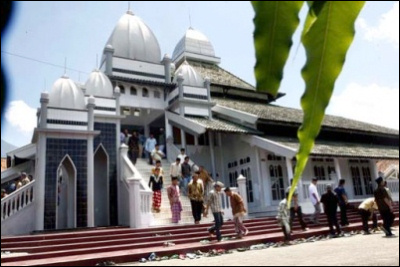
In the spotlight: People exit An-Nur Mosque, which belongs to the Ahmadiyah sect, after Friday prayer in Manis Lor village in Kuningan, West Java, on Friday.JP/R. Berto Wedhatama

Tension was still in the air after a clash broke out between members of more than five Muslim groups and Islamic sect Jamaah Ahmadiyah on Thursday in Manis Lor village, Kuningan regency, in West Java.

Most residents still preferred to stay in their homes in the village, home to the country’s biggest Ahmadiyah following, which was established in 1954. Of the village’s 4,350 residents, 3,000 belong to the sect.

In and around the village, some policeofficers, including several in plainclothes, were on the lookout.

On a street corner, a group of men stayed alert, with cups of coffee and scattered cigarette butts all around them.

Nurahim, a 47-year-old secretary of the Jamaah Ahmadiyah Indonesia branch in Manis Lor, said they were afraid another attack would come but were relieved by the police’s presence.

“But I’m sure the situation will soon return to normal and people will go back to their daily routines.”

Last Thursday’s clash triggered panic among the sect’s followers. Many rushed home from their workplaces to check their loved ones were safe.

“When I heard about the attack, I panicked. I then decided to leave work to make sure my family and other residents were safe,” said 37-year-old Syaiful, who works for a private company in Jakarta.

Another Manis Lor resident, Kusworo, had to close down his shop because of the attack.

“The clash affected me financially, but I had to make sure my family was safe,” said the 43-year-old trader, who sells basic foodstuffs and now has to rely on his savings to support his family.

The attack has also raised concern among parents and children.

A mother of two, Rosidah, was worried the attack would traumatize her children.

“I’m concern that the clash would have a bad effect on my children. They saw what happened.”

Several children who witnessed the attack said they were afraid and others said they were having trouble sleeping.

“I could not sleep that night after witnessing the fight,” said Karmilatur Rasidah, a 13-year-old seventh grader at SMP Amal Bhakti junior high school.

The attack, she said, happened when she was at school.

“Classes were stopped. The teacher asked us to immediately go home,” she recalled.

For the Ahmadiyah followers, the attack was nothing new. Residents of Manis Lor suffered a similar attack in December 2007, in which four people were injured.

Similar attacks on the sect’s members have occurred in other places, including in West Java towns Bogor and Garut last month.

The Thursday attack, which injured three and damaged scores of houses, erupted after an angry mob failed to convince the government to disband Ahmadiyah.

Earlier, the regency’s public order officers, armed with a written order from the Kuningan regent, tried to seal Ahmadiyah’s eight mosques in the village, but failed.

Under a 2008 joint ministerial decree, the sect’s members are allowed to perform their religious duties but are banned from propagating their teachings.

The attack was soon condemned by many, with President Susilo Bambang Yudhoyono telling the police to be strict in dealing with any anarchic action.

GP Anshor, the youth wing of the country’s biggest Muslim organization, Nahdlatul Ulama, announced Saturday its members were ready to protect the sect’s followers.

Rosidah said she was aware there had been protests against the sect’s presence in the village.

“We have been constantly living under threat and pressure. We’re used to this.”

URL: www.thejakartapost.com/news/2010/08/02/jamaah-ahmadiyah-followers-remain-edge-after-latest-attack.html

Thursday, July 8, 2010

Religious intolerance of Pakistan is a global threat

Duluth News Tribune, Canada
Religious intolerance of Pakistan is a global threat
On May 28, with memories of the despicable attempt of a Pakistani-American Muslim to kill scores of New Yorkers still fresh in our minds, Pakistani Muslim terrorists brutally killed 86 innocent people while they offered Friday prayers. The twin mosque attack was in Lahore, Pakistan. The two events took place on two opposite corners of the globe but shared a striking similarity.
By: Imran Hayee, Duluth News Tribune        July 08, 2010

On May 28, with memories of the despicable attempt of a Pakistani-American Muslim to kill scores of New Yorkers still fresh in our minds, Pakistani Muslim terrorists brutally killed 86 innocent people while they offered Friday prayers. The twin mosque attack was in Lahore, Pakistan.

The two events took place on two opposite corners of the globe but shared a striking similarity. In both events, the victims were non-Muslims, according to Pakistani law, and the terrorists belonged to the same Pakistani extremist organization, the Tehrik Taliban Pakistan.

Over the past few years, it has seemed that almost every terrorist act anywhere on the globe somehow has involved Pakistan. Why? Finding a clear answer may be a complex exercise, but the unyielding and state-sanctioned religious intolerance in Pakistan is the major contributing factor for this phenomenon.

Soon after its founding, Pakistan succumbed to the demands of religious extremists who started a concerted campaign to establish a puritanical fundamentalist state. The successive governments allowed this religious bigotry to flourish and distract the people from real issues of governance. Intolerance gradually crept into the fabric of Pakistani society. In 1974, the Pakistani government committed an unprecedented act of religious intolerance when it constitutionally defined who is a Muslim. In 1984, Ordinance XX and the subsequent anti-blasphemy laws institutionalized the persecution of minorities and religious dissidents with severe punishment and even death for those non-Muslims “impersonating” Muslims.

The unfounded but patronized religious intolerance of the Pakistani government has encouraged extremist clerics to define their own obscurantist version of Islam. Their version allows no tolerance for divergent views; killing any non-Muslim or heretic is their favorite slogan. Christians, Jews, Hindus and Buddhists are their obvious targets, but any Muslims who do not see the world through their eyes are not spared. Many extremist clerics spread this philosophy of hate and intolerance through their madrassas, or religious schools, by brainwashing innocent children and frustrated youth. The graduates of these madrassas are trained to do nothing but kill all who fall outside the realm of their narrow spectrum of life.

This kind of religious intolerance is bound to outgrow the geographical boundaries of Pakistan and few such waves already have occurred with the outpour exponentially increasing. Whether it be the World Trade Center bombing in New York, the shoe bomber’s foiled attempt to blow a U.S.-bound plane, the 7/7 subway attacks in London, the massive hotel and synagogue killings in Mumbai or the recent botched Times Square bombing attempt, each incident has its roots submerged in the philosophy of hatred and the religious intolerance of Pakistan.

If not reverted, this monster can perpetrate unparalleled damage to humanity and civilized culture throughout the world.

To protect against future acts of terrorism, America and the world must act now to pressure the government of Pakistan to uproot the seed of religious intolerance by repealing the anti-blasphemy laws and the current constitutional definition of Islam. Moreover, all madrassas which impart religious intolerance and hatred must be abolished. These madrassas could be nationalized by replacing hate-oriented elements of the intolerant religious education with traditional secular curriculum. This also will help provide jobs to many unemployed, educated, Pakistani youths who otherwise become vulnerable to the ploy of extremist clerics.

The suggested approach is not easy but necessary. Today, if this or a similarly effective approach is not deployed, then tomorrow, each radical madrassa in Pakistan will emerge as a fertile recruiting place for the militant extremists and terrorists, like al-Qaeda. I hope the world and America deal with this Pakistani religious intolerance before it is too late.

Imran Hayee of Duluth is an associate professor and the director of graduate studies in the electrical and computer engineering department at the University of Minnesota Duluth. He is UMD’s only Pakistani-American Muslim faculty member. He flew to Pakistan the day of the May 28 twin mosque terrorist attacks because his brother-in-law was among the 86 victims. He wrote this for the News Tribune upon his recent return.

Sunday, May 30, 2010

Murder of another innocent Ahmadi in Pakistan

Ahmadiyya Muslim Jamaat International
30th May 2010
PRESS RELEASE

Murder of another innocent Ahmadi in Pakistan
Murder inspired by Lahore attacks

It is with great regret and sadness that the Ahmadiyya Muslim Jamaat confirms that following the Lahore attacks on Friday, another Ahmadi, Mr Nehmatullah of District Narawal, Pakistan was today martyred due to his faith. It appears that this pre-meditated murder was directly inspired by the Lahore attacks.

Full details have not yet been received. However what is known is that the deceased was attacked whilst sleeping during the night with his wife next to him. He was attacked with a knife and died soon after.

One of the sons of Mr Nehmatullah recognised the assailant as he tried to flee and thus the assailant also attacked him with a knife. The son of Mr Nehmatullah survived and has been moved to a hospital where he is being treated. The extent of his injuries is not yet known.

The village in which the deceased lived is populated with three Ahmadi families. After hearing recently in a Friday sermon that Ahmadis were ‘Wajibul Qatl’ the assailant was allegedly openly preaching that he would murder Ahmadis. The term ‘Wajibul Qatl’ is being used increasingly in Pakistan in regard to Ahmadis and translates as deserving to be killed.

Following the Lahore attacks on Friday the assailant also allegedly said openly that he would personally make sure that no Ahmadi was left alive in his village.

The deceased is survived by his wife, three sons and three daughters.

This incident shows again that Ahmadis are facing a time of great uncertainty and danger in Pakistan. The International Community and Media are all urged to take action to help safeguard and protect the lives of Ahmadi Muslims.
22 Deer Park Road, London, SW19 3TL UK
Tel/Fax: 020 8544 7613 Mob: 077954 90682
Email: press at ahmadiyya.org.uk
Press Secretary AMJ International

Saturday, May 1, 2010

Anti-Ahmadiyya Conferences on the increase in Pakistan

In the Name of Allah, Most Gracious, Ever Merciful
International Press and Media Desk
Ahmadiyya Muslim Jamaat International
22 Deer Park, London, SW19 3TL
Tel / Fax (44) 020 8544 7613 Mobile (44) 077954 90682
Email: press@ahmadiyya.org.uk
Web: Alislam.org
LONDON, 30 April 2010
PRESS RELEASE
ANTI-AHMADIYYA CONFERENCES ON THE INCREASE IN PAKISTAN

It is with great regret and concern that the Ahmadiyya Muslim Jamaat notes the increased number of hate filled conferences being held throughout Pakistan by various extreme organisations who claim to be acting in accordance with the teachings of Islam. These conferences are being held solely for the purpose of igniting and spreading anti-Ahmadiyya sentiment far and wide.

One recent example was the Khatme Nabuwwat Conference held in Rabwah (Ahmadiyya Headquarters in Pakistan) on 28 February 2010. This two day conference was widely publicised in the Pakistani Press.

The Daily Ausaf of 1 March 2010 reported that throughout the conference all the speakers utilised the platform to abuse the Founder of the Ahmadiyya Muslim Jamaat, Hadhrat Mirza Ghulam Ahmad and to incite the mass population into targeting Ahmadis. It is of the utmost concern that at such conferences and rallies Ahmadis are being declared ‘Wajibul Qatl’ which translates as ‘Liable to Death’. Thus those attending the rallies, many of whom are uneducated and living impoverished lives, are being coerced into killing or violently attacking Ahmadis with the promise that they will be rewarded by God for their evil acts.

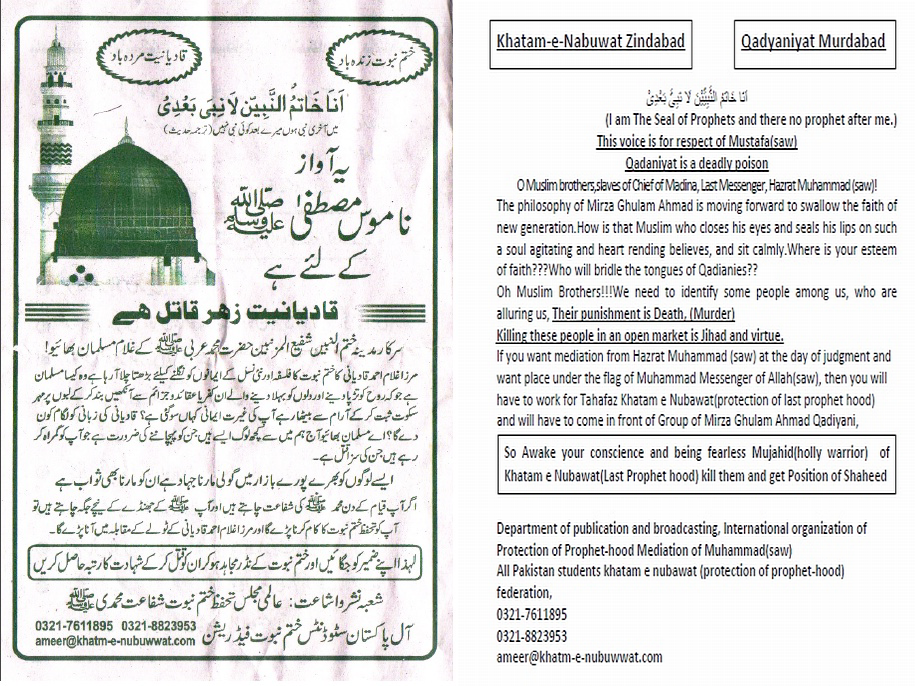
The hate filled organisations are continually producing literature to complement the vitriolic tone of their conferences. The literature is spread far and wide and even though it clearly transcends all levels of decency the authors are not subjected to any sanction whatsoever. One example is the recently published ‘World Tahaffuz-e-Khatme Nabuwwat Council Calendar 2010’ which states that the only ‘cure for Qadianis’ is a violent Jihad. Furthermore it asserts that Ahmadis have no right to live in Pakistan and that the ‘streets should be cleansed of Ahmadis’. The rhetoric is particularly concerning given that the recent history of Pakistan shows that ordinary Pakistanis are being influenced to such an extent that they act upon these orders. Earlier this month three Ahmadis were brutally killed in Faisalabad which has become a centre for anti-Ahmadiyya violence.

Due to the imposition of anti-Ahmadiyya laws in 1974 and 1984 the targeting of Ahmadi Muslims has gained a form of legitimacy which is being continually taken advantage of by extremist factions. This despite the fact that Article 20 of Pakistan’s Constitution guarantees each citizen’s freedom to ‘profess religion and to manage religious institutions’. Article 33 of the same document furnishes the State with a responsibility to ‘discourage parochial, racial, tribal, sectarian and provincial prejudices among the citizens.’ Further, Article 36 furnishes the State with the responsibility to ‘safeguard the legitimate rights and interests of minorities.’

It is high time that the State took responsibility for safeguarding the rights of Ahmadis and indeed all other minority groups within Pakistan in line with the responsibilities imposed by the nation’s own Constitution. This can only be done when it is made clear to extremist factions that their hate filled, barbaric activities will no longer be tolerated.

End of Release
Abid Khan press at ahmadiyya.org.uk

Thursday, January 28, 2010

Martyrdom of Professor Muhammad Yusuf

Video report on the martyrdom of Professor Muhammad Yusuf. Presentation of MTA Studios Pakistan.

Retired Professor Muhammad Yusuf (aged 70) was killed around 7:30am on 5th January, 2010 by two masked gunmen in Rachna Town, Ferozwala, Lahore when he was tending his son's grocery shop.

Sunday, January 24, 2010

Ahmadi leader’s family offered to withdraw case: accused

---Daily Times, Pakistan
Friday, January 22, 2010

Ahmadi leader’s family offered to withdraw case: accused

*Claim they want Khatam-e-Nabuwat Youth Wing dismantled
*Family deny allegation, say accused conducting anti-Ahmadi propaganda

LAHORE: The four men accused of murdering Professor Muhammad Yousaf, an Ahmadi leader from Ferozewala, have claimed that the man’s family has offered to withdraw the case against them if the Khatam-e-Nabuwat Youth Wing (KNYW) is shut down. Muhammad Ahmed Faridi, Inamullah – the president of the KNYW — Ashraf and Haji Arshad, all currently being held at the Ferozwala Police Station, told Daily Times on Thursday that the complainant had sent them various messages, offering to withdraw the case against them provided that the men guaranteed that they quit the KNYW and dismantled its operations, a claim that the complainant denies. Faridi said Inamullah had been “indirectly” contacted by the complainant, with an offer to withdraw the case against the men if they would quit the KNYW. They said they would never quit the KNYW, going as far as saying that they would prefer to die before they thought of leaving the organisation. Pakistan Muslim League-Nawaz Member of the Provincial Assembly Pir Ashraf Rasool, who is allegedly favouring the accused, told Daily Times that the complainant had asked him to offer the compromise to the accused. He said the accused had informed him that they were ready to face imprisonment or even the death sentence for the sake their beliefs. Fatehul Din, Yousaf’s son, told Daily Times that no one had made any such offer to the four men, adding that the accused were trying to divert attention from the real issue. He said they were trying to gain sympathy in the public and were trying to fuel public bias against Ahmadis. rana tanveer

URL: www.dailytimes.com.pk/default.asp?page=2010\01\22\story_22-1-2010_pg7_31

Wednesday, January 20, 2010

Ahmadi leader’s murder in Ferozewala: Police yet to ‘book’ suspects in custody

--- Daily Times, Pakistan
Tuesday, January 19, 2010

Ahmadi leader’s murder in Ferozewala : Police yet to ‘book’ suspects in custody
  • Men not produced in court, no paperwork against them yet
  • Bereaved family claims politicians ‘restraining’ police from taking action
  • DSP declines comment
By Rana Tanveer

LAHORE: The ‘arrest’ of four people in connection with an Ahmadi leader’s murder was meant to merely pacify the bereaved family, as police have not made the case against them official, nor have their names been mentioned in any paperwork. In addition, the men are yet to be interrogated, Ferozewala police sources told Daily Times on Monday.

On January 13, Ferozewala police arrested Muhammad Ahmed Faridi, Inamullah, Ashraf and Haji Arshad, for their involvement in the January 5 murder of a local Ahmadi leader, Muhammad Yousaf.

Sources said police had arrested the men only to placate the aggrieved party, but had not fulfilled all the legal formalities.

They said certain influential individuals were pressing police not to book them and keep them in lock for some time before declaring them innocent and releasing them without presenting them in court.

When contacted, Ferozewala Deputy Superintendent of Police Tariq Gujjar avoided comment on the issue.

Fatehul Din, son of the slain Ahmadi leader Muhammad Yousaf, told Daily Times that police was using ‘delaying tactics’ to hush up the case. “The police are probably serious about pursuing the matter, but certain influential politicians are pressing them to hush it up.”

Din said he had even submitted a proof of the accused’s involvement in the case to the investigation officer, adding that he had pictures proving the men in custody were provoking locals against Ahmadis in the area.

He said there had been no development in the investigation as police had been restrained from performing their duties. Din said the accused were given ‘undue protocol’ at the police station.

His counsel, Muhammad Abu Bakar, told Daily Times that according to Section 167(2) of the Criminal Procedure Code (CrPC), police were bound to produce the accused before a magistrate for a physical remand within 24 hours of the arrest.

URL: www.dailytimes.com.pk/default.asp?page=2010\01\19\story_19-1-2010_pg13_4

Thursday, January 14, 2010

Ahmadi leader’s murder suspects ‘visit’ police again

---Daily Times, Pakistan
Thursday, January 14, 2010

Ahmadi leader’s murder suspects ‘visit’ police again

*
None of the accused have moved court for bail despite being named in FIR 8 days ago
*
Complainant denies SP’s claim that he had asked police not to arrest accused
*
MPA says four men are innocent and he advised them not to get bail

By Rana Tanveer


LAHORE: All four men accused of murdering a local Ahmadi leader in Ferozewala appeared before the Sheikhupura superintendent of police (SP) (Investigation), accompanied by a Pakistan Muslim League-Nawaz (PML-N) member of the provincial assembly, to “prove their innocence” on Wednesday.

Eight days have passed since the victim’s family nominated the four men in the FIR but the police have yet to formally arrest the suspects despite getting two chances – when the men visited the police station with PML-N MPA Pir Ashraf Rasool to ‘prove their innocence’. It is important to mention here that the suspects have not moved the court for bail so far.

According to details, two assailants gunned down 70-year-old Muhammad Yousaf while he was at his general store on January 5. A first information report (FIR) was registered at the Ferozewala Police Station, wherein Muhammad Ahmed Fridi, Inamullah son of Shaukat Ali, Ashraf and Haji Arshad were named as the accused. The two assailants were not named in the FIR.

Consent: Syed Amin Bukhari, the SP, told Daily Times that the accused were not on bail and according to the law they should be arrested, but with the consent of the complainant the police had given them a chance to prove their innocence.

The SP said both parties had appeared before him, adding that he had given them a few days to resolve the matter through a local panchayat. He said the accused had guaranteed their cooperation and would not evade the police.

Influence: However, Faatehul Din, the complainant and son of the murdered Ahmadi leader, told Daily Times the accused had been given undue favour by the police and PML-N MPA Pir Ashraf Rasool. He said he had never asked the police not to arrest the accused. He said the MPA accompanied the accused to the office of the SP to influence the police.

Suspects are innocent: The MPA told Daily Times that the four men were innocent. He said he had advised the four not to get bails as they were innocent, adding that the competent authority to decide the case were the police and the courts. Ashraf said he was ready to hand over the men to police custody.

Saleemud Din, a spokesperson for the Jamaat-e-Ahmadia, told Daily Times the accused were being given undue favour.

URL: www.dailytimes.com.pk/default.asp?page=2010\01\14\story_14-1-2010_pg13_1

Protect Ahmadis [Editorial]

---Daily Times, Pakistan
Wednesday, January 13, 2010

Second Editorial: Protect Ahmadis

The recent incident of murder of an Ahmadi leader in Ferozewala, a city of Sheikhupura district situated near Lahore, is a sad reflection of how society chooses to treat a section of the minorities, variously known as Mirzais or Qadianis in Pakistan. What is more disconcerting though, is the apathy — rather collusion — of the state, which not only allows such incidents to take place under its very nose, it tends to protect the perpetrators. According to a series of reports published in this paper, Professor Mohammad Yousaf, leader of the Ahmadi community in Ferozewala, had sought police protection against sectarian zealots in his locality who had been threatening him. Allegedly, in response to this, two unidentified assailants shot him dead while he was at his general store. It was with some effort the family managed to lodge the FIR against the two murderers and four abettors known to the victim, who live in the same area. Instead of arresting the accused and investigating further, it is reported that the police let the four abettors go when they visited the police station with PML-N’s member of the Punjab Assembly Pir Ashraf Rasool. Meanwhile, both the police and the nominees in the FIR have been pressurising the family to withdraw the murder case. Alarmingly, even after the ghastly retribution visited upon Mohammad Yousaf, Khatam-e-Nabuwat Youth Wing’s signboard on the main roundabout of the town, which urges believers to kill and maim Islam’s enemies and to socially boycott Ahmadis, has not been removed.

While we are witnessing the gruesome consequences of promoting extremist Islam in the form of suicide attacks, this incident shows another dimension of the free rein given to hate-mongering mullahs. Most often the paranoia and hatred against Ahmadis inspired by self-styled Islamic leaders has taken a murderous turn. Not long ago, a TV presenter incited the wholesale murder of Ahmadis by declaring it an obligation for Muslims, as a result of which two targeted killings took place in Sindh. This continues unabated because of the failure of the concerned authorities to take action against the culprits. Apparently, it is due to a deep bias that runs through the entire system. There is a visible nexus of protection as demonstrated in this case. Whether they are Muslim or non-Muslim, the state is responsible to protect all citizens of Pakistan against oppression. It is these kinds of cases that really require judicial activism, as the legislature and executive have both been found siding with the perpetrators rather than the victims. *

URL: www.dailytimes.com.pk/default.asp?page=2010\01\13\story_13-1-2010_pg3_1

Wednesday, January 13, 2010

Ahmadi leader killed in Ferozwala: Police let suspects leave with PML-N MPA

---Daily Times, Pakistan
Tuesday, January 12, 2010

Ahmadi leader killed in Ferozwala: Police let suspects leave with PML-N MPA

* IO says nominated suspects allowed to leave on guarantee of MPA Pir Ashraf Rasool
* Complainants claim efforts being made to exonerate Yousaf’s killers

By Rana Tanveer

LAHORE: Four suspects – who remained at large for six days after their nomination in a first information report in the murder of a local Ahmadi leader were brought to a police station on Monday, but police let them leave with a member of the provincial assembly instead of arresting them, sources in the Ferozewala Police Station told Daily Times.

The sources said the MPA, a member of the Pakistan Muslim League-Nawaz (PML-N), had brought the four suspects – Muhammad Ahmed Fridi, Inamullah, Ashraf and Haji Arshad – to the police station, and they remained there for more than an hour. They said the investigation officer listened to their side of the story, wherein they claimed they were innocent and had been wrongly implicated in the case. Following this, the police – instead of arresting them on the basis of their nomination in the FIR – let them go with the MPA, said the sources.

According to the FIR registered with the Ferozewala Police Station on January 5, two armed assailants attacked 70-year-old Muhammad Yousaf while he was at his general store in the presence of Yousaf’s sons, Fatehuddin and Mahmood Yousaf. The FIR said Yousaf was shot six times in the chest and arms and he died immediately. Yousaf was allegedly killed for reporting the assailants to police over their reported involvement in the spread of religious hatred against the Ahmadi sect and provoking people to kill Ahmadis. According to the FIR, Muhammad Ahmed Fridi, Inamullah, Ashraf and Haji Arshad abetted Yousaf’s murder.

The policeman in charge of the investigation, Sub-Inspector Rai Zulfiqar Ali, told Daily Times that the suspects came to the police station with PML-N MPA Pir Ashraf Rasool, and conceded they were allowed to leave, “as the complainant party did not come to the police station”.

MPA’s guarantee: He said the suspects were summoned to the police station on Monday to listen to arguments from both sides. He said although the four men had been named in the FIR, they were allowed to leave on the MPA’s guarantee. “The MPA will bring them to the police station on Tuesday (today),” he said.

Zulfiqar said police were trying locate the two assailants – who had not yet been identified. He said after three raids were conducted to arrest the four suspects named in the FIR, the MPA brought them to the police station.

Exonerate suspects: Yousaf’s son Fatehuddin told Daily Times that police and the MPA were giving the suspects “an undue favour”. He said efforts were being made to “exonerate the suspects because they are influential”.

He claimed that the MPA had been “sheltering the suspects since the day of the murder … they have been living with him”. He said while police summoned his family to the station on Monday, they did not go because “we were feeling insecure because of their influence”.

Azhar Siddique advocate, an expert in criminal law, told Daily Times that the police decision to let the suspects go was “gross misconduct and illegal”. He said the development showed that police were biased against the complainants.

Meanwhile, the Jamaat Ahmadia Lahore adopted a resolution against the murder of a member of their sect. Spokesman Munawar Shahid told Daily Times that his group strongly condemned the role of “extremists spreading religious hatred”. He said that with such incidents on the rise, the government must take serious notice of alleged atrocities against Ahmadis.

URL: www.dailytimes.com.pk/default.asp?page=2010\01\12\story_12-1-2010_pg13_1

Wednesday, January 6, 2010

Ahmadi leader shot dead in Ferozewala (Pakistan)

--- Daily Times, Pakistan
Wednesday, January 06, 2010

Ahmadi leader shot dead in Ferozewala

* Victim’s son claims police took no action despite being intimated about threats

By Rana Tanveer

LAHORE: An Ahmadi leader was gunned down allegedly for seeking police protection against sectarian zealots in Ferozewala police precincts on Tuesday.

The family of 70-year-old victim Muhammad Yousaf — leader of the Ahmadi community in Ferozwala — alleged that extremists killed him for demanding police to stop them from creating religious strife in the area. Earlier, extremists had gathered together, carrying placards and signboards bearing slogans against the Ahmadis.

Ferozewala Police Station House Officer (SHO) Muhammad Munir told Daily Times that police had registered the first information report (FIR) against unidentified persons for Yousaf’s murder. Although no one had been arrested so far, the murderers would be brought to justice, he added.

According to complainant Fatehul Deen — son of the deceased — two armed assailants on a motorbike sprayed bullets at his father around 8am when he was sitting at his general store, where he (Fateh) and his brother were also present. He said his father died instantly while he and his brother narrowly escaped the attack.

No action: Fateh alleged that the assailants were the henchmen of local religious leader Muhammad Ahmed Faridi. He alleged that two men — Inamullah and Shaukat — were also involved in his father’s murder.

Fateh said that on December 29, Faridi erected a huge signboard at the main roundabout in Ferozewala Bazaar, which bore slogans provoking people against the Ahmadis. He said the accused also made phone calls to him and other Ahmadis in the area, threatening them to leave the area or else face dire consequences. Fateh said despite being intimated about these threats, police took no action against the accused that had resulted in his father’s death.

URL: www.dailytimes.com.pk/default.asp?page=2010...2010_pg7_5

Tuesday, January 5, 2010

Retired Ahmadi Professor murdered in Lahore, Pakistan

In the Name of Allah, Most Gracious, Ever Merciful
International Press and Media Desk
Ahmadiyya Muslim Jamaat International
22 Deer Park, London, SW19 3TL
Tel / Fax (44) 020 8544 7613 Mobile (44) 077954 90682
Email: press@ahmadiyya.org.uk
Web: Alislam.org
LONDON, 5 January 2010
PRESS RELEASE

RETIRED AHMADI PROFESSOR MURDERED IN LAHORE

It is with great sadness that the Ahmadiyya Muslim Jamaat confirms that another member of its community, Retired Professor Muhammad Yusuf (aged 70) was killed earlier today by two masked gunmen in Lahore.

At around 7.30am, Professor Yusuf was tending his son’s grocery shop near his own home in Rachna Town when two masked persons drove up to the shop on motorbikes. They immediately fired two shots at Professor Yusuf and thereafter fled the scene.

Upon hearing the gunshots a son of Professor Yusuf came running to the grocery shop and found his father seriously wounded. The wounds were indeed fatal and Professor Yusuf died on route to the local hospital.

The Jamaat has faced a great deal of opposition in the Rachna Town area and this opposition has markedly increased in recent times. Banners are seen around the area stating that Ahmadis are ‘Wajibul Qatl’ that is that they ought to be killed. Further, a number of anti-Ahmadi rallies have taken place in the area inciting others to violently oppose and harass all Ahmadis. One such rally took place yesterday. A number of Ahmadis in the area had also faced death threats. Police have been made aware of all such incidents yet no action has been forthcoming.

Professor Yusuf was a greatly loved and well known personality of the Ahmadiyya Muslim Jamaat. He is survived by his widow, four sons and one daughter.

The Press Secretary of the Ahmadiyya Muslim Jamaat, Abid Khan said:
“The martyrdom of Professor Muhammad Yusuf grieves every single Ahmadi the world over. He was a gentle and loving elderly man. It is a grave reality that no Ahmadi - man, woman or child - is safe in Pakistan. A country founded on principles of tolerance and religious freedom has transformed into a country of hatred, extremism and cruelty of the highest order.

Last year 11 Ahmadis were killed in Pakistan for no other reason than that they belonged to the Ahmadiyya Muslim Jamaat. This new year of 2010 is not even a week old and already the blood of another Ahmadi has been shed.
May God grant patience to the family and friends of the deceased at this time of great trial.”
End of Release

Abid Khan, Tel: +44(0)208 5447613 +44(0)7795490682, Email: press at ahmadiyya.org.uk

Tuesday, December 8, 2009

Indonesia: Int'l Religious Freedom Report - 2009

Excerpts from
U.S. Department of State
International Religious Freedom Report 2009 : Indonesia
Released by the Bureau of Democracy, Human Rights, and Labor
October 26, 2009

The Constitution provides for freedom of religion. However, the Government officially recognized only six religions, and legal restrictions continued on certain types of religious activity.

The Government generally respected religious freedom in practice; however, ongoing government restrictions, particularly among unrecognized religions and sects of the recognized religions considered “deviant” were significant exceptions to respect for religious freedom. Since the previous reporting period the Government convicted and sentenced the leaders of a hardline Muslim organization to 18 months in prison, including time served, for their role in organized violence against a peaceful demonstration in support of religious freedom. The Government also prosecuted terrorists responsible for religiously tinged violence in Sulawesi and the Malukus. In some cases, however, the Government tolerated discrimination against and the abuse of religious groups by private actors and failed to punish perpetrators, although the Government prevented several vigilante actions during Ramadan. Aceh remained the only province authorized to implement Islamic law (Shari’a), although non-Muslims in the province are exempted from Shari’a. Many local governments outside of Aceh maintained laws with elements of Shari’a that abrogated certain rights of women and religious minorities; however, no new laws based on Shari’a were known to have passed during the reporting period. Even though the central Government holds authority over religious matters, it did not try to overturn any local laws that restricted rights guaranteed in the Constitution. Members of minority religious groups continued to experience some official discrimination in the form of administrative difficulties, often in the context of civil registration of marriages and births or the issuance of identity cards.

There were a number of reports of societal abuses or discrimination based on religious affiliation, belief, or practice. Some groups used violence and intimidation to forcibly shut at least nine churches and 12 Ahmadiyya mosques. Some of the churches remained closed and one Ahmadiyya mosque in Riau that was completely destroyed had not been rebuilt. Other mosques were reopened. Many perpetrators of past abuse against religious minorities were not brought to justice.

The U.S. Government discusses religious freedom with government and civil society leaders as part of its overall policy to promote human rights. The Embassy promoted religious freedom and tolerance through exchanges and civil society development.

Section I. Religious Demography


An archipelago of more than 17,000 islands, the country has an area of approximately 700,000 square miles and a population of 245 million.

According to a 2000 census report, 88 percent of the population is Muslim, 6 percent Protestant, 3 percent Roman Catholic, 2 percent Hindu, and in total less than 1 percent Buddhist, followers of traditional indigenous religions, Jewish, and other Christian denominations. Some Christians, Hindus, and members of other minority religious groups argued that the census undercounted non-Muslims.

Most Muslims in the country are Sunni. The two largest Muslim social organizations, Nahdlatul Ulama (NU) and Muhammadiyah, claimed 40 million and 30 million Sunni followers, respectively. There are also an estimated 1 million to 3 million Shi’a.

Many smaller Muslim organizations exist, including approximately 400,000 persons who subscribe to the Ahmadiyya Qadiyani interpretation of Islam. A smaller group, known as Ahmadiyya Lahore, is also present. Other Islamic minorities include al-Qiyadah al-Islamiya, Darul Arqam, Jamaah Salamulla (Salamulla Congregation), and members of the Indonesian Islamic Propagation Institute.
………

Section II. Status of Religious Freedom

Legal/Policy Framework


The Constitution provides for freedom of religion and accords “all persons the right to worship according to their own religion or belief.” The Constitution states that “the nation is based upon belief in one supreme God.” The first tenet of the country’s national ideology, Pancasila, similarly declares belief in one God. Government employees must swear allegiance to the nation and to the Pancasila ideology. Other laws and policies placed some restrictions on certain types of religious activity, particularly among unrecognized religious groups and “deviant” sects of recognized religious groups. The Government did not use its constitutional authority to review or revoke local laws that violated freedom of religion.

The Ministry of Religious Affairs extends official status to six religious groups: Islam, Catholicism, Protestantism, Buddhism, Hinduism, and Confucianism. Unrecognized groups may register with the Ministry of Culture and Tourism as social organizations. Although these groups have the right to establish a house of worship, obtain identity cards, and register marriages and births, they face administrative difficulties in doing so. In some cases these challenges make it more difficult for individuals to seek employment or enroll children in school.

In June 2008 the Government released a joint ministerial decree freezing the activities of the Ahmadiyya Qadiyani (Ahmadiyya), banning proselytizing by the Ahmadiyya, and prohibiting vigilantism against the group. The decree is short of the outright ban strongly advocated for by hardline groups and a government-appointed body, the Coordinating Board for Monitoring Mystical Beliefs in Society (Bakor Pakem). The decree was signed by the Attorney General’s Office, the Ministry of Religion, and the Ministry of Home Affairs. The Minister of Religious Affairs stated that violations of the ban on proselytizing would result in a maximum 5-year jail sentence on charges of blasphemy. The decree does not prohibit the Ahmadiyya from worshipping or continuing to practice within its own community.

Following the decree’s release, the Government issued a joint circulatory letter providing the executive guidance on the joint ministerial decree on Ahmadiyya. The letter was signed by the Secretary General of the Ministry of Religion, the Assistant Attorney General for Intelligence, and the Director General for National Integration and Internal Politics at the Ministry of Home Affairs. The letter provides guidance for Governors, Regents, Mayors, Heads of the High Court, and Heads of Regional Offices under the Provincial Ministries of Religion throughout the country on proper implementation of the Joint Ministerial Decree (SKB).

Prior to the government decree, Bakor Pakem issued a recommendation to the Government to dissolve the Ahmadiyya. The April 2008 recommendation declared the group heretical and deviant, citing a 1965 presidential instruction on the “prevention of misuse and disgrace of religion.” The Government delayed action on issuing a formal decree against the group amid pressure from civil society and Islamic organizations that claim the ban would be unconstitutional and contrary to the teachings of Islam.

The Indonesian Council of Ulamas (MUI) released a number of fatwas (religious decrees) in recent years on the issue of “deviance” from mainstream Islam, including recommendations to ban the Ahmadiyya, that were influential in enabling official and social discrimination against the Ahmadiyya and other minority religious groups during the reporting period.

The Government formed the MUI in 1975 and continued to fund its members, but MUI opinions are not legally binding. Nevertheless, the MUI’s edicts or fatwas are designed to be moral guiding principles for Muslims and society, and the Government seriously considers them when making decisions or drafting legislation. MUI’s influence in restricting religious freedoms increased during the year, sometimes with government support.

In 2007 MUI issued a fatwa with 10 guidelines for determining deviant teachings. These include disagreeing with any of the six core principles of Islam; acknowledging a prophet after Muhammad; and changing or modifying Islamic rituals such as performing the Hajj to a place other than Mecca or saying that prayer five times daily is not necessary. In October 2007 the MUI declared the minority sect, al-Qiyadah al-Islamiyah deviant. It issued a similar fatwa against the Ahmadiyya in 2005.

The 2006 civil registration bill requires citizens to identify their religion on National Identity Cards (KTP). The bill does not allow citizens to identify themselves as anything outside of the six recognized religious groups. Legally, citizens may leave the religious section blank, but some local government officials were not familiar with this option. Members of unrecognized religious groups were often unable to obtain KTPs as a result.

The Government requires officially recognized religious groups to comply with Ministry of Religious Affairs and other ministerial directives, such as the Revised Joint Ministerial Decree on the Construction of Houses of Worship (2006), Overseas Aid to Religious Institutions in Indonesia (1978), and Guidelines for the Propagation of Religion (1978).

The 2006 Revised Joint Ministerial Decree on the Construction of Houses of Worship requires religious groups that want to build a house of worship to obtain the signatures of at least 90 members of the group and 60 persons of other religious groups in the community stating that they support the construction. The decree also requires obtaining approval from the local religious affairs office, the Forum for Religious Harmony (FKUB).

The Guidelines for Overseas Aid to Religious Institutions require domestic religious organizations to obtain approval from the Ministry of Religion to receive funding from overseas donors. The Guidelines for Propagation of Religion ban proselytizing under most circumstances.
………

Article 156 of the Criminal Code makes spreading hatred, heresy, and blasphemy punishable by up to five years in prison. Although the law applies to all officially recognized religions, the few cases in which it has been enforced have almost always involved blasphemy and heresy against Islam.

Many of the country’s policies concerning religion are enacted and enforced at the subnational level. Since October 2005 the regional representative office of the Ministry of Religious Affairs in West Nusa Tenggara upheld a ban on 13 religious groups, including the Ahmadiyya, Jehovah’s Witness, Hare Krishna, and 10 forms of Aliran Kepercayaan as being deviations of Islam, Christianity, or Hinduism. The West Nusa Tenggara Board for Monitoring Mystical Beliefs in Society closely monitored Ahmadiyya members in Mataram during the reporting period. There were no reports, however, on how the restriction affects the other banned groups in the region. In West Java a joint decree issued in January 2005 in the Kuningan Regency restricts the propagation of Ahmadiyya teachings. On May 5, 2008, Pakem West Java recommended municipal authorities ban Ahmadiyya. On May 6, 2008, the Mayor of Cimahi, West Java, issued an order banning the religious group.
………

The Government bans proselytizing, arguing that such activity, especially in religiously diverse areas, could prove disruptive.

Restrictions on Religious Freedom


The Government generally respected religious freedom; however, a government decree restricting the ability of the Ahmadiyya to practice freely was a significant exception. Certain other laws, policies, and official actions also restricted religious freedom and the Government sometimes tolerated private actors’ discrimination against and abuse of individuals based on their religious belief.

Local governments issued bans against Ahmadiyya, al-Qiyadah al-Islamiyah, and other minority Islamic sects during the reporting period and monitored them closely, frequently at the request of local MUI chapters.

In September 2008 the acting Governor of South Sumatra issued a governor’s decree banning Ahmadiyya. The decree stated that “the Ahmadiyya would be prohibited in the province because the sect is not compatible with Islamic teachings.” The local ban was supported by officials from the provincial offices of the Ministry of Religious Affairs, local prosecutors, representatives from the local MUI and other Islamic organizations, including academics from Palembang-based Raden Fatah State Islamic Institute. Before the ban, several conservative groups under the umbrella organization Islamic People’s Forum (FUI), including the Islam Defenders Front (FPI) and the Indonesian Mujahidin Council, along with Hizbuth Tahrir Indonesia, a transnational organization, demanded the dissolution of the Ahmadiyya sect.

Despite the South Sumatra decree’s violation of the June 2008 central Government decree and guidance on Ahmadiyya, the central Government has taken no action to demand it be rescinded. The decree remains in place, but no efforts have been made to enforce it and local authorities consider that the decree has no force of law, given that the acting Governor was only in power for three months. The Ahmadiyya community reports that it is still able to perform its usual and normal religious activities in the province.

The June 2008, government decree on Ahmadiyya that bans proselytizing and practices deemed to be “deviant” from mainstream Islam came five months after a government-appointed team began monitoring the Ahmadiyya at the request of MUI. Civil society activists have said that passage of the decree was the most recent example of an escalating effort by Islamic hardliners to restrict the practice of the Ahmadiyya.
………

Human rights groups continued to receive sporadic reports of local civil registry officials who rejected applications for identity cards (KTPs) submitted by members of unrecognized or minority religious groups. Some applicants found it easier to register with a religion other than their own and were issued KTPs that inaccurately reflected their religion. For example, some animists received KTPs that listed their religion as Islam. Many Sikhs were registered as Hindu on their KTPs and marriage certificates. Similarly, many Jews registered as Christians. Some citizens without a KTP had difficulty finding work. Several NGOs and religious advocacy groups continued to urge the Government to delete the religion category from the KTPs, but no progress was made.

Ahmadiyya followers forced from their homes in West Lombok by a mob in 2006 and living in the Transito Camp in Mataram continued to face difficulty obtaining KTPs due to the absence of a clear home address while displaced in the camp. As a result, The Ahmadiyya sometimes could not get free health services from hospitals as local officials refused to issue notification letters regarding their poor condition. The Ahmadiyya believed that they could obtain KTPs and resolve the issue if they could return to their home village.

In June 2008 in the Solok district of West Sumatra, local officials refused to perform marriage ceremonies for members of the Ahmadiyya sect. However, with the assistance of the local village head, individuals from the Solok district were able to marry in a different district and have not faced problems since their return.

Since the Government promulgated the Revised Joint Ministerial Decree on the Construction of Houses of Worship in 2006, implementation and defense of rights conferred under the decree have not always been enforced at the local level. During the reporting period, some Christian and Hindu groups pointed to sporadic acts of discrimination in which local authorities refused to authorize the building of churches and temples even though the groups managed to collect the necessary signatures.
………

Abuses of Religious Freedom


During the reporting period, the Government continued to explicitly and implicitly restrict the religious freedom of groups associated with forms of Islam viewed as outside the mainstream.

The Government tolerated discrimination and abuse toward the Ahmadiyya by remaining silent on the 2007 MUI fatwa containing guidelines condemning Islamic groups such as the Ahmadiyya, who profess belief in a prophet after Muhammad. The Government also remained silent on the 2005 MUI fatwa that explicitly banned the Ahmadiyya, as well as local government bans. Varying reports provided different numbers of mosques attacked or closed. However, according to national Ahmadiyya spokespersons, since the June 2008 decree, 21 Ahmadiyya mosques were forced to close around the country; 15 were closed in West Java alone. The June 2008 joint ministerial decree on the Ahmadiyya responded to calls to restrict the group’s rights. For the most part, Ahmadiyya followers were allowed to continue worshiping, although some mosques were closed after the decree. However, because of the decree, Ahmadiyya followers were not free to proselytize or otherwise practice their faith publicly.

Authorities failed to halt vandalism on a number of Ahmadiyya facilities during the reporting period.

On June 2, 2009, a mosque belonging to Ahmadiyya members in Kebayoran Lama, South Jakarta, was deliberately set on fire by unidentified arsonists during dawn prayers. Witnesses told police that eight Ahmadiyya members were performing the dawn prayer on the second floor of the two-story building when two men sprayed the mosque with gasoline from a jerry can and lit the fire. There were no injuries in the incident and no arrests were made.

On April 19, 2009 a group of unidentified persons reportedly vandalized the Mahmud mosque in Talaga village. One hundred and fifty residents had sealed the same mosque in July 2008. Also, in July 2008, they sealed the Taher mosque in neighboring Sindankerta village, Cianjur, West Java.

On October 5, 2009, a group of people destroyed the Mubarak mosque in Mahato area, Tanjung Medan village, Pujud District, Rokan Hilir Regency, Riau Province, after the Eid al-Fitr celebration.

On August 27, 2008, hundreds of FPI members threatened the Ahmadiyya congregants of Al Mubarak mosque in Jagakarsa, South Jakarta, and demanded they cease all of their activities before the month of Ramadan.

Members of Ciputat Muslim Community Forum (FMCC) sealed the Baitul Qoyyum mosque belonging to Ahmadiyya on August 19. The FMCC believed that Ahmadiyya members had failed to abide by a joint ministerial decree released in June that banned the group from proselytizing. Police thwarted the residents’ attempt to seal the mosque.

On August 8, 2008, local residents vandalized Baiturahman and Baitol Do’a mosques in Parakansalak, Sukabumi, West Java.

A group of hardliners sealed a small Ahmadiyya mosque in Talaga village and a mosque in Parabon village, Cianjur, West Java on August 1, 2008.

The Ahmadiyya community of 182 individuals living in camps as internally displaced persons (IDPs) in West Lombok since their homes and mosques were attacked by a mob in 2006 continued to face challenges during the reporting period. On April 14, 2009, the local government requested that the IDPs cancel plans to return to their homes in Gegerungan Village due to continued security concerns and pending compensation issues. The April request followed an earlier series of requests in March that the Ahmadiyya delay their plans to return. So far, four families have returned to Gegerungan Village. They are reportedly living and working there safely, although sometimes they still face low level intimidation from the local community.

During the reporting period 125 Ahmadiyya IDPs remained in the Transito Camp and 57 in Praya Camp. In mid-2008 one family from the Praya Camp returned home briefly, only to return to the camp shortly thereafter due to threats of violence. Sources within the Ministry of Religion reported a lower number of 150 IDPs living in the camps, of which 80 had been repatriated back to their homes.

In 2007 the local government reduced the rice subsidy and stopped subsidizing the electricity supply for the IDP camp. At the end of the reporting period, IDPs in the shelter receive two tons of rice subsidies every month. The local government also reduced the water supply to the camp in 2008. Camp conditions remained difficult, with cramped living space and limited access to water. Although children have been able to attend local schools since 2006, they faced harassment. Ahmadiyyas who lived in the camps sometimes faced difficulties obtaining an ID card due to the absence of a clear address. However, those who lived in rented houses or took shelter in their family’s houses did not have these problems. Ahmadiyya who lived in the camp also found it difficult to participate in the free health service program for the poor because they were not able to obtain a letter from local authorities verifying their economic status.

In February 2009 the provincial government in West Nusa Tenggara established a “Coordination Team” consisting of 17 members (religious leaders and academicians) to examine Ahmadiyya teaching and to discuss alternative solutions for the Ahmadiyya. The team offered two options: to relocate the Ahmadiyya into a heterogeneous area in Pemanang district in West Lombok, or to disperse them throughout city-owned land. Ahmadiyya representatives said that these two options were not acceptable and too complicated. Most city-owned land is in disputed areas and located in open green space.

During the reporting period, the Government arrested and charged individuals with heresy, blasphemy, and insulting Islam.
………


Improvements and Positive Developments in Respect for Religious Freedom


On October 30, 2008, the leader of the Islam Defenders Front (FPI), Rizieq Shihab, and the leader of the Islam Troop Command (KLI), Munarman, were sentenced to 18 months in prison, including time served, for their roles in leading attacks on members of the National Alliance for Religious Freedom (AKKBB) on June 1, 2008. The AKKBB was holding a rally in support of religious freedom, pluralism, and tolerance at the National Monument (Monas) square. FPI and KLI members believed the rally was intended as a show of support for the Ahmadiyya. FPI and KLI attacked protesters, including women and children, with sticks and stones, leaving an estimated 70 persons injured. After serving nine months of their 18 month sentence, both Rizieq Shihab and Munarman were released in July 2009 based on good behavior.
………

Local government officials in West Nusa Tenggara (NTB) demonstrated a willingness to acknowledge the marriages of Ahmadiyya followers. Officials from the NTB Department of Religion went to the Ahmadiyya Transito Camp to marry Ahmadiyya couples, and to record and issue marriage certificates. Unlike previous years, it was difficult for the Ahmadiyya followers to marry as there were no local officials willing to either perform or register the marriage.
………

Section III. Societal Attitudes


There were numerous reports of societal abuses or discrimination based on religious affiliation, belief, or practice.

Controversy over the Ahmadiyya continued throughout the reporting period. Hardline groups renewed attacks on the minority group.

Hardline religious groups demanded the Government act quickly to disband the Ahmadiyya and threatened to do so independently if the Government failed to act. Various rallies took place throughout the country both for and against a ban. Civil rights activists, members of the Presidential Advisory Council, and some leaders from Muhammadiyah and Nadhlatul Ulama spoke out claiming such a ban would be unconstitutional and contrary to the principles of Islam. Groups such as FUI, Majelis Mujahidin Indonesia, and FPI threatened senior NU clerics in Cirebon West Java who opposed banning Ahmadiyya. According to media reports and Ahmadiyya sources, after the June 2008 decree, hardline groups in some areas vandalized or closed 20 Ahmadiyya mosques. Women’s groups reported continued discrimination against Ahmadiyya women and children whose schools were forced to close.

In August 2008 fifty FPI members rallied in front of East Java DPRD, protesting Ahmadiyya. Eighteen FPI representatives received by East Java DPRD demanded the President issue a Presidential Decree and that the East Java Parliament issue a local regulation (Perda) banning Ahmadiyya teaching because the teaching is in violation of and insulting to Islam.
………

Section IV. U.S. Government Policy


The U.S. Government discusses religious freedom with the Government as part of its overall policy to promote human rights.

The U.S. Embassy in Jakarta, consulate general in Surabaya, and consulate in Medan regularly engaged Government officials on specific religious freedom issues, and also encouraged officials from other missions to discuss the subject with the Government. Embassy staff at all levels met frequently with religious leaders, officials of Islamic social organizations, and human rights advocates to clarify U.S. policy in support of religious freedom, discuss religious tolerance, and promote respect for religious freedom. Embassy staff also met with members of minority religious groups, whose houses of worship were forcefully closed, to discuss religious freedom and pluralism.

Embassy and consulate outreach to the public emphasized the importance of religious freedom and tolerance in a democratic and diverse society. The Embassy and consulates also promoted pluralism and tolerance through exchanges and civil society programs.

During the reporting period, two short-term programs sponsored by the U.S. Government that incorporated discussions of religious freedom, pluralism, and tolerance in the United States and Indonesia brought a total of 63 Indonesians to the United States. The programs allowed participants to engage in dialogue with U.S. counterparts about the integral roles of religious pluralism, interfaith dialogue, and multiculturalism in a democratic society, to promote the concept of religious freedom in the country. One exchange program offered 45 Indonesian Islamic boarding school (pesantren) educators the opportunity to shadow teachers in 12 schools throughout the United States and give presentations to American students about Indonesia. Participants examined U.S. democracy as well as religious freedom, civic involvement, and religious education in schools, and related those issues to U.S. and Indonesian society. Furthering the program, upon their return to Indonesia the pesantren educators continued dialogue via on-line blogs and e-mail communication connecting both students and educators.

Another exchange program brought 15 American high school teachers together with 17 Indonesian teachers to build a curriculum unit that promotes interfaith dialogue, cultural understanding, and democratic values to build tolerance among various communities. The Americans visited a wide variety of local leaders, teachers, and students, representing the country’s major religious groups, in Yogyakarta, Makassar, Balikpapan, and Jakarta. The Indonesian teachers traveled to the University of Massachusetts Donahue Institute to work alongside the Americans in creating this unit of curriculum to be used in American and Indonesian schools.

The Embassy and consulates reached a broad population during the reporting period through the production of media programs that provided in-depth coverage of issues, including religious freedom, from a U.S. perspective. These included several television co-op productions, which aired on major free-to-air Indonesian television stations.

The Embassy and consulates also supported campus seminar programs aimed at strengthening supporters of pluralism on Islamic campuses, and reinforcing an understanding of religious freedom, tolerance, pluralism, and gender equity. Five American religious scholars visited Indonesia on an exchange program and held public discussions on several campuses in Jakarta, Lombok, and Malang in cooperation with state Islamic universities and public universities. More than 1,500 students from a wide range of backgrounds participated in the discussions.

In October 2008 USAID signed a Memorandum of Understanding (MOU) with the National Commission on Human Rights. Under this MOU, which will run through July 2010, the National Commission on Human Rights (Komnas HAM) agreed to provide training and technical assistance to selected provincial and district government officials to improve their understanding and implementation of national law protecting freedom of religion.

The U.S. State Department funded a summer institute for university faculty and education practitioners on religious pluralism, democracy, and culture in the United States.

URL: www.state.gov/g/drl/rls/irf/2009/127271.htm
 
^ Top of Page