Showing posts with label West Java. Show all posts

Tuesday, December 6, 2011

2011 Yet Another Bad Year for Human Rights: Setara

Jakarta Globe, Indonesia
HOME
2011 Yet Another Bad Year for Human Rights: Setara
Ulma Haryanto | December 06, 2011

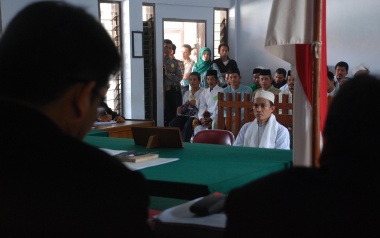
Only a handful of those involved in the attack on a small Ahmadiyah community in Cikeusik, Banten, were charged, and they only received prison sentences of just a few months. An Ahmadi survivor who almost had his hand hacked off, though, was charged with provoking the attack and sentenced to six months in prison, half a month longer than his attacker. (JG Photo)
The year 2011 has been yet another period of abject failure by the government to protect human rights, according to the results of a survey released on Monday.

Bonar Tigor Naipospos, deputy chairman of the Setara Institute for Peace and Democracy, said the survey of leading rights activists, community and religious leaders and bureaucrats showed no improvement in the state’s efforts to protect rights.

“There has been no significant change or effort from the government to uphold human rights compared to the previous year,” he said.

“The survey used a similar approach as last year. The Setara Institute grouped the variables in eight categories and measured how these items were perceived by our 71 respondents.”

Bonar said the category respondents rated the lowest was the resolution of past human rights violations, which received a score of 1.4 on a scale from 0 to 7. Last year’s worst-performing category, the perception of religious freedom, improved from a score of 1.0 to 2.3, while elimination of discrimination dropped from 4.0 to 2.8.

“Even though the score for religious freedom improved, one item in that group that still received a low score was the handling of cases of violence against minority groups,” said Ismail Hasani, a researcher at the Setara Institute.

He said that this year the worst of those incidents was the attack by a mob of 1,500 on a small Ahmadiyah community in Cikeusik, Banten province. That attack, in February, led to the deaths of three members of the beleaguered sect.

Only a handful of the perpetrators were charged, and wound up receiving prison sentences of just a few months. An Ahmadi survivor who almost had his hand hacked off, though, was charged with provoking the attack and sentenced to six months in prison, half a month longer than his attacker.

Hendardi, the Setara Institute chairman, called on President Susilo Bambang Yudhoyono to “construct policies that uphold human rights through the resolution of past human rights abuses, end impunity and provide legislation enabling the enforcement of human rights.”

“Compared to previous presidents, Yudhoyono has the strongest political backing because he was directly elected by the people,” he added.

“So there’s no excuse for him for not to uphold human rights.”

Researchers said that on the positive side, survey respondents were more satisfied with the performance of state bodies such as the National Commission on Violence Against Women (Komnas Perempuan), the Indonesian Commission for Child Protection (KPAI), and the National Commission on Human Rights (Komnas Ham).

“Komnas Perempuan received the highest score, with a 3.7, while the KPAI got 3.6 and Komnas HAM got 3.4,” Ismail said.

“Another government initiative that received a higher score was terrorism eradication.”

The survey questioned 71 respondents across 13 provinces in the country. It was carried out in September and October and focused on items in international covenants on human rights.

Copyright 2010 The Jakarta Globe
URL: www.thejakartaglobe.com/home/2011-yet-another.../482919

Friday, November 18, 2011

The Thinker: Open or Closed?

Jakarta Globe, Indonesia
OPINION
The Thinker: Open or Closed?
Elaine Pearson | November 18, 2011

“Now we are vilified,” an Ahmadiyah imam told me last week at a mosque outside Jakarta that is threatened with closure. This is not the Indonesia that US President Barack Obama described last year on his visit to Jakarta, when he said, “Even as this land of my youth has changed in so many ways, those things that I learned to love about Indonesia — that spirit of tolerance that is written into your Constitution, symbolized in mosques and churches and temples standing alongside each other, that spirit that’s embodied in your people — that still lives on.”

In Bali this week, Obama should urge President Susilo Bambang Yudhoyono to protect the rights of religious minorities and take urgent steps to protect religious freedom.

Religious tolerance in Indonesia is in danger. There has been a surge in deadly sectarian attacks against religious communities and dozens of mosques and churches have been forced to close. In the first nine months of 2011, the Setara Institute, which monitors religious freedom in Indonesia, documented 184 incidents of religious violence — a higher rate than the annual average of 204 such attacks over the last four years. About 80 percent of these attacks took place on Java, which is predominantly Sunni Muslim, and targeted Christians, Shia Muslims, Bahai, and the Ahmadiyah, who consider themselves Muslim but whom many Muslims consider heretics.

As Obama said, religious freedom is protected under the nation’s Constitution. But as freedom of expression in Indonesia has grown since the fall of Suharto in 1998, so has intolerance and violence. Instead of protecting minorities, the government has promoted and enforced discrimination.

The Ahmadiyah mosque I visited last week in the Jakarta suburb of Bekasi is facing increasing pressure to close. The imam told me: “We’ve been here for 22 years. We have never faced these problems before. We are a part of this community.” The imam showed me threatening SMS messages warning him of violence if the mosque doesn’t close.

Indonesia’s national Ahmadiyah association, Jemaat Ahmadiyah, estimates that at least 30 Ahmadiyah mosques have been closed in recent years. In 2008 the national government passed a decree that prohibits the Ahmadiyah from practicing their faith. So far 16 provinces and regencies have followed suit, issuing local decrees banning the Ahmadiyah.

On Oct. 13, the mayor of Bekasi issued a decree banning all “Ahmadiyah activities” in the city. The exact meaning of “activities” is unclear, but every Friday since then the local Muslim clerical council, police and the military have gone to the community center to urge the Ahmadiyah to stop their religious services.

Attacks against the Ahmadiyah have gotten increasingly violent because perpetrators know sectarian violence is not seriously prosecuted in Indonesia. In a deadly attack in February, a 1,500-strong mob of Islamist militants beat three Ahmadiyah men to death and seriously injured five others in the village of Cikeusik, Banten. Although the brutal violence was captured on film, only 12 of the attackers were tried and they received prison sentences of just three to six months. The prosecutors claimed the Ahmadiyah provoked the attack and sentenced one victim who nearly lost an arm to six months in prison for assault and disobeying police orders.

The Ahmadiyah are not the only victims. This year, militants have burned down Christian churches in Temanggung, Central Java, and a suicide bomber targeted a church in Solo, killing himself and wounding 14 churchgoers. Churches in Riau were burned down in August and now, perhaps in retaliation, a mosque in predominantly Christian West Timor is facing similar pressure to close.

The upsurge in religious violence and the lack of state protection is akin to what happened in Pakistan, where the Ahmadiyah faced systematic and legalized persecution. This played into the hands of the Taliban and other militant sectarian groups. Now fewer and fewer voices in Pakistan are willing to speak up for religious minorities because they themselves wind up targets of deadly attacks.

Given Obama’s words on religious tolerance during his last visit, ignoring the growing religious violence now would show he is out of touch with reality in Indonesia. The United States has an interest in a stable, democratic Indonesia, and that demands a country that respects religious freedom. Urging Yudhoyono to speak out against religious intolerance and to seek a repeal of laws that inflame sectarian violence and discrimination should be at the top of Obama’s agenda.

Elaine Pearson is deputy director of the Asia Division at Human Rights Watch.

Wednesday, November 16, 2011

Human Rights Watch Calls on Obama to Tackle Indonesian Abuses

Jakarta Globe, Indonesia
NEWS
Human Rights Watch Calls on Obama to Tackle Indonesian Abuses
November 16, 2011

Armed soldiers patroling the Nusa Dua beach front area on Indonesia's holiday island of Bali on Wednesday. The 16 leaders and heads of state of the Association of Southeast Asian Nations (Asean) and East Asia Summit participants are gathering in Nusa Dua's convention and resort enclave for this week's annual meeting where world leaders from US, Russia, China, India and Japan will be attending. (AFP Photo)
Armed soldiers patroling the Nusa Dua beach front area on Indonesia’s holiday island of Bali on Wednesday. The 16 leaders and heads of state of the Association of Southeast Asian Nations (Asean) and East Asia Summit participants are gathering in Nusa Dua’s convention and resort enclave for this week’s annual meeting where world leaders from US, Russia, China, India and Japan will be attending. (AFP Photo)
Human Rights Watch on Wednesday urged United States President Barack Obama to tackle Indonesia’s leaders during his visit this week on issues including outbreaks of mob violence against religious minorities.

The New York-based watchdog said that despite warming ties with Indonesia, Obama should be forthright when he meets President Susilo Bambang Yudhoyono during this week’s East Asia Summit held on the resort island of Bali.

Local and international human rights groups have expressed outrage over light sentences handed out to members of a religious lynch mob who killed three members of the Ahmadiyah minority sect in February.

The same court on Java island in August jailed one of the Ahmadiyah survivors of the attack, a man who almost lost his hand in the violence, for six months for defending himself and his friends.

“The Obama administration’s deepening relationship with Indonesia means being frank about Indonesia’s serious human rights challenges,” said Elaine Pearson, deputy Asia director at Human Rights Watch.

“Indonesian government indifference to mob violence against religious groups and brutality by soldiers against peaceful protesters are good places to start,” she said in a statement.

Pearson called on Obama to push Yudhoyono to end discriminatory laws and protect religious minorities in the world’s most populous Muslim nation.

“Obama needs to temper his past praise of religious tolerance in Indonesia with some tough talk on religious freedom,” she added.

Indonesia’s constitution guarantees freedom of religion but rights groups say violence against minorities including Christians and the Ahmadiyah Islamic sect has escalated since 2008.

In February, a 1,500-strong mob of Muslims set two churches alight and ransacked a third in the town of Temanggung, on Java island, as they demanded that a Christian man be sentenced to death for insulting Islam.

More than 80 percent of Indonesia’s estimated 240 million people are Muslim. Five percent are Protestants and three percent Catholic.

Human Rights Watch said Obama must address “the lack of accountability of security forces for continuing abuses” as well as the 90 prisoners in the restive provinces of Papua and Maluku jailed for peaceful political activity.

“Obama should point out that as long as soldiers who commit torture get a few months in jail while peaceful activists get sentenced for years, Papuans are unlikely to have faith in Indonesian rule,” Pearson said.

Jakarta has faced a low-level insurgency in Papua ever since its 1969 takeover of the vast, mineral-rich territory which borders Papua New Guinea and has its own ethnically distinct population.

Washington and Jakarta have reinforced ties in recent years, signing new trade agreements and strengthening military and anti-terror cooperation.

Agence France-Presse

Copyright 2010 The Jakarta Globe
URL: www.thejakartaglobe.com/news/...indonesian-abuses/478849

Tuesday, November 15, 2011

Hard-Line Group Lashes Out At Bekasi Ahmadis

Jakarta Globe, Indonesia
HOME
Hard-Line Group Lashes Out At Bekasi Ahmadis
Ulma Haryanto | November 15, 2011

More than 30 people claiming to be from the notorious Islamic Defenders Front besieged an Ahmadiyah mosque in the Jatibening area of Bekasi on Monday, demanding it be sealed off.

Local Ahmadiyah leader Rahmat Rahmadijaya told the Jakarta Globe that the group tried to place a placard in front of the mosque to make clear that Ahmadis were not allowed to worship.

“It happened around 2 p.m., about 30 people entered the mosque. They wanted to hang up a placard stating that Ahmadiyah is banned, based on the Joint Ministerial Decree, a West Java gubernatorial decree and a decree by the Bekasi mayor,” Rahmat said, referring to the activists.

Human rights groups have blamed the 2008 joint ministerial decree for increasing violence against followers of the minority Muslim sect.

The Setara Institute for Peace and Democracy said the number of attacks rose from three in 2006 to 50 in 2010.

Earlier this year, West Java Governor Ahmad Heryawan issued a decree banning the sect from spreading its beliefs through any media and forbidding the display of its name in public, including signposts on mosques. A similar decree was signed by Bekasi’s acting mayor, Rahmat Effendi, and went into effect last month.

The Ahmadiyah mosque had faced weekly threats from the local Islamic Defenders Front (FPI) branch and had to hold its Friday prayers under protection from Bekasi Police. There are around 200 Ahmadis in the area.

Bekasi Police Chief Sr. Comr. Priyo Widyanto denied there had been a siege.

“It is a lie. The truth is that the Bekasi municipality was only trying to hang a placard in front of their mosque, banning Ahmadiyah,” Priyo said, adding that the event was also witnessed by officials from the Indonesian Council of Ulema (MUI), the Inter-Religious Communication Forum (FKUB) and the FPI.

The police chief of Pondok Gede district, Sr. Comr. Burhanuddin, said police were aware of hard-line Muslim groups’ opposition to the presence of Ahmadis and had “secured” the area.

Firdaus Mubarik, a spokesman for the Indonesian Ahmadiyah Congregation (JAI), said the Bekasi anti-Ahmadiyah decree could be used by hard-line groups to legitimize their harassment.

Copyright 2010 The Jakarta Globe
URL: www.thejakartaglobe.com/...bekasi-ahmadis/478494

Monday, October 3, 2011

The dying canary and Indonesia’s religious freedom

Jakarta Post, Indonesia
OPINIONMon, 10/03/2011 7:57 PM
The dying canary and Indonesia’s religious freedom
Tobias Basuki, Jakarta
“Religious liberty is the proverbial canary in the mine,” according to Doug Bandouw, a senior fellow at the Cato Institute. Canaries are often used by miners as an early-warning signal for poisonous gases. When the small birds stop singing and suffocate, miners know toxic gases have polluted the area and something is wrong.

The right of religious freedom for small groups within a country is a vital indicator of the health of society. Religious freedom is the most basic freedom. Without it, it is doubtful that the lives and dignity of its citizens is truly respected.

Religious minorities in Indonesia have recently been systematically and aggressively silenced. Repression is allegedly perpetrated by religious extremists. The state is not without blame either.

The state partakes in the oppression of its own citizens, first through oversight and omission, and second by undertaking discriminatory actions and policies. The Blasphemy Law and a joint ministerial regulation on the Ahmadiyah minority Islamic sect are proof.

Two cases illustrate the dire condition of religious freedom in Indonesia.

First is the plight of the Ahmadis. The Ahmadis were part of our archipelago’s society even before independence and partook in the independence movement. The sect has now been cast aside and discriminated against.

Physical and verbal attacks against them have intensified in the past five years. One attack culminated in the slaughter of three members in Cikeusik, Banten.

Adding greater madness to the brutality was the gross injustice of our judiciary.

Those who participated in the vicious attacks were sentenced to jail for terms as little as three to six months. Deden Sudjana, whose house the Ahmadis were protecting, received a harsher sentence than those convicted of instigating the violence, who were hailed as heroes upon their release.

The Ahmadis understandably decided not to pursue and prolong the case considering the amount of prejudice and unfair treatment they have had to endure.

It was the first sign that the canary was not doing well.

The Blasphemy Law and the logic used to apply it is schizophrenic. Here is an example: The Blasphemy Law prohibits the existence of religions that resemble a major religion and also prohibits programming based on such religions from being broadcast.

In one city, an Ahmadiyah mosque was attacked and closed because it had a sign identifying it as an Ahmadiyah place of worship. The sign was considered “broadcasting” under the law. In another city, an Ahmadiyah mosque was attacked and closed because it had no signs on it and was accused of luring Muslims inside for conversion.

There are some well-intentioned arguments that state the Ahmadis should declare a new religion to avoid further prosecution. But the same logic would immediately put them in the crosshairs again.

The sect’s similarity to Islam puts it at odds with the law and prejudice against them. Labeling is not the issue; it is the bigoted view and actions of the few that are the main problems.

Another poignant example is the case of GKI Taman Yasmin. The congregation obtained a permit to build a church in July 2006. The construction, however, was stopped in 2008 by the head of Bogor’s Urban Planning and Landscaping Agency.

The church challenged the decision in court, which annulled the suspension issued by the city.

The annulment was disregarded and the church took its plight to the Supreme Court, which also ruled in favor of the church. Obstinately, the Bogor government under Mayor Diani Budiarto has chosen to blatantly disobey the Supreme Court’s ruling.

Opposition to the church’s construction is based on feeble grounds and outright ridiculous statements involving alleged counterfeit signatures, obstructing businesses and the infamous “no church should be on a street named after a Muslim”.

The reasoning proposed by the officials begs a serious question about the real motives behind the church ban. I attended one of the outdoor services conducted by the congregation in front of the sealed church.

None of the “public inconvenience” accusations held true. Even with a large number of visitors and an outdoor service, traffic was barely disturbed. There were no visible or plausible disturbances to businesses or the community.

However, one thing is clear. The mayor has broken the law on several accounts. First, he ignored court rulings, including a ruling from the Supreme Court. Second, the city violated the Regional Autonomy Law, which states that religion is the jurisdiction of the central government, not the local government.

Last but most flagrantly, Diani violated the Constitution and his oath of office. His repeated disregard of a court decision has made him a law breaker. The mayor should be impeached at the very least.

The canary is not dead … yet.

Indonesia as a nation faces two towers of evil. The first is epidemic corruption. It is like anemia. It is fatal, widespread and will kill us slowly. The second is radicalism and narrow-minded bigotry. Many say the radicals are few. It is true, but these few let loose will wound the nation and bleed us.

It is like a flesh wounds. It may not necessarily be fatal, but with a cancer draining our blood, a small wound can worsen and break us apart.

The writer is a graduate of Northern Illinois University and a lecturer at Pelita Harapan University, Tangerang.

Copyright © 2008 The Jakarta Post - PT Bina Media Tenggara. All Rights Reserved
URL: www.thejakartapost.com/news/2011/10/03/the-dying...freedom.html

Friday, September 30, 2011

Ahmadiyah onslaught ‘hardest test’ for RI democracy

Jakarta Post, Indonesia
NATIONALFri, 09/30/2011 2:20 PM
Ahmadiyah onslaught ‘hardest test’ for RI democracy
Ati Nurbaiti, The Jakarta Post, Canberra
Indonesians used to glowing praise over the country’s democratization were abruptly shamed with scenes of February’s mob attack and brutal killing of three Ahmadis in Cikeusik, West Java, projected in the first session of annual talks on Indonesia in Canberra on Friday.

Although the mob assault was acknowledged as an extreme exception, speaker Greg Fealy said it reflected one of the “hardest tests” for Indonesian democracy.

Even though Ahmadis were the least-liked of Indonesia’s minorities, “with no one important” defending them, in part given their exclusivity, Fealy said they were entitled to state protection guaranteed by the Constitution, more so because of the hostility against them.

He noted that the government was under pressure to ban the Ahmadiyah sect, who are regarded as un-Muslim by other Muslims, because they do not regard the Prophet Muhammad as the final prophet.

Fealy was addressing Indonesian Update 2011 at the Australian National University, after Chancellor and former foreign minister Gareth Evans had lauded Indonesia as “a talismanic example to the rest of the Muslim world”.

Fealy, among the most renowned scholars on Islam in Indonesia, cited the incident as one of the indicators of Indonesia’s “regression”, along with the dwindling anti-corruption drive and declining trust in elections and political parties.

The absence of the rule of law and mixed signals from the state regarding the attack had all resulted in the immunity of “emboldened sectarian vigilantes”.

Western leaders must pay more attention to this issue, Fealy said.

He noted how Jakarta seemed to endorse bylaws in several regencies that have banned Ahmadiyah in their areas, despite the decentralization law clearly stating that religious affairs are an authority of the central government.

Fealy noted how the attackers became the victims, with Justice and Human Rights Minister Patrialis Akbar stating that the assault and murder may not have been a human rights violation. Religious Affairs Minister Suryadharma Ali, who has been among many pushing for the state ban on Ahmadis, asserted that they were not Muslim.

Fealy compared the due process against the attackers to protesters who had brought a buffalo to a rally with “SBY” painted on its body. Students were immediately arrested.

“It seems insulting the President is more important” than murder, Fealy said.

“Arrests were made only after an outrage,” Fealy said. The recent verdict on the 11 attackers and one Ahmadi, their security chief, gave the latter, Deden Sujana, the sentences of between three and six months’ imprisonment, for “provoking” the attack that resulted in the death of three Ahmadis after being stabbed and tortured.

Douglas Ramage of AusAID, Australia’s aid agency, and another scholar on Indonesia, said the main factor constraining Indonesia’s progress was the weakening of its oversight institutions in recent years.

Yudhoyono’s leadership, he added, reflected “extreme inclusiveness and consensus”, Ramage said. This guarantees stability but showed a failure of Yudhoyono’s leadership for reform, “ceding space for others to roll back ‘reformasi’”.

Copyright © 2008 The Jakarta Post - PT Bina Media Tenggara. All Rights Reserved
URL: www.thejakartapost.com/news/2011/09/30/ahmadiyah...democracy.html

Friday, September 9, 2011

Indonesians Feel Ahmadis Should Be Protected as Fellow Countrymen: Poll

Jakarta Globe, Indonesia
NEWS
Indonesians Feel Ahmadis Should Be Protected as Fellow Countrymen: Poll
Ronna Nirmala | September 09, 2011

FPI members protesting in front of Ahmadiyah secretariat in Makassar. They urged the Ahmadiyah members to stop their activities. (Antara Photo/Yusran Uccang)
Most Indonesians oppose the use of violence against the minority Muslim sect Ahmadiyah and think its followers here are their compatriots and should not be facing oppression, a survey by a human rights watchdog showed on Thursday.

Many respondents also said the deadly February attack in Cikeusik, Banten, occured because the government allowed it to happen, the Setara Institute for Freedom and Democracy said.

When asked who should be held accountable for the Cikeusik attack, in which three Ahmadis were killed, 33 percent of respondents said: “I don’t know.”

Another 32 percent blamed the government and security officials for doing little to prevent it, and 18 percent blamed the Ahmadiyah as they spread “blasphemous teachings.” The remaining 17 percent blamed the hard-line Muslims who carried out the attack, the survey said.

“The poll also indicates that almost 70 percent of the respondents consciously said that whatever happened, Ahmadiyah members are their fellow countrymen — aside from their differences in interpreting religion,” said Ismail Hasani, a researcher with Setara.

The survey was conducted among about 3,000 respondents in 27 districts in nine provinces, including Jakarta, West Java, Yogyakarta, East Java and West Nusa Tenggara.

A majority of respondents, about 60 percent, said they had no idea about what Ahmadiyah teachings entailed.

“Although some [Muslim] respondents refused to call Ahmadiyah followers their brothers, they agreed the attack in Cikeusik should never have happened,” said Bonar Tigor Naipospos, the deputy chairman of Setara. In fact, only a small portion of those questioned said the Cikeusik incident was caused by differences over religious beliefs.

“Some of them believed that it happened because of a fabricated issue from a third party, not related to religious interests,” Bonar said.

Two months ago, the Serang District Court in Banten convicted 12 hard-line Muslims for the Cikeusik attack but sentenced them to a maximum of just six months in jail.

Deden Sujana, the former head of security for the Indonesian Ahmadiyah Congregation (JAI), was a sentenced to six months in jail by the same court last month. He was found guilty of disobeying police officers who had ordered him and about a dozen other Ahmadis to leave the house they occupied just before the violence broke out. Deden was badly injured in the attack.

Thursday, September 8, 2011

Attack on Ahmadiyah condemned by most, survey reveals

Jakarta Post, Indonesia
NATIONALThu, 09/08/2011 8:26 PM
Attack on Ahmadiyah condemned by most, survey reveals
The Jakarta Post
According to Setara Institute, most Indonesians condemn the attack on Ahmadiyah in Cikeusik, Banten, West Java, which occurred earlier this year.

“As many as 82.3 percent of the respondents said they disapproved the attack, 7.9 were in favor, while 9.8 did not give a statement,” Setara Institute researcher Ismail Hasani told The Jakarta Post on Thursday.

The research on people’s perception of Ahmadiyah was conducted in 47 regencies of 10 provinces in the country from July 10 to 25. It comprised 3,000 respondents from various religions, but 90 percent were Muslims

Ismail said the research also found out that 68.2 respondents regarded Ahmadiyah as fellow citizens, 11.9 percent did not regard them as fellow citizens. Twenty percent did not respond.

“The results bring us a hope that tolerance still exists in this country,” he said.

Yet, he said the research also found that more than 40 percent of respondents were in favor of a joint ministerial decree (SKB) and the Indonesian Ulema Councils (MUI) edict declaring Ahmadiyah be disbanded because it was heretic and blasphemous.

The joint decree was issued by the religious affairs and home ministers, and the attorney general in 2008 in efforts to regulate Ahmadiyah followers’ religious practice.

Ismail said people’s inter-religious tolerance in this country was at a good level, “But they can hardly accept others of the same religion, because of a slight variation in beliefs.”

On February 6, Ahmadiyah followers were set upon by angered residents who objected to their beliefs, which they say go against “pure” Islam.

Hundreds of people attacked 21 Ahmadis, killing three of them and injuring at least five, while ransacking and setting a house belonging to Ahmadis on fire.

Copyright © 2008 The Jakarta Post - PT Bina Media Tenggara. All Rights Reserved
URL: www.thejakartapost.com/news/2011/09/08/attack-ahmadiyah...reveals.html

Thursday, September 1, 2011

Ahmadis’ Holidays Plagued With Fear in Indonesia

Jakarta Globe, Indonesia
NEWS
Ahmadis’ Holidays Plagued With Fear in Indonesia
Elisabeth Oktofani & Fitri | September 01, 2011

Not all Muslims celebrated Idul Fitri with jubilance and excitement. For members of the Ahmadiyah minority sect, this year’s celebration is marked by heartache and fear.

Firdaus Mubarik, a spokesman for the Indonesian Ahmadiyah Congregation (JAI), told the Jakarta Globe on Wednesday that approximately 600 Ahmadis in Sukadana village in West Java’s Cianjur district had been banned from using their mosque for prayers.

“Ahmadiyah followers in Sukadana village were told by the village chief that they could not use their own mosque to hold a Idul Fitri prayer in case of a possible attack by the residents,” Firdaus said.

“For us, this is a threat.”

Instead, Firdaus said the group had to hold its prayers inside an Ahmadiyah Islamic school as guards from Cianjur kept watch.

Similar threats were also aired against Ahmadis in Makassar, who were recently attacked by assailants from the hardline Islamic Defenders Front (FPI).

“Even though our mosque was damaged by the FPI on August 13, thank God we could hold Idul Fitri prayers in our own mosque peacefully this morning wthout any disturbance,” Irza Rasid, an Ahmadi from Makassar, told the Globe.

“Unfortunately, we could not stay longer to gather and celebrate Idul Fitri among the Ahmadiyah congregation because we did not want the FPI to come and attack us,” he added.

Last month, FPI members attacked the Makassar office of the JAI, where Ahmadis had planned to hand out food and groceries to the surrounding community.

“The FPI often conducts raids on Ahmadiyah activities without any coordination with the police. Not only did they carry out raids, but also threats and intimidation towards us.” Irza said. “It needs to be understood that we do not want to fight back … because we have our own motto, which is love for all, hatred for none.”

The JAI has recorded more than 160 cases of violence against Ahmadiyah communities in the last 10 years.

In Mataram, West Nusa Tenggara, Ahmadis have been living in a rundown shelter for nearly six years after their village was attacked and ransacked by mainstream Muslim groups.

“We have lost our land, we have lost our homes. Some have even lost their lives, but we are thankful for we have you, Allah,” Ahmadi children sang after the community performed their Idul Fitri prayer on Wednesday.

Many cried as some 50 children sang the song remembering the violence that drove them away from one village to the next, destroying every possession that they owned.

More than 250 Ahmadis took part in the prayer, occupying a tiny room in the middle of the abandoned Transito building. The ceiling showed signs of collapsing on to the congregation, which had to use makeshift prayer mats made from recycled newspapers and torn sheets of plastic.

Community members prepared a simple chicken stew and rice cake.

“I know they are nothing fancy, but they remind me of home,” 58 year-old Siti Kalsum said.

Copyright 2010 The Jakarta Globe
URL: www.thejakartaglobe.com/news/ahmadis.../462681

Saturday, June 18, 2011

Bashir Sentence Passed to Avoid Angering Radicals

Jakarta Globe, Indonesia
NEWS
Bashir Sentence Passed to Avoid Angering Radicals
Wahyudi Soeriaatmadja – Straits Times Indonesia | June 18, 2011

The 15-year jail term handed to convicted terrorist Abu Bakar Bashir this week is sparking debate, with analysts suggesting it was kept light to avoid angering the radicals who revere him.

The prosecution had pushed for a life term for the 72-year-old.

But analyst Mardigu Wowiek Prasantyo, who helps the police interrogate terrorist suspects, said the lighter sentence was seen as having “the best outcome for society.”

Bashir was sentenced on Thursday for helping to plan and fund a militant training camp, where men learnt to use weapons to attack Indonesian government officials and foreigners. Police destroyed the camp in February last year.

While Bashir does not head any of the disparate radical cells responsible for recent attacks against religious minorities in Indonesia, fundamentalists see him as a spiritual leader.

Though the courts have charged individual perpetrators of violence, the government has shied away from clamping down on fundamentalist groups for fear of being portrayed as anti-Muslim.

They have not tried to disband radical groups such as the Islamic Defenders Front, whose members have attacked moderate figures and members of the minority Ahmadiyah sect. Some experts fear Indonesia could become like Pakistan — a society struggling with intolerance, brewing terrorism and religious vigilantism.

Bashir, who looks frail but is healthy, has been jailed twice before - once for his complicity in the 2002 Bali bombings and once for the 2003 Marriott Hotel bomb attacks in Jakarta.

He has not openly condoned acts of terrorism but has said he supports paramilitary training as Muslims need to learn how to defend themselves.

This admission — along with testimony from men involved in the Aceh training camp — helped prosecutors to nail him during the four-month trial.

One of the prosecutors said on Thursday that judges had been too lenient. Bashir was proven to have incited people to commit acts of terrorism, a crime punishable by death, and to have supported the use of violence to inflict harm, which can bring life imprisonment.

“But the judges had to consider the wider feelings of society,” said the prosecutor, who did not want to be named.

“It seems they don’t just follow the law book exactly. They make decisions after taking into account all the relevant aspects.”

Analysts do agree on a few things though. One is that Bashir should be isolated while in prison so he cannot influence others.

On Friday, National Police spokesman Brig. Gen. Ketut Untung Yoga Ana said Bashir was still in police custody in his own cell and would be moved to a prison only at a later date.

“The court will decide where to put Bashir,” Ketut said.

Reprinted courtesy of Straits Times Indonesia.

Copyright 2010 The Jakarta Globe
URL: www.thejakartaglobe.com/indonesia/bashir.../447687

Friday, June 17, 2011

HRW ‘Deeply Troubled’ by Police’s Ahmadiyah Attack Investigation

Jakarta Globe, Indonesia
NEWS
HRW ‘Deeply Troubled’ by Police’s Ahmadiyah Attack Investigation
Jakarta Globe | June 17, 2011

Human Rights Watch has criticized Indonesian authorities for failing to uncover the people behind February’s brutal attack on the Ahmadiyah community in western Java.

In a statement obtained by the Jakarta Globe, the New York-based nongovernmental organization calls on police to mount a “full investigation” into the deadly religious violence that left three members of the minority religion dead and another five seriously wounded.

The attack by a mob of 1,500 people on 20 Ahmadis in Cikeusik was captured by an amateur cameraman and uploaded on YouTube.

HRW deputy Asia director Elaine Pearson says courtroom testimony during a hearing on June 9 indicated that Umbulan village head Johar and Ahmad Baghawi, the local branch of the Indonesian Council of Ulema (MUI), played roles in setting Feb. 6 “as the date to forcibly remove the Ahmadiyah from Cikeusik.”

“It is deeply troubling that police investigations into the brutal beating deaths of three people for their religious beliefs did not uncover who was behind the attacks,” Pearson says. “For justice to be complete, investigations should not stop at the 12 defendants, but include all those playing a role in this horrific attack.”

HRW also urged Indonesia’s Judicial Commission to monitor the trials of those charged, saying it “would acknowledge the importance of the case for the rights of religious minorities in Indonesia as well as concerns about the conduct of the proceedings.”

“Indonesia has often failed to successfully prosecute crimes targeting religious minorities, exacerbating a culture of violent persecution,” Pearson said. “The [Judicial] Commission should monitor these trials to strengthen justice in response to anti-Ahmadiyah attacks.”

Twelve people allegedly involved in the attacks face are defending a number of charges, including assault causing death, which carries a maximum sentence of 12 years in jail, but none have been charged with murder or manslaughter.

“Violence against the Ahmadiyah community and other religious minorities is common in Indonesia, yet the Indonesian government has failed to seriously address the problem,” Human Rights Watch says.

“Despite the high-profile nature of the case, the conduct of the trial so far has raised concerns that the religious beliefs of the victims might affect the outcome of the trials.”

HRW says an eight-minute video clip uploaded on YouTube shows one of the judges “berating” an Ahmadiyah witness, Deden Sujana, about his religion.

“Defense lawyers have asked inappropriate questions of some witnesses – such as probing Sujana’s religious faith — in an apparent effort to intimidate them, with no interference from the judges. Outside the courtroom, a defense lawyer told reporters that Sujana must be “bullied till he shits” [“digencet hingga mencret”], but has suffered no rebuke from the court.”

In a separate trial, the Serang District Court is hearing the case against Sujana for alleged involvement in provoking the attack. Prosecutors are seeking a six-year jail sentence.

[Court] is separately hearing a case against Sujana on allegations that he had a role in provoking the attack. Prosecutors have called for a six-year prison sentence on charges of incitement, disobeying police orders, and maltreatment (less serious assault). Human Rights Watch urged the Judiciary Commission to monitor Sujana’s trial along with the others.

“If Indonesia’s courts deal properly with these cases, it could go a long way toward protecting religious minorities in the country,” Pearson said. “The [Juticial] Commission should send representatives to monitor the trials to ensure justice is done for all parties involved.”

Copyright 2010 The Jakarta Globe
URL: www.thejakartaglobe.com/indonesia/hrw.../447528

Monday, May 23, 2011

Legal Activists Want Charges Dropped Against Ahmadi Nearly Killed by Mob

Jakarta Globe, Indonesia
NEWS
Legal Activists Want Charges Dropped Against Ahmadi Nearly Killed by Mob
Ulma Haryanto | May 23, 2011

The house in Cikeusik, Banten, where a mob attacked an Ahmadiyah community in February. Three Ahmadiyah members were killed in the attack. (Antara Photo)
A coalition of civil society organizations have demanded that prosecutors drop charges against an Ahmadi man who was critically injured in the deadly February attack on members of the beleaguered sect in Cikeusik, Banten.

Deden Sujana, head of security for the Indonesian Ahmadiyah Congregation (JAI), was detained on Friday at a prison in Serang for allegedly inciting violence and disobeying authorities in connection with the Feb. 6 attack, Erna Ratnaningsih, chairwoman of the Indonesian Legal Aid Foundation (YLBHI), said on Sunday.

In that attack, three Ahmadis were killed by a mob of 1,500. Deden nearly lost his right arm defending himself from a machete-wielding assailant.

Deden is allegedly seen in a video circulating on the Internet of the attack asking a police officer to let the assault take place.

Police had said in the immediate wake of the attack that no Ahmadis were being considered as suspects in the case.

Erna said that Deden’s arrest was baseless since he had always been cooperative in answering police summonses.

“Besides, if they want to have him detained, the prosecutors should have sufficient reason that Deden would tamper with evidence or try to escape, which is not the case,” she added.

Erna said he could face trial in approximately two weeks, but vowed that when that happened, he would be represented by a team of attorneys from the YLBHI, the Jakarta Legal Aid Foundation (LBH), the Human Rights Watch Group and the Commission for Missing Persons and Victims of Violence (Kontras).

“Deden is one of the victims,” Erna said. “His physical condition, and especially psychological condition, was not taken into consideration when the prosecutors decided to detain him.”

Twelve men linked to the mob that attacked the group of 25 Ahmadis are on trial at the Serang District Court.

If found guilty, they could receive punishment ranging from 12 years in prison to death by firing squad.

But Erna on Sunday pointed to what she claimed was a disturbing precedent set in previous trials involving attacks on Ahmadis.

“From previous cases, the attackers received the minimum sentence while the victims received longer sentences. This happened during the Cisalada hearing,” she said.

In that case, an Ahmadi man was sentenced to nine months in jail for stabbing a teenager who was part of a mob of hard-line Muslims who attacked an Ahmadiyah community in Cisalada, Bogor, in October. The attackers were given a year’s probation.

‘Botched trial’ leaves Cikeusik mob in the dark

Jakarta Post, Indonesia
NATIONALMon, 05/23/2011 11:32 PM
‘Botched trial’ leaves Cikeusik mob in the dark
Bagus BT Saragih, The Jakarta Post, Jakarta

Firebrand trial: Judges overrule an objection last week from defendant Ujang against charges of battery and inciting hatred in the deadly attack against an Ahmadiyah minority sect in Cikeusik, Pandeglang regency, Banten. Antara/Asep Fathulrahman

Missing testimony on the events that led to a fatal attack on Ahmadis in Cikeusik, Pandeglang, has left the truth behind the ambush untold, a legal aid group said.

“None of the presented witnesses revealed the background of the incident, the history behind the attack, which we think would be very important to uncovering the motives, the key figures mobilizing the mobs and the source of the funds distributed to the attackers,” Erna Ratnaningsih, chairwoman of the Indonesian Legal Aid Foundation (YLBHI) told a press conference on Sunday.

As many as 12 defendants have stood trial at the Serang District Court in Banten since late March. They have been indicted for violating various articles of the Criminal Code, including Article 170 on battery and Article 160 on inciting hatred.

The YLBHI is the official advocate of the Jamaah Ahmadiyah Indonesia (JAI).

According to Erna, the indictments against the defendants did not include the series of events that lead up to the attack.

“The efforts to intimidate and evict the Ahmadis had commenced at least by November 2010. Meetings were held by leaders of the local administration aimed at seeking ways to expel the Ahamdiyah followers from Cikeusik,” she said.

Erna said prosecutors also failed to mention the failure of the police to prevent the attack. She believed the police could actually have named more suspects in the case.

“We urge investigators to handle this case seriously and continue to develop the investigation based on any facts and evidence, including those revealed in court.”

Deden, an Ahmadiyah member, will also stand trial at the same court, pending finalization of an indictment by prosecutors. He has been charged with inciting hatred.

Erna said the police’s decision to arrest Deden was “a criminalization against a victim”.

“We strongly oppose such victim criminalization. We are declaring protest against the police and the prosecutors’ office. Based on available facts and evidence, Deden is innocent and clearly a victim of the tragedy,” she said.

On Feb. 6, about 1,500 people attacked a house used as a place of worship by Ahmadis in Cikeusik, after long-standing tension between the minority group and local residents.

The mob that killed three Ahmadis and injured five came under scrutiny after a video of the ambush circulated in the public.

In the video, the attackers wore blue ribbons, which police believed were to differentiate themselves from the targets of the attack.

Erna said Deden might have committed violence, but it was “self-defense against the attack”.

She cited Article 49 of the Criminal Code stipulating that such self-defense efforts could not be criminalized.

Another defendant is Ujang, reportedly a firebrand cleric. Prosecutors said at a hearing that Ujang had persuaded other clerics and public figures to disband the Ahmadis.

“Through text messages, the defendant was able to get many clerics and other public figures to join in his cause because he was an influential cleric in Pandeglang,” prosecutor Mad Yunus said.

Lawyer Achmad Michdan, from the Muslim Lawyers’ Team (TPM) who represented the defendants, said the prosecutors’ indictments against the 12 defendants were normative and solely based on the fact that there were victims in the case, while the chronology of the attack was not clear.

Michdan, however, shared Erna’s opinion that the indictments had been “designated not to reveal the masterminds”.

The hearings have consistently attracted hundreds of supporters of the defendants, forcing the Banten Police to deploy more than 500 officers to guard the courthouse.

Copyright © 2008 The Jakarta Post - PT Bina Media Tenggara. All Rights Reserved
URL: www.thejakartapost.com/news/2011/05/23/%E2%80%98botched...dark.html

Wednesday, May 18, 2011

UN High Commissioner urges for Special Rapporteur visit

Jakarta Post, Indonesia
NATIONALWed, 05/18/2011 9:29 PM
UN High Commissioner urges for Special Rapporteur visit
The Jakarta Post, Jakarta
The United Nations’ High Commissioner for Human Rights, Navanethem Pillay, has urged the government to accept the request of the Special Rapporteur on freedom of religion or belief to visit the country this year.

The call came in a letter sent to Foreign Affairs Minister Marty Natalegawa, a copy of which was obtained by The Jakarta Post on Wednesday.

In the letter, dated April 26, Pillay expressed his concern over reports of violence against members of religious minorities in Indonesia.

He said he had received reports of widespread violence and discrimination against the Ahmadiyah community in Indonesia, including the issuance of several decrees banning their activities in certain regions.

He had also received reports concerning harassment and violence against members of other religious minorities, he said.

“In Bogor, West Java, I am informed that local authorities have closed off the Indonesian Christian Church of Taman Yasmin and prevented them from conducting religious services,” Pillay wrote in his letter.

There were also reports of Christian groups being attacked and Christian churches being burned in several regions. He further mentioned reports that a Buddhist community in North Sumatra was ordered to dismantle a Buddha statue at a temple that was considered by some to be a challenge to Islam in that area.

Pillay said he hoped that his office “might be able to contribute in some meaningful and constructive way to the discussion and law reform efforts taking place within Indonesia and would welcome the opportunity to discuss this further” with the Indonesian government.

“In this regard, I strongly encourage the Government of Indonesia to accept the request of the Special Rapporteur on freedom of religion or belief to undertake a visit to the country later this year,” he added.

Copyright © 2008 The Jakarta Post - PT Bina Media Tenggara. All Rights Reserved
URL: www.thejakartapost.com/news/2011/05/18/un-high...visit.html

UN tells RI to review laws restricting religious freedom

Jakarta Post, Indonesia
NATIONALWed, 05/18/2011 8:15 PM
UN tells RI to review laws restricting religious freedom
The Jakarta Post, Jakarta
The United Nations’ High Commissioner for Human Rights Navanethem Pillay has urged Indonesia to review its laws restricting religious expression and practice.

In a letter sent to Foreign Minister Marty Natalegawa, a copy of which was obtained by The Jakarta Post on Wednesday, Pillay expressed his concern over reports of violence against members of religious minorities in Indonesia.

“I have been particularly disturbed by the widespread violence and discrimination reported against the Ahmadiyya community which has included the state-sanctioned closing of Ahmadi mosques, the burning of homes and places of worship, and even physical violence and murder,” Pillay wrote in his letter dated April 26.

Three Ahmadis were killed when Islamic hard-liners attacked a small Ahmadiyah community in Cikeusik, West Java, on Feb. 6 this year. Several local and provincial administrations have since issued decrees banning Ahmadiyah activities in their respective regions.

Pillay said reports had said that since the new regulations were issued, “further acts of harassment and violence have taken place”.

He pointed out that Indonesia had ratified the International Covenant on Civil and Political Rights (ICCPR), which guarantees the right to freedom of religion.

“Government at both national and provincial levels should comply with the guarantees contained in the Indonesian Constitution and in the international treaties in which Indonesia is a party. All laws, particularly those restricting religious expression and practice, should be reviewed to ensure they comply with these standards,” he said.

He also urged the Indonesian government to ensure the legal accountability of all perpetrators, including the imposition of penalties.

Copyright © 2008 The Jakarta Post - PT Bina Media Tenggara. All Rights Reserved
URL: www.thejakartapost.com/news/2011/05/18/un-tells...freedom.html

Tuesday, May 17, 2011

UN ‘Disturbed’ by Indonesia’s Religious Violence

Jakarta Globe, Indonesia
HOME
UN ‘Disturbed’ by Indonesia’s Religious Violence
Camelia Pasandaran & Cameron Bates | May 17, 2011

The United Nations has written to the Indonesian government expressing “concern” about the increasing number of reports about violence committed against religious minorities.

The Ministry of Foreign Affairs, however, says it is yet to receive a copy of the letter, dated April 26, 2011, from UN High Commissioner for Human Rights Navanethem Pillay. The letter was also copied to the National Commission on Human Rights (Komnas HAM) and a number of other Indonesia institutions.

Pillay also reveals a proposed visit by the UN’s special rapporteur on freedom of religion or belief to visit Indonesia this year to investigate the allegations.

In the letter, a copy of which was obtained by the Jakarta Globe on Sunday, Pillay says she is writing to the Indonesian government to “express my concern over the large number of letters and reports I have received in recent months concerning violence against members of religious minorities in Indonesia.”

“I have been particularly disturbed by the widespread violence and discrimination reported against the [Ahmadiyah] community, which has included the state-sanctioned closing of Ahmadi mosques, the burning of homes and places of worship, and even physical violence and murder.”

Pillay said that since the violent attack that left three Ahmadi dead in Cikeusik, West Java, on Feb. 6, several government authorities had responded by issuing new regulations and decrees that allowed “further acts of harassment and violence” to occur.

Pillay also noted a number of other reported incidences of religious intolerance, including the ongoing stand-off between the Bogor government and the Indonesian Christian Church (GKI) Yasmin.

“Christian groups have reportedly been attacked and Christian churches have reportedly been burned in Gebyog, Klaten and Tegal in Central Java. In North Sumatra, a Buddhist community was ordered to dismantle a Buddha statue at a temple that was considered by some to be a challenge to Islam in that area.”

The commissioner said the incidents put at risk the human rights guaranteed in the Constitution and the International Covenant on Civil and Political Rights, to which Indonesia is a signatory.

“The General Assembly and Human Rights Council have repeatedly urges States to take all necessary and appropriate actions, in conformity with international human rights standards, to combat hatred, discrimination, intolerance and acts of violence, intimidation and coercion motivated by intolerance based on religion or belief, as well as incitement to hostility and violence, with particular regard to members of religious minorities.”

Pillay said she understood that discussions were ongoing between the government, Komnas HAM, civil society and religious groups concerning the issue.

“I encourage the government of Indonesia to take this opportunity to support reflection and action at various levels to address the broader issues behind religious intolerance and discrimination.”

She said that laws that restricted religious expression and practise “must be reviewed to ensure they comply with these standards” and well as ensuring that justice was upheld against those found to have committed wrongdoing.

Pillay also “strongly encouraged” the government to accept a proposed visit by the United Nation’s special rapporteur on freedom of religion or belief to visit Indonesia this year.

Rev. Ujang Tanusaputra of GKI Yasmin said the letter was “a bad assessment of Indonesia in the context of religious freedom.”

“As a nation that is based on [the state ideology] Pancasila with its motto Unity in Diversity, the government should uphold and implement the pillars of Indonesia.”

Copyright 2010 The Jakarta Globe
URL: www.thejakartaglobe.com/home/united-nations.../441540

Monday, May 2, 2011

Is Dislike of SBY Driving Military Old Guard to Hard-Liners?

Jakarta Globe, Indonesia
NEWS
Is Dislike of SBY Driving Military Old Guard to Hard-Liners?
Nivell Rayda | May 02, 2011

President Susilo Bambang Yudhoyono’s speeches often leave many Indonesians mystified, and the one he made shortly after a series of book bomb scares across the capital last month was no exception.

“To that group, [I say] if you don’t like me, don’t sacrifice the people. Don’t let them become victims,” he said on March 18, shortly after police discovered a fourth bomb sent to the house of a prominent music mogul.

To some, the president appeared presumptuous for assuming that he was the target, but Mufti Makaarim, executive director of the Institute for Defense, Security and Peace Studies, thinks that there is more to the remark than meets the eye.

“He knows that there are some people who benefit from religious violence and acts of terrorism. He senses that there are a few retired generals who would love to see him lose legitimacy to run this country,” he said. “For me the speech was clear. As vague and intriguing as it may seem to the rest of the nation, he was addressing military retirees.”

Connecting the Dots

Two other incidents that took place shortly after that speech seemed to crystallize what Yudhoyono meant.

On March 20, a little-known Islamic political analyst named Wachiduddin received thunderous applause from an audience of 500 veiled women and bearded men at a talk show organized by Hizbut Tahrir Indonesia, a hard-line group that seeks the formation of an Islamic caliphate.

Wachiduddin on that day said that it was important for hard-line Muslim activists to establish ties with warmongers and military officials. Excerpts and video recordings of the show have been circulating online since.

“Gaining support from ahlul quwwah [bearers of military might] in a revolution is a method exemplified by the great prophet, Muhammad,” he said. “The prophet and his disciples once convened with ahlul quwwahs throughout Mecca, asking them to convert to Islam and join his holy struggle.”

Muhammad eventually gained the support of Sa’ad bin Muaz, a prominent seventh-century warlord from Medina, Saudi Arabia, the self-proclaimed expert added. “Muslim activists [in Indonesia] must visit these generals. We must convince them that Islam is the only system blessed by Allah. Generals must become the 21st century Sa’ad bin Muaz,” Wachiduddin said.

On March 22, two days after the speech, Al Jazeera reported that “senior retired generals” were supporting the Islamic Defenders Front (FPI) and other hard-liners to incite religious violence and overthrow Yudhoyono.

The report included an interview with retired Army Chief Gen. Tyasno Sudarto, a staunch government critic who acknowledged his support for the groups that he said aimed to topple Yudhoyono in a “revolution.”

Coming Out

Besides Tyasno, there are more military men backing the hard-liners, according to Chep Hernawan, head of the Islamic Reform Movement (Garis). In an interview with the Jakarta Globe, he identified them as retired Maj. Gen. Muchdi Purwoprandjono, former commander of the Army’s Special Forces (Kopassus); retired Maj. Gen. Kivlan Zen, former commander of the Army’s Strategic Reserve Command (Kostrad); and retired Gen. Fahrul Razi, a former deputy chief of staff.

Chep said several meetings had already taken place since January between the ex-generals and conservative Muslim leaders to discuss their plans.

“We’re united by the Ahmadiyah issue, since these retired generals have also lost faith in how the president is managing the country. They are Muslims too and know very well that Yudhoyono’s hesitance in banning Ahmadiyah could spark public anger, particularly from Muslims,” Chep said.

He was referring to the minority sect deemed deviant by mainstream Muslims that has faced increasing persecution over the years, including from the state.

Islamic People’s Forum (FUI) secretary general Muhammad Al Khaththath had also acknowledged its movement to seek the dissolution of the sect was supported by retired generals but refused to divulge details into what sort of arrangements the hard-liners had with the generals.

‘Awan Merah’

A source inside the military retiree circle told the Jakarta Globe that the hard-liners had benefited financially as well as politically from the relationship.

“These generals always finance pesantrens [Islamic religious boarding school] and madrasahs [Islamic schools] owned by hard-line figures. Their houses are always visited by hard-line groups and some return with plenty of donations,” the source said on condition of anonymity.

“In return they pledge allegiance and consider these generals as their patrons. [Hard-liners] are often exploited for a certain political gain.”

But the source said that the retired generals had a more sinister plot. “The other retirees are calling their actions ‘Awan Merah’ [Red Cloud], short for ‘Aksi Purnawirawan Militer Berdarah’ [Bloody Actions of Military Retirees],” he told the Globe.

“Their aim was to create another religious conflict like the ones in Ambon [North Maluku] or Poso [Central Sulawesi]. But this time, they want it to be close to the capital. It is likely that their target would be Kuningan or Parung.”

Around 2,000 followers of the Ahmadiyah faith live in Manis Lor village in Kuningan district, West Java, making it the largest Ahmadi community in Indonesia. An attack on the community occurs almost every year.

Parung, a small town about halfway between Jakarta and Bogor, is home to an Ahmadiyah center. It was last attacked in 2008.

“Other retirees are not too sure about their strategies. Toppling a president is not that easy,” the source said. “But what these generals have in common is that they all hate SBY, they’re devout Muslims or what some would describe as ‘green generals,’ they have close ties with hard-liners and in the past they had their hands dirty in cases of religious violence.”

Mufti of the IDSPS said the retired generals were discontented with Yudhoyono because he had failed to provide enough political positions for members of his former corps.

Only two retired generals sit in Yudhoyono’s administration: State Secretary Sudi Silalahi and Deputy Defense Minister Sjafrie Sjamsuddin.

“The aim is to topple Yudhoyono through de-legitimization of his rule, to show that civilian-controlled government is failing and that we should go back to military rule,” he told the Globe. “That has happened during the administrations of [former presidents] [B.J.] Habibie and Gus Dur [Abdurrahman Wahid].”

Mutual Interests

Muchdi, the retired major general, has confirmed that he has close relationships with hard-line Muslim figures. “I have friends from almost every Muslim organization and yes, some of them are radicals,” he told the Globe.

He was cautious, however, about revealing the extent of those ties with radicals. “All I can say is that these [hard-liners] don’t have a political vehicle to channel their aspirations. They just want their voices heard by the government,” he said.

“I don’t agree with violence and every Muslim organization that I have talked to feels the same way. There is not a single political party that can facilitate their needs, that is why some rogue elements within the organizations feel frustrated and do [violent] things.”

Muchdi, the former head of the National Intelligence Agency (BIN) who was controversially acquitted in 2009 of the murder of rights activist Munir Said Thalib, has also been cited as a senior adviser of FUI publication Suara Islam and of Media Dakwah, a publication tied to the Indonesian Islam Propagation Council (DDII).

Although he is open about opposing the existence of the Ahmadiyah, he denied playing a part in religious violence.

“After the cases in Cikeusik [Banten] and Temanggung happened, text messages began circulating saying that me and Tyasno Sudarto were behind the melees,” he said, referring to a mob attack on Ahmadis in Banten that left three sect members dead and the violent riot in the West Java town after a blasphemy trial.

“To me, rumors like that happen almost on a daily basis. Some issues we have to fight back but some I chose to ignore. I don’t know why, but people see me as a hard-line Muslim myself.”

A long time critic of Yudhoyono, Tyasno has been participating in various rallies and activities to oust the president. His disapproval for his former classmate in the military academy had led him to form an unlikely bond with radical Muslims, secular nationalists and other groups frustrated with the sitting administration.

In March 2010, Tyasno joined hard-line Muslim activists in an event organized by HTI to denounce the growing economic influence of the United States in Indonesia.

The retired Army chief did little to hide his alliance with hard-line groups during the interview with Al Jazeera.

“We work together to enlighten each other. Our angle is different. They fight in the name of Islam, we use national politics. But we have a common goal, which is change. We want to save our country, not destroy it. The revolution should be peaceful, not anarchist or bloody,” he said.

Al Jazeera cited a Web site that detailed a proposed cabinet line-up for the so-called Islamic government — which included Tyasno — drafted by FUI’s Al Khaththath, himself a member of the HTI and former chairman.

Like Muchdi, Kivlan denied sponsoring religious violence and suggested Muslim groups channel their resentment toward the Ahmadiyah in a court of law.

“For me, the solution is simple. Launch a legal action [against the sect]. The same with Ahmadiyah, if they feel intimidated, report it. Don’t take this problem to the street … let the court decide. Only then will all problems be solved,” he told reporters after his name circulated as a mastermind of attacks against members of the sect.

Old Ties

But despite the denials, it is hard not to question how hardliners have continued to enjoy impunity without the presence of political support from powerful figures.

In February, hard-line groups began demanding that Yudhoyono step down unless he issued a decree banning the Ahmadiyah, just days after the president announced plans to disband organizations that used violence to further their goals.

“The fact that the government is reluctant to dissolve hard-line groups suggests that these organizations have support from powerful people. He wouldn’t even touch HTI, which is clearly trying to establish an Islamic state and replace our national ideology. That’s treason,” human rights activist and noted military critic Usman Hamid told the Globe.

In 1965, the military began establishing close ties with Muslim groups in order to fight communists. It is widely estimated that close to a million people were killed in an ensuing witch hunt for Indonesian Communist Party (PKI) supporters.

During the Suharto regime, the military maintained the relationships, including with former elements of the Darul Islam and the Islamic Troops of Indonesia (TII), which launched a widespread rebellion during the Sukarno era in a failed attempt to establish a theocracy.

The military allegedly capitalized on the relationships during the final days of Suharto’s 32-year regime by inciting hatred toward the Chinese ethnic minority through rumors that they had caused the Asian financial crisis of 1997-98. A widespread riot occurred in May 1998, targeting Chinese businesses and homes.

After the fall of Suharto, the ethnic violence spread throughout the islands of Java, Borneo, Sulawesi and the Malukus.

Witnesses detected a similar pattern in the seemingly separate conflicts and reported the presence of unidentified men provoking an attack on other religious groups. “What we are seeing today is a re-establishment of old ties. There is a good chance that similar conflicts would occur again,” Usman said.

In a recent interview with the Globe, Mahmudi Haryono, alias Yusuf, a former terrorism convict who once participated in religious violence in Poso, said that the best possible way to disrupt national stability in Indonesia would be to incite another violent religious conflict.

“There are thousands of us who ‘graduated’ from Moro, Poso and Ambon. This is a time of peace so most of us just carry on with our daily lives. But when there is another conflict, they would leave their job and everything they have and fight. A lot of people that I know feel that way,” he said.

“I realized, even back then, that the jihadist movement has been exploited by political power to destabilize the government. But blind faith and the notion that Muslims are under attack can prompt radical Muslims to do just about anything.”

Copyright 2010 The Jakarta Globe
URL: www.thejakartaglobe.com/indonesia/is-dislike.../438560

Tuesday, April 19, 2011

Nine Months for Ahmadi Found Guilty of Stabbing

Jakarta Globe, Indonesia
HOME
Nine Months for Ahmadi Found Guilty of Stabbing
Vento Saudale | April 19, 2011

Ahmad Nuryamin
Ahmad Nuryamin
Bogor. An Ahmadi man was sentenced to nine months in jail on Monday for stabbing a teenager following an attack by hundreds of hard-line Muslims on an Ahmadiyah community in Cisalada, Bogor district, in October.

Ahmad Nuryamin, 30, was found guilty of stabbing 15-year-old Rendy Apriansyah, from the neighboring village of Pasar Salasa, during the commotion following a mob attack on the Cisalada Ahmadiyah community on Oct. 1, said Eddy Wibisono, the head of the panel of judges.

Eddy said witnesses, including the victim himself, had identified the defendant as the man who carried out the stabbing.

Eddy also said the panel of judges took into consideration the fact that “before the stabbing, the Ahmadiyah complex was set on fire.”

Ahmad was charged with violating an article of the penal code on abuse and a 1951 emergency law on possession and use of a pointed weapon. The charges carry up to five years in jail

Eddy said that Ahmad was only found guilty of the penal code violation.

Both the defendant’s lawyer, Nurkholis Hidayat, and the prosecutor, Nuraini, said they needed time to decide whether to lodge an appeal against the verdict.

Nurkholis, who is from the Jakarta Institute of Legal Aid, said the judges had ignored the background to the stabbing.

“It is true that in the hearing, Yamin [Ahmad] admitted that he had stabbed someone, but the judges ignored testimonies that said there was an attack that prompted the stabbing,” he said.

He said the defense counsel might appeal, arguing that the stabbing was an act of self-defence in the face of an attack, but lawyers would first discuss the matter with the defendant and his family.

Meanwhile, Ahmad said he accepted the verdict.

“I accept it, but will leave it entirely in the hands of my lawyer,” he said.

A court in Cibinong district last week sentenced three of those who attacked Ahmadiyah followers to terms of between four and six months.

The attack in Cisalada, home to about 600 followers of Ahmadiyah, also targeted homes and schools of the group, which has come under increasing attack by Islamic hard-liners in Bogor and other parts of West Java.

Copyright 2010 The Jakarta Globe
URL: www.thejakartaglobe.com/home/nine-months.../436206

Monday, April 18, 2011

Fears of Indonesia’s Ahmadiyah sect

Asia-Pac
18 April 2011 Last updated at 23:49 GMT
Fears of Indonesia’s Ahmadiyah sect
By Kate McGeown
BBC News, Jakarta

In recent months there have been several anti-Ahmidiyah rallies in Indonesia
In the Indonesian city of Bogor, members of a small Islamic sect called the Ahmadiyah tried to ignore the police patrol car parked opposite their mosque as they walked to Friday prayers.

Peering in through the window, I could see them kneeling, facing Mecca, listening to a sermon.

But at any slight noise, several heads turned round nervously.

The Ahmadiyah are afraid and it is obvious why. Hardline Islamic groups want the sect to be banned - they say it deviates from the tenets of Islam, and therefore has no place in Indonesian society.

Over the past few months these hardliners have become increasingly vocal in their demands - holding rallies in central Jakarta and airing their views in the media.

But some have taken it even further. In February, a violent mob bludgeoned three Ahmadis to death. Since then, houses and mosques have been attacked and protesters have vowed to escalate the violence if they do not get their way.

And it is not just hardliners who want the Ahmadiyah disbanded.

'

In terms of whether the Ahmadiyah should be banned, we’re still studying whether it will be the best

Nasarudin Umar
Director General for Islamic Guidance, Religious Ministry
n TV talk-shows and internet chat-rooms, it is obvious that an increasing number of Indonesians, while not condoning the violence, would like to see an end to the Ahmadiyah in their country.

One man we spoke to, who lived opposite the Ahmadis’ mosque in Bogor, said he thought it would be better if they just went away.

Even the local authorities are making life difficult for them.

In common with some other provinces, officials in West Java - which includes the city of Bogor - have recently issued a new set of decrees restricting the Ahmadiyah’s activities.

The Ahmadiyah are not allowed to promote any of their activities, or convert anyone to their faith. They are also being encouraged to attend meetings to re-integrate themselves into mainstream Islam.

Low profile

So what have the Ahmadiyah done that is causing so much offence?

When I watched their prayers through the window, there did not appear to be any obvious differences between the Ahmadis and the mainstream Sunni Muslims who make up the majority of the Indonesian population.

The men were modestly dressed, and the women - confined to the balcony - wore the hijab. The format seemed virtually identical to Islamic prayers I have seen in other mosques.

Mohammad Harris says pressure will not make him change his faith

Afterwards, when I spoke to Muhammad Harris, the local Ahmadiyah leader, he agreed that his faith was actually very similar to that of his Sunni neighbours.

“The prophet Muhammad is the last prophet - there is no other prophet after him,” he said.

“But unlike other Muslims, we believe our founder was a loyal disciple who was chosen to continue the teaching of Islam that came through Muhammad.”

Hardline Islamic groups, though, insist the Ahmadiyah faith disputes that Muhammad was the last prophet, and is therefore nothing short of blasphemy - an offence against Islam and a violation of Indonesian law.

And Mohammad Harris is suffering for it.

There used to be a sign outside his mosque saying it belonged to the Ahmadiyah, but that has been taken down now, after officials asked for it to be removed.

People he knows have had to flee their homes after being threatened, and having their mosques and homes attacked.

His own mosque has not been affected, but given the presence of the police patrol outside the building - one plain-clothed officer was even inside, mingling with the congregation - it is obvious that it might be a target.

‘Took an oath’

While local authorities have been announcing decrees against the sect, the national government has so far shied away from making any definite pronouncements against the Ahmadiyah.

After all, although Indonesia is the world’s most populous Muslim country, it has a secular constitution - including the right to freedom of religious expression.

Nasarudin Umar, the religious ministry’s director general for Islamic guidance, said he wanted to explore other measures before banning the Ahmadiyah.

“We’re asking Islamic groups, clerics and experts to give comprehensive guidance to both Ahmadiyah members and mainstream Muslims. We believe that the more they understand their religion, the more co-operative they’ll be.

“In terms of whether the Ahmadiyah should be banned, we’re still studying whether it will be the best.”

Other officials, though - including the religious affairs minister Suryadharma Ali - have already decided that the sect should be disbanded.

For human rights groups, this is a very worrying sign. In the past, Indonesia has often been praised for its religious tolerance, allowing many different faiths to live together side by side.

Poengky Indarti, executive director of the rights group Imparsial, said that if the government decided to ban the Ahmadiyah, other minority groups might meet the same fate.

“In the near future I think that it’s also dangerous for the Shia groups here in Indonesia, because many Indonesians are majority Sunni - I’m afraid this will become a clash between Islam versus Islam,” she said.

But whatever the government tries to do to limit the Ahmadiyah, the one thing it will not be able to do is convert the faithful, Muhammad Harris among them.

“God willing I’ll always be an Ahmadiyah,” he said. “I took an oath to follow it and I’m going to stick to it.”

 
^ Top of Page