Showing posts with label victim. Show all posts

Monday, November 21, 2011

The Other Indonesia

Time MagazineWorld

The Other Indonesia

By Emily Rauhala Monday, November 21, 2011

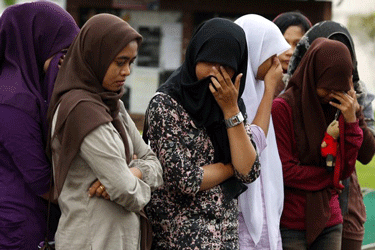
Guilt trip Dani bin Misra was sentenced to three months' jail - AP
Guilt trip Dani bin Misra was sentenced to three months’ jail — AP
A year ago Barack Obama returned to Indonesia, where he lived as a boy, as President of the United States. In a speech at the University of Indonesia, he reminisced about catching dragonflies, flying kites and running through rice paddies in the Jakarta of his youth. “Indonesia is a part of me,” he told the audience, while lauding the nation and its people for their new democracy, commitment to the rule of law and tolerance for religious diversity. Obama’s affection for Indonesia is understandable. But as he prepares to go to Bali on Nov. 19 for the East Asia Summit, he needs to ditch the nostalgia and deliver a stern message to his onetime home for not living up to its purported ideals.

A key measure of the level of justice and compassion in any society is how it treats its minorities — often its most vulnerable citizens. On that score, Indonesia, the world’s most populous Muslim country, is failing. In the past year, public violence against religious minorities, who together make up about 12% of the 240 million population, has been relentless: there has been a slew of incidents, from burnings and bombings of churches to attacks by radical Muslims on moderates. The authorities appear unable or unwilling to firmly intervene.

That seemed to be the case when I was in a packed courtroom outside Jakarta a few months ago. On trial were 12 men charged in connection with a mass assault early this year on members of the peaceful Ahmadiyah sect. Ahmadis believe that their Indian founder Mirza Ghulam Ahmad (1835-1908) was also a prophet, after Muhammad — a claim orthodox Muslims find heretical. This plus other differences have made Ahmadis a target for hard-liners in Pakistan, Bangladesh and, of late, Indonesia too. The attack on the Ahmadis was brutal. A hundreds-strong crowd gathered at opposite ends of a remote rice-farming village on the western edge of Java and converged on an Ahmadi home. The people inside were surrounded and attacked with machetes, sharpened sticks and stones. Three men died; five were badly injured.

At the trial, before the judges entered the chamber, an Islamic cleric in a white robe stepped from the gallery and led the courtroom in prayer. Those inside — plus many more pressed against the outside gate — prayed for the mob, not those killed. People in the crowd told me the Ahmadis had it coming, that the mob was provoked and the violence spontaneous.

One of the accused, 17-year-old Dani bin Misra, was filmed smashing an Ahmadi man’s skull with a rock. He and the other defendants were convicted of “participation in a violent attack that results in casualties.” Dani was sentenced to three months’ jail. The rest, including two clerics, received five to six months. (By contrast, an Ahmadi got six months for wounding an attacker when defending a family’s property.) Said New York City — based Human Rights Watch: “The trial sends the chilling message that attacks on minorities will be treated lightly by the legal system.”

We expect better from Indonesia. When the 1997 Asian financial crisis sparked mass protests that helped bring down longtime strongman Suharto, the majority-Muslim nation shattered the tired myth that Islam is antithetical to democracy. Today, Indonesia is freer and more open than ever. Indeed, many see the country as a model for the postrevolutionary Arab world. Yet institutions are weak, corruption is endemic, and military repression persists in the forgotten territory of Papua. President Susilo Bambang Yudhoyono has condemned the various religious attacks, but not, say his critics, forcefully enough. Extremists have flourished on the fringes of the moderate mainstream, spawning radical groups and religious vigilantes. Their actions undermine everything good about contemporary Indonesia.

I raised the Ahmadiyah verdict with Suryadharma Ali, Indonesia’s Minister of Religious Affairs, one of whose responsibilities is to keep the peace among all faiths. Suryadharma was unapologetic in tone: he said Indonesia respects religious freedom, but that minorities could not use that freedom to “completely modify” Islamic beliefs. He also defended regulations that ban Ahmadis from proselytizing or openly practicing their faith. The minister compared antagonism toward Ahmadis to flag burning: “Your country would get angry if you burned their flag. And the case of religion is higher than the flag.” Perhaps so, but for Indonesia to be truly the modern, moderate society it claims to be, it needs to show through word and deed that it will not tolerate intolerance.

Copyright © 2011 Time Inc. All rights reserved.
URL: www.time.com/time/magazine/article/0,9171,2099185,00.html?xid=gonewsedit

Tuesday, September 27, 2011

Indonesia’s ‘individual jihadists’ gaining ground

MSN News, Malaysia

By Agence France-Presse, Updated: 9/27/2011
Indonesia’s ‘individual jihadists’ gaining ground
There was nothing sophisticated about the suicide bombing at an Indonesian church Sunday – using homemade explosives packed with nails, nuts and bolts, the bomber killed only himself.

National Police spokesman Anton Bachrul Alam holds up photographs of Ahmad Yosepa Hayat, the Bethel Injil Church bomber, during a press conference in Jakarta on September 27, 2011.
The attack was in stark contrast to the country’s deadliest terrorist incident nine years ago, when the Al-Qaeda-linked Jemaah Islamiyah (JI) killed 202 people, mostly foreigners, in the highly planned Bali bombings.

With networks such as JI suffering serious damage in the face of a remarkably successful crackdown by Indonesian security forces, a new generation of loosely-connected jihadists has been left to step up.

“The weakening of the large organisations is something positive. Indonesia has done a pretty damn good job of basic law enforcement,” International Crisis Group analyst Sidney Jones told AFP.

“The chances are less likely you’ll get an attack of that magnitude,” she added, referring to the Bali bombings.

Instead the world’s most populous Muslim-majority nation has seen a spate of smaller attacks on minority religious groups both from bombers and in incidents of mob violence.

Details that have emerged about Sunday’s attack indicate that these small groups are finding strength and solidarity in their loose alliances.

Police identified Sunday’s bomber as 31-year-old Ahmad Yosepa Hayat, a member of Jemaah Ansharut Tauhid (JAT), which was founded by militant spiritual leader Abu Bakar Bashir.

Hayat was sitting among the Bethel Injil Church congregation in Solo, Central Java, when he stood up and detonated a bomb strapped to his stomach, killing himself and wounding 27 others.

Hayat was already on Indonesia’s most-wanted list for his role in another suicide attack five months ago in far-away Cirebon, 300 kilometres (186 miles) east of Jakarta, where another bomber attacked a police mosque.

That incident bore striking similarities to Sunday’s attack, with the bomber managing to kill only himself, and the explosives containing nails, nuts and bolts.

In recent years Indonesia’s police anti-terror unit, Detachment 88, has killed some of the country’s most-wanted militants, including Noordin Top, believed to have played a role in every major terrorist attack in the country’s recent history, and Dulmatin, who had a hand in the Bali bombings.

JI’s spiritual leader Abu Bakar Bashir was sentenced in June to 15 years’ imprisonment for funding a militant training camp in Aceh on Sumatra island, where special autonomy allows the region to implement some sharia laws.

But the attacks on religious minorities and “enemies of Islam” over the past year have been carried out by new cells – with old ties – and mostly made up of young men from vulnerable communities.

In an editorial, the Jakarta Globe said there was “no shortage of young people willing to take up the jihadist cause” and warned Indonesia is heading down a “very dangerous path”.

Jones said there are seven or eight known small groups operating in Solo alone, which are “all in communication with one another” and beginning to merge their agendas.

“Every time we’ve seen one of these smaller networks emerge, there have been at least one or two members with links to older networks,” she said.

“They’re harder to detect than bigger networks. They understood it was dangerous for them to use mobile phones to communicate, which makes it much more difficult for police to track them down.”

Critics of the government say it has done nothing to combat sectarian attacks, which while less deadly, have seen worrying incidents of mob violence.

A court sentenced 12 Muslim radicals to just a few months in jail for an attack on members of the minority Muslim sect Ahmadiyah, in Cikeusik in West Java in February.

The machete-wielding mob clubbed, hacked and stoned three defenceless men to death in front of police.

Victims who survived the attack were handed longer sentences than their assailants for “provoking violence”.

On September 12, on Indonesia’s remote Maluku islands, violence erupted in the provincial capital Ambon after rumours spread through text message that a Muslim motorcycle taxi driver had been attacked and killed by Christians.

“The government didn’t take strong action in Ambon, so this has created a wake-up call to jihadis to do something,” the Institute for International Peacebuilding security analyst Noor Huda Ismail said.

“We need to have transparent and accountable law enforcement. Of course if Indonesia doesn’t enforce the law these groups will keep doing these attacks.”

Saturday, September 3, 2011

Indonesia sect fears more attacks

Los Angeles Times
WORLD
Indonesia sect fears more attacks
Three members of the Ahmadiyah, a minority sect, were slain by Islamic hard-liners in February. Ahmadis fear the attackers' light sentences signal tacit government acceptance of religious violence.
Nurhayati, a member of the Ahmadiyah, a minority Islamic sect, and her child are among those seeking refuge at a safe house in Banten, Indonesia. (Dita Alangkara, Associated Press / September 3, 2011)
By Kate Lamb, Los Angeles Times
September 3, 2011

Reporting from Jakarta, Indonesia— Arif Hakim recalls that deadly day in February when a thousand machete-wielding Islamic hard-liners descended upon his tiny congregation in rural West Java.

“I saw them coming, screaming that we were infidels and should be killed,” the 32-year-old welder said. “The police just watched and I panicked. I escaped and ran through the rice fields, but I could still hear the sounds of my friends being captured and [attacked].”

Three of Hakim’s fellow worshipers were killed in the melee. Their offense: They were members of a minority Islamic sect called Ahmadiyah, which has been under growing pressure by Islamic extremist groups.

The sect, which has adherents worldwide, is nonetheless banned in many Muslim countries because Ahmadis have divergent beliefs about the coming of the second messiah.

Across Indonesia, Ahmadiyah members have in recent years been the target of attacks, but the incident in the village of Cikeusik, West Java, stands out for both the level of violence and the fact that it was recorded on video.

The video, distributed worldwide on YouTube, shows a mob chanting religious slogans as they beat three Ahmadis to death with rocks, wooden clubs and machetes.

Many say the violence signals a dangerous wave of intolerance in the world’s most populous Muslim nation, one that had long prided itself on its acceptance of minority religious groups.

In recent years, harassment and attacks have been on the rise, with Christian groups, as well as Ahmadis, facing intimidation.

Many believe the attacks have come with tacit government acceptance in a nation where 200 million of the 237 million citizens are Muslim.

Bowing to political pressure, the Indonesian government in 2008 issued a decree calling on Ahmadiyah to “stop spreading interpretations and activities that deviate from the principal teachings of Islam.”

Although officials say the decree was intended to defuse religious tension, attacks against the minority group increased to 50 in 2010 from three in 2006, according to the Setara Institute, a nongovernmental group that monitors religious freedom.

The 12 men charged in the West Java deaths were sentenced to between three and six months in prison, court rulings that critics say give a virtual green light to the violent persecution of minorities.

Meanwhile, an Ahmadi man involved in the incident was sentenced to six months in prison, convicted of having provoked the violence because he called on fellow sect members to help defend Ahmadi property before the attack.

“I think the verdicts were appalling and underscore an image that the Indonesian government is going to have to confront, which is of a place of growing intolerance,” said Sidney Jones, a political analyst with the International Crisis Group.

The U.S. State Department has also criticized the sentencing of the Ahmadi man.

Islamic hard-liners, on the other hand, continue to defend their anti-Ahmadiyah campaign. A group called the Islamic Defenders Front, or FPI, which has previously attacked brothels, nightclubs and the editor of Indonesian Playboy, denies that it was involved in the West Java incident but says Ahmadiyah must go.

“Ahmadiyah is not Islam; they are an insult to Islam,” said the group’s Jakarta leader, Habib Salim Alatas, wearing a yellow sarong and heavy eyeliner, seated in a living room lined with portraits of stern-faced imams. “It is like a religion for rats.”

On Aug. 16, the eve of Indonesia’s Independence Day, President Susilo Bambang Yudhoyono defended the country’s pluralistic reputation against growing criticism at home and abroad. But many Ahmadiyah followers are not reassured.

“People attack Ahmadi homes, their children are bullied in school, their businesses are boycotted and others are injured. I think it is a scary life,” says Firdaus Mubarik.

Ahmadiyah, which originated in India in the 19th century, has 200,000 followers in Indonesia. Many who fled Cikeusik after the attack are afraid to return. On Lombok island, the 138 members of another group of Ahmadis have lived in a shelter for six years since an attack there.

Hakim, the Cikeusik welder who sought refuge in a neighboring village but was later interrogated and beaten by a second knife-wielding mob, worries about a similar fate.

“I thought that would be the end of my life,” he said, sitting under a fuchsia bougainvillea tree at the entrance of a Jakarta mosque. But “I am trying to think the incident is not the scariest thing in my life, but the sweetest because I still live.”

Lamb is a special correspondent.

Copyright © 2011, Los Angeles Times
URL: www.latimes.com/news/nationworld/world/la-fg-indonesia...story

Friday, September 2, 2011

Ahmadi Victim Recalls Cikeusik Mob Attack, Says Threats Continue in Jail

Jakarta Globe, Indonesia
NEWS
Ahmadi Victim Recalls Cikeusik Mob Attack, Says Threats Continue in Jail
Chrestella Tan | September 02, 2011

Deden Sujana, head of security for the Indonesian Ahmadiyah Congregation (JAI) during his trial at Serang District Court. (Antara Photo/Asep Fathulrahman)
For months Deden Sujana had to be treated in a Jakarta hospital. He was put on life support as doctors raced to save his right hand, which was nearly severed during a deadly attack on members of the Muslim minority sect Ahmadiyah in February.

Now in jail for provoking the attack and still facing intimidation, Deden told the Jakarta Globe in an interview on Thursday that when a mob of 1,500 descended upon an Ahmadi’s house in Cikeusik, Banten, he was prepared to die.

“Let’s die together,” Deden said, recalling the words he told an Ahmadi friend as the two were lying on the ground bleeding, while men armed with machetes, bamboo sticks and rocks continued to beat their ailing bodies.

“I was stabbed in the chest,” he said, adding that the blade just missed his heart. “Doctors said I should have been dead. It is a miracle of God that I am still alive.”

Deden’s wrist was slashed by a machete when he was trying to protect his head during the attack. There is now a long scar encircling it. Although doctors managed to reattach Deden’s hand, he has lost feeling in most parts of it.

He said his hand would never fully recover. Only his thumb and index finger are still functioning properly, and he regularly feels intense pain.

When asked who attacked him, Deden said: “I remember, it was Idris.”

He was referring to Idris bin Mahdani, who in August was sentenced to five and a half months in prison for possession of a machete, but not for attacking Deden. Just weeks after his conviction, Idris was released.

Instead, the Serang District Court put the blame for the attack on Deden, claiming he refused to vacate the building and thereby provoked the assault that left three Ahmadis dead. Last month, Deden received a harsher penalty than Idris: six months in jail.

Deden has refused to lodge an appeal, however, saying that with just two months before his release, the legal move would be useless. There was also concern that his appeal would only cause more controversy and lead to more hatred of Ahmadis, who have already suffered more than 160 attacks across the country over the last decade.

Kiagus Ahmad, Deden’s lawyer from the Jakarta Legal Aid Foundation (LBH Jakarta), said he respected his client’s decision, but there was a downside.

“Deden’s decision is setting a bad precedent. If every victim like him does the same thing, people will think that it is OK for [victims] to be criminalized,” he said. He added that Deden’s decision in the long run could further endanger minority groups.

Deden said he was concerned about the threats and intimidation he continued to face, even behind bars.

Since his trial began last month, Deden said several people claiming to represent the local administration had approached him before trial sessions. They said he could have his charges dropped or given a lenient sentence if he renounced his faith as an Ahmadi.

Prison officials now keep a close eye on Deden, who faces insults and intimidation from the rest of the prison population.

“There are many people — inside and outside this jail — who want me dead,” he said.

“The hardest intimidation came from Serang Police,” Deden added, referring to the deputy chief of Serang City Police, Adj. Comr. Jajang.

He would not specify the intimidation allegedly carried out.

The chief of Serang District Police, Adj. Sr. Comr. Krisnandi, challenged Deden to come up with evidence. “What Deden has said about the intimidation was not credible. Nobody has been able to show us there was truth to the claims,” Krisnandi said.

Kiagus maintained that the intimidation proved that law enforcers have been biased in their treatment of the minority group, which mainstream Muslim organizations deem deviant.

Andreas Harsono, an Indonesian consultant for New York-based Human Rights Watch, urged the police and the National Police Commission to investigate Deden’s statement about the attack by Idris as well as his claims of harassment and intimidation by police officials.

Andreas reiterated that the court had not been fair toward Ahmadiyah. The HRW consultant highlighted the court’s refusal to put the survivors of the attack on the witness stand.

“There were many irregularities in the Cikeusik trial, but it’s Deden Sujana’s choice to appeal or not to appeal. He needed to consider the possibility of a higher sentence on appeal. He has his family to be with,” Andreas said.

Copyright 2010 The Jakarta Globe
URL: www.thejakartaglobe.com/news/ahmadi-victim.../462886

Thursday, September 1, 2011

Ahmadis’ Holidays Plagued With Fear in Indonesia

Jakarta Globe, Indonesia
NEWS
Ahmadis’ Holidays Plagued With Fear in Indonesia
Elisabeth Oktofani & Fitri | September 01, 2011

Not all Muslims celebrated Idul Fitri with jubilance and excitement. For members of the Ahmadiyah minority sect, this year’s celebration is marked by heartache and fear.

Firdaus Mubarik, a spokesman for the Indonesian Ahmadiyah Congregation (JAI), told the Jakarta Globe on Wednesday that approximately 600 Ahmadis in Sukadana village in West Java’s Cianjur district had been banned from using their mosque for prayers.

“Ahmadiyah followers in Sukadana village were told by the village chief that they could not use their own mosque to hold a Idul Fitri prayer in case of a possible attack by the residents,” Firdaus said.

“For us, this is a threat.”

Instead, Firdaus said the group had to hold its prayers inside an Ahmadiyah Islamic school as guards from Cianjur kept watch.

Similar threats were also aired against Ahmadis in Makassar, who were recently attacked by assailants from the hardline Islamic Defenders Front (FPI).

“Even though our mosque was damaged by the FPI on August 13, thank God we could hold Idul Fitri prayers in our own mosque peacefully this morning wthout any disturbance,” Irza Rasid, an Ahmadi from Makassar, told the Globe.

“Unfortunately, we could not stay longer to gather and celebrate Idul Fitri among the Ahmadiyah congregation because we did not want the FPI to come and attack us,” he added.

Last month, FPI members attacked the Makassar office of the JAI, where Ahmadis had planned to hand out food and groceries to the surrounding community.

“The FPI often conducts raids on Ahmadiyah activities without any coordination with the police. Not only did they carry out raids, but also threats and intimidation towards us.” Irza said. “It needs to be understood that we do not want to fight back … because we have our own motto, which is love for all, hatred for none.”

The JAI has recorded more than 160 cases of violence against Ahmadiyah communities in the last 10 years.

In Mataram, West Nusa Tenggara, Ahmadis have been living in a rundown shelter for nearly six years after their village was attacked and ransacked by mainstream Muslim groups.

“We have lost our land, we have lost our homes. Some have even lost their lives, but we are thankful for we have you, Allah,” Ahmadi children sang after the community performed their Idul Fitri prayer on Wednesday.

Many cried as some 50 children sang the song remembering the violence that drove them away from one village to the next, destroying every possession that they owned.

More than 250 Ahmadis took part in the prayer, occupying a tiny room in the middle of the abandoned Transito building. The ceiling showed signs of collapsing on to the congregation, which had to use makeshift prayer mats made from recycled newspapers and torn sheets of plastic.

Community members prepared a simple chicken stew and rice cake.

“I know they are nothing fancy, but they remind me of home,” 58 year-old Siti Kalsum said.

Copyright 2010 The Jakarta Globe
URL: www.thejakartaglobe.com/news/ahmadis.../462681

Saturday, August 27, 2011

Idul Fitri Brings Little Cheer to Ahmadi Shelter

Jakarta Globe, Indonesia
NEWS
Idul Fitri Brings Little Cheer to Ahmadi Shelter
Fitri | August 27, 2011

Ahmadiyah families in Transito shelter, Mataram, West Nusa Tenggara.
Mataram, West Nusa Tenggara. Nothing has changed at the Transito shelter in the five and a half years that it has served as home to 138 members of the beleaguered Ahmadiyah Islamic sect.

A sixth successive Idul Fitri in cramped conditions without even the most basic of amenities beckons, with no word on when they will be allowed to return to their home village of Gegerung in West Lombok, from where they were driven out by fellow Muslims in February 2006.

The electricity to the shelter was cut off three years ago, food aid from the government — which has perpetuated their limbo by refusing them the right to return home or register as residents of Mataram — was halted last year, and sanitation facilities are non-existent.

A stipend from the state was stopped in 2007. Not being registered residents, they have been denied the free gas stoves distributed by the government to all citizens, and they now resort to gathering scrap to burn as fuel.

“It’s the durian season now, and people are throwing out lots of durian husks. We’re collecting those to fire our stoves,” says Munikah, one of the shelter’s inhabitants. “We can’t afford to use kerosene because it costs Rp 12,000 [$1.40] a liter.”

The women band together in preparing the predawn and sunset meals during Ramadan, crowding the shelter’s corridor as they toil over smoky stoves. The meals themselves are basic, heavy on starchy ingredients to mask the lack of vegetables or meat. However, they carry on fasting like most other Muslims.

Clothes for the Kids

The rest of the country may be in a festive mood with the approach of Idul Fitri — and its attendant indulgences such as family reunions, hearty meals and the buying of new clothes — but at Transito, it will be just another day of trying to scrape by.

All that Munikah is hoping for before then is that her husband can bring home a little more than the Rp 25,000 per day he typically makes through cutting hair at a nearby market.

“It’d be nice if he got a little something extra for Idul Fitri so we could at least get the kids some new clothes,” she says. “But if that doesn’t happen, they won’t be too disappointed.”

After living so long at the shelter, the Ahmadiyah children have grown more accepting of their situation, says Basir Aziz, a local Ahmadi elder. “There are 50 children here, 16 of whom were born in this shelter,” he says.

“This year they seem a lot more resilient and upbeat. They don’t feel marginalized. They’re showing a tremendous passion to study and practice their faith, despite all they’ve been through.”

The life at the shelter is the only one that 6-year-old Ida knows. Asked if her parents had bought her new clothes for the holiday, she responds with a maturity beyond her years. “I’ve got the clothes from last year. They’re still fine,” she says with a smile.

Nor do they complain about the partially collapsed ceiling in their prayer hall, or the fact that all 33 families here are forced to share crowded living quarters, with only flimsy partitions of cardboard and rags mounted on bamboo frames giving privacy.

No More Tears

“When the kids play, they’re never sad,” says Hairudin, an Ahmadi who earns Rp 5,000 a day as a coolie at the local market.

“They’ve become used to all this after almost six years. We’ve got no more tears. We have to take what we get.”

For Hairudin and the other Ahmadis, sorrow is an emotion they dare not indulge. “If I broke down in sadness just thinking about how we got hounded out of our homes, I wouldn’t be able to go to work each day, and that would be the biggest problem for my family,” he says.

“That’s why we don’t think about that anymore. Tears are a luxury we can’t afford. All we can do now is just think about how to get through each day.”

H. Mahmulludin, an Ahmadi elder, agrees there is no use being bitter about the past.

He bears no grudge against the local authorities, who last year raised the ire of human rights activists with a plan to exile all Ahmadis in West Lombok to a remote island and bar them from plans to develop the region as a top tourist draw.

“The governor has resolved all the differences between us in a peaceful manner,” he says. “The violence against us has stopped, and that helps a lot.”

What also helps, Mahmulludin says, is a weekly stipend from local community leaders.

But that pales in comparison to what they would have received if the government had agreed to compensate them for the homes they left behind in Gegerung.

In what activists have highlighted as just another example of discrimination against the Ahmadis, they have been denied compensation or the option of selling their homes, even as the government bars them from going back to inhabit them.

Continuing Pogrom

Despite this, there have been several attempts by some of the Ahmadis to return and farm their land while keeping a low profile. However, they have been routinely chased out by other villagers, who have branded them “a stain on this village” that “must be cleaned out.”

In the most recent incident, last November, local authorities themselves led the pogrom of the Ahmadis, forcing men, women and children to flee with their belongings.

Those who remained behind had their homes burned by a mob, while others vowed to keep coming back to farm their land.

“If I farm, at least I’m making a living, whereas at Transito I have no hope for a meaningful life,” said Sarim, one of the Ahmadis targeted last November.

Nobody was prosecuted for the attack, and the local administration did not compensate for losses, which the victims estimated at Rp 735 million.

For Munikah and the other mothers forced to watch their children grow up in what has become a refugee camp, the hope that there will ever be a resolution to the community’s plight and that they may one day return to their homes has dwindled along with the sadness.

All that remains, Munikah says, is a sense of resignation and just an iota of optimism that maybe — just maybe — Idul Fitri this year will herald a change for the better.

Copyright 2010 The Jakarta Globe
URL: www.thejakartaglobe.com/news/idul-fitri.../462042

Friday, August 26, 2011

Ahmadiyah activity banned during Idul Fitri in S. Sulawesi

Jakarta Post, Indonesia
NATIONALFri, 08/26/2011 6:57 PM
Ahmadiyah activity banned during Idul Fitri in S. Sulawesi
The Jakarta Post
The South Sulawesi administration says it forbids members of the Ahmadiyah Muslim community to conduct religious activities during the upcoming Idul Fitri holiday.

South Sulawesi governor Syahrul Yasin Limpo said according to his subordinate’s report, the condition in the province was conducive, but he said he was concerned that Ahmadiyah members would still conduct activities over the holiday, which could promote violence.

“We don’t want a repeat of conflicts, we will guard the Ahmadiyah mosque,” Syahrul said Friday as quoted by tempointeraktif.com

Syahrul refused to comment on whether Ahmadis could conduct worship activity in their mosques. “I cannot answer that. But their religious activities are certainly forbidden.”

South Sulawesi Police head, Insp. Gen. Johny Wainal Usman also stipulated that no Ahmadiyah activities could be carried out during Idul Fitri.

South Sulawesi Ahmadiyah spokesman M. Mahtiar Ahmad said he was disappointed by the governor’s decision.

He said that the government should protect Ahmadiyah because it was peaceful and did not threaten Indonesia’s sovereignty.

“Insya Allah [God willing] we cam continue to practice our worship activities. I hope the police remove the police tape surrounding our mosque.”

Copyright © 2008 The Jakarta Post - PT Bina Media Tenggara. All Rights Reserved
URL: www.thejakartapost.com/news/2011/08/26/ahmadiyah-activity...sulawesi.html

Thursday, August 25, 2011

Cleansing Indonesia

Front Page Magazine

Cleansing Indonesia

Posted by Frank Crimi on Aug 25th, 2011

.
A shocking verdict rendered by an Indonesian court underscores the rising tide of violence and discrimination against religious minorities in Indonesia, long purported to be the world’s most tolerant Muslim nation.

In February 2011, Deden Sudjana, a 48-year old Indonesian male, was one of twenty members of a Muslim minority sect called the Ahmadiyah who were violently attacked by an enraged Muslim mob while they gathered in a house in the Indonesian village of Cikeusik.

The fury of the mob attack — which ironically occurred during Indonesia’s Interfaith Harmony Week — was engendered by the presence of Ahmadiyah in Cikeusik. The Ahmadiyah, with 200,000 followers in Indonesia, is considered heretical by many Muslims because of its belief that Muhammad was not the final prophet.

While Sudjana and a handful of Ahmadiyah men tried to defend the property with stones and slingshots, they were quickly overwhelmed by nearly 1,500 Muslims, all armed with clubs, machetes and rocks.

In a terrifying scene caught on video, three Ahmadiyah men were killed and the others badly beaten. As the mob danced around the dead men, laughing and chanting “God is Great,” Indonesian police merely stood and watched.

However, the Indonesian police did manage to arrest Sudjana — whose hand was nearly severed by a machete in the attack — for ostensibly inciting the mob to violence by not leaving the home upon the mob’s arrival.

While that action may have been surprising, it was overshadowed in early August when an Indonesian court sentenced Sudjana to six months in jail. It was a verdict that understandably shocked Sudjana, given the fact that 12 members of the attacking mob had been given sentences between three to six months.

In fact, one of those attackers who had crushed in the skull of an Ahmadiyah man with a rock was released from prison days before Sudjana’s sentencing. Upon his return to Cikeusik, he was treated as a conquering hero by his fellow villagers. As one man said of the attack, “I do feel bad people had to die, but we had to clean our village.”

So, as he was being escorted from the courtroom, an incredulous Sudjana asked aloud, “I’m the victim. Why am I getting a higher sentence than some of the perpetrators?”

Mistreatment of the Ahmadiyah has escalated dramatically since 2008 when the Indonesian government decreed the Ahmadiyah to be a deviant sect whose followers could face up to five years in prison for practicing their faith. Since then, over a hundred violent incidents against the Ahmadiyah have been recorded, incidents which include the torching of mosques and homes.

One of the bigger driving forces behind those attacks has been the Islamic Defenders Front (FPI), a violent and hard-line Islamic militant group founded in 1998 whose stated goal is the implementation of Sharia law in Indonesia.

Unfortunately, the Ahmadiyah are not the only ones to offend the religious sensibilities of the FPI and other Muslim groups. Christians have also seen a dramatic escalation of discrimination and violence launched against them.

In 2011 alone, the Indonesian Community of Churches reported at least 20 churches were forced to suspend services due to mob threats and government intervention, with scores more torched and vandalized.

Unfortunately, replacing a destroyed church or building a new one is highly problematic as Indonesian law requires that construction of a new church must have the support of 60 percent of a community’s residents, an often impossible task for Christians who make up less than nine percent of Indonesia’s total population.

In one notable example, local authorities in Bogor, a suburb of the capital city of Jakarta, have prevented the Indonesian Christian Church (GKI) from moving into a new building for over two years despite a ruling from Indonesia’s Supreme Court that the church be unsealed.

Yet, Bogor’s mayor, Diani Budiarto, has refused to comply with the order and has recently come up with a new excuse for not opening the church, reasoning that the street the church was built on has an Islamic name and is thus an offense to Muslims.

Unfortunately, the Indonesian government has refused to intervene in the case. According to Indonesia’s Home Affairs Minister Gamawan Fauzi, “this is the political reality in the field and it could cause disturbances to security and peace. It would not be healthy in the long run, even for the congregation members themselves.”

Unfortunately, Fauzi’s concern for Christian well-being is well-placed as Muslim intolerance has grown more overt. It’s a trend perhaps best expressed in June 2010, at the second Bekasi Islamic Congress in Bekasi, West Java, when Muslims were instructed to form Islamic paramilitary forces in readiness for a jihad against Christians.

Another more recent example of that intolerance occurred in February 2011 when a Christian man accused of blasphemy for distributing pamphlets that apparently insulted Islam received a sentence of five years in prison. However, a mob of over 1,000 Muslims, believing the verdict required a death sentence, went on a rampage, storming the courthouse and setting several local Christian churches on fire.

Yet, despite Muslims making up over ninety percent of Indonesia’s 240 million citizens, the Indonesian government insists it is committed to promoting religious tolerance, citing its constitutional guarantee of freedom of religion.

Instead, some have laid the blame for the rise in religious intolerance squarely at the doorstep of Indonesian President Susilo Bambang Yudhoyono. Critics say that because Yudhoyono relies on the support of Islamic parties in parliament, he has been reluctant to condemn or act upon religiously-motivated violence and thus has emboldened the FPI and other Islamist groups.

While Yudhoyono hasn’t been a profile in courage in dealing with the issue, others say it is the Indonesian government’s own laws and its selective enforcement that are actually fueling the continued harassment and persecution of religious minorities.

Specifically, Indonesia’s blasphemy law grants local governments the freedom to charge and detain members of religious minorities that are considered deviant. In fact, in April 2010 Indonesia’s Supreme Court ruled that that it was constitutional to ban religious groups that “distort” or “misrepresent” official faiths.

While Indonesia officially recognizes six religions (Islam, Protestantism, Catholicism, Buddhism, Hinduism and Confucianism) in practice, the blasphemy law is applied primarily to perceived offenses against Islam.

Unfortunately, the punishment for those offenses, whether carried out by the Indonesian government or by an enraged mob, can be quite severe. As he lingers alone in his jail cell, it’s a fact Deden Sudjana understands all too well.

Frank Crimi is a writer living in San Diego, California. You can read more of Frank's work at his blog www.politicallyunbalanced.com.

Copyright © 2011 FrontPageMagazine.com
URL: http://frontpagemag.com/2011/08/25/cleansing-indonesia/

Indonesian journalists support Islamic fundamentalism: Survey

Jakarta Post, Indonesia
NATIONALThu, 08/25/2011 8:00 AM
Indonesian journalists support Islamic fundamentalism: Survey
The Jakarta Post
More than 50 percent of Indonesian journalists agreed that the religious sect Ahmadiyah and Playboy magazine should be banned, while sharia and anti-pornography laws should be enacted, a survey has revealed.

The Pantau Foundation, a Jakarta-based journalism research and training organization, conducted a survey in late 2009 about the influence of Islam, the nation’s principal religion, upon 600 journalists from mainstream newspapers, radio and television.

Using the multi-random sampling method, Muslims accounted for 85 percent of the survey’s respondents, while 7 percent were Protestants, 4 percent Catholics and 3 percent Hindus and others.

The survey showed that 64.3 percent of the respondents strongly agreed that the Ahmadiyah sect should be banned, even though 96 percent of them said giving a voice to the minority was their duty, and more than 70 percent of them agreed that human rights issues were important, said foundation head, Andreas Harsono.

“While most of the respondents acknowledged their journalistic principles, this survey tells us that their personal religious beliefs directly or indirectly influence their points of view on social and religious issues,” he said in the survey, which was launched on Wednesday.

The survey also found that 63.1 percent of respondents agreed on the implementation of the Anti-pornography Law; thus, relating to the law, Playboy magazine should be banned.

“Over 63 percent of the survey’s respondents believed the magazine should not be sold in Indonesia,”
he said.

Other than that, 63.5 percent of respondents agreed to the edict issued by the Indonesian Ulema Council (MUI) stating that secularism, liberalism and pluralism were prohibited; 41.4 percent of them said that Muslim women should wear head coverings; and 37.6 percent supported the enactment of Islamic-based sharia law, including the punishment of flogging.

Andreas, who is also a member of the New York-based Human Rights Watch, said that the inclination of journalists toward Islamic fundamentalism should be considered as an alarming sign for the nation’s future democracy and pluralism.

“Once journalists go outside their house, they have to leave their personal identities behind them and become news-seekers. It means that they have to put their profession before their religious beliefs or nationality,” he said.

“If a journalist ever takes sides, they should support the weak, the discriminated, and the untouched rather than follow the majority,” he added.

The Wahid Institute researcher Rumadi, who was also a speaker at the discussion, referred to the results of the survey as “the growth of silent fundamentalism”.

He said that everyone, including journalists, should be aware of, and worry about, such things.

“Honestly, the survey results don’t surprise me,” he said.

“Fundamentalism grows in silence but it can grow quickly in many sectors, including journalism.”

He added that journalists should increase their awareness on this matter because “journalism is one of the most essential components within civil society. Journalists’ views represent public opinion, and, at many times, can also influence it.”

Senior journalist and former head of the Indonesian Press Council, Atmakusumah Astraatmadja, who said that he had seen changes in society, hoped that journalism would return to its original, pure function. (lfr)

Copyright © 2008 The Jakarta Post - PT Bina Media Tenggara. All Rights Reserved
URL: www.thejakartapost.com/news/2011/08/25/indonesian-journalists...

Tuesday, August 23, 2011

Jakarta’s Tough on Terrorists But Not Other Radicals

Jakarta Globe, Indonesia
OPINION
Jakarta’s Tough on Terrorists But Not Other Radicals
John McBeth - Straits Times Indonesia | August 23, 2011

When criminal court judges are fearful of dishing out tough punishment or, worse, allow a certain empathy for the accused to colour their judgment, it is important to look higher up the chain for the underlying reason.

In the case of the leaders of the mob who murdered three members of the Ahmadiyah sect last February, it comes down to the way the Government treats Islamic terrorists differently from other religious radicals who may not bomb but terrorize all the same.

President Susilo Bambang Yudhoyono’s administration clearly sees the terrorists as a direct challenge to the state, ignoring the more insidious threat mainstream extremists pose to the Constitution and the rule of law.

As a result, while Indonesia gets deserved praise for the success of its anti-terrorism campaign, its much-vaunted reputation for moderation and religious tolerance has paradoxically undergone a significant erosion at the same time.

There may well be a connection. Anxious not to appear as if it is at war with Islam, the government is consciously leaning the other way when it comes to other hardline groups who flirt with the law.

In its latest report, the United States- based Pew Research Centre groups Indonesia with Iraq, Pakistan, Afghanistan, India, Somalia, Nigeria and Bangladesh as countries where social hostilities and government restrictions involving religion are the highest in the world.

The ludicrously light three- to six-month jail terms handed out to the 12 defendants accused of killing the three Ahmadis in the western Java province of Banten is the worst example yet of how the tyranny of the majority has been allowed to prosper.

The sentences were even less than the seven months demanded by prosecutors and fell well below the maximum penalty of 12 years, with a teenage boy receiving just three months for using a stone to beat to death one of the helpless victims.

It was obvious from the start of the trial that prosecutors and judges alike were cowed by the hundreds of hardliners who showed up for each court session in what was once the heartland of Darul Islam, the movement that fought for an Islamic state in the 1950s.

Prosecutors even told the court that despite a horrifying, secretly filmed video of the incident, the victims’ refusal to flee the house where they had futilely tried to hold off the mob contributed to the violence and justified a reduced sentence.

Rather than acting as a deterrent, the sentences will almost certainly encourage further persecution of an Islamic sect, widely regarded as heretic, whose numbers range from the government figure of 50,000 to 80,000 to its own estimate of 400,000.

Sadly, the government finds itself in a cleft stick, realising that if it bans the sect it will not only be breaching the Constitution, which guarantees freedom of religion, but also officially declaring open season on its adherents.

Already under pressure in Muslim- dominated neighbourhoods, where churches can be built only with the approval of the majority of the local populace, Christians fear the increased intimidation will not end there. They have good cause to worry.

Four days after the Banten court handed down its verdict, mobs burned down three supposedly ‘illegal’ churches in Sumatra’s Riau province, the latest of 200 such attacks in the past five years and the 17th this year.

Last February, three churches were destroyed in Central Java, in protest over a court’s decision not to sentence a Christian man to death for defaming Islam. He had already received a five-year prison term, the maximum allowed under law.

The government’s timid attitude is also reflected in the lack of law enforcement that only exacerbates religious tensions. As in Banten, police more often than not stand idly by when thuggish groups like the Islamic Defenders Front go on the rampage.

Indonesia has long been held up as a shining example of religious tolerance and a nation where democracy and Islam co-exist in harmony. In that, it is rightfully held to much higher standards.

One Jakarta-based security firm told its clients recently that if Indonesia maintains its current trajectory, “the trend will transcend the realm of religion and affect other factors, such as the overall state of security and the business and investment climate”.

“At worst,” it warned, “it could lead to increased acts of terrorism and possibly a re-occurrence of the sectarian violence that nearly tore Indonesia asunder during the early post-Suharto period over a decade ago.”

Reprinted courtesy of Straits Times Indonesia.

Copyright 2010 The Jakarta Globe
URL: www.thejakartaglobe.com/opinion/jakartas-tough.../461094

Monday, August 22, 2011

Ahmadis in West Java Fear They’re Next

Jakarta Globe, Indonesia
HOME
Ahmadis in West Java Fear They’re Next
Nivell Rayda | August 22, 2011

The Ahmadiyah community in Cianjur, West Java, is airing fears of violence and retaliation after a court in Banten recently jailed 12 men for an attack there that left three members of the minority Muslim sect dead.

The Islamic Reform Movement (Garis), a hard-line Muslim group based in Cianjur, had previously voiced its support for hose involved in the Cikeusik killings in February. Hundreds of Garis members had attended the trials of the 12 men, who were eventually convicted for their roles in the brutal attack but were jailed for only up to six months.

Firdaus Mubarik, a spokesman for the Indonesian Ahmadiyah Congregation (JAI), said that Ahmadi youths in Cianjur had been coerced into joining Garis-sanctioned Koranic recitals and mass prayer meetings, and some had been physically threatened for refusing to attend.

“There are indications that violence is just around the corner in Cianjur. Garis has been visiting Ahmadis’ homes, telling them to renounce their faith. An Ahmadiyah boy was recently bullied, stones were thrown at JAI properties and homes have been vandalized,” he told the Jakarta Globe on Sunday.

Firdaus said that just days before the 12 men involved in the Cikeusik attack were sentenced to between three and six months in prison, at least four houses in Cianjur were burned down in suspicious circumstances.

But Chep Hermawan, chairman of Garis, played down the incidents, saying they were not arson. “Garis has always been the victim of rumors like that. Whenever there is something bad like an accidental fire at an Ahmadi’s house, people immediately say we are to blame. It was a fire, not arson,” he told the Globe.

Chep, who is also a wealthy businessman and influential figure in Cianjur, said his group only used peaceful means to persuade Ahmadiyah members to join mainstream Muslim groups.

“We are preaching the correct view of Islam,” he said. “We even offered those who leave Ahmadiyah a Rp 1 million ($120) loan because we understand some joined because the blasphemous sect had been generous to them.”

The JAI recorded more than 160 cases of violence against Ahmadiyah communities in the last 10 years. Some Muslims accuse the sect of believing its founder, Mirza Ghulam Ahmad, to be a prophet, contrary to the dogma that Muhammad was the last prophet. But the JAI has refuted this, saying its teachings are in line with mainstream beliefs.

Andreas Harsono, an Indonesian consultant for New York-based Human Rights Watch, said the lenient sentences in the Cikeusik case had only emboldened hard-liners to further intimidate Ahmadis. “The verdict was like a license for groups such as Garis,” he said. “The government is sending a message that attacks against Ahmadiyah will not be properly punished.”

Copyright 2010 The Jakarta Globe
URL: www.thejakartaglobe.com/home/ahmadis-in.../460643

Thursday, August 18, 2011

Freedom Elusive for Religious Minorities

Jakarta Globe, Indonesia
HOME
Freedom Elusive for Religious Minorities
Ulma Haryanto | August 18, 2011

For Firdaus Mubarik, an Indonesian Ahmadiyah activist, Independence Day provides no cause for celebration.

“For me and my family, there is no Independence Day this year,” Firdaus said on Wednesday. “I don’t want to hear people talking about it or to watch celebrations, because I know my brothers are not free at all. Many more live in fear all across Indonesia.”

Firdaus referred to Deden Sudjana and Ahmad Nuryamin, who were sent to prison for defending their community from mob attacks. Deden was found guilty of violent assault and disobeying police officers during an anti-Ahmadiyah protest in Cikeusik, Banten, in February. Three Ahmadis were killed in the attack.

“I take it as a new experience. Now I know what it is like to be an inmate,” Deden said in a phone interview. “I also see this place as a temporary retreat.”

Deden is expected to be released in November, if he accepts the court’s ruling. “I decided to appeal. I haven’t given up my hope of seeking justice,” he said.

Ahmad, from Cisalada, Bogor, received an 18-month sentence for stabbing an attacker in self-defense in October 2010. In that incident, a group of 200 people attacked his village, looting and burning homes.

Ahmad admitted to carrying a knife, but he said he panicked and did not remember stabbing one of the teenagers who set an Ahmadiyah mosque on fire.

Ahmad was originally sentenced to nine months by the Cibinong district court, but he saw his jail term increased after appealing to the West Java High Court.

Meanwhile, Bona Sigalingging from the GKI Yasmin church in Bogor reflected on the congregation’s second year of having to pray on the roadside, because its church was still sealed by the city government.

“Our independence is still something to be thankful for. We feel that the current injustice is more reason for us to stand up and fight,” he said. The congregation church has held its Sunday services on the pavement since last April.

For Yap Sungkono, a Falun Gong practitioner, not being legally accepted as an official organization does not mean he cannot celebrate Independence Day.

“The group has a marching band and we were invited to perform today at the National Archives Building,” Yap said. Outlawed in China, Falun Gong activists are trying to make a new home in Indonesia.

The government has refused to recognize Falun Gong has a legal organization, though, based on input from the Ministries of Foreign Affairs, Justice and Religious Affairs, as well as the National Police and the State Intelligence Agency (BIN).

Copyright 2010 The Jakarta Globe
URL: www.thejakartaglobe.com/home/freedom-elusive.../459861

As We Reflect on Independence Day, Can We Honesty Say We Are Free?

Jakarta Globe, Indonesia
OPINION
As We Reflect on Independence Day, Can We Honesty Say We Are Free?
Tasa Nugraza Barley | August 18, 2011

Celebrating this 66th independence day, there’s one question every Indonesian needs to ask themselves: Do they have the independence they deserve?

Although this nation gained its independence a long time ago, through long, bloody wars against the Dutch occupation, it wasn’t until 1998 that we really could say whatever we wanted to say. Although many think Suharto was able to improve our economy greatly, the fact that his 32-year dictatorship oppressed us politically and culturally was not debatable. It was simply another kind of occupation.

But is it right to claim that conditions are so much better now? Is everyone finally enjoying the independence in this country?

Sadly, I don’t think so.

As we’ve been practicing democracy for more than a decade, it may be a valid claim that we finally have the political right that we never had in the past. If there are things that go wrong, people can easily criticize the government or lawmakers, an act that would send someone to jail during Suharto’s regime.

Even though this nation may be a role model of democracy in the region, by providing its people the independence to speak freely and criticize, Indonesians still don’t have their independence in many other areas.

Countless times, the president and his ministers have announced how our economy has been improving very significantly. It’s true that Indonesia’s economic growth looks very confident — it is now predicted to reach 6.6 percent, surpassing the government official target of 6.5 percent — and is stubbornly unaffected by the downfall of American and European economies.

Looking from this perspective, it’s easy to say that the government has successfully improved the prosperity of the people. But as shown by the Central Statistics Agency (BPS) in early July, there are still 30 million poor people in Indonesia, a slight improvement from last year’s number, 31 million. Is it just me, or are the rich getting richer and the poor, well, staying very poor?

As has been revealed through a number of corruption cases — the most high-profile involving the likes of Gayus Tambunan, Susno Duadji and now Muhammad Nazaruddin — the justice system is controlled by little other than power and money.

People were clearly hurt to find out that former tax man Gayus could miraculously travel to Bali, Singapore, Macau and Hong Kong while supposedly in police detention during his graft trial.

The Gayus case clearly made us understand even better than before how justice can still be bought in this country. As long as you have money, the chances are you can fix things here and there, whether you’re right or wrong.

The public is watching another political circus show, with Democratic lawmaker Nazaruddin as its main star. Not only is he alleged to have a key role in the Southeast Asian Games graft scandal, but the Corruption Eradication Commission (KPK) has also stated that the disgraced politician is also involved in other corruption cases, worth more than a staggering Rp 6 trillion ($700 million) in total.

Looking at the amount of money involved, if true, Nazaruddin could not have done this by himself; many other politicians and government officials must have played a role in the scandal.

But based on previous corruption cases, my hunch tells me that only a few will be sacrificed, while many others will walk free as if nothing has happened.

And this is all happening when a poor man can easily spend months, or even years, in jail just for stealing a pair of slippers from the mosque or a chicken from his neighbor’s house.

Try to talk about independence to those in the Ahmadiyah sect, a religious minority group whose 500,000 members are receiving threats all over the country. Among many of these incidents, one stands out. In February, Ahmadiyah members in Cikeusik, West Java, were attacked by a 1,500-strong mob who wanted to kick them out from the village. Three Ahmadis died.

A court has now jailed 12 members of the Sunni Muslim mob for, at most, just six months each, although they were caught on film violently attacking Ahmadiyah members in clear sight of police officers. As if this was not weird enough, the same court this week jailed one of the Ahmadiyah survivors for six months. Deden Sudjana, the Ahmadiyah member, afterwards bitterly questioned why he had been treated the same as — or even worse than — the people who had murdered his three friends.

When he asked “Where is the justice?” what he was essentially saying was that he and many other minority counterparts did not have the privilege to enjoy this country’s independence. Believing in whatever god and religion you wish to is supposed to be a basic right here, yet Deden and his friends cannot do this.

If our founding fathers and national heroes could come back and see all this, I’m sure they would cry. They would be shocked to see how their noble values have been stamped on by today’s leaders in the interests of people’s egos.

When our heroes bravely fought for independence, all they wanted to do was ensure that their grandchildren could live freely, happily and prosperously. To achieve that goal, they did not mind having a humble life.

But look at us now, we’ve become a shameless nation whose “independence” seems to be nothing but a rhetorical term in the history books.

Ahmadis to drop further legal proceedings in Cikeusik killings

Jakarta Post, Indonesia
NATIONALTue, 04/19/2011 10:29 PM
Ahmadis to drop further legal proceedings in Cikeusik killings
The Jakarta Post
The Indonesian Ahmadiyah Congregration (JAI) says it will not seek further legal action against the hard-liners given lenient sentences for instigating a riot in which three Ahmadis were beaten to death.

The JAI, a repeated target of violence by Muslim hard-liners who accuse it of straying from Islam, said that the Ciekusik riot case was over.

“The families of the victims have forgiven all the attackers. They are fine now,” JAI spokesman Zafrullah A. Pontoh said. “We deeply regret that we had to lose three of our members. But we will not prolong the conflict by reporting the murder cases,” he added.

However, the incident would not deter the group from practicing or defending their beliefs, he said.

Several legal experts have suggested that the Ahmadis file another report following the Serang District Court’s decision to sentence 12 hard-liners to jail for terms ranging from three to six months for involvement in the attack.

The same court sent Deden Darmawan Sudjana, an Ahmadi man who was critically injured in the attack, to prison for six months for defying an order to leave the area where the mob was ready to ransack the assets of Ahmadi community members.

Human rights activists, foreign governments and legal experts have agreed that the verdicts were unfair.

Criminal law expert Yesmil Anwar of Padjajaran University in Bandung, West Java, said that the trials should not have ended with such light sentences. “We cannot merely say it was an unanticipated tragedy. Indonesia is a state of laws. All crimes, regardless of whether they are committed intentionally or unintentionally, should be investigated fairly,” he said.

Yesmil said that the outcome of the legal proceedings was partisan and unfair to the Ahmadis. “The ultimate goal of the judicial system should be justice for victims.”

Yesmil said the Ahmadis should continue to fight. “File a new case that focuses on the murder of its three members,” he said. “If the Ahmadis file a report for murder, the police should respond by holding an investigation. All of us can keep our eyes on the investigation to make sure the police do their job.”

Yesmil also questioned the judges’ decision to sentence Deden under article 212 of the Criminal Code for acting against the state, which was not part of the indictment submitted by prosecutors. Deden had only been charged with physical abuse and inciting hatred.

“The judges’ decision has gone too far away from the real point of the case,” he said.

Another criminal law expert, Eddy S. Hiariej of Yogyakarta-based Gadjah Mada University, said it was not usual for judges to expand upon the indictment submitted by prosecutors. “Judges determine the sentence based on the prosecutors’ demand. In this case, the judges considered another charge,” he said.

However, Eddy said, the practice, while uncommon, was allowed. “The judges can do so if they see another violation of the law,” he said.

Hasril Hartanto, a criminal law expert from the University of Indonesia in Depok, likened the sentence to a compromise. “The prosecutors saw their priorities as stabilizing the social situation first, then justice,” he said.

“Prosecutors might have faced an unpleasant situation if they supported the Ahmadis. For the sake of social security, they chose to make the minority suffer,” he said.

On Tuesday, activists from various organizations, including the Indonesia Legal Aid Institution Foundation, the Jakarta Legal Aid Institute, Kontras, Imparsial, Elsam, and the Human Rights Working Group, issued a statement condemning Deden’s sentence. “We criticize law enforcement’s unwillingness to pursue the case fairly for the minority Ahmadi,” Kiagus Ahmad Bella Sati of the Jakarta Legal Aid Institute said. Ahmad, who also represented Deden, said he activists demanded that the Court Commission investigate prosecutors in the case.

Copyright © 2008 The Jakarta Post - PT Bina Media Tenggara. All Rights Reserved
URL: www.thejakartapost.com/news/2011/08/18/ahmadis-drop-further-legal-proceedings-cikeusik-killings.html

Wednesday, August 17, 2011

Fostering Intolerance: Indonesian Laws Fuel Violence against Religious Minorities

Human Rights First

Fostering Intolerance: Indonesian Laws Fuel Violence against Religious Minorities

8-17-2011

By Quinn O’Keefe
Senior Associate, Human Rights Defenders

When the Indonesian government says it is tolerant of religious minorities, don’t believe it. It is the government’s laws and their selective enforcement that are fueling extremist violence, as well as the continued harassment and persecution of religious minorities.

While all religious minorities are at risk, Indonesia’s Ahmadiyya have been particularly persecuted compared to other minorities. An incident that received international notoriety occurred in February 2011, when more than 1,000 villagers armed with machetes and sticks stormed a house of Ahmadiyya worship, killing three and wounding six others. This happened in a village in Banten, not far from Jakarta. For a short while, graphic video footage of the attack went viral on YouTube (it was quickly taken down). The attackers were caught on tape stoning their victims to death, then beating the corpses as police officers and villagers watched and did nothing to stop the bloodshed.

This was not an isolated incident of extremist violence against the Ahmadiyya, an Islamic sect that is considered “deviant” by Indonesian ministerial decree. Just last week, 30 members of the Islamic Defenders Front attacked an Indonesian Ahmadiyya congregation in South Sulawesi, an incident in which three were injured.

The Indonesian criminal justice system has simply failed in Banten and in many other violent attacks against religious minorities. Despite the police presence and video documenting the attack, only 12 villagers were charged and received sentences ranging from three to six months imprisonment for their role in the attack. None were charged with murder, even though one had been caught on video bashing an Ahmadi man to death with a rock. The court even handed down sentences that were less than recommended by the prosecutors, stating that the Ahmadiyya were the true culprits instigating the violence. Then on Monday, the same court found an Ahmadi victim of that attack, Deden Sudjana, guilty of disobeying police orders and “ill-treatment,” and sentenced him to six months in prison. Deden’s hand was nearly severed during the attack.

It is this appalling juxtaposition between sentences that really illustrates the government’s mistreatment of religious minorities through the application of its criminal laws.

Take another example: In February, a Christian man accused of blasphemy for distributing pamphlets that apparently insulted Islam received five years imprisonment – the maximum penalty under the law. Upon hearing the verdict and deeming anything but penalty of death too lenient, a mob of over 1,000 strong stormed the courthouse and set Christian churches on fire in protest.

Violence against religious minorities is a result of laws that fuel intolerance in Indonesia. While the constitution guarantees freedom of religion, there are many provincial and regional bans against Ahmadiyya practice, including in Java. There is also a 2008 ministerial decree meant to protect Ahmadiyya from further persecution, but in actuality restricts public shows of support for the religion and actually calls the sect deviant. Then the blasphemy law grants local governments freedom to charge and detain members of religious minorities that are considered deviant.

The central government should not hide behind its constitution and international commitments to say Indonesia is a religious tolerant nation. Rather, it must take the lead and guarantee uniform enforcement of criminal laws and reform decrees that, in effect, officially ban minority religions and practice. President Susilo Bambang Yudhoyono should also be held to his word when he says mob violence is illegal, and hardline groups should be disbanded.

The Indonesian government has long been considered a human rights and democratic outpost in Asia, now it is time it starts acting like one.

In November 2010, Human Rights First released a report, Blasphemy Laws Exposed: The Consequences of Criminalizing “Defamation of Religions”, which details more than 50 recent cases from 15 countries. The report provides a window into how national blasphemy laws are abused by governments around the globe. The real-life stories in the report document how, time and again, accusations of blasphemy have resulted in arrests and arbitrary detentions and have sparked assaults, murders and mob attacks.

Tuesday, August 16, 2011

Indonesia sentencing sets dangerous precedent

Ahmadiyya Muslim Jamaat International
16th August 2011
PRESS RELEASE
Indonesia sentencing sets dangerous precedent
Ahmadiyya Muslim Jamaat condemns unjust imprisonment of Ahmadi Muslim in Indonesia

The Ahmadiyya Muslim Jamaat condemns in the very strongest terms the sentencing of Mr Deden Sudjana to six months imprisonment by a District Court in Indonesia.

In February Mr Sudjana was one of the many victims of a brutal assault by a mob of over 1,000 people that shocked the entire world. During the attack 3 Ahmadi Muslims were martyred in the most vicious and brutal way imaginable.

Only 12 of the perpetrators of the February attack were charged by the police and each received very negligible sentences. On the other hand Mr Sudjana, who did nothing but defend himself, his fellow Ahmadi Muslims and their mosque has been sentenced to six months imprisonment.

The Press Secretary of the Ahmadiyya Muslim Jamaat, Abid Khan said:

“The sentencing of Deden Sudjana to six months imprisonment is an affront to all forms of decency. It is clearly a travesty of justice. Rightly this decision has been condemned by media and human rights agencies across the world.

Let it be absolutely clear that neither Deden Sudjana nor any other Ahmadi Muslim provoked in any way the brutal assault in Banten that took place last February. That attack was caused only by the fanaticism and cruelty of over a thousand extremists determined to see the blood of innocent and peace loving Ahmadi Muslims.

This decision sets an extremely dangerous precedent, whereby the Courts have taken away the right of an Ahmadi Muslim to defend himself or his property even when faced with a violent and brutal assault, whilst on the other hand it gives a free hand to extremists to continue their wave of attacks against the Ahmadiyya Muslim Jamaat in Indonesia.”

The Ahmadiyya Muslim Jamaat hereby seeks the release of Deden Sudjana immediately and requests the international community to take urgent notice of this case.

Furthermore, the Ahmadiyya Muslim Jamaat condemns in the strongest terms another attack on one of its mosques in South Sulawesi on Sunday.

22 Deer Park Road, London, SW19 3TL UK
Tel/Fax: 020 8544 7613 Mob: 077954 90682
Email: press @ ahmadiyya.org.uk
Press Secretary AMJ International

Curious Justice in Banten

Jakarta Globe, Indonesia
OPINION
Curious Justice in Banten
A. Lin Neumann | August 16, 2011

People in Medan protesting against violence in the name of religion and urging the government to act against those behind the anti-Ahmadiyah violence in Cikeusik earlier this year. (Antara File Photo)
Almost exactly one year ago, Indonesian President Susilo Bambang Yudhoyono said the following on the occasion of Independence Day: “I want to underline the importance of maintaining and strengthening our brotherhood, harmony and tolerance as a nation… In everyday life, we still find cases that don’t reflect the harmony, tolerance and mutual respect … related to religion, ethnicity, tribe and regions. We must not ignore such a situation.”

I guess no one was listening. Monday’s court verdict finding the victim guilty of inciting the mob that nearly took off his arm with a machete and killed three fellow members of the Ahmadiyah sect last February, set a new low for justice.

The district court in Banten province found Deden Sujana at fault because he was one of a handful of Ahmadiyah members who attempted to stop a crowd of about 1,500 people as it attacked the house where they were staying. By the logic of the court, if Deden had fled the area nothing would have happened and his three friends would not have been beaten and hacked to death. By such reasoning, banks should be robbed because they have money in them and pedestrians are only killed by runaway drivers because they are walking on the street.

Deden’s crime was being there. And for that he was given a six month sentence. On July 28, the same court gave 12 men involved in the violence, including the leader of the mob, sentences of three to six months for carrying out the attacks, which millions have seen on YouTube.

“I, the victim, am sentenced in a trial held under political pressure,” Deden told the court Monday, noting that he was also convicted of violent assault, a crime he was not even charged with. “I was treated the same way as the uncivilized murderers of my three friends. Where is the justice?”

The strange thing is, the sentence was neither a surprise nor an aberration.

Just days after the Feb. 6 attack in the village of Cikeusik, National Police Chief Gen. Timur Pradopo told a hearing in the House of Representatives that Deden, who was then head of security for Ahmadiyah in Jakarta, was responsible for the violence because he had gone to the village to occupy a house owned by the sect, fearing that it would be ransacked if left abandoned. “That’s why the mob got out of control and the fatalities occurred on the Ahmadiyah side,” the police chief said at the time.

In that same hearing, Religious Affairs Minister Suryadharma Ali defended a 2008 joint ministerial decree that restricts the Ahmadiyah’s activities and bans Ahmadis from spreading their faith. The decree, which is frequently cited by those who attack the sect for being heretical to Islam, is really there to help Ahmadiyah, the minister said. “The decree was not made to discriminate against certain groups, it was aimed at maintaining religious harmony, including protecting the Ahmadiyah.”

Last year, Suryadharma called for outlawing Ahmadiyah altogether. “To ban [the Ahmadiyah] is far better than to let them be… To outlaw them would mean that we are working hard to stop deviant acts from continuing,” he said.

So it is in this upside down world where victims are criminals and intolerance is cited in defense of minorities.

It should surprise no one that a day before Deden was found guilty a gang of thugs under the banner of the Islamic Defenders Front attacked an Ahmadiyah mosque in Makassar. Hardly anyone noticed since this time no one was killed and such assaults are by now routine.

Predictably, Monday’s outrage has been denounced by foreign governments and human rights groups as a sign that despite Indonesia’s booming economy it seemingly has no coherent rule of law. But will it also occasion official denunciations at home and a spirited and courageous defense of tolerance and secular freedom? Not likely.

Precious few political leaders ever speak out in defense of tolerance and the constitution’s guarantee of religious freedom. Eva Sundari, a PDI-P lawmaker who has made defending minorities one of the hallmarks of her work, told me last week that she finds it almost impossible to recruit allies in the House. “Christians are afraid of speaking out, because they are a minority,” she said. And progressive Muslims are afraid to speak out because they do not want to be accused of attacking Islam.

And so the stain of lawlessness and bigotry grows.

Still, one can hope. “It would be so nice if something made sense for a change,” the title character says in the classic Alice in Wonderland.

Yes, it would be so nice.

A. Lin Neumann is a senior adviser to the Jakarta Globe.

 
^ Top of Page