Showing posts with label trial. Show all posts

Tuesday, November 15, 2011

Indonesia: Obama Should Press Rights Concerns

Human Rights Watch
Indonesia: Obama Should Press Rights Concerns
November 15, 2011

The Obama administration’s deepening relationship with Indonesia means being frank about Indonesia’s serious human rights challenges. Indonesian government indifference to mob violence against religious groups and brutality by soldiers against peaceful protesters are good places to start.
Elaine Pearson, deputy Asia director at Human Rights Watch
(Washington, DC) – US President Barack Obama has an important and timely opportunity to raise human rights issues with the Indonesian government when meeting President Susilo Bambang Yudhoyono this week in Indonesia, Human Rights Watch said today in a letter to Obama. He will travel to Bali for the Association of Southeast Asian Nations (ASEAN) Summit on November 19, 2011.

Obama should address key human rights challenges in Indonesia, including attacks on religious minorities, restrictions on freedom of expression, and the lack of accountability of Indonesian security forces for human rights abuses, especially in the easternmost province of Papua, Human Rights Watch said.

“The Obama administration’s deepening relationship with Indonesia means being frank about Indonesia’s serious human rights challenges,” said Elaine Pearson, deputy Asia director at Human Rights Watch. “Indonesian government indifference to mob violence against religious groups and brutality by soldiers against peaceful protesters are good places to start.”

On his last visit to Indonesia in November 2010, Obama made a point of praising Indonesia’s religious tolerance. However, in the last year, religious violence has become more frequent and deadly as Islamist militants have repeatedly mobilized mobs to attack religious minorities in their homes, places of worship, and community centers.

“Obama needs to temper his past praise of religious tolerance in Indonesia with some tough talk on religious freedom,” Pearson said. “He should press President Yudhoyono to end discriminatory laws and actively protect the country’s religious minorities.”

Human Rights Watch urged Obama to criticize the lack of accountability of security forces for continuing abuses, including extrajudicial killings and torture, in Papua and other areas. He should also raise concerns about Indonesian officials using vague and overbroad laws to prosecute the peaceful expression of political, religious, and other viewsin Papua and the Moluccas Islands. More than 100 activists are behind bars in Indonesia for peaceful acts of free expression. They include the former Papuan civil servant Filep Karma, who was sentenced to 15 years in prison after publicly calling for Papuan independence in December 2004.

“Obama should point out that as long as soldiers who commit torture get a few months in jail while peaceful activists get sentenced for years, Papuans are unlikely to have faith in Indonesian rule,” Pearson said. “He should urge Yudhoyono that to begin to win Papuans’ trust he should unconditionally release all political prisoners.”

Letter to President Barack Obama Regarding his Visit to Indonesia and Human Rights Issues

Human Rights Watch
Letter to President Barack Obama Regarding his Visit to Indonesia and Human Rights Issues
November 15, 2011

Barack Obama
President of the United States of America
The White House
1600 Pennsylvania Avenue NW
Washington, DC 20500

Via facsimile: +1-202-456-2461

Re: Visit to Indonesia and Human Rights Issues

Dear President Obama,

Your administration has placed great emphasis on its deepening relationship with Indonesia. We believe your trip to Bali for the East Asian Summit on November 19, 2011, is an important opportunity for you to raise human rights issues with the Indonesian government, both publicly and privately, including matters concerning freedom of religion, freedom of expression, and accountability of the military for human rights abuses.

Freedom of Religion

Last November, when visiting Jakarta, you visited the Istiqlal Grand Mosque and later made a speech at Universitas Indonesia in which you praised Indonesia’s “religious tolerance,” noting that the Istiqlal Mosque was built by a Christian architect.

In the last year, however, increasingly violent attacks on religious minorities by Islamist militants, combined with bans issued by provincial authorities, have severely undermined Indonesia’s record on this front.

Incidents of religious violence have become more deadly and more frequent in 2011, as Islamist militants have repeatedly mobilized mobs to attack religious minorities in their homes, places of worship, and community centers. According to the Setara Institute, which monitors religious freedom, religious attacks have increased from 135 incidents in 2007, 216 incidents in 2010 to 184 cases in the first nine months in 2011. Most attacks were committed with complete impunity. Police and prosecutors have failed to adequately investigate and prosecute cases, sending a chilling message that members of minority religious groups are not provided the same protections as other Indonesian citizens. Even the most deadly cases have resulted only in short prison terms for a handful of offenders.

Some Indonesian ministers, including the minister of religious affairs, Suryadharma Ali, have made multiple public statements that appear to legitimize religious discrimination and violence. President Yudhoyono has not demanded that officials retract or clarify such remarks.

Recently, the Ministry of Religions submitted a draft law on “religious harmony.” There are concerns, however, that rather than promoting tolerance, the law will simply compile existing discriminatory decrees into a single law and strengthen discrimination against religious minorities.

The government has failed to overturn several decrees that discriminate against minority religions and foster intolerance. A 2008 national government decree prohibits the Ahmadiyah, a group who consider themselves Muslim but who some Muslims consider to be heretics, from practicing their faith. At least 17 provinces and regencies in Indonesia have issued local decrees banning the Ahmadiyah faith in Indonesia. As recently as October 13, 2011, the mayor of Bekasi, near Jakarta, issued a decree banning all “Ahmadiyah activities” in the city, effectively closing down its six Ahmadiyah mosques.

Ahmadiyah have suffered some of the worst of the recent violence. In one of the worst religiously-motivated attacks in 2011, more than 1,500 Islamist militants attacked a house in Cikeusik, in western Java, in February, killing three and seriously wounding five Ahmadiyah men. The incident was recorded on video. Public outrage prompted the authorities to promise to investigate the attack. But in July the Serang district court sentenced 12 men to between just three and six months’ imprisonment for the crimes of disturbing public order, incitement, and assault. Police did not conduct thorough investigations, and prosecutors did not call key eyewitnesses to the attack. The prosecutors sought reduced sentences, contending that the Ahmadiyah provoked the attack. In August, the Serang district court convicted one of the Ahmadiyah members seriously injured in the attack, Deden Sudjana, for assault and disobeying police orders, sentencing him to six months’ imprisonment.

Other religious minorities have increasingly expressed fears about the rise in attacks since President Susilo Bambang Yudhoyono took office in 2004. In February of this year, militants attacked three churches in Temanggung, Central Java. The Semarang district court later convicted eight of the perpetrators, sentencing them to short sentences of between five months and one year in prison. In April, an Islamist suicide bomber attacked a police mosque in Cirebon, West Java, killing himself and injuring at least 28 people; the bomber had previously been involved in violent protests over a blasphemy trial and an anti-Ahmadiyah attack in Cirebon in 2010. In September, another Islamist suicide bomber attacked a Christian church in Solo, Central Java, killing himself and wounding 14 churchgoers.

Minority congregations have also reported that local government officials arbitrarily refuse to issue permits required under a 2006 decree on building houses of worship. Those who attempt to worship without a permit often face harassment and violence from local populations or police.

Given your past statements on religious tolerance, we believe you are uniquely placed to register these issues with President Yudhoyono and call on him to take urgent steps to address growing religious tensions. In particular, you should call on President Yudhoyono to use the influence and stature of his presidency to speak out against religious violence. He should also revoke the 2008 decree on the Ahmadiyah, order provincial authorities to repeal similar local decrees, review or revoke the 2006 decree on building houses of worship, and consider amending or repealing the 1965 blasphemy law, which designates six official religions in Indonesia. You should also urge him to ensure that Indonesian prosecutors and police are tasked to fully and fairly investigate and prosecute individuals and groups implicated in attacks, threats, and harassment of religious minorities, anywhere in the country.

Impunity for Abuses by the Military

Impunity for members of Indonesia’s security forces remains a serious problem, undermining the development of the rule of law in Indonesia. The military insists on policing itself, but military tribunals rarely charge soldiers even for serious abuses. When they do file charges, the proceedings lack transparency and the charges frequently fail to reflect the seriousness of the abuses committed. We have long recommended that civilian courts be given jurisdiction over soldiers who commit serious human rights abuses, but the military and the Indonesian government have refused. This greatly exacerbates the difficulty in bringing soldiers to justice.

On July 22, 2010, then-US Secretary of Defense Robert Gates formally announced the resumption of US military relations with Indonesia’s special forces, Kopassus, the last significant barrier to full-fledged US-Indonesian military ties. Secretary Gates articulated the standards agreed to by the US and Indonesian governments and militaries:

The Ministry of Defense has publicly pledged to protect human rights and advance human rights accountability and committed to suspend from active duty military officials credibly accused of human rights abuses, remove from military service any member convicted of such abuses, and cooperate with the prosecution of any members of the military who have violated human rights.

However, 18 months later, the Indonesia military has failed to live up to the pledges made by the Defense Ministry. Past problems persist: the Indonesian military still shows no inclination to adequately and transparently investigate soldiers and especially officers responsible for abuses, involve civilian authorities in their investigations, or ensure the safety of witnesses.

While a handful of military tribunals have been held in Papua, the charges have been inadequate and soldiers that committed abuses continue to serve in the Indonesian military.

For instance, in January, a military tribunal in Jayapura, Papua, convicted three soldiers from Battalion 753 and sentenced them to between eight to twelve months’ imprisonment for the extremely brutal torture of two Papuan farmers. Despite video showing the involvement of six soldiers, the tribunal tried only three of the six soldiers, and on lesser military discipline charges instead of torture. The soldiers have not been discharged.

In August, the Jayapura military tribunal convicted three soldiers from the same battalion after soldiers shot and killed Reverend Kinderman Gire on the suspicion he was a Papuan separatist. At the trial, the defendants claimed Gire led them to believe he was a member of the rebel Free Papua Movement (Organisasi Papua Merdeka, OPM) and tried to grab a rifle from one of them, who then shot him in the chest. They dumped the body in a river, after trying to cut off his head. Again, the tribunal convicted them of a lesser offense of “disobeying orders” and sentenced them respectively to just six, seven, and fifteen months in prison.

In August, internal military documents, mainly from Kopassus, were made public, exposing how the Indonesian military monitors peaceful activists, politicians, and religious clergy in Papua. The documents show the deep military paranoia in Papua that conflates peaceful political expression with criminal activity. Several of those named in the documents as targets have faced arbitrary arrest, imprisonment, harassment, or violence.

Recently, on October 17, the Indonesian police, backed by a detachment of military forces in armored personnel carriers, attacked a peaceful demonstration of the Papuan People’s Congress in Jayapura, killing at least three of the protesters and arresting approximately 300, including several of the event’s leaders (some of whom have traveled to the United States in the past and attended events with State Department officials and members of Congress). According to witnesses, police and army forces fired military assault weapons over the crowd and later pistol-whipped or beat the participants with rattan canes and batons, resulting in 96 injuries according to Indonesia’s Human Rights Commission. Hundreds of the protesters fled into a nearby forest, where at least three were killed under unclear circumstances –two died of gunshot wounds. We urge you to ask the Indonesian government what efforts are being made to investigate the deaths and injuries, and alleged excessive use of force by security forces at the demonstration.

We ask that you use the US’s deepening ties with the Indonesian government to press the military on its failure to hold its personnel to account for serious abuses. If the current situation prevails, the United States will increasingly be called to task for its uncritical support for the Indonesian military.

It would be very helpful if publicly and in your meeting with President Yudhoyono you were to raise concerns about recent military tribunals in Papua and the failure to bring those implicated in serious abuses to justice. The US should ask the Indonesian government for full disclosure of all military tribunal cases involving alleged abuses against civilians. Until the Indonesian government takes steps to hold perpetrators accountable, in line with the Leahy law, which prevents the US from cooperating with abusive military units, the US government should not participate in joint endeavors with military personnel or units implicated in abuses against civilians.

Intelligence Law

A new law on intelligence-gathering approved by Indonesian parliament on October 12 contains vague and overbroad language that the government could use to repress dissent and peaceful acts of free expression. The law also lacks a strong and transparent accountability mechanism. We urge you to raise concerns about the law with President Yudhoyono, and urge that it be revised to meet rule-of-law requirements and international due process standards. The president should immediately order an interim measure to limit any opportunity for the law’s misuse by setting up an independent oversight mechanism for the State Intelligence Agency (Badan Intelejen Negara, BIN).

Threats to Free Expression

In the years immediately after President Suharto was forced from power, Indonesia made huge strides in opening space for free expression and the media. But recent years have seen some troubling developments. Indonesian officials continue to enforce a number of laws that criminalize the peaceful expression of political, religious, and other views. These laws include offenses in Indonesia’s criminal code such as treason (makar) and “inciting hatred” (haatzai artikelen), which have been used repeatedly against peaceful political activists, particularly those from the Moluccas and Papua.

More than a hundred such activists are currently behind bars in Indonesia for peaceful acts of free expression. For instance, Filep Karma, a civil servant, made a speech in December 2004 in Jayapura that was critical of the government’s policies in Papua. He is currently serving a 15-year sentence in Abepura on charges of treason. Ruben Saiya, a farmer from the Moluccas, joined a protest dance in front of President Yudhoyono in an Ambon stadium in June 2007. He was sentenced to 20 years’ imprisonment for treason. And as noted above, several Papua leaders were recently arrested after holding an event in Jayapura.

Human Rights Watch takes no position on claims to self-determination in the Moluccas Islands and Papua. Consistent with international law, however, Human Rights Watch supports the right of all individuals, including independence supporters, to express their political views peacefully without fear of arrest or other forms of reprisal. Indonesian laws, however, consider these non-violent acts as “treason” with the maximum penalty of life imprisonment.

We urge that you raise your concerns on the right to free expression in Indonesia with President Yudhoyono, and particularly urge that you ask Indonesian authorities to unconditionally release Filep Karma, Ruben Saiya, and all prisoners held for the peaceful expression of their views. The Indonesian government should also amend or repeal laws that criminalize peaceful political expression and repeal laws that criminalize defamation and “insulting” public officials, which are subject to misuse by authorities and individuals seeking to silence criticism.

Thank you for your consideration. We look forward to working with the White House, the State Department, the Defense Department, and the US Embassy in Jakarta to address these concerns.

Sincerely,

Brad Adams
Executive Director
Asia Division

Thursday, August 25, 2011

Cleansing Indonesia

Front Page Magazine

Cleansing Indonesia

Posted by Frank Crimi on Aug 25th, 2011

.
A shocking verdict rendered by an Indonesian court underscores the rising tide of violence and discrimination against religious minorities in Indonesia, long purported to be the world’s most tolerant Muslim nation.

In February 2011, Deden Sudjana, a 48-year old Indonesian male, was one of twenty members of a Muslim minority sect called the Ahmadiyah who were violently attacked by an enraged Muslim mob while they gathered in a house in the Indonesian village of Cikeusik.

The fury of the mob attack — which ironically occurred during Indonesia’s Interfaith Harmony Week — was engendered by the presence of Ahmadiyah in Cikeusik. The Ahmadiyah, with 200,000 followers in Indonesia, is considered heretical by many Muslims because of its belief that Muhammad was not the final prophet.

While Sudjana and a handful of Ahmadiyah men tried to defend the property with stones and slingshots, they were quickly overwhelmed by nearly 1,500 Muslims, all armed with clubs, machetes and rocks.

In a terrifying scene caught on video, three Ahmadiyah men were killed and the others badly beaten. As the mob danced around the dead men, laughing and chanting “God is Great,” Indonesian police merely stood and watched.

However, the Indonesian police did manage to arrest Sudjana — whose hand was nearly severed by a machete in the attack — for ostensibly inciting the mob to violence by not leaving the home upon the mob’s arrival.

While that action may have been surprising, it was overshadowed in early August when an Indonesian court sentenced Sudjana to six months in jail. It was a verdict that understandably shocked Sudjana, given the fact that 12 members of the attacking mob had been given sentences between three to six months.

In fact, one of those attackers who had crushed in the skull of an Ahmadiyah man with a rock was released from prison days before Sudjana’s sentencing. Upon his return to Cikeusik, he was treated as a conquering hero by his fellow villagers. As one man said of the attack, “I do feel bad people had to die, but we had to clean our village.”

So, as he was being escorted from the courtroom, an incredulous Sudjana asked aloud, “I’m the victim. Why am I getting a higher sentence than some of the perpetrators?”

Mistreatment of the Ahmadiyah has escalated dramatically since 2008 when the Indonesian government decreed the Ahmadiyah to be a deviant sect whose followers could face up to five years in prison for practicing their faith. Since then, over a hundred violent incidents against the Ahmadiyah have been recorded, incidents which include the torching of mosques and homes.

One of the bigger driving forces behind those attacks has been the Islamic Defenders Front (FPI), a violent and hard-line Islamic militant group founded in 1998 whose stated goal is the implementation of Sharia law in Indonesia.

Unfortunately, the Ahmadiyah are not the only ones to offend the religious sensibilities of the FPI and other Muslim groups. Christians have also seen a dramatic escalation of discrimination and violence launched against them.

In 2011 alone, the Indonesian Community of Churches reported at least 20 churches were forced to suspend services due to mob threats and government intervention, with scores more torched and vandalized.

Unfortunately, replacing a destroyed church or building a new one is highly problematic as Indonesian law requires that construction of a new church must have the support of 60 percent of a community’s residents, an often impossible task for Christians who make up less than nine percent of Indonesia’s total population.

In one notable example, local authorities in Bogor, a suburb of the capital city of Jakarta, have prevented the Indonesian Christian Church (GKI) from moving into a new building for over two years despite a ruling from Indonesia’s Supreme Court that the church be unsealed.

Yet, Bogor’s mayor, Diani Budiarto, has refused to comply with the order and has recently come up with a new excuse for not opening the church, reasoning that the street the church was built on has an Islamic name and is thus an offense to Muslims.

Unfortunately, the Indonesian government has refused to intervene in the case. According to Indonesia’s Home Affairs Minister Gamawan Fauzi, “this is the political reality in the field and it could cause disturbances to security and peace. It would not be healthy in the long run, even for the congregation members themselves.”

Unfortunately, Fauzi’s concern for Christian well-being is well-placed as Muslim intolerance has grown more overt. It’s a trend perhaps best expressed in June 2010, at the second Bekasi Islamic Congress in Bekasi, West Java, when Muslims were instructed to form Islamic paramilitary forces in readiness for a jihad against Christians.

Another more recent example of that intolerance occurred in February 2011 when a Christian man accused of blasphemy for distributing pamphlets that apparently insulted Islam received a sentence of five years in prison. However, a mob of over 1,000 Muslims, believing the verdict required a death sentence, went on a rampage, storming the courthouse and setting several local Christian churches on fire.

Yet, despite Muslims making up over ninety percent of Indonesia’s 240 million citizens, the Indonesian government insists it is committed to promoting religious tolerance, citing its constitutional guarantee of freedom of religion.

Instead, some have laid the blame for the rise in religious intolerance squarely at the doorstep of Indonesian President Susilo Bambang Yudhoyono. Critics say that because Yudhoyono relies on the support of Islamic parties in parliament, he has been reluctant to condemn or act upon religiously-motivated violence and thus has emboldened the FPI and other Islamist groups.

While Yudhoyono hasn’t been a profile in courage in dealing with the issue, others say it is the Indonesian government’s own laws and its selective enforcement that are actually fueling the continued harassment and persecution of religious minorities.

Specifically, Indonesia’s blasphemy law grants local governments the freedom to charge and detain members of religious minorities that are considered deviant. In fact, in April 2010 Indonesia’s Supreme Court ruled that that it was constitutional to ban religious groups that “distort” or “misrepresent” official faiths.

While Indonesia officially recognizes six religions (Islam, Protestantism, Catholicism, Buddhism, Hinduism and Confucianism) in practice, the blasphemy law is applied primarily to perceived offenses against Islam.

Unfortunately, the punishment for those offenses, whether carried out by the Indonesian government or by an enraged mob, can be quite severe. As he lingers alone in his jail cell, it’s a fact Deden Sudjana understands all too well.

Frank Crimi is a writer living in San Diego, California. You can read more of Frank's work at his blog www.politicallyunbalanced.com.

Copyright © 2011 FrontPageMagazine.com
URL: http://frontpagemag.com/2011/08/25/cleansing-indonesia/

Tuesday, August 23, 2011

Jakarta’s Tough on Terrorists But Not Other Radicals

Jakarta Globe, Indonesia
OPINION
Jakarta’s Tough on Terrorists But Not Other Radicals
John McBeth - Straits Times Indonesia | August 23, 2011

When criminal court judges are fearful of dishing out tough punishment or, worse, allow a certain empathy for the accused to colour their judgment, it is important to look higher up the chain for the underlying reason.

In the case of the leaders of the mob who murdered three members of the Ahmadiyah sect last February, it comes down to the way the Government treats Islamic terrorists differently from other religious radicals who may not bomb but terrorize all the same.

President Susilo Bambang Yudhoyono’s administration clearly sees the terrorists as a direct challenge to the state, ignoring the more insidious threat mainstream extremists pose to the Constitution and the rule of law.

As a result, while Indonesia gets deserved praise for the success of its anti-terrorism campaign, its much-vaunted reputation for moderation and religious tolerance has paradoxically undergone a significant erosion at the same time.

There may well be a connection. Anxious not to appear as if it is at war with Islam, the government is consciously leaning the other way when it comes to other hardline groups who flirt with the law.

In its latest report, the United States- based Pew Research Centre groups Indonesia with Iraq, Pakistan, Afghanistan, India, Somalia, Nigeria and Bangladesh as countries where social hostilities and government restrictions involving religion are the highest in the world.

The ludicrously light three- to six-month jail terms handed out to the 12 defendants accused of killing the three Ahmadis in the western Java province of Banten is the worst example yet of how the tyranny of the majority has been allowed to prosper.

The sentences were even less than the seven months demanded by prosecutors and fell well below the maximum penalty of 12 years, with a teenage boy receiving just three months for using a stone to beat to death one of the helpless victims.

It was obvious from the start of the trial that prosecutors and judges alike were cowed by the hundreds of hardliners who showed up for each court session in what was once the heartland of Darul Islam, the movement that fought for an Islamic state in the 1950s.

Prosecutors even told the court that despite a horrifying, secretly filmed video of the incident, the victims’ refusal to flee the house where they had futilely tried to hold off the mob contributed to the violence and justified a reduced sentence.

Rather than acting as a deterrent, the sentences will almost certainly encourage further persecution of an Islamic sect, widely regarded as heretic, whose numbers range from the government figure of 50,000 to 80,000 to its own estimate of 400,000.

Sadly, the government finds itself in a cleft stick, realising that if it bans the sect it will not only be breaching the Constitution, which guarantees freedom of religion, but also officially declaring open season on its adherents.

Already under pressure in Muslim- dominated neighbourhoods, where churches can be built only with the approval of the majority of the local populace, Christians fear the increased intimidation will not end there. They have good cause to worry.

Four days after the Banten court handed down its verdict, mobs burned down three supposedly ‘illegal’ churches in Sumatra’s Riau province, the latest of 200 such attacks in the past five years and the 17th this year.

Last February, three churches were destroyed in Central Java, in protest over a court’s decision not to sentence a Christian man to death for defaming Islam. He had already received a five-year prison term, the maximum allowed under law.

The government’s timid attitude is also reflected in the lack of law enforcement that only exacerbates religious tensions. As in Banten, police more often than not stand idly by when thuggish groups like the Islamic Defenders Front go on the rampage.

Indonesia has long been held up as a shining example of religious tolerance and a nation where democracy and Islam co-exist in harmony. In that, it is rightfully held to much higher standards.

One Jakarta-based security firm told its clients recently that if Indonesia maintains its current trajectory, “the trend will transcend the realm of religion and affect other factors, such as the overall state of security and the business and investment climate”.

“At worst,” it warned, “it could lead to increased acts of terrorism and possibly a re-occurrence of the sectarian violence that nearly tore Indonesia asunder during the early post-Suharto period over a decade ago.”

Reprinted courtesy of Straits Times Indonesia.

Copyright 2010 The Jakarta Globe
URL: www.thejakartaglobe.com/opinion/jakartas-tough.../461094

Monday, August 22, 2011

Ahmadis in West Java Fear They’re Next

Jakarta Globe, Indonesia
HOME
Ahmadis in West Java Fear They’re Next
Nivell Rayda | August 22, 2011

The Ahmadiyah community in Cianjur, West Java, is airing fears of violence and retaliation after a court in Banten recently jailed 12 men for an attack there that left three members of the minority Muslim sect dead.

The Islamic Reform Movement (Garis), a hard-line Muslim group based in Cianjur, had previously voiced its support for hose involved in the Cikeusik killings in February. Hundreds of Garis members had attended the trials of the 12 men, who were eventually convicted for their roles in the brutal attack but were jailed for only up to six months.

Firdaus Mubarik, a spokesman for the Indonesian Ahmadiyah Congregation (JAI), said that Ahmadi youths in Cianjur had been coerced into joining Garis-sanctioned Koranic recitals and mass prayer meetings, and some had been physically threatened for refusing to attend.

“There are indications that violence is just around the corner in Cianjur. Garis has been visiting Ahmadis’ homes, telling them to renounce their faith. An Ahmadiyah boy was recently bullied, stones were thrown at JAI properties and homes have been vandalized,” he told the Jakarta Globe on Sunday.

Firdaus said that just days before the 12 men involved in the Cikeusik attack were sentenced to between three and six months in prison, at least four houses in Cianjur were burned down in suspicious circumstances.

But Chep Hermawan, chairman of Garis, played down the incidents, saying they were not arson. “Garis has always been the victim of rumors like that. Whenever there is something bad like an accidental fire at an Ahmadi’s house, people immediately say we are to blame. It was a fire, not arson,” he told the Globe.

Chep, who is also a wealthy businessman and influential figure in Cianjur, said his group only used peaceful means to persuade Ahmadiyah members to join mainstream Muslim groups.

“We are preaching the correct view of Islam,” he said. “We even offered those who leave Ahmadiyah a Rp 1 million ($120) loan because we understand some joined because the blasphemous sect had been generous to them.”

The JAI recorded more than 160 cases of violence against Ahmadiyah communities in the last 10 years. Some Muslims accuse the sect of believing its founder, Mirza Ghulam Ahmad, to be a prophet, contrary to the dogma that Muhammad was the last prophet. But the JAI has refuted this, saying its teachings are in line with mainstream beliefs.

Andreas Harsono, an Indonesian consultant for New York-based Human Rights Watch, said the lenient sentences in the Cikeusik case had only emboldened hard-liners to further intimidate Ahmadis. “The verdict was like a license for groups such as Garis,” he said. “The government is sending a message that attacks against Ahmadiyah will not be properly punished.”

Copyright 2010 The Jakarta Globe
URL: www.thejakartaglobe.com/home/ahmadis-in.../460643

Thursday, August 18, 2011

Freedom Elusive for Religious Minorities

Jakarta Globe, Indonesia
HOME
Freedom Elusive for Religious Minorities
Ulma Haryanto | August 18, 2011

For Firdaus Mubarik, an Indonesian Ahmadiyah activist, Independence Day provides no cause for celebration.

“For me and my family, there is no Independence Day this year,” Firdaus said on Wednesday. “I don’t want to hear people talking about it or to watch celebrations, because I know my brothers are not free at all. Many more live in fear all across Indonesia.”

Firdaus referred to Deden Sudjana and Ahmad Nuryamin, who were sent to prison for defending their community from mob attacks. Deden was found guilty of violent assault and disobeying police officers during an anti-Ahmadiyah protest in Cikeusik, Banten, in February. Three Ahmadis were killed in the attack.

“I take it as a new experience. Now I know what it is like to be an inmate,” Deden said in a phone interview. “I also see this place as a temporary retreat.”

Deden is expected to be released in November, if he accepts the court’s ruling. “I decided to appeal. I haven’t given up my hope of seeking justice,” he said.

Ahmad, from Cisalada, Bogor, received an 18-month sentence for stabbing an attacker in self-defense in October 2010. In that incident, a group of 200 people attacked his village, looting and burning homes.

Ahmad admitted to carrying a knife, but he said he panicked and did not remember stabbing one of the teenagers who set an Ahmadiyah mosque on fire.

Ahmad was originally sentenced to nine months by the Cibinong district court, but he saw his jail term increased after appealing to the West Java High Court.

Meanwhile, Bona Sigalingging from the GKI Yasmin church in Bogor reflected on the congregation’s second year of having to pray on the roadside, because its church was still sealed by the city government.

“Our independence is still something to be thankful for. We feel that the current injustice is more reason for us to stand up and fight,” he said. The congregation church has held its Sunday services on the pavement since last April.

For Yap Sungkono, a Falun Gong practitioner, not being legally accepted as an official organization does not mean he cannot celebrate Independence Day.

“The group has a marching band and we were invited to perform today at the National Archives Building,” Yap said. Outlawed in China, Falun Gong activists are trying to make a new home in Indonesia.

The government has refused to recognize Falun Gong has a legal organization, though, based on input from the Ministries of Foreign Affairs, Justice and Religious Affairs, as well as the National Police and the State Intelligence Agency (BIN).

Copyright 2010 The Jakarta Globe
URL: www.thejakartaglobe.com/home/freedom-elusive.../459861

As We Reflect on Independence Day, Can We Honesty Say We Are Free?

Jakarta Globe, Indonesia
OPINION
As We Reflect on Independence Day, Can We Honesty Say We Are Free?
Tasa Nugraza Barley | August 18, 2011

Celebrating this 66th independence day, there’s one question every Indonesian needs to ask themselves: Do they have the independence they deserve?

Although this nation gained its independence a long time ago, through long, bloody wars against the Dutch occupation, it wasn’t until 1998 that we really could say whatever we wanted to say. Although many think Suharto was able to improve our economy greatly, the fact that his 32-year dictatorship oppressed us politically and culturally was not debatable. It was simply another kind of occupation.

But is it right to claim that conditions are so much better now? Is everyone finally enjoying the independence in this country?

Sadly, I don’t think so.

As we’ve been practicing democracy for more than a decade, it may be a valid claim that we finally have the political right that we never had in the past. If there are things that go wrong, people can easily criticize the government or lawmakers, an act that would send someone to jail during Suharto’s regime.

Even though this nation may be a role model of democracy in the region, by providing its people the independence to speak freely and criticize, Indonesians still don’t have their independence in many other areas.

Countless times, the president and his ministers have announced how our economy has been improving very significantly. It’s true that Indonesia’s economic growth looks very confident — it is now predicted to reach 6.6 percent, surpassing the government official target of 6.5 percent — and is stubbornly unaffected by the downfall of American and European economies.

Looking from this perspective, it’s easy to say that the government has successfully improved the prosperity of the people. But as shown by the Central Statistics Agency (BPS) in early July, there are still 30 million poor people in Indonesia, a slight improvement from last year’s number, 31 million. Is it just me, or are the rich getting richer and the poor, well, staying very poor?

As has been revealed through a number of corruption cases — the most high-profile involving the likes of Gayus Tambunan, Susno Duadji and now Muhammad Nazaruddin — the justice system is controlled by little other than power and money.

People were clearly hurt to find out that former tax man Gayus could miraculously travel to Bali, Singapore, Macau and Hong Kong while supposedly in police detention during his graft trial.

The Gayus case clearly made us understand even better than before how justice can still be bought in this country. As long as you have money, the chances are you can fix things here and there, whether you’re right or wrong.

The public is watching another political circus show, with Democratic lawmaker Nazaruddin as its main star. Not only is he alleged to have a key role in the Southeast Asian Games graft scandal, but the Corruption Eradication Commission (KPK) has also stated that the disgraced politician is also involved in other corruption cases, worth more than a staggering Rp 6 trillion ($700 million) in total.

Looking at the amount of money involved, if true, Nazaruddin could not have done this by himself; many other politicians and government officials must have played a role in the scandal.

But based on previous corruption cases, my hunch tells me that only a few will be sacrificed, while many others will walk free as if nothing has happened.

And this is all happening when a poor man can easily spend months, or even years, in jail just for stealing a pair of slippers from the mosque or a chicken from his neighbor’s house.

Try to talk about independence to those in the Ahmadiyah sect, a religious minority group whose 500,000 members are receiving threats all over the country. Among many of these incidents, one stands out. In February, Ahmadiyah members in Cikeusik, West Java, were attacked by a 1,500-strong mob who wanted to kick them out from the village. Three Ahmadis died.

A court has now jailed 12 members of the Sunni Muslim mob for, at most, just six months each, although they were caught on film violently attacking Ahmadiyah members in clear sight of police officers. As if this was not weird enough, the same court this week jailed one of the Ahmadiyah survivors for six months. Deden Sudjana, the Ahmadiyah member, afterwards bitterly questioned why he had been treated the same as — or even worse than — the people who had murdered his three friends.

When he asked “Where is the justice?” what he was essentially saying was that he and many other minority counterparts did not have the privilege to enjoy this country’s independence. Believing in whatever god and religion you wish to is supposed to be a basic right here, yet Deden and his friends cannot do this.

If our founding fathers and national heroes could come back and see all this, I’m sure they would cry. They would be shocked to see how their noble values have been stamped on by today’s leaders in the interests of people’s egos.

When our heroes bravely fought for independence, all they wanted to do was ensure that their grandchildren could live freely, happily and prosperously. To achieve that goal, they did not mind having a humble life.

But look at us now, we’ve become a shameless nation whose “independence” seems to be nothing but a rhetorical term in the history books.

Ahmadis to drop further legal proceedings in Cikeusik killings

Jakarta Post, Indonesia
NATIONALTue, 04/19/2011 10:29 PM
Ahmadis to drop further legal proceedings in Cikeusik killings
The Jakarta Post
The Indonesian Ahmadiyah Congregration (JAI) says it will not seek further legal action against the hard-liners given lenient sentences for instigating a riot in which three Ahmadis were beaten to death.

The JAI, a repeated target of violence by Muslim hard-liners who accuse it of straying from Islam, said that the Ciekusik riot case was over.

“The families of the victims have forgiven all the attackers. They are fine now,” JAI spokesman Zafrullah A. Pontoh said. “We deeply regret that we had to lose three of our members. But we will not prolong the conflict by reporting the murder cases,” he added.

However, the incident would not deter the group from practicing or defending their beliefs, he said.

Several legal experts have suggested that the Ahmadis file another report following the Serang District Court’s decision to sentence 12 hard-liners to jail for terms ranging from three to six months for involvement in the attack.

The same court sent Deden Darmawan Sudjana, an Ahmadi man who was critically injured in the attack, to prison for six months for defying an order to leave the area where the mob was ready to ransack the assets of Ahmadi community members.

Human rights activists, foreign governments and legal experts have agreed that the verdicts were unfair.

Criminal law expert Yesmil Anwar of Padjajaran University in Bandung, West Java, said that the trials should not have ended with such light sentences. “We cannot merely say it was an unanticipated tragedy. Indonesia is a state of laws. All crimes, regardless of whether they are committed intentionally or unintentionally, should be investigated fairly,” he said.

Yesmil said that the outcome of the legal proceedings was partisan and unfair to the Ahmadis. “The ultimate goal of the judicial system should be justice for victims.”

Yesmil said the Ahmadis should continue to fight. “File a new case that focuses on the murder of its three members,” he said. “If the Ahmadis file a report for murder, the police should respond by holding an investigation. All of us can keep our eyes on the investigation to make sure the police do their job.”

Yesmil also questioned the judges’ decision to sentence Deden under article 212 of the Criminal Code for acting against the state, which was not part of the indictment submitted by prosecutors. Deden had only been charged with physical abuse and inciting hatred.

“The judges’ decision has gone too far away from the real point of the case,” he said.

Another criminal law expert, Eddy S. Hiariej of Yogyakarta-based Gadjah Mada University, said it was not usual for judges to expand upon the indictment submitted by prosecutors. “Judges determine the sentence based on the prosecutors’ demand. In this case, the judges considered another charge,” he said.

However, Eddy said, the practice, while uncommon, was allowed. “The judges can do so if they see another violation of the law,” he said.

Hasril Hartanto, a criminal law expert from the University of Indonesia in Depok, likened the sentence to a compromise. “The prosecutors saw their priorities as stabilizing the social situation first, then justice,” he said.

“Prosecutors might have faced an unpleasant situation if they supported the Ahmadis. For the sake of social security, they chose to make the minority suffer,” he said.

On Tuesday, activists from various organizations, including the Indonesia Legal Aid Institution Foundation, the Jakarta Legal Aid Institute, Kontras, Imparsial, Elsam, and the Human Rights Working Group, issued a statement condemning Deden’s sentence. “We criticize law enforcement’s unwillingness to pursue the case fairly for the minority Ahmadi,” Kiagus Ahmad Bella Sati of the Jakarta Legal Aid Institute said. Ahmad, who also represented Deden, said he activists demanded that the Court Commission investigate prosecutors in the case.

Copyright © 2008 The Jakarta Post - PT Bina Media Tenggara. All Rights Reserved
URL: www.thejakartapost.com/news/2011/08/18/ahmadis-drop-further-legal-proceedings-cikeusik-killings.html

Tuesday, August 16, 2011

Indonesia sentencing sets dangerous precedent

Ahmadiyya Muslim Jamaat International
16th August 2011
PRESS RELEASE
Indonesia sentencing sets dangerous precedent
Ahmadiyya Muslim Jamaat condemns unjust imprisonment of Ahmadi Muslim in Indonesia

The Ahmadiyya Muslim Jamaat condemns in the very strongest terms the sentencing of Mr Deden Sudjana to six months imprisonment by a District Court in Indonesia.

In February Mr Sudjana was one of the many victims of a brutal assault by a mob of over 1,000 people that shocked the entire world. During the attack 3 Ahmadi Muslims were martyred in the most vicious and brutal way imaginable.

Only 12 of the perpetrators of the February attack were charged by the police and each received very negligible sentences. On the other hand Mr Sudjana, who did nothing but defend himself, his fellow Ahmadi Muslims and their mosque has been sentenced to six months imprisonment.

The Press Secretary of the Ahmadiyya Muslim Jamaat, Abid Khan said:

“The sentencing of Deden Sudjana to six months imprisonment is an affront to all forms of decency. It is clearly a travesty of justice. Rightly this decision has been condemned by media and human rights agencies across the world.

Let it be absolutely clear that neither Deden Sudjana nor any other Ahmadi Muslim provoked in any way the brutal assault in Banten that took place last February. That attack was caused only by the fanaticism and cruelty of over a thousand extremists determined to see the blood of innocent and peace loving Ahmadi Muslims.

This decision sets an extremely dangerous precedent, whereby the Courts have taken away the right of an Ahmadi Muslim to defend himself or his property even when faced with a violent and brutal assault, whilst on the other hand it gives a free hand to extremists to continue their wave of attacks against the Ahmadiyya Muslim Jamaat in Indonesia.”

The Ahmadiyya Muslim Jamaat hereby seeks the release of Deden Sudjana immediately and requests the international community to take urgent notice of this case.

Furthermore, the Ahmadiyya Muslim Jamaat condemns in the strongest terms another attack on one of its mosques in South Sulawesi on Sunday.

22 Deer Park Road, London, SW19 3TL UK
Tel/Fax: 020 8544 7613 Mob: 077954 90682
Email: press @ ahmadiyya.org.uk
Press Secretary AMJ International

Curious Justice in Banten

Jakarta Globe, Indonesia
OPINION
Curious Justice in Banten
A. Lin Neumann | August 16, 2011

People in Medan protesting against violence in the name of religion and urging the government to act against those behind the anti-Ahmadiyah violence in Cikeusik earlier this year. (Antara File Photo)
Almost exactly one year ago, Indonesian President Susilo Bambang Yudhoyono said the following on the occasion of Independence Day: “I want to underline the importance of maintaining and strengthening our brotherhood, harmony and tolerance as a nation… In everyday life, we still find cases that don’t reflect the harmony, tolerance and mutual respect … related to religion, ethnicity, tribe and regions. We must not ignore such a situation.”

I guess no one was listening. Monday’s court verdict finding the victim guilty of inciting the mob that nearly took off his arm with a machete and killed three fellow members of the Ahmadiyah sect last February, set a new low for justice.

The district court in Banten province found Deden Sujana at fault because he was one of a handful of Ahmadiyah members who attempted to stop a crowd of about 1,500 people as it attacked the house where they were staying. By the logic of the court, if Deden had fled the area nothing would have happened and his three friends would not have been beaten and hacked to death. By such reasoning, banks should be robbed because they have money in them and pedestrians are only killed by runaway drivers because they are walking on the street.

Deden’s crime was being there. And for that he was given a six month sentence. On July 28, the same court gave 12 men involved in the violence, including the leader of the mob, sentences of three to six months for carrying out the attacks, which millions have seen on YouTube.

“I, the victim, am sentenced in a trial held under political pressure,” Deden told the court Monday, noting that he was also convicted of violent assault, a crime he was not even charged with. “I was treated the same way as the uncivilized murderers of my three friends. Where is the justice?”

The strange thing is, the sentence was neither a surprise nor an aberration.

Just days after the Feb. 6 attack in the village of Cikeusik, National Police Chief Gen. Timur Pradopo told a hearing in the House of Representatives that Deden, who was then head of security for Ahmadiyah in Jakarta, was responsible for the violence because he had gone to the village to occupy a house owned by the sect, fearing that it would be ransacked if left abandoned. “That’s why the mob got out of control and the fatalities occurred on the Ahmadiyah side,” the police chief said at the time.

In that same hearing, Religious Affairs Minister Suryadharma Ali defended a 2008 joint ministerial decree that restricts the Ahmadiyah’s activities and bans Ahmadis from spreading their faith. The decree, which is frequently cited by those who attack the sect for being heretical to Islam, is really there to help Ahmadiyah, the minister said. “The decree was not made to discriminate against certain groups, it was aimed at maintaining religious harmony, including protecting the Ahmadiyah.”

Last year, Suryadharma called for outlawing Ahmadiyah altogether. “To ban [the Ahmadiyah] is far better than to let them be… To outlaw them would mean that we are working hard to stop deviant acts from continuing,” he said.

So it is in this upside down world where victims are criminals and intolerance is cited in defense of minorities.

It should surprise no one that a day before Deden was found guilty a gang of thugs under the banner of the Islamic Defenders Front attacked an Ahmadiyah mosque in Makassar. Hardly anyone noticed since this time no one was killed and such assaults are by now routine.

Predictably, Monday’s outrage has been denounced by foreign governments and human rights groups as a sign that despite Indonesia’s booming economy it seemingly has no coherent rule of law. But will it also occasion official denunciations at home and a spirited and courageous defense of tolerance and secular freedom? Not likely.

Precious few political leaders ever speak out in defense of tolerance and the constitution’s guarantee of religious freedom. Eva Sundari, a PDI-P lawmaker who has made defending minorities one of the hallmarks of her work, told me last week that she finds it almost impossible to recruit allies in the House. “Christians are afraid of speaking out, because they are a minority,” she said. And progressive Muslims are afraid to speak out because they do not want to be accused of attacking Islam.

And so the stain of lawlessness and bigotry grows.

Still, one can hope. “It would be so nice if something made sense for a change,” the title character says in the classic Alice in Wonderland.

Yes, it would be so nice.

A. Lin Neumann is a senior adviser to the Jakarta Globe.

Monday, August 15, 2011

Indonesia jails man who fought off mob attackers

Bangkok Post
News > Asia
Indonesia jails man who fought off mob attackers
Published: 15/08/2011 at 03:32 PM

A video grab shows villagers attacking members of the minority Ahmadiyah Islamic sect in Pandeglang, Banten province, on February 6, 2011. Disturbing video emerged February 7 of a bloody religious mob attack in Indonesia that killed three members of a minority Muslim sect, showing extremists beating their victims to death. One member of the sect has been jailed for 6 months for defending himself.
An Indonesian court on Monday jailed a minority sect member for six months for defending himself and others from a lynch mob that killed three of his friends earlier this year.

The sentence was the same or stiffer than those handed out last month to 12 Islamic extremists who led the mob in the February rampage, including a teenager who was filmed crushing one victim’s head with a stone.

Human rights activists expressed outrage that one of those wounded by the mob should be jailed for longer than the leaders of the violence.

A panel of judges found Ahmadiyah sect member Deden Sudjana guilty of ill-treatment and ignoring an order to evacuate the sect’s property in Cikeusik, western Java, as the armed mob arrived.

“The defendant failed to act following the police order to evacuate,” one of the judges told Serang district court.

“Video footage shows the defendant started punching a man with a black jacket,” the judge added.

Wearing a traditional batik shirt, the 48-year old defendant heard the sentence in stunned silence. Later he told AFP he was “disappointed” with the ruling.

“It’s embarrassing. I’m purely a victim who has been criminalised in my own country,” he told AFP.

“There was no police order to evacuate and I hit the man because he entered our house of worship, calling us infidels, and ordered people to kill us. Isn’t it normal that I hit the man as an act of self-defense?“

Human Rights Watch deputy Asia director Elaine Pearson said: “The inconsistency between the trials of those who killed the Ahmadiyah and the trial of Deden Sudjana is appalling and smacks of injustice.

“Those responsible for the deaths of three Ahmadis got three to six months, and Sudjana also got six months – seems like the Ahmadiyah face blatant discrimination not just from Islamic militant mobs, but also from an Indonesian court.”

One of the mob, members of Indonesia’s majority Sunni sect, almost severed Sudjana’s left hand with a machete during the February 6 onslaught, which pitted about 20 Ahmadiyah followers against around 1,500 enraged fanatics.

A secretly filmed video of the Cikeusik rampage sparked international concern when it appeared online within days of the attack.

The footage shows police fleeing the scene as the mob – armed with machetes and knives and shouting abuse at the “infidels” – launched their attack.

A handful of Ahmadiyah men tried to defend the property with stones and slingshots but were quickly overwhelmed.

Indonesia Ahmadiyah attack: Outrage over victim jailing

Asia-Pac
15 August 2011 Last updated at 09:07 GMT
Indonesia Ahmadiyah attack: Outrage over victim jailing

Deden Sudjana, who was injured by a machete in the attack, said the verdict was embarrassing
Rights groups have expressed outrage after an Indonesian court jailed a Muslim sect member for defending himself from a brutal mob attack.

The court jailed Ahmadiyah member Deden Sudjana for six months, a heavier term than many of the attackers received.

Three Ahmadiyah members were bludgeoned to death in an attack by a 1,000-strong mob of hardliners in February. No-one was charged with murder.

US-based Human Rights Watch said Sudjana’s sentence was appalling.

“It seems like the Ahmadiyah face blatant discrimination not just from Islamic militant mobs, but also from an Indonesian court,” said the group’s Elaine Pearson.

Sudjana was hit with a machete and almost had his hand severed during the attack, which pitted about 20 Ahmadiyah followers against more than 1,000 fanatics in the village of Cikeusik, west Java.

But the court ruled that he had disobeyed a police order to leave the scene, and had been filmed punching another man.

Sudjana told the AFP news agency that the verdict was embarrassing.

“I’m purely a victim who has been criminalised in my own country,” he said.

“There was no police order to evacuate and I hit the man because he entered our house of worship, calling us infidels, and ordered people to kill us. Isn’t it normal that I hit the man as an act of self-defence?“

Video footage of the attack shows crowds of hardliners beating a small group of Ahmadis as police watch.

So far 12 of the attackers have been found guilty of minor offences and sentenced to between three and six months.

Ahmadi Victim of Cikeusik Attack Jailed for 6 Months

Jakarta Globe, Indonesia
NEWS
Ahmadi Victim of Cikeusik Attack Jailed for 6 Months
Heru Andriyanto | August 15, 2011

Serang, Banten. An Ahmadiyah member lashed out at the court that sentenced him to six months in jail on Monday for a deadly mob attack in which he and other sect members were targeted.

“I would like to say that this [verdict] could set a bad precedent because I, the victim, am sentenced in a trial held under political pressure,” Deden Sujana, the former head of security for the Indonesian Ahmadiyah Congregation (JAI), said at the Serang District Court.

The court found Deden guilty of violent assault and disobeying police officers who had ordered him and about a dozen other Ahmadis to evacuate a home in the Cikeusik subdistrict of Pandeglang on Feb. 6. The house was surrounded by a mob of more than a thousand people who eventually attacked, killing three Ahmadis.

Deden also asked the judges why he had been convicted of violent assault, a charge that was not included in his indictment.

“I was treated the same way as the uncivilized murderers of my three friends. Where is the justice?” he said shortly after the hearing in the Banten capital.

Most of the 12 people convicted in the Cikeusik attack were sentenced last month to six months in jail by the same court.

“It’s a major failure for Indonesia, not providing protection for religious freedom. We are tired of people chanting Allahu Akbar and then killing others,” Deden said. “Religious freedom is granted by the Constitution: I have my religion, you have yours.”

The court said that Deden had ignored repeated warnings by the police to leave the home of local Ahmadiyah leader Suparman as about 1,500 people surrounded the house. Police told him they weren’t sure if they could control the mob.

“The defendant replied that he was there to secure the Ahmadiyah property and he told the officer that if the police could not cope with it, just leave, let the brawl erupt,” said the presiding judge, Sumartono.

The judges said Deden had attacked Idris bin Mahdani, one of the 12 men earlier convicted.

They said they had taken into account that “the defendant is in fact also a victim,” as he was seriously injured in the attack. The court cleared him of the more serious charge of inciting hatred.

Bonar Tigor Naipospos, deputy chairman of the Setara Institute for Freedom and Democracy, called the Cikeusik trials a failure of the justice system.

“The system has failed and has given rise to horizontal conflicts,” Bonar told the Jakarta Globe. “The Cikeusik hearings are ironic in that sense.”

Elaine Pearson, deputy Asia director at Human Rights Watch, called the verdict “appalling” and said it “smacks of injustice.” She pointed out that the perpetrators of the deadly assault were given three- to six-month sentences.

“It seems like Ahmadiyah faces blatant discrimination, not just from Islamic militant mobs, but also from an Indonesian court,” Pearson said. “The outcome of these trials shows that the Indonesian government should clean up its justice system.”

Additional reporting by Anita Rachman & Ulma Haryanto

Copyright 2010 The Jakarta Globe
URL: www.thejakartaglobe.com/news/senior-ahmadi.../459390

Senior Ahmadi Leader Sentenced to 6 Months Imprisonment

Jakarta Globe, Indonesia
NEWS
Senior Ahmadi Leader Sentenced to 6 Months Imprisonment
Heru Andriyanto | August 15, 2011

Deden Sudjana, a member of the minority sect Ahmadiyah, consults with his lawyers at the Serang District Court on Monday. Deden is sentenced to six months for obstructing justice and failing to obey authorities during the violent attack on Ahmadiyah community in Cikeusik village, Serang, Banten on Feb. 6, 2011. (JG Photo/Heru Andriyanto)
A senior Amadiyah member was sentenced to six months imprisonment at the Serang District Court on Monday in relation to the violent mob attack that killed three other members of the minority sect on February 6.

Deden was convicted of inciting violence, obstruction of justice and disobedience after he refused police orders to evacuate when a group of Ahmadis were besieged by an angry mob at a home in Ciekusik, Banten.

He was among 20 Ahmadis who came to protect the home of an Ahmadiyah leader in Cikeusik, following rumors that locals wanted to forcibly disband the sect in the area.

The brutal attack involving about 1,500 hard-liners from surrounding villages left three Ahmadis dead and five, including Deden, seriously injured.

The Serang District Court found Deden guilty of a violent attack on Idris bin Madanim, one of the protestors, but it cleared him from the more serious charge of inciting hatred.

“We have considered the defendant is also a victim in the attack. He sustained injuries, his car was burned down. So we have delivered a sentence lower than what the prosecution is asking for,” said presiding judge Sumartono.

In response Deden told the court, his sentence could set a bad precedence.

“I, a victim, am sentenced because of political pressures.”

Copyright 2010 The Jakarta Globe
URL: www.thejakartaglobe.com/news/senior-ahmadi.../459390

Wednesday, August 3, 2011

Heavier sentence sought for Ahmadi man

Jakarta Post, Indonesia
HEADLINESWed, 08/03/2011 8:00 AM
Heavier sentence sought for Ahmadi man
The Jakarta Post
Amid criticism and condemnation from human rights activists and foreign governments over the lenient jail sentences handed to 12 extremists involved in a mob riot that killed three Ahmadis, prosecutors at the Serang District Court sought a heavier sentence for an Ahmadi defendant accused of provoking the violence.

Prosecutors on Tuesday sought nine months’ imprisonment for Deden Darmawan Sudjana, a defendant implicated in the fatal attack perpetrated by a group of Muslim hard-liners against the minority Ahmadiyah sect in Cikeusik, Banten, on Feb. 6.

Deden is facing a longer jail term compared to 12 others indicted for participating in the riot, who were sentenced to between three and six months in jail. Prosecutors had previously sought jail sentences of between five and seven months.

Prosecutors said they could not charge the 12 defendants with murder because the death of the three Ahmadis was “an unanticipated incident” and “an inevitable consequence of an uncontrolled clash”.

“We have collected enough evidence. Deden was proven to have breached the Criminal Code Article 160 on inciting hatred and Article 351 (1) on physical abuse,” Serang Prosecutors’ Office head Jan Maringka said. “We found several sharp weapons in Deden’s cars. It showed that Deden had the intention to fight the attackers.”

Local Ahmadiyah congregation security chief Deden came to Cikeusik in Banten on Feb. 6 after a seven-hour journey from Jakarta, along with 16 other Ahmadis to secure a house. There were widespread rumors that a group of people planned to destroy the house and set it on fire because of Ahmadiyah’s “deviant” religious beliefs.

Media reports said that the Ahmadis carried three spears, a sack of stones, slingshots and straight-blade daggers inside two cars.

Jan said that Deden and other Ahmadis refused to leave even though the police had said that they would secure the house.

According to Antara news agency, Deden told the police: “Just let [the riot] happen. We will see a bloodbath here.”

Despite the fact that the Ahmadis were the victims of the attack, Jan said that “The Ahmadis provoked the riot. They had been warned before but refused to withdraw”.

Deden’s lawyer from the Jakarta Legal Aid Institute, Kiagus Ahmad Bella Sati, said that the nine-month sentence was unfair. “The attackers received five to seven months, while Deden, who is a victim, could face nine months,” he said.

Deden suffered a significant injury to his arm during the riot that required seven hours of surgery at Pertamina Central Hospital.

“The prosecutors want to give Deden a longer sentence. It shows that the prosecutors consider his crime more serious than the attackers who killed three people,” he said.

Ahmad admitted that his client said “just let [the riot] happen. We will see a bloodbath here”, but added that he had only said this in frustration over perceptions of insufficient police protection for the Ahmadis. The defense lawyer also presented experts who testified that Deden acted in self-defense.

The Cikeusik incident and its trial have put Indonesia under the spotlight for failing to protect its minorities. The light sentences handed to the perpetrators of the attacks triggered a storm of criticism from human rights defenders and the international community. (lfr)

Copyright © 2008 The Jakarta Post - PT Bina Media Tenggara. All Rights Reserved
URL: www.thejakartapost.com/news/2011/08/03/heavier-sentence...man.html

Injured Ahmadi Faces Jail Time

Jakarta Globe, Indonesia
NEWS
Injured Ahmadi Faces Jail Time
Ulma Haryanto & Markus Junianto Sihalolo | August 03, 2011

Deden Sujana, head of security for the Indonesian Ahmadiyah Congregation (JAI) during his trial at Serang District Court. (Antara Photo/Asep Fathulrahman)
Adding insult to injury, prosecutors at the Serang District Court on Tuesday recommended nine months in jail for an Ahmadi man critically injured in the deadly attack on members of the community in Cikeusik, Banten.

Prosecutors last month recommended prison sentences of between five months and seven months for 12 men accused of participating in the attack, from provoking violence to assault leading to death or injuries.

Last week, the court handed down sentences of only between three months and six months, prompting stern criticism from international and local human rights groups.

Deden Sujana, who was the head of security for the Indonesian Ahmadiyah Congregation (JAI) at the time, has been detained since May for allegedly inciting the Feb. 6 attack, during which three Ahmadiyah community members died.

“According to the prosecutors, the evidence proves that Deden prepared himself [for the clash],” Kiagus Ahmad, Deden’s lawyer, told the Jakarta Globe.

“The prosecutors seem to think that what Deden did was worse than the men who carried out the slaughter,” he added.

“When someone repeatedly hits someone with a rock and beats their lifeless body, that is slaughter.”

Some 1,500 people attacked the home of an Ahmadiyah community leader in Cikeusik in February, brutally killing three members of the Muslim sect, which some consider deviant.

Kiagus said prosecutors had neglected the fact that Deden was a victim in the incident.

“They said that the factors that helped reduce his sentence demand was his helpful attitude during the hearings and that he has never been convicted before,” he said.

He compared this to the prosecution’s argument for some of the attackers, namely Ujang Muhammad Arif, Muhammad bin Syarif, Endang bin Sidik and Muhammad Munir bin Basri.

“At the time, they said that the sentencing recommendation was light because they were religious leaders and there was a request from clerics and religious leaders in Banten to reduce their punishment,” he said.

Separately, Serang’s chief prosecutor, Jan Maringka, told the Jakarta Globe that his team was convinced that Deden had provoked the attack.

“He prepared weapons, spears, sickles and catapults. When the mob came, police warned him but he told them to step aside,” he said.

Jan said the mob had gone to Cikeusik for a communal prayer. “They didn’t come there to start a fight,” he added.

Meanwhile, Eva Kusuma Sundari, a member of the House of Representatives’ Commission III, which oversees legal affairs, said the disparity in the sentence demands was a clear indication that law enforcers had lost their impartiality.

Police and prosecutors had been taken hostage by the interests of the majority, the Indonesian Democratic Party of Struggle (PDI-P) lawmaker said, .

“Under the current situation, law enforcers have failed to ensure tolerance, respect for the law and human rights and respect for humanity,” she said.

Eva also criticized the lack of protection for the country’s minorities. “This will only weaken our democracy,” she said. “Just remember, the biggest challenge for democracy is to provide protection for minorities.”

Tuesday, August 2, 2011

Prosecutors demand 9 months for Ahmadi defendant

Jakarta Post, Indonesia
NATIONALTue, 08/02/2011 7:07 PM
Prosecutors demand 9 months for Ahmadi defendant
The Jakarta Post
State prosecutors demanded Tuesday a nine months’ prison term for Deden Darmawan Sujana, a defendant in the bloody clash that took place between a group of Islamic hardliners and the minority Ahmadiyah sect in Cikeusik, Banten, on Feb. 6.

Serang Prosecutor’s Office head Jan Marinka said that Deden had allegedly breached Criminal Code Article 160 on inciting hatred and Article 351 (1) on physical abuse.

“We have enough evidence that show Deden’s intention to abuse others. He had prepared weapons inside his car. He also neglected the police’s order to get out of Cikeusik,” he said.

Deden is among 13 defendants involved in the clash, that left three Ahmadis dead and five injured, and became the only Ahmadi taken to trial. He is being tried separately.

The other 12 defendants have been sentenced to terms of between three and six months in prison, slightly lighter than the prosecutors’ demand for five to seven months, on July 28. Prosecutors declined to charge anyone with the murder of the Ahmadis, instead charging them with inciting hatred.(lfr)

Copyright © 2008 The Jakarta Post - PT Bina Media Tenggara. All Rights Reserved
URL: www.thejakartapost.com/news/2011/08/02/prosecutors-demand...

Friday, July 29, 2011

Indonesia rejects outrage over anti-Ahmadi mob sentences

Express Tribune, Pakistan
World
Indonesia rejects outrage over anti-Ahmadi mob sentences
By AFP
Published: July 29, 2011
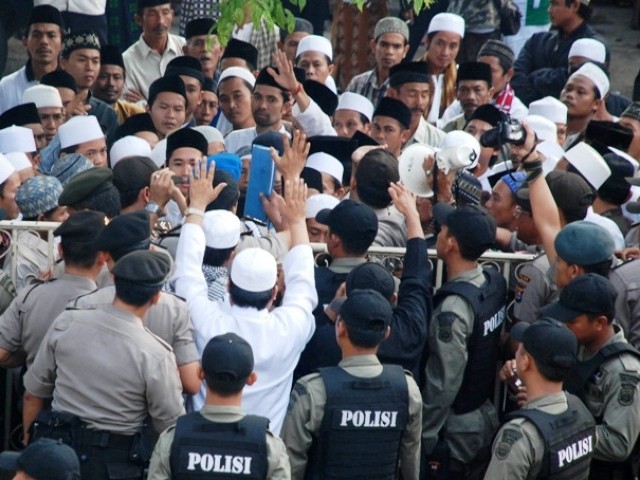
Indonesia policemen block Muslim supporters who are rallying in support for their friend, who was accused of assault on a Ahmadiyah follower, in Serang, Indonesia's Banten province July 28, 2011. PHOTO: REUTERS/FILE
Indonesia policemen block Muslim supporters who are rallying in support for their friend, who was accused of assault on a Ahmadiyah follower, in Serang, Indonesia’s Banten province July 28, 2011. PHOTO: REUTERS/FILE
JAKARTA: Indonesia on Friday dismissed expressions of outrage and disbelief over the perceived light sentences handed down to extremists who killed three minority sect members in a mob frenzy.

The United States and the European Union expressed strong misgivings while local rights groups and international watchdogs issued strong condemnations and calls for action to address rising intolerance in the mainly Muslim country.

But religious affairs ministry spokesman Zubaidi said the sentences of three to six months for the men accused of leading the murderous assault on the Ahmadiyah sect members in February were the result of a fair trial.

“As an executive body, we cannot interfere in the legal system. We believe in the law enforcers. They have the right to come up with the sentences,” he told AFP.

“Whether the sentences are light or harsh, how it’s perceived is relative.”

Indonesian President Susilo Bambang Yudhoyono, often held up by the United States and others as a champion of pluralism and democracy, made no comment on the sentences. Foreign ministry officials were unavailable to comment.

Human rights activists said prosecutors and the court in Serang, which handed down the verdicts, had been influenced by local Islamic leaders to play down the gravity of the crime.

They say religious violence against minorities is going unchecked in Indonesia, the world’s most populous Muslim-majority country, and criticise Yudhoyono for failing to defend the nation’s pluralist, moderate traditions.

But Zubaidi said the court was independent and its decisions could not be questioned.

“I don’t see that there has been any pressures from anyone. On the matter of intervention, I believe there was none,” he said.

The violence against the Ahmadiyah sect members in Cikeusik, western Java, was one of the most horrific in a long line of attacks on the minority group in Indonesia in recent years.

A secretly filmed video of the Cikeusik rampage sparked international concern when it appeared online within days of the attack.

Copyrighted © 2011 The Express Tribune News Network
URL: http://tribune.com.pk/story/219867/indonesia-rejects.../
 
^ Top of Page