Showing posts with label light sentences. Show all posts

Tuesday, November 15, 2011

Indonesia: Obama Should Press Rights Concerns

Human Rights Watch
Indonesia: Obama Should Press Rights Concerns
November 15, 2011

The Obama administration’s deepening relationship with Indonesia means being frank about Indonesia’s serious human rights challenges. Indonesian government indifference to mob violence against religious groups and brutality by soldiers against peaceful protesters are good places to start.
Elaine Pearson, deputy Asia director at Human Rights Watch
(Washington, DC) – US President Barack Obama has an important and timely opportunity to raise human rights issues with the Indonesian government when meeting President Susilo Bambang Yudhoyono this week in Indonesia, Human Rights Watch said today in a letter to Obama. He will travel to Bali for the Association of Southeast Asian Nations (ASEAN) Summit on November 19, 2011.

Obama should address key human rights challenges in Indonesia, including attacks on religious minorities, restrictions on freedom of expression, and the lack of accountability of Indonesian security forces for human rights abuses, especially in the easternmost province of Papua, Human Rights Watch said.

“The Obama administration’s deepening relationship with Indonesia means being frank about Indonesia’s serious human rights challenges,” said Elaine Pearson, deputy Asia director at Human Rights Watch. “Indonesian government indifference to mob violence against religious groups and brutality by soldiers against peaceful protesters are good places to start.”

On his last visit to Indonesia in November 2010, Obama made a point of praising Indonesia’s religious tolerance. However, in the last year, religious violence has become more frequent and deadly as Islamist militants have repeatedly mobilized mobs to attack religious minorities in their homes, places of worship, and community centers.

“Obama needs to temper his past praise of religious tolerance in Indonesia with some tough talk on religious freedom,” Pearson said. “He should press President Yudhoyono to end discriminatory laws and actively protect the country’s religious minorities.”

Human Rights Watch urged Obama to criticize the lack of accountability of security forces for continuing abuses, including extrajudicial killings and torture, in Papua and other areas. He should also raise concerns about Indonesian officials using vague and overbroad laws to prosecute the peaceful expression of political, religious, and other viewsin Papua and the Moluccas Islands. More than 100 activists are behind bars in Indonesia for peaceful acts of free expression. They include the former Papuan civil servant Filep Karma, who was sentenced to 15 years in prison after publicly calling for Papuan independence in December 2004.

“Obama should point out that as long as soldiers who commit torture get a few months in jail while peaceful activists get sentenced for years, Papuans are unlikely to have faith in Indonesian rule,” Pearson said. “He should urge Yudhoyono that to begin to win Papuans’ trust he should unconditionally release all political prisoners.”

Letter to President Barack Obama Regarding his Visit to Indonesia and Human Rights Issues

Human Rights Watch
Letter to President Barack Obama Regarding his Visit to Indonesia and Human Rights Issues
November 15, 2011

Barack Obama
President of the United States of America
The White House
1600 Pennsylvania Avenue NW
Washington, DC 20500

Via facsimile: +1-202-456-2461

Re: Visit to Indonesia and Human Rights Issues

Dear President Obama,

Your administration has placed great emphasis on its deepening relationship with Indonesia. We believe your trip to Bali for the East Asian Summit on November 19, 2011, is an important opportunity for you to raise human rights issues with the Indonesian government, both publicly and privately, including matters concerning freedom of religion, freedom of expression, and accountability of the military for human rights abuses.

Freedom of Religion

Last November, when visiting Jakarta, you visited the Istiqlal Grand Mosque and later made a speech at Universitas Indonesia in which you praised Indonesia’s “religious tolerance,” noting that the Istiqlal Mosque was built by a Christian architect.

In the last year, however, increasingly violent attacks on religious minorities by Islamist militants, combined with bans issued by provincial authorities, have severely undermined Indonesia’s record on this front.

Incidents of religious violence have become more deadly and more frequent in 2011, as Islamist militants have repeatedly mobilized mobs to attack religious minorities in their homes, places of worship, and community centers. According to the Setara Institute, which monitors religious freedom, religious attacks have increased from 135 incidents in 2007, 216 incidents in 2010 to 184 cases in the first nine months in 2011. Most attacks were committed with complete impunity. Police and prosecutors have failed to adequately investigate and prosecute cases, sending a chilling message that members of minority religious groups are not provided the same protections as other Indonesian citizens. Even the most deadly cases have resulted only in short prison terms for a handful of offenders.

Some Indonesian ministers, including the minister of religious affairs, Suryadharma Ali, have made multiple public statements that appear to legitimize religious discrimination and violence. President Yudhoyono has not demanded that officials retract or clarify such remarks.

Recently, the Ministry of Religions submitted a draft law on “religious harmony.” There are concerns, however, that rather than promoting tolerance, the law will simply compile existing discriminatory decrees into a single law and strengthen discrimination against religious minorities.

The government has failed to overturn several decrees that discriminate against minority religions and foster intolerance. A 2008 national government decree prohibits the Ahmadiyah, a group who consider themselves Muslim but who some Muslims consider to be heretics, from practicing their faith. At least 17 provinces and regencies in Indonesia have issued local decrees banning the Ahmadiyah faith in Indonesia. As recently as October 13, 2011, the mayor of Bekasi, near Jakarta, issued a decree banning all “Ahmadiyah activities” in the city, effectively closing down its six Ahmadiyah mosques.

Ahmadiyah have suffered some of the worst of the recent violence. In one of the worst religiously-motivated attacks in 2011, more than 1,500 Islamist militants attacked a house in Cikeusik, in western Java, in February, killing three and seriously wounding five Ahmadiyah men. The incident was recorded on video. Public outrage prompted the authorities to promise to investigate the attack. But in July the Serang district court sentenced 12 men to between just three and six months’ imprisonment for the crimes of disturbing public order, incitement, and assault. Police did not conduct thorough investigations, and prosecutors did not call key eyewitnesses to the attack. The prosecutors sought reduced sentences, contending that the Ahmadiyah provoked the attack. In August, the Serang district court convicted one of the Ahmadiyah members seriously injured in the attack, Deden Sudjana, for assault and disobeying police orders, sentencing him to six months’ imprisonment.

Other religious minorities have increasingly expressed fears about the rise in attacks since President Susilo Bambang Yudhoyono took office in 2004. In February of this year, militants attacked three churches in Temanggung, Central Java. The Semarang district court later convicted eight of the perpetrators, sentencing them to short sentences of between five months and one year in prison. In April, an Islamist suicide bomber attacked a police mosque in Cirebon, West Java, killing himself and injuring at least 28 people; the bomber had previously been involved in violent protests over a blasphemy trial and an anti-Ahmadiyah attack in Cirebon in 2010. In September, another Islamist suicide bomber attacked a Christian church in Solo, Central Java, killing himself and wounding 14 churchgoers.

Minority congregations have also reported that local government officials arbitrarily refuse to issue permits required under a 2006 decree on building houses of worship. Those who attempt to worship without a permit often face harassment and violence from local populations or police.

Given your past statements on religious tolerance, we believe you are uniquely placed to register these issues with President Yudhoyono and call on him to take urgent steps to address growing religious tensions. In particular, you should call on President Yudhoyono to use the influence and stature of his presidency to speak out against religious violence. He should also revoke the 2008 decree on the Ahmadiyah, order provincial authorities to repeal similar local decrees, review or revoke the 2006 decree on building houses of worship, and consider amending or repealing the 1965 blasphemy law, which designates six official religions in Indonesia. You should also urge him to ensure that Indonesian prosecutors and police are tasked to fully and fairly investigate and prosecute individuals and groups implicated in attacks, threats, and harassment of religious minorities, anywhere in the country.

Impunity for Abuses by the Military

Impunity for members of Indonesia’s security forces remains a serious problem, undermining the development of the rule of law in Indonesia. The military insists on policing itself, but military tribunals rarely charge soldiers even for serious abuses. When they do file charges, the proceedings lack transparency and the charges frequently fail to reflect the seriousness of the abuses committed. We have long recommended that civilian courts be given jurisdiction over soldiers who commit serious human rights abuses, but the military and the Indonesian government have refused. This greatly exacerbates the difficulty in bringing soldiers to justice.

On July 22, 2010, then-US Secretary of Defense Robert Gates formally announced the resumption of US military relations with Indonesia’s special forces, Kopassus, the last significant barrier to full-fledged US-Indonesian military ties. Secretary Gates articulated the standards agreed to by the US and Indonesian governments and militaries:

The Ministry of Defense has publicly pledged to protect human rights and advance human rights accountability and committed to suspend from active duty military officials credibly accused of human rights abuses, remove from military service any member convicted of such abuses, and cooperate with the prosecution of any members of the military who have violated human rights.

However, 18 months later, the Indonesia military has failed to live up to the pledges made by the Defense Ministry. Past problems persist: the Indonesian military still shows no inclination to adequately and transparently investigate soldiers and especially officers responsible for abuses, involve civilian authorities in their investigations, or ensure the safety of witnesses.

While a handful of military tribunals have been held in Papua, the charges have been inadequate and soldiers that committed abuses continue to serve in the Indonesian military.

For instance, in January, a military tribunal in Jayapura, Papua, convicted three soldiers from Battalion 753 and sentenced them to between eight to twelve months’ imprisonment for the extremely brutal torture of two Papuan farmers. Despite video showing the involvement of six soldiers, the tribunal tried only three of the six soldiers, and on lesser military discipline charges instead of torture. The soldiers have not been discharged.

In August, the Jayapura military tribunal convicted three soldiers from the same battalion after soldiers shot and killed Reverend Kinderman Gire on the suspicion he was a Papuan separatist. At the trial, the defendants claimed Gire led them to believe he was a member of the rebel Free Papua Movement (Organisasi Papua Merdeka, OPM) and tried to grab a rifle from one of them, who then shot him in the chest. They dumped the body in a river, after trying to cut off his head. Again, the tribunal convicted them of a lesser offense of “disobeying orders” and sentenced them respectively to just six, seven, and fifteen months in prison.

In August, internal military documents, mainly from Kopassus, were made public, exposing how the Indonesian military monitors peaceful activists, politicians, and religious clergy in Papua. The documents show the deep military paranoia in Papua that conflates peaceful political expression with criminal activity. Several of those named in the documents as targets have faced arbitrary arrest, imprisonment, harassment, or violence.

Recently, on October 17, the Indonesian police, backed by a detachment of military forces in armored personnel carriers, attacked a peaceful demonstration of the Papuan People’s Congress in Jayapura, killing at least three of the protesters and arresting approximately 300, including several of the event’s leaders (some of whom have traveled to the United States in the past and attended events with State Department officials and members of Congress). According to witnesses, police and army forces fired military assault weapons over the crowd and later pistol-whipped or beat the participants with rattan canes and batons, resulting in 96 injuries according to Indonesia’s Human Rights Commission. Hundreds of the protesters fled into a nearby forest, where at least three were killed under unclear circumstances –two died of gunshot wounds. We urge you to ask the Indonesian government what efforts are being made to investigate the deaths and injuries, and alleged excessive use of force by security forces at the demonstration.

We ask that you use the US’s deepening ties with the Indonesian government to press the military on its failure to hold its personnel to account for serious abuses. If the current situation prevails, the United States will increasingly be called to task for its uncritical support for the Indonesian military.

It would be very helpful if publicly and in your meeting with President Yudhoyono you were to raise concerns about recent military tribunals in Papua and the failure to bring those implicated in serious abuses to justice. The US should ask the Indonesian government for full disclosure of all military tribunal cases involving alleged abuses against civilians. Until the Indonesian government takes steps to hold perpetrators accountable, in line with the Leahy law, which prevents the US from cooperating with abusive military units, the US government should not participate in joint endeavors with military personnel or units implicated in abuses against civilians.

Intelligence Law

A new law on intelligence-gathering approved by Indonesian parliament on October 12 contains vague and overbroad language that the government could use to repress dissent and peaceful acts of free expression. The law also lacks a strong and transparent accountability mechanism. We urge you to raise concerns about the law with President Yudhoyono, and urge that it be revised to meet rule-of-law requirements and international due process standards. The president should immediately order an interim measure to limit any opportunity for the law’s misuse by setting up an independent oversight mechanism for the State Intelligence Agency (Badan Intelejen Negara, BIN).

Threats to Free Expression

In the years immediately after President Suharto was forced from power, Indonesia made huge strides in opening space for free expression and the media. But recent years have seen some troubling developments. Indonesian officials continue to enforce a number of laws that criminalize the peaceful expression of political, religious, and other views. These laws include offenses in Indonesia’s criminal code such as treason (makar) and “inciting hatred” (haatzai artikelen), which have been used repeatedly against peaceful political activists, particularly those from the Moluccas and Papua.

More than a hundred such activists are currently behind bars in Indonesia for peaceful acts of free expression. For instance, Filep Karma, a civil servant, made a speech in December 2004 in Jayapura that was critical of the government’s policies in Papua. He is currently serving a 15-year sentence in Abepura on charges of treason. Ruben Saiya, a farmer from the Moluccas, joined a protest dance in front of President Yudhoyono in an Ambon stadium in June 2007. He was sentenced to 20 years’ imprisonment for treason. And as noted above, several Papua leaders were recently arrested after holding an event in Jayapura.

Human Rights Watch takes no position on claims to self-determination in the Moluccas Islands and Papua. Consistent with international law, however, Human Rights Watch supports the right of all individuals, including independence supporters, to express their political views peacefully without fear of arrest or other forms of reprisal. Indonesian laws, however, consider these non-violent acts as “treason” with the maximum penalty of life imprisonment.

We urge that you raise your concerns on the right to free expression in Indonesia with President Yudhoyono, and particularly urge that you ask Indonesian authorities to unconditionally release Filep Karma, Ruben Saiya, and all prisoners held for the peaceful expression of their views. The Indonesian government should also amend or repeal laws that criminalize peaceful political expression and repeal laws that criminalize defamation and “insulting” public officials, which are subject to misuse by authorities and individuals seeking to silence criticism.

Thank you for your consideration. We look forward to working with the White House, the State Department, the Defense Department, and the US Embassy in Jakarta to address these concerns.

Sincerely,

Brad Adams
Executive Director
Asia Division

Tuesday, September 13, 2011

Indonesia’s Ahmadiyah Sect Fears Religious Violence

VOA News
Asia
Indonesia’s Ahmadiyah Sect Fears Religious Violence
Brian Padden | Jakarta September 13, 2011
Members of the Ahmadiyah community attend Friday prayers at the An-Nur Mosque in Manis Lor village, in Kuningan, West Java. Indonesian Foreign Minister Marty Natalegawa defended the country's judicial system after a court sentenced Muslim radicals to a few months in jail for killing members of the minority sect (File photo, August 5, 2011).Photo: AFP
Members of the Ahmadiyah community attend Friday prayers at the An-Nur Mosque in Manis Lor village, in Kuningan, West Java. Indonesian Foreign Minister Marty Natalegawa defended the country's judicial system after a court sentenced Muslim radicals to a few months in jail for killing members of the minority sect (File photo, August 5, 2011).

Last month, an Indonesian court sparked outrage over the light sentences handed out to 12 people accused of a deadly riot. The accused were part of a mob that targeted members of the Ahmadiyah Muslim minority sect, killing three of them.

Analysts say the light sentences were an example of what they say is Indonesia’s uneven justice system that can hand down unpredictable sentences.

An example is the case of Irwan Kristanto, who has been locked behind the doors of Pondok Rajeg prison for five months now. He is allowed to have visitors, but can not give a recorded interview.


The frail 29 year-old looks like he is barely 20. He explains that life here has been tough.

As a thief, the shy young man is forbidden to work in the orchard garden that stands in the middle of the concrete block. That is a job only accessible for those on a narcotics-related offense. But Irwan’s case is different from the murderers serving 20 year sentences. His crime was stealing two computer memory cards from an Internet café. Net value: $40.

Antonius Badar follows the Irwan case for the Indonesian legal aid group LBH Masyarakat. On Monday, he is visited Irwan’s parents, Hendri and Siti, to make sure they managed to get a copy of their son’s judgment.

“Sometimes, the district court doesn’t give this letter to the prison,” Badar says. “And the prison doesn’t know how long the prisoner should be in the prison. If Irwan didn’t have this letter, he could stay longer in prison.”

Irwan’s father, Hendri, describes a case that, he says, should not have ended with a young man with no prior police record sent to a hardcore jail.

Last February, he says, Irwan was spending time in an internet café, wondering how to better provide for his newly pregnant wife. In the spur of the moment he steals the two memory cards and leaves. But he forgot his cell phone and when he later returns to retrieve it, he is caught and sent to the police. A court later sentences him to 6 months in jail.

Rizal, owner of the Internet café, says that he now regrets having called the police. After a few hours Irwan apologized and his parents reimbursed the cost of the memory cards. Rizal says there was no real damage done and that should have been taken into account by the court.

Leopold Sudaryono, a researcher for the Asia Foundation, says the police have a quota system with financial incentives to prosecute such petty crimes.

“They have very limited amount of budget to process cases every month while at the same time each police station has quotas, a minimum amount of cases they have to bring to justice,” Sudaryono says. “Meaning what they are doing, they have to press charges for very petty crimes which will not require many operational costs to investigate. And usually the prosecutors just carry on with the cases.”

But there are other factors that contribute to uneven sentencing, which are highlighted in the Ahmadiyah case.

The maximum sentence given to the 12 people accused of taking part of the deadly attack on the minority sect was 6 months in jail. That is the same sentence Irwan received for his petty theft offense.

Leopold Sudaryono blames the police for the stark difference in the two sentences. He says police undermined the Ahmadiyah case after officers were widely accused of failing to stop the mob attack.

“So it is in the interest of the police, in the investigation of the case, not to substantiate that the violence is orchestrated,” he says.”If they investigate the case and provide the evidence otherwise, they will cut their own neck! That’s why they refer the case to the prosecutor as a weak case.”

Last week, Indonesia’s foreign minister refused to comment on the verdict or whether such light sentences would encourage more violence. Foreign Minister Marty Natalegawa told reporters the problem of religious intolerance is not Indonesia’s alone.

“I’m afraid when we speak of, for example, the whole issue of now outside the domain of the court, about the whole issue of religious intolerance or intolerance in general and all kinds of phobia, I’m afraid Indonesia doesn’t have a monopoly on that, unfortunately,” he said.

Indonesian public opinion polls indicate that law enforcement agencies are the least trusted institutions.

Irwan, the convicted thief, says as harsh as his sentence was, he has fared relatively well. He should be released on August 27, just in time he hopes, to be home for the birth of his first child, a baby girl, due on the same day.

Tuesday, August 9, 2011

Setara Accuses Police, Courts of Engineering Ahmadiyah Verdicts

Jakarta Globe, Indonesia
NEWS
Setara Accuses Police, Courts of Engineering Ahmadiyah Verdicts
Elisabeth Oktofani | August 09, 2011

The lenient sentences handed down to the killers of three Ahmadiyah followers were the result of “manipulated” legal proceedings, which began when police launched their preliminary investigation, a human rights group said on Monday.

Police limited the scope of the investigation and distracted the core issue to the point that Ahmadiyah members were blamed for the Feb. 6 attack, when they should have been recognized as victims, the Setara Institute for Peace and Democracy said.

“Instead of providing justice for the victims and getting the facts surrounding the incident, police constructed a story in which Ahmadiyah followers provoked the mob to attack them,” said Ismail Hasani, a researcher at the institute.

Police were too busy to defending their reputation, he said, to launch a fair and professional probe into the case.

Ismail said that during the incident in Cikeusik, Banten, officers were present at the scene but said they couldn’t control the mob or prevent them from assaulting the members of the minority Islamic sect. In order to avoid accusations of criminal negligence, he continued, police argued they had asked the Ahmadis to flee but the call was ignored.

From that point on, right up to the point the court verdicts were read, the Ahmadis were blamed for the attack, Ismail said.

Police arrested and charged 12 suspects in relation to the attack. Despite facing sentences of up to 12 years in jail, prosecutors recommended prison sentences of between five and seven months for the defendants.

On the other hand, prosecutors recommended nine months in jail for Deden Sujana, the head of security for the Indonesian Ahmadiyah Congregation (JAI), for allegedly provoking the attack.

The Serang District Court sentenced the attackers to between three and six months in jail, with the judge saying repeatedly that the Ahmadiyah members triggered the violence.

“We cannot blame the judicial system itself for the result because it might have been manipulated by the law enforcers, from the police to the prosecutors and the judge,” Ismail said.

Bonar Tigor Naipospos, Setara’s deputy chairman, said sectarian conflict would soon become a daily occurrence unless the government took serious measures against extremism.

“The main problem here is that there is no significant regulation to deal with the perpetrators of sectarian conflicts, especially if the perpetrators are coming from an Islamic group led by influential clerics,” Bonar said. “In such cases, law enforcement officials are hesitant to take serious action.”

According to the group, there were 99 sectarian conflicts or attacks in 13 provinces during the first half of the year. West Java experienced the most clashes, with 30 incidents.

“There were three major attacks in February, including in Cikeusik, Temanggung [Central Java] and Pasuruan [East Java],” Ismail said.

A violent mob burned down three churches in Temanggung, demanding that a Christian man be sentenced to death for insulting Islam. Also in February, hundreds of people set on the Yapi pesantren, or Islamic boarding school, which was accused of spreading Shiite teachings, injuring four students.

“Those three major clashes in February actually triggered more attacks in March and April,” he said. “Our reports show there were 24 incidents of religious violence in March and another 24 in April.”

Most of the incidents involved destruction of places of worship, accusations of apostasy, discriminatory regulations toward minority religions and forced conversions, particularly of Ahmadiyah members, the group said.

In March, 33 Ahmadiyah members living in Bogor decided to convert to mainstream Islam, following the wave of attacks and intimidation against sect members.

Copyright 2010 The Jakarta Globe
URL: www.thejakartaglobe.com/news/setara-accuses.../458073

Monday, August 8, 2011

Activists: Indonesia Hands Down Uneven, Unpredictable Justice

VOA News
Asia
Activists: Indonesia Hands Down Uneven, Unpredictable Justice
Solenn Honorine | Jakarta August 08, 2011
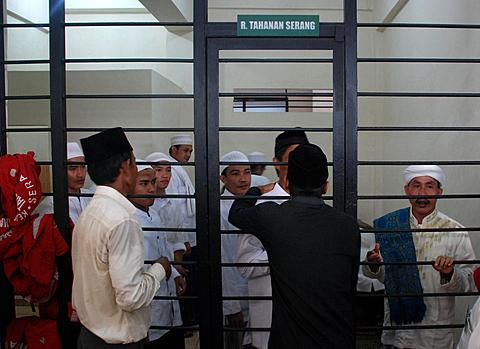
A group of Indonesian Muslims accused of attacking Ahmadiyah followers wait in a cell at a court room in Serang, Indonesia's Banten province July 28, 2011.Photo: Reuters
A group of Indonesian Muslims accused of attacking Ahmadiyah followers wait in a cell at a court room in Serang, Indonesia's Banten province July 28, 2011.

Last month, an Indonesian court sparked outrage over the light sentences handed out to 12 people accused of a deadly riot. The accused were part of a mob that targeted members of the Ahmadiyah Muslim minority sect, killing three of them.

Analysts say the light sentences were an example of what they say is Indonesia’s uneven justice system that can hand down unpredictable sentences.

An example is the case of Irwan Kristanto, who has been locked behind the doors of Pondok Rajeg prison for five months now. He is allowed to have visitors, but can not give a recorded interview.

The frail 29 year-old looks like he is barely 20. He explains that life here has been tough.

As a thief, the shy young man is forbidden to work in the orchard garden that stands in the middle of the concrete block. That is a job only accessible for those on a narcotics-related offense. But Irwan’s case is different from the murderers serving 20 year sentences. His crime was stealing two computer memory cards from an Internet café. Net value: $40.

Antonius Badar follows the Irwan case for the Indonesian legal aid group LBH Masyarakat. On Monday, he is visited Irwan’s parents, Hendri and Siti, to make sure they managed to get a copy of their son’s judgment.

“Sometimes, the district court doesn’t give this letter to the prison,” Badar says. “And the prison doesn’t know how long the prisoner should be in the prison. If Irwan didn’t have this letter, he could stay longer in prison.”

Irwan’s father, Hendri, describes a case that, he says, should not have ended with a young man with no prior police record sent to a hardcore jail.

Last February, he says, Irwan was spending time in an internet café, wondering how to better provide for his newly pregnant wife. In the spur of the moment he steals the two memory cards and leaves. But he forgot his cell phone and when he later returns to retrieve it, he is caught and sent to the police. A court later sentences him to 6 months in jail.

Rizal, owner of the Internet café, says that he now regrets having called the police. After a few hours Irwan apologized and his parents reimbursed the cost of the memory cards. Rizal says there was no real damage done and that should have been taken into account by the court.

Leopold Sudaryono, a researcher for the Asia Foundation, says the police have a quota system with financial incentives to prosecute such petty crimes.

“They have very limited amount of budget to process cases every month while at the same time each police station has quotas, a minimum amount of cases they have to bring to justice,” Sudaryono says. “Meaning what they are doing, they have to press charges for very petty crimes which will not require many operational costs to investigate. And usually the prosecutors just carry on with the cases.”

But there are other factors that contribute to uneven sentencing, which are highlighted in the Ahmadiyah case.

The maximum sentence given to the 12 people accused of taking part of the deadly attack on the minority sect was 6 months in jail. That is the same sentence Irwan received for his petty theft offense.

Leopold Sudaryono blames the police for the stark difference in the two sentences. He says police undermined the Ahmadiyah case after officers were widely accused of failing to stop the mob attack.

“So it is in the interest of the police, in the investigation of the case, not to substantiate that the violence is orchestrated,” he says.”If they investigate the case and provide the evidence otherwise, they will cut their own neck! That’s why they refer the case to the prosecutor as a weak case.”

Last week, Indonesia’s foreign minister refused to comment on the verdict or whether such light sentences would encourage more violence. Foreign Minister Marty Natalegawa told reporters the problem of religious intolerance is not Indonesia’s alone.

“I’m afraid when we speak of, for example, the whole issue of now outside the domain of the court, about the whole issue of religious intolerance or intolerance in general and all kinds of phobia, I’m afraid Indonesia doesn’t have a monopoly on that, unfortunately,” he said.

Indonesian public opinion polls indicate that law enforcement agencies are the least trusted institutions.

Irwan, the convicted thief, says as harsh as his sentence was, he has fared relatively well. He should be released on August 27, just in time he hopes, to be home for the birth of his first child, a baby girl, due on the same day.

Accepting Others Is Indonesia’s Homework

Jakarta Globe, Indonesia
OPINION
Accepting Others Is Indonesia’s Homework
Nicholaus Prasetya | August 08, 2011

A police talks with three defendants of Ahmadiyah attack in Cikeusik during the first trial at Serang District Court, Banten, April 26, 2011. (Antara Photo/Asep Fathulrahman)
Sadly, the barometer of intolerance continues to rise. While the perpetrators of the latest incident — in which two houses used as churches in Riau were burned to the ground — have not been found, it seems to be in line with many other acts of intolerance happening across Indonesia.

What makes the Riau incident worse is that it happened during the holy month of Ramadan, a time of peace and devotion recognized by Muslims around the world.

The attack also served to keep other similar events in the front of Indonesians’ minds. It was only about a week ago when the people who led the mob that attacked and killed members of the Ahmadiyah sect in Cikeusik were sentenced to just a few months in prison. One of the Ahmadiyah followers, meanwhile, was given a nine-month prison sentence. It also recalled the Temanggung rampage, when a Catholic church there suffered damage from a mob inflamed by religious intolerance.

Another lingering indication that intolerance is become the norm in Indonesia is the GKI Yasmin Church in Bogor. There is still no agreement on where the GKI members may conduct their services, since the local authorities have barred them from their church. They have been forced to pray on the side of the road, making them an easy target for passers-by, who shout in protest, objecting to the public display of a minority religion.

While church members are harassed for standing up for their beliefs, hard-line Islamic groups in Jakarta easily conducted protests and marches in advance of Ramadan, causing traffic chaos. The Islamic Defenders Front (FPI) met no resistance with their protest several days ago, where they demanded that the government ban Ahmadiyah. Indeed, the FPI seems to be able to do whatever it wants, wherever and whenever it wants, with no intervention by police or authorities. How is this justified?

What is at stake in all these incidents is Indonesia’s reputation for tolerance, which is often praised but in reality is no longer deserved. If we are a tolerant country, what, exactly, are we tolerating?

It appears that tolerance in Indonesia has come to mean tolerance based upon loyalty among people who share the same values. Or taking it further, tolerance is only for those who have power and dominate a given area or region.

This fact is clearly seen in the case of the FPI. Do the police “tolerate” the FPI simply because it has a large following and powerful leaders? Looking at it the other way, should Indonesia “tolerate” those who attacked and killed Ahmadiyah followers simply because the Ahmadiyah are a tiny minority? Does that justify the lenient court verdicts?

This is the paradox when it comes to discussing tolerance. On the one hand, tolerance is easily applied to members of the majority, even in cases where the law has been broken. On the other hand, people from religious minorities consistently bear the brunt of intolerance.

Real tolerance for minorities cannot come about just by listening to the words of our leaders. It has to take root in reality. Only talking about tolerance is nonsense, as can be seen from so many recent cases. Sadly, there is often simply no room for minorities.

This is also part of the paradox of a democratic country: the majority can easily control the law, and minorities, who are supposedly equal, are often repressed. This is a paradox that goes back as far as Socrates and is not easily resolved. In a democracy, what should be right can be made wrong, simply because enough people demand it. Those with the power and the numbers can enforce their will.

As a diverse country with a large Muslim majority, we must have the courage to not allow our many minorities to be dominated by the majority. Religious tolerance should not be based on power. But this seems hard to achieve given the existence of extremists who undoubtedly also play an important role in our democratic society. As a result, the Indonesian government fails to protect minorities and develop and promote the values of real tolerance. At a time when these values are most needed, the virtues of tolerance are being neglected.

Two things are lacking here. One is communication. As the philosopher Jurgen Habermas has noted, in a diverse democratic community, effective communication is vital because without it consensus cannot be reached.

But a consensus must be reached in Indonesia free of coercion and domination. The nature of the extremist groups in our society shows that they cannot share their ideology and thoughts in a peaceful manner; they will not engage in reasoned debate and discussion. Their manner is rigid and cagey — they feel they are always right. If they are opposed by anyone, they resort to intimidation.

We need to change our perception of the limits of freedom. Our social contract with one another imposes limits on our absolute freedom and those limits are what allow society to function. What one group believes is absolutely correct may not be consistent with the rights of others, especially religious minorities.

This is why people need to practice tolerance through communication in their daily lives. We need to build not simple relativism but a real appreciation of differing views.

This is the great homework that has to be done immediately by the Indonesian government and its people. If intolerance cannot be stopped, diversity in Indonesia will be lost.

Nicholaus Prasetya is currently a student at the Bandung Institute of Technology (ITB).

Saturday, August 6, 2011

Pluralism, Tolerance in Indonesia Under Growing Threat

Jakarta Globe, Indonesia
HOME
Pluralism, Tolerance in Indonesia Under Growing Threat
Zubaidah Nazeer-Straits Times Indonesia | August 06, 2011

Groups like Nahdlatul Ulama (above) and Muhammadiyah are being squeezed out by the raucous voices of radical organisations such as the Islamic Defenders Front. (AFP Photo)
Indonesia’s two largest Muslim groups count a third of the country’s population as followers, but appear to be losing ground in shaping the national conversation about Islam.

Drowned out by the raucous voices of Islamic political parties and confrontational hardline groups, Nahdlatul Ulama (NU) and Muhammadiyah are being squeezed out of the picture, which analysts fear could ultimately damage Indonesia’s brand of pluralism and tolerance.

The two groups boast a combined membership of 80 million and share a common goal of upholding Islamic teachings, but increasingly, it is the political parties and radical groups that are pushing the boundaries and setting the pace in trying to define what Islam stands for with their attacks on what they deem immoral behavior and deviant practices.

In 2008, for instance, the Prosperous Justice Party (PKS) lobbied for an anti-pornography law which banned some traditional cultural dances that were considered too sexy. Meanwhile, radical groups like the Islamic Defenders Front (FPI) and Hizbut Tahrir have made the headlines for attacking religious minorities such as the Ahmadiyah sect.

‘The order now has changed,’ said Broto Wardoyo, an analyst in terrorism studies at the University of Indonesia.

‘Political parties have taken on greater weight while groups like the Hizbut Tahrir have grown louder. They are easily heard, seem to attract an audience and can be remembered better.’

This development worries some Islamic scholars such as Zuhairi Misrawi, chairman of the Moderate Muslim Society, who fear an erosion of religious freedom if groups like NU and Muhammadiyah fail to speak up loudly enough and do more to put their stamp on community issues.

Zuhairi’s non-governmental organisation comprises mainly academics and intellectuals.

Agreeing, Syafi’i Anwar of the International Centre for Islam and Pluralism, added that sensational acts by radicals tend to grab attention.

NU and Muhammadiyah ‘need to find a way to remain in people’s minds’, he said.

That could prove challenging for the two organisations which were founded with relatively simple aims: to preserve Islamic teachings and provide community services.

NU, which turned 85 years old just three weeks ago, was set up by religious leaders, while Muhammadiyah, which is 99 years old, was founded by a Muslim scholar.

Together, they run more than 30,000 mostly religious schools across Indonesia.

NU is the bigger of the two, is seen as more traditional and has a large network of village boarding schools. Muhammadiyah, with 30 million members, draws a more middle-class crowd. It runs orphanages, hospitals and charity foundations.

With 80 per cent of the country’s 240 million people identifying themselves as Muslims - making Indonesia home to the world’s largest Muslim population - the role of these two organizations in shaping Islamic thought is crucial: Their messages are seen as able to influence even Muslims who are not their members.

Once they too had formidable political clout.

After the fall of President Suharto in 1998, NU and Muhammadiyah leaders set up rival political parties. Amien Rais, leader of Muhammadiyah, formed the National Mandate Party while Abdurrahman Wahid, better known as Gus Dur, set up the National Awakening Party, and later became president between 1999 and 2001.

However, in the past few years, especially after Gus Dur’s death in 2009 and as civil society blossomed, the political influence of both groups has waned even as extremist voices become louder.

Ms Robin Bush of the Asia Foundation in an opinion piece noted: ‘There is a perception expressed within both organisations that they are facing an identity crisis as the country modernizes.’

Added Mr Broto: ‘In the past, we used to identify people by their membership of the NU or Muhammadiyah. Now we say this person is PKS, this person is FPI, that other person is Hizbut Tahrir.’

The radical groups have also become emboldened by their seeming ability to get away with little or no punishment for acts like raiding stalls selling alcoholic beverages and killing Ahmadiyah sect members.

The authorities’ weak response, said Syafi’i, is ‘allowing such radical groups to hog the limelight’.

The numbers of hardliners are small, estimated at less than 1 per cent of the population, but their voices are louder because their extreme acts draw media coverage.

Some observers believe that a number of these groups are funded by political or military elites for their own interests. Law enforcers, meanwhile, hesitate to rein them in for fear of being seen as anti-Islam.

To be sure, both Muhammadiyah chairman Din Syamsudin and NU chairman Said Aqil Siraj have done their bit to condemn the actions of radicals. ‘We have been doing a lot of work such as preaching the positive side of Islam in our schools, holding seminars and talks, but they are not reported,’ said Said.

‘It does not mean we are not doing such work. Our plans are still running and we remain relevant.’

Analysts agreed that Muhammadiyah and NU still have an important role to play in nurturing the moderate ground, given their huge grassroots networks.

But to make sure their message gets through, the NU youth wing last month formed a new unit. Called Densus 99 - after the crack Densus 88 anti-terror squad - its mission is to counter the spread of radical views among the young.

Reprinted courtesy of Straits Times Indonesia.

Friday, August 5, 2011

Foreign Minister Defends Indonesian Judiciary in the Wake of Ahmadiyah Verdicts

Jakarta Globe, Indonesia
NEWS
Foreign Minister Defends Indonesian Judiciary in the Wake of Ahmadiyah Verdicts
August 05, 2011

Foreign Minister Marty Natalegawa on Friday defended the country’s judicial system after a court sentenced Muslim radicals to a few months in jail for killing members of a minority sect.

The sentences handed down last month to 12 defendants over a deadly lynch mob attack on members of the Ahmadiyah community in February shocked human rights groups and drew criticism from the United States and the European Union.

But in his first public response to the outrage, Natalegawa defended the independence of Indonesia’s courts and said the mainly Muslim archipelago was not the only country to suffer from religious intolerance.

“There is an obvious delineation between the executive, the judiciary and legislative branches,” he said in response to a reporter’s question.

The Cambridge-educated minister said “heinous acts” were being committed all over the world due to religious intolerance, but he did not address concerns that light sentences for hate crimes only encourage more killings.

“I’m afraid when you speak of the whole issue of religious intolerance and all kinds of phobia … Indonesia doesn’t have a monopoly on that unfortunately,” he said.

A secretly filmed video of the rampage in Cikeusik, western Java, sparked international concern when it appeared online within days of the attack.

The footage shows police fleeing the scene as the enraged mob – armed with machetes and knives and shouting abuse at the “infidels” – launch an unprovoked attack on a house owned by an Ahmadiyah follower.

A handful of Ahmadiyah men tried to defend the property with stones and slingshots but they were quickly overwhelmed.

The mob then clubbed, hacked and stoned three defenseless men to death in front of police, and stood around joking over their bodies. Several Ahmadiyah tried to flee but were hunted down and badly beaten.

None of the 12 men punished over the incident was charged with murder, and none received more than six months in jail, including the ringleader and a 17-year-old who was filmed smashing a victim’s skull with a stone.

Prosecutors managed to convince the court that the video and the victims’ refusal to flee the property justified a reduced sentence for the killers. In the end the sentences were even lighter than requested by the state.

Ahmadiyah, unlike mainstream Muslims, do not believe Mohammed was the last prophet and are regarded as heretics and blasphemers by conservatives in countries such as Indonesia and Pakistan.

AFP

British MP’s Call Indonesia to Uphold Human Rights

Jakarta Globe, Indonesia
NEWS
British MP’s Call Indonesia to Uphold Human Rights
Jakarta Globe | August 05, 2011

Ujang, a defendant in the Feb.6 attack on Ahmadiyah followers in Cikeusik, jokes with supporters as codefendants greet and receive encouragement from visitors during their trial. (JG Photo/Heru Andriyanto)
In the latest wave of international condemnation over the ‘lenient sentences’ handed out to a extremist mob, British MPs are calling for Indonesia to uphold human rights and squash religious intolerance.

British MP Siobhain Mcdonagh, who is also chair of the UK All Party Parliamentary Group for the Ahmadiyya Muslim Community said the light sentences was in stark contrast with Indonesia’s “reputation for tolerance.

“I am shocked at the sentences given to the perpetrators of these brutal murders. These verdicts show a disturbing shift in the country’s commitment to freedom of religion and justice.”

The light sentences, which raged from three to six months, were issued last week by a court in Serang District Court, Banten to 12 men found guilty of attacking members of Ahmadiyah community in Cikeusik, West Java.

The attack was captured on video, shocking the world, as it showed the mob hacking three of the members to death.

Now the trivial sentences have once again attracted global condemnation.

The National President of the Muslim Community in the UK, Rafiq Hayat said the “ineffectual sentences” handed out by the Indonesian justice system had essentially condoned mob violence and religious intolerance by extremists.

“Victims of recent attacks also include Christians and members of other faiths, but can include anyone who may disagree with the extremists.”

Rafiq said Indonesia must become the leading light for the Muslim world and permit true freedom of religion.

“It must not fall prey to the extremist mindset that will fan the flames of intolerance and will eventually consume the nation.”

Vice-Chair of the UK All Party Parliamentary Group for Human Rights Lord Eric Avebury commented that the verdict was a huge setback for Indonesia in particular its justice system.

“The fact that a longer sentence is being sought by prosecutors for an Ahmadi Muslim who defended his property during the attacks than for those who killed three innocent Ahmadi Muslims is deplorable.”

Lord Eric said what was more frightening was the ‘legal shadow’ cast over the whole of the Ahmadiyah community ever since extremists have attempted to make the faith illegal.

“We see where this has led in Pakistan, with wholesale massacres, assassinations, destruction of mosques and exclusion from public life,” he said. “Indonesia for its own sake must avoid going down the same path.”

As a signatory to the International convention on Civil and Political rights, Lord Eric said Indonesia must uphold its obligations.

“Its constitution guarantees freedom of expression but the reality seems to be that the government is caving in to pressure from religious extremists under the threat of violence,” he said.” The Ahmadiyah community must be given full freedom of religion as must Christians and all citizens of Indonesia.”

The Ahmadiyah community is a global Islamic religious movement that despite being in Indonesia since its creation has remained a minority group.

It numbers around 200,000 out of Indonesia’s population of 220 million.

In 2008 the minority group became subject to the Joint Ministerial decree which forbids Ahmadiyah followers from promoting their activities and spreading their faith.

Critics of the degree have blamed it for inciting religious intolerance and attacks on the minority group.

Siobhan said in the aftermath of the Cikeusik attacks she summoned Indonesia to honor its commitments to freedom of religion, and to repeal its 2008 Joint Ministerial decree against the Ahmadiyah community and to hold those committing acts of violence against religious communitis to be held to account.

“This motion has been widely supported with 45 MPs signing up,” she said. “Indonesia must step up to the challenge of tackling extremists who threaten the peace of the country.”

Friday, July 29, 2011

Indonesia rejects outrage over anti-Ahmadi mob sentences

Express Tribune, Pakistan
World
Indonesia rejects outrage over anti-Ahmadi mob sentences
By AFP
Published: July 29, 2011
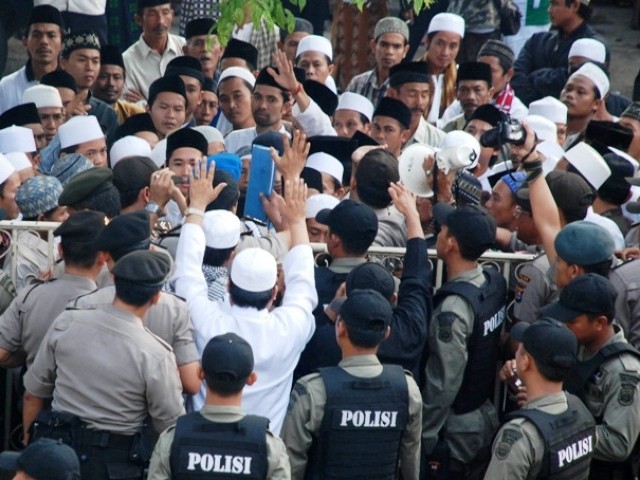
Indonesia policemen block Muslim supporters who are rallying in support for their friend, who was accused of assault on a Ahmadiyah follower, in Serang, Indonesia's Banten province July 28, 2011. PHOTO: REUTERS/FILE
Indonesia policemen block Muslim supporters who are rallying in support for their friend, who was accused of assault on a Ahmadiyah follower, in Serang, Indonesia’s Banten province July 28, 2011. PHOTO: REUTERS/FILE
JAKARTA: Indonesia on Friday dismissed expressions of outrage and disbelief over the perceived light sentences handed down to extremists who killed three minority sect members in a mob frenzy.

The United States and the European Union expressed strong misgivings while local rights groups and international watchdogs issued strong condemnations and calls for action to address rising intolerance in the mainly Muslim country.

But religious affairs ministry spokesman Zubaidi said the sentences of three to six months for the men accused of leading the murderous assault on the Ahmadiyah sect members in February were the result of a fair trial.

“As an executive body, we cannot interfere in the legal system. We believe in the law enforcers. They have the right to come up with the sentences,” he told AFP.

“Whether the sentences are light or harsh, how it’s perceived is relative.”

Indonesian President Susilo Bambang Yudhoyono, often held up by the United States and others as a champion of pluralism and democracy, made no comment on the sentences. Foreign ministry officials were unavailable to comment.

Human rights activists said prosecutors and the court in Serang, which handed down the verdicts, had been influenced by local Islamic leaders to play down the gravity of the crime.

They say religious violence against minorities is going unchecked in Indonesia, the world’s most populous Muslim-majority country, and criticise Yudhoyono for failing to defend the nation’s pluralist, moderate traditions.

But Zubaidi said the court was independent and its decisions could not be questioned.

“I don’t see that there has been any pressures from anyone. On the matter of intervention, I believe there was none,” he said.

The violence against the Ahmadiyah sect members in Cikeusik, western Java, was one of the most horrific in a long line of attacks on the minority group in Indonesia in recent years.

A secretly filmed video of the Cikeusik rampage sparked international concern when it appeared online within days of the attack.

Copyrighted © 2011 The Express Tribune News Network
URL: http://tribune.com.pk/story/219867/indonesia-rejects.../

Thursday, July 28, 2011

Indonesia: Verdicts a Setback for Religious Freedom

Human Rights Watch
Indonesia: Verdicts a Setback for Religious Freedom
Investigate All Involved in Deadly Attack on Ahmadiyah Community
July 28, 2011
A still shot from a video showing the assault of Ahmadiyah muslims by a group of assailants in Banten province in Western Java on Sunday, January 6. Source: Private
A still shot from a video showing the assault of Ahmadiyah muslims by a group of assailants in Banten province in Western Java on Sunday, January 6.
Source: Private
Indonesian authorities should be making all-out efforts to bring to justice those who kill people because of their religious beliefs. The Cikeusik trial sends the chilling message that attacks on minorities like the Ahmadiyah will be treated lightly by the legal system.
Elaine Pearson, deputy Asia director at Human Rights Watch
(Jakarta) — The light sentences imposed on Islamist militants for a deadly attack on a religious minority in Indonesia reflect the authorities’ weak efforts to prosecute the case, Human Rights Watch said today. The verdicts, announced on July 28, 2011, are a setback for religious freedom in Indonesia, Human Rights Watch said.

Human Rights Watch said both police and prosecutors failed to present a fully compelling case against the 12 defendants for their role in an organized attack on the Ahmadiyah community in Cikeusik village, Banten province in western Java on February 6 that left three people dead and five seriously injured. Police did not conduct thorough investigations, and prosecutors did not call key eyewitnesses to the attack. The prosecutors also sought reduced sentences, contending that the Ahmadiyah provoked the attack.

“Indonesian authorities should be making all-out efforts to bring to justice those who kill people because of their religious beliefs,” said Elaine Pearson, deputy Asia director at Human Rights Watch. “The Cikeusik trial sends the chilling message that attacks on minorities like the Ahmadiyah will be treated lightly by the legal system.”

The Serang district court in Java found 12 persons guilty on a mixture of charges, including public incitement, illegal possession of sharp weapons, destruction of property, maltreatment of others, individual assault, participating in an assault, involvement in an attack, and attacking others causing serious injuries or death. The court sentenced the accused to between 3 to 6 months in prison. Assault resulting in death can bring a maximum penalty of 12 years in prison.

None of the defendants were charged with murder or manslaughter.

Much of the attack on the Ahamadiyah home, which involved some 1,500 Islamist militants against about 20 Ahmadiyah members, was captured on video and posted on the Internet.

At the trial, which began on April 26, prosecutors only recommended sentences of up to seven months, saying that the sentences should be reduced since the Ahmadiyah members partly provoked the attack and filmed and distributed videos of the attack. By contrast, in a separate trial against an Ahmadiyah member, Deden Sujana, for his alleged role in provoking the attack, the prosecutors have charged him with incitement, disobeying police orders, and maltreatment. One of those charges, disobeying police orders, provides a maximum sentence of four years.

“It’s outrageous that the prosecutors asked for a reduction in sentences on the basis that the Ahmadiyah filmed and distributed a video of the attack on their community,” Pearson said. “It is telling victims of serious crime that they should keep quiet rather than come forward.”

Arif, an Ahmadiyah present during the attack, made the recording of the violence, which was later posted on YouTube. The police and prosecutors used the 28-minute video in their investigation. The 12 defendants were identified from the video footage and can be seen beating Ahmadiyah members.

The three Ahmadiyah members killed – Warsono Kastolib, Roni Pasaroni, and Tubagus Chandra – died of multiple injuries sustained during the attack, forensic reports said. In the footage, a 17-year-old defendant, “D.,” whose name was withheld because he is a child, hits Kastolib, who is sitting next to a hedge, on the head with a large stone. According to the prosecution, D. then struck the fallen Kastolib six times in the head with a wooden stick. The prosecutors also said that D. later struck Pasaroni, who was lying motionless, with a wooden stick. The prosecutors said that Chandra was killed when the crowd caught him next to the Ahmadiyah house.

Police investigations of the attack were woefully inadequate, Human Rights Watch said. Police interviewed Arif and two of the five Ahmadiyah who were seriously injured, but failed to question other Ahmadiyah who were injured or present during the attack or to ask them to testify.

“An extremely well-organized group of attackers targeted a religious minority group, yet the authorities have made no apparent effort to uncover the people behind the attack,” Pearson said. “The police shouldn’t rest until those who orchestrated the violence are arrested.”

One of those seriously injured, Muhamad Ahmad, told Human Rights Watch that he was not given an opportunity to testify at the trial.

“I might not recognize them, one by one, but I could describe the situation,” he said. “We were just trying to defend our properties. Hundreds of Ahmadiyah properties were destroyed and the government did almost nothing.”

Sujana, the Ahmadiyah being tried on charges of provoking the attack, was the only Ahmadiyah member asked to testify. He was berated by a judge about his faith and his motivations in going to Cikeusik that day, a scene videoed and available on YouTube. Responding to a question from the judges, prosecutors claimed they could not find the addresses of other witnesses, although two of them later testified at Sujana’s trial.

“The Cikeusik trial should have been a way to show vulnerable groups in Indonesia that when they are targets of violence, the state will protect them,” Pearson said. “Instead, these sentences will embolden militants who will see that using deadly violence brings few consequences.”

Background
The Ahmadiyah, a religious community founded in 1889 by Mirza Ghulam Ahmad, identify themselves as Muslims but differ with other Muslims about whether Muhammad was the “final” monotheist prophet. Consequently, some Muslims perceive the Ahmadiyah as “heretics.” Approximately 200,000 Indonesians follow the faith.

Indonesian law facilitates discrimination against the Ahmadiyah. A June 2008 decree requires the Ahmadiyah to “stop spreading interpretations and activities that deviate from the principal teachings of Islam,” including “spreading the belief that there is another prophet with his own teachings after Prophet Muhammad.” Violations of the decree can result in prison sentences of up to five years.

At the time the 2008 decree was signed, officials said it was necessary to help stop further violence. Yet since the decree, violence against the Ahmadiyah has increased dramatically, from three incidents in 2006 to 50 in 2010, according to the Setara Institute, a nongovernmental group that monitors religious freedom.

Few cases of violence against religious communities make it to court in Indonesia. When cases are brought to trial, the sentences for those convicted rarely match the seriousness of their crimes. In a trial that began in January in Bogor district court, three defendants were tried for setting fire to an Ahmadiyah mosque, a school, and more than a dozen houses in an October 2010 attack in Cisalada village, western Java. Three Ahmadiyah were injured in the attack. On April 14, the defendants were found guilty and sentenced to prison terms of between four and six months, while an Ahmadiyah man who tried to defend himself from attack was sentenced to nine months in prison.

Earlier in 2011, more than a dozen provincial governors and regents issued anti-Ahmadiyah regulations, contradicting Indonesia’s Autonomy Law, which prohibits regional governments from regulating religious matters. Human Rights Watch has repeatedly called for the government of President Susilo Bambang Yudhoyono to rescind the 2008 decree, as it violates the fundamental right to freedom of religion. The Home Affairs Ministry should also annul all regional regulations on religions.

Prohibiting the Ahmadiyah from practicing their religion violates the International Covenant on Civil and Political Rights, ratified by Indonesia in 2005, which protects the right to freedom of religion and the right to engage in religious practice “either individually or in community with others and in public or private.” The treaty also protects the rights of minorities “to profess and practice their own religion.”

 
^ Top of Page