Showing posts with label West Nusa Tenggara. Show all posts

Saturday, August 27, 2011

Idul Fitri Brings Little Cheer to Ahmadi Shelter

Jakarta Globe, Indonesia
NEWS
Idul Fitri Brings Little Cheer to Ahmadi Shelter
Fitri | August 27, 2011

Ahmadiyah families in Transito shelter, Mataram, West Nusa Tenggara.
Mataram, West Nusa Tenggara. Nothing has changed at the Transito shelter in the five and a half years that it has served as home to 138 members of the beleaguered Ahmadiyah Islamic sect.

A sixth successive Idul Fitri in cramped conditions without even the most basic of amenities beckons, with no word on when they will be allowed to return to their home village of Gegerung in West Lombok, from where they were driven out by fellow Muslims in February 2006.

The electricity to the shelter was cut off three years ago, food aid from the government — which has perpetuated their limbo by refusing them the right to return home or register as residents of Mataram — was halted last year, and sanitation facilities are non-existent.

A stipend from the state was stopped in 2007. Not being registered residents, they have been denied the free gas stoves distributed by the government to all citizens, and they now resort to gathering scrap to burn as fuel.

“It’s the durian season now, and people are throwing out lots of durian husks. We’re collecting those to fire our stoves,” says Munikah, one of the shelter’s inhabitants. “We can’t afford to use kerosene because it costs Rp 12,000 [$1.40] a liter.”

The women band together in preparing the predawn and sunset meals during Ramadan, crowding the shelter’s corridor as they toil over smoky stoves. The meals themselves are basic, heavy on starchy ingredients to mask the lack of vegetables or meat. However, they carry on fasting like most other Muslims.

Clothes for the Kids

The rest of the country may be in a festive mood with the approach of Idul Fitri — and its attendant indulgences such as family reunions, hearty meals and the buying of new clothes — but at Transito, it will be just another day of trying to scrape by.

All that Munikah is hoping for before then is that her husband can bring home a little more than the Rp 25,000 per day he typically makes through cutting hair at a nearby market.

“It’d be nice if he got a little something extra for Idul Fitri so we could at least get the kids some new clothes,” she says. “But if that doesn’t happen, they won’t be too disappointed.”

After living so long at the shelter, the Ahmadiyah children have grown more accepting of their situation, says Basir Aziz, a local Ahmadi elder. “There are 50 children here, 16 of whom were born in this shelter,” he says.

“This year they seem a lot more resilient and upbeat. They don’t feel marginalized. They’re showing a tremendous passion to study and practice their faith, despite all they’ve been through.”

The life at the shelter is the only one that 6-year-old Ida knows. Asked if her parents had bought her new clothes for the holiday, she responds with a maturity beyond her years. “I’ve got the clothes from last year. They’re still fine,” she says with a smile.

Nor do they complain about the partially collapsed ceiling in their prayer hall, or the fact that all 33 families here are forced to share crowded living quarters, with only flimsy partitions of cardboard and rags mounted on bamboo frames giving privacy.

No More Tears

“When the kids play, they’re never sad,” says Hairudin, an Ahmadi who earns Rp 5,000 a day as a coolie at the local market.

“They’ve become used to all this after almost six years. We’ve got no more tears. We have to take what we get.”

For Hairudin and the other Ahmadis, sorrow is an emotion they dare not indulge. “If I broke down in sadness just thinking about how we got hounded out of our homes, I wouldn’t be able to go to work each day, and that would be the biggest problem for my family,” he says.

“That’s why we don’t think about that anymore. Tears are a luxury we can’t afford. All we can do now is just think about how to get through each day.”

H. Mahmulludin, an Ahmadi elder, agrees there is no use being bitter about the past.

He bears no grudge against the local authorities, who last year raised the ire of human rights activists with a plan to exile all Ahmadis in West Lombok to a remote island and bar them from plans to develop the region as a top tourist draw.

“The governor has resolved all the differences between us in a peaceful manner,” he says. “The violence against us has stopped, and that helps a lot.”

What also helps, Mahmulludin says, is a weekly stipend from local community leaders.

But that pales in comparison to what they would have received if the government had agreed to compensate them for the homes they left behind in Gegerung.

In what activists have highlighted as just another example of discrimination against the Ahmadis, they have been denied compensation or the option of selling their homes, even as the government bars them from going back to inhabit them.

Continuing Pogrom

Despite this, there have been several attempts by some of the Ahmadis to return and farm their land while keeping a low profile. However, they have been routinely chased out by other villagers, who have branded them “a stain on this village” that “must be cleaned out.”

In the most recent incident, last November, local authorities themselves led the pogrom of the Ahmadis, forcing men, women and children to flee with their belongings.

Those who remained behind had their homes burned by a mob, while others vowed to keep coming back to farm their land.

“If I farm, at least I’m making a living, whereas at Transito I have no hope for a meaningful life,” said Sarim, one of the Ahmadis targeted last November.

Nobody was prosecuted for the attack, and the local administration did not compensate for losses, which the victims estimated at Rp 735 million.

For Munikah and the other mothers forced to watch their children grow up in what has become a refugee camp, the hope that there will ever be a resolution to the community’s plight and that they may one day return to their homes has dwindled along with the sadness.

All that remains, Munikah says, is a sense of resignation and just an iota of optimism that maybe — just maybe — Idul Fitri this year will herald a change for the better.

Copyright 2010 The Jakarta Globe
URL: www.thejakartaglobe.com/news/idul-fitri.../462042

Tuesday, May 3, 2011

‘Victim’ Reveals Sinister Workings Of NII Recruiters

Jakarta Globe, Indonesia
HOME
‘Victim’ Reveals Sinister Workings Of NII Recruiters
Fitri R. | May 03, 2011

Rights activists have claimed to see disturbing similarity in the deadly mob attack on an Ahmadi community, above, in Cikeusik, Banten, in February, and religious violence targeting Christians in Central Sulawesi and Maluku, below, from 2000-07. Activists say both conflicts show evidence of being instigated by agent provocateurs. (AP, AFP, JG Photos)
After weeks of tweaking and trials and errors, an activist at a prominent human rights group was finally able to connect his laptop computer to an old 32-inch cathode-ray tube television at home.

Although he had seen it about 20 times already, Hendi (not his real name) was eager to watch the 40-minute video of the bloody attack on the Ahmadiyah minority sect in the Cikeusik subdistrict of Banten on a screen with a much bigger resolution than that of his laptop.

“I’m curious to learn who these people who wear the blue and green ribbons are. The fact that they wear ribbons to distinguish friends from foe suggests that they don’t know each other,” he told the Jakarta Globe after asking not to reveal his identity because he was far from concluding his research.

Witnesses say around 20 attackers wearing the ribbons on their jackets and shirts were among the first to arrive at the scene on Feb. 6 and could be seen provoking others to attack a house belonging to an Ahmadi. More than 1,000 people eventually joined the assault which resulted in the death of three Ahmadis.

Hendi said he was curious how the attackers, who witnesses say were not from the area, knew which house to attack.

Obsessed with learning who these people were, Hendi scrutinized every frame of the video, listening to a barrage of sounds and noises and scribbling in his notebook every time he heard an audible conversation.

“They were highly skilled in martial arts, can be seen provoking the masses to attack Ahmadiyah and simply vanished just minutes into the riot,” he concluded, adding that this was precisely the pattern found in scores of sectarian conflicts that sprung up after the fall of Suharto.

Finding the Mastermind

Hendi said that he became fixated on digging up the truth that many of his activist friends chose to ignore after the Al Jazeera television station in March reported closer ties being forged by hard-line groups and several retired military generals.

The activist said that unless police were able to apprehend the provocateurs, the mastermind behind the Cikeusik attack would never be revealed.

But Hendi is not alone. Mufti Makaarim, executive director of the Institute for Defense, Security and Peace Studies, also thinks that there is more to the attack than meets the eye.

“Rogue elements within the military have used radical Muslims as proxies before to create diversions or push certain political agendas. They don’t want to be linked directly to sectarian conflicts,” he said, adding that religious violence had been used in the past to de-legitimize civilian-controlled governments.

Chep Hermawan, head of the Islamic Reform Movement (Garis), a hard-line group, has said that several retired generals had approached radical Muslim groups one month prior to the Cikeusik attack in a bid to topple President Susilo Bambang Yudhoyono by exploiting mainstream Muslims’ resistance toward the Ahmadiyah.

Chep named them as former Army chief of staff Gen. (ret.) Tyasno Sudarto; Maj. Gen. (ret.) Muchdi Purwoprandjono, former commander of the Army’s Special Forces (Kopassus); Maj. Gen. (ret.) Kivlan Zen, former commander of the Army’s Strategic Reserve Command (Kostrad); and Gen. (ret.) Fahrul Razi, a former deputy chief of staff.

IDSPS’ Mufti seemed hardly surprised. “These are old players,” he said.

Similar Patterns

In his book, “Civil Islam: Muslims and Democratization of Indonesia,” anthropology professor Robert Hefner said that during the Suharto regime, the government made use of hard-liners to act as agent provocateurs to de-legitimize criticisms toward his rule, particularly when calls were mounting for him to step down at the height of the 1997-98 Asian Financial Crisis. In the book, Hefner details numerous reports and anecdotes that detail links between the military and hard-liners.

He writes that during the May 1998 riots in Jakarta, a group of unidentified men started burning and looting businesses and homes owned by ethnic Chinese. The men provoked ordinary civilians to follow suit and by the time security forces arrived they had vanished, similar to Hendi’s observations of the Cikeusik attack 12 years later.

A similar pattern was reported during a religious conflict in East Java a year earlier, with efforts to break ties between the Nahdlatul Ulama, led by future President Abdurrahman “Gus Dur” Wahid, and syncretist Javanese Muslims.

NU probes quoted witnesses as saying that groups of men dressed in “ninja” outfits had been killing Muslims clerics as well as people believed to be black-magic sorcerers. But a series of rumors that sprang up after the violence would omit mention of the ninja-clad attackers and allege that the Muslim clerics and sorcerers had in fact been killing each other.

It would not be the last time such tactics would be reported.

In 2000, a string of religious conflicts between Muslims and Christians erupted in Poso, Central Sulawesi, and Ambon, Maluku. Several rights groups cited witnesses reporting ninja-clad bands of people killing both Muslim clerics and Christian priests.

Then-President Gus Dur accused a Maj. Gen. “K” and a civilian named “Gogon” to be behind in the conflicts in Poso and Ambon. But until he was forced to resign in 2001, Wahid never disclosed the full identities of those he accused.

At the time, Kivlan was one of only two major-generals in the military with that initial.

“Gogon” is the reported nickname of Ahmad Sumargono of the conservative Indonesian Islamic Propagation Council (DDII), a long-time friend of Muchdi and later a politician of the Star Crescent Party (PBB.)

Conflicts in Ambon and Poso went on until 2007, ending after the National Police toured the area with FPI leader Rizieq Shihab, who urged remnants of the Muslim militias to join FPI and fight new enemies: immorality and blasphemous sects. Some former militia members chose to join the Jemaah Islamiyah terror network.

Military Might

After the fall of Suharto in May 1998, the new government formed fact-finding teams to investigate the cause of the Jakarta riots as well as the kidnapping and murder of 14 student activists, according to Hefner.

In October 1998, one team probing the kidnapping of activists released its findings and concluded that it was conducted by a special unit inside the Army Special Forces Command (Kopassus). The team deemed former Kopassus commander Prabowo Subianto and his successor, Muchdi, responsible for the crime.

Prabowo would later go on to found the Great Indonesia Movement Party (Gerindra). Muchdi would go on to head the National Intelligence Agency (BIN). In 2009 he would be controversially acquitted for the 2004 murder of rights activist Munir Said Thalib.

In a postscript addendum after he concluded research into his book in November 1999, Hefner wrote that most disturbances at the time bore the telltale signs of agent provocateurs.

“Although its leaders have been removed from the heights of government, advocates of state terror remain ensconced in segments of the military and bureaucracy. The dismantlement of their shadowy network of vigilantes and gangsters will be one of the greatest challenges facing democratic Indonesia,” he wrote.

For Hendi, the evidence is still up for debate. But the patterns he says he sees are undeniable.

“What is intriguing for me about the Cikeusik attack is that it doesn’t follow the same pattern as other cases of violence on Ahmadiyah involving hard-liners,” Hendi said. “The attack bears more resemblance to the ones seen during the sectarian conflicts in Ambon or Poso.

“I think there is a good indication that one of the martial arts groups associated with a military figure might be involved.

“But unless police are able to arrest one of the provocateurs or at least have someone who would identify who they are and where they’re from, we won’t know who the true masterminds are.”

Thursday, February 3, 2011

HRW News Release: Hate Crimes Against Religious Minorities a Troubling Trend

Jakarta Globe, Indonesia
HOME
HRW News Release: Hate Crimes Against Religious Minorities a Troubling Trend
February 03, 2010

New York. Indonesian police should arrest those responsible for attacking an Ahmadiyah congregation in South Sulawesi province and protect vulnerable religious minorities throughout the country, Human Rights Watch said in a statement released on Thursday.

On Jan. 28, 2011, police “evacuated” members of an Ahmadiyah congregation from their mosque in Makassar, the capital of South Sulawesi, amid increasingly threatening protests by members of a militant Islamist group, the Islamic Defenders Front (FPI). FPI militants then attacked the mosque, destroying property and breaking windows.

“Indonesian police may have thought they were taking the Ahmadiyah out of harm’s way, but they let the mob go on a rampage,” said Elaine Pearson, deputy Asia director at Human Rights Watch. “The authorities need to send a message that hate crimes won’t be tolerated by prosecuting those responsible.”

The attack on the Ahmadiyah community in South Sulawesi underscored a troubling trend in Indonesia, Human Rights Watch said. Religious extremists are harassing religious minorities, particularly members of the Ahmadiyah community, and law enforcement officials are failing to hold those responsible to account. The Setara Institute for Peace and Democracy, a Jakarta-based group working on religious freedom, recorded 50 cases of attacks in 2010 against the Ahmadiyah community.

In the Makassar attack, hundreds of FPI protesters gathered on Jan. 27 outside the mosque, where hundreds of Ahmadiyah were holding an annual prayer ceremony, the Jalzah Salanah and demanded that they end the ceremony. Jamaluddin Feli, the Ahmadiyah imam in Makassar, told Human Rights Watch that the community tried to speed up the ceremony and that some members left the following morning.

When the mob returned at around 4 p.m. the next day, members of the Ahmadiyah congregation barricaded themselves inside. At about 8 p.m., the South Sulawesi chief of police, Insp. Gen. Johny Waenal Usman, arrived and asked the congregation members to evacuate the building for their safety. They initially refused, saying that it was their property, and held hands to prevent being removed. Police entered the mosque and pressured the Ahmadiyah to leave with them in trucks to the police station.

Feli said most of the congregation members agreed to leave and asked the police to guard the mosque from the protesters. As the main group of Ahmadiyah left, the protesters broke into the mosque and yelled at the remaining Ahmadi members to leave – some congregation members had remained in the center, hidden upstairs. By 10 p.m. all of the remaining Ahmadiyah members had left. The police provided no protection to the mosque and did not intervene when the mob smashed the windows, committed vandalism, seized financial records and tore down religious placards.

The Indonesian authorities’ pattern of ineffectiveness reflects a political, legal, and social framework that propagates a culture of religious discrimination, Human Rights Watch said. Since August, Religious Affairs Minister Ali Suryadharma has repeatedly called for the Ahmadiyah faith to be banned in Indonesia. President Susilo Bambang Yudhoyono has failed to repudiate those statements, leading many to believe that he supports such an action.

In recent years Islamist militants have repeatedly attacked and burned Ahmadiyah homes and mosques. Anti-Ahmadiyah violence has increased since Yudhoyono announced a prohibition on teachings or public displays of the Ahmadiyah religion in June 2008.

In July 2010, municipal police and hundreds of people organized by militant Islamist groups forcibly tried to close an Ahmadiyah mosque in Manis Lor village. On October 1, mobs attacked the Ahmadiyah community in Cisalada, south of Jakarta, burning their mosque and several houses.

The Ahmadiyah faith was founded in what is now Pakistan in 1889 by Mirza Ghulam Ahmad. The Ahmadiyah community is banned in Pakistan and Saudi Arabia, and has come under attack in Bangladesh. There are approximately 200,000 Ahmadis in Indonesia.

The Ahmadiyah identify themselves as Muslims but differ with other Muslims as to whether Muhammad was the “final” monotheist prophet. Consequently, some Muslims perceive the Ahmadiyah as heretics.

Indonesian law facilitates discrimination against the Ahmadiyah. The June 2008 decree requires the Ahmadiyah to “stop spreading interpretations and activities that deviate from the principal teachings of Islam,” including “spreading the belief that there is another prophet with his own teachings after Prophet Muhammad.” Violations of the decree can result in prison sentences of up to five years. Human Rights Watch has consistently called for the government to rescind this decree, as it violates the right to freedom of religion. At the time of signing the decree, officials said it was necessary to help stop further violence.

“The 2008 decree has not stopped violence against the Ahmadiyah community, as officials said it would, but fueled further hatred and intolerance,” Pearson said.

Prohibiting the Ahmadiyah from practicing their religion also violates the International Covenant on Civil and Political Rights, ratified by Indonesia in 2006, which protects the right to freedom of religion and to engage in religious practice “either individually or in community with others and in public or private.” The treaty also protects the rights of minorities “to profess and practice their own religion.”

“The Makassar violence is not an isolated incident – time and again the police are ineffective in protecting religious minorities,” Pearson said. “Indonesia’s reputation as a rights-respecting country will suffer unless President Yudhoyono acts to end the violence against the Ahmadiyah and lifts the ban on their religious practices.”

Rights watch condemns police lax on Ahmadiyah attack

NATIONAL
Thu, 02/03/2011
6:40 PM
Rights watch condemns police lax on Ahmadiyah attack
Ina Parlina, The Jakarta Post, Jakarta
Human Rights Watch condemned the National Police for “tolerating” hate crimes in South Sulawesi during the attack of an Ahmadiyah congregation recently.

“The Indonesian Police may have thought they were taking the Ahmadiyah out of harm’s way, but they let the mob go on a rampage,” Elaine Pearson, deputy Asia director at Human Rights Watch said Thursday. “The authorities need to send a message that hate crimes won’t be tolerated by prosecuting those responsible.”

On January 28, 2011 police “evacuated” members of an Ahmadiyah congregation from their mosque in Makassar of South Sulawesi, amid increasingly threatening protests by members of the Islamic Defenders Front (FPI). The FPI later attacked the mosque, destroying property and breaking windows.

Elaine added that the police should arrest those responsible for attacking an Ahmadiyah congregation in South Sulawesi, as well as protect vulnerable religious minority groups throughout the country.

She asserted that the attack on the Ahmadiyah community in South Sulawesi underscored a troubling trend in Indonesia.

“Religious extremists are harassing religious minorities, particularly members of the Ahmadiyah community, and law enforcement officials are failing to hold those responsible to account.”

The Setara Institute for Peace and Democracy, a Jakarta-based group working on religious freedom, recorded 50 cases of attacks in 2010 against the Ahmadiyah community.

Thursday, January 27, 2011

Rally Rages Outside Bogor Court Trial on Ahmadiyah Village Attack

Jakarta Globe, Indonesia
NEWS
Rally Rages Outside Bogor Court Trial on Ahmadiyah Village Attack
Elisabeth Oktofani | January 27, 2011

Bogor. Over 1,000 Muslim hard-liners surrounded a district court in Bogor on Wednesday, demanding the immediate release of three youths standing trial for an attack on an Ahmadiyah community last year.

Dede Novi, 18, Aldi Afriansyah, 23, and Akbar Ramanda, 17, are accused of destroying property and inciting violence during an October riot in Cisalada village, according to indictment documents.

The three were said to be part of a mob that burned down houses, schools and a mosque at the Bogor village, home to 600 members of the Ahmadiyah, a minority Islamic sect deemed deviant by mainstream Muslims for their different beliefs on the Prophet Muhammad.

The crowds that came out in support of the defendants on Wednesday, however, slammed these accusations.

Though police had barred them from entering the courtroom, the protesters reportedly “became incensed” when the defendants’ lawyer told them about a witness who said Dede had set the At-Taufiq Mosque and an Ahmadiyah Koran on fire.

Ari Saputra, a resident in Cisalada, testified on Wednesday that Dede could have thrown a Molotov cocktail at the mosque.

“I cannot be sure that he really was the one who threw the Molotov cocktail, but I saw that he was part of the group,” Ari told the court, led by Judge Astriwati.

Dede, however, denied throwing the fire bomb, but admitted at the hearing that he was part of the group which set the village mosque on fire.

A second witness, Mubarik Ahmad, a Cisalada resident and an Ahmadi, said he saw the three defendants break into and torch the mosque.

“I saw them. They were among hundreds who came to our village that night and attacked. They were brutal,” Mubarik said. “They threw stones at the mosque, broke its windows and set it on fire. Others came on motorbikes and made noises with their horns.

“They burned and destroyed so much property in our village,” he added. “That evening, our only concern was how to stay alive.”

After being informed of Mubarik’s statements, the angry crowds outside the courtroom began to yell out that the witness was a liar.

Protesters also tried to attack Mubarik as he left the courtroom under tight police guard.

Amid Wednesday’s unrest, hundreds of security personnel were deployed to Cisalada and the Cibinong District Court, where the trial was held.

The three defendants are accused of violating the Criminal Code, particularly Article 406 on the destruction of property and Article 170 on assault.

Article 406 carries a maximum sentence of two years and eight months in jail, while Article 170 carries a punishment of up to five years and six months.

Agus Sulaiman, one of the protesters, said the people of Bogor would “never accept the presence of the Ahmadiyah.”

“What is worse is that they built an Ahmadiyah information center in our village,” said Agus, a resident of Ciampea subdistrict.

“If they don’t stop this, we will stop them. We will burn their properties,” he said. “They call themselves followers of Islam. This is what we cannot accept.”

Agus said many conservative Muslims in the area detested the sect for believing that Ahmadiyah founder Mirza Gulam Ahmad was the last prophet.

This runs counter to mainstream Islamic beliefs which reserve that distinction for the Prophet Muhammad.

Copyright 2010 The Jakarta Globe
URL: www.thejakartaglobe.com/home/rally-rages...attack/419272

Crowd bullies Ahmadi at trial, disrupts courtroom

HEADLINES
Thu, 01/27/2011
11:02 AM
Crowd bullies Ahmadi at trial, disrupts courtroom
Hans David Tampubolon, The Jakarta Post, Jakarta
An elderly man was harassed by a rowdy mob on Wednesday as he testified in court about the destruction the property of Ahmadiyah followers in Ciampea, Bogor.

Mubarik Ahmadari came to the Cibinong District Court in Bogor on Wednesday to testify about the attack against his fellow Ahmadiyah members in October.

The 70-year-old man was greeted by more than 1,000 anti-Ahmadiyah protesters. Members of the crowd claimed to be residents of Ciampea who came to support the alleged arsonists on trial: Dede Novi, Aldi and Akbar.

The protesters jammed the courtroom. Many had to stand outside. Throughout the trial, unruly protesters in the courtroom were heard yelling, demanding that the judges drop all charges against the suspects and that the government disband Ahmadiyah.

Despite the clamor, Mubarik remained calm and told the court a version of events that was vociferously rejected by onlookers. He seemed unfazed by the constant din of mockery and hate-filled comments directed at him.

However, even after giving his testimony, Mubarik found that his day was not over yet.

As Mubarik finished his testimony he went to exit the courtroom. Protesters blocked his path. Some stood at the doors. Others tried to grab him.

Police officers were there to protect the witness from what looked to be a potential savage beating at the angry rabble’s hands. After a brief scuffle, officers safely escorted Mubarik out of the courtroom.

Mubarik was one of four witnesses heard in Wednesday’s court session.

Around 20 people attacked Cisalada village in Ciampea in October, vandalizing and setting fire to the community’s mosque and the homes and vehicles of Ahmadiyah followers.

Hendardi, a human rights activist from the Setara Institute, said what happened to Mubarik was evidence that intolerance had become a dangerous disease in Indonesia.

“The fact that a man could be terrorized at a court of law is a horrific occurrence in the life of our nation,” Hendardi told The Jakarta Post over the telephone on Wednesday.

“This shows how the state is completely helpless in ensuring the basic human rights of its citizens,” he added.

Hendardi said that if the state continued to fail to impose strict punishment on violent fundamentalists, then violent acts, such as the those perpetrated on Mubarik and other Ahmadiyah followers, would continue.

Followers of Ahmadiyah have come under attack in recent years from Islamic hardliners who believe that the sect follows a heretical version Islam.

While the earliest recorded attacks against Ahmadis date to the early 1950s, it was not until 2005 that violence intensified dramatically.

In 2010 alone there were 10 recorded attacks against Ahmadis throughout the archipelago.

The government drew criticism from human rights activists for symbolically condoning violence against Ahmadis after Religious Affairs Minister Suryadharma Ali said that it would be better if the Ahmadiyah sect was “disbanded”. Suryadharma is also the chairman of the United Development Party (PPP), an Islamic-based political party.

Tuesday, January 25, 2011

Governor Wants Lombok Tolerant, but Ahmadiyah-Free

Jakarta Globe, Indonesia
NEWS
Governor Wants Lombok Tolerant, but Ahmadiyah-Free
Nivell Rayda | January 25, 2011

Senggigi beach on Indonesia's Lombok. The island's governor wants to turn Lombok into a top holiday destination, but only if the minority Ahmadiyah leave the island. (Reuters Photo)
Lombok, Indonesia. West Nusa Tenggara’s governor dreams of turning Lombok into a top holiday destination, rich in culture and known for interreligious harmony — but only if a minority Muslim sect is out of the picture.

Zainul Majdi says that he did not see why the Ahmadiyah should be part of the island’s plans to follow in the footsteps of neighboring Bali, a noted tourist hotspot.

Ahmadis, Zainul said, would be better off moving out of the province entirely or agreeing to a proposal to relocate to a remote island in West Nusa Tenggara.

The governor said the sect — maligned by mainstream Muslims for believing that Ahmadiyah founder Mirza Ghulam Ahmad was a prophet, in opposition to Islamic tenets — did not fit into his drive to ramp up Lombok’s tourist appeal.

Zainul, a politician from the conservative Prosperous Justice Party (PKS), said he planned to promote dozens of traditional festivals to draw in more visitors.

The main highlight, he says, is Perang Topat, or rice cake war, a festival observed by both Hindus and Muslims in Lombok.

It is celebrated after Ramadan, the Islamic month of fasting, at the Lingsar Temple, a Hindu shrine in West Lombok.

The governor said he was eager to promote the rice cake festival as an example of the province’s cultural diversity and religious tolerance.

However, such tolerance was called into question by some residents in Mataram, who said the Ahmadiyah members had suffered through mob attacks, the closure of their mosques or eviction from their homes.

“The relationship between Muslims and Hindus is harmonious. Conservative Muslims also live side by side with other Islamic communities which still conform to animistic beliefs. How can Muslims be so violent toward the Ahmadiyah?” said Gusti, a Hindu driver in Mataram.

But Zainul, who referred to the sect as “my Ahmadiyah brothers,” said the only solution to tensions was to “get them out of the province” or move them to the remote village of Teluk Sepi in southern Lombok.

“Ahmadiyah had never been a problem. It was only after they formed their own community, maintaining their exclusivity and proselytizing their faith did friction with surrounding areas occur,” he said.

Copyright 2010 The Jakarta Globe
URL: www.thejakartaglobe.com/news/governor...free/418631

Monday, January 24, 2011

Hounded Indonesia Muslim Group Still in Dire Straits

Jakarta Globe, Indonesia
NEWS
Hounded Indonesia Muslim Group Still in Dire Straits
Nicholaus Prasetya | January 24, 2011

Mataram, West Nusa Tenggara. Last year, Faizah used the money she had painstakingly saved over the course of four years to rebuild the home that had been destroyed in a 2006 mob attack.

Last year, though, the village of this mother of four came under attack again, with Faizah and her neighbors being forced to flee.

A former resident of Gegerung village in West Lombok, Faizah is a member of Ahmadiyah, a minority Muslim sect deemed deviant and constantly harassed by mainstream Muslim groups.

On Nov. 26, more than a hundred people ransacked the village, with police standing by idly.

Speaking to the Jakarta Globe at a temporary shelter that houses around 500 displaced Ahmadiyah members in Mataram, the provincial capital, Faizah said that although her home was spared in the November incident, people did loot her possessions — and continue to do so.

“I am too afraid to return home,” she said. “I have been told there are still people taking away tiles from the roof of my home, stealing the wooden beams, taking everything I have. I believe all that’s left is just the skeleton of my former home.”

November’s violence was the third attack against the Ahmadiyah group in West Nusa Tenggara in recent years. Like most residents of Gegerung, Faizah and her family moved there from Selong village in neighboring East Lombok, where hard-line groups reduced their houses to rubble. Nobody was prosecuted for the attack, and the local administration did not compensate for losses.

In fact, amid intensifying calls to ban the sect, the central government issued a decree in 2008 that prohibited its members from practicing their faith in public and from spreading its beliefs.

“Before the [2006] incident, we lived harmoniously with [non-Ahmadiyah] residents,” Faizah said. “We prayed at the same mosques. They visited us like neighbors do. Some of them borrowed soap and kitchen utensils. There was never any tension.”

She accused firebrand clerics for fueling hatred toward the Ahmadiyah and intolerance in the district.

“There was this one man, Syafii. He used to borrow money from us. We were very nice to him and treated him like a family member. But when the attackers came, he joined them in destroying our homes,” Faizah said. “I guess the provocateurs brought out the worst in him.”

The only protection the government offered the displaced Ahmadiyah members was to relocate them to the Transito building complex in Mataram — an abandoned facility once used to temporarily house migrant workers.

More than 500 homeless Ahmadiyah members were cramped into the 600-square-meter facility. Four years on, the government seems to have forgotten about the displaced as they now live with hardly any running water, proper sanitation, electricity or financial assistance.

What was supposed to be a temporary solution seems to have become permanent. There have been no signs from the local administration that the Ahmadiyah members will be allowed to return to Gegerung.

Zubaidah, 52, another displaced Ahmadiyah member, agreed to show the 3-meter by 4-meter booth she shares with her two daughters, their husbands and her six grandchildren. The structure is in the corner of one of the 150-square-meter rooms in the run-down facility.

Up to 10 families occupy a single room, each with its own booth, partitioned off with bamboo poles, cardboard and pieces of fabric.

With such limited space, children are forced to play in the small hallways and toddlers are left to lie on the dirty tile floor as their mothers prepare meals in a small, makeshift kitchen outside.

Each family has its own kitchenette constructed of bamboo and a corrugated iron roof. The kitchenettes are dark, blackened by the fumes of kerosene stoves. Some poorer families cook with wood.

“Five years we have been neglected. In five years, government officials have never set foot in this place to check our condition or to listen to our problems,” Zubaidah said.

“Just once, in 2009, did they come — to erect a booth for the legislative and presidential elections, so that those of us who still had valid ID cards could vote.”

Those whose ID cards have expired have great difficulties in getting them extended because of their disputed residency status.

The grim conditions at the shelter have left some families willing to return to their village, despite knowing that police and the government have refused to vouch for their safety.

“The conditions at the shelter are unbearable to some, so many have reluctantly ventured to other cities and provinces,” said Jauzi Djafar, spokesman of the West Nusa Tenggara chapter of the Indonesian Ahmadiyah Congregation (JAI).

Jauzi added that the local government has refused to grant the displaced Ahmadiyah members ID cards, even though such cards are compulsory in Indonesia.

Without an ID card it is almost impossible for the Ahmadiyah members — having lost virtually all their belongings in the attacks — to apply for jobs, obtain a driver’s license or a passport for the hajj pilgrimage.

“Mataram refuses to give the displaced ID cards because officially they are residents of West Lombok district,” Jauzi said. “But the district argues they should apply for Mataram residency because they have been living here for years.”

All the displaced can do is work at local plantations or — like Faizah — make a living as a small-scale vendor.

Copyright 2010 The Jakarta Globe
URL: www.thejakartaglobe.com/news/hounded...straits/418628

Monday, January 17, 2011

MUI fatwa feeds flames of clerics’ hate speech

SPECIAL REPORT
Mon, 01/17/2011
10:10 AM
MUI fatwa feeds flames of clerics’ hate speech
The Jakarta Post
The animosity faced by followers of Ahmadiyah in Ketapang hamlet in West Lombok, West Nusa Tenggara, peaked on Oct. 19, 2005, a few months after the Indonesian Ulema Council (MUI) issued a second fatwa against the nation’s most persecuted religious minority.

Local resident Zulkhair Mujib vividly recalls the day.

He said local firebrand cleric Izzi Muslim, speaking at a mosque through a loudspeaker, called for the expulsion of the 130 Ahmadis in the hamlet.

“Ahmadiyah is a deviant and deviating faith. I tell you, if the residents of Ketapang don’t banish the Ahmadis, I will ask people in Central Lombok to do so,” Zulkhair quoted Izzi as preaching.

“If the people in Ketapang do not join us in attacking the Ahmadis, I will burn their houses,” Izzi continued.

The hate speech led to the first attack on Ahmadis in Ketapang, but failed to drive them out of the village.

Zulkhair said people became angry because of the failure, with Izzi strengthening his vow to continue efforts to expel the Ahmadis.

On Feb. 4, 2006, locals made another attempt to drive the Ahmadis out. This time, they succeeded.

Dozens of Ahmadi families now have no other option than to live in a refugee camp in Mataram, probably for the rest of their lives.

The MUI has repeatedly brushed off allegations that its irresponsible and controversial fatwa triggered the attacks on the Ahmadiyah followers.

Analysts said several clerics were actively spreading hate speech, using the MUI fatwa as a platform to vilify Ahmadiyah.

On July 28, 2005, at its seventh national congress in Jakarta, the MUI reiterated a 1980 fatwa that said Ahmadiyah strayed from Koranic teaching and ordered the government to outlaw the group.

The point of contention between the MUI and the Ahmadis, the MUI claims, centered around the refusal of Ahmadis to acknowledge Muhammad as the last prophet of Islam.

The MUI said the debacle would end if Ahmadis formed their own religion by ridding themselves of all pretensions to Islam.

“The government is obliged to ban the spread of Ahmadiyah across Indonesia, disband the organization and outlaw its activities,” the fatwa signed by then MUI chairman Umar Shihab and secretary Din Syamsuddin (now chairman of Muhammadiyah, the nation’s second-largest Muslim organization after the Nahdlatul Ulama), read.

Muhammadiyah is widely seen as the voice of moderate Islam.

The MUI fatwa was issued at a time of growing pressure from hard-line Muslim groups who wanted the MUI — which consists of representatives from major mainstream Muslim groups in the country — to take a firmer stance on the issue.

Zukhair said that only weeks after the MUI edict was issued, religious congregations in West Lombok were becoming increasingly critical of Ahmadiyah, fomenting hatred against the Ahmadis among the general public.

Izzi confirmed he had made harsh speeches about the Ahmadis, but said he was only citing the MUI fatwa in his rhetoric. He said he was convinced Ahmadis were heretical and had no place in Indonesia.

“The people cannot accept Ahmadiyah. We can accept Hindus and Christians because they do not blaspheme against Islam,” he said.

“If you ask me whether Islam condones violence toward the Ahmadis, let me ask you this: Are others allowed to commit blasphemy against Islam?”

A report issued by the National Commission for Human Rights (Komnas HAM) in 2006 indicated systematic efforts to spread anti-Ahmadiyah sentiment.

The report said religious justifications, such as the fatwa, were used as a pretext to persecute Ahmadiyah.

Subki Sasaki, a Muslim cleric from Central Lombok, said hatred among locals could be prevented if clerics distanced themselves from the language of hate.

He said locals could coexist despite religious differences, citing the existence of Islam Sasak or Wetu Telu followers, whose faith also differs from mainstream Islam.

“People are susceptible to indoctrination by religious leaders. When the fatwa was issued, religious leaders conveyed the fatwa to a subservient public. So when people are incited to attack, they will.”

— Additional reporting by Panca Nugrah
— JP/Arghea Desafti Hapsari

In Jakarta, Ahmadis left relatively unscathed

SPECIAL REPORT
Mon, 01/17/2011
9:23 AM
In Jakarta, Ahmadis left relatively unscathed
The Jakarta Post
The Al-Hidayah mosque on Jl. Balikpapan in Harmoni, Central Jakarta, was quiet at noon on Tuesday last week.

A man sitting at a food stall outside the mosque gate greeted visitors. “You want to pray? Just go inside. The gate’s not locked.”

The 57-year-old mosque used to be the center of the Ahmadiyah organization in Indonesia.

Located in a crowded residential area, the mosque is just several hundred meters to the south of the notorious drug trafficking center of Kampung Bali and just 2 kilometers east of Jakarta’s infamous district on Jl. Hayam Wuruk and Jl. Mangga Besar.

Despite its grim location, the Ahmadis who pray or hold other activities at the mosque have so far been spared from the violence that has plagued their compatriots in other parts of the archipelago.

An estimated 10,000 Ahmadis currently reside in the capital, according to Ahmadiyah spokesman Zafrullah Pontoh

Muslim hardliners living far from the area protested against the existence of the mosque in 2005 and 2008. Local residents are mostly indifferent.

“I don’t really care about religious differences and the like,” said one resident, who asked to be identified as Yeni.

“As long as they don’t bother us when doing their activities, they can have a place here,” she added.

Around 15 kilometers west of the Al-Hidayah mosque is another iconic Ahmadiyah place of worship, which, coincidentally, is also named Al-Hidayah.

A group of Ahmadis gathered at the mosque in Kebayoran Lama, South Jakarta, one Friday afternoon in late December.

Soon a cleric began his Friday sermon, encouraging his audience not to fight fire with fire. “If we use violence to fight the violence that has been unleashed upon us, it is justified. It’s much better if we return that violence with prayers for those who persecute us.”

Local Ahmadis have been offering more than prayers to the surrounding community. This might explain why there has rarely been harsh persecution of the group, which has been labeled as “deviant” by the MUI, in Jakarta.

A resident living near the mosque, A’as, said the Ahmadis regularly gave charitable donations to people in the neighborhood, which was home to mostly lower- and middle-income people.

“Almost every month they give away free packages of staple food. They also give us donations during Idul Fitri and other Islamic celebration days.”

A’as said she personally knew some of the Ahmadis who regularly came for Friday prayers or weekly religious study.

“They’re very kind. They always say hello to us and we’ve become friends now,” she said.

Members of the Al-Hidayah mosque’s congregation come from many parts of the city.

Although seven mosques in Jakarta serve Ahmadiyah followers, only Al-Hidayah in Kebayoran Lama has been the target of recent attacks.

The mosque is located about 7 kilometers from the headquarters of the hardline Islam Defenders Front (FPI) on Jl. Petamburan III, Central Jakarta.

In June 2009, assailants set a fire in the mosque, damaging parts of the second floor. In early December, a group of men armed with swords and machetes threw stones at the mosque, smashing lights and window panes.

“The perpetrators are not from this area,” A’as said. “Why would we do it? [The Ahmadis] have been nothing but kind to us.”

“I know they’re different. But as long as they don’t go around looking for trouble, we won’t bother them. I think the people here just mind their own business.”

After Friday prayers, the Ahmadis went to a nearby Indonesian Red Cross office to donate blood. An Ahmadi woman said it was something the group regularly did.

Despite numerous stories of charity and kindness, threats of persecution still loom over Ahmadis in Jakarta.

In November, students staged a rally in front of Nuruddin Mosque in Tanjung Priok, North Jakarta, demanding its closure. In 2008, hundreds of people grouped under sealed the Baitul Qoyyum mosque in Serua, Ciputat, Southeast Tanggerang, Banten.

Imas Kartini, an Ahmadi from Pondok Labu, South Jakarta, said she has grown accustomed to threats of violence. “I feel sorry for my brothers and sisters and am anxious myself. But I live with it. Besides, the people in my neighborhood are very kind to me. We’ve gotten along well. I don’t believe they will do me any harm,” she added.

- JP/Arghea Desafti Hapsari

Anti-Ahmadi pogrom alive and well

SPECIAL REPORT
Mon, 01/17/2011
9:17 AM
Anti-Ahmadi pogrom alive and well
The Jakarta Post
For decades, the violence against the followers of the Ahmadiyah sect has continued without an end in sight. The Jakarta Post’s Arghea Desafti Hapsari explores the root causes of the violence by visiting several Ahamdiyah enclaves in the archipelago. Here are the stories:

Aftermath: Two members of the police mobile brigade guard houses ransacked by a mob in an Ahmadiyah community center in the Ciampea subdistrict of Bogor, West Java, in this photo taken on Oct. 1, 2010. Non-assimilation into the community by some members of the Ahmadiyah Islamic sect has been cited as among the triggers for the attacks by mainstream Islamic mobs. JP/Theresia Sufa
Empty barren houses sit with their windows shattered and walls half torn down while a yellow police line encircles the fence, warning off those who would trespass.

The houses are separated by a dirt road running a few hundreds meters from other houses in Ketapang hamlet in Gegerung village, West Lombok, West Nusa Tenggara.

Every once in a while the owners return from a refugee shelter in the provincial capital Mataram — where they have taken shelter since 2006 — to tend to their farms and guard what is left of their homes.

The ransacked houses are among the countless witnesses to the unfolding tragedy of the endless persecution of the Ahmadiyah faith and its 200,000 followers across the archipelago.

While early incidents of violence against the Ahmadis by mainstream Islamic hardliners — who insist Ahmadiyah is heretical — date back to the early 1950s, it was not until 2005 that the hostility intensified dramatically. In 2010 alone, there were at least 10 recorded attacks against the minority sect.

While the Ahmadis identify themselves as Muslims and follow the Koran, they believe Mirza Ghulam Ahmad, who founded the sect in 1889, was a prophet and also the messiah. This goes against the belief of mainstream Muslims who insist Muhammad was the last prophet.

But the root causes of violence may not be limited to differences in theological interpretation, a claim regularly spouted by hardliners.

Allegations that Ahmadis tend not to assimilate into the general population have also played a great role in fuelling mainstream resentment against them.

The locals in a hamlet in Pancor village, East Lombok, West Nusa Tenggara, recounted how the Ahmadis set themselves apart from the other villagers.

The hamlet was the scene of several attacks on the Ahmadis in 2002 that forced 83 Ahmadi families to flee their houses and take refuge in Mataram.

“That’s where the houses of the Ahmadis were,” Fitri, a resident of Kampung Baru Baluo, a hamlet in the heart of Pancor, points out to plots run over by wild bushes hiding the stone foundations that were once houses.

The abandoned land is located close to the hamlet perimeter.

“They built a cluster of houses there. When they had new members, they would buy them plots of land nearby to build houses,” Fitri said.

“The locals knew them of course. After all, we were neighbors long before the attacks.”

Another local, speaking on condition of anonymity, said the locals were never really close to the Ahmadis as the latter were viewed as being different.

She said the Ahmadis never visited other residents in the hamlet.

“In turn we never visited them as well,” she said, adding that residents’ interactions with the Ahmadis were limited to the marketplace.

Similar stories were also shared by Gegerung village residents, who forced local Ahmadis out of their homes in Ketapang hamlet in 2006 due to allegations that they did not want to assimilate.

In November last year, Ahmadis planned to return to Ketapang only to be evicted again at the request of Gegerung residents, despite exhortations by Ketapang hamlet leader Muntahar that the Ahmadis did get along with other residents.

He recounted a time when Ahmadis helped other villagers build the village mosque.

“They even contributed money for the construction,” he said. “However, the money was returned once the locals found out about the difference in doctrines.”

Allegations of non-assimilation have also plagued Ahmadis in Parung, Bogor, where the sect built a 15-hectare compound to house followers.

An attack in July 2005 by hardliners was vigorously supported by locals.

While Jakarta has one of the largest Ahmadiyah communities in the country, the movement has faced little violence in the city as most Ahmadis get along well with neighbors.

A recent attack on an Ahmadiyah mosque in Kebayoran Lama, South Jakarta, launched by outsiders was condemned by locals, who said the Ahmadis contributed much to the community.

“It’s obvious that if Ahmadis can get along with others, there is a reduced risk of their facing hostilities,” Syarif Hidayatullah Islamic University sociologist Musni Umar said.

“In some cases, violence against the Ahmadis is triggered by their way of living, which is exclusive.”

Musni urged Ahmadis to be more active in advocating dialogue and openness with their neighbors so more people would understand that theological differences would not be a point of resentment.

Some Ahmadi communities have begun to make the effort to be more open.

Nurrahim, the secretary-general of the Ahmadiyah community in Manislor village in Kuningan, West Java, said Ahmadiyah was an Islamic organization that upheld the virtue of sacrifice.

“We believe the more we give, the more we receive in return,” he added.

All adherents to the faith commit to allotting 1/16 to 1/10 of their monthly income to the organization, in addition to an annual contribution.

The money is held by the Ahmadiyah center in Jakarta, which disburses the money back to the congregations to finance activities such as charities and other social programs.

Nurrahim said the money was never disbursed to Ahmadiyah members personally. The Ahmadis also refute allegations that they refuse to assimilate.

“We live alongside and with people of other faiths,” said Nur Hidayati, an Ahmadi from Pancor, who was forced to flee her home after the 2002 attacks.

Ahmadiyah spokesman Zafrullah Pontoh said Ahmadis never prohibited others from praying in their mosques and vice versa.

“Our mosque on Jl. Balikpapan [in Central Jakarta] is open to anyone. People in the neighborhood can perform Friday prayer there. So reasoning that we are being attacked because we refuse to assimilate is just unfounded.”

In some cases, attacks on Ahmadiyah have been incited by hardliners living outside the community.

Ahmadis in Cisalada hamlet in Ciampea Udik village in Bogor, West Java, had no problems with locals until the 2005 attacks in Parung — 10 miles from the village — changed everything.

A resident from a neighboring hamlet, Gaos Hanafi, recalled how in the 1970s people from his hamlet would come to Cisalada, where all 700 residents were Ahmadis, to play soccer.

“We were very close back then. I even had relatives there. The Ahmadis and other villagers used to have an open debate about Islam but there was never any violence.”

But the Parung incident stirred resentment that peaked in 2007 when hundreds of people gathered to stage a protest against the renovation of an Ahmadiyah mosque in Cisalada.

Another protest against the mosque and other properties owned by Ahmadis in the hamlet took place in July 2010. Three months later, violence erupted as assailants set fire to five houses, a car and two motorcycles owned by Ahmadis.

Critics rightly alleged that provocation by policymakers and mainstream clerics fuelled the hostility.

Last year Religious Affairs Minister Suryadharma Ali insisted that Ahmadiyah was a heretical sect and “must be disbanded immediately” as its doctrine violated tenets of Islam — a pronouncement that intensified the pogrom against the sect.

Suryadharma claimed he was only reinforcing a fatwa first issued in 1980 by the Indonesian Ulema Council (MUI) and another in 2005.

In 2008, a joint ministerial decree was issued to ban Ahmadiyah from propagating its teachings.

The fatwa and the decree cited theological differences between Ahmadiyah and mainstream Islam in outlawing the sect.

“The violence has been going on for decades and is likely to continue this year. Hostility is just not the answer,” Musni said.

“It’s time for policymakers and clerics to initiate dialogue with the Ahmadis instead of perpetuating the pogrom through hate speech, unconstitutional decrees and vile sermons.”

— Additional reporting by Panca Nugraha
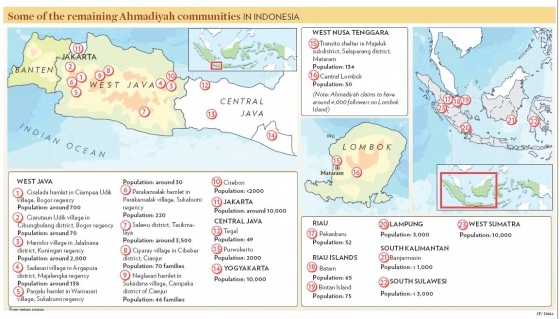
Ahmadiyya Communities in Indonesia

Wednesday, December 1, 2010

Indonesian Team to Move Out Ahmadiyah of Lombok

Jakarta Globe, Indonesia
NEWS
Indonesian Team to Move Out Ahmadiyah of Lombok
Fitri | December 01, 2010

Mataram, West Nusa Tenggara. Authorities in West Lombok district have formed a special team to supervise and relocate members of the Ahmadiyah sect, an official said on Wednesday.

M.S. Udin, an assistant to the district chief, said officials meeting on Tuesday evening agreed to set up a nine-man team to deal with the minority Islamic group, whose members were forced out of Gegerung village in Lingsar subdistrict by mainstream Muslims opposed to their beliefs.

Udin said the team would oversee the sale of Ahmadiyah property and make sure the sect members received compensation.

The team will also begin the process of moving Ahmadiyah families. It is currently looking at a proposal to move them to the coastal Sekotong subdistrict.

He said the Ahmadis would also be required to report to officials whenever they returned to the village to work their fields.

“It would be impossible to restrict them from making a living by working their own land. Many of them still own land in [Gegerung’s] Ketapang hamlet,” he said.

“But to be safe, they should report to the [security] coordination post that they are returning to Ketapang — not to live [there], but to work their fields.”

“These Ahmadis are still convinced they will be able to return to Ketapang and that there will be no problem,” Udin added. “But if residents heard they were back, there would be new problems, destruction of property and more.”

Tuesday’s meeting of officials was held in Mataram, the capital of West Nusa Tenggara, and was attended by Ahmadiyah leaders, security officials, prosecutors and district heads.

In addition to Udin, the nine-man team will include representatives of the National Land Agency (BPN), the district secretary, head of the district’s assets unit, the Lingsar subdistrict chief, the Gegerung village head and security officials.

Zaini Arony, the head of West Lombok district, will meet with the Ahmadis — who have been living in temporary shelters since being chased from their village — to discuss the relocation plan.

Zauji, the head of the Ahmadiyah’s provincial chapter who attended Tuesday’s meeting, said the group’s members wanted “legal clarity” on the issue of the destruction of their homes and assurances that they would be protected from further violence and intimidation.

“Whatever the decision, it will have nothing to do with the organization. [Officials] will have to deal with the Ahmadiyah members directly,” he said. “We will leave it to them to decide.”

Zulhair, an Ahmadi who has lived in a hajj transit building in Mataram since 2006, said he wanted to go home. “If I could, I want to return to my house in Ketapang. That is my personal wish.”

He said it was difficult for Ahmadis to trust an administration that had repeatedly failed to protect them from attacks.

Many mainstream Muslims view Ahmadiyah as a deviant sect because they believe its members recognize the sect’s founder, Mirza Ghulam Ahmad, as the last prophet.

Copyright 2010 The Jakarta Globe

Tuesday, November 30, 2010

Editorial: In Jakarta, Signs of Creeping Intolerance

Jakarta Globe, Indonesia
EDITORIAL
Editorial: In Jakarta, Signs of Creeping Intolerance
November 30, 2010

Indonesia has always prided itself in its social and political tolerance toward all citizens, no matter what their faith or background. Now, radical organizations are pushing these boundaries and sowing distrust and hatred. (JG Photo)
The results of a survey by a nongovernmental organization on rising religious intolerance in Greater Jakarta make for chilling reading. More than half of those surveyed said they would not accept people of different faiths within their neighborhoods.

Conducted by the Setara Institute for Democracy and Peace , the survey also found residents of Jakarta, Bogor, Depok, Tangerang and Bekasi to be easily swayed economically, socially and politically.

The survey, conducted from Oct. 20 to Nov. 10 , had 1,200 randomly sampled respondents.

It is truly alarming that nearly 50 percent said tolerance of different faiths and ethnic groups was limited to social relations.

This meant they would not accept a person of a different faith in their family and would not consent to the building of a house of worship in their community.

It should also be of concern that 41.9 percent said economic injustice was the main cause of terrorism.

This showed that for much of the population, there was no correlation between radical organizations and terrorism.

Greater Jakarta represents a microcosm of the entire country.

If Jakarta, the most cosmopolitan city in the country, is growing increasingly intolerant, the rest of the country may well follow suit.

With half the country’s population now urbanized, more and more people of different faiths and ethnic backgrounds will find themselves living side by side.

If the trend toward growing intolerance continues, the prospects of ethnic friction becomes much greater.

Indonesia has always prided itself in its social and political tolerance toward all citizens, no matter what their faith or background. Now, radical organizations are pushing these boundaries and sowing distrust and hatred.

People are routinely attacked because they have different beliefs.

Take the case of the Ahmadiyah, a minority Muslim sect that has been the target of violence and persecution in the past few years, especially in West Java and Lombok in West Nusa Tenggara.

The group, which had lived for decades in peace with its mainstream Muslim neighbors, suddenly became the target of violence after the reform era.

This trend must be arrested immediately if we are to keep the social fabric from being torn to shreds.

The government must enforce the law fairly and impartially against those who incite and exert violence on others.

We must bring back the philosophy of living peacefully and harmoniously with peoples of all faiths.

Allowing certain groups to hijack religion for narrow political goals will lead to the disintegration of the nation.

Everyone should be reminded that our country’s founder had set down a powerful motto for this nation: Bhinneka Tunggal Ika, which means Unity in Diversity.

Copyright 2010 The Jakarta Globe

Most Lombok Ahmadiyah Converted: Indonesian Official

Jakarta Globe, Indonesia
NEWS
Most Lombok Ahmadiyah Converted: Indonesian Official
Fitri | November 30, 2010

Mataram. Hundreds of members of the Ahmadiyah sect in the Central Lombok district of Lombok Island have returned to the fold of mainstream Islam, while only five families, or 21 people, remained followers of the faith, a local official said Monday.

Gabriel Mbulu, a member of the Central Lombok office of the Ministry for Religious Affairs, said that of the 500 Ahmadiyah followers once reported living in the district, only 21 remained part of the sect.

“From the 500, there are only 21 who do not want to return to Islam, besides those who left for Sulawesi. Hundreds have returned to true Islam,” Gabriel said.

The five families were still at a temporary shelter in the former general hospital in Praya after being driven from their homes, he added.

He said the Ministry also continued to call on people not to resort to violence when dealing with members of Ahmadiyah, a sect that is ostracized by mainstream Muslims because of their belief that their founder, Mirza Ghulam Ahmad, is the Messiah.

He was referring to the violence that has repeatedly hit the Ahmadiyah community in Gerungan village in West Lombok since 2006, leading to hundreds of sect members seeking shelter in Mataram.

Nursalim, head of the Central Lombok Ahmadiyah group, speaking from the group’s shelter in Praya, said there were actually 31 people still at the shelter.

But he denied the claim that hundreds of Ahmadiyah members had reverted to mainstream Islam, saying that they simply became “inactive.”

“I have never heard of that,” he said of the claim of a mass conversion.

Nursalim said hundreds of Ahmadiyah members were forced to flee their homes in Central Lombok because of violence against them in 2006, about the same time their fellow Ahmadi were attacked in West Lombok.

He also said that, although the government initially provided relief aid for the Ahmadiyah refugees, the aid was halted without notice in 2007.

“Now we no longer even receive medicine,” he said.

But for Sionah, a mother of three who has been in the former hospital since 2006, nothing would make her convert from her faith.

“I remain confident as an Ahmadi, wherever I am,” Sonah said.

She said she had already been evicted from her home twice, first from her home in Sambielen in North Lombok amid violence against the sect in 2002.

She said she then moved to Praya in Central Lombok, but was forced to flee again during the attacks in 2006.

Ahmadiyah communities have been the target of attacks by hard-line Muslims in several regions, mostly in Lombok and West Java, in recent years.

Members of the sect also claim to face official discrimination, including difficulty obtaining jobs and processing official paperwork.

Ahmadiyah representatives have dismissed claims by their mainstream Muslim opponents that the group does not believe Muhammad was the last prophet and does not consider the Koran its holy book.

Copyright 2010 The Jakarta Globe

Sunday, November 28, 2010

Lombok Ahmadiyah Families Lodge Complaint Over Lost Homes

Jakarta Globe, Indonesia
INDONESIA
Lombok Ahmadiyah Families Lodge Complaint Over Lost Homes
Fitri | November 28, 2010

Indonesia. Members of the beleaguered Ahmadiyah Islamic sect have filed a police report over the destruction of their homes on Friday by residents of Gegerung village in West Lombok district.

The village’s Ahmadiyah community was first driven out by angry residents in 2006, and has since been forced to live at a temporary shelter in Mataram, West Nusa Tenggara’s capital.

On Nov. 19, the authorities evicted 12 families who had since returned, following threats against them by the residents, and a week later, the villagers made good on their word and destroyed 22 homes that had been abandoned by the fleeing families.

Police failed to prevent the destruction or arrest anyone, despite having deployed 100 personnel to the area.

On Saturday, six Ahmadis reported the case to the West Lombok Police, citing Rp 735 million ($80,000) in damages.

They said that while they had long accepted their persecution as a test, they would not stand for any criminal acts.

“Our people can no longer go back to their homes that were attacked by the mob, for almost none of them are now fit for habitation,” said Nasiruddin Ahmadi, one of the complainants.

He added he hoped the police would follow up the case and bring to justice those responsible for the destruction.

West Lombok Police’s operations head, Comr. Deky Subagio, pledged his office would investigate the case just like any other. He added that police had long attempted to secure the situation in Gegerung. “But it was difficult to prevent the villagers destroying the homes because most of them were kids,” he said.

Deky also denied reports that police had not tried to prevent the destruction. “We did our best to contain the situation, and we’re continuing to take all measures to secure the area,” he said.

He called on the Ahmadis staying at the transit shelter in Mataram to hold off any planned return to Gegerung until the animosity had died down.

There are now 183 Ahmadis, or 72 families, staying at the shelter, up from the initial 133 people who were driven out of Gegerung during the 2006 incident.

Copyright 2010 The Jakarta Globe

As the Flames of Intolerance Flare, Indonesians Are Reminded of Their Nation’s Origins in Diversity

Jakarta Globe, Indonesia
INDONESIA
As the Flames of Intolerance Flare, Indonesians Are Reminded of Their Nation’s Origins in Diversity
Nivell Rayda & Fitri | November 28, 2010

Indonesia. A hundred police officers armed with assault rifles and pistols were not enough to dissuade Tuti (not her real name) from walking barefoot for a kilometer, her 3-year-old son on her back, to the village of Gegerung in Lombok, West Nusa Tenggara, on Friday.

Once she arrived, the 25-year-old mother joined hundreds of people from her village in ransacking and demolishing dozens of houses belonging to members of the Ahmadiyah minority sect.

“Infidels,” she screamed as she pelted one of the homes with rocks. “Get out of our village.”

The mob destroyed 22 homes, with one burned to the ground after villagers emptied a canister of kerosene in it and lit it on fire.

As Tuti watched the house burn, she and the other villagers thanked God for the suffering of those they deemed heretics.

Need for a National Strategy

The seemingly never-ending string of attacks on minority religious groups — at least a hundred against Ahmadiyah alone over the past decade, according to one activist — prompted the International Crisis Group in a recent report to call on Indonesia to adopt a comprehensive national strategy to promote religious tolerance and curb rising sectarian violence.

“There needs to be a long-term vision and strategy. Local officials have been addressing the incidents on a case-by-case basis,” said Jim Della-Giacomathe, the ICG Southeast Asia project director.

“And most of the time, they surrender to those with the loudest voice. If this keeps happening, mob rule prevails.”

Della-Giacoma’s statement highlights an important observation regarding the government’s response so far to the apparent increase in religious intolerance in the country: that the core of the problem isn’t being addressed.

In Bekasi, which the ICG report says is a clear example of the tensions brought about by clashing fundamentalisms, 10 people have been arrested for an attack that saw one churchgoer hospitalized with a stab wound and a female reverend badly injured.

Among those arrested was the local leader of the hard-line Islamic Defenders Front (FPI), a group that has led calls for Christians to leave the area.

West Lombok Police operations head, Comr. Deky Subagio, has promised that his office will investigate the attack on the Ahmadiyah homes on Friday just like any other case.

Despite local police promises such as these, attacks continue.

Bonar Tigor Naipospos, vice president of the Setara Institute for Democracy and Peace, said if the core of the problem was not addressed soon, sectarian conflicts would be unavoidable.

“There are elements within the minorities that are discontented with the government’s inaction and are becoming fed up with continuously playing the victim,” he said. “These elements may even have become radicalized themselves.”

Largely Local?

Bonar notes that the areas prone to religious conflict often have weak law enforcement or government leaders who are easily pressured by majority religious groups.

For instance, in Kuningan, West Java, where mainstream Muslims in July attempted to seal off an Ahmadiyah mosque, the local government has been reluctant to acknowledge marriages involving members of the minority sect.

In West Nusa Tenggara, the local government has also refused to issue mandatory identification cards to followers of the sect, and last month raided homes belonging to Ahmadiyah members, urging them to move out of Gegerung village.

The government announced plans to relocate the remaining members of the community to a remote island in the Sumba Strait, some 40 kilometers off the main island of Lombok, saying it was the will of other religious communities and residen ts.

In Bekasi and Depok, where a string of attacks and forced closures of Protestant churches has taken place, local administrations have defended their position of siding with the demands of hard-line groups against minorities by saying they needed to keep the peace.

“The political support of religious elites is essential even for political parties that are not based in Islam,” Bonar said.

“Religious elites need to expand their political influence; in return politicians enjoy great support from faithful followers of certain religious leaders.”

Decentralized, Disconnected

Analysts trace part of the problem to decentralization.

“Decentralization has brought more autonomy and self-government, but unfortunately the interpretation and implementation of religious freedom and tolerance, in practice, is also left with the local leaders, who sometimes have a narrow view on the subject,” said Siti Zuhro, a political analyst from the Indonesian Institute of Sciences (LIPI).

Zuhro said that during the iron-fisted rule of former President Suharto there was no tolerance shown for religious frictions, and any statements that had the potential to stir up social, religious and racial tensions were greatly limited.

“Today, the situation is different. Hate speech is protected by the citizens’ constitutional rights of freedom of expression,” she said. “But this is a slippery slope.”

Bonar said that although President Susilo Bambang Yudhoyono had made a number of speeches expressing support for religious freedom and the need to protect minority groups, his words had never been translated into definitive action by local governments.

“There is a discrepancy between the central government’s commitment and the policies and practices at the local level,” he said.

“Decentralization has left the central government to rely heavily on how local officials can translate its directives.

“But while the central government claims that the job of protecting minorities rests with local governments, the local governments tell minority groups that they have to consult with the central government.”

Confusing Commands

Even at the national level, Yudhoyono’s statements on religious freedom sometimes stand in stark contrast to the words and actions of his ministers.

Ulil Abshar Abdalla, a member of the president’s Democratic Party, pointed out that Religious Affairs Minister Suryadharma Ali “has made comments that oppose religious freedom and have a dangerous potential to fuel further violence.”

The minister has repeatedly called for Ahmadiyah to disband, and has showed support for the 1965 law on blasphemy that many observers say has legitimized acts of violence against minority sects and groups.

He also supports the 2006 joint ministerial decree on houses of worship, which requires the consent of the surrounding community for building churches, temples and mosques. Critics say the regulation is discriminatory.

Rohadi Abdul Fatah, the director of Islam and Shariah law at the Ministry of Religious Affairs, denied that anyone had turned a blind eye to the problem of intolerance.

“Our officials always work according to the law and official procedure,” he said. “We never harm other groups, for example by prohibiting them from using public facilities or burning their places of worship. That is totally against human rights and the law.”

Regarding Ahmadiyah, he said the ministry did not tolerate the sect, but that did not mean the ministry was failing to provide members protection.

“We keep trying to persuade Ahmadiyah through education and dialogue to return to the right path of Islam,” he said. “We don’t tolerate anyone who harms them even though their belief is not acceptable in Islam.”

Democratic Pitfall

So what should a government that listens to its people do when a number of surveys indicate a worrying increase in religious intolerance among Muslims in the country?

A survey released in September by the Center for the Study of Islam and Society found that among 1,200 adult Muslim men and women surveyed nationwide, 57.8 percent said they were against the construction of churches and other non-Muslim places of worship — the highest rate the study center has recorded since 2001.

More than a quarter, or 27.6 percent, said they minded if non-Muslims taught their children, up from 21.4 percent in 2008.

“The government should not bow down to political pressure from a religious elite that voices intolerance,” Ulil said. “The government should protect minorities and not only cater to the demands of the majority.

“We should re-educate these opportunistic bureaucrats and political parties about ‘Bhinneka Tunggal Ika’ [‘Unity in Diversity’], the principle taught by our founding fathers.”

Firdaus Mubarik, an Ahmadiyah activist, said he hoped the government would listen to minority voices as well.

“The government should remain neutral on religious issues and bridge differences between religious groups,” he said.

“If the government continues turning a blind eye to the problem, hard-line Muslim groups will soon target other minorities.”

An Ahmadiyah member holding a burned Koran in Ciampea, West Java, after a mob set fire to a mosque and houses belonging to members of the minority sect. Pluralism advocates are warning of the dangers posed by failing to sufficiently address rising intolerance. Reuters Photo/Dadang Tri

Copyright 2010 The Jakarta Globe
 
^ Top of Page