Showing posts with label Ketapang hamlet. Show all posts

Monday, January 17, 2011

In Jakarta, Ahmadis left relatively unscathed

SPECIAL REPORT
Mon, 01/17/2011
9:23 AM
In Jakarta, Ahmadis left relatively unscathed
The Jakarta Post
The Al-Hidayah mosque on Jl. Balikpapan in Harmoni, Central Jakarta, was quiet at noon on Tuesday last week.

A man sitting at a food stall outside the mosque gate greeted visitors. “You want to pray? Just go inside. The gate’s not locked.”

The 57-year-old mosque used to be the center of the Ahmadiyah organization in Indonesia.

Located in a crowded residential area, the mosque is just several hundred meters to the south of the notorious drug trafficking center of Kampung Bali and just 2 kilometers east of Jakarta’s infamous district on Jl. Hayam Wuruk and Jl. Mangga Besar.

Despite its grim location, the Ahmadis who pray or hold other activities at the mosque have so far been spared from the violence that has plagued their compatriots in other parts of the archipelago.

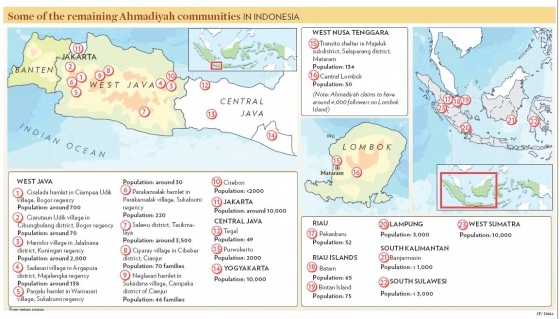
An estimated 10,000 Ahmadis currently reside in the capital, according to Ahmadiyah spokesman Zafrullah Pontoh

Muslim hardliners living far from the area protested against the existence of the mosque in 2005 and 2008. Local residents are mostly indifferent.

“I don’t really care about religious differences and the like,” said one resident, who asked to be identified as Yeni.

“As long as they don’t bother us when doing their activities, they can have a place here,” she added.

Around 15 kilometers west of the Al-Hidayah mosque is another iconic Ahmadiyah place of worship, which, coincidentally, is also named Al-Hidayah.

A group of Ahmadis gathered at the mosque in Kebayoran Lama, South Jakarta, one Friday afternoon in late December.

Soon a cleric began his Friday sermon, encouraging his audience not to fight fire with fire. “If we use violence to fight the violence that has been unleashed upon us, it is justified. It’s much better if we return that violence with prayers for those who persecute us.”

Local Ahmadis have been offering more than prayers to the surrounding community. This might explain why there has rarely been harsh persecution of the group, which has been labeled as “deviant” by the MUI, in Jakarta.

A resident living near the mosque, A’as, said the Ahmadis regularly gave charitable donations to people in the neighborhood, which was home to mostly lower- and middle-income people.

“Almost every month they give away free packages of staple food. They also give us donations during Idul Fitri and other Islamic celebration days.”

A’as said she personally knew some of the Ahmadis who regularly came for Friday prayers or weekly religious study.

“They’re very kind. They always say hello to us and we’ve become friends now,” she said.

Members of the Al-Hidayah mosque’s congregation come from many parts of the city.

Although seven mosques in Jakarta serve Ahmadiyah followers, only Al-Hidayah in Kebayoran Lama has been the target of recent attacks.

The mosque is located about 7 kilometers from the headquarters of the hardline Islam Defenders Front (FPI) on Jl. Petamburan III, Central Jakarta.

In June 2009, assailants set a fire in the mosque, damaging parts of the second floor. In early December, a group of men armed with swords and machetes threw stones at the mosque, smashing lights and window panes.

“The perpetrators are not from this area,” A’as said. “Why would we do it? [The Ahmadis] have been nothing but kind to us.”

“I know they’re different. But as long as they don’t go around looking for trouble, we won’t bother them. I think the people here just mind their own business.”

After Friday prayers, the Ahmadis went to a nearby Indonesian Red Cross office to donate blood. An Ahmadi woman said it was something the group regularly did.

Despite numerous stories of charity and kindness, threats of persecution still loom over Ahmadis in Jakarta.

In November, students staged a rally in front of Nuruddin Mosque in Tanjung Priok, North Jakarta, demanding its closure. In 2008, hundreds of people grouped under sealed the Baitul Qoyyum mosque in Serua, Ciputat, Southeast Tanggerang, Banten.

Imas Kartini, an Ahmadi from Pondok Labu, South Jakarta, said she has grown accustomed to threats of violence. “I feel sorry for my brothers and sisters and am anxious myself. But I live with it. Besides, the people in my neighborhood are very kind to me. We’ve gotten along well. I don’t believe they will do me any harm,” she added.

- JP/Arghea Desafti Hapsari

Anti-Ahmadi pogrom alive and well

SPECIAL REPORT
Mon, 01/17/2011
9:17 AM
Anti-Ahmadi pogrom alive and well
The Jakarta Post
For decades, the violence against the followers of the Ahmadiyah sect has continued without an end in sight. The Jakarta Post’s Arghea Desafti Hapsari explores the root causes of the violence by visiting several Ahamdiyah enclaves in the archipelago. Here are the stories:

Aftermath: Two members of the police mobile brigade guard houses ransacked by a mob in an Ahmadiyah community center in the Ciampea subdistrict of Bogor, West Java, in this photo taken on Oct. 1, 2010. Non-assimilation into the community by some members of the Ahmadiyah Islamic sect has been cited as among the triggers for the attacks by mainstream Islamic mobs. JP/Theresia Sufa
Empty barren houses sit with their windows shattered and walls half torn down while a yellow police line encircles the fence, warning off those who would trespass.

The houses are separated by a dirt road running a few hundreds meters from other houses in Ketapang hamlet in Gegerung village, West Lombok, West Nusa Tenggara.

Every once in a while the owners return from a refugee shelter in the provincial capital Mataram — where they have taken shelter since 2006 — to tend to their farms and guard what is left of their homes.

The ransacked houses are among the countless witnesses to the unfolding tragedy of the endless persecution of the Ahmadiyah faith and its 200,000 followers across the archipelago.

While early incidents of violence against the Ahmadis by mainstream Islamic hardliners — who insist Ahmadiyah is heretical — date back to the early 1950s, it was not until 2005 that the hostility intensified dramatically. In 2010 alone, there were at least 10 recorded attacks against the minority sect.

While the Ahmadis identify themselves as Muslims and follow the Koran, they believe Mirza Ghulam Ahmad, who founded the sect in 1889, was a prophet and also the messiah. This goes against the belief of mainstream Muslims who insist Muhammad was the last prophet.

But the root causes of violence may not be limited to differences in theological interpretation, a claim regularly spouted by hardliners.

Allegations that Ahmadis tend not to assimilate into the general population have also played a great role in fuelling mainstream resentment against them.

The locals in a hamlet in Pancor village, East Lombok, West Nusa Tenggara, recounted how the Ahmadis set themselves apart from the other villagers.

The hamlet was the scene of several attacks on the Ahmadis in 2002 that forced 83 Ahmadi families to flee their houses and take refuge in Mataram.

“That’s where the houses of the Ahmadis were,” Fitri, a resident of Kampung Baru Baluo, a hamlet in the heart of Pancor, points out to plots run over by wild bushes hiding the stone foundations that were once houses.

The abandoned land is located close to the hamlet perimeter.

“They built a cluster of houses there. When they had new members, they would buy them plots of land nearby to build houses,” Fitri said.

“The locals knew them of course. After all, we were neighbors long before the attacks.”

Another local, speaking on condition of anonymity, said the locals were never really close to the Ahmadis as the latter were viewed as being different.

She said the Ahmadis never visited other residents in the hamlet.

“In turn we never visited them as well,” she said, adding that residents’ interactions with the Ahmadis were limited to the marketplace.

Similar stories were also shared by Gegerung village residents, who forced local Ahmadis out of their homes in Ketapang hamlet in 2006 due to allegations that they did not want to assimilate.

In November last year, Ahmadis planned to return to Ketapang only to be evicted again at the request of Gegerung residents, despite exhortations by Ketapang hamlet leader Muntahar that the Ahmadis did get along with other residents.

He recounted a time when Ahmadis helped other villagers build the village mosque.

“They even contributed money for the construction,” he said. “However, the money was returned once the locals found out about the difference in doctrines.”

Allegations of non-assimilation have also plagued Ahmadis in Parung, Bogor, where the sect built a 15-hectare compound to house followers.

An attack in July 2005 by hardliners was vigorously supported by locals.

While Jakarta has one of the largest Ahmadiyah communities in the country, the movement has faced little violence in the city as most Ahmadis get along well with neighbors.

A recent attack on an Ahmadiyah mosque in Kebayoran Lama, South Jakarta, launched by outsiders was condemned by locals, who said the Ahmadis contributed much to the community.

“It’s obvious that if Ahmadis can get along with others, there is a reduced risk of their facing hostilities,” Syarif Hidayatullah Islamic University sociologist Musni Umar said.

“In some cases, violence against the Ahmadis is triggered by their way of living, which is exclusive.”

Musni urged Ahmadis to be more active in advocating dialogue and openness with their neighbors so more people would understand that theological differences would not be a point of resentment.

Some Ahmadi communities have begun to make the effort to be more open.

Nurrahim, the secretary-general of the Ahmadiyah community in Manislor village in Kuningan, West Java, said Ahmadiyah was an Islamic organization that upheld the virtue of sacrifice.

“We believe the more we give, the more we receive in return,” he added.

All adherents to the faith commit to allotting 1/16 to 1/10 of their monthly income to the organization, in addition to an annual contribution.

The money is held by the Ahmadiyah center in Jakarta, which disburses the money back to the congregations to finance activities such as charities and other social programs.

Nurrahim said the money was never disbursed to Ahmadiyah members personally. The Ahmadis also refute allegations that they refuse to assimilate.

“We live alongside and with people of other faiths,” said Nur Hidayati, an Ahmadi from Pancor, who was forced to flee her home after the 2002 attacks.

Ahmadiyah spokesman Zafrullah Pontoh said Ahmadis never prohibited others from praying in their mosques and vice versa.

“Our mosque on Jl. Balikpapan [in Central Jakarta] is open to anyone. People in the neighborhood can perform Friday prayer there. So reasoning that we are being attacked because we refuse to assimilate is just unfounded.”

In some cases, attacks on Ahmadiyah have been incited by hardliners living outside the community.

Ahmadis in Cisalada hamlet in Ciampea Udik village in Bogor, West Java, had no problems with locals until the 2005 attacks in Parung — 10 miles from the village — changed everything.

A resident from a neighboring hamlet, Gaos Hanafi, recalled how in the 1970s people from his hamlet would come to Cisalada, where all 700 residents were Ahmadis, to play soccer.

“We were very close back then. I even had relatives there. The Ahmadis and other villagers used to have an open debate about Islam but there was never any violence.”

But the Parung incident stirred resentment that peaked in 2007 when hundreds of people gathered to stage a protest against the renovation of an Ahmadiyah mosque in Cisalada.

Another protest against the mosque and other properties owned by Ahmadis in the hamlet took place in July 2010. Three months later, violence erupted as assailants set fire to five houses, a car and two motorcycles owned by Ahmadis.

Critics rightly alleged that provocation by policymakers and mainstream clerics fuelled the hostility.

Last year Religious Affairs Minister Suryadharma Ali insisted that Ahmadiyah was a heretical sect and “must be disbanded immediately” as its doctrine violated tenets of Islam — a pronouncement that intensified the pogrom against the sect.

Suryadharma claimed he was only reinforcing a fatwa first issued in 1980 by the Indonesian Ulema Council (MUI) and another in 2005.

In 2008, a joint ministerial decree was issued to ban Ahmadiyah from propagating its teachings.

The fatwa and the decree cited theological differences between Ahmadiyah and mainstream Islam in outlawing the sect.

“The violence has been going on for decades and is likely to continue this year. Hostility is just not the answer,” Musni said.

“It’s time for policymakers and clerics to initiate dialogue with the Ahmadis instead of perpetuating the pogrom through hate speech, unconstitutional decrees and vile sermons.”

— Additional reporting by Panca Nugraha
Ahmadiyya Communities in Indonesia

Thursday, March 19, 2009

West Nusa Tenggara set to ban Ahmadiyah

---The Jakarta Post

The Archipelago - Thu, 03/19/2009 3:01 PM

West Nusa Tenggara set to ban Ahmadiyah


MATARAM, West Nusa Tenggara: The West Nusa Tenggara administration plans to officially ban activities by the Ahmadiyah sect in the province in the near future.

Governor M. Zainul Majdi said the proposed policy was agreed upon after several options carried out by his administration had yet to succeed in resolving the Ahmadiyah refugee issue.

“We are studying the ban on the Ahmadiyah. Our basis is very strong because we are implementing the mandate stated in the 1945 Constitution and the Criminal Code to prevent religious sacrilege. The ban will also strengthen the joint ministerial decree on Ahmadiyah,” he said Wednesday in Mataram.

He added the ban would be stipulated in a gubernatorial decree, such as that carried out by the South Sumatra provincial administration to also ban the Ahmadiyah.

The move is widely deemed the right effort toward resolving the Ahmadiyah refugee issue. Hundreds of Ahmadiyah members have lived for the past three years at the Wisma Transito shelter in Mataram, after being forced from their homes in Ketapang hamlet in West Lombok.

Zainul said based on observations by the provincial religious affairs agency and other bodies, the Ahmadiyah refugees tended to be tight-lipped and controlled by the Ahmadiyah organization. -JP

URL: www.thejakartapost.com/new...-tenggara-set-ban-ahmadiyah.html

Saturday, March 14, 2009

West Lombok forbids Ahmadiyah refugees from returning home

---The Jakarta Post

National - Sat, 03/14/2009 1:46 PM

West Lombok forbids Ahmadiyah refugees from returning home

West Lombok regency has decided to forbid members of the Ahmadiyah Islamic sect, who have been living uncertainly at a refugee center in West Nusa Tenggara for three years, to return to their homes, citing security concerns.

Basirun Anwat, spokesman of the regency, told tempointeraktif.com Saturday that the decision was made during a meeting attended by the regency secretary, the local leaders forum and sect members on Thursday.

“To ensure security, they are not allowed to go home,” he said.

Basirun also said that Ahmadiyah members were still allowed to work on their farms and that the regency was going to discuss buying their land so they could move elsewhere.

Last month, 68 Ahmadiyah members from 17 families decided to risk going from the Transito building in Mataram back to their homes in Ketapang hamlet, Gegerung village, Lingsar district, West Lombok regency, on March 14.

At least 160 Ahmadiyah members from 33 families were driven from their homes when hard-line Muslims attacked them and destroyed their homes and belongings in early February 2006.

The Indonesian Ulema Council (MUI) previously issued an edict calling the Ahmadiyah heretical. The edict was seized upon by other hard-line Muslims to attack the sect’s followers elsewhere, including in West Java. (dre)

URL: www.thejakartapost.com/news/2...h-refugees-returning-home.html

Monday, March 2, 2009

Refugees’ return home ‘welcomed’

---The Jakarta Post

The Archipelago - Mon, 03/02/2009 2:18 PM

Refugees’ return home ‘welcomed’


Panca Nugraha, The Jakarta Post, Lombok Barat

The West Lombok regency has welcomed the plan by Ahmadiyah refugees to return home, but says it hopes the sect’s members will not choose to stick out again.

Regency spokesman Basirun Anwar said the administration would facilitate the return of the followers from the Transito building refugee center to their homes in Ketapang hamlet, Gegerung village, West Lombok, West Nusa Tenggara, on March 14.

“They are West Lombok residents, so we must help them,” Basirun told The Jakarta Post on Sunday, adding the administration had received a copy of a letter from the refugees about the planned return.

Basirun also said the administration had met with local leaders in the village to discuss the matter.

Besides trying to mix with local residents, he said the leaders also urged Ahmadiyah followers to obey the recent joint ministerial decree (SKB) banning them from spreading their teachings.

Jauzi Djafar, West Nusa Tenggara chairman of the Indonesian Ahmadiyah Group, promised the group would abide by the SKB, but at the same time the group also urged the residents not to use violence against its members.

After three years in limbo at the refugee center, 68 Ahmadis have decided to risk returning home.

They are among 160 followers from 33 families who were driven from their homes by hard-line Muslims in 2006.

They decided to go back since their homes were still habitable, while the remaining 92 members of the sect chose to stay at the refugee center because their homes were completely destroyed.

The Indonesia Ulema Council (MUI) previously issued an edict declaring the Ahmadiyah heretical, mainly due to the sect’s belief that its founder Mirza Ghulam Ahmad was a prophet.

Based on the edict, among other factors, the government than banned Ahmadiyah followers from spreading their teachings.

Human rights activists have deplored the use of violence against the sect’s followers and criticized the MUI for issuing the edict, which was used as a reason by the hard-liners for the attacks.

Besides followers in West Nusa Tenggara, property owned by Ahmadis in West Java were also destroyed by Muslim hard-liners.

Basirun said the West Lombok administration would coordinate with the provincial administra-tion to organize the return of the refugees.

He said the return would be conducted in a formal ceremony that would be witnessed by local Muslim leaders.

“Ketapang residents hope the return can be conducted officially. So now we are coordinating with Mataram municipality, the provincial administration and the security authorities over the return home of the refugees,” he said.

Provincial social services agency head Bachruddin said his office would provide 1 ton of rice to help out the refugees upon their return.

“Even when they do get back to their homes, they’ll still need a little help first,” he said.

URL: www.thejakartapost.com/news...eturn-home-welcomed039.html
 
^ Top of Page