Showing posts with label refugees. Show all posts

Tuesday, June 21, 2011

New Refugee Arrests Undermine Recent Progress

Irrawaddy News, Thailand
Burma
==
New Refugee Arrests Undermine Recent Progress
Tuesday, June 21, 2011 By SIMON ROUGHNEEN
In this photo taken on Feb. 16, 2011, Rohingya boat people wait for medical treatment after being rescued, at a port in Aceh Besar, Aceh province, Indonesia. (Photo: AP)

BANGKOK — on June 7, the day after 96 Pakistani Ahmadiyah refugees and asylum seekers were freed on bail in what was hailed as a landmark new departure in Thailand’s dealings with refugees, six other Pakistani asylum seekers and one refugee were arrested in Pathum Thani, north of Bangkok.

The seven were sent to Bangkok’s Suan Phlu Immigration Detention Centre (IDC), site of the high-profile June 6 release, says the UN refugee agency (UNCHR). “We are deeply concerned about these arrests that just increase the sense of insecurity that refugees and asylum seekers already feel”, said Jean-Noël Wetterwald, UNHCR regional representative and coordinator for Southeast Asia.

The June 7 arrests were followed up on June 9 with the arrest of nine more Ahmadiyah asylum-seekers in Ayutthuya, with still more Ahmadiyah detained on June 15. The new arrests include children under five years old, as well as a number of Sri Lankan nationals. The Ahmadiyah are members of a minority Islamic group that is oppressed in Pakistan, where they are not recognized as Muslims and are often victims of sectarian violence.

Speaking on Monday evening at Bangkok’s Foreign Correspondent’s Club, Thailand National Human Rights Commissioner Niran Pitakwatchara described possible human rights violations at the IDC, such as detention conditions he depicted as crowded and unhealthy. One year ago today, Thailand assumed the Presidency of the United Nations Human Rights Council in Geneva.

Thailand has long been a destination for refugees fleeing oppression in south and southeastern Asia, and currently around 140,000 Burmese refugees are in Thailand, mostly in nine camps along the Thai-Burma border. Monday, June 20, was World Refugee Day, with Burma cited as the world’s fifth-highest source of refugees with 415,700 worldwide, around 200,000 of which are Rohingya.

The Rohingya are a Muslim people numbering around one million, mostly living in northern Arakan State in western Burma. They are denied Burmese citizenship and have long been persecuted. According to Refugees International, state and army land seizures, forced labor, arbitrary arrests and extortion of Rohngya are common.

More than 40 Rohngya are detained in Suan Plu IDC, which sits close to the main banking and finance district in Bangkok. Others are held elsewhere in Thailand, some of whom have languished inside detention centers for more than two years, although negotiations are taking place between refugee rights groups and the Thai authorities for the release of the Rohingya detainees.

In early 2009, allegations that the Thai army abandoned nearly 1,000 Rohingya at sea caused international anger, prompting then newly-installed Prime Minister Abhisit Vejajjiva to say he would investigate the claims. A diplomatic cable sent from the US Embassy in Bangkok, which was released early on Tuesday, outlined that prior to March 2009, the US sought to influence Thailand’s ‘pushback’ of Rohingya trying to enter Thailand by sea.

The American representatives, including then-Ambassador to Thailand Eric John, said they raised the issue with Thai officials and lawmakers, including PM Abhisit, resulting in what the Americans perceived to be a temporary respite in Thailand’s maritime pushbacks. The cable acknowledged the role played by media coverage, including that of The Irrawaddy, in pressuring the Thai authorities to relax the pushbacks.

After the advocacy push and media coverage, the next group of Rohingya arrivals to Thailand’s shores were well-treated, according to the US account. However, the Thai authorities cited their concerns that the granting of full refugee status to a party of 78 Rohingya being held at Ranong would prompt more refugees to come to Thailand in the hope of acquiring the same status and possible eventual third-country resettlement to a Western nation.

The cable mentioned US efforts to address the ‘root causes’ of the Rohingya problem, namely the human rights situation in Burma and Arakan State specifically. The US said it wanted Burma’s fellow members of the Association of Southeast Asian Nations (ASEAN) to pressure Burma into improving conditions in Rohingya-populated regions of Burma, measures that some analysts believe would reduce the numbers of Rohingya seeking refuge abroad.

On June 9, US Assistant Secretary for Bureau of Population, Refugees and Migration Eric P Schwartz reiterated the American position that “the solution to the Rohingya issue lies in Burma.” However, it is not clear that the US can convince Burma’s neighbors that Burmese Government policy toward Rohingya is the cause of their flight to Bangladesh, Thailand and Malaysia.

In early June, Bangladeshi Food Minister Abdur Razaque accused Western countries of being the root cause of the Rohingya refugee crisis, due to their pressure on his country to register more of the estimated 200,000 Rohingya. Only 28,000 are officially-recognized as refugees by Dhaka, with the rest living in dire conditions in squalid camps.

Copyright © 2008 Irrawaddy Publishing Group. All Rights Reserved.
URL: www.irrawaddy.org/article.php?art_id=21536

Refugees are ‘still suffering’

Bangkok Post
News > Local News
Refugees are ‘still suffering’
Published: 21/06/2011 at 12:00 AM

Although Thailand has not ratified the Convention on the Status of Refugees, the Thai government still needs to provide basic rights such as access to bail and better shelter for refugees, according to a panel discussion yesterday on World Refugee Day.

Although 96 Pakistani refugees received bail on June 6 with assistance from the Refugee Freedom Fund, 200 of them remain at the Immigration Detention Centre (IDC) in Bangkok’s Suan Phlu area.

Speaking at the forum, National Human Rights Commissioner Niran Pitakwatchara said his commission had found likely human right violations at the IDC including arrest patterns and detention conditions, which he characterised as crowded and unhealthy, especially for children and women.

Thailand should avoid exposing refugees and displaced people to environments in which their basic human rights can easily be violated, Mr Niran said.

He called on Thai authorities to build a new refugee-friendly shelter outside the IDC. Dr Niran also called for interim measures that the UN High Commission for Refugees (UNHCR) could employ to screen these refugees.

The UNHCR said it was concerned about the arrests of Ahmadiyya and Sri Lankan asylum seekers in Pathum Thani, Ayutthaya and Bangkok.

“We have long believed that refugees should not be locked up simply for being refugees,” said Jean-Noel Wetterwald, the Bangkok-based UNHCR’s Regional Representative and Coordinator for Southeast Asia.

Thailand, like many Asian countries, does not have a national asylum system.

All foreigners who enter or live in Thailand without proper documentation are subject to arrest, prosecution, detention and deportation under immigration laws, even if they are registered with UNHCR as asylum-seekers or refugees.

Veerawit Tianchainan, director of the Thai Committee for Refugees, said the recently formed Refugee Freedom Fund, established a good foundation for assisting the remaining 200 Pakistani detainees and asylum seekers when it recently posted bail for 96 Ahmadiyya.

Monday, June 13, 2011

Immigration law is always top priority

Bangkok Post
News > Crime
Immigration law is always top priority
In-transit asylum seekers must still face Thai justice
Published: 13/06/2011 at 12:00 AM

Police will continue to arrest illegal immigrants who enter the country under the guise of refugees and claim human rights protection.

The migrants, mainly from North Korea and Pakistan, are using Bangkok as a transit point to resettle in a third country.

The city is a good channel for them as it houses the Asia-Pacific office of the United Nations High Commissioner for Refugees (UNHCR) where they can ask for refugee status, according to immigration police.

They are also given help by human rights advocates and even foreign diplomats.

“If we don’t arrest them, more illegal migrants will come to Thailand. This will lead to more crimes and human trafficking,” said Phongnakhon Nakhonsantiphap, deputy chief of investigation at the Immigration Bureau.

North Koreans who illegally enter northern Thailand from Laos are reportedly helped by human trafficking gangs to initially travel to China, from where they travel in cargo boats to Laos, according to investigations by the bureau and the Internal Security Operations Command.

Once in Thailand, officials from the South Korean embassy will contact them and facilitate the last leg of travel to South Korea, which is their final destination.

However, because their entry and stay in Thailand are both illegal, the North Korean immigrants must be prosecuted in court, according to the Immigration Bureau.

While the North Koreans claim hardship in their country as the reason for resettlement in South Korea, illegal Pakistani migrants, mainly from a minority Islamic sect, cite religious conflict as the main cause for them trying to get to Europe and America.

The Ahmadiyya, the name given to people belonging to the sect, want the UNHCR to grant them refugee status.

In some Islamic countries, they claim, the Ahmadiyya are killed as they are not accepted by mainstream Muslims.

Despite their plight, Pol Lt Col Phongnakhon said, if they are illegal migrants in Thailand, they have to be tried, fined and held at the Immigration Bureau.

On Dec 14 last year, immigration police arrested 96 Pakistani Ahmadiyya at a housing estate in Pathum Thani. All have since been prosecuted under Thai law.

However, they were later released on bail on human rights grounds, Pol Lt Col Phongnakhon said.

Last Monday, the group was helped by human rights advocates from the Thai Committee for Refugees Foundation.

The Immigration Bureau requires them to report to police every 30 days while waiting for the UNHCR’s response to their request.

In the meantime, the foundation has agreed to provide them with accommodation and occupational training.

Also, the bureau has adhered to the non-refoulement policy, a principle under international law not to send refugees to places where their lives and freedom will be threatened. They ask the illegal migrants where they want to go before being deported.

All insist they will not go back to Pakistan, Pol Lt Col Phongnakhon said.

According to an investigation, most of the 96 Ahmadiyya are well-to-do and entered Thailand legally. However, they were categorised as illegal migrants because they had overstayed their visas. The over-stay was caused by their wait for refugee status.

“Investigators have found they are not involved in criminal or terrorism activities,” Pol Lt Col Phongnakhon said.

But their appearance in large numbers has worried other residents in the housing estate, he said.

The Immigration Bureau has urged members of the public to call 1178 if they have information about illegal immigrants in their neighbourhood.

Operators of home or car rental services were also warned against helping the immigrants. People who provide accommodation for illegal immigrants could face up to 10 years in jail or a fine of 100,000 baht, while those providing them with transport risk five years in prison or a fine of up to 50,000 baht, he said.

Thursday, September 16, 2010

Lawmaker Rebukes Religious Minister

Jakarta Globe, Indonesia
Jakarta
Lawmaker Rebukes Religious Minister
Armando Siahaan | September 16, 2010

Jakarta. The deputy speaker of the House of Representatives has roundly criticized Religious Minister Suryadharma Ali, joining human rights watchdogs in saying the man in charge of ensuring religious freedom actually did more to inhibit it.

The deputy speaker, Pramono Agung, of the Indonesian Democratic Party of Struggle (PDI-P), suggested on Thursday that recent statements by Suryadharma, including his advocacy for banning the Ahmadiyah sect, showed that members of political parties should not be appointed to the position he holds.

Suryadharma is the chairman of the United Development Party (PPP), the second-largest Islamic party in the country.

Pramono said some of Suryadharma’s decisions on religious issues had been heavily influenced by his political background.

“A religious affairs minister should be one who protects all religious groups. Not just his group or his religion,” Pramono said. Suryadharma “is unable to take unbiased action.”

Pramono’s statement comes amid a string of attacks on religious minorities across the country, including against the Ahmadiyah minority Muslim sect and churchgoers of the Batak Christian Protestant Church (HKBP) of Pondok Timur Indah.

Pramono said a religious affairs minister without political affiliations would likely pursue more prudent policies.

“Let’s hope that the current situation will serve as a lesson in the future, for any cabinet,” Pramono said.

Romy Romahurmuzy, the PPP’s House factional secretary, disagreed with Pramono.

“The recommendation is irrelevant. The dynamics of religion would take place regardless of whether or not the minister came from a political party,” Romy said.

He pointed out that the religious affairs minister had always been from a political party in the past.

But many human rights watchdogs took Pramono’s side.

Bonar Tigor Naipospos, the deputy chairman for the Setara Institute for Democracy and Peace, said: “It is very obvious that Suryadharma often uses his position for political interests to gain support.”

The most striking example, he said, was the minister’s statements to the House in late August that “the most suitable choice is to disband Ahmadiyah completely and not let them do their activities.”

Pramono has called for the revision of the 2006 Joint Ministerial Decree on Houses of Worship, which mandates that at least 60 residents of a neighborhood must support a new mosque or church before it can be built there.

“Maybe it is about time the House issues a law protecting religious harmony,” he said. “That is, after all, guaranteed by the 1945 Constitution.”

Copyright 2010 The Jakarta Globe

Sunday, September 12, 2010

‘We Are Ready to Leave This Country’: Displaced Ahmadis Plead for Answers

Jakarta Globe, Indonesia
Jakarta
‘We Are Ready to Leave This Country’: Displaced Ahmadis Plead for Answers
Fitri | September 12, 2010

Mataram, West Nusa Tenggara. Idul Fitri should serve as a reminder never to give up, an imam, Nasiruddin Ahmadi, told his congregation of nearly 200 Ahmadiyah members as he led prayers on Friday at a transit shelter on the island of Lombok.

The shelter in the West Nusa Tenggara capital, Mataram, is home to 22 families who belong to the minority Muslim sect. They have been there since February 2006, when they were evicted from West Lingsar village by the district administration in West Lombok.

Ever since electricity was cut off two years ago and the government stopped providing food aid, the displaced families have had to fend for themselves.

“Even though Ramadan has come and gone, the spirit of Ramadan is always present in our lives,” Nasiruddin said during the sermon on Friday. “If Idul Fitri is the day of triumph, then make sure that triumph is evident in your daily lives.”

While Muslims across the country traveled to their hometowns to celebrate the end of the fasting month of Ramadan, the Ahmadis in Mataram marked the holy festival at the transit shelter with a meal that included two donated goats.

Sahiddin, the group’s leader, said the goats were donated by other Ahmadi groups so that they could celebrate Idul Fitri with goat curry and ketupat , rice cakes traditionally associated with the holiday.

“What was most important, however, was that we were able to pay zakat fitrah [alms], as is the duty of every Muslim,” he said.

But Idul Fitri this year was also marked by hardship for Ahmadiyah followers. Last week, Religious Affairs Minister Suryadharma Ali reiterated his belief that the group should be banned, claiming that it would be good for both the country and Ahmadiyah followers.

A ban, he said, would protect the group’s members from attack and also help bring them into the fold of mainstream Islam.

Founded in India in 1889, Ahmadiyah holds that the sect’s founder, Mirza Ghulam Ahmad, was a prophet — a belief contested by mainstream Muslims.

Suryadharma said that the government could ban Ahmadiyah by using the 1965 Blasphemy Law and a joint decree, issued in 2008 by the Attorney General’s Office and the ministries of religious affairs and home affairs, that restricts the group’s religious activities.

The 2008 decree stops short of banning the sect, but prohibits Ahmadiyah followers from publicly practicing their faith and from proselytizing. According to Suryadharma, all Ahmadis want to follow mainstream Islam, and therefore “it is the duty of every Islamic figure to take them in, teach them the correct way of the religion.”

The minister also said that until a ban was enacted, Ahmadiyah followers would continue to be targets of violent attacks by hard-line groups. “Why don’t you study the reactions toward Ahmadiyah?” he said. “We believe such harsh reactions are because there are rules that are not being followed.”

Despite the upbeat Idul Fitri celebrations at the shelter, Sahiddin said he was concerned about the minister’s remarks.

“His statements reminded us of the time when we had written to the Mataram mayor, Ruslan, in 2009,” he said, explaining that the group had decided to write to the mayor after spending its fourth year celebrating Idul Fitri in the shelter.

“We begged him to let us go back to our homes in Lingsar subdistrict, West Lombok. He refused us.

“We told him that if he could not give us a stable home to live in — and if we were indeed in violation of the Blasphemy Law — then he should just imprison us, every single one of us, all together. We still hold steadfast to our faith.”

Sahiddin said the group would gladly move to any other country if it was no longer welcome in Indonesia. “We are ready to leave this country and go wherever we are accepted,” he said.

Copyright 2010 The Jakarta Globe

Sunday, August 8, 2010

Indonesian Ahmadiyah Members Mark Fifth Ramadan in Limbo

Jakarta Globe, Indonesia
Indonesia
Indonesian Ahmadiyah Members Mark Fifth Ramadan in Limbo
Tangguh | August 08, 2010
Ahmadiyah members, whose homes were razed by angry villagers in 2006, at the Transito temporary camp in Mataram. JG Photo/Tangguh
.
Lombok. For four years and five months, 33 Ahmadiyah families have been staying at the Transito shelter in Mataram, West Nusa Tenggara, after having been driven from their homes.

The families ended up here in February 2006 after their neighbors in Lingsar Barat village, West Lombok district, turned on them during the height of the anti-Ahmadiyah sentiment that was sweeping the country at the time. The families’ homes were razed.

Most mainstream Muslims oppose the Ahmadiyah sect because its members believe that its founder, Mirza Ghulam Ahmad, was a prophet.

“We just want to go back home,” a spokesman for the group, Dzulkhair Mujip, tells the Jakarta Globe. “No matter how nice a place is, it’s still not home.”

The group has several times announced its plan to return to its home village. Each time, it has been stayed by the Ministry of Religious Affairs and the police, who claim such a move would threaten the peace that the families’ expulsion has brought to their village.

Like other Indonesian Muslims, these Ahmadiyah members are looking forward to Ramadan, which begins on Wednesday.

Unlike most Muslims, however, the 137 people here will be forced to spend the holy month at this “temporary” refuge for a fifth straight year.

Despite everything, Dzulkhair says, the Ahmadiyah will not let the situation sully their Ramadan, which they cherish as a chance to get closer to God.

There is not much they can do to prepare, he points out, except figure out how to accommodate everyone in the tiny local mosque for the obligatory evening prayers during the holy month.

The group has also been without electricity for the past six months after failing to pay the bill for the shelter, which the government is supposed to be managing for them.

Dzulkhair says that during the refugees’ stay in Mataram, they have been treated as second-class citizens. They are denied ID cards that are obligatory for all Indonesian citizens.

“None of us here has a driver’s license, because to get one you have to have an ID card, which we don’t have,” Dzulkhair says.

He adds that this problem extends to other civic documents, such as marriage licenses and birth certificates.

Couples from the community who want to marry must do so without official state permission, which several Islamic organizations frown upon. This perpetuates a vicious circle of animosity directed at the Ahmadiyah members.

For the first two years of their stay in Mataram, the group members received a stipend of rice and cash from the Social Welfare Ministry. However, that aid dried up in mid-2008 when the ministry said they were no longer eligible for it, without explaining why.

Dzulkhair says he and several other Ahmadiyah representatives have repeatedly tried to get the West Lombok administration to clarify their legal status, but to no avail.

“The regional administration keeps telling us to take it up with the provincial government, and the provincial administration passes us back off to the West Lombok administration,” he says.

“We’re being tossed around like a bunch of playthings, and there’s nothing we can do about it.”

Dzulkhair also tells of persistent threats group members have received from local Islamic hard-liners, although the shows of aggression are not as vicious or public as they used to be.

Yet Dzulkhair adds that despite these challenges, the group is still trying to lead a normal life.

Most of the adults are employed as manual laborers, farmhands and vendors — anything that helps put food on the table and keeps the children in school, Dzulkhair says.

Hafiz Kidratullah, 12, says he had to repeat a whole year at school because of the disruption to his studies caused by the move to the Mataram shelter.

His father, Hairuddin, ekes out a living selling plastic bags at a local market.

Another parent, Yunus, says he sells tapes at Mataram’s Pangesangan Market. He makes around Rp 30,000 ($3) a day.

“At least I have a job, that’s what really matters,” he says.

What these Ahmadiyah members want more than ever, Dzulkhair and the others say, is for the government to tell them where they stand, especially in relation to their home village.

The Ahmadiyah members say they are willing to make a permanent home at the Transito shelter, but only if the government allows them basic civic rights like the right to get an ID card, Dzulkhair says.

He adds the group has lost all faith in the district and provincial administrations, and has now pinned all its hopes on the government of President Susilo Bambang Yudhoyono.

“Our last hope is the central government, is the president himself,” he says.

“Hopefully amid his important duties managing the nation’s problems, he can spare a thought for us out here in Transito.”

Copyright 2010 The Jakarta Globe

Friday, May 14, 2010

Displaced Ahmadiyah followers take part in national census

---The Jakarta Post, Indonesia
Archipelago | Fri, 05/14/2010 9:48 PM

Displaced Ahmadiyah followers take part in national census

Panca Nugraha, The Jakarta Post, Mataram, West Nusa Tenggara


Around 120 Ahmadiyah followers taking shelter at Wisma Transito building took part in the national census and were listed as residents of Mataram city in West Nusa Tenggara (NTB), although many had no valid identification.

Head of the Mataram Central Bureau of Statistics (BPS), Peter Willem, said Friday the followers of the controversial sect had taken part in the census, which ends May 31.

“We registered them as residents of Mataram since they have lived in the city for the last six months,” Peter told The Jakarta Post.

He said the refugees were registered using the regular form just like other residents.

The form, he said, did not mention their status as refugees.

“It’s because the census does not query data on the status of refugees”.

Peter said the BPS did not single out the census pattern and treatment between Ahmadiyah refugees and other residents.

Some 136 families or 157 people of the Ahmadiyah sect, considered heretical by the Indonesian Ulema Council, have been living in the shelter for four years since being evicted from their homes in West Lombok by angry mobs.

Some had left or moved to other provinces but some 33 families of 126 people remain.

URL:  
www.thejakartapost.com/news/2010/04/21/discourse-blas...99.html

Friday, April 16, 2010

Ahmadiyah followers promised safe return home

---The Jakarta Post, Indonesia
The Archipelago | Sat, 04/15/2010 10:37 AM

Ahmadiyah followers promised safe return home
Panca Nugraha, The Jakarta Post, West Lombok

West Lombok regency administration told more than 100 Jamaah Ahmadiyah members currently taking refuge in Mataram to return home, saying they did not have to worry about their safety.

The 33 families (126 people) have been taking shelter in Wisma Transito building after their homes in Ketapang village, Gegerung subdistrict, were attacked by angry residents in 2006.

West Lombok Regent Zaini Arony said the Ahmadiyah members did not have to worry about their safety and could go back home.

“But they should assimilate with other residents. They should no longer live exclusively within their own group,” Zaini told The Jakarta Post on Wednesday.

He said that the local administrations, from the regency to subdistrict levels, began dialogue with the families and also informed Ketapang residents of their return plan.

“They should not live exclusively as they did before as it is unfair on the other residents,” Zaini said.

He said that the administration had called on all residents to accept Ahmadiyah followers and let the Indonesian Ulema Council (MUI) decide whether they were right or wrong.

“As residents of West Lombok regency, they have the same rights to live securely in the region,” he said.

He added that based on a report from Gegerung subdistrict head, some Ahmadiyah followers had begun returning to their homes in Ketapang. However, Zaini admitted that the decision to send the refugees back home was made partly because it was impossible for the administration to compensate them for properties left in the village.

He said that the Ahmadiyah followers last year asked for Rp 700 million (US$77,700) in compensation for their 21 houses and land in Ketapang. They later increased their demand to Rp 1.5 billion, he added.

“We cannot meet their demand since the administration refers [compensation] to the NJOP,” he said, referring to the market value of the properties.

Separately, coordinators of the refugees, Syahidin, said that some Ahmadiyah members had visited their homes in Ketapang to find out the latest situation in the area.

“But we don’t have the courage to reside back there,” he said.

Ahmadiyah, whose members believe the last prophet was their founder, not the Prophet Muhammad, has been subject to several attacks across the country. [*]

The Indonesian Ulema Council first issued an edict in 1980 saying that Ahmadiyah was not Islamic, although the group, believed to number about 200,000 followers here, has been recognized as Islamic in Indonesia since 1953.


* The statement is erroneous. Hadhrat Mirza Ghulam Ahmad of Qadian did not make any such claim of being last prophet. Please visit Alislam.org/messiah for further info.

URL: www.thejakartapost.com/news/2010/04/15/ahmadi...ome.html

Monday, March 15, 2010

Longing to return home

---The Jakarta Post, Indonesia
Feature - Mon, 03/15/2010 8:58 AM

Longing to return home

Panca Nugraha, The Jakarta Post, Mataram

A number of mothers and children were savoring homemade fruit salad one late afternoon at Wisma Transito (transit house) in Mataram, Lombok.

A group of men sat on the porch of the building, playing games with their children.

All of them actually have homes, friends and families and once worked as farmers, but four years after being evacuated from their village in Ketapang, West Lombok, West Nusa Tenggara (NTB), their old lives seem millions of years away.

For the members of Ahmadiyah, returning to their village remains an impossible dream.

Ahmadiyah community members were evacuated to the transit house — a government-owned building that used to serve as a refuge for migrant workers — on Feb. 4, 2006, and have been living there ever since.

“We were told it was a temporary situation until security was restored in our village. But it turns out we can’t return home even now,” said Syahidin (45), the coordinator of the Ahmadiyah refugees at Wisma Transito.

During their four-year-long evacuation, 12 babies were born, with part of the evacuated congregation choosing to move to other regions outside NTB, leaving only 33 families or 126 people in the transit home.

Some of the babies born in the refuge were even named after the place, like Transiti Mariam Sudikah (3), Transita Nuriyah (2), and Muhamad Iqbal Transito (2).

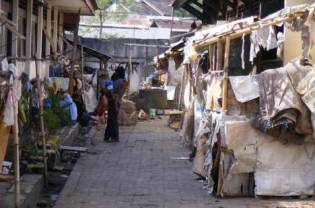
The 3-by-3 meter makeshift rooms in the refuge are partitioned with curtains made of cloth, pre-used banners and sarongs. Highlighting the limitations and plain existence of the evacuees’ lives.

There are only six bathrooms with barely enough water to satisfy the needs of all families residing there. For cooking, the sect members have built a basic kitchen from used-cement sacks and wood or bamboo to support the back of the building.

Since mid 2008, the NTB social affairs office has stop delivering rice and other food aid to the refugees because social assistance was only made available for two years. They are still struggling to make a living. In the last six months, they had no electricity after they couldn’t afford to pay the bill. Worse, as citizens, they have lost their identities as they do not possess valid identity cards (KTP).

“The cards obtained from Ketapang have expired and our applications for new KTPs has been rejected here. This makes it difficult to obtain certificates for free medical aid for disadvantaged people,” said Sarim Ahmad (40), one of the refugees.

Without KTPs, the refugees have no access to free medical services and student aid (BSM). They had to pay the normal rate for hospital fees for each baby born during that time, and have not yet received allowances for their children’s education.

The BSM scheme normally provides Rp 15,000 per primary school student, Rp 50,000 per secondary school student and Rp 75,000 per high school student a month.

To support their families, some of the members of the sect have taken jobs in the construction industry, others in retail like snack shops. Sarim and 12 other members have been working for several months in Singkong Keju Mataram (Sikemat), a fried-cassava shop with 12 branches in Mataram.

They only earn Rp 12,000 a day, working from 8 a.m. to 5 p.m. local time.

“Sometimes we don’t have enough money to buy rice. But fortunately there’s the job at the snack shop, otherwise there would be nobody to turn to,” said Nuraeni (28), another Ahmadiyah evacuee with two children.

“I want to be a policeman,” said Ridho (3), the son of Zuhri and Nuraeni, when asked what he wished to become when he grew up. But who can guarantee Ridho’s dream will come true, when his parents cannot afford to pay for basic health and his education?

— Photos by JP/Panca Nugraha

URL: www.thejakartapost.com/news/2010/03/15/longing-return-home.html

Saturday, March 14, 2009

West Lombok forbids Ahmadiyah refugees from returning home

---The Jakarta Post

National - Sat, 03/14/2009 1:46 PM

West Lombok forbids Ahmadiyah refugees from returning home

West Lombok regency has decided to forbid members of the Ahmadiyah Islamic sect, who have been living uncertainly at a refugee center in West Nusa Tenggara for three years, to return to their homes, citing security concerns.

Basirun Anwat, spokesman of the regency, told tempointeraktif.com Saturday that the decision was made during a meeting attended by the regency secretary, the local leaders forum and sect members on Thursday.

“To ensure security, they are not allowed to go home,” he said.

Basirun also said that Ahmadiyah members were still allowed to work on their farms and that the regency was going to discuss buying their land so they could move elsewhere.

Last month, 68 Ahmadiyah members from 17 families decided to risk going from the Transito building in Mataram back to their homes in Ketapang hamlet, Gegerung village, Lingsar district, West Lombok regency, on March 14.

At least 160 Ahmadiyah members from 33 families were driven from their homes when hard-line Muslims attacked them and destroyed their homes and belongings in early February 2006.

The Indonesian Ulema Council (MUI) previously issued an edict calling the Ahmadiyah heretical. The edict was seized upon by other hard-line Muslims to attack the sect’s followers elsewhere, including in West Java. (dre)

URL: www.thejakartapost.com/news/2...h-refugees-returning-home.html

Monday, March 2, 2009

Refugees’ return home ‘welcomed’

---The Jakarta Post

The Archipelago - Mon, 03/02/2009 2:18 PM

Refugees’ return home ‘welcomed’


Panca Nugraha, The Jakarta Post, Lombok Barat

The West Lombok regency has welcomed the plan by Ahmadiyah refugees to return home, but says it hopes the sect’s members will not choose to stick out again.

Regency spokesman Basirun Anwar said the administration would facilitate the return of the followers from the Transito building refugee center to their homes in Ketapang hamlet, Gegerung village, West Lombok, West Nusa Tenggara, on March 14.

“They are West Lombok residents, so we must help them,” Basirun told The Jakarta Post on Sunday, adding the administration had received a copy of a letter from the refugees about the planned return.

Basirun also said the administration had met with local leaders in the village to discuss the matter.

Besides trying to mix with local residents, he said the leaders also urged Ahmadiyah followers to obey the recent joint ministerial decree (SKB) banning them from spreading their teachings.

Jauzi Djafar, West Nusa Tenggara chairman of the Indonesian Ahmadiyah Group, promised the group would abide by the SKB, but at the same time the group also urged the residents not to use violence against its members.

After three years in limbo at the refugee center, 68 Ahmadis have decided to risk returning home.

They are among 160 followers from 33 families who were driven from their homes by hard-line Muslims in 2006.

They decided to go back since their homes were still habitable, while the remaining 92 members of the sect chose to stay at the refugee center because their homes were completely destroyed.

The Indonesia Ulema Council (MUI) previously issued an edict declaring the Ahmadiyah heretical, mainly due to the sect’s belief that its founder Mirza Ghulam Ahmad was a prophet.

Based on the edict, among other factors, the government than banned Ahmadiyah followers from spreading their teachings.

Human rights activists have deplored the use of violence against the sect’s followers and criticized the MUI for issuing the edict, which was used as a reason by the hard-liners for the attacks.

Besides followers in West Nusa Tenggara, property owned by Ahmadis in West Java were also destroyed by Muslim hard-liners.

Basirun said the West Lombok administration would coordinate with the provincial administra-tion to organize the return of the refugees.

He said the return would be conducted in a formal ceremony that would be witnessed by local Muslim leaders.

“Ketapang residents hope the return can be conducted officially. So now we are coordinating with Mataram municipality, the provincial administration and the security authorities over the return home of the refugees,” he said.

Provincial social services agency head Bachruddin said his office would provide 1 ton of rice to help out the refugees upon their return.

“Even when they do get back to their homes, they’ll still need a little help first,” he said.

URL: www.thejakartapost.com/news...eturn-home-welcomed039.html

Saturday, February 28, 2009

Ahmadiyah refugees to take risk, return home

--- The Jakarta Post, Indonesia

Headlines - Sat, 02/28/2009 9:12 AM

Ahmadiyah refugees to take risk, return home

Panca Nugraha, THE JAKARTA POST, MATARAM

After living in uncertainty at a refugee center in West Nusa Tenggara for three years, 68 members of the Ahmadiyah Islamic sect have decided to risk returning home.

Syahidin, coordinator for the refugees, said the 68 people from 17 families would move from the Transito building in Mataram back to their homes in Ketapang hamlet, Gegerung village, Lingsar district, West Lombok regency, on March 14.

“We the 17 families, including mine, have decided to return to our homes in Ketapang, whatever the risk we might face, after having lived here in uncertainty for three years. We want to live like any other citizens,” Syahidin said Friday.

He added at least four people had died at the refugee center, while nine babies were born there during the same period.

At least 160 Ahmadiyah members from 33 families were driven from their homes after hard-line Muslims attacked them and destroyed their homes and belongings in early February 2006.

The Indonesian Ulema Council (MUI) previously issued an edict calling the Ahmadiyah heretical. The edict was seized upon by other hard-line Muslims to attack the sect’s followers elsewhere, including in West Java.

Based on the edict, among other factors, the government then banned Ahmadiyah followers from spreading their teachings.

The MUI said Ahmadiyah followers had deviated from mainstream Islam by believing that sect founder Mirza Ghulam Ahmad was a prophet.

Human rights activists have long deplored the attacks against the sect’s followers and criticized the MUI for issuing the edict that triggered the widespread violence.

Syahidin said the 17 families decided to return home because their houses were still habitable, while the remaining 16 families chose to stay because their homes were completely destroyed. He added he hoped the police and local administration would accompany the refugees on their return.

“But if they don’t, we will still go back home. On the security front, we believe the police are responsible for security,” he said.

The Social Services Ministry previously stopped donating rice to the refugees, saying they could no longer be considered refugees because they had lived at the center for three years. The ministry said the rice stock would be prioritized for victims of natural disasters.

Jauzi Djafar, West Nusa Tenggara chairman of the Indonesia Ahmadiyah Group, said his group had sent a letter to Governor M. Zainul Majdi to inform him of the planned return.

He added copies of the letter were also sent to the President, Vice President, home minister, religious affairs minister, social services minister, National Police chief, attorney general and the National Commission on Human Rights.

“We sent the letters on Feb. 20 to high- and low-ranking officials, including in Gegerung,” he said.

He added the planned return was the Ahmadis’ own initiative since the government had seemingly forgotten their plight.

URL: www.thejakartapost.com/news/2009/...fugees-take-risk-return-home.html

Wednesday, January 21, 2009

Indonesia: Religious violence up: survey

--- The Straits Times, Singapore

Breaking News January 15, 2009 Thursday Updated 11.28 pm

Religious violence up: survey

JAKARTA - RELIGIOUS violence in Indonesia escalated in 2008, researchers said on Thursday.

A study by the Setara Institute for Democracy and Peace found 265 cases of violence on religious grounds last year compared to 135 cases in 2007.

‘Religious violence was more sporadic in 2008 than 2007 as more individuals were involved besides the radical Islamic organisations,’ Setara Institute chairman Hendardi, who only uses one name, said.

‘The government’s ban on the Ahmadiyah sect triggered the escalation of religious violence,’ he said of the Muslim sect which claimed as having about 500,000 followers in Indonesia.

The study found 103 religious violence cases alone in June 2008, the month in which the government issued a quasi-ban on the Ahmadiyah sect.

But liberals in the world’s most populous Muslim country lambasted the ban as unconstitutional and criticised the government as caving in to the behest of extremist groups.

Hendardi said the institute used a different method for its latest study.

‘We had field researchers across 10 provinces for the latest study. In 2007, we only observed reports in the media,’ he said, adding that the media had done a thorough job in reporting religious violence in the country. — AFP

URL: www.straitstimes.com/Breaking+News/SE+Asia/Story/STIStory_326614.html

Indonesia: Religious intolerance getting worse, says report

--- The Jakarta Post, Indonesia

Headlines Wed, 01/14/2009 8:11 AM

Religious intolerance getting worse, says report

Adianto P. Simamora, The Jakarta Post, Jakarta

Religious intolerance is getting worse here, with state agencies, radical groups and community organizations involved in violations of freedom of faith and religion, according to a report released Tuesday.
Areas with histories of religious violence in Indonesia


The recent sealing of the synagogue in Surabaya, East Java, by Muslims in a protest against the Israeli attacks on the Gaza Strip was the latest case of religious intolerance in Indonesia.

The incident was not included in the 2008 Report on the Condition of Religious and Faith Freedom in Indonesia, which was released by the Setara Institute for Democracy and Peace.

But Setara Institute chairman Hendardi said the closure of the Jewish place of worship was against the principle of religious tolerance.

“It is clearly part of religious violence and cannot be tolerated,” he told The Jakarta Post after launching the report.

The report found 265 cases of violence against religions from January-December last year, a significant increase from only 135 cases in 2007.

“The increase is spurred by the rising persecution against the Jamaah Ahmadiyah by Islamic organizations to pressure the government to issue a presidential decree banning the minority sect,” the report said.

Last year, the government issued a joint ministerial decree forbidding Ahmadiyah from spreading its religious teachings, bowing to pressure from extremist groups that had attacked its followers, their mosques and houses across the country.

Out of the 265 incidents, the institute recorded 367 violations against freedom of religion and faith.

“Of the 367 violations, the state was involved in 188 cases of violence both by ‘commission and omission’,” Hendardi said.

The report said police were involved in 121 cases of religious intolerance, regents and mayors in 28 cases while 52 others involved courts and regional legislative councils.

“What is worrying is that more individuals and unidentified groups launched sporadic religious attacks, which reached 91 cases last year,” Hendardi said.

The report blamed the radical Islamic Defender Front (FPI) and the Indonesian Ulama Council (MUI) as the main actors in the religious violence.

“We record the MUI involved in 42 cases and the FPI in 27 cases including in the Monas incident last year,” he said, referring the brutal attack on activists during a pro-tolerance rally in the National Monument, Central Jakarta.

The Setara conducted investigations in North Sumatra, South Sumatra, West Sumatra, Jakarta, Banten, West Java, Central Java, Yogyakarta, South Sulawesi, South Kalimantan and West Nusa Tenggara.

West Java was the province recording the highest rate of religious violence with 73 cases, followed by West Sumatra and Jakarta provinces with 56 and 45 cases, respectively.

“Most of the cases took place in June when the government issued a joint ministerial decree to curb the activities of Ahmadiyah,” Hendardi said.

Religious Affairs Minister Maftuh Basyuni claimed a 2006 decree on religious harmony had sharply decreased religious violence in the country. “This is big achievement,” he said Tuesday as quoted by Antara.

The 2006 decree requires people to obtain government permits to build houses of worship. Earlier, the Wahid Institute said religious violence rose to 232 cases in 2008 from 197 in the previous year.

URL: www.thejakartapost.com/news/2009/01/14/religious-intolerance-getting-worse-says-report.html

Tuesday, January 20, 2009

Govt to stop donations for Ahmadiyah refugees

---Jakarta Post, Indonesia

Headlines
Tue, 01/13/2009 8:00 AM

Govt to stop donations for Ahmadiyah refugees


Panca Nugraha, The Jakarta Post, Mataram

The government will stop donating rice to hundreds of followers of an Islamic sect taking refuge in shelters in West Nusa Tenggara for the past three years, an official said Monday.

The head of the province’s social services agency, Bachruddin, said the Social Services Ministry would only allocate the rice for victims of natural disasters, not for Ahmadiyah followers.

“Frankly, the ministry did not allocate rice for Ahmadiyah refugees this year. So we will stop the donations,” Bachruddin said in Mataram, adding the current stock of 35 tons of rice would instead be used in cases of natural disasters.

The government previously provided 9 to 12 tons of rice for 271 people from 57 families living in refugee shelters in Mataram and Central Lombok, after their homes were destroyed by other Muslims who considered the sect heretical.

“Last year we still had rice stocks for them, but not this year. It’s also because they’ve been taking refuge here for more than two years now. They can’t be categorized as refugees,” Bachruddin said.

To handle the matter, he went on, the social services agency was approaching communities where the sect’s followers came from, to try to persuade them to accept back the refugees.

He added the agency was also working with the Mataram and Central Lombok administrations to relocate the refugees to residential areas, and not colonies, as they used to live in.

“But some residents still reject the followers. The residents want them to uphold ‘real Islam’, while the refugees defend their beliefs,” Bachruddin said.

To date, 130 people from 37 families of Ahmadiyah refugees have been living in the Transito House in Mataram, after being forced from their homes in Ketapang hamlet, Gegerung village, Lingsar district in West Lombok, in February 2006. Another 19 people from 7 families have been living in the defunct Praya Hospital, Central Lombok, since they were expelled from their homes in Praya three years ago.

M. Jauzi, chairman of the provincial branch of Ahmadiyah, said his organization would leave the decision to stop the donations up to the government.

But he called on the government to return the refugees to their respective homes if they decided to press on with the decision to stop the donations, saying that “taking refuge is not the will of the Ahmadiyah followers”.

“We’ve frequently asked the government to return the refugees to their homes so they can work rather than live off of handouts,” he said.

Jauzi said his organization had sent a letter to the governor, asking the administration to resolve the issue quickly.

“In the latest developments, the provincial administration and religious affairs office said they would facilitate the refugees’ return home. But we’re still waiting,” he said.

Violence against Ahmadiyah followers is not isolated to the province.

In West Java, property owned by sect supporters have been vandalized. Attackers often use an edict issued by the Indonesian Ulema Council, which declared Ahmadiyah heretical, to justify the violence. Many moderate Muslims have decried the violence against the Ahmadiyah followers as a violation of the Constitution, which guarantees the freedom of religion and religious belief.

URL: www.thejakartapost.com/news/2009/01/13/govt-stop-donations-ahmadiyah-refugees.html

Wednesday, November 12, 2008

NTB government prepares to allow Ahmadiyah refugees to return home

-- Jakarta Post, Indonesia

Headlines Tue, 11/11/2008 10:51 AM

NTB government prepares to allow Ahmadiyah refugees to return home

Panca Nugraha, The Jakarta Post, Mataram

Ahmadiyah refugees in West Nusa Tenggara will be allowed to return to their homes soon, the host governor announced Monday, following three years of foot-dragging over the issue.

Governor M. Zainul Majdi told The Jakarta Post his administration, through the relevant agencies, would repatriate the refugees by conducting public awareness campaigns to “provide understanding to people where the Ahmadiyah members came from”, and ask the beleaguered minority sect members to socialize with the local community.

“The administration will return them to their home villages, but this process must be supported by a willingness on the part of residents in these villages to accept them again, and by members of Ahmadiyah interacting more and not remaining so exclusive any more. We are carrying out dissemination efforts at the moment,” Majdi said.

He did not specify when the Ahmadiyah members would be returned, but said this was the administration’s final decision on the matter, rather than relocating them.

“We’ll definitely keep addressing the Ahmadiyah issue through approaches according to the joint ministerial decree,” he said.

As many as 137 Ahmadiyah members from 33 families have taken refuge at the Mataram transmigration transit center since being forced from their homes in Ketapang hamlet, Gegerung village, Lingsar district in West Lombok in February 2006.

In Central Lombok regency, around 57 Ahmadis from 15 families now live at the former Praya hospital after being driven from their homes in Praya subdistrict, Praya district, Central Lombok, in June 2006. To date, six people have died and eight babies have been born in their three years in exile.

It remains unclear how the Ahamdiyah members will reintegrate into their previous communities, having seen most of their belongings destroyed, including houses.

The violence against Ahmadiyah followers was believed to be triggered by the Indonesian Ulema Council’s issuance of an edict calling the sect heretical.

Earlier this year, the government bowed to pressure from radical Islamic groups and issued a joint ministerial decree banning the Ahmadiyah from spreading their teachings.

Bachruddin, head of the West Nusa Tenggara Social, Demographic and Civil Statistics Agency, said the status of the refugees was considered unique, and stressed its handling could not be carried out according to standard procedures.

The United Nations High Commission on Refugees defines refugees as a group of people forced to move because their places of origin are ravaged by natural or social disaster, in which the state cannot guarantee their safety.

“The Ahmadis took refuge not because of a natural disaster, but because they were evicted by the state,” Bachruddin said.

“This poses a unique problem: They are actually not refugees, but the fact is they effectively are.”

URL: www.thejakartapost.com/news/2008/11/1...rn-home.htmll

Monday, September 29, 2008

Ahmadiyah members assured they can celebrate in peace


The Jakarta Post The Archipelago Tue, 09/30/2008 10:19 AM

Panca Nugraha, The Jakarta Post, Mataram

West Nusa Tenggara Police have stressed that members of the Ahmadiyah sect seeking refuge at the Mataram Transmigration Transit Center during the Idul Fitri holiday would be safe, with officers conducting routine patrols on site.

“The police have so far not specifically posted personnel at the location, but we are patrolling the area on a regular basis,” provincial police spokesman Comr. Tribudi Pangastuti told The Jakarta Post on Monday.

“They remain Indonesian citizens who should be protected.”


Tribudi added police personnel deployment at the transit center would depend on the situation there.

Ever since the government issued a joint decree banning Ahmadiyah activities, police have been monitoring the group and conducting routine patrols to ensure they are not targeted by hard-line Islamic activists.

“The situation remains calm as of now. There’s still no reaction from the public. The center has never been a scene of protest over the presence of the group,” Tribudi said.

As in previous years, hundreds of Ahmadiyah refugees will this year perform Idul Fitri prayers Wednesday at a small mosque in the transit center.

“Actually, we were looking forward to performing the prayers at our home village, but we will be staying here this year because we still hold refugee status,” said Ahmadiyah refugee coordinator Syahidin.

He said that after the Idul Fitri prayer, those living at the transit center, and others at the former Praya Hospital in Central Lombok would visit each other for the traditional seeking of forgiveness.

Some 137 Ahmadiyah members from 33 families are still sheltering at the transit center after being forced from their homes in Gegerung village, West Lombok, in February 2006.

As many as 57 other refugees from 15 families are still occupying the former Praya Hospital, having been forced from their homes in Praya village, Central Lombok, in June 2006.

In that time, six people have died and eight babies have been born.

Ahmadiyah advisor Syaiful Uyun told the Post the provincial office of the Religious Affairs Ministry had held a dialogue with Ahmadis in mid-September.

But there has yet to be any visit by officials to the evacuation centers, he added.

“The joint decree states that Ahmadiyah not to proselytize its teaching and live exclusively, calling for an integration with the public at large,” he said.

“But how can we mix if we are still taking refuge here? The government should have resolved the refugee issue first.”

Syaiful also said that during the dialogue, a number of people had asked Ahmadiyah members to perform a mass repentance in public, similar to that done by members of the Al-Qiyadah Al-Islamiyah sect.

“This confuses us. Al-Qiyadah is obviously a deviant sect because it acknowledges its leader Musadeq as the last prophet, and thus ought to repent,” Syaiful said.

“But we recognize Prophet Muhammad as the final prophet and pledge the same syahadah (profession of faith) as other Muslims. So what should we repent for?”

Ahmadiyah is considered heretical by many mainstream Muslims for its recognition of founder Mirza Ghulam Ahmad as a prophet, despite Islamic tenet insisting Muhammad was the final prophet and no prophet could come after him.

The group eventually split into two schools of thought, with one still recognizing Ahmad as a prophet and messiah, and the other considering Ahmad just a reformer, not a prophet.

The provincial administration is still monitoring the Ahmadis’ activities before it decides to return them to their homes.

H.M. Nur, head of the provincial People’s Unity and Protection Agency, said the government would persuade the communities that expelled the Ahmadiyah members to accept them back.

“If the Ahmadiyah members have abided by the joint decree, but the local communities have yet to accept them, this could also cause a problem,” he said.

URL: www.thejakartapost.com/news/2008/...-peace.html

 
^ Top of Page