Showing posts with label Suryadharma Ali. Show all posts

Friday, April 8, 2011

The banal rhetoric of imperialism, colonialism

OPINION
Fri, 04/08/2011
8:00 AM
The banal rhetoric of imperialism, colonialism
Al Makin, Yogyakarta
The current campaign waged by the US and its allies against Col. Muammar Qaddafi’s merciless dictatorship also entails a war of ideas.

Qaddafi and his followers have shielded themselves from democratic protesters with a predictable and boring rhetoric of anti-imperialism and anti-colonialism.

Libya will be occupied by the West, just as Iraq, Afghanistan and Vietnam were occupied! Colonial powers harbor nothing but jealousy of the Third World’s advancing wealth! Oil is at the root of every problem!

The rhetoric evokes the bitter experience of the Islamic world under a long period of Western colonialism. It is not surprising that the US and its allies have been branded as crusading armies bent on destroying their Muslim enemies.

Conspiracy theorists have already drawn analogies between colonialism and the recent Libya campaign. Some Indonesian politicians have promoted this rhetoric in public. Whether anyone wants to listen is a different issue.

Hidayat Nur Wahid, a senior politician of the Prosperous Justice Party (PKS), said that the goal of the current war in Libya was “to seize the nation’s oil”, adding that “European countries have suffered from an economic recession. They need new resources to revive their economy.”

It sounds like the rhetoric of Iranian president Ahmadinedjad, except in an Indonesian format. Compare Hidayat’s words with those of Ahmadinedjad on the Libyan crisis: “The Westerners have to cast aside their colonialist ambitions.”

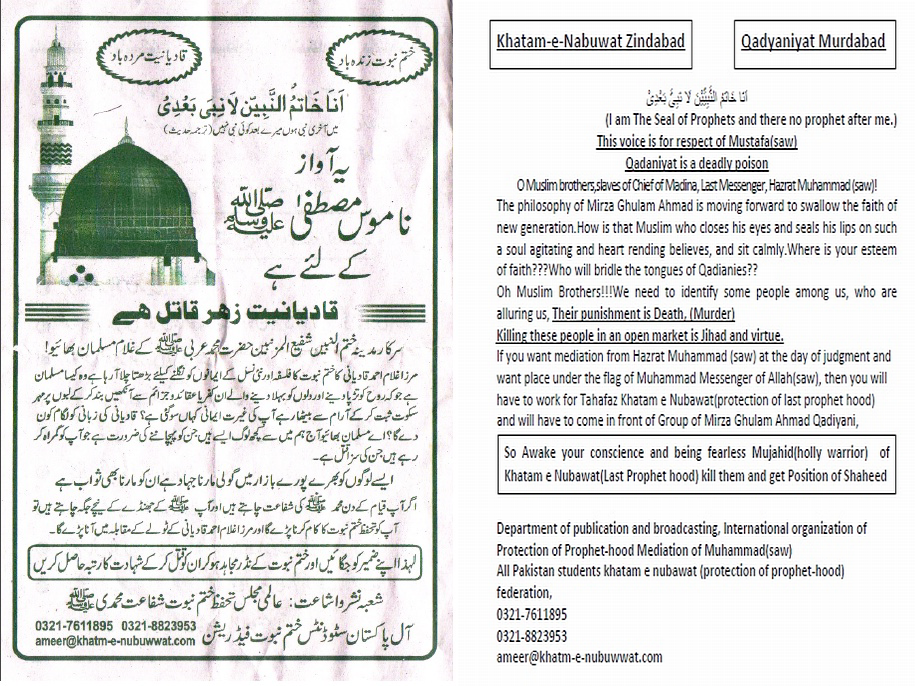
The rhetoric of imperialism and colonialism can also be found in the case of Ahmadiyah, the minority Islamic sect that has suffered repeated harassment at the hands of Indonesian radicals.

According to the hard-liners, the European Union, the UN and US congressmen asked the Indonesian government to pay serious attention to the plight of Ahmadiyah. Many Indonesian officials, rather than heeding their warnings, fired back at perceived international pressure.

Home Minister Gamawan Fauzi, for instance, rejected demands to revoke laws that discriminate against the Islamic sect. Gamawan’s response to the US congressmen does not surprise us, as he warmly welcomed the FPI leaders’ proposal to disband the group. You can guess which faction the man sides with.

On March 23, I was invited to speak at the Religious Affairs Ministry’s dialogue and public hearing on Ahmadiyah that was held in Central Jakarta.

I made myself as clear as possible to other participants that the failure to protect any citizen of Indonesia means the beginning of the nation’s collapse. I reminded the audience about the domino effect. After Ahmadiyah, the Shiite, Christian minority, and liberals, Nahdlatul Ulama and Muhammadiyah — all groups that are not considered purely “Islamic” by Islamists — will be targeted by the radicals.

I realized that most of the participants disagreed with me. Before my turn to speak I listened to members of the Islam Defenders Front (FPI) — an organization whose fame lies in their radical stances and terrifying tactics — give their threatening opinions.

The Religious Affairs Ministry used to be a place where the idea of religious pluralism and other progressive concepts were incubated under the leadership of A. Mukti Ali, Alamsjah Ratuprawiranegara and Munawir Sadzali. Now the ministry has become a rendezvous for the FPI leaders.

I am afraid that Ahmadiyah will be disbanded by a more “authoritative” law, enacted after the government’s “consults” with different groups.

In fact, nobody is sure that the government listened the sound judgments conveyed by scholars and activists at the seminar. As usual, politicians placed political interests ahead of all other concerns.

Religious Affairs Minister Suryadharma Ali, who also chairs the United Development Party (PPP), revealed his true colors.

At a conference in Samarinda he urged fellow party members not to hesitate to make Islam as an ‘ideology’ (The Jakarta Post, March 27, 2011). He also denounced liberal thinking (The Jakarta Post, Feb. 23, 2011).

Indeed, at the ministry’s dialogue I heard a moderator provoke the audience when he said that the US and Western powers were meddling in the case of Ahmadiyah — a form of intervention that we must not bow down to.

This rhetoric reminds us the way Abu Bakar Ba’asyir often defends himself in the court. He has repeatedly said that he was arrested under orders from the US. The conspiracy theories then followed: the Indonesian government was a mere toy of the world superpower, the US.

I am afraid to draw some points of similarities among the opinions conveyed by Qaddafi, Ahmadinedjad, Hidayat Nur Wahid, the FPI leaders, Ba’asyir, two of the President’s current ministers and perhaps other state officials. I question to what extent radical thinking has penetrated the government.

Has this government and other political leaders already knelt down before the FPI’s leaders?

The writer is a lecturer at Sunan Kalijaga State Islamic University, Yogyakarta.

Copyright © 2008 The Jakarta Post - PT Bina Media Tenggara. All Rights Reserved
URL: www.thejakartapost.com/news/2011/04/08/the-banal...

Tuesday, March 29, 2011

Ministry to hold another meeting on Ahmadiyah

NATIONAL
Tue, 03/29/2011
11:02 PM
Ministry to hold another meeting on Ahmadiyah
The Jakarta Post, Jakarta
Muslim organizations, law experts, human rights watchdogs and Ahmadiyah figures will hold a dialogue on the Ahmadiyah on Tuesday and Wednesday, the religious affairs minister said Monday.

Minister Suryadharma Ali said the two-day dialogue hosted by his office would give equal chance to Muslim organizations, including the Islam Defenders Front (FPI), Ahmadiyah figures, experts and human rights activists, to present their opinions on the Islamic sect.

Last week, the ministry also held a meeting on the Ahmadiyah on the heels of a fatal clash and the issuance of bylaws banning the Ahmadiyah. Jamaah Ahmadiyah Indonesia (JAI) refused to attend the meeting, saying the meeting was biased judging from the list of invitees.

JAI’s legal consultant, Indonesia Legal Aid Institution Foundation (YLBHI), told The Jakarta Post that JAI would once again not attend Tuesday’s or Wednesday’s meeting. — JP

Copyright © 2008 The Jakarta Post - PT Bina Media Tenggara. All Rights Reserved
URL: www.thejakartapost.com/news/2011/03/29/ministry...

Monday, March 28, 2011

Ministry invites Ahmadis to attend another dialog

NATIONAL
Mon, 03/28/2011
6:42 PM
Ministry invites Ahmadis to attend another dialog
The Jakarta Post, Jakarta
Religious Affairs Minister Suryadharma Ali is issuing another invitation to Ahmadiyah members to attend a discussion concerning their religious beliefs.

The Ahmadis refused to attend a dialog last week with mainstream Muslim leaders fearing it would be biased.

“We are inviting Ahmadiyah and Ahmadiyah Movement Indonesia in order to give them a chance to explain Ahmadiyah teachings,” Suryadharma said.

Aside from Ahmadiyah members, the government also invited the Indonesia Ulema Council (MUI), Islamic communities, legal experts and human rights activists.

“All parties will get the chance to explain their views. The discussion is not intended to corner Ahmadis; our target is to be able to understand each other,” he said.

Suryadharma has yet to receive confirmation that the Ahmadis will attend. (swd)

Copyright © 2008 The Jakarta Post - PT Bina Media Tenggara. All Rights Reserved
URL: www.thejakartapost.com/news/2011/03/28/ministry...

Friday, March 25, 2011

Dialogue Won’t Wait for Ahmadiyah

Jakarta Globe, Indonesia
NEWS
Dialogue Won’t Wait for Ahmadiyah
Camelia Pasandaran & Antara | March 25, 2011

Having missed out on getting its voice heard on Tuesday and Wednesday, the Indonesia Ahmadiyah Congregation has two more days to attend hearings at a national dialogue organized by the Religious Affairs Ministry.

The hearings are geared toward resolving an ongoing nationwide dispute over the minority Ahmadiyah sect, Religious Affairs Minister Suryadharma Ali said on Thursday.

He added that no amendment would be made to the schedule of the dialog simply to accommodate the wishes of the sect.

“If they want to come, we will be holding this dialogue on March 28 and 29. They could come on those days. If they have no intentions to resolve this matter, they should come and explain why,” the minister said.

The congregation, also known as the JAI, said it declined the invitation because of the short notice it was given, plus the venue — the Ministry of Religious Affairs.

Zafrullah Pontoh, the JAI’s national secretary, said on Monday that the invitation had only arrived on Friday, adding that the group had been allocated just four seats at the conference.

Wednesday’s talks saw a majority of the representatives agreeing to the complete disbandment of Ahmadiyah.

In a separate development, West Java Governor Ahmad Heryawan claimed that hundreds of Ahmadis had converted to the “correct” teachings of Islam following the recent issuance of local regulations banning the religious activities of the sect.

“Hundreds of Ahmadis have come to the correct path of Islam in West Java,” Ahmad said on Thursday.

“It is my hope that the figure reaches 500 Ahmadis.”

Copyright 2010 The Jakarta Globe
URL: www.thejakartaglobe.com/news/dialogue.../431551

Tuesday, March 22, 2011

Ahmadiyah Declines Invite to Ministry Dialogue

Jakarta Globe, Indonesia
HOME
Ahmadiyah Declines Invite to Ministry Dialogue
Arientha Primanita | March 22, 2011

The Indonesia Ahmadiyah Congregation has cited the short notice given for its declining an invitation to a national dialogue today that aims to address the growing intimidation and violence faced by the group’s members.

Representatives of the congregation, also known as the JAI, were invited by the Ministry of Religious Affairs to attend the conference in Jakarta, which was organized to help resolve the ongoing controversy surrounding the minority Muslim sect.

Zafrullah Pontoh, the JAI’s national secretary, said on Monday that the invitation had only been received on Friday. He added that the group had only been allocated four seats at the conference.

After discussions with its legal representatives, Zafrullah said the JAI had asked the ministry to reschedule the event. He said the group had also voiced concerns about the makeup of the conference invitees and the direction of the talks.

“In the invitation we received to attend this dialogue, we were given just four seats. Plus, they gave us very short notice,” he said at the Indonesian Legal Aid Foundation (YLBHI).

There was no word on whether the ministry would go forward with the event or reschedule.

Zafrullah said the JAI’s stance was clear that the religious freedom guaranteed by the Constitution extended to the Ahmadiyah community.

He also said other groups should be involved in any talks, including the Coordinating Ministry for Political, Legal and Security Affairs and the National Commission on Human Rights (Komnas HAM), because the problem had moved beyond a theological dispute and was now about protecting citizens.

“Due to the stigma attached to Ahmadis, we ask that this dialogue have set regulations and rules to give both parties enough time to offer thorough explanations,” he said. “There are so many misconceptions about Ahmadiyah. We want to be given a forum to clear up all the issues.”

Erna Ratnaningsih, chairwoman of the YLBHI, said the dialogue should be held on neutral ground, not at the Religious Affairs Ministry.

Nurkholis Hidayat, director of the Jakarta Legal Aid Foundation (LBH Jakarta), said if the dialogue was only facilitated by ministry, the discussion would be limited to theological issues. “The bigger issue here is human rights,” he said.

Copyright 2010 The Jakarta Globe
URL: www.thejakartaglobe.com/home/ahmadiyah.../430756

Ministry meeting likely ‘one-sided’: Ahmadiyah

HEADLINES
Tue, 03/22/2011
10:40 PM
Ministry meeting likely ‘one-sided’: Ahmadiyah
Ina Parlina and Yuli Tri Suwarni, The Jakarta Post, Jakarta/Bandung
Rejecting 'biased dialogue': Indonesian Legal Aid Foundation chairwoman Erna Ratnaningsih (center) speaks at a press conference in Jakarta on Monday, accompanied by Jamaah Ahmadiyah Indonesia (JAI) spokesperson Jafrullah Ahmad Pontoh (left) and JAI vice president Mirauddin (right). Erna said her clients, Ahmadiyah followers, refused to honor the Religious Affairs Ministry's invitation to dialogue. JP/Ricky Yudhistira
Rejecting ‘biased dialogue’: Indonesian Legal Aid Foundation chairwoman Erna Ratnaningsih (center) speaks at a press conference in Jakarta on Monday, accompanied by Jamaah Ahmadiyah Indonesia (JAI) spokesperson Jafrullah Ahmad Pontoh (left) and JAI vice president Mirauddin (right). Erna said her clients, Ahmadiyah followers, refused to honor the Religious Affairs Ministry’s invitation to dialogue. JP/Ricky Yudhistira
Jamaah Ahmadiyah Indonesia is refusing to attend a meeting spnsored by the Religious Affairs Ministry scheduled for Tuesday, saying they feared they would be “lynched” at the meeting by other participants.

Erna Ratnaningsih from the Indonesian Legal Aid Foundation (YLBHI), which represents Ahmadiyah congregations across the country, said that her clients refused to have a “biased dialogue”.

“The composition of the parties that will participate in the dialogue is unfair to Ahmadiyah. Many of them are in favor of those who want Ahmadiyah to be disbanded,” Erna told the press on Monday.

“Therefore, we won’t attend the dialogue.”

Erna said at least two-thirds of the total 44 participants attending would be from the Religious Affairs Ministry. Religious Affairs Minister Suryadharma Ali has repeatedly expressed support for bylaws banning Ahmadiyah.

The ministry also invited the Islamic People’s Front (FUI), which recently barricaded an Ahmadiyah facility in Yogyakarta, and other Muslim leaders who supported bans on Ahmadiyah. Erna denied accusations that the refusal was an indication that Ahmadiyah was being uncooperative, saying that her clients would only attend a fair dialogue.

“We will attend a dialogue only if it has a fair composition. We want the dialogue to also involve neutral parties,” she said.

She was concerned that the meeting, dubbed by the ministry a “dialogue and opinion sharing” session, would only trick Ahmadiyah into something harmful to themselves.

Nurkholis Hidayat from the Jakarta Legal Aid Institute (LBH) said that the Ahmadiyah matter was not merely about Islam.

“It’s not about Islam. It has become a matter of the state because Ahmadis are citizens who have the same constitutional right to worship,” he said.

He added that if the government was truly committed to finding a permanent settlement on the matter they must take Ahmadiyah’s constitutional rights into consideration.

He said it would be best not to shift the matter into theological debate through unfair dialogue “because faith is individual territory that cannot be interfered”.

“I’m sure with such composition, the dialogue would only lead to Ahmadiyah dissolution,” he said.

Zafrullah Ahmad Pontoh, a spokesman for Ahmadiyah Indonesia, said the manner in which the Religious Affairs Ministry sent the invitation was suspicious.

“We received the letter on March 18, but it was dated March 16. It was Friday; it means that we had only one working day to prepare for the Tuesday dialogue,” he said. “It’s not fair.”

The ministry’s director general of guidance to the Muslim community, Nasaruddin Umar, said that he regretted Ahmadiyah’s decision not to attend the Tuesday dialogue.

“This will be a good chance for the Ahmadis to present what they called their faith to the state officials.

Show us what we called deviation as something right and not against Islam,” he said. “Deciding not to attend our meeting means they will lose their chance to show it.”

However, he asserted that his office would not impose any sanctions against Ahmadiyah.

“We will still hold the Tuesday dialogue, even without Ahmadiyah,” he said, adding that his office might schedule another dialogue for Ahmadiyah.

Nurkholis said the government’s efforts to hold such dialogue were tardy.

“All this time, local administrations have made unfair policies against Ahmadiyah and the central government did nothing,” he said.

The Legal Aid Institute said it found at least 10 new local bylaws and decrees which ban Ahmadiyah from practicing their faith after a fatal mob attack against Ahmadiyah congregation in Cikeusik village, Banten.

In Bandung, members of FUI successfully persuaded eight Ahmadiyah members to return the Ahmadis — who had been deemed heretical — to the “right path” of Islam by relieving their debt on Monday. Two men, three women and three young girls who were previously members of Ahmadi’s Al-Ukhuwah, returned to Islam, claiming that they wanted a peaceful life.

Copyright © 2008 The Jakarta Post - PT Bina Media Tenggara. All Rights Reserved
URL: www.thejakartapost.com/news/2011/03/22/ministry-meeting...

‘Bad intentions’ in Ahmadi rebuff of govt meeting: Minister

NATIONAL
Tue, 03/22/2011
3:40 PM
‘Bad intentions’ in Ahmadi rebuff of govt meeting: Minister
The Jakarta Post
Religious Affairs Minister Suryadharma Ali says he regrets that Ahmadis have refused to attend a discussion with the government about Ahmadiyah in the country and its interactions with others.

The discussions are scheduled for four days starting today.

“It is very regrettable that they decided not to attend. This can been seen as them having bad intentions,” Suryadharma said Tuesday.

Suryadharma said the government was hopeful that Ahmadiyah representatives would come and explain their religion. “We would like to hear their Islamic beliefs so that we can solve this matter together,” he said.

The secretary-general for the ministry, Bahrul Hayat, said the dialog was initiated by the government. He said the government was the one who wanted to listen, “not them listening to us,” he said.

Erna Ratnaningsih from the Indonesian Legal Aid Foundation, which represents Ahmadiyah congregations across the country, said her clients refused to participate in a “biased dialog”.

Copyright © 2008 The Jakarta Post - PT Bina Media Tenggara. All Rights Reserved
URL: www.thejakartapost.com/news/2011/03/22/%E2%80%98bad...html

Tuesday, March 15, 2011

Indonesia: Revoke Provincial Decrees to Ban a Faith

Human Rights Watch
Indonesia: Revoke Provincial Decrees to Ban a Faith
Religious Affairs Minister Should be Removed for Promoting Discrimination
March 15, 2011

Repeated calls by Religious Affairs Minister Suryadharma Ali to ban the Ahmadiyah fan the flames of violence against the group. President Yudhoyono should signal that such discrimination has no place in a society that promotes religious tolerance and remove Suryadharma Ali from his post.
Phil Robertson, deputy Asia director at Human Rights Watch
President Susilo Bambang Yudhoyono of Indonesia should void decrees recently adopted by two provinces that ban activities by the Ahmadiyah religious community, Human Rights Watch said today. Human Rights Watch repeated its call for the president to revoke the national anti-Ahmadiyah 2008 decree, which bars public propagation of the Ahmadiyah faith.

On February 28, 2011, the provincial government in East Java, which has a population of 37 million, banned the activities of the Ahmadiyah community, outlawing the display of their mosque and school signs and the use of “electronic media” to extend their teachings. On March 3, the government in West Java, Indonesia’s most populous province, with 43 million people, also banned the Ahmadiyahs’ activities. Both provincial governments based their laws on the June 2008 national decree by the Yudhoyono administration, violations of which can result in prison sentences of up to five years. Jemaah Ahmadiyah Indonesia, the religious group’s leadership, reports that 16 provinces and regencies in Indonesia have issued anti-Ahmadiyah decrees since 2006.

“Indonesian national and provincial authorities risk being complicit in anti-Ahmadiyah violence by stripping this religious community of their basic rights,” said Phil Robertson, deputy Asia director at Human Rights Watch. “These decrees place officials on the side of militants who increasingly have been carrying out attacks on the Ahmadiyah.”

The Ahmadiyah movement was founded in 1889 by Mirza Ghulam Ahmad. The Ahmadiyah identify themselves as Muslims but differ with other Muslims as to whether Muhammad was the final monotheist prophet. As a result, some other Muslims perceive the Ahmadiyah as heretics. Approximately 300,000 Indonesians follow the faith.

On February 6, a mob of 1,500 people attacked 21 Ahmadiyah members in Cikeusik, a village in the Banten province in western Java, killing three people and seriously wounding five others. About 30 police officers were present but did little to stop the attack. A videographer recorded the brutality, and the video was later posted by various individuals and organizations on YouTube. Widespread national and international condemnation of the attack ultimately prompted the Indonesian police to investigate the attack and arrest 12 suspects.

Additional attacks on Ahmadiyah communities soon followed. On March 11, villagers attacked four Ahmadiyah houses in Ciareuteun village, in Bogor. The police took no action against the assailants but arrested and questioned seven Ahmadiyah members and forced them to sign a document to renounce their faith. On March 13, in the nearby Bogor village of Cimanggu, assailants attacked four Ahmadiyah houses, causing the residents to flee. Local police later assigned guards around the Ahmadiyah properties in Cimanggu.

Since the February 6 attack, Religious Affairs Minister Suryadharma Ali has repeatedly urged the cabinet to issue a total ban on the Ahmadiyah, claiming justification in a 2005 fatwa issued by the Indonesian Ulemas’ Council and the 2008 national anti-Ahmadiya decree. Ali has also recommended that the government declare the Ahmadiyah faith a new religion that is not permitted to make use of Islamic symbols such as the Quran, its rituals, and the Prophet Mohammed. He also has frequently urged Indonesia to follow the “Pakistan road,” to ban and criminalize Ahmadiyah activities.

“Repeated calls by Religious Affairs Minister Suryadharma Ali to ban the Ahmadiyah fan the flames of violence against the group,” Robertson said. “President Yudhoyono should signal that such discrimination has no place in a society that promotes religious tolerance and remove Suryadharma Ali from his post.”

At least one senior Indonesian military officer has similarly called for restrictions on the rights of Ahmadiyah. On March 9 the West Java military commander, Major General Moeldoko, openly asked his soldiers in Bandung to support banning the Ahmadiyah and urged Muslims “to invade” and “to occupy” Ahmadiyah mosques. Soldiers under his command and police officers went to an Ahmadiyah mosque in Bandung during Friday prayers on March 11 and demanded that the Ahmadiyah imam, Ahmad Sulaeman, be replaced by Asep Zaenal Ausof of the Indonesian Ulemas’ Council’s Bandung branch.

“Indonesia’s top army commander, General George Toisuta, should order all officers to respect the rights of all religious communities and take immediate action against those harassing the Ahmadiyah or other faiths,” Robertson said.

Indonesian law facilitates discrimination against the Ahmadiyah. The June 2008 decree, the “Joint Ministerial Decree on Warning and Ordering the Jemaah Ahmadiyah Indonesia and Others,” requires the Ahmadiyah to “stop spreading interpretations and activities that deviate from the principal teachings of Islam,” including “spreading the belief that there is another prophet with his own teachings after Prophet Muhammad.” Human Rights Watch has consistently called for the government to rescind this decree, as it violates the right to freedom of religion. At the time the decree was signed, officials said it was necessary to help stop further violence.

Since the national anti-Ahmadiyah decree was issued, violence against the Ahmadiyah community has increased dramatically. The Setara Institute, a respected nongovernmental organization that monitors religious freedom in Indonesia, recorded a rise from three attacks in 2006 to 50 in 2010.

Prohibiting the Ahmadiyah from practicing their religion is in violation of Indonesia’s obligations under the International Covenant on Civil and Political Rights, ratified by Indonesia in 2006, which protects the right to freedom of religion and to engage in religious practice “either individually or in community with others and in public or private.” The treaty also protects the rights of minorities “to profess and practice their own religion.” It provides that the protections in the treaty shall extend throughout a state “without any limitations or exceptions,” thus obliging provincial and other local governments to abide by its provisions.

Human Rights Watch urged concerned countries to call on the Indonesian government to protect the rights of religious minorities in the country. Specifically, foreign embassies in Jakarta should raise their concerns and seek reforms not only in contacts with national officials, such as Yudhoyono and Home Affairs Minister Gamawan Fauzi, but with provincial leaders, including the West Java governor, Ahmad Heryawan, and the East Java governor, Soekarwo.

“Provincial officials are no less responsible than their counterparts in Jakarta for ensuring that the rights of their populations are fully protected” Robertson said.

Monday, February 28, 2011

Best to Disband Ahmadiyah, Religious Minister Says

Jakarta Globe, Indonesia
NEWS
Best to Disband Ahmadiyah, Religious Minister Says
Fitri | February 28, 2011

Minister Suryadharma Ali meeting with top religious leaders in Lombok, Mataram, on Sunday. At the meeting, the minister said he was in favor of banning Ahmadiyah but that religious leaders, not the government, had the power to make such a decision happen. (JG Photo/Fitri)
Mataram, West Nusa Tenggara. Religious Affairs Minister Suryadharma Ali told a gathering of Islamic leaders on Sunday that the Ahmadiyah sect should be outlawed, but that the government did not have the power to make the decision.

To shouts of “Disband Ahmadiyah” from an audience that included the heads of about 500 Islamic boarding schools and the leaders of at least nine Islamic organizations, the minister seemed to urge religious leaders to take the lead in pushing for the minority Islamic sect to be disbanded.

“We [the government] do not have the right to disband Ahmadiyah,” he said. “That right lies in the hands of you esteemed ulema. We, the government, only have the right to regulate and control, not to disband or excommunicate.”

Suryadharma told the audience in Mataram, Lombok, which included leaders from the Indonesian Council of Ulema (MUI), Nahdlatul Ulama (NU), Muhammadiyah and Hizbut Tahrir, that MUI branches across the country had declared Ahmadiyah a deviant sect.

On those grounds, he said, any request by religious leaders to have the sect disbanded was reasonable and had his approval.

The minister’s statement came on the same day that Habib Rizieq, leader of the hard-line Islamic Defenders Front (FPI), called on Muslims nationwide to attend a march on Tuesday demanding the banning of Ahmadiyah.

In a sermon in Jakarta, Rizieq invited Muslims from across Indonesia to attend a rally at the Hotel Indonesia traffic circle in Jakarta to protest the sect.

Suryadharma said the government had not issued an official statement in regard to banning Ahmadiyah, but that he would favor any proposal to outlaw the sect.

“I admit that the government has not issued any such statement,” he said. “However, I personally am of the opinion that it would be best if Ahmadiyah was disbanded. In this case, there lies a question: If we let them be, will the problem eventually be resolved? And if we disband them, will the problem go away?

“If we leave them the way the are, the problem will only become much bigger. Ahmadiyah deserves to be disbanded.

“Once they are disbanded, harmony will be guaranteed. I have pushed members of Ahmadiyah to form a new sect that is devoid of any and all attributes of Islam, not to ever use the word or symbol of the mosque in any of their prayer halls, and never to accept the Koran as their holy book if they call themselves Ahmadiyah. My preference would be that they all leave Ahmadiyah and follow the right path by entering into Islam.”

He also urged religious leaders in the audience to work harder to bring what he called the “correct” teachings of Islam to isolated corners of the country, to prevent deviant sects from flourishing in those areas. He then posed a question for those supporting the rights of Ahmadis.

“ The problem now is that those who oppose Ahmadiyah are fighting against those campaigning for religious freedom,” he said. “If we work toward disbanding [Ahmadiyah], those fighting for religious freedom will accuse the government of getting in the way of religious freedom.

“So my question is, does religious freedom mean the freedom to insult someone else’s religion and rewrite the teachings of someone’s religion?”

Copyright 2010 The Jakarta Globe
URL: www.thejakartaglobe.com/news/regional...ahmadiyah/425228

Thursday, February 10, 2011

Govt, House urge for Ahmadiyyah decree to become law

NATIONAL
Thu, 02/10/2011
9:48 AM
Govt, House urge for Ahmadiyyah decree to become law
The Jakarta Post, Jakarta
The government and legislators have called for the speedy issuance of a new law, based on a joint ministerial decree (SKB) on the Islamic minority sect Jamaah Ahmadiyyah, to ensure “more efficient” law enforcement relating to Ahmadis.

The joint decree was originally issued by the religious affairs minister, the home minister and the attorney general in 2008, in efforts to regulate what Ahmadiyyah followers could and could not do in terms of religious practice.

“After becoming law, it can serve as a legal basis for more effective law enforcement,” Religious Affairs Minister Suryadharma Ali said early Thursday morning after a hearing with the House of Representatives’ commission on religion.

“Making the decree into law will provide stronger legal grounds to maintain harmony among people of different faiths,” he said.

Many have said the joint decree only reaffirms the community opposition to the minority, and has given some degree of legal backing to violent actions against Ahmadis, the worst of which was seen in Pandeglang, Banten, on Sunday, when three Ahmadis were brutally killed in a mob attack on their congregation.

However, the government has insisted the move would serve as a means to preventing communities from being further provoked by Ahmadis’ activities, thus protecting the latter from violence.

Religious commission chairman Abdul Kadir Karding said the recent attack in Pandeglang was evidence that the ministerial decree needed to be made into law.

“With the recent situation, it is urgent that we immediately discuss and complete [deliberation of the bill],” Abdul said, as quoted by tempointeraktif.com.

Tuesday, February 8, 2011

Minister told to take precautions when commenting on Ahmadiyah

NATIONAL
Tue, 02/08/2011
4:56 AM
Minister told to take precautions when commenting on Ahmadiyah
The Jakarta Post, Jakarta
Religious Affairs Minister Suryadharma Ali needs to be more prudent when commenting on the Ahmadiyah religious sect, Abdul Kadir Karding, chairman of the House of Representatives’ Commission VIII overseeing religious affairs, warned Tuesday.

Suryadharma, Abdul said, should not blatantly announce his plan to ban the sect as he did last year as it only fuelled animosity toward the Ahmadis.

“The religious affairs minister is not the minister for Muslims only, but for all people in Indonesia. He represents the government and the government represents the people. A statement like that will only fuel the militancy of hard-line groups and justify their violent acts,” he added.

Ahmadiyah mosques and homes in Indonesia have been the target of intimidation and a series of attacks, reportedly not only committed by civilians, but also by the authorities. The latest incident happened over the weekend in a village in Pandeglang, Banten, where a mob of 1,500 people attacked a house guarded by around 20 Ahmadis. Three Ahmadis died in the attack.

Suryadharma has repeatedly called for the Ahmadiyah faith to be banned in Indonesia. In late August 2010 he claimed that after seeking divine advice he concluded that banning Ahmadiyah would be the best solution.

Monday, January 17, 2011

The Thinker: Faith Talks Silenced

Jakarta Globe, Indonesia
OPINION
The Thinker: Faith Talks Silenced
Nicholaus Prasetya | January 17, 2011
Last week, Religious Affairs Minister Suryadharma Ali sparked debate when he said “there were no religious conflicts during 2010” in Indonesia.

But it doesn’t take much to see that the minister’s comment was far from the truth.

Last week, for instance, members of a hard-line Muslim group forced 15 people in Surabaya to halt a discussion on religious tolerance.

The Surabaya incident was a continuation of religious tussles from last year, including disputes over permits to worship and the forced closure of churches.

It had the look of numerous conflicts before it, having been perpetrated by intolerant groups whose moves were, in the end, supported by local authorities. In this case, police in Surabaya ultimately forced the meeting to end.

The forum was disbanded for two main reasons.

First, members of the Ahmadiyah community, a minority Muslim sect, were at the talks, according to news portal Detik.com. Their mere presence anywhere is enough for critics to launch protests or other forms of intimidation.

The other reason is an old excuse: The 15 participants apparently lacked a permit to hold such a forum.

The country is supposed to celebrate diversity, even when it comes to religion. Ahmadiyah members have rights that should be protected by the government.

However, many of the sect’s members live in fear — and they’re not the only ones.

The Setara Institute for Democracy and Peace recorded 28 attacks and rights violations against Christian communities across the archipelago in the first seven months of last year, up from 18 cases in 2009 and 17 in 2008.

The Wahid Institute cited 196 cases last year of violence based on intolerance and religious discrimination, an increase of almost 50 percent from a year earlier.

The Moderate Muslim Society, moreover, said at least 81 cases of religious conflict occurred last year — an increase of more than 30 percent from 2009.

In such a country where the government fails to ensure the rights of all its citizens, communication becomes integral to avoiding clashes such as the ones we have seen or heard about in the news.

But is there still room for religious tolerance if criticism is often silenced?

The German sociologist and philosopher Jurgen Habermas theorized that a rational society would evolve through the development of economy, technology or capital.

But he also said communication and information exchange — not the economy, as others such as Marx posited — was the true driving force of society.

Seen in this context, the Surabaya forum’s dispersal is particularly regrettable because participants were trying to engage in discourse on the very subject of engaging in discourse.

Ideally, peaceful communication means no group dominates the dialogue, giving all participants — with the goal of reaching a consensus — the chance to speak their minds, regardless of their status in the community.

Before the breakup of the talks, the Ahmadiyah members at the Surabaya forum were given a fair chance to share their thoughts. For once, they were not silenced by rowdy protests or government sanctions. They were not forced to follow what other groups wanted them to do.

The Ahmadis were there to talk about how to foster a better environment for interfaith harmony in the country.

Surely the meeting in Surabaya was a welcome break from the world where stigmatization, threats and repression are part of their daily lives. They are Indonesians, but strangers in their own land.

This begs the question: Why is it that groups of hard-liners do not participate in such forums instead of cracking down on such peaceful initiatives?

It is clear that, as a country with a Muslim majority, mainstream Islamic groups should be involved in the dialogue.

But resisting the urge to advance their own interests should be a prerequisite before they can take part. Ideal communication eschews the supremacy of one group over another and focuses on finding long-term solutions to conflicts through building consensus.

Interreligious conflicts should be bridged by communication.

They cannot be solved by force.

Thus, it is everyone’s duty to protect open lines of communication wherever they have been established.

Last year, it was clear to all — save perhaps for our religious affairs minister — just how common acts of intolerance were.

Should we expect the same this year?

We will if the rights to free speech and religious freedom are at the mercy of those who shut out ideas and beliefs contrary to their own.

Nicholaus Prasetya is currently a student at the Bandung Institute of Technology (ITB)

Copyright 2010 The Jakarta Globe
URL: www.thejakartaglobe.com/news/hard...activists/416885

Thursday, September 30, 2010

Study Finds Rising Intolerance Among Indonesian Muslims

Jakarta Globe, Indonesia
INDONESIA
Study Finds Rising Intolerance Among Indonesian Muslims
September 30, 2010

Indonesian worshipers at the Istiqlal Mosque in Central Jakarta. A new survey by the Center for the Study of Islam and Society has found 'a worrying increase' in religious intolerance among Muslims in 2010 compared to 2001. (Antara Photo)
Indonesian worshipers at the Istiqlal Mosque in Central Jakarta. A new survey by the Center for the Study of Islam and Society has found “a worrying increase” in religious intolerance among Muslims in 2010 compared to 2001. (Antara Photo)
Jakarta. Indonesia’s Muslim majority has become less tolerant over the past decade and the government of President Susilo Bambang Yudhoyono is turning a blind eye to the problem, a survey has found.

The new survey by the Center for the Study of Islam and Society found “a worrying increase” in religious intolerance among Muslims in 2010 compared to 2001.

Centre chief Jajat Burhanudin said on Wednesday that certain ministers in Yudhoyono’s cabinet actively encouraged intolerance, while the police too often failed to protect minority groups.

“If this continues, the process of democracy in this country will be disrupted as people will justify their acts in the name of Islam,” he said.

Of 1,200 adult Muslim men and women surveyed nationwide, 57.8 percent said they were against the construction of churches and other non-Muslim places of worship, the highest rate the study centre has recorded since 2001.

More than a quarter, or 27.6 percent, said they minded if non-Muslims taught their children, up from 21.4 percent in 2008.

Burhanudin said the results were good news for radical groups in the world’s most populous Muslim-majority country.

“Religious intolerance can encourage people them to become radicals, join terrorist networks or at least support the agenda of fundamentalists who commit violence in the name of religion,” he said.

Indonesia’s constitution guarantees freedom of religion and the country of some 240 million people, 80 percent of whom are Muslim, has ratified the International Covenant on Civil and Political Rights.

But it has a festering problem with homegrown, Al Qaeda-inspired terror groups, as well as stick-wielding vigilantes that constantly agitate, often violently, for Shariah or Islamic law.

In the latest serious incident, extremists allegedly stabbed a church elder and bashed a female priest outside Jakarta earlier this month.

Thousands of members of the minority Islamic Ahmadiya sect have lived in constant fear of attack since a 2008 ministerial decree limited their religious freedoms.

Burhanudin said ex-general Yudhoyono, who invited Islamic parties into his governing coalition, “doesn’t dare” to crack down on Muslim extremists.

“There is no systematic or serious effort to reduce the strength of Islamism and intolerance,” he said.

Agence France-Presse

Copyright 2010 The Jakarta Globe

Tuesday, September 28, 2010

Questions for religious affairs minister

READERS FORUM
Tue, 09/28/2010
11:05 AM

Letter: Questions for religious affairs minister

Religious Affairs Minister Suryadharma Ali said the Jamaah Ahmadiyah faith — who claim to be Muslim — had to be broken up, as these followers violated regulations and were not Muslim (the Post, Aug. 31).

Suryadharma Ali and his group apparently see themselves to be “true” Muslims and Ahmadis not.

Now, my questions are:

• Can any definition of a Muslim be found in the Holy Koran, or was any such definition applied by the Holy Prophet (peace be upon him) without exception during his lifetime? If there does exist such a definition then what is it?

• Can it be considered legitimate for anyone to propose any definition, in any era, which is in disregard of such a definition found in the Holy Koran, or by the Holy Prophet, a definition that can be shown to have been applied in the lifetime of the Holy Prophet?

• Is it to be considered legitimate to declare someone to be outside the pale of Islam, notwithstanding one’s belie8f in the Five Pillars of Islam, just because one’s interpretation of a few verses of the Holy Koran is unacceptable to some Muslim divines of certain sects?

The Ahmadis believe in the Five Pillars of Islam, Six Pillars of Faith including the Holy Koran as their Holy Book. Their “problem” is that their interpretation of the verse khataman nabiyyin is unacceptable to some Muslims.

The Holy Koran says “[Allah] named you Muslims both before and in this Book,” (Chapter 22: 78)

The words “He named you Muslims before” mean that this name was prophesized a long time ago before Prophet Muhammad. Muslim and Islam as proper names were given from God to the Holy Prophet Muhammad so this name belongs to Allah and He has the patent.

The Holy Prophet Muhammad said “One who observes the same prayer as we do, faces the same direction [in prayer] as we do, and partakes from the animal slaughtered by us, then such a one is a Muslim concerning whom there is a covenant of Allah and His Messenger; so you must not seek to hoodwink Allah in the matter of this Covenant.” from Bukhari, Kitabus-Salat, Baab Fazl Istiqbal il-Qibla.

Can Mr. Suryadharma surpass the authority of defining what is “Islam” and “Muslim” that are defined by God in the Holy Koran and Prophet Muhammad? Do you think the Prophet Muhammad’s definition of Muslim has expired?

The history of religious persecution, as told by the Koran, clearly shows that followers of true religion or true faith did not begin to persecute religious minority groups but they were victims of violence as minority groups.

The Koran gives the example of Noah, Hud, Abraham, Saleh, Moses, Jesus, Muhammad and others, who called the people to God by using love, sympathy and humility.

Dildaar Ahmad
Indonesian Muslim Ahmadi
Bogor, West java


Thursday, September 23, 2010

Rising Bigotry Makes Extremism Easier: Survey

Jakarta Globe, Indonesia
INDONESIA
Rising Bigotry Makes Extremism Easier: Survey
Ulma Haryanto | September 23, 2010

Jakarta. The recent forcible shuttering of churches and Ahmadiyah mosques, as well as the recent attack on two protestant church leaders, do not come as a surprise to two key organizations that track intolerance in the country.

Both the Indonesian Survey Institute (LSI) and Lazuardi Birru, an independent organization focused on combating extremism, have said religious prejudice was on the rise here, leading to a higher potential for people to become radial in their views

Clear signals of religious intolerance among Indonesians came out of a national survey the groups carried out earlier this year, according to Lazuardi Birru chairwoman Dhyah Madya Ruth.

Dhyah said on Wednesday that the nationwide survey was conducted across all 33 provinces from March 26 to April 6, and involved 1,320 randomly selected respondents, the majority of whom were Muslims.

She said the survey results were compiled into a “radicalization vulnerability index” to show how vulnerable Indonesian Muslims were to being radicalized, and the highest factor contributing to the vulnerability was intolerance.

“Our survey revealed that dislikes against certain religious groups also influenced their actions and views,” Dhyah told the Jakarta Globe on Wednesday.

As many as 63.8 percent of the survey’s respondents would object if other religious groups built houses of worship in their neighborhoods, while 51.6 percent objected if groups from other religions held a religious event in their area.

Meanwhile, 47.8 percent would have no objection if somebody outside Islam became a state official, and 32.4 percent would object.

The numbers differed slightly for those simply active in political parties – 51.3 percent said they had no objection while 25.6 percent objected .

“From this result, if the expectations [of state leaders] are that Indonesian Muslims are already tolerant enough to the groups that they dislike, including Christians, then they are clearly out of touch,” Dhyah said.

The survey showed that 1.3 percent of the respondents had once attacked houses of worship of other faiths, and that 5.3 percent would do the same if they had the chance.

“Intolerance against groups that the respondents disliked increased their involvement in radical actions or support for radical actions,” Dhyah explained.

The survey was launched as part of an effort by the organization to understand how vulnerable Indonesian Muslims were towards radicalization efforts.

“We are concerned about the level of radicalism in this country,” Dhyah said. Lazuardi Birru had been using the data as its reference in creating programs to deter radicalization in youths.

Separately, Bonar Tigor Naipospos, deputy chairman of the Setara Institute, said that mobile puritan and relatively intolerant groups were spreading their influence at the grass-roots level.

“It could be the FPI [Islamic Defenders Front], and could take other names,” he said.

Bonar said it was impossible that the government was unaware of the survey’s conclusions, because in every religion there were always hard-line views.

“It’s just a matter of how the state could protect the citizens from such views…. The reluctance of government to take a stand had a lot to do with religion being a sensitive issue,” he said.

Copyright 2010 The Jakarta Globe
URL: www.thejakartaglobe.com/home/risin...s-extremism-easier-survey/397625

Tuesday, September 21, 2010

Editorial: Religious Freedom Needs the Rule of Law

Jakarta Globe, Indonesia
OPINION
Editorial: Religious Freedom Needs the Rule of Law
September 21, 2010

We emphatically support efforts by both the government and the legislature to formulate a law that would guarantee religious harmony. The issue desperately deserves attention, because the joint ministerial decree has been found by many to be fundamentally flawed and wholly unable to provide a strong foundation for pluralism in the country. (Antara Photo/Yudhi Mahatma)
.
The right to worship freely is clearly enshrined in our Constitution. But to our nation’s chagrin, this guarantee may only exist in theory, and not yet in practice. As the recent spate of violence against religious minorities — such as Christian congregations and the Ahmadiyah sect — has shown, the pluralism that our nation’s founding fathers wisely envisioned has yet to materialize.

In a country as wide and as diverse as ours, ignoring pluralism would mean eliminating the very ties that have been able to bind us together as a nation for so long. It is the recognition of this plurality, and the need for all Indonesians to mutually respect each other’s differences, that has been able to make this nation so strong.

But the latest incidents, including the assault on members of the Batak Christian Protestant Church in Bekasi, have not only sullied the tolerance this nation is known for, but also threaten to endanger our national unity and cohesion.

Many people have blamed these problems on the 2006 joint ministerial decree on the building of houses of worship, issued by the attorney general and the ministers of home affairs and religious affairs.

They say it encourages official discrimination against religious minorities and provides justification for the violence increasingly being directed against these minorities.

That is why recent statements from Djoko Suyanto, the coordinating minister for political, legal and security affairs, have come as such a breath of fresh air.

Djoko initially said the joint ministerial decree could always be reviewed and amended, and on Tuesday he supported calls for a law on religious harmony to replace the decree.

Even more welcome was the decision reached on Tuesday by the House of Representatives and the government to immediately start drafting a law on religious harmony.

Although the House remains divided over whether the law should use the controversial joint ministerial decree as its starting point, the willingness to address the problem and try to overcome it is laudable.

We emphatically support efforts by both the government and the legislature to formulate a law that would guarantee religious harmony.

The issue desperately deserves attention, because the joint ministerial decree has been found by many to be fundamentally flawed and wholly unable to provide a strong foundation for pluralism in the country.

It is not our intention to try and influence or interfere with the work of the government and the House.

But we think it is important for us to remind them that to uphold the Constitution, the laws that protect the rights of religious minorities and provide a secure environment for them must be honored.

The new law must go further than the current ones to protect the religious rights of all members of Indonesia’s ever-changing society.

Copyright 2010 The Jakarta Globe

Monday, September 20, 2010

Minister for Religion Says No to Calls to Revise Decree

Jakarta Globe, Indonesia
Jakarta
Minister for Religion Says No to Calls to Revise Decree
Camelia Pasandaran & Eras Poke | September 20, 2010

Jakarta. The minister of religious affairs on Monday said there were no plans to revise the joint Ministerial Decree on Houses of Worship despite a chorus of criticism from rights activists and lawmakers against the regulation.

Suryadharma Ali dismissed calls to amend the decree, which have been mounting since an attack on two leaders of a congregation from the Batak Christian Protestant Church (HKBP) Pondok Timur Indah in Bekasi on Sept. 12, in which one church elder was stabbed.

Tensions have been raised in Bekasi for the past few months with some hard-line Muslim groups opposing the building of a church in the Pondok Timur Indah area because it lacks the proper permits.

“This regulation is needed to maintain harmony,” Suryadharma said. “If this regulation didn’t exist, people would be free to do whatever they wanted.”

The decree, issued by both the ministries of religious affairs and home affairs, requires the approval of at least 60 households in the immediate vicinity of new houses of worship before they are granted permits to build or conduct services.

Suryadharma said securing the approval of 60 households was not too much to ask for.

“In the past, the requirement included securing approvals from up to 300 to 400 households. So if every household in that lot included at least three people, that would mean 1,200 approvals. This is just 60 households,” he said.

The decree, however, has been slammed by rights groups for making it nearly impossible for minority faiths to build houses of worship in Muslim-majority areas.

In recent months, the regulation has been cited to justify a spate of attacks against Christians in the Greater Jakarta area by hard-line Muslim groups who say the congregations have no permits to hold religious services.

Some state officials, however, have expressed support for revising the decree.

Constitutional Court Chief Mahfud MD has said he backs revising — but not abolishing — the regulation, arguing it should adapt to changing social conditions.

“A law should be attuned to the times and consider the changes and developments that take place in the society,” he said.

Several lawmakers have also said the decree should be revised, and have even supported calls to draft a new law to support religious harmony.

In addition to securing the approval of 60 households, the decree also states that new houses of worship need recommendations from the local offices of the Religious Affairs Ministry and Interreligious Communication Forum (FKUB).

But Hendardi, who chairs the Setara Institute for Democracy and Peace, has accused the FKUB of regularly “filtering out” permit applications instead of protecting the rights of religious groups.

Meanwhile, hundreds of people from the East Nusa Tenggara People’s Solidarity and Transparency Forum (Somasi) rallied outside the provincial council building in Kupang to protest against the attacks on the HKBP in Bekasi and the ban on its members from worshiping in a vacant lot.

The demonstrators, who included officials from the provincial branch of the Commission for Missing Persons and Victims of Violence (Kontras), also protested against recent attacks on members of Ahmadiyah, a minority Islamic sect, which Suryadharma has repeatedly called for a ban on, claiming that its followers had “violated regulations” and were “not Muslims.”

Speaking with the East Nusa Tenggara Council speaker, Agustinus Medah, Somasi said the attacks against the HKBP and Ahmadiyah were evidence the state was failing to protect the constitutional right to worship.

“The president should have acted firmly,” said Winston Rondo, a representative of Somasi. “He should do so now and protect his people from violence. He is instead more interested in raising his public image.”

Copyright 2010 The Jakarta Globe

Friday, September 17, 2010

Disbanding Ahmadiyah costs the freedom of the nation

OPINION
Fri, 09/17/2010
10:48 AM

Disbanding Ahmadiyah costs the freedom of the nation
Al Makin, Yogyakarta

By the end of Ramadan, Religious Affairs Minister Suryadharma Ali promised to bestow a “controversial gift” on Indonesians, a gift that would displease proponents of tolerance, peace and common sense.

That is, after Idul Fitri he will take serious steps to disband Ahmadiyah. The arguments supporting his statement sound obsolete and unfounded. That is, the group violated a 2008 joint ministerial decree and the outdated 1965 anti-blasphemy law. The public knows where these “weak laws” lead us.

As a politician of the United Development Party (PPP) and a former cooperatives and small and medium enterprises minister, Suryadharma Ali’s maneuver is not mindless. Genuine motivations behind his effort should be explained.

However, as he will unlikely explain what has really provoked him to lash out at the religious minority, we can only guess.

Take a political drive as the first clue to this puzzle.

As a politician, he needs popularity to enhance the number of voters for his party. To become the center of the media’s attention is of great benefit to him. He is now popular. As soon as you type his name into Google, his statement about disbanding Ahmadiyah will appear in various online publications.

As a party that targets conservative voters, the PPP, which was established in the early years of Soeharto’s government, faces the Prosperous Justice Party (PKS) as a serious competitor in the political race.

However, the PKS is seemingly building its image as an “open political party” that “makes room” for the values of pluralism and nationalism. This party has seemed to have learned the lesson that Indonesians are not fond of leaning too far to the right. PKS leaders want to swing the party to the middle, at least in the eyes of the public.

The gambit sounds tactical. The PKS also deserves credit, for educating conservative stakeholders to accept the fact that the party needs to increase the number of voters, regardless of their beliefs and ideologies. Politics is about the voters, in front of whom your principles should be disguised.

However, the strategy also yields risks. Indonesian voters with nationalist sentiments may look at the PKS’ move with a measure of skepticism, while loyal voters with conservative and radical minds may leave the party, seeing that the party has betrayed their original ideology.

The PPP, which wants to construct itself as an icon of conservatism, has seized on an opportunity. The Ahmadiyah issue has been chosen to attract potential conservative and radical voters.

If this is the case, short-term political gain has won out over long-term national interest.

Iskandar Zulkarnain, a scholar on Ahmadiyah, wrote that the Islamic sect’s contributions to this country and Indonesian Muslims since even before independence, such as translating the Koran into Javanese and other intellectual endeavors, cannot be belittled. Amien Rais also held Ahmadiyah’s achievements in the world, such as promoting intellectual Islam in Europe, in high regard.

What is obvious is that in the soil of Indonesia, Ahmadiyah has stood for much longer than those who want to eradicate it. Ahmadiyah — like NU (Nahdlatul Ulama), Muhammadiyah, the PGI, Kawali, Parisada Hindu Dharma, and other religious groups that have colored the Indonesian canvas with diversity — has contributed to this country much more than those who want to annihilate it.

Ahmadiyah is part of Indonesia. If its members are not allowed to live in this country, which they love as much as we do, where should they go? Should we just throw them into ocean? Or expel them?

There are rows and rows of Indonesian leaders and intellectuals who will side with the “oppressed” Ahmadiyah, as they know that banning Ahmadiyah comes at the cost of the freedom of all Indonesian people.

If Ahmadiyah is disbanded because its teachings are different from Indonesian Shafi’ite Sunni majority, there are more sects and Islamic groups on the list, including Indonesian Hanbalite Sunni, Hanafite Sunni, Shiite, Tarekat groups (e.g. Naqshabandiyah, Satiriyah, Jalaluddin Rumi groups), numerous Islamic local variants, and so on.

Next, if you follow a religion that is different from those the Religious Affairs Ministry officially acknowledges, be ready to be banned. The same warning rings true for those who embrace different faiths.

Simply put, our fate and freedom is now attached to that of Ahmadiyah. To allow Ahmadiyah to be disbanded means to let us follow the same fate. Here, in Indonesia, we persecute our own brother Muslims.

Let us consult to the speech delivered by President Susilo Bambang Yudhoyono at Harvard University, in which he challenged Samuel Huntington’s “clash of civilizations”. Agreed Mr. President! Now a question please. What about clashes among Indonesians?

The writer is a lecturer at the State Islamic University Sunan Kalijaga.

Sunday, September 12, 2010

‘We Are Ready to Leave This Country’: Displaced Ahmadis Plead for Answers

Jakarta Globe, Indonesia
Jakarta
‘We Are Ready to Leave This Country’: Displaced Ahmadis Plead for Answers
Fitri | September 12, 2010

Mataram, West Nusa Tenggara. Idul Fitri should serve as a reminder never to give up, an imam, Nasiruddin Ahmadi, told his congregation of nearly 200 Ahmadiyah members as he led prayers on Friday at a transit shelter on the island of Lombok.

The shelter in the West Nusa Tenggara capital, Mataram, is home to 22 families who belong to the minority Muslim sect. They have been there since February 2006, when they were evicted from West Lingsar village by the district administration in West Lombok.

Ever since electricity was cut off two years ago and the government stopped providing food aid, the displaced families have had to fend for themselves.

“Even though Ramadan has come and gone, the spirit of Ramadan is always present in our lives,” Nasiruddin said during the sermon on Friday. “If Idul Fitri is the day of triumph, then make sure that triumph is evident in your daily lives.”

While Muslims across the country traveled to their hometowns to celebrate the end of the fasting month of Ramadan, the Ahmadis in Mataram marked the holy festival at the transit shelter with a meal that included two donated goats.

Sahiddin, the group’s leader, said the goats were donated by other Ahmadi groups so that they could celebrate Idul Fitri with goat curry and ketupat , rice cakes traditionally associated with the holiday.

“What was most important, however, was that we were able to pay zakat fitrah [alms], as is the duty of every Muslim,” he said.

But Idul Fitri this year was also marked by hardship for Ahmadiyah followers. Last week, Religious Affairs Minister Suryadharma Ali reiterated his belief that the group should be banned, claiming that it would be good for both the country and Ahmadiyah followers.

A ban, he said, would protect the group’s members from attack and also help bring them into the fold of mainstream Islam.

Founded in India in 1889, Ahmadiyah holds that the sect’s founder, Mirza Ghulam Ahmad, was a prophet — a belief contested by mainstream Muslims.

Suryadharma said that the government could ban Ahmadiyah by using the 1965 Blasphemy Law and a joint decree, issued in 2008 by the Attorney General’s Office and the ministries of religious affairs and home affairs, that restricts the group’s religious activities.

The 2008 decree stops short of banning the sect, but prohibits Ahmadiyah followers from publicly practicing their faith and from proselytizing. According to Suryadharma, all Ahmadis want to follow mainstream Islam, and therefore “it is the duty of every Islamic figure to take them in, teach them the correct way of the religion.”

The minister also said that until a ban was enacted, Ahmadiyah followers would continue to be targets of violent attacks by hard-line groups. “Why don’t you study the reactions toward Ahmadiyah?” he said. “We believe such harsh reactions are because there are rules that are not being followed.”

Despite the upbeat Idul Fitri celebrations at the shelter, Sahiddin said he was concerned about the minister’s remarks.

“His statements reminded us of the time when we had written to the Mataram mayor, Ruslan, in 2009,” he said, explaining that the group had decided to write to the mayor after spending its fourth year celebrating Idul Fitri in the shelter.

“We begged him to let us go back to our homes in Lingsar subdistrict, West Lombok. He refused us.

“We told him that if he could not give us a stable home to live in — and if we were indeed in violation of the Blasphemy Law — then he should just imprison us, every single one of us, all together. We still hold steadfast to our faith.”

Sahiddin said the group would gladly move to any other country if it was no longer welcome in Indonesia. “We are ready to leave this country and go wherever we are accepted,” he said.

Copyright 2010 The Jakarta Globe

Wednesday, September 8, 2010

Ahmadiyah Again Faces Minister’s Call for a Ban

Jakarta Globe, Indonesia
Jakarta
Ahmadiyah Again Faces Minister’s Call for a Ban
Camelia Pasandaran | September 08, 2010

Jakarta. Ignoring the outrage of rights activists, the religious affairs minister on Tuesday reiterated his belief that an outright ban on Ahmadiyah would be good for both the country and the sect.

Suryadharma Ali said the government had two options: maintain the restrictions on the group’s activities, or ban Ahmadiyah. A ban, he said, would protect group members from attack and also help bring them into the fold of mainstream Islam.

“The government can let them be or ban them. Both carry risks,” he said. “To let them be is not regulated by our laws, but we can ban them because we have regulations for this.”

The minister, who last week caused an uproar by saying Ahmadiyah should be banned because the group had angered mainstream Muslims, was referring to the 1965 Blasphemy Law and a joint decree issued in 2008 by the religious affairs and home affairs ministries, and the Attorney General’s Office, restricting the group’s religious activities.

The decree stopped short of banning the sect but prohibited Ahmadiyah followers from publicly practicing their faith and from proselytizing.

“Banning Ahmadiyah, in my opinion, is not an act of hatred or enmity, it is an act of love and care for all our brothers across the nation. To ban them is far better than to let them be,” Suryadharma said.

“To outlaw them would mean that we are working hard to stop deviant acts from continuing. It is better for us to take the hard steps now and, God willing, all will be well.”

According to Suryadharma, all Ahmadis want to follow mainstream Islam, and therefore “it is the duty of every Islamic figure to take them in, teach them the correct way of the religion.”

The minister also said that until a ban was enacted, Ahmadiyah followers would continue to be targets for violent attacks by hard-line groups.

“Why don’t you study the reactions toward the Ahmadiyah?” he said. “We believe such harsh reactions are because there are rules that are not being followed.”

Ahmadiyah followers have been the target of numerous attacks by hard-line Muslim groups, with authorities being accused of failing to take steps to protect sect members.

Rights activists have said the minister’s comments could be construed by hard-liners as justification for more attacks on the group. Suryadharma, however, said that, in principle, there should be no violence.

Founded in India in 1889, Ahmadiyah holds that the group’s founder, Mirza Ghulam Ahmad, was a prophet — a belief that goes against mainstream Islam, which holds that Muhammad was the last prophet.

Said Aqil Siradj, chairman of Nahdlatul Ulama, the country’s largest Muslim organization with an estimated 40 million members, last week urged caution against banning Ahmadiyah.

“Ahmadiyah has been in Indonesia since 1925. Why is it being made a problem now?” he said. “This is not a local organization, it is present in 102 countries around the globe.”.

Copyright 2010 The Jakarta Globe
 
^ Top of Page