Showing posts with label Pandeglang. Show all posts

Sunday, July 31, 2011

Lightly on the lynch mob

The Economist
Sunday July 31st 2011 
Asia Banyan
Religious persecution in Indonesia
Lightly on the lynch mob
Jul 31st 2011, 9:54 by R.C. | PENANG
Lynching perpetrators

SO, WHAT sort of sentence do you think a man convicted of killing someone by smashing in his skull with a stone might get in Indonesia? Life? Thirty years in prison? Twenty? Five? No. Three months, apparently.

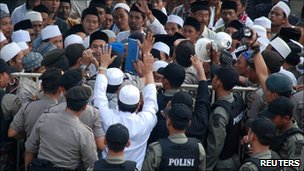
At least, that was the sentence handed down by a court in Java on July 28th against Dani bin Misra. He was part of a frenzied mob of Sunni Muslim chauvinists, about 1,000 strong, that hacked and beat to death three members of the minority Ahmadi sect of Islam in February. Eleven others were on trial (including the cleric pictured above, white turban on the left). None of the guilty received more than six months for their crimes; none of them were even accused of murder. The ringleader was convicted of nothing more terrible than illegal possession of a machete; he got just over five months.

Considering the horror of the killings, these verdicts were risible and have been condemned as such by all and sundry—human-rights groups, the American government (which usually leans over backwards to be nice towards its new friend and the world’s largest Muslim country), the EU, as well as Indonesian civil-rights organisations.

It’s a terrible verdict for Indonesia, and for Indonesian justice. On the subject of religious tolerance—and the related matter of Islamic terrorism—it’s as if the country always takes two steps forwards and then quickly takes another step back. A few weeks ago a court finally sentenced one of the country’s most culpable terrorist leaders to a meaningful prison sentence; now another court gives these perpetrators nothing more than a slap on the wrist for what was clearly an awful murder. Furthermore, no one could have been in any doubt as to the savagery and barbarity of the attack on the Ahmadis; it was all caught on film and posted (temporarily) on YouTube.

Most worryingly, the verdicts would seem to give a virtual green light to anyone else who wants to attack the Ahmadiyah, a sect that many Muslims regard as illegitimate and heretical (they face terrible persecution in Pakistan). As Human Rights Watch has said: “The…verdict sends the chilling message that attacks on minorities like the Ahmadiyah will be treated lightly by the legal system. This is a sad day for justice in Indonesia.”

In theory the rights of the Ahmadis to freedom of worship and expression should be protected by the country’s constitution, like everyone else’s. But the government has partly gone along with the more extremist Muslims who wanted the sect banned completely; as a result, the sect has been stranded in a legal twilight zone. Many have argued that this invites attacks on the sect; these latest verdicts also point in that direction. The present government wants to be known as progressive and democratic at home and abroad—putting the Suharto years behind it, as it were—but that aspiration will remain well out of reach unless it does a great deal more to protect vulnerable minorities within its own borders.

(Picture credit: AFP)

Thursday, July 28, 2011

Indonesia: Anger at ‘light’ sentences on sect killings

Asia-Pac
28 July 2011 Last updated at 15:13 GMT
Indonesia: Anger at ‘light’ sentences on sect killings

Supporters of the defendants gathered outside the court in Serang
Three men who took part in an attack on members of a minority Muslim group in Indonesia have been sentenced to between three and six months in jail.

Three Ahmadiyah members were bludgeoned to death in west Java in February.

Human rights activists said the court had sent a chilling message that attacks on minorities would be treated lightly by the legal system.

The US embassy in Jakarta expressed disappointment at “the disproportionately light sentences”.

“The United States encourages Indonesia to defend its tradition of tolerance for all religions, a tradition praised by President Obama in his November 2010 visit to Jakarta,” a US embassy statement said.

None of the defendants faced murder charges over the mob attack in which 1,000 Muslims surrounded the home of an Ahmadi.

The sentences handed down ranged from between three and six months in prison — well below the maximum 12-year penalty sought by prosecutors.

Human Rights Groups say that despite constitutional safeguards of religious freedom in Indonesia, attacks on minorities have been increasing.

Indonesia has the world’s largest Muslim population, but is a secular nation.

Indonesia under fire for light sentences in Islamic sect attack

CNN, USA
Indonesia under fire for light sentences in Islamic sect attack
By Kathy Quiano, CNN
July 28, 2011 -- Updated 1123 GMT (1923 HKT)
Members of the Ahmadiyah Islamic sect bury a fellow member in Banten province on February 8, 2011

Jakarta, Indonesia (CNN) – An Indonesian court Thursday convicted 12 Indonesians to sentences of six months or less for their roles in a mob attack that killed three followers of a minority Muslim sect.

The attack also injured five followers of the Ahmadiyah, a minority Muslim sect.

Critics decried the sentences as too light and a blow to religious freedom in Indonesia.

“This trial is obviously engineered. This is a case of torture, murder, where is the justice?“ said Muhamad Ahmad, who was injured in the assault.

In February, a mob of people wielding knives and stones attacked about 25 Ahmadiyah members in Cikeusik, Banten province.

The crowd opposed the presence of the sect in the village and demanded the group stop its activities.

Many Muslims consider the sect – which believes Mohammed is not the last prophet – as holding heretical beliefs.

Amateur video of the incident showed people pummeling what looked like lifeless bodies with sticks and rocks. The video was posted on the Internet, fueling public outrage.

Ahmad said he was not called to testify.

“Seeing their sadistic behavior toward us, chopping up bodies, kicking, hitting and stabbing us. Some of them (victims) were even burned. We didn’t get call. They only called defense witnesses,” he said.

The 12 attackers faced multiple charges but no one was charged with murder.

The most grievous charge, attack causing serious injuries, carried a maximum penalty of nine years. Prosecutors demanded a maximum seven months.

Human Rights Watch called the verdicts a setback for religious freedom in Indonesia.

The rights group said police did not not conduct a thorough probe and prosecutors did not call key witnesses.

Deden Sujana, a member of Ahmadiyah who survived the assault, is facing a six-year jail sentence for his alleged role in provoking the attack. He faces charges of incitement, disobeying police orders and maltreatment.

“Indonesian authorities should be making all-out efforts to bring to justice those who kill people because of their religious beliefs,” said Elaine Pearson, deputy Asia director at Human Rights Watch.

“The Cikeusik trial sends the chilling message that attacks on minorities like the Ahmadiyah will be treated lightly by the legal system.”

Defense lawyer Agus Setiawan, however, says the court was unfair toward the defendants.

“I do not know who has to be responsible for the death of the victims. This was not a case of persecution, it was a clash. The defendants should have been set free.”

With the short sentences and time spent in jail, the 12 men may soon be released.

In 2008, Indonesia issued a joint ministerial decree prohibiting the sect – which has about 200,000 members in the nation – from spreading its beliefs.

Since then, hardliners have taken the law into their own hands, at times attacking the sect’s followers nationwide.

Human rights activists have called on the government to revoke the decree.

The Setara Institute for Peace and Democracy, a local human rights organization, noted an increase in attacks against Ahmadiyah and other minority religions in Indonesia in recent years.

The U.S. Embassy in Jakarta and a European Union delegation also decried the light sentences.

“The United States encourages Indonesia to defend its tradition of tolerance for all religions, a tradition praised by President (Barack) Obama in his November 2010 visit to Jakarta,” the embassy said in a statement.

The most populous Muslim country in the world, Indonesia has been touted as an example of tolerance and democracy in the Islamic world.

But a 2009 study from the Pew Forum on Religion & Public Life in Washington indicated it was among the most restrictive countries when it comes to religion.

© 2011 Cable News Network. Turner Broadcasting System, Inc. All Rights Reserved.
URL: http://edition.cnn.com/2011/WORLD/asiapcf/07/28/indonesia...

Friday, June 17, 2011

Third time’s a charm

The Economist
Friday June 17th 2011 
Asia Banyan
Indonesia’s radical in chief
Third time’s a charm
Jun 17th 2011, 10:18 by J.C. and R.C. | JAKARTA
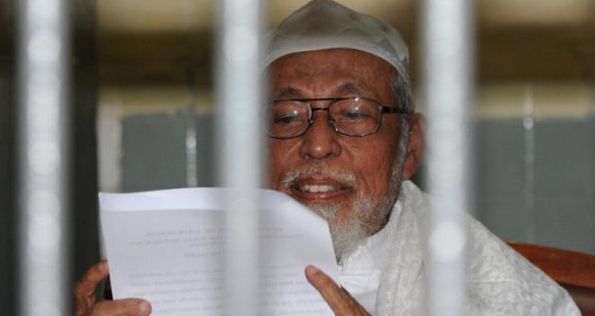
Abu Bakar Basyir

INDONESIAN prosecutors and anti-terrorism officials spent nearly a decade trying to put away Abu Bakar Basyir, so they didn’t much mind waiting an additional four hours and 45 minutes on Thursday. That’s how long it took a panel of judges at the South Jakarta District Court to read the guilty verdict against Mr Basyir, on charges of terrorism, and to sentence him to 15 years in prison. The old firebrand is now 72 years old, and ailing. Several hundred of Mr Basyir’s supporters who had gathered outside the courthouse since the early morning—most of them angry young men in white—dispersed without incident after the verdict was announced. Widespread fears that they would ransack the courthouse and local churches, or target the judges with bombs (as had been threatened via Twitter and SMS messages) proved unfounded.

Whether due to fatigue from their long wait, or the fact that they were outnumbered better than 3-to-1 by 3,000 armed police and soldiers, Mr Basyir’s young followers didn’t muster for a fight. The same might be said about Mr Basyir’s entire movement at present. It had drawn widespread attention and even some admiration within Indonesia in the wake of the 9/11 attacks on the United States, but since then it has slowly and steadily deflated, like a hot-air balloon after touching down. The Indonesian public tuned in to catch the news of Mr Basyir’s guilty verdict, in the world’s largest Muslim-majority nation, most citizens have long since tuned out his call for an anti-Western Islamic state. As they showed with their indifference to his trial since it opened on February 14th, they prefer watching “American Idol” and local reality shows copied from Hollywood, or updating their Facebook accounts (which as of this week stood at 38.1 million—the second-most in the world).

Mr Basyir emerged from self-exile in Malaysia amid Indonesia’s pro-democracy movement in the late 1990s, and used the country’s newfound freedoms to praise Osama bin Laden and lambast Indonesia’s secular government and its friendship with America. The frail-looking cleric, constantly wearing a toothy grin and a bristly white beard, became the poster child for Indonesia’s radical Islamists. Even then they were tiny in number, amid a country of 237m, but they dominated the headlines with their rhetoric and intimidation tactics. After the Bali bombings in 2002, which killed 202 tourists and Indonesian citizens, Mr Basyir claimed that the American CIA was behind it—just as the CIA and Israel’s Mossad took down the World Trade Centre in New York the year before. The fact that Mr Basyir didn’t back his wild claims with a shred of evidence didn’t matter: he found listeners among some Indonesian politicians and intellectuals, and on university campuses.

Local and international media were always ready to publish Mr Basyir’s most outrageous rants: he once declared that the naked female form was more immoral than the Bali bombings. His statements infuriated America, Australia and Britain, all of whom lost citizens in the 2002 Bali attacks. But they were perhaps angrier with Indonesia’s judicial system, for its inability to lock him up and throw away the key—or put him before a firing squad. America and Australia have long accused Mr Basyir of being the spiritual leader of Jemaah Islamiyah, the South-East Asian offshoot of al-Qaeda, which carried out a string of terrorist bombings in Indonesia dating back to 2000, including the Bali bombings, which altogether have killed more than 240 people.

Mr Basyir’s arrest in West Java on August 9th 2010 was his third on terrorism-related charges: he was first arrested after the Bali bombings, but then prosecutors botched the case and he ended up serving only 18 months, on a dubious immigration-violation charge. He was immediately re-arrested upon his release from prison, this time in connection with the bombing of the J.W. Marriott Hotel in Jakarta in 2003, but then he did only 30 months, because he hadn’t been an active participant in the plot; he was, after all, in prison at the time. So Mr Basyir was released again.

But even then the Indonesian cleric had begun to lose his public appeal. Shocked and repulsed by the suicide-bombing of the Australian embassy in Jakarta in 2004, and by a second set of attacks on Bali in 2005, and then again by the (second) bombing of the Marriott and another upscale hotel in 2009, the silent majority of Indonesia’s 190m Muslims began to murmur that enough was enough. Nearly all the victims in those later attacks were Indonesian Muslims. Indonesian voters also continued their pattern of choosing secular candidates in presidential and parliamentary elections in 2004 and 2009, further cementing the country’s democracy and leaving Mr Basyir nothing beyond small clusters of followers in rural villages across Java.

As al-Qaeda’s attempt to trigger an Islamic revolution in the Arab world failed, so did Mr Basyir’s movement to create an Islamic state in Indonesia. Like Osama bin Laden, all the Indonesian cleric had left was terrorism, an ugly tactic. Despite his public renunciation of violence in 2006, Mr Basyir’s conviction on Thursday was for organising and funding a terrorist-training camp in the Indonesian province of Aceh, on the northern tip of Sumatra. The 100 or so militants who had trained there were allegedly plotting to assassinate the president, Susilo Bambang Yudhoyono, and carry out Mumbai-style attacks on Western hotels and embassies in Jakarta.

While the judges who sentenced Mr Basyir to 15 years in prison—prosecutors asked for life—have been accused of taking the easy road to avoid further alienating Indonesia’s few thousand hard-line radicals, Mr Basyir faces additional charges in connection with the suicide-bombing of a mosque inside a police compound in Central Java on April 15th. He is all but certain to spend the rest of his life behind bars. Police say they have linked the bomber and the attack’s arrested planners to Jemaah Ansharut Tauhid, or JAT, a legally-recognised group that was founded by Mr Basyir.

But this hardly marks the end of Indonesia’s struggle with violence in the name of religion. Despite the curtains falling on Mr Basyir’s one-man sideshow, surveys taken over the past 10 years show that religious intolerance in Indonesia has been growing at an alarming pace—in both rural and urban areas. Mass organisations such as JAT and the infamous Islamic Defenders Front have in recent years attacked churches and blocked the construction of new ones, usually claiming that they failed to win the approval of local Muslims. Cowed local officials and police have done nothing to stop them. Last year, a Christian pastor was stabbed in the stomach by a local radical leader as he led a congregation to a Sunday service. Christian Solidarity Worldwide recently called on Mr Yudhoyono’s government to tackle Islamic extremism as attacks on Christians and their houses of worship proliferated. The head of a Christian group in Jakarta has said there were 14 attacks on churches in the first five months of 2011, and 46 last year.

Radical groups have also been involved in lynchings, including numerous attacks against the minority Ahmadiyah sect. On February 6th, a mob of hundreds of people in rural West Java, incited by local radical religious figures, attacked the homes of local Ahmadiyah leaders, killing four people. Graphic footage of Ahmadiyah members being beaten and hacked to death were seen everywhere on YouTube. Analysts say Indonesian radical groups are using exploiting push-button issues such as the Ahmadiyah (who don’t believe that Muhammad was the final prophet of Islam) because they resonate with rural villagers. Mr Yudhoyono’s government seemed paralysed, standing back and doing nothing as attacks continue and church close their doors.

The president, a retired Army general who might fear being painted as un-Islamic by his political opponents, has since made vague statements calling radicalism a threat to the nation. He has called for expanding the study of pancasila, the Indonesian state ideology which regards the country’s six recognised religions as equals. But he’s also spoken of a “middle way” in which radical groups might be tolerated as a proper part of the country’s democracy. This despite the fact that some of them have openly stated their intention to overthrow Mr Yudhoyono’s government and form an Islamic state, using violence if necessary.

Terrorism remains a grave threat to Indonesia. The now-defunct Jemaah Islamiyah has many splinter cells actively plotting attacks, as well as “lone wolf” terrorists such as Muhammad Syarif, the bomber of the mosque in Central Java. He was among the protesters who gathered outside the South Jakarta District Court when Mr Basyir’s trial opened four months ago. Police are still searching for 15 suicide vests that are supposed to be in circulation, as well as remaining co-conspirators in the attack. On Tuesday police arrested 16 people for plotting to poison officers’ food with cyanide, as well as kill them with pen guns. Mr Basyir’s conviction will remove a venomous voice from Indonesia’s internal debate on the place of Islam, but in everyday terms it will not make the country any safer.

Wednesday, April 27, 2011

Indonesian leader unworried by radical Islam rise

April 27, 2011
Indonesian leader unworried by radical Islam rise
Updated on Wednesday, April 27, 2011, 12:40

SBY
Washington: Indonesian President Susilo Bambang Yudhoyono acknowledged that Islamic radicalism may be on the rise in his country but said he was not worried it would spiral out of control.

Speaking to US public television, Yudhoyono said that the world’s most populous Muslim-majority nation offered proof that Islam was compatible with democracy and that radical groups had small membership.

“I can see to a certain degree there is an escalation of radicalism in many countries. Probably we could see also that kind of thing that happens in Indonesia,” Yudhoyono told ‘The Charlie Rose Show’ in an interview broadcast late Monday.

“But I believe that we could manage, we could control the activities of radical groups here in Indonesia by empowering religious leaders, by ensuring through education and other means that force of moderation is still in place,” he said.

“So it could be yes, but I’m not really worried about the so-called rise of radicalism,” he said when asked if radical Islam was rising in Indonesia.

Indonesia’s transition to democracy has won wide praise around the world, but rights groups say that violence against minorities has been escalating during Yudhoyono’s tenure.

Islamic fanatics in February brutally murdered three members of the Ahmadiyah movement, in one of the grisliest attacks on the minority Muslim sect whose freedoms were curtailed under a 2008 degree.

Around 2,000 people held a mass prayer in a show of solidarity with the 12 accused as they went on trial on Tuesday.

Yudhoyono said he was walking a fine line as he wanted to assure Indonesians that action against terrorism was not targeting Islam.

“I am really more than willing to speak loudly,” he said. “We actually conduct anti-terrorism campaigns very seriously in Indonesia, by all means.”

“But, of course, I have to maintain the climate of brotherhood here in Indonesia, because the majority of the population are Muslim, so I try to maintain their feelings, because sometimes the policy of the government is initially misinterpreted,” he said.

Bureau Report

Tuesday, April 26, 2011

Amid tight security, Indonesia tries 12 men over attack on Muslim sect

CNN, USA
Amid tight security, Indonesia tries 12 men over attack on Muslim sect
By Kathy Quiano, CNN
April 26, 2011 — Updated 0710 GMT (1510 HKT)
Protesters shout slogans during a rally against the minority Muslim Ahmadiyah sect in Jakarta on February 18, 2011.

Jakarta, Indonesia (CNN) — The trial of 12 men charged in a deadly attack against a minority Muslim sect began Tuesday under heavy security in West Java.

“We deployed about 1,095 personnel,” said Senior Commissioner Budiarto, the operations head of the police department in Banten province. Two water cannons and three armored vehicles were also on standby.

Budiarto, like many in Indonesia, go by one name.

Hundreds of people, mostly students from nearby Islamic boarding schools, prayed and chanted outside the courthouse in support of the defendants.

The men are on trial for a February 6 incident in which a mob of about 1,000 people, wielding knives and stones, attacked about 25 members of the Muslim minority sect, Ahmadiyah, in Cikeusik village in the province. Three people were killed and six others injured.

The crowd opposed the presence of the Ahmadiyah in the village and demanded the group stop its activities.

Amateur video of the incident obtained by Human Rights Watch showed people pummeling what looked like lifeless bodies with sticks and rocks. The video has been posted on the Internet, fueling public outrage.

In a televised statement, Indonesian President Susilo Bambang Yudhoyono condemned the violence against Ahmadiyah and ordered a thorough investigation.

Human rights activists, however, have called on the government to revoke a ministerial decree issued in 2008 that bans the community’s religious activities.

Many Muslims consider the Ahmadiyah a deviation from the orthodox Islamic faith.

Followers of Ahmadiyah believe Mirza Ghulam Ahmad, the founder of the religious movement in India, was Islam’s last prophet. Orthodox Muslims say Mohammed was the last prophet.

The Setara Institute for Peace and Democracy, a local think tank, noted in a recent report a marked increase in the number of attacks against Ahmadiyah and other minority religions in Indonesia in recent years.

The most populous Muslim country in the world, Indonesia has previously been touted as an example of tolerance and democracy in the Islamic world.

But a 2009 study from the Pew Forum on Religion & Public Life in Washington suggested it was actually among the most restrictive countries when it comes to religion.

Last week, Human Rights Watch issued a statement, urging authorities to ensure proper security at the trial.

“For the Cikeusik trial to be a step toward ending religious violence in Indonesia, the police need to ensure the security of everyone in the courtroom,” said Elaine Pearson, deputy Asia director at Human Rights Watch.

“Witnesses brave enough to testify, as well as judges and prosecutors, should not have to face intimidation.”

© 2011 Cable News Network. Turner Broadcasting System, Inc.
All Rights Reserved.
URL: http://edition.cnn.com/2011/...ahmadiyah.attack/

12 Indonesians stand trial over sectarian murders

MSN News, Malaysia
By Agence France-Presse, Updated: 4/26/2011
12 Indonesians stand trial over sectarian murders
Twelve Indonesians stood trial Tuesday over the gruesome mob slaying of three minority Islamic sect members, the worst in a recent spate of hate crimes in the mainly Muslim country.

More than 1,000 troops and police backed by water cannon and armoured vehicles threw a security cordon around the court in Serang, west Java, amid fears of further violence from the defendants’ radical supporters.

Around 2,000 people held a mass prayer and chanted Koranic verses in a show of solidarity with the accused, who could face between 12 years in jail and death if convicted.

The indictment accuses the male defendants of crimes including “inciting violence” but not murder, even though a graphic video of the slayings has been widely distributed on the Internet.

Islamic fanatics brutally murdered three members of the Ahmadiyah sect in west Java’s Banten province in February, one of the most horrific in a long line of attacks on the sect in Indonesia in recent years.

Ahmadiyah, unlike mainstream Muslims, do not believe Mohammed was the last prophet (**) and are regarded as heretics and blasphemers by conservatives in places like Indonesia and Pakistan.

A video taken by a sect member showed the crowd of more than 1,000 people push police aside and storm a local Ahmadiyah leader’s house shouting “infidel” and “Allahu akbar” (God is greater).

After a brief exchange of rocks, the mob overpowered the defenders and set upon them with sticks and stones. One man was filmed being stoned and clubbed to death as he knelt on the ground half naked. The bodies were then mutilated.

Police officers fled the scene once the violence began, but returned later to mill among the mob as it destroyed the sect’s property and continued to beat the corpses of the three male victims.

A cleric, Ujang Mohammed Arif, 52, is charged with masterminding the attack by inciting others to commit violence.

Arif sent another defendant, Endang bin Sidik, a phone text message days before the attack reading “please mobilise ulemas (Muslim scholars), clerics and Koranic school students to besiege Ahmadis in Cikeusik (village),“ prosecutors said.

Endang forwarded the message to 62 people and asked them to gather at his house and wear blue ribbons on the day of the assault.

Two of the accused could face the death penalty if convicted of carrying sharp weapons under a 1951 emergency law. The law has traditionally been used against suspected separatist rebels, analysts say.

Human rights groups have said the trial is a chance for Indonesia to roll back a long-standing culture of impunity for religious violence by the dominant Muslim community against minorities such as Ahmadiyah and Christians.

“For the Cikeusik trial to be a step toward ending religious violence in Indonesia, the police need to ensure the security of everyone in the courtroom,” Human Rights Watch deputy Asia director Elaine Pearson said last week.

“Witnesses brave enough to testify, as well as judges and prosecutors, should not have to face intimidation.”

A 2008 decree restricted the Ahmadiyah’s religious freedoms but stopped short of banning the sect outright. Even so, senior government officials say the Ahmadiyah should accept mainstream Sunni Islam or renounce their faith.

The sect claims 500,000 followers in Indonesia, where it has existed in relative peace since the 1920s.

Rights groups say violence against minorities has been escalating in Indonesia – the world’s most populous Muslim-majority country – during the tenure of President Susilo Bambang Yudhoyono.

The statement is erroneous. Hadhrat Mirza Ghulam Ahmad of Qadian did not make any such claim of being last prophet. Please visit Alislam.org/messiah for further info.

Saturday, March 19, 2011

Police coercing members to quit faith, sect claims

Sydney Morning Herald, Australia
World
Police coercing members to quit faith, sect claims
Tom Allard HERALD CORRESPONDENT
March 19, 2011

JAKARTA: Members of the Ahmadiyah religious sect have been pressured by Indonesian security personnel to abandon the faith amid continual harassment of them, sect leaders say.

The military and government ministers have defended their actions, saying there has been no intimidation, only efforts to protect Ahmadis from violence.

Ahmadis have come under increasing attacks in the past 18 months, culminating in the killing of three adherents by a mob of hundreds of Islamists in Banten province last month.

Advertisement: Story continues below The government denounced the violence and 12 people have been arrested.

But since the incident, several provincial governments have introduced edicts banning Ahmadiyah, while the Minister for Religious Affairs, Suryadharma Ali, has continued his campaign for the group to be outlawed entirely.

Ata ur-Rahman, an Ahmadiyah preacher from Cirebon, in west Java, said 12 Ahmadis in his area had been summoned in recent days by the military or district chief to sign a petition disavowing their faith.

“So far only five have signed it and left Ahmadiyah,” Mr Ata said.

Others had been visited at their homes, he said. More than 50 such approaches had been documented in West Java.

“The military guys told them, ‘This is for the sake of security … We don’t want things that occurred in other places happening here too … Therefore, we ask you to join mainstream Islam. Don’t follow a false sect,”‘ Mr Ata said.

Ahmadis follow the Koran and observe most Islamic traditions but they believe that a late 19th-century Indian religious figure, Mirza Ghulam Ahmad, was the messiah foreshadowed in the Hadith.

The belief angers some orthodox Muslims, who view any deviance from the tenet that Mohammed was the final prophet as deeply offensive.

There are more than 200,000 Ahmadis in Indonesia, where the faith was introduced in the 1920s. However, since a presidential decree was issued in 2008, Ahmadiyah adherents are forbidden from proselytising and must observe their religion in private.

The deadly attack in February was captured on video and the shocking footage went viral online. A censored version was shown widely on Indonesian and international television.

It prompted much soul-searching about Indonesia’s commitment to its constitutional right to freedom of religion.

However, incidents of harassment have continued unabated. In West Java, there have been attacks on the homes of Ahmadis, prompting police to question followers of the sect. The perpetrators of the attacks were not arrested.

The local military commander in West Java reportedly demanded the replacement of an Ahmadi cleric at a mosque in Bandung with a preacher from the conservative Indonesian Ulemas Council.

In East Java, Ahmadis were told this month to remove the signs outside their mosque.

In South Sumatra, Ahmadis were ordered to cancel a celebration of the Prophet Mohammed’s birthday, said Basuki Ahmad, a preacher from Palembang.

“We are only allowed to hold small gatherings inside our mosques now,” Mr Basuki said.

Five provinces and six regencies have banned the sect since the killings in Banten.

“These decrees place officials on the side of militants who increasingly have been carrying out attacks on Ahmadiyah,” said Phil Robertson, of Human Rights Watch.

But the Minister for Justice and Human Rights, Patrialis Akbar, said there had been no violations by the military or police because they were trying to foster communication between Ahmadis and aggrieved Muslim groups.

The Defence Minister, Purnomo Yusgiantoro, said: “There’s no negative element, there’s no coercion whatsoever.”

© 2011 AAP | Copyright © 2011 Fairfax Media
URL: www.smh.com.au/world/police-coercing-...1c0dt.html

Tuesday, March 15, 2011

Indonesia: Revoke Provincial Decrees to Ban a Faith

Human Rights Watch
Indonesia: Revoke Provincial Decrees to Ban a Faith
Religious Affairs Minister Should be Removed for Promoting Discrimination
March 15, 2011

Repeated calls by Religious Affairs Minister Suryadharma Ali to ban the Ahmadiyah fan the flames of violence against the group. President Yudhoyono should signal that such discrimination has no place in a society that promotes religious tolerance and remove Suryadharma Ali from his post.
Phil Robertson, deputy Asia director at Human Rights Watch
President Susilo Bambang Yudhoyono of Indonesia should void decrees recently adopted by two provinces that ban activities by the Ahmadiyah religious community, Human Rights Watch said today. Human Rights Watch repeated its call for the president to revoke the national anti-Ahmadiyah 2008 decree, which bars public propagation of the Ahmadiyah faith.

On February 28, 2011, the provincial government in East Java, which has a population of 37 million, banned the activities of the Ahmadiyah community, outlawing the display of their mosque and school signs and the use of “electronic media” to extend their teachings. On March 3, the government in West Java, Indonesia’s most populous province, with 43 million people, also banned the Ahmadiyahs’ activities. Both provincial governments based their laws on the June 2008 national decree by the Yudhoyono administration, violations of which can result in prison sentences of up to five years. Jemaah Ahmadiyah Indonesia, the religious group’s leadership, reports that 16 provinces and regencies in Indonesia have issued anti-Ahmadiyah decrees since 2006.

“Indonesian national and provincial authorities risk being complicit in anti-Ahmadiyah violence by stripping this religious community of their basic rights,” said Phil Robertson, deputy Asia director at Human Rights Watch. “These decrees place officials on the side of militants who increasingly have been carrying out attacks on the Ahmadiyah.”

The Ahmadiyah movement was founded in 1889 by Mirza Ghulam Ahmad. The Ahmadiyah identify themselves as Muslims but differ with other Muslims as to whether Muhammad was the final monotheist prophet. As a result, some other Muslims perceive the Ahmadiyah as heretics. Approximately 300,000 Indonesians follow the faith.

On February 6, a mob of 1,500 people attacked 21 Ahmadiyah members in Cikeusik, a village in the Banten province in western Java, killing three people and seriously wounding five others. About 30 police officers were present but did little to stop the attack. A videographer recorded the brutality, and the video was later posted by various individuals and organizations on YouTube. Widespread national and international condemnation of the attack ultimately prompted the Indonesian police to investigate the attack and arrest 12 suspects.

Additional attacks on Ahmadiyah communities soon followed. On March 11, villagers attacked four Ahmadiyah houses in Ciareuteun village, in Bogor. The police took no action against the assailants but arrested and questioned seven Ahmadiyah members and forced them to sign a document to renounce their faith. On March 13, in the nearby Bogor village of Cimanggu, assailants attacked four Ahmadiyah houses, causing the residents to flee. Local police later assigned guards around the Ahmadiyah properties in Cimanggu.

Since the February 6 attack, Religious Affairs Minister Suryadharma Ali has repeatedly urged the cabinet to issue a total ban on the Ahmadiyah, claiming justification in a 2005 fatwa issued by the Indonesian Ulemas’ Council and the 2008 national anti-Ahmadiya decree. Ali has also recommended that the government declare the Ahmadiyah faith a new religion that is not permitted to make use of Islamic symbols such as the Quran, its rituals, and the Prophet Mohammed. He also has frequently urged Indonesia to follow the “Pakistan road,” to ban and criminalize Ahmadiyah activities.

“Repeated calls by Religious Affairs Minister Suryadharma Ali to ban the Ahmadiyah fan the flames of violence against the group,” Robertson said. “President Yudhoyono should signal that such discrimination has no place in a society that promotes religious tolerance and remove Suryadharma Ali from his post.”

At least one senior Indonesian military officer has similarly called for restrictions on the rights of Ahmadiyah. On March 9 the West Java military commander, Major General Moeldoko, openly asked his soldiers in Bandung to support banning the Ahmadiyah and urged Muslims “to invade” and “to occupy” Ahmadiyah mosques. Soldiers under his command and police officers went to an Ahmadiyah mosque in Bandung during Friday prayers on March 11 and demanded that the Ahmadiyah imam, Ahmad Sulaeman, be replaced by Asep Zaenal Ausof of the Indonesian Ulemas’ Council’s Bandung branch.

“Indonesia’s top army commander, General George Toisuta, should order all officers to respect the rights of all religious communities and take immediate action against those harassing the Ahmadiyah or other faiths,” Robertson said.

Indonesian law facilitates discrimination against the Ahmadiyah. The June 2008 decree, the “Joint Ministerial Decree on Warning and Ordering the Jemaah Ahmadiyah Indonesia and Others,” requires the Ahmadiyah to “stop spreading interpretations and activities that deviate from the principal teachings of Islam,” including “spreading the belief that there is another prophet with his own teachings after Prophet Muhammad.” Human Rights Watch has consistently called for the government to rescind this decree, as it violates the right to freedom of religion. At the time the decree was signed, officials said it was necessary to help stop further violence.

Since the national anti-Ahmadiyah decree was issued, violence against the Ahmadiyah community has increased dramatically. The Setara Institute, a respected nongovernmental organization that monitors religious freedom in Indonesia, recorded a rise from three attacks in 2006 to 50 in 2010.

Prohibiting the Ahmadiyah from practicing their religion is in violation of Indonesia’s obligations under the International Covenant on Civil and Political Rights, ratified by Indonesia in 2006, which protects the right to freedom of religion and to engage in religious practice “either individually or in community with others and in public or private.” The treaty also protects the rights of minorities “to profess and practice their own religion.” It provides that the protections in the treaty shall extend throughout a state “without any limitations or exceptions,” thus obliging provincial and other local governments to abide by its provisions.

Human Rights Watch urged concerned countries to call on the Indonesian government to protect the rights of religious minorities in the country. Specifically, foreign embassies in Jakarta should raise their concerns and seek reforms not only in contacts with national officials, such as Yudhoyono and Home Affairs Minister Gamawan Fauzi, but with provincial leaders, including the West Java governor, Ahmad Heryawan, and the East Java governor, Soekarwo.

“Provincial officials are no less responsible than their counterparts in Jakarta for ensuring that the rights of their populations are fully protected” Robertson said.

Monday, March 7, 2011

Indonesia: USCIRF Urges Protection of the Ahmadiyah

United States Commission on International Religious Freedom
News Room > Press Releases
3/07/2011: Indonesia: USCIRF Urges Protection of the Ahmadiyah
FOR IMMEDIATE RELEASE
March 7, 2011

WASHINGTON, DC – The U.S. government should urge the government of Indonesia to protect the embattled Ahmadiyah religious community and to repeal laws prohibiting the Ahmadiyah community from manifesting their faith, said the U.S. Commission on International Religious Freedom (USCIRF) today.

Since 2008, a joint ministerial decree prohibited Ahmadis from spreading their faith and promised protection of their communities’ worship activities. USCIRF’s statement comes as three Indonesian provinces issued decrees that prohibit the Ahmadiyah from publicly manifesting their faith. Provincial governments in West and East Java and South Sulawesi issued their decrees following a mob attack that killed three Ahmadiyah followers in Banten almost one month ago. The Minister for Law and Human Rights and the Minister of Religious Affairs have supported the provincial decrees claiming that they are necessary to maintain public order. The provincial decrees appear to violate Indonesia’s constitution, which guarantees religious freedom. President Yudhoyono has not yet called for the decrees to be repealed, though he did call for the protection of Ahmadiyah followers, the arrest of perpetrators of violence, and an investigation into whether police provided sufficient protection for the Ahmadiyah community of Banten.

“The Obama Administration is right to commend Indonesia’s tradition of tolerance, but it should condemn the enactment of these discriminatory laws and other recent trends that threaten the country’s stability, pluralistic culture, and democratic future,” said Leonard Leo, USCIRF chair. “The banning of a peaceful religious group in three provincial areas contradicts Indonesia’s reputation for religious tolerance. The Indonesian government needs to protect, not ban, the Ahmadis.”

USCIRF traveled to Indonesia last year and wrote to President Obama asking him to raise the issues of protection for religious minorities, the existence of anti-Ahmadiyah and blasphemy laws, and the ability of militant groups to use violence with impunity. USCIRF also urged the Administration to emphasize religious freedom in bilateral engagement, given the prominence religious organizations, actors, and political parties play in politics and civil society. That letter can be found at www.uscirf.gov.

“Extremist groups were repudiated at the polls, but continue to seek power by spreading violence and hate,” said Mr. Leo. “The Indonesian government should get tough on militant groups that use violence to intimidate religious minorities and swiftly prosecute those who carried out the gruesome killings of Ahmadis in Banten. Indonesia’s government should see its blasphemy and anti-Ahmadiyah laws as breeding sectarian violence, not social stability. These laws should be repealed if Indonesia is to remain true to its long commitment to religious freedom. As has happened in Pakistan and other places, sectarian violence will continue as long as militant groups expect the government to enforce their version of orthodoxy, instead of religious freedom for all.”

USCIRF is an independent, bipartisan U.S. federal government commission. USCIRF Commissioners are appointed by the President and the leadership of both political parties in the Senate and the House of Representatives. USCIRF’s principal responsibilities are to review the facts and circumstances of violations of religious freedom internationally and to make policy recommendations to the President, the Secretary of State and Congress.

To interview a USCIRF Commissioner, contact Tom Carter, Communications Director at tcarter @uscirf.gov or (202) 523-3257.

HRWG to File Report on Ahmadi Killing to UN

HeadlinesVIVA News
HRWG to File Report on Ahmadi Killing to UN
“The meeting is scheduled to take place on 10th of March 2011”
Senin, 7 Maret 2011, 10:50 WIBElin Yunita Kristanti
Attackers of Ahmadi members in Banten (dok. Ahmadiyah)
VIVAnews — Human Rights Working Group (HRWG) will be filing report on the brutal attacks against Ahmadi members in Cikeusik, Banten, to the UN Human Rights Council in no time.

“The Cikeusik case is a caution of dire problems which pose threat over freedom of religion and belief,” said Executive Deputy Director of HRWG, Choirul Anam, today in Jakarta.

HRWG also plans of filling in accounts on any acts of violence committed against Indonesia’s Ahmadiyya since 2005. “Ahmadiyya suffer from more systematic acts of violence. If no efforts of prevention are made, we fear that more serious threats will be posed in the days to come,” said Choirul Anam.

Written reports and oral presentations will be brought before a session with special UN rapporteur on freedom of religion and belief. “The meeting is scheduled to take place on 10th of March 2011,” he said.

Granted that the report is ready, HRWG expects the International community will urge the Indonesian government to assure for protections over Ahmadi members.

The Cikeusik attack was ignited on February 6, 2011, by hundreds of angry crowd toward a group of Ahmadis who were at that time gathering in the home of an Ahmadi cleric, Suparman. Three men were slaughtered during the assault and seven others were severely injured.

Police have named 16 suspects from the case, one of which is a member of Ahmadi.

• VIVAnews

Thursday, March 3, 2011

Indonesia province announces Ahmadiyah curbs

Asia-Pac
3 March 2011 Last updated at 13:23 GMT
Indonesia province announces Ahmadiyah curbs
By Kate McGeown
BBC News, Jakarta

Anti-Ahmadiyah sentiment has been gathering momentum in recent monthsAnti-Ahmadiyah sentiment has been gathering momentum in recent months

Authorities in Indonesia’s West Java have issued a decree which severely limits the activities of a small Islamic sect called the Ahmadiyah.

Members will not be able to publicly identify themselves and are being urged to convert to mainstream Islam.

Indonesia is a secular country, where freedom of religious expression is enshrined in the constitution.

But recently the government has been under pressure from hardliners to ban the sect completely.

Low profile

The province of West Java is home to Indonesia’s largest community of Ahmadis, but there are estimated to be more than 200,000 throughout the country.

But now they will be much harder to find.

The local authorities want them to limit their activities, take down signs identifying their mosques and schools, and - ideally - to re-educate and re-integrate themselves within mainstream Islam.

They are even encouraging other people in the area to monitor what the Ahmadis are doing.

Lawyers for the Ahmadiyah say the decree violates a law protecting people’s rights to worship how they choose.

But hardline Islamic groups say the order is perfectly legal, claiming that the sect’s beliefs deviate from the tenets of Islam and therefore violate the country’s rules against blasphemy.

The hardliners have repeatedly petitioned the government to outlaw the Ahmadiyah completely, and they are finding an increasingly positive reception.

Even the minister for religion supports a ban.

The Ahmadis have already been keeping a low profile since three of their members were killed last month by an angry mob.

This decree is yet another sign that their way of life is no longer welcome in a country often lauded for religious tolerance.

Wednesday, March 2, 2011

RI seeks to redefine freedom amid rising religious violence

NATIONAL
Wed, 03/02/2011
12:22 PM
RI seeks to redefine freedom amid rising religious violence
Bagus B.T. Saragih, The Jakarta Post, Jakarta
God have mercy: A group of Ahmadiyah followers in Yogyakarta conduct a prayer on Tuesday after recent bans issued by several regional leaders across the country. The Yogyakarta chapter of Ahmadiyah has halted its public activities. -JP/Slamet Susanto
As local administrations move to ban Ahmadiyah, the government is in a dilemma revolving around “liberty versus order” as it responds to calls to disband the notorious Islam Defenders Front, known as the FPI.

Following the mob incident that killed three Ahmadis in Banten and the burning of three churches in Central Java last month, President Susilo Bambang Yudhoyono ordered his ministers to seek legal measures to disband groups frequently involved in acts of violence.

Some believed he was likely referring to groups such as the FPI. But the order has proved to be no easy task.

The Home Ministry, which is endowed with the authority to outlaw an organization, said the freedom to form a union or organization was guaranteed by the 1945 Constitution. This, ministry spokesman Reydonnyzar Moenek told The Jakarta Post, meant the government was in a dilemma.

As of 2010, more than 9,000 mass organizations were registered with the ministry. It has never banned a single one since the issuance of the mass organization law in 1985, which granted it authority.

Home Minister Gamawan Fauzi, a politician from President Yudhoyono’s Democratic Party, denied he had ignored the President’s order, saying he was only cautious not to use the authority recklessly in fear of violating the Constitution. “We are now studying the facts of the incidents,” he claimed.

The minister argued that the procedures to disband mass organizations under the existing regulation were complex. “The 1985 Mass Organization Law is too old and is no longer relevant to the country’s current situation,” he said, adding that his ministry was finalizing the revision draft of the law, which will be submitted to the House of Representatives for deliberation this year.

A 1986 government regulation outlining the ministry’s authority to disband mass organizations stipulates the government at central and regional levels can freeze a mass organization that disrupts national security and public order, receives foreign aid without the central government’s permission and helps foreign parties that jeopardize national interests.

The regulation also stipulates that the ministry ask for considerations from the Supreme Court on whether a certain group be frozen. A frozen organization shall be disbanded if found to continue the illicit acts for three months after receiving warning letters from the government.

Despite its violent acts over the past few years, the ministry said it had not yet found evidence that the FPI had broken the 1985 law.

While legal matters are hindering the government from taking stern action against the militant group, local administrations are facing no difficulties in finding reasons to ban Ahmadiyah, a minority group deemed heretical by the country’s mainstream Muslims.

Last week, Samarinda Mayor Syaharie Jaang in East Kalimantan froze the local chapter of Ahmadiyah after dozens of FPI members rallied in front of his office a few days earlier. The hardline group gave Syaharie a week’s deadline to disband the local chapter of the Islamic sect, saying if it failed to do so it would do it themselves.

The mayor reportedly granted the FPI’s demand because he considered Ahmadiyah “a time-bomb that could trigger violence”.

In another instance, East Java Governor Soekarwo issued a decree banning Ahmadis from conducting any kind of activity on Monday, only days after 32 Islamic organizations announced a plan to carry out a mass rally in the provincial capital of Surabaya to demand the administration outlaw Ahmadiyah in the province.

Activists have questioned whether democracy is the actual reason behind the government’s reluctance to disband the FPI.

Indonesian Legal Aid Foundation (YLBHI) chairwoman Erna Ratnaningsih said Timur had a long history of hobnobbing with hardliners since he was West Java Police chief in 2008. Along with Jakarta Governor Fauzi Bowo, Timur attended the FPI’s 12th anniversary celebration at the organization’s headquarters in Jakarta, she said. Last month, she added, Gamawan also met with FPI leader Rizieq Shihab to seek advice over Ahmadiyah.

But disbanding mass organizations, some have argued, might not be the answer to end religious violence. Imam Prasodjo, a sociologist from the University of Indonesia, for instance, said violent acts were also caused by cultural aspects that were difficult to manage. “Disbandment of those groups will not automatically reduce violence. Group members will continue [committing violence] as long as cultural problems exist,” he said referring to the stigma against Ahmadiyah.

MASS ORGANIZATIONS INVOLVED IN VIOLENT ACTS

Copyright © 2008 The Jakarta Post - PT Bina Media Tenggara. All Rights Reserved
URL: www.thejakartapost.com/news/2011/03/02/ri...violence.html

Tuesday, March 1, 2011

An Ahmadi Named Suspect on Mob Attack Case

HeadlinesVIVA News
An Ahmadi Named Suspect on Mob Attack Case
“Police accommodate the interests of both conflicting parties”
Selasa, 1 Maret 2011, 15:55 WIBBayu Galih, Dedy Priatmojo
Attackers of Ahmadi members in Banten (dok. Ahmadiyah)
VIVAnews — Jakarta Legal Aid Center condemns criminalization against an Ahmadi member named Deden, who, like many Indonesians, uses one name, by the Indonesian police as regards mob attack against Ahmadi members in Cikeusik, Banten. Police file charges toward Deden with crowd provocation and disregard of orders issued by state officials.

“Police accommodate the interests of both conflicting parties: the attackers, and the Ahmadi members. It’s not fair. It’s, on the other hand, biased,” said Director of Jakarta Legal Aid Center, Nurcholis Hidayat, in Jakarta today, March 1.

According to Nurcholis, one out of 12 suspects is an Ahmadi member who, according to him, should on the contrary be under witness protection.

“Most of the witnesses from Ahmadiyya went through interrogations from which the final testimonies will be used against them,” said Nurcholis.

E. Java Ahmadiyah decree violates constitution, harms pluralism

NATIONAL
Tue, 03/01/2011
6:52 PM
E. Java Ahmadiyah decree violates constitution, harms pluralism
The Jakarta Post, Makassar
A decree regulating restrictions on Ahmadiyah activities issued by the East Java governor is against the Constitution and harms the nation’s value of pluralism, noted lawyer Todung Mulya Lubis on Tuesday.

“The decree is a violation of the Constitution,” he said as quoted by tempointeraktif.com.

The Constitution guarantees the freedom of religion, including people’s right to practice their beliefs, he added.

East Java governor Soekarwo on Monday issued a decree that prohibited all Ahmadis in the province from conducting activities related to Ahmadiyah.

Soekarwo’s decree prohibits Ahmadis from distributing pamphlets and placing signs at their offices and mosques. They are also not allowed to wear anything to indicate that they are Ahmadiyah members.

The decree is a bad precedent that may be followed by other regions, Todung said. He urged Home Minister Gamawan Fauzi to immediately annul the decree.

Todung also said he suspected that the decree was issued without careful consideration and was a result of pressure from certain groups.

“That’s one of the risks of being a public official,” he said, adding that he would challenge the decree at the State Administrative Court.

Copyright © 2008 The Jakarta Post - PT Bina Media Tenggara. All Rights Reserved
URL: www.thejakartapost.com/news/2011/03/01/e-java...pluralism.html

Organizations demand govt disband Ahmadiyah in S. Sulawesi

NATIONAL
Tue, 03/01/2011
7:21 AM
Organizations demand govt disband Ahmadiyah in S. Sulawesi
Andi Hajramurni, The Jakarta Post, Makassar
The South Sulawesi Islamic People’s Forum (FUI), comprised of 18 Muslim organizations, rallied Tuesday demanding that the local government issue a regulation disbanding Ahmadiyah in the area.

They rallied in front of the Regional House of Representatives building.

South Sulawesi FUI secretary Siradjuddin said Ahmadiyah had been declared heretical in 1974 by the Indonesian Ulema Council and that stance was further strengthened by the joint decree prohibiting the spread of Ahmadiyah’s teachings.

“But in reality Ahmadiyah is still in existence. That is clearly a violation and an abjection toward Islam,” he said.

The police ordered the Jamaah Ahmadiyah mosque emptied and stood guard at the mosque and the secretarial building.

“Ahmadiyah activities will be shut down until the situation is safe,” South Sulawesi Police chief Insp. Gen. Johny Wainal Usman said.

Copyright © 2008 The Jakarta Post - PT Bina Media Tenggara. All Rights Reserved
URL: www.thejakartapost.com/news/2011/03/01/organizations...sulawesi.html

Regional heads violate Constitution with bans

HEADLINES
Tue, 03/01/2011
1:48 AM
Regional heads violate Constitution with bans
Bagus BT Saragih and Achmad Faisal, The Jakarta Post, Jakarta/Surabaya
While the Indonesian Constitution guarantees religious freedom, the government is backing regional heads who have issued restrictions on the religious activities of followers of Ahmadiyah.

East Java Governor Soekarwo on Monday issued a decree that prohibited all Ahmadis in the country’s second most populous province from conducting any kind of activities related to Ahmadiyah.

According to Soekarwo’s decree, Ahmadis are prohibited from distributing pamphlets and putting signs in front of their offices and mosques. They are also not allowed to wear anything to indicate that they are members of Ahmadiyah.

“This is for the sake of security and public order. It is my right to keep this region free from violence,” Soekarwo told a press conference.

Also attending the conference were East Java Police chief Insp. Gen. Badrodin Haiti, Indonesian Ulema Council (MUI) East Java chapter head Abdusshomad Bukhori, the head of the East Java Prosecutors’ Office Abdul Taufiq and Brawijaya Military Commander Maj. Gen. Gatot Nurmantyo.

Abdul said government leaders in the province were concerned about the recent fatal attack on an Ahmadiyah congregation in Cikeusik, Banten, that claimed three Ahmadis’ lives.

“With this policy we hope those who consider Ahmadiyah deviant will not commit violence,” he said.

Home Minister Gamawan Fauzi said such regulations are in line with the 2008 joint ministerial decree banning Ahmadiyah members from proselytizing.

East Java’s restriction on Ahmadis followed regulations issued in Samarinda and Pandeglang following the Cikeusik incident. All cited security issues as their basis.

Indonesian Legal Aid Foundation (YLBHI) chairwoman Erna Ratnaningsih said the local rulings might instead exacerbate potential violence.

“The regulation could be taken as justification for pressures against Ahmadiyah,” she said.

Erna said banning Ahmadiyah was against Article 28 of the Constitution, which guarantees every citizen religious rights.

“Besides, religious affairs are supposed to be a central government matter according to the 2004 Regional Autonomy Law,” she said.

The law stipulates that the central government is in charge of foreign affairs, defense, security, the judiciary, monetary affairs and national fiscal policy as well as religious affairs. The rest is under the authority of local administrations.

Prior to the issuance of Soekarwo’s decree, 32 Islamic organizations had announced that they planned to carry out a massive rally in the provincial capital of Surabaya next week to demand the administration not allow Ahmadiyah in the province.

“If the government does not react immediately leaders in other regions will keep succumbing to pressures and continue banning Ahmadis,” Erna said.

Similar policies were also reportedly in effect in the provinces of South Sumatra and West Nusa Tenggara and in the cities of Bogor and Kuningan prior to the Cikeusik incident.

Zafrullah Ahmad Pontoh, a spokesman for Ahmadiyah Indonesia, said he was disappointed with the ban.

Copyright © 2008 The Jakarta Post - PT Bina Media Tenggara. All Rights Reserved
URL: www.thejakartapost.com/news/2011/03/01/regional...bans.html

Monday, February 28, 2011

Rights groups condemn local bans on Ahmadiyah

HEADLINES
Mon, 02/28/2011
11:38 AM
Rights groups condemn local bans on Ahmadiyah
Ina Parlina, The Jakarta Post, Jakarta
Groups condemned bans issued by local administrations on the followers of Ahmadiyah following a fatal mob attack in Cikeusik village, Banten.

The chairwoman of the Indonesian Legal Aid Foundation (YLBHI), Erna Ratnaningsih, said such policies would only erode the country’s diversity and violated the Constitution.

“Such policies violate people’s right to worship as stipulated by the Constitution,” she told The Jakarta Post via telephone Sunday.

She added that the ban was justification for and a tool of violence against religious minorities.

Ahmadiyah teachings are considered heretical and blasphemous against Islam by the Indonesian Ulema Council (MUI). Followers of the faith have been a target of mob attacks in recent years.

The latest incident in Cikeusik village in which three Ahmadis were murdered, raised public calls for the government to find a solution.

Saying it would prevent violence, several local administrations enacted bylaws prohibiting Ahmadis from practicing their faith.

A week after the Pandeglang administration banned Ahmadiyah activities, the Samarinda administration issued an order to seal off Ahmadiyah houses of worship and halt religious activities.

The YLBHI identified at least three similar discriminative regulations long imposed in Bogor and Kuningan, West Java, and in Lombok, West Nusa Tenggara.

Erna said she was concerned discrimination and violence were most likely to spread throughout the country if the central government left the policies unchecked.

“These policies set the stage for intolerance at the grass-roots level.”

Ridha Saleh from the National Commission for Human Rights shared Erna’s concerns, saying local administrations could not subjectively impose certain rulings to control people’s religious lives “because it does not only violate the Constitution, but also usurps the authority of the central government.

“Regulating such religious matters lies in the hands of the central government,” he told the Post.

Erna said the enactment of the local policies violated the 2004 Regional Autonomy Law because local regulations must be issued based on a higher law.

“In this case, local administrations violated the regional autonomy law, which stipulates that religion is one of five issues that are overseen by the central government,” she said, adding that many of those regulations were based on the wrong foundation: the intolerant fatwa (decree) of the MUI.

“I doubt the deliberations for these local regulations received public participation, as is required,” Erna said. “Ahmadiyah spokesman Ahmad Mubarik once told me these local administrations never sought their opinions.”

Both Erna and Ridha called on local administrations to revoke the policies. Ridha urged local governments not to jump the gun by issuing such regulations, but to let the central government solve the “problem” with Ahmadiyah.

The central government has not addressed the issue beyond reviewing a controversial 2008 joint ministerial decree on Ahmadiyah, which critics say is often used to justify violence against the religious sect.

“Such rushed decisions that eventually result in intolerant policies may be used by hard-line groups to mete out violence against Ahmadiyah,” Ridha said, adding that such regulations were prone to abuse and misinterpretation.

Copyright © 2008 The Jakarta Post - PT Bina Media Tenggara. All Rights Reserved
URL: www.thejakartapost.com/news/2011/02/28/rights...ahmadiyah.html

Ahmadis in C. Sulawesi told to stop using house as place of worship

ARCHIPELAGO
Mon, 02/28/2011
8:27 AM
Ahmadis in C. Sulawesi told to stop using house as place of worship
The Jakarta Post
An Ahmadiyah community in Sigi, Central Sulawesi, says its local House of Representatives (DPRD) was discriminating against them by demanding they stop using a house in the area as a place of worship.

“We have been in Sigi since the 1960s…We have never done anything to upset the community’s sense of security or disturb the region’s security,” Sigi Ahmadiyah leader Ahmad Najamuddin said Sunday, as quoted by Tempointeraktif.com.

Sigi DPRD chairman Gesang said the Ahmadiyah community must stop using the house as a place of worship or the government would force them to do so.

“Please use that Ahmadiyah mosque shaped like a house as a house, not a mosque,” Gesang said. He added that a permit from the local government was needed before establishing a place of worship.

Copyright © 2008 The Jakarta Post - PT Bina Media Tenggara. All Rights Reserved
URL: www.thejakartapost.com/news/2011/02/28/ahmadis...worship.html

Friday, February 25, 2011

Understanding right to religious freedom

OPINION
Fri, 02/25/2011
11:00 AM
Understanding right to religious freedom
Harison Citrawan, Jakarta
Attacks on Ahmadis in Cikeusik, Banten, and on three churches in Temanggung in Central Java a few weeks ago have once again sparked public debate. Subsequently, the debate leads the nation to a crossroad on whether or not Ahmadiyah should be banned.

In my view, this can actually serve as momentum for us to enhance a progressive discourse on human rights now that the government is working on the bill on religious harmony. Thus, this article attempts to construe the idea of religious freedom from a human rights point of view, particularly concerning the two problematic issues of limitations of such freedom and the concept of proselytism.

Article 18 of the International Covenant on Civil and Political Rights mentions that: (1) Everyone shall have the right to freedom of thought, conscience and religion. This right shall include freedom to have or to adopt a religion or belief of his choice, and freedom, either individually or in community with others and in public or private, to manifest his religion or belief in worship, observance, practice and teaching; (2) No one shall be subject to coercion which would impair his freedom to have or to adopt a religion or belief of his choice.

I would like to emphasize the state’s protection of individual’s freedom of religion. Nevertheless, on some occasions many Indonesians mix up the terms of religious tolerance and religious freedom.

It appears that when we tolerate one’s religion along with his/her religious activities, it demonstrates the degree of freedom of religion; and vice versa, the degree of tolerance depends on how free people are to hold and practice their religions. But, in my view both terms differ fundamentally from one another.

Religious freedom is a legal right. The Human Rights Committee in its General Comment on Article 18 elaborates such freedom as “the freedom to manifest religion or belief [that] may be exercised ‘either individually or in community with others and in public or private’.”

The concept of worship extends to ritual and ceremonial acts giving direct expression to belief, as well as various practices integral to such acts, including the building of places of worship, the use of ritual formulae and objects, the display of symbols, and the observance of holidays and days of rest.

In addition, the practice and teaching of religion or belief includes acts integral to the conduct by religious groups of their basic affairs, such as the freedom to choose their religious leaders, priests and teachers, the freedom to establish seminaries or religious schools and the freedom to prepare and distribute religious texts or publications.

This interpretation should be quite clear to implement and certainly Indonesia could adopt this authoritative interpretation made by the Committee as the Covenant has been enacted into national law in 2005.

Nevertheless, on the other side, religious tolerance signifies the acceptance of differing views of people in religious matters. Such concept of toleration emerges mostly in a religious authority state, and further it presupposes preferential treatment of a predominant religious group.

Thus, it is also worth noting that the law preserves individual freedom, not individual tolerance, to a different view or faith. In many religious violence cases around the country, it seems that the state merely preserves the predominant religious group’s toleration; hence all religions are not equal.

With the law enforcement officers reluctant to prosecute perpetrators of the violence, predominant religious group toleration would likely prevail over individual freedom.

Second is the issue of proselytism. I would base the argument from a liberal democracy perspective which provides freedom to all individuals to a marketplace of ideas. Freedom of thought, opinion and religion are to be put on one bucket list of ideas and the human rights law indeed protects individuals to exercise such freedom.

It is interesting to highlight a debate in the case of Kokkinakis v. Greece (1993) in the European Court of Human Rights. In this case, the claimant defended proselytism by stating that “religion was part of the ‘constantly renewable flow of human thought’” and it was impossible to conceive of its being excluded from public debate.

From the court’s assessment I conclude that there should be a distinction between bearing witness and improper proselytism. The former relates to true evangelism and is likely to be inherent to some major religions, and the latter refers to the form of activities offering material or social advantages with a view to gaining new members for a congregation or exerting improper pressure on people in distress or in need; it may even entail the use of violence or brainwashing.

In addition, Judge Pettiti in his concurring opinion went even further by mentioning that freedom of religion and conscience certainly entails accepting proselytism; a believer must be able to communicate his faith and beliefs in the religious sphere as in the philosophical sphere. He also mentioned that the only limits to the exercise of this right are “those dictated by respect for the rights of others where there is an attempt to coerce the person into consenting or to use manipulative techniques”.

The use of violence in proselytism is clearly not covered under freedom of religion, but proselytism per se cannot be regarded as a direct infringement of one’s right. Moreover, the mere discussion of religion, or to try to convince one’s neighbor about his belief by “proper” means are not contrary to the current human rights law regime.

An important aspect of these legal reasonings conveyed above is that the state has to assess the existence of possible interference in an individual’s right to freedom of religion upon two considerations: first, the maintenance of public safety, order or morals or importantly the fundamental rights and freedoms of others, and second, such interference should be proportionate to the legitimate aim necessary in a democratic society.

These two assessments consequently require the current government to define or to set criteria of religious freedom and adjust the bill on religious harmony to make it in line with the international human rights law.

It appears that in many aspects, the current bill is unlikely in accordance with the freedom protected in international human rights rules conveyed above, particularly concerning the issue of the limits of religious practice and proselytism.

Finally, as we still lack positive development of human rights — both in terms of system and practice — in construing the right to religious freedom the government and lawmakers may also have to take several human rights practices in well-established democracies into account.

In many religious violence cases around the country, it seems that the state merely preserves the predominant religious group’s toleration.

The writer is an alumnus of Rijksuniversiteit Groningen, the Netherlands

Copyright © 2008 The Jakarta Post - PT Bina Media Tenggara. All Rights Reserved
URL: www.thejakartapost.com/news/2011/02/25/understanding...freedom.html
 
^ Top of Page