Showing posts with label killing. Show all posts

Monday, September 5, 2011

Another Ahmadi Muslim killed in Pakistan

Ahmadiyya Muslim Jamaat International
5th September 2011
PRESS RELEASE
Another Ahmadi Muslim killed in Pakistan
Naseem Ahmad Butt (55), was martyred in Faisalabad

It is with great sadness that the Ahmadiyya Muslim Jamaat hereby confirms that on 4 September 2011, a well-known and respected Ahmadi Muslim, Mr Naseem Ahmad Butt (55), was martyred in Faisalabad, Pakistan.

Naseem Ahmad Butt was sleeping in his home in Muzzaffar Colony, Faisalabad when four unknown assailants jumped over the wall of his home and fired at him. He was shot in his stomach and chest. The assailants immediately fled the scene.

Naseem Ahmad Butt was left critically injured and was taken to hospital. Despite attempts to revive him, he passed away at approximately 9am local time.

Naseem Ahmad Butt was a peaceful and law abiding citizen who was kind and generous to all. He served the Ahmadiyya Muslim Jamaat with great distinction throughout his life.

He is survived by his wife, four daughters and one son. He has been buried at Bahishti Maqbara, Rabwah.

The Press Spokesman of the Ahmadiyya Muslim Jamaat, Abid Khan said:

“The religious extremists within Pakistan have taken yet another innocent life. What they perhaps fail to realise is that through their actions they are harming the entire peace and stability of Pakistan as a whole. Hatred and persecution of any organisation or group must be condemned by all those who believe in tolerance and love for humanity. Such attacks serve only to destabilise society and to spread discord”

This latest murder continues the trend of Ahmadi Muslims being targeted in Faisalabad. One year ago, a cousin of the deceased, Mr Naseer Ahmad Butt was also martyred in a brutal and barbaric fashion. Furthermore, recently leaflets were openly distributed in the city, stating that the killing of Ahmadi Muslims was worthy of praise and would be rewarded by God. These leaflets contained the names and addresses of various Ahmadi Muslims and it seems that this latest killing was likely motivated by such hate propaganda.

The International Community, Media and Human Rights organisations are all urged to take action to safeguard the basic human and civil rights of Ahmadi Muslims both in Pakistan and in other countries where they face discrimination. In an era where freedom of religion and belief is accepted as a basic human right throughout the world it is of disbelief that anti-Ahmadiyya legislation is still active and indeed still being enforced in Pakistan. If such hatred and sectarianism is allowed to continue then it is inevitable that further tragedies will occur.

22 Deer Park Road, London, SW19 3TL UK
Tel/Fax: 020 8544 7613 Mob: 077954 90682
Email: press @ ahmadiyya.org.uk
Press Secretary AMJ International

Sunday, July 31, 2011

Lightly on the lynch mob

The Economist
Sunday July 31st 2011 
Asia Banyan
Religious persecution in Indonesia
Lightly on the lynch mob
Jul 31st 2011, 9:54 by R.C. | PENANG
Lynching perpetrators

SO, WHAT sort of sentence do you think a man convicted of killing someone by smashing in his skull with a stone might get in Indonesia? Life? Thirty years in prison? Twenty? Five? No. Three months, apparently.

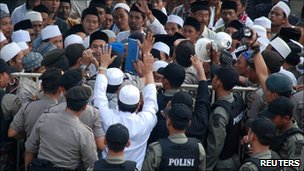
At least, that was the sentence handed down by a court in Java on July 28th against Dani bin Misra. He was part of a frenzied mob of Sunni Muslim chauvinists, about 1,000 strong, that hacked and beat to death three members of the minority Ahmadi sect of Islam in February. Eleven others were on trial (including the cleric pictured above, white turban on the left). None of the guilty received more than six months for their crimes; none of them were even accused of murder. The ringleader was convicted of nothing more terrible than illegal possession of a machete; he got just over five months.

Considering the horror of the killings, these verdicts were risible and have been condemned as such by all and sundry—human-rights groups, the American government (which usually leans over backwards to be nice towards its new friend and the world’s largest Muslim country), the EU, as well as Indonesian civil-rights organisations.

It’s a terrible verdict for Indonesia, and for Indonesian justice. On the subject of religious tolerance—and the related matter of Islamic terrorism—it’s as if the country always takes two steps forwards and then quickly takes another step back. A few weeks ago a court finally sentenced one of the country’s most culpable terrorist leaders to a meaningful prison sentence; now another court gives these perpetrators nothing more than a slap on the wrist for what was clearly an awful murder. Furthermore, no one could have been in any doubt as to the savagery and barbarity of the attack on the Ahmadis; it was all caught on film and posted (temporarily) on YouTube.

Most worryingly, the verdicts would seem to give a virtual green light to anyone else who wants to attack the Ahmadiyah, a sect that many Muslims regard as illegitimate and heretical (they face terrible persecution in Pakistan). As Human Rights Watch has said: “The…verdict sends the chilling message that attacks on minorities like the Ahmadiyah will be treated lightly by the legal system. This is a sad day for justice in Indonesia.”

In theory the rights of the Ahmadis to freedom of worship and expression should be protected by the country’s constitution, like everyone else’s. But the government has partly gone along with the more extremist Muslims who wanted the sect banned completely; as a result, the sect has been stranded in a legal twilight zone. Many have argued that this invites attacks on the sect; these latest verdicts also point in that direction. The present government wants to be known as progressive and democratic at home and abroad—putting the Suharto years behind it, as it were—but that aspiration will remain well out of reach unless it does a great deal more to protect vulnerable minorities within its own borders.

(Picture credit: AFP)

Thursday, July 28, 2011

Indonesia: Anger at ‘light’ sentences on sect killings

Asia-Pac
28 July 2011 Last updated at 15:13 GMT
Indonesia: Anger at ‘light’ sentences on sect killings

Supporters of the defendants gathered outside the court in Serang
Three men who took part in an attack on members of a minority Muslim group in Indonesia have been sentenced to between three and six months in jail.

Three Ahmadiyah members were bludgeoned to death in west Java in February.

Human rights activists said the court had sent a chilling message that attacks on minorities would be treated lightly by the legal system.

The US embassy in Jakarta expressed disappointment at “the disproportionately light sentences”.

“The United States encourages Indonesia to defend its tradition of tolerance for all religions, a tradition praised by President Obama in his November 2010 visit to Jakarta,” a US embassy statement said.

None of the defendants faced murder charges over the mob attack in which 1,000 Muslims surrounded the home of an Ahmadi.

The sentences handed down ranged from between three and six months in prison — well below the maximum 12-year penalty sought by prosecutors.

Human Rights Groups say that despite constitutional safeguards of religious freedom in Indonesia, attacks on minorities have been increasing.

Indonesia has the world’s largest Muslim population, but is a secular nation.

Indonesia under fire for light sentences in Islamic sect attack

CNN, USA
Indonesia under fire for light sentences in Islamic sect attack
By Kathy Quiano, CNN
July 28, 2011 -- Updated 1123 GMT (1923 HKT)
Members of the Ahmadiyah Islamic sect bury a fellow member in Banten province on February 8, 2011

Jakarta, Indonesia (CNN) – An Indonesian court Thursday convicted 12 Indonesians to sentences of six months or less for their roles in a mob attack that killed three followers of a minority Muslim sect.

The attack also injured five followers of the Ahmadiyah, a minority Muslim sect.

Critics decried the sentences as too light and a blow to religious freedom in Indonesia.

“This trial is obviously engineered. This is a case of torture, murder, where is the justice?“ said Muhamad Ahmad, who was injured in the assault.

In February, a mob of people wielding knives and stones attacked about 25 Ahmadiyah members in Cikeusik, Banten province.

The crowd opposed the presence of the sect in the village and demanded the group stop its activities.

Many Muslims consider the sect – which believes Mohammed is not the last prophet – as holding heretical beliefs.

Amateur video of the incident showed people pummeling what looked like lifeless bodies with sticks and rocks. The video was posted on the Internet, fueling public outrage.

Ahmad said he was not called to testify.

“Seeing their sadistic behavior toward us, chopping up bodies, kicking, hitting and stabbing us. Some of them (victims) were even burned. We didn’t get call. They only called defense witnesses,” he said.

The 12 attackers faced multiple charges but no one was charged with murder.

The most grievous charge, attack causing serious injuries, carried a maximum penalty of nine years. Prosecutors demanded a maximum seven months.

Human Rights Watch called the verdicts a setback for religious freedom in Indonesia.

The rights group said police did not not conduct a thorough probe and prosecutors did not call key witnesses.

Deden Sujana, a member of Ahmadiyah who survived the assault, is facing a six-year jail sentence for his alleged role in provoking the attack. He faces charges of incitement, disobeying police orders and maltreatment.

“Indonesian authorities should be making all-out efforts to bring to justice those who kill people because of their religious beliefs,” said Elaine Pearson, deputy Asia director at Human Rights Watch.

“The Cikeusik trial sends the chilling message that attacks on minorities like the Ahmadiyah will be treated lightly by the legal system.”

Defense lawyer Agus Setiawan, however, says the court was unfair toward the defendants.

“I do not know who has to be responsible for the death of the victims. This was not a case of persecution, it was a clash. The defendants should have been set free.”

With the short sentences and time spent in jail, the 12 men may soon be released.

In 2008, Indonesia issued a joint ministerial decree prohibiting the sect – which has about 200,000 members in the nation – from spreading its beliefs.

Since then, hardliners have taken the law into their own hands, at times attacking the sect’s followers nationwide.

Human rights activists have called on the government to revoke the decree.

The Setara Institute for Peace and Democracy, a local human rights organization, noted an increase in attacks against Ahmadiyah and other minority religions in Indonesia in recent years.

The U.S. Embassy in Jakarta and a European Union delegation also decried the light sentences.

“The United States encourages Indonesia to defend its tradition of tolerance for all religions, a tradition praised by President (Barack) Obama in his November 2010 visit to Jakarta,” the embassy said in a statement.

The most populous Muslim country in the world, Indonesia has been touted as an example of tolerance and democracy in the Islamic world.

But a 2009 study from the Pew Forum on Religion & Public Life in Washington indicated it was among the most restrictive countries when it comes to religion.

© 2011 Cable News Network. Turner Broadcasting System, Inc. All Rights Reserved.
URL: http://edition.cnn.com/2011/WORLD/asiapcf/07/28/indonesia...

Wednesday, July 13, 2011

Another Ahmadi Muslim killed in Pakistan

Ahmadiyya Muslim Jamaat International
13th July 2011
PRESS RELEASE
Another Ahmadi Muslim killed in Pakistan
Hatred against the Ahmadiyya Muslim Jamaat in Pakistan continues to spread and leads to such tragic incidents

It is with great sadness that the Ahmadiyya Muslim Jamaat hereby confirms that on 11 July 2011, a well-known and respected Ahmadi lawyer, Mr Malik Mabroor Ahmad (50), was martyred in Nawab Shah, Sindh.

At approximately 8.15pm local time, Malik Mabroor Ahmad was shot point blank near his office by an unidentified gunman. Upon hearing the gunfire, the brother of the deceased, Malik Waseem Ahmad, rushed to the scene, however by the time he had arrived Malik Mabroor Ahmad had already passed away.

Malik Mabroor Ahmad was a peaceful and law abiding citizen and a renowned lawyer. He is survived by his wife, three sons and two daughters.

The spokesman for the Ahmadiyya Muslim Jamaat, Abid Khan said:

“Hatred against the Ahmadiyya Muslim Jamaat in Pakistan continues to spread and leads to such tragic incidents. Hatred and persecution of any organisation or group must be condemned by all those who believe in tolerance and love for humanity. Such attacks serve only to destabilise society and to spread discord.”

Malik Mabroor Ahmad was very well respected amongst the local community and was known for his kindness. He served the Ahmadiyya Muslim Jamaat with great distinction throughout his life.

A number of prominent Ahmadi Muslims have been martyred in Sindh Province over the past few years but those responsible have not been brought to justice and remain at large.

The Ahmadiyya Muslim Jamaat calls on the international community and media to highlight the continued persecution of minorities in Pakistan. If such hatred and sectarianism is allowed to continue then it is inevitable that further tragedies will occur.

22 Deer Park Road, London, SW19 3TL UK
Tel/Fax: 020 8544 7613 Mob: 077954 90682
Email: press @ ahmadiyya.org.uk
Press Secretary AMJ International

Friday, June 17, 2011

Third time’s a charm

The Economist
Friday June 17th 2011 
Asia Banyan
Indonesia’s radical in chief
Third time’s a charm
Jun 17th 2011, 10:18 by J.C. and R.C. | JAKARTA
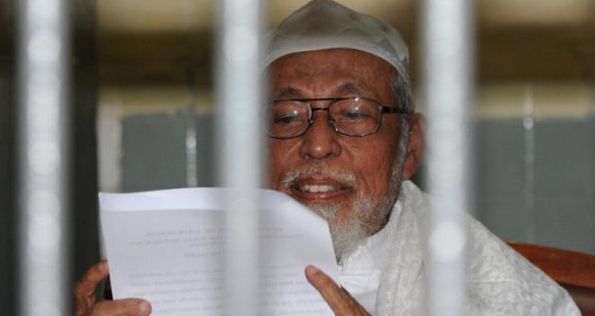
Abu Bakar Basyir

INDONESIAN prosecutors and anti-terrorism officials spent nearly a decade trying to put away Abu Bakar Basyir, so they didn’t much mind waiting an additional four hours and 45 minutes on Thursday. That’s how long it took a panel of judges at the South Jakarta District Court to read the guilty verdict against Mr Basyir, on charges of terrorism, and to sentence him to 15 years in prison. The old firebrand is now 72 years old, and ailing. Several hundred of Mr Basyir’s supporters who had gathered outside the courthouse since the early morning—most of them angry young men in white—dispersed without incident after the verdict was announced. Widespread fears that they would ransack the courthouse and local churches, or target the judges with bombs (as had been threatened via Twitter and SMS messages) proved unfounded.

Whether due to fatigue from their long wait, or the fact that they were outnumbered better than 3-to-1 by 3,000 armed police and soldiers, Mr Basyir’s young followers didn’t muster for a fight. The same might be said about Mr Basyir’s entire movement at present. It had drawn widespread attention and even some admiration within Indonesia in the wake of the 9/11 attacks on the United States, but since then it has slowly and steadily deflated, like a hot-air balloon after touching down. The Indonesian public tuned in to catch the news of Mr Basyir’s guilty verdict, in the world’s largest Muslim-majority nation, most citizens have long since tuned out his call for an anti-Western Islamic state. As they showed with their indifference to his trial since it opened on February 14th, they prefer watching “American Idol” and local reality shows copied from Hollywood, or updating their Facebook accounts (which as of this week stood at 38.1 million—the second-most in the world).

Mr Basyir emerged from self-exile in Malaysia amid Indonesia’s pro-democracy movement in the late 1990s, and used the country’s newfound freedoms to praise Osama bin Laden and lambast Indonesia’s secular government and its friendship with America. The frail-looking cleric, constantly wearing a toothy grin and a bristly white beard, became the poster child for Indonesia’s radical Islamists. Even then they were tiny in number, amid a country of 237m, but they dominated the headlines with their rhetoric and intimidation tactics. After the Bali bombings in 2002, which killed 202 tourists and Indonesian citizens, Mr Basyir claimed that the American CIA was behind it—just as the CIA and Israel’s Mossad took down the World Trade Centre in New York the year before. The fact that Mr Basyir didn’t back his wild claims with a shred of evidence didn’t matter: he found listeners among some Indonesian politicians and intellectuals, and on university campuses.

Local and international media were always ready to publish Mr Basyir’s most outrageous rants: he once declared that the naked female form was more immoral than the Bali bombings. His statements infuriated America, Australia and Britain, all of whom lost citizens in the 2002 Bali attacks. But they were perhaps angrier with Indonesia’s judicial system, for its inability to lock him up and throw away the key—or put him before a firing squad. America and Australia have long accused Mr Basyir of being the spiritual leader of Jemaah Islamiyah, the South-East Asian offshoot of al-Qaeda, which carried out a string of terrorist bombings in Indonesia dating back to 2000, including the Bali bombings, which altogether have killed more than 240 people.

Mr Basyir’s arrest in West Java on August 9th 2010 was his third on terrorism-related charges: he was first arrested after the Bali bombings, but then prosecutors botched the case and he ended up serving only 18 months, on a dubious immigration-violation charge. He was immediately re-arrested upon his release from prison, this time in connection with the bombing of the J.W. Marriott Hotel in Jakarta in 2003, but then he did only 30 months, because he hadn’t been an active participant in the plot; he was, after all, in prison at the time. So Mr Basyir was released again.

But even then the Indonesian cleric had begun to lose his public appeal. Shocked and repulsed by the suicide-bombing of the Australian embassy in Jakarta in 2004, and by a second set of attacks on Bali in 2005, and then again by the (second) bombing of the Marriott and another upscale hotel in 2009, the silent majority of Indonesia’s 190m Muslims began to murmur that enough was enough. Nearly all the victims in those later attacks were Indonesian Muslims. Indonesian voters also continued their pattern of choosing secular candidates in presidential and parliamentary elections in 2004 and 2009, further cementing the country’s democracy and leaving Mr Basyir nothing beyond small clusters of followers in rural villages across Java.

As al-Qaeda’s attempt to trigger an Islamic revolution in the Arab world failed, so did Mr Basyir’s movement to create an Islamic state in Indonesia. Like Osama bin Laden, all the Indonesian cleric had left was terrorism, an ugly tactic. Despite his public renunciation of violence in 2006, Mr Basyir’s conviction on Thursday was for organising and funding a terrorist-training camp in the Indonesian province of Aceh, on the northern tip of Sumatra. The 100 or so militants who had trained there were allegedly plotting to assassinate the president, Susilo Bambang Yudhoyono, and carry out Mumbai-style attacks on Western hotels and embassies in Jakarta.

While the judges who sentenced Mr Basyir to 15 years in prison—prosecutors asked for life—have been accused of taking the easy road to avoid further alienating Indonesia’s few thousand hard-line radicals, Mr Basyir faces additional charges in connection with the suicide-bombing of a mosque inside a police compound in Central Java on April 15th. He is all but certain to spend the rest of his life behind bars. Police say they have linked the bomber and the attack’s arrested planners to Jemaah Ansharut Tauhid, or JAT, a legally-recognised group that was founded by Mr Basyir.

But this hardly marks the end of Indonesia’s struggle with violence in the name of religion. Despite the curtains falling on Mr Basyir’s one-man sideshow, surveys taken over the past 10 years show that religious intolerance in Indonesia has been growing at an alarming pace—in both rural and urban areas. Mass organisations such as JAT and the infamous Islamic Defenders Front have in recent years attacked churches and blocked the construction of new ones, usually claiming that they failed to win the approval of local Muslims. Cowed local officials and police have done nothing to stop them. Last year, a Christian pastor was stabbed in the stomach by a local radical leader as he led a congregation to a Sunday service. Christian Solidarity Worldwide recently called on Mr Yudhoyono’s government to tackle Islamic extremism as attacks on Christians and their houses of worship proliferated. The head of a Christian group in Jakarta has said there were 14 attacks on churches in the first five months of 2011, and 46 last year.

Radical groups have also been involved in lynchings, including numerous attacks against the minority Ahmadiyah sect. On February 6th, a mob of hundreds of people in rural West Java, incited by local radical religious figures, attacked the homes of local Ahmadiyah leaders, killing four people. Graphic footage of Ahmadiyah members being beaten and hacked to death were seen everywhere on YouTube. Analysts say Indonesian radical groups are using exploiting push-button issues such as the Ahmadiyah (who don’t believe that Muhammad was the final prophet of Islam) because they resonate with rural villagers. Mr Yudhoyono’s government seemed paralysed, standing back and doing nothing as attacks continue and church close their doors.

The president, a retired Army general who might fear being painted as un-Islamic by his political opponents, has since made vague statements calling radicalism a threat to the nation. He has called for expanding the study of pancasila, the Indonesian state ideology which regards the country’s six recognised religions as equals. But he’s also spoken of a “middle way” in which radical groups might be tolerated as a proper part of the country’s democracy. This despite the fact that some of them have openly stated their intention to overthrow Mr Yudhoyono’s government and form an Islamic state, using violence if necessary.

Terrorism remains a grave threat to Indonesia. The now-defunct Jemaah Islamiyah has many splinter cells actively plotting attacks, as well as “lone wolf” terrorists such as Muhammad Syarif, the bomber of the mosque in Central Java. He was among the protesters who gathered outside the South Jakarta District Court when Mr Basyir’s trial opened four months ago. Police are still searching for 15 suicide vests that are supposed to be in circulation, as well as remaining co-conspirators in the attack. On Tuesday police arrested 16 people for plotting to poison officers’ food with cyanide, as well as kill them with pen guns. Mr Basyir’s conviction will remove a venomous voice from Indonesia’s internal debate on the place of Islam, but in everyday terms it will not make the country any safer.

Wednesday, June 8, 2011

Could Indonesia ‘Pakistanize’?

   Wednesday, June 8, 2011
Wall Street Journal, USA
REVIEW & OUTLOOK ASIA
Could Indonesia ‘Pakistanize’?
The present tepid leadership hasn’t done enough to halt the rise of militant Islam.

By BENEDICT ROGERS

Four men, traumatized, terrorized and stigmatized, sat in a Jakarta apartment and described to me how they were almost killed by a Muslim mob earlier this year.

One was stripped naked, beaten to a pulp, a machete held at his throat with a threat to cut off his penis. He was dragged through the village and dumped in a truck like a corpse. Another fled into a fast-flowing river, pursued by attackers throwing rocks and shouting “kill, kill, kill.” He hid in a bush, dripping wet and extremely cold, for four hours. A third suffered a broken jaw, while a fourth, pursued by men armed with sickles, machetes and spears, was detained by the police for three days, treated as a suspect not a victim.

The four were members of Indonesia’s Ahmadiyya community, a Muslim sect regarded by other Muslims as heretical. They were victims of an attack in Cikeusik, Banten province, on February 6. More than 1,500 Muslims attacked 21 Ahmadis, killing three. President Susilo Bambang Yudhoyono has called for a full investigation.

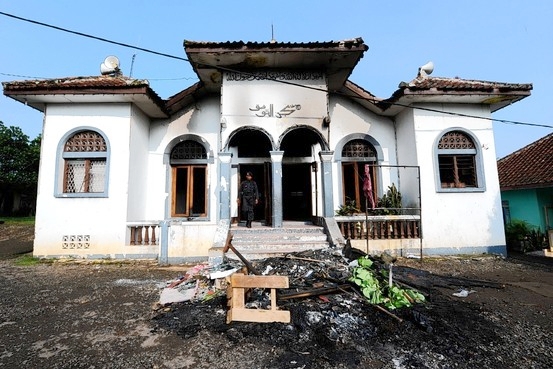
If Cikeusik was an isolated incident, it could be dismissed as a tragedy. Sadly, such tragedies are increasingly frequent. Last month I visited Cisalada, West Java, the scene of a similarly violent attack in October. Houses had broken windows boarded up, and some had been burned. A mob had thrown Molotov cocktails at the Ahmadi mosque and carried samurai swords. Anti-Ahmadi abuse was scrawled on the walls.

Indonesia’s tradition of pluralism, enshrined in its state ideology “pancasila,” is now under increasing threat. The world’s largest Muslim-majority nation has won applause for its religious tolerance and remarkable transition from authoritarianism to democracy, but these achievements are undermined by an increasingly vocal, violent Islamist minority. Under pressure from Islamists, the government banned the dissemination of Ahmadiyya teachings in 2008.

The rise of militant Islam has caused some in Indonesia to warn of “Pakistanization.” As a term to describe Indonesia today it is an exaggeration, but as a warning of what may come if action is not taken, it is valid. Pakistan’s path to extremism accelerated when the Ahmadiyya were banned in 1984; their treatment is a barometer of tolerance in a Muslim society.

It’s not just the Ahmadiyya. Christians are also under pressure. Radical Islamists have stirred tensions and forced churches to close. Even churches that have legal registration and secured Supreme Court rulings in their favor have remained sealed, their congregations forced to worship in the street. According to the Setara Institute in Indonesia, 91 violations of religious freedom were documented in 2010, at least 75 of which affected Christians.
A police officer stand guards at the damaged house of a member of Ahmadiyah after it was attacked by Muslim mob in Pandeglang, Banten province, Indonesia, Monday, Feb. 7, 2011.

A police officer stand guards at the damaged house of a member of Ahmadiyah after it was attacked by Muslim mob in Pandeglang, Banten province, Indonesia, Monday, Feb. 7, 2011.
AFP/Getty Images
A mob damaged this Ahmadiyya mosque in Cisalada, West Java, last year.
“The radicals want to push us to the limit, to see how long we are prepared to worship [out on the street] before we surrender,” Rev. Palti Panjetan, pastor of the HKBP Filadelfia church in Bekasi, West Java, told me. Local Muslims who have supported the church have also faced intimidation from Islamists.

Both Ahmadis and Christians warn that if their persecution continues, Indonesia could fracture. The victims of Cikeusik talk of seeking asylum overseas for their entire community. “We still love our country, but one day Christians and Ahmadis will decide we want to separate from Indonesia, if the situation does not change,” Rev. Panjetan says. “It is only a matter of time before there is ‘Sudan-ization,’ a separation of Indonesia between Muslims and minorities, like north and south Sudan. We don’t want that.”

Indonesia does have constitutional and legal protections for minorities. In fact, United Nations High Commissioner for Human Rights Navanethem Pillay, in a letter to Indonesia’s foreign minister in April, called for a review of all laws restricting religious freedom, to “ensure they comply” with Indonesia’s own constitution and international covenants.

The core problem is the weakness of the government. President Yudhoyono makes tepid statements condemning violence, but takes no action to protect minorities. Perpetrators of violence are arrested, but face minor charges and paltry punishments.

There are some signs that leaders are waking up. Last week former presidents B.J. Habibie and Megawati Sukarnoputri expressed concern that pancasila had lost its prominence. Last month, leading political and judicial figures, including the president, warned that “pancasila has been sidelined from people’s way of life.” Such statements are welcome, but rhetoric alone will not stop Indonesia’s slide toward Islamization.

Instead there are concrete steps Mr. Yudhoyono should take. Domestically, he can ensure that perpetrators of violence are brought to justice, that victims and witnesses receive proper protection, and that more investment is made in counter-extremism initiatives like the Wahid Institute, a liberal Muslim think tank founded by former President Abdurrahman Wahid. Jakarta could revise a blasphemy law on the books since the Sukarno era—often used by radicals to stir up hatred—and repeal the Ahmadiyya decree.

These recent events have tarnished Indonesia’s international reputation as a tolerant society. President Yudhoyono could start to repair it by inviting the U.N. Special Rapporteur on freedom of religion and belief to visit the country, as suggested by Ms. Pillay in her letter. Since Mr. Yudhoyono seems to care about Indonesia’s stature abroad—evidenced by Jakarta’s willingness to take on leadership roles in the region—the international community is in the right place to urge him to act.

Appeals from people like Rev. Panjetan must be heard. “We need support from the international community… . The rise of radicalism is not only a problem between Indonesians. There is an international agenda. Wahhabi influence is growing. We need the international community to be a watchdog. If there is no help from the international community, we are hopeless, we will be destroyed.”

If Indonesia abandons pluralism, the geopolitical consequences will be significant. The democratic success of the largest Muslim-majority country will be in jeopardy. The world will have lost a role model of tolerant, moderate Islam, which doesn’t bode well for the success of democratic revolutions in the Middle East. It is in all our interests to ensure that does not happen.

Mr. Rogers is East Asia Team Leader at Christian Solidarity Worldwide, a human rights organization based in London.

Copyright ©2011 Dow Jones & Company, Inc. All Rights Reserved
URL: http://online.wsj.com/article/SB10001...824805736.html

Tuesday, May 3, 2011

‘Victim’ Reveals Sinister Workings Of NII Recruiters

Jakarta Globe, Indonesia
HOME
‘Victim’ Reveals Sinister Workings Of NII Recruiters
Fitri R. | May 03, 2011

Rights activists have claimed to see disturbing similarity in the deadly mob attack on an Ahmadi community, above, in Cikeusik, Banten, in February, and religious violence targeting Christians in Central Sulawesi and Maluku, below, from 2000-07. Activists say both conflicts show evidence of being instigated by agent provocateurs. (AP, AFP, JG Photos)
After weeks of tweaking and trials and errors, an activist at a prominent human rights group was finally able to connect his laptop computer to an old 32-inch cathode-ray tube television at home.

Although he had seen it about 20 times already, Hendi (not his real name) was eager to watch the 40-minute video of the bloody attack on the Ahmadiyah minority sect in the Cikeusik subdistrict of Banten on a screen with a much bigger resolution than that of his laptop.

“I’m curious to learn who these people who wear the blue and green ribbons are. The fact that they wear ribbons to distinguish friends from foe suggests that they don’t know each other,” he told the Jakarta Globe after asking not to reveal his identity because he was far from concluding his research.

Witnesses say around 20 attackers wearing the ribbons on their jackets and shirts were among the first to arrive at the scene on Feb. 6 and could be seen provoking others to attack a house belonging to an Ahmadi. More than 1,000 people eventually joined the assault which resulted in the death of three Ahmadis.

Hendi said he was curious how the attackers, who witnesses say were not from the area, knew which house to attack.

Obsessed with learning who these people were, Hendi scrutinized every frame of the video, listening to a barrage of sounds and noises and scribbling in his notebook every time he heard an audible conversation.

“They were highly skilled in martial arts, can be seen provoking the masses to attack Ahmadiyah and simply vanished just minutes into the riot,” he concluded, adding that this was precisely the pattern found in scores of sectarian conflicts that sprung up after the fall of Suharto.

Finding the Mastermind

Hendi said that he became fixated on digging up the truth that many of his activist friends chose to ignore after the Al Jazeera television station in March reported closer ties being forged by hard-line groups and several retired military generals.

The activist said that unless police were able to apprehend the provocateurs, the mastermind behind the Cikeusik attack would never be revealed.

But Hendi is not alone. Mufti Makaarim, executive director of the Institute for Defense, Security and Peace Studies, also thinks that there is more to the attack than meets the eye.

“Rogue elements within the military have used radical Muslims as proxies before to create diversions or push certain political agendas. They don’t want to be linked directly to sectarian conflicts,” he said, adding that religious violence had been used in the past to de-legitimize civilian-controlled governments.

Chep Hermawan, head of the Islamic Reform Movement (Garis), a hard-line group, has said that several retired generals had approached radical Muslim groups one month prior to the Cikeusik attack in a bid to topple President Susilo Bambang Yudhoyono by exploiting mainstream Muslims’ resistance toward the Ahmadiyah.

Chep named them as former Army chief of staff Gen. (ret.) Tyasno Sudarto; Maj. Gen. (ret.) Muchdi Purwoprandjono, former commander of the Army’s Special Forces (Kopassus); Maj. Gen. (ret.) Kivlan Zen, former commander of the Army’s Strategic Reserve Command (Kostrad); and Gen. (ret.) Fahrul Razi, a former deputy chief of staff.

IDSPS’ Mufti seemed hardly surprised. “These are old players,” he said.

Similar Patterns

In his book, “Civil Islam: Muslims and Democratization of Indonesia,” anthropology professor Robert Hefner said that during the Suharto regime, the government made use of hard-liners to act as agent provocateurs to de-legitimize criticisms toward his rule, particularly when calls were mounting for him to step down at the height of the 1997-98 Asian Financial Crisis. In the book, Hefner details numerous reports and anecdotes that detail links between the military and hard-liners.

He writes that during the May 1998 riots in Jakarta, a group of unidentified men started burning and looting businesses and homes owned by ethnic Chinese. The men provoked ordinary civilians to follow suit and by the time security forces arrived they had vanished, similar to Hendi’s observations of the Cikeusik attack 12 years later.

A similar pattern was reported during a religious conflict in East Java a year earlier, with efforts to break ties between the Nahdlatul Ulama, led by future President Abdurrahman “Gus Dur” Wahid, and syncretist Javanese Muslims.

NU probes quoted witnesses as saying that groups of men dressed in “ninja” outfits had been killing Muslims clerics as well as people believed to be black-magic sorcerers. But a series of rumors that sprang up after the violence would omit mention of the ninja-clad attackers and allege that the Muslim clerics and sorcerers had in fact been killing each other.

It would not be the last time such tactics would be reported.

In 2000, a string of religious conflicts between Muslims and Christians erupted in Poso, Central Sulawesi, and Ambon, Maluku. Several rights groups cited witnesses reporting ninja-clad bands of people killing both Muslim clerics and Christian priests.

Then-President Gus Dur accused a Maj. Gen. “K” and a civilian named “Gogon” to be behind in the conflicts in Poso and Ambon. But until he was forced to resign in 2001, Wahid never disclosed the full identities of those he accused.

At the time, Kivlan was one of only two major-generals in the military with that initial.

“Gogon” is the reported nickname of Ahmad Sumargono of the conservative Indonesian Islamic Propagation Council (DDII), a long-time friend of Muchdi and later a politician of the Star Crescent Party (PBB.)

Conflicts in Ambon and Poso went on until 2007, ending after the National Police toured the area with FPI leader Rizieq Shihab, who urged remnants of the Muslim militias to join FPI and fight new enemies: immorality and blasphemous sects. Some former militia members chose to join the Jemaah Islamiyah terror network.

Military Might

After the fall of Suharto in May 1998, the new government formed fact-finding teams to investigate the cause of the Jakarta riots as well as the kidnapping and murder of 14 student activists, according to Hefner.

In October 1998, one team probing the kidnapping of activists released its findings and concluded that it was conducted by a special unit inside the Army Special Forces Command (Kopassus). The team deemed former Kopassus commander Prabowo Subianto and his successor, Muchdi, responsible for the crime.

Prabowo would later go on to found the Great Indonesia Movement Party (Gerindra). Muchdi would go on to head the National Intelligence Agency (BIN). In 2009 he would be controversially acquitted for the 2004 murder of rights activist Munir Said Thalib.

In a postscript addendum after he concluded research into his book in November 1999, Hefner wrote that most disturbances at the time bore the telltale signs of agent provocateurs.

“Although its leaders have been removed from the heights of government, advocates of state terror remain ensconced in segments of the military and bureaucracy. The dismantlement of their shadowy network of vigilantes and gangsters will be one of the greatest challenges facing democratic Indonesia,” he wrote.

For Hendi, the evidence is still up for debate. But the patterns he says he sees are undeniable.

“What is intriguing for me about the Cikeusik attack is that it doesn’t follow the same pattern as other cases of violence on Ahmadiyah involving hard-liners,” Hendi said. “The attack bears more resemblance to the ones seen during the sectarian conflicts in Ambon or Poso.

“I think there is a good indication that one of the martial arts groups associated with a military figure might be involved.

“But unless police are able to arrest one of the provocateurs or at least have someone who would identify who they are and where they’re from, we won’t know who the true masterminds are.”

Monday, May 2, 2011

Is Dislike of SBY Driving Military Old Guard to Hard-Liners?

Jakarta Globe, Indonesia
NEWS
Is Dislike of SBY Driving Military Old Guard to Hard-Liners?
Nivell Rayda | May 02, 2011

President Susilo Bambang Yudhoyono’s speeches often leave many Indonesians mystified, and the one he made shortly after a series of book bomb scares across the capital last month was no exception.

“To that group, [I say] if you don’t like me, don’t sacrifice the people. Don’t let them become victims,” he said on March 18, shortly after police discovered a fourth bomb sent to the house of a prominent music mogul.

To some, the president appeared presumptuous for assuming that he was the target, but Mufti Makaarim, executive director of the Institute for Defense, Security and Peace Studies, thinks that there is more to the remark than meets the eye.

“He knows that there are some people who benefit from religious violence and acts of terrorism. He senses that there are a few retired generals who would love to see him lose legitimacy to run this country,” he said. “For me the speech was clear. As vague and intriguing as it may seem to the rest of the nation, he was addressing military retirees.”

Connecting the Dots

Two other incidents that took place shortly after that speech seemed to crystallize what Yudhoyono meant.

On March 20, a little-known Islamic political analyst named Wachiduddin received thunderous applause from an audience of 500 veiled women and bearded men at a talk show organized by Hizbut Tahrir Indonesia, a hard-line group that seeks the formation of an Islamic caliphate.

Wachiduddin on that day said that it was important for hard-line Muslim activists to establish ties with warmongers and military officials. Excerpts and video recordings of the show have been circulating online since.

“Gaining support from ahlul quwwah [bearers of military might] in a revolution is a method exemplified by the great prophet, Muhammad,” he said. “The prophet and his disciples once convened with ahlul quwwahs throughout Mecca, asking them to convert to Islam and join his holy struggle.”

Muhammad eventually gained the support of Sa’ad bin Muaz, a prominent seventh-century warlord from Medina, Saudi Arabia, the self-proclaimed expert added. “Muslim activists [in Indonesia] must visit these generals. We must convince them that Islam is the only system blessed by Allah. Generals must become the 21st century Sa’ad bin Muaz,” Wachiduddin said.

On March 22, two days after the speech, Al Jazeera reported that “senior retired generals” were supporting the Islamic Defenders Front (FPI) and other hard-liners to incite religious violence and overthrow Yudhoyono.

The report included an interview with retired Army Chief Gen. Tyasno Sudarto, a staunch government critic who acknowledged his support for the groups that he said aimed to topple Yudhoyono in a “revolution.”

Coming Out

Besides Tyasno, there are more military men backing the hard-liners, according to Chep Hernawan, head of the Islamic Reform Movement (Garis). In an interview with the Jakarta Globe, he identified them as retired Maj. Gen. Muchdi Purwoprandjono, former commander of the Army’s Special Forces (Kopassus); retired Maj. Gen. Kivlan Zen, former commander of the Army’s Strategic Reserve Command (Kostrad); and retired Gen. Fahrul Razi, a former deputy chief of staff.

Chep said several meetings had already taken place since January between the ex-generals and conservative Muslim leaders to discuss their plans.

“We’re united by the Ahmadiyah issue, since these retired generals have also lost faith in how the president is managing the country. They are Muslims too and know very well that Yudhoyono’s hesitance in banning Ahmadiyah could spark public anger, particularly from Muslims,” Chep said.

He was referring to the minority sect deemed deviant by mainstream Muslims that has faced increasing persecution over the years, including from the state.

Islamic People’s Forum (FUI) secretary general Muhammad Al Khaththath had also acknowledged its movement to seek the dissolution of the sect was supported by retired generals but refused to divulge details into what sort of arrangements the hard-liners had with the generals.

‘Awan Merah’

A source inside the military retiree circle told the Jakarta Globe that the hard-liners had benefited financially as well as politically from the relationship.

“These generals always finance pesantrens [Islamic religious boarding school] and madrasahs [Islamic schools] owned by hard-line figures. Their houses are always visited by hard-line groups and some return with plenty of donations,” the source said on condition of anonymity.

“In return they pledge allegiance and consider these generals as their patrons. [Hard-liners] are often exploited for a certain political gain.”

But the source said that the retired generals had a more sinister plot. “The other retirees are calling their actions ‘Awan Merah’ [Red Cloud], short for ‘Aksi Purnawirawan Militer Berdarah’ [Bloody Actions of Military Retirees],” he told the Globe.

“Their aim was to create another religious conflict like the ones in Ambon [North Maluku] or Poso [Central Sulawesi]. But this time, they want it to be close to the capital. It is likely that their target would be Kuningan or Parung.”

Around 2,000 followers of the Ahmadiyah faith live in Manis Lor village in Kuningan district, West Java, making it the largest Ahmadi community in Indonesia. An attack on the community occurs almost every year.

Parung, a small town about halfway between Jakarta and Bogor, is home to an Ahmadiyah center. It was last attacked in 2008.

“Other retirees are not too sure about their strategies. Toppling a president is not that easy,” the source said. “But what these generals have in common is that they all hate SBY, they’re devout Muslims or what some would describe as ‘green generals,’ they have close ties with hard-liners and in the past they had their hands dirty in cases of religious violence.”

Mufti of the IDSPS said the retired generals were discontented with Yudhoyono because he had failed to provide enough political positions for members of his former corps.

Only two retired generals sit in Yudhoyono’s administration: State Secretary Sudi Silalahi and Deputy Defense Minister Sjafrie Sjamsuddin.

“The aim is to topple Yudhoyono through de-legitimization of his rule, to show that civilian-controlled government is failing and that we should go back to military rule,” he told the Globe. “That has happened during the administrations of [former presidents] [B.J.] Habibie and Gus Dur [Abdurrahman Wahid].”

Mutual Interests

Muchdi, the retired major general, has confirmed that he has close relationships with hard-line Muslim figures. “I have friends from almost every Muslim organization and yes, some of them are radicals,” he told the Globe.

He was cautious, however, about revealing the extent of those ties with radicals. “All I can say is that these [hard-liners] don’t have a political vehicle to channel their aspirations. They just want their voices heard by the government,” he said.

“I don’t agree with violence and every Muslim organization that I have talked to feels the same way. There is not a single political party that can facilitate their needs, that is why some rogue elements within the organizations feel frustrated and do [violent] things.”

Muchdi, the former head of the National Intelligence Agency (BIN) who was controversially acquitted in 2009 of the murder of rights activist Munir Said Thalib, has also been cited as a senior adviser of FUI publication Suara Islam and of Media Dakwah, a publication tied to the Indonesian Islam Propagation Council (DDII).

Although he is open about opposing the existence of the Ahmadiyah, he denied playing a part in religious violence.

“After the cases in Cikeusik [Banten] and Temanggung happened, text messages began circulating saying that me and Tyasno Sudarto were behind the melees,” he said, referring to a mob attack on Ahmadis in Banten that left three sect members dead and the violent riot in the West Java town after a blasphemy trial.

“To me, rumors like that happen almost on a daily basis. Some issues we have to fight back but some I chose to ignore. I don’t know why, but people see me as a hard-line Muslim myself.”

A long time critic of Yudhoyono, Tyasno has been participating in various rallies and activities to oust the president. His disapproval for his former classmate in the military academy had led him to form an unlikely bond with radical Muslims, secular nationalists and other groups frustrated with the sitting administration.

In March 2010, Tyasno joined hard-line Muslim activists in an event organized by HTI to denounce the growing economic influence of the United States in Indonesia.

The retired Army chief did little to hide his alliance with hard-line groups during the interview with Al Jazeera.

“We work together to enlighten each other. Our angle is different. They fight in the name of Islam, we use national politics. But we have a common goal, which is change. We want to save our country, not destroy it. The revolution should be peaceful, not anarchist or bloody,” he said.

Al Jazeera cited a Web site that detailed a proposed cabinet line-up for the so-called Islamic government — which included Tyasno — drafted by FUI’s Al Khaththath, himself a member of the HTI and former chairman.

Like Muchdi, Kivlan denied sponsoring religious violence and suggested Muslim groups channel their resentment toward the Ahmadiyah in a court of law.

“For me, the solution is simple. Launch a legal action [against the sect]. The same with Ahmadiyah, if they feel intimidated, report it. Don’t take this problem to the street … let the court decide. Only then will all problems be solved,” he told reporters after his name circulated as a mastermind of attacks against members of the sect.

Old Ties

But despite the denials, it is hard not to question how hardliners have continued to enjoy impunity without the presence of political support from powerful figures.

In February, hard-line groups began demanding that Yudhoyono step down unless he issued a decree banning the Ahmadiyah, just days after the president announced plans to disband organizations that used violence to further their goals.

“The fact that the government is reluctant to dissolve hard-line groups suggests that these organizations have support from powerful people. He wouldn’t even touch HTI, which is clearly trying to establish an Islamic state and replace our national ideology. That’s treason,” human rights activist and noted military critic Usman Hamid told the Globe.

In 1965, the military began establishing close ties with Muslim groups in order to fight communists. It is widely estimated that close to a million people were killed in an ensuing witch hunt for Indonesian Communist Party (PKI) supporters.

During the Suharto regime, the military maintained the relationships, including with former elements of the Darul Islam and the Islamic Troops of Indonesia (TII), which launched a widespread rebellion during the Sukarno era in a failed attempt to establish a theocracy.

The military allegedly capitalized on the relationships during the final days of Suharto’s 32-year regime by inciting hatred toward the Chinese ethnic minority through rumors that they had caused the Asian financial crisis of 1997-98. A widespread riot occurred in May 1998, targeting Chinese businesses and homes.

After the fall of Suharto, the ethnic violence spread throughout the islands of Java, Borneo, Sulawesi and the Malukus.

Witnesses detected a similar pattern in the seemingly separate conflicts and reported the presence of unidentified men provoking an attack on other religious groups. “What we are seeing today is a re-establishment of old ties. There is a good chance that similar conflicts would occur again,” Usman said.

In a recent interview with the Globe, Mahmudi Haryono, alias Yusuf, a former terrorism convict who once participated in religious violence in Poso, said that the best possible way to disrupt national stability in Indonesia would be to incite another violent religious conflict.

“There are thousands of us who ‘graduated’ from Moro, Poso and Ambon. This is a time of peace so most of us just carry on with our daily lives. But when there is another conflict, they would leave their job and everything they have and fight. A lot of people that I know feel that way,” he said.

“I realized, even back then, that the jihadist movement has been exploited by political power to destabilize the government. But blind faith and the notion that Muslims are under attack can prompt radical Muslims to do just about anything.”

Copyright 2010 The Jakarta Globe
URL: www.thejakartaglobe.com/indonesia/is-dislike.../438560

Saturday, April 30, 2011

Exclusive: Secret Report Reveals How BIN Misread Threat to Ahmadiyah

Jakarta Globe, Indonesia
NEWS
Exclusive: Secret Report Reveals How BIN Misread Threat to Ahmadiyah
Nivell Rayda | April 30, 2011

Defendants on trial for the gruesome slaying of three Ahmadiyah followers await there trial at a Banten courthouse on Tuesday. A document obtained by the Jakarta Globe reveals that the State Intelligence Agency totally misread the threat facing Ahmadiyah.
When the hard-line Islamic Defenders Front attacked demonstrators rallying in support of the embattled Ahmadiyah sect on June 1, 2008, many believed that fundamentalists would go to any length until they succeeded in ridding Indonesia of the minority Islamic group.

Many more had predicted that the issuance of a joint ministerial decree (SKB) — which bans Ahmadis from practicing their faith in public and proselytizing — a week after the rally would not be enough to halt intimidation and discrimination against members of the sect.

A secret document obtained by the Jakarta Globe, however, suggests there was one institution that believed otherwise: the State Intelligence Agency (BIN).

‘Unfounded Concerns’

A month after the June 2008 attack on the rally at the National Monument (Monas), BIN prepared a 180-page assessment on the expected implications of the decree. In the document, BIN claimed it had found no indications that persecution, torture or intimidation of the sect’s members would continue.

“Concerns that there would be an escalation of violence following the enactment of the SKB, prove to be unfounded,” according to the preface of this document, written by Bambang Karsono, a BIN expert on social and cultural affairs. “In fact, members of Ahmadiyah, who have become … targets of attacks, have so far been passive in response to the enactment.

“The reaction [to the SKB] from the opponents of Ahmadiyah appears to be modest. Although they still demand the complete disbandment of Ahmadiyah, apparently they feel that the banning of its [Ahmadiyah’s] activities is enough,” the document continues.

The same document, however, acknowledges the presence of hard-line groups that, according to BIN’s assessment, “have the potential to use violence to deal with Ahmadiyah.”

It then went on to identify the groups that might cause trouble: the Islamic Defenders Front (FPI), the Islamic People’s Forum (FUI), the Indonesian Committee for Solidarity with the Islamic World (Kisdi), Hizbut Tahrir Indonesia, Ittihadul Muballighin, the Indonesian Islamic Propagation Council (DDII) and the Islamic Union (Persis).

But BIN had focused its attention mainly on the expected reactions within Nahdlatul Ulama and Muhammadiyah, the country’s largest Islamic organizations, which have always chosen peaceful methods in voicing objections against the Ahmadiyah.

Mufti Makaarim, executive director of the Institute for Defense, Security and Peace Studies, said he had no doubts whatsoever the documents obtained by the Globe were authentic.

“This is not a top-secret operations document. This is more of an academic analysis that BIN obtained. Still, it is not meant for public scrutiny,” Mufti told the Globe, adding that the structure and format is consistent with other documents produced by the intelligence agency.

“BIN’s suggestions on the implications of the SKB on Ahmadiyah are deeply flawed, because none of its predictions came true. The data is quite comprehensive so I assume the problem lies with the analysis,” Mufti added.

Hard-Liners Underestimated

As events since the Monas rally have proven, attacks and persecution against Ahmadiyah communities nationwide grew at the hands of hard-line groups like the FPI, the FUI and the HTI.

Elaine Pearson, deputy Asia director at Human Rights Watch, said that Ahmadiyah communities in Indonesia have paid the price for BIN’s flawed analysis.

“The document suggests that BIN naively underestimated the Islamist militant groups [in its analytical report]. Attacks on Ahmadiyah have steadily increased following the 2008 decree,” she told the Globe.

Last year, an entire Ahmadiyah village in Bogor was ransacked. On Feb. 26, three Ahmadis were brutally murdered in the subdistrict of Cikeusik in Banten, by a lynch mob of some 1,500 people.

Ahmadis have not even found refuge in death. Last month, the grave of a recently deceased Ahmadi was dug up by a mob, and his body removed from a Bandung cemetery.

Instead of protecting the beleaguered community, the government has put the blame on Ahmadiyah, with Religious Affairs Minister Suryadharma Ali saying the sect should be disbanded.

A crucial tenet in Islam is that Muhammad was the final prophet. But mainstream Muslim organizations accuse Ahmadiyah of considering its founder, Mirza Ghulam Ahmad (1835-1908), to be a prophet as well.

Sect members have faced intense discrimination as a consequence. Ahmadis in West Nusa Tenggara live in abject poverty, shunned by mainstream Muslim communities. Ahmadiyah members say that in some areas the government refused to issue marriage certificates or renew their identification cards.

Limits to the Rule of Law

In its 2008 report, “Indonesia: Implications of the Ahmadiyah Decree,” the Brussels-based International Crisis Group predicted the SKB would increase the likelihood of religious vigilantism.

“The decree satisfied no one except a few members of the parliament,” ICG said.

“Hard-liners felt it did not go far enough and, scenting victory, pressed for more.”

BIN in its analysis assumed that mainstream Muslim groups would take any Ahmadiyah violations of the decree to the courts of law. But the intelligence agency underestimated the violent nature of hard-line groups.

FPI figures responsible for the June 2008 attack were later sent to prison for a year, a punishment many saw as too lenient in relation to the damage they had done to the nation’s image of religious tolerance and freedom.

Persecution against Ahmadiyah members occurred time and again because of police inaction, the Setara Institute for Peace and Democracy has said.

The Indonesian Ahmadiyah Congregation (JAI) recorded more than 150 cases of attacks and intimidation after the SKB was enacted. Perpetrators were brought to trial in just two cases. Those found guilty would be sentenced to less than a year in prison, while the actual masterminds behind the attack would often not even be prosecuted.

Perceptions and Promises

A 2010 study by the Indonesian Survey Circle (LSI) showed that 30.2 percent of 1,000 respondents supported acts of violence against the sect.

While making no connection to the issuance of the decree, LSI researcher Adrian Sopa said that this was a sharp increase to a similar survey in 2005 that showed only 13.9 percent of respondents backed such moves. The 2005 survey was conducted after the Indonesian Ulema Council (MUI) reaffirmed Ahmadiyah’s blasphemous status.

The MUI had declared Ahmadiyah deviant in 1980, but acts of violence against the sect were suppressed under former President Suharto’s iron-fisted rule. However, as soon as the regime was toppled, some Muslim groups brought up the issue again.

After former President Abdurrahman “Gus Dur” Wahid — who many deemed a champion of religious tolerance — stepped down in 2001, the call intensified and a string of violence against Ahmadiyah was set in motion.

The government also made empty pledges about the protection of Ahmadiyah’s right to practice its beliefs.

On Feb. 27, 2006, then Religious Affairs Minister Maftuh Basyuni said that if Ahmadiyah would call its founder Mirza Ghulam Ahmad a mere reformer and not a prophet of Islam “then all problems would be solved.”

On Jan. 14, 2008, then JAI chairman Abdul Basit issued a document titled “Twelve Commitments of Ahmadiyah” which stated that the Ahmadiyah community believes Muhammad to be the final prophet of Islam.

But despite JAI’s wish to be welcomed into the mainstream Muslim community, the ministry continued to push for the dissolution of Ahmadiyah or have it declared a separate religion, thus banning Ahmadiyah from using Islamic attributes like the Koran.

So far, the government has stopped short of disbanding Ahmadiyah altogether. The BIN document argues that Ahmadiyah met all of the formal requirements to legally exist.

‘International Embarrassment’

The BIN dossier also suggests the agency was concerned about Ahmadis members seeking asylum abroad, on the grounds of persecution. “This would be an international embarrassment. There is a need for diplomatic talks with countries presumed to be the destination of asylum seekers,” the document says.

“It’s disturbing that BIN seems more worried about the potential for embarrassment if Ahmadis seek refuge abroad than about their being beaten to death by other Indonesians,” HRW’s Pearson said.

Firdaus Mubarik, JAI spokesman, said BIN’s underestimating the anti-Ahmadiyah movement was to have dire consequences.

“They forgot about the potential for violence, which led to terror and murder.”

Copyright 2010 The Jakarta Globe
URL: www.thejakartaglobe.com/indonesia/exclusive.../438263

Wednesday, April 27, 2011

Indonesian leader unworried by radical Islam rise

April 27, 2011
Indonesian leader unworried by radical Islam rise
Updated on Wednesday, April 27, 2011, 12:40

SBY
Washington: Indonesian President Susilo Bambang Yudhoyono acknowledged that Islamic radicalism may be on the rise in his country but said he was not worried it would spiral out of control.

Speaking to US public television, Yudhoyono said that the world’s most populous Muslim-majority nation offered proof that Islam was compatible with democracy and that radical groups had small membership.

“I can see to a certain degree there is an escalation of radicalism in many countries. Probably we could see also that kind of thing that happens in Indonesia,” Yudhoyono told ‘The Charlie Rose Show’ in an interview broadcast late Monday.

“But I believe that we could manage, we could control the activities of radical groups here in Indonesia by empowering religious leaders, by ensuring through education and other means that force of moderation is still in place,” he said.

“So it could be yes, but I’m not really worried about the so-called rise of radicalism,” he said when asked if radical Islam was rising in Indonesia.

Indonesia’s transition to democracy has won wide praise around the world, but rights groups say that violence against minorities has been escalating during Yudhoyono’s tenure.

Islamic fanatics in February brutally murdered three members of the Ahmadiyah movement, in one of the grisliest attacks on the minority Muslim sect whose freedoms were curtailed under a 2008 degree.

Around 2,000 people held a mass prayer in a show of solidarity with the 12 accused as they went on trial on Tuesday.

Yudhoyono said he was walking a fine line as he wanted to assure Indonesians that action against terrorism was not targeting Islam.

“I am really more than willing to speak loudly,” he said. “We actually conduct anti-terrorism campaigns very seriously in Indonesia, by all means.”

“But, of course, I have to maintain the climate of brotherhood here in Indonesia, because the majority of the population are Muslim, so I try to maintain their feelings, because sometimes the policy of the government is initially misinterpreted,” he said.

Bureau Report

Tuesday, April 26, 2011

Amid tight security, Indonesia tries 12 men over attack on Muslim sect

CNN, USA
Amid tight security, Indonesia tries 12 men over attack on Muslim sect
By Kathy Quiano, CNN
April 26, 2011 — Updated 0710 GMT (1510 HKT)
Protesters shout slogans during a rally against the minority Muslim Ahmadiyah sect in Jakarta on February 18, 2011.

Jakarta, Indonesia (CNN) — The trial of 12 men charged in a deadly attack against a minority Muslim sect began Tuesday under heavy security in West Java.

“We deployed about 1,095 personnel,” said Senior Commissioner Budiarto, the operations head of the police department in Banten province. Two water cannons and three armored vehicles were also on standby.

Budiarto, like many in Indonesia, go by one name.

Hundreds of people, mostly students from nearby Islamic boarding schools, prayed and chanted outside the courthouse in support of the defendants.

The men are on trial for a February 6 incident in which a mob of about 1,000 people, wielding knives and stones, attacked about 25 members of the Muslim minority sect, Ahmadiyah, in Cikeusik village in the province. Three people were killed and six others injured.

The crowd opposed the presence of the Ahmadiyah in the village and demanded the group stop its activities.

Amateur video of the incident obtained by Human Rights Watch showed people pummeling what looked like lifeless bodies with sticks and rocks. The video has been posted on the Internet, fueling public outrage.

In a televised statement, Indonesian President Susilo Bambang Yudhoyono condemned the violence against Ahmadiyah and ordered a thorough investigation.

Human rights activists, however, have called on the government to revoke a ministerial decree issued in 2008 that bans the community’s religious activities.

Many Muslims consider the Ahmadiyah a deviation from the orthodox Islamic faith.

Followers of Ahmadiyah believe Mirza Ghulam Ahmad, the founder of the religious movement in India, was Islam’s last prophet. Orthodox Muslims say Mohammed was the last prophet.

The Setara Institute for Peace and Democracy, a local think tank, noted in a recent report a marked increase in the number of attacks against Ahmadiyah and other minority religions in Indonesia in recent years.

The most populous Muslim country in the world, Indonesia has previously been touted as an example of tolerance and democracy in the Islamic world.

But a 2009 study from the Pew Forum on Religion & Public Life in Washington suggested it was actually among the most restrictive countries when it comes to religion.

Last week, Human Rights Watch issued a statement, urging authorities to ensure proper security at the trial.

“For the Cikeusik trial to be a step toward ending religious violence in Indonesia, the police need to ensure the security of everyone in the courtroom,” said Elaine Pearson, deputy Asia director at Human Rights Watch.

“Witnesses brave enough to testify, as well as judges and prosecutors, should not have to face intimidation.”

© 2011 Cable News Network. Turner Broadcasting System, Inc.
All Rights Reserved.
URL: http://edition.cnn.com/2011/...ahmadiyah.attack/

12 Indonesians stand trial over sectarian murders

MSN News, Malaysia
By Agence France-Presse, Updated: 4/26/2011
12 Indonesians stand trial over sectarian murders
Twelve Indonesians stood trial Tuesday over the gruesome mob slaying of three minority Islamic sect members, the worst in a recent spate of hate crimes in the mainly Muslim country.

More than 1,000 troops and police backed by water cannon and armoured vehicles threw a security cordon around the court in Serang, west Java, amid fears of further violence from the defendants’ radical supporters.

Around 2,000 people held a mass prayer and chanted Koranic verses in a show of solidarity with the accused, who could face between 12 years in jail and death if convicted.

The indictment accuses the male defendants of crimes including “inciting violence” but not murder, even though a graphic video of the slayings has been widely distributed on the Internet.

Islamic fanatics brutally murdered three members of the Ahmadiyah sect in west Java’s Banten province in February, one of the most horrific in a long line of attacks on the sect in Indonesia in recent years.

Ahmadiyah, unlike mainstream Muslims, do not believe Mohammed was the last prophet (**) and are regarded as heretics and blasphemers by conservatives in places like Indonesia and Pakistan.

A video taken by a sect member showed the crowd of more than 1,000 people push police aside and storm a local Ahmadiyah leader’s house shouting “infidel” and “Allahu akbar” (God is greater).

After a brief exchange of rocks, the mob overpowered the defenders and set upon them with sticks and stones. One man was filmed being stoned and clubbed to death as he knelt on the ground half naked. The bodies were then mutilated.

Police officers fled the scene once the violence began, but returned later to mill among the mob as it destroyed the sect’s property and continued to beat the corpses of the three male victims.

A cleric, Ujang Mohammed Arif, 52, is charged with masterminding the attack by inciting others to commit violence.

Arif sent another defendant, Endang bin Sidik, a phone text message days before the attack reading “please mobilise ulemas (Muslim scholars), clerics and Koranic school students to besiege Ahmadis in Cikeusik (village),“ prosecutors said.

Endang forwarded the message to 62 people and asked them to gather at his house and wear blue ribbons on the day of the assault.

Two of the accused could face the death penalty if convicted of carrying sharp weapons under a 1951 emergency law. The law has traditionally been used against suspected separatist rebels, analysts say.

Human rights groups have said the trial is a chance for Indonesia to roll back a long-standing culture of impunity for religious violence by the dominant Muslim community against minorities such as Ahmadiyah and Christians.

“For the Cikeusik trial to be a step toward ending religious violence in Indonesia, the police need to ensure the security of everyone in the courtroom,” Human Rights Watch deputy Asia director Elaine Pearson said last week.

“Witnesses brave enough to testify, as well as judges and prosecutors, should not have to face intimidation.”

A 2008 decree restricted the Ahmadiyah’s religious freedoms but stopped short of banning the sect outright. Even so, senior government officials say the Ahmadiyah should accept mainstream Sunni Islam or renounce their faith.

The sect claims 500,000 followers in Indonesia, where it has existed in relative peace since the 1920s.

Rights groups say violence against minorities has been escalating in Indonesia – the world’s most populous Muslim-majority country – during the tenure of President Susilo Bambang Yudhoyono.

The statement is erroneous. Hadhrat Mirza Ghulam Ahmad of Qadian did not make any such claim of being last prophet. Please visit Alislam.org/messiah for further info.

Ahmadiyah Attack Trial Begins Under Heavy Security

Jakarta Globe, Indonesia
NEWS
Ahmadiyah Attack Trial Begins Under Heavy Security
Jakarta Globe | April 26, 2011

Roni Pasaroni was one of three Ahmadiyah members killed by a 1,500-strong mob in Cikeusik, Banten, on Feb. 6. The trial for the 12 suspects in the case opens today. (Photo courtesy of JAI)
The opening trial for 12 men facing charges in relation to the deadly attack on an Ahmadiyah community in Cikeusik, Banten, started under tight security on Tuesday at the Serang District Court.

More than a thousand police officers were deployed to stand guard within a 200-meter radius from the court. Two water cannons and three Barracuda armored vehicles were also on stand by.

Police officers inspecting the damaged house of an Ahmadi after it was attacked by an Islamist mob in Pandeglang, Banten, on Feb. 6. The trial of 12 suspects in the attack, which left three Ahmadis dead, opened under heavy security on Tuesday.
“We deployed 1,095 officers,” Banten Police’s head of operations, Sr. Comr. Budiarto, was quoted as saying by the National Police Web site.

All those attending the hearing were required to go through three baggage checks and no private vehicles were allowed in the court parking lot.

Prosecutors were scheduled on Tuesday to read the indictments of the 12 defendants in bloody Feb. 6 incident that left three Ahmadis dead and five severely injured.

The attack, which was filmed and posted on YouTube, saw a mob of about a thousand attacking a house that sheltered 25 members of the minority Islamic sect.

Bebi, 45, is one of the survivors of the Cikeusik attack that saw three people killed. Critics say most media have failed to highlight the victims' plight and instead debated the validity of the unorthodox sect's teachings. (JG Photo/Nivell Rayda)
Human Rights Watch has issued a statement urging authorities to provide full protection for everyone attending the trial.

“For the Cikeusik trial to be a step toward ending religious violence in Indonesia, the police need to ensure the security of everyone in the courtroom,” said Elaine Pearson, deputy Asia director at Human Rights Watch.

“Witnesses brave enough to testify, as well as judges and prosecutors, should not have to face intimidation.”

Copyright 2010 The Jakarta Globe
URL: www.thejakartaglobe.com/opinion/as-terrorism.../437317

Monday, April 18, 2011

Fears of Indonesia’s Ahmadiyah sect

Asia-Pac
18 April 2011 Last updated at 23:49 GMT
Fears of Indonesia’s Ahmadiyah sect
By Kate McGeown
BBC News, Jakarta

In recent months there have been several anti-Ahmidiyah rallies in Indonesia
In the Indonesian city of Bogor, members of a small Islamic sect called the Ahmadiyah tried to ignore the police patrol car parked opposite their mosque as they walked to Friday prayers.

Peering in through the window, I could see them kneeling, facing Mecca, listening to a sermon.

But at any slight noise, several heads turned round nervously.

The Ahmadiyah are afraid and it is obvious why. Hardline Islamic groups want the sect to be banned - they say it deviates from the tenets of Islam, and therefore has no place in Indonesian society.

Over the past few months these hardliners have become increasingly vocal in their demands - holding rallies in central Jakarta and airing their views in the media.

But some have taken it even further. In February, a violent mob bludgeoned three Ahmadis to death. Since then, houses and mosques have been attacked and protesters have vowed to escalate the violence if they do not get their way.

And it is not just hardliners who want the Ahmadiyah disbanded.

'

In terms of whether the Ahmadiyah should be banned, we’re still studying whether it will be the best

Nasarudin Umar
Director General for Islamic Guidance, Religious Ministry
n TV talk-shows and internet chat-rooms, it is obvious that an increasing number of Indonesians, while not condoning the violence, would like to see an end to the Ahmadiyah in their country.

One man we spoke to, who lived opposite the Ahmadis’ mosque in Bogor, said he thought it would be better if they just went away.

Even the local authorities are making life difficult for them.

In common with some other provinces, officials in West Java - which includes the city of Bogor - have recently issued a new set of decrees restricting the Ahmadiyah’s activities.

The Ahmadiyah are not allowed to promote any of their activities, or convert anyone to their faith. They are also being encouraged to attend meetings to re-integrate themselves into mainstream Islam.

Low profile

So what have the Ahmadiyah done that is causing so much offence?

When I watched their prayers through the window, there did not appear to be any obvious differences between the Ahmadis and the mainstream Sunni Muslims who make up the majority of the Indonesian population.

The men were modestly dressed, and the women - confined to the balcony - wore the hijab. The format seemed virtually identical to Islamic prayers I have seen in other mosques.

Mohammad Harris says pressure will not make him change his faith

Afterwards, when I spoke to Muhammad Harris, the local Ahmadiyah leader, he agreed that his faith was actually very similar to that of his Sunni neighbours.

“The prophet Muhammad is the last prophet - there is no other prophet after him,” he said.

“But unlike other Muslims, we believe our founder was a loyal disciple who was chosen to continue the teaching of Islam that came through Muhammad.”

Hardline Islamic groups, though, insist the Ahmadiyah faith disputes that Muhammad was the last prophet, and is therefore nothing short of blasphemy - an offence against Islam and a violation of Indonesian law.

And Mohammad Harris is suffering for it.

There used to be a sign outside his mosque saying it belonged to the Ahmadiyah, but that has been taken down now, after officials asked for it to be removed.

People he knows have had to flee their homes after being threatened, and having their mosques and homes attacked.

His own mosque has not been affected, but given the presence of the police patrol outside the building - one plain-clothed officer was even inside, mingling with the congregation - it is obvious that it might be a target.

‘Took an oath’

While local authorities have been announcing decrees against the sect, the national government has so far shied away from making any definite pronouncements against the Ahmadiyah.

After all, although Indonesia is the world’s most populous Muslim country, it has a secular constitution - including the right to freedom of religious expression.

Nasarudin Umar, the religious ministry’s director general for Islamic guidance, said he wanted to explore other measures before banning the Ahmadiyah.

“We’re asking Islamic groups, clerics and experts to give comprehensive guidance to both Ahmadiyah members and mainstream Muslims. We believe that the more they understand their religion, the more co-operative they’ll be.

“In terms of whether the Ahmadiyah should be banned, we’re still studying whether it will be the best.”

Other officials, though - including the religious affairs minister Suryadharma Ali - have already decided that the sect should be disbanded.

For human rights groups, this is a very worrying sign. In the past, Indonesia has often been praised for its religious tolerance, allowing many different faiths to live together side by side.

Poengky Indarti, executive director of the rights group Imparsial, said that if the government decided to ban the Ahmadiyah, other minority groups might meet the same fate.

“In the near future I think that it’s also dangerous for the Shia groups here in Indonesia, because many Indonesians are majority Sunni - I’m afraid this will become a clash between Islam versus Islam,” she said.

But whatever the government tries to do to limit the Ahmadiyah, the one thing it will not be able to do is convert the faithful, Muhammad Harris among them.

“God willing I’ll always be an Ahmadiyah,” he said. “I took an oath to follow it and I’m going to stick to it.”

 
^ Top of Page