Showing posts with label violent. Show all posts

Wednesday, March 2, 2011

Banning Ahmadiyah not a solution: Yenny

HEADLINES
Wed, 03/02/2011
4:10 AM
Banning Ahmadiyah not a solution: Yenny
The Jakarta Post, Jakarta
Wahid Institute executive director Yenny Wahid said Tuesday that East Java Governor Soekarwo’s decision to ban the Ahmadiyah sect in her province was not an effective solution as plenty of other factors would need settling after that.

“After being dissolved and banned, what next? Oust Ahmadiyah followers from East Java? Then where will they go?” Yenny said after a discussion at the Wahid Institute in Jakarta.

She said there must be a more realistic solution in responding to the Ahmadiyah issue.

“Will they have to ask for asylum overseas?” Yenny added as quoted by Antara.

On Monday, the East Java governor issued a decree in Surabaya that prohibited all Ahmadis in Indonesia’s second most populous province from any kind of activities related to Ahmadiyah.

Yenny considered the ban that violates the Constitution, which guarantees all citizens can embrace their own beliefs without intervention from the government, as unacceptable.

Whatever Yenny’s objections are, however, calls for banning Ahmadiyah have continuously been echoed by various elements of Muslim society members.

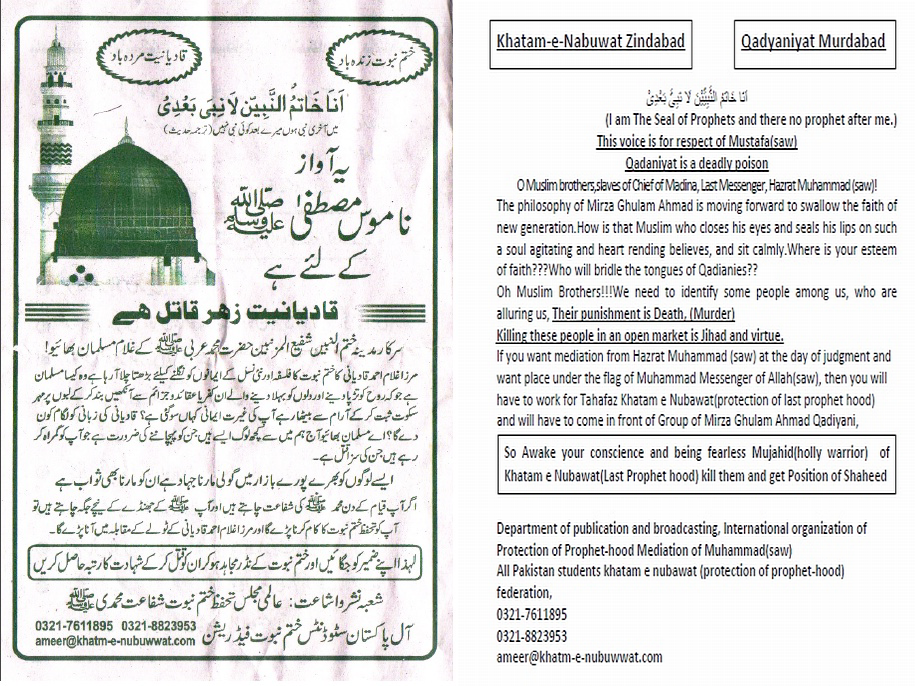
In Jakarta, Islam Defenders Front (FPI) activists staged a rally Tuesday to demand the banning of Ahmadiyah teachings in Indonesia.

Earlier, a number of Islamic organizations and the Indonesian Ulema Council (MUI) in Banten had asked the government to ban Ahmadiyah in the province.

In Makassar, South Sulawesi, the Islam Congregation Forum, which groups 18 Islam organizations, urged the local administration to issue a decree on the Ahmadiyah banning.

The demand was aired in a mass rally in front of the provincial legislative council’s building. They claimed that the dissolution of Ahmadiyah was not negotiable as the sect was considered to have tainted the religion of Islam and had sparked unending conflicts.

— Indra Harsaputra and Andi Hajramurni contributed to this article from Surabaya and Makassar

Copyright © 2008 The Jakarta Post - PT Bina Media Tenggara. All Rights Reserved
URL: www.thejakartapost.com/news/2011/03/02/banning...yenny.html

RI seeks to redefine freedom amid rising religious violence

NATIONAL
Wed, 03/02/2011
12:22 PM
RI seeks to redefine freedom amid rising religious violence
Bagus B.T. Saragih, The Jakarta Post, Jakarta
God have mercy: A group of Ahmadiyah followers in Yogyakarta conduct a prayer on Tuesday after recent bans issued by several regional leaders across the country. The Yogyakarta chapter of Ahmadiyah has halted its public activities. -JP/Slamet Susanto
As local administrations move to ban Ahmadiyah, the government is in a dilemma revolving around “liberty versus order” as it responds to calls to disband the notorious Islam Defenders Front, known as the FPI.

Following the mob incident that killed three Ahmadis in Banten and the burning of three churches in Central Java last month, President Susilo Bambang Yudhoyono ordered his ministers to seek legal measures to disband groups frequently involved in acts of violence.

Some believed he was likely referring to groups such as the FPI. But the order has proved to be no easy task.

The Home Ministry, which is endowed with the authority to outlaw an organization, said the freedom to form a union or organization was guaranteed by the 1945 Constitution. This, ministry spokesman Reydonnyzar Moenek told The Jakarta Post, meant the government was in a dilemma.

As of 2010, more than 9,000 mass organizations were registered with the ministry. It has never banned a single one since the issuance of the mass organization law in 1985, which granted it authority.

Home Minister Gamawan Fauzi, a politician from President Yudhoyono’s Democratic Party, denied he had ignored the President’s order, saying he was only cautious not to use the authority recklessly in fear of violating the Constitution. “We are now studying the facts of the incidents,” he claimed.

The minister argued that the procedures to disband mass organizations under the existing regulation were complex. “The 1985 Mass Organization Law is too old and is no longer relevant to the country’s current situation,” he said, adding that his ministry was finalizing the revision draft of the law, which will be submitted to the House of Representatives for deliberation this year.

A 1986 government regulation outlining the ministry’s authority to disband mass organizations stipulates the government at central and regional levels can freeze a mass organization that disrupts national security and public order, receives foreign aid without the central government’s permission and helps foreign parties that jeopardize national interests.

The regulation also stipulates that the ministry ask for considerations from the Supreme Court on whether a certain group be frozen. A frozen organization shall be disbanded if found to continue the illicit acts for three months after receiving warning letters from the government.

Despite its violent acts over the past few years, the ministry said it had not yet found evidence that the FPI had broken the 1985 law.

While legal matters are hindering the government from taking stern action against the militant group, local administrations are facing no difficulties in finding reasons to ban Ahmadiyah, a minority group deemed heretical by the country’s mainstream Muslims.

Last week, Samarinda Mayor Syaharie Jaang in East Kalimantan froze the local chapter of Ahmadiyah after dozens of FPI members rallied in front of his office a few days earlier. The hardline group gave Syaharie a week’s deadline to disband the local chapter of the Islamic sect, saying if it failed to do so it would do it themselves.

The mayor reportedly granted the FPI’s demand because he considered Ahmadiyah “a time-bomb that could trigger violence”.

In another instance, East Java Governor Soekarwo issued a decree banning Ahmadis from conducting any kind of activity on Monday, only days after 32 Islamic organizations announced a plan to carry out a mass rally in the provincial capital of Surabaya to demand the administration outlaw Ahmadiyah in the province.

Activists have questioned whether democracy is the actual reason behind the government’s reluctance to disband the FPI.

Indonesian Legal Aid Foundation (YLBHI) chairwoman Erna Ratnaningsih said Timur had a long history of hobnobbing with hardliners since he was West Java Police chief in 2008. Along with Jakarta Governor Fauzi Bowo, Timur attended the FPI’s 12th anniversary celebration at the organization’s headquarters in Jakarta, she said. Last month, she added, Gamawan also met with FPI leader Rizieq Shihab to seek advice over Ahmadiyah.

But disbanding mass organizations, some have argued, might not be the answer to end religious violence. Imam Prasodjo, a sociologist from the University of Indonesia, for instance, said violent acts were also caused by cultural aspects that were difficult to manage. “Disbandment of those groups will not automatically reduce violence. Group members will continue [committing violence] as long as cultural problems exist,” he said referring to the stigma against Ahmadiyah.

MASS ORGANIZATIONS INVOLVED IN VIOLENT ACTS

Copyright © 2008 The Jakarta Post - PT Bina Media Tenggara. All Rights Reserved
URL: www.thejakartapost.com/news/2011/03/02/ri...violence.html

Monday, January 24, 2011

Extremist Intimidation Chills Pakistan Secular Society

National Public Radio, USA
Extremist Intimidation Chills Pakistan Secular Society
by Julie McCarthy
 Listen to the Story or Download. 07:46

Pakistani police guards carry the coffin of the assassinated governor of Punjab, Salman Taseer, during the funeral procession in Lahore on Jan. 5. - Arif Ali/AFP/Getty Images
January 24, 2011

In Pakistan, a battle has been joined by those who want a tolerant Islamic state against those who want a fundamentalist religious regime.

The killing in Pakistan earlier this month of Punjab Gov. Salman Taseer has cheered the religious right while chilling secular Pakistanis and exposing deep fissures in the society.

The governor was gunned down in Islamabad by a bodyguard angered at his bid to relax the country’s blasphemy laws. The assassination of Taseer, an audacious advocate for modernism, revealed the conservative attitudes about Islam that are sweeping through Pakistan.

A Growing Rift

A growing and dangerous dichotomy is evident in the Old City of Lahore that teems with shop owners and vendors. Outdoor stalls sit cheek by jowl in the city of 6 million.

In the aftermath of the governor’s killing, Zafar Iqbol, 65, who owns a fabric shop in the Mehood Cloth Market, says he “fears for the future.”

“We feel utterly helpless,” he says. “The market here is under the dominion of elements who have affiliations with religious parties. They come along and they insist that we shut things down, and of course we’re afraid not to, so we do close things down and we lose our business.”

A few of the men who run the market traders association hoist themselves onto the counter of Iqbol’s stall and lean in to listen, causing the owner obvious discomfort.

Members of the Association to Protect the Dignity of the Holy Prophet, or Tahafuz-e-Namwoos Risalat, join the Sunni Itehad Council in a protest march to denounce the Pope. The Vatican called for the abolition of Pakistan's blasphemy laws after a Christian woman accused of blaspheming the Prophet Muhammad was sentenced to death. - Julie McCarthy/NPR
While Iqbol mourns the loss of the governor, his unannounced visitors feel anything but sorrow. Mohammad Ilyas, the vice president of the traders association, says the slain governor maligned Islam when he said Pakistan’s strict laws on blasphemy had become a tool to oppress religious minorities.

“It was totally wrong on the part of the governor to say that the blasphemy laws of Pakistan should be changed. The governor not only criticized the law of the land, but he went out of his way to protect Asia Bibi,” a Christian woman who was sentenced to death last year on the charge of blaspheming the Prophet Muhammad.

When asked whether Taseer deserved to die, Ilyas, 65, says, “Definitely, because he interfered with the religion of this country. If he hadn’t interfered, he would not have been killed.”

Making An Assassin A Hero

Banners draped in the streets of the Punjab capital, Lahore, call the governor’s confessed killer, Mumtaz Qadri, a hero. The 23-year-old police commando assigned to guard the governor said Taseer was an apostate for opposing Pakistan’s blasphemy law.

Evidence that fundamentalism is becoming mainstream was found in the young lawyers who showered the assassin with rose petals as he entered court in Islamabad one day after the shooting. It signaled that religious fundamentalism was not the purview of the poor Pakistani masses but reaches far into the educated class as well.

Demonstrations saluting Qadri have continued throughout the country, a disturbing signal for Washington, which is hoping for greater stability from its nuclear armed ally.

Supreme Court Bar Association President Asma Jahangir says each time democracy begins to take hold in Pakistan, the extreme right wages an offensive that is more lethal than the one before.

“And there is a reason behind it. They do not want a democratic dispensation here. It doesn’t suit them. They don’t figure in there. They get marginalized there. So the murder of the governor was a part of that larger plan as well,” she says.

Parliamentarian Sherry Rehman also is facing death threats for proposing amendments to the blasphemy law, as had the governor. Rehman says “sane” voices have been silenced.

Historian Mubarak Ali estimates that the religious right now makes up some 30 percent of Pakistani society and says radical clerics have been emboldened by the mainstream parties, including President Asif Ali Zardari's Pakistan Peoples Party. - Julie McCarthy/NPR
“And none of them are seeking to offend sensibilities of any religion, let alone Muslims themselves,” she says.

Rehman’s Pakistan Peoples Party, the party of President Asif Ali Zardari, has disowned any reform of the blasphemy laws and has been conspicuously quiet amid the uproar. Historian Mubarak Ali says all of the mainstream parties have emboldened the religious right by kowtowing to the radical clerics who are roiling the streets.

“Instead of fighting, instead of challenging — they just surrendered,” he says. “And now these clerics, they are so powerful, they are so bold, that now they are threatening everybody.”

‘No Other Alternative’

Farid Piracha, the deputy secretary general of Jamaat-e-Islami, Pakistan’s largest religious party, says “if there [were] justice in Pakistan,” there would be no eruptions on the streets.

The party’s Islamic revivalist message has pushed Pakistan toward conservatism while preaching the dangers of a perceived U.S. war on Islam.

The radical right is gathering strength in Pakistan conflating religious dogma with the policies of the United States. Piracha says they cannot be separated.

“There is damage of more than 30,000 innocent people during the so-called war against terrorism. So, one cannot believe that America is not against Islam. America’s total military actions are against the Muslim states,” he says.

U.S. drone attacks and the war in Afghanistan have provoked a popular outcry among Pakistanis, which radical Islamists exploit. Historian Ali says extremists have expanded their constituency by emerging as the only alternative voice in a country where millions feel under threat by everything from the faltering economy to the lack of security.

“They say that dictatorships didn’t give them anything. Democracy didn’t give them anything,” he says. “So, they are exhorted that Islam is going to solve their problems, give them dignity in the society and rule of law. Because there is no other alternative, they believed it.”

The extremists also benefit from the legacy of Zia al Haq, the 1980s dictator who undertook the Islamization of the schools that indoctrinated a generation in religious orthodoxy.

“As a result of this education,” Ali says, “they have very closed minds.”

Speaking Out

As religious passions stifle liberal voices, one group refuses to be repressed — the Ajoka Theater.

Ajoka Theater founder Madeeha Guahar on stage following a performance in Islamabad of a play about blasphemy. In the antisecular atmosphere following the Punjab governor's assassination, the staging of the play is a rare example of secular society standing up against the intimidation of religious extremists. - Julie McCarthy/NPR
Ajoka Theater founder Madeeha Guahar on stage following a performance in Islamabad of a play about blasphemy. In the antisecular atmosphere following the Punjab governor’s assassination, the staging of the play is a rare example of secular society standing up against the intimidation of religious extremists. - Julie McCarthy/NPR
It’s been in the forefront of the struggle for a secular democratic Pakistan. This past week, it staged a disturbing production about blasphemy and dedicated it to the slain governor.

It’s a study in brutality, with white-robed clerics in league with black-clad followers haranguing their victims as they hang them.

“That this play was shown in Islamabad is an act of courage,” says audience member Pervez Hoodbhoy, a physicist and essayist. “This is a country that stands at the very verge of religious fascism.”

Hoodbhoy says he fears for the theater company.

“I don’t know when they might be targeted,” he says.

The theater founder and director of the play, Madeeha Guahar, says Ajoka will continue performing and take the risk.

Sunday, January 23, 2011

26 shots that sent Pakistan over the edge

The Washington Post
washingtonpost.com > Print Edition > Sunday Outlook
26 shots that sent Pakistan over the edge
Pamela Constable
Washington Post Staff Writer
Sunday, January 23, 2011
Demonstrators rallied this month in Islamabad after Pope Benedict XVI called for Pakistan to get rid of its blasphemy law. (Photos By Muhammed Muheisen)
ISLAMABAD, PAKISTAN has reported from South Asia for more than a decade

At a fashionable plaza in this serene Pakistani capital, a few dozen people gather in the evenings at the spot where provincial governor Salman Taseer was gunned down on Jan. 4. More than the man, their candlelight vigils mourn the open debate and religious compassion that have been lost with the assassination of the outspoken liberal politician.

Fifteen miles away, in a working-class alley of Rawalpindi, thousands of people flock each day to the home of Mumtaz Qadri, the elite police guard who killed Taseer. Qadri is in jail now, but the site has become a shrine to what many Pakistanis see as his heroic act against a blasphemer who insulted their prophet. Someone has even put up posters of Qadri riding a white horse to heaven.

In the days since Taseer’s death, Pakistan has become a different country. The veneer of Western democracy has been ripped away, the liberal elite has been cowed into silence, and the civilian government has beaten a hasty retreat from morality, authority and law. Islamic extremist groups, once dismissed as unable to win more than a few seats in Parliament, are filling the streets, with bearded acolytes waving flags and chanting like giddy crowds at a post-game victory rally.

Suddenly, a crucial U.S. ally in the fight against terrorism seems incapable of stopping a tide of intolerant and violent Islam at home - raising doubts about Pakistan’s ability to play a constructive role in the war against the Taliban or to help the United States extricate its forces from Afghanistan, Pakistan’s northern neighbor.

Qadri, who happily confessed to murdering the politician he was assigned to protect, has little chance of being convicted. Instead of suffering ostracism, he was greeted with handshakes and garlands by courthouse lawyers, who offered to defend him pro bono. The provincial court system, notorious for freeing radical Islamic leaders, is unlikely to condemn a national religious hero.

“There is no justice in our country for the common man, but Qadri’s act against a blasphemer has made all Muslims feel stronger,” a shopkeeper in Rawalpindi told me. “They can punish him, but what will they do with a million Qadris who have been born now?”

Prime Minister Yousaf Raza Gillani, whose ruling coalition recently recovered from near-collapse, has reassured the restive Muslim masses that not a word of Pakistan’s blasphemy law will be changed. One of the harshest such statutes in the Muslim world, it makes any purported slur against the prophet Muhammad - even a misinterpreted remark or a discarded Koran - grounds for execution.

Taseer had proposed softening the law. Another legislator who did the same has received death threats. The police, whose ranks produced the killer, seem duped or complicit. The army, caught between fighting the Taliban and courting public opinion, has remained prudently silent.

Pakistani commentators have expressed shock at the public lionization of Qadri and the demonization of Taseer, who did nothing worse than criticize the blasphemy law and commiserate with a Christian peasant woman who was sentenced to death under it. The atmosphere is so charged now that most clerics refused to officiate at Taseer’s funeral, and the Christian woman’s prison warden said he may not be able to protect her even from the guards.

For the past several years, a few voices have warned against the growth of religious hatred in Pakistan. Columnist Kamila Hyat described a “Talibanization of minds” creeping across the country, emboldening extremist groups and censoring debate. Physicist and activist Pervez Hoodbhuy decried the quashing of critical thought in Pakistani schools and the rote Koranic learning that shapes many young minds.

But in Friday sermons and at many levels of Pakistani society, one hears warnings about creeping Westernization, secular culture and forceful aggression against Islam by America and its allies. When Pope Benedict XVI called for a repeal of Pakistan’s blasphemy law this month, some Muslim clerics decried it as part of the foreign conspiracy and said the pope was inviting attacks on minority Christians in Pakistan.

Some observers here say it is unfair to tar millions of Pakistani Muslims as extremists just because they feel strongly enough about the sacred nature of the prophet Muhammad to justify killing someone who insults him. What is needed, they say, is stronger national leaders who will uphold the laws - against blasphemy and murder alike. “This is an Islamic republic, and people feel very strongly about the blasphemy issue,” said Hamid Mir, a leading television journalist here. “We have to respect that, but we also have to respect the law and the constitution, or we will be lost.”

Others argue that a mind-set that finds spiritual justification for shooting a government official 26 times will also accept the public flogging of drunks, the beheading of policemen and the stoning of unmarried lovers - all hallmarks of the Taliban forces that swept through Pakistan’s scenic Swat Valley two years ago.

Pakistan’s army, a close partner of the U.S. military, ultimately drove the Taliban out of Swat after cementing public opinion in its favor. Now Washington is prodding army leaders here to extend their campaign to other insurgent-infested tribal areas.

But public opinion in Pakistan today is not what it was a year ago, and no one wants to risk igniting popular wrath. Not the nuclear-armed security establishment, which still sees Islamic militants as a useful tool to harass arch-rival India. Not the weak, unpopular government, saddled by a secular past and still reeling from the slaying of its most charismatic leader, Benazir Bhutto, three years ago.

In recent days I have listened to Islamic activists rant about the sanctity of the prophet and the evil of those who offend him or dare to question any tents of Islam. They even have a label for such dangerous subversives, which translates roughly as “ought to be killed.”

But there is one conversation that haunts me in particular, an encounter I had with a young man on a flight between Islamabad and Karachi. He was neatly dressed and beardless, a recent science graduate on his way to a job interview. As I read through the morning papers and discarded them on the floor, I noticed him squirming.

“Madam, could you please pick up the papers?” he finally said. “The name of our prophet is on the front page, and it must not be on the ground.”

I complied, and we spoke cordially about our respective religions. But when I asked about Taseer’s murder, his tone changed. “They say he blasphemed against our prophet,” the young man said solemnly. “If this is true, then it would be my duty as a Muslim to kill him, too.”

Pamela Constable, a Washington Post foreign correspondent, is the author of the forthcoming “Playing With Fire: Why Pakistan’s Democracy Is Losing Ground to Islamic Extremists.”

©2011 The Washington Post Company
URL: www.washingtonpost.com/wp-dyn/.../AR2011012300278.html
 
^ Top of Page