Showing posts with label west lombok. Show all posts

Tuesday, December 20, 2011

W. Java the ‘least tolerant province’

Jakarta Post, Indonesia
NATIONALTue, 12/20/2011 11:25 PM
W. Java the ‘least tolerant province’
The Jakarta Post, Jakarta
A survey by human rights watchdog Setara Institute has found that West Java was the least tolerant province in 2011, registering the largest number of religious violence cases.

Throughout 2011, West Java saw 57 incidents involving government-endorsed discriminatory policies, instances in which government officials condoned acts of violence against minority groups, the closure of places of worship and religiously motivated killings.

In the survey, South Sulawesi ranked second place with 45 incidents, followed by East Java and North Sumatra in the third and fourth position with 31 and 24 incidents, respectively.

Banten, which saw the Cikeusik Ahmadiyah lynching in April, and West Nusa Tenggara were both in fifth position with 12 cases each. Bali and West Kalimantan were found to be the most tolerant provinces.

“This high number of violence and discrimination indicates that the government has done little to mitigate religious acrimony. The numbers remain high compared to last year’s,” Setara Institute chairman Hendardi said Monday.

Hendardi attributed the violence to President Susilo Bambang Yu-dhoyono’s lack of leadership.

“The President is even powerless in the face of opposition from Bogor Mayor Diani Budiarto, who refuses to obey the Supreme Court’s ruling to reopen GKI Yasmin Church and let its members practice their faith freely,” he said.

The survey also found correlation between religious conflicts and the level of urban spread.

“We found that the more urban an area, the more likely religious conflicts will occur,” Setara Institute deputy chairman Bonar Tigor Naipospos said.

The Setara Institute recorded 244 incidents in which religion was cited as the cause.

The survey also found that government officials owned the biggest share of the blame in allowing religious conflict to happen. A total of 105 incidents were initiated by government officials.

Members of the National Police were responsible for 40 cases, the Indonesian Military (TNI) personnel for 22 cases, regents and mayors 18 violations, governors 10 violations and the Religious Affairs Ministry nine violations.

Setara also cited the Islam Defenders Front (FPI) and the Indonesian Ulema Council (MUI) as non-governmental organizations that registered the highest number of discrimination cases.

Setara researcher Ismail Hasani said religious conflicts peaked between February and March, when locals in Cikeusik attacked members of the Ahmadiyah sect.

“Following the incident, two churches were burned down in the same month, which heightened tension between the majority Muslim and minorities groups for the rest of the year,” he said.

Ismail added that the increasing religious conflict could indicate hypocrisy on the part of the government.

“We recorded that the President made at least 19 public statements encouraging religious harmony. However, change could hardly happen in the coming years because those around the President include people from several political parties who oppose religious freedom,” Ismail told The Jakarta Post.

According to the Setara Institute, the Ahmadiyah suffered the worst type of discrimination in 2011.

It recorded 22 policies, including 15 ordinances, issued by local governments that promoted animosity toward the sect. The policies include the Religious Affairs Ministry’s decision to prohibit Ahmadiyah members from performing the haj pilgrimage to Mecca. (msa)

Copyright © 2008 The Jakarta Post - PT Bina Media Tenggara. All Rights Reserved
URL: www.thejakartapost.com/news/...province.html

Monday, December 19, 2011

Bleak prospects for Ahmadis

Jakarta Post, Indonesia
ARCHIPELAGOMon, 12/19/2011 11:50 PM
Bleak prospects for Ahmadis
Panca Nugraha, The Jakarta Post, Mataram

Hopeful eyes: Children pose at an Ahmadiyah shelter in Mataram, Lombok. Members of the religious community have been largely shunned by society, and their future as part of Indonesia’s workforce and as citizens is looking bleak. The 33 families of the community have lived in the shelters since they were evicted from their homes six years ago. JP/Panca Nugraha
The Ahamdiyah community comprises about 140 people and 33 families who have been forced to take shelter in Wisma Transito in Mataram after they were evicted from their homes six years ago.

The outreach program provided by the NTB provincial administration, involving the NTB Agency for Political Affairs and National Unity and a number of clerics, has not been effective, the Ahmadis say, while the West Lombok regency administration has backtracked from its promise to compensate assets they were forced to leave behind in their village.

An early estimation revealed that their assets, comprising 21 houses and land, were valued at Rp 1.4 billion (US$155,000).

“The outreach program, they said, would last for six months from June until December was in fact carried out for only two months. It began early on in the month of Ramadhan and ended just after Idul Fitri,” Nasiruddin, one of the Ahmadis, said recently when interviewed at Wisma Transito.

He is a respected member of the Ahmadiyah community, often playing the role of advisor.

Nasiruddin accused the government of not being serious about resolving their problem.

The condition of the Ahmadiyah refugees in Wisma Transito, which is located around 2 kilometers from the NTB gubernatorial office, has not improved. The community still lives in makeshift quarters made of cloth and used banners.

Two infants were in the community in November, bringing the total number of babies born in the community since they were evicted to 18.

“I gave birth at Mataram General Hospital for free, thanks to the Delivery Assurance program, but we faced difficulties in applying for the Jamkesmas and Jamkesmasda health insurance because we don’t have identity cards,” said Maemunah, 25.

She was carrying her baby, Noval Syaif Irfan, who was born on Nov. 15, while eight pre-school-aged children were cheerfully playing around her.

Ahmadiyah is considered by mainstream Muslims as heretical. Ahmadiyah communities across the country have been persecuted by their fellow Muslims, and in some severe instances have had members seriously injured or killed.

In a number of provinces, local administrations have banned the sect citing security concerns.

Ahmadiyah members in West Lombok say they continue to be persecuted.

Amaq Marsudin, 52, who suffers from kidney failure and requires regular dialysis, was rejected by the NTB General Hospital because he did not have an identity card.

“He was admitted to the hospital for two weeks but did not receive dialysis because he is not covered by Jamkesmasda as he doesn’t have an identity card. Finally, we brought him back to Wisma Transito and he has resigned his fate to God,” Nasiruddin said.

According to Nasiruddin, during the e-ID card campaign program in Mataram in October, the Ahmadiyah refugees tried to apply for ID cards at the Mataram Population Agency.

However, they were turned down on the grounds that they were only temporary residents.

“The West Lombok regency administration also refused to issue us ID cards. Actually, we only requested residence identity permits. It doesn’t matter if we don’t live in West Lombok, but owning an ID card is important for access to healthcare and education programs, especially as an ID card proves citizenship status,” he said.

The Ahmadiyah refugees endure living at the shelter despite that most of the families are in dire financial straits. In general, the men seek a living as construction workers, ojek (motorcycle taxi) drivers, barbers and hawkers.

Sarim Ahmad, 45, for instance, owns a chicken noodle cart now. He had worked for a fritter seller earlier.

“I saved up my salary to make a cart to sell noodles, and the proceeds are not bad,” he said.

The NTB provincial administration had initially promised that the outreach program provide startup capital for the refugees.

However, for Sarin, it was all just talk and no action.

“They promised to provide startup capital, but have failed to do so as of now. Furthermore, we prefer to be independent because the assistance is a loan in nature and we have to pay installments,” he said.

West Lombok spokesman Ispan Junaedi said the administration would never compensate the assets of Ahmadiyah members in Ketapang because funds set aside for that purpose in 2010 and 2011 had not been realized “because the refugees raised the amount”.

Copyright © 2008 The Jakarta Post - PT Bina Media Tenggara. All Rights Reserved
URL: www.thejakartapost.com/news/2011/12/19/bleak-prospects-ahmadis.html

Saturday, August 27, 2011

Idul Fitri Brings Little Cheer to Ahmadi Shelter

Jakarta Globe, Indonesia
NEWS
Idul Fitri Brings Little Cheer to Ahmadi Shelter
Fitri | August 27, 2011

Ahmadiyah families in Transito shelter, Mataram, West Nusa Tenggara.
Mataram, West Nusa Tenggara. Nothing has changed at the Transito shelter in the five and a half years that it has served as home to 138 members of the beleaguered Ahmadiyah Islamic sect.

A sixth successive Idul Fitri in cramped conditions without even the most basic of amenities beckons, with no word on when they will be allowed to return to their home village of Gegerung in West Lombok, from where they were driven out by fellow Muslims in February 2006.

The electricity to the shelter was cut off three years ago, food aid from the government — which has perpetuated their limbo by refusing them the right to return home or register as residents of Mataram — was halted last year, and sanitation facilities are non-existent.

A stipend from the state was stopped in 2007. Not being registered residents, they have been denied the free gas stoves distributed by the government to all citizens, and they now resort to gathering scrap to burn as fuel.

“It’s the durian season now, and people are throwing out lots of durian husks. We’re collecting those to fire our stoves,” says Munikah, one of the shelter’s inhabitants. “We can’t afford to use kerosene because it costs Rp 12,000 [$1.40] a liter.”

The women band together in preparing the predawn and sunset meals during Ramadan, crowding the shelter’s corridor as they toil over smoky stoves. The meals themselves are basic, heavy on starchy ingredients to mask the lack of vegetables or meat. However, they carry on fasting like most other Muslims.

Clothes for the Kids

The rest of the country may be in a festive mood with the approach of Idul Fitri — and its attendant indulgences such as family reunions, hearty meals and the buying of new clothes — but at Transito, it will be just another day of trying to scrape by.

All that Munikah is hoping for before then is that her husband can bring home a little more than the Rp 25,000 per day he typically makes through cutting hair at a nearby market.

“It’d be nice if he got a little something extra for Idul Fitri so we could at least get the kids some new clothes,” she says. “But if that doesn’t happen, they won’t be too disappointed.”

After living so long at the shelter, the Ahmadiyah children have grown more accepting of their situation, says Basir Aziz, a local Ahmadi elder. “There are 50 children here, 16 of whom were born in this shelter,” he says.

“This year they seem a lot more resilient and upbeat. They don’t feel marginalized. They’re showing a tremendous passion to study and practice their faith, despite all they’ve been through.”

The life at the shelter is the only one that 6-year-old Ida knows. Asked if her parents had bought her new clothes for the holiday, she responds with a maturity beyond her years. “I’ve got the clothes from last year. They’re still fine,” she says with a smile.

Nor do they complain about the partially collapsed ceiling in their prayer hall, or the fact that all 33 families here are forced to share crowded living quarters, with only flimsy partitions of cardboard and rags mounted on bamboo frames giving privacy.

No More Tears

“When the kids play, they’re never sad,” says Hairudin, an Ahmadi who earns Rp 5,000 a day as a coolie at the local market.

“They’ve become used to all this after almost six years. We’ve got no more tears. We have to take what we get.”

For Hairudin and the other Ahmadis, sorrow is an emotion they dare not indulge. “If I broke down in sadness just thinking about how we got hounded out of our homes, I wouldn’t be able to go to work each day, and that would be the biggest problem for my family,” he says.

“That’s why we don’t think about that anymore. Tears are a luxury we can’t afford. All we can do now is just think about how to get through each day.”

H. Mahmulludin, an Ahmadi elder, agrees there is no use being bitter about the past.

He bears no grudge against the local authorities, who last year raised the ire of human rights activists with a plan to exile all Ahmadis in West Lombok to a remote island and bar them from plans to develop the region as a top tourist draw.

“The governor has resolved all the differences between us in a peaceful manner,” he says. “The violence against us has stopped, and that helps a lot.”

What also helps, Mahmulludin says, is a weekly stipend from local community leaders.

But that pales in comparison to what they would have received if the government had agreed to compensate them for the homes they left behind in Gegerung.

In what activists have highlighted as just another example of discrimination against the Ahmadis, they have been denied compensation or the option of selling their homes, even as the government bars them from going back to inhabit them.

Continuing Pogrom

Despite this, there have been several attempts by some of the Ahmadis to return and farm their land while keeping a low profile. However, they have been routinely chased out by other villagers, who have branded them “a stain on this village” that “must be cleaned out.”

In the most recent incident, last November, local authorities themselves led the pogrom of the Ahmadis, forcing men, women and children to flee with their belongings.

Those who remained behind had their homes burned by a mob, while others vowed to keep coming back to farm their land.

“If I farm, at least I’m making a living, whereas at Transito I have no hope for a meaningful life,” said Sarim, one of the Ahmadis targeted last November.

Nobody was prosecuted for the attack, and the local administration did not compensate for losses, which the victims estimated at Rp 735 million.

For Munikah and the other mothers forced to watch their children grow up in what has become a refugee camp, the hope that there will ever be a resolution to the community’s plight and that they may one day return to their homes has dwindled along with the sadness.

All that remains, Munikah says, is a sense of resignation and just an iota of optimism that maybe — just maybe — Idul Fitri this year will herald a change for the better.

Copyright 2010 The Jakarta Globe
URL: www.thejakartaglobe.com/news/idul-fitri.../462042

Thursday, January 27, 2011

Rally Rages Outside Bogor Court Trial on Ahmadiyah Village Attack

Jakarta Globe, Indonesia
NEWS
Rally Rages Outside Bogor Court Trial on Ahmadiyah Village Attack
Elisabeth Oktofani | January 27, 2011

Bogor. Over 1,000 Muslim hard-liners surrounded a district court in Bogor on Wednesday, demanding the immediate release of three youths standing trial for an attack on an Ahmadiyah community last year.

Dede Novi, 18, Aldi Afriansyah, 23, and Akbar Ramanda, 17, are accused of destroying property and inciting violence during an October riot in Cisalada village, according to indictment documents.

The three were said to be part of a mob that burned down houses, schools and a mosque at the Bogor village, home to 600 members of the Ahmadiyah, a minority Islamic sect deemed deviant by mainstream Muslims for their different beliefs on the Prophet Muhammad.

The crowds that came out in support of the defendants on Wednesday, however, slammed these accusations.

Though police had barred them from entering the courtroom, the protesters reportedly “became incensed” when the defendants’ lawyer told them about a witness who said Dede had set the At-Taufiq Mosque and an Ahmadiyah Koran on fire.

Ari Saputra, a resident in Cisalada, testified on Wednesday that Dede could have thrown a Molotov cocktail at the mosque.

“I cannot be sure that he really was the one who threw the Molotov cocktail, but I saw that he was part of the group,” Ari told the court, led by Judge Astriwati.

Dede, however, denied throwing the fire bomb, but admitted at the hearing that he was part of the group which set the village mosque on fire.

A second witness, Mubarik Ahmad, a Cisalada resident and an Ahmadi, said he saw the three defendants break into and torch the mosque.

“I saw them. They were among hundreds who came to our village that night and attacked. They were brutal,” Mubarik said. “They threw stones at the mosque, broke its windows and set it on fire. Others came on motorbikes and made noises with their horns.

“They burned and destroyed so much property in our village,” he added. “That evening, our only concern was how to stay alive.”

After being informed of Mubarik’s statements, the angry crowds outside the courtroom began to yell out that the witness was a liar.

Protesters also tried to attack Mubarik as he left the courtroom under tight police guard.

Amid Wednesday’s unrest, hundreds of security personnel were deployed to Cisalada and the Cibinong District Court, where the trial was held.

The three defendants are accused of violating the Criminal Code, particularly Article 406 on the destruction of property and Article 170 on assault.

Article 406 carries a maximum sentence of two years and eight months in jail, while Article 170 carries a punishment of up to five years and six months.

Agus Sulaiman, one of the protesters, said the people of Bogor would “never accept the presence of the Ahmadiyah.”

“What is worse is that they built an Ahmadiyah information center in our village,” said Agus, a resident of Ciampea subdistrict.

“If they don’t stop this, we will stop them. We will burn their properties,” he said. “They call themselves followers of Islam. This is what we cannot accept.”

Agus said many conservative Muslims in the area detested the sect for believing that Ahmadiyah founder Mirza Gulam Ahmad was the last prophet.

This runs counter to mainstream Islamic beliefs which reserve that distinction for the Prophet Muhammad.

Copyright 2010 The Jakarta Globe
URL: www.thejakartaglobe.com/home/rally-rages...attack/419272

Crowd bullies Ahmadi at trial, disrupts courtroom

HEADLINES
Thu, 01/27/2011
11:02 AM
Crowd bullies Ahmadi at trial, disrupts courtroom
Hans David Tampubolon, The Jakarta Post, Jakarta
An elderly man was harassed by a rowdy mob on Wednesday as he testified in court about the destruction the property of Ahmadiyah followers in Ciampea, Bogor.

Mubarik Ahmadari came to the Cibinong District Court in Bogor on Wednesday to testify about the attack against his fellow Ahmadiyah members in October.

The 70-year-old man was greeted by more than 1,000 anti-Ahmadiyah protesters. Members of the crowd claimed to be residents of Ciampea who came to support the alleged arsonists on trial: Dede Novi, Aldi and Akbar.

The protesters jammed the courtroom. Many had to stand outside. Throughout the trial, unruly protesters in the courtroom were heard yelling, demanding that the judges drop all charges against the suspects and that the government disband Ahmadiyah.

Despite the clamor, Mubarik remained calm and told the court a version of events that was vociferously rejected by onlookers. He seemed unfazed by the constant din of mockery and hate-filled comments directed at him.

However, even after giving his testimony, Mubarik found that his day was not over yet.

As Mubarik finished his testimony he went to exit the courtroom. Protesters blocked his path. Some stood at the doors. Others tried to grab him.

Police officers were there to protect the witness from what looked to be a potential savage beating at the angry rabble’s hands. After a brief scuffle, officers safely escorted Mubarik out of the courtroom.

Mubarik was one of four witnesses heard in Wednesday’s court session.

Around 20 people attacked Cisalada village in Ciampea in October, vandalizing and setting fire to the community’s mosque and the homes and vehicles of Ahmadiyah followers.

Hendardi, a human rights activist from the Setara Institute, said what happened to Mubarik was evidence that intolerance had become a dangerous disease in Indonesia.

“The fact that a man could be terrorized at a court of law is a horrific occurrence in the life of our nation,” Hendardi told The Jakarta Post over the telephone on Wednesday.

“This shows how the state is completely helpless in ensuring the basic human rights of its citizens,” he added.

Hendardi said that if the state continued to fail to impose strict punishment on violent fundamentalists, then violent acts, such as the those perpetrated on Mubarik and other Ahmadiyah followers, would continue.

Followers of Ahmadiyah have come under attack in recent years from Islamic hardliners who believe that the sect follows a heretical version Islam.

While the earliest recorded attacks against Ahmadis date to the early 1950s, it was not until 2005 that violence intensified dramatically.

In 2010 alone there were 10 recorded attacks against Ahmadis throughout the archipelago.

The government drew criticism from human rights activists for symbolically condoning violence against Ahmadis after Religious Affairs Minister Suryadharma Ali said that it would be better if the Ahmadiyah sect was “disbanded”. Suryadharma is also the chairman of the United Development Party (PPP), an Islamic-based political party.

Monday, January 17, 2011

MUI fatwa feeds flames of clerics’ hate speech

SPECIAL REPORT
Mon, 01/17/2011
10:10 AM
MUI fatwa feeds flames of clerics’ hate speech
The Jakarta Post
The animosity faced by followers of Ahmadiyah in Ketapang hamlet in West Lombok, West Nusa Tenggara, peaked on Oct. 19, 2005, a few months after the Indonesian Ulema Council (MUI) issued a second fatwa against the nation’s most persecuted religious minority.

Local resident Zulkhair Mujib vividly recalls the day.

He said local firebrand cleric Izzi Muslim, speaking at a mosque through a loudspeaker, called for the expulsion of the 130 Ahmadis in the hamlet.

“Ahmadiyah is a deviant and deviating faith. I tell you, if the residents of Ketapang don’t banish the Ahmadis, I will ask people in Central Lombok to do so,” Zulkhair quoted Izzi as preaching.

“If the people in Ketapang do not join us in attacking the Ahmadis, I will burn their houses,” Izzi continued.

The hate speech led to the first attack on Ahmadis in Ketapang, but failed to drive them out of the village.

Zulkhair said people became angry because of the failure, with Izzi strengthening his vow to continue efforts to expel the Ahmadis.

On Feb. 4, 2006, locals made another attempt to drive the Ahmadis out. This time, they succeeded.

Dozens of Ahmadi families now have no other option than to live in a refugee camp in Mataram, probably for the rest of their lives.

The MUI has repeatedly brushed off allegations that its irresponsible and controversial fatwa triggered the attacks on the Ahmadiyah followers.

Analysts said several clerics were actively spreading hate speech, using the MUI fatwa as a platform to vilify Ahmadiyah.

On July 28, 2005, at its seventh national congress in Jakarta, the MUI reiterated a 1980 fatwa that said Ahmadiyah strayed from Koranic teaching and ordered the government to outlaw the group.

The point of contention between the MUI and the Ahmadis, the MUI claims, centered around the refusal of Ahmadis to acknowledge Muhammad as the last prophet of Islam.

The MUI said the debacle would end if Ahmadis formed their own religion by ridding themselves of all pretensions to Islam.

“The government is obliged to ban the spread of Ahmadiyah across Indonesia, disband the organization and outlaw its activities,” the fatwa signed by then MUI chairman Umar Shihab and secretary Din Syamsuddin (now chairman of Muhammadiyah, the nation’s second-largest Muslim organization after the Nahdlatul Ulama), read.

Muhammadiyah is widely seen as the voice of moderate Islam.

The MUI fatwa was issued at a time of growing pressure from hard-line Muslim groups who wanted the MUI — which consists of representatives from major mainstream Muslim groups in the country — to take a firmer stance on the issue.

Zukhair said that only weeks after the MUI edict was issued, religious congregations in West Lombok were becoming increasingly critical of Ahmadiyah, fomenting hatred against the Ahmadis among the general public.

Izzi confirmed he had made harsh speeches about the Ahmadis, but said he was only citing the MUI fatwa in his rhetoric. He said he was convinced Ahmadis were heretical and had no place in Indonesia.

“The people cannot accept Ahmadiyah. We can accept Hindus and Christians because they do not blaspheme against Islam,” he said.

“If you ask me whether Islam condones violence toward the Ahmadis, let me ask you this: Are others allowed to commit blasphemy against Islam?”

A report issued by the National Commission for Human Rights (Komnas HAM) in 2006 indicated systematic efforts to spread anti-Ahmadiyah sentiment.

The report said religious justifications, such as the fatwa, were used as a pretext to persecute Ahmadiyah.

Subki Sasaki, a Muslim cleric from Central Lombok, said hatred among locals could be prevented if clerics distanced themselves from the language of hate.

He said locals could coexist despite religious differences, citing the existence of Islam Sasak or Wetu Telu followers, whose faith also differs from mainstream Islam.

“People are susceptible to indoctrination by religious leaders. When the fatwa was issued, religious leaders conveyed the fatwa to a subservient public. So when people are incited to attack, they will.”

— Additional reporting by Panca Nugrah
— JP/Arghea Desafti Hapsari

Anti-Ahmadi pogrom alive and well

SPECIAL REPORT
Mon, 01/17/2011
9:17 AM
Anti-Ahmadi pogrom alive and well
The Jakarta Post
For decades, the violence against the followers of the Ahmadiyah sect has continued without an end in sight. The Jakarta Post’s Arghea Desafti Hapsari explores the root causes of the violence by visiting several Ahamdiyah enclaves in the archipelago. Here are the stories:

Aftermath: Two members of the police mobile brigade guard houses ransacked by a mob in an Ahmadiyah community center in the Ciampea subdistrict of Bogor, West Java, in this photo taken on Oct. 1, 2010. Non-assimilation into the community by some members of the Ahmadiyah Islamic sect has been cited as among the triggers for the attacks by mainstream Islamic mobs. JP/Theresia Sufa
Empty barren houses sit with their windows shattered and walls half torn down while a yellow police line encircles the fence, warning off those who would trespass.

The houses are separated by a dirt road running a few hundreds meters from other houses in Ketapang hamlet in Gegerung village, West Lombok, West Nusa Tenggara.

Every once in a while the owners return from a refugee shelter in the provincial capital Mataram — where they have taken shelter since 2006 — to tend to their farms and guard what is left of their homes.

The ransacked houses are among the countless witnesses to the unfolding tragedy of the endless persecution of the Ahmadiyah faith and its 200,000 followers across the archipelago.

While early incidents of violence against the Ahmadis by mainstream Islamic hardliners — who insist Ahmadiyah is heretical — date back to the early 1950s, it was not until 2005 that the hostility intensified dramatically. In 2010 alone, there were at least 10 recorded attacks against the minority sect.

While the Ahmadis identify themselves as Muslims and follow the Koran, they believe Mirza Ghulam Ahmad, who founded the sect in 1889, was a prophet and also the messiah. This goes against the belief of mainstream Muslims who insist Muhammad was the last prophet.

But the root causes of violence may not be limited to differences in theological interpretation, a claim regularly spouted by hardliners.

Allegations that Ahmadis tend not to assimilate into the general population have also played a great role in fuelling mainstream resentment against them.

The locals in a hamlet in Pancor village, East Lombok, West Nusa Tenggara, recounted how the Ahmadis set themselves apart from the other villagers.

The hamlet was the scene of several attacks on the Ahmadis in 2002 that forced 83 Ahmadi families to flee their houses and take refuge in Mataram.

“That’s where the houses of the Ahmadis were,” Fitri, a resident of Kampung Baru Baluo, a hamlet in the heart of Pancor, points out to plots run over by wild bushes hiding the stone foundations that were once houses.

The abandoned land is located close to the hamlet perimeter.

“They built a cluster of houses there. When they had new members, they would buy them plots of land nearby to build houses,” Fitri said.

“The locals knew them of course. After all, we were neighbors long before the attacks.”

Another local, speaking on condition of anonymity, said the locals were never really close to the Ahmadis as the latter were viewed as being different.

She said the Ahmadis never visited other residents in the hamlet.

“In turn we never visited them as well,” she said, adding that residents’ interactions with the Ahmadis were limited to the marketplace.

Similar stories were also shared by Gegerung village residents, who forced local Ahmadis out of their homes in Ketapang hamlet in 2006 due to allegations that they did not want to assimilate.

In November last year, Ahmadis planned to return to Ketapang only to be evicted again at the request of Gegerung residents, despite exhortations by Ketapang hamlet leader Muntahar that the Ahmadis did get along with other residents.

He recounted a time when Ahmadis helped other villagers build the village mosque.

“They even contributed money for the construction,” he said. “However, the money was returned once the locals found out about the difference in doctrines.”

Allegations of non-assimilation have also plagued Ahmadis in Parung, Bogor, where the sect built a 15-hectare compound to house followers.

An attack in July 2005 by hardliners was vigorously supported by locals.

While Jakarta has one of the largest Ahmadiyah communities in the country, the movement has faced little violence in the city as most Ahmadis get along well with neighbors.

A recent attack on an Ahmadiyah mosque in Kebayoran Lama, South Jakarta, launched by outsiders was condemned by locals, who said the Ahmadis contributed much to the community.

“It’s obvious that if Ahmadis can get along with others, there is a reduced risk of their facing hostilities,” Syarif Hidayatullah Islamic University sociologist Musni Umar said.

“In some cases, violence against the Ahmadis is triggered by their way of living, which is exclusive.”

Musni urged Ahmadis to be more active in advocating dialogue and openness with their neighbors so more people would understand that theological differences would not be a point of resentment.

Some Ahmadi communities have begun to make the effort to be more open.

Nurrahim, the secretary-general of the Ahmadiyah community in Manislor village in Kuningan, West Java, said Ahmadiyah was an Islamic organization that upheld the virtue of sacrifice.

“We believe the more we give, the more we receive in return,” he added.

All adherents to the faith commit to allotting 1/16 to 1/10 of their monthly income to the organization, in addition to an annual contribution.

The money is held by the Ahmadiyah center in Jakarta, which disburses the money back to the congregations to finance activities such as charities and other social programs.

Nurrahim said the money was never disbursed to Ahmadiyah members personally. The Ahmadis also refute allegations that they refuse to assimilate.

“We live alongside and with people of other faiths,” said Nur Hidayati, an Ahmadi from Pancor, who was forced to flee her home after the 2002 attacks.

Ahmadiyah spokesman Zafrullah Pontoh said Ahmadis never prohibited others from praying in their mosques and vice versa.

“Our mosque on Jl. Balikpapan [in Central Jakarta] is open to anyone. People in the neighborhood can perform Friday prayer there. So reasoning that we are being attacked because we refuse to assimilate is just unfounded.”

In some cases, attacks on Ahmadiyah have been incited by hardliners living outside the community.

Ahmadis in Cisalada hamlet in Ciampea Udik village in Bogor, West Java, had no problems with locals until the 2005 attacks in Parung — 10 miles from the village — changed everything.

A resident from a neighboring hamlet, Gaos Hanafi, recalled how in the 1970s people from his hamlet would come to Cisalada, where all 700 residents were Ahmadis, to play soccer.

“We were very close back then. I even had relatives there. The Ahmadis and other villagers used to have an open debate about Islam but there was never any violence.”

But the Parung incident stirred resentment that peaked in 2007 when hundreds of people gathered to stage a protest against the renovation of an Ahmadiyah mosque in Cisalada.

Another protest against the mosque and other properties owned by Ahmadis in the hamlet took place in July 2010. Three months later, violence erupted as assailants set fire to five houses, a car and two motorcycles owned by Ahmadis.

Critics rightly alleged that provocation by policymakers and mainstream clerics fuelled the hostility.

Last year Religious Affairs Minister Suryadharma Ali insisted that Ahmadiyah was a heretical sect and “must be disbanded immediately” as its doctrine violated tenets of Islam — a pronouncement that intensified the pogrom against the sect.

Suryadharma claimed he was only reinforcing a fatwa first issued in 1980 by the Indonesian Ulema Council (MUI) and another in 2005.

In 2008, a joint ministerial decree was issued to ban Ahmadiyah from propagating its teachings.

The fatwa and the decree cited theological differences between Ahmadiyah and mainstream Islam in outlawing the sect.

“The violence has been going on for decades and is likely to continue this year. Hostility is just not the answer,” Musni said.

“It’s time for policymakers and clerics to initiate dialogue with the Ahmadis instead of perpetuating the pogrom through hate speech, unconstitutional decrees and vile sermons.”

— Additional reporting by Panca Nugraha
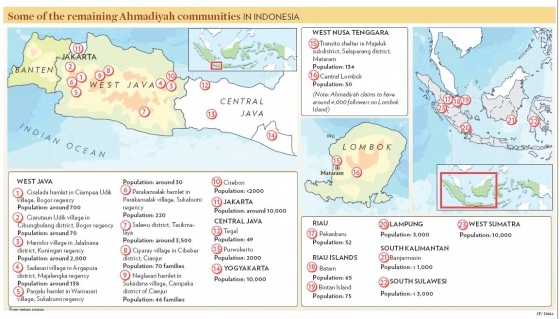
Ahmadiyya Communities in Indonesia

Tuesday, November 2, 2010

The Thinker: Losing the Faith

Jakarta Globe, Indonesia
COLUMN
The Thinker: Losing the Faith
Robin Lee Santoso | November 02, 2010

President Susilo Bambang Yudhoyono’s speech against the persecution of minorities last month received much acclaim. Speaking with an eye to the recent string of clashes between Islamic extremists and members of the Ahmadiyah sect, he voiced his strongest statement on religious extremism to date, saying mosques should provide “comfort and peace to everyone, and not encourage provocation.”

But how can we reconcile Yudhoyono’s condemnation with the many laws that condone the oppression of Ahmadiyahs?

A 2008 joint ministerial decree still prohibits Ahmadiyah mosque leaders from preaching in public.

When a West Java Ahmadiyah mosque was attacked in August, government officials shut it down for weeks and even entertained the idea of relocating it.

With only 100,000 members in a country of 240 million, Ahmadiyahs are virtually unable to build new mosques, as a 2006 joint ministerial decree requires the approval of 60 households before such construction can take place.

And the list of restrictions goes on and on.

This indicates that Yudhoyono is preaching to the wrong audience.

Aside from the fact that Ahmadiyah’s violent attackers are Islamic extremists and not members of the mainstream Baiturrahim Mosque, Yudhoyono overlooks the laws that sanction oppression.

If Yudhoyono wants to eliminate the persecution of minorities, he must revise our discriminatory religious ideology.

Indonesia’s religious ideology singles out and protects five religions — Islam, Christianity, Hinduism, Buddhism and Confucianism — above others.

The perks of being approved includes protection by the 1965 Blasphemy Law, which bans religious groups that “distort” or “misrepresent” the central tenets of the official faiths.

In practice, the Blasphemy Law is distorted to preserve the Islamic status quo.

Without an official definition of what constitutes “orthodox Islamic beliefs,” lawmakers have filled the void with their own definition, to the exclusion of the Ahmadiyahs.

This took place despite the fact that Ahmadiyah members consider themselves part of the Sunni tradition of Islam.

When I spoke to one Ahmadiyah spokesman this summer, he explained in detail how all their claims were based on verses of the Koran.

Although the Ahmadiyahs differ in their interpretation of some Koranic verses, these differences are secondary to the faith’s central tenets.

Yet they are still being stripped of their basic rights.

There was a time when the Catholic Church persecuted the believers of Protestantism.

Need there be a repeat of history?

The intolerance bred by the nation’s religious ideology goes against the country’s democratic aspirations.

Lawmakers should not have the freedom to choose what beliefs are orthodox, or who gets to keep their rights.

The Constitution mandates the government to uphold the basic rights of every citizen, regardless of gender, race or religion.

What’s more, Indonesia also protects approved religions from proselytizers, and this law often becomes a pretext for persecution.

It is used to silence minorities.

Ahmadiyah leaders, for example, have been instructed not to preach in public, and their members are prohibited from sharing their faith with others.

This is unacceptable, given our country’s democratic aspirations.

True, believers need some protection from the government.

After all, one cannot have religious freedom if one constantly faces physical or intellectual threat.

But the government needs to make sure that it does not give some people rights at the expense of others.

It rather should focus on protecting the basic human rights of all people, in order to create a safe environment for self-expression.

Indonesia’s religious ideology flies in the face of other parts of the Constitution, which grants every person the right to choose and practice his or her chosen religion.

The recognition of five religions came at a time when communism threatened the very integrity of the Constitution.

With that threat behind it, the country needs to recover its spirit of giving the people equal freedom to believe what they please.

To achieve this, Yudhoyono needs to revise the Constitution’s biggest barrier — a religious ideology that fuels persecution.

Just hours after the president’s comments last month, an Ahmadiyah mosque in Bogor was torched — again, to the surprise of no one.

If Indonesia maintains its current religious ideology, these events will continue to be the norm, and eloquent speeches won’t change a thing.

Robin Lee Santoso is an American graduate student focusing on religion and human rights.

Copyright 2010 The Jakarta Globe

Saturday, October 23, 2010

SBY fails to uphold supremacy of law: Observers

NATIONAL
Sat, 10/23/2010
11:34 AM

SBY fails to uphold supremacy of law: Observers
Hans David Tampubolon, The Jakarta Post, Jakarta

Law enforcement, the fight against corruption and economic enhancement were the weak points of President Susilo Bambang Yudhoyono’s administration during the first year of his second term, a discussion heard on Friday.

“In terms of law enforcement, we have witnessed many issues over the last year, including the Bibit-Chandra case, the Bank Century debacle, bloated bank accounts allegedly belonging to high-ranking police officers, the Molotov attack on the Tempo magazine office and the bullying of anticorruption activist Tama S. Langkun,” Indonesian Survey Institute (LSI) senior researcher Burhanuddin Muhtadi told the discussion at the House of Representatives.

Oppression against minority groups was a major problem Yudhoyono had to resolve, Burhanuddin added.

“There is one regent’s instruction to exile Ahmadiyah followers to a remote island. The state must do something about that,” he said.

Burhanuddin was referring to the West Lombok regency administration’s suggestion to move 20 Ahmadi families, who had already been displaced for many years after their village was attacked by mainstream Muslims, to an island in Sekotong subdistrict. West Lombok regent Zaini Arony said the plan was part of the government’s efforts to “protect” the Ahmadis.

Zaini said he would seek the governor’s support of the widely-criticized plan, because it had only been put forth after consultations with religious, community and youth leaders. Critics have said the plan would amount to violation of human rights, and Zaini acknowledged that not everybody in the meeting supported the idea.

Early this month, an Ahmadiyah village in Bogor, just south of Jakarta was also attacked by militant mainstream Muslims, but the police were able to contain the violence.

Signs of increasing intolerance have also been evidenced by church closures and fierce militant rejection of churches and their congregation members in their neighborhoods.

Burhanuddin said that persecution against the Ahmadis reminded him of medieval practices in Europe, which should have long since been absent in a modern democracy like Indonesia. The government’s poor showing in the fight against corruption was ironic because the main selling point of Yudhoyono’s last presidential campaign was his commitment to the supremacy of law, he added. Another discussion speaker, law expert Irmanputra Sidin, said the President was to blame for the law enforcement agencies’ failure to reform themselves.

“The police and the attorney general have both failed to regain public trust. We can [therefore] say that Yudhoyono has failed,” he said.

Yudhoyono’s Democratic Party chairman Anas Urbaningrum defended the administration, saying there had been major improvements in law enforcement, however, most of them went unheard because of poor public relations.

Commenting on a possible Cabinet reshuffle, Anas said that Yudhoyono should react firmly to Cabinet ministers who did not perform well, and some ministers should be replaced.

“The President should not maintain Cabinet ministers who did not perform well because they would only burden his administration,” he said.

Rumors of a possible Cabinet reshuffle have been swirling since last week when Yudhoyono marked the first year of his second term in office.

The Democratic Party has long insisted that Yudhoyono must improve his administration by replacing certain ministers. Golkar, the second largest party, has also made similar calls, and has even said it did not mind preparing substitutes should Yudhoyono dismiss certain Golkar ministers.

Anas said the first year in office was the best time for Yudhoyono to reshuffle his Cabinet because the new ministers would still have enough time to familiarize themselves with their jobs.

He maintained that the Yudhoyono administration had made progress during the past year, but public awareness remains low because of the administration’s inadequate communication skills.

Wednesday, October 13, 2010

Ahmadis may be relocated to an island ‘for their own good’

HEADLINES
Wed, 10/13/2010
10:05 AM

Ahmadis may be relocated to an island ‘for their own good’
Panca Nugraha, The Jakarta Post, Mataram

It is proposed that Ahmadiyah followers be relocated to an island, some 60 kilometers south of West Nusa Tenggara capital Mataram, as the West Lombok regency administration is seeking “to provide protection for these displaced people”.

“We have discussed the plan in a coordination meeting with the regency’s officials and community and religious leaders. They’re probably going to be relocated,” the regency administration’s spokesman Ispan Junaedi said on Tuesday.

Over a hundred of the followers of the Islamic sect have taken shelter at Wisma Transito building in Mataram after being kicked out of their homes in Ketapang hamlet in Lingsar district on Feb. 4, 2006.

West Lombok Regent Zainy Arony had earlier told reporters the relocation plan was intended to protect Ahmadiyah followers.

He said the plan was made based on human rights consideration since under the law, and despite their beliefs, they are Indonesian citizens, who were protected.

“We also hope the provincial administration to play a role in assisting solve the problem,” Zainy said.

Ahmadiyah followers said they did not know about the plan.

“I just found out about the plan after an interview with a BBC London journalist. We regret the plan has not involved us,” Ahmadiyah provincial chapter head Jauzi Djafar told The Jakarta Post on Tuesday.

He said the relocation plan may be an acceptable solution for the refugees, who have been denied their rights for the past five years, but they had to be involved in the plan.

He said that the 127 Ahmadiyah followers living in the shelter were still hoping they could return to their homes in Ketapang hamlet.

He said the regency administration would need to provide houses and to ensure their safety.

“Why don’t they just compensate them for their assets lost in Ketapang so they can find new places to live outside the shelter?” Jauzi said

“And if there is guarantee of their safety, why there is a need to be relocated? Why not return them to their hometown as before? We’re confused about this plan.”

Religious Affairs Minister Suryadharma Ali claimed in Medan, North Sumatra on Monday that disbanding Ahmadiyah “would cause fewer problems than keeping it in existence”, insisting this was not discriminatory since the sect spread false Islamic teachings.

He said that the 2008 joint ministerial decree on the sect, which banned the Ahmadis from propagating their views — allegedly leading to attacks on the sect by hardline Muslims, would not be changed.

The latest attack against the sect, believed to have some 200,000 followers across the country, took place in Bogor, West Java, when some 20 people threw stones and set fire to Ahmadiyah houses and places of worship in Ciampea. A mosque, five houses, a car and two motorcycles were burned in the attack.

Monday, October 11, 2010

Officials Announce Plan to Relocate Ahmadiyah Families to a Deserted Island

Jakarta Globe, Indonesia
Indonesia
Officials Announce Plan to Relocate Ahmadiyah Families to a Deserted Island
Nivell Rayda | October 11, 2010

A follower of the minority Islamic sect, Ahmadiyah, holding a burnt copy of the Koran in Ciampea, West Java, after violence directed at the Islamic sect earlier this month. In what is likely to be a hugely controversial - if not illegal - decision, authorities in West Nusa Tenggar plan to relocated 20 sect families to a deserted island in Lombok. (Reuters Photo/Dadang Tri)
A follower of the minority Islamic sect, Ahmadiyah, holding a burnt copy of the Koran in Ciampea, West Java, after violence directed at the Islamic sect earlier this month. In what is likely to be a hugely controversial — if not illegal — decision, authorities in West Nusa Tenggar plan to relocated 20 sect families to a deserted island in Lombok. (Reuters Photo/Dadang Tri)
akarta. A district head in West Nusa Tenggara announced plan to relocate 20 Ahmadiyah families to a deserted island, a move many say is both discriminatory and inhumane.

“We are trying to protect Ahmadiyah members,” Zaini Arony, district head of West Lombok, said on Monday, as quoted by Antara.

Zaini said he had discussed the matter with religious figures and members of society, adding that it had been agreed that Ahmadiyah members would be relocated to an island in Sekotong subdistrict.

He claimed the local government feared a repeat of an incident in February 2006 when thousands of mainstream Muslims burned homes belonging to Ahmadiyah members in the district.

The incidents left as many as 137 people homeless, all of whom had to be escorted by police officers to a temporary shelter in the provincial capital, Mataram.

In August, at least 20 families left the shelter and returned to the district. Zaini said their return was rejected by a number of groups.

Zafrullah Pontoh, the president of the Indonesian Ahmadiyah Congregation (JAI), told the Jakarta Globe that the West Lombok government had never discussed the matter with the sect. “The local government is trying to banish Ahmadiyah from West Lombok,” he said.

Followers of Ahmadiyah, a sect founded in India in 1889, profess that the group’s founder, Mirza Ghulam Ahmad, is the last prophet, a belief that runs counter to mainstream Islamic beliefs that reserve that claim for the Prophet Muhammad.

The nation’s highest authority on Islamic affairs, the Indonesian Council of Ulema (MUI), issued a fatwa in 2005 against the Ahmadiyah, calling its teachings blasphemous. And the government issued a joint ministerial decree in 2008 banning its members from practicing their faith in public or spreading its beliefs.

Ulil Abshar Abdalla, founder of the Liberal Islam Network and a Democratic Party politician, said the government must remain neutral and not support calls of intolerance against Ahmadiyah from mainstream Muslim groups.

“It needs time to correct religious indoctrination [in mainstream Muslim] that spur hatred towards Ahmadiyah. It needs time to reach cultural maturity to accept different views,” he said.

“However, I am saddened that the government is supporting this cultural immaturity and making it a political policy.

Copyright 2010 The Jakarta Globe

Sunday, August 8, 2010

Indonesian Ahmadiyah Members Mark Fifth Ramadan in Limbo

Jakarta Globe, Indonesia
Indonesia
Indonesian Ahmadiyah Members Mark Fifth Ramadan in Limbo
Tangguh | August 08, 2010
Ahmadiyah members, whose homes were razed by angry villagers in 2006, at the Transito temporary camp in Mataram. JG Photo/Tangguh
.
Lombok. For four years and five months, 33 Ahmadiyah families have been staying at the Transito shelter in Mataram, West Nusa Tenggara, after having been driven from their homes.

The families ended up here in February 2006 after their neighbors in Lingsar Barat village, West Lombok district, turned on them during the height of the anti-Ahmadiyah sentiment that was sweeping the country at the time. The families’ homes were razed.

Most mainstream Muslims oppose the Ahmadiyah sect because its members believe that its founder, Mirza Ghulam Ahmad, was a prophet.

“We just want to go back home,” a spokesman for the group, Dzulkhair Mujip, tells the Jakarta Globe. “No matter how nice a place is, it’s still not home.”

The group has several times announced its plan to return to its home village. Each time, it has been stayed by the Ministry of Religious Affairs and the police, who claim such a move would threaten the peace that the families’ expulsion has brought to their village.

Like other Indonesian Muslims, these Ahmadiyah members are looking forward to Ramadan, which begins on Wednesday.

Unlike most Muslims, however, the 137 people here will be forced to spend the holy month at this “temporary” refuge for a fifth straight year.

Despite everything, Dzulkhair says, the Ahmadiyah will not let the situation sully their Ramadan, which they cherish as a chance to get closer to God.

There is not much they can do to prepare, he points out, except figure out how to accommodate everyone in the tiny local mosque for the obligatory evening prayers during the holy month.

The group has also been without electricity for the past six months after failing to pay the bill for the shelter, which the government is supposed to be managing for them.

Dzulkhair says that during the refugees’ stay in Mataram, they have been treated as second-class citizens. They are denied ID cards that are obligatory for all Indonesian citizens.

“None of us here has a driver’s license, because to get one you have to have an ID card, which we don’t have,” Dzulkhair says.

He adds that this problem extends to other civic documents, such as marriage licenses and birth certificates.

Couples from the community who want to marry must do so without official state permission, which several Islamic organizations frown upon. This perpetuates a vicious circle of animosity directed at the Ahmadiyah members.

For the first two years of their stay in Mataram, the group members received a stipend of rice and cash from the Social Welfare Ministry. However, that aid dried up in mid-2008 when the ministry said they were no longer eligible for it, without explaining why.

Dzulkhair says he and several other Ahmadiyah representatives have repeatedly tried to get the West Lombok administration to clarify their legal status, but to no avail.

“The regional administration keeps telling us to take it up with the provincial government, and the provincial administration passes us back off to the West Lombok administration,” he says.

“We’re being tossed around like a bunch of playthings, and there’s nothing we can do about it.”

Dzulkhair also tells of persistent threats group members have received from local Islamic hard-liners, although the shows of aggression are not as vicious or public as they used to be.

Yet Dzulkhair adds that despite these challenges, the group is still trying to lead a normal life.

Most of the adults are employed as manual laborers, farmhands and vendors — anything that helps put food on the table and keeps the children in school, Dzulkhair says.

Hafiz Kidratullah, 12, says he had to repeat a whole year at school because of the disruption to his studies caused by the move to the Mataram shelter.

His father, Hairuddin, ekes out a living selling plastic bags at a local market.

Another parent, Yunus, says he sells tapes at Mataram’s Pangesangan Market. He makes around Rp 30,000 ($3) a day.

“At least I have a job, that’s what really matters,” he says.

What these Ahmadiyah members want more than ever, Dzulkhair and the others say, is for the government to tell them where they stand, especially in relation to their home village.

The Ahmadiyah members say they are willing to make a permanent home at the Transito shelter, but only if the government allows them basic civic rights like the right to get an ID card, Dzulkhair says.

He adds the group has lost all faith in the district and provincial administrations, and has now pinned all its hopes on the government of President Susilo Bambang Yudhoyono.

“Our last hope is the central government, is the president himself,” he says.

“Hopefully amid his important duties managing the nation’s problems, he can spare a thought for us out here in Transito.”

Copyright 2010 The Jakarta Globe

Saturday, August 7, 2010

Ahmadiyah children denied right to free education

HEADLINES
Sat, 08/07/2010
12:10 PM

Ahmadiyah children denied right to free education
Panca Nugraha, The Jakarta Post, Mataram

Sixth grader Muhyidin Sayid Ahmad returned home from school wearing a sad face. His school had just denied him the right to free education that has been provided by the West Nusa Tenggara provincial administration for poor students for the past two years.

Muhyidin is one of 40 children of Islamic sect Ahmadiyah who have been living in Wisma Transito in Mataram, West Nusa Tenggara, for the past four years, since they were driven out of their homes by an angry mob in Ketapang hamlet, Lingsar district, in West Lombok regency.

Apsotates?: Children of Jamaah Ahmadiyah members pose at a refugee shelter in Mataram, West Nusa Tenggara. The children, who have been persecuted by local Muslims and the authorities, have also been denied their right to a free education. JP/Panca Nugraha
Of the 40 children, 20 are in primary school, seven in high school and the rest are of preschool age. The boy’s father, Syahidin, said his son’s poor friends were getting cash assistance from the program — called the Assistance for Poor Students [BSM] — from his school, the nearby SDN 42 elementary school.

“But my son did not get the assistance despite the fact we’re so poor,” Syahidin told The Jakarta Post. Children of other Ahmadiyah refugees suffered the same gloomy fate.

“There are 40 children here. None of them received assistance for poor students,” said 45-year-old Syahidin, who is the refugee coordinator at the shelter.

Under the program, which disburses cash every three months, each needy elementary school student is entitled to receive Rp 15,000 [US$1.68] a month. Junior high school students get Rp 50,000 and high school students get Rp 75,000.

The provincial administration has provided more than Rp 124 billion annually through the BSM program since 2009.

However, the children of Ahmadiyah members have not been included in the program.

Syahidin said that as refugees, the sect’s members had been living with a social unclear status over the past year.

On the other hand, they have to survive, including to provide their children’s school needs, such as for transportation, books and uniform.

Each year, he said, the condition of refugees worsened.

The province’s Social Affairs Office stopped providing assistance to them in mid 2008 on the grounds that the assistance was allocated for only two years.

The provision of rice and cash for dishes also stopped and the refugees now have to fend for themselves. Many of the refugees, mostly farmers, ended up doing odd jobs, such as working as construction workers.

Over the past six months, they have been living in the shelter without electricity because they can not afford to pay the bills.

“We have tried everything to be able to return home to Ketapang but to no avail. We can only resign ourselves to our fate and hope for justice from God,” Syahidin said.

None of the refugees hold valid identity cards — which are required to be eligible for government assistance for the poor.

“Our Ketapang identity cards have expired. It is impossible for us to apply for ID cards here since we have been rejected everywhere,” Syahidin said.

“Without this card, we can’t apply to get free healthcare or education programs.”

The province’s Education Youth and Sports Office secretary M. Imhal said the BSM assistance aimed to reach every poor student.

However, he said, the program’s recipients were listed by school authorities, not his office.

“We get the data from schools. If the refugees’ children did not get the aid, they were probably not listed by their schools.”

The province’s Ahmadiyah advisor, Nasiruddin, said the refugees had been aided by overseas relief groups, human rights observers and foreign embassies, not their own government.

“Why does the international community care about us, while our own government thinks we don’t exist?” Nasiruddin said.

“The government should not shut their eyes and ears,” he said. “If they don’t wish to take any notice of us, that’s fine. But please take notice of the condition of our children.”

Friday, August 7, 2009

Let us out of this shelter, Ahmadis plead

--- The Jakarta Post, Indonesia
Headlines Thu, 08/06/2009 1:11 PM
Let us out of this shelter, Ahmadis plead

Panca Nugraha, The Jakarta Post, Mataram

Around 140 members of the Jamaah Ahmadiyah sect asked the Mataram municipal administration Wednesday for permission to leave their shelter at the Transito Guest House, where they have been living for the last three-and-a-half years.

Representatives of the minority Islamic sect, branded deviant by mainstream Muslim groups, met with staff from the Mataram mayor’s office to make their request.

“We asked for permission from the administration to allow us live wherever we may in the city, even along riverbanks or in slums,” Syahidin, coordinator of the refugees, said after the 30-minute meeting.

“We’re tired of living at the shelter.”

He added the Ahmadis had made the plea because local authorities had never responded to an earlier request to be allowed to return to their home hamlet of Ketapang, in Gegerung village, West Lombok.

“We’ve been waiting for an answer for four months,” Syahidin said.

“Neither the provincial nor municipal administrations deigned to respond to our request.” The Ahmadis were driven from their homes in February 2006 by a marauding mob of local Muslim residents. The attackers burned down their homes and mosque.

They were evacuated to the Transito dormitory on Feb. 4 that year, to prevent more attacks.

The government has since stopped providing financial aid and food rations for the Ahmadis, and cut off the electricity to the shelter, claiming it cannot afford the costs.

“Should the government consider us guilty of whatever it is we’re being accused of, we’re ready for the legal process,” Syahidin said.

“We’re ready to go to prison, even without due legal process.

“All we want is to not be abandoned at the refugee camp, waiting in limbo,” he went on. “We’re humans who wish to live normal lives.”

On March 14 this year, the Ahmadis wrote to West Nusa Tenggara Governor Zainul Majdi, seeking permission to return to Ketapang.

But after a meeting with West Lombok administration officials, the refugees were told to delay their return, saying local authorities would buy up their homes and land to get them settled elsewhere. However, the West Nusa Tenggara administration later dropped the plan, citing, as ever, a lack of funds.

The U-turn forced the Ahmadiyah members to stay on at the refugee camp, having been forbidden from returning home to Ketapang or to relocate elsewhere.

On numerous occasions, local authorities have dissuaded them from leaving the camp by saying they would face certain persecution that the authorities had no intention of preventing.

This year’s Islamic fasting month of Ramadhan, expected to start on Aug. 22, will be the fourth for the Ahmadis at the Transito dormitory.

Mataram administration official Husnan Ahmad said Wednesday his office had actually allowed the refugees to return to Ketapang, on the condition they would have to assimilate into the local Muslim community.

“From the very beginning, the mayor has given them permission to return home, but only if they agree to not live ‘exclusively’,” he said.

He added the Ahmadis had not agreed to the terms.

Ahmadiyah members and properties have come under frequent attacks from mainstream Muslims across the country, following two separate decrees from the unctuous Indonesian Ulema Council (MUI) and the Religious Affairs Ministry branding their teachings “heresy”.

A central Ahmadiyah belief is that the sect’s founder, Mirza Gulam Ahmad, was a prophet after Muhammad.

In July 2005, an estimated 10,000 members of the Indonesian Muslim Solidarity group attacked the Indonesian Ahmadiyah Congregation complex in Bogor, West Java.

URL: www.thejakartapost.com/n...ead.html

Wednesday, August 5, 2009

Ahmadiyah followers seek exit from shelter

---The Jakarta Post, Indonesia
National Wed, 08/05/2009 3:24 PM

Ahmadiyah followers seek exit from shelter

Panca Nugraha, The Jakarta Post, Mataram

Around 140 members of the Ahmadiyah sect and their families asked the Mataram municipal administration on Wednesday for permission to leave the shelter at the Transito Guest House where they have been living for the last three-and-a-half years.

Representatives of the Islamic sect, which has been deemed defiant by mainstream Muslim groups, met assistants to the Mataram mayor to make their request.

“We ask for a permit from the regional government to live in wherever part of the city, even along the river banks or slum areas. We are tired of living in the shelter,” coordinator of the displaced Ahmadiyah followers, Syahidin, said after a 30-minute meeting.

He said the Ahmadiyah members sought a permit to live in Mataram as the local government had never responded to their request to return to their home village of Gegerung, West Lombok.

“We have been waiting for the answer for four months. Both the provincial and municipal governments have not answered our request,” Syahidin said.

The Ahmadiyah followers were displaced from their village following an attack by hard-line Muslims in February 2006. The attackers burned down their homes and place of worship.

URL: www.thejakartapost.com/new...it-shelter.html

Tuesday, June 9, 2009

Ahmadiyah refugees kept in misery, seek Jakarta help

---The Jakarta Post, Indonesia
The Archipelago | Tue, 06/09/2009 10:48 AM

Ahmadiyah refugees kept in misery, seek Jakarta help

Panca Nugraha, The Jakarta Post, Mataram


West Nusa Tenggara (NTB) administration has reportedly dropped plans to buy assets of local Jamaah Ahmadiyah followers, forcing them to remain in refugee camps.

The cancellation sees the groups’ plight continue, since they have been forbidden from returning home to the hamlet of Ketapang in Gegerung village, West Lombok, or allowed to move elsewhere.

At least 126 followers of the Islamic minority sect, who were violently evicted by a Muslim mob in 2006, have on numerous occasions been prevented by local authorities from returning home — the authorities citing security reasons.

As a trade-off, in March the provincial administration claimed it was planning to buy the refugees’ assets so they could leave their refugee accommodation at the Transito dormitory in the NTB capital of Mataram, for safe areas outside Ketapang.

However, on Monday NTB’s Ahmadiyah leader, Jauzi Djafar, said both the provincial and regency administrations had told the refugees that they lacked funds and were not interested in buying the land and houses in Ketapang.

Jauzi said information of the cancellation had been received late last month through Tuan Guru Haji Anwar, a special envoy to NTB Governor Zainul Majdi.

“Tuan Guru Anwar delivered the information through a verbal notification, and we recorded it. So far, all our official correspondence has been responded to verbally.”

Jauzi blasted the local government for betraying the Ahmadiyah refugees saying the move to buy their assets was “merely camouflage” to delay the refugees’ return.

The refugees had asked the government to pay Rp 500 million for their combined assets, comprising 20 houses and plots of land, Jauzi said.

Separately, NTB administration spokesman Andy Hadiyanto could not confirm or deny the decision on the purchase of refugees’ assets. “I cannot explain this in detail yet. We have to coordinate with local administrations and the Religious Affairs Office. This issue is still being discussed,” Andy said.

Jauzi further said that the refugees were now pinning their hopes on the central government to provide much-needed help.

They would write to President Susilo Bambang Yudhoyono concerning the decision against purchasing their assets and to tell him of their wish to return home.

“We don’t want to allow the local administration to report to the central government that this asset issue is still being discussed, but *wish to state* the fact that it seems the local administration has deliberately neglected our fate,” Jauzi said.

The local government had not provided aid to the refugees since January, Ahmadiyah refugee coordinator Syahidin said.

Last month, state electricity firm PT PLN cut power supplies to the Transito dormitory because the refugees could not afford the monthly bill. “How could we pay the electricity bill, when we even have difficulty getting enough food to survive?” Syahidin said.

The Ahmadiyah followers were several times attacked by their Muslim neighbors of different faiths in February 2006, forcing them to flee their homes in Ketapang.

In July 2005, an estimated 10,000 members of the Indonesian Muslim Solidarity group attacked the Indonesian Ahmadiyah Congregation complex in Bogor, West Java.

The Religious Affairs Ministry had issued a circular in 2004, branding Ahmadiyah teachings as “heresy”, based on its belief that its founder, Mirza Gulam Ahmad, was a prophet (after Muhammad).

The attackers claimed Ahmadiyah members had engaged in the practice of teaching local people about their sect.

URL: www.thejakartapost.com/news/2009/...ta-help.html

Saturday, March 14, 2009

West Lombok forbids Ahmadiyah refugees from returning home

---The Jakarta Post

National - Sat, 03/14/2009 1:46 PM

West Lombok forbids Ahmadiyah refugees from returning home

West Lombok regency has decided to forbid members of the Ahmadiyah Islamic sect, who have been living uncertainly at a refugee center in West Nusa Tenggara for three years, to return to their homes, citing security concerns.

Basirun Anwat, spokesman of the regency, told tempointeraktif.com Saturday that the decision was made during a meeting attended by the regency secretary, the local leaders forum and sect members on Thursday.

“To ensure security, they are not allowed to go home,” he said.

Basirun also said that Ahmadiyah members were still allowed to work on their farms and that the regency was going to discuss buying their land so they could move elsewhere.

Last month, 68 Ahmadiyah members from 17 families decided to risk going from the Transito building in Mataram back to their homes in Ketapang hamlet, Gegerung village, Lingsar district, West Lombok regency, on March 14.

At least 160 Ahmadiyah members from 33 families were driven from their homes when hard-line Muslims attacked them and destroyed their homes and belongings in early February 2006.

The Indonesian Ulema Council (MUI) previously issued an edict calling the Ahmadiyah heretical. The edict was seized upon by other hard-line Muslims to attack the sect’s followers elsewhere, including in West Java. (dre)

URL: www.thejakartapost.com/news/2...h-refugees-returning-home.html

Monday, March 2, 2009

Refugees’ return home ‘welcomed’

---The Jakarta Post

The Archipelago - Mon, 03/02/2009 2:18 PM

Refugees’ return home ‘welcomed’


Panca Nugraha, The Jakarta Post, Lombok Barat

The West Lombok regency has welcomed the plan by Ahmadiyah refugees to return home, but says it hopes the sect’s members will not choose to stick out again.

Regency spokesman Basirun Anwar said the administration would facilitate the return of the followers from the Transito building refugee center to their homes in Ketapang hamlet, Gegerung village, West Lombok, West Nusa Tenggara, on March 14.

“They are West Lombok residents, so we must help them,” Basirun told The Jakarta Post on Sunday, adding the administration had received a copy of a letter from the refugees about the planned return.

Basirun also said the administration had met with local leaders in the village to discuss the matter.

Besides trying to mix with local residents, he said the leaders also urged Ahmadiyah followers to obey the recent joint ministerial decree (SKB) banning them from spreading their teachings.

Jauzi Djafar, West Nusa Tenggara chairman of the Indonesian Ahmadiyah Group, promised the group would abide by the SKB, but at the same time the group also urged the residents not to use violence against its members.

After three years in limbo at the refugee center, 68 Ahmadis have decided to risk returning home.

They are among 160 followers from 33 families who were driven from their homes by hard-line Muslims in 2006.

They decided to go back since their homes were still habitable, while the remaining 92 members of the sect chose to stay at the refugee center because their homes were completely destroyed.

The Indonesia Ulema Council (MUI) previously issued an edict declaring the Ahmadiyah heretical, mainly due to the sect’s belief that its founder Mirza Ghulam Ahmad was a prophet.

Based on the edict, among other factors, the government than banned Ahmadiyah followers from spreading their teachings.

Human rights activists have deplored the use of violence against the sect’s followers and criticized the MUI for issuing the edict, which was used as a reason by the hard-liners for the attacks.

Besides followers in West Nusa Tenggara, property owned by Ahmadis in West Java were also destroyed by Muslim hard-liners.

Basirun said the West Lombok administration would coordinate with the provincial administra-tion to organize the return of the refugees.

He said the return would be conducted in a formal ceremony that would be witnessed by local Muslim leaders.

“Ketapang residents hope the return can be conducted officially. So now we are coordinating with Mataram municipality, the provincial administration and the security authorities over the return home of the refugees,” he said.

Provincial social services agency head Bachruddin said his office would provide 1 ton of rice to help out the refugees upon their return.

“Even when they do get back to their homes, they’ll still need a little help first,” he said.

URL: www.thejakartapost.com/news...eturn-home-welcomed039.html
 
^ Top of Page