Showing posts with label hostile. Show all posts

Thursday, January 27, 2011

Rally Rages Outside Bogor Court Trial on Ahmadiyah Village Attack

Jakarta Globe, Indonesia
NEWS
Rally Rages Outside Bogor Court Trial on Ahmadiyah Village Attack
Elisabeth Oktofani | January 27, 2011

Bogor. Over 1,000 Muslim hard-liners surrounded a district court in Bogor on Wednesday, demanding the immediate release of three youths standing trial for an attack on an Ahmadiyah community last year.

Dede Novi, 18, Aldi Afriansyah, 23, and Akbar Ramanda, 17, are accused of destroying property and inciting violence during an October riot in Cisalada village, according to indictment documents.

The three were said to be part of a mob that burned down houses, schools and a mosque at the Bogor village, home to 600 members of the Ahmadiyah, a minority Islamic sect deemed deviant by mainstream Muslims for their different beliefs on the Prophet Muhammad.

The crowds that came out in support of the defendants on Wednesday, however, slammed these accusations.

Though police had barred them from entering the courtroom, the protesters reportedly “became incensed” when the defendants’ lawyer told them about a witness who said Dede had set the At-Taufiq Mosque and an Ahmadiyah Koran on fire.

Ari Saputra, a resident in Cisalada, testified on Wednesday that Dede could have thrown a Molotov cocktail at the mosque.

“I cannot be sure that he really was the one who threw the Molotov cocktail, but I saw that he was part of the group,” Ari told the court, led by Judge Astriwati.

Dede, however, denied throwing the fire bomb, but admitted at the hearing that he was part of the group which set the village mosque on fire.

A second witness, Mubarik Ahmad, a Cisalada resident and an Ahmadi, said he saw the three defendants break into and torch the mosque.

“I saw them. They were among hundreds who came to our village that night and attacked. They were brutal,” Mubarik said. “They threw stones at the mosque, broke its windows and set it on fire. Others came on motorbikes and made noises with their horns.

“They burned and destroyed so much property in our village,” he added. “That evening, our only concern was how to stay alive.”

After being informed of Mubarik’s statements, the angry crowds outside the courtroom began to yell out that the witness was a liar.

Protesters also tried to attack Mubarik as he left the courtroom under tight police guard.

Amid Wednesday’s unrest, hundreds of security personnel were deployed to Cisalada and the Cibinong District Court, where the trial was held.

The three defendants are accused of violating the Criminal Code, particularly Article 406 on the destruction of property and Article 170 on assault.

Article 406 carries a maximum sentence of two years and eight months in jail, while Article 170 carries a punishment of up to five years and six months.

Agus Sulaiman, one of the protesters, said the people of Bogor would “never accept the presence of the Ahmadiyah.”

“What is worse is that they built an Ahmadiyah information center in our village,” said Agus, a resident of Ciampea subdistrict.

“If they don’t stop this, we will stop them. We will burn their properties,” he said. “They call themselves followers of Islam. This is what we cannot accept.”

Agus said many conservative Muslims in the area detested the sect for believing that Ahmadiyah founder Mirza Gulam Ahmad was the last prophet.

This runs counter to mainstream Islamic beliefs which reserve that distinction for the Prophet Muhammad.

Copyright 2010 The Jakarta Globe
URL: www.thejakartaglobe.com/home/rally-rages...attack/419272

Crowd bullies Ahmadi at trial, disrupts courtroom

HEADLINES
Thu, 01/27/2011
11:02 AM
Crowd bullies Ahmadi at trial, disrupts courtroom
Hans David Tampubolon, The Jakarta Post, Jakarta
An elderly man was harassed by a rowdy mob on Wednesday as he testified in court about the destruction the property of Ahmadiyah followers in Ciampea, Bogor.

Mubarik Ahmadari came to the Cibinong District Court in Bogor on Wednesday to testify about the attack against his fellow Ahmadiyah members in October.

The 70-year-old man was greeted by more than 1,000 anti-Ahmadiyah protesters. Members of the crowd claimed to be residents of Ciampea who came to support the alleged arsonists on trial: Dede Novi, Aldi and Akbar.

The protesters jammed the courtroom. Many had to stand outside. Throughout the trial, unruly protesters in the courtroom were heard yelling, demanding that the judges drop all charges against the suspects and that the government disband Ahmadiyah.

Despite the clamor, Mubarik remained calm and told the court a version of events that was vociferously rejected by onlookers. He seemed unfazed by the constant din of mockery and hate-filled comments directed at him.

However, even after giving his testimony, Mubarik found that his day was not over yet.

As Mubarik finished his testimony he went to exit the courtroom. Protesters blocked his path. Some stood at the doors. Others tried to grab him.

Police officers were there to protect the witness from what looked to be a potential savage beating at the angry rabble’s hands. After a brief scuffle, officers safely escorted Mubarik out of the courtroom.

Mubarik was one of four witnesses heard in Wednesday’s court session.

Around 20 people attacked Cisalada village in Ciampea in October, vandalizing and setting fire to the community’s mosque and the homes and vehicles of Ahmadiyah followers.

Hendardi, a human rights activist from the Setara Institute, said what happened to Mubarik was evidence that intolerance had become a dangerous disease in Indonesia.

“The fact that a man could be terrorized at a court of law is a horrific occurrence in the life of our nation,” Hendardi told The Jakarta Post over the telephone on Wednesday.

“This shows how the state is completely helpless in ensuring the basic human rights of its citizens,” he added.

Hendardi said that if the state continued to fail to impose strict punishment on violent fundamentalists, then violent acts, such as the those perpetrated on Mubarik and other Ahmadiyah followers, would continue.

Followers of Ahmadiyah have come under attack in recent years from Islamic hardliners who believe that the sect follows a heretical version Islam.

While the earliest recorded attacks against Ahmadis date to the early 1950s, it was not until 2005 that violence intensified dramatically.

In 2010 alone there were 10 recorded attacks against Ahmadis throughout the archipelago.

The government drew criticism from human rights activists for symbolically condoning violence against Ahmadis after Religious Affairs Minister Suryadharma Ali said that it would be better if the Ahmadiyah sect was “disbanded”. Suryadharma is also the chairman of the United Development Party (PPP), an Islamic-based political party.

Monday, January 17, 2011

MUI fatwa feeds flames of clerics’ hate speech

SPECIAL REPORT
Mon, 01/17/2011
10:10 AM
MUI fatwa feeds flames of clerics’ hate speech
The Jakarta Post
The animosity faced by followers of Ahmadiyah in Ketapang hamlet in West Lombok, West Nusa Tenggara, peaked on Oct. 19, 2005, a few months after the Indonesian Ulema Council (MUI) issued a second fatwa against the nation’s most persecuted religious minority.

Local resident Zulkhair Mujib vividly recalls the day.

He said local firebrand cleric Izzi Muslim, speaking at a mosque through a loudspeaker, called for the expulsion of the 130 Ahmadis in the hamlet.

“Ahmadiyah is a deviant and deviating faith. I tell you, if the residents of Ketapang don’t banish the Ahmadis, I will ask people in Central Lombok to do so,” Zulkhair quoted Izzi as preaching.

“If the people in Ketapang do not join us in attacking the Ahmadis, I will burn their houses,” Izzi continued.

The hate speech led to the first attack on Ahmadis in Ketapang, but failed to drive them out of the village.

Zulkhair said people became angry because of the failure, with Izzi strengthening his vow to continue efforts to expel the Ahmadis.

On Feb. 4, 2006, locals made another attempt to drive the Ahmadis out. This time, they succeeded.

Dozens of Ahmadi families now have no other option than to live in a refugee camp in Mataram, probably for the rest of their lives.

The MUI has repeatedly brushed off allegations that its irresponsible and controversial fatwa triggered the attacks on the Ahmadiyah followers.

Analysts said several clerics were actively spreading hate speech, using the MUI fatwa as a platform to vilify Ahmadiyah.

On July 28, 2005, at its seventh national congress in Jakarta, the MUI reiterated a 1980 fatwa that said Ahmadiyah strayed from Koranic teaching and ordered the government to outlaw the group.

The point of contention between the MUI and the Ahmadis, the MUI claims, centered around the refusal of Ahmadis to acknowledge Muhammad as the last prophet of Islam.

The MUI said the debacle would end if Ahmadis formed their own religion by ridding themselves of all pretensions to Islam.

“The government is obliged to ban the spread of Ahmadiyah across Indonesia, disband the organization and outlaw its activities,” the fatwa signed by then MUI chairman Umar Shihab and secretary Din Syamsuddin (now chairman of Muhammadiyah, the nation’s second-largest Muslim organization after the Nahdlatul Ulama), read.

Muhammadiyah is widely seen as the voice of moderate Islam.

The MUI fatwa was issued at a time of growing pressure from hard-line Muslim groups who wanted the MUI — which consists of representatives from major mainstream Muslim groups in the country — to take a firmer stance on the issue.

Zukhair said that only weeks after the MUI edict was issued, religious congregations in West Lombok were becoming increasingly critical of Ahmadiyah, fomenting hatred against the Ahmadis among the general public.

Izzi confirmed he had made harsh speeches about the Ahmadis, but said he was only citing the MUI fatwa in his rhetoric. He said he was convinced Ahmadis were heretical and had no place in Indonesia.

“The people cannot accept Ahmadiyah. We can accept Hindus and Christians because they do not blaspheme against Islam,” he said.

“If you ask me whether Islam condones violence toward the Ahmadis, let me ask you this: Are others allowed to commit blasphemy against Islam?”

A report issued by the National Commission for Human Rights (Komnas HAM) in 2006 indicated systematic efforts to spread anti-Ahmadiyah sentiment.

The report said religious justifications, such as the fatwa, were used as a pretext to persecute Ahmadiyah.

Subki Sasaki, a Muslim cleric from Central Lombok, said hatred among locals could be prevented if clerics distanced themselves from the language of hate.

He said locals could coexist despite religious differences, citing the existence of Islam Sasak or Wetu Telu followers, whose faith also differs from mainstream Islam.

“People are susceptible to indoctrination by religious leaders. When the fatwa was issued, religious leaders conveyed the fatwa to a subservient public. So when people are incited to attack, they will.”

— Additional reporting by Panca Nugrah
— JP/Arghea Desafti Hapsari

Manislor, the largest Ahmadiyah ghetto

SPECIAL REPORT
Mon, 01/17/2011
9:23 AM
Manislor, the largest Ahmadiyah ghetto
The Jakarta Post
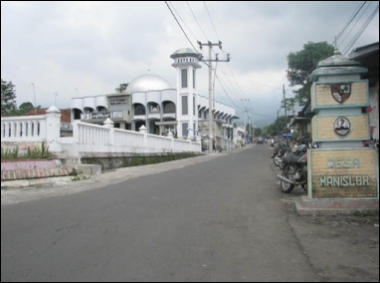
Into the war zone: The Al-Huda mosque in Manislor village in Kuningan regency, West Java, stands at the entry into the village in this photo taken early this month. The village, where 2,000 Ahmadis live side by side with more than 1,000 other villagers, is the epicenter of the unfolding tragedy of discrimination against the minority. JP/Arghea Desafti Hapsari
Followers of the minority Ahmadiyah sect in West Java have seen the worst. They face persecutions by hard-line Islamic groups that have become more frequent and violent than in any other area in Indonesia.

The province is home to the largest population of Ahmadiyah followers in the country, and the epicenter of this unfolding tragedy is Manislor village in Kuningan regency, where 2,000 Ahmadis live side by side with more than 1,000 other villagers.

The Ahmadis have witnessed angry mobs forcing their way into the village to attack and seal off their mosque and houses, but to no avail. This has not happened only once, but four times.

“This village has the largest number of Ahmadis in one location. So it makes us a big glowing target for hardliners,” Nurahim, the secretary-general of Manislor’s Ahmadiyah community, said.

“The hardliners think that if they can take down the biggest group, it would be easier to quash smaller ones.”

Ahmadiyah first spread to the four hamlets of Manislor in the 1950s when village elders attended a discussion on Ahmadiyah in Cirebon, located an hour’s drive from Kuningan.

“They wanted to learn more about Islam so they invited a cleric to the village to teach locals,” Nurahim said.

The arrival of the cleric changed the face of Manislor.

“Manislor in the 1950s was very underdeveloped. It was poor and the villagers practiced animism. They worshipped trees and performed shamanist rituals,” Nurahim said.

“But this all ended when Ahmadiyah spread to this village. Villagers were taught to think more about religion, traditions and social issues,” he said.

The villagers began to abandon their animist ways, paving the path for Ahmadiyah to develop rapidly since 1954, with more and more locals taking up the faith.

Today, villagers who identify as Ahmadis outnumber other residents.

Despite decades of living peacefully despite theocratic differences, no physical confrontations had ever erupted until August 2002 when Islamic hard-line groups from outside the village launched a concerted attack on the Ahmadis.

The incident began when a Muslim youth group in Kuningan attended a seminar on Ahmadiyah at Istiqlal Mosque in Jakarta and returned to the city to stage a protest in Manislor, claiming the Ahmadis were heretical.

Two months later, the group attacked several houses and two small Ahmadiyah places of worship in the village.

Since then, the Kuningan administration has been bombarded by almost constant pressure from various groups to ban Ahmadiyah and evicted the Ahmadis from the village.

The hard-line groups and the Ahmadis frequently lobbied local authorities, each looking to get their demands met, but to no avail.

Manislor villagers have become accustomed to the ever-present tension and carried on with life as usual.

“We’ve experienced so many attacks I lost count. I think we’ve probably been attacked every year since the [2002] attack,” Siti Mudiati, an Ahmadi villager in Manislor, said.

She said the first attack left her traumatized, but as the attacks gained in frequency, she became more inured to them.

But other villagers are not as enduring as Siti. Ayu, who is not an Ahmadi, remains gripped by fear when hardliners appear at her village.

Her house is located between an Ahmadiyah mosque, An-Nur, and the village mosque, Al-Huda, which is used by non-Ahmadi villagers.

“What can I do? It’s not like I can stop the mobs or move my house somewhere else,” she said.

Manislor, a village located at the foot of the Ciremai hills, still bears traces of the latest attack that occurred in July last year.

Several houses along the main street are still plastered with signs reading “members of the Al-Huda mosque, followers of Prophet Muhammad” on their front walls to let attackers know that they are not the targeted Ahmadis. Ayu displays the sign in her window.

Al-Huda sits 150 meters from the An-Nur mosque, which is the center of the Ahmadis’ religious life in Manislor.

Not far from An-Nur is a cooperative run by the Ahmadiyah office in Manislor. Nurahim said the cooperative provided services ranging from granting loans, and electricity and phone bill payment facilities to courier services.

The Ahmadiyah organization in the village also runs a junior high school with around 230 students.

In another hamlet, Siti and 20 other housewives gather to make snacks and handicrafts to be sold at local food stalls and shops.

Ahmadis gather at the An-Nur mosque every Friday for noon prayer and every Wednesday and Sunday when they hold regular religious studies.

As an important part of Ahmadi life, the mosque has been a target of repeated attacks.

In October 2004, a public gathering was held at the Al-Huda mosque, which was attended by members of an Islamic hard-line group.

After the event, a large crowd was mobilized in Manislor and attacked the An-Nur mosque. The attackers demanded that the sect be broken up and its activities terminated.

In July 2005, the Indonesian Ulema Council (MUI) issued a fatwa declaring Ahmadiyah a deviant faith and called on the government to ban it. The fatwa was a reiteration of a previous fatwa issued in the 1980s.

On July 29, a day after the fatwa, the Kuningan administration shut down the An-Nur mosque and seven smaller Ahmadi places of worship in Manislor. Other facilities run by Ahmadis were also closed off, including the school.

Pressure on the Ahmadis in Manislor intensified on Dec. 18, 2007, when a large crowd damaged a small Ahmadiyah mosque and dozens of houses.

The Ahmadis, however, stood their ground, defending their house of worship. Both sides threw rocks and four people were injured in the incident.

But the worst insult to the villagers occurred on July 26, 2010. Local officials and dozens of public order officers came to Manislor to shut down the iconic An-Nur mosque.

After heated debate between the Ahmadis and officials, the latter decided to leave the village without sealing off the mosque.

However, two days later, the Ahmadis woke up to find their mosque sealed off with planks of wood and chains.

On July 29, the Al-Huda mosque held a mass prayer, after which hundreds of outsiders tried to force their way into Manislor to support the officials’ closure of the Ahmadi mosque.

Police halfheartedly attempted to stop them, resulting in clashes and rock throwing, with houses damaged and several people injured in the incident.

- JP/Arghea Desafti Hapsari

In Jakarta, Ahmadis left relatively unscathed

SPECIAL REPORT
Mon, 01/17/2011
9:23 AM
In Jakarta, Ahmadis left relatively unscathed
The Jakarta Post
The Al-Hidayah mosque on Jl. Balikpapan in Harmoni, Central Jakarta, was quiet at noon on Tuesday last week.

A man sitting at a food stall outside the mosque gate greeted visitors. “You want to pray? Just go inside. The gate’s not locked.”

The 57-year-old mosque used to be the center of the Ahmadiyah organization in Indonesia.

Located in a crowded residential area, the mosque is just several hundred meters to the south of the notorious drug trafficking center of Kampung Bali and just 2 kilometers east of Jakarta’s infamous district on Jl. Hayam Wuruk and Jl. Mangga Besar.

Despite its grim location, the Ahmadis who pray or hold other activities at the mosque have so far been spared from the violence that has plagued their compatriots in other parts of the archipelago.

An estimated 10,000 Ahmadis currently reside in the capital, according to Ahmadiyah spokesman Zafrullah Pontoh

Muslim hardliners living far from the area protested against the existence of the mosque in 2005 and 2008. Local residents are mostly indifferent.

“I don’t really care about religious differences and the like,” said one resident, who asked to be identified as Yeni.

“As long as they don’t bother us when doing their activities, they can have a place here,” she added.

Around 15 kilometers west of the Al-Hidayah mosque is another iconic Ahmadiyah place of worship, which, coincidentally, is also named Al-Hidayah.

A group of Ahmadis gathered at the mosque in Kebayoran Lama, South Jakarta, one Friday afternoon in late December.

Soon a cleric began his Friday sermon, encouraging his audience not to fight fire with fire. “If we use violence to fight the violence that has been unleashed upon us, it is justified. It’s much better if we return that violence with prayers for those who persecute us.”

Local Ahmadis have been offering more than prayers to the surrounding community. This might explain why there has rarely been harsh persecution of the group, which has been labeled as “deviant” by the MUI, in Jakarta.

A resident living near the mosque, A’as, said the Ahmadis regularly gave charitable donations to people in the neighborhood, which was home to mostly lower- and middle-income people.

“Almost every month they give away free packages of staple food. They also give us donations during Idul Fitri and other Islamic celebration days.”

A’as said she personally knew some of the Ahmadis who regularly came for Friday prayers or weekly religious study.

“They’re very kind. They always say hello to us and we’ve become friends now,” she said.

Members of the Al-Hidayah mosque’s congregation come from many parts of the city.

Although seven mosques in Jakarta serve Ahmadiyah followers, only Al-Hidayah in Kebayoran Lama has been the target of recent attacks.

The mosque is located about 7 kilometers from the headquarters of the hardline Islam Defenders Front (FPI) on Jl. Petamburan III, Central Jakarta.

In June 2009, assailants set a fire in the mosque, damaging parts of the second floor. In early December, a group of men armed with swords and machetes threw stones at the mosque, smashing lights and window panes.

“The perpetrators are not from this area,” A’as said. “Why would we do it? [The Ahmadis] have been nothing but kind to us.”

“I know they’re different. But as long as they don’t go around looking for trouble, we won’t bother them. I think the people here just mind their own business.”

After Friday prayers, the Ahmadis went to a nearby Indonesian Red Cross office to donate blood. An Ahmadi woman said it was something the group regularly did.

Despite numerous stories of charity and kindness, threats of persecution still loom over Ahmadis in Jakarta.

In November, students staged a rally in front of Nuruddin Mosque in Tanjung Priok, North Jakarta, demanding its closure. In 2008, hundreds of people grouped under sealed the Baitul Qoyyum mosque in Serua, Ciputat, Southeast Tanggerang, Banten.

Imas Kartini, an Ahmadi from Pondok Labu, South Jakarta, said she has grown accustomed to threats of violence. “I feel sorry for my brothers and sisters and am anxious myself. But I live with it. Besides, the people in my neighborhood are very kind to me. We’ve gotten along well. I don’t believe they will do me any harm,” she added.

- JP/Arghea Desafti Hapsari

Anti-Ahmadi pogrom alive and well

SPECIAL REPORT
Mon, 01/17/2011
9:17 AM
Anti-Ahmadi pogrom alive and well
The Jakarta Post
For decades, the violence against the followers of the Ahmadiyah sect has continued without an end in sight. The Jakarta Post’s Arghea Desafti Hapsari explores the root causes of the violence by visiting several Ahamdiyah enclaves in the archipelago. Here are the stories:

Aftermath: Two members of the police mobile brigade guard houses ransacked by a mob in an Ahmadiyah community center in the Ciampea subdistrict of Bogor, West Java, in this photo taken on Oct. 1, 2010. Non-assimilation into the community by some members of the Ahmadiyah Islamic sect has been cited as among the triggers for the attacks by mainstream Islamic mobs. JP/Theresia Sufa
Empty barren houses sit with their windows shattered and walls half torn down while a yellow police line encircles the fence, warning off those who would trespass.

The houses are separated by a dirt road running a few hundreds meters from other houses in Ketapang hamlet in Gegerung village, West Lombok, West Nusa Tenggara.

Every once in a while the owners return from a refugee shelter in the provincial capital Mataram — where they have taken shelter since 2006 — to tend to their farms and guard what is left of their homes.

The ransacked houses are among the countless witnesses to the unfolding tragedy of the endless persecution of the Ahmadiyah faith and its 200,000 followers across the archipelago.

While early incidents of violence against the Ahmadis by mainstream Islamic hardliners — who insist Ahmadiyah is heretical — date back to the early 1950s, it was not until 2005 that the hostility intensified dramatically. In 2010 alone, there were at least 10 recorded attacks against the minority sect.

While the Ahmadis identify themselves as Muslims and follow the Koran, they believe Mirza Ghulam Ahmad, who founded the sect in 1889, was a prophet and also the messiah. This goes against the belief of mainstream Muslims who insist Muhammad was the last prophet.

But the root causes of violence may not be limited to differences in theological interpretation, a claim regularly spouted by hardliners.

Allegations that Ahmadis tend not to assimilate into the general population have also played a great role in fuelling mainstream resentment against them.

The locals in a hamlet in Pancor village, East Lombok, West Nusa Tenggara, recounted how the Ahmadis set themselves apart from the other villagers.

The hamlet was the scene of several attacks on the Ahmadis in 2002 that forced 83 Ahmadi families to flee their houses and take refuge in Mataram.

“That’s where the houses of the Ahmadis were,” Fitri, a resident of Kampung Baru Baluo, a hamlet in the heart of Pancor, points out to plots run over by wild bushes hiding the stone foundations that were once houses.

The abandoned land is located close to the hamlet perimeter.

“They built a cluster of houses there. When they had new members, they would buy them plots of land nearby to build houses,” Fitri said.

“The locals knew them of course. After all, we were neighbors long before the attacks.”

Another local, speaking on condition of anonymity, said the locals were never really close to the Ahmadis as the latter were viewed as being different.

She said the Ahmadis never visited other residents in the hamlet.

“In turn we never visited them as well,” she said, adding that residents’ interactions with the Ahmadis were limited to the marketplace.

Similar stories were also shared by Gegerung village residents, who forced local Ahmadis out of their homes in Ketapang hamlet in 2006 due to allegations that they did not want to assimilate.

In November last year, Ahmadis planned to return to Ketapang only to be evicted again at the request of Gegerung residents, despite exhortations by Ketapang hamlet leader Muntahar that the Ahmadis did get along with other residents.

He recounted a time when Ahmadis helped other villagers build the village mosque.

“They even contributed money for the construction,” he said. “However, the money was returned once the locals found out about the difference in doctrines.”

Allegations of non-assimilation have also plagued Ahmadis in Parung, Bogor, where the sect built a 15-hectare compound to house followers.

An attack in July 2005 by hardliners was vigorously supported by locals.

While Jakarta has one of the largest Ahmadiyah communities in the country, the movement has faced little violence in the city as most Ahmadis get along well with neighbors.

A recent attack on an Ahmadiyah mosque in Kebayoran Lama, South Jakarta, launched by outsiders was condemned by locals, who said the Ahmadis contributed much to the community.

“It’s obvious that if Ahmadis can get along with others, there is a reduced risk of their facing hostilities,” Syarif Hidayatullah Islamic University sociologist Musni Umar said.

“In some cases, violence against the Ahmadis is triggered by their way of living, which is exclusive.”

Musni urged Ahmadis to be more active in advocating dialogue and openness with their neighbors so more people would understand that theological differences would not be a point of resentment.

Some Ahmadi communities have begun to make the effort to be more open.

Nurrahim, the secretary-general of the Ahmadiyah community in Manislor village in Kuningan, West Java, said Ahmadiyah was an Islamic organization that upheld the virtue of sacrifice.

“We believe the more we give, the more we receive in return,” he added.

All adherents to the faith commit to allotting 1/16 to 1/10 of their monthly income to the organization, in addition to an annual contribution.

The money is held by the Ahmadiyah center in Jakarta, which disburses the money back to the congregations to finance activities such as charities and other social programs.

Nurrahim said the money was never disbursed to Ahmadiyah members personally. The Ahmadis also refute allegations that they refuse to assimilate.

“We live alongside and with people of other faiths,” said Nur Hidayati, an Ahmadi from Pancor, who was forced to flee her home after the 2002 attacks.

Ahmadiyah spokesman Zafrullah Pontoh said Ahmadis never prohibited others from praying in their mosques and vice versa.

“Our mosque on Jl. Balikpapan [in Central Jakarta] is open to anyone. People in the neighborhood can perform Friday prayer there. So reasoning that we are being attacked because we refuse to assimilate is just unfounded.”

In some cases, attacks on Ahmadiyah have been incited by hardliners living outside the community.

Ahmadis in Cisalada hamlet in Ciampea Udik village in Bogor, West Java, had no problems with locals until the 2005 attacks in Parung — 10 miles from the village — changed everything.

A resident from a neighboring hamlet, Gaos Hanafi, recalled how in the 1970s people from his hamlet would come to Cisalada, where all 700 residents were Ahmadis, to play soccer.

“We were very close back then. I even had relatives there. The Ahmadis and other villagers used to have an open debate about Islam but there was never any violence.”

But the Parung incident stirred resentment that peaked in 2007 when hundreds of people gathered to stage a protest against the renovation of an Ahmadiyah mosque in Cisalada.

Another protest against the mosque and other properties owned by Ahmadis in the hamlet took place in July 2010. Three months later, violence erupted as assailants set fire to five houses, a car and two motorcycles owned by Ahmadis.

Critics rightly alleged that provocation by policymakers and mainstream clerics fuelled the hostility.

Last year Religious Affairs Minister Suryadharma Ali insisted that Ahmadiyah was a heretical sect and “must be disbanded immediately” as its doctrine violated tenets of Islam — a pronouncement that intensified the pogrom against the sect.

Suryadharma claimed he was only reinforcing a fatwa first issued in 1980 by the Indonesian Ulema Council (MUI) and another in 2005.

In 2008, a joint ministerial decree was issued to ban Ahmadiyah from propagating its teachings.

The fatwa and the decree cited theological differences between Ahmadiyah and mainstream Islam in outlawing the sect.

“The violence has been going on for decades and is likely to continue this year. Hostility is just not the answer,” Musni said.

“It’s time for policymakers and clerics to initiate dialogue with the Ahmadis instead of perpetuating the pogrom through hate speech, unconstitutional decrees and vile sermons.”

— Additional reporting by Panca Nugraha
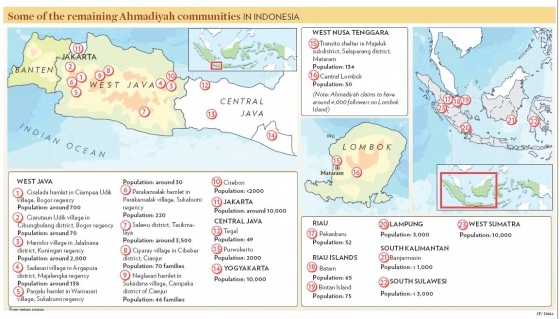
Ahmadiyya Communities in Indonesia

 
^ Top of Page