Showing posts with label religion. Show all posts

Tuesday, August 2, 2011

Muslim sect braces for Indonesia Ramadan violence

The Straits Times, Singapore
Breaking News
August 02, 2011 Tuesday
Updated 11.29 pm
SE Asia
Home > Breaking News > SE Asia > Story
Aug 02, 2011
Muslim sect braces for Indonesia Ramadan violence
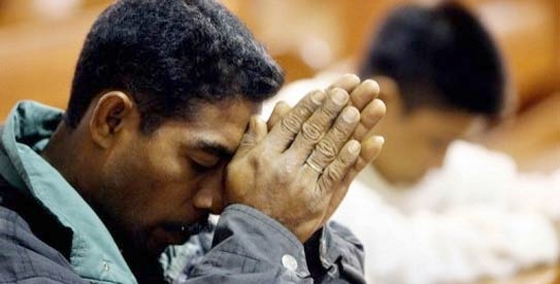
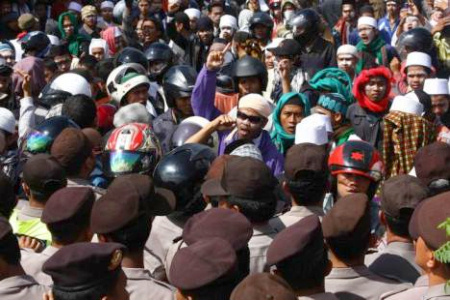
Ahmadiyah leaders said they feared the worst after a court last week handed down sentences of only a few months in jail to hardliners who killed three sect members in a vicious mob attack. -- PHOTO: REUTERS
Ahmadiyah leaders said they feared the worst after a court last week handed down sentences of only a few months in jail to hardliners who killed three sect members in a vicious mob attack. — PHOTO: REUTERS
JAKARTA - AS MOST Indonesian Muslims started the fasting month of Ramadan peacefully this week, followers of the minority Ahmadiyah Islamic sect braced themselves for hatred and bloodshed.

Ahmadiyah leaders said they feared the worst after a court last week handed down sentences of only a few months in jail to hardliners who killed three sect members in a vicious mob attack.

‘The extremists say this is a holy month, everything must be pure and sacred. So we, the Ahmadiyah followers, must be cleared out,’ Ahmadiyah spokesman Firdaus Mubarik told AFP.

The sect is unorthodox in that it does not believe Mohammed is the last prophet of Islam. It claims 500,000 followers in Indonesia, where it has existed in relative calm since the 1920s.

Islamic vigilante groups, emboldened by a decree ordering the sect to stop spreading its beliefs in the Muslim-majority country, have recently started targeting the Ahmadiyah in an ugly wave of hate crimes.

‘For us, the fasting month doesn’t mean there’ll be peace for us to perform our religious obligations. On the contrary, there are more opportunities for Muslim extremists to mobilise and incite people to attack us,’ Mr Mubarik said. — AFP

Saturday, July 30, 2011

Indonesian Muslims demand Ahmahdiyah be outlawed

The Straits Times, Singapore
Breaking News
July 30, 2011 Saturday
Updated 3.30 pm
SE Asia
Home > Breaking News > SE Asia > Story
Jul 30, 2011
Indonesian Muslims demand Ahmahdiyah be outlawed

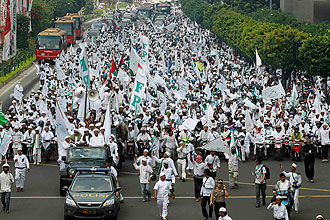
Members of Indonesia's Islamic Defenders Front (FPI) rally on the streets in Jakarta July 30, 2011. Members of the FPI are demanding the government to disband Ahmadiyah sect. Indonesia's Assembly of Indonesian Muslim Clerics (MUI) considers the Ahmadiyah sect to be 'heretical' for believing that Mohammad was not Islam's final prophet. -- PHOTO: REUTERS
Members of Indonesia's Islamic Defenders Front (FPI) rally on the streets in Jakarta July 30, 2011. Members of the FPI are demanding the government to disband Ahmadiyah sect. Indonesia's Assembly of Indonesian Muslim Clerics (MUI) considers the Ahmadiyah sect to be 'heretical' for believing that Mohammad was not Islam's final prophet. — PHOTO: REUTERS
JAKARTA — HUNDREDS of conservative Muslims held a noisy but peaceful rally in Indonesia’s capital on Saturday to demand the government outlaw an Islamic sect they consider heretical.

Nearly 1,500 white-robed protesters - gathering days after a court sentenced 12 men to less than six months in jail for lynching three Ahmahdiyah sect members - marched through the streets until they reached the presidential palace.

Some held placards that said ‘Disband Ahmadiyah or Revolution’ and ‘War against Ahmadiyah.’

Cleric Muhammad Rizieq Shihab shouted through his bullhorn that President Susilo Bambang Yudhoyono should ‘not be a coward.’ ‘Disband them!‘ he said, as the crowd of 1,500 cheered and chanted ‘Allah Akbar’ or ‘God is great’.

Indonesia, a predominantly Muslim and secular nation of 240 million, has a long history of religious tolerance.

But experts say a small, extremist fringe has grown more vocal in recent years and is seeking - with some success - to impose its will on police, the judicial system and the government. They’ve been emboldened by the inaction of Mr Yudhoyono, who relies on the support of Islamic parties in Parliament, and does not want to offend conservative Muslims by taking sides. — AP

Thursday, July 28, 2011

Indonesia sends ‘chilling message’ in mob trial: HRW

Daily Dawn, Pakistan
World
Indonesia sends ‘chilling message’ in mob trial: HRW
July 28, 2011AFP
Two days after a Muslim lynch mob killed members of a minority Islamic sect two churches have been set alight. – AFP Photo
Two days after a Muslim lynch mob killed members of a minority Islamic sect two churches have been set alight. — AFP Photo
SERANG: An Indonesian court on Thursday sentenced religious fanatics who killed three members of a minority Muslim sect in a frenzied mob attack to between three and six months in jail.

Dani bin Misra, a 17-year-old who smashed a victim’s skull with a stone, received three months for manslaughter.

Idris bin Mahdani, who led the mob of more than 1,000 Muslims in the February attack, was convicted of illegal possession of a machete and received five months and 15 days in jail.

Twelve people stood trial but none faced murder charges in what human rights activists said was a travesty of justice in the world’s most populous Muslim-majority country.

The unprovoked violence against the Ahmadiyah sect members in Cikeusik, western Java, was one of the most horrific in a long line of attacks on the minority group in Indonesia in recent years.

A secretly filmed video of the attack brought religious violence in Indonesia under the international spotlight, and provoked condemnation from the United States, Italy and international rights groups.

“When the Cikeusik video went viral, people around the world were shocked and appalled by the savagery of the mob kicking and slashing three men to death,” Human Rights Watch Deputy Director for Asia Phil Robertson said.

“But instead of charging the defendants with murder and other serious crimes, prosecutors came up with an almost laughable list of ‘slap-on-the wrist’ charges.

“The Cikeusik trial sends the chilling message that attacks on minorities like the Ahmadiyah will be treated lightly by the legal system. This is a sad day for justice in Indonesia.”

©2010 DAWN Media Group. All rights reserved
URL: www.dawn.com/2011/07/28/indonesia-sends...hrw.html

Wednesday, March 9, 2011

Depok rules to ban Ahmadiyah from public worship

NATIONAL
Wed, 03/09/2011
11:13 PM
Depok rules to ban Ahmadiyah from public worship
Ina Parlina, The Jakarta Post, Jakarta
Following in the footsteps of East Java, West Java and South Sulawesi, Depok Mayor Nurmahmudi Ismail issued on Wednesday a ban forbidding the Ahmadiyah religious sect from practicing their religion in public.

Nurmahmudi said the ban was a follow-up to a 2006 joint ministerial decree and West Java gubernatorial decree, both of which ban the sect from practicing their religion publicly.

“This ruling is made to uphold security and order in society and to stop the spread of any errant teaching,” the Prosperous Justice Party members said as quoted by tempointeraktif.com on Wednesday.

Nurmahmudi said his administration would assign a special team led by the Depok city secretary to enforce the ruling and monitor the activities of the sect.

“The objective [of the team] is to monitor the activities of Ahmadiyah members from spreading their interpretation of the religion, which is against Islamic teachings. It will become an implementation of the joint ministerial decree as well as West Java gubernatorial decree,” Nurmahmudi said.

Copyright © 2008 The Jakarta Post - PT Bina Media Tenggara. All Rights Reserved
URL: www.thejakartapost.com/news/2011/03/09/depok...worship.html

Thursday, February 3, 2011

“No option” but to abide by PM’s decision on blasphemy: Sherry

Daily Dawn, Pakistan
Pakistan
“No option” but to abide by PM’s decision on blasphemy: Sherry
AFP
February 03, 2011
Sherry Rehman — (File Photo)

ISLAMABAD: A liberal lawmaker on Thursday accused Pakistan’s prime minister of sabotaging efforts to reform blasphemy laws that have been widely condemned by rights groups.

“Appeasement of extremism is a policy that will have its blowback,” said Sherry Rehman, a lawmaker for the main ruling Pakistan People’s Party (PPP).

The former information minister petitioned parliament to reform the legislation in November after a Christian woman was sentenced to death, but the private member’s bill was never listed on parliament’s agenda.

Despite escalating international condemnation and the murder of politician Salman Taseer for backing reform, the government refuses to consider any amendment, bowing to protest from the nation’s powerful religious right-wing.

Prime Minister Yousuf Raza Gilani on Wednesday told lawmakers that Rehman “agreed to withdraw her bill according to party policy”.

“The prime minister categorically made it clear that government has no intention to amend the law. Neither he nor the speaker of the national assembly has constituted any committee to consider the amendment bill,” his office said.

A furious Rehman disagreed, but said she had “no option” but abide by the decision after the prime minister ruled out any discussion.

“It was a question of protecting our citizens from injustice done in the name of a religion that values peace and tolerance more than anything else,” she said.

The government had pledged to keep intact the blasphemy law on December 30, in a bid to head off threatened protests.

The move exposed Rehman and Taseer as lone campaigners. Five days later Taseer was murdered outside an Islamabad cafe by his bodyguard, since lauded a hero by hundreds of religious conservative clerics, student activists and lawyers.

The law stirred fresh controversy this week after the arrest of a 17-year-old boy for allegedly writing a blasphemous comment in a school exam.

Human rights campaigners say the law encourages Islamist extremism and is too often used to settle personal scores.

“Pakistan has set the standard for intolerance when it comes to misusing blasphemy laws, but sending a schoolboy to jail for something he scribbled on an exam paper is truly appalling,” said Human Rights Watch.

While the law carries a maximum penalty of death, those sentenced to hang in the past have had their sentences overturned or commuted on appeal.

©2010 DAWN Media Group. All rights reserved
URL: www.dawn.com/2011/02/03/no-option...sherry.html

Wednesday, January 26, 2011

Kidnapping for ransom a boon for militants

Daily Dawn, Pakistan
Pakistan
Kidnapping for ransom a boon for militants
From the Newspaper
January 26, 2011

ISLAMABAD, Jan 25: Kidnapping for ransom has always been a well-paying crime but the entry of militants has made this more profitable, which is why the incidence of the case is continuously rising.

Senior investigating officers of police claim that militants are involved in kidnapping cases in all corners of Pakistan.

“They are directly involved in kidnapping in Punjab, Khyber Pakhtunkhwa, Sindh, especially in Karachi, and Islamabad,” one police officer tells Dawn.

Senior police officers say that money is the main reason for the increased incidence of kidnapping though the militants have also started using it as a tactic to pressure law enforcement and intelligence agencies; in a number of cases they refuse to accept money in exchange for the hostage and ask for the release of their arrested accomplices.

“A third reason is also to spread fear,” says a senior policeman.

However, a new trend is the links the militants and the criminal gangs are forming with each other at different levels. These had first been established when kidnappings were carried out by the two groups together. By now it is routine practice for the kidnapping to be carried out by the local criminals of the area the hostage lives in either out of choice or because they have been asked to do so by militants.

In cases where the objective is to collect ransom, the local criminals continue to keep the hostage in their custody. The hostages are said to be kept in hideouts in Khyber Pakhtunkhwa and Central Punjab.

“But at times, especially when the militants want to spread fear, the hostage is kept in their custody,” says a police officer, adding that the Tehrik-i-Taliban militants have an exclusive committee (Shura) which decides the fate of the victims – exchange for ransom, exchange for militants in state custody or spread fear.

With the entry of militants, religion also tends to play a role in the kidnappings from the act to the negotiations to the release. In some cases, militants have picked up hostages, assuming that they were Ahmedi or Shia. The later realisation that the victims were Sunni compelled the militants to accept a reduced ransom. Some years ago a businessman from Islamabad was kidnapped only to be released when he and his kidnappers were intercepted at a checkpost as they were exiting Islamabad.

During interrogations, the kidnappers revealed that they had kidnapped the businessman because they thought he was a Qadiani. A similar perception about a law enforcement personnel’s faith also led to him being kidnapped.

Dawn has learnt that in many cases, religio-political leaders or religious leaders have helped at the negotiation stage. In such cases, the police react according to the politicians, who negotiate with the militants over the ransom, they added.

For instance, even the negotiations over the release of a Polish engineer, Piotr (Peter) Stanczak, were carried out with the help of a religio-political leader. But as the militants demanded the release of their accomplices arrested in connection with suicide attacks in Islamabad, the two sides could reach no agreement. It was after this that the kidnappers killed the engineer.

In some cases, however, as a last resort, prisoners have been exchanged for hostages. This is what happened in the case of foreign engineers from an East Asian country.

As their captors refused to accept ransom money, the government had no choice but to release militants in exchange.

The ‘business’ has spread so far that separate groups of militants have been formed who ‘specialise’ in kidnappings – they select victims, collect information such as financial wherewithal, carry out the reconnaissance of the area. This information is passed on to the militants who then carry out the kidnapping themselves or pass it to other criminal gangs.

“In some kidnapping cases, the hostages’ families were even informed of their bank balances when the ransom was being negotiated,” an officer adds.

One such group is said to be headed by Mullah Sabir and Mullah Rahim which operates from South Waziristan.

Before they used to work independently but later they started kidnapping for ransom for the Tehrik-i-Taliban Pakistan, said an official.

©2010 DAWN Media Group. All rights reserved
URL: www.dawn.com/2011/01/26/kidnapping...militants.html

Sunday, December 12, 2010

Anti-blasphemy resolution at UN is absurd

Calgary Herald, Canada
Anti-blasphemy resolution at UN is absurd
By Dan Shapiro, For The Calgary Herald DECEMBER 12, 2010

The recent UN Human Rights Council draft resolution on “Combating defamation of religions” would make George Orwell roll over in his grave. If adopted by the UN General Assembly, it will give governments around the world unacceptable powers.

In the name of preventing religious discrimination, the resolution insulates religious orthodoxy from all criticism. The resolution is incoherent, self-contradictory and a gross violation of the fundamental freedoms of religion and expression.

Sponsored by Morocco on behalf of the Organization of the Islamic Conference (OIC), it lends cover and legitimacy to the blasphemy laws of oppressive states which do not respect their citizens’ religious freedom. It thus precludes any possibility of an Islamic reformation, the very thing many Muslims want.

How can you “defame” a religion by saying something “false” about it? “Defamation” involves making a purportedly factual claim about someone that harms their reputation, but is false. For example, Jerry Falwell famously sued Hustler publisher Larry Flynt for printing a cartoon implying Falwell had sex with his own mother in an outhouse. The U.S. Supreme Court ruled that public figures such as Falwell cannot be protected from offensive speech recognizable as satire. Why, then, should “religious symbols and venerated personalities” be protected from ridicule, as the resolution suggests?

Besides, religious disagreement is a very different beast than protecting individuals’ reputations. It is about the truth or falsity of the religion or religious claims. So, you can’t have a law against saying something “false” about a religion precisely because there is no agreed upon means of determining truth or falsity here.

If religious disputes are to be decided by the state, they will come down on the side of orthodoxy and against dissenting views every time.

The resolution claims, disingenuously, that it aims to combat discrimination based on religion. Of course, we should combat actual religious discrimination. For example, if you don’t get a job because you are Muslim or a Jew, that is unjustifiable discrimination. But this doesn’t mean that Islam or Judaism should be protected from criticism and debate.

The resolution is incoherent because it targets the wrong kind of discrimination and protects the wrong entities. Individuals have human rights to be protected; ideas, ideologies, religions and states do not.

Yet, the resolution claims that it protects freedom of religion. Invoking a measure that restricts freedom of religion (by seeking to make it illegal to express religious views that differ from official opinion) is a funny way to protect this fundamental freedom.

Belief systems such as religions are not homogeneous. Blasphemy laws exacerbate, rather than reduce, discrimination based on religion. Such laws violate state neutrality, since the state evaluates competing religious claims and punishes the dissenting minority.

Minorities who differ from the majority religion, for example Christians or non-believers in Muslim-majority countries, are at risk. So too are minority co-religionists, such as Ahmadis who do not view Muhammad as the last Prophet and are persecuted as apostates in many Muslim-majority countries.

Case in point: “Although Christians, Ahmadis, and Hindus make up less than three per cent of Pakistan’s population, they have accounted for about half of the blasphemy defendants over the last two decades,” according to “Policing Belief,” a recent Freedom House report. Pakistan’s Penal Code imposes capital punishment for blasphemy, including for defamation of Islam.

You can’t have meaningful freedom of religion and conscience without robust freedom of speech. For if we’re not free to express our deeply held beliefs, then it makes no sense to speak of freedom of religion and conscience.

In the case of blasphemy or “defamation of religion” laws, there is a dangerously slippery slope since they are often used to punish political opponents and dissidents. For example, bloggers in Pakistan and Iran who have criticized their governments have been charged with “defaming Islam.”

Unfortunately, it bears constant repetition: No government, church, mosque, synagogue or UN Human Rights Council should coerce you into thinking or saying – or, not thinking or not saying – what you believe (short of the infamous yelling “fire” in a crowded theatre exception).

The “defamation of religions” resolution is not about protecting human rights; it is about justifying repression of opinion not sanctioned by the authorities. The resolution does not advance freedom of religion; on the contrary, it curtails it in dangerous ways.

Dan Shapiro is a research associate with the Sheldon Chumir Foundation for Ethics in Leadership.

Copyright © The Calgary Herald

Thursday, November 4, 2010

Ahmadi rights: No grounds for a burial

Express Tribune, Pakistan
PAKISTAN
BLOGS
Ahmadi rights: No grounds for a burial
Aatekah Mir Khanby Aatekah Mir Khan
A senior sub-editor for the Lahore city pages of The Express Tribune
November 4 2010
The police were nice enough instead to act as an escort throughout the exhumation.
Politics is a dirty business, be it at any level. Add religion to it and it makes a messy mix.

On Sunday night, the body of an Ahmadi citizen was exhumed from a graveyard near Bhalwal, because the graveyard was a Muslim one.

The police harassed the family until they acquiesced to the demand.


There are only two Ahmadi families in that area, but they have lived there for decades. According to the brother of the deceased, their elders were also buried in the same graveyard. But this time around, the clerics in Sargodha decided that they did not want a graveyard of their faith ‘polluted’.

Religion is supposed to be something between you and God, even when you are alive. Thus, people who do not give the living that freedom are wrong, but to continue hounding a person based on their religion even when he is dead is detestable. But have we heard a single condemnation from any of the politicians or the religious leaders on the outrage? No. Why? Because commenting on anything that has to do with religion (if it is against what ‘they’ believe) is shunned like playing with fire. There is no way you can leave unscathed if you dare speak up.

As far as I know, the Quran doesn’t say anywhere that a Muslim is ordered – or even allowed – to disturb a dead man’s peace, even if he is not a Muslim-even if a non-Muslim is buried in a Muslim cemetery!

According to the police, they did so because they were afraid that unless they did what the clerics had asked (read: told) them to do, there would be a law and order situation. If you think it is strange that the police bend so easily to the whims of clerics, please don’t be. We live in a country where religion was infused into politics with such skill that even decades later, no one dares to spoil the fancy ‘finish’. If anything, everyone wants to add a cherry on top. The Hudood Ordinance and blasphemy laws are just two glaring examples of no-go-areas. If you need recent examples, then the unanimous condemnations of Nawaz Sharif – who ‘mistakenly’ called Ahmadis our brothers after the attack on their worship places in Lahore – and Nilofer Bakhtiar – for suggesting that there was nothing wrong with selling alcohol at TDCP motels – should help job your memory.

Just on Monday, there was a rally taken out by some religious parties at The Mall, which brought the city to a halt, Now usually, whenever there is a rally or a protest there, the police are willing to impose Section 144, but on Monday, they did not. The police were nice enough instead to act as an escort throughout. The reason? They did not want to be on the ‘wrong side’ of religious leaders. It’s fairly simple, really. Just like George W. Bush spelled it out: either you are with us or you are against us (and honey, you do not want to be against us). Why would they want to be? They can slap you with a fatwa and declare you worthy of being killed.

Keith Olbermann, an MSNBC anchor, wrote in August about the Ground Zero ‘mosque’ and appealed to Americans not to fall victim to “prejudice and religious intolerance and our greatest enemy: stupidity, exploited by rapacious politicians.” In the same column, he wrote how he interprets Pastor Martin Niemoller’s ‘Then they came’: “But Niemoller was not warning of the Holocaust. He was warning of the willingness of a seemingly rational society to condone the gradual stoking of enmity towards an ethnic or religious group, warning of the building-up of a collective pool of national fear and hate, warning of the moment in which the need to purge, outstrips even the parametres of the original scape-goating, when new victims are needed because a country has begun to run on a horrible fuel of hatred — magnified, amplified, multiplied, by politicians and zealots, within government and without…Niemoller was not warning of the holocaust. He was warning of the thousand steps before a holocaust became inevitable. If we are at just the first of those steps again — today, here — it is one step too close.”

URL: http://blogs.tribune.com.pk/story/2739/ahmadi-rights-no-grounds-for-a-burial/

Monday, August 16, 2010

Religious minorities in Indonesia push back

Daily Dawn, Pakistan
World
.
Religious minorities in Indonesia push back
   Monday, 16 Aug, 2010

Protesters cover their mouths as a sign of protest during a rally in Jakarta August 15, 2010. Several hundred Indonesians rallied in Jakarta on Sunday demanding that the president do more to protect freedom of religion and to punish hardline Muslim groups which have attacked minority faiths. - Reuters Photo
Protesters cover their mouths as a sign of protest during a rally in Jakarta August 15, 2010. Several hundred Indonesians rallied in Jakarta on Sunday demanding that the president do more to protect freedom of religion and to punish hardline Muslim groups which have attacked minority faiths. — Reuters Photo
.
BEKASI: Tired of government inaction, Christians and other religious minorities in Indonesia are pushing back against rising violence by Islamic hard-liners.

Christians were warned last week against worshipping on a field that houses a shuttered church in the industrial city of Bekasi, but 20 members of the congregation showed up anyway, opening their service with a hymn.

The act of defiance enraged 300 Islamic hard-liners, many of whom hurled shoes and chanted death threats before pushing past a row of riot police, chasing down members of the group and beating some with sticks.

“It’s nonsense,” said Yudi Tambunan of the Batak Christian Protestant Church, vowing to return every Sunday until their request for a house of worship, made more than two years ago, is approved.

“The constitution guarantees our right to practice our religion,” he said. “And we want to do that on our own property, in our own church.”

Indonesia, a secular country of 235 million people, has more Muslims than any other in the world. Though it has a long history of religious tolerance, a small extremist fringe has become more vocal in recent years.

Hard-liners have also become more violent, according to the Setara Institute for Peace and Democracy, a human rights group, which said there have already been 28 attacks on religious freedom in 2010, including everything from preventing groups from performing prayers to shutting down or burning houses of worship.

The institute said there were 18 such incidents in all of 2009 and 17 in 2008.

Although most Indonesians are moderate and oppose violence, President Susilo Bambang Yudhoyono’s government has been slow to intervene because it relies heavily on the support of Islamic parties in parliament.

Hundreds of people held an inter-faith rally the capital Sunday critisizing his soft line.

“Those attackers have to be arrested, otherwise they will feel their actions are right,” said Saur Siagain, a rally organizer, standing in front of a banner that said: “The president has to be responsible in guaranteeing freedom of religion.”

In some cases, provincial leaders even appear to be fanning the flames.

Acting on the orders of local officials, police helped hard-liners forcibly close several mosques owned by Ahmadiyah, an Islamic sect they call “deviant,” last month in Manis Lor, a village in West Java province.

But members of the sect, who differ from other Muslims about whether Muhammad was the “final” monotheist prophet, are refusing to buck under.

“We’re tired of being harassed and attacked,” said Yati Hidayat, a 48-year-old Ahmadiyah member. “We have the right to pray just like any other religious community. If anyone tries to stop us, we’re ready to fight.”

Recent attacks have largely been led by the Islamic Defenders Front, or the FPI, which is pushing for the implementation of Islamic-based laws in regions across the nation.

They are known for smashing bars, attacking transvestites and going after those considered blasphemous with bamboo clubs and stones.

Minority groups, who represent less than 15 percent of the population, have long tried to keep a low profile.

Christians have quietly applied and reapplied for permits so they could build their own churches, sometimes putting construction on hold for years as local authorities weigh the risks of angering hard-liners.

In the meantime, some congregations have held services in apartments, office buildings and even shopping malls.

But as attacks become more frequent and more brutal they – together with moderate Muslims – appear to be losing patience.

“The Batak Christian Protestant Church and Ahmadiyah were around long before FPI,” said Hilmar Farid from Indonesia’s Social History Institute. “They are getting tired of being intimidated.”

They are also weary of government inaction.

Yudhoyono has in recent days urged his countrymen to be tolerate of others, especially during the Islamic holy month of Ramadan. But he has not made any direct reference to recent violence.

Though police were present during the Aug. 8 attack in Bekasi, 25 miles (40 kilometers) east of the capital, they made little effort to stop FPI members as they got more and more vitriolic.

“The Batak Christians deserve to be stabbed to death,” yelled Murhali Barda, who heads the local chapter of FPI. “If they refuse to go home we are ready to fight.”

An argument broke out between Barda and three female members of the congregation.

He grabbed one by the neck and other hard-liners started punching them. All the while, men chanted from a truck and clerics made speeches saying “Leave … We will not let you perform prayers here!”

“God is great!” the crowd cheered in response.

Political analysts warn that unless the government steps in to end persecution of religious minorities soon, groups like FPI will get bigger and more powerful. – AP

©2010 DAWN Media Group. All rights reserved

Sunday, August 15, 2010

Hundreds protest in Jakarta, urge religious freedom

Reuters Blogs, USA

Hundreds protest in Jakarta, urge religious freedom
Sun Aug 15, 2010 3:04pm IST
Protesters cover their mouths as a sign of protest while gesturing during a rally in Jakarta August 15, 2010. Credit: Reuters/Supri
Protesters cover their mouths as a sign of protest while gesturing during a rally in Jakarta August 15, 2010.
Credit: Reuters/Supri

By Karima Anjani

JAKARTA (Reuters) — Several hundred Indonesians rallied in Jakarta on Sunday demanding that the president do more to protect freedom of religion and to punish hardline Muslim groups which have attacked minority faiths.

The protest reflects growing public alarm over recent attacks on churches, Christian prayer gatherings, and on mosques used by the Ahmadiyya, an Islamic sect that some Muslims deem heretical.

Such attacks have hurt Indonesia’s reputation for religious tolerance, and could potentially threaten the status of Southeast Asia’s biggest and most-populous economy as an attractive investment destination, in turn derailing growth and development.

Indonesia is officially secular and recognises six main faiths – Islam, Christianity, Catholicism, Buddhism, Hinduism, and Confucianism – of which Islam is the most widespread, accounting for about 85 percent of the population and making Indonesia the world’s most populous Muslim country.

In the past, attacks on minority religions in other parts of the country have led to wider outbreaks of violence, for example in the aftermath of President Suharto’s ouster in 1998.

Several of the recent attacks have involved members of Muslim gangs such as the Islamic Defenders Front or FPI, a hardline group whose members are considered as little more than thugs and racketeers because of their suspected links to the police and use of intimidation and violence.

Many Indonesians were outraged when Jakarta’s governor, Fauzi Bowo, and the head of the Jakarta police, attended the FPI’s 12th anniversary celebration recently – a move seen as an official endorsement of the group’s vigilantism.

On Sunday, about 500 people, many carrying red-and-white Indonesian flags and red ribbon arm bands, chanted “freedom of worship, freedom for all religions,” and sang religious songs as they rallied around the National Monument in Jakarta.

“We’ve been patient enough over these recent incidents of violence and brutality, even against women and children. We have reported these criminal acts to the police, and we’ve seen no firm response against the attackers,” said Saor Siagian, spokesman of The Forum for Religious Freedom Solidarity.

“If this escalates it could potentially lead to a more dangerous situation and poses a real threat to this nation. So far, the president hasn’t taken any firm action.”

The Setara Institute for Democracy and Peace last month reported an increase in the number of attacks by “intolerant groups”, citing forced closures of churches, the withholding of building permits for churches, and torching of church buildings.

Many of the attacks have taken place in the areas around the capital Jakarta, including Bekasi, Bogor and Tangerang, which have become strongholds for hardline groups.

These areas increasingly support sharia law and want it to be compulsory for women to wear the headscarf, according to a recent survey by Roy Morgan, whereas nationwide support for sharia law has declined over the past nine months.

“It is easy for Muslims to build a place of worship, while the others find it difficult to get a permit from the government,” said Faisal Rahman, a Muslim who joined the protest.

“Islam and the prophet’s teachings show that all religions should be treated equally. This is not an Islamic nation. People should be able to worship freely.”

(Writing by Sara Webb; Editing by Sanjeev Miglani)

URL: http://in.reuters.com/article/idINIndia-50855020100815

Sunday, August 1, 2010

Politics Seen in Ahmadiyah Violence

Jakarta Globe, Indonesia
August 1, 2010
Farouk Arnaz & Antara

Politics Seen in Ahmadiyah Violence
.
Kuningan, West Java. The forcible closure of Ahmadiyah mosques, which led to rioting in Manis Lor village in Kuningan, West Java, was most likely fueled by the political desires of district head Aang Hamid Suganda, an official from the Commission for Missing Persons and Victims of Violence alleged on Sunday.

“We found a fact [regarding Aang’s political designs]. We need to confirm it, but we believe it to be true,” said Sinung Karto, a member of the commission also known as Kontras.

“After two years of peace, anarchy occurred last Thursday.

This was triggered by instructions issued by the district head to seal off Ahmadiyah mosques,” he said, adding that the commission had undertaken two days of intensive research and investigations at the scene of the violence.

Sinung said that Aang had promised to close the mosques during his campaign for the 2008 district head election, in which he won a second term.

Aang’s term ends in 2013, and even though he cannot run for a third term, he is believed to be preparing the way for his wife, Utje Ch, to succeed him.

Closing down the Ahmadiyah mosques, Sinung suggested, was an effort by Aang to achieve this by courting public support.

Indra Listiantara, from the Setara Institute for Peace and Democracy, said that having investigated the case, Setara had come to the preliminary conclusion that Aang had ordered the mosques closed for political reasons.

“We suspect that once his term as Kuningan district head ends, Aang will run in the West Java gubernatorial election,” Indra said.

“He wants to keep his support base intact, and gaining political support from Muslim hard-liners by openly opposing and taking action against Ahmadiyah is key to that.”

Both Indra and Sinung have called on the police to take action and investigate the mosque closures and subsequent violence.

“Even though the police were a little slow in preventing what transpired on Thursday, we have to give them credit for stopping the scuffles from degenerating into a full-blown riot,” Indra said. “They should, however, find the person responsible for the incident.”

Police officers, acting on orders from Aang, on Thursday sealed off Ahmadiyah mosques in Manis Lor after having failed to do so on Monday due to resistance from the group’s members.

But as the protesters blocked police attempts to shut down their mosques, groups of hard-line Muslims flocked to the village and scuffles broke out.

Amid pressure from Muslim groups, the government in 2008 prohibited members of Ahmadiyah from practicing their faith in public or proselytizing, but stopped short of banning the sect.

Many mainstream Muslims consider Ahmadiyah deviant because its members recognize the sect’s founder, Mirza Ghulam Ahmad, as a prophet.

Kuningan Police Chief Adj. Sr. Comr. Yoyoh Indayah confirmed that Aang issued an official letter last Thursday to seal off the mosques, “based on the demands of a certain Islamic group.”

“I do not want to speculate about what was behind the letter or those demands. I don’t know about political motivations,” Yoyoh told the Jakarta Globe.

“Nobody was arrested because I prefer to [keep the peace]. Those who sealed off the mosques, by the way, were not locals. They were from Tasikmalaya, Sumedang and Ciamis.”

Meanwhile, the Indonesian Legal Aid Foundation (YLBHI) said that if the government did not take action against the hard-liners, it was in effect endorsing further violence.

“We believe that violence against minority religious groups will continue if the government does not do anything,” Erna Ratnaningsih, from the YLBHI, said on Saturday.

Ifdal Kasim, from the National Commission on Human Rights (Komnas HAM), said he regretted a recent statement by Religious Affairs Minister Suryadharma Ali, in which he declared Ahmadiyah haram, or forbidden.

“The government must admit to the existence of Ahmadiyah in Indonesia. It is the government’s job to allow the Ahmadis to hold their prayer services,” Ifdal said, a day after Suryadharma declared Ahmadiyah was haram because it was a misguided sect that did not consider Muhammad to be the last prophet.

Suryadharma urged police to take action against Ahmadis found spreading their teachings, even as he warned residents in Kuningan not to take the law into their own hands.

Hasyim Muzadi, who formerly led Nahdlatul Ulama, the largest Muslim organization in Indonesia, also said that even if Ahmadis veered away from mainstream Islamic teachings, Indonesians must not take the law into their own hands.

“Violence will cause those ideologies to turn even more militant, because they are pressured through physical means,” Hasyim said.

Copyright 2010 The Jakarta Globe

Saturday, July 31, 2010

Indonesian President: Hit Back at West Java ‘Anarchy’

Jakarta Globe, Indonesia

July 31, 2010
Camelia Pasandaran
Police form a line between Ahmadiyah protestors who want their mosque reopened and mainstream Muslims who want to make sure it stays closed. (AFP Photo/Yonda)
.
Indonesian President: Hit Back at West Java ‘Anarchy’
.
Jakarta. Amid rising tensions in Kuningan, West Java, following the closure of Ahmadiyah mosques there by security officials, President Susilo Bambang Yudhoyono on Friday called for firm police action.

Djoko Suyanto, coordinating minister for political, legal and security affairs, said the president had instructed him to order the police to take resolute action against the unrest.

“In my opinion, anarchy — no matter by whom or where — should be handled firmly,” the minister quoted Yudhoyono as saying.

The Kuningan Police have already been told of their duties, Djoko said, adding that he had confidence they would be able to contain the situation.

Police officers, acting on orders from the Kuningan district head, on Thursday sealed off Ahmadiyah mosques in Manis Lor village after having failed to do so on Monday due to resistance from the group’s members.

But as the protesters blocked police attempts to shut down their mosques, groups of hard-line Muslims flocked to the village and scuffles have broken out. Police have since been busy preventing an escalation in violence.

Amid pressure from Muslim groups, the government in 2008 prohibited members of Ahmadiyah from practicing their faith in public or proselytizing, but stopped short of banning the sect that many mainstream Muslims consider deviant.

Unlike other Muslims, members of Ahmadiyah recognize the sect’s founder, Mirza Ghulam Ahmad, as a prophet.

While ordering the police to be firm, Djoko recognized they also faced difficulties in containing the situation. “If there are only five officers up against 500 people, they cannot be firm,” he said. “So they have to adjust to the conditions in the field.”

Kuningan’s district head, Aang Hamid Suganda, who had ordered the mosques sealed, called on all parties to avoid violence.

“We must make all Kuningan people feel secure,” Aang said. “Violence is not the best way to solve problems, so let us discuss it and go through legal channels.

Dedeh, a resident of Manis Lor, said it had been four days since villagers had boarded up their windows to protect them from stones being thrown by protesters.

According to Dedeh, Thursday’s clashes were relatively minor compared to the violence that occurred last year and in 2007.

The Jakarta Legal Aid Foundation (LBH) on Friday urged the government to punish people who resorted to violence or infringed on freedom of worship.

“It is not only about the right to have a religion or faith, but also about the right to feel secure, to be protected, to be free from discrimination, and the right to be protected as a minority,” said Nurkholis Hidayat, LBH’s director.

He said both the central government and regional administrations should be responsible for protecting and promoting human rights, as well as all religions and faiths, including Ahmadiyah.

The Setara Institute for Peace and Democracy also said on Friday that the state should safeguard freedom of religion.

“The president should be embarrassed if there are citizens who are unable to worship because of pressure from unruly masses.”


Additional reporting by Antara

Copyright 2010 The Jakarta Globe

Friday, July 30, 2010

Minority Islamic sect under fire in Indonesia

Yahoo News


Minority Islamic sect under fire
in Indonesia
.
Achmad Ibrahim, Associated Press Writer — Fri Jul 30, 11:03 am ET
.
MANISLOR, Indonesia – A minority Islamic sect told followers Friday to prepare for war after rock-throwing mobs attacked one of their mosques in central Indonesia, calling its members heretics.

The weeklong violence in Manislor, a village in West Java province, peaked Thursday after more than 500 hard-liners from the Islamic Defenders Front, known as FPI, clashed with 3,000 Ahmadiyah sect followers.

At least eight people were injured, including three police.

“We have to defend ourselves and our mosques,” said Deden Sujana, who heads security for the sect, saying hard-liners have “gone too far.”

“We call on Ahmadiyah followers to fight against them in the name of Allah,” Sujana said.

Indonesia, a secular state of 235 million, has more Muslims than any other in the world.

Most people practice a moderate form of the faith, but a small but vocal extremist fringe has gained influence in recent years because the government relies heavily on Muslim parties in parliament.

Ahmadiyah, which has roughly 200,000 members, is considered deviant by conservatives because it does not recognize Muhammad as the final prophet. Perpetrators of violence against the sect often go unpunished.

Tensions started building around Manislor after local authorities sealed Ahmadiyah’s An-Nur mosque, saying they had violated a 2008 government decree that stops short of banning the group but orders members to stop practicing.

That gave FPI, hard-liners known for attacking nightclubs and bars, the unspoken go-head to target the sect.

Mobs threw rocks over the wall. Police, who are bracing for more violence over the weekend, responded by firing tear gas.


It is surprising to note that reporter mis-quoted Jamaat Ahmadiyya’s view and misunderstood it a “call for war”. Ahmadiyya Muslims in Manis Lor are trying to save their Eight Mosques from destruction by unruly mobs coming from other cities.

Ahmadiyah Clashes Continue in Indonesia

Jakarta Globe, Indonesia

July 30, 2010
Nurfika Osman, Ronna Nirmala & Camelia Pasandaran

A group of people believed to be Ahmadiyah followers fight back as Indonesian mainstream Muslims try to attack their mosque in Manislor village, Kuningan district, on Thursday. (AFP Photo/Yonda)

Ahmadiyah Clashes Continue in Indonesia

As the standoff between West Java villagers and followers of the Ahmadiyah sect entered its fourth day, the Ministry of Religious Affairs said it was trying to mediate the week-long dispute, which flared into violence again on Thursday.

Religious Affairs Minister Suryadharma Ali said the tension was essentially a “political problem.” He did not elaborate further but urged the warring parties to settle their dispute peacefully.

“Differences of opinion over religion should not be solved with violence but through discussion,” he said.

The Ahmadiyah is perceived as a deviant sect by mainstream Islam. The government has stopped the group from worshiping in public but has fallen short of banning it altogether.

After a failed attempt to seal the sect’s mosques in a village in Kuningan on Monday, police and the Public Order Agency (Satpol PP) followed through with the closures on Wednesday, meeting fierce resistance.

“Government officials have an obligation to protect citizens without looking at their beliefs,” Ifdhal Kasim, the chairman of the National Commission on Human Rights (Komnas HAM) told the Jakarta Globe on Thursday. “Sealing their house of worship is against the Constitution.”

Ahmadiyah followers and security forces clashed again on Thursday as groups opposed to the sect joined local police and Mobile Brigade (Brimob) units trying to close several mosques.

Groups claiming to support a pure form of Islam against the Ahmadiyah gathered around the entrance to Manis Lor village in Kuningan in the morning, following the sealing of eight Ahmadiyah mosques in the village, a local police officer said.

“At first, the anti-Ahmadiyah groups pelted the mosque with stones. The followers of Ahmadiyah were angry because their mosque was attacked, and there was fighting,” the officer said of Thursday’s violence, which reportedly stopped just after midday prayers. Ifdhal said Ahmadiyah followers were the real victims in the violence.

“They face many forms of discrimination. Their access to education and livelihood is limited and at the same time they are facing a government that facilitates the discrimination,” he said.

Bonar Tigor Naipospos, deputy chairman of the Setara Institute for Peace and Democracy, said the state should guarantee religious freedom to all, including the Ahmadiyah.

The group is often a target of orthodox Muslims worldwide because of its claim that the sect’s founder, Mirza Ghulam Ahmad, is the last prophet, a view many consider blasphemy.

The government passed a decree in 2008 prohibiting the sect from practicing its faith in public or trying to convert others to its beliefs. [**]

According to Setara, which monitors religious tolerance, the past month has seen a sharp increase in acts of violence against the Ahmadiyah, especially in West Java.

“The use of public pressure and regional government power has been a systematic pattern in violations of religious freedom recently,” Bonar said.

The Kuningan district government has used pressure groups to back its effort to close the Ahmadiyah mosques in Manis Lor, but Bonar doubts they are local villagers. “According to our sources, these people did not come from Kuningan, but from other areas such as Ciamis and Tasikmalaya,” he said.

Bonar urged President Susilo Bambang Yudhoyono to show his commitment to pluralism by speaking out against the violence.


The statement is erroneous. Hadhrat Mirza Ghulam Ahmad of Qadian did not make any such claim of being last prophet. Please visit Alislam.org/messiah for further info.

Copyright 2010 The Jakarta Globe

Rights Commission Urges Authorities to be Strict on Sectarian Attack

TEMPO Interkatif, Indonesia
Rights Commission Urges Authorities to be Strict on Sectarian Attack
Friday, 30 July, 2010 | 13:13 WIB

TEMPO Interactive, Jakarta — The National Human Rights Commission has responded to a renewed attack on the banned Islamic sect the Ahmadiyah yesterday (29/7) in West Java which involved thousands from different islamic organisations in Kuningan Regency.

Stanley Adi Prasetyo a commissioner with the national body said today (30/7) “even law enforcement apparatus could not curb certain belief of faith let alone those who are not part of the authority.”

Thousands of people from different islamic group which are against the Ahmadiyah sect attacked a group of people after a religious gathering by the Ahmadiyah group in Manis Lor Village on Thursday (29/7). Attacks on the group have been reported since 2007.

Stanley said authorities should take strict measure against those who take the law into their own hands radically which he said will affect those outside the conflict.

ARIE FIRDAUS


The statement is erroneous. Hadhrat Mirza Ghulam Ahmad of Qadian did not make any such claim of being last prophet. Please visit Alislam.org/messiah for further info.

Copyright © 2010 TEMPOinteraktif
URL: www.tempointeractive.com/hg/nasional/2010/07/30/brk,20100730-267511,uk.html

Thursday, July 29, 2010

Indonesia mob attacks Muslim sect

AlJazeera News
UPDATED ON:
Thursday, July 29, 2010
21:18 Mecca time, 18:18 GMT
.
NEWS   Asia-Pacific

Indonesia mob attacks Muslim sect

The mob stoned the mosque of Ahmadiya sect, whose beliefs contradicts mainstream Islam [AFP]
Indonesian police have clashed with about 200 people trying to attack a mosque used by a minority Islamic sect known as Ahmadiya.

The mob hurled stones at the mosque in Manislor village in Kuningan district in West Java, prompting an hour-long confrontation with police, a local Ahmadiya official said.

“About 200 people pelted stones at our mosque and clashed with the police for about an hour. It is not clear yet who was the organiser of the mob,” Nurahim, the local general secretary of the sect, told the AFP news agency.

“The police were able to secure the mosque and handle the people. The situation, however, is still tense now.”

Nurahim said the village’s 3,000 Ahmadiyah followers were ready to help the police if needed but would not respond to the violence.

“We had a similar experience before in 2007, in which our mosque and houses were attacked. A house was burned and several were damaged at the time,” he said.

The Ahmadiyah sect, which claims 500,000 followers in Indonesia, believes that its founder Mirza Ghulam Ahmad was the final prophet and not Mohammad, contradicting a central tenet of mainstream Islam.

Ahmad claimed to be a reincarnation of Prophet Mohammad, a claim rejected by Muslim authorities and scholars.

He also claimed to to be the Christian messiah. His sect believes that Jesus did not die on the cross, but he moved to India where he died at the age of 120.

Indonesia’s top Islamic body issued a fatwa in 2008 describing the sect as “deviant”.

Ahmadiyah has had a presence in the country since the 1920s.

Aljazeera.net/english 2003 - 2010 ©

Hundreds attack mosque

The Straits Times, Singapore
Breaking News
July 29, 2010 Thursday
Updated 11.17 pm
SE Asia
Home » Breaking News » SE Asia » Story
Jul 29, 2010
Hundreds attack mosque
JAKARTA - INDONESIAN police clashed with about 200 people on Thursday as the mob tried to attack a mosque in West Java belonging to a minority Islamic sect.

The crowd hurled stones at an Ahmadiyah mosque in Manislor village in Kuningan district, leading to an hour-long conflict with police, said local general secretary of the Ahmadiyah sect, Nurahim.

‘About 200 people pelted stones at our mosque and clashed with the police for about an hour. It’s not clear yet who was the organiser of the mob,’ Mr Nurahim, who goes by one name, told AFP.

‘The police were able to secure the mosque and handle the people. The situation, however, is still tense now,’ he said.

Mr Nurahim said the village’s 3,000 Ahmadiyah followers were ready to help the police if needed and were not carrying out counter-attacks.

‘We had a similar experience before in 2007, in which our mosque and houses were attacked. A house was burned and several were damaged at the time,’ Mr Nurahim said. – AFP

Situation in Manis Lor Remains Tense as Ahmadi Hold Firm

Jakarta Globe, Indonesia
July 29, 2010
Situation in Manis Lor Remains Tense as Ahmadi Hold Firm

The stand-off between locals and followers of the Ahmadiyah sect in Manis Lor village, Kuningan, West Java, is continuing.

On Thursday, 300 Islamic activists from Kuningan, Ciamis and Indramayu districts gathered at the village to protest against the continued existence of the Ahmadiyah community.

Ahmadiyah is seen as a deviant sect by mainstream Muslims. The government has banned the group from holding its rituals in public but has stopped short of banning it altogether.

Metro TV reported that Kuningan district head Aang Suganda arrived at the village to meet with both sides of the dispute.

He urged the parties to discuss their differences peacefully and avoid resorting to violence.

Meanwhile, in front of the An-Nur Mosque, 200 Ahmadiyah followers remained on guard, along with Kuningan Police and local Public Order Agency (Satpol PP) officers.

Many villagers were forced to erect signs in front of their homes. The signs read: “The residents in this house are not Ahmadiyah and please do not damage our house.”

Two previous attempts by local authorities and police to close the mosque have failed after they were met with fierce resistance.

The Setara Institute for Peace and Democracy recorded 33 cases of attacks against Ahmadiyah members last year and well as many other cases of religious discrimination against Christians.

Copyright 2010 The Jakarta Globe

In Indonesia, Muslims, Ahmadis in standoff

CNN, USA
In Indonesia, Muslims, Ahmadis in standoff
From Kathy Quiano-Castro, CNN
July 29, 2010 -- Updated 1355 GMT (2155 HKT)
.
Jakarta, Indonesia (CNN) – Sectarian tensions rippled through an Indonesian town Thursday, where groups squared off over the closing of a minority group’s mosques.

Groups of Muslims and Ahmadis threw rocks at each other in the West Javan village of Kuningan, with police standing guard between the two groups.

Indonesian TV showed scenes from the village and quoted police and others about the tensions.

The violence flared after the local government ordered the sealing and closing down of several Ahmadi mosques.

Ahmadis, a religious group loathed by many in the Muslim world, are considered heretical and have been persecuted.

Sunni and Shiites do not consider the Ahmadis part of Islam because they do not regard Mohammed as the last prophet sent by God. [**] As such, they have been targeted by Islamic extremists.

The Indonesians haven’t banned the group but have issued a decree banning the religion from holding public gatherings and spreading their beliefs. An Islamic council there also issued a fatwa against the group.

After the mosques were ordered closed, Ahmadis resisted, hurling rocks at police deployed there. Islamic activists came to the scene and demanded the closings.

Anti-Ahmadi protesters tried to break through the police barricade to get to the mosques. Residents fearing more attacks have put up signs in front of their homes, saying they’re not members of the Ahmadiya group.

Police officer Yoyo Indayah, from the Kuningan police, says officers were trying to persuade the activists to leave the site after evening prayers.

Slamet Effendy, head of the commission on inter-religious harmony in the Indonesian Islamic Clerics Council, said in a TV interview that he hopes for a peaceful resolution to the conflict.

“Our security officers are still guarding the sealed mosques,” a police commander, S. Priyono, said on TV.


The statement is erroneous. Hadhrat Mirza Ghulam Ahmad of Qadian did not make any such claim of being last prophet. Please visit Alislam.org/messiah for further info.

© 2010 Cable News Network. Turner Broadcasting System, Inc. All Rights Reserved.
URL: http://edition.cnn.com/2010/WORLD/asiapcf/07/29/ind...#fbid=c78-j6zQYaU

Hundreds attack Ahmadiyah mosque in Indonesia

Saigon Post, Vietnam
INTERNATIONAL
Thursday ,Jul 29,2010, Posted at: 15:08(GMT+7)
Hundreds attack Ahmadiyah mosque in Indonesia
.
JAKARTA, July 29, 2010 (AFP) — Indonesian police clashed with about 200 people Thursday as the mob tried to attack a mosque in West Java belonging to a minority Islamic sect.

The crowd hurled stones at an Ahmadiyah mosque in Manislor village in Kuningan district, leading to an hour-long conflict with police, said local general secretary of the Ahmadiyah sect, Nurahim.

“About 200 people pelted stones at our mosque and clashed with the police for about an hour. It’s not clear yet who was the organiser of the mob,” Nurahim, who goes by one name, told AFP.

“The police were able to secure the mosque and handle the people. The situation, however, is still tense now,” he said.

Nurahim said the village’s 3,000 Ahmadiyah followers were ready to help the police if needed and were not carrying out counter-attacks.

“We had a similar experience before in 2007, in which our mosque and houses were attacked. A house was burned and several were damaged at the time,” Nurahim said.

The Ahmadiyah sect, which claims 500,000 followers in Indonesia, believes that its founder Mirza Ghulam Ahmad was the final prophet and not Mohammed, [**] contradicting a central tenet of mainstream Islam.

Indonesia’s top Islamic body issued a fatwa in 2008 describing the sect as “deviant”.

Ahmadiyah, which many conservative Islamic leaders in the Muslim-majority nation describe as their enemy, has had a presence in the country since the 1920s.

The statement is erroneous. Hadhrat Mirza Ghulam Ahmad of Qadian did not make any such claim of being last prophet. Please visit Alislam.org/messiah for further info.


The statement is erroneous. Hadhrat Mirza Ghulam Ahmad of Qadian did not make any such claim of being last prophet. Please visit Alislam.org/messiah for further info.

© Copyright 2005 SGGP English edition
 
^ Top of Page