Showing posts with label arson. Show all posts

Tuesday, January 25, 2011

Governor Wants Lombok Tolerant, but Ahmadiyah-Free

Jakarta Globe, Indonesia
NEWS
Governor Wants Lombok Tolerant, but Ahmadiyah-Free
Nivell Rayda | January 25, 2011

Senggigi beach on Indonesia's Lombok. The island's governor wants to turn Lombok into a top holiday destination, but only if the minority Ahmadiyah leave the island. (Reuters Photo)
Lombok, Indonesia. West Nusa Tenggara’s governor dreams of turning Lombok into a top holiday destination, rich in culture and known for interreligious harmony — but only if a minority Muslim sect is out of the picture.

Zainul Majdi says that he did not see why the Ahmadiyah should be part of the island’s plans to follow in the footsteps of neighboring Bali, a noted tourist hotspot.

Ahmadis, Zainul said, would be better off moving out of the province entirely or agreeing to a proposal to relocate to a remote island in West Nusa Tenggara.

The governor said the sect — maligned by mainstream Muslims for believing that Ahmadiyah founder Mirza Ghulam Ahmad was a prophet, in opposition to Islamic tenets — did not fit into his drive to ramp up Lombok’s tourist appeal.

Zainul, a politician from the conservative Prosperous Justice Party (PKS), said he planned to promote dozens of traditional festivals to draw in more visitors.

The main highlight, he says, is Perang Topat, or rice cake war, a festival observed by both Hindus and Muslims in Lombok.

It is celebrated after Ramadan, the Islamic month of fasting, at the Lingsar Temple, a Hindu shrine in West Lombok.

The governor said he was eager to promote the rice cake festival as an example of the province’s cultural diversity and religious tolerance.

However, such tolerance was called into question by some residents in Mataram, who said the Ahmadiyah members had suffered through mob attacks, the closure of their mosques or eviction from their homes.

“The relationship between Muslims and Hindus is harmonious. Conservative Muslims also live side by side with other Islamic communities which still conform to animistic beliefs. How can Muslims be so violent toward the Ahmadiyah?” said Gusti, a Hindu driver in Mataram.

But Zainul, who referred to the sect as “my Ahmadiyah brothers,” said the only solution to tensions was to “get them out of the province” or move them to the remote village of Teluk Sepi in southern Lombok.

“Ahmadiyah had never been a problem. It was only after they formed their own community, maintaining their exclusivity and proselytizing their faith did friction with surrounding areas occur,” he said.

Copyright 2010 The Jakarta Globe
URL: www.thejakartaglobe.com/news/governor...free/418631

Monday, January 24, 2011

Hounded Indonesia Muslim Group Still in Dire Straits

Jakarta Globe, Indonesia
NEWS
Hounded Indonesia Muslim Group Still in Dire Straits
Nicholaus Prasetya | January 24, 2011

Mataram, West Nusa Tenggara. Last year, Faizah used the money she had painstakingly saved over the course of four years to rebuild the home that had been destroyed in a 2006 mob attack.

Last year, though, the village of this mother of four came under attack again, with Faizah and her neighbors being forced to flee.

A former resident of Gegerung village in West Lombok, Faizah is a member of Ahmadiyah, a minority Muslim sect deemed deviant and constantly harassed by mainstream Muslim groups.

On Nov. 26, more than a hundred people ransacked the village, with police standing by idly.

Speaking to the Jakarta Globe at a temporary shelter that houses around 500 displaced Ahmadiyah members in Mataram, the provincial capital, Faizah said that although her home was spared in the November incident, people did loot her possessions — and continue to do so.

“I am too afraid to return home,” she said. “I have been told there are still people taking away tiles from the roof of my home, stealing the wooden beams, taking everything I have. I believe all that’s left is just the skeleton of my former home.”

November’s violence was the third attack against the Ahmadiyah group in West Nusa Tenggara in recent years. Like most residents of Gegerung, Faizah and her family moved there from Selong village in neighboring East Lombok, where hard-line groups reduced their houses to rubble. Nobody was prosecuted for the attack, and the local administration did not compensate for losses.

In fact, amid intensifying calls to ban the sect, the central government issued a decree in 2008 that prohibited its members from practicing their faith in public and from spreading its beliefs.

“Before the [2006] incident, we lived harmoniously with [non-Ahmadiyah] residents,” Faizah said. “We prayed at the same mosques. They visited us like neighbors do. Some of them borrowed soap and kitchen utensils. There was never any tension.”

She accused firebrand clerics for fueling hatred toward the Ahmadiyah and intolerance in the district.

“There was this one man, Syafii. He used to borrow money from us. We were very nice to him and treated him like a family member. But when the attackers came, he joined them in destroying our homes,” Faizah said. “I guess the provocateurs brought out the worst in him.”

The only protection the government offered the displaced Ahmadiyah members was to relocate them to the Transito building complex in Mataram — an abandoned facility once used to temporarily house migrant workers.

More than 500 homeless Ahmadiyah members were cramped into the 600-square-meter facility. Four years on, the government seems to have forgotten about the displaced as they now live with hardly any running water, proper sanitation, electricity or financial assistance.

What was supposed to be a temporary solution seems to have become permanent. There have been no signs from the local administration that the Ahmadiyah members will be allowed to return to Gegerung.

Zubaidah, 52, another displaced Ahmadiyah member, agreed to show the 3-meter by 4-meter booth she shares with her two daughters, their husbands and her six grandchildren. The structure is in the corner of one of the 150-square-meter rooms in the run-down facility.

Up to 10 families occupy a single room, each with its own booth, partitioned off with bamboo poles, cardboard and pieces of fabric.

With such limited space, children are forced to play in the small hallways and toddlers are left to lie on the dirty tile floor as their mothers prepare meals in a small, makeshift kitchen outside.

Each family has its own kitchenette constructed of bamboo and a corrugated iron roof. The kitchenettes are dark, blackened by the fumes of kerosene stoves. Some poorer families cook with wood.

“Five years we have been neglected. In five years, government officials have never set foot in this place to check our condition or to listen to our problems,” Zubaidah said.

“Just once, in 2009, did they come — to erect a booth for the legislative and presidential elections, so that those of us who still had valid ID cards could vote.”

Those whose ID cards have expired have great difficulties in getting them extended because of their disputed residency status.

The grim conditions at the shelter have left some families willing to return to their village, despite knowing that police and the government have refused to vouch for their safety.

“The conditions at the shelter are unbearable to some, so many have reluctantly ventured to other cities and provinces,” said Jauzi Djafar, spokesman of the West Nusa Tenggara chapter of the Indonesian Ahmadiyah Congregation (JAI).

Jauzi added that the local government has refused to grant the displaced Ahmadiyah members ID cards, even though such cards are compulsory in Indonesia.

Without an ID card it is almost impossible for the Ahmadiyah members — having lost virtually all their belongings in the attacks — to apply for jobs, obtain a driver’s license or a passport for the hajj pilgrimage.

“Mataram refuses to give the displaced ID cards because officially they are residents of West Lombok district,” Jauzi said. “But the district argues they should apply for Mataram residency because they have been living here for years.”

All the displaced can do is work at local plantations or — like Faizah — make a living as a small-scale vendor.

Copyright 2010 The Jakarta Globe
URL: www.thejakartaglobe.com/news/hounded...straits/418628

Saturday, January 8, 2011

Arson attacks against Berlin mosques continue

The Local, Germany
Society
The entrance to the Ahmadiyya mosque. Photo: DPA
Arson attacks against Berlin mosques continue
Published: 8 Jan 11 13:37 CET

Police in Berlin are investigating an arson attack on a mosque in the capital city after a man walking past saw flames at the entrance in the early hours of Saturday morning.

Detectives said on Saturday there was a message left at the site of the attack at the Ahmadiyya community in the Wilmersdorf district of Berlin, but did not reveal what it said.

Someone had set the entrance to the mosque on fire, but the passer-by noticed the flames at around 1:45 am on Saturday, and started putting out the blaze himself. When police officers arrived, they finished off the job with a fire extinguisher from their vehicle.

Criminal detectives are now on the case, trying to determine whether there is a link between this attack and arson attacks on other mosques during 2010.

The last six months of last year saw six such attacks – the Shitlik mosque on Columbiadamm was attacked in June, twice in August and again in November, while the Neukölln Al-Nur mosque was attacked in November and an Islamic cultural centre in Tempelhof was targeted in December.

No-one was hurt in any of the attacks, but damage was done in every case.

DAPD/hc

Copyright The Local Europe GmbH All rights reserved.
URL: www.thelocal.de/society/20110108-32297.html

Friday, October 8, 2010

Three Suspects for Mob Attack on Ahmadiyah

Jakarta Globe, Indonesia
Indonesia
Three Suspects for Mob Attack on Ahmadiyah
Zaky Pawas | October 08, 2010

Jakarta. Police in Bogor have identified three suspects in last week’s torching of homes and a mosque belonging to members of the Ahmadiyah sect, but have not yet arrested any of them.

The attack on the evening of Oct. 1 saw a mob of hundreds ransack and burn down houses, schools and a mosque in Cisalada village, home to 600 followers of the minority sect, which is deemed deviant by many mainstream Muslims.

Since then, police have arrested an Ahmadiyah member for allegedly stabbing one of the attackers, a 15-year-old boy, during the incident.

On Friday, Adj. Comr. Zulkarnaen Harahap, the Bogor Police’s chief of detectives, said three of the alleged attackers — identified only as RM, DM and AB — had been named suspects in the case, but would not yet be taken into custody.

“We’re not detaining them because they’ve been vouched for by community leaders and their families. But they will have to report in regularly,” he said, adding that the trio would be charged with assault, vandalism and arson.

Zulkarnaen said the suspects had been questioned by police on Friday afternoon at the Ciampea subdistrict police station.

“During the questioning, all three suspects were cooperative,” he said. “Two of them claimed they didn’t do anything, so we’re going to try to strengthen the evidence that shows they were involved in the incident.”

Copyright 2010 The Jakarta Globe

Tuesday, October 5, 2010

Police in Bogor Make Arrest Over Ahmadiyah Violence

Jakarta Globe, Indonesia
INDONESIA
Police in Bogor Make Arrest Over Ahmadiyah Violence
Zaky Pawas, Farouk Arnaz & Arientha Primanita | October 05, 2010

Jakarta. Police have arrested an Ahmadiyah member alleged to have stabbed a teenager during last week’s attack on the minority Islamic sect in Ciampea, Bogor.

Adj. Comr. Zulkarnaen Harahap, Bogor Police’s chief of detectives, said on Monday that three other suspects, who are not members of the sect, were being sought.

The attack on Friday evening saw a mob ransack and burn down houses and a mosque in Cisalada village, home to 600 members of the Ahmadiyah — deemed a deviant sect by many mainstream Muslims.

Zulkarnaen said police had arrested a 30-year-old Ahmadi, identified only as AN, who was accused of stabbing Rendi Apriansyah, 15, during the violence.

“We are charging AN for now under Article 351 of the Criminal Code on aggravated assault, which carries a maximum prison term of five years,” Zulkarnaen told the Jakarta Globe.

Rendi, a student at a Bogor technical school, is being treated at the Bogor Indonesian Red Cross Hospital.

Zulkarnaen said that according to initial police investigations, Rendi was stabbed by AN because the teenager was pelting the Ahmadiyah mosque with stones.

He said Rendi was part of the first wave of attackers, numbering around 200, who broke the windows of At-Taufiq Mosque and set it on fire using Molotov cocktails.

A second group of attackers arrived later and looted 17 homes.

Zulkarnaen said that three other suspects, believed to have been involved in the attack on the mosque and homes, were being sought by police.

The attackers, believed to be residents of neighboring villages, also destroyed a kindergarten, an Islamic elementary school, a car and seven motorcycles during the violence.

“They [the suspects] were involved in the ransacking, looting and burning of the homes of the Ahmadiyah. None of them have been arrested,” Zulkarnaen said.

The four suspects were named after police questioned 20 witnesses, both members of Ahmadiyah and non-Ahmadis.

“We might still question more people. This case is not done yet,” Zulkarnaen said, adding that at least 400 police officers and soldiers had been deployed to Cisalada to prevent a repeat of the violence.

“Acting on instructions issued by West Java Police headquarters, the Ahmadis will receive protection here for an indefinite period, until things calm down,” Zulkarnaen said. Insp. Gen. Sutarman, the newly promoted Jakarta Police chief, acknowledged weaknesses in intelligence-gathering in relation to the Cisalada violence.

Sutarman, the former West Java Police chief, was promoted on Monday, replacing Comr. Gen. Timur Pradopo, who was appointed chief for security management at National Police headquarters and who was also named a candidate for National Police chief.

Sutarman, who had been appointed West Java Police chief in June, is expected to be replaced by Insp. Gen. Suparto Parni.

The Setara Institute for Peace and Democracy has criticized Sutarman’s appointment as Jakarta Police chief, pointing to what it said was his failure to address a string of attacks targeting minority religious groups in West Java.

“[Sutarman’s] track record as West Java Police chief must be considered, as there have been many cases of religious intolerance there,” said Ismail Hasani, a researcher at Setara.

Friday’s attack on the Ahmadiyah community in Bogor came just months after a similar attack on the sect in the province.

In July, Muslims and security personnel clashed with Ahmadiyah members over the closure of several mosques in Kuningan.

More recently, on Sept. 12, two Protestant church leaders in Bekasi were attacked by youths who said the leaders were not welcome in the area.

Asia Sihombing, an elder of the Batak Christian Protestant Church (HKBP) in Pondok Timur Indah, was stabbed by unknown assailants, while the Rev. Luspida Simandjuntak, a fellow leader, was beaten with a stick.

Both were taken to Mitra Keluarga Hospital in East Bekasi, where Sihombing underwent surgery and had to be monitored in the intensive care unit.

Copyright 2010 The Jakarta Globe

Govt blames Ahmadiyah for attacks

NATIONAL
Tue, 10/05/2010
10:00 AM

Govt blames Ahmadiyah for attacks
Erwida Maulia and Theresia Sufa, The Jakarta Post, Jakarta/Bogor

Ahmadiyah followers continue to encounter challenges in Indonesia in practicing their religion freely, with the government sticking to its belief that violent acts against the group is their own fault.

After Religious Affairs Minister Suryadharma Ali said Ahmadiyah “must be disbanded immediately” for allegedly violating an agreement it had earlier promised to comply with; Home Minister Gamawan Fauzi similarly criticized Ahmadiyah’s failure to comply with the agreement, although he said nothing about disbanding the group.

Speaking to reporters before a Cabinet plenary meeting at the Presidential Office on Monday, Gamawan said, “Ahmadiyah has agreed on the 12 points, and yet it fails to comply with them, which makes non-Ahmadiyah Muslims question it.”

“Had they implemented all the 12 points, I think other Muslims will accept them. If they fail to fully comply, [the violence] will continue.”

Gamawan was referring to a 2008 agreement between Jamaat Ahmadiyah Indonesia (JAI) and the Supervision Committee on Cults and Sects (Bakorpakem), which consists of 12 points including that Ahmadis should regard Mirza Ghulam Ahmad, the founder of Ahmadiyah, as a guru instead of a prophet, and that Ahmadiyah should not deem non-Ahmadiyah Muslims as non-Muslims.

He stopped short, however, at mentioning what points the Ahmadis have violated, saying the government was seeking a “permanent solution” to the issue, and that it wanted to collect views from different parties to do so. “We can’t decide on the solution yet as we haven’t had a hearing with Ahmadiyah,” Gamawan said.

Violent acts against Ahmadis in Indonesia have been rising at an alarming rate over the past few years, with the latest incident involving the arson attack on houses and a place of worship of Ahmadis in Cisalada village in West Java regency of Bogor last Friday.

The attack is rumored to have been triggered after a non-Ahmadiyah member of a neighboring village had been stabbed by the Ahmadis.

Bogor Police criminal division chief Adj. Comr. Zulkarnaen Harahap said Monday the police had

questioned 16 witnesses and named four of them suspects; a Cisalada resident for stabbing Rendi, 16, from the neighboring Pasar Salasa village, and three unidentified persons for the arson attack.

Separately in Bandung, the Alliance for Religious tolerance (AKUR) claimed it had found evidence that the Cisalada attack had been planned, and that the police had learned about the plan before the attack occurred.

“Thus, it is not true that there had been a stabbing by the Ahmadis prior [to the attack],” AKUR chairman Asep Hadian Pernama told reporters in the West Java capital.

Arya Dipa contributed to the story from Bandung.

Monday, October 4, 2010

Ahmadiyah should not promote teachings: Kalla

ARCHIPELAGO
Mon, 10/04/2010
9:35 AM

Ahmadiyah should not promote teachings: Kalla
The Jakarta Post

MAKASSAR: Ahmadiyah should not promote its views to the public because it strays from mainstream Islam, former vice president Jusuf Kalla says.

Kalla made the statement at a lecture to more than 6,600 Muhammadiyah University students in Makassar on Saturday.

However, people must avoid anarchism and violence in rejecting Ahmadiyah, he said.

“Ahmadiyah’s ideology does not conform with Islam. That’s why [Ahmadiyah] should not disseminate it to others. They may of course do so internally,” he said.

Some radical Muslims have violently attacked Ahmadiyah followers, most recently in Bogor, West Java. — JP

Government to review Ahmadiyah joint decree

HEADLINES
Mon, 10/04/2010
9:18 AM

Government to review Ahmadiyah joint decree
Arghea Desafti Hapsari and Theresia Sufa, The Jakarta Post, Jakarta/Bogor

In a bid to seek a “permanent solution” to the burning issue of Ahmadiyah, the government will review the controversial decree on the religious sect.

The director general of guidance to the Muslim community at the Religious Affairs Ministry, Nasaruddin Umar, said Sunday that there have been requests to “[assess] if the Ahmadis have actually complied with the [2008 joint ministerial] decree and whether the public in general have also done the same”. He added that the decree was bound not only to Ahmadis but also to people outside of the group.

Religious Affairs Minister Suryadharma Ali and Home Minister Gamawan Fauzi said last week they would meet to find a “permanent solution” to the Ahmadiyah problem. The talks are slated to start Monday.

The plan came on the heels of an arson attack on Ahmadis’ houses and places of worship in Ciampea village in the West Java regency of Bogor on Friday night.

Rafendi Djamin, Indonesia’s representative to ASEAN’s Intergovernmental Commission on Human Rights, said the talks would likely“lead to justifying a ban” on the religious sect.

“This is apparent from the fact that the government, through the Attorney General’s Office and the Religious Affairs Ministry, still supports the Indonesian Ulema Council’s interpretation of Islam.

Besides, the minister himself has time and again given his personal stance to disband the Ahmadiyah.”

Suryadharma has said Ahmadiyah “must be disbanded immediately” because it violated the decree, which states that Ahmadiyah cannot propagate its teachings. Jamaah Ahmadiyah, which has about 200,000 followers in Indonesia, has been the target of attacks from hard-line Islamic groups who demand that the sect be banned.

A mosque, five houses, a car and two motorcycles were burnt in the latest in a string of attacks on Ahmadis. On Sunday, the daughter of former president Abdurrahman Wahid, Inayah Wahid and the chairman of the National Commission on Children Protection, Seto Mulyadi visited the Ahmadi enclave.

Inayah said that whoever committed attacks on the minorities did not represent Muslims but only some people who wanted to destroy other beliefs. The attackers’ actions, she said, is based on “little knowledge of their religion” and “their own fears.” “I’m representing the Wahid family to show our support for the minority who are under attack,” she said. Lawmaker Gayus Lumbuun from the House of Representatives’ Commission III overseeing legal affairs expressed his concerns over “people who no longer have any regard for the law”.

“This is a tremendous threat to the nation’s unity,” he said, adding that both the religious affairs minister and home minister were responsible for the violence on Ahmadis. He promised to pool support from other House commissions to summon the ministers. “Warnings against them are useless. We will hold them responsible.”

He also said the talks should involve the National Commission on Human Rights, the National Commission on Violence against Women, interfaith groups and civil society groups that advocate on religious freedom. The deputy chairman of the Setara Institute for Peace and Democracy, Bonar Tigor Naipospos, said: “The talks should definitely involve Ahmadiyah members. There is no way the government can make a decision without taking the subject at hand into account.”

He urged the government to raise the awareness of followers of mainstream religions to show more tolerance to the minorities. “It is high time that tolerance comes from the majority,” he added.

Editorial: Zero Tolerance for Indonesian Terrorists and Bigots

Jakarta Globe, Indonesia
EDITORIAL
Editorial: Zero Tolerance for Indonesian Terrorists and Bigots
October 4, 2010

Turning up the heat against Islamic militants, the police raided a Sumatra hideout over the weekend, where they shot six suspects dead and arrested four others. The gunbattle, on the heels of a raid on another terrorist hideout last month, sent a strong signal to terrorists and extremists.

Indonesia is no longer a safe haven for them and they will be hunted down and dealt with in accordance with the law. Kudos to the police for continuing this fight and ensuring that militants and terrorists can no longer operate freely within our borders. The suspects are believed to be linked to a group accused of killing a police officer during a heist in Medan last August, which was meant to raise funds for terrorist attacks.

Also, the suspects were allegedly involved in an attack on a police station near Medan, where three police officers were killed. Indonesia has suffered a number of devastating terrorist attacks in recent years, claiming innocent lives and hampering economic stability.

Terrorists are waging a war in the name of Islam, but it is clear to Muslims that they have disparaged and insulted the religion through their actions.

These threats must be wiped out, but it will take time. We cannot rest. Security forces must remain alert at all times. While the police continue the fight against extremists, there are still worrying signs that they are not giving ample attention to protecting minority groups in the country.

Last Friday’s attack on members of the Ahmadiyah sect must be condemned and the perpetrators must be brought to justice. President Susilo Bambang Yudhoyono has appealed for calm and instructed the police to arrest those responsible for the attack, which involved burning and looting the homes of Ahmadiyah members.

Apparently, the attack was triggered by rumors that some members of the sect had stabbed villagers in the area.

Around 600,000 members of Ahmadiyah throughout the country have faced constant harassment and discrimination for years. Some have been denied access to state jobs while their children are often taunted at school. Similar burnings and attacks on Ahmadiyah mosques and homes have occurred in several places like West Nusa Tenggara, where homes belonging to members of the sect were burned, leaving hundreds homeless.

The last attack occurred in Bogor, West Java, on the same day that the president warned the public against spreading hate and violence. Assailants torched an Ahmadiyah mosque, two houses and seven vehicles, as well as vandalized several other buildings. Freedom of worship is guaranteed by the Constitution. Burning and looting are crimes.

The police cannot turn a blind eye to discrimination if we, as a nation and society, want to call ourselves truly democratic. The test of our social character is our willingness and ability to provide security and protection to minority groups.

Copyright 2010 The Jakarta Globe

Sunday, October 3, 2010

Police name Ahmadiyah follower suspect

NATIONAL
Sun, 10/03/2010
8:15 PM

Police name Ahmadiyah follower suspect
The Jakarta Post, Jakarta

The National Police have named Ahmadiyah follower M. Nur Yam, 35, of Ciampea, Bogor, West Java, a suspect in connection with an attack on the Islamic sect on Friday night.

“Nur admitted to stabbing Randy, 15, with a kitchen knife,” spokesman Insp. Gen. Iskandar Hasan said Sunday as quoted by kompas.com.

Iskandar said that the incident triggered the attack on Ahmadiyah followers in Ciampea village.

On Friday night, hundreds of people set fire to a mosque, dozens of houses and vehicles belonging to the Islamic sect members.

Indonesian Villagers Relive Torching of Ahmadiyah Mosque and Their Homes

Jakarta Globe, Indonesia
INDONESIA
Indonesian Villagers Relive Torching of Ahmadiyah Mosque and Their Homes
Nivell Rayda | October 03, 2010

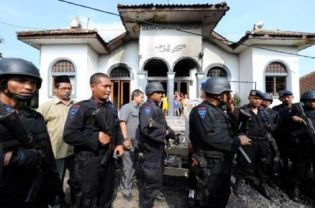
Indonesian Mobile Brigade policemen standing guard in front of a damaged Ahmadiyah mosque in Cisalada village, Bogor, on Saturday. A mob of 200 outsiders arrived at the remote village on Friday, smashing its windows with rocks and setting the building alight with Molotov cocktails. (AFP Photo)
Bogor. Ahmad Zainuddin, 75, had returned home to Cisalada village in Bogor after a trip into Jakarta to pick up his monthly pension stipend, just hours before his home was looted and ransacked by unknown attackers on Friday.

“All I could do was watch from a safe distance when they knocked down my front door using a bamboo chair that was sitting on my porch,” Ahmad told the Jakarta Globe on Saturday in the village.

Like Zainuddin, all 600 residents of the village are members of the Ahmadiyah, a sect deemed deviant by hard-line and mainstream Islamic groups.

Followers of Ahmadiyah, a sect founded in India in 1889, profess that the group’s founder, Mirza Ghulam Ahmad, is the last prophet, a belief that runs counter to mainstream Islamic beliefs that reserve that claim for the Prophet Muhammad.

The nation’s highest authority on Islamic affairs, the Indonesian Council of Ulema (MUI), issued a fatwa in 2005 against the Ahmadiyah, calling its teachings blasphemous. And the government issued a joint ministerial decree in 2008 banning its members from practicing their faith in public or spreading its beliefs.

That condemnation came to a fiery head on Friday evening when a mob of some 200 outsiders arrived at the remote village and attacked the At-Taufiq mosque, smashing its windows with rocks and setting the building alight with Molotov cocktails.

“They came with their motorbikes, honking their horns and shouting ‘Allahu Akbar’ [‘God is great’],” Syaidatur Rohmi, 55, told the Globe. “Most of them were teenagers. There were hundreds of them. I just hid behind the sofa and could only stare in tears as they burned the mosque.”

Village Inferno

But the destruction did not stop there. “After the first group of attackers left, a second group arrived 30 minutes later,” Syaidatur said. “This time they were targeting homes. My children and I fled for our lives along with other villagers, hiding in the graveyards.”

She said her back door was knocked open, and her sofas and coffee table were carried outside and burned.

But Syaidatur was among the more fortunate. Fellow villager Bashir Newai’s home was completely burned to the ground. “They broke into my house and took everything. Jewelry, figurines and cash — all were stolen. They torched everything else,” he told the Globe.

In total, 17 homes were ransacked and looted. Two of them, like Bashir’s, were burned beyond repair. The attackers also destroyed a kindergarten and an Islamic elementary school, as well as a car and seven motorcycles. No residents, however, were injured in the assault.

“I don’t see how we could use the mosque again,” said 57-year-old Cisalada resident Muhmiddin as he gazed at the soot-blackened walls and ceiling of the house of worship.

“The wooden beams look like they will fall apart soon,” he said. A few minutes later, one beam did just that, taking with it a portion of the ceiling. Struggling to contain his emotions, Muhmiddin managed to keep his composure as he gave a tour of the ruins. He burst into tears however, when he came across a burned section of the Koran in a field next to the mosque.

“Whoever did this are heartless monsters,” he said.

Unknown Attackers

No one had claimed responsibility for the violence over the weekend. West Java Police Chief Insp. Gen. Sutarman said he had heard two versions of the attack’s chronology — the first being that the assault was sparked by resentment of mainstream Muslim groups toward the sect, and the second being that it was triggered after an Ahmadiyah member was stabbed by someone from another village.

Sutarman declined to elaborate where the latter rumor originated from, or the identity of the person allegedly stabbed.

“We are trying to establish what had really happened. Our team is now gathering the evidence from the scene,” he said. Around 500 heavily armed police officers, many from the elite Mobile Brigade (Brimob) were deployed to safeguard the village. Some 50 troops from the local military command were also stationed around the village.

“Our target right now is to ensure the safety of the villagers and to maintain security,” Sutarman said. On Saturday, President Susilo Bambang Yudhoyono instructed police to punish those responsible for the attack.

“President SBY has urged people not to get easily provoked by issues from unclear sources. Do not listen to rumors,” said Julian Aldrin Pasha, the head of state’s spokesman. The attack occurred on the same day that Yudhoyono had urged Indonesians not to use mosques to preach hate and violence, and instead use them as places where brotherhood and close ties between all peoples would be encouraged.

Brother Against Brother

The Ahmadiyah in Cisalada date back to 1933. Back then, the members of the sect lived in harmony with other Muslim groups. It wasn’t until the end of President Suharto’s regime in the late 1990s that the first stirrings of resentment arose. In 2001, after former president Abdurrahman “Gus Dur” Wahid — considered a champion of pluralism — stepped down, the calls for the sect’s disbandment intensified.

There are currently around 600,000 Ahmadiyah members throughout the country. Since 2001, many of them have faced near-constant harassment and discrimination.

Similar burnings and attacks on Ahmadiyah mosques and homes have occurred in West Java, Central Sulawesi and West Nusa Tenggara, where in 2006, homes belonging to members of the group were burned, leaving hundreds homeless.

More recently, mainstream Muslims, attempting to seal off an Ahmadiyah mosque, clashed with sect members in Kuningan, West Java, in July.

Harassment against Ahmadiyah members in Cisalada was first recorded in 2007, when hundreds of people protested the renovation of the mosque there. Some even went as far as to vandalize the steel rods and concrete used for the foundation of the new structure.

“Rejection against the Ahmadis in Cisalada seem to come from outside of Ciampea [in Bogor]. They are not from around here,” A. Hidayatullah, a congregation leader in the village, said on Saturday.

“Friday’s incident is by far the worse that has happened to us. Our children can’t go to school, we can’t pray at our mosque and some people are now homeless.”

With his home ransacked and his money stolen, Zainuddin said that he was not quite sure what he would do.

“This will be my lunch and dinner, unless the neighbors are kind enough to spare me their food,” he said, pointing to a bunch of unripe bananas from his garden.

“I guess I’ll have to make good of the Rp 200,000 [$22] I still have in my pocket until the end of the month. All my money was stolen and I guess I have a lot of cleaning to do since I live by myself and my house was looted.”

The Setara Institute for Peace and Democracy, which promotes religious freedom, released a statement on Saturday demanding the government put a stop to its repeated calls to ban the sect. “Statements from the Religion Minister [Suryadharma Ali] are provocative and have only justified countless intimidations toward Ahmadiyah.”

The show of support arrived too late to stop the destruction of the mosque, but the Ahmadiyah have not lost faith. Hidayatullah said the congregation used the burned-out building for services on Sunday night.

“We won’t let this attack deter us from practicing our beliefs.”

Additional reporting by Camelia Pasandaran

Copyright 2010 The Jakarta Globe

Jakarta Journo: Testing Indonesia’s Belief in Democracy

Jakarta Globe, Indonesia
LIFE & TIMES
Jakarta Journo: Testing Indonesia’s Belief in Democracy
Armando Siahaan | October 03, 2010

An Indonesian Police officer standing in front of a burnt house belonging to an Ahmadiyah follower in Ciampea village, West Java province, Bogor, on Saturday. Hundreds of people set a mosque and five houses, reportedly belonging to followers of Ahmadiyah, on fire, stirring panic among the Islamic sect members, local media said. (EPA Photo)
This is truly a dark time for the country. Friday’s mob attack on the Ahmadiyah sect in Ciampea, Bogor, is a concrete example of an alarming trend. We are witnessing yet again the escalating — yet unchecked — oppression of a minority group.

On Friday, angry villagers in Ciampea ransacked and burned a mosque and some houses belonging to members of Ahmadiyah, a minority denomination deemed deviant and heretical by mainstream Islam.

Both sides have their own versions of what ignited the encounter. But determining who is to blame for this should not be our main concern, as this is just another episode in a larger, more systemic and endemic attack against the sect.

In July, a confrontation erupted in Manis Lor village, Kuningan, West Java, when the local government and a hard-line Islamic group tried to close down an Ahmadiyah mosque and were met with fierce resistance from its followers. Other incidents have taken place in West Java towns and villages like Tasikmalaya, Parung and Garut, as well as in East Lombok. These places are no strangers to violent persecution.

But Ahmadiyah is not the only group suffering from pugnacious oppression. Vigilant Islamic groups have also targeted Christians. Churches have been shut down and churchgoers have been harassed, culminating in the recent assaults on an elder and a female pastor from the HKBP Church in Ciketing, Bekasi.

And we must not turn a blind eye to the menacing protests by the Islamic Defenders Front (FPI) and a small group of university students against the Q! Film Festival, which showcases films with gay themes. The Indonesia Council of Ulema (MUI) has joined the protests, claiming that the festival promotes a lifestyle contradictory to Islamic and Indonesian cultural values. Even worse, MUI has pilloried homosexuality as a form of human rights abuse. The protesters have accused the festival of screening pornographic movies, but their actions were certainly nothing but a bare-faced attack against gays in general.

At the same time, surveys by the Center for the Study of Islam and Society and a joint study by the Indonesian Survey Institute (LSI) and Lazuardi Biru, a de-radicalization program, respectively found that 57.8 percent and 63.8 percent of respondents would object if other religious groups built a house of worship in their neighborhood.

These surveys and the recent attacks against minority groups strengthen the worrying portrait that in our supposedly pluralistic society, religious intolerance is on the rise. As such, the government must play a greater role in preserving the country’s much-acclaimed pluralism and curb any movement that seeks otherwise.

To start with, the government must revoke a number of controversial policies that are clearly disadvantageous to minority groups. A 2006 joint ministerial decree requires a religious group to gather the approval of at least 60 households in the area to build a house of worship. This makes it virtually impossible for non-Muslim faiths to build houses of worship in Indonesia, making it appear to be a state-sponsored effort to curb minority faiths.

A 2008 joint ministerial decree prohibited Ahmadiyah from spreading its teachings. But the sect has been acknowledged as an official Islamic organization since 1953 and imposing the decree only suggests that the current government — despite its claim to be the guardian of post-reform democracy — condones oppression.

These discriminatory decrees must be revoked. Not only do they defy the Constitution’s promise of freedom of religion, but they are also frequently the source of trouble that leads to violent conflict.

Regarding the mistreatment of the gay community, the government must remember that this is a country that upholds the law. There is no law that prohibits homosexuality. Thus, gays deserve to be safeguarded at all costs from intimidation and assault.

The government must also turn a deaf ear to the MUI’s statement that homosexuality is a violation of human rights. It is ridiculous. If anything, enforced uniformity and conformity toward a particular belief is the violation of human rights. We also can’t have a minister publicly declaring his desire to ban Ahmadiyah. Or one whose Twitter posts suggest that homosexuality is the No. 1 cause of the rise in HIV/AIDS cases here and that the infected deserve to be stoned.

This brings us to the most important point: The government must be firmer in dealing with extremist groups that take matters into their own hands, and arrest and disband groups that pose threats against minorities. The country cannot fall into an abyss that glorifies the tyranny of the majority.

Armando Siahaan is a reporter with the Jakarta Globe and writes a weekly column about current events. Find Jakarta Journo on Facebook at http://bit.ly/apxo4g, or e-mail him at armando.siahaan@thejakartaglobe.com

Copyright 2010 The Jakarta Globe

Govt deplored for failing to stop attacks on Ahmadiyah

HEADLINES
Sun, 10/03/2010
8:57 AM

Govt deplored for failing to stop attacks on Ahmadiyah
Erwida Maulia, Irawaty Wardany and Theresia Sufa, The Jakarta Post, Jakarta/Bogor

Embattled sect: A National Police Mobile Brigade officer guards a mosque belonging to a congregation of the Ahmadiyah sect in Ciampea, Bogor, on Saturday. Locals attacked members of the congregation Friday night. JP/Theresia Sufa

Critics renewed calls of outrage at the government’s failure to protect minority groups on Saturday after an attack on a mosque and several houses belonging to followers of the Ahmadiyah Islamic sect in Bogor, West Java.

Moderate Muslim Society chairman Zuhairi Misrawi said a recent string of violent attacks against Ahmadiyah had been prompted by Religious Affairs Minister Suryadharma Ali’s call last month to dismiss the sect on the grounds that it was heretical.

“We demand President Yudhoyono question the religious affairs minister for not protecting a religious minority group,” Zuhairi said at a press conference of the Indonesian Legal Aid Foundation on Saturday. He said the minister’s remarks could be used as justification for the attack.

Around 20 people attacked Cisalada village at around 7.15 p.m. on Friday, throwing stones at an Ahmadiyah mosque that is under construction there.

“Ahmadiyah followers successfully chased the troublemakers away, however they came back with a bigger group half an hour later and started vandalizing and setting fire to properties including the Ahmadiyah mosque, five houses, a car and two motorcycles,” said Jamaah Ahmadiyah Congregation’s national press secretary Zafrullah Ahmad Pontoh.

Zafrullah said the congregation had reported the incident to the local police, who showed up 90 minutes later.

One resident, Atun, said women and children had run into nearby rice fields to hide, and had stayed there for hours.

“I hid in the rice fields for around three hours because we were afraid of those people who threatened to kill us. We only left the fields after the police had arrived,” she said.

Separately, presidential spokesman Julian Aldrin Pasha said that Yudhoyono “deplored the attack and has ordered law enforcers to take action against the guilty parties”.

Quoting a police report, Julian said the attack had been triggered by a rumor that Ahmadiyah followers had stabbed to death two residents of Pasar Salasa village.

“[The rumor] is not true; as of [Saturday] morning no one has been confirmed dead or admitted to hospital. But the rumor was quick to spread and provoke people to launch the attack as they thought the incident was a religious-related issue,” Julian said.

West Java Police chief Insp. Gen. Sutarman said the police had questioned four witnesses over the incident.

Ahmadiyah national security commission head Deden Sujana said all of the witnesses questioned by the police were Ahmadiyah followers.

“We are the victims but it’s our members who are undergoing police questioning,” he said.

Indonesian Conference on Religious and Peace secretary-general Johannes Hariyanto said the government was guilty of systematic neglect in preventing attacks on Ahmadiyah.

“In most of the cases, it was the victims who were criminalized,” he said.

The Ahmadiyah congregation has lived in Cisalada since 1933. It now has about 700 followers. “Their existence started being threatened in 2007. [The Friday attack] is the third,” community unit head Edi Humaedi said.

In July, Ciampea district chief Budi Lukmanul Hakim, accompanied by 24 public order officers and 300 police officers, destroyed the steel foundations of what was to be an extension of the Ahmadiyah mosque. The action cost the congregation Rp 250 million (US$26,000) in losses.

A week later, 500 protesters from a hard-line Islamic group clashed with members of the congregation in Manis Lor, Kuningan, West Java.

Home Minister Gamawan Fauzi and Religious Affairs Minister Suryadarma Ali said after a meeting in Bogor on Saturday that they would hold a meeting to discuss a “permanent solution” to the Ahmadiyah problem. The talks will begin Monday.

Saturday, October 2, 2010

Press Release: Arson attack on Ahmadiyah Mosque/Houses

Jamaat Ahmadiyah, Indonesia
Press Release
Jakarta, October 2, 2010
Arson attack on Ahmadiyah Mosque/Houses

Jemaat Ahmadiyah (Ahmadiyya Muslim Community), Indonesia hereby clarifies its position on certain points in respect of recent attacks on its Mosques and members residing in Cisalada, Ciampea Udil Village, Ciampea District, Bogor Regency:

1.
On Friday October 1, 2010 around 7:15 pm, a group of about 20 rowdy people attacked Ahmadiyah Mosque of Cisalada, Ciampea Udik Village and pelted stones. The Mosque was built and is used by Jemaat Ahmadiyah.
2.
Media reports of confrontation are totally baseless and fabrication.
3.
One of the attackers, who had surrendered was peacefully handed over to Ciampea Police through Head of local community.
4.
Officials of Jemaat Ahmadiyah Indonesia had reported the incident to Ciampea Police as soon as it occurred.
5.
Before Police reinforcement could reach from Cisalada District, attackers gathered in masses and started burning and looting Ahmadiyah Houses and Mosque. Mosque and Mission House were partially burnt and badly damaged. Five other houses belonging to Ahmadiyah Community members, a Car and two Motorcycles were also burn to ashes.
6.
It is untrue that Security Officers evacuated Ahmadiyah Community members.
7.
The real fact is that the attackers burnt two houses owned by people of Cisalada district, Ciampea Udik village, Ciampea Regent, (who are also members of Jemaat Ahmadiyah). In order to save their lives, the occupants abandoned their houses at their own and took refuge with their sibling's houses, in same district.
8.
An official of JAI clarified that Police of Resort Bogor arrived after 1½ hour after the attacks and burning incident.
9.
JAI demands that Security Officials provide complete protection to its members and a firm action is taken against perpetrators in accordance with law.
10.
We thank everyone who has taken positive steps and sympathized with victims as well as our people who are living under injustice and yet continuously carry harmony in life as fellowmen and citizens.

National Press Secretary,
Jamaat Ahmadiyah, Indonesia

Govt to hold talk over Ahmadiyah

NATIONAL
Sat, 10/02/2010
7:38 PM

Govt to hold talk over Ahmadiyah
The Jakarta Post, Jakarta

The government said Saturday it would hold discussion over a “permanent solution” over Islamic sect Ahmadiyah following an arson attack on houses and place of worship belonging to Ahmadiyah followers in Ciampea village in the West Java regency of Bogor on Friday night.

Home Minister Gamawan Fauzi and Religious Affairs Minister Suryadarma said after a meeting in Bogor Saturday that the discussion would be held starting Monday.

Also attending Saturday meeting were, among others, West Java Governor Achmad Heryawan, Bogor Regent Rachmat Yasin, and West Java Police Chief Insp. Gen. Sutarman.

President Susilo Bambang Yudhoyono had ordered the home minister to work with the regional government in seeking a solution to the problem immediately. The president also ordered enforcement of the law against perpetrators of the attack.

National Police chief Gen. Bambang Hendarso Danuri has said peace and order has been restored in the village. There has been no report of arrests so far following the arson attack on followers of an Islamic sect which mainstream Muslim groups deem as heretical.

Kalla blames security authorities for attack on Ahmadiyah

NATIONAL
Sat, 10/02/2010
5:55 PM

Kalla blames security authorities for attack on Ahmadiyah
Andi Hajramurni, The Jakarta Post, Makassar, South Sulawesi

Former vice president Jusuf Kalla said security authorities were to blame for the latest attack on Ahmadiyah followers on Friday night and other acts of violence plaguing the country in the last six months.

Kalla said the attack on the Islamic sect members in Ciampea village in the West Java regency of Bogor should have not occurred had the police strictly enforced the law and taken tough measures against those who violated the law.

“Security authorities should not hesitate to take stiff actions against offenders of the law. The should not be afraid of being accused of violating human rights, because human rights do not prohibit security personnel from taking firm measures,” Kalla said after a public lecture for new students of Muhammadiyah University in Makassar, South Sulawesi on Saturday.

Kalla, who now chairs the Indonesian Red Cross, said he was against Ahmadiyah teachings, but he could not tolerate the use of violence against followers of the Islamic sect, which the Indonesia Ulema Council has declared heretical.

He added that dissolving the sect was not a solution to the Ahmadiyah case, citing adverse impacts on thousands of its followers.

“In principle Ahmadiyah followers must not propagate the sect’s teachings which go against Islam. If they spread the teachings among themselves, it will not matter,” Kalla said.

Indonesian President Again Appeals for Calm After Islamic Sect Attacked

Jakarta Globe, Indonesia
OPINION
Indonesian President Again Appeals for Calm After Islamic Sect Attacked
Camelia Pasandaran | October 02, 2010

Jakarta. Indonesia President Susilo Bambang Yudhoyono has again appealed to the nation for calm after members of the minority Ahmadiyah sect in Ciampea, Bogor, were targeted by a violent mob.

Presidential spokesman Julian Pasha, speaking a news conference at the Presidential Palace on Saturday, said Yudhoyono had asked Indonesians “not to be easily provoked” by rumors and instead join the government in helping provide secure the country.

He was commenting in relation to the attack on Ahmadiyah, in which hundreds of villagers armed with sticks, axes and sharp weapons torched a car, four houses and part of a mosque on Friday.

The attack was reportedly motivated by false rumors that two members of Ahmadiyah – which is based on Islamic teachings but is considered heretical by mainstream Indonesian Muslims – had stabbed and killed two villagers.

The attack came just hours after Yudhoyono addressed the nation at the Baiturrahim Mosque inside the State Palace complex to ask for religious tolerance.

Julian said Yudhoyono had instructed Home Affairs Minister Gamawan Fauzi, National Police and the local government to address and solve the problems in Ciampea.

“The president asks that the system function well and whenever there is a violation of the law violation by anyone, those people should be sanctioned.”

Yudhoyono also said that those responsible for spreading the rumors “should be handled properly,” Julian said.

Yuniyanti Chuzaifah, chairwoman of the National Commission on Violence against Women (Komnas Perempuan), meanwhile, condemned the violence against Ahmadiyah.

She said people should be free to follow their religion, without exception, and the government should act to ensure the Constitution was upheld. Those responsible for the violence should be charged, she said.

Copyright 2010 The Jakarta Globe

Editorial: It’s Time to Remove Hate From Mosques

Jakarta Globe, Indonesia
OPINION
Editorial: It’s Time to Remove Hate From Mosques
October 02, 2010

Recent events have reminded us that terrorism remains a menace to society. One way to stop terrorists would be to prevent them from enjoying safe havens in mosques, which are holy places that should be reserved for the worship of God. (JG Photo/Yudhi Sukma Wijaya)
President Susilo Bambang Yudhoyono has finally responded to a growing problem that already had many Indonesians worried. He has acknowledged that mosques are being used to spread violence, and has called for it to stop immediately. With the fall of the iron-fisted government of President Suharto in 1998, decades of strict surveillance of mosques also fell by the wayside. Now, it is well known that religious extremists often use mosques to spread messages of hatred, nurture dangerous radicalism and recruit jihadists.

“We should be providing comfort and peace to everyone and not turn mosques into places to encourage provocation,” Yudhoyono said after inaugurating the newly renovated Baiturrahim Mosque at the State Palace complex.

The president said that mosques should be places where brotherhood and close ties between all people were fostered and strengthened.

They should also be places where the purity of the Islamic creed and teachings are safeguarded, he said.

The president’s message is both timely and timeless, as places of worship are sacred and should be used for peaceful purposes only.

With hundreds of thousands, if not millions, of mosques spread across the country, places of worship can and should be used to unite the country.

Still, it cannot be denied that in numerous mosques on Java and other islands, messages of peace are not what is being taught. Some mosques have become centers where hard-line and radical forms of Islam are being preached and advocated.

It is not surprising then that a recent survey by a noted institution found that tolerance toward minority religions was on the decline in the country.

This alarming trend must be reversed, for the sake of national security and national unity.

Just hours after the president made his statement, a mosque belonging to the Ahmadiyah, an Islamic sect considered deviant by many mainstream Muslims, was attacked and set on fire in Bogor.

It was just the latest in a series of violent attacks on the Ahmadiyah this year.

In response to this rise in religious violence, analysts have called on the government to more strictly monitor hate speech and messages of extremism.

And not only those messages spread from the pulpit, but also those readily available and accessible on the Internet.

If the government is attempting to filter pornography on the Internet, it should do likewise for hate speech and messages of extremism.

Firm measures are in order.

Recent events have reminded us that terrorism remains a menace to society.

One way to stop terrorists would be to prevent them from enjoying safe havens in mosques, which are holy places that should be reserved for the worship of God.

Copyright 2010 The Jakarta Globe

Indonesian President Calls for Calm at Mosques

Jakarta Globe, Indonesia
INDONESIA
Indonesian President Calls for Calm at Mosques
Nivell Rayda, Ulma Haryanto & Antara | October 02, 2010

In this file photo, President Susilo Bambang Yudhoyono has spoken out in the strongest terms yet about religious violence. (Antara Photo)
Jakarta. In his strongest statement so far on religious extremism, President Susilo Bambang Yudhoyono said on Friday that mosques should not be used to preach hate and violence.

“We should be providing comfort and peace to everyone and not turn mosques into places to encourage provocation,” Yudhoyono said after opening the renovated Baiturrahim Mosque inside the State Palace complex.

The president said that mosques should be places where brotherhood and close ties between all peoples were encouraged and strengthened.

“Therefore, I urge that in the future, together, not only the congregation at Baiturrahim Mosque but all congregations wherever they are, make mosques centers of good deeds and benevolence,” Yudhoyono said.

The decades of pervasive monitoring of mosques under the dictator Suharto ended with his resignation in 1998, allowing some of those places of worship to foster a more hard-line and radical form of Islam.

Just hours after the president’s comments, a mosque belonging to the minority Ahmadiyah sect in Ciampea, Bogor, was torched.

A National Police spokesman, Insp. Gen. Iskandar Hasan, said the attack on the mosque was caused by unconfirmed rumors that Ahmadiyah members had stabbed two local villagers.

He said one car, part of the mosque and four houses were torched and that 250 police officers were at the site.

“They came with sticks, axes and sharp weapons. Hundreds of people showed up and started burning,” said Muchsin, an Ahmadiyah leader. ?

Worries over violent extremism again arose with Thursday’s botched suicide bombing in Bekasi.

Preliminary investigations show the bicycle bomber, Ahmad, who is still in critical condition, was a drifter influenced by jihadi messages and not connected with any major terrorist network.

Criminologist Erlangga Masdiana, ?from the University of Indonesia, said the government must impose stricter regulations on the publishing of jihadi material and expand the scope of Internet censorship, which was fixated on pornography.

“The government must identify the type of messages that can disrupt national stability or inspire others to carry out terrorist attacks and see to it that they are inaccessible,” Erlangga told the Jakarta Globe.

He said the government and religious groups should also spread messages of tolerance and peace “so that more and more people will become aware that terrorism is not the answer and that terror attacks are damaging Islam.”

Ronny Nitibaskara, another criminologist from the University of Indonesia, said law enforcers would have to “rethink” their approach to terrorism.

“We can no longer assume terrorists are using the same old ways and the attacks are being carried out by the same types,” he said.

Ken Conboy, a terrorism expert and author, said: “Instructions on how to build an explosive and messages of extremisms are available in printouts and DVDs distributed from one person to the next.”

Many Web sites, he said, spread the word of Osama Bin Laden, while others give detailed instructions on bomb making.

Copyright 2010 The Jakarta Globe

President deplores attack on Ahmadiyah followers

HEADLINES
Sat, 10/02/2010
1:34 PM

President deplores attack on Ahmadiyah followers
The Jakarta Post, Jakarta

President Susilo Bambang Yudhoyono expressed his regret on Saturday over an arson attack on houses and place of worship belonging to Ahmadiyah followers in Ciampea village in the West Java regency of Bogor on Friday night.

Presidential spokesman Julian Aldrin Pasha said the head of state had received a report on the act of violence and ordered the home minister to work with the regional government in seeking a solution to the problem immediately. The president also ordered enforcement of the law against perpetrators of the attack.

“The incident is regrettable and should have not occurred because it was sparked by misunderstanding between people of two different villages,” Julian quoted Yudhoyono.

The president said the police had found that the attack was ignited by rumors that Ahmadiyah followers had stabbed two residents of Pasar Salasa village to death.

“The rumor is not true, because until this morning no one has been confirmed dead or admitted to the hospital there. But the rumor quickly provoked the people to perpetrate the attack as they perceived the incident was related to religion,” Julian was quoted by kompas.com.

National Police chief Gen. Bambang Hendarso Danuri has said peace and order has been restored in the village. There has been no report of arrests so far following the arson attack on followers of an Islamic sect which mainstream Muslim groups deem as heretical.

 
^ Top of Page