Showing posts with label Lahori Group. Show all posts

Thursday, December 1, 2011

Blasphemy allegations: Ahmadi family under threat from clerics

Express Tribune, Pakistan
Pakistan
Punjab
Blasphemy allegations: Ahmadi family under threat from clerics
By Rana Tanveer
Published: December 1, 2011
“The police should come and see me. If I go to the police station, thousands of Muslims will come with me and there will be unrest,” Qari Saeed.
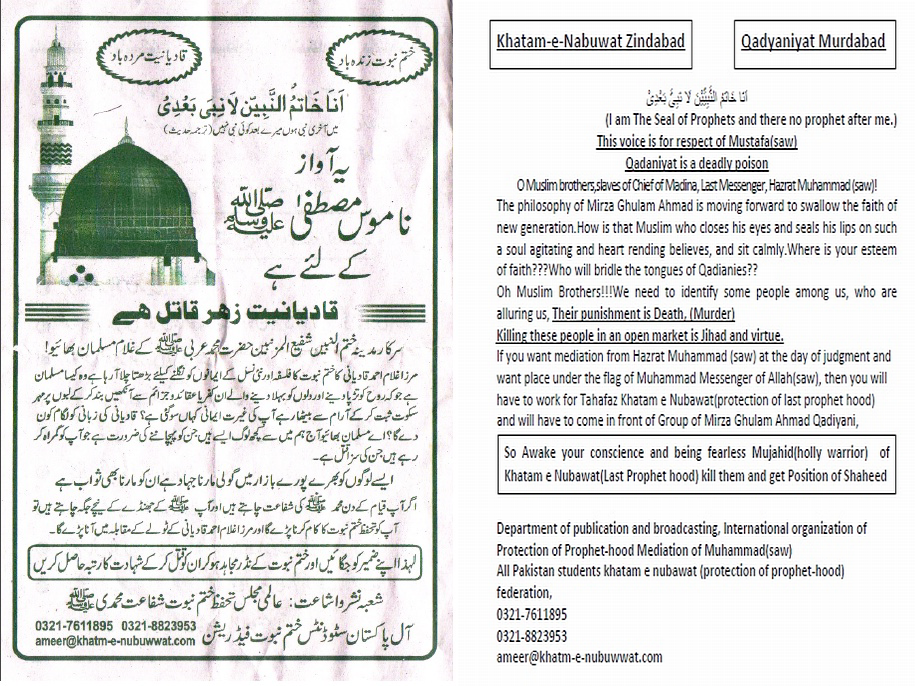
LAHORE: An Ahmadi family in Khushab says it is being victimised by local clerics who instigated the expulsion of a 16-year-old from his school and are now pressing the police to register blasphemy cases against him and his father.

The father, Hakim Jameel, told The Express Tribune that activists of the Aalmi Majlis Tahafuz Khatme Nabuwat (AMTKN) were also trying to get his other two sons expelled from a college where they are ICom and BSc students.

AMTKN members insisted that the 16-year-old student of class 10 and his father had both committed blasphemy. They also made thinly-veiled threats to this correspondent not to publish this story.

Qari Saeed, the divisional president of AMTKN, and Waqas Ahmed moved the application seeking a case under Section 295-C of the Pakistan Penal Code against Rana Sajeel, 16, for allegedly making derogatory remarks about the Holy Prophet (peace be upon him), and under Section 289 against his father Rana Hakim Jameel for allegedly describing Sajeel as a Muslim in the school admission form.

The law does not permit anyone to call Ahmadis Muslims. Jameel denied putting down Islam as Sajeel’s religion, saying he had put down Ahmadi, as he had done when his other sons were applying to colleges.

He said the allegation against his son stemmed from a fight at school. He said that the school’s principal had overheard some students abusing Sajeel and had beaten them up. The students accused Sajeel of telling on them and beat him up. Sajeel then went to the principal to complain. “They made up a story, telling the principal they had attacked him because he made blasphemous remarks,” Jameel said.

He said that the principal of Al-Tahir Public School, Haji Aslam, was an AMTKN supporter and had lost an eye during a protest organised by the group. “The principal expelled my son and then got together with other AMTKN activists to lodge a police complaint,” Jameel said.

He said since the family had been accused of blasphemy, the AMTKN had been organising meetings at a mosque near their residence where they made inflammatory speeches. “People have turned against us,” he said. “We are under serious threat.”

He said that a property dispute may also lie behind the accusations. In August 2011, the Jamaat-i-Ahmadia had moved the courts against a woman named Zaibun Nisa who had tried to sell off land belonging to the Jamaat as her own, he said. Her grandfather had donated the land to the Jamaat in his will, he said.

The court ordered the registration of a case against Nisa and four others for fraud. She spent about three weeks in jail, before she announced that she was renouncing the community and moved in with Qari Saeed. He also arranged for her bail, Jameel said.

Qari Saeed said that he had no doubt that the police would register the blasphemy cases as “hundreds of students” had told him about the incident. Asked why he had not contacted the Khushab DPO when he was summoned as part of the investigation, he said: “The police should come to me if they need me. If I go to the police station, thousands of Muslims will come with me and there will be unrest.”

He admitted that Zaibun Nisa and her family were residing with him, but insisted that had nothing to do with this case. Asked about the property dispute, he lost his temper and hung up. Shortly after, a man identifying himself as AMTKN secretary general Abdullah phoned this correspondent and sought the address of The Tribune offices, saying he would send over some Lahore-based activists. As of late Wednesday night, they had not arrived.

A relative of Qari Saeed who taught at Al-Tahir School, speaking on the condition of anonymity, said that Sajeel had been his student and he did not believe that the boy had made blasphemous remarks. He said Saeed had a deep personal hatred towards Ahmadis.

Khushab DPO Imran Mahmood said that he was personally investigating the case and would not register the FIRs without substantial evidence. He said he would decide the applications in a few days.

Published in The Express Tribune, December 1st, 2011.

Copyrighted © 2011 The Express Tribune News Network
URL: http://tribune.com.pk/story/300305/...from-clerics/

Wednesday, July 14, 2010

The bazaar of opinion

Express Tribune, Pakistan
Opinion
The bazaar of opinion
Khurram Husain
By Khurram Husain
July 14, 2010
The writer is editor of business and economic policy for Express News and 24/7 (khurram.husain@tribune.com.pk)

I’d like to add my voice to the growing number of people who are fed up with prime time talk shows on Pakistani television.

It’s bad enough when the shows feature ignorant anchors asking asinine questions from clueless guests who are invited as experts in their respective fields. It’s also ridiculous when the anchors try to create a ruckus between their guests, usually politicians, to generate some entertainment for the viewers.

So what? Just change the channel, say some. If only it was that simple. I could change the channel – and very often I do – but the problem is not just an aesthetic one of viewers making informed choices from a menu of options. The problem is the poison that many of these exalted fools who run these shows are spreading in our society. Primetime television is a powerful medium for shaping public perceptions of important national issues, and far too important a space to be left to the whims of blowhards whose only priorities are ratings and paycheques.

Remember the story about the rickshaw driver who committed suicide with his family? The outpouring of righteous indignation by these anchors over the incident? One anchor had the gall to do an entire show with a sleeping child from a poor family in her lap, shamelessly exploiting their grief for her ratings. Now think how many of them have gone back to follow up on the story.

Another character had three maulanas from bloodthirsty outfits as guests on his show to discuss the terrorist attacks on the Ahmadi community. Why on earth would one turn to a group like the Majlis Khatm-i-Nabuwat to ask them their opinion of these attacks? Their poisonous ideology is already well known, what useful contribution did the anchor believe these people would make to people’s understanding of the attacks? Yet this anchor not only invited them on air, but repeatedly pandered to their bloodlust by declaring that members of this oppressed group are indeed “wajibul qatl.”

The same fellow had Zaid Hamid (remember him?) on his show a few days back. He began by trying to establish the veracity of the stories about Zaid Hamid’s links with a man who had claimed prophethood. The anchor’s way of doing so was to ask his guest whether he believes in the finality of Prophet Muhammad (pbuh), to declare his faith in this finality, and then ask him to cast a curse on all those who profess divine inspiration after him.

This may have made gripping viewing for some but is the lowest form of inquisition-style questioning that I have seen on television anywhere and sets a dangerous precedent. Is it now going to be prime-time viewing fodder to grill people on aspects of their faith? There can be shows which bring on people, strap them into a chair, subject their faith to a barrage of questions, and declare some as infidels and others as true believers. Do we really want to go there?

There’s also a new trend developing where anchors bring other anchors from other channels onto their shows as guests and discuss the role of the media or some other such inanity. Never mind that they are all of the same opinion and mostly affirm what each other is saying. I just saw one such show that featured three anchors as guests, all discussing the difference between an ‘anchor’ and a ‘moderator’. Must we wallow in inanities when we are not baying for another’s blood?

What the channels have created is not a marketplace of ideas, but a bazaar of opinion. The bazaar opens every night at eight pm. Whose playing with what issue? Who has what guests? Each shopkeeper presides over that days wares, and employs a now familiar set of gimmicks to compete for prime time eyeballs. Non-issues are magnified out of all proportion — as in the ruckus around the Punjab Assembly resolution drowning out coverage of the Mohmand bomb blast — and the quickest tongue carries the day. I could change the channel on this reality every time, but what worries and saddens me is that the television channels are slowly changing the reality around me.

Published in The Express Tribune, July 15th, 2010.

Sunday, May 9, 2010

Legitimate discrimination

---Express Tribune, Pakistan
Pakistan
Legitimate discrimination

By Basil Nabi Malik
May 09, 2010


The writer is a lawyer with Malik, Chaudhry, Ahmed and Siddiqi in Karachi (basil.nabi@tribune.com.pk)


In my preceding article, I talked about the precariousness of defining the terms ‘Muslim’ and ‘non-Muslim’ in the Constitution of Pakistan. This article, in continuation, attempts to follow the unfortunate consequences of doing exactly that.

In addition to Article 260 discussed in the previous article, the constitution also contains Article 20 which guarantees every citizen the “right to profess, practice, and propagate his religion”, whereas it’s sub-article (b) allows every religious denomination and every sect “the right to establish, maintain and manage its religious institutions”. Both are subject to “law, public order and morality”. Looking at the same, one would think that any discrimination on the basis of one’s religion would be a violation of said article.

In addition to this, Articles 4 and 25 of the constitution, which require citizens to be treated in accordance with the law and mandate that everyone be equal before the law, amongst others, also ensure that discrimination on the basis of religion is not allowed. If any discriminatory law is made targeting a group, the said law is liable to be struck down, subject to a “reasonable classification” founded on a reasonable distinction and on a reasonable basis.

And this may very well be the reason that provisions are usually content neutral, meaning that certain actions are made punishable for all and sundry who undertake them, rather than certain groups.

However, the inclusion of Article 260 in the constitution seems to have complicated the situation at hand and made lawful certain provisions which would otherwise be termed discriminatory and illegal.

A case in point would be Section 298-B and Section 298-C of the Pakistan Penal Code which relates to Qadianis. According to them, “any person of the Qadiani group or the Lahori Group” cannot refer his or her place of worship as ‘masjid’, cannot call the call to prayer ‘azaan’ or recite it in any way similar to that of Muslims. It is interesting that as per this law, if someone from another group undertook these actions, presumably this section would have no issues with that. As per Section 298-C, with respect to the two groups mentioned above, it would be a crime to ‘pose’ as a Muslim, refer to your faith as Islam, or do anything which “either spoken or written, or by visible representations or in any manner whatsoever outrages the religious feelings of Muslims”.

On the face of it, these two sections of the Pakistan Penal Code seem to be plainly discriminatory. However, it seems that the Supreme Court, in 1993 SCMR 1718, due to Article 260, had no option but to come to a different conclusion. In a majority decision, the Supreme Court in this landmark case held that these sections were legal and in line with the Constitution. Article 260(3) was used as the foundation upon which the said provisions were held to be intra vires of the Constitution, wherein the specifying of certain groups was declared a reasonable classification in terms of the said Article. Amongst other things, it was stated by the Supreme Court that such provisions were “in advancement of the Constitutional mandate and not in derogation of it”.

Hence, in a nutshell, whereas the inclusion of Article 260 in the Constitution of Pakistan was dubious for the many reasons already enunciated, its implications are nonetheless probing in as much as it allows for the propagation of discrimination on the basis of one’s beliefs on the touchstone of the constitution.

In light of this, perhaps the political forces should take some time out of their busy schedules to review the said legal provisions which directly impact the lives of certain segments of Pakistani society, rather than dillydallying on other issues.

URL: http://tribune.com.pk/story/11928/legitimate-discrimination/

Monday, May 3, 2010

A matter of faith

---Express Tribune, Pakistan

A matter of faith

By Basil Nabi Malik
May 03, 2010


The writer is a lawyer with Malik, Chaudhry, Ahmed and Siddiqi in Karachi (basil.nabi@tribune.com.pk)

It is common knowledge that we are duty bound to follow and respect the Constitution of Pakistan and each and every one of its articles. However, the same becomes a tad bit difficult when certain unpalatable clauses are added which really have no business being in the constitution.

For example, if I were to ask anyone as to the definition of a ‘Muslim’, I am guessing the last place they’d look would be in the Constitution of Pakistan. However, lo and behold Article 260 of our constitution actually defines the term. Ironically, all this happened during the time of Zulfikar Ali Bhutto, though he was, of course, pressured to do this by certain religious quarters.

Although it was clearly a political move, the method was unique. Rather than to go into the intricacies and complications of trying to forge a unanimously agreed-upon definition, which many thought was next to impossible and perhaps even unnecessary, he thought it fit to zero in on an exclusionary clause which ‘enlightened’ us on what a Muslim could not be.
.
However, clearly, this was the kind of medieval quackery that only ‘scheming politicians’ could think of. It took the likes of General Zia in 1985 to give us an affirmative definition of a Muslim, sans the discussions and attempts at consensus building, which in all likelihood, he probably found irrelevant. He did this in the form of the President’s Order No. 24 of 1985, whereby Article 260(3) was substituted with what can best be described as intriguing definitions of the terms ‘Muslim’ and ‘non-Muslim’.

The word ‘Muslim’ entailed: “a person who believes in the unity and oneness of Almighty Allah, in the absolute and unqualified finality of the Prophethood of Muhammad (pbuh), the last of the Prophets and does not believe in, or recognise as a prophet or religious reformer, any person who claimed or claims to be a prophet, in any sense of the word or of any description whatsoever, after Muhammad (pbuh)”. General Zia, however, didn’t leave it at that.

For some odd reason, he didn’t feel that the people of the country would actually be able to understand the term ‘Muslim’ and so the definition of ‘non-Muslim’ was also inserted. The term ‘non-Muslim’ was defined as: “a person who is not a Muslim and includes a person belonging to the Christian, Hindu, Sikh, Buddhist or Parsi community, a person of the Qadiani Group or the Lahori Group who call themselves ‘Ahmadis’ or by any other name or a Bahai and a person belonging to any of the Scheduled Castes”.

Effectively, in one stroke, General Zia did what Justice Munir in the Munir Report of 1954 dreaded and forewarned against: the adoption of certain religious worldviews at the expense of others, thereby inducing divisions in society. To be more exact, after asking a variety of the ulema as to what the definition of a Muslim would entail and receiving varying responses, Justice Munir said in the report that: “keeping in view the several definitions given by the ulema [defining the term Muslim], need we make any comment except that no two learned divines are agreed on this fundamental.”

The point is that what business is it of the state to get into this whole matter of defining who is a Muslim and who isn’t. One would have thought that this is a matter best left to individuals themselves and is something to be assessed by their conduct and actions — and in any case it is a private matter for each individual. It’s a pity that the 18th amendment chose to ignore this in the present constitution.

URL:
http://tribune.com.pk/story/10274/a-matter-of-faith/
 
^ Top of Page