Showing posts with label Ahmadi community. Show all posts

Saturday, August 14, 2010

Saving Jinnah’s Pakistan

Express Tribune, Pakistan
Pakistan
Opinion
Saving Jinnah’s Pakistan
Ayesha Siddiqa
By Ayesha Siddiqa
August 14, 2010
The writer is author of Military Inc and a visiting professor at Johns Hopkins University, US ayesha.siddiqa@tribune.com.pk

The Awami Jamhoori Party’s march to save “Jinnah’s Pakistan” is commendable. It denoted mobilisation of civil society against violence and intolerance. The procession ended at Data Darbar, which is considered a symbol of the country’s liberal Islamic ethos or culture of religious multi-polarity. But are we quite clear about whether this is the kind of liberal Islamic tradition that Jinnah and other founding leaders of Pakistan opted for?

There was quite a bit of confusion regarding the type of religious ideology that the leaders thought was suited to the new state. According to renowned scholar Farzana Sheikh, whose latest book Making Sense of Pakistan adds to our knowledge of Pakistan’s polity, Iqbal and others did not prefer sufi Islam for the functioning of a modern Islamic state. For them, sufi Islam represented the traditional type which may be popular but was certainly not modern. In any case, Jinnah did not necessarily think deeply about the ideological and socio-political connotations of religion or using religion for nation-building. Much that some people may protest against the factual description of Jinnah’s personal habits, the fact of the matter is that he had a western lifestyle. Nevertheless, he created a state that defined citizenship on the basis of, what Sheikh argues, is the citizen’s putative relationship with religion.

Later, the Muslim League engaged with Majlis-e-Ahrar because the group had links with the Punjabi elite and made inroads into society. The anti-Ahmadi riots of the 1950s exhibited both the growing power of puritanical and illiberal ideology, and the Muslim League’s leadership’s willingness to turn a blind eye to Ahrar’s activities. Instead of giving a liberal direction to the state, if that was indeed the intention, Liaquat Ali Khan went for a formula that appeared as a concession to both the liberal and religious-right in the form of the Objectives Resolution of 1949. The document with its conservative-religious interpretation is central to Pakistan’s legal, constitutional and political frameworks.

But then is cultural or religious-liberalism all that falls in the purview of religion? How about political-liberalism, which no one really wants to talk about? One can be less sure of Jinnah’s intended direction as far as political liberalism is concerned. The conflict between words and actions emerged due to his decisions to annex the state of Kalat and sack Dr Khan Sahib’s provincial government in the frontier. This, as Ayesha Jalal argues, might have been necessary for establishing and strengthening the newly born state. The measures, however, set a politically non-liberal tradition which was followed by his successors. The emphasis was on building a central state with a singular identity. All sub-nationalities were forced to merge their independent cultural and social identity into one mega-identity. The formula did not work so well because the state’s option for sub-nationalities or individuals was to opt for the central narrative and abandon everything else.

But even if we were to use the narrow definition of liberalism as representing religious-liberalism, even that may not seem possible at this juncture. Religious liberalism cannot happen in the absence of political liberalism. Religious radicalism grows not just because the majority or a minority believe in a peculiar and narrow interpretation of religion, but due to the fact that they live in a politically closed system which does not empower them economically and politically. It is not money alone which checks radicalisation but also the richness of a political system. The combination of political and economic poverty makes the problem even denser.

A lot of people have been radicalised in Pakistan not because they understand the radical philosophy of Ibn Tamiyya, Syed Qutb,and Maulana Maududi or its tactical interpretation by Maulana Shamzai, Zawahiri, bin Laden and others, but because they view religion and violence both as necessary tools to fight existing political hegemony and oppression. Under the circumstances, talking about Jinnah’s Pakistan does not make sense until the capable people (those who have resources, education, contacts and power) have the sense to take the bulk of people along and give them at least some of the opportunities they deserve.

Maybe it is time we thought about all what Jinnah could not do.

Published in The Express Tribune, August 15th, 2010.


URL: http://tribune.com.pk/story/39340/saving-jinnah%E2%80%99s-pakistan/

Wednesday, July 14, 2010

The bazaar of opinion

Express Tribune, Pakistan
Opinion
The bazaar of opinion
Khurram Husain
By Khurram Husain
July 14, 2010
The writer is editor of business and economic policy for Express News and 24/7 (khurram.husain@tribune.com.pk)

I’d like to add my voice to the growing number of people who are fed up with prime time talk shows on Pakistani television.

It’s bad enough when the shows feature ignorant anchors asking asinine questions from clueless guests who are invited as experts in their respective fields. It’s also ridiculous when the anchors try to create a ruckus between their guests, usually politicians, to generate some entertainment for the viewers.

So what? Just change the channel, say some. If only it was that simple. I could change the channel – and very often I do – but the problem is not just an aesthetic one of viewers making informed choices from a menu of options. The problem is the poison that many of these exalted fools who run these shows are spreading in our society. Primetime television is a powerful medium for shaping public perceptions of important national issues, and far too important a space to be left to the whims of blowhards whose only priorities are ratings and paycheques.

Remember the story about the rickshaw driver who committed suicide with his family? The outpouring of righteous indignation by these anchors over the incident? One anchor had the gall to do an entire show with a sleeping child from a poor family in her lap, shamelessly exploiting their grief for her ratings. Now think how many of them have gone back to follow up on the story.

Another character had three maulanas from bloodthirsty outfits as guests on his show to discuss the terrorist attacks on the Ahmadi community. Why on earth would one turn to a group like the Majlis Khatm-i-Nabuwat to ask them their opinion of these attacks? Their poisonous ideology is already well known, what useful contribution did the anchor believe these people would make to people’s understanding of the attacks? Yet this anchor not only invited them on air, but repeatedly pandered to their bloodlust by declaring that members of this oppressed group are indeed “wajibul qatl.”

The same fellow had Zaid Hamid (remember him?) on his show a few days back. He began by trying to establish the veracity of the stories about Zaid Hamid’s links with a man who had claimed prophethood. The anchor’s way of doing so was to ask his guest whether he believes in the finality of Prophet Muhammad (pbuh), to declare his faith in this finality, and then ask him to cast a curse on all those who profess divine inspiration after him.

This may have made gripping viewing for some but is the lowest form of inquisition-style questioning that I have seen on television anywhere and sets a dangerous precedent. Is it now going to be prime-time viewing fodder to grill people on aspects of their faith? There can be shows which bring on people, strap them into a chair, subject their faith to a barrage of questions, and declare some as infidels and others as true believers. Do we really want to go there?

There’s also a new trend developing where anchors bring other anchors from other channels onto their shows as guests and discuss the role of the media or some other such inanity. Never mind that they are all of the same opinion and mostly affirm what each other is saying. I just saw one such show that featured three anchors as guests, all discussing the difference between an ‘anchor’ and a ‘moderator’. Must we wallow in inanities when we are not baying for another’s blood?

What the channels have created is not a marketplace of ideas, but a bazaar of opinion. The bazaar opens every night at eight pm. Whose playing with what issue? Who has what guests? Each shopkeeper presides over that days wares, and employs a now familiar set of gimmicks to compete for prime time eyeballs. Non-issues are magnified out of all proportion — as in the ruckus around the Punjab Assembly resolution drowning out coverage of the Mohmand bomb blast — and the quickest tongue carries the day. I could change the channel on this reality every time, but what worries and saddens me is that the television channels are slowly changing the reality around me.

Published in The Express Tribune, July 15th, 2010.

Monday, July 5, 2010

Sectarianism has poisoned Pakistan

Guardian, UK
Comment is free > Cif Belief
Sectarianism has poisoned Pakistan
The violence seen in Lahore last week was aided by a bigoted constitution. How has stock in our nationhood plummeted so?
Basim Usmani
Basim Usmani
guardian.co.uk, Monday 5 July 2010 09.01 BST

The recent attacks on a prominent shrine in Lahore demonstrate how the unrest in Pakistan is caused by a minority of few who cannot tolerate the plurality of beliefs in Pakistan. The Tehrik-e-Taliban are lying through their teeth when they claim that they do not attack public places. It’s becoming more and more apparent that these militants aren’t resisting American hegemony; this a war to determine Pakistan’s future and, by proxy, the future of Islam.

Whether the Tehrik-e-Taliban actually arranged the bombers’ suicide belts is irrelevant; they have created a domino effect that’s likely to spread from commercial capitals such as Lahore to cities with historic shrines and Pakistani historical sites, such as Multan, or Taxila.

Unlike Baghdad, where violence between Islamic sects is a product of the war America is waging, the onus of last Thursday’s blasts falls squarely on us, the citizens of Pakistan. We have been complacent about sectarianism for too long.

A good friend who works for a transportation company told me in 2007 that in villages along the highways to Waziristan where the Taliban had seized control were the bodies of butchered Shia Muslims. That year, Lahore’s public was too busy mobilising about the judiciary and President Musharraf to pay the violence any mind.

Sectarianism has a brutal history in Pakistan that existed long before militants in Afghanistan began calling themselves the Taliban. I remember as a child in Lahore the broadcasts of gun violence outside Shia houses of worship during the early 1990s.

Many Pakistanis feel that the attacks on two Ahmadiyya mosques last May, where gunmen unloaded bullets and grenades on Friday prayer-goers, were unprecedented. Certainly the Ahmadiyya community doesn’t think they are.

To have a Pakistani passport requires citizens to assert that they are not part of the Ahmadiyya community. In a sense, holding that passport also makes you complicit in the blasts that killed dozens in Lahore’s most famous Sufi shrine last week. Our inability to understand that this war is about national identity is rooted in the same complacency.

We are OK with the state deciding for us who is or isn’t Muslim. In this regard, the Pakistani government has the weakest moral fibre in taking on this growing strand of extremism. It is hypocritical to fight the Taliban in Waziristan if we are okay about denying citizenship to millions of Muslims born in Pakistan.

It may sound extreme of me, but we should be jailing clerics in Pakistan that give edicts declaring believers to be non-Muslim or anti-Pakistani. It may seem extreme to an American that writers who deny the Holocaust are imprisoned in Europe, but extreme contexts call for extreme measures.

Pakistanis must stress how being born or raised in their country is enough to be Pakistani; laws preventing Ahmadis from referring to themselves as Muslims were amended to the constitution by Zulfikar Ali Bhutto in the 1970s.

I remember being uneasy at my desk in middle school when I was studying at Aitchison College in Lahore, and some of my classmates were getting bullied for having marks on them after returning from Shia processions during Muharram. Pakistanis themselves are the only ones capable of stamping out this discriminatory culture.

Some proactiveness is necessary on our part to make it clear that mystics, Shias, Ahmadis and Christians are all fellow Pakistanis. When you are pulled over by street police in any major Pakistani city, the first bit of information the police ask for is your family name. From one name your caste, religious beliefs and affluence is determined.

This came as a shock to all of my family who have emigrated away: that collectively our stock in our own nationhood has plummeted so. In a sense, these problems are all accrued debt we’ve accumulated for being so complacent. In the light of our bigoted constitution and deterministic culture we have to – for ourselves – decide that being Pakistani is enough to make us all countrymen. Otherwise, we might as well just refer to ourselves as Taliban, Muslim extremists, Islamic militants, and so forth.

© Guardian News and Media Limited 2010

Sunday, June 27, 2010

Fear and silence

Daily Dawn, Pakistan
FROM THE PAPER »
EDITORIAL
.
Fear and silence
   By Mohsin Hamid
   Sunday, 27 Jun, 2010
 .
Why are Ahmadis persecuted so ferociously in Pakistan? - (File Photo)
Why are Ahmadis persecuted so ferociously in Pakistan? — (File Photo)

Why are Ahmadis persecuted so ferociously in Pakistan?

The reason can’t be that their large numbers pose some sort of ‘threat from within’. After all, Ahmadis are a relatively small minority in Pakistan. They make up somewhere between 0.25 per cent (according to the last census) and 2.5 per cent (according to the Economist) of our population.

Nor can the reason be that Ahmadis are non-Muslims. Pakistani Christians and Pakistani Hindus are non-Muslims, and similar in numbers to Pakistani Ahmadis. Yet Christians and Hindus, while undeniably discriminated against, face nothing like the vitriol directed towards Ahmadis in our country.

To understand what the persecution of Ahmadis achieves, we have to see how it works. Its first step is to say that Ahmadis are non-Muslims. And its second is to say that Ahmadis are not just non-Muslims, but apostates: non-Muslims who claim to be Muslims. These two steps are easy to take: any individual Pakistani citizen has the right to believe whatever they want about Ahmadis and their faith.

But the process goes further. Step three is to say that because Ahmadis are apostates, they should be victimised, or even killed. We are now beyond the realm of personal opinion. We are in the realm of group punishment and incitement to murder. Nor does it stop here. There is a fourth step. And step four is this: any Muslim who says Ahmadis should not be victimised or killed, should themselves be victimised or killed.

In other words, even if they are not themselves Ahmadi, any policeman, doctor, politician, or passerby who tries to prevent, or just publicly opposes, the killing of an Ahmadi, deserves to die. Why? Because anyone who defends an apostate is themselves an apostate.

Aha.

This is what the persecution of Ahmadis achieves. It allows any Muslim to be declared an apostate. For the logic can be continued endlessly. When an Ahmadi man is wounded in an attack and goes to a hospital for treatment, if the doctor agrees to treat him, she is helping an apostate, and therefore she becomes an apostate and subject to threats. When a policeman is deputed to protect the doctor, since she is an apostate, the policeman is helping an apostate, so he too becomes an apostate. And on and on.

The collective result of this is to silence and impose fear not just on the few per cent of Pakistanis who are Ahmadis, or even on those who are Christians and Hindus, but on all of us. The message is clear. Speaking out against the problem means you are the problem, so you had better be quiet.

Our coerced silence is the weapon that has been sharpened and brought to our throats.

This is why Nawaz Sharif’s statement in defence of Ahmadis met with such an angry response. Because the heart of the issue isn’t whether Ahmadis are non-Muslims or not. The heart of the issue is whether Muslims can be silenced by fear.

Because if we can be silenced when it comes to Ahmadis, then we can be silenced when it comes to Shias, we can be silenced when it comes to women, we can be silenced when it comes to dress, we can be silenced when it comes to entertainment, and we can even be silenced when it comes to sitting by ourselves, alone in a room, afraid to think what we think.

That is the point.

The writer is the author of the novels Moth Smoke and The Reluctant Fundamentalist.

©2010 DAWN Media Group. All rights reserved

Monday, June 21, 2010

Hate speech

Daily Dawn, Pakistan
FROM THE PAPER »
EDITORIAL
.
Hate speech
Dawn Editorial
Monday, 21 Jun, 2010
.
A strong case can be made against the JI leader for fomenting aggression and religious persecution under the country's laws regarding hate speech and incitement to violence. - Photo on file
A strong case can be made against the JI leader for fomenting aggression and religious persecution under the country’s laws regarding hate speech and incitement to violence. — Photo on file

The street power and political clout wielded by Pakistan’s religious right have resulted in the state and society being held hostage by extremist elements. The latter stop at nothing to further their agenda of inciting hatred, divisiveness and violence. The latest example is that of the Jamaat-i-Islami chief, Syed Munawwar Hasan, who during a sermon in Lahore on Friday threatened a fresh movement against the Ahmadi community if it “did not accept their minority status” and the government kept silent about “their blasphemous and unconstitutional activities”.

Mr Hasan did not specify any particular instance substantiating his charges, leading one to read his comments as hate speech and also as an attempt to blackmail the government into further victimising an already persecuted community. Given the incendiary passions the issue arouses, any call by religious parties in this context is certain to be attended by violence. A strong case can be made against the JI leader for fomenting aggression and religious persecution under the country’s laws regarding hate speech and incitement to violence.

Even beyond this particular case, it has now become a matter of urgency that the government show an active and uncompromising stance on the issue of hate speech and incitement to violence or other sorts of criminal activity. Pakistan’s polity is already rent by religious, ethnic and sectarian divisions. Allowing irresponsible and divisive opinions to be aired publicly will deepen these fissures. Once it begins, the process of religious, ethnic and other communities being pitted against one another will prove difficult to bring under control. Spiralling violence, particularly in view of other issues being faced by the country such as militancy and terrorism, can then be expected. It is in the interests of both the state and citizenry to take a stand against inflammatory hate speech and lobby for the prosecution of those who break the law.

©2010 DAWN Media Group. All rights reserved

Sunday, June 13, 2010

What the eye did not see

Daily Dawn, Pakistan
Columnist
.
What the eye did not see
   By Ardeshir Cowasjee
   Sunday, 13 Jun, 2010

On May 28 of this year, how many members of the minority Ahmadi community were massacred in cold blood by the 'student' fraternity upholding their version of the religion of the majority? The official reaction: silence. Unforgivable! - Photo by Reuters.
On May 28 of this year, how many members of the minority Ahmadi community were massacred in cold blood by the ‘student’ fraternity upholding their version of the religion of the majority? The official reaction: silence. Unforgivable! — Photo by Reuters.

“Wherein adequate provisions shall be made for the minorities freely to profess and practise their religions and develop their cultures” reads the fifth clause of the Objectives Resolution as adopted by the Constituent Assembly of Pakistan, having been moved by Prime Minister Liaquat Ali Khan, on March 7, 1949.

“Wherein adequate provisions shall be made for the minorities to profess and practise their religions and develop their cultures” reads the same clause in the same resolution when inserted into the constitution of 1973 by the Eighth Amendment and made the annex, and thus a substantive part of the constitution, by President Gen Zia ul Haq and his Majlis-i-Shura in 1985.

“CJ lauds parliament for correcting historic wrong” read the lead headline in this newspaper on June 9. The historic wrong was the omission of the word ‘freely’ from the constitution. It has now been reinserted by the 18th Amendment to the constitution as brought in by this PPP-Z government (accompanied by considerable fulsome fanfare).

Hearing petitions in the Supreme Court against various clauses in that contentious amendment, Chief Justice Iftikhar Chaudhry is quoted as having remarked not only how wrong it was that the word ‘freely’ was removed from the original clause in the Objectives Resolution but it was also strange that at the time the amendment was passed not one Majlis member had noticed the omission.

He might have added that it was equally strange that since 1985 none of our constitutional experts who have tinkered with the constitution, nor any member of succeeding governments until now, had been at all bothered about the removal of the word, which removal was obviously done with a purpose.

An editorial in our press on June 10 noted that “nobody noticed it till now” and “it is shocking that not only was this omission never highlighted but even the reinsertion was ignored by many until the Supreme Court’s remarks on this issue….”

On April 2, 1993, in my column printed in this space, I wrote about the grand opening on March 21 that year of the newly built Supreme Court and of the passing of its keys by Prime Minister Nawaz Sharif to Chief Justice of Pakistan Afzal Zullah. I also wrote of the Objectives Resolution, the text of which, embossed on brass plaques, was affixed to a wall in the entrance hall of the court, and quoted the entire original text.

Then: “What now adorns the wall of our Supreme Court is a modified version of the resolution which has destroyed its sanctity. Let us zero in on the original clause … The powers that be have deemed it fit and right to purposefully omit the word ‘freely’ from what has been inscribed. The people thus stand deceived. Does there live a man amongst us who will stand up and say ‘mea culpa’? Who will right the wrong? It is the true text, in toto, of the resolution as passed that must be embossed in the building wherein sit men against whose judgments an appeal lies only before God Almighty.”

On to Dec 3, 2000, when once more in my column printed in this space writing on the omission of the word ‘freely’ from the Annex to the constitution I commented: “Now we move to the Supreme Court, the Islamic Republic’s citadel of justice which in 1997 was so shamelessly stormed by Nawaz Sharif, his aiders and abettors, for which Nawaz remains unpunished. When the present building in which the Supreme Court sits was inaugurated plaques were affixed to the walls of the entrance hall on which were engraved in English and in Urdu the text of the Objectives Resolution. In the English version the word ‘freely’ was mischievously (repeat mischievously) omitted although it was contained in the Urdu version.

“In 1993 I made a vain attempt to get through to Chief Justice Afzal Zullah and impress upon him that the English version should be corrected. Then came Chief Justice Dr Nasim Hasan Shah, who said he would do his best to set things right. Nothing happened. He was followed by Chief Justice Sajjad Ali Shah who settled the issue by having both plaques, English and Urdu, removed from the hall. No successive chief justice has seen to it that the plaques with the corrected English version be re-affixed.

“Now I appeal to Gen Pervez Musharraf to do what he can to amend the annex to the constitution and to have the plaques refitted….”

So, somewhere within the storage vaults of Chief Justice Chaudhry’s court lie two plaques, unmourned, over the passage of over a decade. As matters in the Islamic Republic have evolved it is perhaps better that they remain where they are, for grave doubts have surfaced as to the wisdom of the passing of the Objectives Resolution. And, the resolution being the preamble to the 1973 constitution, what was Ziaul Haq’s true purpose in adding it for a second time, and amending it, as the annex?

We have seen over the past three decades how impossible it is for the minorities to truly ‘freely’ practise their religion. How many minority citizens of Pakistan have been killed or persecuted, through bigotry, intolerance and Zia’s iniquitous blasphemy laws. And on May 28 of this year, how many members of the minority Ahmadi community were massacred in cold blood by the ‘student’ fraternity upholding their version of the religion of the majority? The official reaction: silence. Unforgivable!

arfc@cyber.net .pk

©2010 DAWN Media Group. All rights reserved

Monday, June 7, 2010

Ahmadi massacre silence is dispiriting

Guardian, UK
Comment is free > Cif Belief
Ahmadi massacre silence is dispiriting
The virtual conspiracy of silence after the murder of 94 Ahmadis in Pakistan exposes the oppression suffered by the sect
Declan Walsh
Declan Walsh
guardian.co.uk, Monday 7 June 2010 14.59 BST
Candles were lit by members of a civil society for victims of the attack on the Ahmadi sect in Lahore. Photograph: KM Chaudary/AP
The virtual conspiracy of silence after the murder of 94 Ahmadis
in Pakistan exposes the oppression suffered by the sec

I often find myself defending Pakistan against the unbidden prejudices of the outside world. No, Islam is not the cause of terrorism. Yes, the Taliban is a complex phenomenon. No, Imran Khan is not a major political figure.

This past week, though, I am silent. The massacre of 94 members of the minority Ahmadi community on May 28 has exposed something ugly at the heart of Pakistan – its laws, its rulers, its society.

It’s not the violence that disturbs most, gut-churning as it was. During Friday prayers two teams of attackers stormed Ahmadi mosques in the eastern city of Lahore. They fired Kalashnikovs from minarets, chucked grenades into the crowds, exploded their suicide vests.

As the massacre unfolded, a friend called – his father-in-law, a devout Ahmadi, was inside one of the besieged mosques. The family, glued to live television coverage, were sick with worry.

Two hours later, my friend’s relative emerged alive. But many of his friends – old men, including a retired general and former judge – were dead.

The killers were quickly identified as “Punjabi Taliban” – a loose collective of local extremists with ties to the tribal belt. This was unsurprising. More dispiriting, however, was the wider reaction.

Human rights groups reacted with pre-programmed outrage; otherwise there was a virtual conspiracy of silence. A dribble of protestors attended street protests against the attack in Lahore and Karachi; eleven people showed up in Islamabad.

The normally vociferous media were unusually reticent. Commentators expressed dismay at the violence, but few dared voice support for the Ahmadi community itself. Politicians turned yellow.

Few visited the bereaved; still today, the chief minister of Punjab, Shahbaz Sharif, has not visited the bullet-pocked mosques or offered compensation to the injured.

In the national parliament, three brave female MPs crossed party lines to propose a resolution condemning the attacks, in the face of massive indifference. The motion passed, just.

The reticence is rooted in law and history. Ahmadis believe that Mirza Ghulam Ahmad, a 19th century Punjabi cleric, was the messiah sent by God – a notion that deeply offends orthodox Muslims for whom Muhammad, who lived in 7th-century Arabia, is the final prophet.

The problem is that the state has taken sides in this religious argument. Since the 1970s, civilian and military governments have passed laws enshrining the discrimination against Ahmadis, today thought to number about 4 million in Pakistan.

And so they live in the shadows of society. Under the law, Ahmadis may not call themselves Muslims and may not refer to their places of worship as “mosques”. Orthodox Muslims applying for a passport must sign a statement deriding Ahmad as an “imposter”.

Any Ahmadi who defies these edicts can be sentenced to death; in 2009, 37 were charged under the blasphemy laws and 57 under Ahmadi-specific laws.

This state-directed discrimination has caused prejudice to soak into the bones of even well-educated Pakistanis. It is acceptable to denigrate Ahmadis as “agents of foreign powers” such as the CIA and Raw, India’s intelligence service.

In 2008 a prominent preacher on Geo, the country’s largest channel, suggested that right-minded Muslims should kill Ahmadis. Within 48 hours two Ahmadis had been lynched. The television presenter has prospered.

Last year a banner appeared outside the high court in Lahore, declaring “Jews, Christians and Ahmadis are enemies of Islam”. Few complained.

The silence that followed the Ahmadi killings was broken last week by a tsunami of outrage at the Israeli commando raids on boats headed for Gaza. Commentators and politicians fulminated at the treatment of the Palestinians – a minority that suffers state-sanctioned, religiously driven discrimination. Nobody got the irony.

It makes one realise how small the constituency of true liberals is in Pakistan – not Pervez Musharraf-style liberals, who drink whisky and attend fashion shows, but people who believe the state should cherish all citizens equally. That, after all, was the publicly expressed desire of Pakistan’s founder, Muhammad Ali Jinnah, 63 years ago. Today it lies in tatters.

© Guardian News and Media Limited 2010

Pity the nation

Daily Dawn, Pakistan
Columnist

Pity the nation
   By Hajrah Mumtaz
   Monday, 07 Jun, 2010

Whether your leanings are towards the left or the right, if you're a rational person in any way this will have set you shuddering. It's awful, chilling and frightening. It is also hate speech, incitement to murder and violence, possibly conspiracy to commit crime (murder) and many other things viewed as criminal under the laws of the land. - Photo on file
Whether your leanings are towards the left or the right, if you’re a rational person in any way this will have set you shuddering. It’s awful, chilling and frightening. It is also hate speech, incitement to murder and violence, possibly conspiracy to commit crime (murder) and many other things viewed as criminal under the laws of the land. — Photo on file

The ironies we witness every day in Pakistan would have us shaking our heads were it not for the fact that they usually provoke such deep visceral dread.

Take the furore over the recent shutdown of Facebook and other websites. In Pakistan the debate framed the issue mainly in terms of either the freedom of speech or the legitimacy of government censorship. Both models, as constructed here in Pakistan, were flawed and reductionist. Let that be as it may, I wish to point out something else. The websites were shut down because many people found their content ‘blasphemous’ and hurtful to their sentiments as Muslims.

Fine. I’m willing to go with that for the moment, and indeed add that the instigator of the Facebook event can also validly be accused of religious discrimination, hate speech and incitement to violence, which are criminalised in many countries.

A few days later came the sickening attacks on the Ahmadi community in Lahore. Here verbatim are excerpts from an email sent subsequently to some individuals and organisations, including Maj-Gen Athar Abbas, the military spokesman, if the message address field is to be believed:

“Congratulations for the whole nation. What the brave Mujahideen did yesterday in Garhi Shahu and Model Town, Lahore. […] As a whole we do like to encourage the nation for increasing this kind of activities like target killings of Qadianis, Shia, supporting political parties, Law enforcement agencies, Pakistan Army, racist parties and many more. […] We advise realistic people to take initiative and kill every that person who came in their range. There is no specific need of detonators, bombs and explosives. Just kill them either by means of just crashing them under their cars. […]”

Whether your leanings are towards the left or the right, if you’re a rational person in any way this will have set you shuddering. It’s awful, chilling and frightening. It is also hate speech, incitement to murder and violence, possibly conspiracy to commit crime (murder) and many other things viewed as criminal under the laws of the land.

Yet this email, sent by the ‘Taliban media cell’ through a web-based email account, received no attention. No one ordered the government to contact the email system’s authorities and have the address shut down. No call was made to ban or block the address. No Muslim found it repugnant to the sensibilities of either their religion or their own sense of right and wrong.

Perhaps this email did not come to the attention of either our right-minded justice system or the public. Fair enough. Nevertheless, this is just one example of criminal behaviour. One finds similar sentiments with regularity across the country’s media and academic landscape.

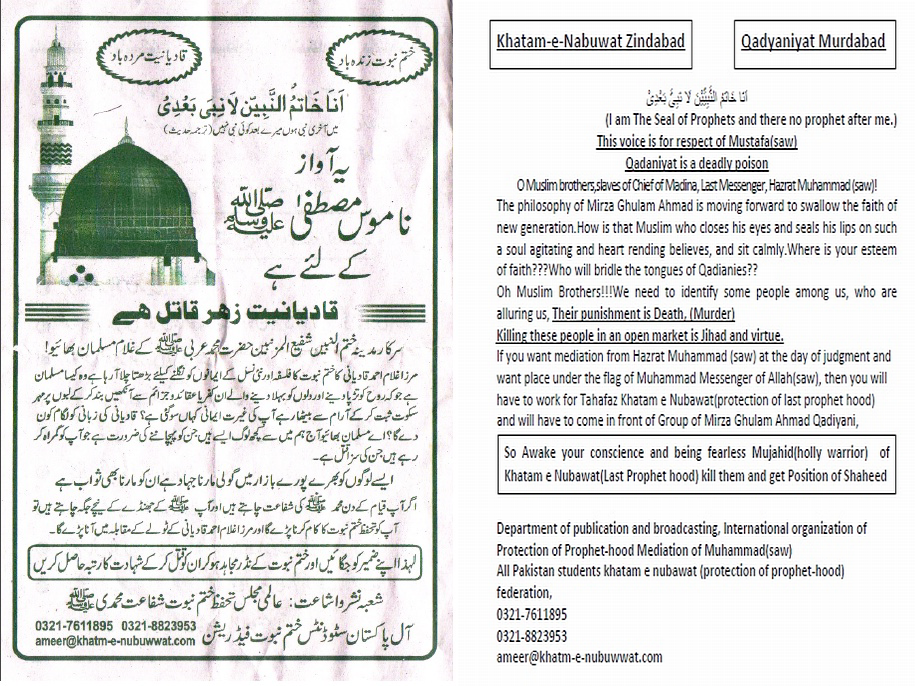
Television anchors have on air declared certain communities as deserving of being killed. Similar statements have been made in public rallies by rightwing people and parties. Recently, a journalist came under suspicion for having links with the Taliban. Religious seminaries print, teach and widely distribute books and pamphlets that incite hatred and violence against any number of communities, from Ahmadis and Shias to women and aid agencies.

Meanwhile, the law looks the other way. In fact, sometimes it colludes, as in the case of two banners that were up in Lahore. One was recently on Mall Road outside the Lahore High Court and translated, read: “Jews, Christians, Ahmadis are enemies of Islam.”

The other was a billboard put up last year, reportedly, for the Aalmi Majlis Tahaffuz-i-Khatm-i-Nabuwat. Translated, a section of it reads: “Friendship with Ahmadis is rebellion against the Prophet, peace be upon him.” City authorities did not remove this venom for fear of provoking a reaction by the extremist right.

On May 30, Zaeem Qadri, adviser to Punjab Chief Minister Shahbaz Sharif, said in an interview on Dunya TV that the provincial government had failed to remove the threatening banners from the city’s thoroughfares in order to prevent “adverse reaction against the government” by the groups responsible.

Bombings and mass-scale massacres have become a regular feature in our country. And while they are condemned almost by routine, there are few examples of the average good Muslim standing up to say that murder and mayhem are repugnant to their religion and hurtful to the memory of and example set by the leaders of Islam. It took years for religious scholars to condemn suicide bombings as un-Islamic, despite this manifestly being the case. And it took politicians some time before they visited Ahmadi victims in hospital.

The fact is that over the years bigotry and religious discrimination have been institutionalised in Pakistan. The 1974 anti-Ahmadi amendments to the constitution are one example. Ziaul Haq’s 1984 Martial Law Ordinance XX was another move that legalised, even encouraged, the persecution of the Ahmadi community.

The blasphemy law continues to be used to target the Christian community in southern Punjab in particular, often for reasons of dispossession of land and assets. And where the laws of the land are not discriminatory in specific, the lack of reaction by law enforcers makes for the rest. Why is hate material in books, video and audio form so easily available across the country? Why are people who spew venom against others and create the social fabric that makes criminal acts not prosecuted? Why are the laws not repealed?

It could be because the mindset of bigotry and discrimination, and the violence it engenders, has been absorbed by policy formulators, justice dispensers, lawmakers and enforcers in the same manner as the rest of the citizenry. We have had, after all, at least three decades in which to steep ourselves in hatred for those who are different.

Khalil Gibran got it right: “Pity the nation that raises not its voice when it walks in a funeral, boasts not except among its ruins, and will rebel not save when its neck is laid between the sword and the block. / Pity the nation divided into fragments, each fragment deeming itself a nation.” — The Garden of the Prophet (1934). Except that in Pakistan’s case, it is the pity one reserves for people on death row, there as a result of their own crimes.


hajrahmumtaz@gmail.com

©2010 DAWN Media Group. All rights reserved

Sunday, May 30, 2010

A murderous mindset

Daily Dawn, Pakistan                           |      Columnist
 
A murderous mindset
   By Huma Yusuf
   Sunday, 30 May, 2010

Pakistan is currently leading 56 other Islamic countries in an anti-defamation of religion campaign. But it is too ironic, indeed insulting, to see our government lobby for the rights of religions on the world stage when it cannot defend the rights or lives of its own people at home. - Photo by Reuters.

As soon as I heard that gunmen had attacked two Ahmadi houses of worship in Lahore, I posted a despairing comment on my Facebook page, condemning the violence and wondering out loud why we, as a nation, had let it come to this.

Only later was I struck by the irony of my action: I had logged on to a website recently banned for carrying blasphemous content to decry the murder of members of a community that has for too long been persecuted on charges of blasphemy. But the point of my comment was not to be ironic — it was simply the closest I could get to screaming out loud.

Even as the attack was unfolding, law-enforcement officers started pointing fingers at the Taliban and its affiliated terror groups. But we can no longer pretend that Friday’s attacks were the extreme actions of a lone terror group. Instead, attacks of escalating horror and violence, growing in their scope, against the Ahmadi community are the most terrible articulations of a widespread social sentiment — that members of this community are, because of their religious beliefs, lesser people. For letting this ill-conceived notion flourish over the decades, Pakistanis are collectively complicit in the attacks.

On a practical level, the attacks are another tragic failure by the state to protect its citizens. The government is aware of the increasingly religiously motivated nature of terror attacks in Pakistan, and had been warned of the possibility of organised violence against Ahmadi targets in Punjabi cities. Friday’s ambush comes on the heels of the blatant persecution of the Ahmadi community in Faisalabad through robberies, kidnappings and target killings in March and April. In this context, it is appalling that the government had not provided better security for the mosques.

But more than an inquiry into the anti-terror capacity of the Lahore police, Friday’s attacks demand soul-searching at all levels of the state and society. The fact is, young men, not automatons, carried out Friday’s attacks. They were no doubt brainwashed into thinking that they were attacking the sites of worship of ‘infidels’, a label that is consistently used by extremists to dehumanise minorities and other vulnerable groups.

In a way, the attackers were fed the same rhetoric that Pakistanis have been heartily chewing on in the past few weeks — the idea that some views, practices or people are anti-Islam and blasphemous, and should therefore be obliterated. This basic idea is manifest in the sweeping ban against Facebook and other websites believed to host sacrilegious content, in the murder of a former ISI official accused of having links to the Ahmadi community and now in the slaughter of over 70 people at prayer.

It may seem inappropriate to compare these disparate events, but the logic deployed in each instance has been the same: wherever a difference of opinion or a divergent belief is detected, it must be snuffed out, no matter what the toll on human life, human rights, freedom of belief, freedom of expression and social harmony. This is the premise of the endemic and institutional intolerance that has Pakistan in a death grip.

Immediately after the attacks, Punjab Chief Minister Shahbaz Sharif declared that the “entire nation will fight this evil”, by which he meant terrorism. One wishes he had the courage to correctly identify the ‘evil’ that Pakistanis must collectively battle as the intolerance and hatred that have become hallmarks of our national character.

Political rhetoric aside, the ferocity of Friday’s attacks demands a concrete and drastic government response. It has been well documented over the years that growing intolerance of minority beliefs is a consequence of Pakistan’s controversial blasphemy laws. These have been used to justify censorship, settle personal vendettas, facilitate land grabs and inflict violence on minorities. Crying blasphemy, as Fauzia Wahab well knows, is also becoming a political tactic to silence dissent in a mockery of the basic principles of democratic dialogue. Most dangerously, accusations of blasphemy fuel the mob mentality that has hijacked social interaction in this country.

Given that this is the broader religio-political context in which Friday’s attacks occurred, there is no question that the government must repeal the blasphemy laws on an urgent basis. In August 2009, Prime Minister Yousuf Raza Gilani announced the establishment of a committee to review “laws detrimental to religious harmony”, which was understood to include the blasphemy laws. Nothing came to pass from that process. Subsequently, in February, the government announced that it would implement procedural changes to laws that can be exploited to create ‘violence and disharmony’ in society. Sadly, no changes have been implemented and the battle cry of blasphemy is increasingly invoked. Now, there is no more time for dithering on this issue.

Moreover, the government should reconsider lobbying the United Nations for international legislation against blasphemy. Pakistan is currently leading 56 other Islamic countries in an anti-defamation of religion campaign. But it is too ironic — indeed insulting — to see our government lobby for the rights of religions on the world stage when it cannot defend the rights or lives of its own people at home. Indeed, how can the powers that be champion blasphemy laws in the name of protecting religious freedom, when those same laws are being used to incite hatred, foster extremism and justify the persecution and even murder of innocent Pakistanis?

The fact is, if our government truly rejects Friday’s violence, it should take all the necessary steps to address the root causes of discrimination against religious minorities. Chasing down those who planned, financed and executed Friday’s attack is just a stop-gap measure — the government must now take the bold step of showing Pakistanis as well as the international community that intolerance and hatred can have no place in our society. In addition to outlawing the blasphemy law, the government must support open debate, interfaith dialogue and school and madressah curriculum reform with an eye to dispelling misconceptions about different religions and sects.

Sadly, that’s a tall order, which cannot come to pass for a host of reasons: shameful historical precedent; the resurgence of banned Punjabi sectarian outfits pursuing an independent agenda; the political clout of religious parties; and Pakistan’s aspirations to be a major player within the Muslim world. But if we don’t address systemic intolerance and the violence and human rights abuses that it engenders, someone else will.

In 2002, the US House of Representatives introduced a resolution urging Pakistan to repeal its blasphemy and anti-Ahmadi laws. If the situation worsens, it may place similar demands on Pakistan again. But if the impetus to quell religious intolerance comes from an external power, it will never be effective. This is one evil we have to ward off ourselves.

huma.yusuf@gmail.com
©2010 DAWN Media Group. All rights reserved
URL : www.dawn.com/wps/wcm/connect/dawn-content...-a-murderous-mindset-050-hh-11

Monday, October 6, 2008

Islamic sect complaint highlights Ofcom’s increasing impotence

- The Independent, UK

By Jerome Taylor
Monday, 6 October 2008

A small Islamic sect that is deemed heretical by some mainstream Muslims has complained to Ofcom after being labelled “liable for death” by a Pakistani television show broadcast in Britain via the Sky satellite platform.

The complaint, made by leaders of the Ahmadi community in Britain, is being investigated by the watchdog and raises concerns over how much control it has over the content of the burgeoning number of foreign language channels UK viewers can access. The comments were made during a live broadcast of Aalim Online, a religious discussion programme aired daily on Geo TV throughout the Islamic holy month of Ramadan. It is viewed by millions of Urdu speaking viewers worldwide.

Aalim Online, available in Britain on Sky Channel 815, is presented by Dr Aamir Liaquat Hussain, a former minister for religious affairs turned popular spiritual television host. Ofcom is investigating the 7 September edition of the show, which included views from a number of prominent Pakistani Muslims scholars as guest speakers. The broadcast coincided with the anniversary of a change in Pakistan’s constitution in 1974 that officially classified Ahmadis as “non-Muslims”. Human rights groups say this event legitimised persecution of the sect in Pakistan and eventually forced the leadership of the 70 million strong community to flee to London. The Ahmadis are deemed heretical by hardline Islamic authorities because of their belief that their 19th century founder was the Mahdi – Islam’s equivalent of the messiah – and the successor to the Prophet Mohamed.

Dr Hussein asked his guests during the broadcast how orthodox Muslims should respond to the claims made by Ahmadis. One speaker, Dr Saeed Ahmad Innayatullah, responded: “As long as this sedition is alive and even one [Ahmadi] remains on this earth, there is need to eliminate it.” Two other speakers, meanwhile, used the Arabic phrase “Wajb-ul-Qatal” (liable for death) to describe those who believe in Ahmadi doctrine. Dr Hussein did not intervene to moderate those views, nor was a member of the Ahmadi community invited to speak.

Earlier this year, Ofcom ruled Geo TV had breached guidelines during another prayer show hosted by Dr Hussein, when the host called for the death of Satanic Verses author Salman Rushdie. During evening prayers he said: “Ruin Rushdie. I beg you for his death. O God, give him death.”

Two prominent Ahmadi leaders were murdered in Pakistan shortly after Aalim Online was televised.

Rafiq Ahmad Hayat, president of the Ahmadiyya Muslim Association UK, said: “We demand a response from Geo TV for their flagrant abuse of satellite broadcasting for promoting animosity against our community. Geo officials must explain their endorsement of the clerics’ twisted ideology, and for the programme presenter’s failure to challenge their views.”

Geo TV failed to respond to The Independent’s requests to comment.

URL : www.independent.co.uk/news/media/islamic-...-952289.html
 
^ Top of Page