Showing posts with label Jamaat-i-Islami. Show all posts

Thursday, January 13, 2011

Pakistan’s Pols Paralyzed by Religious Extremism

Time CNN, USAWorld
Pakistan’s Pols Paralyzed by Religious Extremism
Thursday, Jan. 13, 2011 By Omar Waraich / Islamabad
Pakistani Islamists attend a rally supporting the blasphemy law on Jan. 9, 2011, in Karachi. Asif Hassan/AFP/Getty Images
Pakistan’s President Asif Ali Zardari will visit the White House on Friday, amid growing U.S. concern that his country is drifting into the embrace of Islamist extremism. The brutal assassination of Punjab Governor Salmaan Taseer, over his moves to reform a blasphemy law used to persecute religious minorities, has been a shocking indicator: Taseer was shot 27 times by one of his own bodyguards, while the others looked on. The murder was widely celebrated in Pakistan, and its confessed perpetrator, Mumtaz Qadri, has been lionized by tens of thousands of demonstrators on the street, while the liberal element personified by Taseer has been marginalized. The unrestrained march of extremism in the world’s second largest Muslim nation — the only one with nuclear weapons — and on whose support the U.S. is depending in Afghanistan is a clear cause for anxiety in Washington. “Societies that tolerate such actions,” Vice President Joe Biden told reporters during a brief visit to Islamabad on Wednesday, “end up being consumed by those actions.”

Still, despite worrying signs, it’s easy to overstate the Islamist challenge. Pakistan’s religious parties remain at the political margins, usually sharing between them less than 10% of the vote. “It’s the secular forces that have always been in power, whether it was the military or the main political parties,” says opposition lawmaker Ayaz Amir. “The clerical forces are entitled to articulate whatever they want to. But who’s been succumbing, who’s been doing the backtracking? It’s the secular forces.” Successive governments have attempted for political reasons to placate the religious right with concessions. The same principle was evident in the current government’s capitulation to the conservatives on the blasphemy law, making clear in the wake of Taseer’s murder that it has no intention of pursuing his effort to reform the measure.

Taseer’s assassination certainly presented a formidable challenge, by bringing together erstwhile enemies in the religious camp in a rare show of unity. The crowd of 40,000 on the streets of Karachi last weekend celebrating Taseer’s murder included such sects as the typically moderate Barelvis, their more hard-line rival Deobandis, the even more extreme Wahhabis, and even the Shi’ites so often targeted by the more extreme Sunni sects. Groups that are more inclined to fight one another than to pray together have found common cause on blasphemy. “It’s the one issue where you can put together more people on the streets than are willing to vote for you,” says analyst Mosharraf Zaidi. The religious right now feels emboldened by the impassiveness of secular parties and the state: no one who threatened to kill Taseer and other like-minded politicians has been arrested.

Among the keenest supporters of Qadri was the Sunni Tehreek, an armed group headquartered in Karachi that opposes the Taliban and related extremists. The group has donated a reward to Qadri’s family and issued threats against Taseer’s daughter. “Qadri did what he did out of his religious conviction,” says Fahimuddin Sheikh, a spokesman for the Sunni Tehreek. But, he adds, “We are very much against the Taliban and the terrorists. We haven’t just supported the army’s offensives against them, but mounted rallies in support of them. These are people who want to use the gun to impose their views.” Which, of course, is exactly what Taseer’s assassin appears to have been doing.

Like Qadri, the members of the Sunni Tehreek are drawn from the Barelvi sect, estimated to make up 80% of the population. In recent years, Barelvi shrines and leaders have been attacked by Taliban-affiliated militants who deem their practices heretical. But when it comes to defending the “honor of the Prophet,” the Barelvis can be fiercer than other sects, and Taseer’s opposition to the blasphemy laws was cast as an act of blasphemy. It was always misleading to cast the Barelvis as exemplars of tolerance, says lawmaker Amir. “This impression really comes down to the Barelvis’ support for our recent wars against the Taliban,” he adds. “Otherwise they’ve been involved in the spread of religiosity in Pakistani society. That’s the problem with Pakistan: too much religion.”

The spread of religiosity has created a sense of religious guilt and shame in much of mainstream Pakistan, analysts say, pulling the consensus in a more conservative direction. Within hours of the killing, some 2,000 Pakistanis, most conversant in English, had joined a Facebook fan page dedicated to Qadri before it was shut down. They were not fundamentalists, nor were they averse to Western culture. “If you go through the profiles of Qadri supporters on Facebook, you’d think Justin Bieber was the cause of extremism in Pakistan,” tweeted the Pakistani blogger Kala Kawa. Says analyst Zaidi: “Articulating love for the Prophet is a way people purge their guilt. They see blasphemy as a red line, and if it’s seen to be crossed, they say they’re on board.”

Pakistani tensions over religion don’t exist independently of the tensions of social class in this grotesquely unequal society. After Taseer’s assassination, many liberals discovered to their horror that their domestic staff didn’t share their grief; some smiled at the news. Even though the governor had come from a modest background, many Pakistanis saw him as epitomizing a wealthy, English-speaking, liberal elite. “If you’re from the Urdu-schooled mainstream of the country, the assertiveness of the class rubs you the wrong way,” says Zaidi. “And it’s easy to depict someone who’s outwardly Westernized as being distant from religion.” Taseer’s status as a high-profile politician also diluted any sympathy for him from those sections of the population resentful of a political class they perceive as being inept, distant and venal.

Opposition to the U.S. war in Afghanistan and the Taliban’s claim to represent a purer form of Islam made it difficult for the Pakistani authorities to rally public support against the domestic extremist challenge. It was only after the Pakistani Taliban revealed its brutality in parts of the country over which it had gained control that public support swung behind a military offensive to drive them out. But Taseer’s assassination is an uncomfortable reminder of a religious intolerance deeply embedded within the country’s mainstream, which no Pakistani government is likely to risk confronting head-on.

© 2011 Time Inc. All rights reserved
URL: www.time.com/time/world/article/0,8599,2042522,00.html

Thursday, January 6, 2011

Religious parties pledge support to assassin

The daily Nation, Pakistan
 Thursday, January 06, 2011
Religious parties pledge support to assassin
Published January 06, 2011

Assassin Mumtaz Hussain Qadri
MULTAN/KARACHI – The religious parties Wednesday were all praise for Mumtaz Hussain Qadri, the assassin of Punjab Governor Salmaan Taseer, and warned the govt that any attempt to repeal or amend the blasphemy law would be resisted.

In Multan, Tehrik Tahaffuz-e-Namoos-e-Risalat (TTNR) offered full legal and moral support to Qadri, saying no stone would be left unturned to get him released.

“We’ll dedicate our all out energies and resources for the sacred cause. We’re also going to hold a ‘successful’ public meeting in Karachi on January 9 for the protection of the Namoos-e-Risalat,” announced a joint declaration issued by the Multan chapter of the body after an emergency meeting held at the Jama’at-e-Islami (JI) office.

The meeting, chaired by the local president of TTNR Mufti Hidayatullah Pasroori, was attended by the representatives of all religious parties including JI, JUP, JUI and Jamiat Ahl-e-Hadith besides lawyers and traders.

“The arrest of family members of Ghazi Mumtaz Hussain Qadri is highly condemnable. The government has no logic to detain them. They should be released forthwith,” demanded the declaration.

The clerics further asked of the government to immediately dissolve the committee formed by President Asif Ali Zardari to amend the blasphemy law (295-C) and withdraw Sherry Rehman’s bill; otherwise, the rulers would be responsible for any related development.

“He (Salmaan Taseer) himself is responsible for his killing. No Muslim can tolerate blasphemy,” said Pasroori while addressing the meeting. He said the killing of someone on the issue of blasphemy was nothing new in the region. “Those who committed blasphemy have been facing the same fate in the past.”

TTNR Secretary-General Dr Ashraf Ali Ateeq warned the rulers to mend their ways and seek forgiveness from Almighty Allah for their blasphemous behaviours. “They’re bent upon hurting the religious sentiments of Muslims to appease their foreign masters. We warn them to refrain from making such ill-advised moves; otherwise, they’ll have to face serious consequences,” he added.

Wednesday, January 5, 2011

Salmaan Taseer: murder in an extremist climate

Guardian, UK
Comment is free > Cif Belief
Salmaan Taseer: murder in an extremist climate
Intolerance, extremism and vigilantism are devouring us all in Pakistan. Yet the authorities still allow hate to be cultivated
Sana Saleem
Sana Saleem
guardian.co.uk, Wednesday 5 January 2011 12.14 GMT
Pakistani bodyguard Malik Mumtaz Hussain Qadri sits in a police van after being arrested at the site of a fatal attack on Salmaan Taseer, the governor of Punjab, in Islamabad yesterday. Photograph: Sabir Khan/AFP/Getty Images
It was less than a month ago that a Muslim cleric from Peshawar, Yousaf Qureshi, publicly offered money to anyone who would kill Aasia Bibi; kill in the name of the blasphemy law. Despite the public announcement and incitement to murder for money, no action was taken against this man. It was overlooked as an emotional outburst.

However, these public incitements to murder and violence do not always end there; there are many waiting to carry out such acts in the name of religion. On Tuesday, one such man gunned down Salmaan Taseer, Punjab governor, business tycoon and a vocal critic of abuse of the blasphemy law. Taseer was shot dead outside a restaurant in Islamabad by one of his own guards, Malik Mumtaz Hussain Qadri. Shortly afterwards, he handed himself to police, beaming with pride in front of cameras while confessing that he had killed Taseer because of his opposition to the blasphemy law. As Taseer’s bullet-riddled body was taken to hospital, later to be pronounced dead, Qadri’s confession was broadcast on television. A young bearded man, smiling, staring right into the camera while confessing a murder. There was no sign of remorse, only an uncanny smile reflecting reassurance that God will accept his great deed.

Shamefully, Qadri is not alone, as many as eight Facebook fan pages sprang up within a few hours, pronouncing Qadri a “hero” and a “son of Pakistan”. Clerics announced that Taseer’s death can’t be mourned because he supported a blasphemer, Bibi. In one breath, television anchors described his death as a great loss at this time of political instability and questioned his stance on the blasphemy law.

The interior minister, while talking to the media, spoke about the need for added security for government personnel and emphasised the importance of better scrutiny of those who join the elite forces. However, the real cause of Taseer’s assassination was only whispered, minced with other issues, when it should be the only thing on our minds. His death is more than just a political loss, it is a reminder of the extremism, bigotry and intolerance that has been brewing in the very heart of this country. The roots of this can be tracked back over three decades, when murder became justified in the name of religion, when killing someone for having an opinion became a law in this country.

His death indicates the strength of the forces Pakistan is up against. It highlights the inhumanity that is propagated by these draconian laws. As an activist, I will not allow his death and the cause he stood for to go in vain. We can’t afford to succumb to extremism. His murder is a message to everyone in Pakistan who stands for justice and humanity, that the intolerance, the extremism, the vigilantism has devoured us all as a society. It is a threat to silence all those who stand for justice, to make them kowtow to extremism or have their heads struck off in the name of religion. Civil society in Pakistan and everyone else who has been struggling for justice needs to come forth stronger than before.

Taseer’s assassination was orchestrated through public announcements, hate speech on television, text messages and even by distributing pamphlets. Each one of these actions was overlooked, eventually leading to Taseer’s cold murder. As for the authorities in Pakistan, they should realise that no amount of security will help, when the extremist mindsets and factors that cultivate them continue to be tolerated. Until the state takes firm action against the hate campaigns, many more Qadris will spring up ready to gun down anyone who dares to speak out against injustice.

© Guardian News and Media Limited 2011
URL: www.guardian.co.uk/commentisfree/belief/20...r-pakistan

Lawyers shower roses for governor’s killer

Daily Dawn, Pakistan
Pakistan
Lawyers shower roses for governor’s killer
AP
January 05, 2011
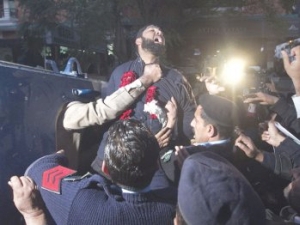
Malik Mumtaz Hussain Qadri, the bodyguard arrested for the killing of Punjab Governor Salman Taseer, shouts religious slogans while being taken away by police after he was presented at a court in Islamabad. - Reuters Photo

LAHORE: Lawyers showered the suspected killer of a prominent Pakistani governor with rose petals when he arrived at court Wednesday and an influential Muslim scholars group praised the assassination of the outspoken opponent of laws that order death for those who insult Islam.

Mumtaz Qadri made his first appearance in an Islamabad court, where a judge remanded him in custody a day after he allegedly sprayed automatic gunfire at the back of Punjab province Gov. Salman Taseer while he was supposed to be protecting him as a bodyguard.

A rowdy crowd slapped him on the back and kissed his cheek as he was escorted inside. The lawyers who tossed handfuls of rose petals over him were not involved in the case.

As he left the court, a crowd of about 200 sympathizers chanted “death is acceptable for Muhammad’s slave.” The suspect stood at the back door of an armored police van with a flower necklace given to him by an admirer and repeatedly yelled “God is great.”

More than 500 clerics and scholars from the group Jamat Ahle Sunnat said no one should pray or express regret for the killing of the governor. The group representing Pakistan’s majority Barelvi sect, which follows a brand of Islam considered moderate, also issued a veiled threat to other opponents of the blasphemy laws.

“The supporter is as equally guilty as one who committed blasphemy,” the group warned in a statement, adding politicians, the media and others should learn ”a lesson from the exemplary death.”

Jamat leader Maulana Shah Turabul Haq Qadri paid “glorious tribute to the murderer … for his courage, bravery and religious honor and integrity.”

Mumtaz Qadri told interrogators Tuesday that he shot the liberal Taseer multiple times because of the politician’s vocal opposition to the harsh blasphemy laws.

©2010 DAWN Media Group. All rights reserved
URL: www.dawn.com/2011/01/05/lawyers-shower-...-killer.html

‘No grief, no sorrow’

The daily Nation, Pakistan
 Wednesday, January 05, 2011
‘No grief, no sorrow’
Published January 05, 2011

Tehrik Tahafuz-e-Namoos-e-Risalat Convener and JUP President Sahibzada Dr Abulkhair has stated that Punjab Governor Salman Taseer’s remarks against the blasphemy law and his support to Aasia Bibi (a convict under this law) led to his assassination.

In a TV interview, he said those who respected Holy Prophet Muhammad (PBUH) would express no grief or sorrow over the incident because the governor had used such remarks for the blasphemy law which had hurt the sentiments of Muslims.

He said no Muslim could tolerate remarks against the Holy Prophet Muhammad (PBUH).

Asked whether the accused should be set free, the TTNR chief said the matter should be thoroughly investigated to determine the motive.

He said the accused had no regrets for what he did, and there were many people who were distributing sweets.

Jamaat-i-Islami leader Dr Farid Paracha said it was a deplorable incident and nobody should be allowed to take the law into his own hands.

He offered condolences to the bereaved family.

The JI leader said the tragedy had proved once again that there was dire need for the Blasphemy Law.

He said while nobody should be killed because of his statements, but at the same time no statement should be issued which hurt the sentiments of others.

He said the matter should be left for the court to decide.

Meanwhile, police arrested former tehsil nazim Sardar Ebad Dogar in connection with the assassination of Punjab Governor Salmaan Taseer, reported a private TV channel.

The local politician was detained after police conducted a raid on his house in Muzaffargarh because he had announced Rs30 million as ‘head money’ for the killer of Taseer over his demand to repeal the law related to blasphemy.

It is worth recalling that the religious parties, including banned outfits, were very critical of Taseer for his outspoken liberal stance after a court in Sheikhupura awarded Aasia Bibi, a Christian woman, death sentence for allegedly passing remarks against Holy Prophet (PBUH). Since then, Taseer was receiving life threats continuously.

The leader of militant organisation, now working under a new name after the parent outfit was banned by the govt, a few week ago said in a live TV current affairs show that someone would kill Aasia Bibi if President Zardari accepted her request for a pardon.

‘No grief, no sorrow’

Thursday, December 30, 2010

Govt appeases religious parties on blasphemy law

Daily Dawn, Pakistan
Pakistan
Govt appeases religious parties on blasphemy law
From the Newspaper
December 30, 2010
By Raja Asghar
Community condemns murder of man, the fourth in his family to be shot dead this year
Tahafuz-e-Namoos-e-Risalat Action Committee Chairman, Anwar-ul-Haq Haqqani addresses press conference at Quetta press club on Wednesday. — Photo by PPI

ISLAMABAD: In a move to appease religious parties, the government told the National Assembly on Wednesday it had no mind to change the controversial anti-blasphemy law often seen misused against members of minority communities, but appeared calm against political theatrics of some volatile allies.

Religious Affairs Minister Khurshid Ahmed Shah interrupted the house proceedings to make a policy statement “with full responsibility” that the “government has no intention to repeal the anti-blasphemy law and to disown a private bill of a PPP member proposing changes in the Zia-era law to abolish a mandatory death sentence against a convict provided by it and to guard against miscarriage of justice.

The government assurance came ahead of what has been described as a countrywide “shutter down strike” called for Friday by a religious grouping seeking to protect the dignity of the holy prophet Mohammad (PBUH), or “namoos-i-risalat”. “The government regards safeguarding ‘namoos-i-risalat’ as its responsibility and believes in it”, the minister said and, in a reference to the daft submitted by former information minister Sherry Rehman but yet to come before the house, added: “If someone has brought a private bill, it has nothing to do with the government.”

Mr Shah also assured the house that the government would not allow any wrong done to minorities, which have often complained of false accusations made against their members under a law enforced by former military dictator Gen Mohammad Zia-u-Haq as part of his controversial campaign to Islamise the Pakistani society. But he did not specify any measures to do that.

The strike call was given by a “Namoos-i-Risalat” conference held in Islamabad on Dec 15 under the auspices of Majlis-i-Tahafuz Khatam-e-Nabuwat (association for the protection of the finality of prophethood), which was also attended by the representatives of some banned religious groups operating under new names. ……

©2010 DAWN Media Group. All rights reserved
URL: www.dawn.com/2010/12/30/govt-appeases-...-blasphemy-law.html

Tuesday, December 28, 2010

Religious parties announce strike over blasphemy issue

Daily Dawn, Pakistan
National
Religious parties announce strike over blasphemy issue
From the Newspaper
December 28, 2010

PESHAWAR, Dec 27: Tehrik-i-Namoos-i-Risalat has announced a province-wide shutter down strike in Khyber Pakhtunkhwa on Dec 31 to stall any move for making amendments to the blasphemy law and appealed to business community to make the strike a success.

The decision was taken in a meeting of the steering committee of Tehrik-i-Namoos-i-Risalat at Al-Markaz-i-Islami with its convener Shabir Ahmed Khan in the chair here on Monday.

Those who attended the meeting included Shamsur Rehman Shamsi and Maulana Amanat Shah of the JUI-F, Ikramullah Shahid and Maulana Abdul Haseeb Haqqani of JUI-S, Fayaz Khan and Maulana Merajuddin of JUP, Fazalur Rehman Madni of Markazi Jamiat Ahle Hadith, Ramzan Tauqeer of Tehrik-i-Islami, and Israrullah advocate and Hamidullah Jan of JI.

The participants criticised Punjab Governor Salman Taseer and Pakistan People`s Party MNA Sherry Rehman for their attempt to help release the blasphemy convict Aasia Bibi.

“There is no room for changes in the blasphemy law as it is a matter of faith,” they unanimously said and asked the government to forthwith reject the bill presented by Sherry Rehman in the National Assembly for amendment to the law.

Holding their respective party flags activists of all the religious parties would hold rallies and public meetings in different districts, and the traders would keep the shutters down to express solidarity with the Tehrik-i-Namoos-i-Risalat.

The meeting decided that the district leadership of all the parties would hold meetings with traders to seek their complete support for shutter down strike. However, the traffic will remain smooth in all the districts. The steering committee will meet again today (Tuesday).

©2010 DAWN Media Group. All rights reserved
URL: www.dawn.com/2010/12/28/religious-parties-announce...issue.html

Friday, December 24, 2010

Pakistan to review blasphemy laws, official says

CNN, USA
Pakistan to review blasphemy laws, official says
By Nasir Habib, CNN
December 24, 2010 — Updated 1031 GMT (1831 HKT)

Asia Bibi, a Christian, was sentenced to death for blasphemy of Islam - judicial proceedings could take years.
Asia Bibi, a Christian, was sentenced to death for blasphemy of Islam — judicial proceedings could take years.
Islamabad, Pakistan (CNN) – Pakistan will review blasphemy laws to prevent them from targeting innocent people, a government official said.

The government will form a committee of scholars to revisit the law, said Shahbaz Bhatti, the federal minister for minority affairs.

It will submit its suggestions and procedures, which will be implemented to stop the law’s misuse, the minister said Thursday.

“After the formation of the committee we will …. find the way that whether through the legislation or some other procedural way we can stop the blasphemy law,” Bhatti said.

On pardoning of Asia Bibi, a Christian woman sentenced to death for blasphemy of Islam, Bhatti said the president will wait for the judicial proceedings.

Bibi’s lawyer has said that the proceedings might take years because the case is still in high court and may later go to the Supreme court.

Religious parties are planning protests after Friday prayers. The parties have been upset since the governor of Punjab province helped file a mercy petition with President Asif Ali Zardari’s office requesting a pardon for Bibi.

Parties including the Jamiat Ulema-e-Islam-Fazal ur Rehman (JUI-F) party will hold the rallies on Christmas Eve, said Moulana Amjad Khan, party spokesman.

A Pakistani court in November found the 45-year-old woman guilty of defiling the name of the Prophet Mohammed during a 2009 argument with Muslim fellow field workers.

The offense is punishable by death or life imprisonment, according to Pakistan’s penal code.

But an investigation by a Pakistani government ministry found the charges stemmed from “religious and personal enmity” and recommended Bibi’s release. Zardari has said he would pardon Bibi, but a court has ruled that the president can’t act until the sentence is confirmed by a higher court – a process her lawyer says could take two to three years.

About 2 million Christians live in Pakistan. The Islamic nation has a population of about 170 million, according to government statistics as religious parties plan Friday rallies to protest possible changes.

© 2010 Cable News Network. Turner Broadcasting System, Inc. All Rights Reserved.
URL: http://edition.cnn.com/2010/WORLD/asiapcf/12/24/pakistan...laws/?hpt=T2

Thursday, December 23, 2010

Pakistan parties protest possible blasphemy law changes

CNN, USA
Pakistan parties protest possible blasphemy law changes
By Nasir Habib, CNN
December 23, 2010 -- Updated 0941 GMT (1741 HKT)
Pakistani women of the fundamentalist Jamaat-i-Islami party march against Asia Bibi on December 9.
Islamabad, Pakistan (CNN) – Pakistan’s religious parties are planning protests this week against any attempts to change the nation’s blasphemy laws, a party spokesman said Thursday.

Moulana Amjad Khan, spokesman for the Jamiat Ulema-e-Islam-Fazal ur Rehman (JUI-F) party, said the JUI-F and other religious parties are going to hold the rallies on December 24.

JUI-F recently left the collation government led by President Asif Ali Zardari’s Pakistan People’s Party.

Religious parties have been upset since the governor of Punjab province, Salman Taseer, helped file a mercy petition with Zardari’s office, requesting a pardon for Asia Bibi, a Christian woman sentenced for death for blasphemy.

In November, a Pakistani court found the 45-year-old Bibi guilty of defiling the name of the Prophet Mohammed during a 2009 argument with Muslim fellow field workers. The offense is punishable by death or life imprisonment, according to Pakistan’s penal code.

But an investigation by a Pakistani government ministry found the charges stemmed from “religious and personal enmity” and recommended Bibi’s release. Zardari has said he would pardon Bibi, but a court has ruled that the president can’t act until the sentence is confirmed by a higher court – a process her lawyer says could take two to three years.

A Pakistani cleric is offering a nearly $6,000 bounty for anyone killing Bibi.

Moulana Yousaf Qureshi made his announcement in early December, condemning any effort by Zardari to pardon or release her.

“I will pay 500,000 rupees for the loyal follower of Muhammad who beheads Asia Bibi,” Qureshi told a crowd of several hundred people. The amount is equivalent to about $5,800, or more than six times the country’s average annual wage.

About 2 million Christians live in Pakistan, making up slightly over 1 percent of the officially Islamic nation’s population of about 170 million, according to government statistics.

© 2010 Cable News Network. Turner Broadcasting System, Inc. All Rights Reserved.

Saturday, December 4, 2010

Not an American conspiracy

Express Tribune, Pakistan
Opinion
Not an American conspiracy
Asad Jamal
Kunwar Khalid Yunus
December 04, 2010
The writer is a Lahore-based advocate of the high court with five years experience and an LLM from the University of Sussex

Is the demand to change Pakistan’s blasphemy laws an American conspiracy as being thought by some people in the country? Though there is no evidence to respond to this question in the affirmative, many believe it to be the case. Thus, Sherry Rehman’s proposed bill to amend blasphemy laws is being termed a conspiracy. This line of thinking is part of the same stream which is averse to reason.

If the demand to change the law is really a conspiracy, then senior advocate of the Supreme Court Muhammad Ismail Qureshi, the chief architect of the most stringent blasphemy law i.e. Section 295-C of the Pakistan Penal Code (PPC), is also part of the conspiracy. Because on pages 336-7 of the fourth edition (2010) of his book titled Namoos-i-Rasool (SAS) aur Qanoon-i-Tauhin-i-Risalat, he proposes an amendment to Section 295-C to make it less stringent.

He acknowledges that the present Section 295-C of the PPC is not in accordance with the Holy Quran and Sunnah and is indiscriminate as regards intentional and unintentional (bil irada and bila irada) offences of blasphemy in respect of the Holy Prophet (pbuh). He proposes to amend the provision by dividing it into two parts, while retaining the ‘death sentence’ for cases of intentional and wilful use of derogatory remark in respect of the Holy Prophet (pbuh) and by providing a ‘fine’ as punishment in cases of unintentional remarks.

While acknowledging parliament’s right to amend the law, Mr Qureshi suggests that the matter of blasphemy laws is not a closed chapter: “Another aspect that the legislature needs to look into is that for the imposition of Hudood punishments, evidence must fulfil the test of Tazkiyah-tul-Shahood without which Hadd may not be imposed, and a lesser punishment by way of Tazir may only be awarded in such cases. Similarly, parliament may change the law to provide for a due lesser punishment by way of Tazir for blasphemy in respect of the Holy Prophet (pbuh) in cases where conditions for the imposition of Hadd are not met.” (Translated by the writer)

Qureshi’s argument for a death sentence, based on some Islamic sources, is highly contentious. For instance, Javed Ahmad Ghamidi, finding support from the Holy Quran, argues that “…the death sentence can only be given to a person who has killed someone or to someone who is guilty of spreading disorder in a society. No other person can be punished by death.” (The Penal Shariah of Islam, page 39)

Back in 1986, Qureshi drafted Section 295-C providing the death sentence as the only punishment for blasphemy and got it tabled in the National Assembly in 1986 through MNA Apa Nisar Fatima of the Jamaat-i-Islami. The law was passed by parliament in an amended form as it is present in the statute. In 1990, a Federal Shariat Court decision on a petition by Ismail Qureshi rendered the alternative punishment of life imprisonment inapplicable. Clearly, the author of the law has reconsidered his stance since then.

Evidence suggests that stringent religious laws have only encouraged and complimented increasing radicalism and provided reasons for mob justice and abuse of laws for personal motives. In most cases, this has resulted in a grave miscarriage of justice at the hands of the courts. A recent confirmation of death sentence in a blasphemy case by the Lahore High Court is an example (Criminal Appeal No. 1356/2002) in which the court has based its judgment on indirect, hearsay evidence and an extra-judicial confession.

Efforts to change blasphemy laws cannot be termed a conspiracy. Indeed, if there is a conspiracy of scandalous proportions it is the ongoing propaganda and threat of violence to thwart the proposed amendments to blasphemy laws. Sherry Rehman’s proposed amendment bill, while doing away with the death sentence, addresses some of the concerns raised by civil society including lawyers and human rights defenders. Parliament must not lose this opportunity to reconsider the laws that have caused so much insecurity especially amongst religious minorities.

Published in The Express Tribune December 4th, 2010.

Blasphemy laws — a modification is in order

Express Tribune, Pakistan
Opinion
Blasphemy laws — a modification is in order
Kunwar Khalid Yunus
Kunwar Khalid Yunus
December 04, 2010
The writer served as member of the National Assembly for the MQM four times and is currently a member of the party’s Rabita Committee

The biggest millstone hanging around Pakistan is a remnant from General Ziaul Haq’s time in power — the seemingly untouchable blasphemy laws, first introduced and passed as law in 1986. The law was in fact never drafted, produced or debated in either house of parliament and was more or less bulldozed, through Zia’s Majlis-e-Shura, by a member of parliament who belonged to the Jamaat-i-Islami. The law was approved swiftly without any debate, because that would have meant opposition and the climate in those days was such that it was a risk most lawmakers would not be willing to take. Besides, the dictator in charge at that time, General Zia, wanted their passage so there wasn’t really much that parliament could do in any case.

Given the widespread reported abuse of the blasphemy law, it should be clear to any sensible individual that the existing legislation needs to be modified. To this effect, a proposal has been introduced by an MNA from the ruling party. However, I should add that in the past, it was the MQM that presented at least five amendments to the Hudood Ordinance in 2002. Laying the Hudood Ordinance for amendments in parliament was no joke, given the threats that usually come from clerics and risks associated with backing such legislation.

The most brutal blasphemy laws out of the 57 countries that make up the OIC are found in Saudi Arabia, Afghanistan and Pakistan. Among them, the laws in Pakistan are perhaps the most stringent. A blasphemy law constitutes a death penalty or a death penalty with a fine for the “use of derogatory remarks in respect of the Holy Prophet (pbuh)” and a Shariat Court judgment in 1990 made the death sentence mandatory.

In Afghanistan, the constitution says: “Blasphemy may be punished by penalties up to execution by hanging.” The Afghan constitution was later rewritten, changing many of its articles to make them in accordance with the 21st century.

In Saudi Arabia, the laws prescribe “penalty up to the death for blasphemy” — and this is, surprisingly, less harsh than the law in Pakistan. The law in the world’s largest Muslim country, Indonesia, prescribes a maximum punishment for blasphemy for five years in jail (Article 156-A of the Indonesian constitution).

Statistics compiled by a well-reputed NGO in Pakistan reveals that of the 378 individuals who have been tried over the years under the blasphemy law, as many as 10 per cent met a violent fate, as in they were killed by frenzied mobs merely on the assumption that they had indeed committed an act of blasphemy. This shows the extent of the law’s misuse and is a strong argument for their modification so as to prevent innocent people from being killed.

Published in The Express Tribune, December 4th, 2010.

Saturday, November 27, 2010

Several injured, arrested at Sunni Ittehad Council rally

Daily Dawn, Pakistan
Pakistan
Several injured, arrested at Sunni Ittehad Council rally
Agencies
November 27, 2010
The workers of Sunni Tehreek (ST) arriving on board Khyber Mail were arrested at Rawalpindi Railways station. — File Photo

ISLAMABAD: Over a hundred local leaders and activists of Sunni Ittehad Council were arrested on Saturday. Police stopped the rally near ‘Soha Rawalpindi, where the activists had held a sit-in protest and were determined to move forward.

Police in twin cities of Islamabad and Rawalpindi jump-started into action since Saturday morning in a bid to stem Council’s Long March from Islamabad to Lahore. Hazrart Bari Imam Shrine was sealed.

The workers of Sunni Tehreek (ST) arriving on board Khyber Mail were arrested at Rawalpindi Railways station.

According to Cantt Police Station, at least 50 people were taken into custody. Meanwhile, Sunni Council spokesman claimed over 200 of their workers were nabbed.

In view of security apprehensions, the government was in top gear since yesterday to stanch Islamabad-Lahore Long March announced by Sunni Ittehad as the march to ‘Save Pakistan’.

Islamabad’s exits and entry points especially those roads leading to Bari Imam Darbar were heavily guarded with baton-wielding police contingents armed with tear-gas shells and armored personnel carrier (APC).

Police were given duties outside madaris in support of Sunni Tehreek. Also, some local leaders were browbeaten into staying back.

Police took 19 Tehreek workers including a local leader during an operation in Jhelum.

According to Rawalpindi officials, over 100 people have been taken into custody. – Agencies

Chief of the Sunni Ittehad Council (SIC) Sahibzada Fazal Karim on Saturday said the SIC will not allow the repeal of the blasphemy laws. He said terrorism had distorted Pakistan’s image across the globe, adding that those persuading people for suicide bombings were not loyal to Pakistan.

Hundreds of SIC activists started a nearly 200-mile long march on Saturday in a protest against Taliban attacks on the country’s religious sites.

Authorities warned that militants could attack the procession which was being led by Sahibzada Fazal Karim.

Police escorted the convoy out of Islamabad, where the journey had started.

The participants, travelling on foot and in cars, plan to rally in Lahore, where 47 people died in a suicide bombing at a Sufi shrine in July.

While addressing the participants of the long march at Islamabad’s Bari Imam shrine, Karim said the government had not accepted the SIC’s demand for legislation to curb terrorism and called for an All Parties Conference on the issue.

He further demanded the release of the arrested SIC activists.

The local administration had imposed Section 144 in Rawalpindi and several activists from various religious seminaries had been arrested.

Following intelligence reports of possible terror attacks, the Punjab government had banned the long march to avert any untoward incident.

©2010 DAWN Media Group. All rights reserved

Wednesday, November 24, 2010

Religious parties threaten protest in blasphemy case

Daily Dawn, Pakistan
Pakistan
Religious parties threaten protest in blasphemy case
From the Newspaper
November 24, 2010
Activists of Jamaat-e-Ahl-e-Sunnat stage demonstration in support of their demands outside press club Lahore on Wednesday. - Online Photo
Activists of Jamaat-e-Ahl-e-Sunnat stage demonstration in support of their demands outside press club Lahore on Wednesday. — Online Photo

LAHORE: Religious parties have warned the Pakistan People’s Party government, especially Punjab Governor Salmaan Taseer, of a rigorous protest drive if they try to release the woman convicted of blasphemy.

The Aalmi Tanzeem Ahle Sunnat staged a demonstration outside the Lahore Press Club on Tuesday where participants chanted slogans against Taseer for promising to use his influence to seek presidential pardon for Asia, who was sentenced to death by a sessions court judge on blasphemy charges.

Addressing the demonstrators, Pir Afzal Qadri demanded the Supreme Court take notice of the governor’s interference into the judicial system and disqualifying him to hold the public office as, what Qadri said, Taseer had proved himself to be an enemy of the religion by declaring the blasphemy law as ‘black law’ and the verdict a “cruel judgment”.

Other speakers demanded that President Zardari should refrain from hurting feelings of the Ummah by granting pardon to the convict otherwise a protest drive would be launched against the government.

They announced observing Friday (Nov 26) as a protest day against the governor’s statement and his intention to seek relief for the convict.

Jamaat-i-Islami (JI) amir Munawwar Hasan has also condemned the campaign launched by the governor and the country’s secular lobby for the release of Asia, and said the nation would foil every conspiracy to abolish the blasphemy law.

In a statement, he said any such attempt would prove to be the last nail in the coffin of the PPP government.

He said the JI would consult other political and religious parties to chalk out a joint line of action against the secular lobby’s designs.

Besides some foreign powers, the secular lobby and the foreign-funded NGOs having ‘anti-Islam’ and ‘anti-Pakistan’ agenda were pressurising the government into releasing the convict in a blatant interference in the country’s judicial system and its internal affairs, he alleged.

He said none of the human rights or women’s rights bodies had made any protest when a US court sentenced Dr Aafia Siddiqui to 86 years in jail without any proof and no ruler, including the governor, felt any sympathy for her.

However, on the conviction of Asia, Taseer promptly reached the jail to ensure “justice” to a blasphemer and even President Zardari hinted at releasing her, the JI chief lamented.

©2010 DAWN Media Group. All rights reserved

Saturday, July 17, 2010

ISI link doctor to Jinnah Hospital attack

Express Tribune, Pakistan
Pakistan
Punjab
ISI link doctor to Jinnah Hospital attack
By Abdul Manan
July 17, 2010
Members of the Ahmadiyya community listen to a sermon during Friday prayers at their worship place in Garhi Shahu, Lahore. This was one of...

LAHORE: The Inter Services Intelligence (ISI) have picked up a doctor in connection with the May 31 attack on the Jinnah Hospital after “a thorough surveillance lasting over a month and a half” on July 10, officials in the agency have told The Express Tribune.

However, Dr Abdullah’s parents and colleagues dismiss the assertions and rule out his involvement in the terrorist attack. They say they will hold a press conference at the Lahore Press Club on July 17 to chalk out a strategy for his release.

Intelligence officials said that the ISI men had started monitoring doctors who they suspected might have facilitated the terrorists who attacked the hospital in a bid to free or kill a suspect named Moaz, who was injured during the May 28 attack on the Ahmadis’ places of worship in Model Town.

The sources said that Abdullah was the first one to send a bouquet to the injured suspect on May 30 while he was still recuperating in the hospital’s intensive care unit (ICU).

Despite Abdullah being a junior doctor, they said, he gained access to the terrorist inside the ICU because of his alleged connections with the Islami Jamiat-e-Taleba (IJT) and the Jamaatud Dawa, which is a banned group.

According to the intelligence officials, six members of the Ahmadiya community, who were admitted to the surgical ward unit 2 of the hospital, indicated that they were not being given proper medical care and said that doctors’ negligence had caused some patients’ injuries to deteriorate.

During their surveillance, they said that they found that two of the doctors in surgical ward’s unit 2 had a close relationship with Dr Ali Abdullah, who “visited the Ahmadis’ ward several times a day despite working in a different ward”. He often “helped” his fellow doctors, prescribing medicines for the Ahmadi victims. A serving deputy inspector-general of police, who belongs to the Ahmadiya community, is also said to have alerted the ISI about the “suspicious movements of Dr Abdullah”. He is also said to have filed his own findings based on information gathered by provincial level intelligence operatives.

Dr Abdullah, sources said, was picked up on Saturday afternoon and by Monday, he was transferred to Islamabad for further questioning.

A local office-bearer of the Ahmadiya community, Nasrullah Baloch, confirmed that the condition of some of the injured community members had deteriorated in the Jinnah Hospital’s ICU. He said that they were now being treated at another private hospital.

Investigation SP of the Model Town Division Abdul Rab said that they were investigating about the missing doctor from all angles, adding that they had also questioned some of the relatives of Dr Abdullah in a bid to establish the extent of his links with the terrorists. He said that despite his being a doctor, his links with terrorists could not be ruled out.

Dr Sarfaraz, the suspect doctor’s father, who is also an additional medical superintendent of the Services Hospital told The Express Tribune that his son might have been detained because of his “ties with the IJT”, adding that his son might even have been killed.

Reaffirming his political affiliation with the Jamaat-e-Islami, he said that although his son had served as an IJT Nazim when he was a studying in the Allama Iqbal Medical College in Lahore, he could not have been involved in abetting terrorists who attacked Jinnah Hospital. “It is not a crime to be affiliated with a religious political organisation.”

According to Dr Sarfaraz, his bearded 24-year-old son had been missing since July 10, adding that he had lodged an FIR with the Garden Town police station on July 11.

He said that a number of doctors had assured him that they would “paralyse hospitals across the province”. He said that the doctors had assured him that when they could “force the UAE government to release Dr Ayaz, our own government will not be able to sustain such protests for more than a week”.

Dr Ayaz was picked up by a US intelligence agency from Ras al Khaimah in the UAE on suspicion of having ties with al Qaeda. The detained doctor was freed after 64 days in custody after doctors in the UAE and Pakistan launched a concerted protest campaign.

The spokesman for the Jinnah Hospital told The Express Tribune that Dr Abdullah had been working in the hospital as the house officer in the surgical ward’s unit 1 for the past three months. He said that there was no doubt that Dr Abdullah was a “hardcore IJT activist, but he simply cannot be involved in facilitating the attackers”.

Published in The Express Tribune, July 17th, 2010.

Saturday, July 3, 2010

Fire breathing clerics call for revenge

Express Tribune, Pakistan
Pakistan
Punjab
Fire breathing clerics call for revenge
By Rana Tanveer
July 03, 2010
Protestors express their anger over the attacks at the Data Darbar, and call for punishing people involved in the incident. PHOTO: EXPRESS
Protestors express their anger over the attacks at the Data Darbar, and call for punishing
people involved in the incident. PHOTO: EXPRESS

Addressing a charged protest demonstration outside the Data Darbar on Friday, with over 3,000 emotional participants, the leaders of the Sunni Ittehad Council (SIC) openly advocated violent revenge.

Several SIC members vowed to ‘seek revenge’ for ‘the attack on Sunni honour’ and urged violence against those responsible. Instigating the cheering and vulnerable mass of participants, Allama Abdul Tawab Siddiqi questioned, “Are you a devotee of the saint in name only or do you want to seek revenge and prove your allegiance?”

Tempers and emotions ran high as the protestors raised their hands in unison, heeding the call and promising to prove their loyalty. Allama Siddiqi then administered them a collective oath.

A masked gunman fired a round from the midst of the crowd to mark the end of Allama Siddiqi’s speech and as a symbolic gesture of the crowd’s respect and agreement.

Raghib Naeemi then took the stage and read out a list of demands for the government. He said that all the individuals responsible for the Thursday night’s suicide attack should be arrested and publically hanged preferably in front of the Data Darbar. He demanded that all literature spewing hatred against Sunnis should be destroyed and banned.

Raghib urged the government to protect the lives and properties of the Sunni community. He suggested that Rana Sanaullah should be dismissed from his position as law minister for his alleged links with terrorist organisations.

Moreover he demanded that Abdul Rehman Jullendhari (member Wafaqul Madaris Qari Hanif) and Maulana Ahmed Ludhianvi (member Sipah-i-Sahaba) should be named in the FIR.

Other speakers alleged that the Punjab government and the Auqaf Department were equally responsible for the attack on the saint’s shrine by failing to ensure its security.

Qari Zawar Bahadar claimed that the government was promoting terrorism by continuing to finance various factions. He said that the government had banned various militant organisations owing to international pressure but had continued to support them under new names. He said that the government needed to give up its duplicity on terrorism.

The council announced a shutter-down strike for Saturday in a joint meeting at Jamia Naeemia.

Despite the public declarations and incitement, the protest was not interrupted and the police superintendant present at the scene made no move to arrest any of the leaders or the participants or to stop them.

Published in The Express Tribune, July 3rd, 2010.

Monday, June 21, 2010

Hate speech

Daily Dawn, Pakistan
FROM THE PAPER »
EDITORIAL
.
Hate speech
Dawn Editorial
Monday, 21 Jun, 2010
.
A strong case can be made against the JI leader for fomenting aggression and religious persecution under the country's laws regarding hate speech and incitement to violence. - Photo on file
A strong case can be made against the JI leader for fomenting aggression and religious persecution under the country’s laws regarding hate speech and incitement to violence. — Photo on file

The street power and political clout wielded by Pakistan’s religious right have resulted in the state and society being held hostage by extremist elements. The latter stop at nothing to further their agenda of inciting hatred, divisiveness and violence. The latest example is that of the Jamaat-i-Islami chief, Syed Munawwar Hasan, who during a sermon in Lahore on Friday threatened a fresh movement against the Ahmadi community if it “did not accept their minority status” and the government kept silent about “their blasphemous and unconstitutional activities”.

Mr Hasan did not specify any particular instance substantiating his charges, leading one to read his comments as hate speech and also as an attempt to blackmail the government into further victimising an already persecuted community. Given the incendiary passions the issue arouses, any call by religious parties in this context is certain to be attended by violence. A strong case can be made against the JI leader for fomenting aggression and religious persecution under the country’s laws regarding hate speech and incitement to violence.

Even beyond this particular case, it has now become a matter of urgency that the government show an active and uncompromising stance on the issue of hate speech and incitement to violence or other sorts of criminal activity. Pakistan’s polity is already rent by religious, ethnic and sectarian divisions. Allowing irresponsible and divisive opinions to be aired publicly will deepen these fissures. Once it begins, the process of religious, ethnic and other communities being pitted against one another will prove difficult to bring under control. Spiralling violence, particularly in view of other issues being faced by the country such as militancy and terrorism, can then be expected. It is in the interests of both the state and citizenry to take a stand against inflammatory hate speech and lobby for the prosecution of those who break the law.

©2010 DAWN Media Group. All rights reserved

Thursday, June 10, 2010

Religious Leaders Imply Ahmedis not Victims

Newsline, Pakistan
Home »
Blog Row, The Water Cooler
Religious Leaders Imply Ahmedis not Victims
By Talib Qizilbash                                          10 JUNE 2010
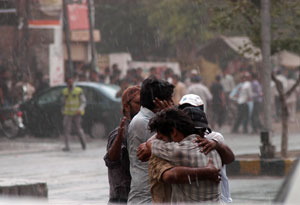
Drowned in sorrow: Men console each other after the deadly attacks on Ahmedi places of worship on May 28. Photo: AFP

First they condemned the attacks. Religious parties got together after the May 28 attacks on the Ahmedi places of worship and termed them un-Islamic (while tempering their criticism with some conspiracy theories). The News reported this:


Jamaat-e-Islami ameer Syed Munawwar Hasan termed the attacks on the Youm-e-Takbeer a conspiracy to trigger a civil war in the country and justify the US interference in the country. He said Islam strongly prohibited persecuting minorities and causing any harm to their worship places. He said the minorities in the country had always been secure and Islam made it a state responsibility to protect them.

Of course, everyone knows that minorities have NOT always been secure in Pakistan, but at least the religious parties agreed that the attacks on the Ahmedi community “were uncalled for and condemnable”.

But clearly it was false sympathy and crocodile tears. The view that the attacks were also, as reported by The News, a foreign “conspiracy to malign the country in the world in order to put more pressure [on Pakistan] regarding a change in the blasphemy laws” came with a sickening twist yesterday.

A BBC Urdu article reported on a Lahore meeting of leaders of the Muttahida Tehrik-i-Khatm-i-Nabuwat where the attendees concluded that the May 28 attacks on Ahmedis were part of a conspiracy to repeal the laws against them and challenge the finality of the Prophethood. There is an inherent insinuation that Ahmedis were an active part of the conspiracy; that Ahmedis hired terrorists to kill other Ahmedis in order to garner attention because they want to remake Islam. So, Ahmedis are not the real victims here?

This is like 9/11 conspiracy theorists: Americans killed Americans to launch a crusade against Islam.

Further, a Dawn.com report referencing the BBC article said that “the gathering was attended by leaders of the Jamaat-i-Islami, Jamiat-i-ulema-i-Islam Fazlur Rahman group, Jamaatud Dawa and Markazi Jamaat-i-Ahl-i-Sunnat among others” and that “Maulana Ilyas Chinioti, a member of the PML-N and the Punjab provincial assembly, condemned Nawaz Sharif’s statement in which he had sympathised with the Ahmadis and called them his brothers.”

Maulana Chinioti seems to be openly preaching that non-Muslims are lesser humans: only certain Pakistanis who are brutally massacred are worthy of pity. Our religious leaders believe Allah to be the most compassionate and merciful (and expect Him to show compassion towards them) but do they not believe they have a duty to love and show compassion in their lives (or even try to show compassion) to all people of all faiths. The people killed and injured on May 28 were innocent people, harming no one, only kneeling before God in peace. What about the verse from the Quran that says “killing one innocent person is regarded as the equivalent to killing all of mankind?”

The US, Israel and India (and whatever other foreign agents are at work) do not have to do anything to “malign the country in the world.” These religious and political ‘leaders’ are doing a fine job themselves.

Talib Qizilbash has been freelance writing since 2003. He joined Newsline in 2006, working as both a writer and editor. He is currently the magazine’s online editor.

URL: www.newslinemagazine.com/2010/06/religious-leaders-imply-ahmedis-not-victims/

Editor’s Note: June 2010

Newsline, Pakistan
Home »
Editorial, Opinion
Editor’s Note: June 2010
By Rehana Hakim                                                   10 JUNE 2010

Pakistan is fast becoming a state that will be habitable only for extremists: religious bigots who hold the view that only Muslims (as defined by them) have the right to live in this country – and that all non-Muslims are kafirs, infidels who are wajib-ul-qatl or deserve to be killed. Further, that all those who kill them are guaranteed a place in heaven, replete with houris and streams of milk and honey.

It’s criminal that those who harbour such hatred are being allowed to operate with impunity, to spout venom from the pulpits of mosques, to train in the Punjab government’s backyard while the head honcho feigns ignorance, even as his own law minister is seen hobnobbing with the Sipah-e-Sahaba at an election rally in Jhang.

Is it any surprise then that two dastardly attacks are carried out in broad daylight on Ahmedi mosques in Lahore, killing 95 people and injuring a 100 more. This is followed by yet another strike by the same terrorist group at a government hospital – to kill or secure the release of an accomplice recuperating in the same emergency ward as the victims of the earlier attacks.

How does this reflect on the intelligence and state of preparedness of this country’s security network that still remains ‘unaware’ of the hideouts of these elements, who have been making life intolerable for Pakistan’s small minority communities for several years now?

Ahmedi mosques, Christian churches and Hindu temples have been vandalised, their properties burnt or seized illegally; additionally, forcible conversions and marriages have taken place. And the culprits have always managed to escape the (not-so-long?) arm of the law.

Ironically, it is these very characters who have been quick to use the controversial blasphemy law to implicate minorities in false cases and make sure that they are lynched by charged mobs or left to rot in jails forever. Any attempts to make amendments to this law have met with stiff resistance from them, forcing the government to back off.

Consequently, the perpetrators of these hate crimes are getting bolder by the day. Three days after the attacks on the Ahmedi mosques, a father and son from the community were stabbed by a fanatic in Narowal wanting to convert them. The father died instantaneously. The hate crimes against the Shias have not ceased either. Yet another young doctor was gunned down – a stark reminder of the murder of 74 other Shia doctors in Karachi between the early 1990s and 2002, which remain unresolved to this day.

Likewise, the victims of the Gojra and Shantinagar incidents in which several Christian families lost their family members and property are yet to get any justice. There are no accused to hold to account – and the few who were arrested have been acquitted for “want of evidence.”

What evidence would be needed to prove an “identified” accused’s culpability? Only recently, Maulana Aziz and his entire family were acquitted of charges of illegally occupying a children’s library in Islamabad for lack of evidence.

Wasn’t this “illegal occupation” one of the causes that had sparked off the whole Lal Masjid furore in the first place? This fact was reported in the country’s major newspapers at the time. If these reports were inadmissible in a court of law, why couldn’t the police find any witnesses to substantiate the charge? Was it the threats from extremist forces or orders from some relevant quarters at the top that made the police and the prosecutor back off?

Rehana Hakim is one of the core team of journalists that helped start Newsline. She has been the editor-in-chief since 1996.

Wednesday, June 9, 2010

‘Attack on Ahmedis conspiracy to repeal laws against them’

Daily Dawn, Pakistan
PAKISTAN


‘Attack on Ahmedis conspiracy to repeal laws against them’
Wednesday, 09 Jun, 2010

People from Ahmadi community prepare to bury a casket containing a victim of an attack by militants, at their graveyard in Rabwah, some 150 kilometres northwest from Lahore, May 29, 2010. - AP
People from Ahmadi community prepare to bury a casket containing a victim of an attack by militants, at their graveyard in Rabwah, some 150 kilometres northwest from Lahore, May 29, 2010. — AP

LAHORE: A gathering of the leaders of 13 religious and political parties in Lahore claimed that the attack on Ahmedis on May 28 was part of a conspiracy to repeal the laws against them, BBCUrdu reported.

The meeting was held in an office of the Majlis Ahrar Islam in Lahore’s Muslim Town. The parties concluded that a conspiracy was in place to debate the laws against Ahmedis, the report said.

Maulana Zahidul Rashdi, who is a founding member of the Muttahida Tehrik-i-Khatm-i-Nabuwat and also the Secretary-General of the Pakistan Shariat Council, read the joint statement at the meeting’s conclusion: The attack on Ahmedis is being used as an excuse to generate suspicions regarding the concept of khatm-i-nabuwat.

The gathering was attended by leaders of the Jamaat-i-Islami, Jamiat-i-ulema-i-Islam Fazlur Rahman group, Jamaatud Dawa and Markazi Jamaat-i-Ahl-i-Sunnat among others.

During the meeting, Maulana Ilyas Chinioti, a member of the PML-N and the Punjab provincial assembly, condemned Nawaz Sharif’s statement in which he had sympathised with the Ahmedis and called them his brothers.

The meeting’s participants demanded that Nawaz Sharif immediately withdraw his statement.

©2010 DAWN Media Group. All rights reserved

Sunday, June 6, 2010

Laws that stoke violence

Daily Dawn, Pakistan
FROM THE PAPER »
EDITORIAL

Laws that stoke violence
    By Kunwar Idris
    Sunday, 06 Jun, 2010
Sectarian fanatics will get deadlier unless some basic changes are made in principles underlying state policy. - Photo by Reuters
Sectarian fanatics will get deadlier unless some basic changes are made in principles underlying state policy. — Photo by Reuters

The 1971 war is a sad chapter in Pakistan’s history which every citizen and soldier would like to forget. But not the children of Maj-Gen Nasir Chaudhry. They recall with some pride that their father was the only general seriously wounded on the frontline.

Now, 40 years later, they mourn his death at the age of 90 and in a hail of bullets and grenades fired by his own countrymen. The invading Indians gave him a chance to fight back and live, the sneaking fanatics of his own country did not. They killed him while he kneeled in prayer.

Also falling victim to two murderous assaults in Lahore on Friday, May 28 were Munir Sheikh, an incorruptible accountability judge, barrister Ejaz Nasrullah and advocate Hafeez Chaudhry. Almost all of the 100 or more Ahmadi shot dead at prayers on that day were productive and peaceable citizens who did no harm to anyone.

Rubbing salt into the wounds of the grief-stricken Ahmadis have been the expressions of sympathy for them and condemnation of killers coming from some religious leaders who have been incessantly preaching hatred and, of late, inciting violence against them through a section of the press and TV talk shows. It is hard to deny where lies the responsibility and with whom for the ever-increasing targeted killings of Ahmadis that culminated in the Lahore carnage. The government looked on as anchormen and muftis debated death as the only penalty for their heresy.

Looking for a foreign hand, as most among us tend to do, is only to confuse the public and leave the criminals free to strike again. Of all people, the Lahore commissioner Khusro Pervez should not have been heard instantly blaming India’s RAW to divert attention from his administrative incompetence.

The home-grown sectarian killers are an older breed distinct from the latter-day world terrorists — Al Qaeda, its regional sub-variant the Taliban and Indian agents provocateur.

To deal with terrorism may be beyond the skill and resources of the central and provincial governments but both surely can with the sectarian sipahs and lashkars. But they do not consider it politically expedient. They would rather use them to further their political ends.

Sectarianism as a creed is sustained by the laws and policies of the state or, as some would say, by the ideology of Pakistan. Not Ahmadis alone, every sect of Islam including the majority Sunni has been the victim of sectarian fanatics. And they will keep growing in numbers and getting deadlier in their strikes unless some basic changes are made in the principles underlying the state policy.

The first in order should be to shift the emphasis from religious ideology to fundamental rights of individuals and political rights of the constituent units of the federation. The religious belief of a person or a community should in no manner impair their rights as those of Ahmadis indeed have been drastically — both in law and practice.

Likewise, the political power of a province should not be curtailed because its leadership is considered more defiant and demanding as Balochistan’s has been visibly. The leader of no other province could have been bombed to death as was Akbar Bugti nor would his sons and loyalists been driven to the hills.

Secondly, the loyalty of a person or a party to the country should not be called into question only because of their political orientation before independence. Parties like Jamaat-i-Islami and various groups of the Jamiat-i-Ulema who had undeniably opposed Jinnah’s concept of Pakistan now put all the emphasis on its Islamic identity which inevitably stokes fires of sectarian hatred. Any party which restricts its membership to a particular religious denomination should be barred from taking part in national polls and denied representation in parliament.

Thirdly, the state must not legislate in matters of faith. No modern democracy does. All differences were freely debated till the time the National Assembly determined in 1975 that Ahmadis were not Muslims.

Ten years later, Gen Ziaul Haq enacted laws to punish Ahmadis if they “directly or indirectly” posed as Muslim or if any one from among them “in any manner whatsoever outrages the religious feelings of Muslims”. Not to be found wanting in zeal, Nawaz Sharif then decreed to abrogate the name of the Ahmadi headquarter town — Rabwah — drawn from the Holy Quran.

Since then the Ahmadis have been a target of discrimination by the state and violence by orthodox groups whom neither the government nor the religious leaders nor civil society can tame though all may be condemning.

Only reverting to the Pakistan of Jinnah’s conception will end this. Ironically, the first departure was made by Liaquat Ali Khan who, though fully sharing Jinnah’s outlook, had the Objectives Resolution passed by the constituent assembly requiring the state to enable the Muslims “to order their lives in the individual and collective spheres in accordance with the teachings and requirements of Islam as set out in the Holy Quran and the Sunnah”.

A greater irony was that the resolution found its most forceful spokesman in the foreign minister, Zafrulla Khan, whose community in later years became its chief victim. Gen Ziaul Haq incorporated the resolution in the constitution to legitimise his own rule. The violent legacy he handed down is being exploited fully by his successors in politics. The final answer to sectarian terror may have to be found in constitutional reforms. The 18th Amendment hasn’t gone beyond issues of political power.

kunwaridris@hotmail.com

©2010 DAWN Media Group. All rights reserved
URL: www.dawn.com/wps/wcm/connect/dawn-content...toke-violence-660
 
^ Top of Page