Showing posts with label legislation. Show all posts

Wednesday, February 2, 2011

Pakistan: Drop Blasphemy Charges Against 17-Year-Old

Human Rights Watch
Pakistan: Drop Blasphemy Charges Against 17-Year-Old
Student’s Case Underscores Urgent Need to Repeal Abusive Law
February 02, 2011

Pakistan has set the standard for intolerance when it comes to misusing blasphemy laws, but sending a schoolboy to jail for something he scribbled on an exam paper is truly appalling. It’s bad enough that a school official flagged it, but for police and judicial authorities to go ahead and lock up a teenager under these circumstances is mind boggling.Bede Sheppard, senior children's rights researcher at Human Rights Watch
(New York) — The Pakistani government should immediately drop blasphemy charges against a 17-year-old student and ensure his safe release from detention, Human Rights Watch said today.

The authorities arrested Muhammad Samiullah on January 28, 2011, and charged him under Pakistan’s “blasphemy law,” article 295-C of the criminal code, for allegedly including derogatory remarks about the Prophet Muhammad in his answers on a written school exam in April 2010. According to press reports, police at Shahra Noor Jahan Police Station in Karachi registered a case against Samiullah after receiving a complaint from the chief controller of the intermediate level education board. On January 29, a judicial magistrate, Ehsan A. Malik, ordered Samiullah sent to a juvenile prison pending trial.

“Pakistan has set the standard for intolerance when it comes to misusing blasphemy laws, but sending a schoolboy to jail for something he scribbled on an exam paper is truly appalling,” said Bede Sheppard, senior children’s rights researcher at Human Rights Watch. “It’s bad enough that a school official flagged it, but for police and judicial authorities to go ahead and lock up a teenager under these circumstances is mind boggling.”

The police have said that they cannot report exactly what was written in the exam paper as doing so would also amount to blasphemy.

The Convention on the Rights of the Child, an international treaty to which Pakistan is a party, guarantees everyone under age 18 the right to freedom of expression, thought, conscience, and religion.

Section 295-C of Pakistan’s penal code makes the death penalty mandatory for blasphemy. Although this case involves a Muslim, Human Rights Watch has documented how the law is often used to persecute and discriminate against religious minorities in Pakistan.

Pakistan has applied the blasphemy law to children before, Human Rights Watch said. On February 9, 1995, Salamat Masih, a Pakistani Christian boy who was then 14 was sentenced to death for blasphemy by a lower court in Lahore, Pakistan, for allegedly writing derogatory remarks about the Prophet Muhammad on the wall of a mosque. He was also sentenced to two years’ hard labor and fined. Masih was acquitted on February 23, 1995, because the court found that he was, in fact, illiterate. Masih then fled the country out of concerns for his safety. Justice Arif Iqbal Bhatti, who acquitted Masih, was assassinated in his chambers at the Lahore High Court in 1997. The assassin, who was subsequently arrested, claimed to have murdered the judge as revenge for acquitting Masih.

Hundreds of people have been charged under section 295-C since it was added to the penal code in 1986 by Gen. Muhammad Zia-ul-Haq, the military ruler at that time. In 2009, authorities charged scores of people under the law, including at least 50 members of the Ahmadiyya religious community. Many of those charged remain in prison.

Pakistani and international human rights organizations have long called for the repeal of the blasphemy law. The law has come under renewed scrutiny in recent months as a consequence of a death sentence imposed on November 8, 2010, on Aasia Bibi, an illiterate farmhand from Sheikhupura district in Punjab province.

Extremists responded to government attempts to pardon Aasia Bibi with a campaign of intimidation, violence, and threats against critics of the law. On January 5, Salman Taseer, the governor of Punjab province, was assassinated, and the man charged with the killing said he had committed the crime because Taseer had called the blasphemy law a “black law.” Sherry Rehman, Pakistan’s former information minister who in November proposed a parliamentary bill to amend the law, has also received death threats, which Pakistan’s government has ignored.

“While Pakistan’s government keeps up the mantra that it will not allow ‘misuse’ of the law, government inaction has only emboldened extremists,” Sheppard said. “Until this law is repealed, it will be used to brutalize religious minorities, children, and other vulnerable groups.”


Tuesday, December 28, 2010

Religious parties announce strike over blasphemy issue

Daily Dawn, Pakistan
National
Religious parties announce strike over blasphemy issue
From the Newspaper
December 28, 2010

PESHAWAR, Dec 27: Tehrik-i-Namoos-i-Risalat has announced a province-wide shutter down strike in Khyber Pakhtunkhwa on Dec 31 to stall any move for making amendments to the blasphemy law and appealed to business community to make the strike a success.

The decision was taken in a meeting of the steering committee of Tehrik-i-Namoos-i-Risalat at Al-Markaz-i-Islami with its convener Shabir Ahmed Khan in the chair here on Monday.

Those who attended the meeting included Shamsur Rehman Shamsi and Maulana Amanat Shah of the JUI-F, Ikramullah Shahid and Maulana Abdul Haseeb Haqqani of JUI-S, Fayaz Khan and Maulana Merajuddin of JUP, Fazalur Rehman Madni of Markazi Jamiat Ahle Hadith, Ramzan Tauqeer of Tehrik-i-Islami, and Israrullah advocate and Hamidullah Jan of JI.

The participants criticised Punjab Governor Salman Taseer and Pakistan People`s Party MNA Sherry Rehman for their attempt to help release the blasphemy convict Aasia Bibi.

“There is no room for changes in the blasphemy law as it is a matter of faith,” they unanimously said and asked the government to forthwith reject the bill presented by Sherry Rehman in the National Assembly for amendment to the law.

Holding their respective party flags activists of all the religious parties would hold rallies and public meetings in different districts, and the traders would keep the shutters down to express solidarity with the Tehrik-i-Namoos-i-Risalat.

The meeting decided that the district leadership of all the parties would hold meetings with traders to seek their complete support for shutter down strike. However, the traffic will remain smooth in all the districts. The steering committee will meet again today (Tuesday).

©2010 DAWN Media Group. All rights reserved
URL: www.dawn.com/2010/12/28/religious-parties-announce...issue.html

Saturday, December 4, 2010

Not an American conspiracy

Express Tribune, Pakistan
Opinion
Not an American conspiracy
Asad Jamal
Kunwar Khalid Yunus
December 04, 2010
The writer is a Lahore-based advocate of the high court with five years experience and an LLM from the University of Sussex

Is the demand to change Pakistan’s blasphemy laws an American conspiracy as being thought by some people in the country? Though there is no evidence to respond to this question in the affirmative, many believe it to be the case. Thus, Sherry Rehman’s proposed bill to amend blasphemy laws is being termed a conspiracy. This line of thinking is part of the same stream which is averse to reason.

If the demand to change the law is really a conspiracy, then senior advocate of the Supreme Court Muhammad Ismail Qureshi, the chief architect of the most stringent blasphemy law i.e. Section 295-C of the Pakistan Penal Code (PPC), is also part of the conspiracy. Because on pages 336-7 of the fourth edition (2010) of his book titled Namoos-i-Rasool (SAS) aur Qanoon-i-Tauhin-i-Risalat, he proposes an amendment to Section 295-C to make it less stringent.

He acknowledges that the present Section 295-C of the PPC is not in accordance with the Holy Quran and Sunnah and is indiscriminate as regards intentional and unintentional (bil irada and bila irada) offences of blasphemy in respect of the Holy Prophet (pbuh). He proposes to amend the provision by dividing it into two parts, while retaining the ‘death sentence’ for cases of intentional and wilful use of derogatory remark in respect of the Holy Prophet (pbuh) and by providing a ‘fine’ as punishment in cases of unintentional remarks.

While acknowledging parliament’s right to amend the law, Mr Qureshi suggests that the matter of blasphemy laws is not a closed chapter: “Another aspect that the legislature needs to look into is that for the imposition of Hudood punishments, evidence must fulfil the test of Tazkiyah-tul-Shahood without which Hadd may not be imposed, and a lesser punishment by way of Tazir may only be awarded in such cases. Similarly, parliament may change the law to provide for a due lesser punishment by way of Tazir for blasphemy in respect of the Holy Prophet (pbuh) in cases where conditions for the imposition of Hadd are not met.” (Translated by the writer)

Qureshi’s argument for a death sentence, based on some Islamic sources, is highly contentious. For instance, Javed Ahmad Ghamidi, finding support from the Holy Quran, argues that “…the death sentence can only be given to a person who has killed someone or to someone who is guilty of spreading disorder in a society. No other person can be punished by death.” (The Penal Shariah of Islam, page 39)

Back in 1986, Qureshi drafted Section 295-C providing the death sentence as the only punishment for blasphemy and got it tabled in the National Assembly in 1986 through MNA Apa Nisar Fatima of the Jamaat-i-Islami. The law was passed by parliament in an amended form as it is present in the statute. In 1990, a Federal Shariat Court decision on a petition by Ismail Qureshi rendered the alternative punishment of life imprisonment inapplicable. Clearly, the author of the law has reconsidered his stance since then.

Evidence suggests that stringent religious laws have only encouraged and complimented increasing radicalism and provided reasons for mob justice and abuse of laws for personal motives. In most cases, this has resulted in a grave miscarriage of justice at the hands of the courts. A recent confirmation of death sentence in a blasphemy case by the Lahore High Court is an example (Criminal Appeal No. 1356/2002) in which the court has based its judgment on indirect, hearsay evidence and an extra-judicial confession.

Efforts to change blasphemy laws cannot be termed a conspiracy. Indeed, if there is a conspiracy of scandalous proportions it is the ongoing propaganda and threat of violence to thwart the proposed amendments to blasphemy laws. Sherry Rehman’s proposed amendment bill, while doing away with the death sentence, addresses some of the concerns raised by civil society including lawyers and human rights defenders. Parliament must not lose this opportunity to reconsider the laws that have caused so much insecurity especially amongst religious minorities.

Published in The Express Tribune December 4th, 2010.

Blasphemy laws — a modification is in order

Express Tribune, Pakistan
Opinion
Blasphemy laws — a modification is in order
Kunwar Khalid Yunus
Kunwar Khalid Yunus
December 04, 2010
The writer served as member of the National Assembly for the MQM four times and is currently a member of the party’s Rabita Committee

The biggest millstone hanging around Pakistan is a remnant from General Ziaul Haq’s time in power — the seemingly untouchable blasphemy laws, first introduced and passed as law in 1986. The law was in fact never drafted, produced or debated in either house of parliament and was more or less bulldozed, through Zia’s Majlis-e-Shura, by a member of parliament who belonged to the Jamaat-i-Islami. The law was approved swiftly without any debate, because that would have meant opposition and the climate in those days was such that it was a risk most lawmakers would not be willing to take. Besides, the dictator in charge at that time, General Zia, wanted their passage so there wasn’t really much that parliament could do in any case.

Given the widespread reported abuse of the blasphemy law, it should be clear to any sensible individual that the existing legislation needs to be modified. To this effect, a proposal has been introduced by an MNA from the ruling party. However, I should add that in the past, it was the MQM that presented at least five amendments to the Hudood Ordinance in 2002. Laying the Hudood Ordinance for amendments in parliament was no joke, given the threats that usually come from clerics and risks associated with backing such legislation.

The most brutal blasphemy laws out of the 57 countries that make up the OIC are found in Saudi Arabia, Afghanistan and Pakistan. Among them, the laws in Pakistan are perhaps the most stringent. A blasphemy law constitutes a death penalty or a death penalty with a fine for the “use of derogatory remarks in respect of the Holy Prophet (pbuh)” and a Shariat Court judgment in 1990 made the death sentence mandatory.

In Afghanistan, the constitution says: “Blasphemy may be punished by penalties up to execution by hanging.” The Afghan constitution was later rewritten, changing many of its articles to make them in accordance with the 21st century.

In Saudi Arabia, the laws prescribe “penalty up to the death for blasphemy” — and this is, surprisingly, less harsh than the law in Pakistan. The law in the world’s largest Muslim country, Indonesia, prescribes a maximum punishment for blasphemy for five years in jail (Article 156-A of the Indonesian constitution).

Statistics compiled by a well-reputed NGO in Pakistan reveals that of the 378 individuals who have been tried over the years under the blasphemy law, as many as 10 per cent met a violent fate, as in they were killed by frenzied mobs merely on the assumption that they had indeed committed an act of blasphemy. This shows the extent of the law’s misuse and is a strong argument for their modification so as to prevent innocent people from being killed.

Published in The Express Tribune, December 4th, 2010.

Saturday, November 27, 2010

Several injured, arrested at Sunni Ittehad Council rally

Daily Dawn, Pakistan
Pakistan
Several injured, arrested at Sunni Ittehad Council rally
Agencies
November 27, 2010
The workers of Sunni Tehreek (ST) arriving on board Khyber Mail were arrested at Rawalpindi Railways station. — File Photo

ISLAMABAD: Over a hundred local leaders and activists of Sunni Ittehad Council were arrested on Saturday. Police stopped the rally near ‘Soha Rawalpindi, where the activists had held a sit-in protest and were determined to move forward.

Police in twin cities of Islamabad and Rawalpindi jump-started into action since Saturday morning in a bid to stem Council’s Long March from Islamabad to Lahore. Hazrart Bari Imam Shrine was sealed.

The workers of Sunni Tehreek (ST) arriving on board Khyber Mail were arrested at Rawalpindi Railways station.

According to Cantt Police Station, at least 50 people were taken into custody. Meanwhile, Sunni Council spokesman claimed over 200 of their workers were nabbed.

In view of security apprehensions, the government was in top gear since yesterday to stanch Islamabad-Lahore Long March announced by Sunni Ittehad as the march to ‘Save Pakistan’.

Islamabad’s exits and entry points especially those roads leading to Bari Imam Darbar were heavily guarded with baton-wielding police contingents armed with tear-gas shells and armored personnel carrier (APC).

Police were given duties outside madaris in support of Sunni Tehreek. Also, some local leaders were browbeaten into staying back.

Police took 19 Tehreek workers including a local leader during an operation in Jhelum.

According to Rawalpindi officials, over 100 people have been taken into custody. – Agencies

Chief of the Sunni Ittehad Council (SIC) Sahibzada Fazal Karim on Saturday said the SIC will not allow the repeal of the blasphemy laws. He said terrorism had distorted Pakistan’s image across the globe, adding that those persuading people for suicide bombings were not loyal to Pakistan.

Hundreds of SIC activists started a nearly 200-mile long march on Saturday in a protest against Taliban attacks on the country’s religious sites.

Authorities warned that militants could attack the procession which was being led by Sahibzada Fazal Karim.

Police escorted the convoy out of Islamabad, where the journey had started.

The participants, travelling on foot and in cars, plan to rally in Lahore, where 47 people died in a suicide bombing at a Sufi shrine in July.

While addressing the participants of the long march at Islamabad’s Bari Imam shrine, Karim said the government had not accepted the SIC’s demand for legislation to curb terrorism and called for an All Parties Conference on the issue.

He further demanded the release of the arrested SIC activists.

The local administration had imposed Section 144 in Rawalpindi and several activists from various religious seminaries had been arrested.

Following intelligence reports of possible terror attacks, the Punjab government had banned the long march to avert any untoward incident.

©2010 DAWN Media Group. All rights reserved

Thursday, November 25, 2010

The blasphemy law

Daily Dawn, Pakistan
The blasphemy law
I.A Rehman
November 25, 2010

Blasphemy LawsTHE worldwide outrage caused by the awarding of the death sentence to Aasia Bibi on a blasphemy charge was bound to happen sooner or later, in view of Pakistan’s inability to scrutinise a law that satisfies neither human rights advocates nor many authentic authorities on Islam. It is time this shortcoming was seriously addressed.
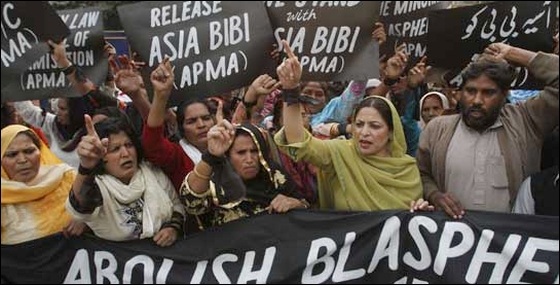
The matter has been complicated by two factors. First, the conservative opinion has not taken the reaction in the West, especially the Pope’s plea for mercy, in a proper spirit. Just as the people of Pakistan have a right to protest at violations of the Palestinian people’s human rights, western observers have a right to express concern at what they think amounts to human rights abuse in Pakistan.

Secondly, the idea of presidential intervention is counter-productive. Reprieve for a convict or two will not solve the problem. Future victims of the controversial legislation may have no defender at home or abroad. A critical appraisal of Section 295-C has become imperative, particularly because the Pakistan Penal Code (PPC) provision does not even enjoy the unanimous support of Islamic scholars.

This will become abundantly clear from the history of the addition of Section 295-C to the Penal Code. As the Penal Code did not have any specific provision for blasphemy against the Holy Prophet (PBUH), advocate Ismail Qureshi moved the Federal Shariat Court (FSC) in 1984 that to prescribe the death penalty for blasphemy. The petition did not go unchallenged. One objection raised by the counsel for the federation (under Gen Zia) was that the petition was not maintainable. Another issue was that since legislation fell under the jurisdiction of parliament, could the FSC issue a direction to the federation? The court reserved judgment.

Meanwhile, a bill was moved in the National Assembly seeking the insertion of Section 295-C in the PPC. It provided for the death penalty for blasphemy against the Prophet (PBUH).

According to Mr Ismail Qureshi, the law minister did not support the bill on the ground that the Quran did not prescribe a penalty for this offence. “Besides, an unexpected situation arose,” says Mr Ismail Qureshi, “when many Islamic-minded members of the Assembly did not wholly agree with the bill because they thought imprisonment for life was sufficient punishment for blasphemy.” Anyhow the bill was passed though the law ministry added life imprisonment as an alternative punishment. Discussion on the bill was cut short because its supporters insisted that the issue was not debatable.

Mr Qureshi again moved the FSC, this time for deletion of the alternative punishment from Section 295-C. He admits that “some ulema argued that blasphemy was a forgivable offence and some even said that the ruler could award a lesser punishment than death”.

The FSC ruled in October 1990 that the alternative punishment should be deleted as it was repugnant to Islam. The court further directed the federation to add a provision to the effect that any act of blasphemy upon other prophets should also be punishable with death. The government was told to amend Section 295-C by April 30, 1991. The federation filed an appeal against the FSC verdict but it was withdrawn.

Fears that Section 295-C could be abused were expressed from the very outset, by Mr Ismail Qureshi himself. He wrote: “In my opinion, this Section 295-C needs to be further amended because it is necessary to bring it in accord with Quran and Sunnah (emphasis added). In the present form it could create ambiguity and legal complications.” He then emphasised that proof of intent was necessary to secure conviction (a point also made by the FSC) and that the sentence of death should be based on ‘tazkiat-ul-shahood’ (unimpeachable evidence).

To give effect to a part of the FSC verdict (relating to the deletion of the alternative punishment) the Nawaz Sharif government moved the Criminal Law (Third Amendment) Bill 1991. In its report on the bill the Senate Standing Committee, headed by PML-N leader Senator Zafarul Haq, expressed reservations about the definition of the offence. It said:

“The Standing Committee on Law and Justice after detailed deliberations decided to recommend the proposed deletion of ‘or imprisonment of life’ from Section 295-C of the Pakistan Penal Code. The members, however, observed that there was a need for a more specific definition of the offence under Section 295 PPC which the members were of the considered opinion was in the present form very generalised. The committee suggests that the matter may be referred to the Council of Islamic Ideology for suggesting a more specific definition of the offence falling under Section 295 PPC As well as for its opinion as to whether during the lifetime of the Holy Prophet (PBUH) or during the period of Khulafa-i-Rashideen or afterwards in any of the Muslim countries, what was the punishment awarded to the offenders for committing offence falling under Section 295 PPC” (Gazette Extraordinary, Feb 22, 1992).

It was only during the early days of Benazir Bhutto’s second government that the amendment bill was finally adopted. Again the government was in a hurry to push the bill because the house was about to be prorogued.

The fears of abuse of Section 295-C started coming true soon afterwards. A surge in blasphemy accusations, mostly against Christians and Ahmadis in the beginning, invited the comment that this law had generated offences that previously were rare.

Three unsavoury facts were established: a) in many cases the law was invoked to deal with a business rival, to grab property or to settle a personal score; b) that filing FIRs against vulnerable persons had been adopted as a lucrative business by quite a few clerics; and c) that the conservative elements subjected courts to unbearable strains by laying siege to them. Subsequently it was found that trial courts were generally afraid of acquitting even an illiterate child accused of writing blasphemous notes or a man about whom a certificate of his mental disorder was on record.

Further, it was found that a blasphemy accused was safe neither in prison nor at a police station, nor even outside the Lahore High Court. Those acquitted by high courts could not live in Pakistan and a judge who had acquitted a child was killed after retirement.

Over the last few years the use of Section 295-C has become a weapon in the hands of sectarian warlords. While cases against non-Muslim citizens are still filed, in a good number of cases the accused are Muslims, including prayer leaders. It is not that governments have not been uncomfortable with 295-C. The governments of Benazir Bhutto, Nawaz Sharif and Pervez Musharraf all toyed with the idea of making some procedural changes but to no effect. Any further dilly-dallying will only compound the government’s difficulties.

While the argument for a repeal of the admittedly flawed text of the law is unexceptionable, this may take a long time. What is urgently needed is a serious effort to ensure that only those who deliberately commit an offence are punished and courts are protected against mob threats.

©2010 DAWN Media Group. All rights reserved
URL: www.dawn.com/2010/11/25/the-blasphemy-law-by-i-a-rehman.html

Wednesday, November 24, 2010

Religious parties threaten protest in blasphemy case

Daily Dawn, Pakistan
Pakistan
Religious parties threaten protest in blasphemy case
From the Newspaper
November 24, 2010
Activists of Jamaat-e-Ahl-e-Sunnat stage demonstration in support of their demands outside press club Lahore on Wednesday. - Online Photo
Activists of Jamaat-e-Ahl-e-Sunnat stage demonstration in support of their demands outside press club Lahore on Wednesday. — Online Photo

LAHORE: Religious parties have warned the Pakistan People’s Party government, especially Punjab Governor Salmaan Taseer, of a rigorous protest drive if they try to release the woman convicted of blasphemy.

The Aalmi Tanzeem Ahle Sunnat staged a demonstration outside the Lahore Press Club on Tuesday where participants chanted slogans against Taseer for promising to use his influence to seek presidential pardon for Asia, who was sentenced to death by a sessions court judge on blasphemy charges.

Addressing the demonstrators, Pir Afzal Qadri demanded the Supreme Court take notice of the governor’s interference into the judicial system and disqualifying him to hold the public office as, what Qadri said, Taseer had proved himself to be an enemy of the religion by declaring the blasphemy law as ‘black law’ and the verdict a “cruel judgment”.

Other speakers demanded that President Zardari should refrain from hurting feelings of the Ummah by granting pardon to the convict otherwise a protest drive would be launched against the government.

They announced observing Friday (Nov 26) as a protest day against the governor’s statement and his intention to seek relief for the convict.

Jamaat-i-Islami (JI) amir Munawwar Hasan has also condemned the campaign launched by the governor and the country’s secular lobby for the release of Asia, and said the nation would foil every conspiracy to abolish the blasphemy law.

In a statement, he said any such attempt would prove to be the last nail in the coffin of the PPP government.

He said the JI would consult other political and religious parties to chalk out a joint line of action against the secular lobby’s designs.

Besides some foreign powers, the secular lobby and the foreign-funded NGOs having ‘anti-Islam’ and ‘anti-Pakistan’ agenda were pressurising the government into releasing the convict in a blatant interference in the country’s judicial system and its internal affairs, he alleged.

He said none of the human rights or women’s rights bodies had made any protest when a US court sentenced Dr Aafia Siddiqui to 86 years in jail without any proof and no ruler, including the governor, felt any sympathy for her.

However, on the conviction of Asia, Taseer promptly reached the jail to ensure “justice” to a blasphemer and even President Zardari hinted at releasing her, the JI chief lamented.

©2010 DAWN Media Group. All rights reserved

Tuesday, November 23, 2010

Pakistan will not repeal blasphemy law: minister

Daily Dawn, Pakistan
Pakistan
Pakistan will not repeal blasphemy law: minister
Reuters
November 23, 2010
Protesters hold up placards while demanding the release of Asia Bibi, a Pakistani Christian woman who has been sentenced to death for blasphemy, at a rally in Lahore November 21, 2010. - Reuters
Protesters hold up placards while demanding the release of Asia Bibi, a Pakistani Christian woman who has been sentenced to death for blasphemy, at a rally in Lahore November 21, 2010. — Reuters

ISLAMABAD: Pakistan will not repeal its controversial blasphemy law but may amend it to prevent abuse because scrapping the legislation could fuel militancy, a government minister said on Tuesday.

The law, which carries the death penalty for insulting Islam or its Prophet Mohammad, has come under the spotlight this month after a court sentenced a Christian mother of four, Asia Bibi, to death in a case stemming from a village dispute.

Widespread media attention on the case has led to renewed appeals by human rights groups for the repeal of the law but Minister for Minorities Shahbaz Bhatti said that would not happen.

“(Repeal) is not being considered though we are considering changing it so that misuse of the law should be stopped,” Bhatti told Reuters.

The law enjoys widespread support in Pakistan, which is more than 95 per cent Muslim, and politicians are loathe to be seen as soft on the defense of the religion.

Blasphemy convictions are common although the death sentence has never been carried out. Most convictions are thrown out on appeal, but angry mobs have killed many people accused of blasphemy.

Bhatti said consultations with Islamic clerics and representatives of religious minorities on amending the law would soon be held.

He said repealing it was not being considered because that could provoke religious parties and militants who want to topple the pro-US civilian government.

“We have to analyse what the reaction of those having intolerant attitudes will be,” Bibi [Bhatti] said. “At this point our aim is to stop its misuse.”

Critics say the law can be misused by people making false accusations against rivals.

Liberal and secular groups say the law discriminates against religious minorities who make up roughly 4 per cent of Pakistan’s 170 million population. Most members of minorities are Christian.

Bhatti said an initial inquiry into the case of the Christian mother suggested she had not committed blasphemy but was falsely accused after a quarrel.

Bibi, the first woman sentenced to death for blasphemy, has appealed to President Asif Ali Zardari to pardon her.

“It will take few more days. We are looking into different things, not just pardon. She could get relief from the courts,” Bhatti said.

Authorities were providing Bibi with security in jail and her family had also moved for safety reasons, he said.

New York-based Human Right Watch has said the blasphemy law and government’s failure to address religious persecution by extremist groups effectively enable atrocities against minorities. – Reuters

©2010 DAWN Media Group. All rights reserved

Pakistan: Repeal Blasphemy Law

Human Rights Watch
Pakistan: Repeal Blasphemy Law
Legal Discrimination Emboldens Extremists
November 23, 2010
A police official takes the thumb print of Aasia Bibi, a Pakistani Christian woman who has been sentenced to death for blasphemy, on an affidavit stating her innocence after she was visited by the Governor of the Punjab Province Salman Taseer (R) at the central jail in Sheikhupura, Punjab Province, on November 20, 2010. © 2010 Reuters
A police official takes the thumb print of Aasia Bibi, a Pakistani Christian woman who has been sentenced to death for blasphemy, on an affidavit stating her innocence after she was visited by the Governor of the Punjab Province Salman Taseer (R) at the central jail in Sheikhupura, Punjab Province, on November 20, 2010.
© 2010 Reuters

The Punjab provincial government is either in denial about threats to minorities or is following a policy of willful discrimination. Provincial law enforcement authorities need to put aside their prejudices and protect religious minorities who are clearly in serious danger from both the Taliban and sectarian militant groups historically supported by the state.
Ali Dayan Hasan, senior South Asia researcher at Human Rights Watch.
(New York) — Pakistan’s government should immediately introduce legislation to repeal the country’s blasphemy law and other discriminatory legislation, Human Rights Watch said today. The government should also take legal action against Islamist militant groups responsible for threats and violence against minorities and other vulnerable groups, Human Rights Watch said.

While international and Pakistani human rights groups have long called for the repeal of the blasphemy law, it has come under renewed scrutiny in recent weeks as a consequence of a death sentence imposed on November 8, 2010, on Aasia Bibi, an illiterate farmhand from Sheikhupura district in Punjab province. She was charged under the blasphemy law after a June 2009 altercation with fellow farm workers who refused to drink water she had touched, contending it was unclean because she was a Christian. She is the first woman in Pakistan’s history to be sentenced to death for blasphemy, though others have been charged and given lesser sentences.

“Aasia Bibi has suffered greatly and should never have been put behind bars,” said Ali Dayan Hasan, senior South Asia researcher at Human Rights Watch. “The injustice and fear the blasphemy law spawns will only cease when this heinous law is repealed.”

President Asif Ali Zardari ordered a review of the case in the face of domestic and international outrage. Government officials have indicated publicly that Zardari is expected to use his constitutional authority to pardon her.

Pakistan’s “Blasphemy Law,” as section 295-C of the penal code is known, makes the death penalty mandatory for blasphemy. In 2009, authorities charged scores of people under the law, including at least 50 members of the Ahmadiyya community, a heterodox sect that claims to be Muslim but has been declared non-Muslim under Pakistani law. Many of these individuals remain in prison.

Legal discrimination against religious minorities and the failure of Pakistan’s federal and provincial governments to address religious persecution by Islamist groups effectively enables atrocities against these groups and others who are vulnerable. The government seldom brings charges against those responsible for such violence and discrimination. Research by Human Rights Watch indicates that the police have not apprehended anyone implicated in such activity in the last several years.

Social persecution and legal discrimination against religious minorities has become particularly widespread in Punjab province. Human Rights Watch urged the provincial government, controlled by former prime minister Nawaz Sharif’s Pakistan Muslim League (Nawaz) party, to investigate and prosecute as appropriate campaigns of intimidation, threats, and violence against Christians, Ahmadis, and other vulnerable groups.

On November 18, armed assailants opened fire at an Ahmadiyya mosque in Lahore, the Punjab capital. The mosque had no police protection despite a May 28 attack on two Ahmadiyya mosques in the city that killed 94 people and injured well over a hundred. Those attacks were believed to have been carried out by groups affiliated with the Pakistani Taliban.

The November 18 attack did not result in further loss of life only because of private security provided by the mosque management. Local residents told Human Rights Watch that the police initially sought to portray the attack falsely as a consequence of a dispute within the Ahmadiyya community and only made arrests when the mosque authorities provided security camera footage identifying the attackers.

“The Punjab provincial government is either in denial about threats to minorities or is following a policy of willful discrimination,” Hasan said. “Provincial law enforcement authorities need to put aside their prejudices and protect religious minorities who are clearly in serious danger from both the Taliban and sectarian militant groups historically supported by the state.”

Since the Pakistani military government of General Zia-ul-Haq unleashed a wave of persecution in the 1980s, violence against religious minorities has never really ceased. Attackers kill and wound Christians and Ahmadis, in particular, and burn down their homes and businesses. The authorities arrest, jail, and charge members of minority communities, heterodox Muslims and others, with blasphemy and related offenses because of their religious beliefs, as a means of transacting vendettas and settling scores. In several instances, the police have been complicit in harassing and framing false charges against members of these groups or stood by as they were attacked.

Human Rights Watch urged concerned governments and intergovernmental bodies to press the Pakistani government to repeal sections 295 and 298 of the Pakistan Penal Code, which includes the blasphemy law and anti-Ahmadiyya laws. They should also urge the government to prosecute those responsible for planning and executing attacks against religious minorities.

“Continued use of the blasphemy law is abominable,” Hasan said. “As long as such laws remain on the books, Pakistan will remain plagued by abuse in the name of religion.”

 
^ Top of Page