Showing posts with label death. Show all posts

Monday, October 3, 2011

Pakistan’s blasphemy laws have left even judges in fear of their lives

Guardian, UK
Comment is free > Cif Belief
Pakistan’s blasphemy laws have left even judges in fear of their lives
The furore over the killing of Punjab governor Salmaan Taseer for allegedly licentious behaviour is merely the latest and most extreme example of an appallingly divisive issue
Declan Walsh
Declan Walsh
guardian.co.uk, Monday 3 October 2011 20.00 BST
Mumtaz Qadri, sentenced to death for killing Taseer Photograph: STRINGER/PAKISTAN/REUTERS
Mumtaz Qadri, sentenced to death for killing Taseer
Photograph: STRINGER/PAKISTAN/REUTERS
So he’s going to swing — perhaps. On Saturday a Pakistani judge sentenced Mumtaz Qadri, the police bodyguard who assassinated the Punjab governor Salmaan Taseer, to death by hanging. The young policeman smiled and thanked God. “My dream has come true,” he reportedly said.

It was a predictably theatrical turn from Qadri, a former nobody who murdered Taseer in cowardly fashion – shooting the governor 27 times in the back – and who has since revelled in the notoriety of his blood-stained celebrity. Equally predictable, alas, was the reaction on the streets outside.

Close to the courtroom in Rawalpindi, angry young men attacked a monument to the former prime minister Benazir Bhutto, defacing her image on the spot where she died in a suicide bombing in 2007. Down in Lahore, turbaned men with long sticks surged through the ancient Anarkali bazaar, thrashing traders who refused to shutter their shops in sympathy for Qadri.

Meanwhile the clerics engineering the protests – old men with soft palms and tinder-dry beards – issued po-faced statements decrying the sentence. Qadri was a good Muslim, they insisted, and Taseer got what he deserved. The governor had offended them by advocating reforms to Pakistan’s antiquated blasphemy laws. In particularly they hated him for defending Aasia Bibi, a Christian mother-of-five sentenced to death under those laws last November. He deserved to die, they said.

Taseer’s wife and children, in contrast, were silent. They stayed at home, busy worrying about their son and sibling, Shahbaz. The 27-year-old was kidnapped in August as he purred through Lahore in a sports Mercedes – his father’s old car, in fact. Word has it he is being held in the tribal badlands of Waziristan; whether his captors are religious extremists, common criminals, or both, remains unclear.

The family is also reeling from character assaults. When Taseer was still alive, conservatives circulated photos of his children, lifted from their Facebook pages, showing them engaged in objectionable activity, such as dating and swimming in a swimming pool. After Taseer died, Qadri’s lawyers aired allegations about his sex life, drinking habits and apparent taste for pork – proof, they said, of a licentiousness that justified his cold-blooded murder.

The distasteful spectacle is partly a product of Pakistan’s social gulf. The Taseers inhabit the gilded bubble of a tiny elite whose westernised lives play out in Hello!-style photospreads of society magazines. In fact the Taseers own one of the most popular magazines. But it also goes to the heart of a bigger ideological crisis.

In theory, Pakistan is a country that welcomes all creeds and castes. But in practice it is proving to be anything but. Ask Faryal Bhatti, a teenage girl recently expelled from school for the crime of bad spelling.

A week ago last Thursday, the 13-year-old Christian girl was sitting an Urdu exam which involved a poem about the prophet Muhammad when she dropped a dot on the Urdu word naat (a devotional hymn to the prophet), accidentally turning it into lanaat, or damnation. Spotting the error, her teacher scolded her, beat her and reported the matter to the principal. The news soon flamed through her community in Havelian, 30 miles north of Islamabad.

Mullahs raged against Bhatti in their sermons; a school inquiry was hastily convened to examine the matter. Bhatti was expelled; her mother, a government nurse, was banished to another town, and the family has since fled Havelian in fear of their lives. All over a missing dot.

What accounts for such madness? In some parts Taseer’s death has inspired a McCarthyite atmosphere in which nobody wants to seen to be soft on blasphemy. But there is also a more profound reason. Devotion to the prophet Muhammad is central to the faith of the Barelvi Sunnis, who make up the majority of Pakistani Muslims. Even a whiff of insult to the prophet can whip up feverish anger.

The core problem, in fact, is that the blasphemy furore exposes the fragility of the Pakistani state – ideological, legal and security-wise. The mixing of religion and politics has long troubled Pakistan, but over the past 30 years that dangerous cocktail has been spiked by the army’s policy of nurturing extremists – hence men like Qadri who believe they have a right to kill in the name of God.

Meanwhile President Asif Ali Zardari’s government has shown zero leadership when it comes to reforming the blasphemy law – in fact, cowardly ministers have run a mile from any suggestion of change. And those who do dare to stand up for progress – or just the rule of law – live in fear of the next Qadri-style hit.

In truth, Taseer’s baby-faced killer is unlikely to be hanged any time soon. A lengthy appeals process is just starting, and the Zardari government has imposed an unofficial moratorium on capital punishment. But the judge who sentenced him, Pervez Ali Shah, faces perhaps shorter odds.

Judges who rule the “wrong” way on blasphemy face immense dangers in Pakistan. In 1997 extremists burst into the chambers of a high court judge who acquitted an accused blasphemer three years earlier, and shot him dead. Justice Shah will be fearing a repeat.

Reporters at Qadri’s hearing on Saturday noted that the judge slipped from the courtroom via the back door. He knows he is a marked man. Now only time will tell if the discredited Pakistani state can stand up for at least one good man.

© Guardian News and Media Limited 2011
URL: http://www.guardian.co.uk/commentisfree/...blasphemy-laws

Thursday, December 30, 2010

Premeditated murders: Ahmadis concerned over state inaction

Express Tribune, Pakistan
Pakistan
Punjab
Premeditated murders: Ahmadis concerned over state inaction
Rana Tanveer
December 30, 2010
Community condemns murder of man, the fourth in his family to be shot dead this year
Community condemns murder of man, the fourth in his family to be shot dead this year.

LAHORE: The government has failed to provide adequate protection to Ahmadis, members of the Ahmadiyya community said while expressing concern over the killing of a man in Mardan on December 23.

The man, who was expecting the birth of his first child soon, was the fourth in his family to be killed in this manner this year.

Talking to The Express Tribune on Wednesday, members of the community criticised the government and said that they were targets of a deliberate ‘divinely-sanctioned’ reprisal campaign.

Sheikh Omar Javed was killed on December 23 in Mardan. According to a statement issued by the community, Javed was returning home from work with his father and cousin when assailants on a motorbike ambushed them.

Javed, sitting in the back of their family car, died after sustaining bullets in his head and chest. His father and a cousin were also injured.

The handout said that the assailants, having fired about 17 or 18 bullets, fled the crime scene. The condition of Javed’s father and cousin is said to be stable.

Javed’s widow is expecting their first child, the press release said.

The statement recalled that one of Javed’s cousins, Sheikh Amir Raza, was killed in a suicide bombing on an Ahmadiyya place of worship in Mardan on September 3 this year. His father-in-law, Sheikh Mahmud Ahmad and one of his uncles were killed on November 8, the press release said.

The handout recalled that another member of his family was also killed in 1974, the year in which Ahmadis were declared non-Muslim in Pakistan.

Mirza Masroor Ahmad, the head of the Ahmadiyya Jamaat, said that despite numerous killings that have befallen this family, they continue to bear difficulties with bravery and patience.

Jamaat spokesperson Saleemuddin said that Ahmadis were being threatened all over the country. He said that it appeared that the government was not serious in protecting the life and property of Ahmadis.

Appealing to the government to provide proper protection to the members of his community, he said that despite official inaction and silence over innumerable excesses, they continue to bear losses of lives all over the country with patience.

Munawar Ali Shahid, a member of the community, said that it was impossible for them to even mention that they were Ahmadis in public. According to him, just introducing oneself as an Ahmadi was enough to attract criticism and public isolation.

He said that because of a deliberate hate campaign initiated by some radical clerics, Ahmadis were considered not even worthy of staying alive.

Published in The Express Tribune, December 30th, 2010.

Monday, December 13, 2010

In the name of religion: 32 blasphemy cases in Sindh

Express Tribune, Pakistan
PAKISTAN
SINDH
In the name of religion: 32 blasphemy cases in Sindh
June 07, 2010
Not only the accused, but the legal community also faces the ire of vigilantes.
KARACHI: According to the Sindh police, 32 blasphemy cases have been registered in the province this year, which include five in Karachi, six in the Hyderabad region and 21 in the Sukkur region.

While the Citizens Police Liaison Committee (CPLC) has a record of 11 blasphemy cases registered in Karachi from January to December 7, 2010, the Karachi police say they have not registered any case this year.

The Human Rights Commission of Pakistan (HRCP) knows of one incident in Karachi this year – a conviction in a 2006 blasphemy case. HRCP says a total of 24 cases and convictions have been recorded in Pakistan in 2010. Blasphemy cases in Sindh are believed to be less in number than in Punjab. HRCP director and activist IA Rehman told The Express Tribune that this is because, “Anti-Ahmadi sentiment is more prevalent in Punjab, where politics is also mixed with religion. The issue of Ahmadis in Punjab is where the blasphemy laws arose from.”

However, like Punjab, blasphemy cases in Sindh have had violent outcomes. Since 1986, at least three people have been murdered after being charged under the blasphemy laws, according to data compiled by the HRCP and the National Commission for Justice and Peace (NCJP). Jagdesh Kumar was killed in 2008 by colleagues at his workplace in Korangi, while Zafar Ahmad, from the Ahmadi community, was killed in Dadu in 2000. Anees Mallah, who was serving a jail term, was attacked by a mob of 200 people in the Sanghar prison on April 3, 2009. He was reportedly tortured before being shot dead. HRCP’s 2009 annual report quoted his brother as saying that he had been wrongly implicated. In March 2008, Mallah had crashed into a gate erected for a Milad event which angered the organisers, who implicated him in a blasphemy case.

According to the NCJP, three women have been accused in Sindh under the blasphemy laws. In 2009, Tabassum Malkana in Sanghar was accused of desecrating the Quran. In Karachi, Akhtari Begum was booked under Pakistan Penal Code Section 295-B in 2001 for claiming to be a prophet and Bushra Taseer was charged under Section 295-C in 1996 after a tailor alleged that she had given him cloth to stitch, which had a religious inscription on it.

A key issue in such cases is the lack of legal support and security for defendants and their legal counsel. Extra-judicial killings of those accused of blasphemy have taken place since 1990, but the legal community has also faced the ire. In 1997, Lahore High Court judge Arif Iqbal Bhatti, who had acquitted two Christians in a blasphemy case in 1995, was shot dead as he left the court.

Human rights lawyer Zia Awan says defending such cases “is a difficult job”. “We are living in a mad country. Even Islam allows people to defend themselves and so does our law. But the government should arrange for lawyers to defend those accused of blasphemy and provide protection to lawyers in such cases,” he told The Express Tribune. “Prosecutors of anti-terrorism courts recently went on strike for the same reason – to demand that they be provided security to do their job.”

I A Rehman says, “There are also professional complainants who accuse people of having committed blasphemy. Such people are present in Sindh too but in a smaller number.”

In May 2010, two Christian couples residing in Karachi were reportedly accused of blasphemy and went into hiding. According to the Asian Human Rights Commission, seven Hindus from the Bheemo Mal Megwar Para area in Mirpurkhas were reportedly arrested on blasphemy charges in August 2010 after an attack on August 23 by the area’s Muslim residents on a Hindu settlement.

Published in The Express Tribune, December 13th, 2010.

Tuesday, December 7, 2010

Blasphemy killings: 15 of 34 murdered were Muslims

Express Tribune, Pakistan
Pakistan
Blasphemy killings: 15 of 34 murdered were Muslims
December 07, 2010
Human rights organisations urge immediate repeal of blasphemy laws.

LAHORE: A total of 34 people were killed extra judicially in Pakistan during 1990-2010 following charges of blasphemy, The Express Tribune has learnt.

The information obtained by the Tribune revealed that 15 of those killed were Muslims and 31 were killed in the Punjab.

16 of the murdered people were Christians, 15 Muslims, two Ahmadis and one a Hindu. All these people accused, of crimes under the blasphemy laws, were either killed extra judicially or found dead in prison under dubious circumstances.

Eight of these people died in the police custody. Five were killed by the police. One of them committed suicide and two were found dead in prison with the cause of their death unknown. Dr Mehdi Hasan, Human Right Commission of Pakistan (HRCP) chairperson, said that he believed that the extrajudicial killings raised questions in relations to the failure of the police security. “The HRCP has always been condemning such tragic incidents. We have long been campaigning for repeal of these laws,” he added.

Ali Dayan Hasan, the senior South Asia researcher at the Human Rights Watch, said that Pakistan would remain a laboratory for rights abuse in the name of religion if blasphemy laws were not repealed.

National Commission for Peace and Justice (NCPJ) is among the organisations calling for blasphemy laws repeal. NCPJ Executive Secretary Peter Jacob said, “In a society like Pakistan where people can be easily instigated into taking law in their hands, such laws should be immediately abolished.”

Religious scholar Javed Ahmad Ghamidi said that the Quran does not lay down a punishment for blasphemy. “In talking about these laws, one should understand the circumstances in which Ziaul Haq introduced them,” he said. He also said that the current laws were not Islamic.

Published in The Express Tribune, December 7th, 2010.

Friday, November 26, 2010

An instrument of abuse?

Dawn.com Blog
An instrument of abuse?
by ANNIE on 11 26th, 2010 |

ProtestersThe death sentence handed down to Pakistani Christian woman Aasia Bibi by a court in Punjab province’s Nankana district has once again brought attention to Pakistan’s blasphemy laws. And while the 45-year-old mother of five awaits a review of the verdict against her, questions are being raised regarding the intent behind and utility of the said laws.

While the Constitution of Pakistan criminalises “deliberate and malicious acts intended to outrage” the religious sentiments of “any” community, the blasphemy laws, in the form of additions to Sections 295 and 298 of the Pakistan Penal Code (PPC), proceed to recommend much more exacting penalties, including death, if the accused is found to be either disrespectful toward or critical of the Quran, Prophet Mohammad, Islam’s caliphs and other important figures mentioned in the statutes. These particular laws therefore do not stand up for religions other than Islam thereby rendering defenceless other religious communities. Moreover, the laws’ provisions pertaining to the Ahmedi community in many ways constrain them from practicing their religion. Forbidden from calling themselves, or “posing” as, Muslims, the legislation makes abundantly clear, albeit circuitously, that their faith should not be what it is.

It was in the early 1980s and during the regime of former military dictator Ziaul Haq that committing blasphemy was made a penal offence under the PPC. In its current state, the law prescribes a jail term for anyone found disrespectful toward the Quran and death penalty for anyone found to be reproachful of Prophet Mohammad. Oddly enough, while the question of intent is not considered when it comes to the latter offence, it continues to remain punishable by nothing short of the death penalty. The blasphemy laws also prescribe a fine and a prison term with regard to penal offences associated with the Ahmedi community.

Having survived for nearly three decades in its current and extreme form, the blasphemy laws have so far escaped all reform due to opposition from religio-political groups. At the same time, other, essentially secular, political groups have been succumbing to these hardline forces mostly out of fear of losing clout in regions with conservative leanings and where religious organisations seem to enjoy a considerable degree of influence. Even at this point, with the international community ramping up pressure on the government to pardon Aasia and to eventually repeal the blasphemy laws, certain otherwise antagonistic clerics from the Barelvi and Deobandi schools of thought have come together to caution President Asif Ali Zardari over going ahead with the pardon saying the move may lead to “untoward repercussions”.

While the sentencing of Aasia has led to much international uproar, hers is just one of the many cases which have led to blasphemy convictions by the courts. Moreover, many of the blasphemy accused – mostly from the unprotected religious minority groups – have been targeted and sometimes killed by lynch mobs. The still recent killing of two Christian brothers in Faisalabad, the case of Zaibunnisa who remained incarcerated for 14 long years on blasphemy allegations and the violence that targeted Christians in Gojra in 2009 are just some of the recently reported instances which clearly depict how such laws have effectively abandoned the country’s religious minorities and emboldened extremists.

These and similar other incidents have inevitably led to questions pertaining to the rationale behind the laws as well as to their outcome in terms of greater social good. And while the laws are frequently used to blackmail and victimise Pakistan’s miniscule religious minorities, they also come in handy by those wanting to settle personal scores, sort business rivalries and tackle land disputes with other Muslims. Rights groups have continually demanded that the laws be repealed and have referred to the statutes as fundamentally unjust and discriminatory in nature.

Moreover, legal experts and analysts have frequently termed the text of the laws as vague and even flawed in ways that make it a ready instrument of abuse. Incompatible with the universally accepted human rights charter, the laws and their application also stand in clear violation of the Constitution of Pakistan which guarantees every citizen the “right to profess, practice and propagate” his/her religion and in fact forbids the state from making “any law which takes away” the citizens’ fundamental rights.

Given the fact that the blasphemy laws have only served to fuel disharmony and strife in society, a thorough review of the legislation, followed by significant changes to it, can be the first small step toward countering the culture of exploitation that has become all-too-synonymous with these laws.

Qurat ul ain Siddiqui is the Desk Editor at Dawn.com

©2010 DAWN Media Group. All rights reserved

Wednesday, November 24, 2010

Religious parties threaten protest in blasphemy case

Daily Dawn, Pakistan
Pakistan
Religious parties threaten protest in blasphemy case
From the Newspaper
November 24, 2010
Activists of Jamaat-e-Ahl-e-Sunnat stage demonstration in support of their demands outside press club Lahore on Wednesday. - Online Photo
Activists of Jamaat-e-Ahl-e-Sunnat stage demonstration in support of their demands outside press club Lahore on Wednesday. — Online Photo

LAHORE: Religious parties have warned the Pakistan People’s Party government, especially Punjab Governor Salmaan Taseer, of a rigorous protest drive if they try to release the woman convicted of blasphemy.

The Aalmi Tanzeem Ahle Sunnat staged a demonstration outside the Lahore Press Club on Tuesday where participants chanted slogans against Taseer for promising to use his influence to seek presidential pardon for Asia, who was sentenced to death by a sessions court judge on blasphemy charges.

Addressing the demonstrators, Pir Afzal Qadri demanded the Supreme Court take notice of the governor’s interference into the judicial system and disqualifying him to hold the public office as, what Qadri said, Taseer had proved himself to be an enemy of the religion by declaring the blasphemy law as ‘black law’ and the verdict a “cruel judgment”.

Other speakers demanded that President Zardari should refrain from hurting feelings of the Ummah by granting pardon to the convict otherwise a protest drive would be launched against the government.

They announced observing Friday (Nov 26) as a protest day against the governor’s statement and his intention to seek relief for the convict.

Jamaat-i-Islami (JI) amir Munawwar Hasan has also condemned the campaign launched by the governor and the country’s secular lobby for the release of Asia, and said the nation would foil every conspiracy to abolish the blasphemy law.

In a statement, he said any such attempt would prove to be the last nail in the coffin of the PPP government.

He said the JI would consult other political and religious parties to chalk out a joint line of action against the secular lobby’s designs.

Besides some foreign powers, the secular lobby and the foreign-funded NGOs having ‘anti-Islam’ and ‘anti-Pakistan’ agenda were pressurising the government into releasing the convict in a blatant interference in the country’s judicial system and its internal affairs, he alleged.

He said none of the human rights or women’s rights bodies had made any protest when a US court sentenced Dr Aafia Siddiqui to 86 years in jail without any proof and no ruler, including the governor, felt any sympathy for her.

However, on the conviction of Asia, Taseer promptly reached the jail to ensure “justice” to a blasphemer and even President Zardari hinted at releasing her, the JI chief lamented.

©2010 DAWN Media Group. All rights reserved

Tuesday, November 23, 2010

Pakistan will not repeal blasphemy law: minister

Daily Dawn, Pakistan
Pakistan
Pakistan will not repeal blasphemy law: minister
Reuters
November 23, 2010
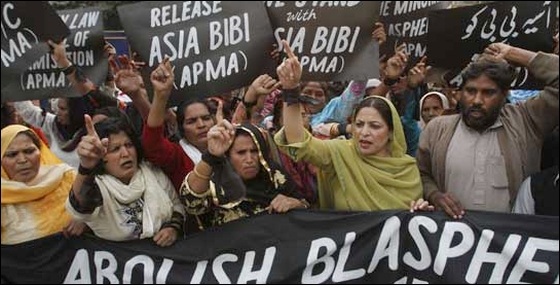
Protesters hold up placards while demanding the release of Asia Bibi, a Pakistani Christian woman who has been sentenced to death for blasphemy, at a rally in Lahore November 21, 2010. - Reuters
Protesters hold up placards while demanding the release of Asia Bibi, a Pakistani Christian woman who has been sentenced to death for blasphemy, at a rally in Lahore November 21, 2010. — Reuters

ISLAMABAD: Pakistan will not repeal its controversial blasphemy law but may amend it to prevent abuse because scrapping the legislation could fuel militancy, a government minister said on Tuesday.

The law, which carries the death penalty for insulting Islam or its Prophet Mohammad, has come under the spotlight this month after a court sentenced a Christian mother of four, Asia Bibi, to death in a case stemming from a village dispute.

Widespread media attention on the case has led to renewed appeals by human rights groups for the repeal of the law but Minister for Minorities Shahbaz Bhatti said that would not happen.

“(Repeal) is not being considered though we are considering changing it so that misuse of the law should be stopped,” Bhatti told Reuters.

The law enjoys widespread support in Pakistan, which is more than 95 per cent Muslim, and politicians are loathe to be seen as soft on the defense of the religion.

Blasphemy convictions are common although the death sentence has never been carried out. Most convictions are thrown out on appeal, but angry mobs have killed many people accused of blasphemy.

Bhatti said consultations with Islamic clerics and representatives of religious minorities on amending the law would soon be held.

He said repealing it was not being considered because that could provoke religious parties and militants who want to topple the pro-US civilian government.

“We have to analyse what the reaction of those having intolerant attitudes will be,” Bibi [Bhatti] said. “At this point our aim is to stop its misuse.”

Critics say the law can be misused by people making false accusations against rivals.

Liberal and secular groups say the law discriminates against religious minorities who make up roughly 4 per cent of Pakistan’s 170 million population. Most members of minorities are Christian.

Bhatti said an initial inquiry into the case of the Christian mother suggested she had not committed blasphemy but was falsely accused after a quarrel.

Bibi, the first woman sentenced to death for blasphemy, has appealed to President Asif Ali Zardari to pardon her.

“It will take few more days. We are looking into different things, not just pardon. She could get relief from the courts,” Bhatti said.

Authorities were providing Bibi with security in jail and her family had also moved for safety reasons, he said.

New York-based Human Right Watch has said the blasphemy law and government’s failure to address religious persecution by extremist groups effectively enable atrocities against minorities. – Reuters

©2010 DAWN Media Group. All rights reserved

Tuesday, November 2, 2010

No place for Ahmadi body in a Muslim graveyard

Express Tribune, Pakistan
Pakistan
Punjab
No place for Ahmadi body in a Muslim graveyard
November 2, 2010
Interred body of an Ahmedi exhumed from a Muslim graveyard after protests held against the burial.

BHALWAL: Interred body of an Ahmadi was exhumed here on Sunday from a Muslim graveyard after some local clerics led protest against the burial and the Sargodha tehsil police forced the dead man’s heirs to remove it from the graveyard.

Shehzad Waraich, who died on October 30, was a resident of Chak 24 North.

Shehzad’s brother told The Express Tribune that several members of the family including his grandparents and parents were buried in the same graveyard. He said there never had been any objection or disapproval.

He said that their families were the only two Ahmadi families in Bhalwal, a town with a population of only a few thousands. Chaks 19, 20, 21, 22, 23 and 24 have three government graveyards, shared by the residents of the area, he said.

He said that the people of his village, Chak 24 North, had not objected to his brother’s burial in the Chak 19 graveyard, so he had buried the body there. “Some of our elders are also buried there, we decided to bury him in the same graveyard,” he added. Waraich’s body was buried in the Chak 19 graveyard on the morning of October 30.

He said that on October 31, Sadar Division SHO Azhar Yaqoob and DSP Ghulam Murtaza came to their village along with other police officials and asked his family to remove the body of his brother from the Muslims graveyard of Chak 19.

“I told him that our elders were all buried in the graveyard. Neither the people of my village, nor of Chak 19 had raised any objection,” he said.

He said that the police told him that some local clerics in Sargodha had objected to the burial and in the interest of law and order, asked him to remove the body of his younger brother.

He said that the family, some relatives and the police then exhumed the body from the graveyard on Sunday.

“I don’t think that the police were forced to do this. The way I see it, the police forced us.”

Saleemul Din, an Ahmadi community spokesman condemned the police action. He said, “To this day, 30 Ahmadis’ bodies have been exhumed for similar reasons. The police do have no right to humiliate the dead from our community like this. Yet, they have been doing it since 1984.”

Sadar Division DSP Ghulam Murtaza said that some clerics had approached him and asked him to remove the body. He said that they had threatened him with protest movement against the police if the body of the Ahmadi man was not exhumed. In view of the sensitivity of the situation, he said, he did his best to resolve the matter peacefully by ordering the removal the body from the graveyard.

Published in The Express Tribune, November 2nd, 2010.

Friday, October 8, 2010

Hate on the Internet

Daily Dawn, Pakistan
Pakistan
Hate on the Internet
By Huma Imtiaz exclusively for Dawn.com
Friday, 08 Oct, 2010
Shoes of members of the attacked Ahmadi worship place lie outside the building's entrance in the Garhi Shahu area of Lahore on May 30, 2010. Over 80 people died as squads of militants burst into prayer halls May 27, firing guns, throwing grenades and taking hostages. - AFP Photo

KARACHI: Pakistan is no stranger to state-sanctioned censorship. Since the 1950s, successive governments, both military and civilian, have taken pains to ensure that the media has been scrutinised, censored and harassed.

Even as the twenty-first century has dawned upon Pakistan, the cycle continues. In 2009, the Pakistan government removed videos, of a Pakistan Army officer allegedly beating a Swat resident, from YouTube. Later on, videos of President Zardari saying “shut up” to a supporter at a public gathering were erased off of YouTube. In 2009, following a petition in the courts, the Lahore High Court slapped a ban on Facebook, which was later lifted. Even www.thepersecution.org, which documents crimes committed against the Ahmadi sect, is routinely banned by the Pakistan Telecommunications Authority (PTA).

Which makes it even all the more surprising that with such stringent control over the media and the internet, the Pakistan government has so far, turned a blind eye to the abundance of religious hate material that is floating around and readily available on the internet.

A simple search on YouTube for Masood Azhar, head of the Jaish-e-Mohammed, a militant organisation, reveals a long list of speeches by Azhar. Some exhort Muslims to rise up against the United States and India, others border on the comical, where Azhar dubs the television as the cause of all evils. Users frequently comment on the videos, praising Masood Azhar and his ideology.

Haq Char Yaar, which describes itself as a website to “expose Shias and Qadianis” is another example of websites that incite hate against different religious sects in the country. Run by supporters of the now banned Sipah-e-Sahaba-Pakistan, even viewing the website requires one to accept faith in the finality of Prophet Muhammad (PBUH) as the last prophet. Two options are given to users, ‘accept’ or ‘decline’, those who decline are labelled “munkir” or non-believers. Clicking on “Decline” leads users to a page with two poems, one that’s first line says, “Shias have no links to Islam”.

Ansar Al Jihad Network’s website is another popular jihadi website that is accessible in Pakistan. The forum has been closed for membership, but features videos, press releases and discussion about the war in Afghanistan and Pakistan. While one could not see the discussion on the forums, it is astounding to see the sheer number of videos that have been produced by the As-Sahab Foundation for Islamic Media Publication, Al-Qaeda’s media cell, featuring members of the Taliban that have been killed, or messages from current Taliban leaders fighting in Afghanistan and Pakistan.

Videos range from As-Sahab documentaries to press statements of the Taliban in Afghanistan. Here, news is classified as being from a “kuffar news source” if posted from a source other than the Taliban media cell.

Majahden2.org has archival footage of As-Sahab productions, with multiple links to download, for example Ayman-Al-Zawahiri videos. And if you cant find what you’re looking for, one can even “ask a mujahedeen brother” to send you the links that will help answer your question.

Shamikh1.net’s forum is another treasure trove for the aspiring jihadi or sympathiser, featuring the latest videos from Osama Bin Laden on Pakistan’s flood relief efforts. Users comment freely here, “God save our sheikh and leader, lion of Islam, Osama bin Laden. God bless you and care and we have made from your followers in the world and the Hereafter.”

And while lawyers were riled up about Draw Muhammad Day on Facebook, no one seems to have filed a petition against this page – where the latest videos from As-Sahab Media and other jihadi sources are regularly posted. Judging from the activity and frequency of posts, this is one of the most actively maintained Facebook pages.

YouTube features other videos that highlight the Taliban’s struggle against “apostate forces” such as this one titled “Night operations targeting apostate forces in Pakistan” and , where users can watch militants walking down a rocky terrain and preparing for battle by loading their arms. Some faces are blurred out in the video, and the night operations consist of sounds of gunfire in the dark. Right when users begin to lose interest, one can see computer animation, to depict the area being attacked and later on, footage of the arms lying on the ground as militants crowd around in a check post. In the morning, the militants show off the gear and arms that they have recovered and the names and pictures of the “shaheeds”.

...

While even the Interpol recently reported on the dramatic increase in extremist websites and the difficulties faced in blocking them, if one can find jihadi websites in a matter of minutes, surely it would take the PTA or the Ministry of IT and Telecom as much time to find and block the websites. During the Facebook ban period, PTA decided to block hundreds more websites than were actually mandated by the court, many of which did not even feature the “Draw Mohammad Day” event or cartoons that had been posted on Facebook and were, for the most part, proxy bypassing websites or websites that would allow you to browse the internet anonymously.

In a telephonic interview, PTA spokeman Khurram Mehran said that it is not the PTA that decides what websites are to be blocked, but rather the decision is made by a committee set up by the Ministry of IT and Telecom. According to the Secretary for the Ministry of IT and Telecom, Najibullah Malik, there is a mechanism in place for blocking such websites that is enforced by the committee. The members include representatives from the Interior Ministry, Ministry of Religious Affairs, and intelligence and law enforcement agencies. “Whenever we get reports about something that is anti-state or anti-Islam, we ask PTA to block the URL.”

The committee’s secretary Mudassir Hussain has this to say about the committee, which has been operational since 2006, “We have a standing order that any organisation that has been proscribed, their websites will be blocked. Regarding jihadi websites, either the agencies refer them to us or we have our own mechanism to find out about them, the Interior Ministry deliberates over the content and then we ask PTA according to block it. “Hussain says that organisations’ websites that have been proscribed by Pakistani law or international law have been blocked.

That these websites are accessible in Pakistan is of grave concern. Multiple terror attacks have wreaked havoc all over the country, and websites such as the ones mentioned above are not helping the security situation. However, Dr. Maria Sultan, the Director General of the South Asian Strategic Stability Institute says that due to Pakistan’s social structure, not many Pakistanis are affected by jihadi websites. “It’s a problem of legality and understanding how active the religious ministry is. The religious ministry has to give information to the Information Ministry about them. Religion is such an sensitive issue so it’s not clear when they’re about religion and when they’ve crossed over into extremism.” According to Dr. Sultan, there is also the question of freedom of expression and religious schools of thought. “Where do you draw the line between constitutional rights and religious freedom?” Analysts believe there is a need for the Council for Islamic Ideology, the Islamic University and the political parties to achieve a consensus on these websites in the absence of ijtihad.

Another analyst, who did not wish to be quoted, said that judging by how many porn videos Pakistanis were looking at on YouTube, it seemed as if they weren’t using the Internet for education, but rather for recreation.

While freedom of expression is a fundamental right and there may only be a small percentage of the population that is accessing these websites, there is a genuine fear among many that such websites could be used to indoctrinate the confused amongst the younger generation, who have access to the internet and are looking for a way to join a cause that may seem to be “the right way”. While a military operation continues in the tribal areas of the country and thousands have died in terror attacks and have been displaced due to the war, it is time for the government to redouble their efforts to block websites that are propagating hatred against religious sects and inciting violence against the people of Pakistan.

Huma Imtiaz works as a journalist in Pakistan and can be reached at huma.imtiaz@gmail.com

©2010 DAWN Media Group. All rights reserved

Sunday, September 5, 2010

Ahmadi killed in suicide bomb attack in Mardan

Ahmadiyya Foreign Missions Office, Vikalat Tabshir
FLASH-Human Rights
FAX
September 5, 2010
Ahmadi killed in suicide bomb attack in Mardan

Ahmadiyya mosque in Mardan, Khyber-Pakhtunkhwa was attacked by two terrorists at about 1:05 p.m. on September 3, 2010. One Ahmadi, Sheikh Amir Raza was martyred during this attack, whilst further loss was prevented by the bravery of Ahmadis charged with securing the premises. The police, despite the threat to the mosque, had provided no official security guards to the mosque even during Friday prayers.

As the terrorists threw a grenade, Ahmadi volunteer guards fired at them and injured one of them. At this one of them beat the retreat while the other persisted in his attack. He failed to enter the mosque, so blew himself up in a huge explosion at the parameter. Consequently the mosque gate and the outer wall were destroyed. This resulted in serious injuries to Mr Raza who died on the way to hospital. Three other Ahmadis Fahim Khan, Taufeeq Ahmad and Imran Javed were injured in the heinous attack.

Sheikh Amir Raza is survived by his wife, a nine years old son and an infant daughter.

The Head of the worldwide Ahmadiyya Jamaat stated in his Friday sermon, inter alia:
“May God quickly save our country from the acts of such evil persons and groups. Indeed, I pray that He saves the entire world because such evil has spread throughout the world.”

Saturday, September 4, 2010

Ahmadi Muslim Killed in Suicide Bomb Attack in Pakistan

Ahmadiyya Muslim Jamaat International
4th September 2010
PRESS RELEASE
Another Ahmadi Muslim Killed in Suicide Bomb Attack in Pakistan
May God quickly save our country from the acts of such evil persons and groups.

It is with great regret that the Ahmadiyya Muslim Jamaat confirms that yesterday, 3rd September 2010 its Bait-ul-Zikr mosque in Mardan, Pakistan was attacked by two terrorists. One Ahmadi Muslim, Sheikh Amir Raza was martyred during this attack, whilst further loss was prevented by the bravery of the Ahmadi Muslims charged with securing the premises.

FACTS

On 3rd September 2010 at around 1.05pm local time Mr Ata-ul Hameed was leading the Friday prayers at the Bait-ul-Zikr mosque at Muslimabad, Canal Road, Mardan when two unknown terrorists tried to enter the premises.

Initially one of the attackers threw a grenade towards the Mosque entrance which landed a few metres away. Upon seeing this, the Ahmadi Muslims near the entrance went into the mosque and locked the door from the inside.

Due to the bravery of further Ahmadi security personnel one of the attackers was injured and so he retreated. However the other began to fire his gun indiscriminately. He again tried to enter the mosque but was prevented from doing so by the Ahmadis on duty. Seeing that he would not be able to enter the mosque the terrorist chose to detonate a bomb hidden inside his jacket in a suicide attack. The effect of the explosion was massive and due to the impact the mosque gate and the outer wall were both destroyed. The homes of Ahmadis who lived nearby were also damaged by the explosion. Upon the explosion the other terrorist who had retreated ran away and remains unaccounted for.

Inside the mosque building at the end of a small corridor is a small room where final security checking takes place. At the time of the attack Sheikh Amir Raza was on duty in that room. When he heard firing he closed the inner door in an effort to protect the worshippers who had come for Friday prayers and also to prevent either of the terrorists from entering into the mosque area. However when the suicide bomber blew himself up the blast was so severe that it caused the door and wall of the room Sheikh Amir Raza was in to collapse. As it fell the door struck Sheikh Amir Raza and he was seriously injured. Tragically, on the way to hospital Sheikh Amir Raza succumbed to the injuries and was thus martyred.

Sheikh Amir Raza was 40 years old and was the son of the late Sheikh Mushtaq Ahmad. He was a much loved and dedicated member of the Ahmadiyya Muslim Jamaat. He had an electronics business and also worked for a food items agency.

Sheikh Amir Raza is survived by his wife, Lubna Amir, his son Usama (9) and infant daughter.

Three other Ahmadi Muslims were also injured in this heinous attack. They are Fahim Ahmad Khan, Taufeeq Ahmad and Imran Jawed.

The Head of the Ahmadiyya Muslim Jamaat, Hadhrat Mirza Masroor Ahmad said in his Friday Sermon of 3rd September 2010:

“Today we received very sad news that during the Friday prayers our Mosque in Mardan was attacked by terrorists. One person was martyred and some others were injured. May Allah elevate the status of the martyr and grant full recovery to those who were injured.”

His Holiness went on to say:

“What type of people are these, who in the name of Islam and in the name of God perpetrate such evil acts? These people who attack worshippers of God in His name can under no circumstances claim to be Godly. Just two days ago there was also an attack on a Shia religious procession in Lahore in which many innocent people were killed and many others were injured. May God quickly save our country from the acts of such evil persons and groups. Indeed I pray that He saves the entire world because such evil has spread throughout the world.”

22 Deer Park Road, London, SW19 3TL UK
Tel/Fax: 020 8544 7613 Mob: 077954 90682
Email: press @ ahmadiyya.org.uk
Press Secretary AMJ International

Bomber targets Ahmadi place of worship

Express Tribune, Pakistan
Pakistan
Khyber Pakhtunkhwa & FATA
Bomber targets Ahmadi place of worship
Manzoor Ali
September 4, 2010
Screen capture of damage caused to the Ahmadi place of worship in Mardan.

PESHAWAR: A suicide bomber blew himself up at the entrance of a worship place of the Ahmadiyya community in the Canal Town neighbourhood of Mardan, killing himself and a security guard on Friday.

Police said the suicide bomber detonated the explosives strapped to his body when he was stopped by the security guard at the gate of the Ahmadiyya place of worship in the Muslimabad area of the city. As a result the security guard, identified as Shaikh Amir, was killed and five more people were wounded. Officials say the death toll could have been much higher, had the bomber managed to enter the worship place where Friday prayers were in progress.

The casualties were ferried to the District Headquarters Hospital. It was the first suicide attack on any minority community in the Khyber-Pakhtunkhwa province since the beginning of the insurgency.

However, the Anjuman Ahmadiyya Rabwah gave a different account. “Two terrorists began firing at the Ahmadi Bait al-Zikkar when Friday prayers were in progress. A grenade was also thrown but it did not explode,” said Saleem ud Din, the spokesperson for the Jama’at Ahmadiyya, in a statement.

“One of the terrorists, however, managed to blow himself up at the door of the Bait al-Zikkar, killing the security guard and injuring three others,” he added. “The wall of the building collapsed as a result of the blast.”

He claimed were no security arrangements made by the authorities outside the Bait al-Zikkar or in the vicinity. And the second terrorist managed to flee the scene.

The spokesperson condemned the “barbaric atrocity”, saying that Ahmadis have been targets of such attacks for too long.

He said that despite the May 28 attacks in Lahore, authorities have made no adequate arrangements for the security and protection of Ahmadis. However, he added that the response of the Jama’at will be peaceful and non-violent. In another incident, a police patrol van was attacked with a bomb on the outskirts of Peshawar at around 10:44 am on Friday.

According to a police account, the patrol vehicle hit an improvised explosive device planted on a roadside near Pishtakhara Chowk on Ring Road. Three policemen were wounded in the blast. They were ferried to the Hayatabad Medical Complex (HMC), where one of them, identified as Shabbir Jan, expired. The other two are stated to be in a stable condition.

Officials from the Bomb Disposal Unit (BDU) said around three kilogrammes of explosives were used in the IED which was detonated through a remote control. (With additional input from Wires)

Published in The Express Tribune, September 4th, 2010.

Friday, September 3, 2010

Attack on Ahmedi worship place in Mardan kills one

Daily Dawn, Pakistan
Pakistan
Attack on Ahmedi worship place in Mardan kills one
Friday, 03 Sep, 2010
Several others were wounded in the suicide blast in the worship place in the northwestern Mardan town. - Photo by AFP
Several others were wounded in the suicide blast in the worship place in the northwestern Mardan town. — Photo by AFP

PESHAWAR: At least one man was killed and four wounded Friday when a suicide bomber blew himself up outside an Ahmadi place of worship in Mardan, police said.

“A suicide bomber was trying to enter the Ahmadis’ worship place, but he was intercepted by the guards outside and blew himself up,” Mardan police chief Waqif Khan told AFP.

“A passerby was killed and four others were wounded in the firing and suicide attack,” Khan said, adding that it was unclear whether the man was killed by the bomb or by gunshots fired by the guards.

Police have handed over the bomber’s body parts to a forensic team, he said.

In May nearly 100 people were killed in the eastern city of Lahore after militants stormed two Ahmadi prayer halls launching gun and grenade attacks.

Gunmen later raided the hospital where victims were being treated, killing four people in a shoot out.

©2010 DAWN Media Group. All rights reserved

Saturday, August 28, 2010

The other Pakistani crisis

Posted on Thu, Aug. 26, 2010Philadelphia Inquirer, USA
Worldview: The other Pakistani crisis
Intolerance and violence threaten to tear the country to pieces.
Trudy Rubin
By Trudy Rubin
Inquirer Opinion Columnist
A shocking e-mail on Monday informed me of a Philadelphian murdered in Pakistan.

Habib Peer, 60, was a hardworking Pakistani American who had raised three children and run two businesses in the city. He considered himself a devout Muslim and was a leader in his Ahmadiyya Muslim community. Last week, he was shot dead by masked men in the southern Pakistani city of Sanghar, where he was helping the family of his brother - who had been murdered four years before.

Both brothers were killed by militants who believe the Ahmadis are apostates. Since 1974, Pakistan’s constitution has labeled its two to four million Ahmadis “non-Muslim” because their beliefs contradict traditional Islam. (They follow a 19th-century mystic they believe was the messiah predicted by the prophet Muhammad.) In no Muslim country is the repression of Ahmadis so severe or so officially sanctioned as in Pakistan.

Peer’s death, however, exposes a crisis affecting all Pakistanis. It reflects a struggle for the soul of the country as daunting as the physical struggle to survive this month’s devastating floods.

Pakistan faces a Herculean challenge in coping with flood damage, and Muslim militants are eager to take advantage. As Pakistan’s leaders now recognize, these militants present a huge threat to their (nuclear-armed) state.

A recent security assessment by Pakistan’s military spy agency concluded, for the first time, that the biggest threat to national security comes from Islamic militants, not India. Some of these militants are probably providing shelter for al-Qaeda’s leadership, including Osama bin Laden, and the Pakistani army is targeting some groups.

Yet there are other jihadis dedicated to sectarian murder that are not on the military’s hit list. Some of these militants were originally trained by Pakistani security services to fight against India in the disputed territory of Kashmir.

Sipah-e-Sahaba, for example, openly calls for the slaying of Shiite Muslims, who make up about 10 to 15 percent of the population; it continues to operate freely. The Pakistani elite largely stays silent, and sectarian violence grows.

In April, I visited a Shiite friend in Karachi who was nearly killed in December, when a suicide bomber blew up 43 people during the Shiite religious celebration of Ashura. Her back and thighs were penetrated by large shards of metal from the bomb, which went off five feet from her; her brother and sister-in-law were killed.

Militants have also been attacking Sufi shrines, which they consider irreligious, although Sufi saints and shrines are highly regarded in South Asia. Pakistani Christians are attacked, too. Fueled by young graduates of radical religious schools, sectarian and ethnic violence is tearing at the social fabric of Karachi, Pakistan’s largest city.

Yet Pakistan’s leaders rarely stand up to religious fanatics who target fellow Pakistanis. When it comes to Ahmadis, the state practically cheers the violence on.

On May 28, gunmen struck at two Ahmadi mosques in Lahore, killing 93 people. After this outrage, the powerful Pakistani politician Nawaz Sharif (whose party has shown sympathy for militants) had the decency to insist that his Ahmadi “brothers and sisters” are an “asset to the country.” He was denounced by religious parties and clerics around the country.

Pakistan’s founder, Mohammed Ali Jinnah, who envisioned an inclusive and tolerant state, must be turning in his grave.

As Pakistanis begin to recover from the floods, they must decide what kind of country they want to live in. Their only Nobel Prize winner, physicist Abdus Salam, was an Ahmadi; when the physics faculty at Quaid-i-Azam University invited him to lecture in 1979, it was thwarted by a religious student group that threatened violence. Is this the country Pakistanis want?

The endless sectarian killings show - contrary to legions of Pakistani conspiracy theorists - that the country is besieged not by the West, but by Muslim militants who use violence.

In the Peer case, militants killed members of a community that opposes religious wars and bloodshed. Will Pakistan’s leaders have the courage to denounce these and other sectarian murders? Will they change the laws that expose Ahmadis to blasphemy charges and death?

To recover from the physical challenge of the flood, Pakistanis will have to pull together in spirit, not pit different communities against one another. The rest of the world can help Pakistan with rebuilding, but only Pakistanis can make their country whole.

Wednesday, August 25, 2010

U.S. citizen slain over his religion in his native Pakistan

Philadelphia Inquirer, USA
Posted on Wed, Aug. 25, 2010
U.S. citizen slain over his religion in his native Pakistan

By David O’Reilly
Inquirer Staff Writer
Pir Habibur Rehman

When Habib Peer closed his Germantown newsstand last year and moved back to Pakistan, his passport made no note of his religion.

Since 1990 he had been a resident and citizen of the United States, where being an Ahmadiyya Muslim is no offense. But in his homeland, Peer’s faith made him a target, his family said.

On Thursday, as he drove with a young nephew through the southern city of Sanghar, two motorbikes approached his car. One of the masked drivers fired a handgun twice through the open window, instantly killing the 60-year-old Peer.

His nephew, 13, survived to describe the assassination. “That’s just how [the boy’s] father died,” recalled Mujeeb Chaudhary, Peer’s brother-in-law and a Philadelphia pharmacist.

“It was a targeted killing, only because of his religion.”

Four years earlier, Peer’s brother, Pasha, a physician who cared for the poor of Sanghar, was shot twice in the head as he left his clinic one evening. His killer ran off and was never found.

Widowed the year his brother died, Peer had moved back to Pakistan to care for Pasha’s widow, whom he married, and to help raise his brother’s children.

Ahmadis follow the Indian mystic Mirza Gulam Ahmad, who in 1887 announced that he was the messiah, or Mahdi, predicted in early Islamic writings as one who would purify Islam near the end of time.

Nearly all Muslims view Ahmad as a heretic, and his followers as inauthentic Muslims. Although tolerated in some Muslim nations, they are especially disdained in Pakistan, whose constitution and passports identify Ahmadis as non-Muslim.

That nation’s four million Ahmadis are forbidden by law to publicly practice their religion, and they can be jailed for blasphemy if they greet Sunni or Shiite Muslims with the traditional “salaam alaykum” or wear Muslim garb.

Mainstream mullahs and imams denounce Ahmadis, with some blaming their presence for the floods ravaging Pakistan. “Some [leaders] even tell their people it is their duty to kill us,” said Chaudhary, who came to the United States in 1972 and is president of the 450-member Philadelphia-area Ahmadiyya community.

The failure of the Pakistani government to suppress such virulent talk, he said, is tantamount to “state-sponsored terrorism.”

Chaudhary added, “The authorities made very little effort for Pasha, and they will do the same for Habib.”

Nadeem Kiani, press attache at the Pakistani embassy in Washington, denied on Tuesday that his government fosters a climate of hostility toward religious minorities, including Ahmadis.

Pir Habibur Rehman“Yes, they are considered a religious minority,” he said, “but they have complete protection and all the constitutional rights.”

Kiani said he was not familiar with Peer’s murder, but said “if any person is murdered, there are legal ways for the family to prosecute the person accused,” although “these can take time.”

Nicole Thompson, a spokeswoman for the State Department, said Tuesday that the Obama administration was “in constant engagement with the government of Pakistan on issues of religious freedom.”

Teresita Schaffer, former U.S. ambassador to Sri Lanka, said Tuesday that the Ahmadiyya community’s cause “is far down on [the State Department’s] list,” though recent violence against Ahmadis is among the worst that nation has seen since its founding in the 1940s.

Schaffer cited the May grenade and assault-weapon attacks by the Pakistani Taliban on two Ahmadi mosques in Lahore that left 78 worshippers dead and dozens severely wounded.

Ahmadis, she said, “are a very controversial part of the community… . The people willing to raise their voices in their defense are few.”

In 2002, the House of Representatives issued a bipartisan resolution calling on Pakistan to repeal the second amendment of its constitution, declaring Ahmadis non-Muslim, and its blasphemy laws.

Since then, the Pakistani government has only toughened its blasphemy laws, Chaudhary said.

On Friday, the Human Rights Commission of Pakistan released a statement expressing dismay over Peer’s murder and that of another Ahmadi in Karachi earlier in the week.

The commission wrote that it also was concerned by reports of denial of shelter to Ahmadis displaced by massive floods in south Punjab.

Although some Muslims are upset by the resistance to a proposed Islamic cultural center near Ground Zero, Chaudhary said he welcomed such debate as “proof of America’s freedom of speech and freedom to practice religion.”

In March, he said, the Philadelphia-area Ahmadi community plans to break ground for a new mosque, with dome and minaret, on West Glenwood Avenue near Temple University. The plan, he said, has encountered no hostility from the neighborhood.

Chaudhary said he was delighted when an employee in the city zoning office asked him, “When will you have your jumma prayers?“ - Friday services.

“Here it is easy to take for granted,” he said, “but this is the greatness of America.”

Thursday, August 19, 2010

American Citizen Murdered in Pakistan due to Government Sanctioned Religious Extremism

Ahmadiyya Muslim Community, USA
In the name of Allah, the Gracious, the Ever Merciful
Muslims who believe in the Messiah
Mirza Ghulam Ahmad Qadiani(AS)
For Immediate Release:
August 19, 2010
Press Release
Contact:
Waseem Sayed, Spokesperson
909-636-4397
waseem.sayed@ahmadiyya.us
American Citizen Murdered in Pakistan due to Government Sanctioned Religious Extremism
Pakistan’s lack of freedom of religion claims a second life this week
Pir Habeeb ur Rehman
Pir Habibur Rehman, resident of Philadelphia, Pennsylvania, was brutally murdered today while in his native country of Pakistan at around 9:30 AM, Pakistani time. Mr. Rehman was in Sindh, Pakistan, when he stopped at a traffic light while driving his nephew and workers to his farm. At that time, two masked gunmen approached his vehicle and opened fire. He was rushed to the hospital but was pronounced dead on arrival. His nephew and workers survived the incident.

Mr. Rehman was a tireless worker for the Ahmadiyya Muslim Community. As Vice President of Muslim Television Ahmadiyya’s USA Studios and the community’s international website (alislam.org), he channeled Philadelphia’s motto of brotherly love into his ability to lead strong teams. He owned a photography store and newspaper stand in Philadelphia and is survived by his wife, two daughters, and a son.

Mr. Rehman is the second member of the Ahmadiyya Muslim Community to be killed in the first week of Ramadan in Pakistan. Dr. Najam al-Hasan, a pediatrician, was shot and killed earlier this week outside of the medical clinic in Karachi where he worked. These appalling acts are a result of Pakistan’s constitution, which subjects the Ahmadiyya Muslim Community to intolerance, injustice, and death with over 260 murders to date since 1974.

Such state-sponsored persecution is due to constitutional amendments declaring members of the Ahmadiyya Muslim Community as “non-Muslim” and criminalizing their religious activities. Amnesty International reports that Pakistan does not prosecute those who kill members of this community, thereby leading killers to continually attack these peaceful Muslims without fear of legal action. Mr. Rehman’s brother, Dr. Pir Mujeeb ur Rehman, was murdered 4 years earlier due to the same extremism perpetuated by these laws.

We call on the US government to engage Pakistan to repeal its laws that violate human rights said Dr. Nasim Rehmatullah, Vice President of the Ahmadiyya Muslim Community USA. Such senseless killing will continue until these laws are revoked.

About the Ahmadiyya Muslim Community:
Ahmadiyya Muslim Community is a dynamic, reformist and fast growing international movement within Islam. Founded in 1889, the Community spans over 190 countries with membership exceeding tens of millions. Ahmadiyya Muslim Community USA, established in 1920, is the first American-Muslim organization.

Ahmadiyya Muslim Community is the only Islamic organization to believe that the long-awaited messiah has come in the person of Mirza Ghulam Ahmad (1835-1908) of Qadian. Ahmad claimed to be the metaphorical second coming of Jesus of Nazareth and the divine guide, whose advent was foretold by the Prophet of Islam, Muhammad. The Community believes that God sent Ahmad, like Jesus, to end religious wars, condemn bloodshed and reinstitute morality, justice and peace. Ahmad’s advent has brought about an unprecedented era of Islamic revival and moderation. He divested Islam of fanatical beliefs and practices by vigorously championing Islam’s true and essential teachings.

# # #
15000 Good Hope Rd Silver Spring, MD 20905
Phone: 301-879-0110 fax: 301-879-0115
www.ahmadiyya.us 1-800-Why-Islam

US Citizen Killed in Religiously Motivated Attack in Pakistan

Ahmadiyya Muslim Jamaat International
19th August 2010
PRESS RELEASE
US Citizen Killed in Religiously Motivated Attack in Pakistan
Pir Habib al-Rehman becomes second Ahmadi Muslim killed in Pakistan this week

Pir Habeeb ur Rehman
It is with great sadness and regret that the Ahmadiyya Muslim Jamaat hereby confirms that a well-known and loved Ahmadi Muslim, Pir Habib al-Rehman (60) was martyred earlier today near Sanghar in Sindh Province.

According to details currently available Pir Habib-al-Rehman was on his way to his farm when two masked assailants approached his vehicle and shot him twice. One of the shots fired was directly at his head. He was rushed to hospital by his nephew and three labourers who were with him at the time, but was pronounced dead on arrival.

The perpetrators of the crime immediately fled the scene and remain unidentified.

Pir Habib al-Rehman was a US citizen and had been in Pakistan on personal business. Thus he is the second US citizen in two years to be martyred for being an Ahmadi. In September 2008 Dr Abdul Mannan Siddiqi, also a US citizen, was brutally killed in Mirpurkhas.

Pir Habib al-Rehman was a kind and humble man who harbored no enmity against anyone. He was 60 at the time of his death and is survived by his wife, a son and two daughters. In 2006 his brother, Dr Pir Mujeeb al –Rehman, was also martyred for being an Ahmadi Muslim.

The deceased was actively involved with the work of the Ahmadiyya Muslim Jamaat and performed great service, in particular, to the development and maintenance of the Jamaat’s official website ‘Alislam.org’.

The Press Secretary of the Ahmadiyya Muslim Jamaat, Abid Khan said:

“The murder of Pir Habib al-Rehman has caused great sadness to all Ahmadis around the world. This incident follows on from the martyrdom of Dr Najam al-Hasan also in Sindh just a couple of days ago. Such violence results from the continuing hatred that is spread throughout Pakistan against our Community. We call upon the international community and media to take notice of the continued persecution of the Ahmadiyya Muslim Jamaat in Pakistan.”

22 Deer Park Road, London, SW19 3TL UK
Tel/Fax: 020 8544 7613 Mob: 077954 90682
Email: press @ ahmadiyya.org.uk
Press Secretary AMJ International

Inhuman acts

Express Tribune, Pakistan
Editorial
Inhuman acts
Editorial
August 19, 2010

Emergencies are a time when the best of man – and the very worst – comes out into the open. In southern Punjab, where leaders of the Ahmadi community say relief goods or a place in camps was denied to flood victims from their faith, the worst has been on display. The treatment of Ahmadis as sub-human is a consequence of years of discrimination stemming from that fateful decision in the 1970s to declare them ‘non-Muslim’. The result of the state’s decision to determine what belief people practice, regardless of their own assertions, has been catastrophic. The massacre of Ahmadis we saw earlier this year in Lahore is one outcome of this. The increasingly vicious campaigns they have faced have obviously had an influence on poisoning minds and influencing the kind of disgraceful behaviour we have seen following the floods.

But sadly, this is not the only example of such conduct. Humanitarian workers out in the field report many examples of bias. In some cases aid has been denied to those from specific castes or clans; in other instances the weakest and most vulnerable have been pushed aside. Christians in the Punjab are reported to have complained about discrimination and it is possible other minority communities have faced similar experiences. While most international and all UN organisations are bound by their own charter to ensure equitable distribution of aid, and usually attempt to follow them, local organisations may not have rules that are as stringent. Some reports already speak of groups affiliated to religious parties being behind some of the worst acts of deprivation on the basis of belief.

So, what does this say about us as a people? As a society? Do we even deserve the distinction of calling ourselves civilised human beings? It is true that the government for now has a lot on its plate. But despite this, an effort must be made to investigate the incidents in Muzaffargarh and elsewhere. It seems obvious they could not have taken place without the connivance of local authorities, who must be made to answer for their acts.

Published in The Express Tribune, August 19th, 2010.

Tuesday, August 17, 2010

Another Ahmadi Muslim doctor brutally martyred in Karachi

Ahmadiyya Muslim Jamaat International
17th August 2010
PRESS RELEASE
Another Ahmadi Muslim doctor brutally martyred in Karachi
20 Ahmadi Doctors have been killed since 1984 anti-Ahmadiyya laws

It is with great sadness and regret that the Ahmadiyya Muslim Jamaat hereby confirms that a well-known Ahmadi Muslim, Dr Najam al-Hasan (39) was martyred in a religiously motivated attack last night in Karachi, at approximately 12:15am local time.

Dr Najam al-Hasan was leaving his clinic and had just entered his car when he was shot dead by a group of assailants, who as of yet, remain unaccounted for. Upon hearing the noise of gunfire, his brother, whose medical store is adjacent to the clinic, rushed to the scene only to discover that the victim had already succumbed to his injuries.

Dr Najam al-Hasan was a peaceful and law abiding citizen and a much renowned pediatrician. He was also a serving assistant professor at Dow University of Health Sciences. Dr Najam al-Hasan is survived by his wife, and three young children.

Since the promulgation of the anti-Ahmadiyya specific Ordinance XX in 1984, 20 Ahmadi Doctors have been killed in sectarian attacks, 10 of whom were murdered in Sindh. Dr Najam al-Hasan becomes the second Ahmadi to be killed in Karachi this year because of his religion. Such violence results from the continuing hatred that is spread throughout Pakistan against the Ahmadiyya Muslim Jamaat.

Violent assaults against Ahmadis that are carried out in the name of religion are all too often premeditated and well organised. It is most unfortunate that certain parts of the media in Pakistan are being used to incite the sentiments of people against Ahmadis and inflame the already raging fire of sectarianism in the country.

22 Deer Park Road, London, SW19 3TL UK
Tel/Fax: 020 8544 7613 Mob: 077954 90682
Email: press @ ahmadiyya.org.uk
Press Secretary AMJ International
 
^ Top of Page