Showing posts with label Apostates. Show all posts

Friday, November 11, 2011

Ahmadis Living Under Siege

The Muslim Times, USA
Ahmadis Living Under Siege
Posted by Abu Nauman Atif - laiqatif@gmail.com
Thursday November 10 2011
There is a community in Malaysia that is under siege. In fact they are under siege in all countries where they exist and where there is a high number of Muslims; the countries in the Middle East and North Africa, Pakistan, Indonesia and here in Malaysia.

In Pakistan and recently in Indonesia, they suffer physical attacks.

Recently in Indonesia followers of Ahmadiyah have been killed. The Indonesian authorities were reluctant to charge their murderers.

That community is the Ahmadiyah. In Malaysia they are the Jemaat Ahmadiyah Muslim Malaysia.

In 1975 the Selangor state religious department issued a Fatwa (a religious edict) declaring that the Ahmadiyah movement is non-Muslim.

They have been forbidden to conduct Friday prayers at their centre in Kampung Nakhoda, Batu Caves and the department is working with the city council and land office to confiscate their property. The reason? Wrongful use.

There is also initiatives to remove ‘Islam’ under the category of religion in the identity cards of the followers and replaced with ‘Qadiani’.

So what is it about the Ahmadiyah that’s drawn so much anger from Muslims and subjected them to persecution in a land that allows freedom of religion in its Constitution and in a religion with a God that demands ‘that there be no compulsion’?

Source: Mr. Jariullh Ahmad, Malaysia


Tuesday, November 8, 2011

Malaysia’s Ahmadis living dangerously

Free Malaysia Today, Malaysia
Malaysia’s Ahmadis living dangerously
Patrick Lee | November 8 2011
Targeted by both society and the state, Ahmadis in Malaysia plead
for a fair voice, fearing the worst if they’re denied this.

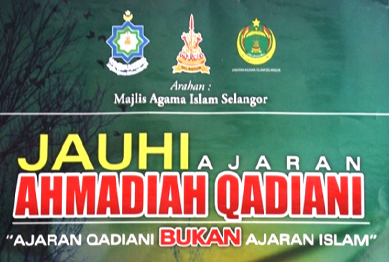
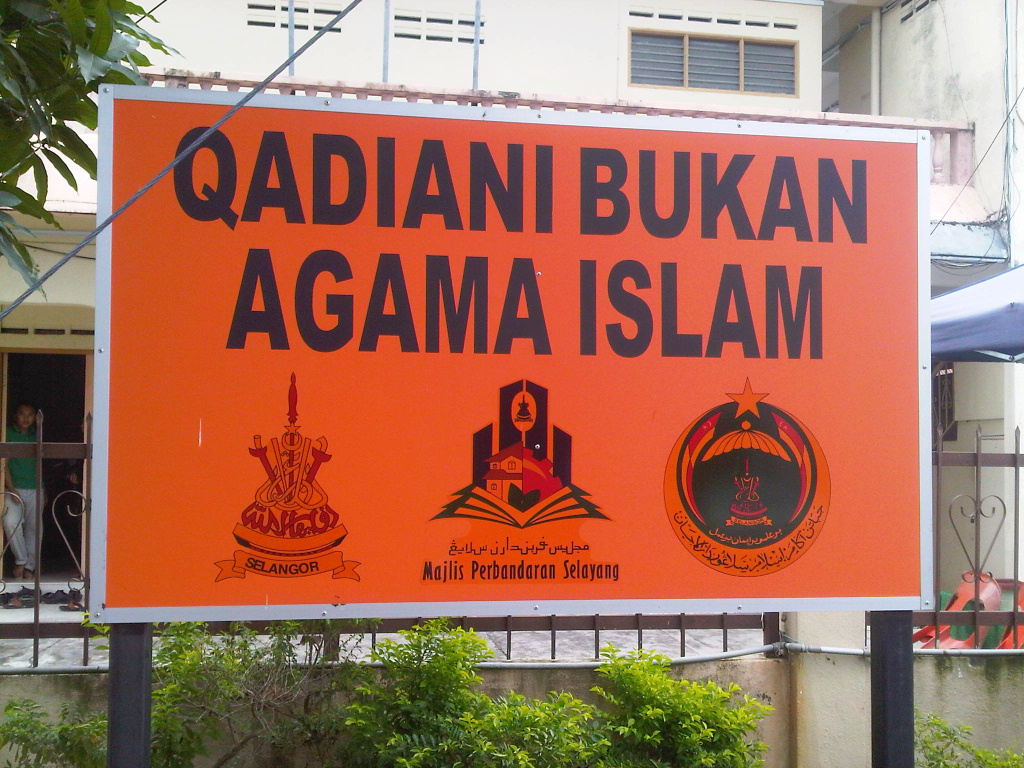
Slengor SignboardSELAYANG: In the middle of Kampung Nakhoda, there is an unassuming three-storey building. Nothing about its humble stature makes it stand out from nearby houses, except for a council-erected signboard that clearly reads: “Qadiani Bukan Islam” (Qadianis are not Muslims).

Youths mingle inside the building’s compound, warily observing passers-by beyond the front gate. At FMT’s approach, they smiled and opened the gate, only to quickly close it, and the front doors leading to the building’s living room.

Inside, the youths set up video cameras and other recording equipment. They are friendly, but slightly skittish with the visiting journalist. They relax a little when their religious leader, Maulana Ainul Yaqeen Sahib, enters.

It is easy to see why. Ainul belongs to the Ahmadiyya movement, an Islamic sect coldly received by Malaysia’s Sunni Islamic authorities.

Selangor Islamic Religious Department (JAIS) officers in the past, he said, have raided the building – named Baitussalam – which serves as the local Ahmadiyya community’s gathering place and mosque.

“They (JAIS) pushed themselves through a hole in the front gate when we didn’t let them come in. They didn’t have a warrant,” he told FMT, relating the 2009 incident.

The JAIS officers barged their way into the building, and started inspecting its prayer room and taking photographs.

Ainul also said that a few of these officers would later pose as curious university students. One of them, he claimed, “borrowed” a copy of the Quran, and never gave back.

Given the cold shoulder

Maulana Ainul Yaqeen SahibAccording to Ainul, Ahmadis are no different from other Muslims in terms of practice and the faith. “We follow the Quran, the five pillars of Islam and the tradition of the Holy Prophet. Even our Kalimah (Islamic creed) is the same,” he said.

But what sets them apart from other Muslims, is the belief that their sect’s founder, Mirza Ghulam Ahmad, was Islam’s Promised Messiah and the redeemer, the Imam Mahdi.

(The Ahmadiyya movement began in Qadian, India, during the late 19th century, and was later called Qadianis.)

It is a belief that has not only incurred the wrath of hardline Islamic authorities, but also their supporters.

In May 2010, Pakistani terrorists attacked two Ahmadiyya mosques in Lahore with grenades and automatic rifles, killing 86 and injuring more than 120.

Earlier in February this year, an Indonesian mob attacked an Ahmadiyya community in Cikeusik, Java. Videos released on the Internet showed the mob chanting “Allahuakbar” (God is great) as they beat and killed three Ahmadis, raining blows on them with sticks and stones even as they lay dead on the ground.

While outright violence against Malaysia’s 2,000-odd Ahmadis is unknown, the sect’s believers nevertheless are given the cold shoulder by both the authorities and locals.

According to the Ahmadis, opposition against the movement started shortly after the movement was introduced to Malaya by an Indian missionary in the 1930s.

Zionist support

Founder of Ahmadiyya and his successorsLater in 1975, the Selangor Fatwa Council decreed that the Ahmadis were not Muslims, and recommended as a result, that their special Malay privileges be removed.

In December 2008, Selangor executive council chairman (for religious affairs) Hasan Mohamed Ali said that the state government was looking into forcibly grabbing the Baitussalam land.

Six months later, in April 2009, the Selangor Islamic Relgious Council (MAIS) issued a directive forbidding the Ahmadis from using the Kampung Nakhoda mosque for Friday prayers.

Those who disobeyed this order, MAIS said, could be subject to a fine and imprisonment.

A 2008 text released by the Federal Territories Mufti’s Office, under the Prime Minister’s Department, claimed that Mirza Ghulam was a British agent sent to divide the Muslims in 19th century India.

Entitled “Beware! Qadianis are out of Islam”, it also alleged that the Ahmadiyya movement received Zionist support, and printed its propaganda material within Israel.

Deceased Malaysian Ahmadis were not allowed to be buried in Muslim cemeteries, Ainul said, adding that their bodies had to be taken to a special gravesite in Cheras.

A few religious Muslim leaders, he claimed, were raising suggestions to change the Ahmadis’ religion under the MyKad to “Qadiani” instead of “Muslim”.

Children not spared

LibrarySome speeches made by other Muslim leaders, he added, were also allegedly inciting locals to act against the Ahmadis.

Citing a nearby mosque in the area, he said: “The uztaz (religious leader) made a speech…saying, ‘In Indonesia, these people (Ahmadis) can be killed.’ So indirectly, they’re asking the community to attack us.”

Although physical violence against Ahmadis is unheard of here, locals nevertheless act in their own way.

“They used to throw faeces at my father’s house… During (this year’s) Ramadan, some people threw fireworks in here… children would pass by shouting, ‘Qadiani kafir!’ (Qadianis are infidels!),” Ainul said.

In one instance, FMT noticed a passing motorcyclist who shouted “Astaghfirullah!” (I seek forgiveness from Allah) at the compound, hinting that the Ahmadis had strayed from Islam.

Not even the Ahmadis’ children are spared.

Mohd Farid Kamam, 26, said that his schoolmates saw him leaving Baitussalam one Friday afternoon when he was in Form Three.

“I was lining up on Monday assembly, and I heard my friends saying ‘sesat’ (astray), but I didn’t know (they were referring to me).”

“When I entered the classroom, seven of my classmates surrounded me and said that I had strayed from Islam… they asked me to recite the Kalimah Shahada to determine that I was Muslim,” he said.

Adding that he had done so, his classmates left him alone after that. But the school’s religious teachers would not, with some even refusing to acknowledge him.

“My friends and I were giving ‘salam’ to a passing uztaz. He would return the salam to my friends, but knowing that I was an Ahmadi, he would not return it to me,” Mohd Farid said.

Bowing to idols

Mob lynching of Indonesian AhmadisBut his most bitter memory came when he was sitting for the Religious Studies paper during his SPM examinations.

“I entered the exam hall, and everyone had a chair except me, so I had to bring in a chair (from outside the hall). As I was carrying it, one of my schoolmates smiled at me and said in front of hundreds of people, ‘What are you here for? You’re not a Muslim, you don’t have to do this exam’,” Mohd Farid said, grinding his teeth.

Malaysian Ahmadis also have to bear the brunt of various accusations about their beliefs. Some of these included “wudu” (the act of washing before prayer) with water from corpses, praying in the nude, dancing the “joget” during prayer and bowing to idols.

Jariullah Ahmad, another believer, told FMT that some locals claimed that the Ahmadis encouraged the eating of pork.

“When my grandmother was taking care of a (hawker) stall, people used to say that she would put pork bones into her food,” he said.

He claimed that state religious leaders were purposely aligning Malaysians against the Ahmadis.

“It doesn’t matter whether it’s a Pakatan Rakyat or a Barisan Nasional government, because they’re both advised by the mullahs here,” Jariullah said.

As such, the Ahmadis have asked for the both the government and the mass media to allow for an open discussion over their beliefs.

Those requests have apparently fallen on deaf ears, Ainul said.

“What we want is an open discussion with JAIS and the religious authorities. We want a platform where we can speak out, and the public can watch. They can ask us questions… we will answer them and let the people judge for themselves,” he said.

Even so, Ainul did not appear confident that this would take place. He feared that his people might suffer the same fate as the Indonesian Ahmadis.

“If they don’t take the right action, we’re afraid that people will turn into a mob… it’s happened to Indonesia, now it’s at the stage where they throw stones at us.”

“We feel that worse things will happen here,” he said.

Copyright © 2011 MToday News Sdn. Bhd. All Rights Reserved.
URL: www.freemalaysiatoday.com/2011/11/08/malaysias...

Saturday, October 29, 2011

Ahmadiyya decry JAIS attacks

Free Malaysia Today, Malaysia
Ahmadiyya decry JAIS attacks
Patrick Lee | October 29, 2011
Islamic authorities are bent on demonising us, say local Ahmadiyya Muslims.

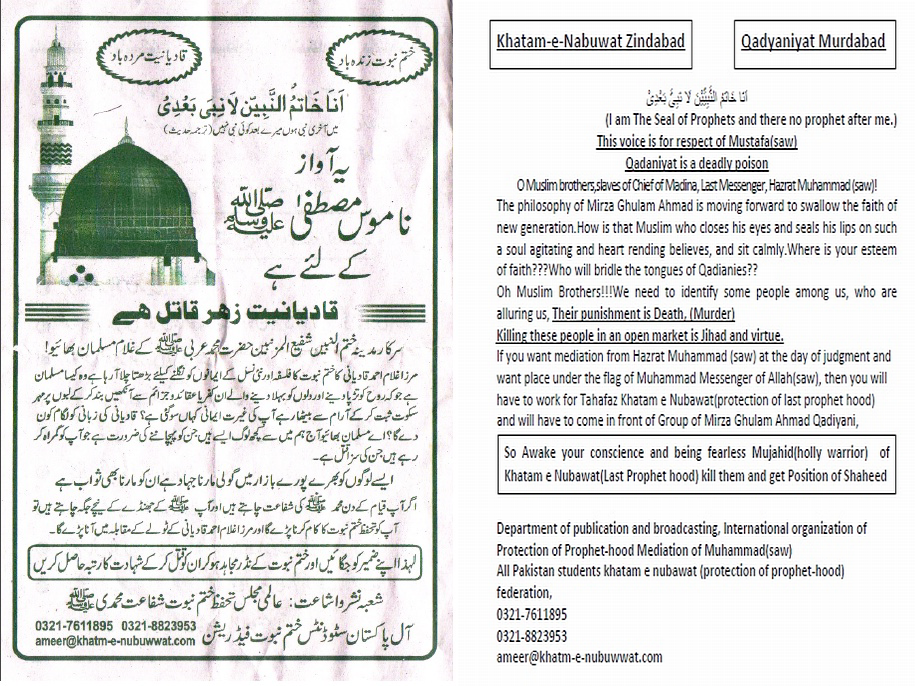
JAIS BillboardPETALING JAYA: Local Ahmaddiyya Muslims are tired of being discriminated against, and want to challenge the state to a discussion on their stand as believers.

The Selangor Islamic Religious Department (JAIS), according to Ahmadiyya spokesman Maulana Ainul Yaqeen Sahib, has worked hard to declare his community as apostates.

“JAIS has been attacking the Ahmadiyya through the media. Everything gets thrown against us. It’s not fair. They say we are not Muslims, and (at the same time) they don’t give us a chance to say anything (in return),” he told FMT.

Maulana was referring to a Oct 20 television programme known as “Kes Akidah” aired by local Islamic TV station Al-Hijrah. At the time, the programme’s episode was allegedly entitled “Nabi Palsu Qaidani” (False prophets of the Qaidanis).

(Qaidani is another term for the Ahmadiyya.)

Unhappy with the attacks against them, Ahmadiyya representatives handed over a memorandum to both JAIS and Al-Hijrah on Oct 25 and 27 respectively.

In the memorandum, they demanded equal and fair treatment as Muslims in Malaysia, as well as an open discussion over their position as Muslims.

The memorandum read: “What is most regrettable is that JAIS is so fervent in its attempts to prevent the Malays from becoming apostates or embracing other faiths.”

“But in the context of the Ahmaddiya, they so easily issue fatwas labeling us as kafirs or having left Islam.”

It added that an open discussion over the Ahmadiyya would be better than state-organised raids, and would avoid instances of violence and murder.

The Selayang Council, as well as the Gombak Land and District Office, the memorandum said, had been influenced by JAIS in the past to persecute the Ahmadiyya.

Malaysia, a predominantly Sunni Muslim country has been known to keep other Islamic sects under close watch.

According to a TheNutGraph report, the Selangor Fatwa Council issued a fatwa in 1975, declaring the Ahmadiyya as non-Muslims.

In 2009, the Selangor Islamic Religious Council (MAIS) forbade the Ahmaddiya from using their Batu Caves mosque.

There are an estimated 2,000 Ahmadiyyas in Malaysia today, with the majority of them residing in Selangor.

The country’s 100,000 Shi’ite Muslims also face discrimination from local Islamic authorities. In May this year, four Shi’ites were arrested after they were celebrating the birthday of Fatimah az-Zahra, Prophet Muhammad’s daughter.

Two hundred Shi’ites were also arrested at a gathering in late December.

Copyright © 2011 MToday News Sdn. Bhd. All Rights Reserved.
URL: www.freemalaysiatoday.com/2011/10/29/ahmadiyya-decry-jais-attacks/

Saturday, August 28, 2010

The other Pakistani crisis

Posted on Thu, Aug. 26, 2010Philadelphia Inquirer, USA
Worldview: The other Pakistani crisis
Intolerance and violence threaten to tear the country to pieces.
Trudy Rubin
By Trudy Rubin
Inquirer Opinion Columnist
A shocking e-mail on Monday informed me of a Philadelphian murdered in Pakistan.

Habib Peer, 60, was a hardworking Pakistani American who had raised three children and run two businesses in the city. He considered himself a devout Muslim and was a leader in his Ahmadiyya Muslim community. Last week, he was shot dead by masked men in the southern Pakistani city of Sanghar, where he was helping the family of his brother - who had been murdered four years before.

Both brothers were killed by militants who believe the Ahmadis are apostates. Since 1974, Pakistan’s constitution has labeled its two to four million Ahmadis “non-Muslim” because their beliefs contradict traditional Islam. (They follow a 19th-century mystic they believe was the messiah predicted by the prophet Muhammad.) In no Muslim country is the repression of Ahmadis so severe or so officially sanctioned as in Pakistan.

Peer’s death, however, exposes a crisis affecting all Pakistanis. It reflects a struggle for the soul of the country as daunting as the physical struggle to survive this month’s devastating floods.

Pakistan faces a Herculean challenge in coping with flood damage, and Muslim militants are eager to take advantage. As Pakistan’s leaders now recognize, these militants present a huge threat to their (nuclear-armed) state.

A recent security assessment by Pakistan’s military spy agency concluded, for the first time, that the biggest threat to national security comes from Islamic militants, not India. Some of these militants are probably providing shelter for al-Qaeda’s leadership, including Osama bin Laden, and the Pakistani army is targeting some groups.

Yet there are other jihadis dedicated to sectarian murder that are not on the military’s hit list. Some of these militants were originally trained by Pakistani security services to fight against India in the disputed territory of Kashmir.

Sipah-e-Sahaba, for example, openly calls for the slaying of Shiite Muslims, who make up about 10 to 15 percent of the population; it continues to operate freely. The Pakistani elite largely stays silent, and sectarian violence grows.

In April, I visited a Shiite friend in Karachi who was nearly killed in December, when a suicide bomber blew up 43 people during the Shiite religious celebration of Ashura. Her back and thighs were penetrated by large shards of metal from the bomb, which went off five feet from her; her brother and sister-in-law were killed.

Militants have also been attacking Sufi shrines, which they consider irreligious, although Sufi saints and shrines are highly regarded in South Asia. Pakistani Christians are attacked, too. Fueled by young graduates of radical religious schools, sectarian and ethnic violence is tearing at the social fabric of Karachi, Pakistan’s largest city.

Yet Pakistan’s leaders rarely stand up to religious fanatics who target fellow Pakistanis. When it comes to Ahmadis, the state practically cheers the violence on.

On May 28, gunmen struck at two Ahmadi mosques in Lahore, killing 93 people. After this outrage, the powerful Pakistani politician Nawaz Sharif (whose party has shown sympathy for militants) had the decency to insist that his Ahmadi “brothers and sisters” are an “asset to the country.” He was denounced by religious parties and clerics around the country.

Pakistan’s founder, Mohammed Ali Jinnah, who envisioned an inclusive and tolerant state, must be turning in his grave.

As Pakistanis begin to recover from the floods, they must decide what kind of country they want to live in. Their only Nobel Prize winner, physicist Abdus Salam, was an Ahmadi; when the physics faculty at Quaid-i-Azam University invited him to lecture in 1979, it was thwarted by a religious student group that threatened violence. Is this the country Pakistanis want?

The endless sectarian killings show - contrary to legions of Pakistani conspiracy theorists - that the country is besieged not by the West, but by Muslim militants who use violence.

In the Peer case, militants killed members of a community that opposes religious wars and bloodshed. Will Pakistan’s leaders have the courage to denounce these and other sectarian murders? Will they change the laws that expose Ahmadis to blasphemy charges and death?

To recover from the physical challenge of the flood, Pakistanis will have to pull together in spirit, not pit different communities against one another. The rest of the world can help Pakistan with rebuilding, but only Pakistanis can make their country whole.

Saturday, July 31, 2010

Minister urges sect followers to stop spreading faith

HEADLINES
Sat, 07/31/2010
10:40 AM

Minister urges sect followers to stop spreading faith
Ridwan Max Sijabat and Dicky Christanto, The Jakarta Post, Jakarta

Religious Affairs Minister Suryadharma Ali called Ahmadiyah apostate to Islamic teaching and said followers should stop propagating their faith.

“It’s clear from a 2008 joint ministerial decree that Ahmadiyah is not a religion and can be categorized as deviant to Islam. Therefore [Ahmadiyah] followers had better stop their activities,” the minister said.

Suryadharma also warned the public against resorting to violence in dealing with the “issue” as occurred on Thursday in Kuningan, West Java.

“The government will not tolerate any use of violence in dealing with sectarianism and all religious communities have to abide by the law to maintain order and security,” he said in Jakarta, after inaugurating the Al-Jabr International Islamic Junior High School in Pondok Labu, South Jakarta, on Friday.

Hundreds of members of hard-line Muslim organizations clashed with Ahmadiyah followers at Manis Lor village in Kuningan regency. The attackers demanded Ahmadiyah be banned. Three people were injured and several houses were damaged in the clashes.

Suryadharma said civil society groups and mass organizations had no authority enforcing the law but were required to report any disturbances of order and security to the police.

He said that despite their similar roots, Ahmadiyah and Islam were different because Ahmadiyah did not recognize Muhammad as the last prophet “and this is really a betrayal of true Islamic teaching”.

The minister said the government would soon enforce a 2008 joint ministerial decree on Ahmadiyah with the help of the police because it had not been effective since being issued.

He said the government would rely on the police to enforce the decree when asked whether the government and the police would crack down on Ahmadiyah followers and close down their houses of worship.

National Police spokesman Insp. Gen. Edward Aritonang said police would remain neutral in handling the incident and enforcing the decree.

“Our concern is solely to prevent any clashes and bloodshed to maintain order and security,” Edward said Friday.

He said 500 security officers were deployed to monitor negotiations between the local administration and Ahmadiyah leaders in the village.

The Setara Institute for Democracy and Peace condemned the attack on Ahmadiyah followers and the forced closure of their mosque in Kuningan, and called on authorities to end the use of violence against the minority group. “The use of violence will not solve the dispute,” Setara deputy chairman Bonar Tigor Naipospos said Friday.

There remains a heavy police presence around Manis Lor village, where 3,000 of the 4,350 residents are followers of Ahmadiyah.

“We feel safe with the security personnel around and we are very grateful for that,” Deden Sujana, who heads Ahmadiyah’s security commission, said.

— Nana Rukmana contributed to the story from Kuningan, West Java.

 
^ Top of Page