Showing posts with label Malaysia. Show all posts

Friday, November 11, 2011

Ahmadis Living Under Siege

The Muslim Times, USA
Ahmadis Living Under Siege
Posted by Abu Nauman Atif - laiqatif@gmail.com
Thursday November 10 2011
There is a community in Malaysia that is under siege. In fact they are under siege in all countries where they exist and where there is a high number of Muslims; the countries in the Middle East and North Africa, Pakistan, Indonesia and here in Malaysia.

In Pakistan and recently in Indonesia, they suffer physical attacks.

Recently in Indonesia followers of Ahmadiyah have been killed. The Indonesian authorities were reluctant to charge their murderers.

That community is the Ahmadiyah. In Malaysia they are the Jemaat Ahmadiyah Muslim Malaysia.

In 1975 the Selangor state religious department issued a Fatwa (a religious edict) declaring that the Ahmadiyah movement is non-Muslim.

They have been forbidden to conduct Friday prayers at their centre in Kampung Nakhoda, Batu Caves and the department is working with the city council and land office to confiscate their property. The reason? Wrongful use.

There is also initiatives to remove ‘Islam’ under the category of religion in the identity cards of the followers and replaced with ‘Qadiani’.

So what is it about the Ahmadiyah that’s drawn so much anger from Muslims and subjected them to persecution in a land that allows freedom of religion in its Constitution and in a religion with a God that demands ‘that there be no compulsion’?

Source: Mr. Jariullh Ahmad, Malaysia


Tuesday, November 8, 2011

Malaysia’s Ahmadis living dangerously

Free Malaysia Today, Malaysia
Malaysia’s Ahmadis living dangerously
Patrick Lee | November 8 2011
Targeted by both society and the state, Ahmadis in Malaysia plead
for a fair voice, fearing the worst if they’re denied this.

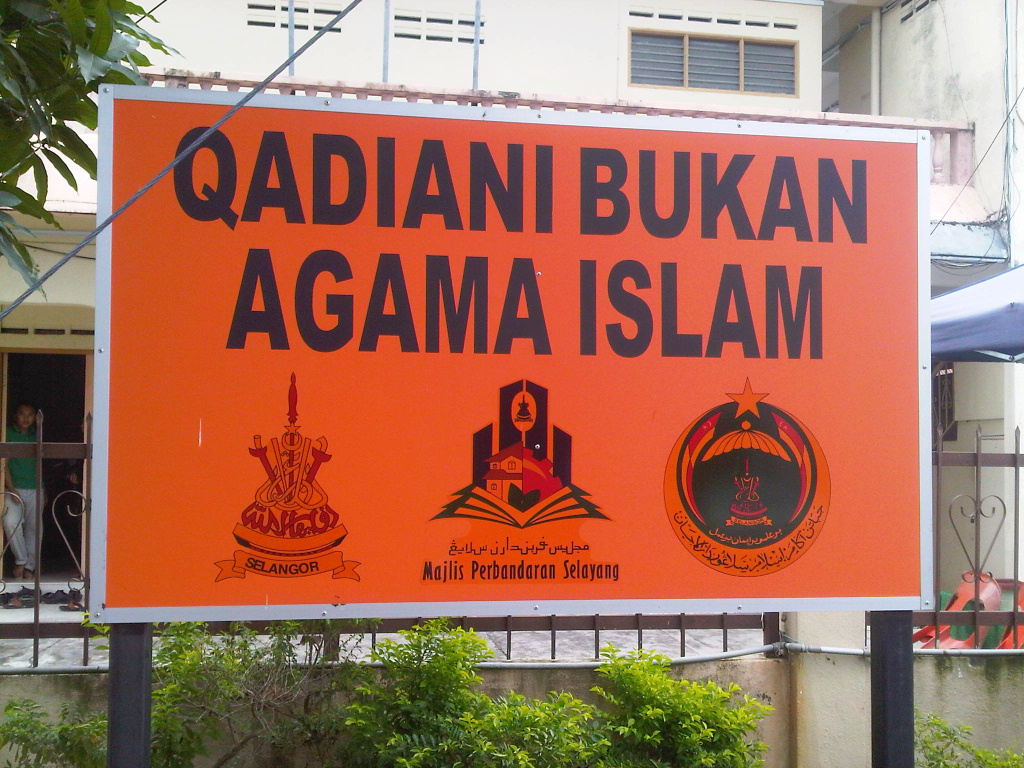
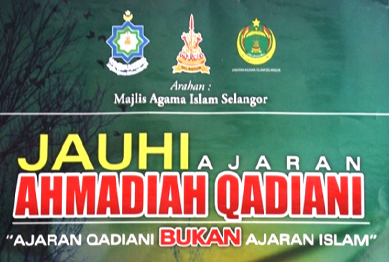
Slengor SignboardSELAYANG: In the middle of Kampung Nakhoda, there is an unassuming three-storey building. Nothing about its humble stature makes it stand out from nearby houses, except for a council-erected signboard that clearly reads: “Qadiani Bukan Islam” (Qadianis are not Muslims).

Youths mingle inside the building’s compound, warily observing passers-by beyond the front gate. At FMT’s approach, they smiled and opened the gate, only to quickly close it, and the front doors leading to the building’s living room.

Inside, the youths set up video cameras and other recording equipment. They are friendly, but slightly skittish with the visiting journalist. They relax a little when their religious leader, Maulana Ainul Yaqeen Sahib, enters.

It is easy to see why. Ainul belongs to the Ahmadiyya movement, an Islamic sect coldly received by Malaysia’s Sunni Islamic authorities.

Selangor Islamic Religious Department (JAIS) officers in the past, he said, have raided the building – named Baitussalam – which serves as the local Ahmadiyya community’s gathering place and mosque.

“They (JAIS) pushed themselves through a hole in the front gate when we didn’t let them come in. They didn’t have a warrant,” he told FMT, relating the 2009 incident.

The JAIS officers barged their way into the building, and started inspecting its prayer room and taking photographs.

Ainul also said that a few of these officers would later pose as curious university students. One of them, he claimed, “borrowed” a copy of the Quran, and never gave back.

Given the cold shoulder

Maulana Ainul Yaqeen SahibAccording to Ainul, Ahmadis are no different from other Muslims in terms of practice and the faith. “We follow the Quran, the five pillars of Islam and the tradition of the Holy Prophet. Even our Kalimah (Islamic creed) is the same,” he said.

But what sets them apart from other Muslims, is the belief that their sect’s founder, Mirza Ghulam Ahmad, was Islam’s Promised Messiah and the redeemer, the Imam Mahdi.

(The Ahmadiyya movement began in Qadian, India, during the late 19th century, and was later called Qadianis.)

It is a belief that has not only incurred the wrath of hardline Islamic authorities, but also their supporters.

In May 2010, Pakistani terrorists attacked two Ahmadiyya mosques in Lahore with grenades and automatic rifles, killing 86 and injuring more than 120.

Earlier in February this year, an Indonesian mob attacked an Ahmadiyya community in Cikeusik, Java. Videos released on the Internet showed the mob chanting “Allahuakbar” (God is great) as they beat and killed three Ahmadis, raining blows on them with sticks and stones even as they lay dead on the ground.

While outright violence against Malaysia’s 2,000-odd Ahmadis is unknown, the sect’s believers nevertheless are given the cold shoulder by both the authorities and locals.

According to the Ahmadis, opposition against the movement started shortly after the movement was introduced to Malaya by an Indian missionary in the 1930s.

Zionist support

Founder of Ahmadiyya and his successorsLater in 1975, the Selangor Fatwa Council decreed that the Ahmadis were not Muslims, and recommended as a result, that their special Malay privileges be removed.

In December 2008, Selangor executive council chairman (for religious affairs) Hasan Mohamed Ali said that the state government was looking into forcibly grabbing the Baitussalam land.

Six months later, in April 2009, the Selangor Islamic Relgious Council (MAIS) issued a directive forbidding the Ahmadis from using the Kampung Nakhoda mosque for Friday prayers.

Those who disobeyed this order, MAIS said, could be subject to a fine and imprisonment.

A 2008 text released by the Federal Territories Mufti’s Office, under the Prime Minister’s Department, claimed that Mirza Ghulam was a British agent sent to divide the Muslims in 19th century India.

Entitled “Beware! Qadianis are out of Islam”, it also alleged that the Ahmadiyya movement received Zionist support, and printed its propaganda material within Israel.

Deceased Malaysian Ahmadis were not allowed to be buried in Muslim cemeteries, Ainul said, adding that their bodies had to be taken to a special gravesite in Cheras.

A few religious Muslim leaders, he claimed, were raising suggestions to change the Ahmadis’ religion under the MyKad to “Qadiani” instead of “Muslim”.

Children not spared

LibrarySome speeches made by other Muslim leaders, he added, were also allegedly inciting locals to act against the Ahmadis.

Citing a nearby mosque in the area, he said: “The uztaz (religious leader) made a speech…saying, ‘In Indonesia, these people (Ahmadis) can be killed.’ So indirectly, they’re asking the community to attack us.”

Although physical violence against Ahmadis is unheard of here, locals nevertheless act in their own way.

“They used to throw faeces at my father’s house… During (this year’s) Ramadan, some people threw fireworks in here… children would pass by shouting, ‘Qadiani kafir!’ (Qadianis are infidels!),” Ainul said.

In one instance, FMT noticed a passing motorcyclist who shouted “Astaghfirullah!” (I seek forgiveness from Allah) at the compound, hinting that the Ahmadis had strayed from Islam.

Not even the Ahmadis’ children are spared.

Mohd Farid Kamam, 26, said that his schoolmates saw him leaving Baitussalam one Friday afternoon when he was in Form Three.

“I was lining up on Monday assembly, and I heard my friends saying ‘sesat’ (astray), but I didn’t know (they were referring to me).”

“When I entered the classroom, seven of my classmates surrounded me and said that I had strayed from Islam… they asked me to recite the Kalimah Shahada to determine that I was Muslim,” he said.

Adding that he had done so, his classmates left him alone after that. But the school’s religious teachers would not, with some even refusing to acknowledge him.

“My friends and I were giving ‘salam’ to a passing uztaz. He would return the salam to my friends, but knowing that I was an Ahmadi, he would not return it to me,” Mohd Farid said.

Bowing to idols

Mob lynching of Indonesian AhmadisBut his most bitter memory came when he was sitting for the Religious Studies paper during his SPM examinations.

“I entered the exam hall, and everyone had a chair except me, so I had to bring in a chair (from outside the hall). As I was carrying it, one of my schoolmates smiled at me and said in front of hundreds of people, ‘What are you here for? You’re not a Muslim, you don’t have to do this exam’,” Mohd Farid said, grinding his teeth.

Malaysian Ahmadis also have to bear the brunt of various accusations about their beliefs. Some of these included “wudu” (the act of washing before prayer) with water from corpses, praying in the nude, dancing the “joget” during prayer and bowing to idols.

Jariullah Ahmad, another believer, told FMT that some locals claimed that the Ahmadis encouraged the eating of pork.

“When my grandmother was taking care of a (hawker) stall, people used to say that she would put pork bones into her food,” he said.

He claimed that state religious leaders were purposely aligning Malaysians against the Ahmadis.

“It doesn’t matter whether it’s a Pakatan Rakyat or a Barisan Nasional government, because they’re both advised by the mullahs here,” Jariullah said.

As such, the Ahmadis have asked for the both the government and the mass media to allow for an open discussion over their beliefs.

Those requests have apparently fallen on deaf ears, Ainul said.

“What we want is an open discussion with JAIS and the religious authorities. We want a platform where we can speak out, and the public can watch. They can ask us questions… we will answer them and let the people judge for themselves,” he said.

Even so, Ainul did not appear confident that this would take place. He feared that his people might suffer the same fate as the Indonesian Ahmadis.

“If they don’t take the right action, we’re afraid that people will turn into a mob… it’s happened to Indonesia, now it’s at the stage where they throw stones at us.”

“We feel that worse things will happen here,” he said.

Copyright © 2011 MToday News Sdn. Bhd. All Rights Reserved.
URL: www.freemalaysiatoday.com/2011/11/08/malaysias...

Saturday, October 29, 2011

Ahmadiyya decry JAIS attacks

Free Malaysia Today, Malaysia
Ahmadiyya decry JAIS attacks
Patrick Lee | October 29, 2011
Islamic authorities are bent on demonising us, say local Ahmadiyya Muslims.

JAIS BillboardPETALING JAYA: Local Ahmaddiyya Muslims are tired of being discriminated against, and want to challenge the state to a discussion on their stand as believers.

The Selangor Islamic Religious Department (JAIS), according to Ahmadiyya spokesman Maulana Ainul Yaqeen Sahib, has worked hard to declare his community as apostates.

“JAIS has been attacking the Ahmadiyya through the media. Everything gets thrown against us. It’s not fair. They say we are not Muslims, and (at the same time) they don’t give us a chance to say anything (in return),” he told FMT.

Maulana was referring to a Oct 20 television programme known as “Kes Akidah” aired by local Islamic TV station Al-Hijrah. At the time, the programme’s episode was allegedly entitled “Nabi Palsu Qaidani” (False prophets of the Qaidanis).

(Qaidani is another term for the Ahmadiyya.)

Unhappy with the attacks against them, Ahmadiyya representatives handed over a memorandum to both JAIS and Al-Hijrah on Oct 25 and 27 respectively.

In the memorandum, they demanded equal and fair treatment as Muslims in Malaysia, as well as an open discussion over their position as Muslims.

The memorandum read: “What is most regrettable is that JAIS is so fervent in its attempts to prevent the Malays from becoming apostates or embracing other faiths.”

“But in the context of the Ahmaddiya, they so easily issue fatwas labeling us as kafirs or having left Islam.”

It added that an open discussion over the Ahmadiyya would be better than state-organised raids, and would avoid instances of violence and murder.

The Selayang Council, as well as the Gombak Land and District Office, the memorandum said, had been influenced by JAIS in the past to persecute the Ahmadiyya.

Malaysia, a predominantly Sunni Muslim country has been known to keep other Islamic sects under close watch.

According to a TheNutGraph report, the Selangor Fatwa Council issued a fatwa in 1975, declaring the Ahmadiyya as non-Muslims.

In 2009, the Selangor Islamic Religious Council (MAIS) forbade the Ahmaddiya from using their Batu Caves mosque.

There are an estimated 2,000 Ahmadiyyas in Malaysia today, with the majority of them residing in Selangor.

The country’s 100,000 Shi’ite Muslims also face discrimination from local Islamic authorities. In May this year, four Shi’ites were arrested after they were celebrating the birthday of Fatimah az-Zahra, Prophet Muhammad’s daughter.

Two hundred Shi’ites were also arrested at a gathering in late December.

Copyright © 2011 MToday News Sdn. Bhd. All Rights Reserved.
URL: www.freemalaysiatoday.com/2011/10/29/ahmadiyya-decry-jais-attacks/

Thursday, October 15, 2009

Persecution of minorities and women in South Asia

---Weekly Blitz, Bangladesh

VOLUME - 4, ISSUE - 42, DHAKA,
OCTOBER 14, 2009

Persecution of minorities and women in South Asia

Salah Uddin Shoaib Choudhury

Right before the end of British rule in Indian sub-continent in 1947, several riot amongst various religious groups, mainly amongst Muslims and Hindus took place in India and Pakistan [the then West and East Pakistan], causing severe rise of religious hatred amongst the people in the region. Subsequently, massive Muslim persecution in Gujrat, Sikh Persecution in Punjab by the Indian government, persecution of Hindus in Pakistan and Bangladesh, Persecution of Christians in India, Pakistan and Bangladesh as well persecution of religious minorities in almost all the countries in South Asia gradually generated deep rooted hatred amongst the people belonging to various religious beliefs. The Partition of India was the partition of British India that led to the creation, on August 14, 1947 and August 15, 1947, respectively, of the sovereign states of the Dominion of Pakistan [later Islamic Republic of Pakistan and People's Republic of Bangladesh] and the Union of India [later Republic of India]. The partition of India included the geographical division of the Bengal province of British India into East Pakistan and West Bengal [India], and the similar partition of the Punjab province into West Punjab [later Punjab - Pakistan and Islamabad Capital Territory] and East Punjab [later Punjab – India, Haryana and Himachal Pradesh], and also the division of other assets, including the British Indian Army, the Indian Civil Service and other administrative services, the Indian railways, and the central treasury. The partition was promulgated in the Indian Independence Act 1947 and resulted in the dissolution of the British Indian Empire. In the aftermath of Partition, the princely states of India, which had been left by the Indian Independence Act 1947 to choose whether to accede to India or Pakistan or to remain outside them, were all incorporated into one or other of the new dominions. The question of the choice to be made in this connection by Jammu and Kashmir led to the Indo-Pakistani War of 1947 and other wars and conflicts between India and Pakistan. Stable democratic nation like India could not free itself of curse of communalism even more than fifty years after independence. If anything it has been getting worse year after year. There has been not a single year in post-independence period, which has been free of communal violence though number of incidents may vary. The year 2002 has been one of the worst years in this matter right from the beginning as the Gujarat carnage began in the very beginning of the year. In the year 2002 the first reported riot took place in Kozhikode [Calicut], Kerala on 3rd January. In the clashes between two communities [Hindus and Muslims] five persons were killed. The clashes occurred on the question of eve teasing. The whole region came in the grip of violence. More than twenty persons were injured including five women. Properties worth millions of rupees were destroyed. A heavy police bandobast was made to bring the situation under control. Kerala is generally thought to be free of communal violence. But occasionally it also experiences such frenzy and bout of communal violence. However, it is generally brought under control as the Kerala government usually does not allow things to go out of had.

Gujarat was next to come under intense bout of communal carnage. It was of the kind, which India had never experienced accept at the time of partition. The communal carnage in Gujarat shook whole world. It was difficult to believe such intense communal frenzy could be incited by the BJP for its political gains. More than 2000 people were killed most cruelly in this carnage according to very reliable sources though the Government admits only about 1000 dead.

The Viswa Hindu Parishad [VHP], the Bajrang Dal and Bharatiya Janata Party [BJP] gave a call for bandh [general strike] on 28th February and violent incidents started from the morning of 28th February, particularly in Ahmedabad. And before the sun set on 28th February more than 100 persons were killed in Ahmedabad alone. Most ghastly incidents took place in a place called Naroda Patia where more than 80 persons were burnt alive including women and children and number of women were raped in full gaze of public. The other ghastly incident took place in Gulbarg Society, Chamanpura where about 40 persons were burnt alive including a former member of parliament named Ahsan Jafri from Congress Party.

What is worse the Chief Mister Narendra Modi justified such frenzy and described it as reaction to action in Godhra. And all this happened with full complicity of the police and bureaucracy. The honest officers who did not allow carnage in their areas were instantly transferred by the Narendra Modi Government.

Some ministers who led the mobs have been named in case lodged after the incident. Many mosques and mausoleums were demolished and ground was leveled. Some accounts maintain about 700 such religious structures were brought down or severely damaged. Ahmedabad, Baroda, Mehsana and Panchmahal districts were the worst affected districts covering entire north and central Gujarat. There have been various estimates of the properties destroyed but generally it is maintained properties worth more than US$ 1.5 billion were looted or burnt. The business lost due to closures and migration of labour is several times this figure. Hundreds of Muslim families were totally uprooted. The carnage continued for more than five months.

The next riot took place in Kaithal, at Indian state of Haryana. Though the cause of the violence on disturbances on 28th February is not clear but it seems to be related to Gujarat incidents. According to The Hindustan Times report Shiv Sena, Viswa Hindu Parishad [VHP] and Bajrang Dal mobs pulled down a mosque and caused extensive damage to two others. They damaged at least four mausoleums and enforced a complete bandh. Prohibitory orders were later clamped down on the town.

During the general strike Maharashtra called by the Shiv Sena, Viswa Hindu Parishad [VHP] and Bharatiya Janata Party [BJP] on 1st March 2002 to protest the setting ablaze of coach of the Sabarmati Express on 27th February 2002 in Godhra a violent mob went on rampage in Murbad 80 kilometer from Mumbai. Fortunately Murbad was the only town affected during the call for bandh by the Sangh Parivar.

During the general strike in Murbad in India the Bajrang Dal alliance began looting and burning Muslims shops. It also looted the houses of two prosperous grain merchants and set fire to a jeep [cross-country vehicle] belonging to a transporter. The general strike was total and all shops were closed. The mob was also determined to attack the families of some of the well to do Muslim shopkeepers. But they fled minutes before the attack and saved themselves.

The Police claimed that it fired 13 rounds in the air but the Minorities Commission said that it did not come across anyone who could corroborate the police claim. The Police claimed that they had arrested 32 people including the local Bajrang Dal leaders and charged them with attempted murder, arson and lootings. The Muslims are a microscopic minority in Morbad and are afraid of giving any details of damage to the madrasa and are praising the role of the police, according to the Minorities Commission.

On 17th March 2002 communal incidents took place in Loharu in Bhivani district of Haryana in India. Loharu was once under a Muslim ruler. There is thus Muslim population in this town. A mob of three hundred incited by the rumour of cow slaughter attacked two mosques and at least 15 shops and houses belonging to the minority community. The police had to fire in the air when the mob could not be controlled by tear gas charges.

When the people belonging to the majority community heard that a cow has been taken for slaughter in one of the mosques, it attacked and set fire to this mosque and shops nearby. According to a media reports quoting the police sources, a mob of 300 Shiv Sainiks [Soldiers of Shiva] set fire at another mosque near the railway station and many shops in the adjacent area.

Next incidents of communal violence in India took place in three places in Rajasthan in which three persons were killed on 25th March 2002 on the occasion of Muharram. The immediate provocation was the holding of poornahuti yagnas [a Hindu religious ritual] and kirtans [Hindu religious songs] at various temples on the route of Muharram processions.

Curfew had to be clamped in the town of Gangapur, 80 kilo meters from Sawai Madhopur, in central Rajasthan where 3 people were killed and 15 injured in police firing. According to the police, violence broke out when activists of the Viswa Hindu Parishad [VHP], Bharatiya Janata Party [BJP] and Bajrang Dal sat inside an ancient Hanumanji temple for religious rituals. They began to chant provocative anti-Muslim slogans when the Muharram procession came closer to the temple.

Persecution of Sikhs:

Operation Blue Star, which continued during 3–6 June 1984 was an Indian military operation ordered by Indira Gandhi, then Prime Minister of India, to remove Sikh separatists who were amassing weapons in the Golden Temple [Holy Temple of Sikhs] in Amritsar [India]. The operation was launched in response to a deterioration of law and order in the Indian state of Punjab.

The operation was carried out by Indian army troops with tanks and armoured vehicles. Militarily successful, the operation aroused immense controversy, and the government's justification for the timing and style of the attack are still under debate. Operation Bluestar was included in the Top 10 Political Disgraces by India Today magazine.

Official reports put the number of deaths among the Indian army at 83 and the number of civilian deaths at 492, though independent estimates ran much higher.

The impact of the military assault, its aftermath and the increased tensions led to assaults on members of the Sikh community within India and uproar amongst Sikhs worldwide. In India, many Sikhs resigned from armed and civil administrative office and returned their government awards.

Indira Gandhi first asked Lieutenant General S. K. Sinha, then Vice-Chief of Indian Army and who was to succeed as the Army chief, to prepare a position paper for assault on the Golden Temple. Lieutenant General Sinha advised against any such move, given the sacrilegious outlook from pious Sikhs. He suggested the government adopt an alternative solution. A controversial decision was made to replace him with General Arun Vaidya as the Chief of the Indian army. General Vaidya was assisted by Lieutenant General K. Sunderjee as Vice-Chief. Operation Blue Star was eventually planned and controlled by them.

On 3 June 1984, a 36-hour curfew was imposed on the state of Punjab with all methods of communication and public travel suspended. Electricity supplies were also interrupted, creating a total blackout and cutting off the state from the rest of India and the world. Complete censorship was placed on all types of media.

The Indian Army stormed the Golden Temple on the night of 5 June under the command of Major General Kuldip Singh Brar. The forces had full control of the Golden Temple by the morning of 7 June, 1984. Bhindranwale, Lieutenant General Shahbeg Singh and several other militant leaders were killed in the operation along with a large number of followers and civilians. The armed forces also suffered many casualties. Operation Blue Star coincided with a Sikh annual festival. Pilgrims, including the elderly and children, were trapped inside the temple when the operation began and many were reported as wounded and killed as a result.

Sikh reaction in India began with the decade old persecution of Sikhs, mostly by the Hindu majorities as well as state-partonized terror on them. Indian government enforced total media blackout and stopped local and international media from covering this tragic blood shed of the decade. Before the attack by army a media blackout was imposed in Punjab. The Times reporter Michael Hamlyn reported that journalists were picked up from their hotels at 5 a.m. in a military bus, taken to the adjoining border of the state of Haryana and “were abandoned there”.

Brahma Chellaney, who was then the South Asia correspondent of the Associated Press, was the only foreign reporter who managed to stay on in Amritsar despite the media blackout. His dispatches, filed by telex, provided the first non-governmental news reports on the bloody operation in Amritsar. His first dispatch, front-paged by the New York Times, The Times of London and The Guardian, reported a death toll about twice of what authorities had admitted. According to the dispatch, about 780 militants and civilians and 400 troops had perished in fierce gunbattles. The high casualty rates among security forces were attributed to “the presence of such sophisticated weapons as medium machine guns and rockets in the terrorists' arsenal.”

Chellaney also reported that “several” suspected Sikh militants had been shot with their hands tied. The dispatch, after its first paragraph reference to “several” such deaths, specified later that “eight to 10” men had been shot in that fashion. In that dispatch, Mr. Chellaney interviewed a doctor who said he was picked up by the army and forced to conduct postmortems despite the fact he had never done any postmortem examination before. The number of causalities reported by Brahma Chellaney were far more than government reports, and the Indian government, which disputed his casualty figures accused him of inflammatory reporting. The Associated Press stood by the reports and figures, the accuracy of which was also “supported by Indian and other press accounts” according to Associated Press; and reports in The Times and The New York Times.

Whole of Punjab and especially the Golden Temple Complex was turned into a murderous mouse trap from where people could neither escape nor could they seek succor of any kind. The way the dead bodies were disposed off adds to the suspicions regarding the number and nature of the casualties. The bodies of the victims of military operation in Punjab were unceremoniously destroyed without any attempt to identify them and hand them over to their relatives. The government, after the operation, on the other hand, did every thing in its power to cover up the excesses of the army action. The most disturbing thing about the entire operation was that a whole mass of men, women, and children were ordered to be killed merely on the suspicion that some terrorists were operating from the Golden Temple and other Sikh temples in India.

Similar accusations of high handedness on part of Indian Army and allegations of human rights violation by security forces in Operation Blue Star and subsequent military operations in Punjab has been leveled by Justice V.M. Tarkunde, Mary Anne Weaver, Ram Narayan Kumar, a noted human rights lawyer, Joyce Pettigrew, a Swedish Anthropologist and many others.

Muslim women in India:

On the completion of five decades of independence, women in Muslim communities face considerable challenges as citizens of India and as members of India's largest minority. Their poor socio-economic status reflects a lack of social opportunity which, though not a feature exclusive to Muslim women, is exacerbated by their marginal status within an overall context of social disadvantage for most Indian women. This point was highlighted in a study of 39 districts in 1981 [where the population of Muslims ranged from 20 per cent to 95 per cent - which could be considered a fairly representative sample of the status of Muslims in India]. In the study, the literacy rate of Muslim women was found to be 21.91 per cent - lower than even the poor national average of 24.82 per cent.

According to government reports, Muslim women are among the poorest, educationally disenfranchised, economically vulnerable, politically marginalized group in the country. In 1983, the Gopal Singh Committee instituted by the government, declared Muslims as a “backward” community in India. A central feature of this “backwardness” is their exceedingly poor socio-economic status, particularly of Muslim women. Most Muslim women remain “invisible” workers in the informal economy. The Muslim share in public employment is less than 3 per cent. Within this picture of marginalization, it is a predictable certainty that the corresponding figures for Muslim women are further skewed towards the bottom. A lack of information on Muslim women contributes to the reinforcement of cultural stereotypes, serving to obfuscate their life experiences and struggles. Consequently, the notion that Muslim women's status in India is attributable to certain intrinsic, immutable “Islamic” features or that their social status derives solely from Muslim laws, is widely prevalent.

On the other hand, the appropriation of Muslim women's issues by a vocal and politically influential male Muslim constituency for political purposes poses a considerable challenge to Muslim women's legal empowerment. This was highlighted during the Shah Bano case and the passage of the Muslim Women's Bill in 1986.

Furthermore, it is crucial for Muslims “women and men” to debate among themselves the possible reasons and remedies for their poor status as citizens of India.

The political ascendence of the Hindu right-wing and its inherent link between politics and religion has threatened India's secular fabric. The rise of communal violence in the last two decades has undermined secular law and violated constitutional ideals of religious non-discrimination, protection of human rights, implementation of social justice and the equality of all Indian citizens as well as principles of international human rights law. Right-wing illiberalism, communal prejudice and intolerance of diversity bodes ill for all Indian women; in the case of Muslim women it heightens physical and economic insecurity, limits possibilities of renegotiating their status with Muslim men and precipitates Muslim militancy.

The lack of social opportunities for Muslim women is a crucial issue needing urgent action. An improvement in literacy rates would directly influence Muslim women's socio-economic and political status as citizens of India.

The acknowledgement of the universality of women's rights by the international community is relevant to the debate on Islam and women's rights, particularly with reference to women's rights in the family. The formation of forums and associations of Muslim men and women's initiatives in the 1990s is an important step towards facilitating public debate on Muslim women's issues. Muslim women and men must collaborate with individuals and organizations who are committed to the realization of women's human rights. The alliance of Muslim women with the women's movement in India, as well as movements for secularism, democracy and human rights, are crucial for forging a common front against forces opposed to women's self-determination.

Christian persecution in India:

When Indian Prime Minister Atal Bihari Vajpayee was in the US in September [2000], the National Association of Asian Christians [NAAC] in the US paid US$ 50,000 to the New York Times to publish “an Open Letter to the Honorable Atal Bihari Vajpayee, prime minister of India.”

While “warmly welcoming the PM,” The NAAC expressed deep concern about the persecution of Christians in India by extremist [meaning Hindu] groups mentioning as examples “the priest, missionaries and church workers who have been murdered,” the nuns “raped,” and the potential enacting of conversion laws, which would make “genuine” conversions illegal. The letter concluded by saying “that Christians in India today live in fear.”

Many Hindu religious leaders feel Christianity is a real threat today for Indian democracy and ‘integrity’.

Rape of a nun and brutality on Churches:

Case – 1: A nun was raped in 2008 in the Indian city of Mumbai. Spanish born sister Antolina Martinez de Maranon of the Daughters of Charity, who works in Mumbai with leprosy, tuberculosis and AIDS patients, said in her letter that the violence began in Orissa, “but has now spread to many more states, even to the state we call the Rome of India, Bangalore, where our provincial house is located.”

“Many churches have been profaned there, Masses have even been disrupted, priests and others have been beaten, many things have been destroyed, and they are sowing panic.”

“Nobody is doing anything to stop the radicals from sowing panic and hatred in the minds of simple people and fear and insecurity in the minds of Christians,” Sister Martinez said.

“The Indian bishops want to draw attention to this all over the world, in order to get the international community to react,” she continued. “Otherwise nothing will be done, even though the central government has warned the extremists. Nevertheless, we are dealing here with the opposition party, which has many economic resources and many members trained to hate Christians,” she explained.

Sister Martinez pointed out that news of the death of a priest or nun in some part of India comes each day. “The Daughters of Charity are very protected by the Virgin Mary, even those who are in the north amidst the violence. We recognize that and we give thanks to God,” she said.

Case – 2: On August 25, 2008, India's Orissa state government has been accused of failing to take action against the perpetrators of the gang rape of a 28 year old Catholic nun.

India’s largest English daily, The Hindu reports the Orissa government has failed to take any action against those who committed the gang rape of the nun and the brutal attack on a Catholic priest who courageously resisted their attempts to force him to participate in the atrocity.

The incidents took place on August 25, 2008 at K. Nuagaon, 12 kilometres from the Baliguda subdivision in Kandhamal district in Orissa state in India. Both victims filed First Information Reports at the Baliguda police station. Sister Nirmala, Superior-General of the Missionaries of Charity, wrote to the Orissa Chief Minister and the Prime Minister specifying the atrocities.

The brutalisation of the nun and the priest by a mob raising anti-Christian, Hindutva slogans took place around 1pm at the site of the Divya Jyothi Pastor Centre.

The church was burnt the previous day in reprisal against the murder of an RSS activist, Lakshmanananda Saraswathi, and four of his associates on August 23 2008. The gang rape of the young nun, whose “virginity [was] grossly violated in public” took place in front of a police outpost with 12 policemen from the Orissa State Armed Police present and watching, according to Fr Thomas Chellan, the priest who was dragged out and badly beaten.

“Around 1:00 pm a gang came and pulled me and the Sister out of the house where we had taken shelter and started assaulting us,” Father Chellan told Indian newspaper The Hindu in a telephone interview from Kerala where he was recuperating.

“My appeals to the policemen who were standing nearby and watching only resulted in further beating. At one point the nun slipped away to plead with the police for help but she was dragged back by the mob and her blouse torn,” he said. The nun was gang raped in a nearby building, and he was doused with kerosene by the mob, which threatened to set him on fire. They were saved by a group of youth who took them to the police outpost where “one among the attackers was present with the police between 3pm and 9pm,” Father Chellan said.

News of the K-Nuagaon atrocity was conveyed through mobile phones to several priests and nuns hiding in the forests, fearing for their lives as the anti-Christian hunt was on. The victims were taken to the Baliguda police station around 9:00 pm where they filed First Information Reports.

Father Augustine Kanjamala is a Verbite clergyman who teaches at the University of Mumbai [India]. He appealed to the Churches of the world to “express their protest to the government of India” which has remained “inactive” with regards to anti-Christian violence. He openly charges the Orissa state government for its increasingly explicit collusion with the pogrom currently underway against the community of faithful.

According to Father Kanjamala a plan to cleanse Orissa of its Christian population has been in the making for years, especially in the district of Kandhamal [where most of the atrocities have taken place] where Christians now constitute around 5 per cent of the population. Conversions by, development for and emancipation of Tribals and Dalits are confronted by Hindutva conservatism.

“On 24 December 2007, while the Christians were getting ready to celebrate the birth of Lord Jesus Christ, Swami Laxmananda Saraswati, a member of a Hindu fundamentalist organization [Vishwa Hindu Parishad] and its supporters attacked and destroyed many churches and prayer centres. A large number of Christians were injured and made homeless in the communally sensitive district of Kandhmal, in Orissa state, eastern India.

Exactly eight months later, on 23 August 2008 when the same seer and the Hindu community were preparing to celebrate the birthday of Lord Krishna [Janmashtami] in Jalespata ashram [monastery], he and four of his disciples were gunned down by tribal revolutionary Maoists.

That it was a premeditated attack is evident from the fact that he was warned in advance and that government authorities were aware of it. A local TV Channel reported that the murderers left a note on the spot of the murder that this was a revenge killing for the last December attack on the Christians.

Hindus were quick to accuse the Church of masterminding the murder of their revered religious leader, who was in his 80s, rather than accept the government’s view that the attack had a Maoist origin and color.

A meeting of Hindu leaders took place on the following day in Rourkela, also known as Steel City, where a decision for an immediate and violent retaliation was taken. The total success of the dawn to dusk strike in Orissa on 25 August, 2008 is clear evidence of the shocking reaction. The simultaneous unleashing of violent attacks on 35 Christian centres in Orissa on the evening of 25 August further confirms that the plan was organized.

All bomb attacks were directed at Christians and their institutions. The rampaging mob, seeking revenge for the Guru’s murder, destroyed the pastoral centre of the archdiocese of Bhuvaneshwar with a bomb. A priest and a nun working there were beaten up, stripped and paraded naked in order to humiliate them. Four other priests were severely beaten—one suffered severe burns and is now in critical conditions in Burla Medical College, in the district of Sambalpur. The nun was also gang raped by the mob.

The mob also ransacked a church-run orphanage near Burgarh, and the caretaker, Ms. Rajni Maji, was set ablaze and burned to death. A large number of churches, prayer centres, convents, hospitals, dispensaries and vehicles were attacked and torched. Some nuns received warned by mobile phone and either ran into the jungle or escaped by jeep to the neighbouring state of Chattisgarh.

A few lay people lost their lives while thousands ran for theirs into the forests; more than 200 houses were set on fire.The radical Hindu mobs defied the curfew and forced everyone and everything to shut down, bringing life to a stand still and the state virtually to its knees. The official death toll of 20 reported by the controlled media is totally false.

With 40 per cent of the population made up of Tribals and Dalits [outcasts] Orissa is one of the most underdeveloped states in the country.The Kandhamal district, which has seen high levels of anti-Christian violence in the last decade, is also where a significant number of Christian conversions have taken place in the same period. As Dalits who embrace Christianity achieve socio-economic progress, many Tribals have followed them in that path in recent times. Thus while Orissa's Christian population is less than 2 per cent, the Christian population in the district doubled in the last decade to reach the 5 per cent mark.

In January 1999, the Australian missionary Graham Staines and his two young sons were burned to death by a mob led by one Dara Singh [convicted in 2003].Objecting to missionary activities, the murdered Hindu sage recently said: “The sooner Christians return to the Hindu fold the better it would be for the country.”

Orissa was the first state in the country that passed legislation against religious conversion in 1967, followed later by other states.

Another factor also generates opposition to Christians. It is becoming increasingly clear that where Christian missionaries operate, important social changes take place. People develop, acting and living with greater dignity. Thus, as a result of education, even basic education, Tribals and Dalits are no longer willing to be used as cheap labour in farming. Their sense of dignity and their education have given them the courage to protest against their exploitation and oppression. In addition to such changes over the past two generations, Tribals are now moving in great numbers to the big cities. In Mumbai alone there are some 100,000 young Tribals or Adivasi from Orissa, all working in domestic service or small industrial plants. It is obvious that these changes are transforming Orissa’s socio-economic structure.

There are series of allegations of rape of nuns by the fanatics Hindus in various parts of India. In most cases, those violated nuns do not speak of such brutality fearing social wrath. In some cases, nuns were viodegraphed while being raped, and such video tapes were sold in Indian market as well as in the Middle East by organized crime racket. Alluring titles such as ‘Raping virgin nun’ etc are given to such tapes and the crime racket are cashing millions by selling the sordid stories of the nuns in Christian missionaries.

Case – 3: Meena Lalita Barwa [29], a Roman Catholic nun was raped by a mob of fanatic Hindus in October 2008 and was paraded half-naked.

Sister Meena said that a mob of up to 50 men armed with sticks, axes, spades, crowbars, iron rods and sickles dragged her from the house where they were shelterin. One of the mob raped her, while two more held her down, and then a fourth tried to rape her again, before they paraded her, minus her blouse and underwear, along a road, she said.

When the crowd passed a group of a dozen policemen she begged for help, but they ignored her and talked in a “very friendly” manner to her attackers, she said. “State police failed to stop the crimes, failed to protect me from the attackers,” she said. “I was raped and I don't want to be victimise[d] by the Orissa police. God Bless India, God bless you all.”

Persecution of Ahmadiyya:

While some fanatic Islamists are demanding declaring Ahmadiyyas as ‘non Muslims’, persecution of this religious group is continuing mostly in Pakistan and Bangladesh, while state authorities are completely silent on this extremely serious matter. There are also reports of persecution of Ahmadiyyas in Malaysia, Indonesia and other Muslim nations.

Indonesian government barred the Ahmadiyyas from visiting Mecca to perform Haj. At West Nusa Tenggara in Indonesia, provincial administration imposed the ban a long time ago, but the matter was not publicly anounced.

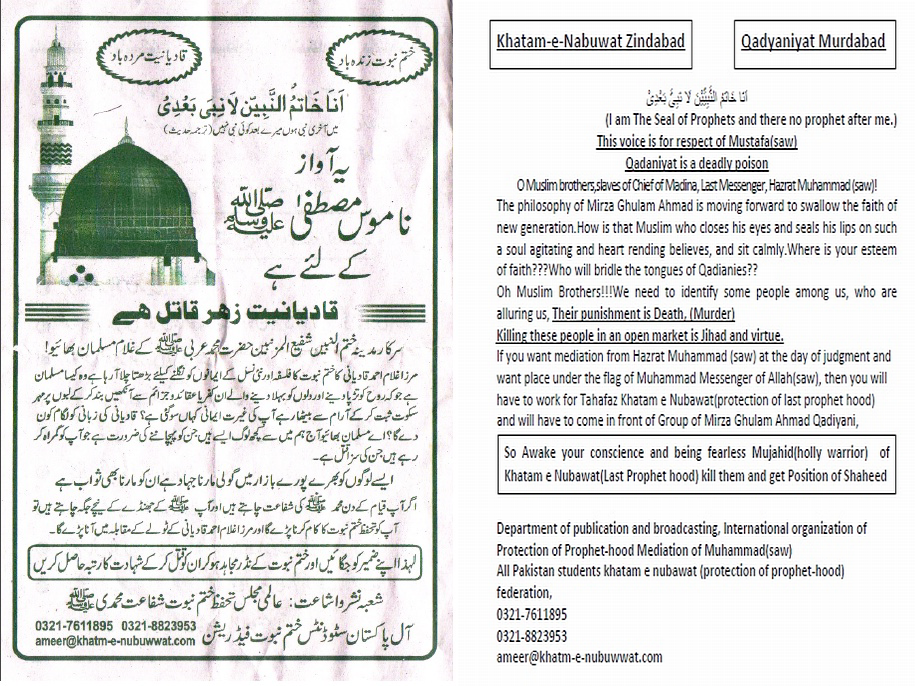
In Bangladesh, dozens of Ahmadiyya mosques were attacked and destroyed by Muslim fanatics. BNP led Islamist coalition government in 2004 imposed ban on religious books of Ahmadiyyas and police raided various mosques of this religious minority group and ransacked those places with the excuse of searching for banned publications.

Rana Ata-ul Karim [36] was killed on 6 August 2009 in Multan, Pakistan. He was murdered simply for being an Ahmadi. Karim, a well educated agriculturist, left his home for a few minutes in the afternoon and returned to find that his wife had been locked in their bedroom by three young men who had entered his home. He was later shot 3 times and died on the spot. The assailants immediately fled the scene.

Ahmadiyyas are arguably the most vilified minority across the Islamic world. They are not considered Muslims by mainstream branches of the religion. Founded in the 1880s by a religious figure named Ghulam Ahmad, Ahmadis differ with the mainstream on the death and return of Jesus, the concept of jihad and, most controversially, the question of whether the Prophet Mohammad was the last messenger from Allah. Ghulam claimed to have received messages himself from god, making him a later prophet.

Pakistan is hardly alone in discriminating against Ahmadis. In Indonesia, where they are known as the Ahmadiyah, they have been terrorized regularly, with their places of worship attacked by fundamentalists and members being banned from taking part in the Haj in some parts of the country. Laws were passed in Indonesia last year restricting their activities and prohibiting them from proselytizing. In many parts of Kyrgistan, they have been told to cease worshiping.

The depredations in Pakistan have been particularly distressing. Since the mid 1980s, the Ahmadiyyas have been dying in droves. Some 104 have been murdered in targeted attacks or lynchings and 117 others have escaped murder attempts, according to the community’s records. Other forms of harassment are also common: mosques have been demolished, set on fire and forcibly occupied and Ahmadiyya corpses have been dug up from Muslim graveyards.

Persecution of Hindu:

In Bangladesh and Pakistan, Hindus are regularly repressed by the religious majorities. Hundreds of cases of rape take place every year, most of which fail to reach the attention of the media. There are also series of allegations of abduction and forceful convertion of Hindu females to Islam. In most cases, these Hindu females are abducted and raped to put pressure on them in converting to Islam thus marrying a Muslim man.

Such notoriety take place almost o a daily basis, mostly in Bangladesh and Pakistan. Grabbing Hindu properties is another phenomenon of great concern. Muslims with social or political links, grab the properties of the Hindus thus in many cases forcing them to leave the country and migrate to India. Several Hindu rich families were evicted from their properties, while there had been murders of Hindus by the influential Muslims in the locality to create panic in the minds of this religious minority group.

According to a figure, only in 2008, more than 10,000 Hindu women and girls were raped in various parts of Bangladesh. The total number of such brutality would be several folds higher, if the cases of such notoriety in Pakistan and other Muslim nations are taken into consideration.

A large number of Hindu temples were destroyed in Bangladesh and Pakistan during since the independence of India in 1947. Most of the governments in the Muslim nations consider Hindus as ‘second class citizen of the country’.

In Bangladesh, Muslim house-owners, while renting out homes to Hindu families, openly warn them to refrain from performing rituals every day. A Bangladeshi newspaper editor, who belongs to Hindu community said, he was instructed by his land-lord to refrain from blowing religious flute during their daily rituals.

Situation of religious minorities in most of the South Asian nations are truly volatile. This is becoming more complicated with the ongoing spread of religious hatred amongst the population, thus resulting in communal riot almost every year.

Government in the respective countries, as well members of the civil societies should surely look into this issue with due urgency, before things turn worst.

URL: www.weeklyblitz.net/index.php?id=1013

Friday, October 2, 2009

Malaysia: Making minorities count

---The Nut Graph, Malaysia

Making minorities count
2 Oct 09 : 8.00AM

By Shanon Shah
shanonshah at thenutgraph dot com

“PAS for all” was an enchanting slogan indeed during the March 2008 general election. It was a sentiment that allowed for a warm partnership to develop between PAS and its eventual Pakatan Rakyat (PR) partners, Parti Keadilan Rakyat (PKR) and DAP. It was also what convinced Malaysians of all races to vote for PAS candidates even in non-Muslim majority constituencies. A case in point is PAS central working committee member Dr Siti Mariah Mahmud’s landslide victory in the 51% non-Muslim Kota Raja parliamentary seat.

But post-March 2008, there seem to have been some caveats to this inclusive slogan. For one thing, there has been an ongoing tussle in Selangor regarding the status of the Ahmadiyah community in Selayang. And the Selangor religious exco from PAS, Datuk Dr Hasan Ali, has been instrumental in
efforts to restrict religious worship among Ahmadiyah.


Granted, Ahmadiyah are but a tiny minority in Malaysia. Ahmadiyah probably make up 0.007% of the entire Malaysian population. Still, the slogan would not be as sexy if it were to say “PAS for 99.993%”, so this is probably why “PAS for all” remains the preferred brand strategy.

But PAS is not alone in having such contradictions between speaking for an inclusive Malaysia, and yet trying to clamp down on those it disagrees with. Just look at Prime Minister Datuk Seri Najib Razak’s much-praised as well as lampooned 1Malaysia slogan. And yet, someone in his administration is guilty of perpetuating, or at the minimum excusing, intimidation of minorities. We just need
to recall Home Minister Datuk Seri Hishammuddin Hussein’s defence of protesters who brandished a severed cow-head as a means of protesting the relocation of a Hindu temple.

Context matters

The question then is not just about how people deal with diversity and disagreement. It is also about how the many treat the few, and how the powerful treat the weak. It is something humanity has had to grapple with in witnessing the Jewish Holocaust in World War II, the 1994 butchering of 800,000 Tutsis and Hutu moderates by Hutus in Rwanda, and the systematic suffocation of indigenous communities in democracies such as the US and Australia.

Perhaps some of these examples are exaggerated in the case of Malaysia. Have we witnessed the gassing of entire communities here? Have we seen an ethnic majority bringing machetes and axes to systematically annihilate a particular ethnic minority? After all, the Selangor authorities are not bringing machetes or axes to the Ahmadiyah compound in Selayang — they are “merely” stopping them from worshipping. Is this cause for worry?

The situation is complicated. Sure, there may only be approximately 2,000 Ahmadiyah in Malaysia, but there are an estimated 200 million worldwide. And of this 200 million, many have settled in countries such as Canada and the UK, where they enjoy the support and protection of secular governments there. In fact, Ahmadiyah communities in these countries are able to lobby government ministers to put pressure on Muslim countries that persecute Ahmadiyah.

Ironically, it’s not that different being a “mainstream” Muslim in certain situations. Plant yourself in t
he US and you become the target of racial profiling, harassment and torture. Move to, for example, Pakistan and you are suddenly all-powerful. In practise, you could then profile, harass or abuse Christian, Hindu and Ahmadiyah communities and very likely get away with it.

A numbers game?

Furthermore, there are minorities and then there are minorities. On some levels, it is a numbers game after all. For example, Indian Malaysians are an ethnic minority, and have been the butt of racist jokes and not-so-helpful policies. But this minority group, spearheaded by Hindraf, managed to summon 30,000 from its ranks to march the streets of Kuala Lumpur in November 2007, demanding reparations and better treatment.


The Indian Malaysian vote also went squarely against the Barisan Nasional (BN) in March 2008, a
nd this inflicted a painful enough blow to the ruling coalition. And so, policies towards Indian Malaysians, especially in terms of education, have changed since then. Is this what it takes for a minority to assert itself? To demonstrate, “Hey, we have the numbers too, and we can inflict some real damage.”

There are various minorities in Malaysia. There are the tiny, often invisible, communities — indigenous people, lesbians, gays, bisexuals and transsexuals, and “deviant” Muslim groups. There are minorities of circumstance — those with HIV/AIDS, migrant workers, refugees, underprivileged urban settlers, and so on. And then there are the “bigger” minorities — Chinese and Indian Malaysians, Christians, Hindus and Buddhists, and so on.

Sometimes different categories of “minority” intersect. A Christian Indian Malaysian would already be a minority. But what if this person was also lesbian, poor and HIV positive? What would we do with her then? Were the 30,000 Hindraf protesters thinking of her when they took to the streets in 2007?

Hunting season

Would it be easier if we just did not have to deal with minorities? Either by doing away with them, or by making them comply with what the majority dictates? Anti-Ahmadiyah quarters might use this argument — in a democracy, we must accept the will of the majority. But what if the will of the majority, as in Rwanda, is that minorities must be killed? If that were the case, then there is not much difference being an Ahmadiyah in Pakistan, a “mainstream” Muslim in the US, a gay teenager in Iran, or a refugee in Australia. You just have to look out for when “hunting season” begins, and when it ends.

And yet, it’s not like societies have not learnt to deal with minorities before. In 2008, Australian Prime Minister Kevin Rudd formally apologised to the country’s indigenous population for wrongdoings caused by successive administrations. Germany openly grapples with its anti-Jewish Nazi past. The staunchly Catholic Ireland ultimately decriminalised homosexuality in 1993.

But getting back to Malaysia, what direction then is the BN government going to take with 1Malaysia? Where is PAS going to take “PAS for all“? Or are these merely the soundtrack to a prolonged hunting season?

The misguided majority-rule argument fails to acknowledge that democracy isn’t just about the will of the majority; it also entails that the majority government recognises the legitimate rights and freedom of the minority. For if it were merely the former, democracy is no more than giving the majority the right to tyrannise over the minority.

See Also:
URL: www.thenutgraph.com/making-minorities-count

Tuesday, September 29, 2009

Malaysia: Living with the Ahmadiyah

---The Nut Graph, Malaysia

Living with the Ahmadiyah
29 Sep 09 : 8.00AM

By Shanon Shah
shanonshah at thenutgraph dot com

“WE have to live with those who do not accept Islam,” Emeritus Prof Datuk Dr Osman Bakar tells The Nut Graph in a phone interview. Osman, who is deputy chief executive officer of the International Institute of Advanced Islamic Studies (IAIS) Malaysia, says this applies to how Muslims treat Ahmadiyah as well.

“The theological aspect is clear, based on the 1975 fatwa that declares them to be outside the fold of Islam,” he says. “But what should Muslims do to those who accept the Ahmadiyah founder, Mirza Ghulam Ahmad, as a prophet? Should they go about discriminating against these people?”

It is a timely question. The Ahmadiyah community in Selangor has been targeted over the past year by the Selangor Islamic authorities, led by Selangor’s religious exco Datuk Dr Hasan Ali. In fact, in April 2009, the Selangor Islamic Religious Council forbade Ahmadiyah in Selangor from worshipping in their own headquarters in Batu Caves on Fridays. In December 2008, the Selayang Municipal Council tried to make them remove the kalimah syahadat, or Islamic creed — “There is no God but God, and Muhammad is the messenger of God” — from their headquarters.

The question of why the Islamic authorities are training their sights on Ahmadiyah is interesting, given that the 1975 fatwa explicitly declares them not Muslim. “If they are to be treated as non-Muslims, then we should not treat them differently from other non-Muslims in Malaysia,” says Osman.

What seems to complicate matters is that Ahmadiyah not only preserve most of the prayer rituals that make them indistinguishable from Sunni Muslims in Malaysia. They are also mostly Malay Malaysians in this country. In other words, one cannot tell if a Malay Malaysian is an Ahmadiyah just by looking at him or her. Perhaps this is why the 1975 fatwa also asks for the state to strip Ahmadiyah of special Malay privileges.

And that’s not the end of it — even though Ahmadiyah are considered non-Muslim according to the 1975 fatwa, Ahmadiyah children have to attend Islamic Studies classes in primary and secondary school. Their identity cards list “Islam” as their religion.
This, then, is the quandary that Ahmadiyah in Malaysia face. Osman says, however, that the formulators of the 1975 fatwa would have taken these complexities into account.

“You see, there are two schools of thought in the Ahmadiyah movement. In the Indian subcontinent, they have distinguished between these two groups. The group that views the movement’s founder more as a saint, who urged spiritual renewal, is not considered to have fallen out of Islam,” says Osman.

This group is the Lahore Ahmadiyah Movement, but it is not the sect that exists in Malaysia. In Malaysia, Ahmadiyah believe that their founder, Mirza Ghulam Ahmad, was a prophet, only not a law-giving prophet as Muhammad was. But according to Osman, “The word for prophet in Arabic, ‘nabi’, is very technical and cannot be taken lightly.”

Even so, Ahmadiyah in Malaysia are but a tiny minority. They number only 2,000 at the most — that’s a mere 0.007% of a population of 28.3 million. Assuming roughly that Muslims form 60% of the Malaysian population, Ahmadiyah would only form 0.012% of all Muslims. That is, if they are considered Muslims at all.

Seeing the humanity

Zaid Kamaruddin, president of Muslim non-governmental organisation Jamaah Islah Malaysia (JIM), tells The Nut Graph that it is important to just see the humanity in everyone.

“Somebody who was born into that sect only knows that as their religion, and we have to see this person as a human being. Only knowledge can alleviate matters,” he says in a telephone interview.

“Nobody should take the law into their own hands,” he says. “We don’t want violence towards them the way it happens in Indonesia.

“But as far as the fatwa goes, it is up to the Islamic council to decide. After all, those sitting on the religious councils are appointed by the sultans. It is not the purview of the state exco to implement the fatwa,” he says.

Osman agrees. “It is true, there are claims that Ahmadiyah in Malaysia try to propagate their religion even to Malay [Malaysians]. But the authorities have to act wisely, and not let people take matters into their own hands. We have seen what has happened to Ahmadiyah in countries like Pakistan and Indonesia.”

In Pakistan in 1974, the constitution under Prime Minister Zulfikar Ali Bhutto’s administration was amended to effectively render Ahmadiyah as non-Muslims. After Zia-ul-Haq seized power from Bhutto in 1977, the persecution of Ahmadiyah intensified under his Islamisation project.

In Indonesia in 2005, the Indonesian Ulama Council issued a fatwa calling for the government to ban Ahmadiyah. This opened a floodgate of violence against Ahmadiyah by Muslim groups which persists to this day.

Thus, Ahmadiyah in Malaysia are afraid for their safety. However, they remain transparent and upfront about their beliefs and do not attempt to disguise or hide their headquarters. In fact, they say they have called for several public dialogues with the religious authorities, including the Selangor Islamic Affairs Department and religious exco Hassan. However, they say their requests have yet to be entertained. The Nut Graph’s attempts to reach Hasan also proved futile.

“The Ahmadiyah community here should have their own private engagement first with the authorities,” says Zaid. “Only if there are people taking the law into their own hands should the Ahmadiyah here press for a public dialogue.”

But with or without private or public dialogue, the fate of the Ahmadiyah at the hands of the state doesn’t look all that promising. From being declared non-Muslims to being persecuted as “deviant” Muslims, it is obvious that the state is unlikely to provide protection for the rights of this minority group of believers.

URL: www.thenutgraph.com/living-with-the-ahmadiyah

Monday, September 28, 2009

Malaysia: A day with the “deviants”

---The Nut Graph, Malaysia

A day with the “deviants”
28 Sep 09 : 8.00AM


By Shanon Shah
shanonshah at thenutgraph dot com

“FROM what we see, Islam [in Malaysia] appears like a one-way religion. But in the Quran, it’s not like this. Even if someone apostates, it’s not another human being’s right to persecut
e them,” Ainul Yakin Muhd Zin, 41, tells The Nut Graph. Perhaps this is why the sect that Ainul leads, the Jemaat Ahmadiyah Muslim of Malaysia, was branded a “threat to national security” in a 3 Aug 2009 Kosmo! report.

In fact, Ainul says that in 1975, a fatwa by the Selangor Islamic authorities declared Ahmadiyah to be outside Islam’s fold. The fatwa also asked for Ahmadiyah followers to be killed by the sultan. Why indeed are Muslims and the Islamic authorities so afraid of Ahmadiyah?


After all, according to Ainul, there are only around 2,000 Ahmadiyah in all of Malaysia. In the Klang Valley, there are maybe 600 Ahmadiyah followers only, and most of them are Malay Malaysians. This, then, was what The Nut Graph aimed to find out on 4 Sept 2009 at the Ahmadiyah headquarters in Batu Caves, Selangor.

Difference in beliefs


Perhaps before answering the question of why there is so much hostility towards Ahmadiyah, we must look briefly at how Ahmadiyah differ from Sunni Muslims who make up the dominant group of Muslims in Malaysia.

Ahmadiyah believe that Mirza Ghulam Ahmad, their founder from late 19th-century Qadian in present-day India was a prophet in his own right. However, they acknowledge Muhammad as the last of the law-giving prophets sent by Allah. Sunni Muslims, however, see this as an unforgivable deviation — there can be no prophets after Muhammad in Islam, full-stop.

Ahmadiyah also have their own caliphate. Their current caliph is the fifth succeeding Mirza Ghulam Ahmad, whom they count as their first caliph. In terms of doctrine, they also differ by arguing that the prophet Isa, or Jesus, died a mortal death and was not raised to heaven by God.

Ahmadiyah also believe in Darwinist evolution to a certain extent — to them, Adam was not literally the first human being, but rather the first evolved human being.

Unverified allegations


So in this sense, it is easy to see why Sunni Muslims have problems with Ahmadiyah doctrine. But the allegations against Ahmadiyah practices and beliefs do not stop here. “They say our prayers are mixed-gender. They say our kiblat (direction of prayer) does not point towards Mecca. This is all untrue,” explains Ainul. In fact, none other than Selangor religious exco Datuk Dr Hassan Ali claimed that Ahmadiyah “do not need to pray, do not fast during Ramadan and do not perform the haj”.

Ainul, however, says, “First of all, there are Muslim governments that prevent us from performing the haj in Mecca when they find out we are Ahmadiyah.” During the asar (late afternoon) congregational prayer, The Nut Graph also observed the Ahmadiyah’s kiblat was no different from the conventional kiblat. When asked if any journalist from the traditional media came to verify this fact, Ainul said they hadn’t.

“And do you see any women praying beside us? We observe purdah (gender segregation) very strictly,” says Ainul. That was indeed clear. In fact, The Nut Graph had to request repeatedly to interview some women Ahmadiyah because they were nowhere to be seen.


“All just a misunderstanding”


But Ainul is good-natured enough to entertain this request. On 9 Sept, The Nut Graph met with two women Ahmadiyah leaders in Malaysia — Afiatunnur, 34, the Kuala Lumpur women’s chief, and Najmul Laila, 38, the moral outreach secretary. Najmul is also Ainul’s wife. Both women are Indonesians married to Ahmadiyah Malaysians.

Afiatunnur and Najmul attest that things were once peaceful for them in Indonesia — Ahmadiyah even had protection from the state. But all this changed in 2005, when the Indonesian Ulama Council issued a fatwa calling for a government ban on Ahmadiyah. Violence then ensued. In July 2005, the Ahmadiyah headquarters in Bogor was attacked, causing it to be shut down. Attacks then spread all across Java, until today.

In 2008, even former President Abdurrahman Wahid appealed for calm and for protection of Ahmadiyah, but his plea was ignored. In June 2008, Religious Affairs Minister Maftuh Basyuni, Home Minister Mardiyanto, and Attorney-General Hendarman Supanji signed a decree outlawing Ahmadiyah from spreading their faith.

But Najmul and Afiatunnur are nothing if not forgiving of such persecution. “It’s all just because they misunderstand Ahmadiyah teachings,” says Najmul.


“Even here in Malaysia, my family was renting from a house owner who was not happy that we are Ahmadiyah,” says Afiatunnur. “But once they saw that we are just like anybody else, they became okay with us.”

Najmul elaborates, “But then the others in their community think these people are suddenly nice to us because we have bewitched them!”

But is this forbearance and humour from these two women too good to be true? When asked, for example, if women are obliged to cover their hair, both women agree fully. But are there Ahmadiyah women who do not cover their hair?

“Yes, a few,” Najmul admits. Are these women then encouraged to cover their hair? “Yes, we advise them.” What if they still do not cover their hair after this advice? Are they forced to cover their hair? Najmul is scandalised. “Of course not,” she says. “But we just keep advising them, that’s all.”

Just another day
This chill-out attitude pervades other aspects of Ahmadiyah life as well. Yes, they fast. And when they broke their fast, the meal was simple, and they did not dilly-dally before performing maghrib (dusk), and then isya (night) and terawih prayers in congregation. And yes, they have a 10-point pledge of allegiance, or baiat, that followers have to accept, calling for strict observance of morality, piety and worship.

But Ahmadiyah are not fussed if there are those who do not accept the creed, or who want to leave the community. As Jariullah Ahmad, another Ahmadiyah spokesperson in Malaysia, explains, “If I leave the Ahmadiyah community, then I leave. The Ahmadiyah community will survive and go on. God will find a replacement for me among Ahmadiyah.”

In fact, Ahmadiyah claim they have nearly 200 million followers worldwide. Their communities flourish especially in secular Canada and the UK, where they are recognised and visited by ministers and Members of Parliament.

How do they deal with negative attitudes towards them, though? Ainul gives an example. In December 2008, he says the Selayang Municipal Council (MPS) ordered them to remove the kalimah syahadat, or Islamic creed — “There is no God but God, and Muhammad is the messenger of God” — from their headquarters.

“I said we cannot bring ourselves to do this, because this is truly what we believe. But if you believe we are wrong, then you need to be the ones to remove the kalimah yourselves,” he says. According to him, MPS then left the kalimah alone.

There are, of course, even more sinister threats, and Ainul says that he has made several reports to the police and other authorities about these threats. He says, though, that until now no action has been taken based on these reports. “Why is this so? And if we are considered non-Muslims from the 1975 fatwa, why do the authorities continue to harass us? Why do they not leave us alone like the Buddhists, Hindus, Christians, and other non-Muslims in Malaysia?” asks Ainul.

Jariullah takes this questioning a step further. “Can the authorities just declare openly if they are able to protect our basic rights? If they admit they truly can’t, then at least we can plan our lives accordingly.”

URL: www.thenutgraph.com/a-day-with-the-deviants

Friday, September 25, 2009

Malaysia: The non-Muslim Muslims

---The Nut Graph, Malaysia

The non-Muslim Muslims
25 Sep 09 : 8.00AM

By Shanon Shah
shanonshah at thenutgraph dot com

IN April 2009, the Selangor Islamic Affairs Council (MAIS) officially forbade the Ahmadiyah community in the state from performing their own Friday prayers. This news, however, did not make headlines — after all, there are at most only 2,000 Ahmadiyah in all of Malaysia, and at most only 600 in the Klang Valley. But from the panic-inducing headlines in the Malay-language press, one would think that the Ahmadiyah were an insidious fanatical sect bent on destroying the faith of Sunni Muslims in Malaysia.

The Ahmadiyah sect started in Qadian, in what is present-day India, in the late 19th century. They were inspired by the teachings of Mirza Ghulam Ahmad. However, there emerged two sects of the Ahmadiyah movement after Mirza Ghulam Ahmad’s death in 1908. There is the Lahore Ahmadiyah movement, which is inspired by his teachings but does not regard him as a prophet. Then there is the Ahmadiyah Muslim Community (AMC), sometimes referred to by other Muslims as “Qadianis”, which regards him as a prophet and messianic figure.

Majoritarian Islam does not have problems with the Lahore sect, but sees the AMC as heretical. Overall, there are nearly 200 million Ahmadiyah followers around the world. Ahmadiyah in Malaysia are part of the AMC.

The Ahmadiyah movement in Malaysia began shortly before the Second World War. Persecution began almost immediately. In the 1950s, the sultan of Selangor had an audience with the community’s leaders together with other Muslim leaders. However, things did not come to a head until 1975, when the Selangor Fatwa Council issued a fatwa declaring Ahmadiyah as non-Muslims. The fatwa called for them to repent, failing which they should be put to death by the ruler.

Malaysia is not the only country in which Ahmadiya face problems. Pakistan and Indonesia have seen a rise in violence and state persecution of Ahmadiya, too. Ironically, Ahmadiya thrive best in secular, Western countries such as Canada and the UK, where they are visited and protected by prominent ministers and members of Parliament.

URL: www.thenutgraph.com/non-muslim-muslims

Friday, May 8, 2009

World leader prays for ‘unjust laws’ to be revoked in Malaysia

---Ahmadiyya Muslim Jamaat International, UK

In the Name of Allah, Most Gracious, Ever Merciful
International Press and Media Desk
Ahmadiyya Muslim Jamaat International
22 Deer Park, London, SW19 3TL
Tel / Fax (44) 020 8544 7613 Mobile (44) 077954 90682
Email: press@ahmadiyya.org.uk
Web: Alislam.org
7 May 2009
PRESS RELEASE

On 28th April 2009 in a Press Release issued by this office it was confirmed that the Selangor Council of Islamic Religion (MAIS) had issued the Ahmadiyya Muslim Jamaat in Malaysia with a notice ordering them to stop offering Friday Prayers at their National Headquarters. Various other activities had also been banned under the terms of the notice.

The Head of the Ahmadiyya Muslim Jamaat, Hadhrat Mirza Masroor Ahmad said:
“Freedom of religion is a basic human right. Moreover it is a principle of Islam that each person has the right to choose and practice his religion without fear or coercion. Thus I regret very much the notice issued by the Selangor Council of Islamic Religion on 24th April 2009 which violates the right of Ahmadi Muslims in Malaysia from practising their religion freely. I hope and pray that these unjust laws are soon revoked.”
End of Release
Further Info: Abid Khan (press @ ahmadiyya.org.uk / 07795490682)

Tuesday, April 28, 2009

MAIS forbids Ahmadiyya worship

---The Nut Graph, Malaysia

MAIS forbids Ahmadiyya worship
28 Apr 09 : 7.55PM

By Shanon Shah
shanonshah at thenutgraph dot com

PETALING JAYA, 28 Apr 2009: The Selangor Islamic Religious Council (MAIS) has forbidden the Ahmadiyya Muslim sect to perform Friday prayers at their mosque with immediate effect.

In a letter to the Ahmadiyya dated 24 Apr 2009 made available to The Nut Graph, MAIS said, “If [the Ahmadiyya] fail to comply with, defy or neglect the directive, the council will take legal action without any notice.”

In a statement, Ahmadiyya spokesperson Ainul Yakin Muhd Zain said, “We … feel deeply hurt and aggrieved at this unjust action to deny us our right to perform our religious obligations.”

MAIS issued its directive on the grounds that the Ahmadiyya mosque did not get the council’s approval first.

In December 2008, Selangor religious exco Datuk Dr Hassan Ali said that he was willing to negotiate with the Ahmadiyya community over seizure of land which they used for their mosque.

PAS Shah Alam chief and Member of Parliament Khalid Samad elaborated to The Nut Graph over the phone: “We should engage and discuss with the Ahmadiyya to understand their perspective.”

According to Ainul, however, no such dialogue has taken place between Hassan and the Ahmadiyya community.

“Besides, he is only willing to talk about the issue of land, not the issue of our aqidah (belief system),” Ainul said in a phone interview today.

“The way the Pakatan Rakyat government is treating us is the same as how the Barisan Nasional treated us,” Ainul added.

The Nut Graph was unable to reach Hassan, but Khalid said it was important to clarify the Ahmadiyya sect’s status.

“There are 1,001 religions in the world, so if they declare themselves non-Muslim, then the solution is easy for us,” he said.

“The problem is if they insist that they are still Muslims,” he noted.

However, Ainul said, “It is … incomprehensible to us that we are subjected to this kind of treatment, as firstly we have been declared non-Muslims.”

In 1975, the Selangor Fatwa Council issued a fatwa declaring the Ahmadiyya sect non-Muslim.

The fatwa also said that ideally, if the Ahmadiyya did not “repent and return to the true teachings of Islam, they should be killed by the Imam which is the King”.

Acknowledging, however, that this was not legally possible, the fatwa then recommended that the Ahmadiyya be stripped of all special Malay privileges.

To believe or not


According to constitutional law expert Prof Dr Shad Saleem Faruqi, however, such declarations that someone is a non-Muslim have massive consequences.

“Every religion has its own jurisdiction to ‘excommunicate’ deviant followers, but in this case it should be a matter of last resort since the implications are devastating,” he said in a phone interview.

Shad said that an official declaration that someone is Muslim or not has implications on the status of marriage, guardianship of children, and inheritance.

Shad also said that the fatwa itself seems to contradict Section 6 of the Selangor Syariah Criminal Offences Enactment, which says that it is illegal to declare any Muslim non-Muslim.

According to Shad, the authorities’ treatment of the Ahmadiyya stands in direct contrast with its treatment of cases such as Lina Joy’s, in which a Muslim sought to publicly renounce Islam.

“We are effectively saying that an individual’s affirmation of faith is not enough for them to follow the religion of their choice,” he said.

“In Lina Joy’s case, she is being prevented from leaving Islam, while the Ahmadiyya are being forcefully kicked out and yet are still liable to punishment by the Islamic authorities,” he said.

Shad said that as far as the law was concerned, the Ahmadiyya should enjoy constitutional protection for their freedom of religion if they are considered non-Muslims.

“But if they want to declare themselves Muslim and follow their version of the faith, then the superior courts will defer to the syariah courts,” he said.

The Ahmadiyya movement was founded by Mirza Ghulam Ahmad of Qadian, India, in 1889. They are sometimes inaccurately referred to as Qadianis.

Although Ahmadiyya consider themselves Muslim, mainstream Muslims reject this because the Ahmadiyya believe that Ahmad was the metaphorical second coming of Jesus.

The sect has its headquarters in the United Kingdom, and Ahmadiyya are persecuted by religious authorities in Muslim-majority countries such as Pakistan and Indonesia.

According to Ainul, there are approximately 1,500 Ahmadiyya followers in Malaysia, with the majority in Sabah.

Most Ahmadiyya Malaysians are ethnic Malays, and the movement was founded in Malaya in the 1930s.

URL: www.thenutgraph.com/mais-forbids-ahmadiyya-worship
 
^ Top of Page