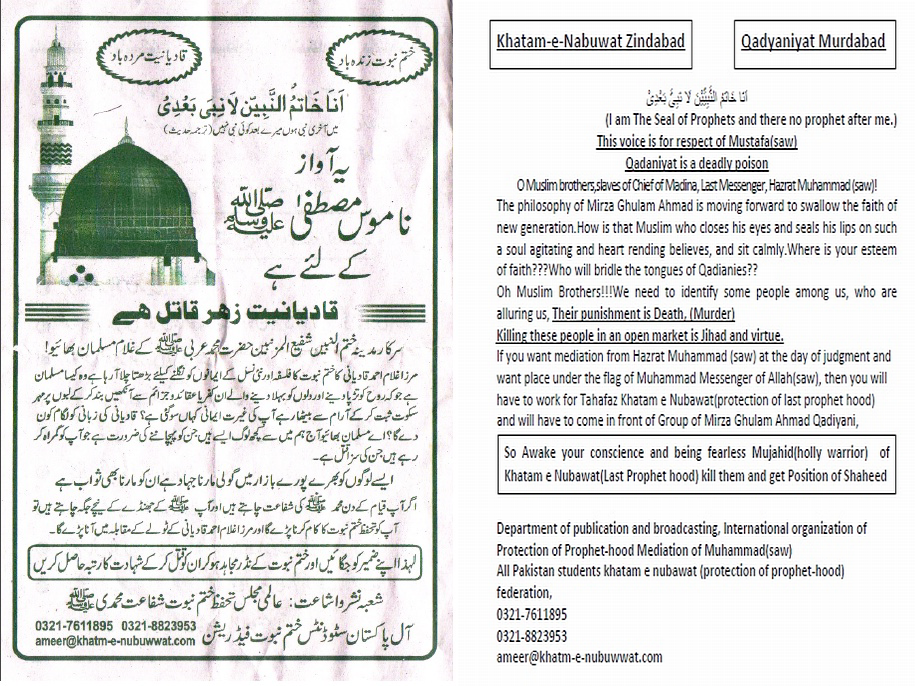
Showing posts with label Religious Hatred. Show all posts

Wednesday, February 2, 2011

Pakistan: Drop Blasphemy Charges Against 17-Year-Old

Human Rights Watch
Pakistan: Drop Blasphemy Charges Against 17-Year-Old
Student’s Case Underscores Urgent Need to Repeal Abusive Law
February 02, 2011

Pakistan has set the standard for intolerance when it comes to misusing blasphemy laws, but sending a schoolboy to jail for something he scribbled on an exam paper is truly appalling. It’s bad enough that a school official flagged it, but for police and judicial authorities to go ahead and lock up a teenager under these circumstances is mind boggling.Bede Sheppard, senior children's rights researcher at Human Rights Watch
(New York) — The Pakistani government should immediately drop blasphemy charges against a 17-year-old student and ensure his safe release from detention, Human Rights Watch said today.

The authorities arrested Muhammad Samiullah on January 28, 2011, and charged him under Pakistan’s “blasphemy law,” article 295-C of the criminal code, for allegedly including derogatory remarks about the Prophet Muhammad in his answers on a written school exam in April 2010. According to press reports, police at Shahra Noor Jahan Police Station in Karachi registered a case against Samiullah after receiving a complaint from the chief controller of the intermediate level education board. On January 29, a judicial magistrate, Ehsan A. Malik, ordered Samiullah sent to a juvenile prison pending trial.

“Pakistan has set the standard for intolerance when it comes to misusing blasphemy laws, but sending a schoolboy to jail for something he scribbled on an exam paper is truly appalling,” said Bede Sheppard, senior children’s rights researcher at Human Rights Watch. “It’s bad enough that a school official flagged it, but for police and judicial authorities to go ahead and lock up a teenager under these circumstances is mind boggling.”

The police have said that they cannot report exactly what was written in the exam paper as doing so would also amount to blasphemy.

The Convention on the Rights of the Child, an international treaty to which Pakistan is a party, guarantees everyone under age 18 the right to freedom of expression, thought, conscience, and religion.

Section 295-C of Pakistan’s penal code makes the death penalty mandatory for blasphemy. Although this case involves a Muslim, Human Rights Watch has documented how the law is often used to persecute and discriminate against religious minorities in Pakistan.

Pakistan has applied the blasphemy law to children before, Human Rights Watch said. On February 9, 1995, Salamat Masih, a Pakistani Christian boy who was then 14 was sentenced to death for blasphemy by a lower court in Lahore, Pakistan, for allegedly writing derogatory remarks about the Prophet Muhammad on the wall of a mosque. He was also sentenced to two years’ hard labor and fined. Masih was acquitted on February 23, 1995, because the court found that he was, in fact, illiterate. Masih then fled the country out of concerns for his safety. Justice Arif Iqbal Bhatti, who acquitted Masih, was assassinated in his chambers at the Lahore High Court in 1997. The assassin, who was subsequently arrested, claimed to have murdered the judge as revenge for acquitting Masih.

Hundreds of people have been charged under section 295-C since it was added to the penal code in 1986 by Gen. Muhammad Zia-ul-Haq, the military ruler at that time. In 2009, authorities charged scores of people under the law, including at least 50 members of the Ahmadiyya religious community. Many of those charged remain in prison.

Pakistani and international human rights organizations have long called for the repeal of the blasphemy law. The law has come under renewed scrutiny in recent months as a consequence of a death sentence imposed on November 8, 2010, on Aasia Bibi, an illiterate farmhand from Sheikhupura district in Punjab province.

Extremists responded to government attempts to pardon Aasia Bibi with a campaign of intimidation, violence, and threats against critics of the law. On January 5, Salman Taseer, the governor of Punjab province, was assassinated, and the man charged with the killing said he had committed the crime because Taseer had called the blasphemy law a “black law.” Sherry Rehman, Pakistan’s former information minister who in November proposed a parliamentary bill to amend the law, has also received death threats, which Pakistan’s government has ignored.

“While Pakistan’s government keeps up the mantra that it will not allow ‘misuse’ of the law, government inaction has only emboldened extremists,” Sheppard said. “Until this law is repealed, it will be used to brutalize religious minorities, children, and other vulnerable groups.”

Tuesday, November 23, 2010

Pakistan: Repeal Blasphemy Law

Human Rights Watch
Pakistan: Repeal Blasphemy Law
Legal Discrimination Emboldens Extremists
November 23, 2010
A police official takes the thumb print of Aasia Bibi, a Pakistani Christian woman who has been sentenced to death for blasphemy, on an affidavit stating her innocence after she was visited by the Governor of the Punjab Province Salman Taseer (R) at the central jail in Sheikhupura, Punjab Province, on November 20, 2010. © 2010 Reuters
A police official takes the thumb print of Aasia Bibi, a Pakistani Christian woman who has been sentenced to death for blasphemy, on an affidavit stating her innocence after she was visited by the Governor of the Punjab Province Salman Taseer (R) at the central jail in Sheikhupura, Punjab Province, on November 20, 2010.
© 2010 Reuters

The Punjab provincial government is either in denial about threats to minorities or is following a policy of willful discrimination. Provincial law enforcement authorities need to put aside their prejudices and protect religious minorities who are clearly in serious danger from both the Taliban and sectarian militant groups historically supported by the state.
Ali Dayan Hasan, senior South Asia researcher at Human Rights Watch.
(New York) — Pakistan’s government should immediately introduce legislation to repeal the country’s blasphemy law and other discriminatory legislation, Human Rights Watch said today. The government should also take legal action against Islamist militant groups responsible for threats and violence against minorities and other vulnerable groups, Human Rights Watch said.

While international and Pakistani human rights groups have long called for the repeal of the blasphemy law, it has come under renewed scrutiny in recent weeks as a consequence of a death sentence imposed on November 8, 2010, on Aasia Bibi, an illiterate farmhand from Sheikhupura district in Punjab province. She was charged under the blasphemy law after a June 2009 altercation with fellow farm workers who refused to drink water she had touched, contending it was unclean because she was a Christian. She is the first woman in Pakistan’s history to be sentenced to death for blasphemy, though others have been charged and given lesser sentences.

“Aasia Bibi has suffered greatly and should never have been put behind bars,” said Ali Dayan Hasan, senior South Asia researcher at Human Rights Watch. “The injustice and fear the blasphemy law spawns will only cease when this heinous law is repealed.”

President Asif Ali Zardari ordered a review of the case in the face of domestic and international outrage. Government officials have indicated publicly that Zardari is expected to use his constitutional authority to pardon her.

Pakistan’s “Blasphemy Law,” as section 295-C of the penal code is known, makes the death penalty mandatory for blasphemy. In 2009, authorities charged scores of people under the law, including at least 50 members of the Ahmadiyya community, a heterodox sect that claims to be Muslim but has been declared non-Muslim under Pakistani law. Many of these individuals remain in prison.

Legal discrimination against religious minorities and the failure of Pakistan’s federal and provincial governments to address religious persecution by Islamist groups effectively enables atrocities against these groups and others who are vulnerable. The government seldom brings charges against those responsible for such violence and discrimination. Research by Human Rights Watch indicates that the police have not apprehended anyone implicated in such activity in the last several years.

Social persecution and legal discrimination against religious minorities has become particularly widespread in Punjab province. Human Rights Watch urged the provincial government, controlled by former prime minister Nawaz Sharif’s Pakistan Muslim League (Nawaz) party, to investigate and prosecute as appropriate campaigns of intimidation, threats, and violence against Christians, Ahmadis, and other vulnerable groups.

On November 18, armed assailants opened fire at an Ahmadiyya mosque in Lahore, the Punjab capital. The mosque had no police protection despite a May 28 attack on two Ahmadiyya mosques in the city that killed 94 people and injured well over a hundred. Those attacks were believed to have been carried out by groups affiliated with the Pakistani Taliban.

The November 18 attack did not result in further loss of life only because of private security provided by the mosque management. Local residents told Human Rights Watch that the police initially sought to portray the attack falsely as a consequence of a dispute within the Ahmadiyya community and only made arrests when the mosque authorities provided security camera footage identifying the attackers.

“The Punjab provincial government is either in denial about threats to minorities or is following a policy of willful discrimination,” Hasan said. “Provincial law enforcement authorities need to put aside their prejudices and protect religious minorities who are clearly in serious danger from both the Taliban and sectarian militant groups historically supported by the state.”

Since the Pakistani military government of General Zia-ul-Haq unleashed a wave of persecution in the 1980s, violence against religious minorities has never really ceased. Attackers kill and wound Christians and Ahmadis, in particular, and burn down their homes and businesses. The authorities arrest, jail, and charge members of minority communities, heterodox Muslims and others, with blasphemy and related offenses because of their religious beliefs, as a means of transacting vendettas and settling scores. In several instances, the police have been complicit in harassing and framing false charges against members of these groups or stood by as they were attacked.

Human Rights Watch urged concerned governments and intergovernmental bodies to press the Pakistani government to repeal sections 295 and 298 of the Pakistan Penal Code, which includes the blasphemy law and anti-Ahmadiyya laws. They should also urge the government to prosecute those responsible for planning and executing attacks against religious minorities.

“Continued use of the blasphemy law is abominable,” Hasan said. “As long as such laws remain on the books, Pakistan will remain plagued by abuse in the name of religion.”

Tuesday, June 8, 2010

Foreign-made arms used in attacks on Ahmedis

Daily Times, Pakistan
Tuesday, June 08, 2010

Foreign-made arms used in attacks on Ahmedis
AK47
*
Investigators shifting focus to imported weapons’ suppliers active in provincial capital
By Shahnawaz Khan

LAHORE: Investigators probing the terrorist attacks on the worship places of the Ahmedis have discovered that all the weapons and ammunitions used in the attacks were foreign made, sources told Daily Times on Monday.

Following the discovery, the investigators have turned their focus on imported weapons’ suppliers in the provincial metropolis, sources said, adding that the investigators were collecting information on the suppliers of AK-47s, its ammunition and hand grenades.

“Besides that, the personnel are also collecting information and questioning a large number of people who are or have at any time been involved in the business of importing weapons,” the sources said, adding that reports of forensic experts confirmed that the terrorists had used Indian-made hand grenades and Russian-made AK-47s.

“Only a few dealers, around seven, in the provincial metropolis are in the business of selling Russian-made AK-47s and its ammunition,” the sources said.

However, the sources said that it was disclosed during investigations that some people are also involved in supplying Israeli-made weapons, adding that the trade of Israeli-made weapons was actively being conducted in Lahore since the last few years.

“Now the personnel are questioning few history sheeters, who were involved in the illegal supply of imported weapons from provincial metropolis to other parts of the country,” the sources added.

It is worth noting that it was disclosed in March that a few gangs in the provincial metropolis were partaking in the illegal trade of imported weapons. This was disclosed after the arrest of a weapons’ smuggler, who supplied imported weapons from Lahore to other cities. Law enforcers nabbed the head of an inter-provincial gang, Muhammad Naeem Khan, who was exporting foreign-made weapons from Lahore to other parts of the country. During investigations, the arrested Naeem confessed that some other weapons’ dealers in Lahore were also involved in the trade.

Following such links, the law enforcers who were investigating the attacks on the Ahmedis’ worship places shifted their focus to weapons’ dealers who were involved in the business of importing weapons, especially those that were Indian and Russian made.

According to the sources, investigators had also taken into account reports – compiled by the Special Branch a few months earlier – on the illegal weapons’ trade being carried out in the city. The reports had revealed that weapons’ dealers were using Lahore as a launching pad for the distribution of illegal weapons to other parts of the country and they are using small railway stations in the city’s outskirts, Lari Addahs and Truck Addahs for smuggling weapons.

Saturday, June 5, 2010

Investigators suspect police of helping Ahmedis’ attackers

Daily Times, Pakistan
Saturday, June 05, 2010

Investigators suspect police of helping Ahmedis’ attackers


* Terrorists carrying weapons bypass police to reach targets

By Shahnawaz Khan

LAHORE: Investigations into the Garhi Shahu and Model Town attacks have taken an important turn after information gathered during the interrogation of the arrested terrorist, Muaaz, and clues from various sources, Daily Times has learnt.

Sources said following the information, investigators now suspect police officials and officers deputed at both worship places of the Ahmedis and have started monitoring them as well. Investigators believe certain police officials are acting as facilitators to the terrorists, which is the reason they have been moving around with such ease during the recent attacks.

They said during interrogation, Muaaz revealed that their high command had directed them to work under one Rana, adding that Rana was the one who had led them during the Friday attacks.

Muaaz further revealed that Rana left him and his accomplices a few yards from the worship place in Model Town and told them he will return soon. He said Rana returned in less than 10 minutes and was carrying two sacks full of weapons on his motorcycle, which he handed over to them with the directions to start the operation.

The sources added that during investigation, it was also ascertained that a man named Hafeez had dropped the terrorists at the Garhi Shahu worship place and gave directions the same way, however, Hafeez returned with weapons after more than 20 minutes.

The sources question the role of police officials, considering that the terrorists commuted to and from the target places in such a less time and with such ease, bypassing several police pickets on their way.

The investigation also revealed that during the Jinnah Hospital attack, terrorists used only one entrance to barge in the ICU – one that opened in front of the hospital’s SDO’s office, the sources said. It was also revealed that as soon as the terrorists entered the ICU, they started firing indiscriminately, while a nurse switched off the lights and hid under a bed and informed the police.

Darkness misguided the terrorists, however, security guards accompanying a politician present in the hospital retaliated, due to which one of the terrorists received a bullet injury in his leg.

After the “action”, the terrorists fled from the same entrance they had entered from. Two of the four terrorists, including the injured one, left the hospital from the main gate, while the remaining jumped over the hospital’s iron bars and fled. The sources added that the investigators are also trying to ascertain who had washed the bloodstains of the injured terrorist from the road.

Thursday, June 3, 2010

Our tolerant society

Daily Times, Pakistan
Thursday, June 03, 2010

PENSIEVE: Our tolerant society — Farrukh Khan Pitafi

Many of us journalists were continuously receiving e-mails from the Taliban and the Asian Tigers. One such e-mail congratulated Muslims on the Friday attacks on the Ahmedis and invited them to kill more Ahmedis and even Shias

Last week I expressed my concern over the rising intolerance in our society and how the antics of the powers that be would essentially add to the general disquiet. But today I need not press that point again. The very same week, terrorists attacked Lahore again and ruthlessly killed nearly 100 Ahmedis during their prayers or Friday congregation. The misery of the situation was that we could not even call their worship place a mosque, nor their worship, prayers. This is because a law forbids us to say any such thing. I would have been complacent but when everyone can pour out venom on the tube against the 18th Amendment despite its being a part of the constitution, I think I am entitled to challenge a law that is an absolute negation of basic rights.

Let me make it clear that I am not a judge of any creed’s philosophy, but I was raised in a fashion to express wariness of the Ahmedi ideology. Old habits, they say, die hard and I think I am still not mature enough to actually fight for the rights of the Ahmediyya community. What I am about to say is purely based on selfish reasons and the instinct of self-preservation. I honestly believe that a state should have nothing to do with any faith at all. When a state is allowed to judge your faith and impose restrictions on your freedom owing to some preconceived notions, a dangerous precedent is created, which can be used against any faith, creed or school of thought. Verily, a country that has witnessed the Rawalpindi Conspiracy Case, Zia’s shariah laws and Pervez Musharraf’s ‘enlightened moderation’ can definitely attack any point of view and try to ban it. If the state were to choose my faith for me, even the concept of freedom of choice in any religion would be compromised. This is only one important point. There are umpteen others.

I am sure you are not new to our sectarian history. If the Sipah-e-Sahaba had its way, all Shias would have been declared non-Muslims. Had the Taliban held sway, we all would have been declared infidels. The point is that the precedent that was created through constitutionally excommunicating the Ahmedis from Islam can be invoked again and again and, perhaps, yet again. There comes a time when you have to stand up and stop the appeasement of the irrational few. That time, for me, has come.

Even if your constitution, undermining its own commitment to basic rights and religious freedoms, decides to exclude a group from the majority religion of the country, that should not make the members of that group lesser citizens. I have grown up listening to theories about the alleged conspiracies of this community but, with due respect, what I have witnessed thus far is exactly the opposite. I have seen how conspiratorially a loyal, patriotic community of taxpayers and law-abiding citizens is being ostracised in our society. And how we are taught, albeit between the lines, that the Ahmedis are virtually untouchables. This is quite heartrending to tell you the truth and can just as easily happen to you. The sooner we wake up the better it is for all of us. We should do every bit to reintegrate this segment back into society, even though it now seems impossible to reintegrate them into the faith. And for that we will have to, at least, throw all the restrictions imposed during the time of Ziaul Haq out the window.

Let us now come back to the issue at hand, that of the rise of intolerance. I firmly believe that the recent debate about Facebook and blasphemy has a lot to do with the incident in Lahore. Believe me I have no intention of questioning a court’s decision to ban a social networking site in the country, even though it was really an unpleasant experience for me. However, once the ban was imposed, the Pakistan Telecommunication Authority (PTA) went on an unrestricted witch-hunt, banning a number of other sites including YouTube (which was mercifully restored last week). And when some of us tried to protest against the ban, we had to endure the wrath of the great defenders of the faith. I could feel it coming already. When there is so much anger in society and the real offender is out of your reach, you try to find an easy scapegoat in the same society. This publicised and even glorified outrage at things that took place beyond our borders, gave the terrorists the courage to attack yet again. And what more convenient target can you find than the Ahmediyya community. I say this because, despite repeated assaults by the terrorists thus far, this community had managed to stay away from the main conflict between the Taliban and the state. Then you are bound to ask yourself: why this community and why now?

Ironically, when the PTA was busy banning foreign sites, many of us journalists were continuously receiving e-mails from the Taliban and the Asian Tigers. One such e-mail congratulated Muslims on the Friday attacks on the Ahmedis and invited them to kill more Ahmedis and even Shias. If you cannot see any double standards here, then you will probably never see them.

And while I was in pain thinking about this state of affairs, something equally troubling came to my notice. Those who had seized control of a children’s library in Islamabad in the wake of the Red Mosque fiasco were exonerated by the court on the basis of lack of evidence. Is it only me who remembers that Ghazi Abdur Rashid and Um-e-Hassan both used to address the media from the very same place? What other evidence could there be? Somehow I fear that our state, which was supposed to be the custodian of our rights and property, is once again desirous of bringing us back to General Zia’s dark ages and hence consciously appeasing the extremists even when their brethren are butchering our soldiers and citizens alike.

The writer is an independent columnist and a talk show host. He can be reached at farrukh.khan@pitafi.com


Wednesday, June 2, 2010

COMMENT: Last Friday

Daily Times, Pakistan
Wednesday, June 02, 2010

COMMENT: Last Friday — Munir Attaullah

Is there any doubt that the Ahmedi community is the victim of state discrimination through specific legislation, and active persecution by fanatic religious elements that the authorities turn a blind eye to?

Last Friday’s horrible act of senseless terrorism conveyed more than one message to this allegedly basha’oor nation. How many of us have understood it, given the powerful hold of right wing and religious ideologies on our minds? Weighing up the media coverage, is it worth my discussing the matter also?

The answer to the latter question is a resounding “Yes”. It is the duty of every right-minded person to strengthen and amplify that barely audible collective voice of reason of the precious few courageous people in our midst, struggling to be heard over the cacophony of bigotry and hate. I take my cue from Shakespeare: “From that it is disposed: therefore it is meet. That noble minds keep ever with their likes; for who is so firm that cannot be seduced?”

Or, browbeaten into terrified silence, he might have added. The motto of my college (now GCU) is ‘Courage to Know’, a translation of the Latin phrase Sapre Aude that Kant used to symbolise the birth of the Age of Reason in Europe. Our problem (and that of the Islamic world) is not that we lack people who have ‘the courage to know’. We have our share of such people. The problem is, rather, the extreme paucity of people having ‘the courage to speak’.

Put that down to the battle that was lost in the Islamic world centuries ago, when Imam Ghazali’s philosophical views prevailed. Since then, the ulema-e-karam, often in connivance with the ruler of the day, have granted themselves a lucrative monopoly: that of being the sole guardians and interpreters of the authentic word of God. When debates on social issues are diverted on to the slippery slope of religion, sooner or later one will invariably crash into the barrier labelled ‘The word of God’. Then try countering the blackmail implicit in the threat, “Are you challenging the Word of God?” Ask Fouzia Wahab what happens when your words are deliberately misinterpreted in a twisted way to suit convenient ends.

And then there is the fact of life, which is social apathy and indifference to most problems and unjust laws that do not touch us directly. Why get involved when there is little to gain and possibly much to lose? I confess this conundrum is a hard nut to crack. So, without adducing lengthy theoretical reasons or justifications, I am simply going to state my bias: my overwhelming preference (as that of many others) is for a concerned, caring and tolerant society where we do whatever we can for the disadvantaged, the deprived and the ill-treated. And I infinitely prefer tolerance and compassion over hate.

Let us, therefore, look at Friday’s tragedy in the context of the above preamble. Is there any doubt that the Ahmedi community is the victim of state discrimination through specific legislation, and active persecution by fanatic religious elements that the authorities turn a blind eye to? Ask the Human Rights Commission of Pakistan (HRCP), or any of the numerous international agencies concerned with human rights issues, who are unanimous in their opinion. But, of course, all such people and agencies are Israeli stooges and the enemies of Islam. Are they not? And have not the legal challenges mounted by the Ahmedis (admittedly a long time ago) against the offending legislation all been summarily dismissed by our judicature using convoluted and disingenuous arguments?

I have a question for those of our constitutional law activists who are ever ready to challenge the constitutional validity of this or that ordinance, or constitutional amendment. Mr Roedad Khan claimed the National Reconciliation Ordinance (NRO) violated his human rights; and on a recent talk show, I heard Barrister Akram Shaikh claim that the imposition of value-added tax (VAT), by sending millions below the poverty line, would amount to a violation of the basic human right to live, against which he would certainly file a petition. Would it be too much to publicly ask them and their likes if they think the anti-Ahmedi laws are, or are not, a violation of the human rights of millions of Pakistanis? And if they are, will they please stand up and file a petition in this regard also?

Which question naturally leads on to what we might expect from our newly independent judiciary, committed to the laudable aim of fearlessly doing justice to one and all, regardless of whether the heavens should fall or not. In this new era, will their lordships look favourably upon a petition, filed, say, by the HRCP, to review these vicious laws that are a blight upon our name in the international community and leave many of us hanging our head in shame?

Do you want my guess what our basha’oor nation will do? Nothing. It will be back to business as usual after a few days of ritual hand wringing and speech making. Incidentally, in many, if not all, such acts of terrorism, high functionaries of state have been quick to condole with the grieved and promise compensation. Yes, our tireless interior minister, and the Punjab law minister, did what they had to do. But where were the Sharifs? And, while Mr Rehman Malik was admirably blunt and typically fearless in what he said, why was Rana sahib keen to downplay the obviously sectarian dimension of the incident?

Above all, why did no one offer a thimble of compensation in this case? I suppose it was not politic to be seen as being supportive of the untouchables. Hunza is more important than the Ahmedi community.

The role of the media was broadly encouraging, though not without its moments of macabre humour that can result from silly laws. In the first flush of reporting, some media people, wholly innocently, used illegal words such as, attacks on Ahmedi ‘masajid’ where people were offering ‘namaaz’, without realising they were thereby committing an offence. But quite quickly, they learnt the politically correct language of ‘ibadatgahs’ and ‘prayers’.

“Are Ahmedis really wajib-al-qatl?” I was looking forward to the answer to this question an anchorperson promised to ask, after a routine commercial break, of a leader of the JI. Mysteriously, this explosive question was never posed or answered. Just as well.

I cannot end this column without saluting again those courageous few amongst us who make us proud by their fearless and outspoken public rejection of black laws and hate mongers. Taking names would be invidious — and unnecessary — but the usual suspects were not found wanting in coming to the fore once again.

Nor must I — or others — forget the Ahmedi community itself. It has borne all its suffering, humiliation, and provocation with immense fortitude and patience, and remains peaceful, model citizens in every way. I, and many, many others are with you in your hour of trial.

The writer is a businessman. A selection of his columns is now available in book form. Visit munirattaullah.com

Tuesday, June 1, 2010

ROVER’S DIARY: Killing fields

Daily Times, Pakistan
Tuesday, June 01, 2010

ROVER’S DIARY: Killing fields — Babar Ayaz

Many of my writer and journalist friends are sad, angry and frustrated. Yes, sad because we are a sensitive and humane bunch and have equal love for all, without distinction of religion, sect, nationality and race

Once again I have fallen on the thorns of the killing fields of Pakistan. I am bleeding. This time over 80 Ahmedis were killed in two attacks on their places of worship in Lahore. Sorry, the law forbids me to call their worship places ‘mosques’ and the killed namazis. Such are the laws of the land of the pure, although they are in violation of the basic principle of the constitution that grants equal rights to the people and freedom of expression. And these laws conflict with the UN Charter of Human Rights.

Target killings on ethnic, political and sectarian basis in Karachi; killing of teachers in Balochistan; killing of the Baloch; missing Baloch nationalists; killing of people by the Taliban in FATA and Khyber Pakhtunkhwa; all those killed are my own people. Even the misled intolerant suicide bombers are of us. And each time a person is killed, something in me snaps.

My cardiologist who I visited for a checkup last Friday says that in Pakistan we live in depressing times. My psychiatrist friend Dr Haroon Ahmed endorses this statement. He says the number of patients who suffer from depression have almost doubled in the last few years. He is conducting a study on the rise in post-trauma mental disorders and the rise in psychosomatic physical disorder cases. Most such cases are not reported. But Dr Ahmed feels that many people in the urban society are taking tranquillisers. All lessons into positive thinking and optimism are dampened by the reigning grief on such days, which are brought live into our households.

Every time intolerance and violence wins over life, my soul is tormented and reminds me of Ghalib: Mujeh kya bura tha marna jo yeh aik bar hota. But then, perhaps, it is not only I; such killings quietly shatter the nerves of most people. It is only that different people pay different tolls. Many of my writer and journalist friends are sad, angry and frustrated. Yes, sad because we are a sensitive and humane bunch and have equal love for all, without distinction of religion, sect, nationality and race. Angry, because we have seen how the shortsighted policies of our successive rulers have sowed the seeds of intolerance and violence in this society. Frustrated, because the obscurantists who preach intolerance have access to the pulpit, madaris and air-time more than the voices of rationality in this country.

No doubt it is important to find out who did it; it is also equally essential to dig out and punish the forces behind terrorism. After every such sectarian killing, our leaders usually say that no Muslim could have done such a thing. Are we not being ostrich-headed? Or, are our leaders trying to tell people that non-Muslims are senseless killers?

In Friday’s killings, the targets were the Ahmedis. Many religious groups live on spitting fire and brimstone against them every day, and the state quietly watches them condescendingly. A large section of the media reports the statements of the hate-mongers with impunity. Of late, some blogs have been targeting them for conspiracies against Pakistan. Even some TV anchors of religious programmes declare Ahmedis as non-Muslims and condemn them for blasphemy. After one such programme, two Ahmedis were killed in Sindh. Each month there are target killings of Ahmedi and Shia doctors in Sindh and Punjab. Neither the popular news channel banned the aalim, nor the Pakistan Electronic Media Regulatory Authority (PEMRA), which is supposed to take notice of such things, took any action.

I think that brings us to the most crucial question: why? Yes, why one Muslim sect considers other Muslim sects apostate and thus liable to death? Why have they the right to decide who is Muslim and who is not? Why human life has lost its value? Why so many people tend to believe that it is the work of a foreign hand or the agencies? Why are we shy to face the reality that even many people sitting in our parliament and the judiciary are bigots? Why so many people are willing to blow themselves up?

Briefly, I can say that there is a broad consensus among the intelligentsia that, for years, the establishment has supported and nourished the extremists. Saudiaisation of our otherwise tolerant Islam in Pakistan has nourished intolerance in the country. All sects and religious minorities have the right to believe in their own interpretation of Islam, but nobody should have the right to preach hatred against another sect. It is easy to say but hard to implement unless there is broad consensus among all the institutions of the state.

Quickly, on what is to be done. First and foremost, nationalise all madaris and convert them to normal schools. Purge them of the extremist teachers who preach jihad against the state and other sects. Second, all school syllabi should be cleansed of any material that inculcates religious hatred against other religions. Third, no political or religious party should be allowed to spread hatred through the media and the mosques. Last, and most important, Pakistan should be declared a secular state. All sectarian amendments inserted by Mr Bhutto and General Ziaul Haq, which discriminate against a section of society, should be struck off.

The terrorists psyche is built on hatred. To fight it, let us take solace in Rumi’s poetry:
Let us fall in love again
and scatter gold dust all over the world
Let us become a new spring
and feel the breeze drift in the heavens’ scent.
Let us dress the earth in green
and like the sap of a young tree
let the grace from within us sustain us.
Let us carve gems out of our stony hearts
and let them light our path to love.
The glance of love is crystal clear
and we are blessed by its light.
(Are we?)
The writer can be reached at ayazbabar@gmail.com

 
^ Top of Page