Showing posts with label banners. Show all posts

Sunday, November 20, 2011

Banner against Ahmadis not removed despite passing 10 days

The daily Nation, Pakistan
 Sunday, November 20, 2011
Banner against Ahmadis not removed despite passing 10 days
By: Syed Danish Hussain | Published: November 20, 2011

anti-Ahmadiyya hate banner in Rawalpindi
RAWALPINDI — It seems that city administration is waiting for occurrence of some untoward incident against Ahmadi community, as despite passage of several days the administration has not removed a number of banners demanding end to religious activities of the community on every Friday in a house located in E-block of Satellite Town.

It was approximately 10 days ago when residents of E-Block, who at all don’t have any problem with holding of religious activities by Ahmadi community on every Friday in a building near Holy Family hospital, saw hanging banners around the locality demanding “immediate end of unconstitutional activities by Qadyanis in E-block.”

The banners are displayed by some “action committee” which wants an immediate end to religious gatherings of the community people at their worship place.

As, according to them, the security measures taken by police as well as administration of the worship place are bothersome for the residents of the area.

A resident of the area, whose house is located few yards away from the worship place of Ahmadis, when interviewed, said that these banners were leaving a bad image on the hearts and minds of his schoolchildren. He said, though a link road in front of the worship place is closed down for every kind of movement for one hour on every Friday, it never created trouble for them.

He said such banners were a source of distress for them more than the activities of Ahmadis. He also said that those who were hanging banners in the area mentioning “area residents” on them were not at all living in the area.

He also criticised the administration of the city for not removing at earliest all such stuff from the streets and roads of the area that were creating hatred for the minority.

When contacted, one of the members of the administration of worship place of Ahmadis, termed such banners a conspiracy and a source of great danger for the community.

Wishing not to be named, he said the banners were getting the attention of more and more people with each passing day and it was alarming.

“We are frightened of being targeted on this baseless propaganda. It is like playing with the emotions of minority that is already facing a social boycott like situation in the country,” he added.

He also argued that people behind this activity were of the view that Ahmadis were using a residential building for worship place but it is a matter of fact that hundreds of residential units across the city were converted into mosques.

He said if something wrong occurred or someone tried to attack their worship place in the area, the administration of the city would be responsible for that.

He said the community was not doing anything unconstitutional, as inscribed on the banners.

The building belongs to Jamaat-e-Ahmadiyya, a registered organisation, he added.

DCO Rawalpindi Saqib Zafar did not respond to several calls made by this scribe for his comments on the issue.

Friday, November 11, 2011

Ahmadis fear another attack after intimidation

Express Tribune, Pakistan
Pakistan
Ahmadis fear another attack after intimidation
By Mudassir Raja
Published: November 11, 2011
Locals foresee outbreak of violence after banners against the community. PHOTO: REUTERS/FILE
RAWALPINDI: The residents of F block, Satellite Town fear for their safety after a number of banners cropped up, demanding that Ahmadis leave the area and terming the community’s activities “unconstitutional”.

The banners are anonymous, though their demands are clear: for Ahmadis to cease all acts of worship in F block.

The Ahmadi community now fears a recurrence of recent attacks on their community, such as in May 2010 in Lahore when 93 people were killed.

Sherjeel Mir, who leads the campaign against the minority, calls Ahmadis ‘Qadianis’ – a term with pejorative connotations. “The Qadianis, a few years ago, purchased a building in Satellite Town from their own people and set up a worship place, in addition to carrying out preaching in the residential areas, creating problems for neighbours”, he says.

Mir says that he has no objections to any community living in the area; his problem is with the congregation of religious groups. He adds that Ahmadis have put up barriers and posted private guards on the main road adjacent to the hospital. Mir, a businessman, even claims the Ahmadi community has snipers on the rooftop of the building, which he terms a “fortress”.

Alarmingly, he adds that if there are delays in dealing with the problem, there could be serious repercussions.

A number of Ahmadis, when interviewed, say they have done no wrong.

“The building was built after Jamaat-e-Ahmadiyya purchased the land. Being a registered organisation, and under the relevant rules, they can carry out worship in the building”, said a senior member of Ahmadi community, who asked not to be identified.

The man added that moveable barriers and a few young security guards were arranged every Friday after last year’s attack in Lahore. The district administration granted permission for this.

“We have removed the barriers and young guards from the main road in front of our building after some people objected to our security measures”, he said.

The community member also justified shifting premises, as the community had previously gathered at a building near Committee Chowk on Benazir Bhutto Road.

He emphasised that his community had committed no unconstitutional or unlawful activities and pleaded for the hate campaign to stop so Ahmadis could feel safe living in the area.

Superintendent of Police for Rawal Town area Malik Matloob Ahmed ruled out any chance the law and order situation might turn sour.

Ahmed said he had referred both sides to contact either the town municipal administrator or the DCO to establish whether the building purchased by the Ahmadis was a residential building or a place of worship. The police will be in a better position to tackle the issue after the determination of the actual status of the building, he added. The SP also said the banners and hoardings against Ahmadis would be removed.

Published in The Express Tribune, November 11th, 2011.

Copyrighted © 2011 The Express Tribune News Network
URL: http://tribune.com.pk/story/290063/ahmadis-fear...

Tuesday, January 25, 2011

Rights group slams Pakistan for abuses

The daily Nation, Pakistan
 Thursday, January 25, 2011
Rights group slams Pakistan for abuses
Published January 25, 2011

NEW YORK — Pakistan came under sharp criticism for human rights abuses in 2010 while India escaped any direct rebuke for its atrocities in Kashmir and elsewhere in the country in a new report released by a prominent rights group on Monday.

The New York-based Human Rights Watch said the Taliban and other religious extremists in Pakistan increased their deadly attacks against civilians and public spaces during the past year, while the Pakistani government response was marred by serious human rights violations.

In doing so, HRW placed Pakistan on the list of most abusive countries. Others on the list are: Belarus, China, Colombia, Congo, Cuba, Egypt, Indonesia, Iran, Myanmar, North Korea, Saudi Arabia, Yemen, and Zimbabwe. The only negative reference to India came indirectly when the report chided democracies around the world are ignoring abuses by repressive regimes and opting for improved relations rather than condemning rights violations and curtailing aid. It said President Barack Obama’s “famed eloquence … has sometimes eluded him when it comes to defending human rights.” This was especially noticeable in contacts with countries that are important to US interests, such as China, India, Indonesia, Egypt and Bahrain, the group said.

The 649-page 2011 report, Human Rights Watch’s 21st annual review of human rights practices around the globe, summarises major human rights trends in more than 90 states and territories worldwide. Suicide bombings, armed attacks, and killings by the Taliban, al-Qaeda, and their affiliates targeted nearly every sector of Pakistani society, including religious minorities and journalists, resulting in hundreds of deaths.

The country’s largest cities bore the brunt of these attacks. Two attacks in late May 2010 against the Ahmadiyya religious community in Lahore killed nearly 100 people, it noted. On July 1, a suicide bombing at Data Darbar, shrine of the patron saint of Lahore, killed 40 people. Militant attacks targeting civilians in conflict areas amounted to war crimes.

“Taliban atrocities aren’t happening in a vacuum, but instead often with covert support from elements in the intelligence services and law enforcement agencies,” Ali Dayan Hasan, senior South Asia researcher at Human Rights Watch, said in a statement. “The Pakistan government needs to use all lawful means to hold those responsible to account.” The government’s response to militant attacks instead has routinely violated basic rights, Human Rights Watch said. Thousands of Taliban suspects have been held in unlawful military detention without charge, many of them in two military facilities in Swat, one in the Khyber agency of the tribal areas, and at least one more in Khyber Pakhtunkhwa Province.

Wednesday, January 5, 2011

Lawyers shower roses for governor’s killer

Daily Dawn, Pakistan
Pakistan
Lawyers shower roses for governor’s killer
AP
January 05, 2011
Malik Mumtaz Hussain Qadri, the bodyguard arrested for the killing of Punjab Governor Salman Taseer, shouts religious slogans while being taken away by police after he was presented at a court in Islamabad. - Reuters Photo

LAHORE: Lawyers showered the suspected killer of a prominent Pakistani governor with rose petals when he arrived at court Wednesday and an influential Muslim scholars group praised the assassination of the outspoken opponent of laws that order death for those who insult Islam.

Mumtaz Qadri made his first appearance in an Islamabad court, where a judge remanded him in custody a day after he allegedly sprayed automatic gunfire at the back of Punjab province Gov. Salman Taseer while he was supposed to be protecting him as a bodyguard.

A rowdy crowd slapped him on the back and kissed his cheek as he was escorted inside. The lawyers who tossed handfuls of rose petals over him were not involved in the case.

As he left the court, a crowd of about 200 sympathizers chanted “death is acceptable for Muhammad’s slave.” The suspect stood at the back door of an armored police van with a flower necklace given to him by an admirer and repeatedly yelled “God is great.”

More than 500 clerics and scholars from the group Jamat Ahle Sunnat said no one should pray or express regret for the killing of the governor. The group representing Pakistan’s majority Barelvi sect, which follows a brand of Islam considered moderate, also issued a veiled threat to other opponents of the blasphemy laws.

“The supporter is as equally guilty as one who committed blasphemy,” the group warned in a statement, adding politicians, the media and others should learn ”a lesson from the exemplary death.”

Jamat leader Maulana Shah Turabul Haq Qadri paid “glorious tribute to the murderer … for his courage, bravery and religious honor and integrity.”

Mumtaz Qadri told interrogators Tuesday that he shot the liberal Taseer multiple times because of the politician’s vocal opposition to the harsh blasphemy laws.

©2010 DAWN Media Group. All rights reserved
URL: www.dawn.com/2011/01/05/lawyers-shower-...-killer.html

Friday, November 26, 2010

Babar Awan says no one can change blasphemy law

The News - Internet Edition
Friday, November 26, 2010,
Zilhajj 19, 1431 A.H.
 Babar Awan says no one can change blasphemy law

Friday, November 26, 2010
By Ansar Abbasi

Babar AwanISLAMABAD: Law Minister Babar Awan has categorically said that no one should think of repealing the blasphemy law. “In my presence as the Law Minister, no one should think of finishing this law,” he said while declaring himself to be a “Shaheen” (eagle). He was talking to a senior member of the Jang Group on Thursday.

The minister came out with these unequivocal remarks in the wake of the latest media debate over the blasphemy laws, which started once again by the recent award of a death sentence to a Christian woman on blasphemy charges.

The categorical stance by Minister Awan, arguably one of the closest aides of President Zardari and one with a role in many controversies, is in direct contradiction to that taken by Governor Punjab Salmaan Taseer, who while being critical of the same law is all out to secure the release of Aasia Masih, sentenced to death by a district and sessions court of Nankana Sahib in the Punjab. Taseer has already declared that the convict was innocent and according to observers his view is shared by many commentators who in a majority of cases may not even have gone through the details of the evidence and judgment.

While appreciating the comment that any effort to amend or repeal the blasphemy law would lead to chaos, the Babar Awan emphasised that in his presence as law minister no one would be allowed to change or repeal the law.

“In order to remove ambiguity pl (please) also write 2moro (tomorrow) that I told U (The Jang Group) (that) in my presence as Law Minister no one should think of finishing this law,” this is what the law minister precisely said in his written statement. On this, the law minister was asked if he should be quoted, he said, “Sure.” Babar Awan added that he was servant of servants of the Prophet Muhammad (PBUH).

He said, “I’m khadim of khadmaan-e-Rasool.” He prayed that candle of ishq-e-Rasool (love for Prophet (PBUH)) is lit in every heart. The law minister, instead, said that all religious nobles must be respected in order to save world from crisis like the publication of caricature.

It is not clear if the law minister has the blessings of President Asif Ali Zardari, who is under pressure to pardon the convict Aasia Masih but it shows serious cracks within the ruling elite about its policy on the blasphemy law.

Babar Awan claims to be a religious scholar; he gives lectures on Islam but at the time faces serious accusation of corruption in the Harris Steel Mill case of Bank of Punjab scandal. Additionally, he continues to claim to be a PhD and uses the prefix of Dr with his name despite the fact that the Monticello University, which awarded him the fake degree, has already been declared unauthorized both by the American and Pakistani authorities to have been entitled to issue such a degree at any stage.

Babar Awan is also generally believed as the man responsible for the government’s confrontational mode with the judiciary. All controversies notwithstanding, on the issue of blasphemy laws he has opted to detach himself from all those who are demanding the repeal of these laws.

URL: www.thenews.com.pk/26-11-2010/Top-Story/2293.htm

Monday, June 28, 2010

The embrace of insanity

The News - Internet Edition
Friday, June 28, 2010,
Rajab 15 ,1431 A.H.
 The embrace of insanity

Monday, June 28, 2010
Sherry Rehman

The writer is an MNA and former federal minister for information.

The nexus between state identity and religion is always a dangerous link. When citizens are massacred and abused on the status of their religious identity, then the slide into bestiality is no longer a heartbeat away. It is firmly among us. At this point only unmitigated public outrage and a matching state response puts us back in the league of the civilized and therefore, human.

The massacre of Ahmadis in Lahore is not the first event to have exposed fault lines in the crafting of a national identity in Pakistan. The Christian pogrom at Gojra in 2009 where the police provided impunity to the attackers, instead of protection to the victims, did just the same. Equally disturbing is the level and scale of ambiguity from several political parties on the action that governments need to take to protect their citizens.

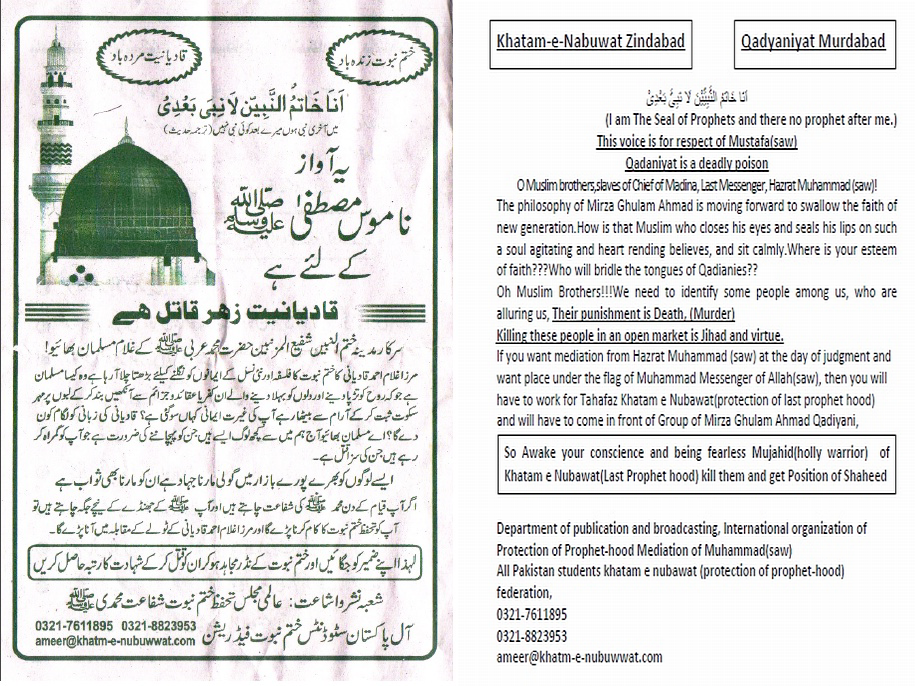
Of course many voices were raised at the brutal attack on May 28, but a religious party actually had the audacity to exhort minorities to live within their implicitly secondary status in Pakistan. Eleven of them condemned the Punjab leadership for declaring solidarity with the Ahmadis, in an act of state contrition. The parliament rallied eventually to voice their condemnation, but even among the heartland of non-denominational parties from Punjab the reluctance exposed the rot at the heart of the promise. One public official from Punjab actually said on a live public transmission that he could not even remove the banners inciting hate against the Ahmadis. We cannot handle the repercussions of that, he openly confessed. Several politicians from across the political divide held their peace as many retained links to extremist and sectarian parties for their votes, mainly again from Punjab.

This admission of state inability to punish minority-haters is no small event. It reinforces the belief that like the murderers at Gojra, the Ahmadi-killers too will remain unpunished. It tears the mask from the conceit that in Pakistan, despite its contested identity, the government will at least strive to adhere to some of the fundamental rights of equal citizenship enshrined in the Constitution to all minorities.

Of course these notional equalities too were brought into challenge by the 18th Constitutional Amendment, which despite its welcome thrust at restoring many entitlements, including the right for minorities to worship “freely” reversed some critical ones, by creating an obligation to be Muslim to be president or prime minister. This clearly states that according to the Constitution now, the right to represent Pakistan in its top elected offices can only go to Muslims. Will we one day only allow a particular sect of Muslims to represent Pakistan? Because if we continue on these lines, that is the next logical step on a slippery slope of concessions that began with the Objectives Resolution. No one should be surprised that Shia doctors are the target of another grisly round of planned exterminations in Karachi.

There can be no right to worship “freely”, if a community is made to carry its denomination on its sleeve, like a star of David in Nazi Germany. To qualify for a Pakistani passport, that ultimate marker of citizenship, all Pakistanis have to sign a disclaimer confirming each person’s commitment to condemn the Ahmadis, and this continues even today. Other than the anti-Ahmadiya Ordinance passed in 1984, which has not been allowed to lapse, the Zia government took several steps to marginalize and persecute this largely educated community. In order to forswear their citizenship, Pakistan has forgone its only Nobel prize-winning laureate, Professor Abdus Salaam, who accepted his physics prize in national dress. Vicious anti-Ahmadiya propaganda was inculcated in classrooms, and there have been many episodes since then, when Ahmadi students were beaten, tortured and hounded on false charges of blasphemy under the black laws introduced in 1986. The list is long and shameful.

Violence gains velocity in an atmosphere of impunity. Quite simply, in the absence of state action, there is little opposition to the narrative that always shifts the debate off-centre from the rights of Pakistani citizens. On all the television channels, religious leaders pop up to cite the primacy of religious law, undeterred and possibly spurred on by the fact that there is no one single codified Islamic law, to subvert the polar axis of the discourse to a privatized view of justice. The rights of citizens as guaranteed under the Constitution get left far behind, while the counter-narrative from civil society and isolated political voices based on recourse in the Constitution, remains un-buttressed by support from the state.

Inertia at a time when moral and political choices have to be made amounts to complicity with turpitude. The government has a unique opportunity to begin incremental reversals of this embrace of insanity. The Constitution, battered as it is, protects minorities very explicitly. While it can certainly do more, even a token adherence to a slew of clauses, particularly Article 20, which allows “each citizen to have the right to profess, practice and propagate his religion” can go a long way in shutting down vitriol against citizens who peacefully worship according to their faith. The courts too can and should use these provisions to take suo moto notice of such outrages in the name of religiosity. So far the superior courts have remained silent on the flagrant violation of the Constitution.

In order to confront this political Islamist lobby it would be useful to remind all concerned that in Islam the core idea of justice is seen as the highest moral path to practical proximity to God. As for minorities specifically, the government can exhort detractors by iterating the words and deeds of Prophet Mohammad (PBUH) when he says: “Beware! If anyone dare oppress a member of a minority or has usurped his or her rights, or tortured, or tool away something forcibly, I will fight on behalf of the minority against the Muslim on the day of Judgement.” (Sunaan-i-Abu Dawood).

The government can start by following up on the review of the Blasphemy Laws promised last year. If the debate is given priority, this parliament will provide the majority needed, and it must act fast to block reactionary hangovers from past governments to challenge the emerging national consensus against extremism and terrorism. There can be no equivocation on the truth that militancy, extremism and terrorism are explicitly connected in Pakistan. We wilfully embrace insanity if we provide impunity for persecution of our minorities, if we pamper militancy on the one hand, and denounce it on another. If the provincial budget of the Punjab government grants money to banned terrorist outfits, even if it is to their charitable wings, then we are truly embracing insanity. Because this is no political leader using extremist votes to buy power. This is institutionalized support to the same outfits we have banned.

Such actions will empower the very forces the Pakistan government and army is engaged in fighting at a very heavy cost. It is a negation of the tremendous sacrifice we as a nation are making, of 3000 people killed in the name of terrorism since last year, of the children still living in refugee camps in their own country, of the fear that stalks our streets after thousands of bombs detonate in reprisals to state operations against militants. It is a negation of the democratic, humane identity of Pakistan.

Our post-colonial state identity may be ambiguous, but it is precisely this space that can be used as an opportunity to steer our fragile nation-hood in another direction.

Email: sherryrehman@jinnahinstitute. com

Tuesday, June 8, 2010

Protest staged against Qadianis

The News - Internet Edition
Tuesday, June 08, 2010,
Jamadi-us-Sani 24, 1431 A.H.
 Protest staged against Qadianis

Tuesday, June 08, 2010
By our correspondent

PESHAWAR: Aalami Majlis-Tahaffuz-e-Khatam-e-Nabuwwat staged protest outside the Peshawar Press Club on Monday, asking the government to take action against Qadianis.

Carrying banners and placards, the activists chanted slogans against Qadianis and asked the Pakistan Muslim League chief Mian Nawaz Sharif to clarify his position on his recent statement.

Criticising Qadianis, the speaker termed them as enemies of Islam and the state. They asked the government to take action against them for their blasphemous activities.

They reiterated to render sacrifices of their lives to protect the honour and respect of their holy prophet (PBUH) and the holy Quran and not allow anyone to continue insulting their religion and prophets.

JTI activists protest sacrilegious caricatures: Jamiat Talaba-e-Islam activists staged demonstration against the blasphemous caricatures and reiterated their commitment to render sacrifices of their lives to protect sanctity of the Holy Prophet (PBUH).

Carrying banners and placards, the activists gathered outside the Peshawar Press Club and chanted slogans against anti-Islamic forces and urged the government to sever diplomatic ties with Western countries.

Saturday, May 29, 2010

Terror in Lahore [Editorial]

---Dawn.com, Pakistan
   
Terror in Lahore
   Dawn Editorial
   Monday, 29 May, 2010


If television crews can reach the scene of an attack before police reinforcements, what does that say about the administration’s state of preparedness? — Reuters Photo

Yet another attack in Lahore has killed scores of people and left over 100 injured. Poor security has plagued the city for a couple of years now. The same grim questions arise. Why were the attackers able to enter the premises so easily, especially at sites known to be targets? The Ahmadi community was commemorating the death anniversary of Mirza Ghulam Ahmad earlier this week, so surely more security was warranted for houses of prayer. More generally, reports from Lahore suggest that banners denouncing religions other than Islam had appeared in parts of the city recently. This should have in any case put the authorities on a heightened state of alert.

What have the Punjab police done to improve their operation procedures to respond to an attack? Yesterday, angry scenes at the assault sites were reminiscent of previous attacks in Lahore — ordinary, helpless people unable to understand why they the victims were left at the mercy of militants. If television crews can reach the scene of an attack before police reinforcements, what does that say about the administration’s state of preparedness?

There have been wholesale changes, summary dismissals and major reshuffles in most other departments of the Punjab government. But the police seem immune, despite their poor track record. Simply dismissing or suspending officers is obviously not enough, and in any case due process needs to be followed. The real question is: why this lax attitude towards the one department, the police, that is responsible for protecting the lives and property of the citizens of Lahore?

Finally, why is it that nothing ever seems to come of the arrests made, of the gunmen themselves but also their accomplices? Convictions secured in anti-terrorism courts are often overturned on appeal by the superior judiciary. Sometimes it’s the evidence that isn’t collected with care, other times statements are recorded improperly. Surely, the Punjab government — though this isn’t a problem confined to just this province — needs to at least provide some justice and closure to the victims and their families. Anyway you look at it, it’s a wretched picture, past, present and future.

©2010 DAWN Media Group. All rights reserved
 
^ Top of Page