Showing posts with label extremist. Show all posts

Saturday, August 21, 2010

Blasphemy: Pakistan’s descent into anarchy

Express Tribune, Pakistan
Blogs
Blasphemy: Pakistan’s descent into anarchy
by by Khubaib UsmaniTaha Kehar
Saturday, 21 August 2010
Upon Pakistan's declaration as an Islamic republic, the rights of religious minorities, particularly Hindus, Christians, and Ahmadiyya, diminished.
Upon Pakistan’s declaration as an Islamic republic, the rights of religious minorities, particularly Hindus, Christians, and Ahmadiyya, diminished.

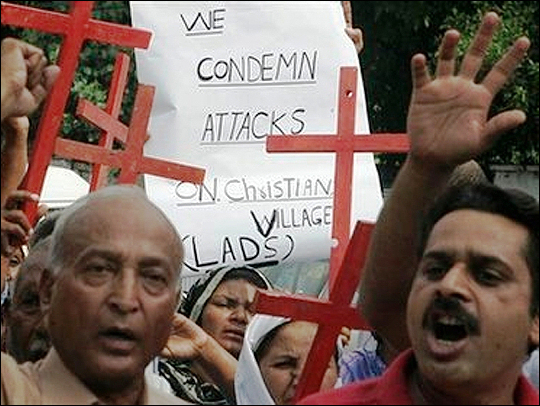
The widow of Bantu Masih hurls her pet hens inside the cage as she prepares dinner. Her only son Bagga, a scavenger, will return sometime after a full day’s tedious labour. The family lives in a remote locality 65 km from Lahore. They had to shift here overnight, after an enraged crowd killed Bantu Masih, the sole breadwinner of the family, over alleged charges of blasphemy in court premises.

Human rights organisations and secular circles in Pakistan have been condemning the abuse of blasphemy laws in the country for the last many decades. Introduced by military dictator General Zia, the law is termed draconian by human rights organisations of the country fast descending down to further anarchy and chaos due to religious fanaticism.

Analysts believe this is the worst form of human right violation and no government in Pakistan could get rid of this despicable use of the law, the seeds of which were sown in 1949 when Liaqat Ali Khan, the country’s first prime minister made it a preamble of the constitution. The Objectives Resolution passed by the first Constituent Assembly in 1949 including 280 Articles and six Schedules became its preamble. The power to amend the Constitution was contained in Article 239.

The country’s checkered history saw the 1956 and 1962 constitutions, but no government in Pakistan could dare to part ways with the controversial Objective Resolution which many believe to be in direct confrontation with the ideology of the Quaid-e-Azam who in his landmark address to the First Legislative Assembly said:

“You are free; you are free to go to your temples, you are free to go to your mosques or to any other place of worship in this State of Pakistan. You may belong to any religion or caste or creed — that has nothing to do with the business of the State.”

It is surprising as to why a staunch supporter of secularism like Bhutto could not do away with the controversial resolution while he is credited with giving a consensus document after 26 years of the country’s independence. Gen Zia cunningly used religion for his own nefarious designs. He exploited the sentiments of extremist segments in the name of religion when the former USSR invaded Afghanistan. Few believe that it was Pakistan’s war on any account. Sentiments of the public had been deliberately exploited in the name of religion with financial backing of the West.

“The Blasphemy Law is the culmination of the sojourn the nation set upon itself in 1949,” commented a senior human rights activist who requested anonymity. “Jinnah wanted to make Pakistan a secular state but the country lost direction following his untimely death. Upon Pakistan’s declaration as an Islamic republic, the rights of religious minorities, particularly Hindus, Christians, and Ahmadiyya, diminished. These minorities live under the fear of threat to their lives and property, desecration of their places of worship, and the Blasphemy Act that carries a penalty of death,” he observed.

The frenzied mob mentality and the knee-jerk reaction on the streets following a blasphemy charge is a real source of concern for human rights organisations of the country. “Trapping anyone in the vicious cobweb of blasphemy is the easiest job in Pakistan,” says an activist of human rights commission of Pakistan who wished to remain anonymous.

It was not that long ago when Gojra, a small city in the heartland of Punjab witnessed frenzied mob attacks on Christian neighbourhoods which killed nine. The attacks were triggered by reports of desecration of the Holy Quran. It was reported that Mukhtar Maseeh, Talib Maseeh and his son Imran Maseeh had desecrated the papers inscribed with Holy Quran verses at a wedding ceremony. Before the tragic attack in Gojra, mosques were used to make announcements provoking the attack. Locals were urged to “make mincemeat of the Christians” before Gojra. Similarly, in Daudnagar announcements were made from mosques asking people to come out to “fight rampaging” Christians.

On October 28, 2001 in Lahore, militants killed 15 Christians at a church, three weeks after the US-led War in Afghanistan to topple the Taliban. On September 25, 2002, unidentified gunmen shot dead seven people at a Christian charity in Karachi’s central business district. They entered the third-floor offices of the Institute for Peace and Justice (IPJ) and shot their victims in the head. All of the victims were Pakistani Christians.

In November 2005, hundreds of militants attacked Christians in Sangla Hill in the Punjab province and destroyed Roman Catholic, Salvation Army and United Presbyterian churches. The attack was over allegations of violation of blasphemy laws by a Pakistani Christian named Yousaf Masih.

In February 2006, churches and Christian schools were targeted in protests over the publications of the Jyllands-Posten cartoons in Denmark, leaving two elderly women injured and many homes and properties destroyed. A young Hindu labourer, a few months back, was beaten black and blue by his own colleagues in Karachi on the pretext that he used derogatory language against the Holy Prophet (PBUH). The victim died on the spot and his family could not dare to lodge a complaint in the local police station and the police arrested no one. The incident happened in broad day light at a construction site in Karachi. The heirs of the deceased disappeared from their native abode on the fear of further persecution by the locals

“We need a paradigm realignment of the country, unless Pakistani is declared a secular state there will not be any tangible development on human rights front” concludes Muneer Ahmad who is pursuing a master’s degree in History from a well recognized public sector university. According to Minority Rights Group International, Pakistan had the world’s highest increase of threats against minorities last year and was ranked the sixth most dangerous country for minorities overall. Pakistan was ranked after Somalia, Sudan, Afghanistan, Iraq, Burma and the Democratic Republic of the Congo.

URL: http://blogs.tribune.com.pk/story/1172/blasphemy-pakistans-descent-into-anarchy/

Saturday, July 31, 2010

Ahmadi faithful targeted by Islamic extremists and local government

Sepro News
World:  Global
Indonesia: West Java, Ahmadi faithful targeted by Islamic extremists and local government
Three days of clashes between Ahmadi Muslims and Islamic extremists. The radical Muslims wish to close their mosques with support from local government. Head of the extremists: “The Ahmadiyya should be banned. Our demand to eliminate them is non-negotiable.”
Saturday, July 31, 2010
By Asia News

Bandung – Tension remains high after three days of clashes between Islamic extremists and the Ahmadi community Manis Lor village, Kuningan district, West Java. On 26 July the police tried to close some mosques of the Ahmadi community. The police failed in their attempts following the massive protests of the faithful.

The next day another attempt was made by a group of 500 Islamic extremists, backed by state employees, who tried to close the mosques clashing with thousands of Ahmadi faithful armed with stones and sticks. The clashes ended yesterday and there are no victims.

The Ahmadis are Muslims who revere as a prophet, not only Muhammad, but Mirza Ghulam Ahmad (**). For this reason they are considered heretics and targeted by Islamic extremists. According to statistics, in 2009 33 attacks took place against the Ahmadis by extremists. In the first six months of 2010, the number of violence has dropped to four.

“Such problems should be approached with caution and tolerance,” said Djoko Suyanto, Minister of Security and Political and Legal Affairs. The Minister, in a meeting with President Yudhoyono expressed regret for the number of injuries and damaged properties of the Ahmadi community.

Hesty Amirwulan, a member of the Indonesian Commission for Human Rights (Komnas Ham), said that the clashes are a sign of how the law has little force in the country. As Ifdal Kasim, the chairman of Komnas Ham, noted “closing places of worship is against the Constitution.”

The Islamic extremists who attacked the Ahmadis are part of the Gapas (Movement against the illegal sects and non-believers). After asking the local administration to dissolve the sect, Andi Mulyono, head of Gapas, said: “The Ahmadiyya should be banned; our demand to eliminate them is non-negotiable.”

Since 1954, 3 thousand Ahmadi Muslims are residents in Kunnigan district, the largest Ahmadi community in the country. Sujan Deden, executive director of the community, condemned the violence of extremists: “They have no legal basis for banning us.”

In a press release, the Indonesian Interfaith Forum, said: “The presence of the Ahmadis should be respected by all parties in the country, including the government, since they have existed in Indonesia since 1950.”

Source: Asia News

Ahmadiyya Muslim Community believe in Prophet Muhammad(saw) as last Law-bearing prophet and also that Hadhrat Mirza Ghulam Ahmad(as) of Qadian is Promised Mahdi and Promised Messiah as prophesied in Ahadith. Please visit Alislam.org/messiah for further info.

Monday, June 21, 2010

Hate speech

Daily Dawn, Pakistan
FROM THE PAPER »
EDITORIAL
.
Hate speech
Dawn Editorial
Monday, 21 Jun, 2010
.
A strong case can be made against the JI leader for fomenting aggression and religious persecution under the country's laws regarding hate speech and incitement to violence. - Photo on file
A strong case can be made against the JI leader for fomenting aggression and religious persecution under the country’s laws regarding hate speech and incitement to violence. — Photo on file

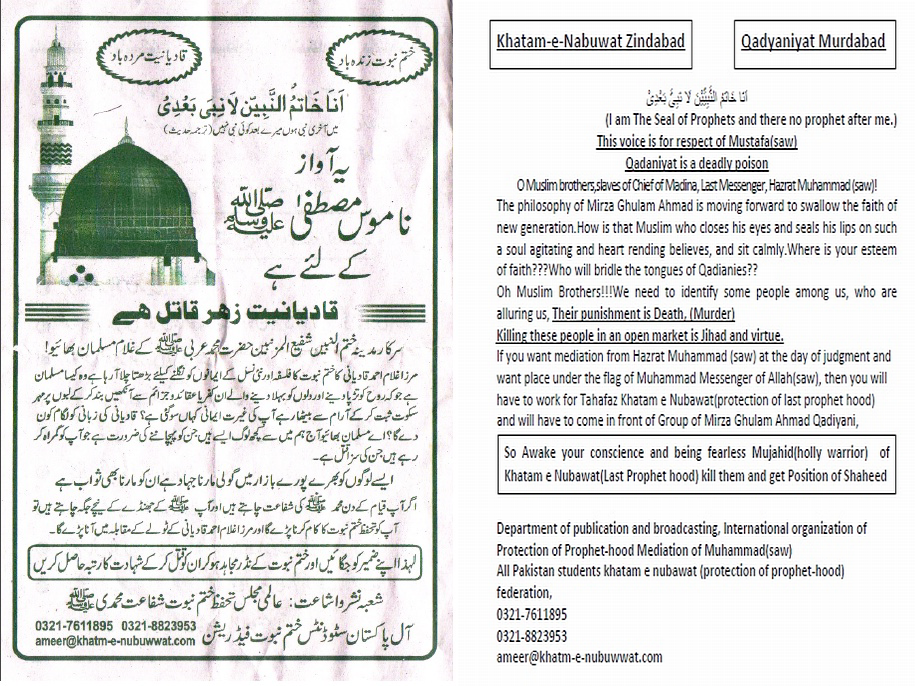
The street power and political clout wielded by Pakistan’s religious right have resulted in the state and society being held hostage by extremist elements. The latter stop at nothing to further their agenda of inciting hatred, divisiveness and violence. The latest example is that of the Jamaat-i-Islami chief, Syed Munawwar Hasan, who during a sermon in Lahore on Friday threatened a fresh movement against the Ahmadi community if it “did not accept their minority status” and the government kept silent about “their blasphemous and unconstitutional activities”.

Mr Hasan did not specify any particular instance substantiating his charges, leading one to read his comments as hate speech and also as an attempt to blackmail the government into further victimising an already persecuted community. Given the incendiary passions the issue arouses, any call by religious parties in this context is certain to be attended by violence. A strong case can be made against the JI leader for fomenting aggression and religious persecution under the country’s laws regarding hate speech and incitement to violence.

Even beyond this particular case, it has now become a matter of urgency that the government show an active and uncompromising stance on the issue of hate speech and incitement to violence or other sorts of criminal activity. Pakistan’s polity is already rent by religious, ethnic and sectarian divisions. Allowing irresponsible and divisive opinions to be aired publicly will deepen these fissures. Once it begins, the process of religious, ethnic and other communities being pitted against one another will prove difficult to bring under control. Spiralling violence, particularly in view of other issues being faced by the country such as militancy and terrorism, can then be expected. It is in the interests of both the state and citizenry to take a stand against inflammatory hate speech and lobby for the prosecution of those who break the law.

©2010 DAWN Media Group. All rights reserved

Monday, June 14, 2010

Reaction: the response to the Ahmedi massacre

Dawn.com Blog
.
Reaction: the response to the Ahmedi massacre
   by SADAF on 06 14th, 2010 |

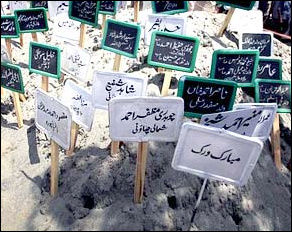
Graves of Martyrs“We are all under threat. They will kill us. They will kill us,” claimed Rubina Saigol, repeating the conversation with members of the Ahmedi community a few months ago. Saigol, an independent social researcher, said that the community members wanted to show her some case files on Ahmedis and talk about the threats publicly.

“I feel guilty and terrible that I didn’t write – partly because of fear.”

But before Saigol could gather up any courage to take any action – the threats had become a reality.

On May 28, militants attacked two Ahmedi houses of worship in Lahore, which resulted in the tragic death of more than 80 people and left more than a 100 injured. Within days, other militants attacked Lahore’s Jinnah Hospital where the injured were still recovering from the first attack.

The Ahmedi massacre has left everyone in shock and the Ahmedi community crippled with grief.

The Ahmedis have struggled for rights within India, Pakistan, Bangladesh, Egypt, and Indonesia for many years.

Although the majority of the Pakistani population is Sunni – there is a growing percentage of people who are seriously questioning the Sharia laws and the constitution. The trend can be followed on local blogs and even the op-ed pages of local newspapers – the rhetoric challenges Sharia laws against the basic rights of a citizen.

Pakistan’s Sharia laws are based mainly on the Hanafi school of thought.

According to Sharia Law, an Ahmedi cannot be accepted as a Muslim or as part of an Islamic sect because one of the basic fundamentals of Islam is to accept Prophet Muhammad (pbuh) as the last prophet in Islam – in Quranic verses he is referred to as the “Final Seal” (al-azhab:40).

In several interviews with religious scholars, from Sunni and Shia schools of thought in Cairo and Q’um in Iran agreed that Ahmedis were not a Muslim sect. They went as far as calling them, “heretics” and “infidels.” As well as, if a non-Muslim shows and preaches under a Muslim façade, then he or she must be charged, proven guilty, and punished in court according to Sharia law, a crime which is punishable by death (wajib-ul-qatl).

But one of the scholars in Cairo, who requested to stay anonymous, was quick to add that if a non-believer is a citizen of an Islamic state then he or she becomes the zami (responsibility) of the state. Therefore, it is the state’s responsibility to protect them more than the Muslim citizen, out of fear for violence against them.

“They should be treated with the utmost respect, because we, as Muslims, need to set an example for them,” he said. “As a Muslim, your responsibility is to follow the basics of Islam and lead a good life – violence of any type against anyone is not an example of leading a good life.”

This one scholar, who remains anonymous out of fear for the repercussions he could face, is not alone.

As soon as the attack hit the news, blogs went up everywhere in an uproar; some immediately condemned the brutal attack, others wrote malicious comments about Ahmedis claiming them to be wajib-ul-qatl (deserving of death), and some tried to explain the causes of the attack through religious, political and social analyses.

On the blog pkpolitics there were many harsh comments and the owners of the blog removed those comments and posted a warning to respondents on abusive language.

One of the more kinder comments on pkpolitics was, “Brother, The Qadyani religion should not be even be called ‘Ahemdi religion’, for you know that the Last Prophet Muhammad is exclusively mentioned by the name ‘Ahmed’ both in the Holy Quran and in the Bible (sic).”

Another respondent scolded back, “I cant believe my eyes, Instead of completely condemning the attack and humiliating the attackers, some are debating on the words used and about Qadyani sect or religion whatever…. no wonder Pakistan is heading towards its doom day by day… shame on us (sic).”

Tazeen Javed, winner of Best Humor Blog category for Pakistan’s first Annual Blog Awards, blogs at A Reluctant Mind wrote, a social aspect of the attack holding everyone accountable, event the public, for the attack in “We all have blood on our hands.”

The Waking Life blog posted, “Is it all worth?” questioning Muslims who asked for tolerance in other parts of the world, wrote, “Time to put things in perspective…Facebook may have partaken in blasphemy but there’s plenty of it going on in our cities and society. How about cleaning our own house first? (sic)”

The popular and controversial blog, Café Pyala, which sometimes uses profanity, condemned the attack in the political analysis “Original Sin:” “Truly, if ever there was short-sightedness among Pakistan’s establishment (and there are plenty of examples of it) this was it…The nurturing of extremist thought during Zia ul Haq’s (mis)rule and its repercussions in the shape of today’s barbaric attacks (and earlier targeting of Shias, Hindus and Christians) are a logical continuation of the original sin. (sic)”

Most editorials and columnists for print media did not have to directly respond to profanity like some online media blogs, however they condemned the attack, pointing out the government’s blatant disregard for protecting minorities, and feeding a culture of bigotry.

The Dawn editorial “Culture of Intolerance” wrote, “Religious minorities in Pakistan have not only been shunted to the margins of society but also face outright persecution on a regular basis…the state, meanwhile, remains largely unmoved by the plight of minorities — and that isn’t surprising either for it is a party to this persecution.”

Columnists did not try to hide the humiliation the government as well as the public should feel over the attacks.

Columnist Kamran Shafi, who writes for Dawn, wrote in A sad place, indeed that he recalled a time when there was no religious distinction, just Pakistani citizens. He stated, “The Ahmedis might be considered non-Muslim by the state; surely they are still Pakistani?”

Shafi added that an important member of the Ahmedi community told him that the compensation that was offered to the victims of the attack would be kindly refused and asked to be transferred over to the people of Hunza-Gojal for the relief work.

These voices of different generations and backgrounds of growing tolerance are currently at a grass-roots level, but they can still be heard, even in some political circles.

On the day of the attack, Punjab’s Chief Minister Shahbaz Sharif held a press conference addressing the attack and the efforts of the police. Even though his offices had received reports on a threat to the Ahmedis several days prior to the attack.

While soon after the attacks, Interior Minister Rehman Malik was the only government official who personally went to visit the Ahmedi community to give condolences

Shahbaz Sharif has yet to visit the Ahmedi community since the attacks.

Although most recently, PML-N party leader Nawaz Sharif did condemn the attacks and named Ahmedis as “brothers” and “sisters.” Only for him to be threatened by religious leaders with an anti-Sharif campaign in the region.

If the public’s reaction has mobilised the government to react at all then it leads to the most important question: What is the next step?

Imam Shamsi Ali might have the answer.

“It is very difficult to accept the nature of the world we live in – part of this world is the freedom of expression. I oppose the idea (Ahmedi movement) but I cannot impose my ideas on anyone. I have no right to impose my ideas on anyone,” said Imam Ali.

Ali, who lived and studied Islamic Studies in Islamabad for seven years, is the leader for the 96th street mosque and runs the Islamic Cultural Center in New York.

“We need engagement. If we oppose those claims then we must have intellectual discourse. If we engage with Hindus, Christians, Jews, or Buddhists, then why cannot we talk to them?”

Ali, ultimately, feels that restricting the freedoms of a people is not the way of Islam, rather allowing people their freedom and showing tolerance is way for people to find the path to Islam.

Sadef A. Kully is a Reporter/Associate Producer for Dawn.com

©2010 DAWN Media Group. All rights reserved

Monday, October 5, 2009

Murder of another Ahmadi Muslim in Pakistan

In the Name of Allah, Most Gracious, Ever Merciful
International Press and Media Desk
Ahmadiyya Muslim Jamaat International
22 Deer Park, London, SW19 3TL
Tel / Fax (44) 020 8544 7613 Mobile (44) 077954 90682
Email: press@ahmadiyya.org.uk
Web: Alislam.org
LONDON, 5th October 2009
PRESS RELEASE

MURDER OF ANOTHER AHMADI MUSLIM IN PAKISTAN

‘Bear trials with patience’ – Message of Head of Ahmadiyya Muslim Jamaat

During his weekly Friday Sermon, the Head of the Ahmadiyya Muslim Jamaat, Hadhrat Mirza Masroor Ahmad confirmed the sad news that yet another Ahmadi Muslim had been martyred for his faith in Pakistan. Furthermore, two other Ahmadi Muslims were the victims of a terrorist bombing in the city of Peshawar.

Muhammad Azim Tahir of Uch Sharif in Pakistan was martyred on 26 September 2009 in the presence of his wife and daughter. Surely, to Allah we belong and to Him shall we return.

Mr Tahir was returning from a family wedding on his motorbike at 8.30pm when two unknown persons brandishing a firearm forced him to stop his vehicle. In the confusion, Mr Tahir, his wife and daughter, fell from the motorbike. As Mr Tahir went to help his family the assailants stopped him and pointed a gun towards him. Mr Tahir pleaded with them to take whatever they wanted and to leave him and his family alone but as he said this one of the assailants shot him in the temple and he died on the spot in sight of his wife and daughter. The assailants fled the scene. Muhammad Azim Tahir was killed simply because he was an Ahmadi Muslim. He is survived by his wife, two sons and daughter.

Also on 26 September 2009 two Ahmadi brothers, Riaz Ahmad (40) and Imtiaz Ahmad (20) were the victims of a huge car bomb blast in a commercial district of Peshawar. Both brothers died as a result of the bombing.

Speaking about the continued atrocities faced by Ahmadis, Hadhrat Mirza Masroor Ahmad said:
“The opponents of our Jamaat can murder a few of our members; they can loot Ahmadis of their wealth; they can destroy our buildings; they can stop us constructing mosques. But they can never weaken our faith.”
His Holiness counselled members of the Jamaat to bear all persecution with fortitude as the Holy Qur’an had taught that ‘surely, Allah is with those who patiently persevere.’ He said the sacrifices made by Ahmadis would never be in vain. Every drop of blood shed by an Ahmadi would become a source of the community’s success.

He continued that even Ahmadi children were now a target for cruelty and violence. School children were often taunted in the hope that they would leave their education in fear; in Faisalabad Ahmadi medical students were suspended in 2008 having been subjected to physical and mental violence from anti-Ahmadi extremists; and most recently in District Layyah four Ahmadi children were imprisoned for months on end in the most inhospitable conditions on baseless charges. His Holiness said:

“If the parents of these children at any point denied the truth of Ahmadiyyat, then immediately all charges would be dropped. It is the vain hope of the opponents that Ahmadis leave their religion as a result of their intimidation and cruelty.”

His Holiness concluded his sermon by warning Ahmadis worldwide that this persecution of the Jamaat could escalate. He said:
“The members of the Jamaat worldwide need to focus on prayer. Because the way the situation is developing it seems that Ahmadis, particularly in Pakistan, are going to face increased cruelty and hardship. The ignorant opponents do not realise that their deeds are not harming our community but in fact are harming the country and society at large.”
End of Release
Further Info: Abid Khan, press @ ahmadiyya.org.uk
 
^ Top of Page