Showing posts with label Punjabi Taliban. Show all posts

Monday, July 5, 2010

Sectarianism has poisoned Pakistan

Guardian, UK
Comment is free > Cif Belief
Sectarianism has poisoned Pakistan
The violence seen in Lahore last week was aided by a bigoted constitution. How has stock in our nationhood plummeted so?
Basim Usmani
Basim Usmani
guardian.co.uk, Monday 5 July 2010 09.01 BST

The recent attacks on a prominent shrine in Lahore demonstrate how the unrest in Pakistan is caused by a minority of few who cannot tolerate the plurality of beliefs in Pakistan. The Tehrik-e-Taliban are lying through their teeth when they claim that they do not attack public places. It’s becoming more and more apparent that these militants aren’t resisting American hegemony; this a war to determine Pakistan’s future and, by proxy, the future of Islam.

Whether the Tehrik-e-Taliban actually arranged the bombers’ suicide belts is irrelevant; they have created a domino effect that’s likely to spread from commercial capitals such as Lahore to cities with historic shrines and Pakistani historical sites, such as Multan, or Taxila.

Unlike Baghdad, where violence between Islamic sects is a product of the war America is waging, the onus of last Thursday’s blasts falls squarely on us, the citizens of Pakistan. We have been complacent about sectarianism for too long.

A good friend who works for a transportation company told me in 2007 that in villages along the highways to Waziristan where the Taliban had seized control were the bodies of butchered Shia Muslims. That year, Lahore’s public was too busy mobilising about the judiciary and President Musharraf to pay the violence any mind.

Sectarianism has a brutal history in Pakistan that existed long before militants in Afghanistan began calling themselves the Taliban. I remember as a child in Lahore the broadcasts of gun violence outside Shia houses of worship during the early 1990s.

Many Pakistanis feel that the attacks on two Ahmadiyya mosques last May, where gunmen unloaded bullets and grenades on Friday prayer-goers, were unprecedented. Certainly the Ahmadiyya community doesn’t think they are.

To have a Pakistani passport requires citizens to assert that they are not part of the Ahmadiyya community. In a sense, holding that passport also makes you complicit in the blasts that killed dozens in Lahore’s most famous Sufi shrine last week. Our inability to understand that this war is about national identity is rooted in the same complacency.

We are OK with the state deciding for us who is or isn’t Muslim. In this regard, the Pakistani government has the weakest moral fibre in taking on this growing strand of extremism. It is hypocritical to fight the Taliban in Waziristan if we are okay about denying citizenship to millions of Muslims born in Pakistan.

It may sound extreme of me, but we should be jailing clerics in Pakistan that give edicts declaring believers to be non-Muslim or anti-Pakistani. It may seem extreme to an American that writers who deny the Holocaust are imprisoned in Europe, but extreme contexts call for extreme measures.

Pakistanis must stress how being born or raised in their country is enough to be Pakistani; laws preventing Ahmadis from referring to themselves as Muslims were amended to the constitution by Zulfikar Ali Bhutto in the 1970s.

I remember being uneasy at my desk in middle school when I was studying at Aitchison College in Lahore, and some of my classmates were getting bullied for having marks on them after returning from Shia processions during Muharram. Pakistanis themselves are the only ones capable of stamping out this discriminatory culture.

Some proactiveness is necessary on our part to make it clear that mystics, Shias, Ahmadis and Christians are all fellow Pakistanis. When you are pulled over by street police in any major Pakistani city, the first bit of information the police ask for is your family name. From one name your caste, religious beliefs and affluence is determined.

This came as a shock to all of my family who have emigrated away: that collectively our stock in our own nationhood has plummeted so. In a sense, these problems are all accrued debt we’ve accumulated for being so complacent. In the light of our bigoted constitution and deterministic culture we have to – for ourselves – decide that being Pakistani is enough to make us all countrymen. Otherwise, we might as well just refer to ourselves as Taliban, Muslim extremists, Islamic militants, and so forth.

© Guardian News and Media Limited 2010

Monday, June 14, 2010

Life after the attacks

Dawn.com Blog

Life after the attacks
   by GUEST on 06 14th, 2010 |

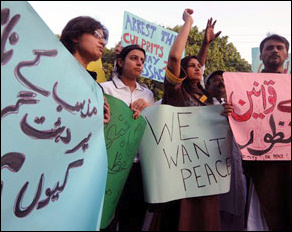
Protests against religious lawsLife in the neighbourhood, where two Ahmedi places of worship in Lahore were attacked by terrorists on May 28, goes on but under a shadow of fear.

The presence of gun-toting policemen and other community members (including the Ahmedis) guarding the gates of the places of worship in Garhi Shahu and Model Town’s C Block, indicates the level of fear in the neighbourhood. The Jamaat-i-Ahmedi centre, Darul Zikr is located on one end of Garhi Shahu and although bunkers have been placed in front of the main entrance, people are still terrified to enter.

The observance of the death anniversary of Dr. Sarfaraz Naeemi on Saturday (June 12) was a grim reminder of the terrorist attacks the area has witnessed in the past one year. Dr. Nameei, the principal of Jamia Naeemia madressah was killed on June 12, 2009 in a suicide attack at the seminary’s office. A section of the road leading to the madressah was cordoned off as police and volunteers frisked each person before allowing them to enter to pay their respects.

“We are sitting on gunpowder,” said Shahzad, the supervisor of Faizan Filling Station located near the main entrance of Darul Zikr. Shahzad said the filling station remained safe during the attack because of pure luck. “But I shudder to think the extent of damage the fuel station could cause if it came directly under attack,” he said.

Sales have declined considerably as people avoid coming near the vicinity of Darul Zikr, mindful of another potential attack. “We have no choice because this is our source of livelihood.”

Malik Mehmood owns a rent-a-car business in a plaza across from Darul Zikr. Mehmood was witness to the attacks and claims how apprehensive everyone in the community has become. Usman lives in the street adjacent to where the attacks took place. According to him, people are now using alternate routes to avoid going near Darul Zikr. He said fear escalated particularly on Friday June 11, as the Ahmedi community gathered for prayers. “The street remained deserted almost the entire day,” he said.

Those living within the barricaded streets are subjected to scrutiny by armed guards at the street entrance. Faqir Mohammad, a chowkidar at a house adjacent to the place of worship, talked from behind a small window in the huge gate but before doing so, he carefully scrutinised this reporter. “We are safe here,” he said. “Our children do not go out.” he snapped. In the background, a few guards with guns could be seen.

An employee (wishing to remain anonymous} of an office set up in a house at the corner of the street said that the police allowed entries to the company vehicles whose registration numbers they knew. He wondered whether life was safe anywhere else in the city – Lahore has been subjected to at least four terrorist attacks (safe houses of security agencies were the earlier targets) in the past year.

The place of worship in Garhi Shahu is located next to huge parks (between blocks C and D). But the attacks have not deterred the children from playing; matches were being held on the two cricket grounds and preparations were underway for a football game in the third ground when this reporter visited the area.

“Yes, these are hard times. But life must go on, we cannot continue living in fear,” said the gardener of the football field.

Intikhab Hanif contributed for Dawn.com

©2010 DAWN Media Group. All rights reserved

Monday, June 7, 2010

Ahmadi massacre silence is dispiriting

Guardian, UK
Comment is free > Cif Belief
Ahmadi massacre silence is dispiriting
The virtual conspiracy of silence after the murder of 94 Ahmadis in Pakistan exposes the oppression suffered by the sect
Declan Walsh
Declan Walsh
guardian.co.uk, Monday 7 June 2010 14.59 BST
Candles were lit by members of a civil society for victims of the attack on the Ahmadi sect in Lahore. Photograph: KM Chaudary/AP
The virtual conspiracy of silence after the murder of 94 Ahmadis
in Pakistan exposes the oppression suffered by the sec

I often find myself defending Pakistan against the unbidden prejudices of the outside world. No, Islam is not the cause of terrorism. Yes, the Taliban is a complex phenomenon. No, Imran Khan is not a major political figure.

This past week, though, I am silent. The massacre of 94 members of the minority Ahmadi community on May 28 has exposed something ugly at the heart of Pakistan – its laws, its rulers, its society.

It’s not the violence that disturbs most, gut-churning as it was. During Friday prayers two teams of attackers stormed Ahmadi mosques in the eastern city of Lahore. They fired Kalashnikovs from minarets, chucked grenades into the crowds, exploded their suicide vests.

As the massacre unfolded, a friend called – his father-in-law, a devout Ahmadi, was inside one of the besieged mosques. The family, glued to live television coverage, were sick with worry.

Two hours later, my friend’s relative emerged alive. But many of his friends – old men, including a retired general and former judge – were dead.

The killers were quickly identified as “Punjabi Taliban” – a loose collective of local extremists with ties to the tribal belt. This was unsurprising. More dispiriting, however, was the wider reaction.

Human rights groups reacted with pre-programmed outrage; otherwise there was a virtual conspiracy of silence. A dribble of protestors attended street protests against the attack in Lahore and Karachi; eleven people showed up in Islamabad.

The normally vociferous media were unusually reticent. Commentators expressed dismay at the violence, but few dared voice support for the Ahmadi community itself. Politicians turned yellow.

Few visited the bereaved; still today, the chief minister of Punjab, Shahbaz Sharif, has not visited the bullet-pocked mosques or offered compensation to the injured.

In the national parliament, three brave female MPs crossed party lines to propose a resolution condemning the attacks, in the face of massive indifference. The motion passed, just.

The reticence is rooted in law and history. Ahmadis believe that Mirza Ghulam Ahmad, a 19th century Punjabi cleric, was the messiah sent by God – a notion that deeply offends orthodox Muslims for whom Muhammad, who lived in 7th-century Arabia, is the final prophet.

The problem is that the state has taken sides in this religious argument. Since the 1970s, civilian and military governments have passed laws enshrining the discrimination against Ahmadis, today thought to number about 4 million in Pakistan.

And so they live in the shadows of society. Under the law, Ahmadis may not call themselves Muslims and may not refer to their places of worship as “mosques”. Orthodox Muslims applying for a passport must sign a statement deriding Ahmad as an “imposter”.

Any Ahmadi who defies these edicts can be sentenced to death; in 2009, 37 were charged under the blasphemy laws and 57 under Ahmadi-specific laws.

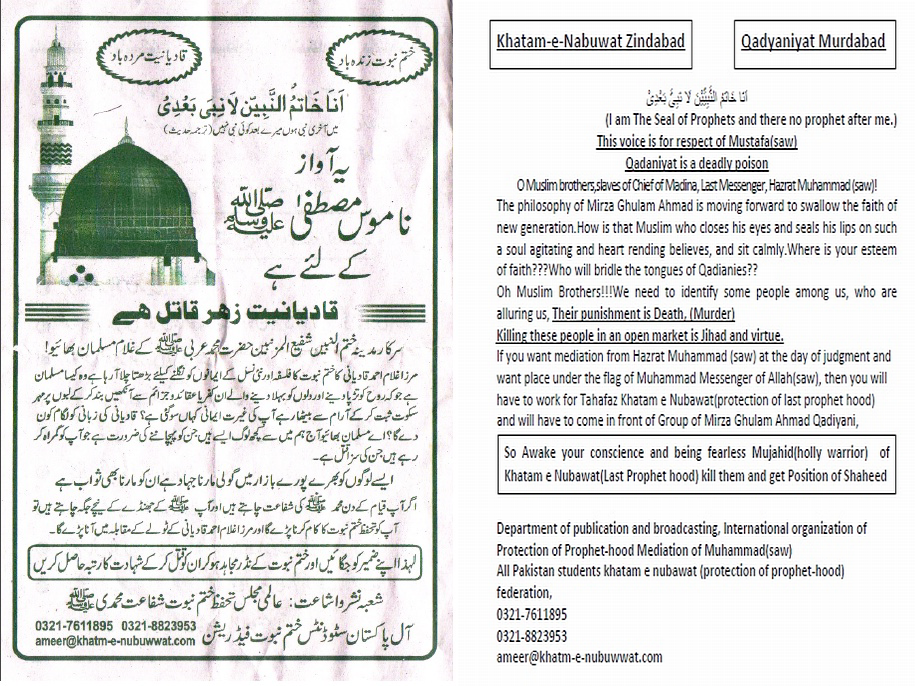
This state-directed discrimination has caused prejudice to soak into the bones of even well-educated Pakistanis. It is acceptable to denigrate Ahmadis as “agents of foreign powers” such as the CIA and Raw, India’s intelligence service.

In 2008 a prominent preacher on Geo, the country’s largest channel, suggested that right-minded Muslims should kill Ahmadis. Within 48 hours two Ahmadis had been lynched. The television presenter has prospered.

Last year a banner appeared outside the high court in Lahore, declaring “Jews, Christians and Ahmadis are enemies of Islam”. Few complained.

The silence that followed the Ahmadi killings was broken last week by a tsunami of outrage at the Israeli commando raids on boats headed for Gaza. Commentators and politicians fulminated at the treatment of the Palestinians – a minority that suffers state-sanctioned, religiously driven discrimination. Nobody got the irony.

It makes one realise how small the constituency of true liberals is in Pakistan – not Pervez Musharraf-style liberals, who drink whisky and attend fashion shows, but people who believe the state should cherish all citizens equally. That, after all, was the publicly expressed desire of Pakistan’s founder, Muhammad Ali Jinnah, 63 years ago. Today it lies in tatters.

© Guardian News and Media Limited 2010

Tuesday, June 1, 2010

A muted response to minority killings

Daily Dawn, Pakistan

A muted response to minority killings
   by SANA SALEEM on 06 1st, 2010 |

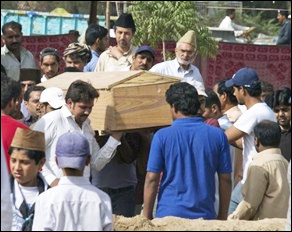
Burial at RaabwahIncomprehensible. That is the only word I can use to express my feelings about the indifference of people, the authorities, and the media towards the attacks against the Ahmadi community in Lahore on Friday. Attacks that were carried out in broad daylight, killing over 90 people and injuring many others. Attacks that turned into a hostage situation with over 1500 people at risk of being killed or fatally injured.

I am disappointed that there is no one to protest and lament the killings, especially since the Ahmadi community seems to have been silenced by years of discrimination and persecution. I was six years old and attending a Quran class when the maulvi sahib blatantly refused to teach two of my friends, Maham and Rija. I remember his words, his eyes flaming with hate as he refused to let them sit in his class, or even touch ‘their’ Quran. I did not understand why no one protested, why they had chosen to leave the room silently, as if the hate and discrimination was expected. I found myself in the same dilemma on Friday, when after one of the largest attacks against them in the history of Pakistan, this was the only official statement issued on behalf of the Ahmadi community.

Despite what has happened no Ahmadi has taken to the streets in protest; no Ahmadi has displayed anything but patience. Instead we have turned towards God and prayed for the victims, for their bereaved relatives and for the long term peace and prosperity of Pakistan. We will continue with this example no matter what is thrown at us in the full certainty that God is with us and always will be.

The only reality check regarding this horrifying episode has come from a woman who was attending to one of the people wounded in Friday’s attacks. She refused to accept a bouquet from Interior Minister Rehman Malik, and went on to lambast him for inadequate security provisions at the sites of worship. It was indeed ironic to see dozens of security guards accompany the interior minister to his trip to the hospital to visit the survivors of Friday’s attacks. If only half of those were present to guard the two sites that came under attack, this incident could have been prevented, or, if nothing else, casualties could have been minimised. There is thus absolutely no justification for this act of negligence.

Meanwhile, the social networks have also been abuzz with outrage. Twitter, in particular, was flooded with messages of condemnation, shock, and horror. Many were disgusted by the way in which media outlets were describing the sites that were attacked as ‘worship places’ instead of ‘mosques.’ Others accused the media of downplaying the casualties. Someone remarked how a popular news channel’s comments suggesting ‘worship places should have their own security’ were derogatory and inhumane. There were debates on whether the media channels will count those killed as ‘martyrs,’ and if not, then why not?

Here’s the thing: I do not care whether those killed on Friday will be labeled martyrs or not. It does not make a difference to me whether the authorities have traced the terrorist outfit responsible for this attack. I remain enraged that most of us refuse to recognise the attacks as a human rights issue, and, most importantly, as a violation of minority rights. And by ‘most of us,’ I am referring to those of us who are neither politicians, scholars, clerics, or media personnel. I have lived in Pakistan long enough not to expect the authorities to be sensitive towards the real issues of the people. But the public framing of Friday’s attacks is about the underlying hate, discrimination, and religious bigotry that has been suffocating us for years. This is about those of us who choose to use religion to justify inhumanity despite the gory images showing attacks on innocent civilians.

There is no justification for killing unarmed civilians – no religion or legal system allows a bunch of people to take the law in their hands and carry out barbaric acts of terror.

Today, I must confess that I am scared of the uncertainties the future holds. I fear that this attack might be one of many to come. And most of all, I fear that another attempt will be similarly downplayed and labeled an act of terrorism, rather than a violation of minority rights. The stabbing of an Ahmadi man at Narowal on Monday further strengthens my fears, especially as the threats of the assailant to “not leave any Ahmadi alive” serve as uncanny reminders of state-sanctioned discrimination against the Ahmadi community.

I feel that in our attempts to prove ourselves so-called pious Muslims and patriotic Pakistanis we have left humanity far behind. Our sympathies have become political, and our humanity has been compromised. Somewhere in our tussle to become pioneers of Islam and the darling of the West, we have stopped being human. For every atrocity that unfolds around us, we have a home-made conspiracy theory, a religious justification, or a history lesson with which to identify the culprits. But amid this information overload, the atrocities go ignored, priorities remain distorted, and the massacre continues.

For every one who witnessed the horrendous killings of Ahmadis this past week, I have one question: how many Garhi Shahos and Gojras will it take for us to stop abusing religious beliefs to justify killing innocent people?

Sana Saleem is a Features Editor at BEE magazine and blogs at Global Voices, Pro-Pakistan her personal blog Mystified Justice. She tweets at twitter.com/sanasaleem.

©2010 DAWN Media Group. All rights reserved

Sunday, May 30, 2010

Death toll rises to 94 following Lahore terrorist attacks

Ahmadiyya Muslim Jamaat International
30th May 2010
PRESS RELEASE


Death toll rises to 94 following Lahore terrorist attacks
Ahmadis have turned towards God with patience

The Ahmadiyya Muslim Jamaat confirms that thus far 94 Ahmadis have been martyred in the terrorist attacks that took place in Lahore two days ago. Some media outlets, particularly in Pakistan are wrongly claiming that the figure is less. The number of those who have been seriously injured is more than 125.

27 people died at the Baitul Nur Mosque in Model Town, the remaining fatalities occurred at the Darul Zikr mosque in Garhi Shahu.

The deceased include Judge Munir Ahmad Sheikh, the Amir (President) of the Ahmadiyya Muslim Jamaat in Lahore; Major General Nasir Ahmad, the President of the Ahmadiyya Muslim Jamaat Model Town; Mr Mahmud Shad, a missionary of the Ahmadiyya Muslim Jamaat and a number of other senior community officials.

The majority of those martyred have been taken to Rabwah where more than 90 graves have been dug at the community’s graveyard. The martyrs are being buried in groups and thus far over fifty burials have taken place. Plans for a large scale burial of all the victims at one time were abandoned due to security concerns.

As a mark of respect market traders and other shops in Rabwah have remained closed since the attacks.

The Press Secretary of the Ahmadiyya Muslim Jamaat, Abid Khan said:
“It is not only the family members of the deceased who have been left bereaved but in fact every Ahmadi the world over is feeling great sadness at this time. Despite what has happened no Ahmadi has taken to the streets in protest; no Ahmadi has displayed anything but patience. We, under the guidance of our spiritual leader, Hadhrat Mirza Masroor Ahmad, have instead turned towards God and prayed for the victims, for their bereaved relatives and for the long term peace and prosperity of Pakistan. We will continue with this example no matter what is thrown at us in the full certainty that God is with us and always will be.”
22 Deer Park Road, London, SW19 3TL UK
Tel/Fax: 020 8544 7613 Mob: 077954 90682
Email: press at ahmadiyya.org.uk
Press Secretary AMJ International

Saturday, May 29, 2010

Frayed ends of sanity

Dawn.com Blog

Frayed ends of sanity

   by NADEEM F. PARACHA on 05 29th, 2010 |


Over and over again I have been using Dawn and Dawn.com to hit home the point about the vicious, soul destroying mindset the bulk of Pakistan’s urban middle-classes (especially in the Punjab) have fallen in to.

I have tried to give numerous examples to highlight this devastating observation and here again is another one: On May 28 when terrorists associated with what is called the ‘Punjabi Taliban’ attacked various places of worship of the Ahmadiyya community in Lahore, the TV channels were out in force covering the gruesome event. However, that did not stop them from running happy-go-lucky commercials of their corporate sponsors during breaks, giving the whole event a rather surreal feel.

But this can be expected from this unfortunate republic’s many TV channels. There is now not an iota of doubt left about the level of sheer cynicism, sensationalism and demagoguery that they operate on. Most of them have become a reckless reflection of some of the most obnoxious, conspiratorial and chauvinistic sections found within the country’s convulsing middle-classes.

That said, one however does expect some semblance of decency and reason in the polished corridors of the companies that advertise their brands on these channels. Couldn’t any of these companies that always claim to be ‘good social citizens’ have the presence of mind and heart to ask TV channels to stop running their ads during the coverage of blood-splattered events?

Can’t they see how strange their ads look and sound when squeezed between images of blood, gore and tragedy? Don’t these ads with an unending series of plastic smiles and jingly material-worshipping actually end up mocking the tragedy that is unfolding live on the TV screens?

I don’t think such a thought even crosses their minds. And how can it when a number of the same companies so nonchalantly end up sponsoring TV shows run by utter hate-mongers. It’s quite a sight, really, watching macho, loud demagogues and so-called TV anchors spiting venom against the West and then asking for a break that are riddled with commercials of Western multinationals.

A religious TV show on a popular TV channel that in 2009 instigated violence against the Ahmadiyyas continues to be sponsored by various colas, facial creams, telecom brands and shampoos, and so is the show whose host is under scrutiny for allegedly having sympathies and links with terrorist organisations.

In my eyes the companies who claim to represent the decent, ‘family-oriented’ and peaceful ‘modern’ sections of the educated urbanites carry an equal amount of blame as do the channels that let hate-mongers run amok in the studios just to jack up their ratings.

It’s like shouting populist slogans mingled with idiotic juice, milk and telecom jingles over the dead bodies of all those unfortunate souls that these very channels so enthusiastically report and show.

Is there no one among us so-called educated urban classes with the sight, mind and conscience to at least question the kind of convoluted and surreal corporate-jihadi anarchy so clearly visible on TV channels?

Can’t we see that much of what is being preached and ‘debated’ on our channels in the name of religion, justice, reform and politics (and cynically being sponsored by multinationals), is one of the major reasons behind the confused and ravaged state our middle-classes (especially its youth) have come to suffer?

This is not an overstatement. Certain TV anchors and their shows have proven to have enough power to actually instigate violence. Examples are in abundance of idiots listening to idiots on TV, gathering hateful ideas about certain Muslim sects, ‘minorities,’ and personalities, with some actually going to the extent of committing murder in the name of religion.

And yet we can still see such TV anchors and their favourite side-kicks holding fort on prime-time television, and multinationals willingly sponsoring all the hatred and venom that is spewed on these shows.

So what is that narrative upon which a bulk of Pakistan’s ‘political’ and ‘religious’ TV programming is based on?

For years this narrative has gleefully been disseminated by the state, the clergy, schools and now the electronic media. It’s quite simple: Pakistan was made in the name of Islam (read, a theocratic state). Thus, only Muslims (mainly orthodox Sunnis) have the right to rule, run and benefit from this country. ‘Minority’ religions and ‘heretical Islamic sects’ living as Pakistani citizens are not to be trusted. They need to be constitutionally, socially and culturally isolated. Parliamentary democracy too can’t be trusted. It unleashes ethnic forces, ‘corruption’ and undermines the role of the military and that of Islam in the state’s make-up. It threatens the ‘unity’ of the country; a unity based on a homogeneous understanding of Islam (mainly concocted by the state and its right-wing allies). Most of our political, economic and social ills are due to the diabolical conspiracies hatched by our many enemies (especially India, Israel and the West in general). They want to break up Pakistan because Pakistan is the ‘bastion of Islam’ in a volatile region dominated by Indian, American and Shia Iranian hegemony. The many terrorist organisations operating in Pakistan are foreign funded …

This narrative can go on in its bizarre depiction of what we as a country are or should become. Not for a moment are we ready to stand back a bit and look at what we have made of ourselves and of what we call our home. We call ourselves ‘moderate Muslims,’ and yet applaud or quietly tolerate the hate-spewing claptrap that pours out from our mosques and TV screens. We cheer about the fact that Pakistan is one of the very few democratic Muslim countries with a constitution, and yet we will not speak a word about those clauses and sections in the same constitution that have triggered violence and repression against women and have sanctioned a religiously apartheid state that only allows the orthodox Muslim majority democratic rights to rule the country, or run in an election.

Isn’t it obvious that not only do these sections in the much celebrated constitution go against the modern-Muslim vision of men like Mohammad Ali Jinnah, Iqbal and Syed Ahmed Khan, but are also against the basic spirit of tolerance, mercy and justice so vividly present in the Quran?

We have clearly lost sight of what Pakistan was supposed to be: A democratic, modern Muslim country where religion had nothing to do with the matters of the state and where the so-called ‘minorities’ were free to practice their respective faiths.

These are not my words. And neither are they the words that Pakistani children are taught at school, in spite of the fact that these words and thoughts were spoken by the founder of the country, Jinnah, when he succeeded in carving out a country for the Muslims of the subcontinent, thinking that they would struggle under what he believed would become a ‘Hindu theocracy.’

So what happened to that Pakistan? The obvious culprits in this regard are the many years of repressive military regimes and their growing nexus with obscurantist forces that we have had to burden and face. But were the democrats any better?

The 1973 constitution that legitimised religious apartheid was inaugurated under a brilliant and popularly elected Prime Minister and approved by equally elected members of the parliament. And even though the same constitution was further riddled with myopic laws against religious minorities and women by a fanatical and hypocritical ‘Islamic’ dictatorship, how many democrats that came after the demise of this dictatorship ever bothered to at least debate or review these laws?

So much has become taboo in this country — so much so that the question now arises, can we ever become a truly free, enlightened and intellectually robust nation? Or will we keep hiding behind our fragile masks of religiosity and ‘patriotism,’ a mask that goes up in front of our faces every time we are confronted by a situation in which our views and actions (especially in the name of faith) are questioned.

We do not debate. We react and then huddle up behind our flimsy and lopsided historical and national narratives for reassurance, cursing the world for our ills, looking out for ‘infidels’ and ‘heretics’ among us, or for scapegoats in the shape of media-constructed punching bags.

The nightmare we are living today has a lot to do with all this. We remain in a slumber, carving out an isolated ideological comfort zone for ourselves, while obnoxious, sectarian and so-called puritanical keepers of the faith attack and kill in the name of God whenever and however they please. We claim to be treading a middle-path between liberalism and fanaticism, when the truth is, it is exactly the middle-path that has gone entirely missing in how we think, behave, act and react.

Nadeem F. Paracha is a cultural critic and senior columnist for Dawn Newspaper and Dawn.com 


Nadeem F. Paracha is a cultural critic and senior columnist for Dawn Newspaper and Dawn.com


©2010 DAWN Media Group. All rights reserved
URL : http://blog.dawn.com/2010/05/29/frayed-ends-of-sanity/

Friday, May 28, 2010

Terrorist attacks on Ahmadi Mosques in Pakistan

Ahmadiyya Muslim Jamaat International
28th May 2010
PRESS RELEASE

Terrorist attacks on Ahmadi Mosques in Pakistan

HEAD OF AHMADIYYA MUSLIM JAMAAT RESPONDS TO TERRORISTS ATTACKS IN LAHORE

Earlier today two mosques belonging to the Ahmadiyya Muslim Jamaat in Lahore were attacked by terrorists. The mosques were the Baitul Nur Mosque in Model Town and the Darul Zikr Mosque in Gharishaw.

Although it is not yet clear what the exact numbers are, it is being reported that dozens of Ahmadis have been killed, many more injured. Ahmadi witnesses are saying that the mosque is covered in blood.

The attacks are the culmination of years of un-policed persecution of the Ahmadiyya Muslim Jamaat, which is a minority sect in Pakistan. In 1974 legislation was passed that declared Ahmadis to be ‘non-Muslim’ and in 1984 further legislation was passed in which the practice of the faith was outlawed. At regular intervals since then Ahmadis have been attacked but today’s attack is the most cruel and barbaric. All Ahmadis, who are based in 195 countries, are peace loving and tolerant people and yet they are continually targeted by extremist factions.

During his Friday Sermon at 1pm today the Head of the Ahmadiyya Muslim Jamaat condemned the terrorist attacks.

His Holiness Hadhrat Mirza Masroor Ahmad said:
“Today two our mosques in Lahore were attacked by extremists. At the moment we do not have full details of what has happened. It is clear though that a number of our Ahmadis have been killed and many others have been injured.

These people had merely come to the mosque to offer their Friday prayers and yet became victims of a heinous terrorist attack. May God grant patience to the bereaved and elevate the status of those who have been martyred.”
Further details will be issued by the Ahmadiyya Muslim Jamaat at regular intervals.

UPDATE – May 28th

In response to the terrorist attacks that took place at two Ahmadi mosques in Lahore earlier today, His Holiness, Hadhrat Mirza Masroor Ahmad has issued the following statement:
“The terrorist attacks that occurred today at two of our mosques in Lahore were completely barbaric and alien to all forms of humanity.

These attacks took place in mosques which are places of worship and at the time of the Friday prayers which all Muslims know is a holy and sacred time. No true Muslims could ever countenance such attacks, such cruelty and such barbaric behaviour. No form of terrorism has any place in Islam and thus those who were behind these attacks may justify their acts in its name, but let it be clear they are Muslim only in name and never in deed.

The situation in Pakistan is extremely grave. For decades Ahmadi Muslims have not been able to live in peace, in fact they live their lives in constant danger. In 1974 Ahmadi Muslims were declared ‘non-Muslim’ by the Government of Pakistan and then ten years later the infamous Ordinance XX was adopted which criminalised all forms of Ahmadi worship and the practice of its faith.

These laws effectively legitimised the exclusion and persecution of our Jama’at in Pakistan. Ever since, extremists have taken advantage and targeted Ahmadis. Despite this cruelty Ahmadis have remained loyal citizens of Pakistan and have never shown any form of civil disobedience.

At this time we do not know the full extent of what has happened. However it is clear that dozens of Ahmadis have been killed and many others have been injured. I pray that Allah may grant patience to all those who have been left bereaved and grant an elevated status in Paradise to those who have been martyred. May God restore to health those who have been injured.

The Ahmadiyya Muslim Jama’at is a peace loving true Muslim Jama’at. Thus there will be no improper reaction from any Ahmadi. Our salvation lies in our supplications to God Almighty and we believe that He has, and always will, help us. No terrorist and no government can ever stop the progress of our Jama’at because it is a Divine organisation.

May Allah protect all good natured people from the evil acts of those opposed to peace.”

22 Deer Park Road, London, SW19 3TL UK
Tel/Fax: 020 8544 7613 Mob: 077954 90682
Email: press@ahmadiyya.org.uk
Press Secretary AMJ International

Thursday, May 20, 2010

Puppet strings [Blog]

---blog.Dawn.com, Pakistan

Puppet strings
by NADEEM F. PARACHA on 05 19th, 2010 |

The emergence of a taped conversation, allegedly between famous TV anchor and journalist, Hamid Mir, and a member of what is called the ‘Punjabi Taliban,’ has created great furor – especially within the journalistic community in Pakistan.

In the the conversation, a man recognised by some as Mir, makes derogatory remarks against the Ahmadiyya sect and insistently alludes that Khalid Khawaja – the controversial former ISI man who was kidnapped and murdered by an group that is believed to have ties to the Punjabi Taliban – was a CIA agent and close to the Ahmadiyya sect.

He blames Khawaja for the death of Lal Masjid (Red Mosque) cleric, Ghazi Rashid, who was killed in the military action against armed men holed up in the volatile mosque in 2007. He tells the Punjabi Taliban that it was on Khawaja’s insistence that Ghazi continued to fight from within the besieged mosque, but was then abandoned by him.

Khawaja, who was supposedly in the custody of the Punjabi Taliban at the time of the conversation, was later found murdered by his captors who accused him of being a CIA agent and responsible for Ghazi’s death. These are the two main points that the conversing journalist makes while talking to the Punjabi Taliban member in the leaked tape.

Leading members of the liberal intelligentsia have frequently been raising concern and alarms against certain prominent figures in the local print and electronic media, blaming them of overtly sympathising and at times glorifying the violent antics of assorted sectarian and Islamist organisations.

People like Hamid Mir, Dr. Shahid Masood, Aamir Liaqat and Ansar Abbasi (all belonging to a large media group in Pakistan), have come under intense scrutiny by their detractors for not only ‘angling’ their stories and rhetoric in favour of extremist organisations, but also constantly undermining the current democratic set-up in Islamabad.

Ironically though, whereas the liberal sections of the media have not gone beyond labeling these men as Taliban sympathisers, it is their opponents within the large net of pro-Taliban actors in the media and the intelligence agencies who are said to be behind leakages such as the taped conversation mentioned above.

According to well-known columnist and author, Ayesha Siddiqa, “the conversation should not surprise people as Hamid Mir has old links with the Islamists and the intelligence agencies.” In an article she adds that there is not a single journalist, especially on the electronic media, who comments on national security and is not fed by the military or one of its many intelligence agencies.

Author of the acclaimed book, Military Inc., Siddiqa says that at present there are three opposing groups within the military and its agencies. One is pro-West, one is pro-Taliban, and the third is pro-China. All three are always at loggerheads. This also means that while each one of these groups has journalists planted in newspapers and TV channels, they use their plants to cancel out the reputation and influence of those belonging to the opposing groups.

But there is nothing new about this. The agencies have always had personnel on their payrolls operating as reporters, anchors, and ‘analysts’ ever since the Ayub Khan dictatorship in the 1960s. Respected journalist and author, late Zamir Niazi, in his book, The Web of Censorship, suggests that the agencies recruited a number of ‘journalists’ during the Ayub dictatorship, specifically to check leftist sentiments that were all the rage among journalists at the time.

Then during the Z.A. Bhutto regime, Niazi hints that the populist government and the conservative ‘establishment’ fought a battle of ideas through paid journalists. But the phenomenon of agency-backed journalists upholding the military establishment’s agenda and ideology in the press really came to the fore during the Ziaul Haq dictatorship in the 1980s.

As left-leaning journalists were forced to exit newspapers during the Zia dictatorship, the corridors of these newspaper offices were suddenly stormed by large groups of pro-establishment personnel, mainly consisting of anti-Bhutto journalists and pro-Jamaat-i-Islami (JI) men.

With the role of the ISI and other intelligence agencies expanding due to Pakistan’s direct involvement in the so-called ‘anti-Soviet Afghan jihad,’ many of these journalists were brought under the wings of various agencies, triggering a trend that still disfigures prominent sections of mainstream Pakistani media. What’s more, between early and late 1980s, the agencies were also able to plant men in the administration and finance departments of various mainstream media groups.

I got first-hand experience of this in 1993 when I joined a newspaper of a large media group; my appointment letter was constantly delayed, in spite of the editor asking the head of finance to release it. The head then bypassed the editor and went straight to the publisher, claiming that I should not be hired because I was a ‘communist’ who’d had links with the KGB (as a student) in the 1980s! As it turned out, this man was an active member of the JI, and also said to be close to a pro-jihad agency.

Crowded at the top

By the 1990s, most media groups had become a startling reflection of the tense sectarian, ethnic and ideologically fractured society that Zia’s disastrous regime and policies had left behind.

The media group I was a part of (for 10 years), was teeming with various lobbies, fighting out a cold war against one another. There were the usual high-profile agency-backed journalists who (as Siddiqa rightly suggests) were/are the ones who always manage to get the best scoops; then there was a large pro-JI lobby (whose mission, it seemed, revolved entirely around getting those they deemed to be ‘leftist’ or ‘liberal’ chucked out from the organisation); there was also a pro-MQM lobby who made sure that MQM received as much positive press as possible; and a ‘liberal’ lobby made up of assorted progressives. But more worryingly, the 1990s also saw the entry of ‘journalists’ planted or having sympathies with radical Sunni sectarian organisations such as the Sipah Sahaba.

As the agencies again became active, this time to sideline any democratically elected government that they saw as a danger to their on-going post-Zia maneuvers in the field of jihad (in Pakistan, Kashmir, and Afghanistan), a number of fresh recruits were instilled in newspapers, so much so, that opposing agencies (all with right-wing Islamist agendas, but differing on sectarian and policy grounds), now began drafting ‘journalists’ to put forward their particular version of pro-jihad ideology and interests. The result was infighting in the country’s intelligence gathering and security apparatus as one agency tried to undermine the other in their quest for more funds and political influence.

An attack in 1992 on a prominent journalist (famous for scoring a number of scoops and presently a famous TV anchor) was a stark reflection of this. The journalist, whom many believed was being fed stories by an agency, was claimed to have been attacked by the supporters of an opposing agency.

Such was the talk at the time, heralding the laying down of a whole new ball game in the intrigue-filled world of mainstream journalism in Pakistan. And this new ball game really got going when (during the Musharraf dictatorship) private TV channels were allowed to mushroom. This is the phenomenon that many within the media blame for triggering the on-going ‘anti-democracy’ and ‘pro-Taliban’ narrative one comes across on almost all major TV news channels. Opposing agency men were said to have come together during the Musharraf dictatorship to counter (through their ‘media contacts’) agency people who were supporting Musharraf’s (albeit half-baked) operation against extremist organisations.

Some political commentators point at the electronic media’s role during the Lal Masjid operation and the Lawyers’ Movement as examples in this respect. They believe whereas some TV anchors and reporters blindly lapped up ‘exaggerated figures’ and scenarios that they were fed to them by agency men opposing the pro-Musharraf organs, the game got even bigger when the same anti-Musharraf agencies ‘facilitated’ some political parties to invest heavily in the Lawyers’ Movement.

Though almost all mainstream parties took part in the landmark movement, however, the PPP and some small leftist parties blamed the PMLN and JI of mutating the movement’s orientation towards the rightist sides of the ideological divide, especially when pictures of activists carrying pro-Taliban and pro-Osama placards at the lawyers’ rallies started appearing in (mainly English) newspapers.

Observers believe that if the journalists belonging to the so-called pro-Musharraf factions of the agencies felt themselves being bogged down by those with alleged links to the more pro-jihad factions, the pro-Musharraf strains in the agencies put men like Zaid Hamid on TV – a manufactured pro-Musharraf demagogue originally placed to distract the people from events such as the Lawyers Movement.

Whose line is it, anyway?

Whereas today when the agencies (with the pragmatic support of bosses of some large media outlets) have successfully sidelined whatever there is left of any liberal, secular or leftist thought in the mainstream electronic media, it seems the channels are now overflowing with right-wing media men, many with clear links in the agencies.

But it’s not been a unanimous takeover. Simply because of the mentioned infighting between various groups within the agencies. For example, on surface, it should sound strange and contradictory if one right-wing media personality attacks another, as was the case when Zaid Hamid publicly accused Hamid Mir of being a CIA agent.

But this can easily be explained if one dwells deeper into the increasingly overlapping and complex maneuvers of the agencies. As a fellow columnist recently noted, in a matter of merely a month, two leading media personalities have been exposed in the most dramatic manner. He claimed that Zaid Hamid had dubious relations with a particular faction of the agencies, but was brought down when another faction decided to strike by bringing into play Zaid’s controversial past with a cult-like Islamic group which some puritanical Islamic organisations consider was blasphemous in its beliefs.

Another fellow journalist thinks that the ‘Mir tapes’ were leaked by a different faction of the ISI or IB. A faction perhaps opposed to the faction that Mir is alleged to have had links with.

The most interesting thing is that whereas attempts by the liberal media personnel to castigate right-wing and contentious TV personalities have not gone beyond protest columns and editorials, it has been such personalities’ fellow rightist journeymen who have been out to orchestrate their downfall.

Zaid Hamid called Hamid Mir a CIA agent, but it was Zaid who got his animated TV slots canceled when a sectarian Sunni organisation threatened to attack the channels that so enthusiastically ran the hate-monger’s much watched shows. On the other hand, Mir laughed off Zaid’s accusations but not before (unwittingly or otherwise) providing a platform on his own show for some politicians to make a meal out of another rightist TV anchor, Shahid Masood, only to supposedly have his own conversation with the Punjabi Taliban ‘leaked.’

Much more is being ‘leaked’ (more frequently than ever) to various websites. Recently, a website also put up a list of the outstanding dues that major media groups still owe in taxes to the government. Also under scrutiny are the ideological orientations and ‘links’ of journalists such as Ansar Abbasi, Shaheen Sehbai, and Amer Mateen.

Hamid Mir has denounced the taped conversation as fake. So has the media group he works for. But surprisingly, instead of investigating the level of involvement some journalists clearly have with extremist groups and intelligence agencies, all the organs of the said media organisation have gone into overdrive in attacking some of their contemporary media outlets, the government, and ‘liberal journalists’ of instigating a ‘conspiracy against free media.’

It is true that many of this media group’s ‘attackers’ have no respect for a free media. But by suggesting that the free-for-all mudslinging and dangerous angling that some of its anchors openly exhibit is akin to the group’s love of democracy and freedom of the media is really a self-defeating delusion, if not a big black joke.

Nadeem F. Paracha is a cultural critic and senior columnist for Dawn Newspaper and Dawn.com

©2010 DAWN Media Group. All rights reserved
 
^ Top of Page