Showing posts with label citizen. Show all posts

Tuesday, November 3, 2009

Bring back Jinnah’s Pakistan

---Daily Dawn, Pakistan

Bring back Jinnah’s Pakistan
By Ardeshir Cowasjee
Sunday, 01 Nov, 2009


Of late, amidst the murder and mayhem accompanied by an absence of government or any signs of governance, a group of citizens has been circulating an email message exhorting whoever to ‘bring back Jinnah’s Pakistan’.

Now, to bring back something that existed for a mere moment in the life of this nation is more than difficult at a time when the national mindset is what it is.

Mohammad Ali Jinnah’s Pakistan was denounced six months after his death when the Objectives Resolution was passed, negating the words he had so eloquently spoken to his constituent assembly on Aug 11 1947: ‘… You may belong to any religion or caste or creed — that has nothing to do with the business of the state.’ Thus, willy-nilly, the state was made the custodian of religion.

In the early 1950s, the British writer Hector Bolitho was commissioned by the government to write an official biography of Jinnah. It was published in 1954. Such was the moral dishonesty and hypocrisy that had taken a firm hold and rooted itself in the country’s psyche that the ruling clique of the day perverted Jinnah’s words, and printed in the book was this version of the quoted sentence: ‘You may belong to any religion or caste or creed — that has nothing to do with the fundamental principle that we are all citizens and equal citizens of one state.’

In April 1962, the days of President Gen Ayub Khan, came a lessening of the prevailing hypocrisy and the government press department published a collection of Jinnah’s speeches as governor general of Pakistan. The Aug 11, 1947 speech was printed in full in its original version. (These speeches were reprinted by the government of Benazir Bhutto and released for sale in 1989.)

In 1984, when wily Ziaul Haq ruled, came the finest biography of Jinnah so far written. Prof Stanley Wolpert’s well-researched book, Jinnah of Pakistan, was published in the US by Oxford University Press and 500 copies were sent to Pakistan to be released for sale.

Prior to its release, two copies were sent by OUP to the information ministry seeking permission to reprint locally. The minions of this pernicious ministry, which should not exist, took exception to certain passages in the book in which our founder-maker’s personal tastes and habits were mentioned.

The 498 copies of the book lying with OUP were removed from their storeroom and reprinting of course denied. To top this crass idiocy, Wolpert was approached and asked to delete the offending passages so that it could be reprinted and sold. Naturally, Wolpert’s response was that as a scholar he was unable to compromise on basic principles and any deletion/amendment was out of the question.

Thus the book effectively remained banned in Pakistan until in 1989, when, to give full credit to Benazir and her government, permission was given to OUP to reprint and the book was released for sale. Zia’s was an exercise in pure futility.

Our large neighbour also has blinkered intolerant elements in its midst. There is a long list of books that are banned in India, amongst them Stanley Wolpert’s ‘factional’ novel on the assassination of Gandhi, Nine Hours to Rama, which was banned by the government in 1962. And now, this August, two days after its release the government of the Indian state of Gujarat saw fit to issue a notification ‘forfeiting’ and ‘prohibiting’ Jaswant Singh’s Jinnah: India-Partition-Independence (Mr Singh was also expelled by his party, the BJP).

The book was banned with immediate effect and in the wider public interest because it was alleged that its contents are highly objectionable, against the national interest, misleading, distort historical fact and that it is defamatory in regard to Sardar Vallabhbhai Patel, who is largely regarded as the architect of modern India.

Mr Singh swiftly approached the Indian Supreme Court challenging the ban on the grounds of the violation of fundamental rights. The court issued a notice to the Gujrat government. In the meantime, an appeal was submitted to the Gujrat High Court which struck down the ban. With the Gujrat government prevaricating, the matter remains before the supreme court.

Now, to the bringing back in totality of Jinnah’s Pakistan — that we can never do as half of his Pakistan was shorn by the collusion of our politicians and army generals, the deadly mixture of Zulfikar Ali Bhutto and Gen Yahya Khan who threw away East Pakistan through a lust for power coupled by incompetence and insensitivity. What can be saved, if we had the leadership to do so, is the spirit of Jinnah’s Pakistan as expressed by him on that distant August day.

Had a large part of the Middle Eastern region and parts of South Asia been able to heed Jinnah’s words that religion, caste and creed ‘has nothing to do with the business of the state’ the world may well have been in better shape today. It is possible that the extremism that has galloped away in these areas would not have taken root had various states not been allowed to force upon the world their dangerously distorted version of a religion.

As for Pakistan, the Objectives Resolution forms the preamble to ZAB’s constitution and was additionally inserted as an annex by Ziaul Haq. Then we have ZAB’s second amendment to his constitution which reinforces bigotry and intolerance. No government has been strong enough to take on the mullah fraternity whose grip has strengthened with the years. To bring us back to Jinnah’s Pakistan, we must have a revolution — a revolution of the national mindset and a latter-day Ataturk to ensure that it is successful.

arfc @ cyber.net.pk

©2009 DAWN Media Group. All rights reserved

Friday, August 28, 2009

NCJP’s signature drive against blasphemy laws

---daily Dawn, Pakistan
The Newspaper - National

NCJP’s signature drive against blasphemy laws

By Our Staff Correspondent
Friday, 28 Aug, 2009 | 02:13 AM PST

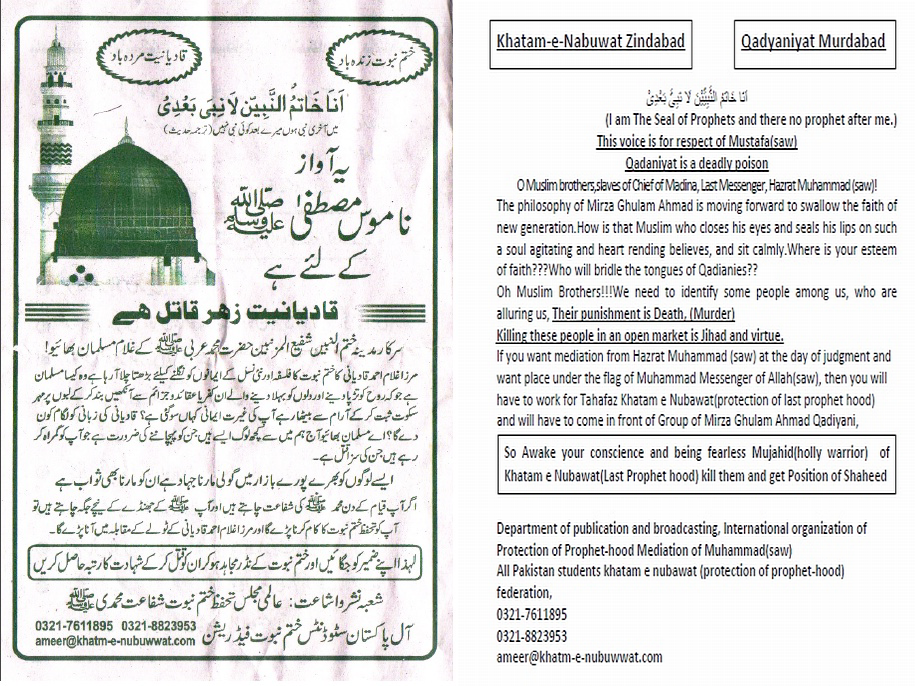
FAISALABAD, Aug 27: The National Commission for Justice and Peace (NCJP) has launched a signature campaign for the repeal of blasphemy laws, including sections 295-B, C, 298 A, B and C of the Pakistan Penal Code.

NCJP director Nisar Barkat said in 2000, the commission had launched a signature campaign for the restoration of joint electorate in Pakistan and collected around 200,000 signatures from people belonging to different segments of society.

He said the commission had started distribution of the forms designed for the campaign which would be collected till Sep 15 for their onward submission to the quarters concerned.

Quoting from the data collected by the commission, he said from 1986 to August 2009, 964 people were booked under these laws and of them 479 were Muslims, 119 Christians, 340 Ahmadis, 14 Hindus and 10 others. As many as 32 people, he said, had been killed by the mob or individuals after facing blasphemy allegations.

Deploring inaction of successive governments regarding misuse of theses laws, Mr Barkat said their repeal was the only solution to the issue.

He urged the parliament to repeal blasphemy laws since they were a source of promoting religious intolerance and disharmony in society.

Citing recent violent incidents in Gojra as an example, he said they were prompted by abuse of blasphemy laws which justified violence against the accused.

©2009 DAWN Media Group. All rights reserved

Sunday, August 23, 2009

Not the business of the state — 2

--- daily DAWN, Pakistan
COLUMNISTS
Not the business of the state — 2
By Ardeshir Cowasjee
Sunday, 23 Aug, 2009 | 09:51 AM PST

Are we not supposed to all be equal citizens with equal rights as decreed by Mohammad Ali Jinnah, the man who founded and made the country? - Photo by Reuters/FileOn Aug 18, a letter from Citizen of Pakistan Naeem Sadiq of Karachi (naeemsadiq @ gmail.com) was printed in this newspaper of record. The subject was a ‘Request for suo moto notice’ and it was an appeal to the chief justice of the Sindh High Court.

Karachi’s Defence Housing Authority in its application form for the allotment of plots in its DHA City scheme has asked those applying to declare their religion and sect. This, states Naeem, is discriminatory and a violation of our fundamental rights. He contends that the intention of the DHA is to make segregated living zones for those of different religions and to further add to this division on sectarian grounds. The demand is at odds with Islam, the Quran and Sunnah making no mention of any ‘sects.’

As he writes: ‘Unless checked, this practice may soon extend to a declaration of religion and sect for other routing commercial transactions, such as buying a PIA ticket or obtaining a mobile telephone SIM.’ So, he has requested the chief justice of Sindh to ‘take suo moto notice and order the DHA to remove the requirement of religion and sect from its application forms and other related documents’.

Absolutely correct — it is not the business of the DHA to delve into the religion and sect of people wishing to purchase plots which it has advertised for sale.

In similar vein, Citizen Sadiq on July 25, 2009 addressed a letter to Chief Justice of Pakistan Iftikhar Chaudhry at Islamabad on the matter of compulsory zakat deductions by the banks of Pakistan, appealing to the Supreme Court in the public interest to take suo moto notice. His letter reads: ‘The Supreme Court of Pakistan in a landmark judgment on March 9, 1999 gave a ruling that members of all ‘fiqhs’ were entitled to exemption from compulsory deduction of zakat, and the federal government had no authority to reject the declaration of any Muslim seeking exemption from zakat, if it was made on a prescribed form. This judgment enables any Muslim to declare his/her ‘fiqh’ and thus seek exemption from compulsory deduction of zakat. De facto, it also recognises the right of individuals to practise their faith according to their own ‘fiqhs,’ and not be dictated by the government’s interpretation.

‘The historic judgment, while so well recognising the right of individuals in matters of their faith, made an irritating mess of how this right was to be practised. Firstly, it requires Muslims to declare their ‘fiqh.’ The great Prophet of Islam (PBUH) did not subscribe to any ‘sect’ or ‘fiqh.’ For his followers to be forced to invent, be branded and be divided by sects and ‘fiqhs’ is therefore an absolutely unethical and undesirable demand on the part of the government.

‘The second irritant relates to the requirement of making this declaration on a prescribed format, thus creating a serious bureaucratic and procedural difficulty for the ordinary citizens. They are required to fill a judicial stamped paper of Rs20 (available for Rs120), have it signed by a notary public and two witnesses before making a completely unnecessary declaration of their ‘fiqh.’ The form is also called CZ-50 affidavit.

‘This anomaly could be easily rectified if the Supreme Court, through a public interest suo moto notice, clarified its original judgment by requiring only those Muslims to give in writing (on a plain piece of paper) who do wish their zakat to be deducted by a bank. This would truly be in keeping with the Supreme Court verdict that all Muslims are entitled to exemption from compulsory deduction of zakat.’

By July 31, Naeem received a letter from the Supreme Court registrar advising him that the chief justice had been pleased to accept the application and ordered that the matter (Suo Moto Case No.12 of 2009) be heard on Aug 10 at Islamabad, and he was required to appear in person.

Two issues were raised at the hearing: (a) that the procedure for exemption from compulsory deduction of zakat was tedious, time-wasting, and cumbersome; and (b) that the state cannot compel its citizens to declare a specific ‘fiqh’ and thus be divided and boxed into one or the other schools of interpretation.

Chief Justice Chaudhry sitting with Justices Jawwad Khawaja and Ijaz Ahmad heard the submission, agreed that it was a pro bono case, and ordered the State Bank and the federation of Pakistan to appear before the court at the next hearing (which is fixed for Oct 5) and explain as to why this procedure cannot be simplified and improved in the light of issues raised by the appellant.

The state of Pakistan is intrusive when it comes to matters of religion. Why? Are we not supposed to all be equal citizens with equal rights as decreed by Mohammad Ali Jinnah, the man who founded and made the country? According to the original constitution as promulgated at noon on Aug 14, 1973 by Zulfikar Ali Bhutto, we were equal citizens of the state, with equal rights. But this equality was done away with in 1974 by Bhutto’s second amendment to his constitution, bending to the obscurantists and bigots, and an entire community was shorn of its rights and declared a minority.

Prior to this, in 1979 the same community was targeted by Ziaul Haq, general of the army and president of the republic, pious and God-fearing. He had decreed that all citizens, regardless of their religion, wishing to obtain a passport must sign a declaration that it is his/her belief that the Prophet of Islam is the final prophet and that any pretender that follows him is false.

Such is the business of the state.

arfc@cyber.net.pk

©2009 DAWN Media Group. All rights reserved
 
^ Top of Page