Showing posts with label Asian Human Rights Commission. Show all posts

Friday, October 7, 2011

PAKISTAN: The principals of the schools obey the instructions of Mullahs to rusticate the Ahmadi students

AHRC Logo
News / AHRC News
PAKISTAN: The principals of the schools obey the instructions of Mullahs to rusticate the Ahmadi students

October 7, 2011

The government has still not taken any action against the cases of rustication of twenty-three Ahmadi students from Punjab Medical College, and particularly against the rustication of Hina Akram, a third year Ahmadi Muslim student at the National Textile University, Faisalabad, Punjab province. Please see the AHRC statement; AHRC-STM-129-2011

In the far-flung areas of Pakistan, students from the Ahmadi community have to face such practices by local religious groups, influential in the school, which force Ahmadi students to hide their identity or to migrate to urban centers where Ahmadis face fewer persecutions. The Islami Jamiat Talaba (IJT), under the guidance of extremist religious leaders, has been allegedly assigned the task to “clean” the educational institutions, including universities and professional colleges in particular, of Ahmadi students. The staff of the educational institutions is being forced to provide details of the students.

After the rustication of 15 Ahmadi female students and 8 male students from the Punjab Medical College, Faisalabad, Pakistan, the Mullahs and extremist groups in Pakistan have ferociously accelerated their campaign against the Ahmadi students.

The AHRC has recently received information that on September 22, a public meeting was held in Dharanwali, a settlement near Hafizabad, Punjab, which was addressed by mischief monger Mullahs whipping up hatred against Ahmadis. Using heart piercing slanderous filthy language against the followers of Ahmadis and its leadership, they announce that they will never allow the burial of any Ahmadiyy Muslim in their cemetery and they will never let any Ahmadi child study in their schools.

Quickly after the inflaming provocation, ten Ahmadi students and a teacher were expelled from the local schools of Faisalabad district, Punjab.

The following students were rusticated from two different schools of being Ahmedis;

1. Shajar Ahmad - son of Amjad Zaid Ahmad, student Class 9,
2. Faraaz Ahmad - son of ijaz Ahmad, student Class 12,
3. Shabih Nasr - daughter of Nasr Ahmad, student Class 10,
4. Tanseelah Khalil - daughter of Khalil Ahmad, studying for B.A Degree,
5. Tanzeela Khalil - daughter of Khalil Ahmad, student Class 12,
6. Nabeela Kahilil - daughter of Khalil Ahmad, student, Class 12,
7. Iqbal Ahmad - son of Munir Ahmad, student, Class 6,
8. Sadia Munir - daughter of Munir Ahmad, student Class 10
9. Maham Jameel - daughter of Jameel Ahmad, student Grade 1,
10. Manahil Jameel - daughter of Jameel Ahmad, student prep class.

They were all expelled from Chenab Public school (Principal Muhammad Yasser Arafat), and Muslim Public school, Dharanwali (Principal Yasser Abbas).

Moreover, an Ahmadiyya teacher Rafiya tul Bari, daughter of Amjad Zaid Ahmad, teaching in Chenab Public school, Dharanwali, was also expelled for being an Ahmadiyya Muslim.

This alarming situation for the fundamental right to education of Ahmadiyy Muslims in Pakistan continues to accelerate and the international community must take resolute action to pursue the Government of Pakistan to honour its commitments to the Universal Declaration on Human Rights and the Harare Declaration to which Pakistan is a signatory.

It is observed that in the recent days a strong wave against the different sects has swept through Punjab province which has provided shelters to the banned Islamic militant groups who are openly organising their public meetings and collecting funds on the streets. The banned religious groups gathered so much power through the ministers of provincial governments that they are now out of control. The rule of law which protects the religious freedom is under the total control of the Mullahs, the religious bigot, in the Punjab government.

The AHRC urges the government of Pakistan to repeal all the laws and ordinances denying Ahmadis their civic and fundamental rights and propping up the Mullahs and extremist groups to continue the murders of Ahmadis and the destruction of their means to livelihood.

Document ID: AHRC-STM-139-2011
URL: www.humanrights.asia/news/ahrc-news/AHRC-STM-139-2011

Wednesday, September 28, 2011

PAKISTAN: Ahmadi students are under threat from the extremist religious groups — government turns a blind eye again

AHRC Logo
News / AHRC News
PAKISTAN: Ahmadi students are under threat from the extremist religious groups — government turns a blind eye again

September 28, 2011

Malice, hatred and discrimination against Ahmadi Muslim students in Pakistan are part of a wider scheme to cripple Ahmadis educationally, economically and socially. Ahmadis were declared a non Muslim minority in Pakistan by the amendment in the Constitution and they cannot perform their religious duties in open places, nor can they declare themselves Muslims. And even then, they cannot enjoy the rights of the minorities as guaranteed in the Constitution of Pakistan.

A campaign against Ahmadi students, particularly women students, has been ongoing, especially in vocational and professional institutions, colleges and universities. Ahmadis are accused of being “the worst enemies of Islam and Pakistan.” It is a common practice by miscreants to paste highly slanderous and provocative posters on walls in the universities and colleges.

It is not long ago that 15 Ahmadi female students and 8 male students were rusticated from the Punjab Medical College, Faisalabad, Pakistan. The Ahmadi female students were particularly targeted and pressurised to choose between faith and career. All this is an organised campaign, conducted allegedly by the Islami Jamiat Talaba (IJT), a student branch of Jamat-e-Islami, a fundamentalist Islamic political and religious party.

One third year student at the National Textile University, Faisalabad, Punjab province, Ms. Hina Akram, had to leave her studies on account of intense faith-based harassment at the hands of some members of the university. One of Hina’s teachers came to know she was an Ahmadi and reacted furiously; He told Hina that she was a Kafir (infidel) and would suffer the consequences. The teacher and his colleagues started a hate-campaign against Hina. Hina’s father complained to the University but nothing was done and sadly, Hina was forced to terminate her studies as she could no longer face the continued hostility.

However, the persecution, the oppression, the injustice, the denial of their right to education, to foster their talents and academic development is encouraged by the legislation and provision by Ordinance and the liberty accorded to the Mullahs (religious leaders) and their accomplices.

Hina’s future, her aspirations, her hopes and ambitions, has been completely destroyed like those of scores of other Ahmadi female and male students. They are victimised for being members of a Community which all over the world carries the reputation of being peaceful, law abiding and highly respectable among faith communities.

The federal government has still not taken seriously the case of the rustication of the 23 Ahmadi students from Punjab Medical College besides the several reminders from their parents and rights organizations. In the far flung areas the students from the Ahmadi community have to face such practices of the local religious groups at school level which forces Ahmadi students to hide their identity or to migrate to urban centers where Ahmadis face less persecution. The IJT, under the guidance of extremist religious leaders, have been allegedly assigned to clean the educational institutional particularly, universities and professional colleges, of Ahmadi students and the staff of the educational institutions are being forced to provide details of the students.

It is reported that the Punjab provincial government has very soft attitude towards the extremist religious elements including banned sectarian groups and allow them to conduct their activities freely in the province. Please see the links;
http://www.humanrights.asia/news/ahrc-news/AHRC-STM-126-2011
http://www.humanrights.asia/news/ahrc-news/AHRC-STM-077-2011

Such cases of blatant violations of human rights, mass terror, stark discrimination, religious vendetta and abominable social harm are a challenge to the World Community to be addressed resolutely and with determination.

The government of Pakistan must not allow the extremist religious groups and parties to persecute the minority groups and run their own parallel government by denying the students from the Ahmaddiya community their right to education. The rusticated students should be readmitted in their educational institutions. The government’s policy of appeasement of religious extremist groups is undermining the rule of law which has gone under the hands of religious gangs and sectarian bigots.

The Government of Pakistan must do more to honour its commitments to the international charters. Declarations and technical assistance must be provided to ensure that every citizen of Pakistan has the fundamental right to education without any discrimination on account of faith, religion or belief. The Harare Commonwealth Declaration of 1991 made it obligatory for every Member State to provide special facilities for the education and equal rights of women and ensure all women are treated equally without any prejudice or discrimination. Article 26 of the UDHR (Universal Declaration of Human Rights 1948) clearly emphasises that everyone has the right to education and it will be equally accessible to all on the basis of merit, which unfortunately is not the case for Ahmadis in Pakistan.

Pakistan is a signatory to UDHR. It is also a signatory to the Harare Declaration and various bilateral agreements to qualify for assistance for the provision of education.

The denial of education to Ahmadi Muslim women and men in Pakistan is a deplorable act which needs to be denounced. International organizations, donors and others who fund the provision and development of education, particularly professional and technical education must ensure that Pakistan faithfully adheres to the word and spirit of the charters and agreements it has signed and create an environment which complies with Article 26:2 of the UDHR which states;

‘Education shall be directed to the full development of the human personality and to the strengthening of respect for human rights and fundamental freedoms. It shall promote understanding, tolerance and friendship among all nations, racial or religious groups’.

We solicit the World community to continue its pressure upon the Government of Pakistan to restore the rights and freedoms of Ahmadi Muslims including civil rights and their right to education and intellectual and professional development.

Document ID: AHRC-STM-129-2011
URL: www.humanrights.asia/news/ahrc-news/AHRC-STM-129-2011

Tuesday, September 6, 2011

PAKISTAN: The federal government must intervene to stop the killings of Ahmadis

AHRC Logo
News / AHRC News
PAKISTAN: The federal government must intervene to stop the killings of Ahmadis

September 5, 2011

Another Ahmadi killed in hate crime against religious minorities

The religious minority group of Ahmadis is under constant threat of religious hate crimes and no serious efforts have been initiated by the government to provide protection the community.

In the latest incident a member of the Ahmadiyya community was murdered after receiving death threats from an extremist group who is allegedly patronized by the Punjab provincial government. Mr. Naseem Ahmad Butt, 55, was shot dead by four men as he lay sleeping inside his house in Muzaffar Colony, Faisalabad, Punjab province. According to his brother Khalid Pervez Butt, at about 1am, the attackers entered by climbing over the walls. “The boys were between 20 and 25 years old. Three of them kept a watch on the door as one kicked my brother. When he was awake, the killer said “You are Ahmadi and liable to be killed”, Khalid told daily The Express Tribune.

The attacker then shot Naseem in the chest while another bullet ruptured his kidney. A car and a bicycle were used in the attack, Khalid said. Naseem, was a worker at a power loom factory and leaves behind his widow, four daughters and a son. His first cousin, Naseer Butt, was also killed last year when he was passing through a crowded market place in the same Faisalabad city. Police have made no effort to trace his killers and the case has been declared as a blind murder.

In a hate campaign a band religious group is openly issuing pamphlets calling on citizens to kill people from the Ahmadiyya community. This should be done in the open and crowded market places as a Jihad (holy war). Killing, beating and punishing them would be rewarded by God.

The Asian Human Rights Commission has informed the authorities about the plan to target Ahmadis but no action whatsoever has been taken and this religious minority group has been left to the mercy of militant religious groups. Please see: PAKISTAN: Extremists openly plan to kill hundreds of Ahmadis–government turns a blind eye. In this instance the pamphlets were published by the All Pakistan Student Khatm-e-Nabowat Federation and were issued by the information department of Aalmi Majlis-e-Khatm-eNabowat Shafaat-e- Muhammadi with their phone numbers and email address.

In the hate crimes against the Ahmadiyya community more than 111 Ahmadis have been killed in target killings since 1984 when an ordinance against Ahmadis were issued by a military dictator. In May last year, more than 88 people were killed in the provincial capital Lahore when gunmen opened fire at two separate places of worship and, one year on, no progress has been made by investigators.

The government of President Asif Zadari must take immediate action to protect the Ahmadiyya community and bring to a halt the hate crimes being committed openly against them. There is no question as to the identities of the religious extremists who are calling for a Jihad against the Ahmadiyya community as they openly express their hate speeches from the public address systems of their mosques. The provincial government of the Punjab has been implicit in assisting the Jihad and makes no effort to conceal the fact that they openly support the extremist. Once again the government of President Zadari knowing that one of their provincial governments is openly supporting the Jihad against the Ahmadiyya community has done nothing.

The federal government must intervene with all haste to rein in the extremists and seriously question a provincial government that encourages violence against the people of Pakistan regardless of their religious faith or ethnicity.

Document ID: AHRC-STM-115-2011
URL: www.humanrights.asia/news/ahrc-news/AHRC-STM-115-2011

Thursday, August 18, 2011

INDONESIA: Conviction of Ahmadyah victim undermines constitutional protections

AHRC Logo
News / AHRC News / INDONESIA: Conviction of Ahmadyah victim …

INDONESIA: Conviction of Ahmadyah victim undermines constitutional protections

August 18, 2011

The Asian Human Rights Commission (AHRC) is disturbed by the punitive decision of the Indonesian Court on August 15, 2011 to jail an innocent Ahmadi Muslim who protected himself during a mob attack, which reveals the impartiality of the judiciary and the legal community.

Deden Sudjana was sentenced to six months imprisonment by the court, for simply protecting the house the mob were attacking. Meanwhile, the 12 men who were responsible for brutally killing three Ahmadi Muslims in an attack in February 2011, were only sentenced to between three and six months imprisonment.

Some 1,500 people attacked the home of an Ahmadiyah community leader in Cikeusik, west Java in February. Sudjana was hit with a machete and almost had his hand severed during the mob attack. Head of security for the Indonesian Ahmadiyah Congregation (JAI) at the time, Sudjana was detained since May for allegedly inciting the attack. In its judgment, the court ruled that he had disobeyed a police order to leave the scene, and had been filmed punching another man. He was thus convicted of articles 212 and 315.1 of the Criminal Code; resisting state officers and maltreatment, respectively.

The decision is senseless and embarrassing, a travesty of justice. The lenient sentences handed out to those convicted of killing three Ahmadis in July raised questions regarding judicial impartiality and upholding of constitutional protections (see AHRC-PRL-034-2011), which have now been spotlighted again. The two verdicts indicate that Indonesia’s criminal justice system is not able to deliver justice independent from religious considerations. Indonesia’s judicial commission must act on this miscarriage of justice and push for reforms that will truly ensure a fair and impartial justice process.

Indonesia today is increasingly seeing extremists push their agenda forward, mostly with the use of violence, resulting in the loss of life and damage to property. The Indonesian government has taken no effective steps to stop or prevent such activities, which will slowly erode the country’s secular values.

Similarly, the Indonesian courts and legal system have shown a complete disregard for the basic rule of law, and have not taken up their mandate of protecting the constitutional rights of Indonesian citizens.

The AHRC urges for a review of both verdicts, and calls upon the Indonesian government and courts to ensure that all religious and other minorities are adequately protected.

Document ID: AHRC-PRL-034-2011
Document Type: Press Release
URL: www.humanrights.asia/news/press-releases/AHRC-PRL-034-2011

Friday, July 29, 2011

INDONESIA: Courts verdict encourages further attacks against religious minorities

AHRC Logo
News / Press Releases / INDONESIA: Courts verdict encourages…
INDONESIA: Courts verdict encourages further attacks against religious minorities

July 29, 2011

(Hong Kong, July 29, 2011) Three to six months in prison was the shocking sentence given to the perpetrators of the mob killing of three Ahmadiyahs earlier this year. The remaining perpetrators will be released on the reading of the verdict on 23 August this year. Most of them will be released during the coming weeks. This lenient punishment and the conduct of the judges in the trial sends a clear signal to religious fundamentalists that they not need to worry about the law and constitutional protection of minorities.

“The verdict and trial conduct does not meet national or international standards” Wong Kai Shing, Executive Director of the Asian Human Rights Commission said. “The lenient punishment will encourage more extremist action against religious minorities” Wong added,” the courts failed to enforce Indonesian law for the protection of citizens.”

On 28 April 2011 the Serang District Court in West Java convicted twelve suspects for maltreatment, joint assault and incitement in the horrendous Cikeusik killing from February this year. A mob set against the discriminated religious minority of Ahmadiyah followers attacked the group in Umbulan village, Cikeusik resulting in five members being injured and three killed. At least one patrol car from Cikeusik sector police and 2 trucks from riot-control force (Dalmas) of Pandeglang dictrict police men were present and watched the violence, doing nothing to prevent it or apprehend the perpetrators. The shocking scenes were published in a video online sparking international outcry.

The Indonesian Ahmadiyah congregation (JAI) commented that the verdict does not fulfil the sense of fairness. According to A. Mubarik Ahmad, the public relation of JAI, this crime must be seen as crimes against humanity, not just a crime against the Ahmadiyah. The Indonesian criminal code never regulated the crimes against Ahmadiyah. Moreover, he stated that the state still cannot find the murderer of the victims, because the trial did not charged the suspect with murder charge, thus there is no examination and trial for the murderer.

In 1980 and 2005, Indonesian Ulama Assembly (Majelis Ulama Indonesia) issued a fatwa against the Ahmadiyah community in Indonesia denouncing Ahmadyah followers as an errant sect. In 2008 a joint ministerial decree banned the group for promulgating its religion and other basic religious rights. The decree is widely believed to be responsible for encouraging attacks against Ahmadis. Numerous attacks against Ahmadiyah communities and their members were documented by the Setara Institute and Wahid Institute over the last years.

The AHRC is concerned that the lenient punishment for a mob killing against the minority group will encourage more fundamentalist violence. Institutions have failed in this case to send a strong message against extremism. The AHRC believes that law and constitutional values were not the basis for the judgement in this case.

Thursday, July 21, 2011

INDONESIA: Ahmadiyah community faces ongoing discrimination

AHRC Logo
Opinions / Interviews / INDONESIA: Ahmadiyah community faces ongoing discrimination
INDONESIA: Ahmadiyah community faces ongoing discrimination

July 21, 2011

An interview with Zaenuda Ikhwanul Aziz from the Indonesian Ahmadiyah Community (JAI) published by the Asian Human Rights Commission regarding the situation faced by Ahmadis in Indonesia.

Zaenuda Ikhwanul AzizZaenuda Ikhwanul Aziz, is the secretary of the legal committee of the Indonesian Ahmadiyah congregation (Jamaah Ahmadiyah Indonesia — JAI). He is actively involved in the struggle of the Ahmadiyah in the country.

How do you feel about what is happening to the Ahmadiyah community in Indonesia?

We feel that we are being discriminated against, especially the Ahmadiyah communities at the localities outside the capital of Jakarta. For example, the government does not give identification cards and marriage certificates to Ahmadiyahs.

At the economic sector many Ahmadiyahs have had to change the location of their businesses. Even in some provinces, the people from the community are intimidated not to buy products from Ahmadiyah shops and businesses and this has resulted in a serious reduction of our income.

In the social sector we also are excluded and intimidated. We are not allowed to be involved in social gatherings.

At the religious sector the Minister of Religion prohibits us from conducting the Hajj, (the pilgrimage to Mekka) and even when we pray, members of the local communities attack our mosques. Sometimes, our villages are also attacked.

Also, in the health sector, many people reject Ahmadiyahs as patients. We therefore feel discriminated against in most, if not all, sectors.

When did you start to feel the discrimination?

The discrimination started when the Indonesian Ulama Assembly (Majelis Ulama Indonesia - MUI) declared Ahmadiyah as an errant sect in 1980. This fatwa brought to light the differences between Ahmadiyahs and the community. The people followed the fatwa believing that Ahmadiyah is errant without seeking any further explanation or consideration.

The main actors involved are the Indonesian government, central and local law enforcement authorities and several Ulama members who influence the people to attack Ahmadiyah communities. This is especially so with those persons who live within Ahmadiyah communities.

In your opinion, what is the reason for the increase of the aggression against Ahmadiyahs in the last few years?

There are several reasons, not the least of which is that the government is indecisive about law enforcement. If the joint ministerial decree against JAI still prevailed then the government could not allow the local regulations in the provinces to declare Ahmadiyah as an errant sect. Unfortunately, the government did nothing to prevent this from happening.

The aggressors see Ahmadiyah as a threat because the numbers of Ahmadiyah communities is increasing and they are scared that they will lose their followers.

Also, the content of the joint ministerial decree has been misinterpreted. There are local regulations which use the joint resolution decree to declare Ahmadiyah as errant whereas there is no such statement in the decree itself. The JAI think this happened because the government is trying to distance itself from the joint of resolution decree.

Is the state doing anything to protect the Ahmadiyahs?

We feel the state protection is still minimal. There is still turmoil because there is no law enforcement. It is seldom that perpetrators of violence against Ahmadiyahs are arrested and they are never prosecuted in the courts.

What do you feel about the work of the police?

In general, the work of the police is still far from professional. However, we must acknowledge that in some areas, there are some good police officers working in relation to Ahmadiyahs.

What about the work of the courts?

Judges are deficient at searching for the truth. Their efforts are deficient when examining at a trial, investigating the witness and proof, such as happened at Cisalada trial. Even the verdict against the Ahmadiyah victim was heavier than that of the perpetrators.

What is the Ahmadiyah community doing in their own defence?

Our representatives visit government officials, legal enforcement authorities, and the community in general. Relating to the legal dealings, we entrust this to our legal counsel.

The result of our visits are promising in that there are several communities and authorities who opened up and accepted us such as in Bandung, Central Java, and Wonosobo. But there have also been rejections such as in Cianjur, Bogor.

What is your ultimate goal in this struggle?

All we ask for is the right to live like other citizens and that these rights are fulfilled by the government

————————
The views shared in this article do not necessarily reflect those of the AHRC, and the AHRC takes no responsibility for them.

Saturday, June 11, 2011

PAKISTAN: Extremists openly plan to kill hundreds of Ahmadis—government turns a blind eye

AHRC Logo
News / AHRC News

PAKISTAN: Extremists openly plan to kill hundreds of Ahmadis—government turns a blind eye

June 11, 2011

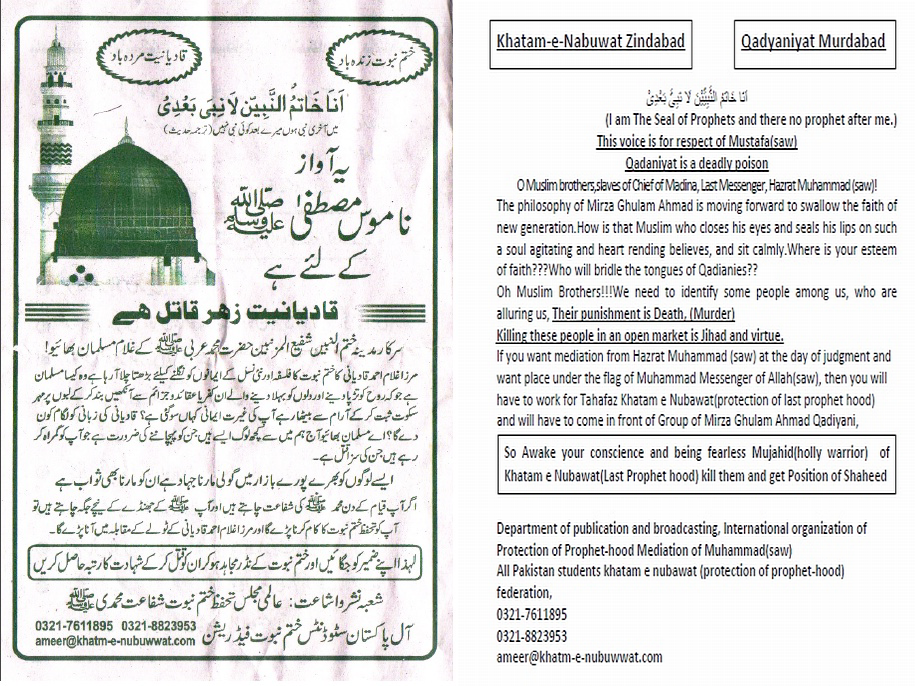
The Asian Human Rights Commission has received information from Faisalabad city of Punjab province, the second largest industrial and commercial city of the country that a plan has been chalked out to kill the owners and their family members of 36 commercial and industrial establishments belonging to Ahmadiyya community. The plan includes the people working in those establishments which means more than 150 persons are targeted. Doctors and other professionals are not exempt from this threat. For two weeks now pamphlets and advertisements have been distributed calling the citizens to kill people from the Ahmadis community. This should be done in the open and crowded market places as a Jihad (holy war). Killing, beating and punishing them would be rewarded by God. The pamphlets were published by the All Pakistan Student Khatm-e-Nabowat Federation and were issued by the information department of Aalmi Majlis-e-Khatm-eNabowat Shafaat-e- Muhammadi with their phone numbers and email address.

The Asian Human Rights Commission cannot reproduced here the copy of the pamphlet for security reasons as it bears the names of commercial and industrial establishments and the names of targeted persons. However, we reproduce below the English translation of the pamphlet which was written in the local language, Urdu.

  • The original leaflet and its translation in English are available for download here: Leaflet of Ahmadis killing announcement (Urdu, English). For security reasons, the names of the Ahmadiyya community members who were targeted in the leaflet have been removed. The English translation is on page two.

These pamphlets are being distributed on a mass scale, openly in the city from where more than four ministers are in the cabinets of Punjab and federal governments. These ministers have failed to take action on this plan of killing people from a religious minority group because they fear these extremists as they themselves would also be declared supporters of Ahmadis or infidels. In Faisalabad and its neighboring cities a good number of Ahmadis and Christians have been residing for at least a century but for some decades now these minority community people have been killed and abducted by the extreme Muslim organizations to purify the ‘Muslim areas’.

The Ahmadiyya community has informed all the members of national and provincial assemblies elected from Faisalabad and the local administration through the Commissioner of the district of this serious threat but no one is taking action. Indeed, nothing will happen until the killings start. It is astonishing that the provincial law minister, Mr. Rana Sanaullah, and leader of the opposition in Punjab assembly, Mr. Raja Riaz, are from the same city and they both know about the mass appeal to kill the Ahmadis but both of them are turning a blind eye to the situation and be doing so show their unwillingness to go against the Muslim extremists as they would lose their constituencies of Muslim voters.

It is alleged that Mr. Rana Sanaullah, who also belongs to Faisalabad, had previously supported the movement against Ahmedis by providing every official support to Majlis-e-Khatm-e-Nabowat (the movement directly aimed at Ahmadis) in holding public meetings from the government funds.

The killing list prepared by Muslim extremists mention also mentions one industrial group from which three partners were killed in a target killing during the month of April 2011 in a span of one week. But even then the administration and ministers did not take note of such threats.

In the recent years when the government of Shahbaz Sharif came to power in Punjab province the Ahmadis and Christians were targeted and many were killed, their houses were burnt and many were booked under the Blasphemy laws including their women and children. On May 28, 2010, over 88 Ahmadis were killed in two gun and bomb attacks at Ahmadi places of worship in the Garhi Shahu and Model Town areas in Lahore. Investigations were launched and arrests were made but little has come out of the investigations. During 2010, 99 members of the community were killed and 64 Ahmadis were charged with blasphemy.

After the distribution of the lists of the Ahmadis to be killed it is clear that in the coming days there would be target killings of Ahmadis at a large scale level. Now that the government has been made fully aware of the threats to the Ahmadis community the AHRC urges the government to take immediate action to prevent such killings and the destruction of their industrial and commercial establishments. Once the killings start it will be too late and the government will not be able to use the excuse that they had not time to prepare. The government will be answerable, not only to the Ahmadiyya community but also the citizens of Pakistan and the international community. Action must be taken against any person or group openly declaring their nefarious designs of mass killings.

In the past it was also observed that in the case of Aasia Bibi, a Christian lady booked in Blasphemy laws, the Muslim fundamentalists were openly announcing the killing of those persons who are providing support to those accused of blasphemy. Huge rewards were offered to persons who killed these people But the government in pursuit of its appeasement policies towards the extremists have ignored the announcements and the result were the murders of former governor of Punjab, Mr. Salman Taseer, and former federal minister of minorities, Mr. Shabaz Bhatti. Therefore the time is ripe for the government to maintain the rule of law and prosecute all those who want to kill the members of religious minority group of Ahmadiyya by provoking the ordinary Muslims of Pakistan.

Document ID: AHRC-STM-077-2011
URL: www.humanrights.asia/news/ahrc-news/AHRC-STM-077-2011

Monday, May 30, 2011

PAKISTAN: A year on from the Lahore attacks but Ahmedis still suffering

AHRC Logo
Opinion / Columns
PAKISTAN: A year on from the Lahore attacks but Ahmedis still suffering

FOR PUBLICATION
AHRC-ETC-017-2011
May 30, 2011

An article by Nasim Malik published by the Asian Human Rights Commission

PAKISTAN: A year on from the Lahore attacks but Ahmedis still suffering


A day of ghastly sight of gristly, gruesome bloodshed of Ahmadis in Lahore Pakistan

A year after the terrifying horrendous massacre of 86 Ahmadis of the Ahmadiyya Muslim Community in Lahore, Pakistan the world remains deeply in shock, appalled by that act of religious terrorism, cold bloodedly covered up by the government of Pakistan.

The 86 murdered were part of a Friday worship service in Darul Zikr mosque in Lahore and Baitul Noor mosque in Model, Town, Lahore. During the course of this carnage nearly 150 people were seriously injured.

The very next day the security forces arrested 6 terrorists who confessed that they had carried out the attack on the Darul Zikr mosque but no action to this day has been taken against anyone. Both the mosques are in close proximity of police stations who could clearly hear the gun shots and blasts but they did not show up on site until the terrorists had exhausted all their ammunition stock. Even on arrival the police did not allow the emergency services to enter the mosque which could have saved many innocent lives of worshippers.

The families of the victims of this carnage received no support or assistance from the government whatsoever and the widows and the orphans are left to suffer and fend for themselves.

The government of Pakistan usurped the fundamental basic human rights, rights of religious freedom of Ahmadis in Pakistan by declaring them non-Muslims in 1974. This was perpetuated by the infamous Ordinance XX promulgated by General Zia ul Haq under which Ahmadi Muslims can be sentenced to death or imprisoned for practising the Islamic faith or using the Islamic scriptures or epithets.

Over 200 Ahmadi Muslims have been murdered in Pakistan for following their faith since 1974 and several hundred prosecuted and imprisoned under the infamous Blasphemy laws.

Pakistan today is infected with Islamists persisting in their hard-line interpretation of Islam based on force and violence to promote their objectives and promote terrorist activities resulting in frightful loss of innocent lives on a daily basis.

The federal government has taken no effective bold step to curb and eliminate the activities of extremists who are continuing to erode the very values on which Pakistan was established.

The political parties in Pakistan too have shown no indication to confront the religious bigotry, extremism and violence which has shattered the social and economic fabric of the society.

Pakistan is a signatory to the UN Human Rights Charter and its ancillary declarations but is attitude and treatment of minorities particularly Ahmadis is deplorable.

Ahmadis now well established in 198 countries of the world have earned a worldwide reputation of being a very tolerant law abiding and peace loving community. They have been treated horribly, unjustly and discriminately to the extent they cannot even vote but they have never protested or acted against the state of Pakistan.

Ahmadi generals shed their blood in the Pakistan wars to protect its integrity and today the government of Pakistan is not showing the slightest regard for the rights, safety and security of Ahmadis in Pakistan.

The 28 May 2010 massacre gives an undeniable slur of cruelty and atrocity upon Pakistan and its continued injustice and violation of the fundamental rights of Ahmadis will not go in vain. It is time that the government of Pakistan sanely attends to its obligations towards all its subjects without discrimination to save itself from a path of destruction on which it is treading. It is now high time for the government of Pakistan to act.

——————
The views shared in this article do not necessarily reflect those of the AHRC, and the AHRC takes no responsibility for them.

About the Author:
Mr. Nasim Malik was a Swedish Socialdemocrat politician and was elected as a reserve member of the Swedish Parliament and President of the International Wing of the Socialdemocrats Kalmar. He can be reached at nasim.malik@kalmar.se


Thursday, April 7, 2011

INDONESIA: Increasing attacks on religious groups demands central government action

AHRC Logo
NEWS
INDONESIA: Increasing attacks on religious groups demands central government action
April 7, 2011

Dear friends,

We wish to share with you the following statement from Amnesty International, KontraS, Imparsial, Elsam, Setara Institute, ICRP, HRWG, ANBTI, ILRC and Wahid Institute.

Asian Human Rights Commission
Hong Kong

FOR IMMEDIATE RELEASE
AHRC-FST-025-2011
April 7, 2011

A Statement from Amnesty International, KontraS, Imparsial, Elsam, Setara Institute, ICRP, HRWG, ANBTI, ILRC and Wahid Institute forwarded by the Asian Human Rights Commission

INDONESIA: Increasing attacks on religious groups demands central government action


The Indonesian government must do more to stop the rising number of incidents of violence, intimidation, harassment and discrimination against religious minorities, said a group of Indonesian and international human rights organizations today.

Amnesty International, along with KontraS, Imparsial, Elsam, Setara Institute, ICRP, HRWG, ANBTI, ILRC and Wahid Institute voiced their concern about the growing environment of discrimination and harassment against religious minorities, in particular the Ahmadiyya community.

KontraS has documented at least 62 incidents between January and March 2011 only against the Ahmadiyya community. According to data collected by HRWG, the pace of such attacks has increased sharply in 2011 compared with the previous two years. There are also concerns about continuing attacks against Christians.

A particularly alarming development was the involvement of the Indonesian military and police in intimidation and forced conversion of members of the beleaguered Ahmadiyya community. KontraS has documented at least 20 cases in March and early April 2011 where military and police have been involved in cases of intimidation, harassment and forced conversion.

Amnesty International shared the concerns raised by Indonesian human rights groups with the senior leadership of the Indonesian National Police on 5 April.

Amnesty International also met some of Indonesia’s largest mass religious organizations, including Muhamadiyyah, Nahdlatul Ulama, and the Communion of Churches in Indonesia (PGI), an umbrella group for Protestant Churches.

Alarmed by the deteriorating situation, and in light of the positive meetings with police officials and religious leaders, the human rights groups issued the following recommendations:

— The central government must fulfill its obligation to ensure that all citizens, regardless of their religious beliefs, benefit from the human rights enshrined in the 1945 Indonesian Constitution and the International Covenant on Civil and Political Rights, which Indonesia ratified in 2005 as provided by Law No. 12/2005;

— The central government, through the Ministry of Home Affairs, should immediately assert its exclusive authority to regulate religious affairs under the 2004 Law on Regional Autonomy and ensure that any regulations issued at the provincial as well as at the district level are in compliance with human rights protections as provided in the 1945 Indonesian Constitution and Indonesia’s obligations under international law, in particular the ICCPR;

— The Joint Ministerial Decree of 2008, which placed significant restrictions on the activities of the Ahmadiyya religious community, has served to foster a climate conducive to violence and vigilanteism, and should be immediately repealed;

— The Indonesian police should restate publicly its commitment to protecting the rights of all citizens regardless of their religious beliefs and put in place a proactive strategy for preventing and addressing incidents of religiously based violence. The groups welcomed the efforts to address the incidents in Cikeusik and Temanggung and look to the government and police to ensure that the trials proceed without intimidation of the victims, witnesses and their lawyers. The police should also ensure they register and investigate all cases of religious-based violence, regardless of the religious background of the victim.

— Central and local government officials should emphasize the basic protections for religious belief, expression, and association included in the 1945 Indonesian Constitution and international law and refrain from making comments stigmatizing religious minorities, which has created a climate fostering discrimination and violence.

Jakarta, 6 April 2011

Monday, March 21, 2011

INDONESIA: Rule by violence

AHRC Logo
NEWS
INDONESIA: Rule by violence
March 21, 2011
Bombing of NGO office following religious standoff while US Congress urges President to revoke decrees
Archive photo, Ahmadiyya homes in Indonesia set on fire, source: Ahmadiyya Times
Following a series of violent incidents against religious minorities, including the Ahmadiyah community, two regional administrations in Indonesia had issued local decrees banning the Ahmadiyah followers. On February 6, in Cikeusik Banten for example three Ahmadiyah followers were killed and several injured after an angry mob attacked them. The few police officers present at the incident did little to stop the violence. An internal investigation by the police only named a few lower ranking officers as suspects of negligence but did not address the structural police involvement in such incidents of fundamentalist violence. Violence and protests against Ahmadiyah followers also took place in other provinces. The bombing of a Jakarta based NGO office advocating religious freedom completes the picture of Indonesian authorities that are not taking the side of the law and who appear unable to withstand the pressure from extremists.

On March 15, 2011, 27 members of the US Congress signed a letter to President Yudhoyono calling for the 2008 decree against Ahmadiya religions promulgation to be revoked as well as the regional decrees which banned the Ahmadiyah followers from exercising their religion. The letter is available here. Article 18 of the ICCPR protects the right of everyone to choose and exercise their religion and requires every government to protect this fundamental freedom as a human right. However, the government responded to the call to revoke the decrees by declaring that it reserves the right to treat the Ahmadiyah religious sect in any manner it likes, the Jakarta Post reported. While the Indonesian government acceded to the International Covenant on Civil and Political Rights (ICCPR) in 2006 it now openly ignores its earlier commitments to human rights.

On Tuesday March 15, 2011 a letter mail was sent to the co-founder of the Liberal Islamic Network (JIL), Ulil Abshar Abdalla in East Jakarta. The radio stations housed in the same building witnessed the blast. The unusual events in building show the inability of police to deal with the situation:

By 10 am on Tuesday March 15, a dark skinned 170cm tall man wearing a parachute jacket and a hat delivered a package wrapped in brown paper to the reception desk of the building used by the JIL (Jaringan Islam Liberal) and the pro democratic radio station KBR68H radio station and other groups.

At 11.30 am 4 or 5 people arrived in a car. Two of them came into the building and identified themselves as members of a travel agency and talked to KBR68H radio about running promotions for the pilgrimage trips to Mecca in the radio channel. After their unusual visit was over the men went on to visit JIL in the same building with the same request, falsely alleging to have been recommended by KBR68H to talk to JIL. This appeared as an attempt to gain trust.

At 2.30pm 3 persons who identified themselves as coming from the National Police Headquarter arrived and alleged to want to talk about the recent situation of religious violence and events about the Ahmadiyah followers. By that time the staff of JIL had become suspicious about the package they received since it contained a book titled “They Deserved to Be Killed: Because of Their Sins to Islam and Muslims” and appeared to be glued together.

Since the suspicion of a bomb in the book arouse, it was of unusual coincidence that three members of police were already around when the JIL were thus able to hand over the book to them. The local police was also called and a group of around ten officers arrived betweem 3 pm – 3.30 pm. It was soon confirmed that wires in the object made it likely to be a bomb. The crowd of police then decided to try traditional methods to neutralise it, by pouring water in it after bringing the bomb into the backyard of the building. Following this the mobile phone battery that had supplied the bomb system with electricity was taken off by the police and this action triggered the bomb. The resulting explosion injured one of the policemen, none of whom were bomb disposal specialists.

A second letter bomb with the same book title was sent to Comr. Gen. Gories Mere, a former key officer of the National Police’s elite counterterrorism unit, Densus 88.

In 2005 the KBR68H radio station had become a target of an attack from the Islamic Defenders Front (FPI) after the radio had promoted religious tolerance.

A day earlier on March 14, four laptops and one computer were stolen from the office of the National Alliance for Unity in Diversity (Aliansi Nasional Bhinneka Tunggal Ika ANBTI). The group supported and promoted the Indonesian constitutional value of a pluralistic society in Indonesia.

It is not only the police and local administrations that have supported activities against Ahmadiyah followers. According to the Human Rights Working Group the Indonesian military has also been involved in activities against the religious minority. Members of the military have occupied mosques and urged Ahmadiyah members to discard their beliefs. With this activity the military has gone far beyond its mandate and has thus violated laws.

The Islamic Defenders Front (FPI) is believed to be behind recent attacks against the Ahmadiyah community. Habib Rizieq Shihab, head of the Islamic Defenders Front (FPI) explained that FPI would only settle for peace if the President would ban the Ahmadiyah in Indonesia. He threatened that violence against Ahmadyah followers would continue unless the Islamic sect would be legally banned.

The repeated and open threats of violence against religious minorities are a crime in the Indonesian Penal Code. The police often do not react appropriately to such incitements of violence and authorities instead allow such incidents, like the recent killings and bans, to take place. In some instances the argument to maintain public security and order is turned around so that the responsibility for the violence is not that of the instigators of the violence but rather at the victims who are accused of causing instability.

The AHRC urges the President, the Indonesian government and the National Police to protect the constitutional values, human rights and applicable international law by fully investigating all threats against any religious groups in Indonesia and to give full support including protection measures to threatened communities. Allegations against members of the police and military to support religious extremists or their views must be investigated. Any officer supporting such views should face disciplinary and criminal measures including suspension and criminal charges.

Document ID: AHRC-STM-043-2011
URL: www.humanrights.asia/news/ahrc-news/AHRC-STM-043-2011

Wednesday, February 23, 2011

BANGLADESH: Government fails to protect freedom of religion and assembly of Ahmadiyya community

AHRC Logo
Asian Human Rights Commission — Urgent Appeals
BANGLADESH: Government fails to protect freedom of religion and assembly of Ahmadiyya community
ASIAN HUMAN RIGHTS COMMISSION — URGENT APPEALS PROGRAMME
Send an Appeal Letter

Urgent Appeal Case: AHRC-UAC-042-2011
22 February 2011

BANGLADESH: Government fails to protect freedom of religion and assembly of Ahmadiyya community


Dear friends,

The Asian Human Rights Commission (AHRC) has received information that the administrative authorities of Gazipur district cancelled permission for the holding of the 87th Annual Convention of Ahmadiyya Muslim Jama’at, Bangladesh, a religious community having conflicting identity with the majority Muslims, on 6 February 2011 in a sudden decision without any prior notice. The annual convention of the community was scheduled for February 6 to 8. The police evacuated the Ahamadiya while the Deputy Commissioner of the district imposed a ban on any public gathering at the venue for which the community had paid all the necessary fees following the procedure. The government has failed to protect the right to freedom of religion and assembly of the community.

CASE DETAILS: (Based on interviews with the community, witnesses and examination of relevant documents)

The “Ahmadiya Muslim Jama’at, Bangladesh”, a religious community having a conflicting identity with the majority Muslims in Bangladesh and other parts of the world, organised its 87th Annual Convention targeting the 6 to 8 February 2011. Accordingly, on 2 January 2011, the General Secretary of the Ahmadiya community Mr. Mohammad Jahidur Rahman booked the venue at the Rover Scouts Camping Centre’s ground at Bahadurpur, under the jurisdiction of the Joydevpur police station in Gazipur district.

As part of the procedure the community leaders sought permission from the local administration, represented by the Deputy Commissioner of the Gazipur district, and requested the Inspector General of the Bangladesh Police to tighten the security of the venue during the convention.

On 24 January, the Office of the Deputy Commissioner (DC) of Gazipur district issued a letter granting permission for the proposed convention at the booked venue at the Bahadurpur Rover Scout Camping Ground for the three days’ convention. The community made the necessary payments in advance to the authorities of the venue after the permission from the Gazipur district administration was granted for hosting the programme.

On 5 February, the senior leaders of the community met the DC Md. Kamal Uddin Talukder and the Assistant Superintendent of Police (ASP) of Joydevpur Circle Mr. Nuruzzaman of the Gazipur district in person and presented them each with the Holy Qura’an. At that time the officials gave no indication of any fear of the deterioration of the law and order or objection of the local inhabitants.

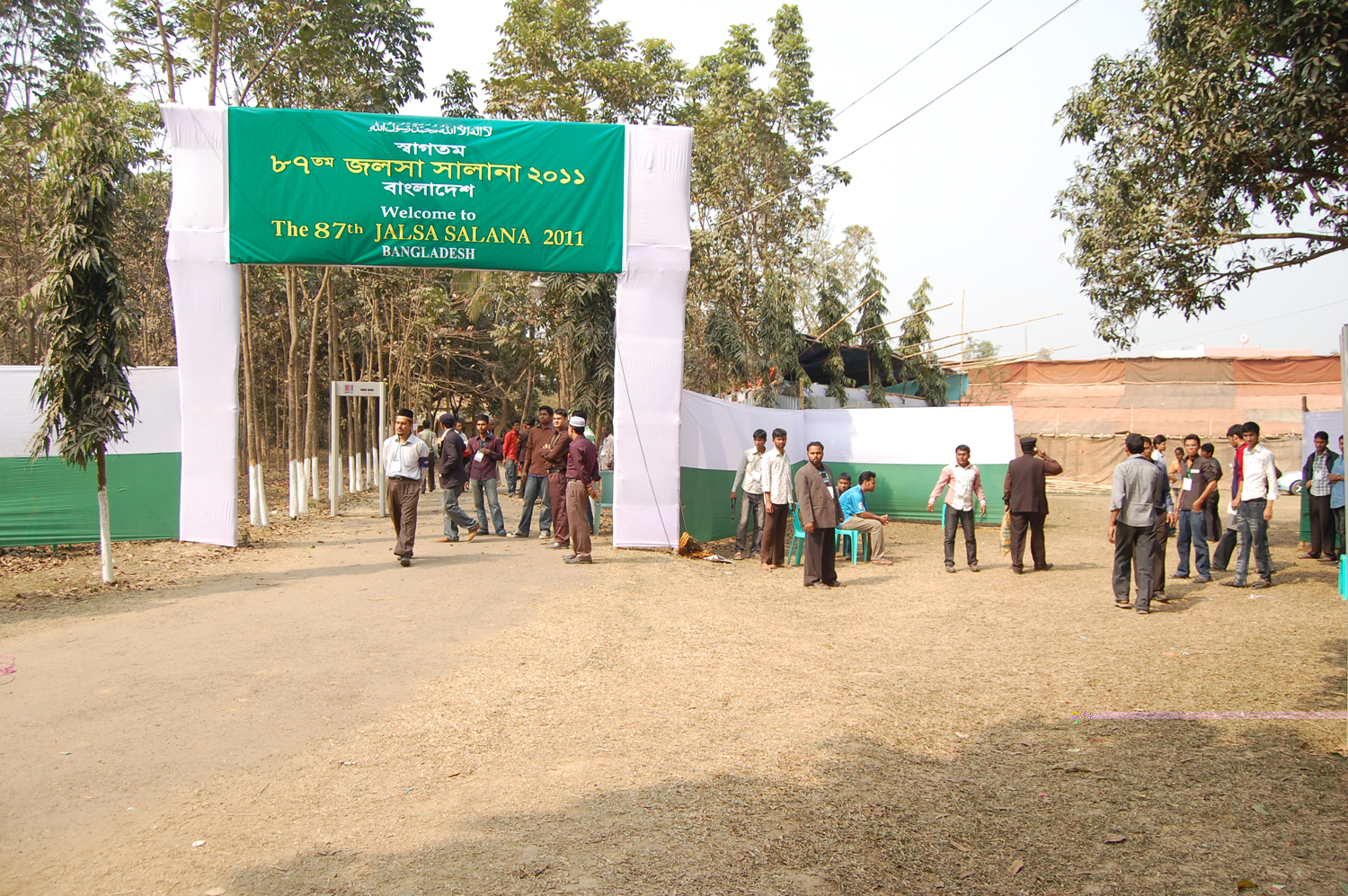
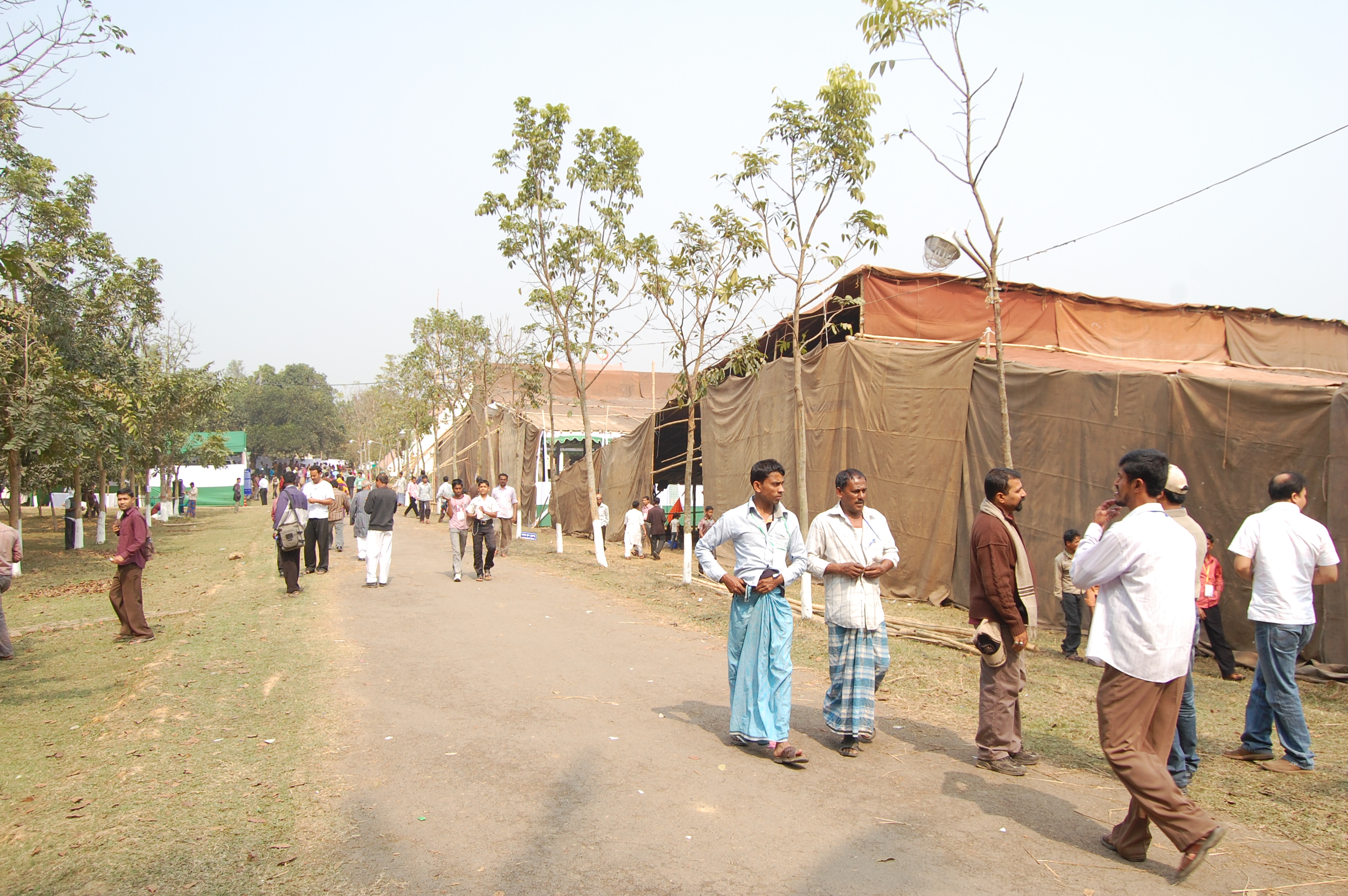
By the morning of 6 February, on the first day of the three day convention, around eight thousand followers arrived in the venue while three thousand people were about to join within a few hours (Please see the photo-1 and photo-2 of the venue here).

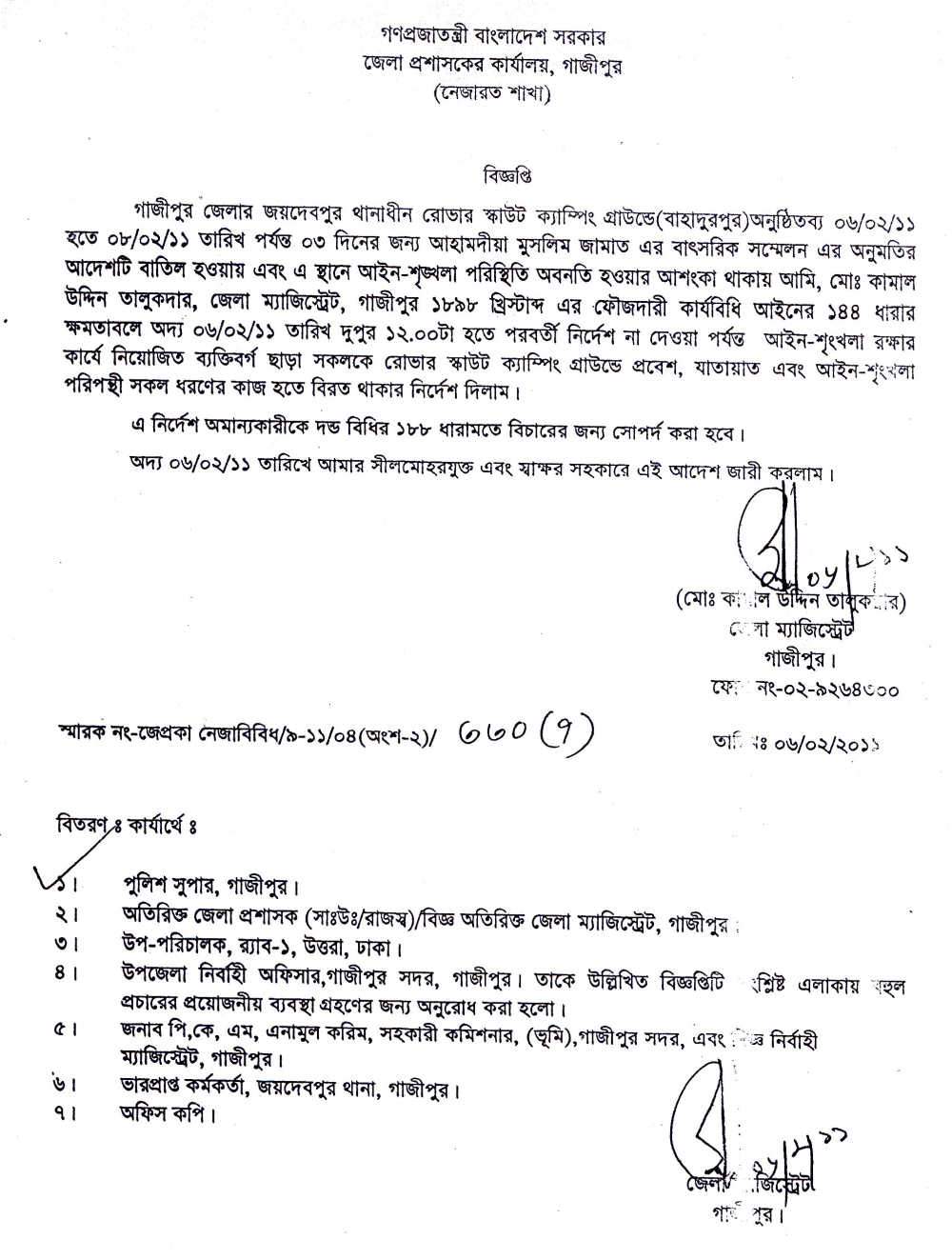
At around 10am an ASP named Mr. Zaman came in force to their venue and asked them to leave the place immediately by saying that the Office of the DC of Gazipur cancelled permission, which had been granted 13 days earlier, and imposed Section 144 (of the Code of Criminal Procedure-1898) following “objection from the local people” regarding the programme of the Ahmadiyya community (See photo here). The police, behaving very rudely, switched off the sound system during the ongoing ceremony.

In the midst of the police pressure for evacuating the venue, Mr. Motahar Ahamed Chowdhury, an executive committee member of the Ahmadiyya community, called on the cell phone no. +880173003489 of the DC, who confirmed that he cancelled the permission by saying that he was “surrounded” by Moulanas to cancel the permission.

A delegation of the Ahmadiyya community communicated with the top level decision-makers of the government, however, the influential authorities suggested the delegation to “fix another date” without helping the community to hold to its scheduled programme. The community leaders did not have an alternative but postponing their religious programme as a result of the administrative decision over the cancellation.

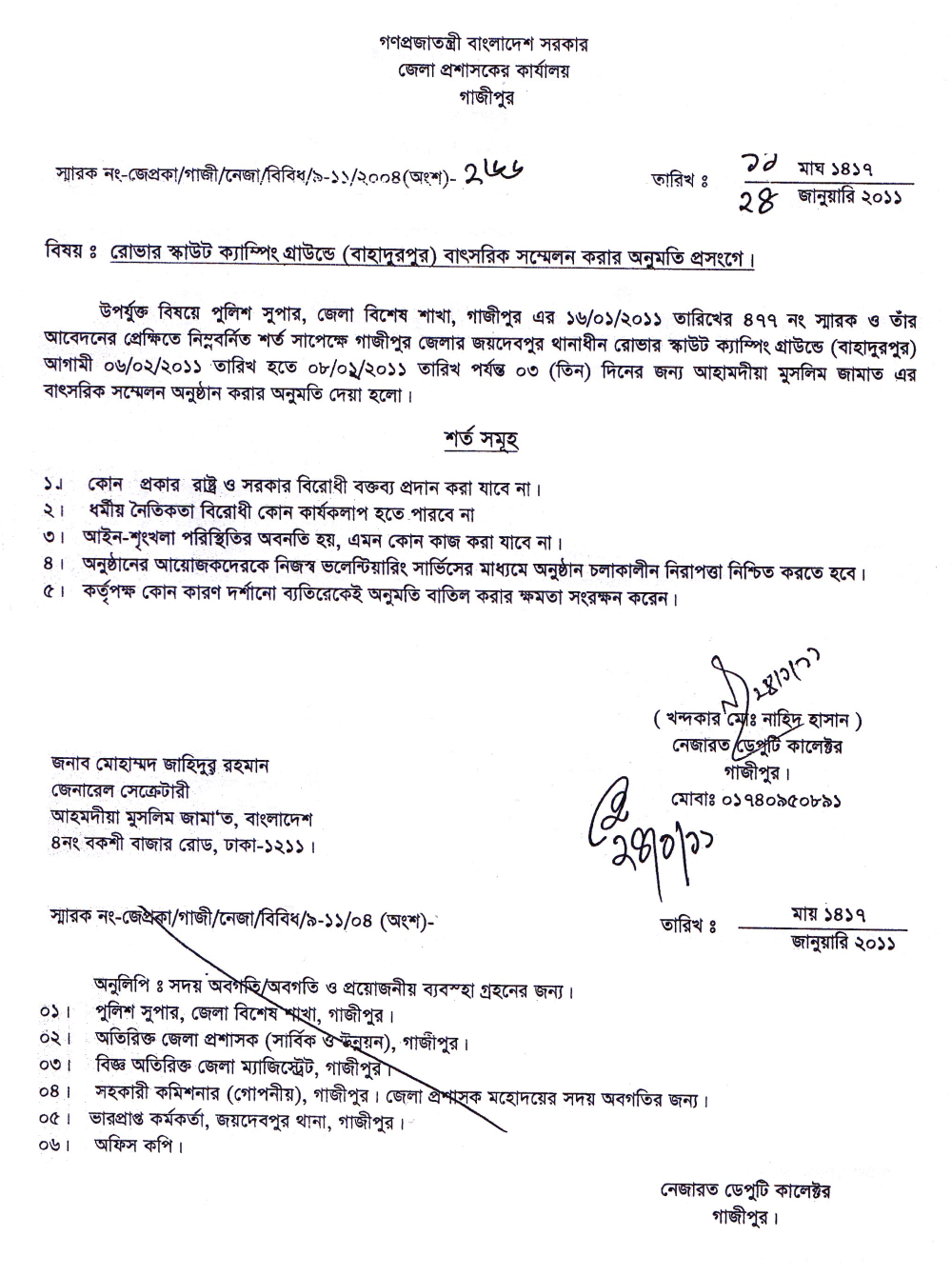
Following repeated requests from the Ahmadiyya community’s leaders to provide an official prove regarding the cancellation of their programme the Gazipur district administration gave two official circulars at around 5pm on 6 February. In the official circular, signed by the DC of Gazipur district Mr. Md. Kamal Uddin Talukder, who is the ex-officio District Magistrate, claimed that at 12 noon on 6 February cancelled the permission by the power bestowed upon him according to Section 144 of the Code of Criminal Procedure-1898. Mr. Md. Kamal Uddin Talukder claims that “due to the fear of deterioration of the law and order in the area all movement, entry, activities against the law and order was ordered banned until any further order”. The circular also mentioned that “any person except a member of the law-enforcing agent violates the order shall be liable for punishment under Section 188 of the Penal Code” (of 1860).

The Ahmadiyya community’s head of the convention organizing committee Mir Mobassher Ali claims in a written statement that the host community’s leaders followed due process to organise their annual convention. As a “non-political and peace-loving community” they selected an isolated place as their venue, which is less-populated and inaccessible to the outsiders, in order to hold comprehensive discussions on their religious norms, standards and feelings among the followers to be gathered from all parts of the country. The local people, including a Member of Parliament and other local government bodies, were cooperating with them and the atmosphere was absolutely non-violent on the eve of the convention. Mir Mobassher alleges that the Gazipur district administration cancelled the permission without any reasonable ground or visible symptom in favour of the cancellation as claimed that there was “fear of deterioration of the law and order in the area”.

The leaders of the community alleges that “the local administration surrendered to a segment of the fundamentalist” denying their constitutionally enshrined right. They claim that around fifty persons chanted slogans demanding the cancellation of the convention (Ahmadiyya) while five Mollahs met the DC and insisted that he impose Section 144 (of the Code of Criminal Procedure-1898).

ADDITIONAL INFORMATION:

Freedom of religion is protected as one of the fundamental rights of the citizens in the Constitution of Bangladesh. Article 41 (1) enshrines freedom of religion, as it reads:

“Subject to law, public order and morality -
(a)
every citizen has the right to profess, practice or propagate any religion;
(b)
every religious community or denomination has the right to establish, maintain and manage its religious institutions.”

Besides, any discrimination is prohibited in the constitution as fundamental rights. The Article 28 (1) of the Constitution of Bangladesh reads:

“The State shall not discriminate against any citizen on grounds only of religion, race caste, sex or place of birth”.

Bangladesh is a party to the International Covenant on Civil and Political Rights (ICCPR). According to Article 18 of the ICCPR,

“Subject to law, public order and morality -
“1.
Everyone shall have the right to freedom of thought, conscience and religion. This right shall include freedom to have or to adopt a religion or belief of his choice, and freedom, either individually or in community with others and in public or private, to manifest his religion or belief in worship, observance, practice and teaching.
2.
No one shall be subject to coercion which would impair his freedom to have or to adopt a religion or belief of his choice.
3.
Freedom to manifest one’s religion or beliefs may be subject only to such limitations as are prescribed by law and are necessary to protect public safety, order, health, or morals or the fundamental rights and freedoms of others.
4.
The States Parties to the present Covenant undertake to have respect for the liberty of parents and, when applicable, legal guardians to ensure the religious and moral education of their children in conformity with their own convictions.”

Moreover, the Constitution of Bangladesh in Article 37 enshrines the freedom of assembly, which reads:

“Every citizen shall have the right to assemble and to participate in public meetings and processions peacefully and without arms, subject to any reasonable restrictions imposed by law in the interests of public order health.”

According to Article 21 of the ICCPR:

“The right of peaceful assembly shall be recognized. No restrictions may be placed on the exercise of this right other than those imposed in conformity with the law and which are necessary in a democratic society in the interests of national security or public safety, public order (ordre public), the protection of public health or morals or the protection of the rights and freedoms of others.”

As a State-party to the ICCPR and due to specific provision of the country’s constitution Bangladesh has international and constitutional obligation to protect the rights of the religious minority communities.

ADDITIONAL COMMENT:

The action of the Gazipur district administration raises question as to why the authority suddenly cancelled the permission for holding the convention of the Ahmadiyya community, which initiated the process more than a month before the latter’s proposed programme. The authorities officially conduct an intelligence survey and verification regarding the proposed public meetings and gatherings prior to granting permission to the hosts of the programme. In this case if it is generally understood that the Gazipur district authority did their job following the required procedure, then the question of the credibility comes due to the sudden cancellation of the programme.

The police arrived at the venue at 10am to evacuate the venue occupied by the organizers and participants of the Ahmadiyya community by informing that the programme had been cancelled by the administration. On the contrary, the ex-officio District Magistrate of Gazipur claims in his official circular that “at 12 noon on 6 February” the order had been issued regarding restriction on entry, movement and gathering at the Rover Scout Camping ground until further order. It raises question that whether the authority intervened into the programme prior to passing the order or the police abused their power due any influence or not?

Moreover, the failure of the decision-making authorities of the government to ensure necessary security arrangements to allow the Ahmadiyya community to hold its pre-scheduled programme represents the mindset of the government regarding the freedom of the religious minority communities in the country.

SUGGESTED ACTION:
Please write to the authorities below asking that they immediately investigate into the case by competent officials and ensure the right to freedom of religion and assembly be guaranteed immediately. Those found to have been involved in the cancellation process without a reasonable ground must be prosecuted without delay. The community must be afforded adequate compensation and protection from any further harassment and threats from state and non-state agents.

Please note that the Asian Human Rights Commission has written separate letters to the UN Independent Expert on Minority Issues requesting his prompt interventions in this case.

To support this appeal, please click here: Send an Appeal Letter

SAMPLE LETTER:

Dear ___________,

BANGLADESH: Right to freedom of religion and public assembly of Ahmadiyya community must be protected

Name of victim: Ahmadiyya Muslim Jama’at, Bangladesh
Names of the alleged perpetrators:
1.
Mr. Md. Kamal Uddin Talukder, Deputy Commissioner of Gazipur district
2.
Mr. Nuruzzaman, Assistant Superintendent of Police (ASP) of the Joydevpur Circle, Gazipur district
4.
Mr. Zaman, Assistant Superintendent of Police (ASP), Gazipur district
5.
Officer-in-Charge (OC) of Joydevpur police station, Gazipur district
Date of incident: 6 February 2011
Place of incident: Rover Scout Camping Centre, Gazipur

I am writing to raise my voice regarding the cancellation of the 87th Annual Convention of the Ahmadiyya Muslim Jama’at, Bangladesh in a sudden manner on 6 February 2011 on the first day of a three day long programme. The actions of the Gazipur district and police administration appear to be a complete failure of the government to protect the freedom of religion and assembly without any substantial reason.

I have received information that the community booked a venue at the Rover Scouts Camping Centre’s ground at Bahadurpur, under the jurisdiction of the Joydevpur police station in Gazipur district. Following the procedure the community leaders sought permission from the Deputy Commissioner of the Gazipur district as the local administrative authority. They also requested the Inspector General of the Bangladesh Police to tighten the security of the venue during the convention.

On 24 January, the Office of the Deputy Commissioner (DC) of Gazipur district granted permission for the proposed convention at the booked venue at the Bahadurpur Rover Scout Camping Ground for the three day convention. The community made necessary payments as advance to the authorities of the venue after the permission from the Gazipur district administration for hosting the programme.

On 5 February, the senior leaders of the community met the DC Md. Kamal Uddin Talukder and the Additional Superintendent of Police Mr. Nuruzzaman of the Gazipur district in person and presented them the Holy Qura’an each. At that time the officials did not talk about any fear of deterioration of the law and order or objection of the local inhabitants.

By the morning of 6 February around eight thousand followers arrived in the venue while three thousand people were about to join within few hours. It has been alleged by the community that at around 10am an Assistant Superintendent of Police named Mr. Zaman came in force to their venue and asked them to leave the place immediately by saying that “the local inhabitants objected” the programme of the Ahmadiyya community. The police, behaving very rudely, switched off the sound system during the ongoing ceremony.

In the midst of the police pressure for evacuating the venue, Mr. Motahar Ahamed Chowdhury, an executive committee member of the Ahmadiyya community, called on the cell phone no. +880173003489 of the DC. I have been informed that the DC confirmed that he cancelled the permission by saying that he was “surrounded” by Moulanas to cancel the permission, which means that the administration exercises legal power arbitrarily instead of reasonable and lawful grounds.

The Asian Human Rights Commission has informed me that it observed that the police arrived at the venue at 10am to evacuate the venue occupied by the organizers and participants of the Ahmadiyya community by informing that the programme had been cancelled by the administration. On the contrary, the ex-officio District Magistrate of Gazipur claims in his official circular that “at 12 noon on 6 February” the order had been issued regarding restriction on entry, movement and gathering at the Rover Scout Camping ground until further order. It raises question that whether the authority intervened into the programme prior to passing the order or the police abused their power due any influence or not?

According to the information the selected venue for the programme was an isolated place, which is less-populated and inaccessible to the outsiders, in order to hold comprehensive discussions on their religious norms, standards and feelings among the followers to be gathered from all parts of the country. The local people, including Member of Parliament and other local government bodies, were cooperating with them and the atmosphere was non-violent on the eve of the convention.

I have learned that a delegation of the Ahmadiyya community communicated with the top level decision-makers of the government, however, the influential authorities suggested the delegation to “fix another date” without helping the community to hold to the scheduled programme.

I am aware that freedom of religion is protected as one of the fundamental rights of the citizens in the Constitution of Bangladesh under Article 41 (1).

I am also aware that any discrimination is prohibited in the constitution as fundamental rights according to Article 28 (1) of the Constitution of Bangladesh.

Bangladesh is a party to the International Covenant on Civil and Political Rights (ICCPR) and has international obligation to protect the right to freedom of thought, conscience and religion in compliance with Article 18 of the ICCPR.

While the Constitution of Bangladesh in Article 37 enshrines the freedom of assembly it very shocking that the government fails to protect the constitutional rights of its citizens as it also fails to fulfill its international obligation under Article 21 of the ICCPR.

The action of the Gazipur district administration raises question that why the authority suddenly cancelled the permission of holding the convention of the Ahmadiyya community, which initiated the process more than a month before the latter’s proposed programme. The authorities conduct intelligence survey and verification regarding the proposed public meetings and gatherings prior to granting permission to the hosts of the programme. In this case if it is generally understood that the Gazipur district authority did their job following the required procedure, then the question of the credibility comes due the cancellation of the programme all of a sudden.

Moreover, the failure of the decision-making authorities of the government to ensure necessary security arrangements to allow the Ahmadiyya community to hold its pre-scheduled programme represents the mindset of the government regarding the freedom of the religious minority communities in the country.

The authorities must initiate a thorough investigation regarding the matter and take necessary lawful actions against the alleged perpetrators immediately. The community must be compensated for the loss due to the governmental decisions and should immediately be allowed to hold their programmes with freedom in compliance with the international standards.

The religious tolerance is a must in a democracy, which Bangladesh claims to be before the international community, and the government can never deny its constitutional obligation to protect the right to freedom of religion and public assembly of all citizens of the country beyond any discrimination.

I look forward for your urgent intervention into this matter.

Yours sincerely,

______________________
PLEASE SEND YOUR LETTERS TO:

1. Mrs. Sheikh Hasina
Prime Minister
Government of the People's Republic of Bangladesh
Office of the Prime Minister
Tejgaon, Dhaka
BANGLADESH
Fax: +880 2 811 3244 / 3243 / 1015 / 1490
Tel: +880 2 882 816 079 / 988 8677
E-mail: pm@pmo.gov.bd or ps1topm@pmo.gov.bd or psecy@pmo.gov.bd

2. Mr. A. B. M. Khairul Haque
Chief Justice
Supreme Court of Bangladesh
Supreme Court Building
Ramna, Dhaka-1000
BANGLADESH
Fax: +880 2 956 5058 /+880 2 7161344
Tel: +880 2 956 2792
E-mail: chief@bdcom.com or supremec@bdcom.com

3. Barrister Shafique Ahmed
Minister
Ministry of Law, Justice & Parliamentary Affairs
Bangladesh Secretariat
Dhaka-1000
BANGLADESH
Tel: +880 2 7160627 (O)
Fax: +880 2 7168557 (O)
Email: info@minlaw.gov.bd

4. Ms. Sahara Khatun MP
Minister
Ministry of Home Affairs
Bangladesh Secretariat
Dhaka-1000
BANGLADESH
Tel: +880 2 7169069 (O)
Fax: +880 2 7160405, 880 2 7164788 (O)
E-mail: minister@mha.gov.bd

5. Mr. Mahbubey Alam
Attorney General of Bangladesh
Office of the Attorney General
Supreme Court Annex Building
Ramna, Dhaka-1000
BANGLADESH
Fax: +880 2 956 1568
Tel: +880 2 956 2868

6. Prof. Mizanur Rahman
Chairman
National Human Rights Commission
6/3 Lalmatia, Block-D
Dhaka-1207
BANGLADESH
Tel: +880 2 9137740
Fax: +880 2 9137743
E-mail: nhrc.bd@gmail.com

7. Mr. Hassan Mahmud Khandker
Inspector General of Police (IGP)
Bangladesh Police
Police Headquarters'
Fulbaria, Dhaka-1000
BANGLADESH
Fax: +880 2 956 3362 / 956 3363
Tel: +880 2 956 2054 / +880 2 717 6451 / +880 2 717 6677
E-mail: ig@police.gov.bd

8. Mr. Asaduzzaman Mian
Deputy Inspector General of Police (DIG)
Dhaka Range
Office of the DIG of Dhaka Range
Shegun Bagicha, Ramna, Dhaka-1000
BANGLADESH
Tel: +880 2 8353926 (O)
Fax: +880 2 8315838 (O)
E-mail: digdhaka@police.gov.bd

Thank you.

Urgent Appeals Programme
Asian Human Rights Commission (AHRC) (ua@ahrc.asia)

Monday, January 31, 2011

International community must intervene for the release of 85 Ahmadi refugees mistreated in Thailand

AHRC Logo
Asian Human Rights Commission — Statement
PAKISTAN/THAILAND: International community must intervene for the release of 85 Ahmadi refugees mistreated in Thailand
FOR IMMEDIATE RELEASE
AHRC-STM-019-2011
January 31, 2011

A Statement by the Asian Human Rights Commission
PAKISTAN/THAILAND: International community must intervene for the release of 85 Ahmadi refugees mistreated in Thailand

A group of 85 persons have been in detention in Bangkok since December 14, 2010 despite the fact that they are already registered as asylum seekers with the United Nations High Commissioner for Refugees in Bangkok. Of the 85 persons, 17 of them have reportedly had their applications accepted and have been granted refugee status. The group includes 38 women and girls, among whom there is at least one pregnant woman. It also includes at least 38 children, including 26 aged under 10 years. There is also a number of babies and elderly one of whom is 60 and is suffering high blood pressure and another person with a heart condition.…

The group belongs to the Ahmadiya community who fled from Pakistan to take shelter in Bangkok, Thailand, after undergoing continuous persecution and killings, particularly after the attacks of Muslim extremists on their two Mosques in May 2010 in which more than 100 persons were killed. They left their country to register as refugees with the UNHCR and seek asylum.

Sadly instead of the compassion and humanitarian assistance they urgently need they have instead suffered serious violations of their human rights. This may be seen in the treatment of those in the detention centre. The hygiene and sanitation conditions are appalling. Medical and nutrition facilities are almost non-existent. The detainees are being fed by the local Thai community and the sick children have little medical care. Women have been assaulted and the one who was pregnant was taken to hospital for delivery in handcuffs and heavy chains and kept in such restraint throughout her delivery. On return to the detention centre she was kept in chains and locked up in a toilet for a whole night.

They were all genuine refugees as defined in the UNHCR 1951 convention. They also had the right to flee to another country under article 14 of the UN Declaration on Human Rights. On registration they were all issued with a protection certificate as a proof of identity for the Thai Government to allow them to remain in the country until their asylum application was determined. However, in total disregard of the UNHCR convention and the international Code of Conduct, the Thai Police raided the lodgings of the refugees and arrested them, heavily fining them for overstaying in the country. Following this they were placed in a detention centre indefinitely.

It is extremely perturbing that the Thai government took this action against the members of a law abiding peaceful community who had fled from Pakistan where they were constantly being prosecuted under the blasphemy laws, the mandatory punishment for which is death.

All those arrested possessed protection certificates issued by the UNHCR which were supposed to be honoured by the Thai Government, even if it is not a signatory to the UNHCR 1951 convention. It is a situation that needs to be taken up seriously with the Thai government by the world community. How can the Thai Government, as a full member of the UN and the current president of the UNHRC, fail to cooperate with, support and honour the work of a UN organisation it has allowed to operate from its country.

The Asian Human Rights Commission is appalled by this situation urges the chairperson of United Nation Human Rights Council (UNHRC), the Swedish Parliament and the European Union to raise the issue with the Government of Thailand and take appropriate action for the immediate release and care of the detainees in Bangkok.

# # #

About AHRC: The Asian Human Rights Commission is a regional non-governmental organisation monitoring and lobbying human rights issues in Asia. The Hong Kong-based group was founded in 1984.

Wednesday, December 22, 2010

PAKISTAN: Statement of concern on the detention of refugees and asylum seekers of Pakistani origin in Thailand

AHRC Logo
Asian Human Rights Commission — Statement
PAKISTAN: Statement of concern on the detention of refugees and asylum seekers of Pakistani origin in Thailand

Dear friends,

We wish to share with you the following statement from 26 Human Rights Organisations.

Asian Human Rights Commission
Hong Kong

___________________________
FOR IMMEDIATE RELEASE
AHRC-FST-101-2010
December 22, 2010

A Statement from 26 Human Rights Organisations forwarded by the Asian Human Rights Commission

PAKISTAN: Statement of concern on the detention of refugees and asylum seekers of Pakistani origin in Thailand

Date: 15/12/2010

We, the undersigned, are deeply concerned and shocked at the arrest and detention of 86 refugees and asylum seekers of Pakistani origin in Bangkok. These vulnerable people were arrested from their homes in a dawn raid and taken to the Bangkok Detention Centre.

We have information that indicates that almost all the detainees have either been recognized as refugees by the UNHCR or have registration documents as their cases for Refugee Status Determination is under way. They all belong to the Ahmadiyya faith. The persecution of Ahmadis has been particularly severe and systematic in Pakistan, which is the only state to have officially declared the Ahmadis to be non-Muslims and are persecuted for professing their religion. The systematic persecution of the community in Pakistan is well documented.

This targeted detention by Thai officials of a particular community from their homes is particularly concerning and disturbing.

We have been informed that the detainees include more than 30 children who have been detained along with their parents.

Thailand has been generous and accommodating of those who have sought refuge within its borders. It has been compassionate and understanding of those in need of protection from persecution. These detentions however are a blot on the tolerant and compassionate image of Thailand.

Thailand is the President of the UN Human Rights Council, and it is highly unbecoming of the President of the Human Rights Coucil to sanction a flagrant violation of basic human rights. International human rights standards prohibit arbitrary, indefinite and non-reviewable detention. Refugees and asylum seekers should not be detained or penalized because they were compelled to enter a country irregularly or without proper documentation.

In addition, Thailand, which has signed the Convention on the Rights of the Child, must ensure the best interest of all children, that they are protected and are not detained for migration-related purposes in the first instance.

These refugees and asylum seekers are NOT criminals, they need to be protected and not victimised.

We strongly urge the Thai government to reconsider its ill advised action and release the 86 detainees.

We hope the Thai government will adhere to the high standards of compassion and human rights through the unconditional release of the detainees.

Signed by 26 human rights organisations as seen below:

 
Name Of organisation
Country
1.
Asylum Access
USA
2.
Asylum Access Thailand
Thailand
3.
Egyptian Foundation for Refugee Rights
Egypt
4.
Fahamu Refugee Programme
UK
5.
Forum Asia
Regional
6.
Glo Foundation
India
7.
Healthy Equity Initiatives
Malaysia
8.
Hong Kong Refugee Advice Centre Limited
Hong Kong, China SAR
9.
INHURED International
Nepal
10.
International Detention Coalition
International
11.
Khmer Kampuchaa Krom Human Rights Association (KKKHRA)
Cambodia
12.
Korean Public Interest Lawyers Group GONGGAM
Republic of Korea
13.
Libyan League for Human Rights
Libya
14.
Lutheran Immigration and Refugee Service
Unied States of America
15.
Mapendo International
USA
16.
NANCEN
South Korea
17.
New Zealand National Refugee Network
New Zealand
18.
OfERR
India
19.
Peoples Empowerment Foundation
Thailand
20.
PPR Nepal
Nepal
21.
Refugee Council of Australia
Australia
22.
Thai Committee for Refugees (TCR)
Thailand
23.
The Arakan Project
Regional
24.
the National Human Rights Society of Malaysia (HAKAM)
Malysia
25.
The other Media
India
26.
U.S. Committee for Refugees and immigrants (USCRI)
USA

# # #

About AHRC: The Asian Human Rights Commission is a regional non-governmental organisation monitoring and lobbying human rights issues in Asia. The Hong Kong-based group was founded in 1984. The above statement has only been forwarded by the AHRC.

URL: www.ahrchk.net/statements/mainfile.php/2010statements/3005/
 
^ Top of Page