Showing posts with label Defamation. Show all posts

Monday, January 31, 2011

International community must intervene for the release of 85 Ahmadi refugees mistreated in Thailand

AHRC Logo
Asian Human Rights Commission — Statement
PAKISTAN/THAILAND: International community must intervene for the release of 85 Ahmadi refugees mistreated in Thailand
FOR IMMEDIATE RELEASE
AHRC-STM-019-2011
January 31, 2011

A Statement by the Asian Human Rights Commission
PAKISTAN/THAILAND: International community must intervene for the release of 85 Ahmadi refugees mistreated in Thailand

A group of 85 persons have been in detention in Bangkok since December 14, 2010 despite the fact that they are already registered as asylum seekers with the United Nations High Commissioner for Refugees in Bangkok. Of the 85 persons, 17 of them have reportedly had their applications accepted and have been granted refugee status. The group includes 38 women and girls, among whom there is at least one pregnant woman. It also includes at least 38 children, including 26 aged under 10 years. There is also a number of babies and elderly one of whom is 60 and is suffering high blood pressure and another person with a heart condition.…

The group belongs to the Ahmadiya community who fled from Pakistan to take shelter in Bangkok, Thailand, after undergoing continuous persecution and killings, particularly after the attacks of Muslim extremists on their two Mosques in May 2010 in which more than 100 persons were killed. They left their country to register as refugees with the UNHCR and seek asylum.

Sadly instead of the compassion and humanitarian assistance they urgently need they have instead suffered serious violations of their human rights. This may be seen in the treatment of those in the detention centre. The hygiene and sanitation conditions are appalling. Medical and nutrition facilities are almost non-existent. The detainees are being fed by the local Thai community and the sick children have little medical care. Women have been assaulted and the one who was pregnant was taken to hospital for delivery in handcuffs and heavy chains and kept in such restraint throughout her delivery. On return to the detention centre she was kept in chains and locked up in a toilet for a whole night.

They were all genuine refugees as defined in the UNHCR 1951 convention. They also had the right to flee to another country under article 14 of the UN Declaration on Human Rights. On registration they were all issued with a protection certificate as a proof of identity for the Thai Government to allow them to remain in the country until their asylum application was determined. However, in total disregard of the UNHCR convention and the international Code of Conduct, the Thai Police raided the lodgings of the refugees and arrested them, heavily fining them for overstaying in the country. Following this they were placed in a detention centre indefinitely.

It is extremely perturbing that the Thai government took this action against the members of a law abiding peaceful community who had fled from Pakistan where they were constantly being prosecuted under the blasphemy laws, the mandatory punishment for which is death.

All those arrested possessed protection certificates issued by the UNHCR which were supposed to be honoured by the Thai Government, even if it is not a signatory to the UNHCR 1951 convention. It is a situation that needs to be taken up seriously with the Thai government by the world community. How can the Thai Government, as a full member of the UN and the current president of the UNHRC, fail to cooperate with, support and honour the work of a UN organisation it has allowed to operate from its country.

The Asian Human Rights Commission is appalled by this situation urges the chairperson of United Nation Human Rights Council (UNHRC), the Swedish Parliament and the European Union to raise the issue with the Government of Thailand and take appropriate action for the immediate release and care of the detainees in Bangkok.

# # #

About AHRC: The Asian Human Rights Commission is a regional non-governmental organisation monitoring and lobbying human rights issues in Asia. The Hong Kong-based group was founded in 1984.


Tuesday, December 21, 2010

PAKISTAN: Appeal to amend the Blasphemy Laws

AHRC Logo
Asian Human Rights Commission — Urgent Appeals
PAKISTAN: Blasphemy laws — Stopping the rot
ASIAN HUMAN RIGHTS COMMISSION — URGENT APPEALS PROGRAMME
Send an Appeal Letter
Urgent Appeal Case: AHRC-UAC-183-2010
21 December 2010

PAKISTAN: Appeal to amend the Blasphemy Laws

Dear friends,

The Asian Human Rights Commission (AHRC) has received information regarding the introduction of a private member’s bill to the National Assembly Secretariat that would end the death penalty for blasphemy, curtail abuse of the blasphemy laws for the purpose of harassing and victimising religious minorities and take steps to ensure equal protection for all religions under the law. The bill was introduced by People’s Party member of the National Assembly Ms. Sherry Rehman, former federal minister, who said, “The bill amends both the Pakistan Penal Code (PPC) and the Code of Criminal Procedure (CRPC), the two main sources of criminal law. The aim is to amend the codes to ensure protection of Pakistan’s minorities and vulnerable citizens, who routinely face judgments and verdicts in the lower courts where mob pressure is often mobilised to obtain a conviction.”

CASE NARRATIVE:

Following the Asia Bibi case, in which a Christian woman was sentenced to death under the blasphemy laws, Ms. Rehman has introduced an amendment to the Pakistan Penal Code and the Code of Criminal Procedure. The amendment would end the death penalty for blasphemy and take steps toward ensuring equal protections for religious minorities under the law in Pakistan.

Currently, extreme militant Muslim organisations may use blasphemy laws as a way to pressure and oppress religious minority groups. So far, the government has failed to protect the lives and property of the minority community. Although there is formal protection in place for religious minorities in the Constitution and although the blasphemy law has made it compulsory that no police officer below the rank of Superintendent of Police can investigate the charges, these statutes are rarely respected.

Religious minority groups in Pakistan remain vulnerable due to the continued use and abuse of blasphemy charges, despite section 295C of the Pakistan Penal Code. The police, who fail to follow the code and who operate under the directives of extremists in the community, must face strong legal action. Charges of blasphemy are still met with the death penalty in Pakistan.

The deliberate institutionalisation of Islam’s status as protected and predominant promoted the perpetuation of religious intolerance by Islamic fundamentalists. According to data collected through different sources at least 1030 persons were charged under these anti-blasphemy clauses from 1986 to August 2009, while over 30 persons were killed extra-judicially by angry mobs or individuals.

Militant Muslim organisations are using blasphemy as a tool as the best way to keep religious minority groups under pressure and even forcibly take land. The State is failing to protect the lives and property of the minority community.

In August 2009 after the attack on the Christian population in Gojra, Punjab province, in which seven Christians were burnt to death, the Prime Minister Yousuf Raza Gilani again announced plans to review “laws detrimental to religious harmony” in a committee comprising of constitutional experts, the minister for minorities, the religious affairs minister and other representatives, but the government has again hesitated to initiate change due to their unwillingness to antagonize fundamentalist groups.

Recent cases in Pakistan suggest a criminal collaboration among government authorities, police, and fundamentalist organisations, in which the Muslim clergy, on receiving bribes from land-grabbers in the National and Provincial Assemblies, colluded with local police to expropriate land owned by minorities by bringing allegations of blasphemy against them. The situation is especially worrying in Punjab province after the formation of the PML-N government, which has a record of intolerant policies against Christians and Ahmadis in particular.

SUGGESTED ACTION:

The introduction of an amendment in the National Assembly that would limit the abuse of blasphemy laws is a major development in Pakistan and must be supported strongly. Please write letters to legislators, officials, and civil society leaders urging them to support and lobby for this law.

The AHRC is writing a separate letter to the UN Special Rapporteur on the Question of religious minorities calling for his intervention into the misuse of blasphemy law.

To support this appeal, please click here: Send an Appeal Letter

SAMPLE LETTER:

Dear __________,

PAKISTAN: Appeal to amend the Blasphemy laws

I am writing to voice my deep concern regarding the misuse of blasphemy laws and to express strong support for the private member’s bill introduced by the People’s Party MNA, Ms. Sherry Rehman that would amend blasphemy laws to end the death penalty and rationalise punishments under the blasphemy laws.

According to the data I have collected at least 1030 persons were charged under these anti-blasphemy clauses from 1986 to August 2009, while over 30 persons were killed extra-judicially by angry mobs or individuals.

I am appalled by the political expediency of the government and ruling party who do not want to take a firm stand on the misuse of the blasphemy law but instead is trying to sweep the basic issue of freedom of expression and discrimination on the basis of religion under the carpet. The deliberate institutionalisation of Islam’s status as protected and predominant promoted the perpetuation of religious intolerance by Islamic fundamentalists.

I am shocked to know that militant Muslim organisations are using blasphemy as a tool as the best way to keep religious minority groups under pressure and even forcibly take land. The State is failing to protect the lives and property of the minority community. The blasphemy law has made it compulsory that no police officer below the level of Superintendent of Police can investigate the charges but this is rarely adhered to.

I urge you to repeal the Blasphemy law or at least amend it by deleting section 295-c from the Pakistan Penal Code (PPC) (the death sentence). I hereby fully support the initiative of Ms. Sherry Rehman to amend the blasphemy law by submitting a private bill in the national assembly.

I also urge the government, the ruling political parties, the members of the national assemblies and senate to pass the amendment in Blasphemy law introduced in a private bill introduced by MNA Sherry Rehman.

I look forward to your prompt action to provide substantial and comprehensive policy responses on the freedom of expression, protection of religious minority groups and misuse of blasphemy law.

Yours sincerely,

___________________
PLEASE SEND YOUR LETTERS TO:

1. Mr. Asif Ali Zardari
President of Pakistan
President’s Secretariat
Islamabad
PAKISTAN
Tel: +92 51 9204801 +92 51 9204801 +51 9214171
Fax: +92 51 9207458
Email: publicmail@president.gov.pk

2.Mr. Syed Yousaf Raza Gilani
Prime Minister of Pakistan
Prime Minister House
Islamabad
PAKISTAN
Fax: + 92 51 9221596
E-mail: secretary@cabinet.gov.pk, pspm@pmsectt.gov.pk

3. Dr. Fehmida Mirza
Speaker, National Assembly of Pakistan
Parliament house, Islamabad,
PAKISTAN
Email: speaker@na.gov.pk
Tel. No. +92 51 920 3734 +92 51 922 1082
Fax: +92 51 920 4673 / +92 51 922 1106

4.Dr. Zaheeruddin Babar Awan
Federal Minister
Ministry of Law, Justice & Parliamentary Affairs
Government of Pakistan,
R block, Pak Secretariat
Islamabad
PAKISTAN
Tel: 92-51- 9202712 FAX: 92-51-9202541
E-mail: minister@molaw.gov.pk

5. Mr. Syed Mumtaz Alam Gillani
Federal Minister for Human Rights
Ministry of Human Rights
Old US AID Building
Ata Turk Avenue
G-5, Islamabad
PAKISTAN
Fax: +92 51 9204108
E-mail: sarfaraz_yousuf@yahoo.com

6. Dr. Faqir Hussain
Registrar
Supreme Court of Pakistan
Constitution Avenue, Islamabad
PAKISTAN
Fax: + 92 51 9213452
E-mail: mail@supremecourt.gov.pk

Thank you.

Urgent Appeals Programme
Asian Human Rights Commission (ua@ahrc.asia)

URL: www.ahrchk.net/ua/mainfile.php/2010/3614/

Tuesday, November 16, 2010

PAKISTAN: Blasphemy laws — Stopping the rot

AHRC Logo
Asian Human Rights Commission — Statement
PAKISTAN: Blasphemy laws — Stopping the rot
FOR PUBLICATION
AHRC-ETC-040-2010
November 16, 2010
An article by Ms. Beena Sarwar published by the Asian Human Rights Commission
PAKISTAN: Blasphemy laws — Stopping the rot

Beena Sarwar

The introspection, debate and outrage generated a month ago by the attacks on two villages in Gojra on July 31 and Aug 1 may be out of public sight, as happened all too often in the past, but the nine people murdered and the homes and churches gutted are not out of mind. Neither is Najeeb Zafar, the young factory owner in Sheikhupura, Punjab, killed on August 4 for allegedly desecrating Quranic verses when he removed a calendar from a wall. The following day, police in Sanghar, Sindh, saved a similarly accused 60-year old woman, Akhtari Malkani by taking her in protective custody.

On the surface, these incidents were motivated by passions aroused by allegations of blasphemy or disrespect to the holy Quran. These criminal charges can be punishable by death – but this is a punishment for the state to administer, not private citizens. The real motivation remains settling scores, a pattern identified over twenty years ago when the first ‘blasphemy murder’ took place; that of the Punjabi poet and teacher Naiamat Ahmar in Faisalabad in 1992.

The pattern involves one party targeting another, alleging blasphemy while the real motives are personal enmity or economic rivalry as Zubeida Mustafa noted in a recent column. The accused tend to be poor people who have improved their lot in life, triggering jealousies. Accusations of blasphemy are used to justify the violence. Ms Mustafa also pointed to (mis) education as a factor that makes it easy, when such an allegation is levelled, to rabble-rouse a mob into violence.

The three recent cases bear out these observations. In Gojra, evidence points to a pre-meditated plan aimed at clearing out the village from the area, while the administration turned a deaf ear to the warnings and pleas of observers. A disgruntled employee accused Najeeb Zafar of disrespecting the Quran; the unarmed police sent to protect him could only watch as the mob set upon him. Akhtari Malkani had a monetary dispute with her accuser but disappeared without registering an FIR. She says she threw a book of accounts on the floor, not the holy Quran.

Last April, there was the horrific case of Jagdish Kumar, the young Hindu factory worker in Karachi, lynched by co-workers for alleged blasphemy. The real reason appears to have been personal enmity based on Kumar’s reported association with a Muslim girl.

Such cases have been taking place since the option of life imprisonment under Section 295-C of the Pakistan Penal Code (“Use of derogatory remarks, etc., in respect of the Holy Prophet”), the ‘blasphemy law’, introduced by Gen. Ziaul Haq in 1985 was amended by default in 1992 to make death the mandatory punishment for anyone convicted under this law. Certainly, the law does not provide for these extra-judicial murders. However, it is equally true no such murder took place until death was made the mandatory punishment for 295-C convictions.

People of all faiths, including Muslims (remember the Muslim religious scholar lynched in Gujranwala, 1994?), have been accused and attacked since then. Investigations into blasphemy accusations indicate pre-meditation rather than the heat of passion. Those who commit the violence may be arrested but none has ever been punished. Even the Inquiry Commission Tribunal headed by Justice Tanvir A. Khan of the Lahore High Court examining the destruction of Christian homes and churches in Shantinagar, 1997, was quashed (the Punjab Chief Minister then too was Shahbaz Sharif; will he rise to the occasion this time?).

The public defamation of blasphemy victims is a key tactic preceding such attacks – posters and mosque loudspeakers are routinely used for this.

Naimat Ahmar was killed after posters cropped up warning people that a Christian teacher (Ahmar) was leading their children astray. A handwritten copy in Urdu that I saw at the time warned Muslims that Ahmar was misleading students, telling them that the Prophet (pbuh) ‘stole’ goats – ‘bakriyaN charaya kartey thay’. Replace ‘churaya’ (stole) with ‘charaya’ (grazed) and it’s apparent what Ahmar probably said.

A youngster from the militant outfit Anjuman-e-Sipah-e-Sahaba (later changed to Sipah-e-Sahaba Pakistan) accosted Ahmar outside the Education Department in Faisalabad and knifed him to death. Investigations revealed that the murderer’s uncle wanted Ahmar’s job in the Education Department. The allegation of blasphemy alone was enough to ‘justify’ the murder. Policemen at the lockup housing the murderer, garlanded by his ASS (sic) mentors, embraced and kissed him. The ASS was, in fact, behind just about every ‘blasphemy case’ during the 1990s – the SSP, now banned, is believed to be behind the Gojra carnage as well.

Blasphemy accused are attacked and murdered even in prisons and police lock-ups, sometimes by the very people who are supposed to protect them. In 2004 a police constable attacked Samuel Masih, 27, a prisoner under trial at Kot Lakhpat jail with a brick-cutter. Samuel had been charged with spitting at the wall of a mosque (Section 295, “defiling a place of worship with the intent of insulting the religion of any class”, maximum sentence up to two years). He succumbed to his injuries the following day. “I wanted to earn a place in heaven by killing him,” Ali reportedly confessed.

The fanatical and misguided mindset cultivated over the past few decades will not disappear by simply repealing 295-C, although this must be done. Embarking on a sensible education policy is also a long-term step that must be taken to stop the rot. What must be an immediate priority is the strict enforcement of law and order.

Those inciting violence and murder from mosque loudspeakers and public accusations, true or false, must be held culpable, charged, tried and punished according to law. This also goes for those who desecrate a holy book or symbol of any religion. There must be accountability for those who allow these murders to take place. The political leadership is responsible for providing police with the training, means and the orders to prevent such violence. Finally, religion cannot be used or allowed to justify murder.

The views shared in this article do not necessarily reflect those of the AHRC, and the AHRC takes no responsibility for them.

About the Author:
The writer is a freelance journalist and documentary filmmaker. Ms. Sarwar’s email address is beena.sarwar@gmail.com


# # #

About AHRC: The Asian Human Rights Commission is a regional non-governmental organisation monitoring and lobbying human rights issues in Asia. The Hong Kong-based group was founded in 1984.

Monday, August 23, 2010

In defense of Islam, vigilante justice in Indonesia

Global Post, USA
Indonesia
Home / Asia / Indonesia
--
In defense of Islam, vigilante justice in Indonesia
Indonesian government sits idly by as Islamic Defender's Front, called thugs by most, runs amok.
By Sara Schonhardt — Special to GlobalPost
Published: August 23, 2010 06:44 ET in Asia
--
Indonesian Islamic Defenders Front (FPI) leader Rizieq Shihab gestures as he delivers a speech to his supporters inside the court room after his trial in Jakarta on Oct. 30, 2008. (Adek Berry/AFP/Getty Images)

JAKARTA, Indonesia — They call themselves the Islamic Defenders Front and they say their mission is to stamp out sinful acts and to protect the poor and marginalized.

But the majority of Indonesians in this moderate Muslim nation call them thugs. They say the FPI, as they are known here, are tarnishing the image of both Islam and Indonesia.

In only the last few months the group has been accused of attacking churches, raiding suspected communist conferences and waging assaults against minority religions.

A showdown took place in the Jakarta suburb of Bekasi earlier this month when a stick-wielding mob of FPI members attacked and beat around 20 members of the Batak Christian Protestant Church.

And through it all, Indonesia’s secular government has largely stood idly by and, in some cases, offered support. In most cases the country’s leaders have remained silent, even as FPI attacks grow increasingly frequent and increasingly violent.

The FPI argues that the Batak congregation is worshipping without the proper government permits and is threatening Muslim society by proselytizing.

Bonar Tigor Naipospos, vice chairman of the Setara Institute, which works to promote democracy and peace, said the FPI is using the threat of Christianization to strengthen their position, to gain sympathy and spread their ideology to their followers.

According to a recent study by the institute, acts of violence against Christians are on the rise, which could signal that religious tensions, which always seem to be simmering in Indonesia, are coming to a boil.

“Some politicians in the West use Indonesia as a model of moderate Islam, but behind the surface the embryo of intolerance still exists,” Naipospos said. “And if the Indonesian government doesn’t do something, this embryo will get stronger.”

During an Islamic congress in June, FPI leader Habib Rizieq said evangelicals were Christianizing Muslims by offering them social services like free health care and education. They were also performing hypnosis and constructing illegal churches, he said.

Murhali Barda, the leader of the FPI’s Bekasi branch, had been preparing for a clash.

“My Muslim brothers…!!! Come to Ciketing..!!” He wrote on his Facebook page the day before the attack. “Help our brothers that were walked all over by the Batak people … church business people, moneylenders, pig and dog eaters!”

Angry tweets began trending on Twitter after news of the attack broke, just one among many in recent weeks. Forced church closures and protests against community activity, such as the butchering of pigs, have also made recent headlines.

The occasion forced Indonesian President Susilo Bambang Yudhoyono to break his silence on FPI’s attacks. The president, however, said only that anarchic behavior would not be permitted during the Islamic holy month of Ramadan.

“But it is permitted,” said Sidney Jones, a senior analyst at the International Crisis Group, which monitors security issues. “The easiest thing would be to arrest the perpetrators, and it’s not clear to me why they have refrained from doing so.”

In 2008, following an assault on a peaceful rally in support of religious freedom, police did arrest nearly 60 FPI members, including Rizieq. The FPI kingpin was later sentenced to 18 months in prison for helping organize the attack against the supporters of Ahmadiyah, an Islamic sect many conservative Muslims consider heretical since they refuse to accept Mohammad as Islam’s final prophet.

But the arrests were mostly a response to public outrage. And while the government stopped short of completely banning the Ahmadis as the FPI had demanded, it did issue a ministerial decree prohibiting Ahmadis from practicing their faith or proselytizing in public, appearing to again side with religious hardliners instead of religious pluralists.

Jones said it was unacceptable that the Indonesian police and military have stood by and let these attacks continue. Individuals in the FPI should be prosecuted for assault, but the police should also be held responsible, she said.

Both Jakarta’s governor and one of its police chiefs attended the FPI’s 12th-anniversary celebration earlier this month in what is thought to have been an attempt to enlist the group’s material, and perhaps political, support.

And even though the Religious Affairs Ministry in March named the FPI among nearly 70 potentially illegal sects because its actions deviated from the country’s accepted Islamic teachings, the government still took no action against the group.

Started with police and military backing in 1998, the FPI was originally part of a group of street-level militias aimed at countering the student-led, democratic reform movement and providing security to then-president B.J. Habibie. The FPI has since gained notoriety for conducting vigilante crackdowns on “un-Islamic” activities, which, before recently, usually only involved aggressive raids on bars and nightclubs during Ramadan.

FPI members say their actions are not antagonistic to Islam and that they are merely upholding their duty to rid society of sin.

“FPI has one mission and one vision, and that is to eliminate tyranny and to enforce truth and justice,” said H. Chep Hernawan, head of the Islamic Reform Movement. “Our ulemas [Muslim scholars] and Muslim warriors are the ones who fought against the colonizers. So, I think it’s normal if we want to enforce Islamic law.”

The FPI are not religious crusaders, however. Ian Wilson, a researcher of radical groups-cum-gangs at Australia’s Murdock University, said its members frame issues in religious terms but are not on the same page ideologically as Islamic terrorist organizations like Jemaah Islamiyah.

“Their whole rationale is to stir up trouble … to be in the public eye,” he said.

Barda, who wears a wrap-around skirt and white skullcap often associated with conservative Islam, said FPI’s activities in Bekasi are based on the wishes of the community, which it works to coordinate and strengthen against people who might pose threats, namely the Christian Batak, an ethnic group originally from the neighboring island of Sumatra.

For more than a month the Batak congregation has been praying in a field in Ciketing, on the outskirts of Jakarta, where demonstrators meet them each Sunday demanding they cease prayers and leave the area.

Christian groups must have the consent of the surrounding community to establish a place of worship, and the hardliners say they are fighting the Batak because they refuse to abide by the law.

But when asked about rumors of declining membership numbers among the FPI, Barda, who likes speaking in idioms, only laughed. He said all he needs to do is produce a magnet and the nails will come to him.

“We are small, but we have many supporters,” he said.

Copyright 2010 GlobalPost — International News

Tuesday, August 10, 2010

Indonesia: Orders to close Ahmadiyya Mosque in Manis Lor and attacks by extremists

Manis Lor is a small village, located 45KM south of Cirebon city in Kuningan Regency, with a population of approximately 4,350 out of which 3,000 (70%) are Ahmadis. They have one big and seven small Mosques in Village.

H. Aang Hamid Suganda, Head of Kuningan Regent, vide Warrant Number: 451.2/2065/SAT.POL.PP dated July 22, 2010, ordered Civil Order Police Chief Indra Purwantoro to close and seal all eight Mosques belonging to Ahmadiyah Muslim sect in Manis Lor. This order is in clear violation of constitution, which guarantees freedom of worship to all its citizens.
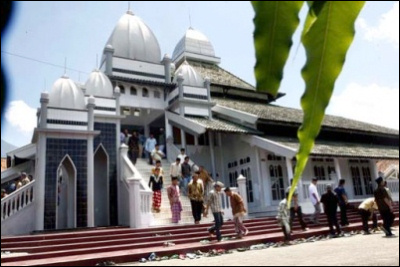
In the spotlight: People exit An-Nur Mosque, which belongs to the Ahmadiyah sect, after Friday prayer in Manis Lor village in Kuningan, West Java, on Friday.JP/R. Berto Wedhatama

In the spotlight: People exit An-Nur Mosque, which belongs to the Ahmadiyah sect, after Friday prayer in Manis Lor village in Kuningan, West Java, on Friday.JP/R. Berto Wedhatama
An-Nur Mosque -JP/R. Berto Wedhatama
Reports are that Aang Hamid’s orders are in line with his promise made during his 2008 election campaign to hardliner extremists group. Some analysts also pointed out that religious extremist organization had pressurized him recently to take strict action and stop all Ahmadiyya activities in region.

Acting on orders Civil Order Police Chief tried to seal the Mosques on July 26, 2010, and met with some resistance from Ahmadiyya Muslims, who demanded a valid reason for closure of Mosques and dialogue to settle the issue. An NGO, Fahmina Institute, recorded the whole event. The Warrant and chronicle is reproduced below :-

Image of Warrant issued by Head of Kuningan Regent
Warrant by Regent of Kuningan
REGENT OF KUNINGAN
W  A   R   R  A  N  T
Number: 451.2/2065/SAT.POL.PP
Legal ground : 
1.
Law number 32 year 2004 article 27 clause 1 letter (c). That a head of district is responsible to keep the people safe and in order.
2.
Recommendation of Indonesian Cleric Council (MUI) of Kuningan Regency number 38/MUI-Kab/VI/2010 on June 24, 2010.
3.
Aspirations from Cleric and Islamic Organizations of Kuningan on June 1, 2010 at Syiarul Islam Mosque and on June 14, 2010 at Meeting Room of Jabar Banten Bank in Kuningan.
Name : 
H. AANG HAMID SUGANDA
Title : 
Regent of Kuningan
.
I N S T R U C T S :
Name : 
INDRA PURWANTORO, SAP
Civil Service ID : 
19670519 198603 1 002
Position/rank : 
Supervisor (IVa)
Title : 
Chief of Civil Order Police Unit of Kuningan
To : 
1.
Undertake the closure/sealing of eight Ahmadiyya function buildings in Manislor village, Jalaksana Sub district with provisions below:
Day/Date :
Monday/ July 26, 2010
Time :
09.00 am till it is finished
Place :
Manislor village, Jalaksana Sub district, Kuningan
2.
Have coordination with related security officers.
3.
Keep the tranquility and public order.
To be executed with a deep sense of responsibility.
Decided at :
KUNINGAN
Dated On :
July 23, 2010
REGENT OF KUNINGAN
H. AANG HAMID SUGANDA
Fahmina Institute - Cirebon

The Seal and Attack on Ahmadiyya Manis in Lor — Eyewitness Account
Editors :
Alimah and Maman Rohman on July 30, 2010
Location :
Manis Lor Village, Jalaksana, Kuningan
Date/Time :
Monday - Thursday (July 26-29, 2010)
Monday, July 26, 2010
Local government planned to seal the Ahmadiyya mosques at Manis Lor Village, Jalaksana District, Kuningan Regency. The process was backed by Satpol PP, Kuningan Regency Police Resort.
The operation failed after the Ahmadiyya Security Commission, Deden Sujana engaged in dialogue with the local government and Kuningan Police Resort officials. Deden indicated that this order to seal the Mosques was not to be executed immediately but there has to be a dialogue first between the local government and Ahmadiyya.
The order to seal Mosques relies on a Letter (SK) from Kuningan Regent Number 451.2/2065/Satpol PP which mentions that “Eight Mosques belongs to Ahmadiyya Jamaat are to be closed and sealed in Manis Lor Village”. This also relies on Majelis Ulama Indonesia’s recommendation Number 38/MUI-Kab/VI/2010 dated June 24, 2010.
A riot took place once but it was soon dispersed by Kuningan Police Resort.
Tuesday, July 27, 2010
Sector Police alongwith Police Resort of Kuningan Regency strictly guarded houses and Mosques belonging to Ahmadiyya Community in Manis Lor against anticipated attacks which failed earlier on Monday (7/26/2010).
Wednesday, July 28, 2010
Local authorities backed by Satpol PP made another attempt to seal the Ahmadiyya Mosque in Manis Lor.
According to one representative of Ahmadiyya Community, the seal was placed around 06.30am (GMT +07:00) but a Police representative from Kuningan Police Resort on patrol duty in Manis Lor denied and informed tha the seal could not be placed due to resistance from Ahmadiyya Jamaat who prevent and protect their Mosques.
Thursday, July 29, 2010
Massive attack on Ahmadiyya in Manis Lor.
Eyewitness Account of attack:
  • In the morning around 08.00 AM, the Muslims belonging to various factions of West Java (some of them were from outside of west java such as Wonosobo and other areas) conducted Istighosah (massive prayer) at Al-Huda Mosque, located about 500 meters from Ahmadiyya Mosque in Manis Lor.
  • About one hundred persons belonging to varioud factions, mostly radical Muslims, gathered in front of the Al-Huda Mosque. From their appearance and dresses they could be recognized and appeared to be affiliated with Majlis Mujahidin (mainly from Cirebon), GAMAS, GRANAT, FPI, some of male Santri from Islamic boarding schools (Pesantren) Kuningan, leader of Muslim (kyai), communities outside west java, and civilian around Kuningan.
  • Most of the Jamaa members alongwith Chairman of Police Resort and Regent were standing in front of the Al-Huda Mosque while hearing orations from Muslim cleric. Under the burning sun, with the fire spirit, they looked ready for one aim only i.e. to attack the Ahmadiyya’s. They called themselves as a ‘Jihad Team’. It was clear and evident, from the beginning, that GAMAS had organized and provoked the attack whose members, wearing black uniforms, were ready with their hitting weapon (stringer made from wood).
  • Istighosah started with a speech from clerics of Kuningan Regency. They belonged to Nahdlatul Ulama, Muhammadiyah, Indonesian Cleric Council (MUI) Kuningan Regency, Chairman of Police Resort and Kuningan Regent. Most of the speech was about denouncing the Ahmadiyya sectand wows to eliminate Ahmadiyya from the region. (According to Fahmina watch, the Istighosah appeared to be only for preparatins to attack Ahmadiyya as it was full with orations denouncing Ahmadiyya.)
  • Around 10.30am, Istighosah ended with prayers. Right after that the attack started by the Istighosah jamaa, who form the very beginning, has named themselves as Jihad Force on Ahmadiyya Jamaat.
  • The attack, conducted by Jihad Army, continued by pelting big stones, bricks and Acid Gas. The Police struggled to prevent the Jihad Army from crossing the border line that had been made earlier by Police but failed. Jihad Army succeeded in crossing the border line at 11.20am.
  • The Jihad Army suffered somr injuries due to stones coming from their members who were behind them as well as the stones thrown by the Ahmadiyya’s counter-attack defending themselves. Also there were some injuries from the Police Department.
  • By 12.00 O’clock, the Jihad Force was still pushing itsway to upside area where the Ahmadiyya gathered).
  • From 12.30 to 13.00 hrs half of the Jihad Force, calmed down by Police, was present upside while othef half got some rest and prayed at the Mosque. Some of them were standing in the middle of the road. After Police successfully ordered them to go downside, they still gathered at the downside re-grouping themselves to prepare for another attack.
  • At 13.11 hrs, the Jihad Force, which consisted of Majlis Mujahidin (MM) Cirebon, GAMAS and others, renewed their attacks twice. Although they almost broke the border-line defense of the Police but failed because the Police, by then, got reinforcements and a Mobile Brigade (Brimob) was moved behind the them.
  • Even though Police foiled the repeated attempts of Jihad Force, they did not disperse. They were still trying to empower themselves standing in front of the Mosque and listening orations from their coordinator. That continued till 17.30 hrs.
  • At 17.30 hrs they tryied to attack Ahmadiyya again and were now face to face with The Mobile Brigade Police which once again foiled their attempt.
According to Fahmina ‘what we heared during the watch, the conversation between some of the honorable person and Heads of Radical Muslims such as Majlis Mujahidin and FPI, that they will carry out another attack again on Friday (July 30, 2010). The attack will be carried out after Friday Prayers with more militants of Jihad Army.’ They said that the plan is a result of direct instructiond from Habib Riziq.

Friday, August 6, 2010

Intimidation Picks Up Ahead of Holy Month

Jakarta Globe, Indonesia
Indonesia
Intimidation Picks Up Ahead of Holy Month
Nivell Rayda,Ulma Haryanto & Armando Siahaan | August 06, 2010

Indonesia. As Muslims nationwide count down the days until the start of the holy month of Ramadan, so are followers of Ahmadiyah, but for a very different reason.

Members of the controversial sect are currently living in fear of a repeat attack by hard-liners in the lead-up to Ramadan, one member told the Jakarta Globe on Thursday.

“We have received numerous text messages and there are also public statements released by the FPI demanding that we shut down our activities at least two days before Ramadan, or face the consequences,” Firdaus Mubarik said, referring to the Islamic Defenders Front.

“We’re afraid that they’ll launch an attack against Ahmadiyah mosques and members.

“This has occurred before. This happens in every major city across the country. They conduct raids against us and our mosques right before Ramadan each year.”

Ramadan is expected to begin on Wednesday.

Violent scenes erupted last week at Manis Lor village in Kuningan, West Java, when police and public order officers sealed off Ahmadiyah mosques in the area.

The closures, however, were met with resistance from members of the sect, with protesters blocking attempts to shut down the mosques. But a number of hard-line Muslim groups soon flocked to the village and scuffles quickly broke out.

Dedeh, a resident of Manis Lor, said villagers had boarded up their windows to protect them from stones being thrown by protesters.

But according to Dedeh, last week’s clashes were relatively minor compared to the violence experienced there last year and in 2007 because of the issue.

The National Commission for Missing Persons and Victims of Violence (Kontras) alleged that the forcible closure of the Ahmadiyah mosques was the result of political intervention, as it had been ordered by Kuningan district head Aang Hamid Suganda.

According to the official letter ordering the closures, a copy of which was obtained by the Globe, several clerics and Muslim groups had requested the action be taken.

Officials from the Kuningan district administration had met with the clerics on June 1 at Syiarul Islam Mosque in Kuningan, and again on June 14 at the Kuningan branch of Bank Jabar-Banten, the document suggested.

According to Alimah, a researcher from the Fahmina Institute, a religious study group that witnessed last week’s attacks, most of the instigators of the violence were not even locals.

“The residents of Manis Lor themselves were never bothered with the presence of Ahmadiyah in their village,” Alimah told the Globe.

“I saw from the clothes that they were wearing that the attackers were from Gamas [Anti-Sinners Movement] and the FPI. Most came from Cirebon and even Wonosobo in Central Java.”

The hard-liners, Alimah said, carried planks of wood, knives and slingshots.

“They were throwing rocks, targeting not just the mosque but also homes of Ahmadiyah members near the mosque,” she said.

The government in 2008 put limits on Ahmadiyah followers practicing their faith in public, but stopped short of banning the sect that hard-liners deem deviant.

Ahmadiyah recognizes the sect’s founder, Mirza Ghulam Ahmad, as a prophet, contradicting orthodox Islamic belief that Muhammad was the last prophet.

Separately, Franz Magnis Suseno, a prominent sociologist and political analyst, said religious institutions might have the right to declare the Ahmadiyah sect as deviant, but its members still deserved to live in peace.

“It’s the government’s utmost responsibility to provide protection to the attacked group,” the Jesuit priest said. “The president and his ministers related to this predicament have so far failed to do their job. The president has been very unclear about this situation. He has no bravery.”

Meanwhile, Said Aqil Siradj, chairman of Nahdlatul Ulama, the country’s largest Islamic organization, said extremist groups had misinterpreted the religion.

“People think that these acts are Islamic. They’re not,” he said. “Although their understanding of the matter is wrong, these groups strongly believe that they are right and their religion is the most important one. So they’re willing to die [for their beliefs].”

Said Aqil said NU and 11 other Islamic organizations were determined to fight against grassroots radicalism.

Pressure from hard-line Islamic groups has also been felt in Bekasi, where Mayor Mochtar Mohammad on June 13 signed an agreement with FPI Bekasi frontman Murhali Barda to address four points, including the removal of the “Tiga Mojang” statue, which they deemed offensive, and the closure of the HKBP Pondok Timur Indah Church.

Bekasi administration spokesman Endang Suharyadi confirmed the church closure was part of the June 13 demands.

Copyright 2010 The Jakarta Globe

Thursday, August 5, 2010

My Jakarta: Zafrullah Ahmad Pontoh, Ahmadiyah Indonesia Spokesman

Jakarta Globe, Indonesia
Indonesia
My Jakarta: Zafrullah Ahmad Pontoh, Ahmadiyah Indonesia Spokesman
Zack Petersen | August 05, 2010
Zafrullah Ahmad Pontoh says that as a member of Ahmadiyah, he fears for his life, but that ultimately he is under God's protection. (JG Photo)
Zafrullah Ahmad Pontoh says that as a member of Ahmadiyah, he fears for his life, but that ultimately he is under God’s protection. (JG Photo)
.
While most of the violence that has affected Ahmadiyah — a controversial sect that believes its founder was a prophet of Islam, a claim that contradicts the beliefs of mainstream Muslims — remains outside the capital, that doesn’t mean the nearly 10,000 members of Ahmadiyah here in Jakarta don’t feel intimidated.
Today, Zafrullah Ahmad Pontoh, the spokesman for Ahmadiyah Indonesia, talks to us from his mosque in Cideng, Central Jakarta, about the controversial attempts to close an Ahmadiyah mosque in West Java and his views on religious freedom.


What is the difference between Ahmadiyah and mainstream Islam here in Indonesia?

According to us, we are Sunnis because we understand that we follow the traditions of the holy prophet.

What differs between us and other Muslims is the interpretation of some of the verses of the holy Koran.

So in the Koran, as we understand it, there is the possibility of the coming of a prophet after the holy prophet of Islam.

What do you say to people who think members of Ahmadiyah are nonbelievers?

They are free to say that. But we believe that God accepts us as Muslims. Anyone can say anything they like.

We won’t say that they are nonbelievers because the holy prophet said that if you call a believer a nonbeliever, then you yourself are the nonbeliever.

Do you introduce yourself to people as a member of Ahmadiyah?

Yes. I just came from Sulawesi and most of my friends are not Ahmadiyah [members], but they saw the attacks in Kuningan and they said: “What kind of people would do this?”

You see, they don’t like this violence either.

Why were the people in Kuningan attacked?

What I understand is that the bupati [district chief] of Kuningan wished to close the mosque.

I understand that some people from outside Kuningan wanted the mosque closed. We had about 4,000 Ahmadiyah members there to protect the mosque in Manis Lor village.

And how do you feel about the church controversy in Bekasi?

Yesterday, I was at the House of Representatives. We are trying to gain religious freedom through dialogue not only for Ahmadiyah, but for all Indonesians.

Because Islam teaches us to live in harmony with others, and never to resort to violence.

The holy prophet never attacked nonbelievers first, he only defended and protected himself and Muslims. Islam is never spread by the sword.

How many Ahmadiyah members are there in Jakarta?

There are seven Ahmadiyah mosques here in Jakarta and around 10,000 Ahmadiyah members. Throughout Indonesia there are 500,000 Ahmadiyah members.

Do you ever fear for your safety?

As a human being, yes, but I still believe in the protection of God. I have no problem walking around the neighborhood here. I was out walking around before you came here.

Has there ever been an attack on this mosque?

The mosque has been here more than 70 years, and in 2006 some Muslims came and asked us to take down the name of the mosque, but I didn’t.

We have been trying to learn patience and love, but as human beings we have limitations, so to be patient is very hard.

I said: “Nobody can stop us from worshiping, God wants us to worship.” Nobody can tell us to stop doing what God wants us to do.

When there are clashes between Ahmadiyah and other Muslim groups, do you feel like the government gives you equal protection?

First, I should clarify that they are not clashes, but attacks. A clash means that there are two sides [fighting], but an attack is where we have to defend ourselves.

The Constitution gives freedom to every person to be a follower of any religion.

But it has to be one of the six official religions?

Yes, but we are Muslims.

Do you think that Ahmadiyah will ever be fully accepted and recognized in Indonesia?

Inshallah [God willing]. We always intermingle with people through love and I feel like love will overcome. Last year, nearly 1,000 people joined Ahmadiyah. You would be surprised how many people click on our Web site, www.alislam.org.

Didn’t the state come up with a law that said Ahmadiyah members are not allowed to worship in public?

Not a law made by the state, but there is a decree. I heard from some people that the current religious affairs minister said Ahmadiyah is straying from Islam.

He should not say that; he should understand how to protect our faith. But I believe he misunderstands the 2008 decree.

That decree only prohibits us from explaining publicly that there is a prophet after the Prophet Muhammad.

Isn’t that a violation of your religious freedoms?

Yes, but our leader said for the time being we should be quiet.

What would you say to the people who passed the decree?

I would tell them they are doing something different from the laws of the country. The decree says that we believe in the prophet, but it also hinders us.

Copyright 2010 The Jakarta Globe
URL: www.thejakartaglobe.com/myjakarta/my-jakarta-zafrullah-ahmad-pontoh-ahmadiyah-indonesia-spokesman/389673

Indonesian Government Needs Tough Action on Hard-Liners: Analysts

Jakarta Globe, Indonesia
Indonesia
Indonesian Government Needs Tough Action on Hard-Liners: Analysts
Nurfika Osman & Ulma Haryanto | August 05, 2010

Indonesia. Without strong sanctions by the state, hardline groups will continue to launch attacks against other religions, political analysts warned on Thursday.

Islamic scholar Azyumardi Azra said groups like the Islamic Defenders Front (FPI) and Betawi Brotherhood Forum (FBR) have become more powerful because they are not punished by the government.

“Until today, police have failed to take firm action against these groups,” he said.

Azyumardi’s statement came days after violent protesters attacked the mosques of Ahmadiyah (a minority Muslim sect) in Kuningan, West Java.

Weeks prior, several churches in West Java were shut down by local authorities, following protests by hardline groups.

“The law on community organizations does not specifically bar organizations from conducting violent acts. We need to amend the existing law,” Azyumardi said.

“The emergence of these kinds of groups are unintended consequences of democracy,” he added. “We are absolutely failing to enforce our laws.”

Similarly, Syamsuddin Haris, head of the Political Research Center at the Indonesian Institute of Sciences (LIPI), said that the government was being negligent when it failed to keep hardline groups in check.

“This government is trapped by its own negligence. It is failing to allow its own citizens to live in peace,” Syamsuddin said, acknowledging that dissolving hardline groups is not easy since they have the right to organize.

Edwin Partogi, head of the sociopolitics bureau at the Commission for Missing Persons and Victims of Violence (Kontras), said that if the state continues to turn a blind eye to simmering religious tensions, “this will prompt the birth of other such organizations that use threats and intimidations, in return for political favors.”

Such organizations, however, would never have thrived, much less existed, during the autocratic rule of the late former president Suharto, according to former left-leaning activist Syafiq Alielha. Suharto’s administration had the muscle to edge out any radical groups, he said.

“In Suharto’s time, people like [FPI leader] Habib Rizieq were not allowed in Indonesia. People like Habib were scared of the government,” Syafiq said. “The president would not have thought twice of jailing those kinds of people.”

Earlier, Syafi’i Anwar, executive director for the International Center for Islam and Pluralism, had said that the government’s inaction would only worsen the situation.

“The government has not done anything, even the House of Representatives, which is only concerned about its payroll. They leave people, like the Kuningan district head, to manipulate religious issues for the sake of politics,” Syafi’i said.

Kuningan district head Aang Hamid Suganda has been accused of ordering the closure of Ahmadiyah mosques to fulfill campaign promises made during the 2008 election.

He also said the Council of Ulema (MUI) are also accountable for the spread of Muslim radicalism.

“Their fatwas also make people intolerant. They never label violence as haram (forbidden),” he said.

Copyright 2010 The Jakarta Globe

Wednesday, August 4, 2010

Business As Usual

Outlook, India
Web | Aug 04, 2010
International / Opinion
Pakistan
Business As Usual
‘It is strange that while the International community seizes upon the slightest violation of human rights in some countries to condemn them from all corners, it is quite reluctant to put pressure on Pakistan to change course’
Sultan Shahin
Cultural and ethnic minorities in Pakistan are in great distress, with suicide bombers routinely killing sectarian minorities like the Shia and the Ahmadi during prayers inside mosques, cross border terrorism once again raising its head after a brief lull, terrorists trained in Pakistan seeking to perpetrate terror even in the West.

After a few threatening noises following the recent Times Square bombing attempt, the international community appears to be treating its dealings with Pakistan as business as usual. But if we are to get rid of the menace of massive violation of the human rights of sectarian, religious, ethnic minorities and women in Pakistan as well as cross border terrorism, it’s high time the world took the issue of neutralising the epicentre of terrorism in the world more seriously.

Recently, nearly a hundred Ahmadis were killed while praying in their mosques in Lahore. This kind of killing has become virtually routine for another sectarian minority, the Shia. Suicide bombers regularly invade their mosques on the pretext of praying with them and explode themselves, killing scores of their co-religionists. Ethnic minorities like the Baluchis, Mohajirs, Pashtuns and Sindhis are under constant pressure of varying intensity at different times on different pretexts.

Religious minorities

Religious minorities like Hindus and Christians face similar persecution. There have been several incidents of these religious minorities having had their prayer houses burnt down, killing scores. Forced conversions to Islam, particularly of Hindu girls, who are abducted first, have become another routine. Hindu minorities who constituted 23 per cent of the population at the time of Pakistan’s creation in 1947 have now been reduced to barely 2 per cent. These religious minorities, along with the Ahmadis, also suffer from Pakistan’s notorious blasphemy laws which prescribe death for alleged defamation of Islam. In the case of Ahmadis their mere claim to be Muslim constitutes blasphemy. This leads to some ridiculous but deadly situation for the minorities. Two Ahmadi teachers were put under detention and faced the threat of death penalty merely because their bikes had a sticker containing a verse of the Holy Quran, (Is God not sufficient for His servant?). Ten important functionaries of the Ahmadiyya Community were detained under PPC 295-A, 298-C and 295-C which carry long imprisonments and death penalty for writing the following in their correspondence:

(In the name of God, the Gracious, the Merciful)

(We praise Him, and invoke blessings on His Noble Prophet)

(May peace and Allah’s mercy be with you)

A case was registered under the Blasphemy law on 12 October 1994 against three Ahmadis for translating the Quran in Sindhi language. Subsequently, two more Ahmadis were added to the final charge sheet, alleging them to be the publishers.

In this age of the internet it will not be difficult for anyone to find hundreds of examples of such persecution of the ethnic, religious and sectarian minorities in Pakistan.

International dimension

Pakistan’s violation of human rights is not only causing distress to millions of its own citizens; it has an international dimension as well. For Human Rights defenders around the world, the most worrying aspect is the involvement of State laws and state machinery. It is no accident that the recent attacks on Ahmadis took place in the backdrop of the recent 18th Amendment to the Pakistan constitution which has sealed off the office of prime minister to non-Muslims by declaring that the post will be held by a Muslim. The presidency has, since 1956, already been reserved for Muslims alone. State’s growing intolerance of minorities inevitably encourages extremists to perpetrate more terror.

For Pakistan’s neighbours like India, the concern arises from the fact that Pakistan continues to ignore, if not actively support, the terrorist groups it had spawned earlier under some misplaced strategic imperatives to export terrorism to other countries.

For Muslims around the world, the concern is that Pakistan maintains such discriminatory laws and allows its misuse by the state machinery in the name o Islam, supposedly to promote Islam. After all, the terrorists who blow themselves up, killing scores of people in Ahmadi or Shia mosques, do not do so just because they have been offered some money, but because they have been brainwashed into believing that this act will take them instantly to heaven. There are ostensibly Islamic institutions preaching this evil, brainwashing their pupils and training them to do so. These institutions are well-known, their leaders strut around Pakistani cities, addressing large gatherings, preaching terror, openly collecting donations for their nefarious acts. Pakistani state cannot possibly be unaware of these events, particularly as it organises security for the leaders of these institutions like Hafiz Mohammad Saeed of Jamaat-ud Dawa and Lashkar-e-Tayyaba.

Pakisani civil society

It is heartening that Pakisani civil society is seized of the matter and many intrepid journalists are condemning such dastardly suicide bombings and other terrorist acts at great personal risk. But at the same time, and very unfortunately, one hears voices, even in the English media that used to be the one corner of sanity in Pakistan, justifying killings of Ahmadis and persecution of other minorities in the name of maintaining the purity of Islam. This is largely a result of the ongoing project of Wahhabisation around the world that has spawned many vested interests promoting a very dry, desiccated version of Islam in which the beauty and generosity of Islam, its compassion and mercy have no place. It is necessary for mainstream Muslims to sit up and take notice. Let us hope there is still time and Islam can still be retrieved from the hands of these marauders.

Pakistani state’s continued involvement in promoting acts of terror abroad, even if it is more an act of omission rather than commission, as it claims, has to be inevitably viewed with concern by all those who believe in the indivisibility of human rights. One cannot protect human rights in one country and allow their violation in another country. But this is a cause for even greater alarm for Muslims who see the goings on in Pakistan, as tarnishing the fair name of Islam, thus immensely fuelling Islamophobia around the world. It is no accident that Islamophobic political parties have begun to gain ground in several European countries in the aftermath of continuing massive human rights violations in some Muslim countries and by Muslim extremists even after 9/11.

UN, OIC must intervene

Humanity in general, but Muslims in particular, have got to become very careful about how Islam is being projected by Muslims in the eyes of the world. Thus not only world organisation like the UN, but also Muslim Organisations like OIC must intervene and seek to impress upon offending Muslim countries like Pakistan to stop following domestic and foreign policies that sully the name of Islam. Suicide bombers trained in Pakistan are not only creating havoc in their own country, but also crossing land and seas to terrorise the world. It is strange that while the International community seizes upon the slightest violation of human rights in some countries to condemn them from all corners, it is quite reluctant to put pressure on Pakistan to change course. This is presumably because it is perceived as an ally in the ongoing war on terror. But it has to be understood that by its acts of omission and commission Pakistan is actually fuelling this war. It is not in Pakistani interest or at least in the interest of all-powerful Pakistan Army for this war to end. So those of us who are working towards creating a more peaceful world should take the issue much more seriously than we have done up to now.

The above is from a speech titled Human Rights in Pakistan: Cultural and Ethinic Dimensions made by Sultan Shahin, editor, New Age Islam, on 11 June 2010, addressing a parallel seminar on Human Right Concerns in South Asia organised by Inter-Faith International during UN Human Rights Council’s June 2010 session at Geneva

Copyright: www.NewAgeIslam.com

Muslims ‘Prone’ to Radicalization

Jakarta Globe, Indonesia
Indonesia
August 04, 2010
Ulma Haryanto
Muslims ‘Prone’ to Radicalization
Indonesian Muslims are still vulnerable to being radicalized, according to a national survey by the Indonesian Survey Institute and Lazuardi Birru, an independent organization focused on combating extremism.

“We made an index of how Indonesian Muslims are vulnerable to being radicalized, and the highest factor contributing to their vulnerability is intolerance,” Dhyah Madya Ruth, who chairs Lazuardi Birru, told the Jakarta Globe on Tuesday.

The index puts susceptibility to radicalization at 54.95, with anything below 67 regarded as vulnerable, according to Lazuardi Birru. The information used to compile the index was taken from a focus group discussion involving 30 participants including government officials, civil society groups, terrorism experts and even former terrorists.

The survey, conducted from March 26 to April 6 across all 33 provinces, involved 1,320 randomly-selected respondents, the majority of whom were Muslims.

The radicalization vulnerability index, made available exclusively to the Jakarta Globe, is just one part of the wide-ranging survey. The rest of the data is still in the process of being analyzed.

Burhanuddin Muhtadi, a political analyst with the Indonesian Survey Institute (LSI) who managed the project, explained that the qualitative survey was meant to contribute to demographic profiling on what made people turn to extremism.

“From the survey, we found that intolerance on the part of respondents was the main factor used by radical groups to gain support,” he said.

The survey asked respondents about their religious and ideological views, particularly about groups they did not like.

“The highest was communism, followed by Jews and the third place went to Christians,” Burhanuddin said. “This shows how the New Order campaign to stigmatize communism worked so well in Indonesia.”

He added it could be concluded from the survey that most Muslims fell into a gray area: “Not resistant to radicalism or people who supported radical actions.”

The results have been released amid a recent spate of incidents in which hard-line Muslim groups have taken the law into their own hands, including the sealing of churches in West Java and the closure of mosques belonging to the Ahmadiyah sect.

Syafi’i Anwar, executive director for the International Center for Islam and Pluralism and who was consulted prior to the survey, told the Globe on Tuesday that the incidents of the past few months confirmed the survey’s results. “This is not the Indonesia I once knew,” he said.

“The government’s inaction only worsens this. They have not done anything — including the House, which is only concerned about its payroll — which leaves people like the Kuningan district head to manipulate religious issues for the sake of politics.”

Kuningan head Aang Hamid Suganda has been accused of ordering the closure of Ahmadiyah mosques to fulfill campaign promises made during the 2008 election.

Syafi’i also laid some blame with the Indonesian Council of Ulema (MUI) for turning a blind eye to radical Muslims. “Their fatwas also make people intolerant. Pluralism is haram. Ahmadiyah is haram. But they never label violence as haram,” he said.

At least 80 percent of the respondents also said they objected when the group they disliked spoke out in public, held parades or when a member of the group worked for the government. About 75 percent said members of such groups should be placed under special police surveillance and should be banned from teaching in public schools.

Noor Huda Ismail, an expert in extremism from the Institute for International Peace Building, agreed with the analysis of the survey, adding that intolerance was fueled by a fear of being victimized. “This includes by Christians, loosely connected to the Chinese minority,” he said. “This makes the majority insecure; the result being they restrict groups that are different to them from growing and moving forward.”

Lazuardi Birru’s Dhyah said economic disparity was another widely held excuse for intolerance. “People still think that Muslims are poor and non-Muslims are rich,” she said.

“The education and income level of people also determines how vulnerable they are to being radicalized, although, poor and low-educated people do not automatically become radicals. There needs to be a trigger. This is where jihad comes in.”

Ansyaad Mbai, head of the antiterror desk at the Coordinating Ministry for Political, Legal and Security Affairs, said a multifaceted approach to addressing terrorism was needed. “Terrorism is not only the government’s problem, society needs to be involved too,” he said.

Regarding the results of the radicalization survey, Ansyaad said more discussion was needed on the matter.

Copyright 2010 The Jakarta Globe

Tuesday, August 3, 2010

Indonesia Must End Oppression of Minority Sect: Human Rights Watch

Jakarta Globe, Indonesia
Indonesia
August 3, 2010
Ahmadiyah Muslims leave An-Nur Mosque after Friday prayers at Manis Lor village in Kuningan, West Java, Indonesia. Human Rights Watch say the government is failing to protect the sect from radical Islamists. (AP Photo/Achmad Ibrahim)
Indonesia Must End Oppression of Minority Sect: Human Rights Watch
Jakarta. Indonesia is letting radical Islamists trample the constitutional rights of minorities, leading to inter-communal violence, Human Rights Watch said on Tuesday.

The New York-based watchdog called on President Susilo Bambang Yudhoyono to repeal laws that it says have given extremists from the dominant religious group the legal space to launch violent attacks on people of other faiths and sects.

“When the Indonesian authorities sacrifice the rights of religious minorities to appease hard-line Islamist groups this simply causes more violence,” the group’s Asia director, Elaine Pearson, said in a statement.

Hundreds of Muslim extremists tried to attack a mosque belonging to the minority Ahmadiyah Islamic sect in Kuningan district of West Java province last week, resulting in clashes with police and the sect’s followers.

A government decree adopted in 2008 under pressure from Islamic conservatives bans the sect from spreading its faith, which includes the belief that its founder, Mirza Ghulam Ahmad, was the final Muslim prophet.

Orthodox Islam holds that Mohammed was the final prophet, leaving the Ahmadis open to charges of heresy and blasphemy which is punishable by up to five years in jail under a controversial 1965 law.

HRW called on the government to rescind such laws and said the failure of the police to arrest a single extremist over repeated attacks on the Ahmadis would only encourage more violence.

“While the police rightly stopped mobs from entering the mosque, their failure to arrest a single person will only embolden these groups to use violence again,” Pearson said.

Indonesia’s constitution explicitly guarantees freedom of religion and the country of some 240 million people, 80 percent of whom are Muslim, has ratified the International Covenant on Civil and Political Rights.

There have been growing calls for Yudhoyono to act against Islamic extremists who regularly attack civil society groups as well as minorities including Christians, “communists” and transvestites.

Agence France-Presse

Copyright 2010 The Jakarta Globe
 
^ Top of Page